


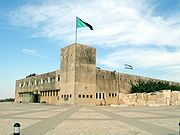
Tegart fort

Encyclopedia
Palestine
Palestine is a conventional name, among others, used to describe the geographic region between the Mediterranean Sea and the Jordan River, and various adjoining lands....
during the British Mandatory period.
The forts are named after British
United Kingdom
The United Kingdom of Great Britain and Northern IrelandIn the United Kingdom and Dependencies, other languages have been officially recognised as legitimate autochthonous languages under the European Charter for Regional or Minority Languages...
police officer and engineer Sir Charles Tegart
Charles Tegart
Sir Charles Augustus Tegart KCIE KPM , the second son of Rev. Joseph Poulter Tegart, was a colonial police officer in India and Mandatory Palestine, variously earning praise for his industry and efficiency, and notoriety for his brutality and use of torture.-Early Life:Tegart was the son of a...
, who designed them in 1938 based on his experiences in the Indian insurgency
Revolutionary movement for Indian independence
The Revolutionary movement for Indian independence is often a less-highlighted aspect of the Indian independence movement -- the underground revolutionary factions. The groups believing in armed revolution against the ruling British fall into this category. The revolutionary groups were...
.
Tens of the reinforced concrete block structures were built to the same basic plan, both along the so-called "Tegart's wall
Tegart's wall
Tegart's Wall was a barbed wire fence erected in 1938 by British Mandatory authorities on the northern border of Palestine in order to keep militants from infiltrating from Syria and Lebanon to join the 1936–1939 Arab revolt in Palestine.-History:...
" of the northern border with Lebanon
Lebanon
Lebanon , officially the Republic of LebanonRepublic of Lebanon is the most common term used by Lebanese government agencies. The term Lebanese Republic, a literal translation of the official Arabic and French names that is not used in today's world. Arabic is the most common language spoken among...
and Syria
Syria
Syria , officially the Syrian Arab Republic , is a country in Western Asia, bordering Lebanon and the Mediterranean Sea to the West, Turkey to the north, Iraq to the east, Jordan to the south, and Israel to the southwest....
, and at strategic intersections in the interior of Palestine.
Many of them stand to this day, and some continue to be used as jails. Others are in use as police stations (e.g. in Rehovot
Rehovot
Rehovot is a city in the Center District of Israel, about south of Tel Aviv. According to the Israel Central Bureau of Statistics , at the end of 2009 the city had a total population of 112,700. Rehovot's official website estimates the population at 114,000.Rehovot was built on the site of Doron,...
and Ness Ziona
Ness Ziona
Ness Ziona is a city in central Israel founded in 1883. At the end of 2009 the city had a total population of 38,100, and its jurisdiction was 15,579 dunams.-Nahalat Reuben:...
). One is used for the controversial Camp 1391
Camp 1391
Camp 1391 is an Israel Defense Force prison camp for "high-risk" prisoners in northern Israel, run by Unit 504 and less than an hour's drive from Tel Aviv...
prison for "high-risk" prisoners.
The fort in Hebron
Hebron
Hebron , is located in the southern West Bank, south of Jerusalem. Nestled in the Judean Mountains, it lies 930 meters above sea level. It is the largest city in the West Bank and home to around 165,000 Palestinians, and over 500 Jewish settlers concentrated in and around the old quarter...
was used successively as the headquarters of the Jordan
Jordan
Jordan , officially the Hashemite Kingdom of Jordan , Al-Mamlaka al-Urduniyya al-Hashemiyya) is a kingdom on the East Bank of the River Jordan. The country borders Saudi Arabia to the east and south-east, Iraq to the north-east, Syria to the north and the West Bank and Israel to the west, sharing...
ian administration between 1949 and 1967, of the Israel
Israel
The State of Israel is a parliamentary republic located in the Middle East, along the eastern shore of the Mediterranean Sea...
i military governor between 1967 and 1997, and of the Palestinian Authority's governor between 1997 and 2002. It was destroyed in 2002 when the city was reconquered by Israeli forces in Operation Defensive Shield
Operation Defensive Shield
Operation Defensive Shield was a large-scale military operation conducted by the Israel Defense Forces in 2002, during the course of the Second Intifada. It was the largest military operation in the West Bank since the 1967 Six-Day War. The operation was an attempt by the Israeli army to stop the...
.
Alternate name
In Israel, Tegart is commonly misspelled as Taggart.This is probably from the compound transliteration
Transliteration
Transliteration is a subset of the science of hermeneutics. It is a form of translation, and is the practice of converting a text from one script into another...
of an English
English language
English is a West Germanic language that arose in the Anglo-Saxon kingdoms of England and spread into what was to become south-east Scotland under the influence of the Anglian medieval kingdom of Northumbria...
name into Hebrew and then back into English. The spelling may have come from the long-running Scottish detective series Taggart
Taggart
Taggart is a Scottish detective television programme, created by Glenn Chandler, who has written many of the episodes, and made by STV Productions for the ITV network...
.
Existing examples of Tegart forts
- LatrunLatrunLatrun is a strategic hilltop in the Ayalon Valley in Israel overlooking the road to Jerusalem. It is located 25 kilometers west of Jerusalem and 14 kilometers southeast of Ramla.-Etymology:...
museum - The MukataaMukataaMukataa is the name used to refer to the offices and administrative centers of the Palestinian National Authority.Mukataas were mostly built during the British Mandate as Tegart forts and were used both as British government centers and as dwellings for the British administrative staff. Some...
in RamallahRamallahRamallah is a Palestinian city in the central West Bank located 10 kilometers north of Jerusalem, adjacent to al-Bireh. It currently serves as the de facto administrative capital of the Palestinian National Authority... - JerichoJerichoJericho ; is a city located near the Jordan River in the West Bank of the Palestinian territories. It is the capital of the Jericho Governorate and has a population of more than 20,000. Situated well below sea level on an east-west route north of the Dead Sea, Jericho is the lowest permanently...
jail - Akko police station
- AfulaAfulaAfula is a city in the North District of Israel, often known as the "Capital of the Valley", referring to the Jezreel Valley. The city had a population of 40,500 at the end of 2009.-History:...
police station - Kfar Sava police station
- Ness ZionaNess ZionaNess Ziona is a city in central Israel founded in 1883. At the end of 2009 the city had a total population of 38,100, and its jurisdiction was 15,579 dunams.-Nahalat Reuben:...
police station - RehovotRehovotRehovot is a city in the Center District of Israel, about south of Tel Aviv. According to the Israel Central Bureau of Statistics , at the end of 2009 the city had a total population of 112,700. Rehovot's official website estimates the population at 114,000.Rehovot was built on the site of Doron,...
police station - Ramat Gan police station
- Metzudat KoachMetzudat KoachThe Metzudat Koach Memorial commemorates 28 soldiers who died during the 1948 conquest of a strategically important fort. The fort and observation point is located in the Upper Galilee, close to the tomb of Nabi Yusha...
(Nebi Yusha fortress) - Camp 1391Camp 1391Camp 1391 is an Israel Defense Force prison camp for "high-risk" prisoners in northern Israel, run by Unit 504 and less than an hour's drive from Tel Aviv...
- Yoav Fort