

Peel Commission

Encyclopedia
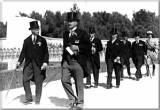
The Peel Commission of 1936-1937, formally known as the Palestine Royal Commission, was a British Royal Commission of Inquiry set out to propose changes to the British Mandate of Palestine following the outbreak of the 1936-1939 Arab revolt in Palestine. It was headed by the Earl Peel
.
On 11 November, 1936, the commission arrived in Palestine to investigate the reasons behind the uprising. It returned to Britain on 18 January 1937. On 7 July, 1937, it published a report that, for the first time, recommended partition. Although initially endorsed by the government, changing political conditions led it to declare the proposal unworkable and formally reject it following publication of the Partition Commission
report in 1938.
made a speech on behalf of the Jews. The Mufti of Jerusalem, Hajj Amin al-Husseini, testified in front of the commission, opposing any partition of Arab lands with the Jews. He demanded full cessation of Jewish immigration. Although the Arabs continued to boycott the Commission officially, there was a sense of urgency to respond to Weizmann's appeal to restore calm. The former Mayor of Jerusalem Ragheb Bey al-Nashashibi
- who was the Mufti's rival in the internal Palestinian arena, was thus sent to explain the Arab perspective through unofficial channels.
to south of Be'er Tuvia
, as well as the Jezreel Valley
and the Galilee
, while the Arab state was to receive territory in the south and mid-east which included Judea
, Samaria
and the sizable, though economically undeveloped and infertile, Negev desert
.
The report recommended that "[s]ooner or later there should be a transfer of land and, as far as possible, an exchange of population" and that "in the last resort the exchange would be compulsory". The 1923 population exchange between Greece and Turkey
was cited as a precedent, while noting the absence of cultivable land to resettle the displaced Arabs. The population exchange
, if carried out, would have involved the transfer of up to 225,000 Arabs and 1,250 Jews.
(3-16 August 1937) announced "that the partition plan proposed by the Peel Commission is not to be accepted, [but wished] to carry on negotiations in order to clarify the exact substance of the British government's proposal for the foundation of a Jewish state in Palestine".
At the same Zionist Congress in Zurich, David Ben-Gurion
, then chairman of the executive committee of the Jewish Agency for Palestine, told those in attendance that, though "there could be no question ... of giving up any part of the Land of Israel, ... it was arguable that the ultimate goal would be achieved most quickly by accepting the Peel proposals." University of Arizona
professor Charles D. Smith suggests that, "Weizmann and Ben-Gurion did not feel they had to be bound by the borders proposed [by the Peel Commission]. These could be considered temporary boundaries to be expanded in the future."
Ben-Gurion
wrote: "The compulsory transfer of the Arabs from the valleys of the proposed Jewish state could give us something which we have never had, even when we stood on our own during the days of the First and Second Temples: [a Galilee almost free of non-Jews]. ... We are being given an opportunity which we never dared to dream of in our wildest imagination. This is more than a state, government and sovereignty---this is a national consolidation in a free homeland. ... if because of our weakness, neglect or negligence, the thing is not done, then we will have lost a chance which we never had before, and may never have again."
Ben-Gurion
wrote 20 years later: "Had partition [referring to the Peel Commission partition plan] been carried out, the history of our people would have been different and six million Jews in Europe would not have been killed---most of them would be in Israel".'
The British response was to set up the Woodhead Commission
to "examine the Peel Commission plan in detail and to recommend an actual partition plan" This Commission declared the Peel Commission partition unworkable (though suggesting a different scheme under which 5% of the land area of Palestine become Israel). The British Government accompanied the publication of the Woodhead Report by a statement of policy rejecting partition as impracticable
Category:History of Israel
William Wellesley Peel, 1st Earl Peel
William Robert Wellesley Peel, 1st Earl Peel GCSI, GBE, PC, TD was a British politician.-Background and education:...
.
On 11 November, 1936, the commission arrived in Palestine to investigate the reasons behind the uprising. It returned to Britain on 18 January 1937. On 7 July, 1937, it published a report that, for the first time, recommended partition. Although initially endorsed by the government, changing political conditions led it to declare the proposal unworkable and formally reject it following publication of the Partition Commission
Woodhead Commission
The Woodhead Commission, properly known as the Palestine Partition Commission, was established in 1938 in the British Mandate of Palestine to investigate the implementation of the Peel Commission's plan for a partition of Palestine....
report in 1938.
Creation
The Commission was established at a time of increased violence; serious clashes between Arabs and Jews broke out in 1936 and were to last three years. The Commission was charged with determining the cause of the riots, and judging the merit of grievances on both sides. Chaim WeizmannChaim Weizmann
Chaim Azriel Weizmann, , was a Zionist leader, President of the Zionist Organization, and the first President of the State of Israel. He was elected on 1 February 1949, and served until his death in 1952....
made a speech on behalf of the Jews. The Mufti of Jerusalem, Hajj Amin al-Husseini, testified in front of the commission, opposing any partition of Arab lands with the Jews. He demanded full cessation of Jewish immigration. Although the Arabs continued to boycott the Commission officially, there was a sense of urgency to respond to Weizmann's appeal to restore calm. The former Mayor of Jerusalem Ragheb Bey al-Nashashibi
Raghib al-Nashashibi
Raghib al-Nashashibi was a wealthy landowner and public figure during the Ottoman Empire, the British Mandate and the Jordanian administration. He was mayor of Jerusalem in 1920–1934.-Background:...
- who was the Mufti's rival in the internal Palestinian arena, was thus sent to explain the Arab perspective through unofficial channels.
Findings
According to the Peel Commission report, Arab allegations regarding Jewish land purchase were unfounded. "Much of the land now carrying orange groves was sand dunes or swamp and uncultivated when it was purchased...There was at the time of the earlier sales little evidence that the owners possessed either the resources or training needed to develop the land." The land shortage decried by the Arabs "was due less to the amount of land acquired by Jews than to the increase in the Arab population." However, "Endeavours to control the alienation of land by Arabs to Jews have not been successful. In the hills there is no more room for further close settlement by Jews; in the plains it should only be allowed under certain restrictions.Recommendations
The report recommended that the Mandate be eventually abolished — except in a "corridor" surrounding Jerusalem, stretching to the Mediterranean coast at Jaffa — and the land under its authority (and accordingly, the transfer of both Arab and Jewish populations) be apportioned between an Arab and Jewish state. The Jewish side was to receive a territorially smaller portion in the mid-west and north, from Mount CarmelMount Carmel
Mount Carmel ; , Kármēlos; , Kurmul or جبل مار إلياس Jabal Mar Elyas 'Mount Saint Elias') is a coastal mountain range in northern Israel stretching from the Mediterranean Sea towards the southeast. Archaeologists have discovered ancient wine and oil presses at various locations on Mt. Carmel...
to south of Be'er Tuvia
Be'er Tuvia
Be'er Tuvia is a moshav in the Southern District of Israel near the city of Kiryat Malakhi. It is affiliated with the Be'er Tuvia Regional Council....
, as well as the Jezreel Valley
Jezreel Valley
-Etymology:The Jezreel Valley takes its name from the ancient city of Jezreel which was located on a low hill overlooking the southern edge of the valley, though some scholars think that the name of the city originates from the name of the clan which founded it, and whose existence is mentioned in...
and the Galilee
Galilee
Galilee , is a large region in northern Israel which overlaps with much of the administrative North District of the country. Traditionally divided into Upper Galilee , Lower Galilee , and Western Galilee , extending from Dan to the north, at the base of Mount Hermon, along Mount Lebanon to the...
, while the Arab state was to receive territory in the south and mid-east which included Judea
Judea
Judea or Judæa was the name of the mountainous southern part of the historic Land of Israel from the 8th century BCE to the 2nd century CE, when Roman Judea was renamed Syria Palaestina following the Jewish Bar Kokhba revolt.-Etymology:The...
, Samaria
Samaria
Samaria, or the Shomron is a term used for a mountainous region roughly corresponding to the northern part of the West Bank.- Etymology :...
and the sizable, though economically undeveloped and infertile, Negev desert
Negev
The Negev is a desert and semidesert region of southern Israel. The Arabs, including the native Bedouin population of the region, refer to the desert as al-Naqab. The origin of the word Neghebh is from the Hebrew root denoting 'dry'...
.
The report recommended that "[s]ooner or later there should be a transfer of land and, as far as possible, an exchange of population" and that "in the last resort the exchange would be compulsory". The 1923 population exchange between Greece and Turkey
Population exchange between Greece and Turkey
The 1923 population exchange between Greece and Turkey was based upon religious identity, and involved the Greek Orthodox citizens of Turkey and the Muslim citizens of Greece...
was cited as a precedent, while noting the absence of cultivable land to resettle the displaced Arabs. The population exchange
Population transfer
Population transfer is the movement of a large group of people from one region to another by state policy or international authority, most frequently on the basis of ethnicity or religion...
, if carried out, would have involved the transfer of up to 225,000 Arabs and 1,250 Jews.
Reactions
The Arab leadership rejected the plan, while the Jewish opinion remained heatedly divided. The Twentieth Zionist Congress in ZurichZürich
Zurich is the largest city in Switzerland and the capital of the canton of Zurich. It is located in central Switzerland at the northwestern tip of Lake Zurich...
(3-16 August 1937) announced "that the partition plan proposed by the Peel Commission is not to be accepted, [but wished] to carry on negotiations in order to clarify the exact substance of the British government's proposal for the foundation of a Jewish state in Palestine".
At the same Zionist Congress in Zurich, David Ben-Gurion
David Ben-Gurion
' was the first Prime Minister of Israel.Ben-Gurion's passion for Zionism, which began early in life, led him to become a major Zionist leader and Executive Head of the World Zionist Organization in 1946...
, then chairman of the executive committee of the Jewish Agency for Palestine, told those in attendance that, though "there could be no question ... of giving up any part of the Land of Israel, ... it was arguable that the ultimate goal would be achieved most quickly by accepting the Peel proposals." University of Arizona
University of Arizona
The University of Arizona is a land-grant and space-grant public institution of higher education and research located in Tucson, Arizona, United States. The University of Arizona was the first university in the state of Arizona, founded in 1885...
professor Charles D. Smith suggests that, "Weizmann and Ben-Gurion did not feel they had to be bound by the borders proposed [by the Peel Commission]. These could be considered temporary boundaries to be expanded in the future."
Ben-Gurion
David Ben-Gurion
' was the first Prime Minister of Israel.Ben-Gurion's passion for Zionism, which began early in life, led him to become a major Zionist leader and Executive Head of the World Zionist Organization in 1946...
wrote: "The compulsory transfer of the Arabs from the valleys of the proposed Jewish state could give us something which we have never had, even when we stood on our own during the days of the First and Second Temples: [a Galilee almost free of non-Jews]. ... We are being given an opportunity which we never dared to dream of in our wildest imagination. This is more than a state, government and sovereignty---this is a national consolidation in a free homeland. ... if because of our weakness, neglect or negligence, the thing is not done, then we will have lost a chance which we never had before, and may never have again."
Ben-Gurion
David Ben-Gurion
' was the first Prime Minister of Israel.Ben-Gurion's passion for Zionism, which began early in life, led him to become a major Zionist leader and Executive Head of the World Zionist Organization in 1946...
wrote 20 years later: "Had partition [referring to the Peel Commission partition plan] been carried out, the history of our people would have been different and six million Jews in Europe would not have been killed---most of them would be in Israel".'
The British response was to set up the Woodhead Commission
Woodhead Commission
The Woodhead Commission, properly known as the Palestine Partition Commission, was established in 1938 in the British Mandate of Palestine to investigate the implementation of the Peel Commission's plan for a partition of Palestine....
to "examine the Peel Commission plan in detail and to recommend an actual partition plan" This Commission declared the Peel Commission partition unworkable (though suggesting a different scheme under which 5% of the land area of Palestine become Israel). The British Government accompanied the publication of the Woodhead Report by a statement of policy rejecting partition as impracticable
External links
- Summary section of the Report of the Palestine Royal Commission (from the United Nations Information System on the Question of Palestine - UNISPAL)
Further reading
- Palestine Royal Commission Report Presented by the Secretary of State for the Colonies to Parliament by Command of His Majesty, July 1937. His Majesty’s Stationery Office., London, 1937. 404 pages + maps.
- Aharon Cohen, Israel and the Arab World (Funk and Wagnalls, New York, 1970) pp. 207-210
See also
- Woodhead CommissionWoodhead CommissionThe Woodhead Commission, properly known as the Palestine Partition Commission, was established in 1938 in the British Mandate of Palestine to investigate the implementation of the Peel Commission's plan for a partition of Palestine....
- Arab-Israeli conflict
- White Paper of 1939White Paper of 1939The White Paper of 1939, also known as the MacDonald White Paper after Malcolm MacDonald, the British Colonial Secretary who presided over it, was a policy paper issued by the British government under Neville Chamberlain in which the idea of partitioning the Mandate for Palestine, as recommended in...
- Shaw ReportShaw ReportThe Report of the Commission on the Palestine Disturbances of August 1929 or Shaw Report of March 1930 was a British report of a Commission of Inquiry, chaired by Sir Walter Shaw, a distinguished jurist, and consisting of three members of the British parliament, Sir Henry Betterton , R.Hopkin...
Category:History of Israel