All Topics  
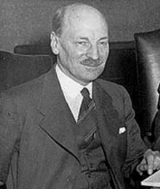
Clement Attlee

 
Clement Attlee

   Email Print
   Bookmark   Link


Clement Attlee


Clement Richard Attlee, 1st Earl Attlee, KG
Order of the Garter

The Most Noble Order of the Garter is an order of chivalry, or knighthood, originating in medieval England, and presently bestowed on recipients in the United Kingdom and other Commonwealth realms; it is the pinnacle of the Orders, decorations, and medals of the United Kingdom....
, OM
Order of Merit

The Order of Merit is a United Kingdom and Commonwealth of Nations Order bestowed by the Elizabeth II of the United Kingdom. It was established in 1902 by King Edward VII of the United Kingdom as a reward for distinguished service in the armed forces, science, art, literature, or for the promotion of culture....
, CH
Order of the Companions of Honour

The Order of the Companions of Honour is a United Kingdom and Commonwealth of Nations Order . It was founded by George V of the United Kingdom in June 1917, as a reward for outstanding achievements in the arts, literature, music, science, politics, industry, or religion....
, PC, FRS (3 January 1883 – 8 October 1967) was a British
British people

The British are citizenship of the United Kingdom, of the Isle of Man, one of the Channel Islands, or of one of the British overseas territories, and their descendants....
 politician
Politician

A politician is an individual who is involved in influencing public decision making through the influence of politics or a person who influences the way a society is governed....
, who served as Prime Minister of the United Kingdom
Prime Minister of the United Kingdom

The Prime Minister of the United Kingdom of Great Britain and Northern Ireland is the political leader of the United Kingdom and the head of government Her Majesty's Government....
 from 1945 to 1951, and leader of the Labour Party
Labour Party (UK)

The Labour Party is a political party in the United Kingdom. Founded at the start of the 20th century, it has been since the 1920s the principal party of the Left-wing politics in England, Scotland and Wales, but not Northern Ireland, where it has only recently organised again....
 from 1935 to 1955. He served as Deputy Prime Minister
Deputy Prime Minister of the United Kingdom

The Deputy Prime Minister of the United Kingdom is a senior member of the British Cabinet. There is not always a Deputy Prime Minister; the office itself is not part of the UK's uncodified constitution, nor does the Government possess a formal permanent office of Deputy Prime Minister....
 under Winston Churchill
Winston Churchill

Sir Winston Leonard Spencer-Churchill, Order of the Garter, Order of Merit, Order of the Companions of Honour, Territorial Decoration, Fellow of the Royal Society, Her Majesty's Most Honourable Privy Council, Queen's Privy Council for Canada was a Politics of the United Kingdom known chiefly for his leadership of the United King...
 in the wartime coalition government, before leading the Labour Party to a landslide election victory over Churchill at the 1945 general election
United Kingdom general election, 1945

The United Kingdom General Election of 1945 was a United Kingdom general election held on 5 July 1945, with delayed polls taking place on 12 July and in Nelson and Colne on 19 July....
. He was the first Labour Prime Minister to serve a full Parliamentary term and the first to have a majority in Parliament.

The government he led put in place the post-war consensus
Post-war consensus

The post-war consensus is a name given by historians to an era in British political history which lasted from the end of World War II in 1945 to the election of Margaret Thatcher as Prime Minister of the United Kingdom in 1979....
, based upon the assumption that full employment
Full employment

In macroeconomics, full employment is a condition of the national economy, where nearly all persons willing and able to work at the prevailing wages and working conditions are able to do so....
 would be maintained by Keynesian policies, and that a greatly enlarged system of social services would be created – aspirations that had been outlined in the wartime Beveridge Report
Beveridge Report

The Beveridge Report was the Report of the Inter-Departmental Committee on Social Insurance and Allied Services chaired by William Beveridge, an economist....
.


Discussion
Ask a question about 'Clement Attlee'
Start a new discussion about 'Clement Attlee'
Answer questions from other users
Full Discussion Forum


Quotations


We have absolutely abandoned any idea of nationalist loyalty.

Speech to the Labour Party Conference in Southport, October 1934.


Encyclopedia


Clement Richard Attlee, 1st Earl Attlee, KG
Order of the Garter

The Most Noble Order of the Garter is an order of chivalry, or knighthood, originating in medieval England, and presently bestowed on recipients in the United Kingdom and other Commonwealth realms; it is the pinnacle of the Orders, decorations, and medals of the United Kingdom....
, OM
Order of Merit

The Order of Merit is a United Kingdom and Commonwealth of Nations Order bestowed by the Elizabeth II of the United Kingdom. It was established in 1902 by King Edward VII of the United Kingdom as a reward for distinguished service in the armed forces, science, art, literature, or for the promotion of culture....
, CH
Order of the Companions of Honour

The Order of the Companions of Honour is a United Kingdom and Commonwealth of Nations Order . It was founded by George V of the United Kingdom in June 1917, as a reward for outstanding achievements in the arts, literature, music, science, politics, industry, or religion....
, PC, FRS (3 January 1883 – 8 October 1967) was a British
British people

The British are citizenship of the United Kingdom, of the Isle of Man, one of the Channel Islands, or of one of the British overseas territories, and their descendants....
 politician
Politician

A politician is an individual who is involved in influencing public decision making through the influence of politics or a person who influences the way a society is governed....
, who served as Prime Minister of the United Kingdom
Prime Minister of the United Kingdom

The Prime Minister of the United Kingdom of Great Britain and Northern Ireland is the political leader of the United Kingdom and the head of government Her Majesty's Government....
 from 1945 to 1951, and leader of the Labour Party
Labour Party (UK)

The Labour Party is a political party in the United Kingdom. Founded at the start of the 20th century, it has been since the 1920s the principal party of the Left-wing politics in England, Scotland and Wales, but not Northern Ireland, where it has only recently organised again....
 from 1935 to 1955. He served as Deputy Prime Minister
Deputy Prime Minister of the United Kingdom

The Deputy Prime Minister of the United Kingdom is a senior member of the British Cabinet. There is not always a Deputy Prime Minister; the office itself is not part of the UK's uncodified constitution, nor does the Government possess a formal permanent office of Deputy Prime Minister....
 under Winston Churchill
Winston Churchill

Sir Winston Leonard Spencer-Churchill, Order of the Garter, Order of Merit, Order of the Companions of Honour, Territorial Decoration, Fellow of the Royal Society, Her Majesty's Most Honourable Privy Council, Queen's Privy Council for Canada was a Politics of the United Kingdom known chiefly for his leadership of the United King...
 in the wartime coalition government, before leading the Labour Party to a landslide election victory over Churchill at the 1945 general election
United Kingdom general election, 1945

The United Kingdom General Election of 1945 was a United Kingdom general election held on 5 July 1945, with delayed polls taking place on 12 July and in Nelson and Colne on 19 July....
. He was the first Labour Prime Minister to serve a full Parliamentary term and the first to have a majority in Parliament.

The government he led put in place the post-war consensus
Post-war consensus

The post-war consensus is a name given by historians to an era in British political history which lasted from the end of World War II in 1945 to the election of Margaret Thatcher as Prime Minister of the United Kingdom in 1979....
, based upon the assumption that full employment
Full employment

In macroeconomics, full employment is a condition of the national economy, where nearly all persons willing and able to work at the prevailing wages and working conditions are able to do so....
 would be maintained by Keynesian policies, and that a greatly enlarged system of social services would be created – aspirations that had been outlined in the wartime Beveridge Report
Beveridge Report

The Beveridge Report was the Report of the Inter-Departmental Committee on Social Insurance and Allied Services chaired by William Beveridge, an economist....
. Within this context, his government undertook the nationalisation of major industries and public utilities
Public utility

A public utility is an organization that maintains the infrastructure for a public services . Public utilities are subject to forms of public control and regulation ranging from local community-based groups to state-wide government monopolies....
 as well as the creation of the National Health Service
National Health Service

The National Health Service is the name commonly used to refer to the four publicly funded healthcare systems of the United Kingdom, collectively or individually, although only the health service in England uses the name 'National Health Service' without further qualification....
. After initial Conservative opposition, this settlement was by and large accepted by all parties until Margaret Thatcher
Margaret Thatcher

Margaret Hilda Thatcher, Baroness Thatcher Order of the Garter, Order of Merit, Her Majesty's Most Honourable Privy Council, Fellow of the Royal Society was Prime Minister of the United Kingdom from 1979 to 1990 and Leader of the Conservative Party of the Conservative Party from 1975 to 1990....
 became leader of the Conservative Party
Conservative Party (UK)

The Conservative and Unionist Party, more commonly known as the Conservative Party, is a conservative political party in the United Kingdom....
 in the 1970s.

His government also presided over the decolonisation of a large part of the British Empire
British Empire

The British Empire comprised the dominions, Crown colony, protectorates, League of Nations mandate, and other Dependent territory ruled or administered by the United Kingdom , that had originated with the overseas colonies and trading posts established by England in the late 16th and early 17th centuries....
, a process by which India
India

India, officially the Republic of India , is a country in South Asia. It is the List of countries and outlying territories by total area country by geographical area, the List of countries by population country, and the most populous liberal democracy in the world....
 and the countries that are now Burma, Sri Lanka
Sri Lanka

Sri Lanka, officially the Democratic Socialist Republic of Sri Lanka is an island country in South Asia, located about off the southern coast of India....
, Pakistan
Pakistan

Pakistan , officially the Islamic Republic of Pakistan, is a country located in South Asia and borders Central Asia and the Middle East. It has a 1,046 kilometre coastline along the Arabian Sea and Gulf of Oman in the south, and is bordered by Afghanistan and Iran in the west, India in the east and People's Republic of China in th...
, Bangladesh
Bangladesh

, officially the People's Republic of Bangladesh is a country in South Asia. It is bordered by India on all sides except for a small border with Burma to the far southeast and by the Bay of Bengal to the south....
, Jordan
Jordan

Jordan , officially the Hashemite Kingdom of Jordan, is an Arab country in Southwest Asia spanning the southern part of the Syrian Desert down to the Gulf of Aqaba....
, and Israel
Israel

Israel officially the State of Israel , is a country in the Middle East located on the eastern shore of the Mediterranean Sea. It borders Lebanon in the north, Syria in the northeast, Jordan in the east, and Egypt on the southwest, and contains geographically diverse features within its relatively small area....
 obtained independence.

In 2004, he was voted
Historical rankings of British Prime Ministers

Although many surveys have been conducted in order to construct rankings of the success of individuals who have served as President of the United States, until the late 1990s few had been done for Prime Ministers of the United Kingdom....
 as the greatest British prime minister of the 20th century in a poll of professors organised by MORI
MORI

Ipsos MORI is the second largest survey research organisation in the UK, formed by two of the UK's leading companies in October 2005. MORI , was originally founded in 1969 by Robert Worcester, and was the largest independent research organisation in the United Kingdom....
.

Early life and family

He was born in Putney
Putney

Putney is a district of south-west London in the London Borough of Wandsworth. It is located south-west of Charing Cross, on the southern bank of the River Thames, opposite Fulham....
, London, England, into a middle-class
Middle class

Middle class is the group of people in contemporary society who are between the working class and nobility. This socioeconomic class includes professionals, highly skilled workers, and lower and middle management....
 family, the seventh of eight children. His father was Henry Attlee (1841–1908), a solicitor, and his mother was Ellen Bravery Watson (1847–1920). He was educated at Northaw School, Haileybury
Haileybury and Imperial Service College

Haileybury and Imperial Service College, , is a British independent school founded in 1862. It is a co-educational boarding school enrolling pupils at 11+, 13+ and 16+....
 and University College, Oxford
University College, Oxford

University College , is one of the Colleges of the University of Oxford of the University of Oxford in England. It is a contender for being the oldest of the colleges of the university, and is amongst the largest in terms of population....
, where he graduated with a Second Class Honours
British undergraduate degree classification

The British undergraduate degree classification system is a grade scheme for undergraduate degrees in the United Kingdom. The system has been applied in other countries, such as India, the Republic of Ireland, Kenya, South Africa, Singapore, Malaysia, Hong Kong, Australia, New Zealand, Nigeria, Malta and Canada....
 BA in Modern History
Modern history

Modern history describes the history of the Modern period, the era after the Middle Ages....
 in 1904. Attlee then trained as a lawyer, and was called to the Bar in 1906.

From 1906 to 1909, Attlee worked as manager of Haileybury House, a club for working class
Working class

Working class is a term used in academic sociology and in ordinary conversation to describe, depending on context and speaker, those employed in specific fields or types of work....
 boys in Limehouse
Limehouse

Limehouse is a place in the London Borough of Tower Hamlets. It is on the northern bank of the River Thames opposite Rotherhithe and between Ratcliff to the west and Millwall to the east....
 in the East End of London
East End of London

The East End of London, known locally as the East End, is the area of London, England, east of the medieval walled City of London and north of the River Thames, although it is not defined by universally accepted formal boundaries....
 run by his old school. Prior to this, Attlee's political views had been conservative
Conservative Party (UK)

The Conservative and Unionist Party, more commonly known as the Conservative Party, is a conservative political party in the United Kingdom....
. However, he was shocked by the poverty and deprivation he saw while working with slum
Slum

A slum, as defined by the United Nations agency UN-HABITAT, is a run-down area of a city characterized by substandard housing and squalor and lacking in tenure security....
 children, this caused him to convert to socialism
Socialism

Socialism refers to a broad set of economic theories of social organization advocating public or state ownership and administration of the means of production and distribution of goods, and a society characterized by equality for all individuals, with a fair or Egalitarianism method of compensation....
. He joined the Independent Labour Party
Independent Labour Party

The Independent Labour Party was a socialist political party in the United Kingdom....
 in 1908, and became active in London local politics.

In 1909 he worked briefly as secretary for Beatrice Webb
Beatrice Webb

Martha Beatrice Webb was an English sociologist, economist, socialism and reformer, usually referred to in the same breath as her husband, Sidney Webb....
, and from 1909 to 1910 he worked as secretary for Toynbee Hall
Toynbee Hall

Toynbee Hall is the original university settlement house of the settlement movement. Founded in 1884 on Commercial Street, Whitechapel in the East End of London, it remains active today....
. In 1911 he took up a government job as an 'official explainer'; touring the country to explain David Lloyd George
David Lloyd George

David Lloyd George, 1st Earl Lloyd-George of Dwyfor Order of Merit , Privy Council of the United Kingdom was a United Kingdom statesman and the only Wales Prime Minister of the United Kingdom - he is also the only one to have spoken English language as a second language, Welsh language having been his first....
's National Insurance Act. He spent the summer of that year touring Essex
Essex

Essex is a counties of England in the East of England England. The county town is Chelmsford, and the highest point of the county is Chrishall Common near the village of Langley, Essex, close to the Hertfordshire border, which reaches ....
 and Somerset
Somerset

Somerset is a Counties of England in South West England. The county town is Taunton, which is in the south of the county. The Ceremonial counties of England of Somerset borders the counties of Bristol and Gloucestershire to the north, Wiltshire to the east, Dorset to the south-east, and Devon to the south-west....
 on a bicycle, explaining the Act to public meetings.

Attlee became a lecturer at the London School of Economics
London School of Economics

The London School of Economics and Political Science, more commonly referred to as The London School of Economics or LSE, is a specialist college of the University of London in London, England....
 in 1912, but promptly applied for a Commission in August 1914 for World War I
World War I

World War I, or the First World War , was a global military conflict which involved the Great powers, organized into two opposing military alliances: the Allies of World War I and the Central Powers....
.

Military service during World War I


During World War I, Attlee was given the rank of captain
Captain (British Army and Royal Marines)

File:UK-Army-OF2.gifCaptain is a junior officer rank of the British Army and Royal Marines. It ranks above Lieutenant and below Major and has a NATO ranking code of OF-2....
 and served with the South Lancashire Regiment in the Gallipoli Campaign in Turkey
Turkey

Turkey , known officially as the Republic of Turkey , is a Eurasian country that stretches across the Anatolian peninsula in southwest Asia and Thrace in the Balkans region of Southern Europe....
. After a while of fighting in the heat, sand, and flies he became ill with dysentery
Dysentery

Dysentery is a disorder of the digestive system that results in severe diarrhea containing mucus and/or blood in the feces. If untreated, Dysentery can be fatal....
 and was sent to hospital in Malta
Malta

Malta , officially the Republic of Malta , is a densely populated developed country European microstates microstate in the European Union....
 to recover. This may have saved his life, as while he was in hospital he missed the Battle of Sari Bair
Battle of Sari Bair

The Battle of Sari Bair , also known as the August Offensive, was the final attempt made by the United Kingdom of Great Britain and Ireland to seize control of the Gallipoli peninsula from the Ottoman Empire during World War I....
 in which many of his comrades were killed.

Attlee had gained a reputation among his superiors as being a competent leader. When he returned to the front, he was informed that his company had been chosen to hold the final lines when Gallipoli was evacuated. He was the last but one man to be evacuated from Suvla Bay (the last being General F.S. Maude
Frederick Stanley Maude

Lieutenant General Sir Frederick Stanley Maude Order of the Bath, Order of St Michael and St George, Distinguished Service Order was a United Kingdom commander, most famous for his efforts in Mesopotamia during World War I and for conquering Baghdad in 1917....
).

The Gallipoli campaign had been masterminded by Winston Churchill
Winston Churchill

Sir Winston Leonard Spencer-Churchill, Order of the Garter, Order of Merit, Order of the Companions of Honour, Territorial Decoration, Fellow of the Royal Society, Her Majesty's Most Honourable Privy Council, Queen's Privy Council for Canada was a Politics of the United Kingdom known chiefly for his leadership of the United King...
. Attlee believed that it was a bold strategy, which could have been successful if it had been better implemented. This gave him an admiration of Churchill as a military strategist, which improved their working relationship in later years.

He later served in the Mesopotamian Campaign
Mesopotamian Campaign

The Mesopotamian campaign was a campaign in the Middle Eastern theatre of World War I of the World War I fought between Allied Powers represented by the British Empire, mostly troops from the Indian Empire, and Central Powers, mostly of the Ottoman Empire....
 in Iraq
Iraq

Iraq , officially the Republic of Iraq , is a country in Western Asia spanning most of the northwestern end of the Zagros Mountains, the eastern part of the Syrian Desert and the northern part of the Arabian Desert....
, where he was badly wounded at El Hannah after being hit in the leg by shrapnel from an exploding shell whilst taking enemy trenches. He was sent back to England to recover, and spent most of 1917 training soldiers. He was sent to France in June 1918 to serve on the Western Front
Western Front (World War I)

Following the outbreak of World War I in 1914, the German Empire army opened the Western Front by first invading Luxembourg and Belgium, then gaining military control of important industrial regions in France....
 for the last months of the war.

In 1917, he had been promoted to the rank of Major, and continued to be known as "Major Attlee" for much of the inter-war period
Interwar period

The interwar period is understood, within recent Western culture, to be the period between the end of the First World War and the beginning of the Second World War....
.

His decision to fight in the war caused a rift between him and his older brother Tom Attlee, who as a pacifist and a conscientious objector
Conscientious objector

A conscientious objector is an individual who, on religious, moral or ethical grounds, refuses to participate as a combatant in war or, in some cases, to take any role that would support a combatant organization armed forces....
 spent much of the war in prison. After the war, he returned to teaching at the London School of Economics
London School of Economics

The London School of Economics and Political Science, more commonly referred to as The London School of Economics or LSE, is a specialist college of the University of London in London, England....
 until 1923.

Marriage and children


Attlee met Violet Millar on a trip to Italy in 1921. Within a few weeks of their return they became engaged and were married at Christ Church, Hampstead
Hampstead

Hampstead is an area of London, England, located north-west of Charing Cross. It is part of the London Borough of Camden. It is situated within Inner London....
 on 10 January 1922. Theirs would be a devoted marriage until her death in 1964. Their four children were Lady Janet Helen (b. 1923), Lady Felicity Ann (1925–2007), Martin Richard
Martin Attlee, 2nd Earl Attlee

Martin Richard Attlee, 2nd Earl Attlee was a British politician, son of former British Prime Minister Clement Attlee, the first Earl Attlee. Martin inherited the title on his father's death in 1967....
 (1927–91) and Lady Alison Elizabeth (b. 1930).

Early political career


Local politics

Attlee returned to local politics
Local government

Local governments are administrative offices that are smaller than a state. The term is used to contrast with offices at nation-state level, which are referred to as the central government, national government, or federal government....
 in the immediate post-war period, becoming mayor of the metropolitan borough
Metropolitan borough

A metropolitan borough is a type of districts of England in England, and is a subdivision of a metropolitan county. Created in 1974 by the Local Government Act 1972, metropolitan boroughs are defined in English law as metropolitan districts, however all of them have been granted or regranted royal charters to give them borough status in...
 of Stepney
Metropolitan Borough of Stepney

The Metropolitan Borough of Stepney was a metropolitan borough in the County of London created in 1900. In 1965 it became part of the London Borough of Tower Hamlets....
 in 1919, one of London's poorest inner-city boroughs. During his time as mayor, the council undertook action to tackle slum
Slum

A slum, as defined by the United Nations agency UN-HABITAT, is a run-down area of a city characterized by substandard housing and squalor and lacking in tenure security....
 landlord
Landlord

Landlord is the owner of a house, apartment, condominium, or real estate which is Rentinged or leased to an individual or business, who is called a Leasehold estate ....
s who charged high rents but refused to spend money on keeping their property in habitable condition. The council served and enforced legal orders on house owners to repair their property. It also appointed health visitors and sanitary inspectors, and reduced the infant mortality rate.

In 1920, whilst he was mayor, he wrote his first book "The Social Worker" which set out many of the principles which underlay his political philosophy, and which underlay the actions of his government in latter years. The book attacked the idea that looking after the poor could be left to voluntary action. He wrote that:

'Charity is a cold grey loveless thing. If a rich man wants to help the poor, he should pay his taxes gladly, not dole out money at a whim'.


He went on to write:
'In a civilised community, although it may be composed of self reliant individuals, there will be some persons who will be unable at some period of their lives to look after themselves, and the question of what is to happen to them may be solved in three ways - they may be neglected, they may be cared for by the organised community as of right, or they may be left to the goodwill of individuals in the community. The first way is intolerable, and as for the third: Charity is only possible without loss of dignity between equals. A right established by law, such as that to an old age pension, is less galling than an allowance made by a rich man to a poor one, dependent on his view of the recipient’s character, and terminable at his caprice’.


He strongly supported the Poplar Rates Rebellion
Poplar Rates Rebellion

The Poplar Rates Rebellion, or Poplar Rates Revolt was a tax protest that took place in Poplar, London, England, in 1921. It was led by George Lansbury, the previous year's Labour Mayor of Poplar, with the support of the Metropolitan Borough of Poplar Council, most of whom were industrial workers....
 led by George Lansbury
George Lansbury

George Lansbury was a United Kingdom politician, Socialism, Christian pacifism and newspaper editor. He was a Member of Parliament from 1910 to 1912 and from 1922 to 1940, and leader of the Labour Party from 1932 to 1935....
 in 1921. This put him into conflict with many of the leaders of the London Labour Party, including Herbert Morrison
Herbert Morrison

Herbert Stanley Morrison, Baron Morrison of Lambeth, Order of the Companions of Honour Privy Council of the United Kingdom was a United Kingdom Labour Party politician....
.

Member of Parliament

At the 1922 general election
United Kingdom general election, 1922

The UK general election of 1922 was held on 15 November 1922. It was the first election held after most of the Irish counties left the United Kingdom to form the Irish Free State, and was won by Andrew Bonar Law's Conservative Party , who gained an overall majority over Labour Party , led by John Robert Clynes and a divided Liberal Party ....
, Attlee became the Member of Parliament
Member of Parliament

A Member of Parliament, or MP, is a representative of the voters to a parliament. In many countries the term applies specifically to members of the lower house, as upper houses often have a unique title, such as senate, and thus also have unique titles for its members, such as senators....
 (MP) for the constituency
Constituency

A constituency is any cohesive body of people bound by shared identity, goals, or loyalty. Constituency can be used to describe a business's customer base and shareholders, or a charity's donors or those it serves....
 of Limehouse
Limehouse (UK Parliament constituency)

Limehouse was a borough constituency centred on the Limehouse district of the East End of London. It returned one Member of Parliament to the British House of Commons of the Parliament of the United Kingdom....
 in Stepney
Stepney

Stepney is an inner-city district in the London Borough of Tower Hamlets. It is located east north-east of Charing Cross and forms part of the East End of London....
. He helped Ramsay MacDonald
Ramsay MacDonald

James Ramsay MacDonald was a British politician and twice Prime Minister of the United Kingdom. He rose from humble origins to become the first Labour Party Prime Minister in 1924....
, who at the time he admired, get elected as Labour Party leader at the 1922 Labour leadership election
Labour Party (UK) leadership election, 1922

The Labour Party leadership election of 1922 was the first leadership election for the posts of Chairman and Leader of the Parlimamentary Labour Party ....
, a decision which he later regretted. He served as Ramsay MacDonald's parliamentary private secretary
Parliamentary Private Secretary

A Parliamentary Private Secretary is a role given to a United Kingdom Member of Parliament by a senior Minister in government or shadow minister to act as their contact for the House of Commons; in the Lords, the department's Parliamentary Under Secretary there takes on this duty....
 for the brief 1922 parliament.

His first taste of ministerial office came in 1924, when he served as Under-Secretary of State for War in the short-lived first Labour government, led by MacDonald.

Attlee opposed the 1926 General Strike, believing that strike action should not be used as a political weapon. However, when it happened he did not attempt to undermine it. At the time of the strike he was chairman of the Stepney Borough Electricity Committee. He negotiated a deal with the Electrical Trade Union that they would continue to supply power to hospitals, but would end supplies to factories. One firm, Scammell and Nephew Ltd took a civil action against Attlee and the other Labour members of the committee (although not against the Conservative members who had also supported this). The court found against Attlee and his fellow councillors and they were ordered to pay Ł300 damages. The decision was later reversed on appeal, but the financial problems caused by the episode almost forced Attlee from politics.

In 1927, he was appointed a member of the multi-party Simon Commission
Simon Commission

The Indian Statutory Commission was a group of seven United Kingdom Members of Parliament of the United Kingdom that had been dispatched to India in 1927 to study constitutional reform in that colony....
, a Royal Commission
Royal Commission

In states that are Commonwealth Realms a Royal Commission is a major government public inquiry into an issue. They have been held in states such as the United Kingdom, Canada, Australia, New Zealand and Saudi Arabia....
 set up to examine the possibility of granting self-rule
Self-governance

Self-governance is an abstract concept that refers to several scales of organization. It may refer to personal conduct or family units but more commonly refers to larger scale activities, i.e., professions, industry bodies, religions and political units, up to and including autonomous regions and aboriginal peoples ....
 to India
British Raj

British Raj primarily refers to the British rule in the Indian subcontinent between 1858 and 1947; it can also refer to the period of dominion, and even the region under the rule....
. As a result of the time he needed to devote to the commission, and contrary to a promise made to Attlee by MacDonald to induce him to serve on the commission, he was not initially offered a ministerial post in the Second Labour Government. Ironically, though, his unsought service on the Commission was to equip Attlee (who was later to have to decide the future of India as Prime Minister) with a thorough exposure to India and many of its political leaders.

In 1930, Labour MP Oswald Mosley
Oswald Mosley

Sir Oswald Ernald Mosley, 6th Baronet was a United Kingdom politician, known principally as the founder of the British Union of Fascists....
 left the party after its rejection of his proposals for solving the unemployment problem. Attlee was given Mosley's post of Chancellor of the Duchy of Lancaster
Chancellor of the Duchy of Lancaster

The Chancellor of the Duchy of Lancaster is, in modern times, a sinecure office in the government of the United Kingdom....
. He was Postmaster General at the time of the 1931 crisis
History of the British Labour Party

This is about the history of the British Labour Party . For information about the wider history of British socialism see History of socialism in Great Britain....
, during which most of the party's leaders lost their seats. During the course of the second Labour government, Attlee had become increasingly disillusioned by Ramsay MacDonald who he came to regard as vain
Vanity

In conventional parlance, vanity is the excessive belief in one's own abilities or attractiveness to others. In many religions vanity is considered a form of self-idolatry, in which one rejects God for the sake of one's own , and thereby becomes divorced from the Divine graces of God....
 and incompetent, and later wrote scathingly of him in his autobiography.

Opposition during the 1930s


Deputy Leader of the Labour Party

After the downfall of the second Labour government, the 1931 General Election
United Kingdom general election, 1931

The UK general election on Tuesday 27 October 1931 was the last in the United Kingdom not held on a Thursday. It was also the last election, and the only one under universal suffrage, where one party received an absolute majority of the votes cast....
 was held. The election was a disaster for the Labour Party which lost over 200 seats, most of the party's senior figures lost their seats, including Arthur Henderson
Arthur Henderson

Arthur Henderson was a British union leader, politician, disarmament advocate, and the 1934 Nobel Peace Prize List of Nobel laureates#Peace. He served three short terms as the leader of the Labour Party from 1908-10, 1914-17 and 1931-32....
 the party leader. George Lansbury
George Lansbury

George Lansbury was a United Kingdom politician, Socialism, Christian pacifism and newspaper editor. He was a Member of Parliament from 1910 to 1912 and from 1922 to 1940, and leader of the Labour Party from 1932 to 1935....
 and Attlee were among the few surviving Labour MPs who had served in government. Accordingly, Lansbury became leader of the party and Attlee became deputy leader.

Attlee served as acting leader for nine months from December 1933, after Lansbury fractured his thigh in an accident. This raised his public profile. During this period, financial problems again almost forced Attlee to quit politics, as his wife was ill, and there was then no separate salary for Leader of the Opposition
Leader of the Opposition (UK)

The Leader of the Opposition in the United Kingdom is the politician who leads Official Opposition . There is also a Leader of the Opposition in the House of Lords....
. He was persuaded to stay on however by Stafford Cripps
Stafford Cripps

Sir Richard Stafford Cripps was a British Labour Party politician and Chancellor of the Exchequer from November 1947 to October 1950....
, a wealthy socialist who agreed to pay him an additional salary.

Leader of the Opposition


George Lansbury, a convinced pacifist, resigned as leader at the 1935 Labour Party conference, after the party voted in favour of sanctions against Italy for its aggression against Abyssinia
Abyssinia

Abyssinia may refer to the nation of Ethiopia, also formerly known as Abyssinia.Abyssinia may also refer to:* SS Abyssinia, 1870 Canadian Pacific steamship...
, a policy which Lansbury fundamentally disagreed with. With a general election looming, the Parliamentary Labour Party then appointed Attlee as interim leader
Interim leader

An interim leader, in Canada politics, is a party leader appointed by the party's legislative caucus or the party's executive to temporarily act as leader to fill a gap between the resignation or death of a party leader and the election of a full-fledged successor....
, on the understanding that a leadership election would be held after the general election.

Attlee led Labour through the 1935 general election
United Kingdom general election, 1935

The UK general election held on 14 November 1935 resulted in a large, though reduced, majority for the UK National Government now led by Conservative Stanley Baldwin....
, which saw the party stage a partial recovery from its disastrous performance in 1931, gaining over one hundred seats. In the post-election leadership contest
Labour Party (UK) leadership election, 1935

The 1935 Labour Party leadership election took place on 26 November 1935 when Herbert Morrison and Arthur Greenwood challenged Clement Attlee, the incumbent party leader of only one month and one day....
 held in November 1935, Attlee was opposed by Herbert Morrison
Herbert Morrison

Herbert Stanley Morrison, Baron Morrison of Lambeth, Order of the Companions of Honour Privy Council of the United Kingdom was a United Kingdom Labour Party politician....
 and Arthur Greenwood
Arthur Greenwood

Arthur Greenwood Order of the Companions of Honour was a prominent member of the Labour Party from the 1920s until the late 1940s. He rose to prominence within the party as secretary of its research department from 1920 and served as Parliamentary Secretary to the Ministry of Health in the short-lived Labour government of 1924....
. Morrison was seen as the favourite by many, but was distrusted by many sections of the party, especially the left. Arthur Greenwood's leadership bid was hampered by his alcohol problem
Alcoholism

Alcoholism is a term with multiple and sometimes conflicting definitions to describe the detrimental effects of alcohol intake.In common and historic usage, alcoholism refers to any condition that results in the continued consumption of alcoholic beverages despite health problems and negative social consequences....
. Attlee came first in both the first and second ballots, and subsequently retained the leadership, a post which he would retain until 1955.

Throughout the 1920s and most of the 1930s, the Labour Party's official policy, supported by Attlee, was to oppose rearmament, and support collective security
Collective security

Collective security can be understood as a security arrangement in which all states cooperate collectively to provide security for all by the actions of all against any states within the groups which might challenge the existing order by using force....
 under the League of Nations
League of Nations

The League of Nations was an inter-governmental organization founded as a result of the Treaty of Versailles in 1919?1920. At its greatest extent from 28 September 1934 to 23 February 1935, it had 58 members....
. However, with the rising threat from Nazi Germany
Nazi Germany

Nazi Germany and the Third Reich are the colloquial English names for Germany under the regime of Adolf Hitler and the Nazi Party , which established a Totalitarianism dictatorship that existed from 1933 to 1945....
, and the ineffectiveness of the League of Nations, this policy lost credibility. By 1937, Labour had jettisoned its pacifist position and came to support rearmament, and oppose Neville Chamberlain
Neville Chamberlain

Arthur Neville Chamberlain was a British Conservative Party politician and Prime Minister of the United Kingdom from 1937 to 1940. Chamberlain is best known for appeasement foreign policy, in particular regarding his signing of the Munich Agreement in 1938, conceding the Sudetenland region of Czechoslovakia to Germany, and for his "containm...
's policy of appeasement
Appeasement

Appeasement is "the policy of settling international quarrels by admitting and satisfying grievances through rational negotiation and compromise, thereby avoiding the resort to an armed conflict which would be expensive, bloody, and possibly dangerous." The term is most often applied to the foreign policy of United Kingdom Prime Minister of t...
.

In 1937 Attlee visited Spain and visited the British Battalion
British Battalion

The British Battalion was the 16th battalion of the International Brigades during the Spanish Civil War. It was also sometimes known as the Saklatvala Battalion or the Clement Attlee Battalion....
 of the International Brigades
International Brigades

The International Brigades were Second Spanish Republic military units in the Spanish Civil War, formed of many non-state sponsored volunteers of different countries who traveled to Spain, to fight for the republic in the Spanish Civil War between 1936 and 1939....
 fighting in the Spanish Civil War
Spanish Civil War

The Spanish Civil War was a major conflict in Spain that started after an attempted coup d'?tat by a group of Spanish Army generals, supported by the conservative Spanish Confederation of the Autonomous Right , Carlist groups and the fascistic Falange, against the government of the Second Spanish Republic, then under the leadership of pr...
. One of the companies was named the 'Major Attlee Company' in his honour.

Deputy Prime Minister

Attlee remained opposition leader when war broke out in September 1939. The disastrous Norwegian campaign
Norwegian Campaign

The Norwegian Campaign, was the name used by the Allies of World War II United Kingdom and France for their first direct land confrontation with the military forces of Nazi Germany in World War II....
 resulted in a motion of no confidence
Norway Debate

The Norway Debate, sometimes called the Narvik Debate, was a famous debate in the British House of Commons that took place on May 7 and May 8 1940....
 in the government. Although Chamberlain survived this, the reputation of his administration was so badly damaged that it was clear that a coalition government
Coalition government

A coalition government is a Cabinet of a parliamentary system government in which several political party cooperate. The usual reason given for this arrangement is that no party on its own can achieve a majority in the parliament....
 was necessary. The crisis coincided with the Labour Party Conference. Even if Attlee had been prepared to serve under Chamberlain
Neville Chamberlain

Arthur Neville Chamberlain was a British Conservative Party politician and Prime Minister of the United Kingdom from 1937 to 1940. Chamberlain is best known for appeasement foreign policy, in particular regarding his signing of the Munich Agreement in 1938, conceding the Sudetenland region of Czechoslovakia to Germany, and for his "containm...
 (in a "national emergency government"), he would not have been able to carry the party with him. Consequently, Chamberlain tendered his resignation, and Labour and the Liberals entered a coalition government led by Winston Churchill
Winston Churchill

Sir Winston Leonard Spencer-Churchill, Order of the Garter, Order of Merit, Order of the Companions of Honour, Territorial Decoration, Fellow of the Royal Society, Her Majesty's Most Honourable Privy Council, Queen's Privy Council for Canada was a Politics of the United Kingdom known chiefly for his leadership of the United King...
.

In the World War II coalition government, three interconnected committees ran the war. Churchill chaired the War Cabinet
War Cabinet

A War Cabinet is a committee formed by a government in time of war. It is usually a subset of the full executive cabinet of ministers. It is also quite common for a War Cabinet to have senior military officers and opposition politicians as members....
 and the Defence Committee. Attlee was his regular deputy in these committees, and answered for the government in parliament when Churchill was absent. Attlee chaired the third body, the Lord President's Committee
Lord President's Committee

The Lord President's Committee was a United Kingdom cabinet committee during the World War II. This committee oversaw many aspects of home affairs, most notably the economy, and was vital to the smooth running of the British war economy and consequently the entire British war effort....
, which ran the civil side of the war. As Churchill was most concerned with executing the war, the arrangement suited both men.

Only he and Churchill remained in the war cabinet from the formation of the Government of National Unity to the 1945 election. Attlee was Lord Privy Seal
Lord Privy Seal

The Lord Privy Seal or Lord Keeper of the Privy Seal is the fifth of the Great Officers of State in the United Kingdom, ranking beneath the Lord President of the Council and above the Lord Great Chamberlain....
 (1940–42), Deputy Prime Minister
Deputy Prime Minister of the United Kingdom

The Deputy Prime Minister of the United Kingdom is a senior member of the British Cabinet. There is not always a Deputy Prime Minister; the office itself is not part of the UK's uncodified constitution, nor does the Government possess a formal permanent office of Deputy Prime Minister....
 (1942–45), Dominions Secretary
Secretary of State for Dominion Affairs

File:Sidney Webb.jpgThe position of Secretary of State for Dominion Affairs was a British cabinet level position created in 1925 to deal with British relations with the Dominions — Canada, Australia, New Zealand, Union of South Africa, Dominion of Newfoundland, and the Irish Free State, as well as the self-governing colony of Southern...
 (1942–43), and Lord President of the Council
Lord President of the Council

The Lord President of the Council is the fourth of the Great Officers of State of the United Kingdom, ranking beneath the Lord High Treasurer and above the Lord Privy Seal....
 (1943–45). Attlee supported Churchill in his continuation of Britain's resistance after the French capitulation in 1940, and proved a loyal ally to Churchill throughout the conflict.

1945 general election


Following the end of the war in Europe in May 1945, Attlee and Churchill wanted the coalition government to last until Japan had been defeated. However, Herbert Morrison
Herbert Morrison

Herbert Stanley Morrison, Baron Morrison of Lambeth, Order of the Companions of Honour Privy Council of the United Kingdom was a United Kingdom Labour Party politician....
 argued that the party would not accept this, and the Labour National Executive Committee agreed with him. Churchill responded by resigning as coalition Prime Minister and decided to call an election at once.

The war set in motion profound social changes within Britain, and led to a popular desire for social reform
Reform movement

A reform movement is a kind of social movement that aims to make gradual change, or change in certain aspects of society rather than rapid or fundamental changes....
. This mood was epitomised in the Beveridge Report
Beveridge Report

The Beveridge Report was the Report of the Inter-Departmental Committee on Social Insurance and Allied Services chaired by William Beveridge, an economist....
. The report assumed that the maintenance of full employment would be the aim of postwar governments, and that this would provide the basis for the welfare state
Welfare State

The Welfare State of the United Kingdom was prefigured in the William Beveridge Report in 1942, which identified five "Giant Evils" in society: squalor, ignorance, want, idleness and disease....
. All major parties were committed to this aim, but perhaps Attlee and Labour were seen by the electorate as the best candidates to follow it through.

Labour campaigned on the theme of "" and positioned themselves as the party best placed to rebuild Britain after the war, while the Conservatives campaign centred around Churchill. With the hero status of Churchill, few expected a Labour victory. However Churchill made some errors during the campaign: His suggestion during a radio broadcast, that a Labour government would require "some form of gestapo
Gestapo

The was the official secret police of Nazi Germany. Under the overall administration of the Schutzstaffel , it was administered by the Reichssicherheitshauptamt and was considered a dual organization of the Sicherheitsdienst and also a suboffice of the Sicherheitspolizei ....
" to implement their socialist policies, was widely seen as being in bad taste, and backfired.

The result of the election when they were announced on 26 July, came as a surprise to almost everyone, including Attlee: Labour had been swept to power on a landslide, winning just under 50% of the vote, to the Conservatives 36%. Labour won 393 seats, giving them a majority of 146.

The story goes that when Attlee visited King George VI at Buckingham Palace
Buckingham Palace

Buckingham Palace is the official London residence of the British monarch. Located in the City of Westminster, the palace is a setting for state occasions and royal entertaining, and a major tourist attraction....
 to kiss hands, the notoriously laconic Attlee and the notoriously tongue-tied George VI stood for some minutes in silence, before Attlee finally volunteered the remark "I've won the election." The King replied "I know. I heard it on the Six O'Clock News."

Prime Minister

Now Prime Minister, Attlee appointed Ernest Bevin
Ernest Bevin

Ernest Bevin Privy Council of the United Kingdom was a United Kingdom labour leader, politician, and statesman best known for his time as Minister of Labour in the war-time coalition government, and as Secretary of State for Foreign Affairs in the post-war Labour Party government....
 as Foreign Secretary; Hugh Dalton
Hugh Dalton

Edward Hugh John Neale Dalton, Baron Dalton Privy Council of the United Kingdom , generally known as Hugh Dalton was a British Labour Party politician, and Chancellor of the Exchequer from 1945 to 1947....
 was appointed Chancellor of the Exchequer
Chancellor of the Exchequer

The Chancellor of the Exchequer is the title held by the British Cabinet of the United Kingdom Minister who is responsible for all economic and financial matters....
 (it had widely been expected to be the other way around). Stafford Cripps
Stafford Cripps

Sir Richard Stafford Cripps was a British Labour Party politician and Chancellor of the Exchequer from November 1947 to October 1950....
 became President of the Board of Trade, while Herbert Morrison
Herbert Morrison

Herbert Stanley Morrison, Baron Morrison of Lambeth, Order of the Companions of Honour Privy Council of the United Kingdom was a United Kingdom Labour Party politician....
 was given the post of Deputy Prime Minister
Deputy Prime Minister of the United Kingdom

The Deputy Prime Minister of the United Kingdom is a senior member of the British Cabinet. There is not always a Deputy Prime Minister; the office itself is not part of the UK's uncodified constitution, nor does the Government possess a formal permanent office of Deputy Prime Minister....
 and given overall control of Labour's nationalisation programme. Aneurin Bevan
Aneurin Bevan

Aneurin Bevan, usually known as Nye Bevan was a Wales Wales Labour Party politician. He was a key figure on the left of the party in the mid-20th century and was the Secretary of State for Health responsible for the formation of the National Health Service....
 became Minister of Health
Secretary of State for Health

Secretary of State for Health is a UK cabinet position responsible for the British Department of Health. The current Secretary of State for Health is Alan Johnson, appointed on 28 June 2007 as part of Gordon Brown's first cabinet....
, whilst Ellen Wilkinson
Ellen Wilkinson

Ellen Cicely Wilkinson was the Labour Party Member of Parliament for Middlesbrough and later for Jarrow on Tyneside. She was one of the first female MPs in Britain....
, the only woman to serve in Attlee's government, became Minister of Education
Secretary of State for Education and Skills

The Secretary of State for Education and Skills was the chief Political minister of the Department for Education and Skills in the United Kingdom government....
.

Domestic policy


Health and Welfare reforms
In domestic policy
Domestic policy

Domestic policy presents decisions, laws, and programs made by the government which are directly related to issues in the country.See also: Public policy...
, the party had clear aims. Attlee's first Health Secretary, Aneurin Bevan
Aneurin Bevan

Aneurin Bevan, usually known as Nye Bevan was a Wales Wales Labour Party politician. He was a key figure on the left of the party in the mid-20th century and was the Secretary of State for Health responsible for the formation of the National Health Service....
, fought against the general disapproval of the medical establishment in creating the British National Health Service
National Health Service

The National Health Service is the name commonly used to refer to the four publicly funded healthcare systems of the United Kingdom, collectively or individually, although only the health service in England uses the name 'National Health Service' without further qualification....
. Although there are often disputes about its organisation and funding, British parties to this day must still voice their general support for the NHS in order to remain electable.

The government set about implementing William Beveridge
William Beveridge

William Henry Beveridge, 1st Baron Beveridge was a British economist and social reformer. He is perhaps best known for his 1942 report Social Insurance and Allied Services which served as the basis for the post-World War II Labour government's Welfare State, especially the National Health Service....
's plans for the creation of a 'cradle to grave' welfare state
Welfare State

The Welfare State of the United Kingdom was prefigured in the William Beveridge Report in 1942, which identified five "Giant Evils" in society: squalor, ignorance, want, idleness and disease....
, and set in place an entirely new system of social security
Social security

Social security primarily refers to a social insurance program providing social protection, or protection against socially recognized conditions, including poverty, old age, disability, unemployment and others....
. Among the most important pieces of legislation was the National Insurance Act 1946, in which, people in work paid a flat rate of national insurance
National Insurance

National Insurance is a system of taxation and related social security benefits in the United Kingdom. It was first introduced by the National Insurance Act 1911, and expanded by the government of Clement Attlee in 1946....
. In return, they (and the wives of male contributors) were eligible for flat-rate pensions, sickness benefit, unemployment benefit, and funeral benefit. Various other pieces of legislation provided for child benefit
Child benefit

Child benefit is a social security payment disbursed to the parents or guardians of children. Child benefit is means-testing in some countries....
 and support for people with no other source of income.
Nationalisation
Attlee's government also carried out their manifesto commitment for nationalisation of basic industries and public utillities. The Bank of England
Bank of England

The Bank of England is the central bank of the United Kingdom and is the model on which most modern, large central banks have been based. Since 1946 it has been a Nationalisation institution....
 and civil aviation were nationalised in 1946. Coal mining
National Coal Board

The National Coal Board was the Statutory Corporation created to run the Nationalization coal mining industry in United Kingdom. Set up under the Coal Industry Nationalisation Act 1946, it took over the mines on 'vesting day', 1 January 1947....
, the railways, road haulage, canals and cable and wireless were nationalised in 1947, electricity and gas followed in 1948. The steel industry
Iron and Steel Corporation of Great Britain

The Iron and Steel Corporation of Great Britain was a nationalised industry, set up in 1949 by Clement Attlee's Labour Party government.The Iron & Steel Act 1949 took effect on 15th February 1951, the Corporation becoming the sole shareholder of 80 of the principal iron and steel companies ....
 was finally nationalised in 1951. By 1951 about 20% of the British economy had been taken into public ownership
Public ownership

Public ownership refers to government ownership of any asset, industry, or corporation at any level, national government, regional government or local government ; or, it may refer to common non-state ownership....
. Other changes included the creation of a National Parks
National parks of the United Kingdom

National parks of the United Kingdom are managed areas of outstanding landscape where habitation and commercial activities are restricted. There are 14 national parks in the United Kingdom at present with 9 in England covering 7% of England's land area, 3 in Wales covering around 20% of the land area of Wales, and 2 in Scotland covering just...
 system, the introduction of the Town and Country Planning system, and the repeal of the Trades Disputes Act 1927.
The Economy
Nevertheless, the most significant problem remained the economy; the war effort
War effort

In politics and military planning, a war effort refers to a coordinated mobilization of Society resources—both industrial and Human resource—towards the support of a military force....
 had left Britain nearly bankrupt. The war had cost Britain about a quarter of its national wealth. Overseas investments had been wound up to pay for the war. The transition to a peacetime economy, and the maintaining of strategic military commitments abroad led to continuous and severe problems with the balance of trade
Balance of trade

The balance of trade is the difference between the monetary value of exports and International trades in an economy over a certain period of time....
. This meant that strict rationing
Rationing

Rationing is the controlled distribution of resources and scarcity goods or services. Rationing controls the size of the ration, one's allotted portion of the resources being distributed on a particular day or at a particular time....
 of food and other essential goods were continued in the post war period, to force a reduction in consumption in an effort to limit imports, boost export
Export

Export goods or services are provided to foreign consumers by domestic Production theory basics. It is a good that is sent to another country for sale....
s and stabilise the Pound Sterling so that Britain could trade its way out of its crisis.

The abrupt ending of the American Lend-Lease
Lend-Lease

Lend-Lease was the name of the program under which the United States supplied the United Kingdom, the Soviet Union, Republic of China, Free France and other Allies of World War II with vast amounts of materiel between 1941 and 1945 in return for, in the case of Britain, military bases in Newfoundland and Labrador, Bermuda, and the British W...
 program in August 1945 almost caused a crisis. This was mitigated by the Anglo-American loan
Anglo-American loan

The Anglo-American loan was a post-Second World War loan made to the United Kingdom by the United States in 1946.The loan was made to enable the British to pay for lend-lease equipment that they needed to retain in the post war period though that equipment was sold to them at only 10% of its value....
 negotiated in December 1945 by John Maynard Keynes, which provided some respite. The conditions attached to the loan included making the pound
Pound sterling

----The pound sterling , subdivided into 100 pence , is the currency of the United Kingdom, its Crown dependency and the British Overseas Territories of South Georgia and the South Sandwich Islands and British Antarctic Territory....
 fully convertible
Convertibility

Convertibility is the quality of paper money substitutes which entitles the holder to redeem them on demand into money proper.Historically, the banknote has followed a common or very similar pattern in the western nations....
 to the dollar. When this was introduced in July 1947, it led to a currency crisis
Currency crisis

A currency crisis, which is also called a balance-of-payments crisis, occurs when the value of a currency changes quickly, undermining its ability to serve as a medium of exchange or a store of value....
 and convertibility had to be suspended after just five weeks. Britain benefited from the American Marshall Aid program from 1948, and the economic situation improved significantly. However another balance of payments crisis in 1949 forced Chancellor of the Exchequer Stafford Cripps
Stafford Cripps

Sir Richard Stafford Cripps was a British Labour Party politician and Chancellor of the Exchequer from November 1947 to October 1950....
 into devaluation of the pound.

Despite these problems, one of the main achievements of Attlee's government was the maintenance of near full employment
Full employment

In macroeconomics, full employment is a condition of the national economy, where nearly all persons willing and able to work at the prevailing wages and working conditions are able to do so....
. The government maintained most of the wartime controls over the economy, including control over the allocation of materials and manpower, and unemployment
Unemployment

File:World map of countries by rate of unemployment.pngUnemployment occurs when a person is available to work and currently seeking work, but the person is without Wage labour....
 rarely rose above 500,000, or 3% of the total workforce. In fact labour shortages proved to be more of a problem. One area where the government was not quite as successful was in housing, which was also the responsibility of Aneurin Bevan. The government had a target to build 400,000 new houses a year to replace those which had been destroyed in the war, but shortages of materials and manpower meant that less than half this number were built.

1947 crisis
1947 proved to be a particularly difficult year for the government; an exceptionally cold winter
Winter of 1946-1947

The winter of 1946–1947 was a harsh European winter noted for its effects in the United Kingdom. The UK experienced several cold spells, beginning on 21 January 1947, bringing large drifts of snow to the country which caused roads and railways to be blocked....
 that year caused coal mines to freeze and cease production, creating widespread power cuts and food shortages. The crisis led to an unsuccessful plot by Hugh Dalton
Hugh Dalton

Edward Hugh John Neale Dalton, Baron Dalton Privy Council of the United Kingdom , generally known as Hugh Dalton was a British Labour Party politician, and Chancellor of the Exchequer from 1945 to 1947....
 to replace Attlee as Prime Minister with Ernest Bevin
Ernest Bevin

Ernest Bevin Privy Council of the United Kingdom was a United Kingdom labour leader, politician, and statesman best known for his time as Minister of Labour in the war-time coalition government, and as Secretary of State for Foreign Affairs in the post-war Labour Party government....
. Later that year Stafford Cripps
Stafford Cripps

Sir Richard Stafford Cripps was a British Labour Party politician and Chancellor of the Exchequer from November 1947 to October 1950....
 tried to persuade Attlee to stand aside for Bevin. However these plots petered out after Bevin refused to co-operate. Later that year, Hugh Dalton resigned as Chancellor after inadvertently leaking details of the budget to a journalist, he was replaced by Cripps.
Relations with the Press and Royal Family
Attlee's government faced constant hostility from Conservative
Conservative Party (UK)

The Conservative and Unionist Party, more commonly known as the Conservative Party, is a conservative political party in the United Kingdom....
 supporting sections of society, including the Conservative supporting press. The Sunday Times journalist James Margach, wrote of the Attlee years; "I have never known the Press so consistently and irresponsibly political, slanted and prejudiced". As early as 1946 the Attorney-General Sir Hartley Shawcross attacked "the campaign of calumny and misrepresentation which the Tory Party and the Tory stooge press has directed at the Labour government. Freedom of the press does not mean freedom to tell lies". In 1946 the government set up a Royal Commission
Royal Commission

In states that are Commonwealth Realms a Royal Commission is a major government public inquiry into an issue. They have been held in states such as the United Kingdom, Canada, Australia, New Zealand and Saudi Arabia....
 on the press which eventually led to the setting up of the Press Council
Press Complaints Commission

The Press Complaints Commission is a Regulation for United Kingdom printed newspapers and magazines, consisting of representatives of the major publishers....
 in 1953.

Relations with the Royal Family
The Royal Family

The Royal Family is a play written by George S. Kaufman and Edna Ferber. Its premiere on Broadway was at the Selwyn Theatre on 28 December 1927, where it ran for 345 performances to close in October 1928....
 were also strained. A letter from Queen Elizabeth
Elizabeth Bowes-Lyon

Elizabeth Bowes-Lyon was the Queen Consort of King George VI of the United Kingdom and the British Empire Dominions from 1936 until his death in 1952....
 (later the Queen Mother
Queen mother

Queen mother is a title or position reserved for a widowed queen consort whose son or daughter from that marriage is the reigning monarch. The term has been used in England since at least 1577....
), dated 17 May 1947, showed "her decided lack of enthusiasm for the socialist government" and describes the British electorate as "poor people, so many half-educated and bemused" for electing Attlee over Winston Churchill, whom she saw as a war hero. That said, according to Lord Wyatt, this was to be expected as the Queen Mother was "the most right-wing member of the Royal Family."

Foreign policy


Postwar Europe and the Cold War
In foreign affairs, Attlee's cabinet was concerned with four issues: postwar Europe, the onset of the cold war
Cold War

The Cold War was the continuing state of conflict, tension and competition that existed between a number of world powers, including the United States, the Soviet Union, People's Republic of China, France, United Kingdom and those countries' respective allies from the mid-1940s to the early 1990s....
, the establishment of the United Nations
United Nations

The United Nations is an international organization whose stated aims are to facilitate cooperation in international law, international security, economic development, Social change, human rights and achieving world peace....
, and decolonisation. The first two were closely related, and Attlee was assisted in these matters by Ernest Bevin
Ernest Bevin

Ernest Bevin Privy Council of the United Kingdom was a United Kingdom labour leader, politician, and statesman best known for his time as Minister of Labour in the war-time coalition government, and as Secretary of State for Foreign Affairs in the post-war Labour Party government....
. Attlee attended the later stages of the Potsdam Conference
Potsdam Conference

The Potsdam Conference was held at Cecilienhof, the home of William, German Crown Prince, in Potsdam, Germany, from July 16 to August 2, 1945....
 in the company of Truman
Harry S. Truman

Harry S. Truman was the List of Presidents of the United States President of the United States . As the List of Vice Presidents of the United States Vice President of the United States, he succeeded Franklin D....
 and Stalin.

In the immediate aftermath of the war, the Government faced the challenge of managing relations with Britain's former war-time ally, Joseph Stalin
Joseph Stalin

Joseph Stalin was the General Secretary of the Communist Party of the Soviet Union's Central Committee of the Communist Party of the Soviet Union from 1922 until his death in 1953....
 and the Soviet Union
Soviet Union

The Union of Soviet Socialist Republics was a Constitution of the Soviet Union socialist state that existed in Eurasia from 1922 to 1991.The name is a translation of the , romanization of Russian Soyuz Sovetskikh Sotsialisticheskikh Respublik, abbreviated ????, SSSR....
. Attlee's Foreign Secretary, the former trade union
Trade union

A trade union or labor union is an organization run by and for workers who have banded together to achieve common goals in key areas such as wages, hours, and working conditions....
 leader Ernest Bevin
Ernest Bevin

Ernest Bevin Privy Council of the United Kingdom was a United Kingdom labour leader, politician, and statesman best known for his time as Minister of Labour in the war-time coalition government, and as Secretary of State for Foreign Affairs in the post-war Labour Party government....
, was passionately anti-communist
Anti-communism

Anti-communism is opposition to communism. Historically, the word communism has been used to refer to several types of communal social organization and their supporters, but, since the mid-19th century, the dominant school of communism in the world has been Marxism....
, based largely on his experience of fighting communist influence in the trades union movement. Bevin's initial approach to the USSR as Foreign Secretary has been described by historian Kenneth O. Morgan as "wary and suspicious, but not automatically hostile".

In an early "good-will" gesture that has been criticised more recently, the Attlee government allowed the Soviets access, under the terms of a 1946 UK-USSR Trade Agreement
Trade pact

A trade pact is a wide ranging tax, tariff and trade pact that often includes investment guarantees. Trade pacts are frequently politically contentious since they may change economic customs and deepen interdependence with trade partners....
, to several Rolls-Royce Nene
Rolls-Royce Nene

The Rolls-Royce River Nene was a 1940s British centrifugal compressor turbojet engine....
 jet engine
Jet engine

A jet engine is a reaction engine that discharges a fast moving jet of fluid to generate thrust in accordance with Isaac Newton Newton's laws of motion....
s. The Soviets, who at the time were well behind the West in jet technology, reverse-engineered
Reverse engineering

Reverse engineering is the process of discovering the technological principles of a device, object or system through analysis of its structure, function and operation....
 the Nene, and installed their own version in the MiG-15
Mikoyan-Gurevich MiG-15

The Mikoyan MiG-15 was a jet aircraft fighter aircraft developed for the Soviet Union by Artem Mikoyan and Mikhail Gurevich. The MiG-15 was one of the first successful swept wing jet fighters, and it achieved fame in the skies over Korea, where early in the war, it outclassed all enemy fighters....
 interceptor, used to good effect against US-UK forces in the subsequent Korean War, as well as in several later MiG models.

After Stalin took political control of most of Eastern Europe
Eastern Europe

Eastern Europe is a term that applies to the geopolitical region encompassing the easternmost part of the Europe. Throughout history and to a lesser extent today, parts of Eastern Europe has been distinguishable from Western Europe and other regions due to cultural, religious, economic, and historical reasons, even though there i...
 and began to subvert other governments in the Balkans, Attlee's and Bevin's worst fears of Soviet intentions were borne out. The Attlee government then became instrumental in the creation of the successful NATO
NATO

The North Atlantic Treaty Organization , also called the Atlantic Alliance, is a military alliance established by the signing of the North Atlantic Treaty on 4 April 1949....
 defence alliance to protect Western Europe
Western Europe

Western Europe refers to the countries in the western most half of Europe. This concept has had different meanings, political and cultural as well as geographical issues have influenced the area....
 against any Soviet aggression. In a crucial contribution to the economic stability of post-War Europe, Attlee's cabinet was instrumental in promoting the American Marshall Plan
Marshall Plan

The Marshall Plan was the primary plan of the United States for rebuilding and creating a stronger foundation for the countries of Western Europe, and repelling communism after World War II....
 for the economic recovery of Europe.

A group of left wing Labour MPs organised under the banner of "Keep Left
Keep Left (pamphlet)

Keep Left was a pamphlet published in the United Kingdom in 1947 by the New Statesman, written by Michael Foot, Richard Crossman and Ian Mikardo that advocated a democratic socialist "third force" foreign policy ? a socialist Europe acting independently from either the United States or the Soviet Union ? against the pro-American foreign polic...
", urged the government to steer a middle way between the two emerging superpowers, and advocated the creation of 'third force' of European powers to stand between the USA and USSR. However, deteriorating relations between Britain and the USSR, and Britain's economic reliance on America, steered policy towards supporting America.

Fear of Soviet and American intentions led, in January 1947, to a secret meeting of senior cabinet ministers, where it was decided to press ahead with the development of Britain's independent nuclear deterrent
Nuclear deterrent

A nuclear deterrent is the phrase used to refer to a country's nuclear weapons arsenal, when considered in the context of deterrence theory.Deterrence theory holds that nuclear weapons are intended to deter other states from attacking with their nuclear weapons, through the promise of retaliation and mutually assured destruction ....
, an issue which later caused a split in the Labour Party, although the first successful test did not occur until 1952, after Atlee had left office.

In 1950 American president Harry S. Truman said that atomic weapons may be used in the Korean War. Attlee became concerned with the power America possessed and therefore called a meeting of some foreign affairs ministers in order to discuss the issue that had evolved.

Decolonisation
Attlee's cabinet was responsible for the first and greatest act of British decolonisation of the British Empire
British Empire

The British Empire comprised the dominions, Crown colony, protectorates, League of Nations mandate, and other Dependent territory ruled or administered by the United Kingdom , that had originated with the overseas colonies and trading posts established by England in the late 16th and early 17th centuries....
 -- India
History of India

The known history of India begins with the Indus Valley Civilization, which spread and flourished in the north-western part of the Indian subcontinent, from c....
. Attlee appointed Lord Louis Mountbatten as Viceroy of India, and agreed to Mountbatten's request for plenipotentiary powers for negotiating Indian independence. In view of implacable demands by the political leadership of the Islamic community in British India for a Muslim homeland, Mountbatten conceded the partition of India
Partition of India

File:Brit IndianEmpireReligions3.jpgThe Partition of India was the Partition of British India that led to the creation, on August 14, 1947 and August 15, 1947, respectively, of the Sovereignty states of the Dominion of Pakistan and the Union of India ....
 between a largely Hindu India and a heavily Islamic Pakistan
Pakistan

Pakistan , officially the Islamic Republic of Pakistan, is a country located in South Asia and borders Central Asia and the Middle East. It has a 1,046 kilometre coastline along the Arabian Sea and Gulf of Oman in the south, and is bordered by Afghanistan and Iran in the west, India in the east and People's Republic of China in th...
 (which at the time incorporated East Pakistan
East Pakistan

East Pakistan was a former Provinces of Pakistan of Pakistan which existed between 1955 and 1971. East Pakistan was created from Bengal Province based on a plebiscite in what was then British Raj in 1947....
, now Bangladesh
Bangladesh

, officially the People's Republic of Bangladesh is a country in South Asia. It is bordered by India on all sides except for a small border with Burma to the far southeast and by the Bay of Bengal to the south....
). Partition was only accomplished at the cost of large-scale population movements and heavy communal bloodshed on both sides. The independence of Burma and Ceylon was also negotiated around this time. Some of the new countries became British Dominions
Dominion

A dominion, often Dominion, refers to one of a group of autonomy polity that were nominally under United Kingdom sovereignty, constituting the British Empire and Commonwealth of Nations, from the late 19th century....
, the genesis of the modern Commonwealth of Nations
Commonwealth of Nations

The Commonwealth of Nations, also known as the Commonwealth or the British Commonwealth, is an intergovernmental organization of fifty-three independent member states....
. One of the most urgent problems concerned the future of the Palestine Mandate. This was a very unpopular commitment and the evacuation of British troops
British Army

The British Army is the Army branch of the British Armed Forces. It came into being with the unification of the Kingdoms of Kingdom of England and Kingdom of Scotland into the Kingdom of Great Britain in 1707....
 and subsequent handing over of the issue to the UN
United Nations

The United Nations is an international organization whose stated aims are to facilitate cooperation in international law, international security, economic development, Social change, human rights and achieving world peace....
 was widely supported by the public. His government's policies with regard to the other colonies, however, particularly those in Africa, were very different. A major military base
Military base

A military base is a facility directly owned and operated by or one of its branches that shelters military equipment and personnel, and facilitates training and operations....
 was built in Kenya, and the African colonies came under an unprecedented degree of direct control from London, as development schemes were implemented with a view to helping solve Britain's desperate post-war balance of payments
Balance of payments

In economics, the balance of payments, measures the payments that flow between any individual country and all other countries. It is used to summarize all international economics transactions for that country during a specific time period, usually a year....
 crisis, and raising African living standards
Standard of living

The standard of living refers to the quality and quantity of goods and services available to people, and the way these goods and services are distributed within a population....
. This 'new colonialism' was, however, generally a failure: in some cases, such as a then-infamous Tanganyika groundnut scheme
Tanganyika groundnut scheme

The Tanganyika Groundnut Scheme was a plan to cultivate tracts of what is now Tanzania with peanuts. It was a project of the United Kingdom Labour Party government of Clement Attlee....
, spectacularly so.

Demise of Attlee's government


The Labour Party was returned to power in the general election of 1950
United Kingdom general election, 1950

The 1950 United Kingdom general election was the first general election ever after a full term of a Labour party government. Despite polling over one and a half million votes more than the Conservative party , the election, held on 23 February 1950 resulted in Labour receiving a slim majority of just five seats over all other parties, and th...
, albeit with a much reduced majority in the first past the post voting system
Voting system

A voting system allows voters to choose between options, often in an election where candidates are selected for public administration. Voting can be also used to award prizes, to select between different plans of action, or by a computer program to find a solution to a problem....
; it was at this time that a degree of Conservative opposition recovered at the expense of the dying Liberal Party
Liberal Party (UK)

The Liberal Party was one of the two major British political parties from the early 19th century until the rise of the Labour Party in the 1920s, and a third party of varying strength and importance up to 1988, when it merged with the Social Democratic Party to form a new party which would become known as the Liberal Democrats....
.

By 1951, the Attlee government was looking increasingly exhausted, with several of its most important ministers having died or ailing. The party split in 1951 over the austerity budget brought in by Hugh Gaitskell
Hugh Gaitskell

Hugh Todd Naylor Gaitskell was a British politician, leader of the Labour Party from 1955 until his death in 1963....
 to pay for the cost of Britain's participation in the Korean War
Korean War

The Korean War refers to a period of military conflict between North Korea and South Korea regimes, with major hostilities lasting from June 25, 1950 until the armistice signed on July 27, 1953....
: Aneurin Bevan
Aneurin Bevan

Aneurin Bevan, usually known as Nye Bevan was a Wales Wales Labour Party politician. He was a key figure on the left of the party in the mid-20th century and was the Secretary of State for Health responsible for the formation of the National Health Service....
, architect of the National Health Service (NHS), resigned to protest against the new charges for "teeth and spectacles" introduced by the budget, and was joined in this action by the later prime minister, Harold Wilson
Harold Wilson

James Harold Wilson, Baron Wilson of Rievaulx, Order of the Garter, Order of the British Empire, Fellow of the Royal Society, Her Majesty's Most Honourable Privy Council was one of the most prominent British politicians of the later half of the 20th century....
.

Labour lost the general election of 1951
United Kingdom general election, 1951

The 1951 United Kingdom general election was held eighteen months after the United Kingdom general election, 1950, which the Labour Party won, but with a very slim majority of just five seats....
 to Churchill's renewed Conservatives, despite polling more votes than in the 1945 election and indeed more votes nationwide than the Conservative Party. And indeed, the most votes Labour had ever won.

His short list of Resignation Honours
1951 Prime Minister's Resignation Honours

The 1951 Prime Minister's Resignation Honours were officially announced in a supplement to the London Gazette of 27 November 1951, published on 30 November 1951, to mark the resignation of Prime Minister of the United Kingdom Clement Attlee....
 announced in November 1951 included an Earldom for William Jowitt, Lord Chancellor.

Return to opposition and retirement


Following the defeat in 1951, Attlee continued to lead the party in opposition. His last four years as leader are widely seen as one of the Labour Party's weaker periods. The party became split between its right wing led by Hugh Gaitskell
Hugh Gaitskell

Hugh Todd Naylor Gaitskell was a British politician, leader of the Labour Party from 1955 until his death in 1963....
 and its left led by Aneurin Bevan
Aneurin Bevan

Aneurin Bevan, usually known as Nye Bevan was a Wales Wales Labour Party politician. He was a key figure on the left of the party in the mid-20th century and was the Secretary of State for Health responsible for the formation of the National Health Service....
. One of his main reasons for staying on as leader was to frustrate the leadership ambitions of Herbert Morrison
Herbert Morrison

Herbert Stanley Morrison, Baron Morrison of Lambeth, Order of the Companions of Honour Privy Council of the United Kingdom was a United Kingdom Labour Party politician....
, whom Attlee disliked for political and personal reasons. Attlee had reportedly at one time favoured Bevan to succeed him as leader, but this became problematic after the latter split the party.

Attlee, now aged 72, contested the 1955 general election
United Kingdom general election, 1955

The 1955 United Kingdom general election was held on 26 May 1955, four years after the United Kingdom general election, 1951. It resulted in a substantially increased majority of 60 for the Conservative Party government under Anthony Eden against the Labour Party under Clement Attlee....
 against Anthony Eden
Anthony Eden

Robert Anthony Eden, 1st Earl of Avon, Order of the Garter, Military Cross, Privy Council of the United Kingdom was a British people Conservative Party politician, who was Secretary of State for Foreign and Commonwealth Affairs for three periods between 1935 and 1955, including during World War II....
, which saw the Conservative majority increase. He retired as leader on 7 December 1955, having led the party for over twenty years, and was succeeded by Hugh Gaitskell
Hugh Gaitskell

Hugh Todd Naylor Gaitskell was a British politician, leader of the Labour Party from 1955 until his death in 1963....
.

He retired from the Commons and was elevated to the peerage to take his seat in the House of Lords
House of Lords

The House of Lords is the second house of the Parliament of the United Kingdom and is also commonly referred to as "the Lords". The Parliament comprises the British monarchy, the British House of Commons , and the Lords....
 as Earl Attlee
Earl Attlee

Earl Attlee is a title in the Peerage of the United Kingdom. It was created on 16 December 1955 for Clement Attlee, the former Labour Party Prime Minister of the United Kingdom....
 and Viscount Prestwood on 16 December 1955. He attended Churchill's funeral in January 1965 - elderly and frail by then, he had to remain seated in the freezing cold as the coffin was carried, having tired himself out by standing at the rehearsal the previous day.

He lived to see Labour return to power under Harold Wilson
Harold Wilson

James Harold Wilson, Baron Wilson of Rievaulx, Order of the Garter, Order of the British Empire, Fellow of the Royal Society, Her Majesty's Most Honourable Privy Council was one of the most prominent British politicians of the later half of the 20th century....
 in 1964, but also to see his old constituency of Walthamstow West
Walthamstow West (UK Parliament constituency)

Walthamstow West was a borough constituency in what is now the London Borough of Waltham Forest in East London, England. It returned one Member of Parliament to the British House of Commons of the Parliament of the United Kingdom....
 fall to the Conservatives in a by-election in September 1967. Clement Attlee died of pneumonia
Pneumonia

Pneumonia is an Inflammation illness of the lung. Frequently, it is described as lung parenchyma/alveolus inflammation and abnormal alveolar filling with fluid ....
 at the age of 84 at Westminster Hospital
Westminster Hospital

Westminster Hospital was founded in 1719, following a meeting in a coffee house, where four men met to discuss a "charitable proposal for relieving the sick and needy and other distressed persons?.....
 on 8 October 1967.

On his death, the title passed to his son Martin Richard Attlee, 2nd Earl Attlee (1927–91). It is now held by Clement Attlee's grandson John Richard Attlee, 3rd Earl Attlee. The third earl (a member of the Conservative Party
Conservative Party (UK)

The Conservative and Unionist Party, more commonly known as the Conservative Party, is a conservative political party in the United Kingdom....
) retained his seat in the Lords as one of the hereditary peer
Hereditary peer

Hereditary peers form part of the Peerage in the United Kingdom. There are over seven hundred peers who hold titles that may be inheritance. Formerly, most of them were entitled to a seat in House of Lords, but since the House of Lords Act 1999 only ninety-two are permitted to sit, although this reduction has been challenged in the European C...
s to remain under an amendment to Labour's 1999 House of Lords Act.

When Attlee died, his estate was sworn for probate purposes at a value of Ł7,295, a relatively modest sum for so prominent a figure.

His ashes are buried in the nave of Westminster Abbey
Westminster Abbey

The Collegiate Church of St Peter at Westminster, which is almost always referred to popularly and informally as Westminster Abbey, is a large, mainly Gothic architecture Church , in Westminster, London, just to the west of the Palace of Westminster....
, close to those of Lord Passfield
Sidney James Webb, 1st Baron Passfield

Sidney James Webb, 1st Baron Passfield Privy Council of the United Kingdom was a British socialist, economist and reformer who is typically mentioned in the same breath as his wife, Beatrice Webb....
 and Ernest Bevin
Ernest Bevin

Ernest Bevin Privy Council of the United Kingdom was a United Kingdom labour leader, politician, and statesman best known for his time as Minister of Labour in the war-time coalition government, and as Secretary of State for Foreign Affairs in the post-war Labour Party government....
.

Legacy

"A modest man, but then he has so much to be modest about", is a quote about Attlee that is very commonly ascribed to Churchill (although Churchill in fact respected Attlee's service in the War Cabinet). Attlee's modesty and quiet manner hid a great deal that has only come to light with historical reappraisal. In terms of the machinery of government
Machinery of government

The Machinery of Government means the interconnected structures and processes of government, such as the functions and accountability of Government department in the Executive branch of government....
, he was one of the most businesslike and effective of all the British prime ministers
List of Prime Ministers of the United Kingdom

The Prime Minister of the United Kingdom is the political leader of the United Kingdom and the Head of Her Majesty's Government. The office holder is responsible for selecting all other members of the government, chairing Cabinet of the United Kingdom meetings and deciding when to call a new Elections in the United Kingdom for the Ho...
. Indeed he is widely praised by his successors, both Labour and Conservative.

His leadership style of consensual government, acting as a chairman rather than a president, won him much praise from historians and politicians alike. Even Thatcherites confess to admiring him. Christopher Soames, a Cabinet Minister under Thatcher, remarked that "Mrs Thatcher was not really running a team. Every time you have a Prime Minister who wants to make all the decisions, it mainly leads to bad results. Attlee didn't. That's why he was so damn good." Even Thatcher herself wrote in her 1995 memoirs, which charted her beginnings in Grantham
Grantham

Grantham is a market town within the South Kesteven district of Lincolnshire, England. It stands athwart the East Coast Main Line railway , the historic A1 main north-south road, and the River Witham, 24 miles south-southwest of the city of Lincoln, Lincolnshire....
 to her victory in the 1979 General Election
United Kingdom general election, 1979

The United Kingdom general election of 1979 was held on 3 May 1979 and is regarded as a pivotal point in 20th century British politics. The Conservative Party under Margaret Thatcher defeated James Callaghan's incumbent Labour Party government in what would prove to be the first of four consecutive general election victories for the Conserv...
, that she admired Attlee saying: "Of Clement Attlee, however, I was an admirer. He was a serious man and a patriot. Quite contrary to the general tendency of politicians in the 1990s, he was all substance and no show".

His administration presided over the successful transition from a wartime economy
War economy

War economy is the term used to describe the contingencies undertaken by the modern state to mobilise its economy for war production. Philippe Le Billon describes a war economy as a "system of producing, mobilising and allocating resources to sustain the violence"....
 to peacetime, tackling problems of demobilisation, shortages of foreign currency
Currency

A currency is a Medium of exchange, facilitating the trade of goods and/or Service s. It is coins and paper bills used as money. It is one form of money, where money is anything that serves as a medium of exchange, a store of value, and a standard of value....
, and adverse deficits in trade balances and government expenditure
Government spending

Government spending or government expenditure is classified by economists into three main types. Government purchases of goods and services for current use are classed as National Income and Product Accounts#Accounting for National Product: The Right Side of the Report....
. Further domestic policies that he brought about included the establishment of the National Health Service
National Health Service

The National Health Service is the name commonly used to refer to the four publicly funded healthcare systems of the United Kingdom, collectively or individually, although only the health service in England uses the name 'National Health Service' without further qualification....
 and post-war Welfare State
Welfare State

The Welfare State of the United Kingdom was prefigured in the William Beveridge Report in 1942, which identified five "Giant Evils" in society: squalor, ignorance, want, idleness and disease....
, which became key to the reconstruction of post-war Britain.

Clement Attlee Statue   Limehouse Library
In foreign affairs, he did much to assist with the post-war economic recovery of Europe, though this did not lead to a realisation that this was where Britain's future might lie. He proved a loyal ally of America at the onset of the cold war. Because of his style of leadership it was not he but Ernest Bevin who masterminded foreign policy.

It was Attlee's government that decided Britain should have an independent atomic weapons programme, and work began on it in 1947. Bevin, Attlee's Foreign Secretary, famously stated that "We've got to have it and it's got to have a bloody Union Jack
Union Flag

The Union Flag, also known as the Union Jack, is the national Flag of the United Kingdom. Historically, the flag was used throughout the former British Empire....
 on it." However, the first operational British A Bomb
Operation Hurricane

Operation Hurricane was the test of the first United Kingdom Nuclear weapon on 3 October 1952. A plutonium Nuclear weapon design#Implosion method was detonated in the lagoon between the Montebello Islands, Western Australia....
 was not detonated until October 1952, about one year after Attlee had left office.

Though a socialist, Attlee still believed in the British Empire of his youth, an institution that, on the whole, he thought was a power for good in the world. Nevertheless, he saw that a large part of it needed to be self-governing. Using the Dominions of Canada, Australia, and New Zealand as a model, he began the transformation of the Empire into the Commonwealth.

His greatest achievement, surpassing many of these, was, perhaps, the establishment of a political and economic consensus about the governance of Britain that all parties, whether Labour
Labour Party (UK)

The Labour Party is a political party in the United Kingdom. Founded at the start of the 20th century, it has been since the 1920s the principal party of the Left-wing politics in England, Scotland and Wales, but not Northern Ireland, where it has only recently organised again....
, Conservative
Conservative Party (UK)

The Conservative and Unionist Party, more commonly known as the Conservative Party, is a conservative political party in the United Kingdom....
 or Liberal
Liberal Party (UK)

The Liberal Party was one of the two major British political parties from the early 19th century until the rise of the Labour Party in the 1920s, and a third party of varying strength and importance up to 1988, when it merged with the Social Democratic Party to form a new party which would become known as the Liberal Democrats....
 subscribed to for three decades, fixing the arena of political discourse until the later 1970s.

Image

Although possessed of a genial personality, Clement Attlee was notably taciturn in his relations with the Press, sometimes offering only monosyllabic answers to reporters' questions. He was seldom referred to by his forenames; usually he was referred to as "C. R. Attlee" or "Mr. Attlee."

Appearance in popular culture


Art

  • Attlee's portrait hangs in the dining hall of University College, Oxford
    University College, Oxford

    University College , is one of the Colleges of the University of Oxford of the University of Oxford in England. It is a contender for being the oldest of the colleges of the university, and is amongst the largest in terms of population....
     in recognition of his services to Britain.


Literature

  • Attlee composed this limerick about himself to demonstrate how he had overcome his lacklustre image:
"Few thought he was even a starter.
There were many in life who were smarter.
But he finished PM,
A CH, an OM,
An earl and a Knight of the Garter."
Source: Jobes, B., Barry Jones' Dictionary of World Biography, 1994

  • An alternative version also exists, which may reflect Attlee's use of English more closely:-
There were few who thought him a starter,
Many who thought themselves smarter.
But he ended PM,
CH and OM,
an Earl and a Knight of the Garter.
Source: Kenneth Harris, "Attlee" (Weidenfeld and Nicholson, London, 1982)

Sport

  • In 1981, Attlee again entered British popular culture
    Popular culture

    Popular culture is the totality of Distinction memes, ideas, Perspective s and Attitude s that are deemed preferred per an informal consensus within the mainstream of a given culture....
     as one of the famous English people taunted by name in Bjřrge Lillelien's
    Bjřrge Lillelien

    Bj?rge Lillelien was a Norway sports journalist and Pundit .A commentator for Norsk Rikskringkasting from 1957 until just before his death from cancer in 1987, he commentated on many sports, but concentrated on winter sports and football ....
     legendary commentary immediately after Norway
    Norway national football team

    The Norwegian national football team, controlled by the Norwegian Football Association, is the national football team of Norway. The team played its first international in 1908....
     defeated England
    England national football team

    The English national football team represents England in international Association football and is controlled by The Football Association, the governing body for football in England....
     in a FIFA World Cup
    1982 FIFA World Cup

    The 1982 FIFA World Cup, the 12th FIFA World Cup, was held in Spain from 13 June to 11 July. Spain was chosen as FIFA World Cup hosts#1974, 1978, 1982 FIFA World Cups by FIFA in July 1966....
     qualifier
    1982 FIFA World Cup qualification (UEFA)

    Listed below are the dates and results for the 1982 FIFA World Cup FIFA World Cup qualification rounds for the European zone . For an overview of the qualification rounds, see the article 1982 FIFA World Cup qualification....
    .


Drama

  • Played by Patrick Troughton
    Patrick Troughton

    Patrick George "Pat" Troughton was an England actor most widely known in his role as the Second Doctor incarnation of Doctor in the long running United Kingdom science fiction on television series Doctor Who, which he played from 1966 to 1969....
     in Edward & Mrs. Simpson.
  • Appeared as a character in the play Tom and Clem, by Stephen Churchett
    Stephen Churchett

    Stephen Churchett is a United Kingdom actor and writer.One of his most notable roles was as solicitor Marcus Christie in EastEnders, on and off from Storylines of EastEnders #1990 to Storylines of EastEnders #2004....
    . In the original production in 1997, Alec McCowen
    Alec McCowen

    Alexander Duncan "Alec" McCowen Order of the British Empire, is an English actor, best known for his strikingly individual stage performances in modern and classical roles including William Shakespeare....
     played Attlee, and Michael Gambon
    Michael Gambon

    Michael John Gambon, Order of the British Empire is a British Academy Television Awards-winning Irish people-born United Kingdom actor who has worked in theatre, television and film....
     played Tom Driberg.
  • Played by Alan David
    Alan David

    Alan David is a Welsh television actor. Living in London, he is married with two sons.He has had many television credits ranging from Coronation Street in 1973 to Virtual Murder , Honey for Tea and "The Unquiet Dead", an episode of Doctor Who in 2005....
     in the final episode of the BBC sitcom
    Goodnight Sweetheart
    Goodnight Sweetheart

    Goodnight Sweetheart is a popular BBC sitcom that ran for six series from 1993 to 1999. It stars Nicholas Lyndhurst as accidental time traveller, Gary Sparrow, who leads a double-life after discovering a time portal allowing him to travel between 1990s London and London of WWII....
    ,
  • The main character in the BBC Radio 4 Saturday Play That Man Attlee. Broadcast on 15 September 2007, it was written by Robin Glendinning, with Bill Wallis
    Bill Wallis

    Bill Wallis is a United Kingdom character actor and comedian who has appeared in numerous radio and television roles, as well as in the theatre....
     playing Attlee.
  • Played by Richard Attlee, his grandson, in Jerome Vincent’s 'Stuffing Their Mouths with Gold'; the story of how the National Health Service came to be. Broadcast on Radio 4 on 4 July 2008, the day before the 60th anniversary of the founding of the NHS.


Attlee's cabinet 1945–50

  • Clement Attlee: Prime Minister
    Prime minister

    A prime minister is the most senior minister of Cabinet in the Executive branch of government in a parliamentary system. The position is usually held by, but need not always be held by, a politician....
     and Minister of Defence
  • Lord Jowitt: Lord Chancellor
    Lord Chancellor

    The Lord High Chancellor of Great Britain, or Lord Chancellor, is a senior and important functionary in the government of the United Kingdom....
  • Herbert Morrison
    Herbert Morrison

    Herbert Stanley Morrison, Baron Morrison of Lambeth, Order of the Companions of Honour Privy Council of the United Kingdom was a United Kingdom Labour Party politician....
    : Lord President of the Council
    Lord President of the Council

    The Lord President of the Council is the fourth of the Great Officers of State of the United Kingdom, ranking beneath the Lord High Treasurer and above the Lord Privy Seal....
     and Leader of the House of Commons
    Leader of the House of Commons

    The Leader of the House of Commons is a member of the Cabinet of the United Kingdom who is responsible for arranging government business in the United Kingdom House of Commons....
  • Arthur Greenwood
    Arthur Greenwood

    Arthur Greenwood Order of the Companions of Honour was a prominent member of the Labour Party from the 1920s until the late 1940s. He rose to prominence within the party as secretary of its research department from 1920 and served as Parliamentary Secretary to the Ministry of Health in the short-lived Labour government of 1924....
    : Lord Privy Seal
    Lord Privy Seal

    The Lord Privy Seal or Lord Keeper of the Privy Seal is the fifth of the Great Officers of State in the United Kingdom, ranking beneath the Lord President of the Council and above the Lord Great Chamberlain....
  • Hugh Dalton
    Hugh Dalton

    Edward Hugh John Neale Dalton, Baron Dalton Privy Council of the United Kingdom , generally known as Hugh Dalton was a British Labour Party politician, and Chancellor of the Exchequer from 1945 to 1947....
    : Chancellor of the Exchequer
    Chancellor of the Exchequer

    The Chancellor of the Exchequer is the title held by the British Cabinet of the United Kingdom Minister who is responsible for all economic and financial matters....
  • Ernest Bevin
    Ernest Bevin

    Ernest Bevin Privy Council of the United Kingdom was a United Kingdom labour leader, politician, and statesman best known for his time as Minister of Labour in the war-time coalition government, and as Secretary of State for Foreign Affairs in the post-war Labour Party government....
    : Secretary of State for Foreign Affairs
  • James Chuter Ede
    James Chuter Ede

    James Chuter Ede, Baron Chuter-Ede, Order of the Companions of Honour, Privy Council of the United Kingdom was a British Labour Party politician, born in Epsom in Surrey....
    : Secretary of State for the Home Department
  • George Henry Hall
    George Henry Hall

    George Henry Hall, 1st Viscount Hall Privy Council of the United Kingdom was a United Kingdom politician. He served as a Labour Party Member of Parliament from 1922 to 1946 and was a member of the House of Lords from 1946 to 1965....
    : Secretary of State for the Colonies
    Secretary of State for the Colonies

    The Secretary of State for the Colonies or Colonial Secretary was the Cabinet of the United Kingdom official in charge of managing the various British colonies....
  • Lord Addison: Secretary of State for Dominion Affairs
    Secretary of State for Dominion Affairs

    File:Sidney Webb.jpgThe position of Secretary of State for Dominion Affairs was a British cabinet level position created in 1925 to deal with British relations with the Dominions — Canada, Australia, New Zealand, Union of South Africa, Dominion of Newfoundland, and the Irish Free State, as well as the self-governing colony of Southern...
     and Leader of the House of Lords
    Leader of the House of Lords

    Leader of the House of Lords is a function in the Her Majesty's Government that is always held in combination with a formal Cabinet of the United Kingdom position, most often Lord President of the Council, Lord Privy Seal or Chancellor of the Duchy of Lancaster....
  • Lord Pethick-Lawrence
    Frederick Pethick-Lawrence, 1st Baron Pethick-Lawrence

    Frederick William Pethick-Lawrence, 1st Baron Pethick-Lawrence, Privy Counsellor was a United Kingdom Labour Party politician.Born Frederick Lawrence in London, he was the son of wealthy Unitarianism who were members of the Liberal Party ....
    : Secretary of State for India and Burma
    Secretary of State for India

    File:John Morley, 1st Viscount Morley of Blackburn - Project Gutenberg eText 17976.jpgThe office of Secretary of State for India, or India Secretary, was created in 1858 when Company rule in India ended and British India was brought under direct British administration ....
  • A. V. Alexander: First Lord of the Admiralty
  • Jack Lawson
    Jack Lawson

    John James "Jack" Lawson, 1st Baron Lawson Privy Council of the United Kingdom , was a United Kingdom trade unionist and a The Labour Party politician....
    : Secretary of State for War
    Secretary of State for War

    The position of Secretary of State for War, commonly called War Secretary, was a United Kingdom Cabinet -level position, first applied to Henry Dundas ....
  • William Wedgwood Benn, Lord Stansgate: Secretary of State for Air
    Secretary of State for Air

    File:Archibaldsinclair.jpgThe Secretary of State for Air was a cabinet level British position, in charge of the Air Ministry. It was created on 10 January 1919 to manage the Royal Air Force....
  • Ellen Wilkinson
    Ellen Wilkinson

    Ellen Cicely Wilkinson was the Labour Party Member of Parliament for Middlesbrough and later for Jarrow on Tyneside. She was one of the first female MPs in Britain....
    : Minister of Education
    Secretary of State for Education and Skills

    The Secretary of State for Education and Skills was the chief Political minister of the Department for Education and Skills in the United Kingdom government....
  • Joseph Westwood
    Joseph Westwood

    Joseph Westwood was a Scotland Labour Party politician.Educated at Buckhaven Higher Grade School, he worked as a draper's apprentice, messenger boy and miner....
    : Secretary of State for Scotland
    Secretary of State for Scotland

    The Secretary of State for Scotland is the principal Political minister of Her Majesty's Government in the United Kingdom with responsibilities for Scotland....
  • Tom Williams
    Tom Williams, Baron Williams of Barnburgh

    "Tom" Williams, Baron Williams of Barnburgh, Privy Council of the United Kingdom was a Labour Party politician in the United Kingdom.Born in Blackwell, Derbyshire, Williams grew up in Swinton, South Yorkshire, and began work in 1899 in Kilnhurst....
    : Minister of Agriculture and Fisheries
  • George Isaacs
    George Isaacs

    George Alfred Isaacs Justice of the Peace Deputy Lieutenant was a United Kingdom politician and Trade union who served in the government of Clement Attlee....
    : Minister of Labour and National Service
    Secretary of State for Employment

    The Secretary of State for Employment was a position in the Cabinet of the United Kingdom. In 1995 it was merged with Secretary of State for Education to make the Secretary of State for Education and Employment....
  • Aneurin Bevan
    Aneurin Bevan

    Aneurin Bevan, usually known as Nye Bevan was a Wales Wales Labour Party politician. He was a key figure on the left of the party in the mid-20th century and was the Secretary of State for Health responsible for the formation of the National Health Service....
    : Minister of Health
    Secretary of State for Health

    Secretary of State for Health is a UK cabinet position responsible for the British Department of Health. The current Secretary of State for Health is Alan Johnson, appointed on 28 June 2007 as part of Gordon Brown's first cabinet....
  • Sir Stafford Cripps
    Stafford Cripps

    Sir Richard Stafford Cripps was a British Labour Party politician and Chancellor of the Exchequer from November 1947 to October 1950....
    : President of the Board of Trade
  • Emanuel Shinwell: Minister of Fuel and Power


Changes

  • July 1946 - Arthur Greenwood
    Arthur Greenwood

    Arthur Greenwood Order of the Companions of Honour was a prominent member of the Labour Party from the 1920s until the late 1940s. He rose to prominence within the party as secretary of its research department from 1920 and served as Parliamentary Secretary to the Ministry of Health in the short-lived Labour government of 1924....
     becomes Paymaster-General
    Paymaster-General

    HM Paymaster General is a ministerial position in the United Kingdom. When the post is held by a minister in HM Treasury it ranks third in the Treasury, after the Chancellor of the Exchequer and the Chief Secretary to the Treasury....
     as well as Lord Privy Seal
    Lord Privy Seal

    The Lord Privy Seal or Lord Keeper of the Privy Seal is the fifth of the Great Officers of State in the United Kingdom, ranking beneath the Lord President of the Council and above the Lord Great Chamberlain....
    .
  • October 1946 - The three service ministers (Secretary of State for War
    Secretary of State for War

    The position of Secretary of State for War, commonly called War Secretary, was a United Kingdom Cabinet -level position, first applied to Henry Dundas ....
    , Secretary of State for Air
    Secretary of State for Air

    File:Archibaldsinclair.jpgThe Secretary of State for Air was a cabinet level British position, in charge of the Air Ministry. It was created on 10 January 1919 to manage the Royal Air Force....
    , and First Lord of the Admiralty) cease to be cabinet positions. A. V. Alexander remains in the cabinet as Minister without Portfolio
    Minister without Portfolio

    A Minister without Portfolio is either a government minister with no specific responsibilities or a minister that does not head a particular ministry ....
    . George Hall
    George Hall

    George Hall may refer to:...
     replaces A. V. Alexander as First Lord of the Admiralty, outside the cabinet. Arthur Creech Jones
    Arthur Creech Jones

    Arthur Creech Jones was a United Kingdom trade union official and politician. Originally a civil servant, his imprisonment as a conscientious objector during the First World War forced him to change careers....
     succeeds Hall
    Hall

    Several things are commonly known as Halls or halls. For the development of meaning of the word 'hall', see Hall .A hall is fundamentally a relatively large space enclosed by a roof and walls....
     as Secretary of State for the Colonies
    Secretary of State for the Colonies

    The Secretary of State for the Colonies or Colonial Secretary was the Cabinet of the United Kingdom official in charge of managing the various British colonies....
    .
  • December 1946 - A. V. Alexander succeeds Attlee as Minister of Defence.
  • February 1947 - George Tomlinson succeeds Ellen Wilkinson
    Ellen Wilkinson

    Ellen Cicely Wilkinson was the Labour Party Member of Parliament for Middlesbrough and later for Jarrow on Tyneside. She was one of the first female MPs in Britain....
     as Minister of Education
    Secretary of State for Education and Skills

    The Secretary of State for Education and Skills was the chief Political minister of the Department for Education and Skills in the United Kingdom government....
     upon her death.
  • March 1947 - Arthur Greenwood
    Arthur Greenwood

    Arthur Greenwood Order of the Companions of Honour was a prominent member of the Labour Party from the 1920s until the late 1940s. He rose to prominence within the party as secretary of its research department from 1920 and served as Parliamentary Secretary to the Ministry of Health in the short-lived Labour government of 1924....
     ceases to be Paymaster-General
    Paymaster-General

    HM Paymaster General is a ministerial position in the United Kingdom. When the post is held by a minister in HM Treasury it ranks third in the Treasury, after the Chancellor of the Exchequer and the Chief Secretary to the Treasury....
    , remaining Lord Privy Seal
    Lord Privy Seal

    The Lord Privy Seal or Lord Keeper of the Privy Seal is the fifth of the Great Officers of State in the United Kingdom, ranking beneath the Lord President of the Council and above the Lord Great Chamberlain....
    . His successor as Paymaster-General
    Paymaster-General

    HM Paymaster General is a ministerial position in the United Kingdom. When the post is held by a minister in HM Treasury it ranks third in the Treasury, after the Chancellor of the Exchequer and the Chief Secretary to the Treasury....
     is not in the cabinet.
  • April 1947 - Arthur Greenwood
    Arthur Greenwood

    Arthur Greenwood Order of the Companions of Honour was a prominent member of the Labour Party from the 1920s until the late 1940s. He rose to prominence within the party as secretary of its research department from 1920 and served as Parliamentary Secretary to the Ministry of Health in the short-lived Labour government of 1924....
     becomes Minister without Portfolio
    Minister without Portfolio

    A Minister without Portfolio is either a government minister with no specific responsibilities or a minister that does not head a particular ministry ....
    . Lord Inman
    Philip Inman, 1st Baron Inman

    Philip Inman, 1st Baron Inman Privy Council of the United Kingdom was a United Kingdom Labour Party politician. He served as Chairman of the Board of Governors of the BBC in 1947....
     succeeds Arthur Greenwood
    Arthur Greenwood

    Arthur Greenwood Order of the Companions of Honour was a prominent member of the Labour Party from the 1920s until the late 1940s. He rose to prominence within the party as secretary of its research department from 1920 and served as Parliamentary Secretary to the Ministry of Health in the short-lived Labour government of 1924....
     as Lord Privy Seal
    Lord Privy Seal

    The Lord Privy Seal or Lord Keeper of the Privy Seal is the fifth of the Great Officers of State in the United Kingdom, ranking beneath the Lord President of the Council and above the Lord Great Chamberlain....
    . William Francis Hare, Lord Listowel
    William Hare, 5th Earl of Listowel

    William Francis Hare, 5th Earl of Listowel, Order of St Michael and St George Privy Council of the United Kingdom , known as Viscount Ennismore from 1924 to 1931, was a United Kingdom hereditary peer and Labour Party politician....
     succeeds Lord Pethick-Lawrence
    Frederick Pethick-Lawrence, 1st Baron Pethick-Lawrence

    Frederick William Pethick-Lawrence, 1st Baron Pethick-Lawrence, Privy Counsellor was a United Kingdom Labour Party politician.Born Frederick Lawrence in London, he was the son of wealthy Unitarianism who were members of the Liberal Party ....
     as Secretary of State for India and Burma.
  • July 1947 - The Dominion Affairs Office becomes the Office of Commonwealth Relations. Addison
    Christopher Addison, 1st Viscount Addison

    Christopher Addison, 1st Viscount Addison, Order of the Garter , Privy Council of the United Kingdom was a United Kingdom medical doctor and politician....
     remains at the head.
  • August 1947 - The India and Burma Office becomes the Burma office with India's independence. Lord Listowel
    William Hare, 5th Earl of Listowel

    William Francis Hare, 5th Earl of Listowel, Order of St Michael and St George Privy Council of the United Kingdom , known as Viscount Ennismore from 1924 to 1931, was a United Kingdom hereditary peer and Labour Party politician....
     remains in office.
  • September 1947 - Sir
    Sir

    Sir is an honorific used as a title and in several other modern contexts.It was once used as a courtesy title among equals, but in common usage it is now usually reserved for one of superior Command hierarchy or Social status, such as an educator or commanding officer, or in age ; as a form of address from a merchant to a customer; in for...
     Stafford Cripps
    Stafford Cripps

    Sir Richard Stafford Cripps was a British Labour Party politician and Chancellor of the Exchequer from November 1947 to October 1950....
     becomes Minister of Economic Affairs
    Secretary of State for Economic Affairs

    The Secretary of State for Economic Affairs was briefly an office of Her Majesty's government in the United Kingdom. It was established by Harold Wilson in October 1964....
    . Harold Wilson
    Harold Wilson

    James Harold Wilson, Baron Wilson of Rievaulx, Order of the Garter, Order of the British Empire, Fellow of the Royal Society, Her Majesty's Most Honourable Privy Council was one of the most prominent British politicians of the later half of the 20th century....
     succeeds Cripps as President of the Board of Trade. Arthur Greenwood
    Arthur Greenwood

    Arthur Greenwood Order of the Companions of Honour was a prominent member of the Labour Party from the 1920s until the late 1940s. He rose to prominence within the party as secretary of its research department from 1920 and served as Parliamentary Secretary to the Ministry of Health in the short-lived Labour government of 1924....
     retires from the Front Bench.
  • October 1947 - Lord Addison
    Christopher Addison, 1st Viscount Addison

    Christopher Addison, 1st Viscount Addison, Order of the Garter , Privy Council of the United Kingdom was a United Kingdom medical doctor and politician....
     succeeds Lord Inman
    Philip Inman, 1st Baron Inman

    Philip Inman, 1st Baron Inman Privy Council of the United Kingdom was a United Kingdom Labour Party politician. He served as Chairman of the Board of Governors of the BBC in 1947....
     as Lord Privy Seal
    Lord Privy Seal

    The Lord Privy Seal or Lord Keeper of the Privy Seal is the fifth of the Great Officers of State in the United Kingdom, ranking beneath the Lord President of the Council and above the Lord Great Chamberlain....
    , remaining also Leader of the House of Lords
    Leader of the House of Lords

    Leader of the House of Lords is a function in the Her Majesty's Government that is always held in combination with a formal Cabinet of the United Kingdom position, most often Lord President of the Council, Lord Privy Seal or Chancellor of the Duchy of Lancaster....
    . Philip Noel-Baker succeeds Lord Addison
    Christopher Addison, 1st Viscount Addison

    Christopher Addison, 1st Viscount Addison, Order of the Garter , Privy Council of the United Kingdom was a United Kingdom medical doctor and politician....
     as Secretary of State for Commonwealth Relations
    Secretary of State for Commonwealth Relations

    The Secretary of State for Commonwealth Relations was a British Cabinet office existing between 1947 and 1966, responsible for dealing with British relationship with members of the Commonwealth of Nations ....
    . Arthur Woodburn
    Arthur Woodburn

    Arthur Woodburn was a Scottish people Labour Party politician.Born in Edinburgh, he was educated at Heriot Watt College. Imprisoned as a conscientious objector during World War I, Woodburn worked in engineering and ironfounding administration, and was a lecturer and national secretary of the Scottish Labour College....
     succeeds Joseph Westwood
    Joseph Westwood

    Joseph Westwood was a Scotland Labour Party politician.Educated at Buckhaven Higher Grade School, he worked as a draper's apprentice, messenger boy and miner....
     as Secretary of State for Scotland
    Secretary of State for Scotland

    The Secretary of State for Scotland is the principal Political minister of Her Majesty's Government in the United Kingdom with responsibilities for Scotland....
    . The Minister of Fuel and Power, Emanuel Shinwell, leaves the Cabinet.
  • November 1947 - Sir
    Sir

    Sir is an honorific used as a title and in several other modern contexts.It was once used as a courtesy title among equals, but in common usage it is now usually reserved for one of superior Command hierarchy or Social status, such as an educator or commanding officer, or in age ; as a form of address from a merchant to a customer; in for...
     Stafford Cripps
    Stafford Cripps

    Sir Richard Stafford Cripps was a British Labour Party politician and Chancellor of the Exchequer from November 1947 to October 1950....
     succeeds Hugh Dalton
    Hugh Dalton

    Edward Hugh John Neale Dalton, Baron Dalton Privy Council of the United Kingdom , generally known as Hugh Dalton was a British Labour Party politician, and Chancellor of the Exchequer from 1945 to 1947....
     as Chancellor of the Exchequer
    Chancellor of the Exchequer

    The Chancellor of the Exchequer is the title held by the British Cabinet of the United Kingdom Minister who is responsible for all economic and financial matters....
    .
  • January 1948 - The Burma Office is abolished with Burma's independence.
  • May 1948: Hugh Dalton
    Hugh Dalton

    Edward Hugh John Neale Dalton, Baron Dalton Privy Council of the United Kingdom , generally known as Hugh Dalton was a British Labour Party politician, and Chancellor of the Exchequer from 1945 to 1947....
     re-enters the Cabinet as Chancellor of the Duchy of Lancaster
    Chancellor of the Duchy of Lancaster

    The Chancellor of the Duchy of Lancaster is, in modern times, a sinecure office in the government of the United Kingdom....
    . Lord Pakenham
    Frank Pakenham, 7th Earl of Longford

    Francis Aungier Pakenham, 7th Earl of Longford, Order of the Garter, Privy Council of the United Kingdom was a politician, author, and social reformer....
     enters the Cabinet as Minister of Civil Aviation.
  • July 1948: Lord Addison
    Christopher Addison, 1st Viscount Addison

    Christopher Addison, 1st Viscount Addison, Order of the Garter , Privy Council of the United Kingdom was a United Kingdom medical doctor and politician....
     becomes Paymaster-General
    Paymaster-General

    HM Paymaster General is a ministerial position in the United Kingdom. When the post is held by a minister in HM Treasury it ranks third in the Treasury, after the Chancellor of the Exchequer and the Chief Secretary to the Treasury....
    .
  • April 1949: Lord Addison
    Christopher Addison, 1st Viscount Addison

    Christopher Addison, 1st Viscount Addison, Order of the Garter , Privy Council of the United Kingdom was a United Kingdom medical doctor and politician....
     ceases to be Paymaster-General
    Paymaster-General

    HM Paymaster General is a ministerial position in the United Kingdom. When the post is held by a minister in HM Treasury it ranks third in the Treasury, after the Chancellor of the Exchequer and the Chief Secretary to the Treasury....
    , remaining Lord Privy Seal
    Lord Privy Seal

    The Lord Privy Seal or Lord Keeper of the Privy Seal is the fifth of the Great Officers of State in the United Kingdom, ranking beneath the Lord President of the Council and above the Lord Great Chamberlain....
     and Leader of the House of Lords
    Leader of the House of Lords

    Leader of the House of Lords is a function in the Her Majesty's Government that is always held in combination with a formal Cabinet of the United Kingdom position, most often Lord President of the Council, Lord Privy Seal or Chancellor of the Duchy of Lancaster....
    . His successor as Paymaster-General
    Paymaster-General

    HM Paymaster General is a ministerial position in the United Kingdom. When the post is held by a minister in HM Treasury it ranks third in the Treasury, after the Chancellor of the Exchequer and the Chief Secretary to the Treasury....
     is not in the Cabinet.


Attlee's cabinet 1950–51

In February 1950, a substantial reshuffle took place following the General Election:
  • Clement Attlee: Prime Minister
  • Lord Jowitt: Lord Chancellor
    Lord Chancellor

    The Lord High Chancellor of Great Britain, or Lord Chancellor, is a senior and important functionary in the government of the United Kingdom....
  • Herbert Morrison: Lord President of the Council
    Lord President of the Council

    The Lord President of the Council is the fourth of the Great Officers of State of the United Kingdom, ranking beneath the Lord High Treasurer and above the Lord Privy Seal....
     and Leader of the House of Commons
    Leader of the House of Commons

    The Leader of the House of Commons is a member of the Cabinet of the United Kingdom who is responsible for arranging government business in the United Kingdom House of Commons....
  • Lord Addison
    Christopher Addison, 1st Viscount Addison

    Christopher Addison, 1st Viscount Addison, Order of the Garter , Privy Council of the United Kingdom was a United Kingdom medical doctor and politician....
    : Lord Privy Seal
    Lord Privy Seal

    The Lord Privy Seal or Lord Keeper of the Privy Seal is the fifth of the Great Officers of State in the United Kingdom, ranking beneath the Lord President of the Council and above the Lord Great Chamberlain....
     and Leader of the House of Lords
    Leader of the House of Lords

    Leader of the House of Lords is a function in the Her Majesty's Government that is always held in combination with a formal Cabinet of the United Kingdom position, most often Lord President of the Council, Lord Privy Seal or Chancellor of the Duchy of Lancaster....
  • Sir Stafford Cripps
    Stafford Cripps

    Sir Richard Stafford Cripps was a British Labour Party politician and Chancellor of the Exchequer from November 1947 to October 1950....
    : Chancellor of the Exchequer
    Chancellor of the Exchequer

    The Chancellor of the Exchequer is the title held by the British Cabinet of the United Kingdom Minister who is responsible for all economic and financial matters....
  • Ernest Bevin
    Ernest Bevin

    Ernest Bevin Privy Council of the United Kingdom was a United Kingdom labour leader, politician, and statesman best known for his time as Minister of Labour in the war-time coalition government, and as Secretary of State for Foreign Affairs in the post-war Labour Party government....
    : Secretary of State for Foreign Affairs
  • James Chuter Ede
    James Chuter Ede

    James Chuter Ede, Baron Chuter-Ede, Order of the Companions of Honour, Privy Council of the United Kingdom was a British Labour Party politician, born in Epsom in Surrey....
    : Secretary of State for the Home Department
  • Jim Griffiths
    Jim Griffiths

    James "Jim" Griffiths Order of the Companions of Honour , was a Wales Labour Party politician, trade union leader and the first ever Secretary of State for Wales....
    : Secretary of State for the Colonies
    Secretary of State for the Colonies

    The Secretary of State for the Colonies or Colonial Secretary was the Cabinet of the United Kingdom official in charge of managing the various British colonies....
  • Patrick Gordon Walker
    Patrick Gordon Walker

    Patrick Chrestien Gordon Walker, Baron Gordon-Walker Order of the Companions of Honour, Privy Council of the United Kingdom was a United Kingdom Labour Party politician....
    : Secretary of State for Commonwealth Relations
    Secretary of State for Commonwealth Relations

    The Secretary of State for Commonwealth Relations was a British Cabinet office existing between 1947 and 1966, responsible for dealing with British relationship with members of the Commonwealth of Nations ....
  • Harold Wilson
    Harold Wilson

    James Harold Wilson, Baron Wilson of Rievaulx, Order of the Garter, Order of the British Empire, Fellow of the Royal Society, Her Majesty's Most Honourable Privy Council was one of the most prominent British politicians of the later half of the 20th century....
    : President of the Board of Trade
  • Lord Alexander of Hillsborough: Chancellor of the Duchy of Lancaster
    Chancellor of the Duchy of Lancaster

    The Chancellor of the Duchy of Lancaster is, in modern times, a sinecure office in the government of the United Kingdom....
  • George Tomlinson: Minister of Education
    Secretary of State for Education and Skills

    The Secretary of State for Education and Skills was the chief Political minister of the Department for Education and Skills in the United Kingdom government....
  • Hector McNeil
    Hector McNeil

    Hector McNeil was a Scotland Labour Party politician.McNeil was educated at Woodside School and the University of Glasgow, trained as an engineer and worked as a journalist on a Scottish national newspaper....
    : Secretary of State for Scotland
    Secretary of State for Scotland

    The Secretary of State for Scotland is the principal Political minister of Her Majesty's Government in the United Kingdom with responsibilities for Scotland....
  • Tom Williams
    Tom Williams, Baron Williams of Barnburgh

    "Tom" Williams, Baron Williams of Barnburgh, Privy Council of the United Kingdom was a Labour Party politician in the United Kingdom.Born in Blackwell, Derbyshire, Williams grew up in Swinton, South Yorkshire, and began work in 1899 in Kilnhurst....
    : Minister of Agriculture and Fisheries
  • George Isaacs
    George Isaacs

    George Alfred Isaacs Justice of the Peace Deputy Lieutenant was a United Kingdom politician and Trade union who served in the government of Clement Attlee....
    : Minister of Labour
    Minister of Labour

    The Minister of Labour, Minister for Labour, Labour Minister, etc. is, in most countries, a Cabinet -level position with portfolio responsibility for employment policy....
     and National Service
  • Aneurin Bevan
    Aneurin Bevan

    Aneurin Bevan, usually known as Nye Bevan was a Wales Wales Labour Party politician. He was a key figure on the left of the party in the mid-20th century and was the Secretary of State for Health responsible for the formation of the National Health Service....
    : Minister of Health
    Secretary of State for Health

    Secretary of State for Health is a UK cabinet position responsible for the British Department of Health. The current Secretary of State for Health is Alan Johnson, appointed on 28 June 2007 as part of Gordon Brown's first cabinet....
  • Emanuel Shinwell: Minister of Defence
  • Hugh Dalton
    Hugh Dalton

    Edward Hugh John Neale Dalton, Baron Dalton Privy Council of the United Kingdom , generally known as Hugh Dalton was a British Labour Party politician, and Chancellor of the Exchequer from 1945 to 1947....
    : Minister of Town and Country Planning


Changes

  • October 1950: Hugh Gaitskell
    Hugh Gaitskell

    Hugh Todd Naylor Gaitskell was a British politician, leader of the Labour Party from 1955 until his death in 1963....
     succeeds Sir Stafford Cripps as Chancellor of the Exchequer.
  • January 1951: Aneurin Bevan succeeds George Isaacs as Minister of Labour and National Service
    National service

    National service is a common name for mandatory or voluntary government service programs . National service was common in the 20th century, and many young people spent one or more years in such programs....
    . Bevan's successor as Minister of Health is not in the cabinet. Hugh Dalton's post is renamed Minister of Local Government and Planning.
  • March 1951: Herbert Morrison succeeds Ernest Bevin as Foreign Secretary. Lord Addison succeeds Morrison as Lord President
    Lord President

    The title Lord President may refer to one of several offices:*The Lord President of the Council is the presiding officer of the Privy Council of the United Kingdom...
    . Bevin succeeds Addison as Lord Privy Seal. James Chuter Ede succeeds Morrison as Leader of the House of Commons whilst remaining Home Secretary.
  • April 1951: Richard Stokes
    Richard Stokes

    Major Sir Richard Rapier Stokes was a United Kingdom Labour Party politician who served briefly as Lord Privy Seal in 1951.Stokes was educated at Downside School, the Royal Military Academy, Woolwich and Trinity College, Cambridge....
     succeeds Ernest Bevin as Lord Privy Seal. Alf Robens succeeds Aneurin Bevan (resigned) as Minister of Labour and National Service. Sir Hartley Shawcross succeeds Harold Wilson (resigned) as President of the Board of Trade.


Further reading


Clement Attlee published his memoirs,
As it Happened, in 1954.

Francis Williams'
A Prime Minister Remembers, based on interviews with Attlee, was published in 1961.

Attlee's other publications include:

The Social Worker (1920); The Town Councillor (1925); The Will and the Way to Socialism (1935); The Labour Party in Perspective (1937); Collective Security Under the United Nations (1958); Empire into Commonwealth (1961).

Biographies include:

  • Roy Jenkins
    Roy Jenkins

    Roy Harris Jenkins, Baron Jenkins of Hillhead Order of Merit Privy Council of the United Kingdom was a British politician. Once prominent as a Labour Party Member of Parliament and government minister in the 1960s and 1970s, he became the first British President of the European Commission and one of the four principal founders of the So...
    ,
    Mr Attlee (1948);
  • Kenneth Harris, Attlee (1982);
  • Trevor Burridge, Clement Attlee: A Political Biography, (1985);
  • Francis Beckett, Clem Attlee (1997).


Biographies of Attlee and of his Cabinet can be found in:

  • Greg Rosen (ed) Dictionary of Labour Biography. Politicos Publishing. ISBN 1902301188


The entry on Attlee in the Dictionary of National Biography
Dictionary of National Biography

The Dictionary of National Biography is a standard work of reference on notable figures from History of the United Kingdom, published from 1885....
 (DNB) was prepared by Maurice Shock, who as a Fellow of University College, Oxford (Attlee's
alma mater), came to know Attlee personally in his later years.

Accounts of the period include:

Kenneth O. Morgan,
Labour in Power 1945–51, Oxford University Press
Oxford University Press

Oxford University Press is a publisher and a department of the University of Oxford in England. It is the largest university press in the world, being larger than all the American university presses combined with Cambridge University Press....
, 1984;

Greg Rosen,
Old Labour to New, Politicos Publishing, 2005.

External links

  • on the Downing Street
    Downing Street

    Downing Street is the street in London, England, which for over two hundred years has contained the official residences of two of the most senior British cabinet ministers: the First Lord of the Treasury, an office held by the Prime Minister of the United Kingdom, and the Second Lord of the Treasury, an office held by the Chancellor of the E...
     website.
  • at Find-A-Grave
    Find A Grave

    Find A Grave is a website providing access and input to an online database of cemetery records....
|- |- |-