

Tyneside

Encyclopedia
Conurbation
A conurbation is a region comprising a number of cities, large towns, and other urban areas that, through population growth and physical expansion, have merged to form one continuous urban and industrially developed area...
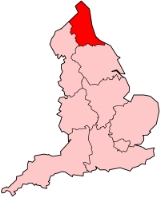
in North East England
North East England
North East England is one of the nine official regions of England. It covers Northumberland, County Durham, Tyne and Wear, and Teesside . The only cities in the region are Durham, Newcastle upon Tyne and Sunderland...
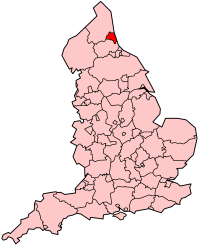
, defined by the Office of National Statistics, which is home to over 80% of the population of Tyne and Wear
Tyne and Wear
Tyne and Wear is a metropolitan county in north east England around the mouths of the Rivers Tyne and Wear. It came into existence as a metropolitan county in 1974 after the passage of the Local Government Act 1972...
. It includes the city of Newcastle upon Tyne
Newcastle upon Tyne
Newcastle upon Tyne is a city and metropolitan borough of Tyne and Wear, in North East England. Historically a part of Northumberland, it is situated on the north bank of the River Tyne...
and the Metropolitan Boroughs of Gateshead
Gateshead
Gateshead is a town in Tyne and Wear, England and is the main settlement in the Metropolitan Borough of Gateshead. Historically a part of County Durham, it lies on the southern bank of the River Tyne opposite Newcastle upon Tyne and together they form the urban core of Tyneside...
, North Tyneside
North Tyneside
The Metropolitan Borough of North Tyneside is a metropolitan borough of Tyne and Wear, in North East England and is part of the Tyneside conurbation. Its seat is Wallsend Town Hall....
and South Tyneside
South Tyneside
South Tyneside is a metropolitan borough in Tyne and Wear in North East England.It is bordered by four other boroughs - Newcastle upon Tyne and Gateshead to the west, Sunderland in the south, and North Tyneside to the north. The border county of Northumberland lies further north...
— all settlements on the banks of the River Tyne. The population of the conurbation was 879,996 according to the census of 2001, the 6th largest conurbation in the UK. The only large settlement in Tyne and Wear that is not part of the Tyneside conurbation is Sunderland, which is on Wearside
Wearside
Wearside is an area of north east England, centred on the continuous urban area formed by Sunderland, Seaham and other settlements by the River Wear. Mackems is a nickname used for the people of Wearside....
.
Geordies
The people of the Tyneside area are often called "GeordieGeordie
Geordie is a regional nickname for a person from the Tyneside region of the north east of England, or the name of the English-language dialect spoken by its inhabitants...
s". Tynesiders may have been given this name, a local diminutive of the name "George", because their miner
Miner
A miner is a person whose work or business is to extract ore or minerals from the earth. Mining is one of the most dangerous trades in the world. In some countries miners lack social guarantees and in case of injury may be left to cope without assistance....
s used George Stephenson
George Stephenson
George Stephenson was an English civil engineer and mechanical engineer who built the first public railway line in the world to use steam locomotives...
's safety lamp
Geordie lamp
The Geordie lamp was invented by George Stephenson in 1815 as a solution to explosions due to firedamp in coal mines.Although controversy arose between Stephenson's design and the Davy lamp, , Stephenson's original design worked on significantly different principles...
(called a "Georgie lamp") to prevent firedamp
Firedamp
Firedamp is a flammable gas found in coal mines. It is the name given to a number of flammable gases, especially methane. It is particularly commonly found in areas where the coal is bituminous...
explosions, rather than the Davy lamp
Davy lamp
The Davy lamp is a safety lamp with a wick and oil vessel burning originally a heavy vegetable oil, devised in 1815 by Sir Humphry Davy. It was created for use in coal mines, allowing deep seams to be mined despite the presence of methane and other flammable gases, called firedamp or minedamp.Sir...
used elsewhere. An alternative explanation is that during the Jacobite
Jacobitism
Jacobitism was the political movement in Britain dedicated to the restoration of the Stuart kings to the thrones of England, Scotland, later the Kingdom of Great Britain, and the Kingdom of Ireland...
risings they declared their allegiance to the Hanoverian
House of Hanover
The House of Hanover is a deposed German royal dynasty which has ruled the Duchy of Brunswick-Lüneburg , the Kingdom of Hanover, the Kingdom of Great Britain, the Kingdom of Ireland and the United Kingdom of Great Britain and Ireland...
kings of Great Britain George I
George I of Great Britain
George I was King of Great Britain and Ireland from 1 August 1714 until his death, and ruler of the Duchy and Electorate of Brunswick-Lüneburg in the Holy Roman Empire from 1698....
and George II
George II of Great Britain
George II was King of Great Britain and Ireland, Duke of Brunswick-Lüneburg and Archtreasurer and Prince-elector of the Holy Roman Empire from 11 June 1727 until his death.George was the last British monarch born outside Great Britain. He was born and brought up in Northern Germany...
; whereas the rest of the county of Northumberland
Northumberland
Northumberland is the northernmost ceremonial county and a unitary district in North East England. For Eurostat purposes Northumberland is a NUTS 3 region and is one of three boroughs or unitary districts that comprise the "Northumberland and Tyne and Wear" NUTS 2 region...
, to the north, was loyal to James Francis Edward Stuart
James Francis Edward Stuart
James Francis Edward, Prince of Wales was the son of the deposed James II of England...
.
Coal production
While Newcastle upon Tyne had been an important local centre since Roman times, and was a major local market town from the Middle Ages, the development of Newcastle and Tyneside is owed to coal miningCoal mining
The goal of coal mining is to obtain coal from the ground. Coal is valued for its energy content, and since the 1880s has been widely used to generate electricity. Steel and cement industries use coal as a fuel for extraction of iron from iron ore and for cement production. In the United States,...
. Coal was first known to be dug in Tyneside from superficial seams in around 1200, but there is some evidence from Bede
Bede
Bede , also referred to as Saint Bede or the Venerable Bede , was a monk at the Northumbrian monastery of Saint Peter at Monkwearmouth, today part of Sunderland, England, and of its companion monastery, Saint Paul's, in modern Jarrow , both in the Kingdom of Northumbria...
's writings that it may have been dug as early as 800 AD. Coal was dug from local drift mines and bell pits, and although initially only used locally, it was exported from the port of Newcastle from the mid 14th century onwards. Tyneside had a strategic advantage as far as the coal trade was concerned, because collier brigs could be loaded with coal on the Tyne and could sail down the east coast to London. In fact, the burgesses of Newcastle formed a cartel, and were known as the Hostmen. The Hostmen were able gain a monopoly over all of the coal exported from Tyneside, a monopoly which lasted a considerable time. A well-known group of workers on the river were the keelmen
Keelmen
The Keelmen of Tyne and Wear were a group of men who worked on the keels, large boats that carried the coal from the banks of both rivers to the waiting collier ships. Because of the shallowness of both rivers, it was difficult for ships of any significant draught to move up river and load with...
who handled the keels, boats that carried the coal from the riverbanks to the waiting colliers.
Steel and shipbuilding
The valley of the River DerwentRiver Derwent, North East England
The River Derwent is a river on the border between County Durham and Northumberland in the north east of England. It broadens into the Derwent Reservoir, west of Consett. The Derwent is a tributary of the River Tyne, which it joins near the MetroCentre...
, a major tributary of the Tyne that rises in County Durham
County Durham
County Durham is a ceremonial county and unitary district in north east England. The county town is Durham. The largest settlement in the ceremonial county is the town of Darlington...
, saw the development of the steel
Steel
Steel is an alloy that consists mostly of iron and has a carbon content between 0.2% and 2.1% by weight, depending on the grade. Carbon is the most common alloying material for iron, but various other alloying elements are used, such as manganese, chromium, vanadium, and tungsten...
industry from around 1600 onwards. This was led by German immigrant cutlers and sword-makers, probably from around Solingen
Solingen
Solingen is a city in North Rhine-Westphalia, Germany. It is located on the northern edge of the region called Bergisches Land, south of the Ruhr area, and with a 2009 population of 161,366 is the second largest city in the Bergisches Land...
, who fled from religious persecution
Religious persecution
Religious persecution is the systematic mistreatment of an individual or group of individuals as a response to their religious beliefs or affiliations or lack thereof....
at home and settled in the then village of Shotley Bridge
Shotley Bridge
Shotley Bridge is a village in the Derwent Valley, adjoining the town of Consett in County Durham, England. Shotley Bridge was once the heart of Britain's swordmaking industry.The origins of swordmaking here dated from 1691...
, near Consett
Consett
Consett is a town in the northwest of County Durham, England, about southwest of Newcastle upon Tyne. It is home to 27,394 .Consett sits high on the edge of the Pennines. In 1841, it was a village community of only 145, but it was about to become a boom town: below the ground was coking coal and...
.
The combination of coal and steel industries in the area was the catalyst for further major industrial development in the 19th century, including the shipbuilding industry—at its peak, the Tyneside shipyard
Shipyard
Shipyards and dockyards are places which repair and build ships. These can be yachts, military vessels, cruise liners or other cargo or passenger ships. Dockyards are sometimes more associated with maintenance and basing activities than shipyards, which are sometimes associated more with initial...
s were one of the largest centres of shipbuilding in the world, and built an entire navy for Japan
Japan
Japan is an island nation in East Asia. Located in the Pacific Ocean, it lies to the east of the Sea of Japan, China, North Korea, South Korea and Russia, stretching from the Sea of Okhotsk in the north to the East China Sea and Taiwan in the south...
in the first decade of the 20th century. There is still a working shipyard in Wallsend
Wallsend
Wallsend is an area in North Tyneside, Tyne and Wear, England. Wallsend derives its name as the location of the end of Hadrian's Wall. It has a population of 42,842.-Romans:...
.
Professional rowing on the Tyne
From early in the 19th century it was a custom to hold boat races on the Tyne. The river had a large number of keelmen and wherrymen, who handled boats as part of their jobs. As on the River ThamesRiver Thames
The River Thames flows through southern England. It is the longest river entirely in England and the second longest in the United Kingdom. While it is best known because its lower reaches flow through central London, the river flows alongside several other towns and cities, including Oxford,...
, there were competitions to show who was the best oarsman. As a wherryman did not earn very much, professional rowing was seen as a quick way of earning extra money. Regattas were held, and provided modest prizes for professionals, but the big money was made in challenge races, in which scullers
Sculling
Sculling generally refers to a method of using oars to propel watercraft in which the oar or oars touch the water on both the port and starboard sides of the craft, or over the stern...
or boat crews would challenge each other to a race over a set distance for a side stake. The crews would usually have backers, who would put up the stake money, as they saw the chance of financial gain from the race. In the days before mass attendances at football matches, races on the river were enormously popular, with tens of thousands attending. Betting would go on both before and during a race, the odds changing as the fortunes of the contestants changed. Contestants who became champions of the Tyne would often challenge the corresponding champions of the River Thames, and the race would be arranged to take place on one of the two rivers.
Rivalry between the Tyne and the Thames was very keen, and rowers who upheld the honour of the Tyne became local heroes. Three such oarsmen, who came from humble backgrounds and became household names in the North East, were Harry Clasper
Harry Clasper
Harry Clasper was a Tyneside professional rower and boat builder. He was an innovative boat designer who pioneered the development of the racing shell and the use of outriggers. He is said to have invented spoon-shaped oars...
, Robert Chambers
Robert Chambers (oarsman)
Robert Chambers was a famous Tyneside professional oarsman. He became the Tyne, Thames, English and World Sculling Champion.He was one of three great Tyneside oarsmen, the other two being Harry Clasper and James Renforth....
and James Renforth
James Renforth
James Renforth was a famous Tyneside professional oarsman. He became the World Sculling Champion in 1868 and was one of three great Tyneside oarsmen, the other two being Harry Clasper and Robert Chambers.-Early history:...
. Clasper
Harry Clasper
Harry Clasper was a Tyneside professional rower and boat builder. He was an innovative boat designer who pioneered the development of the racing shell and the use of outriggers. He is said to have invented spoon-shaped oars...
was a champion rower in fours, as well as an innovative boat designer and a successful rowing coach. Chambers
Robert Chambers (oarsman)
Robert Chambers was a famous Tyneside professional oarsman. He became the Tyne, Thames, English and World Sculling Champion.He was one of three great Tyneside oarsmen, the other two being Harry Clasper and James Renforth....
and Renforth
James Renforth
James Renforth was a famous Tyneside professional oarsman. He became the World Sculling Champion in 1868 and was one of three great Tyneside oarsmen, the other two being Harry Clasper and Robert Chambers.-Early history:...
were oarsmen who excelled at sculling
Sculling
Sculling generally refers to a method of using oars to propel watercraft in which the oar or oars touch the water on both the port and starboard sides of the craft, or over the stern...
. Both held the World Sculling Championship at different times.
The popularity of all three men was such that when they died, many thousands attended their funeral processions, and magnificent funeral monuments were provided by popular subscription in all three cases. At the end of the 19th century professional rowing on the Tyne began a gradual decline and eventually died out altogether leaving the amateur version.
Rapper dancing
Despite its rapid growth in the Industrial RevolutionIndustrial Revolution
The Industrial Revolution was a period from the 18th to the 19th century where major changes in agriculture, manufacturing, mining, transportation, and technology had a profound effect on the social, economic and cultural conditions of the times...
, Tyneside did develop one peculiar local custom, the rapper sword
Rapper sword
Rapper sword is a kind of sword dance associated with the North-East of England.-History:The rapper sword tradition was traditionally performed in the mining villages of the Northumberland and Durham coalfield in North East England, especially in Tyneside...
dance, which later spread to neighbouring areas of Northumberland and County Durham.
Industrial decline and regeneration
During the 1970s and 1980s, there was major industrial decline in the traditional British heavy industries, and Tyneside was hit hard. High unemployment rates, and the national government's resolve to push through with economic transformation, led to great social unrest with strikes and occasional rioting in depressed areas.From the late 1980s onward, an improving national economy and local regeneration helped the area to recover, and although unemployment is still a problem compared with some other areas of Britain, expansion of new industries such as tourism
Tourism
Tourism is travel for recreational, leisure or business purposes. The World Tourism Organization defines tourists as people "traveling to and staying in places outside their usual environment for not more than one consecutive year for leisure, business and other purposes".Tourism has become a...
, science
Science
Science is a systematic enterprise that builds and organizes knowledge in the form of testable explanations and predictions about the universe...
and high-technology, has fuelled local development, especially in Newcastle upon Tyne and Gateshead.
Definition
The ONSOffice for National Statistics
The Office for National Statistics is the executive office of the UK Statistics Authority, a non-ministerial department which reports directly to the Parliament of the United Kingdom.- Overview :...
define a Tyneside Urban Area with a population of 879,996 according to the 2001 census, which has the following urban sub-areas
- BlaydonBlaydonBlaydon-on-Tyne is a town in the North East of England in the Metropolitan Borough of Gateshead. The former urban district, however, extends much further, its fourteen and a half square miles constituting the largest administrative district, after Newcastle, on Tyneside...
- Boldon
- Chester-le-StreetChester-le-StreetChester-le-Street is a town in County Durham, England. It has a history going back to Roman times when it was called Concangis. The town is located south of Newcastle upon Tyne and west of Sunderland on the River Wear...
- CleadonCleadonCleadon is a suburban village in South Tyneside, North East England in the county of Tyne and Wear. The population of Cleadon is 4,795, and there are a few shops including Bon Appetit Deli, Boutiques store and a Post Office. Cleadon is a short walk from the local East Boldon Metro Station. Nearby...
- Felling
- GatesheadGatesheadGateshead is a town in Tyne and Wear, England and is the main settlement in the Metropolitan Borough of Gateshead. Historically a part of County Durham, it lies on the southern bank of the River Tyne opposite Newcastle upon Tyne and together they form the urban core of Tyneside...
- GosforthGosforthGosforth is an area of Newcastle upon Tyne, Tyne and Wear, England, United Kingdom, to the north of the city centre. Gosforth constituted an urban district from 1895 to 1974, when it became part of the City of Newcastle upon Tyne. It has a population of 23,620...
- HebburnHebburnHebburn is a small town situated on the south bank of the River Tyne in North East England, sandwiched between the towns of Jarrow and Bill Quay...
- HowdonHowdonHowdon is a place in Tyne and Wear, England.Howdon is an area in the eastern part of Wallsend, a former coal-mining and shipbuilding town on the north banks of the River Tyne....
- JarrowJarrowJarrow is a town in Tyne and Wear, England, located on the River Tyne, with a population of 27,526. From the middle of the 19th century until 1935, Jarrow was a centre for shipbuilding, and was the starting point of the Jarrow March against unemployment in 1936.-Foundation:The Angles re-occupied...
- LongbentonLongbentonLongbenton is a district of North Tyneside, England. It is largely occupied by an extensive estate originally built as municipal housing by Newcastle City Council in the 1950s and 1960s. It is served by the Tyne and Wear Metro stations Longbenton Metro station and Four Lane Ends Metro Station...
/KillingworthKillingworthKillingworth, formerly Killingworth Township, is a town north of Newcastle Upon Tyne, in North Tyneside, United Kingdom.Built as a planned town in the 1960s, most of Killingworth's residents commute to Newcastle, or the city's surrounding area. However, Killingworth itself has a sizeable... - Meadowell
- NewburnNewburnNewburn is a semi rural village, parish, electoral ward and former urban district in western Tyne and Wear, North East England. Situated on the banks of the River Tyne, it is built rising up the valley from the river...
- Newcastle upon TyneNewcastle upon TyneNewcastle upon Tyne is a city and metropolitan borough of Tyne and Wear, in North East England. Historically a part of Northumberland, it is situated on the north bank of the River Tyne...
- North ShieldsNorth ShieldsNorth Shields is a town on the north bank of the River Tyne, in the metropolitan borough of North Tyneside, in North East England...
- RytonRyton, Tyne and WearRyton is a semi-rural small town near the western border of Tyne and Wear, England. Once an independent town in County Durham it became incorporated into the metropolitan county of Tyne and Wear and the Metropolitan Borough of Gateshead in 1974. It has a population of 15,742.- Location :Ryton lies...
- Percy Main
- ShiremoorShiremoorShiremoor is a large village in the Metropolitian Borough of North Tyneside. It is located approximately inland of Whitley Bay and approximately north of The Tyne Tunnel. A mile or so north of Shiremoor, the extensive built-up areas of North Tyneside change abruptly into green belt stretching...
- South ShieldsSouth ShieldsSouth Shields is a coastal town in Tyne and Wear, England, located at the mouth of the River Tyne to Tyne Dock, and about downstream from Newcastle upon Tyne...
- SpringwellSpringwell villageSpringwell Village is, as the name suggests, a village in Tyneside. Although the postal address is Gateshead, the village lies in the Washington West ward of the City of Sunderland. It has one church, two shops and one local pub. In the surrounding areas are an equestrian centre and farmland...
- TynemouthTynemouthTynemouth is a town and a historic borough in Tyne and Wear, England, at the mouth of the River Tyne, between North Shields and Cullercoats . It is administered as part of the borough of North Tyneside, but until 1974 was an independent county borough in its own right...
- WallsendWallsendWallsend is an area in North Tyneside, Tyne and Wear, England. Wallsend derives its name as the location of the end of Hadrian's Wall. It has a population of 42,842.-Romans:...
- WhickhamWhickhamWhickham is a town in North East England, four miles south west of Newcastle upon Tyne and four and a half miles west of Gateshead. Whickham is part of the Metropolitan Borough of Gateshead. Its postal address is Whickham, Newcastle upon Tyne. Whickham is situated on high ground overlooking the...
- Whitley BayWhitley BayWhitley Bay is a town in North Tyneside, in Tyne and Wear, England. It is on the North Sea coast and has a fine stretch of golden sandy beach forming a bay stretching from St. Mary's Island in the north to Cullercoats in the south...
Economy
This is a chart of trend of regional gross value added of Tyneside at current basic prices published (pp. 240–253) by Office for National Statistics with figures in millions of British Pounds Sterling.| Year | Regional Gross Value Added | Agriculture | Industry | Services |
|---|---|---|---|---|
| 1995 | 7,688 | 9 | 2,244 | 5,435 |
| 2000 | 9,930 | 8 | 2,567 | 7,356 |
| 2003 | 11,895 | 9 | 2,865 | 9,021 |
1 includes hunting and forestry
2 includes energy and construction
3 includes financial intermediation services indirectly measured
4 Components may not sum to totals due to rounding