


Caesarea Palaestina

Encyclopedia
Caesarea Maritima Caesarea Palaestina from 133 CE onwards, was a city and harbor
built by Herod the Great
about 25–13 BC. Today, its ruins lie on the Mediterranean coast
of Israel
about halfway between the cities of Tel Aviv
and Haifa
, on the site of Pyrgos Stratonos ("Straton's Tower") . Caesarea Maritima was named to flatter the Caesar. The city was described in detail by the 1st century Roman Jewish historian Josephus
. The city became the seat of the Roman prefect
soon after its foundation. The emperor Vespasian
raised its status to that of a colonia. After the destruction of Jerusalem in 70 CE, Caesarea was the provincial capital of Iudaea Province
before the change of name to Syria Palaestina
in 134 CE, shortly before the Bar Kokhba revolt. Caesarea was the "administrative capital" beginning in 6 CE. In Byzantine times, Caesarea remained the capital, with brief interruption of Persian and Jewish conquest
between 614 and 625. In the 630s, Arab Muslim armies had taken control of the region, keeping Caesarea as its administrative center. In the early 8th century, the Umayyad
caliph Suleiman transferred the seat of government of the Jund Filastin
from Caesarea to Ramla
.
 Herod built his palace on a promontory jutting out into the sea, with a decorative pool surrounded by stoa
s. In 13 BC, Caesarea became the civilian and military capital of Iudaea Province
and the official residence of the Roman procurators and governors
, Pontius Pilatus, praefectus and Antonius Felix
. Josephus describes the harbor as being as large as the one at Piraeus
, the major harbor of Athens. Remains of the principal buildings erected by Herod and the medieval town are still visible today, including the city walls, the castle and a Crusader cathedral and church. Caesarea grew rapidly, becoming the largest city in Judea, with an estimated population of 125,000 over an urban area of 3.7 square kilometres (1.4 sq mi). In 66 CE, the desecration of the local synagogue led to the disastrous Jewish revolt.
In 69, Vespasian
declared it a colony and renamed it Colonia Prima Flavia Augusta Caesarea. In 70 CE, after the Jewish revolt was suppressed, games were held here to celebrate the victory of Titus. Many Jewish captives were brought to Caesarea Maritima and 2500 were slaughtered in Gladiatorial games.
After the revolt of Simon bar Kokhba
in 132, which ended with the destruction of Jerusalem
and expulsion of Jews, Caesarea became the center of Early Christianity
in Palestine.
, Caesarea was first introduced to Christianity when Peter the apostle baptized Cornelius the Centurion, his household, and his soldiers. This was the first time any Apostle had preached to the Gentiles and before Paul's first missionary journey. The Apostle Paul
sought refuge there, staying once at the house of Philip the Evangelist
, and later being imprisoned at Caesarea (which was the capital of the Roman province) for two years before being sent to Rome. The historical reliability of the Acts of the Apostles
, the primary source
for the Apostolic Age
, is a major issue for biblical scholars and historians of Early Christianity
.
The Apostolic Constitutions
state that the first Bishop of Caesarea was Zacchaeus the Publican
. According to the Catholic Encyclopedia
, Caesarea became the metropolitan See. In the 3rd century
Origen
wrote his Hexapla
and other exegetic and theological works while living there. The early church historian Eusebius
was one of its bishops (315 - 318) in the early 4th century
. Nicene Creed
may have originated in Caesarea.
The main church, a martyrion (martyr's shrine) was built in the 6th century
and sited directly upon the podium that had supported the Roman temple
, as was a widespread Christian practice. Throughout the Empire, prominently-sited pagan temples were rarely left unconsecrated to the new rites
: in time the Martyrion's site was re-occupied, this time by a mosque
. The Martyrion was an octagon, richly re-paved and surrounded by small radiating enclosures. Archaeologists have recovered some foliate capitals
that included representations of the Cross
.
An elaborate government structure contained a basilica
with an apse, where magistrates would have sat, for the structure was used as a hall of justice, as fragments of inscriptions detailing the fees that court clerks might claim attest. A well-preserved 6th century
mosaic gold and colored glass table patterned with crosses and rosettes was found in 2005.
, an avid collector of books of Scripture, the theological school of Caesarea won a reputation for having the most extensive ecclesiastical library
of the time, containing more than 30,000 manuscripts: Gregory Nazianzus, Basil the Great, Jerome
and others came to study there. The Caesarean text-type
is recognized by scholars as one of the earliest New Testament
types. The collections of the library suffered during the persecutions under the Emperor Diocletian
, but were repaired subsequently by bishops of Caesarea. It was noted in the 6th century, but Henry Barclay Swete
was of the opinion that it probably did not long survive the capture of Caesarea by the Saracens in 638, though a modern historian would attribute more destruction to its previous capture
by the Sassanid Persians (in 614).
through a "secret tunnel", perhaps the extensive Byzantine sewers, into the city. The Persian historian al-Baladhuri, who offers the earliest Muslim account, merely states that the city was "reduced". The 7th-century Coptic bishop John of Nikiû
, mentions "the horrors committed in the city of Caesarea in Palestine".
took the city in 1101/2, during the First Crusade
, it was still very rich, nevertheless. A legend grew up that in this city was discovered the Holy Grail
around which so much lore accrued in the next two centuries. The city was strongly refortified and rebuilt by the Crusaders. A lordship was created there, as was one of the four archbishoprics in the kingdom (see Archbishop of Caesarea
). A list of thirty-six Latin bishops, from 1101 to 1496 has been reassembled by 19th century papal historians; the most famous of these is probably Heraclius
. After that the Latin "Bishop of Caesarea" became an empty title. Saladin
retook the city in 1187; it was recaptured by the Crusaders in 1191, and finally lost by them in 1265, this time to the Mamluk
s, who ensured that there would be no more battling over the site— where the harbor has silted in anyway— by razing the fortifications - in line with their practice in other formerly-Crusader coastal cities.
, a type of volcanic ash, set into a concrete underwater. Herod imported over 24,000 m3 pozzolana from Pozzuoli
, Italy, to construct the 500 meter long southern breakwater and 275 meter long northern breakwater. A shipment of this size would have required at least 44 shiploads of 400 tons each. Herod also had 12,000 m3 of kurkar
quarried to make rubble and 12,000 m3 of slaked lime mixed with the pozzolana.
Architects had to devise a way to lay the wooden forms for the concrete moles underwater. One technique was to drive stakes into the ground to make a box and then fill the box with pozzolana concrete bit by bit. However, this method required many divers to hammer in the stakes underwater and it used large quantities of pozzolana. Another technique was a double planking method used in the northern breakwater. On land, carpenters would construct a box with beams and frames on the inside and a watertight, double-planked wall on the outside. This double wall was built with a 23 cm gap between the inner and outer layer. Although the box had no bottom, it was buoyant enough to float out to sea because of the watertight space between the inner and outer walls. Once it was floated into position, pozzolana was poured into the gap between the walls and the box would sink into place on the seafloor and be staked down in the corners. The flooded inside area was then filled by divers bit by bit with pozzolana-lime mortar and kurkar rubble until it rose above sea level.
On the southern breakwater, barge construction was used. The southern side of Sebastos was much more exposed than the northern side, requiring sturdier breakwaters. Instead of using the double planked method filled with rubble, the architects sank barges filled with layers of pozzolana concrete and lime sand mortar. The barges were similar to boxes without lids, and were constructed using mortise and tenon joints, the same technique used in ancient boats, to ensure they remained watertight. The barges were ballasted with 0.5 meters of pozzolana concrete and floated out to their position. Alternating layers of pozzolana based and lime based concretes were hand placed inside the barge to sink it and fill it up to the surface.
At its height, Sebastos was one of the most impressive harbors of its time. It had been constructed on a coast that had no natural harbors and served as an important commercial harbor in antiquity, rivaling Cleopatra’s harbor at Alexandria. Josephus wrote: “Although the location was generally unfavorable, [Herod] contended with the difficulties so well that the solidity of the construction could not be overcome by the sea, and its beauty seemed finished off without impediment.” However, there were underlying problems that led to its demise. Studies of the concrete cores of the moles have shown that the concrete was much weaker than similar pozzolana hydraulic concrete used in ancient Italian ports. For unknown reasons, the pozzolana mortar did not adhere as well to the kurkar rubble as it did to other rubble types used in Italian harbors. Small but numerous holes in some of the cores also indicate that the lime was of poor quality and stripped out of the mixture by strong waves before it could set. Also, large lumps of lime were found in all five of the cores studied at Caesarea, which shows that the mixture was not mixed thoroughly. However, stability would not have been seriously affected if the harbor had not been constructed over a geological fault line that runs along the coast. Seismic action gradually took its toll on the breakwaters, causing them to tilt down and settle into the seabed. Also, studies of seabed deposits at Caesarea have shown that a tsunami struck the area sometime between the 1st and 2nd centuries CE. Although it is unknown if this tsunami simply damaged or completely destroyed the harbor, it is known that by the 6th century the harbor was unusable and today the moles rest over 5 meters underwater.
. Other buildings include a temple dedicated to Caesar; a hippodrome
rebuilt in the 2nd century as a more conventional theater
; the Tiberieum, which has a limestone
block with a dedicatory inscription
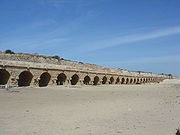
. This is the only archaeological find with an inscription mentioning the name "Pontius Pilatus"; a double aqueduct
that brought water from springs at the foot of Mount Carmel; a boundary wall; and a 200 ft (60 m) wide moat protecting the harbour to the south and west. The harbor was the largest on the eastern Mediterranean coast. Worked directed by Robert Bull of Drew University is still in the process of publication while more recent work in the harbor directed by Robert Hohlfelder *U of Colorado, John Oleson of the U of Victoria, and the late Avner Raban has been largely published. Caesarea has recently become the site of what bills itself as the world's first underwater museum, where 36 points of interest on four marked underwater trails through the ancient harbor can be explored by divers equipped with waterproof maps.
Harbor
A harbor or harbour , or haven, is a place where ships, boats, and barges can seek shelter from stormy weather, or else are stored for future use. Harbors can be natural or artificial...
built by Herod the Great
Herod the Great
Herod , also known as Herod the Great , was a Roman client king of Judea. His epithet of "the Great" is widely disputed as he is described as "a madman who murdered his own family and a great many rabbis." He is also known for his colossal building projects in Jerusalem and elsewhere, including his...
about 25–13 BC. Today, its ruins lie on the Mediterranean coast
Israeli Coastal Plain
The Israeli coastal plain is the narrow coastal plain along Israel's Mediterranean Sea coast which houses 70% of the country's population. The plain extends north to south and is divided into a number of areas; the Plain of Zebulun , Hof HaCarmel , the Sharon plain , and the Plain of Judea The...
of Israel
Israel
The State of Israel is a parliamentary republic located in the Middle East, along the eastern shore of the Mediterranean Sea...
about halfway between the cities of Tel Aviv
Tel Aviv
Tel Aviv , officially Tel Aviv-Yafo , is the second most populous city in Israel, with a population of 404,400 on a land area of . The city is located on the Israeli Mediterranean coastline in west-central Israel. It is the largest and most populous city in the metropolitan area of Gush Dan, with...
and Haifa
Haifa
Haifa is the largest city in northern Israel, and the third-largest city in the country, with a population of over 268,000. Another 300,000 people live in towns directly adjacent to the city including the cities of the Krayot, as well as, Tirat Carmel, Daliyat al-Karmel and Nesher...
, on the site of Pyrgos Stratonos ("Straton's Tower") . Caesarea Maritima was named to flatter the Caesar. The city was described in detail by the 1st century Roman Jewish historian Josephus
Josephus
Titus Flavius Josephus , also called Joseph ben Matityahu , was a 1st-century Romano-Jewish historian and hagiographer of priestly and royal ancestry who recorded Jewish history, with special emphasis on the 1st century AD and the First Jewish–Roman War, which resulted in the Destruction of...
. The city became the seat of the Roman prefect
Prefect
Prefect is a magisterial title of varying definition....
soon after its foundation. The emperor Vespasian
Vespasian
Vespasian , was Roman Emperor from 69 AD to 79 AD. Vespasian was the founder of the Flavian dynasty, which ruled the Empire for a quarter century. Vespasian was descended from a family of equestrians, who rose into the senatorial rank under the Emperors of the Julio-Claudian dynasty...
raised its status to that of a colonia. After the destruction of Jerusalem in 70 CE, Caesarea was the provincial capital of Iudaea Province
Iudaea Province
Judaea or Iudaea are terms used by historians to refer to the Roman province that extended over parts of the former regions of the Hasmonean and Herodian kingdoms of Israel...
before the change of name to Syria Palaestina
Syria Palaestina
Syria Palæstina was a Roman province between 135CE and 390CE. It had been established by the merge of Roman Syria and Roman Judaea, following the defeat of the Bar Kokhba Revolt in 135 CE. In 193 Syria-Coele was split to form a separate provincial locality...
in 134 CE, shortly before the Bar Kokhba revolt. Caesarea was the "administrative capital" beginning in 6 CE. In Byzantine times, Caesarea remained the capital, with brief interruption of Persian and Jewish conquest
Siege of Caesarea (614)
Siege of Caesaria relates to the siege of conquest of Caesaria Maritima of the Palaestina Prima province by joint Sassanid-Jewish armies in 614 CE.-History:...
between 614 and 625. In the 630s, Arab Muslim armies had taken control of the region, keeping Caesarea as its administrative center. In the early 8th century, the Umayyad
Umayyad
The Umayyad Caliphate was the second of the four major Arab caliphates established after the death of Muhammad. It was ruled by the Umayyad dynasty, whose name derives from Umayya ibn Abd Shams, the great-grandfather of the first Umayyad caliph. Although the Umayyad family originally came from the...
caliph Suleiman transferred the seat of government of the Jund Filastin
Jund Filastin
Jund Filastin was one of several sub-provinces of the Ummayad and Abbasid Caliphate province of Syria, organized soon after the Muslim conquest of Syria in the seventh century. According to al-Biladhuri, the main towns in the district at its capture by the Rashidun Caliphate, were Gaza, Sebastiya,...
from Caesarea to Ramla
Ramla
Ramla , is a city in central Israel. The city is predominantly Jewish with a significant Arab minority. Ramla was founded circa 705–715 AD by the Umayyad Caliph Suleiman ibn Abed al-Malik after the Arab conquest of the region...
.
Roman era
Stoa
Stoa in Ancient Greek architecture; covered walkways or porticos, commonly for public usage. Early stoae were open at the entrance with columns, usually of the Doric order, lining the side of the building; they created a safe, enveloping, protective atmosphere.Later examples were built as two...
s. In 13 BC, Caesarea became the civilian and military capital of Iudaea Province
Iudaea Province
Judaea or Iudaea are terms used by historians to refer to the Roman province that extended over parts of the former regions of the Hasmonean and Herodian kingdoms of Israel...
and the official residence of the Roman procurators and governors
Roman governor
A Roman governor was an official either elected or appointed to be the chief administrator of Roman law throughout one or more of the many provinces constituting the Roman Empire...
, Pontius Pilatus, praefectus and Antonius Felix
Antonius Felix
Marcus Antonius Felix was the Roman procurator of Iudaea Province 52-58, in succession to Ventidius Cumanus.- Life :...
. Josephus describes the harbor as being as large as the one at Piraeus
Piraeus
Piraeus is a city in the region of Attica, Greece. Piraeus is located within the Athens Urban Area, 12 km southwest from its city center , and lies along the east coast of the Saronic Gulf....
, the major harbor of Athens. Remains of the principal buildings erected by Herod and the medieval town are still visible today, including the city walls, the castle and a Crusader cathedral and church. Caesarea grew rapidly, becoming the largest city in Judea, with an estimated population of 125,000 over an urban area of 3.7 square kilometres (1.4 sq mi). In 66 CE, the desecration of the local synagogue led to the disastrous Jewish revolt.
In 69, Vespasian
Vespasian
Vespasian , was Roman Emperor from 69 AD to 79 AD. Vespasian was the founder of the Flavian dynasty, which ruled the Empire for a quarter century. Vespasian was descended from a family of equestrians, who rose into the senatorial rank under the Emperors of the Julio-Claudian dynasty...
declared it a colony and renamed it Colonia Prima Flavia Augusta Caesarea. In 70 CE, after the Jewish revolt was suppressed, games were held here to celebrate the victory of Titus. Many Jewish captives were brought to Caesarea Maritima and 2500 were slaughtered in Gladiatorial games.
After the revolt of Simon bar Kokhba
Simon bar Kokhba
Simon bar Kokhba was the Jewish leader of what is known as the Bar Kokhba revolt against the Roman Empire in 132 CE, establishing an independent Jewish state of Israel which he ruled for three years as Nasi...
in 132, which ended with the destruction of Jerusalem
Jerusalem in Christianity
For Christians, Jerusalem's place in the ministry of Jesus and the Apostolic Age gives it great importance, in addition to its place in the Old Testament, the Hebrew Bible.-Jerusalem in the New Testament and early Christianity:...
and expulsion of Jews, Caesarea became the center of Early Christianity
Early Christianity
Early Christianity is generally considered as Christianity before 325. The New Testament's Book of Acts and Epistle to the Galatians records that the first Christian community was centered in Jerusalem and its leaders included James, Peter and John....
in Palestine.
Christian hub
According to the Acts of the ApostlesActs of the Apostles
The Acts of the Apostles , usually referred to simply as Acts, is the fifth book of the New Testament; Acts outlines the history of the Apostolic Age...
, Caesarea was first introduced to Christianity when Peter the apostle baptized Cornelius the Centurion, his household, and his soldiers. This was the first time any Apostle had preached to the Gentiles and before Paul's first missionary journey. The Apostle Paul
Paul of Tarsus
Paul the Apostle , also known as Saul of Tarsus, is described in the Christian New Testament as one of the most influential early Christian missionaries, with the writings ascribed to him by the church forming a considerable portion of the New Testament...
sought refuge there, staying once at the house of Philip the Evangelist
Philip the Evangelist
Saint Philip the Evangelist appears several times in the Acts of the Apostles. He was one of the Seven Deacons chosen to care for the poor of the Christian community in Jerusalem . He preached and performed miracles in Samaria, converted Simon Magus, and met and baptised an Ethiopian man, an...
, and later being imprisoned at Caesarea (which was the capital of the Roman province) for two years before being sent to Rome. The historical reliability of the Acts of the Apostles
Historical reliability of the Acts of the Apostles
The historical reliability of the Acts of the Apostles, the primary source for the Apostolic Age, is a major issue for biblical scholars and historians of Early Christianity. The historicity of Acts became hotly debated between 1895-1915...
, the primary source
Primary source
Primary source is a term used in a number of disciplines to describe source material that is closest to the person, information, period, or idea being studied....
for the Apostolic Age
Apostolic Age
The Apostolic Age of the history of Christianity is traditionally the period of the Twelve Apostles, dating from the Crucifixion of Jesus and the Great Commission in Jerusalem until the death of John the Apostle in Anatolia...
, is a major issue for biblical scholars and historians of Early Christianity
Early Christianity
Early Christianity is generally considered as Christianity before 325. The New Testament's Book of Acts and Epistle to the Galatians records that the first Christian community was centered in Jerusalem and its leaders included James, Peter and John....
.
The Apostolic Constitutions
Apostolic Constitutions
The Apostolic Constitutions is a Christian collection of eight treatises which belongs to genre of the Church Orders. The work can be dated from 375 to 380 AD. The provenience is usually regarded as Syria, probably Antioch...
state that the first Bishop of Caesarea was Zacchaeus the Publican
Zacchaeus
Zacchaeus , according to chapter 19 of the gospel of Luke, was a superintendent of customs; a chief tax-gatherer at Jericho...
. According to the Catholic Encyclopedia
Catholic Encyclopedia
The Catholic Encyclopedia, also referred to as the Old Catholic Encyclopedia and the Original Catholic Encyclopedia, is an English-language encyclopedia published in the United States. The first volume appeared in March 1907 and the last three volumes appeared in 1912, followed by a master index...
, Caesarea became the metropolitan See. In the 3rd century
Christianity in the 3rd century
The 3rd century of Christianity was largely the time of the Ante-Nicene Fathers who wrote after the Apostolic Fathers of the 1st and 2nd centuries but before the First Council of Nicaea in 325...
Origen
Origen
Origen , or Origen Adamantius, 184/5–253/4, was an early Christian Alexandrian scholar and theologian, and one of the most distinguished writers of the early Church. As early as the fourth century, his orthodoxy was suspect, in part because he believed in the pre-existence of souls...
wrote his Hexapla
Hexapla
Hexapla is the term for an edition of the Bible in six versions. Especially it applies to the edition of the Old Testament compiled by Origen of Alexandria, which placed side by side:#Hebrew...
and other exegetic and theological works while living there. The early church historian Eusebius
Eusebius of Caesarea
Eusebius of Caesarea also called Eusebius Pamphili, was a Roman historian, exegete and Christian polemicist. He became the Bishop of Caesarea in Palestine about the year 314. Together with Pamphilus, he was a scholar of the Biblical canon...
was one of its bishops (315 - 318) in the early 4th century
Christianity in the 4th century
Christianity in the 4th century was dominated by Constantine the Great, and the First Council of Nicea of 325, which was the beginning of the period of the First seven Ecumenical Councils and the attempt to reach an orthodox consensus and to establish a unified Christendom as the State church of...
. Nicene Creed
Nicene Creed
The Nicene Creed is the creed or profession of faith that is most widely used in Christian liturgy. It is called Nicene because, in its original form, it was adopted in the city of Nicaea by the first ecumenical council, which met there in the year 325.The Nicene Creed has been normative to the...
may have originated in Caesarea.
The main church, a martyrion (martyr's shrine) was built in the 6th century
Christianity in the 6th century
In 533 Roman Emperor Justinian in Constantinople launched a military campaign to reclaim the western provinces from the Arian Germans, starting with North Africa and proceeding to Italy. Though he was temporarily successful in recapturing much of the western Mediterranean he destroyed the urban...
and sited directly upon the podium that had supported the Roman temple
Roman temple
Ancient Roman temples are among the most visible archaeological remains of Roman culture, and are a significant source for Roman architecture. Their construction and maintenance was a major part of ancient Roman religion. The main room housed the cult image of the deity to whom the temple was...
, as was a widespread Christian practice. Throughout the Empire, prominently-sited pagan temples were rarely left unconsecrated to the new rites
State church of the Roman Empire
The state church of the Roman Empire was a Christian institution organized within the Roman Empire during the 4th century that came to represent the Empire's sole authorized religion. Both the Roman Catholic Church and the Eastern Orthodox churches claim to be the historical continuation of this...
: in time the Martyrion's site was re-occupied, this time by a mosque
Mosque
A mosque is a place of worship for followers of Islam. The word is likely to have entered the English language through French , from Portuguese , from Spanish , and from Berber , ultimately originating in — . The Arabic word masjid literally means a place of prostration...
. The Martyrion was an octagon, richly re-paved and surrounded by small radiating enclosures. Archaeologists have recovered some foliate capitals
Capital (architecture)
In architecture the capital forms the topmost member of a column . It mediates between the column and the load thrusting down upon it, broadening the area of the column's supporting surface...
that included representations of the Cross
Christian cross
The Christian cross, seen as a representation of the instrument of the crucifixion of Jesus Christ, is the best-known religious symbol of Christianity...
.
An elaborate government structure contained a basilica
Basilica
The Latin word basilica , was originally used to describe a Roman public building, usually located in the forum of a Roman town. Public basilicas began to appear in Hellenistic cities in the 2nd century BC.The term was also applied to buildings used for religious purposes...
with an apse, where magistrates would have sat, for the structure was used as a hall of justice, as fragments of inscriptions detailing the fees that court clerks might claim attest. A well-preserved 6th century
Christianity in the 6th century
In 533 Roman Emperor Justinian in Constantinople launched a military campaign to reclaim the western provinces from the Arian Germans, starting with North Africa and proceeding to Italy. Though he was temporarily successful in recapturing much of the western Mediterranean he destroyed the urban...
mosaic gold and colored glass table patterned with crosses and rosettes was found in 2005.
Theological library
Through Origen and especially the scholarly presbyter Pamphilus of CaesareaPamphilus of Caesarea
Saint Pamphilus , was a presbyter of Caesarea and chief among Catholic Biblical scholars of his generation...
, an avid collector of books of Scripture, the theological school of Caesarea won a reputation for having the most extensive ecclesiastical library
Theological Library of Caesarea Maritima
The Theological Library of Caesarea Maritima or simply the Library of Caesarea was the library of the Christians of Caesarea Maritima in Palestine in ancient times.-History:...
of the time, containing more than 30,000 manuscripts: Gregory Nazianzus, Basil the Great, Jerome
Jerome
Saint Jerome was a Roman Christian priest, confessor, theologian and historian, and who became a Doctor of the Church. He was the son of Eusebius, of the city of Stridon, which was on the border of Dalmatia and Pannonia...
and others came to study there. The Caesarean text-type
Caesarean text-type
Caesarean text-type is the term proposed by certain scholars to denote a consistent pattern of variant readings that is claimed to be apparent in certain Greek manuscripts of the four Gospels, but which is not found in any of the other commonly recognized New Testament text-types; the Byzantine...
is recognized by scholars as one of the earliest New Testament
New Testament
The New Testament is the second major division of the Christian biblical canon, the first such division being the much longer Old Testament....
types. The collections of the library suffered during the persecutions under the Emperor Diocletian
Diocletian
Diocletian |latinized]] upon his accession to Diocletian . c. 22 December 244 – 3 December 311), was a Roman Emperor from 284 to 305....
, but were repaired subsequently by bishops of Caesarea. It was noted in the 6th century, but Henry Barclay Swete
Henry Barclay Swete
Henry Barclay Swete was an English Biblical scholar. He became Regius Professor of Divinity at Cambridge in 1890. He is known for his 1906 commentary on the Book of Revelation, and other works of exegesis....
was of the opinion that it probably did not long survive the capture of Caesarea by the Saracens in 638, though a modern historian would attribute more destruction to its previous capture
Siege of Caesarea (614)
Siege of Caesaria relates to the siege of conquest of Caesaria Maritima of the Palaestina Prima province by joint Sassanid-Jewish armies in 614 CE.-History:...
by the Sassanid Persians (in 614).
Arab rule
In 638 the city, capital of Byzantine Palestine and an important commercial and maritime center, was conquered by the Muslims, allegedly through the betrayal of a certain Yusef, who conducted a party of troops of MuawiyahMuawiyah I
Muawiyah I was the first Caliph of the Umayyad Dynasty. After the conquest of Mecca by the Muslims, Muawiyah's family converted to Islam. Muawiyah is brother-in-law to Muhammad who married his sister Ramlah bint Abi-Sufyan in 1AH...
through a "secret tunnel", perhaps the extensive Byzantine sewers, into the city. The Persian historian al-Baladhuri, who offers the earliest Muslim account, merely states that the city was "reduced". The 7th-century Coptic bishop John of Nikiû
John of Nikiû
John of Nikiû was an Egyptian Coptic bishop of Nikiû/Pashati in the Nile Delta and appointed general administrator of the monasteries of Upper Egypt in 696...
, mentions "the horrors committed in the city of Caesarea in Palestine".
Crusader era
The walls remained, but within them the population dwindled and agriculture crept in among the ruins. When Baldwin IBaldwin I of Jerusalem
Baldwin I of Jerusalem, formerly Baldwin I of Edessa, born Baldwin of Boulogne , 1058? – 2 April 1118, was one of the leaders of the First Crusade, who became the first Count of Edessa and then the second ruler and first titled King of Jerusalem...
took the city in 1101/2, during the First Crusade
First Crusade
The First Crusade was a military expedition by Western Christianity to regain the Holy Lands taken in the Muslim conquest of the Levant, ultimately resulting in the recapture of Jerusalem...
, it was still very rich, nevertheless. A legend grew up that in this city was discovered the Holy Grail
Holy Grail
The Holy Grail is a sacred object figuring in literature and certain Christian traditions, most often identified with the dish, plate, or cup used by Jesus at the Last Supper and said to possess miraculous powers...
around which so much lore accrued in the next two centuries. The city was strongly refortified and rebuilt by the Crusaders. A lordship was created there, as was one of the four archbishoprics in the kingdom (see Archbishop of Caesarea
Archbishop of Caesarea
The Archbishop of Caesarea was one of the major suffragans of the Latin Patriarch of Jerusalem during the Crusades. The Bishop of Caesarea became metropolitan of Palestine in the early 3rd century but after the Council of Chalcedon in 451 he was subordinate to the Patriarch of Jerusalem...
). A list of thirty-six Latin bishops, from 1101 to 1496 has been reassembled by 19th century papal historians; the most famous of these is probably Heraclius
Patriarch Heraclius of Jerusalem
Heraclius or Eraclius , was archbishop of Caesarea and Latin Patriarch of Jerusalem.Heraclius was from the Gévaudan in Auvergne, France. Like his later rival William of Tyre he studied law at the University of Bologna: his contemporaries and friends included Stephen of Tournai and Gratian...
. After that the Latin "Bishop of Caesarea" became an empty title. Saladin
Saladin
Ṣalāḥ ad-Dīn Yūsuf ibn Ayyūb , better known in the Western world as Saladin, was an Arabized Kurdish Muslim, who became the first Sultan of Egypt and Syria, and founded the Ayyubid dynasty. He led Muslim and Arab opposition to the Franks and other European Crusaders in the Levant...
retook the city in 1187; it was recaptured by the Crusaders in 1191, and finally lost by them in 1265, this time to the Mamluk
Mamluk
A Mamluk was a soldier of slave origin, who were predominantly Cumans/Kipchaks The "mamluk phenomenon", as David Ayalon dubbed the creation of the specific warrior...
s, who ensured that there would be no more battling over the site— where the harbor has silted in anyway— by razing the fortifications - in line with their practice in other formerly-Crusader coastal cities.
Sebastos harbor
When it was built in the 1st century BC, Sebastos Harbor ranked as the largest artificial harbor built in the open sea, enclosing around 100,000 m2. King Herod built the two moles, or breakwaters, of the harbor between 22 and 15 BC, and in 10/9 BC he dedicated the city and harbor to Caesar (Sebastos is Greek for Augustus). The pace of construction was impressive considering its size and complexity. The moles were made of lime and pozzolanaPozzolana
Pozzolana, also known as pozzolanic ash , is a fine, sandy volcanic ash. Pozzolanic ash was first discovered and dug in Italy, at Pozzuoli. It was later discovered at a number of other sites as well...
, a type of volcanic ash, set into a concrete underwater. Herod imported over 24,000 m3 pozzolana from Pozzuoli
Pozzuoli
Pozzuoli is a city and comune of the province of Naples, in the Italian region of Campania. It is the main city of the Phlegrean peninsula.-History:Pozzuoli began as the Greek colony of Dicaearchia...
, Italy, to construct the 500 meter long southern breakwater and 275 meter long northern breakwater. A shipment of this size would have required at least 44 shiploads of 400 tons each. Herod also had 12,000 m3 of kurkar
Eolianite
Eolianite or aeolianite is any rock formed by the lithification of sediment deposited by aeolian processes; that is, the wind. In common use, however, the term refers specifically to the most common form of eolianite: coastal limestone consisting of carbonate sediment of shallow marine biogenic...
quarried to make rubble and 12,000 m3 of slaked lime mixed with the pozzolana.
Architects had to devise a way to lay the wooden forms for the concrete moles underwater. One technique was to drive stakes into the ground to make a box and then fill the box with pozzolana concrete bit by bit. However, this method required many divers to hammer in the stakes underwater and it used large quantities of pozzolana. Another technique was a double planking method used in the northern breakwater. On land, carpenters would construct a box with beams and frames on the inside and a watertight, double-planked wall on the outside. This double wall was built with a 23 cm gap between the inner and outer layer. Although the box had no bottom, it was buoyant enough to float out to sea because of the watertight space between the inner and outer walls. Once it was floated into position, pozzolana was poured into the gap between the walls and the box would sink into place on the seafloor and be staked down in the corners. The flooded inside area was then filled by divers bit by bit with pozzolana-lime mortar and kurkar rubble until it rose above sea level.
On the southern breakwater, barge construction was used. The southern side of Sebastos was much more exposed than the northern side, requiring sturdier breakwaters. Instead of using the double planked method filled with rubble, the architects sank barges filled with layers of pozzolana concrete and lime sand mortar. The barges were similar to boxes without lids, and were constructed using mortise and tenon joints, the same technique used in ancient boats, to ensure they remained watertight. The barges were ballasted with 0.5 meters of pozzolana concrete and floated out to their position. Alternating layers of pozzolana based and lime based concretes were hand placed inside the barge to sink it and fill it up to the surface.
At its height, Sebastos was one of the most impressive harbors of its time. It had been constructed on a coast that had no natural harbors and served as an important commercial harbor in antiquity, rivaling Cleopatra’s harbor at Alexandria. Josephus wrote: “Although the location was generally unfavorable, [Herod] contended with the difficulties so well that the solidity of the construction could not be overcome by the sea, and its beauty seemed finished off without impediment.” However, there were underlying problems that led to its demise. Studies of the concrete cores of the moles have shown that the concrete was much weaker than similar pozzolana hydraulic concrete used in ancient Italian ports. For unknown reasons, the pozzolana mortar did not adhere as well to the kurkar rubble as it did to other rubble types used in Italian harbors. Small but numerous holes in some of the cores also indicate that the lime was of poor quality and stripped out of the mixture by strong waves before it could set. Also, large lumps of lime were found in all five of the cores studied at Caesarea, which shows that the mixture was not mixed thoroughly. However, stability would not have been seriously affected if the harbor had not been constructed over a geological fault line that runs along the coast. Seismic action gradually took its toll on the breakwaters, causing them to tilt down and settle into the seabed. Also, studies of seabed deposits at Caesarea have shown that a tsunami struck the area sometime between the 1st and 2nd centuries CE. Although it is unknown if this tsunami simply damaged or completely destroyed the harbor, it is known that by the 6th century the harbor was unusable and today the moles rest over 5 meters underwater.
Archaeology and reconstruction
Archaeological excavations in the 1950s and 1960s uncovered remains from many periods, in particular, a complex of Crusader fortifications and a Roman theatreRoman theatre (structure)
The characteristics of Roman to those of the earlier Greek theatres due in large part to its influence on the Roman triumvir Gnaeus Pompeius Magnus. Much of the architectural influence on the Romans came from the Greeks, and theatre structural design was no different from other buildings...
. Other buildings include a temple dedicated to Caesar; a hippodrome
Hippodrome
A hippodrome was a Greek stadium for horse racing and chariot racing. The name is derived from the Greek words "hippos and "dromos"...
rebuilt in the 2nd century as a more conventional theater
Theatre
Theatre is a collaborative form of fine art that uses live performers to present the experience of a real or imagined event before a live audience in a specific place. The performers may communicate this experience to the audience through combinations of gesture, speech, song, music or dance...
; the Tiberieum, which has a limestone
Limestone
Limestone is a sedimentary rock composed largely of the minerals calcite and aragonite, which are different crystal forms of calcium carbonate . Many limestones are composed from skeletal fragments of marine organisms such as coral or foraminifera....
block with a dedicatory inscription
Pilate Stone
The Pilate Stone is the name given to a block of limestone with a carved inscription attributed to Pontius Pilate, a prefect of the Roman-controlled province of Judaea from 26-36...
. This is the only archaeological find with an inscription mentioning the name "Pontius Pilatus"; a double aqueduct
Aqueduct
An aqueduct is a water supply or navigable channel constructed to convey water. In modern engineering, the term is used for any system of pipes, ditches, canals, tunnels, and other structures used for this purpose....
that brought water from springs at the foot of Mount Carmel; a boundary wall; and a 200 ft (60 m) wide moat protecting the harbour to the south and west. The harbor was the largest on the eastern Mediterranean coast. Worked directed by Robert Bull of Drew University is still in the process of publication while more recent work in the harbor directed by Robert Hohlfelder *U of Colorado, John Oleson of the U of Victoria, and the late Avner Raban has been largely published. Caesarea has recently become the site of what bills itself as the world's first underwater museum, where 36 points of interest on four marked underwater trails through the ancient harbor can be explored by divers equipped with waterproof maps.
Further reading
- Avner Raban and Kenneth G. Holum, Caesarea Maritima: a retrospective after two millenia (Leiden, Brill, 1996).
- Clayton Miles Lehmann and Kenneth G. Holum, The Greek and Latin Inscriptions of Caesarea Maritima (Boston, American Schools of Oriental Research, 2000).
- J. Patrich, Caesarea in the Time of Eusebius, in: Sabrina Inowlocki & Claudio Zamagni (eds), Reconsidering Eusebius: Collected papers on literary, historical, and theological issues (Leiden, Brill, 2011) (Vigiliae Christianae, Supplements, 107).
External links
- Jewish Encyclopedia: Cæsarea by the Sea
- Catholic Encyclopedia: Caesarea Palaestinae
- PBS Frontline – Caesarea Maritima
- Archaeology:
- Photos: