


Pope Damasus I

Encyclopedia
Pope Saint Damasus I was the bishop of Rome from 366 to 384.
He was born around 305, probably near the city of Idanha-a-Velha
(in Lusitania
, Hispania
), in what is present-day Portugal
, then part of the Western Roman Empire
. His life coincided with the rise of Constantine I
and the reunion and redivision of the Western
and Eastern Roman Empires, associated with the widespread legitimization of Christianity
and the later adoption of Christianity as the official religion of the Roman state.
Damasus is known to have been raised in the service of the Basilica
of San Lorenzo fuori le Mura
in Rome
, and following the death of Pope Liberius
, he succeeded to the Papacy amidst factional violence. A group of Damasus' supporters, previously loyal to his opponent Felix
attacked and killed rivals loyal to Liberius' deacon
Ursinus
, in a riot that required the intervention of Emperor Valentinian I
to quell.
Damasus faced accusations of murder and adultery (despite having not been married) in his early years as pope. The neutrality of these claims have come into question with some suggesting that the accusations were motivated by the schismatic conflict with the supporters of Arianism
. His personal problems were contrasted with his religious accomplishments, which included restoring Saint Lawrence outside the Walls, appointing Jerome
as his personal secretary and encouraging his Vulgate
translation of the Bible
, and presiding over the Council of Rome
in 382, which set down the canon of Scripture
. He also did much to encourage the veneration of the martyrs
.
, presiding over the Edict of Milan
(313) and winning religious freedom for Christians in all parts of the Roman Empire. A crisis precipitated by the rejection of religious freedom by Licinius
, Emperor of the Eastern Roman Empire, in favor of paganism
resulted in a civil war (324) that placed Constantine firmly in control of a reunited Empire, and led to the establishment of Christian religious supremacy in Constantinople
, called Nova Roma
as well as Rome, gradually leading to a see which sought to rival the authority of the Roman See
. Damasus would have been in his twenties at the time.
to Berea
, in 354, Damasus was archdeacon
of the Roman church and followed Liberius into exile, though he immediately returned to Rome. During the period before Liberius' return, Damasus had a great share in the government of the church.
and the people of the diocese in the presence of the other bishops in the province, which was the manner customarily used in other diocese
s. While this simple method worked well in a small community of Christians unified by persecution, as the congregation grew in size, the acclamation of a new bishop was fraught with division, and rival claimants and a certain class hostility between patrician and plebeian candidates unsettled some episcopal elections. At the same time, 4th century emperors expected each new pope-elect to be presented to them for approval, which sometimes led to state domination of the Church's internal affairs.
On the death of Liberius, September 24, 366, one faction supported Ursinus
(or Ursicinus) who had served as deacon to Liberius, while the other faction, previously loyal to the Antipope Felix II
, supported Damasus. The upper-class partisans of Felix supported the election of Damasus, but the opposing supporters of Liberius, the deacons and laity, supported Ursinus; the two were elected simultaneously (Damasus' election was held in San Lorenzo in Lucina
), in an atmosphere of rioting. Supporters already clashed at the beginning of October. Such was the violence and bloodshed that the two prefect
s of the city were called in to restore order, and after a first setback, when they were driven to the suburbs and a massacre of 137 was perpetrated in the basilica of Sicininus (the modern Basilica di Santa Maria Maggiore
), the prefects banished Ursinus to Gaul
. There was further violence when he returned, which continued after Ursinus was exiled again.
Church historians, such as St. Jerome
and Rufinus
, championed Damasus. At a synod in 378 Ursinus was condemned and Damasus exonerated and declared the true pope. The former antipope continued to intrigue against Damasus for the next few years, and unsuccessfully attempted to revive his claim on Damasus's death. Ursinus was among the Arian
party in Milan
, according to Ambrose
.
This dissension climaxed with a riot which led to a three-day massacre and to the rare intervention of Emperor Valentinian I
to uphold public order. Damasus prevailed, but only with the support of the city prefect. Once he was securely consecrated bishop of Rome, his men attacked Ursinus and his remaining supporters who were seeking refuge in the Liberian basilica, resulting in a massacre of one hundred and thirty seven supporters of Ursinus. Damasus was also accused of murder before a later prefect, but his rich friends secured the personal intervention of the emperor to rescue him from this humiliation. The reputations of both Damasus and the Roman church in general suffered greatly due to these two unseemly incidents.
Edward Gibbon
writes, "The enemies of Damasus styled him Auriscalpius Matronarum, the ladies' ear-scratcher."
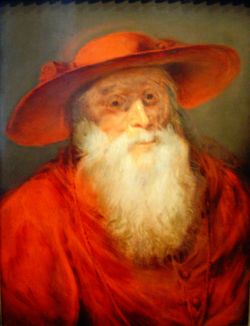 Damasus I was active in defending the Catholic Church against the threat of schism
s. In two Roman synods (368 and 369) he condemned Apollinarianism and Macedonianism, and sent legates to the First Council of Constantinople
that was convoked in 381 to address these heresies
.
Pope Damasus appointed Jerome
as his confidential secretary. Writing in 409 Jerome remarks, "A great many years ago when I was helping Damasus, bishop of Rome with his ecclesiastical correspondence, and writing his answers to the questions referred to him by the councils of the east and west..." If "east and west" do not betray the passage as an interpolation, Jerome spent three years (382–385) in Rome in close intercourse with Pope Damasus and the leading Christians. Invited there originally to a synod of 382 convened to end the schism
of Antioch
, he made himself indispensable to the pope, and took a prominent place in his councils.
In order to put an end to the marked divergences in the western texts of that period, Damasus encouraged the highly respected scholar to revise the available Old Latin
versions of the Bible
into a more accurate Latin
on the basis of the Greek New Testament
and the Septuagint, resulting in the Vulgate
. Jerome devotes a very brief notice to Damasus in his De Viris Illustribus
, written after Damasus' death: "he had a fine talent for making verses and published many brief works in heroic metre. He died in the reign of the emperor Theodosius
at the age of almost eighty".
St. Damasus sat in the Chair of St. Peter eighteen years and two months. His feast day is December 11.
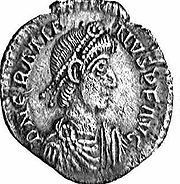 The reign of Gratian
, during Damasus' papacy, forms an important epoch in ecclesiastical history, since during that period (359–383), Catholic Christianity, for the first time became dominant throughout the empire. Under the influence of Ambrose, Gratian prohibited pagan worship
at Rome
; refused to wear the insignia of the pontifex maximus
as unbefitting a Christian; removed the Altar of Victory
from the Senate
at Rome, despite protests of the pagan members of the Senate, and confiscated its revenues; forbade legacies of real property to the Vestals; and abolished other privileges belonging to them and to the pontiffs.
, sought earnestly the aid and encouragement of Damasus against an apparently triumphant Arianism
; Damasus, however, harbored some degree of suspicion against the great Cappadocia
n Doctor of the Church
. In the matter of the Meletian Schism
at Antioch, Damasus—together with Pope St. Athanasius of Alexandria
and his successor, Peter II of Alexandria
—sympathized with the party of Paulinus
as more sincerely representative of Nicene orthodoxy; on the death of Meletius
he sought to secure the succession for Paulinus and to exclude Flavian
. He supported the appeal of the Christian senators to Emperor Gratian
for the removal of the altar of Victory from the Senate House, and lived to welcome the famous edict of Theodosius I
, "De fide Catholica" (February 27, 380), which proclaimed as the religion of the Roman State that doctrine which Saint Peter
had preached to the Romans and of which Damasus was head.
During his papacy, Peter II was obliged for a while to seek refuge in Rome
from the persecuting Arians. He was received by Damasus, who sympathised with him and gave him support against the Arians. This reconciled the relations between the Church of Rome
and the Church of Antioch
, which both supported the Church of Alexandria
.
, known as San Lorenzo fuori le Mura
("St Lawrence outside the walls"), which by the 7th century was a station on the itineraries of the graves of the Roman martyrs.
Damasus' devotion for the Roman martyr is attested also by the tradition, according to which the pope built a church devoted to Laurence in his own house, San Lorenzo in Damaso
.
He was born around 305, probably near the city of Idanha-a-Velha
Idanha-a-Velha
Idanha-a-Velha is a parish in the east of Portugal, in the municipality of Idanha-a-Nova, and in the district Castelo Branco. It covers an area of 20.98 km² and had a population of 79 as of 2001.-History:...
(in Lusitania
Lusitania
Lusitania or Hispania Lusitania was an ancient Roman province including approximately all of modern Portugal south of the Douro river and part of modern Spain . It was named after the Lusitani or Lusitanian people...
, Hispania
Hispania
Another theory holds that the name derives from Ezpanna, the Basque word for "border" or "edge", thus meaning the farthest area or place. Isidore of Sevilla considered Hispania derived from Hispalis....
), in what is present-day Portugal
Portugal
Portugal , officially the Portuguese Republic is a country situated in southwestern Europe on the Iberian Peninsula. Portugal is the westernmost country of Europe, and is bordered by the Atlantic Ocean to the West and South and by Spain to the North and East. The Atlantic archipelagos of the...
, then part of the Western Roman Empire
Western Roman Empire
The Western Roman Empire was the western half of the Roman Empire after its division by Diocletian in 285; the other half of the Roman Empire was the Eastern Roman Empire, commonly referred to today as the Byzantine Empire....
. His life coincided with the rise of Constantine I
Constantine I
Constantine the Great , also known as Constantine I or Saint Constantine, was Roman Emperor from 306 to 337. Well known for being the first Roman emperor to convert to Christianity, Constantine and co-Emperor Licinius issued the Edict of Milan in 313, which proclaimed religious tolerance of all...
and the reunion and redivision of the Western
Western Roman Empire
The Western Roman Empire was the western half of the Roman Empire after its division by Diocletian in 285; the other half of the Roman Empire was the Eastern Roman Empire, commonly referred to today as the Byzantine Empire....
and Eastern Roman Empires, associated with the widespread legitimization of Christianity
Christianity
Christianity is a monotheistic religion based on the life and teachings of Jesus as presented in canonical gospels and other New Testament writings...
and the later adoption of Christianity as the official religion of the Roman state.
Damasus is known to have been raised in the service of the Basilica
Basilica
The Latin word basilica , was originally used to describe a Roman public building, usually located in the forum of a Roman town. Public basilicas began to appear in Hellenistic cities in the 2nd century BC.The term was also applied to buildings used for religious purposes...
of San Lorenzo fuori le Mura
San Lorenzo fuori le Mura
The Papal Basilica of Saint Lawrence outside the Walls is a Roman Catholic parish church and minor basilica, located in Rome, Italy. The basilica is one of the Seven Pilgrim Churches of Rome and one of the five Patriarchal basilicas, each of which is assigned to a patriarchate. St...
in Rome
Rome
Rome is the capital of Italy and the country's largest and most populated city and comune, with over 2.7 million residents in . The city is located in the central-western portion of the Italian Peninsula, on the Tiber River within the Lazio region of Italy.Rome's history spans two and a half...
, and following the death of Pope Liberius
Pope Liberius
Pope Liberius, pope from May 17, 352, to September 24, 366, was consecrated according to the Catalogus Liberianus on May 22, as the successor of Pope Julius I. He was regarded as a saint in the early Church, but his name was later removed from the Roman Martyrology, however, he is once again...
, he succeeded to the Papacy amidst factional violence. A group of Damasus' supporters, previously loyal to his opponent Felix
Antipope Felix II
Antipope Felix II was installed as Pope in 355 after the Emperor Constantius II banished the reigning Pope, Liberius, for refusing to subscribe the sentence of condemnation against Saint Athanasius. In May 357 the Roman laity, which had remained faithful to Liberius, demanded that Constantius, who...
attacked and killed rivals loyal to Liberius' deacon
Deacon
Deacon is a ministry in the Christian Church that is generally associated with service of some kind, but which varies among theological and denominational traditions...
Ursinus
Antipope Ursicinus
Ursicinus, also known as Ursinus, was elected pope in a violently contested election in 366 as a rival to Pope Damasus I. He ruled in Rome for several months in 366 – 367, was afterwards declared an antipope, and died after 381....
, in a riot that required the intervention of Emperor Valentinian I
Valentinian I
Valentinian I , also known as Valentinian the Great, was Roman emperor from 364 to 375. Upon becoming emperor he made his brother Valens his co-emperor, giving him rule of the eastern provinces while Valentinian retained the west....
to quell.
Damasus faced accusations of murder and adultery (despite having not been married) in his early years as pope. The neutrality of these claims have come into question with some suggesting that the accusations were motivated by the schismatic conflict with the supporters of Arianism
Arianism
Arianism is the theological teaching attributed to Arius , a Christian presbyter from Alexandria, Egypt, concerning the relationship of the entities of the Trinity and the precise nature of the Son of God as being a subordinate entity to God the Father...
. His personal problems were contrasted with his religious accomplishments, which included restoring Saint Lawrence outside the Walls, appointing Jerome
Jerome
Saint Jerome was a Roman Christian priest, confessor, theologian and historian, and who became a Doctor of the Church. He was the son of Eusebius, of the city of Stridon, which was on the border of Dalmatia and Pannonia...
as his personal secretary and encouraging his Vulgate
Vulgate
The Vulgate is a late 4th-century Latin translation of the Bible. It was largely the work of St. Jerome, who was commissioned by Pope Damasus I in 382 to make a revision of the old Latin translations...
translation of the Bible
Bible
The Bible refers to any one of the collections of the primary religious texts of Judaism and Christianity. There is no common version of the Bible, as the individual books , their contents and their order vary among denominations...
, and presiding over the Council of Rome
Council of Rome
The Council of Rome was a meeting of Christian Church officials and theologians which took place in 382 under the authority of the bishop of Rome, Damasus I. The previous year, the Emperor Theodosius I had appointed the "dark horse" candidate Nectarius Archbishop of Constantinople...
in 382, which set down the canon of Scripture
Biblical canon
A biblical canon, or canon of scripture, is a list of books considered to be authoritative as scripture by a particular religious community. The term itself was first coined by Christians, but the idea is found in Jewish sources. The internal wording of the text can also be specified, for example...
. He also did much to encourage the veneration of the martyrs
Christian martyrs
A Christian martyr is one who is killed for following Christianity, through stoning, crucifixion, burning at the stake or other forms of torture and capital punishment. The word "martyr" comes from the Greek word μάρτυς, mártys, which means "witness."...
.
Early life
Damasus' parents were Antonius, a priest at the Church of St. Lawrence (San Lorenzo) in Rome, and Laurentia. During Damasus' early years, Constantine I rose to rule first the Western Roman EmpireWestern Roman Empire
The Western Roman Empire was the western half of the Roman Empire after its division by Diocletian in 285; the other half of the Roman Empire was the Eastern Roman Empire, commonly referred to today as the Byzantine Empire....
, presiding over the Edict of Milan
Edict of Milan
The Edict of Milan was a letter signed by emperors Constantine I and Licinius that proclaimed religious toleration in the Roman Empire...
(313) and winning religious freedom for Christians in all parts of the Roman Empire. A crisis precipitated by the rejection of religious freedom by Licinius
Licinius
Licinius I , was Roman Emperor from 308 to 324. Co-author of the Edict of Milan that granted official toleration to Christians in the Roman Empire, for the majority of his reign he was the rival of Constantine I...
, Emperor of the Eastern Roman Empire, in favor of paganism
Paganism
Paganism is a blanket term, typically used to refer to non-Abrahamic, indigenous polytheistic religious traditions....
resulted in a civil war (324) that placed Constantine firmly in control of a reunited Empire, and led to the establishment of Christian religious supremacy in Constantinople
Constantinople
Constantinople was the capital of the Roman, Eastern Roman, Byzantine, Latin, and Ottoman Empires. Throughout most of the Middle Ages, Constantinople was Europe's largest and wealthiest city.-Names:...
, called Nova Roma
Constantinople
Constantinople was the capital of the Roman, Eastern Roman, Byzantine, Latin, and Ottoman Empires. Throughout most of the Middle Ages, Constantinople was Europe's largest and wealthiest city.-Names:...
as well as Rome, gradually leading to a see which sought to rival the authority of the Roman See
Holy See
The Holy See is the episcopal jurisdiction of the Catholic Church in Rome, in which its Bishop is commonly known as the Pope. It is the preeminent episcopal see of the Catholic Church, forming the central government of the Church. As such, diplomatically, and in other spheres the Holy See acts and...
. Damasus would have been in his twenties at the time.
Rise in the Church
When Pope Liberius was banished by Emperor Constantius IIConstantius II
Constantius II , was Roman Emperor from 337 to 361. The second son of Constantine I and Fausta, he ascended to the throne with his brothers Constantine II and Constans upon their father's death....
to Berea
Veria
Veria is a city built at the foot of Vermion Mountains in Greece. It is a commercial center of Macedonia, the capital of the prefecture of Imathia, the province of Imathia and the seat of a bishop of the Greek Orthodox Church...
, in 354, Damasus was archdeacon
Deacon
Deacon is a ministry in the Christian Church that is generally associated with service of some kind, but which varies among theological and denominational traditions...
of the Roman church and followed Liberius into exile, though he immediately returned to Rome. During the period before Liberius' return, Damasus had a great share in the government of the church.
The succession crisis
In the early Church, new Bishops of Rome were elected or chosen by the clergyClergy
Clergy is the generic term used to describe the formal religious leadership within a given religion. A clergyman, churchman or cleric is a member of the clergy, especially one who is a priest, preacher, pastor, or other religious professional....
and the people of the diocese in the presence of the other bishops in the province, which was the manner customarily used in other diocese
Diocese
A diocese is the district or see under the supervision of a bishop. It is divided into parishes.An archdiocese is more significant than a diocese. An archdiocese is presided over by an archbishop whose see may have or had importance due to size or historical significance...
s. While this simple method worked well in a small community of Christians unified by persecution, as the congregation grew in size, the acclamation of a new bishop was fraught with division, and rival claimants and a certain class hostility between patrician and plebeian candidates unsettled some episcopal elections. At the same time, 4th century emperors expected each new pope-elect to be presented to them for approval, which sometimes led to state domination of the Church's internal affairs.
On the death of Liberius, September 24, 366, one faction supported Ursinus
Antipope Ursicinus
Ursicinus, also known as Ursinus, was elected pope in a violently contested election in 366 as a rival to Pope Damasus I. He ruled in Rome for several months in 366 – 367, was afterwards declared an antipope, and died after 381....
(or Ursicinus) who had served as deacon to Liberius, while the other faction, previously loyal to the Antipope Felix II
Antipope Felix II
Antipope Felix II was installed as Pope in 355 after the Emperor Constantius II banished the reigning Pope, Liberius, for refusing to subscribe the sentence of condemnation against Saint Athanasius. In May 357 the Roman laity, which had remained faithful to Liberius, demanded that Constantius, who...
, supported Damasus. The upper-class partisans of Felix supported the election of Damasus, but the opposing supporters of Liberius, the deacons and laity, supported Ursinus; the two were elected simultaneously (Damasus' election was held in San Lorenzo in Lucina
San Lorenzo in Lucina
The Church of St Lawrence's at Lucina is a Roman Catholic parish and titular church and minor basilica in Rome, Italy, dedicated to Saint Lawrence, Roman deacon and martyr. The name Lucina comes from the Roman matron owner of the house on which the church was built.The current Cardinal Priest of...
), in an atmosphere of rioting. Supporters already clashed at the beginning of October. Such was the violence and bloodshed that the two prefect
Prefect
Prefect is a magisterial title of varying definition....
s of the city were called in to restore order, and after a first setback, when they were driven to the suburbs and a massacre of 137 was perpetrated in the basilica of Sicininus (the modern Basilica di Santa Maria Maggiore
Basilica di Santa Maria Maggiore
The Papal Basilica of Saint Mary Major , known also by other names, is the largest Roman Catholic Marian church in Rome, Italy.There are other churches in Rome dedicated to Mary, such as Santa Maria in Trastevere, Santa Maria in Aracoeli, Santa Maria sopra Minerva, but the greater size of the...
), the prefects banished Ursinus to Gaul
Gaul
Gaul was a region of Western Europe during the Iron Age and Roman era, encompassing present day France, Luxembourg and Belgium, most of Switzerland, the western part of Northern Italy, as well as the parts of the Netherlands and Germany on the left bank of the Rhine. The Gauls were the speakers of...
. There was further violence when he returned, which continued after Ursinus was exiled again.
Church historians, such as St. Jerome
Jerome
Saint Jerome was a Roman Christian priest, confessor, theologian and historian, and who became a Doctor of the Church. He was the son of Eusebius, of the city of Stridon, which was on the border of Dalmatia and Pannonia...
and Rufinus
Tyrannius Rufinus
Tyrannius Rufinus or Rufinus of Aquileia was a monk, historian, and theologian. He is most known as a translator of Greek patristic material into Latin—especially the work of Origen.-Life:...
, championed Damasus. At a synod in 378 Ursinus was condemned and Damasus exonerated and declared the true pope. The former antipope continued to intrigue against Damasus for the next few years, and unsuccessfully attempted to revive his claim on Damasus's death. Ursinus was among the Arian
Arianism
Arianism is the theological teaching attributed to Arius , a Christian presbyter from Alexandria, Egypt, concerning the relationship of the entities of the Trinity and the precise nature of the Son of God as being a subordinate entity to God the Father...
party in Milan
Milan
Milan is the second-largest city in Italy and the capital city of the region of Lombardy and of the province of Milan. The city proper has a population of about 1.3 million, while its urban area, roughly coinciding with its administrative province and the bordering Province of Monza and Brianza ,...
, according to Ambrose
Ambrose
Aurelius Ambrosius, better known in English as Saint Ambrose , was a bishop of Milan who became one of the most influential ecclesiastical figures of the 4th century. He was one of the four original doctors of the Church.-Political career:Ambrose was born into a Roman Christian family between about...
.
This dissension climaxed with a riot which led to a three-day massacre and to the rare intervention of Emperor Valentinian I
Valentinian I
Valentinian I , also known as Valentinian the Great, was Roman emperor from 364 to 375. Upon becoming emperor he made his brother Valens his co-emperor, giving him rule of the eastern provinces while Valentinian retained the west....
to uphold public order. Damasus prevailed, but only with the support of the city prefect. Once he was securely consecrated bishop of Rome, his men attacked Ursinus and his remaining supporters who were seeking refuge in the Liberian basilica, resulting in a massacre of one hundred and thirty seven supporters of Ursinus. Damasus was also accused of murder before a later prefect, but his rich friends secured the personal intervention of the emperor to rescue him from this humiliation. The reputations of both Damasus and the Roman church in general suffered greatly due to these two unseemly incidents.
Edward Gibbon
Edward Gibbon
Edward Gibbon was an English historian and Member of Parliament...
writes, "The enemies of Damasus styled him Auriscalpius Matronarum, the ladies' ear-scratcher."
Association with Jerome, defense of the Church against schism
Schism (religion)
A schism , from Greek σχίσμα, skhísma , is a division between people, usually belonging to an organization or movement religious denomination. The word is most frequently applied to a break of communion between two sections of Christianity that were previously a single body, or to a division within...
s. In two Roman synods (368 and 369) he condemned Apollinarianism and Macedonianism, and sent legates to the First Council of Constantinople
First Council of Constantinople
The First Council of Constantinople is recognized as the Second Ecumenical Council by the Assyrian Church of the East, the Oriental Orthodox, the Eastern Orthodox, the Roman Catholics, the Old Catholics, and a number of other Western Christian groups. It was the first Ecumenical Council held in...
that was convoked in 381 to address these heresies
Christian heresy
Christian heresy refers to non-orthodox practices and beliefs that were deemed to be heretical by one or more of the Christian churches. In Western Christianity, the term "heresy" most commonly refers to those beliefs which were declared to be anathema by the Catholic Church prior to the schism of...
.
Pope Damasus appointed Jerome
Jerome
Saint Jerome was a Roman Christian priest, confessor, theologian and historian, and who became a Doctor of the Church. He was the son of Eusebius, of the city of Stridon, which was on the border of Dalmatia and Pannonia...
as his confidential secretary. Writing in 409 Jerome remarks, "A great many years ago when I was helping Damasus, bishop of Rome with his ecclesiastical correspondence, and writing his answers to the questions referred to him by the councils of the east and west..." If "east and west" do not betray the passage as an interpolation, Jerome spent three years (382–385) in Rome in close intercourse with Pope Damasus and the leading Christians. Invited there originally to a synod of 382 convened to end the schism
Schism (religion)
A schism , from Greek σχίσμα, skhísma , is a division between people, usually belonging to an organization or movement religious denomination. The word is most frequently applied to a break of communion between two sections of Christianity that were previously a single body, or to a division within...
of Antioch
Antioch
Antioch on the Orontes was an ancient city on the eastern side of the Orontes River. It is near the modern city of Antakya, Turkey.Founded near the end of the 4th century BC by Seleucus I Nicator, one of Alexander the Great's generals, Antioch eventually rivaled Alexandria as the chief city of the...
, he made himself indispensable to the pope, and took a prominent place in his councils.
In order to put an end to the marked divergences in the western texts of that period, Damasus encouraged the highly respected scholar to revise the available Old Latin
Vetus Latina
Vetus Latina is a collective name given to the Biblical texts in Latin that were translated before St Jerome's Vulgate Bible became the standard Bible for Latin-speaking Western Christians. The phrase Vetus Latina is Latin for Old Latin, and the Vetus Latina is sometimes known as the Old Latin Bible...
versions of the Bible
Bible
The Bible refers to any one of the collections of the primary religious texts of Judaism and Christianity. There is no common version of the Bible, as the individual books , their contents and their order vary among denominations...
into a more accurate Latin
Latin
Latin is an Italic language originally spoken in Latium and Ancient Rome. It, along with most European languages, is a descendant of the ancient Proto-Indo-European language. Although it is considered a dead language, a number of scholars and members of the Christian clergy speak it fluently, and...
on the basis of the Greek New Testament
New Testament
The New Testament is the second major division of the Christian biblical canon, the first such division being the much longer Old Testament....
and the Septuagint, resulting in the Vulgate
Vulgate
The Vulgate is a late 4th-century Latin translation of the Bible. It was largely the work of St. Jerome, who was commissioned by Pope Damasus I in 382 to make a revision of the old Latin translations...
. Jerome devotes a very brief notice to Damasus in his De Viris Illustribus
De Viris Illustribus (Jerome)
De viris illustribus is a collection of short biographies of 135 authors, written in Latin, by the 4th century Latin Church Father Jerome. He completed this work at Bethlehem in 392-3 CE. The work consists of a prologue plus 135 chapters, each consisting of a brief biography. Jerome himself is...
, written after Damasus' death: "he had a fine talent for making verses and published many brief works in heroic metre. He died in the reign of the emperor Theodosius
Theodosius I
Theodosius I , also known as Theodosius the Great, was Roman Emperor from 379 to 395. Theodosius was the last emperor to rule over both the eastern and the western halves of the Roman Empire. During his reign, the Goths secured control of Illyricum after the Gothic War, establishing their homeland...
at the age of almost eighty".
St. Damasus sat in the Chair of St. Peter eighteen years and two months. His feast day is December 11.
Emperor Gratian
Gratian
Gratian was Roman Emperor from 375 to 383.The eldest son of Valentinian I, during his youth Gratian accompanied his father on several campaigns along the Rhine and Danube frontiers. Upon the death of Valentinian in 375, Gratian's brother Valentinian II was declared emperor by his father's soldiers...
, during Damasus' papacy, forms an important epoch in ecclesiastical history, since during that period (359–383), Catholic Christianity, for the first time became dominant throughout the empire. Under the influence of Ambrose, Gratian prohibited pagan worship
Paganism
Paganism is a blanket term, typically used to refer to non-Abrahamic, indigenous polytheistic religious traditions....
at Rome
Rome
Rome is the capital of Italy and the country's largest and most populated city and comune, with over 2.7 million residents in . The city is located in the central-western portion of the Italian Peninsula, on the Tiber River within the Lazio region of Italy.Rome's history spans two and a half...
; refused to wear the insignia of the pontifex maximus
Pontifex Maximus
The Pontifex Maximus was the high priest of the College of Pontiffs in ancient Rome. This was the most important position in the ancient Roman religion, open only to patricians until 254 BC, when a plebeian first occupied this post...
as unbefitting a Christian; removed the Altar of Victory
Altar of Victory
The Altar of Victory was located in the Roman Senate House bearing a gold statue of the goddess Victory. The altar was established by Octavian in 29 BC in honor of the defeat of Antony and Cleopatra at Actium. The statue depicted a winged woman, holding a palm and descending to present a laurel...
from the Senate
Roman Senate
The Senate of the Roman Republic was a political institution in the ancient Roman Republic, however, it was not an elected body, but one whose members were appointed by the consuls, and later by the censors. After a magistrate served his term in office, it usually was followed with automatic...
at Rome, despite protests of the pagan members of the Senate, and confiscated its revenues; forbade legacies of real property to the Vestals; and abolished other privileges belonging to them and to the pontiffs.
Relations with other churches
The Eastern Church, in the person of St. Basil of CaesareaBasil of Caesarea
Basil of Caesarea, also called Saint Basil the Great, was the bishop of Caesarea Mazaca in Cappadocia, Asia Minor . He was an influential 4th century Christian theologian...
, sought earnestly the aid and encouragement of Damasus against an apparently triumphant Arianism
Arianism
Arianism is the theological teaching attributed to Arius , a Christian presbyter from Alexandria, Egypt, concerning the relationship of the entities of the Trinity and the precise nature of the Son of God as being a subordinate entity to God the Father...
; Damasus, however, harbored some degree of suspicion against the great Cappadocia
Cappadocia
Cappadocia is a historical region in Central Anatolia, largely in Nevşehir Province.In the time of Herodotus, the Cappadocians were reported as occupying the whole region from Mount Taurus to the vicinity of the Euxine...
n Doctor of the Church
Doctor of the Church
Doctor of the Church is a title given by a variety of Christian churches to individuals whom they recognize as having been of particular importance, particularly regarding their contribution to theology or doctrine.-Catholic Church:In the Catholic Church, this name is given to a saint from whose...
. In the matter of the Meletian Schism
Meletius of Antioch
Saint Meletius of Antioch was a Christian bishop, or Patriarch of Antioch, from 360 until his death. There were contrasting view about his theological position: on the one hand, he was exiled three times under Arian emperors; on the other, he was strongly opposed by those faithful to the memory...
at Antioch, Damasus—together with Pope St. Athanasius of Alexandria
Athanasius of Alexandria
Athanasius of Alexandria [b. ca. – d. 2 May 373] is also given the titles St. Athanasius the Great, St. Athanasius I of Alexandria, St Athanasius the Confessor and St Athanasius the Apostolic. He was the 20th bishop of Alexandria. His long episcopate lasted 45 years Athanasius of Alexandria [b....
and his successor, Peter II of Alexandria
Peter II of Alexandria
Pope Peter II of Alexandria served as Pope of Alexandria between 373 and 380. He is commemorated in the Coptic Synaxarion on the 20th day of Amshir, the day of his death.Athanasius had designated him as his successor before his death in 373....
—sympathized with the party of Paulinus
Paulinus, Bishop of Antioch
Paulinus was a claimant to the See of Antioch from 362 to 388. He was supported by members of the Eustathian party, and was a rival to Meletius of Antioch. The Eustathians objected to Miletius having been consecrated by Arians, and had begun to meet separately...
as more sincerely representative of Nicene orthodoxy; on the death of Meletius
Meletius of Antioch
Saint Meletius of Antioch was a Christian bishop, or Patriarch of Antioch, from 360 until his death. There were contrasting view about his theological position: on the one hand, he was exiled three times under Arian emperors; on the other, he was strongly opposed by those faithful to the memory...
he sought to secure the succession for Paulinus and to exclude Flavian
Flavian I of Antioch
Flavian I of Antioch was a bishop or Patriarch of Antioch from 381 until his death.He was born about 320, most probably in Antioch. He inherited great wealth, but resolved to devote his riches and his talents to the service of the church...
. He supported the appeal of the Christian senators to Emperor Gratian
Gratian
Gratian was Roman Emperor from 375 to 383.The eldest son of Valentinian I, during his youth Gratian accompanied his father on several campaigns along the Rhine and Danube frontiers. Upon the death of Valentinian in 375, Gratian's brother Valentinian II was declared emperor by his father's soldiers...
for the removal of the altar of Victory from the Senate House, and lived to welcome the famous edict of Theodosius I
Theodosius I
Theodosius I , also known as Theodosius the Great, was Roman Emperor from 379 to 395. Theodosius was the last emperor to rule over both the eastern and the western halves of the Roman Empire. During his reign, the Goths secured control of Illyricum after the Gothic War, establishing their homeland...
, "De fide Catholica" (February 27, 380), which proclaimed as the religion of the Roman State that doctrine which Saint Peter
Saint Peter
Saint Peter or Simon Peter was an early Christian leader, who is featured prominently in the New Testament Gospels and the Acts of the Apostles. The son of John or of Jonah and from the village of Bethsaida in the province of Galilee, his brother Andrew was also an apostle...
had preached to the Romans and of which Damasus was head.
During his papacy, Peter II was obliged for a while to seek refuge in Rome
Rome
Rome is the capital of Italy and the country's largest and most populated city and comune, with over 2.7 million residents in . The city is located in the central-western portion of the Italian Peninsula, on the Tiber River within the Lazio region of Italy.Rome's history spans two and a half...
from the persecuting Arians. He was received by Damasus, who sympathised with him and gave him support against the Arians. This reconciled the relations between the Church of Rome
Roman Catholic Church
The Catholic Church, also known as the Roman Catholic Church, is the world's largest Christian church, with over a billion members. Led by the Pope, it defines its mission as spreading the gospel of Jesus Christ, administering the sacraments and exercising charity...
and the Church of Antioch
Church of Antioch
The Church of Antioch is one of the five major churches that composed the Christian Church before the East-West Schism.-History:...
, which both supported the Church of Alexandria
Church of Alexandria
The Church of Alexandria in Egypt is the particular church headed by the Patriarch of Alexandria. It is one of the original four Apostolic Sees of Christianity, with Rome, Antioch and Jerusalem ....
.
Devotion to Saint Laurence
Damasus rebuilt or repaired a church named for Saint LaurenceSaint Lawrence
Lawrence of Rome was one of the seven deacons of ancient Rome who were martyred during the persecution of Valerian in 258.- Holy Chalice :...
, known as San Lorenzo fuori le Mura
San Lorenzo fuori le Mura
The Papal Basilica of Saint Lawrence outside the Walls is a Roman Catholic parish church and minor basilica, located in Rome, Italy. The basilica is one of the Seven Pilgrim Churches of Rome and one of the five Patriarchal basilicas, each of which is assigned to a patriarchate. St...
("St Lawrence outside the walls"), which by the 7th century was a station on the itineraries of the graves of the Roman martyrs.
Damasus' devotion for the Roman martyr is attested also by the tradition, according to which the pope built a church devoted to Laurence in his own house, San Lorenzo in Damaso
San Lorenzo in Damaso
San Lorenzo in Damaso is a basilica church in Rome, Italy, one of several dedicated to the Roman deacon and martyr Saint Lawrence...
.
Letters of Jerome to Damasus
The alleged letters from Jerome to Damasus have sometimes been adduced as examples of the primacy of the seat of Peter:- …Yet, though your greatness terrifies me, your kindness attracts me. From the priest I demand the safe-keeping of the victim, from the shepherd the protection due to the sheep. Away with all that is overweening; let the state of Roman majesty withdraw. My words are spoken to the successor of the fisherman, to the disciple of the cross. As I follow no leader save Christ, so I communicate with none but your blessedness, that is with the chair of Peter. For this, I know, is the rock on which the church is built! This is the house where alone the paschal lamb can be rightly eaten. This is the ark of Noah, and he who is not found in it shall perish when the flood prevails. But since by reason of my sins I have betaken myself to this desert which lies between Syria and the uncivilized waste, I cannot, owing to the great distance between us, always ask of your sanctity the holy thing of the Lord. Consequently I here follow the Egyptian confessors who share your faith, and anchor my frail craft under the shadow of their great argosies. I know nothing of Vitalis; I reject Meletius; I have nothing to do with Paulinus. He that gathers not with you scatters; he that is not of Christ is of Antichrist.