


Education in Portugal

Encyclopedia
Education in Portugal is regulated by the State through two ministries
- the Ministry of Education, and the Ministry of Science, Technology and Higher Education. There are a system of public education
and also many private school
s at all levels of education. The first Portuguese
medieval universities were created in the 13th century, and the national higher education system is fully integrated into the European Higher Education Area
. The basic literacy
rate of the Portuguese population is 93%, however the functional literacy is amongst the lowest in Europe. According to official sources in 2007, 64% of the population had never read a single book; within the population component that is functionally literate, only 17.9% read more than two books in one year (data collected by Marktest for TSF
). According to INE (Portuguese Institute for National Statistics), only 3.7 million Portuguese workers (67% of the working active population) completed basic education (81% of the working population attainned the lower basic level of education and 12% attained the intermediate level of education). According to the OECD's Programme for International Student Assessment
(PISA) 2009, the average Portuguese 15-years old student, when rated in terms of reading literacy, mathematics and science knowledge, is placed at the same level as those students from the United States, Sweden, Germany, Ireland, France, Denmark, United Kingdom, Hungary and Taipei
, with 489 points (493 is the average). Despite its gradual modernization and relative expansion since the 1960s, the educational system remained underdeveloped until the 2000s when it finally reached the World's best practices and trends.
nationality, the Christian
clergy
was the main player in the educational endeavour. Portuguese universities have existed since 1290. Within the scope of the Portuguese Empire
, the Portuguese founded in 1792 the oldest engineering school of Latin America
(the Real Academia de Artilharia, Fortificação e Desenho), as well as the oldest medical college of Asia
(the Goa Medical College
) in 1842.
However, by the end of the 19th century the illiteracy rate was at over 80 percent and higher education was reserved for a small percentage of the population. 68.1 percent of Portugal's population was still classified as illiterate by the 1930 census.
Portugal's literacy rate by the 1940s and early 1950s was low for North America
n and Western Europe
an standards at the time. From the 1960s, the country made public education available for all children between the ages of six and twelve, expanded a robust network of industrial and commercial technical schools aimed at intermediate education of future skilled workers (ensino médio), recognized the Portuguese Catholic University in 1971, and by 1973 a wave of new state-run universities were founded across mainland Portugal (the Minho University, the New University of Lisbon
, the University of Évora
, and the University of Aveiro - Veiga Simão was the Minister in charge for education by then). From the 1960s to the 1974 Carnation Revolution
, secondary and university education experienced the fastest growth of Portuguese education's history. After 1974 the number of basic and secondary schools as well as of higher education institutions, increased until the end of the century, sometimes without the necessary allocation of quality material and qualified human resources. Anyway, education more than basic (4th or 6th grade) wasn't really affordable for most Portuguese families, the real democratization of education, specially secondary and higher education, only happened in the 1980s. After mid-2000s programs of modernization of schools (basic and secondary) and the construction of new elementary schools called "educational centres" (mostly to reduce the number of overloaded elementary schools, to widespread the 9 AM to 5h30 PM schedule system, because in most overloaded schools there are classes with 8 AM-1 PM schedule and other with 1 PM-6 PM) are being held.
The Bologna process
for higher education
has been adopted since 2006. However the higher-education rate in the country still remains the lowest in the European Union, this rate was around 7% in 2003 (Source: OECD (2003) Education at a Glance and OECD Statistical Compendium), and improved to 11% in 2007 - as compared to Slovakia's and Slovenia's around 16%; Germany's, Estonia, Spain's and Ireland's 28%; or Belgium's, Netherland's, Denmark's, Finland's, Cyprus's and UK's, over 30% (Source: EuroStat, March 2007). According to the OECD's Programme for International Student Assessment
(PISA), the average Portuguese 15-years old student was for many years underrated and underachieving in terms of reading literacy, mathematics and science knowledge in the OECD, nearly tied with the Italian and just above those from countries like Greece, Turkey and Mexico. However, since 2010, PISA results for Portuguese students improved dramatically. The Portuguese Ministry of Education announced a 2010 report published by its office for educational evaluation GAVE (Gabinete de Avaliação do Ministério da Educação) which criticized the results of PISA 2009 report and claimed that the average Portugese teenage student had profund handicaps in terms of expression, communication and logic, as well as a low performance when asked to solve problems. They also claimed that those fallacies are not exclusive of Portugal but indeed occur in other countries due to the way PISA was designed.
or International Baccalaureate.
Children aged six by 15 September must be enrolled in their first school year in that calendar year. In addition, children who reach the age of six between 16 September and 31 December may be authorized to attend the first stage of education, provided a request is submitted by their parents or guardians to the school nearest to their residence (or place of work) during the annual enrollment period. State-run schools are free of charge; private school tuition is refunded by the State in part or fully, when state-run schools in the area are filled to capacity. The first cycle of basic mandatory education covers years 1st-4th, the second cycle years 5th-6th and the third cycle years 7th-9th. The curriculum contains only general education until the 9th year at which point vocational subjects are introduced.
Schools do not give (or sell) any books or materials; financial assistance is available for poorer families. The school books are chosen at school's level every four years.
1st Cycle State-run schools are owned by the municipalities; all other State-run schools are owned by the State.
At State-run schools, 1st Cycle students and sometimes students of other cycles get free mid-morning or mid-afternoon snacks, generally consisting of a 20 cl milk carton.
Personal and Social Education:
Subjects like English, Musical Education, Physical Education among others are offered according to school resources and are part of Enrichment Activities.
Catholic (or other confessions) Moral and Religious Education are optional.
9th Year
Same subjects, plus:
(or between the first and the third, in some schools)
Education system branches out into different secondary programmes, one higher education-oriented (general secondary courses/programmes) and the other more work-oriented (technological secondary courses/programmes). The conclusion of secondary education (general or technological courses) with passing grades confers a diploma, which will certificate the qualification thus obtained and, in the case of work-oriented programmes the qualification for specific jobs.
All General and Technological courses share the following subjects known as General Formation:
All of these programmes offer initial vocational and education training, although the recurrent studies also offer general education. Recurrent education consists of non-regular programmes of study or modular or single units because they are not complete training cycles and they are not included in the regular progression of the education system. The recurrent education provides a second opportunity of training for those who did not undertake training at the normal age or who left school early. Recurrent education covers the three cycles of basic education and the secondary education.
The recurrent education is characterized by the flexibility and adaptability to the students’ learning cycle, availability, knowledge and experiences. The recurrent secondary education branches into two types of courses: the general course for those who want to continue their studies and the technical courses that are work-oriented and confer a level III vocational certificate, although they also permit the access to higher education. Any of the secondary courses, vocational courses, apprenticeship courses (level III), recurrent courses and others (artistic and those of technological schools) share a three-dimensional structure (although the importance of each dimension could vary according to the specific course):
a) general / socio-cultural
b) specific / scientific
c) technical / technological / practical / vocational
The Portuguese educational/vocational system is open. This means that once any student finishes his/her basic studies successfully he/she can choose, freely, any kind of course in any training domain/area. Any secondary course completed successfully allows the student apply to any course of higher education, independently of the training domain the student chose in the secondary level of education.
In Portugal initial vocational education and training can be divided into two main modalities according to the Ministry responsible for the training:
a) Initial vocational education and training in the education system (under the regulation of the Ministry of Education):
- The technological secondary courses are work-oriented and confer qualification for specific jobs, which correspond to the E.U.
level III of vocational qualifications. There are eleven technological courses in the domain of natural sciences, arts, social-economic sciences and humanities;
- The vocational schools courses are a special modality of education that has a primary goal: the development of youngsters’ vocational training. In this type of course the students spend most of their time in practical, technological, technical and artistic training, which allows the development of specific skills indispensable to an occupation. The vocational courses are drawn to give answers to both local and regional labour market needs. These courses function under the regulation of the Ministry of Education, although under the direct initiative and responsibility of civil society institutions, such as municipalities, enterprises, trade unions, etc. The vocational courses are available in the third cycle of basic education (level II) – only a few - and in the secondary education (level III).
- The technical recurrent courses. In the secondary education, the recurrent studies branches into two different types of courses: the general courses and the technical courses. The latter are work-oriented, vocationally oriented to confer a level III vocational certificate;
- The courses of initial qualification can be promoted by schools lecturing the third cycle of mandatory education. If it is necessary, schools can establish protocols with other institutions such as municipalities, enterprises or vocational training centres. These courses are open to a) youngsters who have a 9th grade diploma, without any vocational qualification, and who do not intend to continue their studies; and b) youngsters who, having reached fifteen years of age and attended the 9th grade, did not achieve the basic education certificate.
b) Initial vocational education and training in the labour market (under the regulation of the Ministry of Labour and Social Solidarity through the Institute of Employment and Vocational Training):
- Apprenticeship system. The apprenticeship courses are part of an initial vocational training system alternating between the school and the workplace, addressing mainly youngsters aged between fifteen and twenty five years who are not included in the mandatory school system. The training process alternates between the professional/vocational (where the socio-cultural, scientific-technological and the practice training in training context takes place) and the workplace (where the practice training in work context takes place).
In the mid 2000s, education policy was reorganised aiming more choice and better quality in vocational technical education. Enhanced and improved technical education programs where implemented in 2007 in an effort to revitalize this sector which had been almost discontinued after the Carnation Revolution
of 1974, when many vocational technical schools were administratively upgraded to higher education technical colleges and other were simply closed. This happened despite those vocational technical schools have been generally regarded as reputed institutions with a record of very high standards in vocational technical education across the decades they were supplying the technical labor needs of the country.
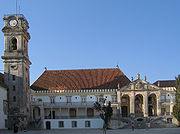 Higher education in Portugal is divided into two main subsystems: university
and polytechnic
education, and it is provided in autonomous public universities
, private universities
, public or private university institutes, polytechnic institutions and higher education institutions of other types. The university system has a strong theoretical basis and is highly research-oriented; the non-university system provides a more practical training and is profession-oriented. Degrees in some fields such as medicine
, law
, natural sciences, economics
, psychology
or veterinary are university. Other fields like engineering
, technology
, management
, education
, agriculture
, sports, or humanities
are found both in university and polytechnic systems. Nursing
, preschool education, accounting technician, or health care technician degrees, are only offered in the polytechnic system. The oldest university is the University of Coimbra founded in 1290, and the biggest by number of enrolled students is the University of Porto
with about 28,000 students. The Catholic University of Portugal, the oldest non-state-run university (concordat
ary status), was instituted by decree of the Holy See
and is recognized by the State of Portugal since 1971. The current public polytechnic subsystem of Institutos Politécnicos was founded in the 1980s. A few polytechnical higher education institutions, though formed as such in the 1980s, have their origin in 19th century educational institutions - this is the case of the Instituto Superior de Engenharia de Lisboa
, the Instituto Superior de Engenharia do Porto
and the Escola Superior Agrária de Coimbra
.
Private higher education institutions cannot operate if they are not recognized by the Ministry of Education. Access is regulated by the same procedures as those for state higher education institutions. The two systems of higher education (university and polytechnic) are linked and it is possible to transfer from one to the other by extraordinary competition. It is also possible to transfer from a public institution to a private one and vice-versa. Admission to public university programmes are often more demanding and selective than to their equivalent in public polytechnic and private institutions. Many specific university institutions and degrees are also regarded as more prestigious and reputed than their peers from the polytechnic system or from certain less notable university institutions.
Many universities are usually organized by Faculty (Faculdade). Institute (Instituto) and School (Escola) are also common designations for autonomous units of Portuguese higher learning institutions, and are always used in the polytechnical system, but also in several universities.
After mid 2000s, with the approval of new legislation and the Bologna Process
any polytechnic or university institution of Portugal, is able to award a first cycle of study, known as licenciatura plus a second cycle which confer the master's degree
. Before that, this was the rule only for university institutions. Virtually all university institutions award master's degrees as a second cycle of study, but some university departments are offering integrated master's degrees (joint degrees) through a longer single cycle of study. Some polytechnic institutions offer the second study cycle in cooperation with a partner university. Doctorate
s are only awarded by the universities.
There are also special higher education institutions linked with the military
and the police
. These specific institutions have generally a good reputation and are popular among the youngsters because its courses are a passport to the military/police career. These state-run institutions are the Air Force Academy
, the Military Academy
, the Naval School
and the Instituto Superior de Ciências Policiais e Segurança Interna
.
Over 35% of college-age citizens (20 years old) attend one of the country's higher education institutions (compared with 50% in the United States and 35% in the OECD countries).
Most student costs are supported with public money. However, with the increasing tuition fees a student has to pay to attend a Portuguese state-run higher education institution and the attraction of new types of students (many as part time students or in evening classes) like employees, businessmen, parents, and pensioners, many departments make a substantial profit from every additional student enrolled in courses, with benefits for the college or university's gross tuition revenue and without loss of educational quality (teacher per student, computer per student, classroom size per student, etc).
was a Europe
an reform process aimed at establishing a European Higher Education
Area by 2010. It was an unusual process in that it was loosely structured and driven by the 45 countries participating in it in cooperation with a number of international organisations, including the Council of Europe
.
The reform aim was to create by 2010 a higher education system in Europe, organised in such a way that:
Portugal, like other European States, has conducted educational policies and reforms to accomplish these objectives. This include the reorganization of both university and polytechnic subsystems and the implementation of extensive legal and curricular changes. Since its field application in 2006 is has being widely contested by students (many lost an academic year with the change), and several universities had disrepute the concept by introducing integrated master degrees in several courses.
(since 2006 - 2007) maintained the degree names but their significance changed. In ascending order of importance:
Bacharelato (Not academically equivalent to Bachelor's degree
) - title: Bacharel or Engenheiro Técnico for technical engineers - abbreviation: none or Bach.
Licenciatura (Academic License) - title: Licenciado (popular: Doutor or Engenheiro for a License in engineering
) - abbreviation used in front of holder's name: Lic. (popular: Dr. or Eng. for Engineer
, used extensively (formal and colloquially))
Pós-Graduação or Especialização (Postgraduate degree) - no specific title
Mestrado (Master's degree
) - title: Mestre
Doutoramento (Doctorate
) - used in front of holder's name: Doutor
Agregação (Agrégation
) - used in front of holder's name: Professor Doutor
exams. An extraordinary exam process is available to anyone aged 23 or older. Admission to private institutions is at the total discretion of each school. Every higher education institution has also a number of other extraordinary admission processes for sportsmen, international students, foreign students from the Lusosphere, degree owners from other institutions, students from other institutions (academic transfer), former students (readmission), and course change, which are subject to specific standards and regulations set by each institution or course department.
, but they are not required to have previously specialised in any specific area at the secondary school. Students sit for one or more entrance exams, Concurso nacional for public institutions or Concurso local for private institutions. In addition to passing entrance exams, students must fulfil particular prerequisites for the chosen course. Enrollment is limited; each year the institution establishes the number of places available. This is called the numerus clausus
. For the public institutions the exam scores count for the final evaluation, which includes the secondary school average marks. Then the students have to choose six institutions/courses they prefer to attend, in preferential order. The ones, who reach the marks needed to attend the desired institution/course, given the attributed vacant, will be admitted. This means that the students could not be admitted at its first or second choice, but be admitted at the third or even sixth choice. In some cases, those entering polytechnics or nursing and health technologies schools, should have some previous vocational training and preference will be given to applicants from the catchment area of the institution concerned. From the academic year 2005/2006 onwards, access rules have enforced minimum grades of 95 (out of 200) in the national access examinations for all candidates in every sector of public higher education. In practical terms, and unlike what happened in the past, the new rule meant the exclusion of a large number of applicants who otherwise would have been admitted with negative grades to the less selective courses of some public institutions, and consequently lead to a number of available places for students left vacant every year in many courses.
The process consists of the general Portuguese exam, an interview to evaluate motivation and CV, and additional exams specific to each school and course, obligatorily written and oral.
Candidates approved go through a separate numerus clausus or enroll directly at the discretion of the school's board. As what happens with the Concurso Nacional through the Exames Nacionais do Ensino Secundário (ENES), the Extraordinary Exam Process for over-23-year-old candidates is more demanding and has a much higher selectiveness in public universities than in the public polytechnics. Humanities and other non-mathematical-intensive fields have also much higher admission rates than classical university engineering, economics or medicine. This implies that almost all new students admitted by this extraordinary process enter a polytechnic institution
, private institution
, or humanities
programmes.
Teachers of basic education attend 4-year courses in Escolas Superiores de Educação or at the universities to obtain a Licenciado degree.
The government as passed a law (February/2007) that makes a teacher to have also a " mestre " degree in Basic and Secondary Education.
Training of secondary school teachers
Teachers of secondary education must hold a Licenciado degree and follow courses that last for between four and six years. Studies are sanctioned by a Licenciado em Ensino or a Licenciatura - Ramo de Formação Educacional, according to the issuing institution. Educators and basic and secondary education teachers, with practice in regular or special education, may obtain a qualification to teach in specialized education. Continuous training for teachers is offered in Centros de Formação Continua.
The government as passed a law (February/2007) that makes a teacher to have also a " mestre " degree in Basic and Secondary Education.
Training of higher education teachers
Teachers at this level receive no formal professional training, but minimum qualifications are laid down for each category.
University: assistente estagiário (Licenciado); assistente (Mestre); professor auxiliar (Doutor); professor associado (Doutor and five years' service); professor catedrático (Agregação and three years' service).
Polytechnics: assistente (Licenciado); professor adjunto (Mestre or DESE); professor coordenador (Doutor and 3-years' service).
(Open University).
Some Portuguese employers and families are of the opinion that the existence of private education institutions, where accessibility is based primarily on ability to pay, is not as fair as the public system and could gloom the meritocracy
concept, leading to easier entrance criteria and lower teaching standards. Some private institutions are known for making it easy for students to enter and also to get higher grades - as long as they pay. Others claim that the private systems could prevent a significant portion of Portugal's population from being able to attend these schools that is also unfair. The quotas imposed on public education institutions to create room for students from former Portuguese colonies, who get automatically a place in those institutions also creates a big problem in terms of fairness, as some of these students can enter with very low grades excluding a portion of the Portuguese born students from studying in the public institutions and first choice courses they want.
On the other side there are some people who prefer to attend private institutions because they don't trust in the public educational infrastructure they have near their residential area. This could be related with overcrowded classes, bad reputation, criminality levels, incidence of ethnic minorities generally considered problematic, lack of quality teaching staff or bad infrastructures in that specific institution.
Without large endowments like those received, for example, by many of the US private universities and colleges, and with little tradition of excellence in the sector, the private higher education institutions of Portugal, with a few exceptions, do not have either the financial support or the academic profile to reach the highest teaching and research standards of the major Portuguese public universities. In addition, a lack of collaboration between the most prominent private sector enterprises and the private universities is also restrictive, and represents another comparative disadvantage between public and private higher education institutions.
Traditionally, public system's institutions are regarded in general as having higher quality and accountability
, but private institutions have developed quickly after the 25 de Abril revolution of 1974, and some have today a great reputation. There are both public and private institutions considered of the highest standard and quality. However, a large majority of Portuguese students attend public schools, universities and colleges because it is considerably less expensive than the private ones, the public system has a much older implantation, and for the other side it covers well the entire territory. There are also some students who simply desire and can afford to attend an elite private institution, even if they have availability to attend one of the largest or most renowned public institutions.
A number of scandals and affairs involving private higher education institutions (Universidade Moderna (1998), Universidade Independente (2007) and Universidade Internacional (2009), among others), and a general perception of many of those institutions as having a tendentially relaxed teaching style with less rigorous criteria, have contributed to their poor reputation which originated a state-run inspection of private higher education institutions in 2007.
s, specially in Greater Lisbon's suburbs where many immigrants, immigrant descendants from PALOP countries, among some other ethnic minorities, are concentrated, and also areas with higher unemployment rates and other severe social problems, exist schools with generalized high dropout
and juvenile delinquency
rates. In Greater Porto there are no African or other significant immigrant ghettos like in Lisbon, but there is a high dropout and juvenile delinquency rates among nationals from former rural areas, of humble origins or from ethnic minorities from specific districts or quarters.
School violence
in Portugal is not unique to public schools or the major urban centers. Public and private Portuguese schools have all experienced an increase in school violence. However, due to the general wealth and educational background of private school student's families, and the increased private security measures adopted, private schools have generally a lower level of violence.
Violence in Portuguese schools became an educational issue for the first time during the 1990s, mainly through the persistence of parental associations and teacher claims. However, it must be said that this was not the first time that violence appeared in Portuguese schools as a significant situation. For decades, during the dictatorship, police violence against students was common inside universities. After the democratisation in 25 de Abril revolution of 1974 the occurrence of violent situations reached the highest point when the intense political debate in schools often ended in physical confrontations between students and even teachers (which was not generally seen as a school violence problem but as a reflection of the violence widely present in the political debate in society). Nevertheless this was a politically socialized and framed violence, quite different from the kind of violence we can find today. That one had political programs, this one is quite anomic. Its origin is very diverse, from poverty to psychological problems. Theft, random or systematic physical aggression, bullying, destruction of school or teachers properties are realities which become current in many schools.http://www.gold.ac.uk/connect/reportportugal.html
In May 2006, a television program was broadcast in RTP 1
, titled Quando a violência vai à escola (When violence goes to the school) by journalist Mafalda Gameiro. Using hidden cameras in the classrooms, the program shows the violent behavior of many young students (with ages between 10 and 13 years old) inside the classroom of a very problematic unidentified school, and the chaos and fear often generated. Students and teachers privacy was also protected during image recording for TV. In 2004 and 2005, the Portuguese Ministry of Education reported over 1,200 aggressions inside Portuguese schools.
and Porto
areas, and also in the Algarve region. These places have a large number of settled foreign families from high income countries. In general, they have good reputation.
Aljezur International School
is a progressive English speaking international secondary school, with an excellent exam result history, and VVIS International School Algarve reports that it has obtained a 100% academic success rate for the last four years for first attempmt IGCSE examinations. Other private schools have obtained world renowned status, including schools such as the Carlucci American International School of Lisbon
(CAISL), VVIS International School Algarve, St Julian's School
, St Dominic's International School
and Vilamoura International School. Oeiras International School
is the latest addition to this set of international schools, opening in September 2010 and catering for students in the area of Greater Lisbon.
coup of 1974 to the Bologna process
of 2007.
There has been also concerns related to the large dropout
rates (mostly in the secondary
and higher education
systems), and the high multi generational functional illiteracy
(48% functional illiterates in Portugal, among the adult population; all over U.S.A. 30 million (14% of adults) are functionally illiterate) and illiteracy rates (7.5% = ~ 800,000 illiterates) - a quite mediocre statistical record when compared with other developed countries of Europe
, North America
and Eastern Asia.
The failure of many private universities and other higher education institutions in providing higher education to students due to generalized lack of quality and rigour has also been a major problem - for several years those institutions were awarding degrees to thousands of people who were spread into the economically active population. Some higher education institutions, in particular from the private and polytechnic sector, have been regarded as true diploma mill
s. In the following decades after their creation in the 1970s and 1980s, the polytechnic institutions didn't assume their specific role as tertiary education vocational schools, which were created to award practical diplomas in more technical or basic fields.
Non-university intermediate professionals and skilled workers for the industry, agriculture, commerce and other services where needed. As more new public university institutions were founded or expanded, polytechnics didn't feel comfortable with their subaltern status in the Portuguese higher education system and a desire to be upgraded into university-like institutions grew among the polytechnic institutions' administrations. This desire of emancipation and evolution from polytechnic status to university status, was not followed by better qualified teaching staff, better facilities for teaching or researching, or by a stronger curricula with a more selective admission criteria, comparable with those enforced by almost all public university institutions. Criteria ambiguity and the general lower standards in polytechnic higher education and admission, were fiercely criticised by education personalities like university rector
s, regarding issues like the lack of admission exams in mathematics for polytechnic engineering applicants, and the proliferation of administration and management courses everywhere, many without a proper curriculum in mathematics, statistics and economics-related disciplines.
According to studies and reports, in the 1990s and 2000s, a fast growth and proliferation of private higher education
and state-run polytechnical institutions
with lower educational standards and ambiguous academic integrity, was responsible for unnecessary and uneconomic allocation of resources with no adequate quality output in terms of both new highly qualified graduates and research.
In March 2008 a mega-protest hit many Portuguese cities along the country, joining over 85,000 basic and secondary school
teachers from all the country in the capital city of Lisbon (March 8), criticizing the Portuguese Minister of Education Maria de Lurdes Rodrigues
(XVII Governo Constitucional headed by PM José Sócrates
) and her new policies, including a new system of teacher's evaluation.
In addition, the XVII Governo Constitucional (the government headed by PM José Sócrates), created a policy of certification and equivalence of qualifications for adult people with low levels of formal education who want a 4th, 6th, 9th or 12th grade equivalence without returning to school (for example, through this process, called Novas Oportunidades, adults (18 years old and older) with the 9th grade might be granted an equivalence to the 12th grade after a process ranging from a part-time 3-month programme or a 1 day per week 8-month programme; those who have less than 9th grade have a similar programme to get the 9th grade certification and can then apply to the 12th grade programme). The curricula do not include any classical high school discipline or a traditional examination process. These diplomas are awarded based on vaguely construed life experience. Some critics alleged this policy was an effort to make up the poor national statistical indicators on education, with little impact on the quality of the work force's qualification of Portugal in the European Union context.
Ministry (government department)
A ministry is a specialised organisation responsible for a sector of government public administration, sometimes led by a minister or a senior public servant, that can have responsibility for one or more departments, agencies, bureaus, commissions or other smaller executive, advisory, managerial or...
- the Ministry of Education, and the Ministry of Science, Technology and Higher Education. There are a system of public education
Public education
State schools, also known in the United States and Canada as public schools,In much of the Commonwealth, including Australia, New Zealand, South Africa, and the United Kingdom, the terms 'public education', 'public school' and 'independent school' are used for private schools, that is, schools...
and also many private school
Private school
Private schools, also known as independent schools or nonstate schools, are not administered by local, state or national governments; thus, they retain the right to select their students and are funded in whole or in part by charging their students' tuition, rather than relying on mandatory...
s at all levels of education. The first Portuguese
Portugal
Portugal , officially the Portuguese Republic is a country situated in southwestern Europe on the Iberian Peninsula. Portugal is the westernmost country of Europe, and is bordered by the Atlantic Ocean to the West and South and by Spain to the North and East. The Atlantic archipelagos of the...
medieval universities were created in the 13th century, and the national higher education system is fully integrated into the European Higher Education Area
European Higher Education Area
The European Higher Education Area was launched along with the Bologna Process' decade anniversary, in March 2010, during the Budapest-Vienna Ministerial Conference....
. The basic literacy
Literacy
Literacy has traditionally been described as the ability to read for knowledge, write coherently and think critically about printed material.Literacy represents the lifelong, intellectual process of gaining meaning from print...
rate of the Portuguese population is 93%, however the functional literacy is amongst the lowest in Europe. According to official sources in 2007, 64% of the population had never read a single book; within the population component that is functionally literate, only 17.9% read more than two books in one year (data collected by Marktest for TSF
TSF (radio)
TSF is a Portuguese radio station headquartered in Lisbon. It is a news focused radio station. It was legally founded in 1989, but its first emission was on February 29, 1988....
). According to INE (Portuguese Institute for National Statistics), only 3.7 million Portuguese workers (67% of the working active population) completed basic education (81% of the working population attainned the lower basic level of education and 12% attained the intermediate level of education). According to the OECD's Programme for International Student Assessment
Programme for International Student Assessment
The Programme for International Student Assessment is a worldwide evaluation in OECD member countries of 15-year-old school pupils' scholastic performance, performed first in 2000 and repeated every three years...
(PISA) 2009, the average Portuguese 15-years old student, when rated in terms of reading literacy, mathematics and science knowledge, is placed at the same level as those students from the United States, Sweden, Germany, Ireland, France, Denmark, United Kingdom, Hungary and Taipei
Taipei
Taipei City is the capital of the Republic of China and the central city of the largest metropolitan area of Taiwan. Situated at the northern tip of the island, Taipei is located on the Tamsui River, and is about 25 km southwest of Keelung, its port on the Pacific Ocean...
, with 489 points (493 is the average). Despite its gradual modernization and relative expansion since the 1960s, the educational system remained underdeveloped until the 2000s when it finally reached the World's best practices and trends.
History
In the beginnings of the PortuguesePortugal
Portugal , officially the Portuguese Republic is a country situated in southwestern Europe on the Iberian Peninsula. Portugal is the westernmost country of Europe, and is bordered by the Atlantic Ocean to the West and South and by Spain to the North and East. The Atlantic archipelagos of the...
nationality, the Christian
Christian
A Christian is a person who adheres to Christianity, an Abrahamic, monotheistic religion based on the life and teachings of Jesus of Nazareth as recorded in the Canonical gospels and the letters of the New Testament...
clergy
Clergy
Clergy is the generic term used to describe the formal religious leadership within a given religion. A clergyman, churchman or cleric is a member of the clergy, especially one who is a priest, preacher, pastor, or other religious professional....
was the main player in the educational endeavour. Portuguese universities have existed since 1290. Within the scope of the Portuguese Empire
Portuguese Empire
The Portuguese Empire , also known as the Portuguese Overseas Empire or the Portuguese Colonial Empire , was the first global empire in history...
, the Portuguese founded in 1792 the oldest engineering school of Latin America
Latin America
Latin America is a region of the Americas where Romance languages – particularly Spanish and Portuguese, and variably French – are primarily spoken. Latin America has an area of approximately 21,069,500 km² , almost 3.9% of the Earth's surface or 14.1% of its land surface area...
(the Real Academia de Artilharia, Fortificação e Desenho), as well as the oldest medical college of Asia
Asia
Asia is the world's largest and most populous continent, located primarily in the eastern and northern hemispheres. It covers 8.7% of the Earth's total surface area and with approximately 3.879 billion people, it hosts 60% of the world's current human population...
(the Goa Medical College
Goa Medical College
Goa Medical College is a medical college and hospital in Goa, India. It was built by the Portuguese in 1842 as the Escola Médico-Cirúrgica de Goa . It is the oldest Medical College in Asia...
) in 1842.
However, by the end of the 19th century the illiteracy rate was at over 80 percent and higher education was reserved for a small percentage of the population. 68.1 percent of Portugal's population was still classified as illiterate by the 1930 census.
Portugal's literacy rate by the 1940s and early 1950s was low for North America
North America
North America is a continent wholly within the Northern Hemisphere and almost wholly within the Western Hemisphere. It is also considered a northern subcontinent of the Americas...
n and Western Europe
Western Europe
Western Europe is a loose term for the collection of countries in the western most region of the European continents, though this definition is context-dependent and carries cultural and political connotations. One definition describes Western Europe as a geographic entity—the region lying in the...
an standards at the time. From the 1960s, the country made public education available for all children between the ages of six and twelve, expanded a robust network of industrial and commercial technical schools aimed at intermediate education of future skilled workers (ensino médio), recognized the Portuguese Catholic University in 1971, and by 1973 a wave of new state-run universities were founded across mainland Portugal (the Minho University, the New University of Lisbon
New University of Lisbon
Universidade NOVA de Lisboa, , also known as NOVA ) was established in 1973 and is the youngest of the three public universities of Lisbon, in Portugal....
, the University of Évora
University of Évora
The University of Évora is a public university in Évora, Portugal.-History:The University of Évora, the second oldest in Portugal, was founded in the 16th century by Cardinal Infante Dom Henrique , and by the Pope Paul IV, and it was delivered to the Society of Jesus.The Jesuit college...
, and the University of Aveiro - Veiga Simão was the Minister in charge for education by then). From the 1960s to the 1974 Carnation Revolution
Carnation Revolution
The Carnation Revolution , also referred to as the 25 de Abril , was a military coup started on 25 April 1974, in Lisbon, Portugal, coupled with an unanticipated and extensive campaign of civil resistance...
, secondary and university education experienced the fastest growth of Portuguese education's history. After 1974 the number of basic and secondary schools as well as of higher education institutions, increased until the end of the century, sometimes without the necessary allocation of quality material and qualified human resources. Anyway, education more than basic (4th or 6th grade) wasn't really affordable for most Portuguese families, the real democratization of education, specially secondary and higher education, only happened in the 1980s. After mid-2000s programs of modernization of schools (basic and secondary) and the construction of new elementary schools called "educational centres" (mostly to reduce the number of overloaded elementary schools, to widespread the 9 AM to 5h30 PM schedule system, because in most overloaded schools there are classes with 8 AM-1 PM schedule and other with 1 PM-6 PM) are being held.
The Bologna process
Bologna process
The purpose of the Bologna Process is the creation of the European Higher Education Area by making academic degree standards and quality assurance standards more comparable and compatible throughout Europe, in particular under the Lisbon Recognition Convention...
for higher education
Higher education in Portugal
Higher education in Portugal is divided into two main subsystems: university and polytechnic education. It is provided in autonomous public universities, private universities, public or private university institutes, polytechnic institutions and higher education institutions of other types...
has been adopted since 2006. However the higher-education rate in the country still remains the lowest in the European Union, this rate was around 7% in 2003 (Source: OECD (2003) Education at a Glance and OECD Statistical Compendium), and improved to 11% in 2007 - as compared to Slovakia's and Slovenia's around 16%; Germany's, Estonia, Spain's and Ireland's 28%; or Belgium's, Netherland's, Denmark's, Finland's, Cyprus's and UK's, over 30% (Source: EuroStat, March 2007). According to the OECD's Programme for International Student Assessment
Programme for International Student Assessment
The Programme for International Student Assessment is a worldwide evaluation in OECD member countries of 15-year-old school pupils' scholastic performance, performed first in 2000 and repeated every three years...
(PISA), the average Portuguese 15-years old student was for many years underrated and underachieving in terms of reading literacy, mathematics and science knowledge in the OECD, nearly tied with the Italian and just above those from countries like Greece, Turkey and Mexico. However, since 2010, PISA results for Portuguese students improved dramatically. The Portuguese Ministry of Education announced a 2010 report published by its office for educational evaluation GAVE (Gabinete de Avaliação do Ministério da Educação) which criticized the results of PISA 2009 report and claimed that the average Portugese teenage student had profund handicaps in terms of expression, communication and logic, as well as a low performance when asked to solve problems. They also claimed that those fallacies are not exclusive of Portugal but indeed occur in other countries due to the way PISA was designed.
Pre-primary education
Pre-primary education is optional from the ages of three to five, and is provided in both state-run and private nursery schools. State-run nursery provision is free of charge; fees are payable for private nursery schools. The schools are known as Jardins-de-Infância (Kindergartens). Most international schools offer an international approach to pre-primary learning and follow a curriculum such as the International Preschool CurriculumInternational Preschool Curriculum
The International Preschool Curriculum "IPC" is research based curriculum for children aged 3 to 6. The curriculum is devised and reviewed by an advisory committee consisting of academics, teachers and education consultants.-Features:...
or International Baccalaureate.
Pre-higher education
Basic Education lasts for nine years divided into three stages of four, two and three years respectively. The stages are respectively Ensino Básico – 1º Ciclo; Ensino Básico – 2º Ciclo and Ensino Básico – 3º Ciclo. A Diploma/Certificate is awarded at the end of the third stage. Secondary education - public, private and cooperative - is compulsory and consists of a three-year cycle after basic education. Access is through the Certificate of Basic Education. There are two types of courses: general courses and technical/vocational courses, providing instruction in technical, technological, professional fields and in the Portuguese language and culture. Permeability between the courses is guaranteed. The teaching and practice of technical, technological or artistic courses are provided by vocational schools and special schools for education in Arts. Courses are sanctioned by the Certificado de Habilitações do Ensino Secundário/Diploma de Ensino Secundário (Secondary School Credential/Diploma), which is the prerequisite for access to higher education through national access examination (people aged 23 and over can apply to higher education institutions through other special examination, even without the Secondary School Credential/Diploma).Basic education
In Portugal, Basic Education consists of nine years of schooling divided into three sequential cycles of education of four, two and three years.Children aged six by 15 September must be enrolled in their first school year in that calendar year. In addition, children who reach the age of six between 16 September and 31 December may be authorized to attend the first stage of education, provided a request is submitted by their parents or guardians to the school nearest to their residence (or place of work) during the annual enrollment period. State-run schools are free of charge; private school tuition is refunded by the State in part or fully, when state-run schools in the area are filled to capacity. The first cycle of basic mandatory education covers years 1st-4th, the second cycle years 5th-6th and the third cycle years 7th-9th. The curriculum contains only general education until the 9th year at which point vocational subjects are introduced.
Schools do not give (or sell) any books or materials; financial assistance is available for poorer families. The school books are chosen at school's level every four years.
1st Cycle State-run schools are owned by the municipalities; all other State-run schools are owned by the State.
At State-run schools, 1st Cycle students and sometimes students of other cycles get free mid-morning or mid-afternoon snacks, generally consisting of a 20 cl milk carton.
1º Ciclo - 1st Cycle
Compulsory subjects:- Portuguese Language
- (Physical and Social) Environment Study
- Mathematics
- Physical and Artistic Education
Personal and Social Education:
- Project Area
- Accompanied Study
- Citizenship Education
Subjects like English, Musical Education, Physical Education among others are offered according to school resources and are part of Enrichment Activities.
Catholic (or other confessions) Moral and Religious Education are optional.
2º Ciclo - 2nd Cycle
- Portuguese Language
- Mathematics
- History and Geography of Portugal
- Foreign Language I / English (levels 1 and 2)
- Natural Sciences
- Visual and Technological Education (Arts and Crafts)
- Physical Education
- Musical Education
- Personal and Social Development or Catholic (or other confessions) Moral and Religious Education (facultative)
- Project Area
- Accompanied Study
- Civic Education
3º Ciclo - 3rd Cycle
7th and 8th years- Portuguese Language
- Mathematics
- Foreign Language I - English (levels 3 and 4)
- Foreign Language II - French or Spanish or German (levels 1 and 2 - some schools may offer only 2 or 1 of the options)
- Natural Sciences
- History
- Geography
- Physics/Chemistry
- Visual Education (Arts)
- Another artistic subject ( Music, Theatre, Dance...) - not offered by some schools
- Technological Education (Hand Works)
- Physical Education
- Personal and Social Development or Catholic (or other confessions) Moral and Religious Education (Facultative)
- Project Area
- Accompanished Study
- Civic Education
9th Year
Same subjects, plus:
- Information and Communication Technologies.
- Option among Visual Education, Music/Theatre or Dance and Technological Education.
(or between the first and the third, in some schools)
Secondary education
It is only after the 9th grade of basic schooling that the Portuguese GeneralEducation system branches out into different secondary programmes, one higher education-oriented (general secondary courses/programmes) and the other more work-oriented (technological secondary courses/programmes). The conclusion of secondary education (general or technological courses) with passing grades confers a diploma, which will certificate the qualification thus obtained and, in the case of work-oriented programmes the qualification for specific jobs.
All General and Technological courses share the following subjects known as General Formation:
- Portuguese Language
- Philosophy (10th and 11th years)
- Physical Education
- Foreign Language I or II (10th and 11th years)
- Personal and Social Development or Catholic (or other confessions) Moral and Religious Education (as above, facultative)
General Courses
- Sciences and Technologies (I or II) - specific subjects: Biology-Geology (I), Physics-Chemistry(I and II), Math (A), Biology (12th grade option), Geology (12th grade option), Psychology (12th grade option), Physics (12th grade option), Chemistry (12th grade option) or Descriptive Geometry (II).
- Social and Human sciences - History, Geography, Literature, Math Applied to Social Sciences, Psychology (12th grade option), Law (12th grade option)
- Socio-Economic Sciences - Economy, Geography
- Visual Arts - Drawing, Descriptive Geometry (I), Math (B) or Art History
Technological Courses
- Civil Construction
- Electronics
- Computing
- Equipment Design
- Multimedia
- Administration
- Marketing
- Environment and Territory Order
- Social action
- Sport, among others.
Other types of school education
There are also special modalities of school education. The programmes offered by vocational schools, those of the apprenticeship system and those of recurrent studies are considered as a special modality of school education. These programmes are not regular, because they are not included in the mainstream regular progression of the education system to which they are an alternative given that they were designed to respond to specific educational needs of different target-groups of the population.All of these programmes offer initial vocational and education training, although the recurrent studies also offer general education. Recurrent education consists of non-regular programmes of study or modular or single units because they are not complete training cycles and they are not included in the regular progression of the education system. The recurrent education provides a second opportunity of training for those who did not undertake training at the normal age or who left school early. Recurrent education covers the three cycles of basic education and the secondary education.
The recurrent education is characterized by the flexibility and adaptability to the students’ learning cycle, availability, knowledge and experiences. The recurrent secondary education branches into two types of courses: the general course for those who want to continue their studies and the technical courses that are work-oriented and confer a level III vocational certificate, although they also permit the access to higher education. Any of the secondary courses, vocational courses, apprenticeship courses (level III), recurrent courses and others (artistic and those of technological schools) share a three-dimensional structure (although the importance of each dimension could vary according to the specific course):
a) general / socio-cultural
b) specific / scientific
c) technical / technological / practical / vocational
The Portuguese educational/vocational system is open. This means that once any student finishes his/her basic studies successfully he/she can choose, freely, any kind of course in any training domain/area. Any secondary course completed successfully allows the student apply to any course of higher education, independently of the training domain the student chose in the secondary level of education.
In Portugal initial vocational education and training can be divided into two main modalities according to the Ministry responsible for the training:
a) Initial vocational education and training in the education system (under the regulation of the Ministry of Education):
- The technological secondary courses are work-oriented and confer qualification for specific jobs, which correspond to the E.U.
European Union
The European Union is an economic and political union of 27 independent member states which are located primarily in Europe. The EU traces its origins from the European Coal and Steel Community and the European Economic Community , formed by six countries in 1958...
level III of vocational qualifications. There are eleven technological courses in the domain of natural sciences, arts, social-economic sciences and humanities;
- The vocational schools courses are a special modality of education that has a primary goal: the development of youngsters’ vocational training. In this type of course the students spend most of their time in practical, technological, technical and artistic training, which allows the development of specific skills indispensable to an occupation. The vocational courses are drawn to give answers to both local and regional labour market needs. These courses function under the regulation of the Ministry of Education, although under the direct initiative and responsibility of civil society institutions, such as municipalities, enterprises, trade unions, etc. The vocational courses are available in the third cycle of basic education (level II) – only a few - and in the secondary education (level III).
- The technical recurrent courses. In the secondary education, the recurrent studies branches into two different types of courses: the general courses and the technical courses. The latter are work-oriented, vocationally oriented to confer a level III vocational certificate;
- The courses of initial qualification can be promoted by schools lecturing the third cycle of mandatory education. If it is necessary, schools can establish protocols with other institutions such as municipalities, enterprises or vocational training centres. These courses are open to a) youngsters who have a 9th grade diploma, without any vocational qualification, and who do not intend to continue their studies; and b) youngsters who, having reached fifteen years of age and attended the 9th grade, did not achieve the basic education certificate.
b) Initial vocational education and training in the labour market (under the regulation of the Ministry of Labour and Social Solidarity through the Institute of Employment and Vocational Training):
- Apprenticeship system. The apprenticeship courses are part of an initial vocational training system alternating between the school and the workplace, addressing mainly youngsters aged between fifteen and twenty five years who are not included in the mandatory school system. The training process alternates between the professional/vocational (where the socio-cultural, scientific-technological and the practice training in training context takes place) and the workplace (where the practice training in work context takes place).
In the mid 2000s, education policy was reorganised aiming more choice and better quality in vocational technical education. Enhanced and improved technical education programs where implemented in 2007 in an effort to revitalize this sector which had been almost discontinued after the Carnation Revolution
Carnation Revolution
The Carnation Revolution , also referred to as the 25 de Abril , was a military coup started on 25 April 1974, in Lisbon, Portugal, coupled with an unanticipated and extensive campaign of civil resistance...
of 1974, when many vocational technical schools were administratively upgraded to higher education technical colleges and other were simply closed. This happened despite those vocational technical schools have been generally regarded as reputed institutions with a record of very high standards in vocational technical education across the decades they were supplying the technical labor needs of the country.
Overview
University
A university is an institution of higher education and research, which grants academic degrees in a variety of subjects. A university is an organisation that provides both undergraduate education and postgraduate education...
and polytechnic
Polytechnic (Portugal)
A polytechnic is a higher education educational institution in Portugal created in the 1980s. After 1998 they were upgraded to institutions which are allowed to confer licenciatura degrees. Before then, they only awarded short-cycle degrees which were known as bacharelatos and didn't provide...
education, and it is provided in autonomous public universities
Public university
A public university is a university that is predominantly funded by public means through a national or subnational government, as opposed to private universities. A national university may or may not be considered a public university, depending on regions...
, private universities
Private university
Private universities are universities not operated by governments, although many receive public subsidies, especially in the form of tax breaks and public student loans and grants. Depending on their location, private universities may be subject to government regulation. Private universities are...
, public or private university institutes, polytechnic institutions and higher education institutions of other types. The university system has a strong theoretical basis and is highly research-oriented; the non-university system provides a more practical training and is profession-oriented. Degrees in some fields such as medicine
Medicine
Medicine is the science and art of healing. It encompasses a variety of health care practices evolved to maintain and restore health by the prevention and treatment of illness....
, law
Law
Law is a system of rules and guidelines which are enforced through social institutions to govern behavior, wherever possible. It shapes politics, economics and society in numerous ways and serves as a social mediator of relations between people. Contract law regulates everything from buying a bus...
, natural sciences, economics
Economics
Economics is the social science that analyzes the production, distribution, and consumption of goods and services. The term economics comes from the Ancient Greek from + , hence "rules of the house"...
, psychology
Psychology
Psychology is the study of the mind and behavior. Its immediate goal is to understand individuals and groups by both establishing general principles and researching specific cases. For many, the ultimate goal of psychology is to benefit society...
or veterinary are university. Other fields like engineering
Engineering
Engineering is the discipline, art, skill and profession of acquiring and applying scientific, mathematical, economic, social, and practical knowledge, in order to design and build structures, machines, devices, systems, materials and processes that safely realize improvements to the lives of...
, technology
Technology
Technology is the making, usage, and knowledge of tools, machines, techniques, crafts, systems or methods of organization in order to solve a problem or perform a specific function. It can also refer to the collection of such tools, machinery, and procedures. The word technology comes ;...
, management
Management
Management in all business and organizational activities is the act of getting people together to accomplish desired goals and objectives using available resources efficiently and effectively...
, education
Education
Education in its broadest, general sense is the means through which the aims and habits of a group of people lives on from one generation to the next. Generally, it occurs through any experience that has a formative effect on the way one thinks, feels, or acts...
, agriculture
Agriculture
Agriculture is the cultivation of animals, plants, fungi and other life forms for food, fiber, and other products used to sustain life. Agriculture was the key implement in the rise of sedentary human civilization, whereby farming of domesticated species created food surpluses that nurtured the...
, sports, or humanities
Humanities
The humanities are academic disciplines that study the human condition, using methods that are primarily analytical, critical, or speculative, as distinguished from the mainly empirical approaches of the natural sciences....
are found both in university and polytechnic systems. Nursing
Nursing
Nursing is a healthcare profession focused on the care of individuals, families, and communities so they may attain, maintain, or recover optimal health and quality of life from conception to death....
, preschool education, accounting technician, or health care technician degrees, are only offered in the polytechnic system. The oldest university is the University of Coimbra founded in 1290, and the biggest by number of enrolled students is the University of Porto
University of Porto
The University of Porto is a Portuguese public university located in Porto, and founded 22 March 1911. It is the largest Portuguese university by number of enrolled students and has one of the most noted research outputs in Portugal...
with about 28,000 students. The Catholic University of Portugal, the oldest non-state-run university (concordat
Concordat
A concordat is an agreement between the Holy See of the Catholic Church and a sovereign state on religious matters. Legally, they are international treaties. They often includes both recognition and privileges for the Catholic Church in a particular country...
ary status), was instituted by decree of the Holy See
Holy See
The Holy See is the episcopal jurisdiction of the Catholic Church in Rome, in which its Bishop is commonly known as the Pope. It is the preeminent episcopal see of the Catholic Church, forming the central government of the Church. As such, diplomatically, and in other spheres the Holy See acts and...
and is recognized by the State of Portugal since 1971. The current public polytechnic subsystem of Institutos Politécnicos was founded in the 1980s. A few polytechnical higher education institutions, though formed as such in the 1980s, have their origin in 19th century educational institutions - this is the case of the Instituto Superior de Engenharia de Lisboa
Instituto Superior de Engenharia de Lisboa
The Instituto Superior de Engenharia de Lisboa is a Portuguese higher education polytechnic institution of engineering. Headquartered in Lisbon, it belongs to the Instituto Politécnico de Lisboa.-History:...
, the Instituto Superior de Engenharia do Porto
Instituto Superior de Engenharia do Porto
The Instituto Superior de Engenharia do Porto or Porto Superior Institute of Engineering is a public polytechnic higher learning and research institute of engineering, located in the city of Porto, Portugal...
and the Escola Superior Agrária de Coimbra
Escola Superior Agrária de Coimbra
The Escola Superior Agrária de Coimbra , in English the Agrarian School of Coimbra, is a state-run polytechnic higher education school of agriculture, based in Coimbra, Portugal...
.
Private higher education institutions cannot operate if they are not recognized by the Ministry of Education. Access is regulated by the same procedures as those for state higher education institutions. The two systems of higher education (university and polytechnic) are linked and it is possible to transfer from one to the other by extraordinary competition. It is also possible to transfer from a public institution to a private one and vice-versa. Admission to public university programmes are often more demanding and selective than to their equivalent in public polytechnic and private institutions. Many specific university institutions and degrees are also regarded as more prestigious and reputed than their peers from the polytechnic system or from certain less notable university institutions.
Many universities are usually organized by Faculty (Faculdade). Institute (Instituto) and School (Escola) are also common designations for autonomous units of Portuguese higher learning institutions, and are always used in the polytechnical system, but also in several universities.
After mid 2000s, with the approval of new legislation and the Bologna Process
Bologna process
The purpose of the Bologna Process is the creation of the European Higher Education Area by making academic degree standards and quality assurance standards more comparable and compatible throughout Europe, in particular under the Lisbon Recognition Convention...
any polytechnic or university institution of Portugal, is able to award a first cycle of study, known as licenciatura plus a second cycle which confer the master's degree
Master's degree
A master's is an academic degree granted to individuals who have undergone study demonstrating a mastery or high-order overview of a specific field of study or area of professional practice...
. Before that, this was the rule only for university institutions. Virtually all university institutions award master's degrees as a second cycle of study, but some university departments are offering integrated master's degrees (joint degrees) through a longer single cycle of study. Some polytechnic institutions offer the second study cycle in cooperation with a partner university. Doctorate
Doctorate
A doctorate is an academic degree or professional degree that in most countries refers to a class of degrees which qualify the holder to teach in a specific field, A doctorate is an academic degree or professional degree that in most countries refers to a class of degrees which qualify the holder...
s are only awarded by the universities.
There are also special higher education institutions linked with the military
Military
A military is an organization authorized by its greater society to use lethal force, usually including use of weapons, in defending its country by combating actual or perceived threats. The military may have additional functions of use to its greater society, such as advancing a political agenda e.g...
and the police
Police
The police is a personification of the state designated to put in practice the enforced law, protect property and reduce civil disorder in civilian matters. Their powers include the legitimized use of force...
. These specific institutions have generally a good reputation and are popular among the youngsters because its courses are a passport to the military/police career. These state-run institutions are the Air Force Academy
Portuguese Air Force Academy
The Air Force Academy is a Portuguese military higher education institution whose aim is to provide all its students with the training and the experience that will enable them to graduate having gained the knowledge and the character qualities that are essential for leadership, and the motivation...
, the Military Academy
Portuguese Military Academy
The Military Academy is a Portuguese military establishment, which has the ability to confer educational qualifications equivalent to a university...
, the Naval School
Portuguese Naval School
The Portuguese Naval School is a university-level naval academy in Lisbon, Portugal. Founded in 1845, the school is located at the Lisbon Naval Base, on the south bank of the Tagus river.-Academics:...
and the Instituto Superior de Ciências Policiais e Segurança Interna
Instituto Superior de Ciências Policiais e Segurança Interna
The Instituto Superior de Ciências Policiais e Segurança Interna is a Portuguese higher education institution, a police university institute or Police academy of the PSP - Polícia de Segurança Pública. It is located in Lisbon, Portugal.-External links:*...
.
Over 35% of college-age citizens (20 years old) attend one of the country's higher education institutions (compared with 50% in the United States and 35% in the OECD countries).
Most student costs are supported with public money. However, with the increasing tuition fees a student has to pay to attend a Portuguese state-run higher education institution and the attraction of new types of students (many as part time students or in evening classes) like employees, businessmen, parents, and pensioners, many departments make a substantial profit from every additional student enrolled in courses, with benefits for the college or university's gross tuition revenue and without loss of educational quality (teacher per student, computer per student, classroom size per student, etc).
University and polytechnic
Portugal has two main systems of higher education:- The universityUniversityA university is an institution of higher education and research, which grants academic degrees in a variety of subjects. A university is an organisation that provides both undergraduate education and postgraduate education...
system, which is the oldest, has its origins in the 13th century. It is composed of thirteen public universities, one public university institute, a public open university, and several private universities and university institutes.
- The polytechnicPolytechnic (Portugal)A polytechnic is a higher education educational institution in Portugal created in the 1980s. After 1998 they were upgraded to institutions which are allowed to confer licenciatura degrees. Before then, they only awarded short-cycle degrees which were known as bacharelatos and didn't provide...
system, that began offering higher education in the 1980s after the former industrial and commercial schools were converted into engineering and administration higher education schools (so its origins could be traced back to some earlier vocational educationVocational educationVocational education or vocational education and training is an education that prepares trainees for jobs that are based on manual or practical activities, traditionally non-academic, and totally related to a specific trade, occupation, or vocation...
schools of the 19th century). It is composed of fifteen state-run polytechnic institutes, public and private non-integrated polytechnic institutions, and other similar institutions.
The Bologna process in Portugal
The Bologna ProcessBologna process
The purpose of the Bologna Process is the creation of the European Higher Education Area by making academic degree standards and quality assurance standards more comparable and compatible throughout Europe, in particular under the Lisbon Recognition Convention...
was a Europe
Europe
Europe is, by convention, one of the world's seven continents. Comprising the westernmost peninsula of Eurasia, Europe is generally 'divided' from Asia to its east by the watershed divides of the Ural and Caucasus Mountains, the Ural River, the Caspian and Black Seas, and the waterways connecting...
an reform process aimed at establishing a European Higher Education
Higher education
Higher, post-secondary, tertiary, or third level education refers to the stage of learning that occurs at universities, academies, colleges, seminaries, and institutes of technology...
Area by 2010. It was an unusual process in that it was loosely structured and driven by the 45 countries participating in it in cooperation with a number of international organisations, including the Council of Europe
Council of Europe
The Council of Europe is an international organisation promoting co-operation between all countries of Europe in the areas of legal standards, human rights, democratic development, the rule of law and cultural co-operation...
.
The reform aim was to create by 2010 a higher education system in Europe, organised in such a way that:
- it is easy to move from one country to the other (within the European Higher Education Area) – for the purpose of further study or employment;
- the attractiveness of European higher education is increased so many people from non-European countries also come to study and/or work in Europe;
- the European Higher Education Area provides Europe with a broad, high quality and advanced knowledge base, and ensures the further development of Europe as a stable, peaceful and tolerant community.
Portugal, like other European States, has conducted educational policies and reforms to accomplish these objectives. This include the reorganization of both university and polytechnic subsystems and the implementation of extensive legal and curricular changes. Since its field application in 2006 is has being widely contested by students (many lost an academic year with the change), and several universities had disrepute the concept by introducing integrated master degrees in several courses.
Degree significance
Schools that adhered to the Bologna processBologna process
The purpose of the Bologna Process is the creation of the European Higher Education Area by making academic degree standards and quality assurance standards more comparable and compatible throughout Europe, in particular under the Lisbon Recognition Convention...
(since 2006 - 2007) maintained the degree names but their significance changed. In ascending order of importance:
Bacharelato (Not academically equivalent to Bachelor's degree
Bachelor's degree
A bachelor's degree is usually an academic degree awarded for an undergraduate course or major that generally lasts for three or four years, but can range anywhere from two to six years depending on the region of the world...
) - title: Bacharel or Engenheiro Técnico for technical engineers - abbreviation: none or Bach.
- Non-Bologna: three-year course in a polytechnic (before 2007)
- Bologna: not used
Licenciatura (Academic License) - title: Licenciado (popular: Doutor or Engenheiro for a License in engineering
Engineering
Engineering is the discipline, art, skill and profession of acquiring and applying scientific, mathematical, economic, social, and practical knowledge, in order to design and build structures, machines, devices, systems, materials and processes that safely realize improvements to the lives of...
) - abbreviation used in front of holder's name: Lic. (popular: Dr. or Eng. for Engineer
Engineer
An engineer is a professional practitioner of engineering, concerned with applying scientific knowledge, mathematics and ingenuity to develop solutions for technical problems. Engineers design materials, structures, machines and systems while considering the limitations imposed by practicality,...
, used extensively (formal and colloquially))
- Non-Bologna: four- to six-year course in a university, or a Bacharelato complemented with one or two extra years in a polytechnic (called licenciatura bietápica, meaning dual-stage license) or university (before 2007)
- Bologna: three-year course in a university or polytechnic.
Pós-Graduação or Especialização (Postgraduate degree) - no specific title
- Usually one year of specific study for holders of a Licenciatura or Mestrado.
Mestrado (Master's degree
Master's degree
A master's is an academic degree granted to individuals who have undergone study demonstrating a mastery or high-order overview of a specific field of study or area of professional practice...
) - title: Mestre
- Non-Bologna: advanced degree in a specific scientific field, indicating capacity for conducting practical research. Courses last two to four semesters, including lectures and the preparation and discussion of an original dissertation. It is only open to those who have obtained a grade average of 14/20 or higher in the Licenciatura course. Those with less than 14/20 may also be eligible for a Mestrado course after analysis of the curriculum by the university.
- Bologna: Licenciatura complemented with one or two extra years in a polytechnic or university; or, in some cases, a 5- to 6-year joint degree (Mestrado Integrado) in a university. Students have to present their public thesis defense in order to be awarded the degree.
Doutoramento (Doctorate
Doctorate
A doctorate is an academic degree or professional degree that in most countries refers to a class of degrees which qualify the holder to teach in a specific field, A doctorate is an academic degree or professional degree that in most countries refers to a class of degrees which qualify the holder...
) - used in front of holder's name: Doutor
- The Doutorado is conferred by universities to those who have passed the Doctorate examinations and have defended a thesis, usually to pursue a teaching and researching career at university level. There is no fixed period to prepare for the Doctorate examinations. Candidates must hold a degree of Mestrado or Licenciatura (if their grade average is equal or higher than 16/20) (or a legally equivalent qualification) and have competences and merit that are recognized by the university.
Agregação (Agrégation
Agrégation
In France, the agrégation is a civil service competitive examination for some positions in the public education system. The laureates are known as agrégés...
) - used in front of holder's name: Professor Doutor
- This is the highest qualification reserved to holders of the Doutor degree. It requires the capacity to undertake high level research and special pedagogical competence in a specific field. It is awarded after passing specific examinations.
Admission
Admission to state-run higher education level studies requires either a secondary school credential, Diploma de Ensino Secundário, given after twelve study years, and the required ENESENES
In Portugal, ENES is an acronym for Exames Nacionais do Ensino Secundário' . Specifically, the ENES Sheet is a document containing the students final secondary education classification as well as the exam results of the "provas específicas" used to apply to university or polytechnical...
exams. An extraordinary exam process is available to anyone aged 23 or older. Admission to private institutions is at the total discretion of each school. Every higher education institution has also a number of other extraordinary admission processes for sportsmen, international students, foreign students from the Lusosphere, degree owners from other institutions, students from other institutions (academic transfer), former students (readmission), and course change, which are subject to specific standards and regulations set by each institution or course department.
With secondary school credential
Students must have studied the subjects for which they are entering to be prepared for the entrance examsENES
In Portugal, ENES is an acronym for Exames Nacionais do Ensino Secundário' . Specifically, the ENES Sheet is a document containing the students final secondary education classification as well as the exam results of the "provas específicas" used to apply to university or polytechnical...
, but they are not required to have previously specialised in any specific area at the secondary school. Students sit for one or more entrance exams, Concurso nacional for public institutions or Concurso local for private institutions. In addition to passing entrance exams, students must fulfil particular prerequisites for the chosen course. Enrollment is limited; each year the institution establishes the number of places available. This is called the numerus clausus
Numerus clausus
Numerus clausus is one of many methods used to limit the number of students who may study at a university. In many cases, the goal of the numerus clausus is simply to limit the number of students to the maximum feasible in some particularly sought-after areas of studies.However, in some cases,...
. For the public institutions the exam scores count for the final evaluation, which includes the secondary school average marks. Then the students have to choose six institutions/courses they prefer to attend, in preferential order. The ones, who reach the marks needed to attend the desired institution/course, given the attributed vacant, will be admitted. This means that the students could not be admitted at its first or second choice, but be admitted at the third or even sixth choice. In some cases, those entering polytechnics or nursing and health technologies schools, should have some previous vocational training and preference will be given to applicants from the catchment area of the institution concerned. From the academic year 2005/2006 onwards, access rules have enforced minimum grades of 95 (out of 200) in the national access examinations for all candidates in every sector of public higher education. In practical terms, and unlike what happened in the past, the new rule meant the exclusion of a large number of applicants who otherwise would have been admitted with negative grades to the less selective courses of some public institutions, and consequently lead to a number of available places for students left vacant every year in many courses.
Extraordinary exam process
Even without a complete secondary school education, anyone 23 or above can apply to state-run higher learning institution through the Exame Extraordinário de Avaliação de Capacidade para Acesso ao Ensino Superior (extraordinary exam to assess the capacity to enter higher-level studies), also called the Ad-Hoc exam.The process consists of the general Portuguese exam, an interview to evaluate motivation and CV, and additional exams specific to each school and course, obligatorily written and oral.
Candidates approved go through a separate numerus clausus or enroll directly at the discretion of the school's board. As what happens with the Concurso Nacional through the Exames Nacionais do Ensino Secundário (ENES), the Extraordinary Exam Process for over-23-year-old candidates is more demanding and has a much higher selectiveness in public universities than in the public polytechnics. Humanities and other non-mathematical-intensive fields have also much higher admission rates than classical university engineering, economics or medicine. This implies that almost all new students admitted by this extraordinary process enter a polytechnic institution
Polytechnic (Portugal)
A polytechnic is a higher education educational institution in Portugal created in the 1980s. After 1998 they were upgraded to institutions which are allowed to confer licenciatura degrees. Before then, they only awarded short-cycle degrees which were known as bacharelatos and didn't provide...
, private institution
Private school
Private schools, also known as independent schools or nonstate schools, are not administered by local, state or national governments; thus, they retain the right to select their students and are funded in whole or in part by charging their students' tuition, rather than relying on mandatory...
, or humanities
Humanities
The humanities are academic disciplines that study the human condition, using methods that are primarily analytical, critical, or speculative, as distinguished from the mainly empirical approaches of the natural sciences....
programmes.
Teacher education
Training of pre-primary and primary/basic school teachersTeachers of basic education attend 4-year courses in Escolas Superiores de Educação or at the universities to obtain a Licenciado degree.
The government as passed a law (February/2007) that makes a teacher to have also a " mestre " degree in Basic and Secondary Education.
Training of secondary school teachers
Teachers of secondary education must hold a Licenciado degree and follow courses that last for between four and six years. Studies are sanctioned by a Licenciado em Ensino or a Licenciatura - Ramo de Formação Educacional, according to the issuing institution. Educators and basic and secondary education teachers, with practice in regular or special education, may obtain a qualification to teach in specialized education. Continuous training for teachers is offered in Centros de Formação Continua.
The government as passed a law (February/2007) that makes a teacher to have also a " mestre " degree in Basic and Secondary Education.
Training of higher education teachers
Teachers at this level receive no formal professional training, but minimum qualifications are laid down for each category.
University: assistente estagiário (Licenciado); assistente (Mestre); professor auxiliar (Doutor); professor associado (Doutor and five years' service); professor catedrático (Agregação and three years' service).
Polytechnics: assistente (Licenciado); professor adjunto (Mestre or DESE); professor coordenador (Doutor and 3-years' service).
Non-traditional studies
At present, distance higher education is provided by the Universidade AbertaUniversidade Aberta
The Universidade Aberta is a Portuguese distance education public university, created in 1988. Its headquarters are located in Lisbon, it has two regional centres in Coimbra and Porto, and study centres all over the country....
(Open University).
Private vs. public
Private Basic and Secondary schools and also private higher education institutions do exist in Portugal and are sometimes elite institutions (like the Universidade Católica Portuguesa in Lisbon and Porto, or some private primary, basic and secondary schools, mainly located in the biggest cities), existing among them many religious or speciality institutions. Many of the best ranked secondary schools in the country are private schools, as well as some of the worst ranked secondary schools. This secondary schools ranking has been released every year in Portugal, and is based on the student's average grades in the National Examinations which are used for higher education admission. Among the best ranked public and private secondary schools are those of Lisbon, Porto and Coimbra. Schools from litoral areas are better ranked than schools from interior and less populated regions. The worst gap between internal school marks by course and the national examination marks is seen among private schools, with higher grades attributed by the school to students who perform poorly in the national examinations.Some Portuguese employers and families are of the opinion that the existence of private education institutions, where accessibility is based primarily on ability to pay, is not as fair as the public system and could gloom the meritocracy
Meritocracy
Meritocracy, in the first, most administrative sense, is a system of government or other administration wherein appointments and responsibilities are objectively assigned to individuals based upon their "merits", namely intelligence, credentials, and education, determined through evaluations or...
concept, leading to easier entrance criteria and lower teaching standards. Some private institutions are known for making it easy for students to enter and also to get higher grades - as long as they pay. Others claim that the private systems could prevent a significant portion of Portugal's population from being able to attend these schools that is also unfair. The quotas imposed on public education institutions to create room for students from former Portuguese colonies, who get automatically a place in those institutions also creates a big problem in terms of fairness, as some of these students can enter with very low grades excluding a portion of the Portuguese born students from studying in the public institutions and first choice courses they want.
On the other side there are some people who prefer to attend private institutions because they don't trust in the public educational infrastructure they have near their residential area. This could be related with overcrowded classes, bad reputation, criminality levels, incidence of ethnic minorities generally considered problematic, lack of quality teaching staff or bad infrastructures in that specific institution.
Without large endowments like those received, for example, by many of the US private universities and colleges, and with little tradition of excellence in the sector, the private higher education institutions of Portugal, with a few exceptions, do not have either the financial support or the academic profile to reach the highest teaching and research standards of the major Portuguese public universities. In addition, a lack of collaboration between the most prominent private sector enterprises and the private universities is also restrictive, and represents another comparative disadvantage between public and private higher education institutions.
Traditionally, public system's institutions are regarded in general as having higher quality and accountability
Accountability
Accountability is a concept in ethics and governance with several meanings. It is often used synonymously with such concepts as responsibility, answerability, blameworthiness, liability, and other terms associated with the expectation of account-giving...
, but private institutions have developed quickly after the 25 de Abril revolution of 1974, and some have today a great reputation. There are both public and private institutions considered of the highest standard and quality. However, a large majority of Portuguese students attend public schools, universities and colleges because it is considerably less expensive than the private ones, the public system has a much older implantation, and for the other side it covers well the entire territory. There are also some students who simply desire and can afford to attend an elite private institution, even if they have availability to attend one of the largest or most renowned public institutions.
A number of scandals and affairs involving private higher education institutions (Universidade Moderna (1998), Universidade Independente (2007) and Universidade Internacional (2009), among others), and a general perception of many of those institutions as having a tendentially relaxed teaching style with less rigorous criteria, have contributed to their poor reputation which originated a state-run inspection of private higher education institutions in 2007.
School violence
The teaching quality of Portuguese learning institutions depends on the population that is receiving the training, their family background support, the teaching staff quality and motivation, the sociocultural environment and the economical development of that population. In some ghettoGhetto
A ghetto is a section of a city predominantly occupied by a group who live there, especially because of social, economic, or legal issues.The term was originally used in Venice to describe the area where Jews were compelled to live. The term now refers to an overcrowded urban area often associated...
s, specially in Greater Lisbon's suburbs where many immigrants, immigrant descendants from PALOP countries, among some other ethnic minorities, are concentrated, and also areas with higher unemployment rates and other severe social problems, exist schools with generalized high dropout
Dropping out
Dropping out means leaving a group for either practical reasons, necessities or disillusionment with the system from which the individual in question leaves....
and juvenile delinquency
Juvenile delinquency
Juvenile delinquency is participation in illegal behavior by minors who fall under a statutory age limit. Most legal systems prescribe specific procedures for dealing with juveniles, such as juvenile detention centers. There are a multitude of different theories on the causes of crime, most if not...
rates. In Greater Porto there are no African or other significant immigrant ghettos like in Lisbon, but there is a high dropout and juvenile delinquency rates among nationals from former rural areas, of humble origins or from ethnic minorities from specific districts or quarters.
School violence
School violence
School violence is widely held to have become a serious problem in recent decades in many countries, especially where weapons such as guns or knives are involved...
in Portugal is not unique to public schools or the major urban centers. Public and private Portuguese schools have all experienced an increase in school violence. However, due to the general wealth and educational background of private school student's families, and the increased private security measures adopted, private schools have generally a lower level of violence.
Violence in Portuguese schools became an educational issue for the first time during the 1990s, mainly through the persistence of parental associations and teacher claims. However, it must be said that this was not the first time that violence appeared in Portuguese schools as a significant situation. For decades, during the dictatorship, police violence against students was common inside universities. After the democratisation in 25 de Abril revolution of 1974 the occurrence of violent situations reached the highest point when the intense political debate in schools often ended in physical confrontations between students and even teachers (which was not generally seen as a school violence problem but as a reflection of the violence widely present in the political debate in society). Nevertheless this was a politically socialized and framed violence, quite different from the kind of violence we can find today. That one had political programs, this one is quite anomic. Its origin is very diverse, from poverty to psychological problems. Theft, random or systematic physical aggression, bullying, destruction of school or teachers properties are realities which become current in many schools.http://www.gold.ac.uk/connect/reportportugal.html
In May 2006, a television program was broadcast in RTP 1
RTP 1
RTP1 is the first television network of Rádio e Televisão de Portugal, the Portuguese public broadcasting corporation. The first television network ever launched in Portugal, RTP1 was launched in 1957 as RTP , and also having a brief period while it was known and marketed as Canal 1...
, titled Quando a violência vai à escola (When violence goes to the school) by journalist Mafalda Gameiro. Using hidden cameras in the classrooms, the program shows the violent behavior of many young students (with ages between 10 and 13 years old) inside the classroom of a very problematic unidentified school, and the chaos and fear often generated. Students and teachers privacy was also protected during image recording for TV. In 2004 and 2005, the Portuguese Ministry of Education reported over 1,200 aggressions inside Portuguese schools.
School safety
Escola Segura provides a safety program to 11 thousand schools, it involves 600 police officers a day, 300 cars and 160 motorbikes.Foreign international schools in Portugal
There are some foreign international schools in Portugal, specially in LisbonLisbon
Lisbon is the capital city and largest city of Portugal with a population of 545,245 within its administrative limits on a land area of . The urban area of Lisbon extends beyond the administrative city limits with a population of 3 million on an area of , making it the 9th most populous urban...
and Porto
Porto
Porto , also known as Oporto in English, is the second largest city in Portugal and one of the major urban areas in the Iberian Peninsula. Its administrative limits include a population of 237,559 inhabitants distributed within 15 civil parishes...
areas, and also in the Algarve region. These places have a large number of settled foreign families from high income countries. In general, they have good reputation.
Aljezur International School
Aljezur International School
Aljezur International School is located in the Western Algarve. It provides secondary education, taught in English, to children ranging from 10 - 17 years of age. The education at AIS follows the Cambridge International syllabus leading to Cambridge International IGCSE qualifications in a broad...
is a progressive English speaking international secondary school, with an excellent exam result history, and VVIS International School Algarve reports that it has obtained a 100% academic success rate for the last four years for first attempmt IGCSE examinations. Other private schools have obtained world renowned status, including schools such as the Carlucci American International School of Lisbon
Carlucci American International School of Lisbon
The Carlucci American International School of Lisbon is a non-profit, non-denominational, co-educational day school in Portugal, American. It is providing study to approximately 550 students from Early Childhood through Grade 12 .- Facilities :CAISL's expanding campus offers a number of quality...
(CAISL), VVIS International School Algarve, St Julian's School
Saint Julian's School
St. Julian's is a private school in Carcavelos, Portugal. It was opened on November 25, 1932, on the site of an 18th century palace, built by José Francisco da Cruz, Treasurer to King D. José I. Several national and international famous figures have their children studying at St. Julian's...
, St Dominic's International School
Saint Dominic's International School
Saint Dominics International School is an IB World School in Outeiro de Polima, near Lisbon, in Portugal. It was founded by Irish Dominican Sisters, beginning as the Bom Sucesso Girls Day School in 1954...
and Vilamoura International School. Oeiras International School
Oeiras International School
Oeiras International School is an IB World School in Oeiras, a suburb of Lisbon, Portugal.-Overview:Established in 2010, the English-speaking school offers the International Baccalaureate program throughout all year groups...
is the latest addition to this set of international schools, opening in September 2010 and catering for students in the area of Greater Lisbon.
Criticism
Education has been a subject of controversy in Portugal due to a number of erratic policies and the state of flux it has experienced by several long periods, particularly between the carnation revolutionCarnation Revolution
The Carnation Revolution , also referred to as the 25 de Abril , was a military coup started on 25 April 1974, in Lisbon, Portugal, coupled with an unanticipated and extensive campaign of civil resistance...
coup of 1974 to the Bologna process
Bologna process
The purpose of the Bologna Process is the creation of the European Higher Education Area by making academic degree standards and quality assurance standards more comparable and compatible throughout Europe, in particular under the Lisbon Recognition Convention...
of 2007.
There has been also concerns related to the large dropout
Dropping out
Dropping out means leaving a group for either practical reasons, necessities or disillusionment with the system from which the individual in question leaves....
rates (mostly in the secondary
Secondary education
Secondary education is the stage of education following primary education. Secondary education includes the final stage of compulsory education and in many countries it is entirely compulsory. The next stage of education is usually college or university...
and higher education
Higher education
Higher, post-secondary, tertiary, or third level education refers to the stage of learning that occurs at universities, academies, colleges, seminaries, and institutes of technology...
systems), and the high multi generational functional illiteracy
Functional illiteracy
Functional illiteracy is a term used to describe reading and writing skills that are inadequate "to manage daily living and employment tasks that require reading skills beyond a basic level." Functional illiteracy is contrasted with illiteracy in the strict sense, meaning the inability to read or...
(48% functional illiterates in Portugal, among the adult population; all over U.S.A. 30 million (14% of adults) are functionally illiterate) and illiteracy rates (7.5% = ~ 800,000 illiterates) - a quite mediocre statistical record when compared with other developed countries of Europe
Europe
Europe is, by convention, one of the world's seven continents. Comprising the westernmost peninsula of Eurasia, Europe is generally 'divided' from Asia to its east by the watershed divides of the Ural and Caucasus Mountains, the Ural River, the Caspian and Black Seas, and the waterways connecting...
, North America
North America
North America is a continent wholly within the Northern Hemisphere and almost wholly within the Western Hemisphere. It is also considered a northern subcontinent of the Americas...
and Eastern Asia.
The failure of many private universities and other higher education institutions in providing higher education to students due to generalized lack of quality and rigour has also been a major problem - for several years those institutions were awarding degrees to thousands of people who were spread into the economically active population. Some higher education institutions, in particular from the private and polytechnic sector, have been regarded as true diploma mill
Diploma mill
A diploma mill is an organization that awards academic degrees and diplomas with substandard or no academic study and without recognition by official educational accrediting bodies. The purchaser can then claim to hold an academic degree, and the organization is motivated by making a profit...
s. In the following decades after their creation in the 1970s and 1980s, the polytechnic institutions didn't assume their specific role as tertiary education vocational schools, which were created to award practical diplomas in more technical or basic fields.
Non-university intermediate professionals and skilled workers for the industry, agriculture, commerce and other services where needed. As more new public university institutions were founded or expanded, polytechnics didn't feel comfortable with their subaltern status in the Portuguese higher education system and a desire to be upgraded into university-like institutions grew among the polytechnic institutions' administrations. This desire of emancipation and evolution from polytechnic status to university status, was not followed by better qualified teaching staff, better facilities for teaching or researching, or by a stronger curricula with a more selective admission criteria, comparable with those enforced by almost all public university institutions. Criteria ambiguity and the general lower standards in polytechnic higher education and admission, were fiercely criticised by education personalities like university rector
Rector
The word rector has a number of different meanings; it is widely used to refer to an academic, religious or political administrator...
s, regarding issues like the lack of admission exams in mathematics for polytechnic engineering applicants, and the proliferation of administration and management courses everywhere, many without a proper curriculum in mathematics, statistics and economics-related disciplines.
According to studies and reports, in the 1990s and 2000s, a fast growth and proliferation of private higher education
Private school
Private schools, also known as independent schools or nonstate schools, are not administered by local, state or national governments; thus, they retain the right to select their students and are funded in whole or in part by charging their students' tuition, rather than relying on mandatory...
and state-run polytechnical institutions
Polytechnic (Portugal)
A polytechnic is a higher education educational institution in Portugal created in the 1980s. After 1998 they were upgraded to institutions which are allowed to confer licenciatura degrees. Before then, they only awarded short-cycle degrees which were known as bacharelatos and didn't provide...
with lower educational standards and ambiguous academic integrity, was responsible for unnecessary and uneconomic allocation of resources with no adequate quality output in terms of both new highly qualified graduates and research.
In March 2008 a mega-protest hit many Portuguese cities along the country, joining over 85,000 basic and secondary school
Secondary school
Secondary school is a term used to describe an educational institution where the final stage of schooling, known as secondary education and usually compulsory up to a specified age, takes place...
teachers from all the country in the capital city of Lisbon (March 8), criticizing the Portuguese Minister of Education Maria de Lurdes Rodrigues
Maria de Lurdes Rodrigues
Maria de Lurdes Rodrigues is a Portuguese university professor of Sociology and politician.MLR is associate professor at ISCTE - Lisbon University Institute, where she has taught since 1986 and received her PhD in Sociology in 1996...
(XVII Governo Constitucional headed by PM José Sócrates
José Sócrates
José Sócrates Carvalho Pinto de Sousa, GCIH , commonly known by José Sócrates , is a Portuguese politician who was the Prime Minister of Portugal from 12 March 2005 to 21 June 2011....
) and her new policies, including a new system of teacher's evaluation.
In addition, the XVII Governo Constitucional (the government headed by PM José Sócrates), created a policy of certification and equivalence of qualifications for adult people with low levels of formal education who want a 4th, 6th, 9th or 12th grade equivalence without returning to school (for example, through this process, called Novas Oportunidades, adults (18 years old and older) with the 9th grade might be granted an equivalence to the 12th grade after a process ranging from a part-time 3-month programme or a 1 day per week 8-month programme; those who have less than 9th grade have a similar programme to get the 9th grade certification and can then apply to the 12th grade programme). The curricula do not include any classical high school discipline or a traditional examination process. These diplomas are awarded based on vaguely construed life experience. Some critics alleged this policy was an effort to make up the poor national statistical indicators on education, with little impact on the quality of the work force's qualification of Portugal in the European Union context.
Sources
- Education in Portugal - country-studies.com
- Euroeducation.net - Structure of Educational System in Portugal
- country-data.com Portugal - EDUCATION
- Funding higher education in Portugal: between State and market, Educ. Soc. vol.25 no.88 special, Campinas Oct. 2004
- Selected Statistics for Portugal, SOURCE: UNESCO Institute for Statistics, Global Education Database
- NATIONAL REPORT ON THE IMPLEMENTATION OF THE BOLOGNA PROCESS (AUGUST 2003)
- Engenharia do Séc.XX (Portuguese)
- JVCosta - Higher Education in Portugal (Portuguese)
See also
- Higher education in PortugalHigher education in PortugalHigher education in Portugal is divided into two main subsystems: university and polytechnic education. It is provided in autonomous public universities, private universities, public or private university institutes, polytechnic institutions and higher education institutions of other types...
- List of colleges and universities in Portugal
- PortugalPortugalPortugal , officially the Portuguese Republic is a country situated in southwestern Europe on the Iberian Peninsula. Portugal is the westernmost country of Europe, and is bordered by the Atlantic Ocean to the West and South and by Spain to the North and East. The Atlantic archipelagos of the...
- School shooting
- School violenceSchool violenceSchool violence is widely held to have become a serious problem in recent decades in many countries, especially where weapons such as guns or knives are involved...
- List of school-related attacks
- Student teachingStudent teachingStudent teaching is a college-supervised instructional experience; usually the culminating course in a university/college undergraduate education or graduate school program leading to teacher education and certification. Examples of programs include Early Childhood , Middle Childhood , and...