

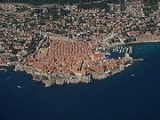
Dubrovnik

Encyclopedia
Croatia
Croatia , officially the Republic of Croatia , is a unitary democratic parliamentary republic in Europe at the crossroads of the Mitteleuropa, the Balkans, and the Mediterranean. Its capital and largest city is Zagreb. The country is divided into 20 counties and the city of Zagreb. Croatia covers ...
n city on the Adriatic Sea
Adriatic Sea
The Adriatic Sea is a body of water separating the Italian Peninsula from the Balkan peninsula, and the system of the Apennine Mountains from that of the Dinaric Alps and adjacent ranges...
coast, positioned at the terminal end of the Isthmus of Dubrovnik
Isthmus of Dubrovnik
400px|thumb|frame|right|The position of Isthmus of Dubrovnik within Croatia|Map of Croatia - the black square indicates the position of the isthmusThe Isthmus of Dubrovnik is the narrow, rocky landbridge connecting mainland Croatia to the important seaport and medieval power of Dubrovnik at its...
. It is one of the most prominent tourist
Tourism
Tourism is travel for recreational, leisure or business purposes. The World Tourism Organization defines tourists as people "traveling to and staying in places outside their usual environment for not more than one consecutive year for leisure, business and other purposes".Tourism has become a...
destinations on the Adriatic, a seaport
Port
A port is a location on a coast or shore containing one or more harbors where ships can dock and transfer people or cargo to or from land....
and the centre of Dubrovnik-Neretva county
Dubrovnik-Neretva County
The Dubrovnik–Neretva County is the southernmost Croatian county located in south Dalmatia. The county seat is Dubrovnik and other large towns are Korčula, Metković, Opuzen and Ploče...
. Its total population is 42,641 (census 2011). In 1979, the city of Dubrovnik joined the UNESCO
UNESCO
The United Nations Educational, Scientific and Cultural Organization is a specialized agency of the United Nations...
list of World Heritage Site
World Heritage Site
A UNESCO World Heritage Site is a place that is listed by the UNESCO as of special cultural or physical significance...
s.
The prosperity of the city of Dubrovnik has always been based on maritime trade
Trade
Trade is the transfer of ownership of goods and services from one person or entity to another. Trade is sometimes loosely called commerce or financial transaction or barter. A network that allows trade is called a market. The original form of trade was barter, the direct exchange of goods and...
. In the Middle Ages
Middle Ages
The Middle Ages is a periodization of European history from the 5th century to the 15th century. The Middle Ages follows the fall of the Western Roman Empire in 476 and precedes the Early Modern Era. It is the middle period of a three-period division of Western history: Classic, Medieval and Modern...
, as the Republic of Ragusa
Republic of Ragusa
The Republic of Ragusa or Republic of Dubrovnik was a maritime republic centered on the city of Dubrovnik in Dalmatia , that existed from 1358 to 1808...
, also known as a Maritime Republic (together with Amalfi
Amalfi
Amalfi is a town and comune in the province of Salerno, in the region of Campania, Italy, on the Gulf of Salerno, c. 35 km southeast of Naples. It lies at the mouth of a deep ravine, at the foot of Monte Cerreto , surrounded by dramatic cliffs and coastal scenery...
, Pisa
Pisa
Pisa is a city in Tuscany, Central Italy, on the right bank of the mouth of the River Arno on the Tyrrhenian Sea. It is the capital city of the Province of Pisa...
, Genoa
Genoa
Genoa |Ligurian]] Zena ; Latin and, archaically, English Genua) is a city and an important seaport in northern Italy, the capital of the Province of Genoa and of the region of Liguria....
, Venice
Venice
Venice is a city in northern Italy which is renowned for the beauty of its setting, its architecture and its artworks. It is the capital of the Veneto region...
and other Italian cities), it became the only eastern Adriatic city-state
City-state
A city-state is an independent or autonomous entity whose territory consists of a city which is not administered as a part of another local government.-Historical city-states:...
to rival Venice. Supported by its wealth and skilled diplomacy
Diplomacy
Diplomacy is the art and practice of conducting negotiations between representatives of groups or states...
, the city achieved a high level of development, particularly during the 15th and 16th centuries. Although demilitarised in the 1970s with the intent of forever protecting it from war devastation, in 1991, after the breakup of Yugoslavia, it was besieged by Serb-Montenegrin forces
Siege of Dubrovnik
The Siege of Dubrovnik is a term marking the battle and siege of the city of Dubrovnik and the surrounding area in Croatia as part of the Croatian War of Independence. Yugoslav People's Army invaded the Dubrovnik area in October 1991 from Montenegro, Bosnia and even parts of Croatia, surrounding...
for 7 months and received heavy damage from shelling.
Name
In CroatianCroatian language
Croatian is the collective name for the standard language and dialects spoken by Croats, principally in Croatia, Bosnia and Herzegovina, the Serbian province of Vojvodina and other neighbouring countries...
, the city is known as Dubrovnik; in Italian
Italian language
Italian is a Romance language spoken mainly in Europe: Italy, Switzerland, San Marino, Vatican City, by minorities in Malta, Monaco, Croatia, Slovenia, France, Libya, Eritrea, and Somalia, and by immigrant communities in the Americas and Australia...
as Ragusa, and its historical name in Greek
Greek language
Greek is an independent branch of the Indo-European family of languages. Native to the southern Balkans, it has the longest documented history of any Indo-European language, spanning 34 centuries of written records. Its writing system has been the Greek alphabet for the majority of its history;...
is Raugia (Ραυγια) or Ragousa (Ραγουσα).
The current Croatian name was officially adopted in 1918 after the fall of Austria–Hungary. It is also referred to as Dubrovnik in the first official document of the treaty with the Ban of Bosnia Ban Kulin
Ban Kulin
Ban Kulin was a notable Ban of Bosnia who ruled from 1180 to 1204 first as a vassal of the Byzantine Empire and then of the Kingdom of Hungary. He was brought to the power by Byzantine Emperor Manuel I Comnenus. He had a son, Stjepan Kulinić who succeeded him as Bosnian Ban...
.
Origins
Historical lore indicates that Ragusa (Dubrovnik) was founded in the 7th century on a rocky island named Laus, which provided shelter for DalmatiaDalmatia
Dalmatia is a historical region on the eastern coast of the Adriatic Sea. It stretches from the island of Rab in the northwest to the Bay of Kotor in the southeast. The hinterland, the Dalmatian Zagora, ranges from fifty kilometers in width in the north to just a few kilometers in the south....
n refugees from the nearby city of Epidaurus
Epidaurus (Dalmatia)
Epidaurus was an ancient Greek colony in Dalmatia founded sometime in the 6th century BC.The town changed its name to Epidaurum during Roman rule in 228 BC....
. The Romance-Dalmatian founders were escaping from the Slavic invasions.
Another theory appeared recently, based on new archaeological excavations
Archaeology
Archaeology, or archeology , is the study of human society, primarily through the recovery and analysis of the material culture and environmental data that they have left behind, which includes artifacts, architecture, biofacts and cultural landscapes...
. New findings (a Byzantine basilica from 8th century and parts of the city walls) contradict the traditional theory. The size of the old basilica clearly indicates that there was quite a large settlement at the time. There is also increasing support in the scientific community
Scientific community
The scientific community consists of the total body of scientists, its relationships and interactions. It is normally divided into "sub-communities" each working on a particular field within science. Objectivity is expected to be achieved by the scientific method...
for the theory that major construction of Ragusa took place before the current era. This "Greek theory" has been boosted by recent findings of numerous Greek artefacts during excavations in the Port of Dubrovnik. Also, drilling below the main city road has revealed natural sand, contradicting the theory of Laus (Lausa) island.
Dr. Antun Ničetić, in his book "Povijest dubrovačke luke" (History of the Port of Dubrovnik), expounds the theory that Dubrovnik was established by Greek sailors. A key element in this theory is the fact that ship
Ship
Since the end of the age of sail a ship has been any large buoyant marine vessel. Ships are generally distinguished from boats based on size and cargo or passenger capacity. Ships are used on lakes, seas, and rivers for a variety of activities, such as the transport of people or goods, fishing,...
s in ancient times
Ancient history
Ancient history is the study of the written past from the beginning of recorded human history to the Early Middle Ages. The span of recorded history is roughly 5,000 years, with Cuneiform script, the oldest discovered form of coherent writing, from the protoliterate period around the 30th century BC...
travelled about 45-50 nautical miles per day, and required a sandy shore to pull out of water
Water
Water is a chemical substance with the chemical formula H2O. A water molecule contains one oxygen and two hydrogen atoms connected by covalent bonds. Water is a liquid at ambient conditions, but it often co-exists on Earth with its solid state, ice, and gaseous state . Water also exists in a...
for the rest period during the night. The ideal rest site would have a fresh water
Freshwater
Fresh water is naturally occurring water on the Earth's surface in ice sheets, ice caps, glaciers, bogs, ponds, lakes, rivers and streams, and underground as groundwater in aquifers and underground streams. Fresh water is generally characterized by having low concentrations of dissolved salts and...
source in its vicinity. Dubrovnik has both, and is situated almost halfway between the two known Greek settlements of Budva
Budva
Budva is a coastal town in Montenegro. It has around 15,000 inhabitants, and it is the centre of municipality...
and Korčula
Korcula
Korčula is an island in the Adriatic Sea, in the Dubrovnik-Neretva County of Croatia. The island has an area of ; long and on average wide — and lies just off the Dalmatian coast. Its 16,182 inhabitants make it the second most populous Adriatic island after Krk...
(95 NM is the distance between them).
The Republic
After the fall of the Ostrogothic Kingdom, the town came under the protectionProtectorate
In history, the term protectorate has two different meanings. In its earliest inception, which has been adopted by modern international law, it is an autonomous territory that is protected diplomatically or militarily against third parties by a stronger state or entity...
of the Byzantine Empire
Byzantine Empire
The Byzantine Empire was the Eastern Roman Empire during the periods of Late Antiquity and the Middle Ages, centred on the capital of Constantinople. Known simply as the Roman Empire or Romania to its inhabitants and neighbours, the Empire was the direct continuation of the Ancient Roman State...
, although it was essentially an independent city-state that actively interacted with the surrounding Croatian littoral and the Italian peninsula. Ragusa in those mediaeval centuries had a population of Latinized Illyrians, who spoke their own Dalmatian language
Dalmatian language
Dalmatian was a Romance language spoken in the Dalmatia region of Croatia, and as far south as Kotor in Montenegro. The name refers to a pre-Roman tribe of the Illyrian linguistic group, Dalmatae...
and was an island. After the Crusades
Crusades
The Crusades were a series of religious wars, blessed by the Pope and the Catholic Church with the main goal of restoring Christian access to the holy places in and near Jerusalem...
, Ragusa came under the sovereignty of Venice
Venice
Venice is a city in northern Italy which is renowned for the beauty of its setting, its architecture and its artworks. It is the capital of the Veneto region...
(1205–1358), which would give its institutions to the Dalmatian city. By the Peace Treaty of Zadar in 1358, Ragusa achieved relative independence as a vassal-state of the Kingdom of Hungary
Kingdom of Hungary
The Kingdom of Hungary comprised present-day Hungary, Slovakia and Croatia , Transylvania , Carpatho Ruthenia , Vojvodina , Burgenland , and other smaller territories surrounding present-day Hungary's borders...
.
Between the 14th century and 1808, Ragusa ruled itself as a free state
Free state (government)
Free state is a term occasionally used in the official titles of some states.In principle the title asserts and emphasises the freedom of the state in question, but what this actually means varies greatly in different contexts:...
, although it was a vassal from 1440 to 1804 of the Ottoman Empire
Ottoman Empire
The Ottoman EmpireIt was usually referred to as the "Ottoman Empire", the "Turkish Empire", the "Ottoman Caliphate" or more commonly "Turkey" by its contemporaries...
and paid an annual tribute to its sultan. The Republic reached its peak in the 15th and 16th centuries, when its thalassocracy
Thalassocracy
The term thalassocracy refers to a state with primarily maritime realms—an empire at sea, such as Athens or the Phoenician network of merchant cities...
rivalled that of the Republic of Venice
Republic of Venice
The Republic of Venice or Venetian Republic was a state originating from the city of Venice in Northeastern Italy. It existed for over a millennium, from the late 7th century until 1797. It was formally known as the Most Serene Republic of Venice and is often referred to as La Serenissima, in...
and other Italian maritime republics.
For centuries, the Republic of Ragusa was an ally of Ancona
Ancona
Ancona is a city and a seaport in the Marche region, in central Italy, with a population of 101,909 . Ancona is the capital of the province of Ancona and of the region....
, the other Adriatic maritime Republic rival of Venice
Venice
Venice is a city in northern Italy which is renowned for the beauty of its setting, its architecture and its artworks. It is the capital of the Veneto region...
, which was the Ottoman Empire
Ottoman Empire
The Ottoman EmpireIt was usually referred to as the "Ottoman Empire", the "Turkish Empire", the "Ottoman Caliphate" or more commonly "Turkey" by its contemporaries...
's chief rival for control of the Adriatic. This alliance enabled the two towns set on opposite sides of the Adriatic to resist attempts by the Venetians to make the Adriatic a "Venetian Bay", also said to control directly or indirectly all the Adriatic ports. Ancona
Ancona
Ancona is a city and a seaport in the Marche region, in central Italy, with a population of 101,909 . Ancona is the capital of the province of Ancona and of the region....
and Ragusa developed an alternative trade route to the Venetian (Venice-Germany
Germany
Germany , officially the Federal Republic of Germany , is a federal parliamentary republic in Europe. The country consists of 16 states while the capital and largest city is Berlin. Germany covers an area of 357,021 km2 and has a largely temperate seasonal climate...
-Austria
Austria
Austria , officially the Republic of Austria , is a landlocked country of roughly 8.4 million people in Central Europe. It is bordered by the Czech Republic and Germany to the north, Slovakia and Hungary to the east, Slovenia and Italy to the south, and Switzerland and Liechtenstein to the...
): this route started from the East, passed through Ragusa and Ancona, then interested Florence
Florence
Florence is the capital city of the Italian region of Tuscany and of the province of Florence. It is the most populous city in Tuscany, with approximately 370,000 inhabitants, expanding to over 1.5 million in the metropolitan area....
and finally Flanders
Flanders
Flanders is the community of the Flemings but also one of the institutions in Belgium, and a geographical region located in parts of present-day Belgium, France and the Netherlands. "Flanders" can also refer to the northern part of Belgium that contains Brussels, Bruges, Ghent and Antwerp...
The Republic of Ragusa received its own Statutes as early as 1272, statutes which, among other things, codified Roman practice and local customs. The Statutes included prescriptions for town planning
Urban planning
Urban planning incorporates areas such as economics, design, ecology, sociology, geography, law, political science, and statistics to guide and ensure the orderly development of settlements and communities....
and the regulation of quarantine (for sanitary reasons).
The Republic was an early adopter of what are now regarded as modern laws and institutions: a medical service was introduced in 1301, with the first pharmacy
Pharmacy
Pharmacy is the health profession that links the health sciences with the chemical sciences and it is charged with ensuring the safe and effective use of pharmaceutical drugs...
, still operating to this day, being opened in 1317. An almshouse
Almshouse
Almshouses are charitable housing provided to enable people to live in a particular community...
was opened in 1347, and the first quarantine hospital (Lazarete) was established in 1377. Slave trading was abolished in 1418, and an orphanage opened in 1432. A 20 km (12 mi) water supply system
Water supply network
A water supply system or water supply network is a system of engineered hydrologic and hydraulic components which provide water supply. A water supply system typically includes:# A drainage basin ;...
was constructed in 1436.
The city was ruled by the local aristocracy
Aristocracy
Aristocracy , is a form of government in which a few elite citizens rule. The term derives from the Greek aristokratia, meaning "rule of the best". In origin in Ancient Greece, it was conceived of as rule by the best qualified citizens, and contrasted with monarchy...
which was of Latin-dalmatian extraction and formed two city council
City council
A city council or town council is the legislative body that governs a city, town, municipality or local government area.-Australia & NZ:Because of the differences in legislation between the States, the exact definition of a City Council varies...
s. As usual for the time, they maintained a strict system of social class
Social class
Social classes are economic or cultural arrangements of groups in society. Class is an essential object of analysis for sociologists, political scientists, economists, anthropologists and social historians. In the social sciences, social class is often discussed in terms of 'social stratification'...
es. The republic abolished the slave trade
History of slavery
The history of slavery covers slave systems in historical perspective in which one human being is legally the property of another, can be bought or sold, is not allowed to escape and must work for the owner without any choice involved...
early in the 15th century and valued liberty highly. The city successfully balanced its sovereignty between the interests of Venice and the Ottoman Empire
Ottoman Empire
The Ottoman EmpireIt was usually referred to as the "Ottoman Empire", the "Turkish Empire", the "Ottoman Caliphate" or more commonly "Turkey" by its contemporaries...
for centuries.
The languages spoken by the people were the Romance Dalmatian and Croatian. The latter started to replace Dalmatian little by little since the 11th century amongst the common people who inhabited the city. The aristocracy was of Latin extraction. The population itself was mostly of Latin origin until the 17th century, when Croatians migrated from the surrounding regions.
Italian
Italian language
Italian is a Romance language spoken mainly in Europe: Italy, Switzerland, San Marino, Vatican City, by minorities in Malta, Monaco, Croatia, Slovenia, France, Libya, Eritrea, and Somalia, and by immigrant communities in the Americas and Australia...
and Venetian
Venetian language
Venetian or Venetan is a Romance language spoken as a native language by over two million people, mostly in the Veneto region of Italy, where of five million inhabitants almost all can understand it. It is sometimes spoken and often well understood outside Veneto, in Trentino, Friuli, Venezia...
would become important languages of culture and trade in the Republic of Ragusa. The Italian language replaced Latin as official language
Official language
An official language is a language that is given a special legal status in a particular country, state, or other jurisdiction. Typically a nation's official language will be the one used in that nation's courts, parliament and administration. However, official status can also be used to give a...
of the Republic of Ragusa from 1472 until the end of the republic itself. At the same time, due to a pacific cohabitation with the Slavic element and the influence of Italian culture
Culture of Italy
From antiquity until the 16th century, Italy was at the centre of Western culture, fulcrum or origin of the Etruscan civilization, Ancient Rome, the Roman Catholic Church, Humanism and the Renaissance....
during the Renaissance, Ragusa became a cradle of Croatian literature
Croatian literature
Croatian literature is a definition given to the compilation of novels, dramas, short stories, poems and other various work of written kind entirely attributed to the medieval and modern culture of the Croats and the Croatian language....
.
Cargo ship
A cargo ship or freighter is any sort of ship or vessel that carries cargo, goods, and materials from one port to another. Thousands of cargo carriers ply the world's seas and oceans each year; they handle the bulk of international trade...
(argosy) that travelled all over the world. From these travels they founded some settlements, from India to America, and brought parts of their culture and flora home with them. One of its keys to success was not conquering, but trading and sailing under a white flag with the word (freedom) prominently featured on it. The flag was adopted when slave trading was abolished in 1418.
Many Conversos
Marrano
Marranos were Jews living in the Iberian peninsula who converted to Christianity rather than be expelled but continued to observe rabbinic Judaism in secret...
, Jews from Spain
Spain
Spain , officially the Kingdom of Spain languages]] under the European Charter for Regional or Minority Languages. In each of these, Spain's official name is as follows:;;;;;;), is a country and member state of the European Union located in southwestern Europe on the Iberian Peninsula...
and Portugal
Portugal
Portugal , officially the Portuguese Republic is a country situated in southwestern Europe on the Iberian Peninsula. Portugal is the westernmost country of Europe, and is bordered by the Atlantic Ocean to the West and South and by Spain to the North and East. The Atlantic archipelagos of the...
, were attracted to the city. In May 1544, a ship landed there filled exclusively with Portuguese refugees, as Balthasar de Faria reported to King John. During this time there worked in the city one of the most famous cannon and bell founders of his time: Ivan Rabljanin
Ivan Rabljanin
Ivan Krstitelj Rabljanin was a famous cannon and bell founder in bronze; born in Rab, most of his works are in Dubrovnik.He made cannons for Italy, Spain and Republic of Dubrovnik. In 1506 he forged a bell that still hangs to-day, in the town's bell tower. His most beautiful cannon was built in...
(Magister Johannes Baptista Arbensis de la Tolle).
Mediterranean Sea
The Mediterranean Sea is a sea connected to the Atlantic Ocean surrounded by the Mediterranean region and almost completely enclosed by land: on the north by Anatolia and Europe, on the south by North Africa, and on the east by the Levant...
shipping and the catastrophic earthquake of 1667
1667 Dubrovnik earthquake
The earthquake in Dubrovnik in 1667 was one of the two most devastating earthquakes to hit the area of modern Croatia in the last 2,400 years, since records began. The earthquake destroyed almost the entire city and killed around 5,000 people...
killed over 5,000 citizens and levelled most of the public buildings, ruining the well-being
Quality of life
The term quality of life is used to evaluate the general well-being of individuals and societies. The term is used in a wide range of contexts, including the fields of international development, healthcare, and politics. Quality of life should not be confused with the concept of standard of...
of the Republic. In 1699, the Republic sold two mainland patches of its territory
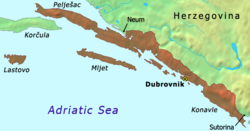
Neum
Neum is the only coastal town in Bosnia and Herzegovina. It comprises of coastline, the country's only access to the Adriatic Sea. As of 2009, municipal population was of 4,605 and the one of Neum main town was of 4,268 .-Features:Neum has steep hills, sandy beaches, and several large tourist...
to the Ottomans in order to avoid being caught in the clash with advancing Venetian forces. Today this strip of land belongs to Bosnia and Herzegovina
Bosnia and Herzegovina
Bosnia and Herzegovina , sometimes called Bosnia-Herzegovina or simply Bosnia, is a country in Southern Europe, on the Balkan Peninsula. Bordered by Croatia to the north, west and south, Serbia to the east, and Montenegro to the southeast, Bosnia and Herzegovina is almost landlocked, except for the...
and is that country's only direct access to the Adriatic.
In 1806, the city surrendered to the Napoleonic army, as that was the only way to end a month long siege by the Russian-Montenegrin fleets (during which 3,000 cannonballs fell on the city). At first, Napoleon
Napoleon I
Napoleon Bonaparte was a French military and political leader during the latter stages of the French Revolution.As Napoleon I, he was Emperor of the French from 1804 to 1815...
demanded only free passage for his troops, promising not to occupy the territory and stressing that the French were friends of the Ragusans. Later, however, French forces blockaded the harbours, forcing the government to give in and let French troops enter the city. On this day, all flags and coats of arms
Coat of arms
A coat of arms is a unique heraldic design on a shield or escutcheon or on a surcoat or tabard used to cover and protect armour and to identify the wearer. Thus the term is often stated as "coat-armour", because it was anciently displayed on the front of a coat of cloth...
above the city walls were painted black as a sign of mourning. In 1808, Marshal Marmont abolished the republic and integrated its territory first into Napoleon's Kingdom of Italy
Kingdom of Italy (Napoleonic)
The Kingdom of Italy was a state founded in Northern Italy by Napoleon, fully influenced by revolutionary France, that ended with his defeat and fall.-Constitutional statutes:...
and later into the Illyrian provinces
Illyrian provinces
The Illyrian Provinces was an autonomous province of the Napoleonic French Empire on the north and east coasts of the Adriatic Sea between 1809 and 1816. Its capital was established at Laybach...
under French rule.
Languages
The official languageOfficial language
An official language is a language that is given a special legal status in a particular country, state, or other jurisdiction. Typically a nation's official language will be the one used in that nation's courts, parliament and administration. However, official status can also be used to give a...
until 1472 was Latin
Latin
Latin is an Italic language originally spoken in Latium and Ancient Rome. It, along with most European languages, is a descendant of the ancient Proto-Indo-European language. Although it is considered a dead language, a number of scholars and members of the Christian clergy speak it fluently, and...
. Later, the Senate of the Republic decided that the official language of the Republic would be the Ragusan dialect of the Romance Dalmatian language
Dalmatian language
Dalmatian was a Romance language spoken in the Dalmatia region of Croatia, and as far south as Kotor in Montenegro. The name refers to a pre-Roman tribe of the Illyrian linguistic group, Dalmatae...
, and forbade the use of the Slavic language in senatorial debate. The Gospari (the Aristocracy) held on to their language for many centuries, while it slowly disappeared.
Although the Latin language
Latin
Latin is an Italic language originally spoken in Latium and Ancient Rome. It, along with most European languages, is a descendant of the ancient Proto-Indo-European language. Although it is considered a dead language, a number of scholars and members of the Christian clergy speak it fluently, and...
was in official use, inhabitants of the republic were mostly native speakers of Slavonic languages (as confirmed by P. A. Tolstoj in 1698, when he noted In Dalmatia... Dubrovnikans....called themselves as Ragusan(Raguseos) and always have pride in the Republic). The Dalmatian language was also spoken in the city.
The Italian language
Italian language
Italian is a Romance language spoken mainly in Europe: Italy, Switzerland, San Marino, Vatican City, by minorities in Malta, Monaco, Croatia, Slovenia, France, Libya, Eritrea, and Somalia, and by immigrant communities in the Americas and Australia...
as spoken in the republic was heavily influenced by the Venetian language
Venetian language
Venetian or Venetan is a Romance language spoken as a native language by over two million people, mostly in the Veneto region of Italy, where of five million inhabitants almost all can understand it. It is sometimes spoken and often well understood outside Veneto, in Trentino, Friuli, Venezia...
and the Tuscan dialect. Italian took root among the Dalmatian Romance-speaking merchant upper classes, as a result of Venetian influence.
Austrian rule
When the Habsburg EmpireHabsburg Monarchy
The Habsburg Monarchy covered the territories ruled by the junior Austrian branch of the House of Habsburg , and then by the successor House of Habsburg-Lorraine , between 1526 and 1867/1918. The Imperial capital was Vienna, except from 1583 to 1611, when it was moved to Prague...
gained these provinces after the 1815 Congress of Vienna
Congress of Vienna
The Congress of Vienna was a conference of ambassadors of European states chaired by Klemens Wenzel von Metternich, and held in Vienna from September, 1814 to June, 1815. The objective of the Congress was to settle the many issues arising from the French Revolutionary Wars, the Napoleonic Wars,...
, the new imperial authorities installed a bureaucratic administration, established the Kingdom of Dalmatia
Kingdom of Dalmatia
The Kingdom of Dalmatia was an administrative division of the Habsburg Monarchy from 1815 to 1918. Its capital was Zadar.-History:...
, which had its own Sabor (Diet) or Parliament, based in the city of Zadar
Zadar
Zadar is a city in Croatia on the Adriatic Sea. It is the centre of Zadar county and the wider northern Dalmatian region. Population of the city is 75,082 citizens...
, also political parties that dominated the scene were in the nineteenth century, the Autonomist Party
Autonomist Party
The Autonomist Party was a political party in the Dalmatian political scene, that existed for around 70 years of the nineteenth century and until World War I. Its goal was to maintain the autonomy of the Kingdom of Dalmatia within the Austro-Hungarian Empire, as opposed to the unification with the...
and the People's Party. It introduced a series of modifications intended to centralize, albeit slowly, the bureaucratic, tax, religious, educational, and trade structures. Unfortunately for the local residents, these centralisation strategies, which were intended to stimulate the economy, largely failed. And once the personal, political and economic trauma of the Napoleonic Wars
Napoleonic Wars
The Napoleonic Wars were a series of wars declared against Napoleon's French Empire by opposing coalitions that ran from 1803 to 1815. As a continuation of the wars sparked by the French Revolution of 1789, they revolutionised European armies and played out on an unprecedented scale, mainly due to...
had been overcome, new movements began to form in the region, calling for a political reorganization of the Adriatic along national lines.
The combination of these two forces—a flawed Habsburg administrative system and new national movements claiming ethnicity as the founding block towards a community—created a particularly perplexing problem; for Dalmatia was a province ruled by the German-speaking
German language
German is a West Germanic language, related to and classified alongside English and Dutch. With an estimated 90 – 98 million native speakers, German is one of the world's major languages and is the most widely-spoken first language in the European Union....
, centralising Habsburg monarchy
Habsburg Monarchy
The Habsburg Monarchy covered the territories ruled by the junior Austrian branch of the House of Habsburg , and then by the successor House of Habsburg-Lorraine , between 1526 and 1867/1918. The Imperial capital was Vienna, except from 1583 to 1611, when it was moved to Prague...
, with bilingual i.e. Slavic and Italian speaking elites that dominated a general population consisting of a Slavic Catholic majority (and a Slavic Orthodox
Serbian Orthodox Church
The Serbian Orthodox Church is one of the autocephalous Orthodox Christian churches, ranking sixth in order of seniority after Constantinople, Alexandria, Antioch, Jerusalem, and Russia...
minority of not more than 300 people).
In 1815, the former Ragusan Government, i.e. its noble assembly, met for the last time in the Ljetnikovac in Mokošica
Mokošica
Mokošica is a district in the city of Dubrovnik in Croatia. The suburb consists of Old and New Mokošica . According to the census of 2001, it has a population of 7528 residents...
. Once again heavy efforts were undertaken to re-establish the Republic however this time it was all in vain. After fall of the Republic most of the aristocracy were recognized by Austrian Empire.
In 1832, Baron Sigismondo Ghetaldi-Gondola
Šišmundo Getaldic-Gundulic
Šišmundo Getaldić-Gundulić was son of Frano Getaldić-Gundulić and Marija Natali. He married Malvina Uršula Božidarević. In 1845, the Austrian government granted him the title of Baron. He was mayor of Dubrovnik for more than 13 years, counting on the respect and social support of the city...
(1795–1860) was elected podestà
Podestà
Podestà is the name given to certain high officials in many Italian cities, since the later Middle Ages, mainly as Chief magistrate of a city state , but also as a local administrator, the representative of the Emperor.The term derives from the Latin word potestas, meaning power...
of Ragusa, serving for 13 years; the Austrian government granted him the title of "Baron".
Count Raffaele Pozza, Dr. Jur., (1828–90) was elected for first time Podestà of Ragusa in the year 1869 after this was re-elected in 1872, 1875, 1882, 1884) and elected twice into the Dalmatian Council, 1870, 1876. The victory of the Nationalist in Spalato in 1882 had a strong echo in the areas of Curzola and Ragusa. It was greeted by the mayor (podestà) of Ragusa Raffaele Pozza, the National Reading Club of Dubrovnik, the Workers Association of Dubrovnik and the review "Slovinac"; by the communities of Kuna and Orebić, the latter one getting the nationalist government even before Split.
Austrian rule and Austro-Hungarian rule which followed lasted for more than a century and were typified by the motto of the world powers of that time: Divide et impera
Divide and rule
In politics and sociology, divide and rule is a combination of political, military and economic strategy of gaining and maintaining power by breaking up larger concentrations of power into chunks that individually have less power than the one implementing the strategy...
(Divide and rule). Austrian policy of denationalizing the Dalmatian coasts left its mark in the political division of the population as best expressed in the political parties: the Croatian People's Party and the mostly Italianite Autonomous Party
Autonomist Party
The Autonomist Party was a political party in the Dalmatian political scene, that existed for around 70 years of the nineteenth century and until World War I. Its goal was to maintain the autonomy of the Kingdom of Dalmatia within the Austro-Hungarian Empire, as opposed to the unification with the...
.
In 1889, the Serbian-Catholics circle supported Baron Francesco Ghetaldi-Gondola
Frano Getaldic-Gundulic
Baron Frano Getaldić-Gundulić or Francesco Ghetaldi-Gondola was the first son of Šišmundo Getaldić-Gundulić and Malvina Uršula Bosdari. Getaldić-Gundulić was a member of the Knights of St. John from 1889 until the death of the Mayor of Dubrovnik. He was decorated with the Cross of Devotion on...
, candidate of Autonomous Party
Autonomist Party
The Autonomist Party was a political party in the Dalmatian political scene, that existed for around 70 years of the nineteenth century and until World War I. Its goal was to maintain the autonomy of the Kingdom of Dalmatia within the Austro-Hungarian Empire, as opposed to the unification with the...
, vs the candidate of Popular Party Vlaho de Giulli, in the 1890 election to the Dalmatian Diet. The following year during the local government election, the Autonomous Party won the municipal re-election with Francesco Gondola, who died in power in 1899, the alliance won the election again on 27 May 1894. Francesco Ghetaldi-Gondola founded the Società Philately
Philately
Philately is the study of stamps and postal history and other related items. Philately involves more than just stamp collecting, which does not necessarily involve the study of stamps. It is possible to be a philatelist without owning any stamps...
on 4 December 1890.
1921–1991
With the fall of Austria-Hungary in 1918, the city was incorporated into the new Kingdom of Serbs, Croats, and SlovenesKingdom of Yugoslavia
The Kingdom of Yugoslavia was a state stretching from the Western Balkans to Central Europe which existed during the often-tumultuous interwar era of 1918–1941...
(later the Kingdom of Yugoslavia
Kingdom of Yugoslavia
The Kingdom of Yugoslavia was a state stretching from the Western Balkans to Central Europe which existed during the often-tumultuous interwar era of 1918–1941...
). The name of the city was officially changed from Ragusa to Dubrovnik.
In 1921 Pero Cingrija died (born 1837), politician and one of the leaders of the People's Party in Dalmatia. It was thanks to his efforts that the People's Party and the Party of Right were fused into one Croatian Party in 1905
During World War II
World War II
World War II, or the Second World War , was a global conflict lasting from 1939 to 1945, involving most of the world's nations—including all of the great powers—eventually forming two opposing military alliances: the Allies and the Axis...
, Dubrovnik became part of the Nazi
Nazism
Nazism, the common short form name of National Socialism was the ideology and practice of the Nazi Party and of Nazi Germany...
controlled Independent State of Croatia
Independent State of Croatia
The Independent State of Croatia was a World War II puppet state of Nazi Germany, established on a part of Axis-occupied Yugoslavia. The NDH was founded on 10 April 1941, after the invasion of Yugoslavia by the Axis powers. All of Bosnia and Herzegovina was annexed to NDH, together with some parts...
, occupied by the Italian army
Italian Army
The Italian Army is the ground defence force of the Italian Armed Forces. It is all-volunteer force of active-duty personnel, numbering 108,355 in 2010. Its best-known combat vehicles are the Dardo infantry fighting vehicle, the Centauro tank destroyer and the Ariete tank, and among its aircraft...
first, and by the German army
German Army
The German Army is the land component of the armed forces of the Federal Republic of Germany. Following the disbanding of the Wehrmacht after World War II, it was re-established in 1955 as the Bundesheer, part of the newly formed West German Bundeswehr along with the Navy and the Air Force...
after 8 September 1943. In October 1944 Tito's partisans entered Dubrovnik, that became consequently part of Communist Yugoslavia
Socialist Federal Republic of Yugoslavia
The Socialist Federal Republic of Yugoslavia was the Yugoslav state that existed from the abolition of the Yugoslav monarchy until it was dissolved in 1992 amid the Yugoslav Wars. It was a socialist state and a federation made up of six socialist republics: Bosnia and Herzegovina, Croatia,...
. Soon after their arrival into the city, Partisans executed approximately 78 citizens without a trial, including a Catholic priest
Holy Orders
The term Holy Orders is used by many Christian churches to refer to ordination or to those individuals ordained for a special role or ministry....
, on the island of Daksa.
Break-up of Yugoslavia
Slovenia
Slovenia , officially the Republic of Slovenia , is a country in Central and Southeastern Europe touching the Alps and bordering the Mediterranean. Slovenia borders Italy to the west, Croatia to the south and east, Hungary to the northeast, and Austria to the north, and also has a small portion of...
, which at that time were republics within Socialist Federal Republic of Yugoslavia
Socialist Federal Republic of Yugoslavia
The Socialist Federal Republic of Yugoslavia was the Yugoslav state that existed from the abolition of the Yugoslav monarchy until it was dissolved in 1992 amid the Yugoslav Wars. It was a socialist state and a federation made up of six socialist republics: Bosnia and Herzegovina, Croatia,...
, declared their independence. At that event, Socialist Republic of Croatia
Socialist Republic of Croatia
Socialist Republic of Croatia was a sovereign constituent country of the second Yugoslavia. It came to existence during World War II, becoming a socialist state after the war, and was also renamed four times in its existence . It was the second largest republic in Yugoslavia by territory and...
was renamed Republic of Croatia
Croatia
Croatia , officially the Republic of Croatia , is a unitary democratic parliamentary republic in Europe at the crossroads of the Mitteleuropa, the Balkans, and the Mediterranean. Its capital and largest city is Zagreb. The country is divided into 20 counties and the city of Zagreb. Croatia covers ...
.
Despite demilitarization
Demilitarisation
Demilitarisation or demilitarization is the reduction of a nation's army, weapons, or military vehicles to an agreed minimum. Demilitarisation is usually the result of a peace treaty ending a war or a major conflict....
of the old town in early 1970s in an attempt to prevent it from ever becoming a casualty of war, following Croatia's independence in 1991, Serbian-Montenegrin
Serbia and Montenegro
Serbia and Montenegro was a country in southeastern Europe, formed from two former republics of the Socialist Federal Republic of Yugoslavia : Serbia and Montenegro. Following the breakup of Yugoslavia, it was established in 1992 as a federation called the Federal Republic of Yugoslavia...
remains of the Yugoslav People's Army
Yugoslav People's Army
The Yugoslav People's Army , also referred to as the Yugoslav National Army , was the military of the Socialist Federal Republic of Yugoslavia.-Origins:The origins of the JNA can...
(JNA) attacked the city. The regime in Montenegro
Montenegro
Montenegro Montenegrin: Crna Gora Црна Гора , meaning "Black Mountain") is a country located in Southeastern Europe. It has a coast on the Adriatic Sea to the south-west and is bordered by Croatia to the west, Bosnia and Herzegovina to the northwest, Serbia to the northeast and Albania to the...
led by Momir Bulatović
Momir Bulatovic
Momir Bulatović , formerly served as a Yugoslavian and Montenegrin politician. Bulatović became federal President of Montenegro while Montenegro was part of a Yugoslav federation, and also Prime Minister of the Federal Republic of Yugoslavia...
, which was installed by and loyal to the Serbian government led by Slobodan Milošević
Slobodan Milošević
Slobodan Milošević was President of Serbia and Yugoslavia. He served as the President of Socialist Republic of Serbia and Republic of Serbia from 1989 until 1997 in three terms and as President of the Federal Republic of Yugoslavia from 1997 to 2000...
, declared that Dubrovnik would not be permitted to remain in Croatia because they claimed it was historically part of Montenegro
Montenegro
Montenegro Montenegrin: Crna Gora Црна Гора , meaning "Black Mountain") is a country located in Southeastern Europe. It has a coast on the Adriatic Sea to the south-west and is bordered by Croatia to the west, Bosnia and Herzegovina to the northwest, Serbia to the northeast and Albania to the...
. This was in spite of the large Croat majority in the city and that very few Montenegrins resided there, though Serbs accounted for six percent of the population. Many consider the claims by the Bulatović government, as being part of Serbian President Milošević's plan to deliver his nationalist supporters the Greater Serbia
Greater Serbia
The term Greater Serbia or Great Serbia applies to the Serbian nationalist and irredentist ideology directed towards the creation of a Serbian land which would incorporate all regions of traditional significance to the Serbian nation...
they desired as Yugoslavia
Yugoslavia
Yugoslavia refers to three political entities that existed successively on the western part of the Balkans during most of the 20th century....
collapsed.
On October 1, 1991 Dubrovnik was attacked by JNA
Yugoslav People's Army
The Yugoslav People's Army , also referred to as the Yugoslav National Army , was the military of the Socialist Federal Republic of Yugoslavia.-Origins:The origins of the JNA can...
with a siege of Dubrovnik
Siege of Dubrovnik
The Siege of Dubrovnik is a term marking the battle and siege of the city of Dubrovnik and the surrounding area in Croatia as part of the Croatian War of Independence. Yugoslav People's Army invaded the Dubrovnik area in October 1991 from Montenegro, Bosnia and even parts of Croatia, surrounding...
that lasted for seven months. Heaviest artillery attack happened on December 6 with 19 people killed and 60 wounded. Total casualties in the conflict according to Croatian Red Cross
International Red Cross and Red Crescent Movement
The International Red Cross and Red Crescent Movement is an international humanitarian movement with approximately 97 million volunteers, members and staff worldwide which was founded to protect human life and health, to ensure respect for all human beings, and to prevent and alleviate human...
were 114 killed civilians, among them celebrated poet Milan Milisić
Milan Milišic
Milan Milišić was a poet and playwright from the former Yugoslavia of Yugoslavian ethnicity. He wrote several volumes of poetry and translated, among others, J. R. R...
. Foreign newspapers have been criticised for exaggerating the damage sustained by the old town, instead of responding to human casualties. Nonetheless, the artillery attacks on Dubrovnik damaged 56% of its buildings to some degree, as the historic walled city, a UNESCO world heritage site, sustained 650 hits by artillery rounds. In May 1992 the Croatian Army
Croatian ground army
The Croatian Army is a branch of the Armed Forces of the Republic of Croatia.The fundamental role and purpose of the Croatian Army is to protect vital national interests of the Republic of Croatia and defend the sovereignty and territorial integrity of the state.Basic tasks of the Croatian Army...
lifted the siege and liberated Dubrovnik's surroundings, but the danger of sudden attacks by the JNA lasted for another three years.
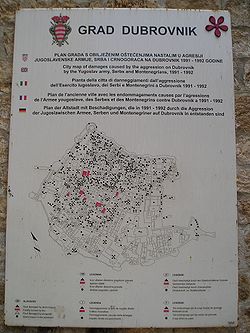
Following the end of the war, damage caused by the shelling of the Old Town was repaired. Adhering to UNESCO guidelines, repairs were performed in the original style. , most damage had been repaired. The inflicted damage can be seen on a chart near the city gate
City gate
A city gate is a gate which is, or was, set within a city wall. Other terms include port.-Uses:City gates were traditionally built to provide a point of controlled access to and departure from a walled city for people, vehicles, goods and animals...
, showing all artillery hits during the siege, and is clearly visible from high points around the city in the form of the more brightly coloured new roofs. ICTY
International Criminal Tribunal for the former Yugoslavia
The International Tribunal for the Prosecution of Persons Responsible for Serious Violations of International Humanitarian Law Committed in the Territory of the Former Yugoslavia since 1991, more commonly referred to as the International Criminal Tribunal for the former Yugoslavia or ICTY, is a...
indictments were issued for JNA generals and officers involved in the bombing.
General Pavle Strugar
Pavle Strugar
Pavle Strugar is a retired Montenegrin general in the Yugoslav People's Army who was found guilty of war crimes for his role in the siege of Dubrovnik....
, who coordinated the attack on the city, was sentenced to an eight year prison term by the International Criminal Tribunal for the former Yugoslavia
International Criminal Tribunal for the former Yugoslavia
The International Tribunal for the Prosecution of Persons Responsible for Serious Violations of International Humanitarian Law Committed in the Territory of the Former Yugoslavia since 1991, more commonly referred to as the International Criminal Tribunal for the former Yugoslavia or ICTY, is a...
for his role in the attack.
The 1996 Croatia USAF CT-43 crash
1996 Croatia USAF CT-43 crash
On April 3, 1996, a United States Air Force CT-43A crashed on approach to Dubrovnik, Croatia while on an official trade mission. The aircraft, a Boeing 737-253 built as a T-43 navigation trainer, was carrying United States Secretary of Commerce Ron Brown and 34 other people, including The New York...
, near Dubrovnik Airport
Dubrovnik Airport
-Traffic statistics:Dubrovnik Airport handled 1,270,062 passengers in 2010.In 1987 Dubrovnik Airport handled 1.5 million passengers and 2500 tons of cargo, making 1987 year the busiest thus far...
, killed everyone on a United States Air Force
United States Air Force
The United States Air Force is the aerial warfare service branch of the United States Armed Forces and one of the American uniformed services. Initially part of the United States Army, the USAF was formed as a separate branch of the military on September 18, 1947 under the National Security Act of...
jet with United States Secretary of Commerce
United States Secretary of Commerce
The United States Secretary of Commerce is the head of the United States Department of Commerce concerned with business and industry; the Department states its mission to be "to foster, promote, and develop the foreign and domestic commerce"...
Ron Brown
Ron Brown (U.S. politician)
Ronald Harmon "Ron" Brown was the United States Secretary of Commerce, serving during the first term of President Bill Clinton. He was the first African American to hold this position...
, The New York Times
The New York Times
The New York Times is an American daily newspaper founded and continuously published in New York City since 1851. The New York Times has won 106 Pulitzer Prizes, the most of any news organization...
Frankfurt
Frankfurt
Frankfurt am Main , commonly known simply as Frankfurt, is the largest city in the German state of Hesse and the fifth-largest city in Germany, with a 2010 population of 688,249. The urban area had an estimated population of 2,300,000 in 2010...
Bureau chief Nathaniel C. Nash and 33 other people.
Heritage
The annual Dubrovnik Summer FestivalDubrovnik Summer Festival
The Dubrovnik Summer Festival In a unique ambient of open and closed scenes of Renaissance-Baroque city of Dubrovnik a rich programme of classical music, theatre, opera and dance is presented.-External links:*...
is a 45 day-long cultural event with live plays, concerts, and games. It has been awarded a Gold International Trophy for Quality (2007) by the Editorial Office in collaboration with the Trade Leaders Club.
The patron saint
Patron saint
A patron saint is a saint who is regarded as the intercessor and advocate in heaven of a nation, place, craft, activity, class, clan, family, or person...
of the city is Sveti Vlaho (Saint Blaise)
Saint Blaise
Saint Blaise was a physician, and bishop of Sebastea . According to his Acta Sanctorum, he was martyred by being beaten, attacked with iron carding combs, and beheaded...
, whose statues are seen around the city. He has an importance similar to that of St. Mark the Evangelist
Mark the Evangelist
Mark the Evangelist is the traditional author of the Gospel of Mark. He is one of the Seventy Disciples of Christ, and the founder of the Church of Alexandria, one of the original four main sees of Christianity....
to Venice. One of the larger churches in city is named after Saint Blaise.
February 3 is the feast of Sveti Vlaho (Saint Blaise)
Saint Blaise
Saint Blaise was a physician, and bishop of Sebastea . According to his Acta Sanctorum, he was martyred by being beaten, attacked with iron carding combs, and beheaded...
, who is the city's patron saint. Every year the city of Dubrovnik celebrates the holiday with Mass, parades, and festivities that last for several days.
The Old Town of Dubrovnik is depicted on the reverse
Obverse and reverse
Obverse and its opposite, reverse, refer to the two flat faces of coins and some other two-sided objects, including paper money, flags , seals, medals, drawings, old master prints and other works of art, and printed fabrics. In this usage, obverse means the front face of the object and reverse...
of the Croatian 50 kuna
Croatian kuna
The kuna is the currency of Croatia since 1994 . It is subdivided into 100 lipa. The kuna is issued by the Croatian National Bank and the coins are minted by the Croatian Monetary Institute....
banknote, issued in 1993 and 2002.
The city boasts of many old buildings, such as the Arboretum Trsteno
Trsteno
Trsteno is a village northwest of Dubrovnik in southern Croatia, population 237 . The name probably comes from the word trska which means reed. It is located on the magistral road between the villages Orašac and Slano.-Trsteno Arboretum:...
, the oldest arboretum
Arboretum
An arboretum in a narrow sense is a collection of trees only. Related collections include a fruticetum , and a viticetum, a collection of vines. More commonly, today, an arboretum is a botanical garden containing living collections of woody plants intended at least partly for scientific study...
in the world, dating back to before 1492. Also, the third oldest European pharmacy
Pharmacy
Pharmacy is the health profession that links the health sciences with the chemical sciences and it is charged with ensuring the safe and effective use of pharmaceutical drugs...
is located in the city, which dates back to 1317 (and is the only one still in operation today). It is located at Little Brothers monastery in Dubrovnik.
In history, many Conversos (Marrano
Marrano
Marranos were Jews living in the Iberian peninsula who converted to Christianity rather than be expelled but continued to observe rabbinic Judaism in secret...
s) were attracted to Dubrovnik, formerly a considerable seaport. In May, 1544, a ship landed there filled exclusively with Portuguese refugees, as Balthasar de Faria reported to King John. Another admirer of Dubrovnik, George Bernard Shaw
George Bernard Shaw
George Bernard Shaw was an Irish playwright and a co-founder of the London School of Economics. Although his first profitable writing was music and literary criticism, in which capacity he wrote many highly articulate pieces of journalism, his main talent was for drama, and he wrote more than 60...
, visited the city in 1929 and said: "If you want to see heaven on earth, come to Dubrovnik."
In the bay of Dubrovnik is the 72-hectare
Hectare
The hectare is a metric unit of area defined as 10,000 square metres , and primarily used in the measurement of land. In 1795, when the metric system was introduced, the are was defined as being 100 square metres and the hectare was thus 100 ares or 1/100 km2...
wooded island of Lokrum
Lokrum
Lokrum or Lacroma is one of the islands off the city of Dubrovnik about 600 metres from the coast stretching from the northwest to the southeast, in the Adriatic Sea, Croatia. Its highest point above sea level is at 96 m....
, where according to legend, Richard the Lionheart
Richard I of England
Richard I was King of England from 6 July 1189 until his death. He also ruled as Duke of Normandy, Duke of Aquitaine, Duke of Gascony, Lord of Cyprus, Count of Anjou, Count of Maine, Count of Nantes, and Overlord of Brittany at various times during the same period...
was cast ashore after being shipwreck
Shipwreck
A shipwreck is what remains of a ship that has wrecked, either sunk or beached. Whatever the cause, a sunken ship or a wrecked ship is a physical example of the event: this explains why the two concepts are often overlapping in English....
ed in 1192. The island includes a fortress, botanical garden
Botanical garden
A botanical garden The terms botanic and botanical, and garden or gardens are used more-or-less interchangeably, although the word botanic is generally reserved for the earlier, more traditional gardens. is a well-tended area displaying a wide range of plants labelled with their botanical names...
, monastery
Monastery
Monastery denotes the building, or complex of buildings, that houses a room reserved for prayer as well as the domestic quarters and workplace of monastics, whether monks or nuns, and whether living in community or alone .Monasteries may vary greatly in size – a small dwelling accommodating only...
and naturist beach
Nude beach
A nude beach is a beach where users are legally at liberty to be nude. Sometimes the terms clothing-optional beach or free beach are used. Nude bathing is one of the most common forms of nudity in public. As beaches are usually on public lands, any member of the public is entitled to use the...
.
Among the many tourist destinations are a few beaches. Banje, Dubrovnik's main public beach, is home to the Eastwest Beach Club. There is also Copacabana Beach, a small stony beach part of the Elaphiti Islands
Elaphiti Islands
The Elaphiti Islands or the Elaphites is a small archipelago consisting of several islands stretching northwest of Dubrovnik, in the Adriatic sea. The Elaphites have a total land area of around 30 square kilometers and a population of 850 inhabitants...
, named after the popular beach in Rio de Janeiro.
Dubrovnik has also been mentioned in popular film and theatre. In the film 20,000 Leagues Under the Sea
20,000 Leagues Under the Sea (1997 Village Roadshow film)
20,000 Leagues Under the Sea is a 1997 television movie produced by Village Roadshow Pictures, based on the novel of the same name by Jules Verne.-Events:In this version:...
with Michael Caine
Michael Caine
Sir Michael Caine, CBE is an English actor. He won Academy Awards for best supporting actor in both Hannah and Her Sisters and The Cider House Rules ....
, one of the characters said to have been dreaming of fairy
Fairy
A fairy is a type of mythical being or legendary creature, a form of spirit, often described as metaphysical, supernatural or preternatural.Fairies resemble various beings of other mythologies, though even folklore that uses the term...
from Dubrovnik (motive known from local legends and literature).
Ivan Gundulić
Ivan Gundulic
Ivan Franov Gundulić is the most celebrated Croatian Baroque poet from the Republic of Ragusa. His work embodies central characteristics of Roman Catholic Counter-Reformation: religious fervor, insistence on "vanity of this world" and zeal in opposition to "infidels." Gundulić's major...
, a 17th century Croatian writer, predicted the downfall of the great Turkish Empire in his poem Osman.
Important monuments
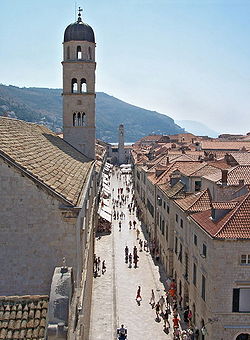
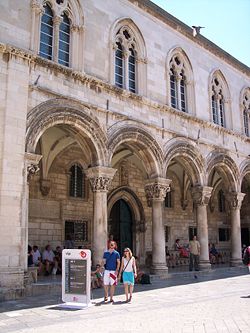
Few of Dubrovnik's Renaissance buildings survived the earthquake of 1667 but fortunately enough remain to give an idea of the city's architectural heritage. The finest Renaissance highlight is the Sponza Palace which dates from the 16th century and is currently used to house the National Archives. The Rectors Palace is a Gothic-Renaissance structure that displays finely carved capitals and an ornate staircase. It now houses a museum. Its façade is depicted on the reverseObverse and reverse
Obverse and its opposite, reverse, refer to the two flat faces of coins and some other two-sided objects, including paper money, flags , seals, medals, drawings, old master prints and other works of art, and printed fabrics. In this usage, obverse means the front face of the object and reverse...
of the Croatian 50 kuna
Croatian kuna
The kuna is the currency of Croatia since 1994 . It is subdivided into 100 lipa. The kuna is issued by the Croatian National Bank and the coins are minted by the Croatian Monetary Institute....
banknote, issued in 1993 and 2002. The St. Saviour Church is another remnant of the Renaissance period, next to the much-visited Franciscan Monastery. The Franciscan monastery's library possesses 30,000 volumes, 22 incunabula, 1,500 valuable handwritten documents. Exhibits include a 15th century silver-gilt cross and silver thurible
Thurible
A thurible is a metal censer suspended from chains, in which incense is burned during worship services. It is used in the Catholic Church as well as in Anglican, Eastern Orthodox, Oriental Orthodox, Armenian Apostolic, some Lutheran, Old Catholic, and in various Gnostic Churches. It is also used...
, an 18th century crucifix from Jerusalem, a martyrology (1541) by Bemardin Gucetic and illuminated psalter
Psalter
A psalter is a volume containing the Book of Psalms, often with other devotional material bound in as well, such as a liturgical calendar and litany of the Saints. Until the later medieval emergence of the book of hours, psalters were the books most widely owned by wealthy lay persons and were...
s.
Dubrovnik's most beloved church is St Blaise's church, built in the 18th century in honour of Dubrovnik's patron saint. Dubrovnik's baroque Cathedral was built in the 18th century and houses an impressive Treasury with relics of Saint Blaise. The city's Dominican Monastery resembles a fortress on the outside but the interior contains an art museum and a Gothic-Romanesque church. A special treasure of the Dominican monastery is its library with over 220 incunabula, numerous illustrated manuscripts, a rich archive with precious manuscripts and documents and an extensive art collection.
Walls of Dubrovnik
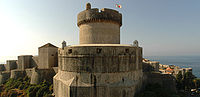
A feature of Dubrovnik is its walls that run almost 2 km (1.24 mi) around the city. The walls run from four to six metres thick on the landward side but are much thinner on the seaward side. The system of turrets and towers were intended to protect the vulnerable city.Demographics
Naselje
Naselje is a settlement in Croatia, usually translated as settlement. It is the smallest unit of Croatian territory. Individual settlements are by and large referred to as selo , while naselje is a statistical and administrative category. The units of local government in Croatia, cities and...
:
- Bosanka, population 139
- BrsečineBrsecineBrsečine is a village in the north-western part of the Dubrovnik littoral in Croatia, about 1 m from the cove bearing the same name, 25 km northwest of Dubrovnik. Population is 99 . Economy is based on farming and fishing. Brsečine is protected from cold, northerly winds by the limestone...
, population 99 - Čajkovica, population 149
- Čajkovići, population 24
- Donje Obuljeno, population 210
- Dubravica, population 37
- Dubrovnik, population 28,113
- Gornje Obuljeno, population 121
- Gromača, population 141
- Kliševo, population 55
- Knežica, population 120
- KoločepKolocepThe island of Koločep is one of the three inhabited Elaphiti Islands situated near the city of Dubrovnik. Koločep is the southernmost inhabited island in Croatia and is locally known as Kalamota.-Location and access:...
, population 165 - Komolac, population 313
- LopudLopudLopud is a small island off the coast of Dalmatia, southern Croatia. Lopud is one of the Elaphiti Islands, and can be reached by boat from Dubrovnik, Orasac and Zaton. The island is famous for its sandy beaches, in particular the bay of Šunj....
, population 249 - LozicaLozicaLozica is a village in Croatia. It is connected by the D8 highway....
, population 136 - Ljubač, population 62
- MokošicaMokošicaMokošica is a district in the city of Dubrovnik in Croatia. The suburb consists of Old and New Mokošica . According to the census of 2001, it has a population of 7528 residents...
, population 1,946 - Mravinjac, population 80
- Mrčevo, population 86
- Nova Mokošica, population 5,921
- Orašac, population 625
- OsojnikOsojnikOsojnik is a village in the Dubrovnik-Neretva County, Croatia. The settlement is administered as a part of the city of Dubrovnik.According to national census of 2001, population of the settlement is 321....
, population 297 - Petrovo Selo, population 22
- Pobrežje, population 121
- PrijevorPrijevor, DubrovnikPrijevor is small village in Rijeka dubrovačka, Dubrovnik-Neretva County, Republic of Croatia.- Demography :* predominantly Croats...
, population 441 - RožatRožatRožat is a small village in Croatia near Dubrovnik.-Geografic position:Rožat is located close to the Adriatic tourist road between the villages Komolac and Prijevor...
, population 339 - Suđurađ, population 203
- Sustjepan, population 306
- Šipanska Luka, population 211
- Šumet, population 173
- TrstenoTrstenoTrsteno is a village northwest of Dubrovnik in southern Croatia, population 237 . The name probably comes from the word trska which means reed. It is located on the magistral road between the villages Orašac and Slano.-Trsteno Arboretum:...
, population 221 - Zaton, population 1,001
The population was 43,770 in 2001, down from 49,728 in 1991. In the 2001 census, approximately 88.39% of the population was Croat.
However, by the Summer of 2011, barely 20 years after the War, the population within the old city walls had dwindled to about 1,000 people, most of them elderly. Many Croats fear that the city will turn into a ghost town catering to tourists only.
Transport
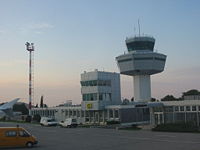
Dubrovnik Airport
-Traffic statistics:Dubrovnik Airport handled 1,270,062 passengers in 2010.In 1987 Dubrovnik Airport handled 1.5 million passengers and 2500 tons of cargo, making 1987 year the busiest thus far...
of its own. It is located approximately 20 km (12.4 mi) from Dubrovnik city centre, near Čilipi
Cilipi
Čilipi is a small village located in the municipality of Konavle, 22 km southeast from the town of Dubrovnik, in southern Croatia. It is connected by the D8 state road.Čilipi is mainly known for the nearby Dubrovnik Airport....
. Buses connect the airport with the Dubrovnik old main bus station
Bus station
A bus station is a structure where city or intercity buses stop to pick up and drop off passengers. It is larger than a bus stop, which is usually simply a place on the roadside, where buses can stop...
in Gruž
Gruž
Gruž is modern day neighborhood in the greater city of Dubrovnik, Croatia. The main port for Dubrovnik is in Gruž as well as its largest market and the main bus station "Libertas". Around 15,000 people currently live in Gruž...
. In addition, a network of modern, local buses connects all Dubrovnik neighbourhoods running frequently from dawn to midnight. However, Dubrovnik, unlike Croatia's other major centres, is not accessible by rail. Until 1975 Dubrovnik was connected to Mostar
Mostar
Mostar is a city and municipality in Bosnia and Herzegovina, the largest and one of the most important cities in the Herzegovina region and the center of the Herzegovina-Neretva Canton of the Federation. Mostar is situated on the Neretva river and is the fifth-largest city in the country...
and Sarajevo
Sarajevo
Sarajevo |Bosnia]], surrounded by the Dinaric Alps and situated along the Miljacka River in the heart of Southeastern Europe and the Balkans....
by a narrow gauge railway(760 mm) built during the Austro-Hungarian rule of Bosnia
Bosnia and Herzegovina (Austro-Hungarian condominium)
The Austro-Hungarian condominium of Bosnia and Herzegovina was a condominium established after the annexation of Bosnia and Herzegovina by Austria-Hungary in 1908, following its occupation in 1878 under the terms of the Treaty of Berlin.-History:...
.
The A1
A1 (Croatia)
The A1 motorway is the longest motorway in Croatia spanning . As it connects Zagreb, the nation's capital, to Split, the second largest city in the country and the largest city in Dalmatia, the motorway represents a major north–south transportation corridor in Croatia and a significant part of the...
highway, in use between Zagreb
Zagreb
Zagreb is the capital and the largest city of the Republic of Croatia. It is in the northwest of the country, along the Sava river, at the southern slopes of the Medvednica mountain. Zagreb lies at an elevation of approximately above sea level. According to the last official census, Zagreb's city...
and Vrgorac
Vrgorac
Vrgorac is a town in Croatia in the Split-Dalmatia County.The total population of Vrgorac is 6,501 , in the following settlements:* Banja, population 214* Dragljane, population 47* Draževitići, population 204* Duge Njive, population 106...
, is planned to be extended all the way to Dubrovnik. The highway will cross the Pelješac Bridge
Pelješac bridge
The Pelješac Bridge is a bridge intended to connect the Croatian peninsula of Pelješac with the Croatian mainland, spanning the Adriatic Sea, which separates the two near the Bay of Mali Ston and the Neretva Channel....
which is currently under construction. An alternative plan proposes the highway running from Neum
Neum
Neum is the only coastal town in Bosnia and Herzegovina. It comprises of coastline, the country's only access to the Adriatic Sea. As of 2009, municipal population was of 4,605 and the one of Neum main town was of 4,268 .-Features:Neum has steep hills, sandy beaches, and several large tourist...
through Bosnia and Herzegovina
Bosnia and Herzegovina
Bosnia and Herzegovina , sometimes called Bosnia-Herzegovina or simply Bosnia, is a country in Southern Europe, on the Balkan Peninsula. Bordered by Croatia to the north, west and south, Serbia to the east, and Montenegro to the southeast, Bosnia and Herzegovina is almost landlocked, except for the...
and an expressway continuing to Dubrovnik. However, this plan has fallen out of favour.
Education
Dubrovnik has a number of educational institutions. These include Dubrovnik International UniversityDubrovnik International University
Dubrovnik International University is a private university established in 2008 under the auspices of the United Nations Alliance of Civilizations and in conjunction with both Croatian and American institutions. It is located within the Dominican Monastery in Dubrovnik, Croatia and is the first...
, the University of Dubrovnik
University of Dubrovnik
The University of Dubrovnik is a university located in Dubrovnik, Croatia. It was founded in 2003 and is organized in 7 Departments.-History:...
, a Nautical College, a Tourist College, a University Centre for Postgraduate Studies of the University of Zagreb
University of Zagreb
The University of Zagreb is the biggest Croatian university and the oldest continuously operating university in the area covering Central Europe south of Vienna and all of Southeastern Europe...
, American College of Management and Technology
American College of Management and Technology
The American College of Management and Technology is a college of the Rochester Institute of Technology located in Dubrovnik, Croatia. It is the only school in the country which grants both American and Croatian degrees. Instruction is in English....
, and an Institute of History of the Croatian Academy of Sciences and Arts
Croatian Academy of Sciences and Arts
The Croatian Academy of Sciences and Arts is the national academy of Croatia. It was founded in 1866 as the Yugoslav Academy of Sciences and Arts , and was known by that name for most of its existence.- History :...
.
Climate
The climate along the Dubrovnik Region is a typical MediterraneanMediterranean Sea
The Mediterranean Sea is a sea connected to the Atlantic Ocean surrounded by the Mediterranean region and almost completely enclosed by land: on the north by Anatolia and Europe, on the south by North Africa, and on the east by the Levant...
one, with mild, rainy winters and hot and dry summers. However, it is perhaps distinct from other Mediterranean climates because of the unusual winds and frequency of thunderstorms. The Bura
Bora (wind)
Bora or Bura is a northern to north-eastern katabatic wind in the Adriatic, Bosnia and Herzegovina, Croatia, Montenegro, Italy, Greece, Slovenia, and Turkey....
wind blows uncomfortably cold gusts down the Adriatic
Adriatic Sea
The Adriatic Sea is a body of water separating the Italian Peninsula from the Balkan peninsula, and the system of the Apennine Mountains from that of the Dinaric Alps and adjacent ranges...
coast between October and April, and thundery conditions are common all the year round, even in summer, when they interrupt the warm, sunny days
Sunny Days
Sunny Days is the third single by British Ska and Indie band Kid British.The song was free on iTunes for a short period of time when first releasedThe single was released on April 20, 2009 on CD and Digital Download....
. The air temperatures can slightly vary, depending on the area or region. Typically, in July and August daytime maximum temperatures reach 29 °C (84 °F), and at night drop to around 21 °C (70 °F). More comfortable, perhaps, is the climate in Spring and Autumn when maximum temperatures are typically between 20 °C (68 °F) and 28 °C (82 °F).
- Air temperature
- average annual
- 16.4 °C (61.5 °F)
-
- average of coldest period = January
- 10 °C (50 °F)
- average of warmest period = August
- 25.8 °C (78.4 °F)
-
- Sea temperature
- average May–September
- 17.9 –
- SalinitySalinitySalinity is the saltiness or dissolved salt content of a body of water. It is a general term used to describe the levels of different salts such as sodium chloride, magnesium and calcium sulfates, and bicarbonates...
*- approximately 38 ‰ (parts per thousandConcentrationIn chemistry, concentration is defined as the abundance of a constituent divided by the total volume of a mixture. Four types can be distinguished: mass concentration, molar concentration, number concentration, and volume concentration...
)
- approximately 38 ‰ (parts per thousand
- PrecipitationPrecipitation (meteorology)In meteorology, precipitation In meteorology, precipitation In meteorology, precipitation (also known as one of the classes of hydrometeors, which are atmospheric water phenomena is any product of the condensation of atmospheric water vapor that falls under gravity. The main forms of precipitation...
- average annual
- Salinity
- 1,020.8 mm
-
- average annual rain days
-
- 109.2
- Sunshine
- average annual
- Sunshine
- 2629 h
-
- average daily hours
-
- 7.2 h
Twin towns - sister cities
Dubrovnik is twinned with:Ravenna
Ravenna
Ravenna is the capital city of the Province of Ravenna in the Emilia-Romagna region of Italy and the second largest comune in Italy by land area, although, at , it is little more than half the size of the largest comune, Rome...
, Italy
Italy
Italy , officially the Italian Republic languages]] under the European Charter for Regional or Minority Languages. In each of these, Italy's official name is as follows:;;;;;;;;), is a unitary parliamentary republic in South-Central Europe. To the north it borders France, Switzerland, Austria and...
(since 1967) Vukovar
Vukovar
Vukovar is a city in eastern Croatia, and the biggest river port in Croatia located at the confluence of the Vuka river and the Danube. Vukovar is the center of the Vukovar-Syrmia County...
, Croatia (since 1993) Graz
Graz
The more recent population figures do not give the whole picture as only people with principal residence status are counted and people with secondary residence status are not. Most of the people with secondary residence status in Graz are students...
, Austria
Austria
Austria , officially the Republic of Austria , is a landlocked country of roughly 8.4 million people in Central Europe. It is bordered by the Czech Republic and Germany to the north, Slovakia and Hungary to the east, Slovenia and Italy to the south, and Switzerland and Liechtenstein to the...
(since 1994)
Helsingborg
Helsingborg
Helsingborg is a city and the seat of Helsingborg Municipality, Skåne County, Sweden with 97,122 inhabitants in 2010. Helsingborg is the centre of an area in the Øresund region of about 320,000 inhabitants in north-west Scania, and is Sweden's closest point to Denmark, with the Danish city...
, Sweden
Sweden
Sweden , officially the Kingdom of Sweden , is a Nordic country on the Scandinavian Peninsula in Northern Europe. Sweden borders with Norway and Finland and is connected to Denmark by a bridge-tunnel across the Öresund....
(since 1996) Ragusa
Ragusa, Italy
Ragusa is a city and comune in southern Italy. It is the capital of the province of Ragusa, on the island of Sicily, with around 75,000 inhabitants. It is built on a wide limestone hill between two deep valleys, Cava San Leonardo and Cava Santa Domenica...
, Italy
Italy
Italy , officially the Italian Republic languages]] under the European Charter for Regional or Minority Languages. In each of these, Italy's official name is as follows:;;;;;;;;), is a unitary parliamentary republic in South-Central Europe. To the north it borders France, Switzerland, Austria and...
(since 2000) Bad Homburg, Germany
Germany
Germany , officially the Federal Republic of Germany , is a federal parliamentary republic in Europe. The country consists of 16 states while the capital and largest city is Berlin. Germany covers an area of 357,021 km2 and has a largely temperate seasonal climate...
(since 2002)
Sarajevo
Sarajevo
Sarajevo |Bosnia]], surrounded by the Dinaric Alps and situated along the Miljacka River in the heart of Southeastern Europe and the Balkans....
, Bosnia and Herzegovina
Bosnia and Herzegovina
Bosnia and Herzegovina , sometimes called Bosnia-Herzegovina or simply Bosnia, is a country in Southern Europe, on the Balkan Peninsula. Bordered by Croatia to the north, west and south, Serbia to the east, and Montenegro to the southeast, Bosnia and Herzegovina is almost landlocked, except for the...
(since 2007) Monterey
Monterey, California
The City of Monterey in Monterey County is located on Monterey Bay along the Pacific coast in Central California. Monterey lies at an elevation of 26 feet above sea level. As of the 2010 census, the city population was 27,810. Monterey is of historical importance because it was the capital of...
, California
California
California is a state located on the West Coast of the United States. It is by far the most populous U.S. state, and the third-largest by land area...
, United States
United States
The United States of America is a federal constitutional republic comprising fifty states and a federal district...
(since 2007) Rueil-Malmaison
Rueil-Malmaison
Rueil-Malmaison is a commune in the western suburbs of Paris, in the Hauts-de-Seine department of France. It is located 12.6 kilometers from the center of Paris.-Name:...
, France
France
The French Republic , The French Republic , The French Republic , (commonly known as France , is a unitary semi-presidential republic in Western Europe with several overseas territories and islands located on other continents and in the Indian, Pacific, and Atlantic oceans. Metropolitan France...
since (2011)
Panorama
See also
- List of people from Dubrovnik
- Walls of DubrovnikWalls of DubrovnikThe Walls of Dubrovnik are a series of defensive stone walls that have surrounded and protected the citizens of the afterward proclaimed maritime city-state of Dubrovnik , situated in southern Croatia, since the city's founding prior to the 7th century as a Byzantium castrum on a rocky island...
- Republic of RagusaRepublic of RagusaThe Republic of Ragusa or Republic of Dubrovnik was a maritime republic centered on the city of Dubrovnik in Dalmatia , that existed from 1358 to 1808...
- DalmatiaDalmatiaDalmatia is a historical region on the eastern coast of the Adriatic Sea. It stretches from the island of Rab in the northwest to the Bay of Kotor in the southeast. The hinterland, the Dalmatian Zagora, ranges from fifty kilometers in width in the north to just a few kilometers in the south....
External links
- Old City of Dubrovnik - UNESCO World Heritage Centre
- Dubrovnik, pearl of the Adriatic Photo gallery and tourist information
- Video, Dubrovnik Digital reconstruction by GRAIL at Washington University
- eGuide to Dubrovnik Churches and Monasteries
- Dubrovnik in Encyclopædia Britannica
- Guide to Dubrovnik history, famous people, culture and monuments