


Ban Kulin

Encyclopedia
Ban
Kulin (1163–1204) was a notable Ban of Bosnia who ruled from 1180 to 1204 first as a vassal
of the Byzantine Empire
and then of the Kingdom of Hungary
. He was brought to the power by Byzantine Emperor Manuel I Comnenus. He had a son, Stjepan Kulinić
who succeeded him as Bosnian Ban. Kulin founded the House of Kulinić
.
.
His rule is often remembered as Bosnia's golden age, and he is a common hero of Bosnian national folk tales. Bosnia was autonomous and mostly at peace during his rule. As an ordered and economically prosperous soon became de facto independent state.
under King Bela that has just launched an attack on the Byzantine Empire
together with Serbs
led by grand župan of Serbia
, Stefan Nemanja
. The cause of the war was the new imposer to the Imperial throne Andronicus Comnenus that was not recognized as legitimate by the Hungarian crown. The united forces met little resistance in the eastern Serbian lands - the Greek squadrons were fighting among themselves as the local Byzantine commanders: Alexios Brannes supported the new Emperor, while Andronicus Lapardes opposed him - and deserted the Imperial Army, going onto adventures on his own. Without difficulties, the Greeks
were pushed out of the Valley of Morava
and the allied forces breached all the way to Sofia
, raiding Belgrade
, Braničevo
, Ravno
, Niš
and Sophia itself. With the Hungarian withdrawal from the conflict, so did Ban Kulin stand down. In Kulin's times, the term Bosnia encompassed roughly the lands of Vrhbosna (near Sarajevo
), Usora, Soli
, the Donji Kraji and Rama
, which is approximately geographical Bosnia
.
in 1199 by the Serbian Duke of Zeta, Vukan, who sent the recently-crowned Pope a letter, telling him of heresy in Bosnia. Vukan claimed that Kulin, was a heretic, as was his wife and sister. He claimed that Kulin had welcomed the heretics whom Bernard had banished, treating them as Catholics and addressing them as “Christians par excellence”. According to Vukan, the ban had led 10,000 of his subjects astray. The mention of “Christians” drew the attention of the Pope, who wrote a letter dated 11 November
1200 to Kulin’s suzerain, the Hungarian King Emeric
, warning him that “no small number of Patarenes” had gone from Split
and Trogir
to Ban Kulin where they were warmly welcomed. Innocent’s tone was a mixture of anguish and ire. He told Emmerich: “Go and ascertain the truth of these reports and if Kulin is unwilling to recant, drive him from your lands and confiscate his property.” (13) We should note that-harsh as he sounds-the Pope was concerned with the truth. In the case of Bosnia, Innocent and his successors sought second and even third opinions. He did not trust local informants and set up his own system of legates and investigators who reported directly to him.
Kulin’s reaction to the threat from Rome was both courageous and astute, setting a pattern for future Bosnian-Papal relations. First, he wrote the Pope that he didn’t regard the new immigrants as heretics, but as Catholics, and he was sending a few of them to
Rome for examination. He also invited the Pope to send a representative to Bosnia to investigate.
Unconvinced by Kulin’s Bosnians, however, Innocent sent his legate John de Casamaris and Archdeacon Marin of Dubrovnik
to Bosnia to interrogate Ban Kulin, his wife, and subjects about “everything relating to faith and life”, and if they found anything that “smelled of this heretical depravity--or if they resisted true teaching—they should correct the situation.” He referred them to a “Constitution” he had prepared regarding heresy.
Innocent was well aware that he might be dealing with dualist heresy in Bosnia. He wrote to Bernard of Split (November 21, 1202) that “a multitude of people in Bosnia are suspected of the damnable heresy of the Cathars."
John de Casamaris and Marin may have stayed one full winter in Bosnia, from the end of November until early April. Since their job was to ascertain the truth about the heresy, the legate went about the country with Marin, stopping at the various krstjani hiže, or lodges—the conventicula mentioned in the Split edict of 1185—interrogating the abbots, monks and nuns regarding their beliefs and practices.
John probably had a list of Patarene or Cathar errors to guide him. Marin was his interpreter, since the Bosnians knew no Latin. If there were Slavonic documents available, Marin translated them.
Not only did Casamaris listen to his informants’ answers, but where they were in error, he would have taught them correct doctrine, in line with Innocent’s directive. John must have convinced himself that he had fulfilled Innocent’s command to correct the krstjani, because the “Confessio” (Abjuration) signed at Bilino Polje by seven priors of the Krstjani church on April 8, 1203, makes no mention of errors.
The same document was brought to Budapest, April 30 by Casamaris and Kulin and two abbots, where it was examined by the Hungarian King and the high clergy. Kulin’s son Stefan, during a later meeting, agreed that if the Bosnians violated the agreement, they would pay a heavy fine of 1,000 marks.
On the surface, the “Confessio” concerned church organization and practices. The monks renounced their schism with Rome and agreed to accept Rome as the mother church. They promised to erect chapels with altars and crucifixes, where they would have priests who would say Mass and dispense Holy Communion at least seven times a year on the main feast days.
The priests would also hear confession and give penances. The monks promised to chant the hours, night and day, and to read the Old Testament as well as the New. They would follow the Church’s schedule of fasts, as well as their own regimen. They also agreed to stop calling themselves krstjani—which had been their exclusive privilege—lest they cause pain to other Christians. They would wear special, uncolored robes, closed and reaching the ankles. In addition they were to have graveyards next to the church, where they would bury their brethren and any visitors who happened to die there.
Women members of the order were to have special quarters away from the men and to eat separately; nor could they be seen talking alone with a monk, lest they cause scandal. The abbots also agreed not to offer lodging to manicheans or other heretics. Finally, upon the death of the head of their order (magister), the abbots, after consultation with their fellow monks, would submit their choice to the Pope for his approval. As for the Bosnian Catholic diocese itself, John advised Innocent that they needed to break the hold
of the Slavonic bishop who had ruled the Bosnian church up to then, and to appoint three or four Latin bishops, since Bosnia was a large country (“ten days’ walk”).
After the “Confessio” was approved by King Emmerich, John de Casamaris, in a letter to Innocent, refers to “the former Patarenes.”(23) Obviously, he thought that he had converted the krstjani, but he was wrong. In my opinion, they were merely waiting for him to go.
Partly due to Rome’s complacency (caused by Casamaris’s feelings of success) and the Pope’s failure to appoint Latin bishops, as John had suggested, the heretical movement grew stronger over the next few decades, uniting with remnants of the old native Catholic
church. Together they formed a national, heretical church which survived crusades and threats of crusades until the mid-fifteenth century, when it gradually vanished in the face of the Ottoman takeover.
that regulates Ragusan trade rights in Bosnia written on August 29, 1189. It is one of the oldest written state documents in the Balkans
and is among the oldest historical documents written in bosančica. The charter is of great significance in Bosnian nationalism.
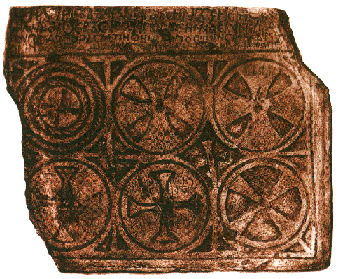
, the Serbian Prince Miroslav of Hum
in Rascia
and Kulin himself had two sons:
Ban (title)
Ban was a title used in several states in central and south-eastern Europe between the 7th century and the 20th century.-Etymology:The word ban has entered the English language probably as a borrowing from South Slavic ban, meaning "lord, master; ruler". The Slavic word is probably borrowed from...
Kulin (1163–1204) was a notable Ban of Bosnia who ruled from 1180 to 1204 first as a vassal
Vassal
A vassal or feudatory is a person who has entered into a mutual obligation to a lord or monarch in the context of the feudal system in medieval Europe. The obligations often included military support and mutual protection, in exchange for certain privileges, usually including the grant of land held...
of the Byzantine Empire
Byzantine Empire
The Byzantine Empire was the Eastern Roman Empire during the periods of Late Antiquity and the Middle Ages, centred on the capital of Constantinople. Known simply as the Roman Empire or Romania to its inhabitants and neighbours, the Empire was the direct continuation of the Ancient Roman State...
and then of the Kingdom of Hungary
Kingdom of Hungary
The Kingdom of Hungary comprised present-day Hungary, Slovakia and Croatia , Transylvania , Carpatho Ruthenia , Vojvodina , Burgenland , and other smaller territories surrounding present-day Hungary's borders...
. He was brought to the power by Byzantine Emperor Manuel I Comnenus. He had a son, Stjepan Kulinić
Stjepan Kulinic
Stephen Kulinić , son of Bosnia's Ban Kulin, was a Bosnian Ban in 1204–1232. He was a faithful Catholic and thus a supporter of the Hungarian Crown, but not very popular in Bosnia - as he turned away from his father's policies and prosecuted the Bogumils...
who succeeded him as Bosnian Ban. Kulin founded the House of Kulinić
House of Kulinic
The Kulinić dynasty was a medieval Bosnian ruling family from the second half of the 12th century to the first half of the 13th century. Its founder, Kulin, was made Bosnia's Ban by the Eastern Roman Emperor Manuel I Comnenus in 1180, but he was present in Bosnia political and social life since...
.
Life
Kulin came to prominence in Bosnia 1163 as he was under the Byzantine Emperor Manuel I Comnenus who was just taking the country from the Hungarians earlier, although it would not be until 1180 that he would place Kulin as his vassal as BanBan (title)
Ban was a title used in several states in central and south-eastern Europe between the 7th century and the 20th century.-Etymology:The word ban has entered the English language probably as a borrowing from South Slavic ban, meaning "lord, master; ruler". The Slavic word is probably borrowed from...
.
His rule is often remembered as Bosnia's golden age, and he is a common hero of Bosnian national folk tales. Bosnia was autonomous and mostly at peace during his rule. As an ordered and economically prosperous soon became de facto independent state.
War against Bizantium
In 1183, he led his troops with the forces of the Kingdom of HungaryKingdom of Hungary
The Kingdom of Hungary comprised present-day Hungary, Slovakia and Croatia , Transylvania , Carpatho Ruthenia , Vojvodina , Burgenland , and other smaller territories surrounding present-day Hungary's borders...
under King Bela that has just launched an attack on the Byzantine Empire
Byzantine Empire
The Byzantine Empire was the Eastern Roman Empire during the periods of Late Antiquity and the Middle Ages, centred on the capital of Constantinople. Known simply as the Roman Empire or Romania to its inhabitants and neighbours, the Empire was the direct continuation of the Ancient Roman State...
together with Serbs
Serbs
The Serbs are a South Slavic ethnic group of the Balkans and southern Central Europe. Serbs are located mainly in Serbia, Montenegro and Bosnia and Herzegovina, and form a sizable minority in Croatia, the Republic of Macedonia and Slovenia. Likewise, Serbs are an officially recognized minority in...
led by grand župan of Serbia
Serbia
Serbia , officially the Republic of Serbia , is a landlocked country located at the crossroads of Central and Southeast Europe, covering the southern part of the Carpathian basin and the central part of the Balkans...
, Stefan Nemanja
Stefan Nemanja
Stefan Nemanja was the Grand Prince of the Grand Principality of Serbia from 1166 to 1196, a heir of the Vukanović dynasty that marked the beginning of a greater Serbian realm .He is remembered for his contributions to Serbian culture and...
. The cause of the war was the new imposer to the Imperial throne Andronicus Comnenus that was not recognized as legitimate by the Hungarian crown. The united forces met little resistance in the eastern Serbian lands - the Greek squadrons were fighting among themselves as the local Byzantine commanders: Alexios Brannes supported the new Emperor, while Andronicus Lapardes opposed him - and deserted the Imperial Army, going onto adventures on his own. Without difficulties, the Greeks
Greeks
The Greeks, also known as the Hellenes , are a nation and ethnic group native to Greece, Cyprus and neighboring regions. They also form a significant diaspora, with Greek communities established around the world....
were pushed out of the Valley of Morava
Morava
Morava is a Slavic river name. It may refer to:Rivers:* Great Morava in central Serbia** South Morava , tributary of the Great Morava** West Morava , tributary of the Great Morava...
and the allied forces breached all the way to Sofia
Sofia
Sofia is the capital and largest city of Bulgaria and the 12th largest city in the European Union with a population of 1.27 million people. It is located in western Bulgaria, at the foot of Mount Vitosha and approximately at the centre of the Balkan Peninsula.Prehistoric settlements were excavated...
, raiding Belgrade
Belgrade
Belgrade is the capital and largest city of Serbia. It is located at the confluence of the Sava and Danube rivers, where the Pannonian Plain meets the Balkans. According to official results of Census 2011, the city has a population of 1,639,121. It is one of the 15 largest cities in Europe...
, Braničevo
Branicevo
Braničevo can refer to:* Braničevo , a geographical region in Serbia.* Braničevo District, a district in Serbia.* Braničevo , a village in Serbia, in the Golubac municipality....
, Ravno
Ravno
Ravno is a town and the seat of its municipality in Bosnia and Herzegovina. It is located in the Herzegovina-Neretva Canton of the Federation of Bosnia and Herzegovina entity. Ravno was a municipality until 1963, when it became a part of the Trebinje municipality...
, Niš
Niš
Niš is the largest city of southern Serbia and third-largest city in Serbia . According to the data from 2011, the city of Niš has a population of 177,972 inhabitants, while the city municipality has a population of 257,867. The city covers an area of about 597 km2, including the urban area,...
and Sophia itself. With the Hungarian withdrawal from the conflict, so did Ban Kulin stand down. In Kulin's times, the term Bosnia encompassed roughly the lands of Vrhbosna (near Sarajevo
Sarajevo
Sarajevo |Bosnia]], surrounded by the Dinaric Alps and situated along the Miljacka River in the heart of Southeastern Europe and the Balkans....
), Usora, Soli
Soli
Soli can refer to:* Soli, Cyprus, an ancient city on the island of Cyprus.* Soli, Cilicia, an ancient city in Cilicia, later renamed Pompeiopolis.* Soli, a 10th century name for Tuzla, a city in Bosnia and Herzegovina....
, the Donji Kraji and Rama
Rama
Rama or full name Ramachandra is considered to be the seventh avatar of Vishnu in Hinduism, and a king of Ayodhya in ancient Indian...
, which is approximately geographical Bosnia
Bosnia (region)
Bosnia is a eponomous region of Bosnia and Herzegovina. It lies mainly in the Dinaric Alps, ranging to the southern borders of the Pannonian plain, with the rivers Sava and Drina marking its northern and eastern borders. The other eponomous region, the southern, other half of the country is...
.
Bogomils
News of the heresy reached Pope Innocent IIIPope Innocent III
Pope Innocent III was Pope from 8 January 1198 until his death. His birth name was Lotario dei Conti di Segni, sometimes anglicised to Lothar of Segni....
in 1199 by the Serbian Duke of Zeta, Vukan, who sent the recently-crowned Pope a letter, telling him of heresy in Bosnia. Vukan claimed that Kulin, was a heretic, as was his wife and sister. He claimed that Kulin had welcomed the heretics whom Bernard had banished, treating them as Catholics and addressing them as “Christians par excellence”. According to Vukan, the ban had led 10,000 of his subjects astray. The mention of “Christians” drew the attention of the Pope, who wrote a letter dated 11 November
1200 to Kulin’s suzerain, the Hungarian King Emeric
Emeric of Hungary
Emeric I , , King of Hungary and Croatia . He was crowned during his father's lifetime, but after his father's death he had to fight against his brother, Andrew, who forced Emeric to assign the government of Croatia and Dalmatia to him...
, warning him that “no small number of Patarenes” had gone from Split
Split (city)
Split is a Mediterranean city on the eastern shores of the Adriatic Sea, centered around the ancient Roman Palace of the Emperor Diocletian and its wide port bay. With a population of 178,192 citizens, and a metropolitan area numbering up to 467,899, Split is by far the largest Dalmatian city and...
and Trogir
Trogir
Trogir is a historic town and harbour on the Adriatic coast in Split-Dalmatia County, Croatia, with a population of 12,995 and a total municipality population of 13,322 . The historic city of Trogir is situated on a small island between the Croatian mainland and the island of Čiovo...
to Ban Kulin where they were warmly welcomed. Innocent’s tone was a mixture of anguish and ire. He told Emmerich: “Go and ascertain the truth of these reports and if Kulin is unwilling to recant, drive him from your lands and confiscate his property.” (13) We should note that-harsh as he sounds-the Pope was concerned with the truth. In the case of Bosnia, Innocent and his successors sought second and even third opinions. He did not trust local informants and set up his own system of legates and investigators who reported directly to him.
Kulin’s reaction to the threat from Rome was both courageous and astute, setting a pattern for future Bosnian-Papal relations. First, he wrote the Pope that he didn’t regard the new immigrants as heretics, but as Catholics, and he was sending a few of them to
Rome for examination. He also invited the Pope to send a representative to Bosnia to investigate.
Unconvinced by Kulin’s Bosnians, however, Innocent sent his legate John de Casamaris and Archdeacon Marin of Dubrovnik
Dubrovnik
Dubrovnik is a Croatian city on the Adriatic Sea coast, positioned at the terminal end of the Isthmus of Dubrovnik. It is one of the most prominent tourist destinations on the Adriatic, a seaport and the centre of Dubrovnik-Neretva county. Its total population is 42,641...
to Bosnia to interrogate Ban Kulin, his wife, and subjects about “everything relating to faith and life”, and if they found anything that “smelled of this heretical depravity--or if they resisted true teaching—they should correct the situation.” He referred them to a “Constitution” he had prepared regarding heresy.
Innocent was well aware that he might be dealing with dualist heresy in Bosnia. He wrote to Bernard of Split (November 21, 1202) that “a multitude of people in Bosnia are suspected of the damnable heresy of the Cathars."
John de Casamaris and Marin may have stayed one full winter in Bosnia, from the end of November until early April. Since their job was to ascertain the truth about the heresy, the legate went about the country with Marin, stopping at the various krstjani hiže, or lodges—the conventicula mentioned in the Split edict of 1185—interrogating the abbots, monks and nuns regarding their beliefs and practices.
John probably had a list of Patarene or Cathar errors to guide him. Marin was his interpreter, since the Bosnians knew no Latin. If there were Slavonic documents available, Marin translated them.
Not only did Casamaris listen to his informants’ answers, but where they were in error, he would have taught them correct doctrine, in line with Innocent’s directive. John must have convinced himself that he had fulfilled Innocent’s command to correct the krstjani, because the “Confessio” (Abjuration) signed at Bilino Polje by seven priors of the Krstjani church on April 8, 1203, makes no mention of errors.
The same document was brought to Budapest, April 30 by Casamaris and Kulin and two abbots, where it was examined by the Hungarian King and the high clergy. Kulin’s son Stefan, during a later meeting, agreed that if the Bosnians violated the agreement, they would pay a heavy fine of 1,000 marks.
On the surface, the “Confessio” concerned church organization and practices. The monks renounced their schism with Rome and agreed to accept Rome as the mother church. They promised to erect chapels with altars and crucifixes, where they would have priests who would say Mass and dispense Holy Communion at least seven times a year on the main feast days.
The priests would also hear confession and give penances. The monks promised to chant the hours, night and day, and to read the Old Testament as well as the New. They would follow the Church’s schedule of fasts, as well as their own regimen. They also agreed to stop calling themselves krstjani—which had been their exclusive privilege—lest they cause pain to other Christians. They would wear special, uncolored robes, closed and reaching the ankles. In addition they were to have graveyards next to the church, where they would bury their brethren and any visitors who happened to die there.
Women members of the order were to have special quarters away from the men and to eat separately; nor could they be seen talking alone with a monk, lest they cause scandal. The abbots also agreed not to offer lodging to manicheans or other heretics. Finally, upon the death of the head of their order (magister), the abbots, after consultation with their fellow monks, would submit their choice to the Pope for his approval. As for the Bosnian Catholic diocese itself, John advised Innocent that they needed to break the hold
of the Slavonic bishop who had ruled the Bosnian church up to then, and to appoint three or four Latin bishops, since Bosnia was a large country (“ten days’ walk”).
After the “Confessio” was approved by King Emmerich, John de Casamaris, in a letter to Innocent, refers to “the former Patarenes.”(23) Obviously, he thought that he had converted the krstjani, but he was wrong. In my opinion, they were merely waiting for him to go.
Partly due to Rome’s complacency (caused by Casamaris’s feelings of success) and the Pope’s failure to appoint Latin bishops, as John had suggested, the heretical movement grew stronger over the next few decades, uniting with remnants of the old native Catholic
church. Together they formed a national, heretical church which survived crusades and threats of crusades until the mid-fifteenth century, when it gradually vanished in the face of the Ottoman takeover.
Charter
The Charter of Ban Kulin is trade agreement between Bosnia and the Republic of RagusaRepublic of Ragusa
The Republic of Ragusa or Republic of Dubrovnik was a maritime republic centered on the city of Dubrovnik in Dalmatia , that existed from 1358 to 1808...
that regulates Ragusan trade rights in Bosnia written on August 29, 1189. It is one of the oldest written state documents in the Balkans
Balkans
The Balkans is a geopolitical and cultural region of southeastern Europe...
and is among the oldest historical documents written in bosančica. The charter is of great significance in Bosnian nationalism.
Kulin death
After the death of Ban Kulin in 1204., the Bosnian throne was set by his son Stephen Kulinić.Marriage and children
Kulin's sister married the brother of Grand Prince Stefan NemanjaStefan Nemanja
Stefan Nemanja was the Grand Prince of the Grand Principality of Serbia from 1166 to 1196, a heir of the Vukanović dynasty that marked the beginning of a greater Serbian realm .He is remembered for his contributions to Serbian culture and...
, the Serbian Prince Miroslav of Hum
Miroslav of Hum
Miroslav Zavidović or Miroslav of Hum was a 12th-century Great Prince of Zachlumia from 1162 to 1190, an administrative division of the medieval Serbian Principality covering Herzegovina and southern Dalmatia....
in Rascia
Rascia
Rascia was a medieval region that served as the principal province of the Serbian realm. It was an administrative division under the direct rule of the monarch and sometimes as an appanage. The term has been used to refer to various Serbian states throughout the Middle Ages...
and Kulin himself had two sons:
- Stephen Kulinić, the following Ban of Bosnia
- a son that went with the Pope's emissaries in 1203 to explain heresy accusations against Kulin
See also
- History of Bosnia and HerzegovinaHistory of Bosnia and Herzegovina-Pre-Slavic Period :Bosnia has been inhabited at least since Neolithic times. In the late Bronze Age, the Neolithic population was replaced by more warlike Indo-European tribes known as the Illyrians. Celtic migrations in the 4th and 3rd century BCE displaced many Illyrian tribes from their former...
- Byzantine EmpireByzantine EmpireThe Byzantine Empire was the Eastern Roman Empire during the periods of Late Antiquity and the Middle Ages, centred on the capital of Constantinople. Known simply as the Roman Empire or Romania to its inhabitants and neighbours, the Empire was the direct continuation of the Ancient Roman State...
- History of HungaryHistory of HungaryHungary is a country in central Europe. Its history under this name dates to the early Middle Ages, when the Pannonian Basin was colonized by the Magyars, a semi-nomadic people from what is now central-northern Russia...
- List of rulers of Bosnia
- List of Bosnians
- History of CroatiaHistory of CroatiaCroatia first appeared as a duchy in the 7th century and then as a kingdom in the 10th century. From the 12th century it remained a distinct state with its ruler and parliament, but it obeyed the kings and emperors of various neighboring powers, primarily Hungary and Austria. The period from the...
External links
- http://spiritofbosnia.org/index.php/duhbosne/article/viewArticle/256/507