
All Topics  
Concentration

 
Concentration

   Email Print
   Bookmark   Link


Concentration


In chemistry
Chemistry

Chemistry is the science concerned with the composition, structure, and properties of matter, as well as the changes it undergoes during chemical reactions....
, concentration is the measure of how much of a given substance
Chemical substance

A chemical substance is a material with a specific Empirical formula. It is a concept that became firmly established in the late eighteenth century after work by the chemist Joseph Proust on the composition of some pure chemical compounds such as basic copper carbonate....
 there is mixed with another substance. This can apply to any sort of chemical mixture, but most frequently the concept is limited to homogeneous solution
Solution

In chemistry, a solution is a homogeneous mixture composed of two or more substances. In such a mixture, a solute is dissolved in another substance, known as a solvent....
s, where it refers to the amount of solute in the solvent.

To concentrate a solution, one must add more solute, or reduce the amount of solvent
Solvent

A solvent is a liquid or gas that dissolves a solid, liquid, or gaseous solute, resulting in a solution.The most common solvent in everyday life is water....
 (for instance, by selective evaporation
Evaporation

Evaporation is the slow vaporization of a liquid and the reverse of condensation. A type of phase transition, it is the process by which molecules in a liquid State of matter spontaneously become gaseous ....
).


Discussion
Ask a question about 'Concentration'
Start a new discussion about 'Concentration'
Answer questions from other users
Full Discussion Forum


Encyclopedia


In chemistry
Chemistry

Chemistry is the science concerned with the composition, structure, and properties of matter, as well as the changes it undergoes during chemical reactions....
, concentration is the measure of how much of a given substance
Chemical substance

A chemical substance is a material with a specific Empirical formula. It is a concept that became firmly established in the late eighteenth century after work by the chemist Joseph Proust on the composition of some pure chemical compounds such as basic copper carbonate....
 there is mixed with another substance. This can apply to any sort of chemical mixture, but most frequently the concept is limited to homogeneous solution
Solution

In chemistry, a solution is a homogeneous mixture composed of two or more substances. In such a mixture, a solute is dissolved in another substance, known as a solvent....
s, where it refers to the amount of solute in the solvent.

To concentrate a solution, one must add more solute, or reduce the amount of solvent
Solvent

A solvent is a liquid or gas that dissolves a solid, liquid, or gaseous solute, resulting in a solution.The most common solvent in everyday life is water....
 (for instance, by selective evaporation
Evaporation

Evaporation is the slow vaporization of a liquid and the reverse of condensation. A type of phase transition, it is the process by which molecules in a liquid State of matter spontaneously become gaseous ....
). By contrast, to dilute a solution, one must add more solvent, or reduce the amount of solute.

Unless two substances are fully miscible there exists a concentration at which no further solute will dissolve in a solution. At this point, the solution is said to be saturated
Saturation (chemistry)

In chemistry, saturation has five different meanings:#In physical chemistry, saturation is the point at which a solution of a substance can dissolve no more of that substance and additional amounts of it will appear as a Precipitation ....
. If additional solute is added to a saturated solution, it will not dissolve (except in certain circumstances, when supersaturation
Supersaturation

The term supersaturation refers to a solution that contains more of the dissolved material than could be dissolved by the solvent under normal circumstances....
 may occur). Instead, phase separation
Phase (matter)

In the physical sciences, a phase is a region of space , throughout which all physical properties of a material are essentially uniform. Examples of physical properties include density, refractive index, and chemical composition....
 will occur, leading to either coexisting phases or a suspension
Suspension (chemistry)

In chemistry, a suspension is a heterogeneous fluid containing solid particles that are sufficiently large for sedimentation. Usually they must be larger than 1 micrometre....
. The point of saturation depends on many variables such as ambient temperature and the precise chemical nature of the solvent and solute.

Analytical concentration includes all the forms of that substance in the solution.

Qualitative description

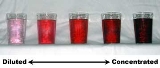
Dilution Concentration Simple Example
Often in informal, non-technical language, concentration is described in a qualitative
Qualitative

The term qualitative is used to describe certain types of information. Qualitative data are described in terms of quality . This is the converse of quantitative, which more precisely describes data in terms of quantity and often using a numerical figure to represent something in a statement....
 way, through the use of adjectives such as "dilute" or "weak" for solutions of relatively low concentration and of others like "concentrated" or "strong" for solutions of relatively high concentration. Those terms relate the amount of a substance in a mixture to the observable intensity of effects or properties caused by that substance. For example, a practical rule is that the more concentrated a chromatic
Color

Color or colour is the visual perception property corresponding in humans to the categories called red, yellow, blue and others....
 solution is, the more intensely colored it is (usually).

Quantitative notation

For scientific or technical applications, a qualitative account of concentration is almost never sufficient; therefore quantitative
Quantitative

A quantitative attribute is one that exists in a range of magnitudes, and can therefore be measurement. Measurements of any particular quantitative property are expressed as a specific quantity, referred to as a Unit of measurement, multiplied by a number....
 measures are needed to describe concentration. There are a number of different ways to quantitatively express concentration; the most common are listed below. They are based on mass, volume, or both. Depending on what they are based on it is not always trivial to convert one measure to the other, because knowledge of the density might be needed to do so. At times this information may not be available, particularly if the temperature varies.

Mass versus volume

Some units of concentration — particularly the most popular one, molarity — require knowledge of a substance's volume, which unlike mass is variable depending on ambient temperature and pressure. In fact (partial) molar volume can even be a function of concentration itself. This is why volumes are not necessarily completely additive when two liquids are added and mixed. Volume-based measures for concentration are therefore not to be recommended for non-dilute solutions or problems where relatively large differences in temperature are encountered (e.g. for phase diagram
Phase diagram

A phase diagram in physical chemistry, mineralogy, and materials science is a type of Graph of a function used to show conditions at which thermodynamically-distinct phase can occur at thermodynamic equilibrium....
s).

Unless otherwise stated, all the following measurements of volume are assumed to be at a standard state
Standard state

In chemistry, the standard state of a material is a reference point used to calculate its properties under different conditions. In principle, the choice of standard state is arbitrary, although the International Union of Pure and Applied Chemistry recommends a conventional set of standard states for general use....
 temperature and pressure (for example 25 degrees Celsius
Celsius

Celsius is a temperature scale that is named after the Swedish astronomer Anders Celsius , who developed a similar temperature scale two years before his death....
 at 1 atmosphere
Atmosphere (unit)

The standard atmosphere is an international reference pressure defined as 101,325 Pascal and formerly used as unit of pressure . For practical purposes it has been replaced by the Bar which is 100,000 Pa....
 or 101.325
kPa). The measurement of mass does not require such restrictions.

Mass can be determined at a precision of < 0.2 mg on a routine basis with an analytical balance
Weighing scale

A weighing scale is a measuring instrument for measuring the weight or mass of an object. They use one of two techniques. A spring scale measures weight by the distance a spring deflects under its load....
 and more precise instruments exist. Both solids and liquids are easily quantified by weighing.

The volume of a liquid is usually determined by calibrated glassware such as burettes and volumetric flasks. For very small volumes precision syringes are available. The use of graduated beakers and cylinders is not recommended as their indication of volume is mostly for decorative rather than quantitative purposes. The volume of solids, particularly of powders, is often difficult to measure, which is why mass is the more usual measure. For gases the opposite is true: the volume of a gas can be measured in a gas burette, if care is taken to control the pressure, but the mass is not easy to measure due to buoyancy effects.

Molarity

See also: Molar concentration
Molar concentration

In chemistry, molar concentration is a measure of the concentration of a solute in a solution, or of any molecule, ionic, or atomic Chemical species in a given volume....


Molarity (in units of mol/L, molar, or M) or molar concentration
Molar concentration

In chemistry, molar concentration is a measure of the concentration of a solute in a solution, or of any molecule, ionic, or atomic Chemical species in a given volume....
 denotes the number of mole
Mole (unit)

The mole is a Units of measurement of amount of substance: it is an SI base unit, and one of the few units used to measure this physical quantity....
s of a given substance per liter
Litér

Lit?r is a village in Veszpr?m , Hungary.External links ...
 of solution. A capital letter M is used to abbreviate the units of mol/L. For instance: The actual formula for molarity is:

Such a solution may be described as "0.50 molar." It must be emphasized that a 0.5 molar solution contains 0.5 moles of solute in 1.0 liter of solution. This is not equivalent to 1.0 liter of solvent. A 0.5 mol/L solution will contain either slightly more or slightly less than 1 liter of solvent because the process of dissolution causes the volume of the liquid to increase or decrease.

Following the SI
Si

Si, si, or SI may refer to :...
 system of units, the National Institute of Standards and Technology
National Institute of Standards and Technology

The National Institute of Standards and Technology , known between 1901 and 1988 as the National Bureau of Standards , is a measurement standards laboratory which is a non-regulatory agency of the United States Department of Commerce....
, the United States
United States

The United States of America is a Federal government constitutional republic comprising U.S. state and a federal district. The country is situated mostly in central North America, where its Contiguous United States and Washington, D.C., the Capital districts and territories, lie between the Pacific Ocean and Atlantic Oceans, Borders of the U...
 authority on measurement
Measurement

Measurement is the process of assigning a number to an attribute according to a rule or set of rules. The term can also be used to refer to the result obtained after performing the process....
, considers the term molarity and the unit symbol M to be obsolete, and suggests instead the amount-of-substance concentration (c) with units mol/m3 or other units used alongside the SI such as mol/L. This recommendation has not been universally implemented in academia or chemistry research yet.

Preparation of a solution of known molarity involves adding an accurately weighed amount of solute to a volumetric flask
Volumetric flask

A volumetric flask is a piece of laboratory glassware used in analytical chemistry for the preparation of solutions. It is made of glass or plastic and consists of a flat bottomed bulb with a long neck, usually fitted with a stopper....
, adding some solvent to dissolve it, then adding more solvent to fill to the volume mark.

When discussing the molarity of minute concentrations, such as in pharmacological
Pharmacology

Pharmacology is the study of drug action. More specifically it is the study of the interactions that occur between a living organism and exogenous chemicals that alter normal biochemical function....
 research, molarity is expressed in units of millimolar (mmol/L, mM, 1 thousandth of a molar), micromolar (µmol/L, µM, 1 millionth of a molar) or nanomolar (nmol/L, nM, 1 billionth of a molar).

Although molarity is by far the most commonly used measure of concentration, particularly for dilute aqueous solutions, it does suffer from a number of disadvantages. Masses can be determined with great precision as balance
Weighing scale

A weighing scale is a measuring instrument for measuring the weight or mass of an object. They use one of two techniques. A spring scale measures weight by the distance a spring deflects under its load....
s are often very precise. Determining volume is often not as precise. In addition, due to a thermal expansion
Thermal expansion

Thermal expansion is the tendency of matter to change in volume in response to a change in temperature. When a substance is heated, its constituent particles move around more vigorously and by doing so generally maintain a greater average separation....
, the molarity of a solution changes with temperature without adding or removing any mass. For non-dilute solutions another problem is that the molar volume of a substance is itself a function of concentration so that volume is not strictly additive.

Molality

Molality (mol/kg, molal, or m) denotes the number of mole
Mole (unit)

The mole is a Units of measurement of amount of substance: it is an SI base unit, and one of the few units used to measure this physical quantity....
s of solute per kilogram
Kilogram

The kilogram or kilogrammeThe spelling kilogram is used by the International Committee for Weights and Measures and the U.S....
 of solvent (not solution). For instance: adding 1.0 mole
Mole (unit)

The mole is a Units of measurement of amount of substance: it is an SI base unit, and one of the few units used to measure this physical quantity....
 of solute to 2.0 kilograms of solvent constitutes a solution with a molality of 0.50 mol/kg. Such a solution may be described as "0.50 molal". The term molal solution is used as a shorthand for a "one molal solution", i.e. a solution which contains one mole of the solute per 1000 grams of the solvent.

Following the SI
Si

Si, si, or SI may refer to :...
 system of units, the National Institute of Standards and Technology
National Institute of Standards and Technology

The National Institute of Standards and Technology , known between 1901 and 1988 as the National Bureau of Standards , is a measurement standards laboratory which is a non-regulatory agency of the United States Department of Commerce....
, the United States
United States

The United States of America is a Federal government constitutional republic comprising U.S. state and a federal district. The country is situated mostly in central North America, where its Contiguous United States and Washington, D.C., the Capital districts and territories, lie between the Pacific Ocean and Atlantic Oceans, Borders of the U...
 authority on measurement
Measurement

Measurement is the process of assigning a number to an attribute according to a rule or set of rules. The term can also be used to refer to the result obtained after performing the process....
, considers the unit symbol m to be obsolete, and suggests instead the term 'molality of substance B' (mB) with units mol/kg or a related unit of the SI. This recommendation has not been universally implemented in academia yet.

Note that molality is sometimes represented by the symbol (m), while molarity by the symbol (M). The two symbols are not meant to be confused, and should not be used as symbols for units. The SI
Si

Si, si, or SI may refer to :...
 unit for molality is mol/kg. (The unit m means meter.)

Like other mass-based measures, the determination of molality only requires a good scale, because the masses of both solvent and solute can be obtained by weighing, and molality is independent of the physical conditions like temperature and pressure, providing advantages over molarity.

In a dilute aqueous solution
Aqueous solution

An aqueous solution is a solution in which the solvent is water. It is usually shown in chemical equations by appending to the relevant formula....
 near room temperature and standard atmospheric pressure, the molarity and molality will be very similar in value. This is because 1 kg of water roughly corresponds to a volume of 1 L at these conditions, and because the solution is dilute, the addition of the solute makes a negligible impact on the volume of the solution.

However, in all other conditions, this is usually not the case.

Mole fraction

The mole fraction
Mole fraction

In chemistry, mole fraction x'' is a way of expressing the composition of a mixture. The mole fraction of each component i'' is defined as its amount of substance ni'' divided by the total amount of substance in the system, n''...
 ?, (also called molar fraction) denotes the number of moles of solute as a proportion of the total number of moles in a solution. For instance: 1 mole of solute dissolved in 9 moles of solvent has a mole fraction of 1/10 or 0.1. Mole fractions are dimensionless quantities. (The mole percentage or molar percentage, denoted "mol %" and equal to 100% times the mole fraction, is sometimes quoted instead of the mole fraction.)

This measure is used very frequently in the construction of phase diagram
Phase diagram

A phase diagram in physical chemistry, mineralogy, and materials science is a type of Graph of a function used to show conditions at which thermodynamically-distinct phase can occur at thermodynamic equilibrium....
s. It has a number of advantages:

  • the measure is not temperature dependent (such as molarity) and does not require knowledge of the densities of the phase(s) involved
  • a mixture of known mole fraction can be prepared by weighing off the appropriate masses of the constituents
  • the measure is symmetrical: in the mole fractions ?=0.1 and ?=0.9, the roles of 'solvent' and 'solute' are reversed.


As both mole fractions and molality are only based on the masses of the components it is easy to convert between these measures. This is not true for molarity, which requires knowledge of the density.

Mass percentage (fraction)

Mass percentage denotes the mass
Mass

In physical science, mass refers to the degree of acceleration a body acquires when subject to a force: bodies with greater mass are accelerated less by the same force....
 of a substance in a mixture as a percentage of the mass of the entire mixture. (Mass fraction
Mass fraction (chemistry)

In chemistry the mass fraction is the fraction of one substance with mass to the total mixture mass would be defined as:with the sum of all the mass fractions equal to 1:...
 xm can be used instead of mass percentage by dividing mass percentage to 100.) For instance: if a bottle contains 40 gram
Gram

The gram , ; symbol g, is a Physical unit of mass.Originally defined as "the absolute weight of a volume of pure water equal to the cube of the hundredth part of a metre, and at the temperature of melting ice" , a gram is now defined as one one-thousandth of the SI base unit, the kilogram, or Scientific notation kg, which itself is...
s of ethanol
Ethanol

Ethanol, also called ethyl alcohol, pure alcohol, grain alcohol, or drinking alcohol, is a volatility , flammable, colorless liquid....
 and 60 grams of water
Water

Water is a common chemical substance that is essential for the survival of all known forms of life. In typical usage, water refers only to its liquid form or States of matter, but the substance also has a solid state, ice, and a gaseous state, water vapor or steam....
, then it contains 40% ethanol by mass or 0.4 mass fraction ethanol. Commercial concentrated aqueous reagents such as acids and bases are often labeled in concentrations of weight percentage with the specific gravity
Specific gravity

Specific gravity is defined as the ratio of the density of a given solid or liquid substance to the density of water at a specific temperature and pressure, typically at 4?C and , making it a dimensionless quantity ....
 also listed. In older texts and references this is sometimes referred to as weight-weight percentage (abbreviated as w/w or wt%). In water pollution
Water pollution

Water pollution is the contamination of water bodies such as lakes, rivers, oceans, and groundwater caused by human activities, which can be harmful to organisms and plants that live in these water bodies....
 chemistry, a common term of measuring total mass percentage of dissolved solids in an aqueous medium is total dissolved solids
Total dissolved solids

Total Dissolved Solids is an expression for the combined content of all inorganic and organic compound substances contained in a liquid which are present in a molecular, ionized or micro-granular suspended form....
.

Mass-volume percentage

Mass-volume percentage, (sometimes referred to as weight-volume percentage
Percentage

In mathematics, a percentage is a way of expressing a number as a fraction of 100 . It is often denoted using the percent sign, "%". For example, 45% is equal to 45 / 100, or 0.45....
 or percent weight per volume and often abbreviated as % m/v or % w/v) describes the mass of the solute in g per 100 mL of the resulting solution. Mass-volume percentage is often used for solutions made from a solid solute dissolved in a liquid. For example, a 40% w/v sugar solution contains 40 g of sugar per 100 mL of resulting solution.

Volume-volume percentage


Volume-volume percentage (sometimes referred to as percent volume per volume and abbreviated as % v/v) describes the volume of the solute in mL per 100 mL of the resulting solution. This is most useful when a liquid - liquid solution is being prepared, although it is used for mixtures of gases as well. For example, a 40% v/v ethanol solution contains 40 mL ethanol per 100 mL total volume. The percentages are only additive in the case of mixtures of ideal gas
Ideal gas

The ideal gas model is a model of matter in which the molecules are treated as non-interacting point particles which are engaged in a random motion that obeys conservation of energy....
es.

Normality

Normality highlights the chemical nature of salts: in solution, salts dissociate into distinct reactive species (ions such as H+, Fe3+, or Cl-). Normality accounts for any discrepancy between the concentrations of the various ionic species in a solution. For example, in a salt such as MgCl2, there are two moles of Cl- for every mole of Mg2+, so the concentration of Cl- is said to be 2 N (read: "two normal"). Further examples are given below.

Definition

A normal is one gram equivalent
Gram equivalent

In chemistry, a gram equivalent is the mass, in grams, of a compound's equivalent weight.More formally, a gram equivalent of a substance taking part in a given reaction is the number of grams of the substance associated with the transfer of n electrons or protons or with the neutralization of n negative or positive charges, wh...
 of a solute per liter of solution. The definition of a gram equivalent varies depending on the type of chemical reaction that is discussed - it can refer to acids, bases, redox species, and ions that will precipitate.

Usage

It is critical to note that normality measures a single ion which takes part in an overall solute. For example, one could determine the normality of hydroxide or sodium in an aqueous solution of sodium hydroxide, but the normality of sodium hydroxide itself has no meaning. Nevertheless it is often used to describe solutions of acids or bases, in those cases it is implied that the normality refers to the H+ or OH- ion. For example, 2 Normal sulfuric acid
Sulfuric acid

Sulfuric acid, hydrogen2sulfuroxygen4, is a strong mineral acid. It is soluble in water at all concentrations. Sulfuric acid has many applications, and is one of the top products of the chemical industry....
 (H2SO4), means that the normality of H+ ions is 2, or that the molarity of the sulfuric acid is 1. Similarly for 1 Molar H3PO4 the normality is 3 as it contains three H+ ions.

Specific cases

As ions in solution can react through different pathways, there are three common definitions for normality as a measure of reactive species in solution:

  • In acid-base chemistry, normality is used to express the concentration of protons or hydroxide ions in the solution. Here, the normality differs from the molarity by an integer value - each solute can produce n equivalents of reactive species when dissolved. For example: 1 M aqueous Ca(OH)2 is 2 N (normal) in hydroxide.
  • In redox
    Redox

    Redox describes all chemical reactions in which atoms have their oxidation number changed.This can be either a simple redox process such as the oxidation of carbon to yield carbon dioxide or the reduction of carbon by hydrogen to yield methane , or it can be a complex process such as the oxidation of sugar in the human body through a ser...
     reactions, normality measures the quantity of oxidizing or reducing agent that can accept or furnish one mole of electron
    Electron

    The electron is a subatomic particle that carries a negative electric charge. It has elementary particle and is believed to be a point particle....
    s. Here, the normality scales from the molarity, most commonly, by a fractional value. Calculating the normality of redox species in solution can be challenging.
  • In precipitation
    Precipitation (chemistry)

    Precipitation is the formation of a solid in a solution during a chemical reaction. When the reaction occurs, the solid formed is called the precipitate, and the liquid remaining above the solid is called the supernate....
     reactions, normality measures the concentration of ions which will precipitate in a given reaction. Here, the normality scales from the molarity again by an integer value.


Practical uses

The measure of normality is extremely useful for titrations - given two species that are known to react with a known ratio, one simply needs to scale the volumes of solutions with known normalities to get a complete reaction with the following equation:

NaVa=NbVb

However, normality cannot reliably represent an unambiguous measure of the concentration of a solution. Since the measure of normality depends on the reaction that the solute participates in, the same concentration of solute can possess two different normalities for two different reactions. For example, Mg2+ is 2 N with respect to a Cl- ion, but it is only 1 N with respect to an O2- ion.

Accordingly, normality is no longer used to represent the concentration of a solution as such. Instead, a solution should be labeled according to its molarity, and it is then possible to calculate the normality for a particular titration using the equation above. NIST has also stipulated that this unit is obsolete and recommends discontinuing its use.

Equivalents

Expression of concentration in equivalents
Equivalent (chemistry)

The equivalent is a measurement unit used in chemistry and the biology.The equivalent is formally defined as the amount of a substance which will react with 6.022 x 10²³ electrons....
 per liter (or more commonly, milliequivalents per liter) is based on the same principle as normality. A normal solution is one equivalent per liter of solution (Eq/L). The use of equivalents and milliequivalents as a means of expressing concentration is losing favor, but medical reporting of serum concentrations in mEq/L still occurs.

Formal

The formal (F) is yet another measure of concentration similar to molarity. Formal concentrations are sometimes used when solving chemical equilibrium problems. It is calculated based on the formula weights of chemicals per liter of solution. The difference between formal and molar concentrations is that the formal concentration indicates moles of the original chemical formula in solution, without regard for the species that actually exist in solution. Molar concentration, on the other hand, is the concentration of species in solution.

For example: if one dissolves sodium carbonate (Na2CO3) in a litre of water, the compound dissociates into the Na+ and CO32- ions. Some of the CO32- reacts with the water to form HCO3- and H2CO3. If the pH of the solution is low, there is practically no Na2CO3 left in the solution. So, although we have added 1 mol of Na2CO3 to the solution, it does not contain 1 M of that substance. (Rather, it contains a molarity based on the other constituents of the solution.) However, it was once said that such solutions contain 1 F of Na2CO3.

"Parts-per" notation

The parts-per notation
Parts-per notation

?Parts-per? notation is used, especially in science and engineering, to denote Proportionality in measured quantities; particularly in low-value proportions at the parts-per-million , parts-per-billion , and parts-per-trillion level....
 is used in some areas of science and engineering because it does not require conversion from weights or volumes to more chemically relevant units such as normality or molarity. It describes the amount of one substance in another. It is the ratio of the amount of the substance of interest to the amount of that substance plus the amount of the substance it is in.

  • Parts per hundred
    100 (number)

    100 is the natural number following 99 and preceding 101 ....
     (denoted by '%' [the per cent symbol], and very rarely 'pph') - denotes the amount of a given substance in a total amount of 100 regardless of the units of measure as long as they are the same. e.g. 1 gram per 100 gram. 1 part in 102.


  • Parts per thousand
    1000 (number)

    1000 is the natural number following 999 and preceding 1001 ....
     (denoted by '‰' [the per mille symbol], and occasionally 'ppt', though this should be avoided) denotes the amount of a given substance in a total amount of 1000 regardless of the units of measure as long as they are the same. e.g. 1 milligram per gram, or 1 gram per kilogram. 1 part in 103.


  • Parts per million ('ppm') denotes the amount of a given substance in a total amount of 1,000,000 regardless of the units of measure used as long as they are the same. e.g. 1 milligram per kilogram. 1 part in 106.


  • Parts per billion
    1000000000 (number)

    1,000,000,000 is the natural number following 999,999,999 and preceding 1,000,000,001.In scientific notation, it is written as 109....
     ('ppb') denotes the amount of a given substance in a total amount of 1,000,000,000 regardless of the units of measure as long as they are the same. e.g. 1 milligram per tonne. 1 part in 109.


  • Parts per trillion ('ppt') denotes the amount of a given substance in a total amount of 1,000,000,000,000 regardless of the units of measure as long as they are the same. e.g. 1 milligram per kilotonne. 1 part in 1012.


  • Parts per quadrillion ('ppq') denotes the amount of a given substance in a total amount of 1,000,000,000,000,000 regardless of the units of measure as long as they are the same. e.g. 1 milligram per megatonne. 1 part in 1015.


Table of concentration measures


Frequently used standards of concentration
Measurement Notation Generic formula Typical units
atomic percent
Atomic percent

Atomic percent or at.% is a measure of concentration of dopant, used in chemistry, physics of solid state lasers and spectroscopy.The meaning of this term strongly depends on the context, host material and dopant....
age (A)
at.% %
atomic percent
Atomic percent

Atomic percent or at.% is a measure of concentration of dopant, used in chemistry, physics of solid state lasers and spectroscopy.The meaning of this term strongly depends on the context, host material and dopant....
age (B)
at.% %
Mass percentage wt% %
Mass-volume percentage - % though strictly %g/mL
Volume-volume percentage - %
Molarity M mol/L (or M or mol/dm3)
Molinity - mol/kg
Molality m mol/kg (or m**)
Molar fraction ? (chi) (decimal)
Formal F mol/L (or F)
Normality N N
Parts per hundred % (or pph) dg/kg
Parts per thousand ‰ (or ppt*) g/kg
Parts per million ppm mg/kg
Parts per billion ppb µg/kg
Parts per trillion ppt* ng/kg
Parts per quadrillion ppq pg/kg
* Although 'ppt' is usually used to denote 'parts per trillion', it is on occasion used for 'parts per thousand'. Sometimes 'ppt' is also used as an abbreviation for precipitate
Precipitation (chemistry)

Precipitation is the formation of a solid in a solution during a chemical reaction. When the reaction occurs, the solid formed is called the precipitate, and the liquid remaining above the solid is called the supernate....
.


** Obsolete unit symbols.

See also

  • Chemical equilibrium
    Chemical equilibrium

    In a chemical process, chemical equilibrium is the state in which the Activity or concentrations of the reactants and products have no net change over time....
  • Serial dilution
    Serial dilution

    A serial dilution is the stepwise dilution of a chemical substance in solution. Usually the dilution factor at each step is constant, resulting in a geometric progression of the concentration in a logarithmic fashion....