

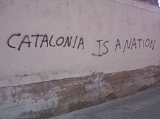
Catalan nationalism

Encyclopedia
Catalan nationalism
or Catalanism , is a political
movement advocating for either further political autonomy or full independence of Catalonia
.
Intellectually, Catalanism departs from the unsuccessful attempts to establish a federal state in Spain in the context of the First Republic
. Valentí Almirall and other intellectuals that participated in this process set up a new political ideology in the 19th century, to restore self-government, as well as to obtain recognition for the Catalan language
. These demands were summarized in the so-called Bases de Manresa in 1892.
It met very little support at first. But after the Spanish-American war in which the United States invaded and annexed the last of the Spanish colonies, these early stages of Catalanism grew in support, mostly because of the weakened Spanish international position after the war and the loss of the two main destinations for Catalan exports (Cuba
and Puerto Rico
).
(PSC), Republican Left of Catalonia (ERC) and Initiative for Catalonia Greens
(ICV)) adhere to Catalanism to some extent, even though some of them (PSC and ICV) reject being labelled as "independentist".
The framework for their national demands diverges as well. While some restrict them to Catalonia-proper, others claim to seek for the acknowledgment of the political personality of the so-called Catalan Countries
, the Catalan-speaking territories as a whole. Such claims, which can be seen as a form of Pan-nationalism
, can be read in official documents of CiU, ERC and Popular Unity Candidates
(CUP). Besides Catalonia, the main Catalan-speaking regions have their own nationalist parties and coalitions thereof which support, at some degree, the demands for the building of a national personality for the Catalan Countries: Valencian Nationalist Bloc
(BNV) in the Valencian Community
, Bloc Nacional i d'Esquerres, PSM and Majorcan Union (UM) in the Balearic Islands. Other nationalist parties existed with additional affiliation such as PSC - Reagrupament whose leader Josep Pallach i Carolà
died in 1977.
The two main Catalan nationalist parties have shown their commitment to the idea of the Catalan Countries in different ways and with different intensities. For CiU, this issue is not among the main items in their agenda. Nevertheless, the federation has enjoyed a long term collaboration with the Valencian party BNV and with the Majorcan parties UM and Majorca Socialist Party
(PSM). In contrast, Esquerra Republicana de Catalunya
(ERC) has taken more substantial steps in that direction by expanding the party to Roussillon
, Balearic Islands
and (as Republican Left of the Valencian Country
(ERPV)) the Valencian Community
.
, the Franks
drove the Muslims south of the Pyrenees. To prevent future incursions, Holy Roman Emperor Charlemagne
created the Marca Hispanica
in 790 CE, which consisted of a series of petty kingdom
s serving as buffer state
s between the Frankish kingdom and Al-Andalus
.
Between 878 and 988 CE, the area became a hotbed of Frankish-Muslim conflict. However, as the Frankish monarchy and the Caliphate of Córdoba
weakened during the 11th century, the resulting impasse allowed for a process of consolidation throughout the region's many earl
doms, resulting in their combination into the County of Barcelona, which became the embryo of today's Catalonia. By 1070, Ramon Berenguer I, Count of Barcelona, had subordinated other Catalan Counts and intransigent nobles
as vassal
s. His action brought peace to a turbulent feudal system and sowed the seeds of Catalan identity
.
According to several scholars, the term "Catalan" and "Catalonia" emerged near the end of the 11th century and appeared in the Usatges of 1150. Two factors fostered this identity: stable institutions and cultural prosperity. While the temporary lack of foreign invasions contributed to Catalonia's stability, it was not a main cause. Rather, it provided a site for sociopolitical development. For example, after the County of Barcelona merged with the Kingdom of Aragon
, to create the Crown of Aragon
in 1137 through a dynastic union
, the system was designed to mutually check both the king's and nobility's powers, while the small but growing numbers of free citizens and bourgeoisie would tactically take sides with the king in order to diminish typically feudal institutions.
By 1150, the king approved a series of pacts, called the Usatges, which "explicitly acknowledged legal equality between burghers…and nobility" (Woolard 17). In addition, the Catalan-Aragonese gentry established the Corts, a representative body of nobles, bishop
s, and abbot
s that counterbalanced the King's authority. By the end of the 13th century, "the monarch needed the consent of the Corts to approve laws or collect revenue" (McRoberts 10). Soon after, the Corts elected a standing body called the Diputació del General or the Generalitat
, which included the rising high bourgeoisie. The first Catalan constitutions
were promulgated by the Corts of Barcelona in 1283, following the Roman tradition of the Codex
.
In the 13th century, King James I of Aragon
conquered Valencia
and the Balearic Islands
. Subsequent conquests expanded into the Mediterranean, reaching Sardinia
, Corsica
, Sicily
, Naples
and Greece, so by 1350 the Crown of Aragon
"presided over the one of the most extensive and powerful mercantile empires of the Mediterranean during this period" (Woolard 16). Catalonia's economic success formed a powerful merchant
class, which wielded the Corts as its political weapon. It also produced a smaller middle class, or menestralia, that was "composed of artisans, shopkeepers and workshop owners" (McRoberts 11).
Over the 13th and 14th centuries, these merchants accrued so much wealth and political sway that placed a significant check on the Aragonese crown. By the 15th century the Aragonese monarch "was not considered legitimate until he had sworn to respect the basic law of the land in the presence of the Corts" (Balcells 9). This balance of power is a classic example of pactisme, or contractualism, which seems to be a defining feature of the Catalan political culture
.
Along with political and economic success, Catalan culture flourished in the 13th and 14th centuries. During this period, the Catalan vernacular gradually replaced Latin as the language of culture and government. Scholars rewrote everything from ancient Visigothic law to religious sermons in Catalan (Woolard 14). Wealthy citizens bolstered Catalan's literary appeal through poetry contests and history pageants dubbed the Jocs Florals, or "Floral Games." As the kingdom expanded southeast into Valencia and the Mediterranean, Catalan followed.
The medieval heyday of Catalan culture would not last, however. After a bout of famine and plague
hit Catalonia in the mid-14th century, the population dropped from 500,000 to 200,000 (McRoberts 13). This exacerbated feudal tensions, sparking serf
revolts in rural areas and political impasses in Barcelona. Financial issues and the burden of multiple dependencies abroad further strained the region.
In 1410, the Aragonese king died without leaving an heir to the throne. Finding no legitimate alternative, leaders of the realms composing the Crown of Aragon
agreed by means of the Compromise of Caspe
that the vacant throne should go to the Castilian Ferdinand I
, as he was among the nearest relatives of the recently extinguished House of Barcelona
through a maternal line. The new dynasty began to assert the authority of the Crown, leading to a perception among the nobility that their traditional privileges associated with their position in society where at risk. From 1458 to 1479, civil wars between King John II
and local chieftains engulfed Catalonia.
During the conflict, John II, on the face of French aggression in the Pyrenees "had his heir Ferdinand married to Isabella I of Castile
, the heiress to the Castilian throne, in a bid to find outside allies" (Balcells 11). Their dynastic union, which came to be known as the Catholic Monarchs
, marked the de facto unification of the Kingdom of Spain. At that point, however, de jure both the Castile
and the Crown of Aragon remained distinct territories, each keeping its own traditional institutions, Parliaments and laws. This was a common practice at this time in Western Europe as the concept of sovereignty laid in the monarch.
With the dawn of the Age of Discoveries, led by the Crown of Castile, the importance of the Aragonese possessions in the Mediterranean became drastically reduced and, along the rise of barbary pirates predating commerce in the Mediterranean, the theater of European power shifted from the Mediterranean basin to the Atlantic Ocean. These political and economic restrictions impacted all segments of society. Also, because of the locally bred social conflicts, Catalonia squandered in one century most of what it had gained in political rights between 1070 and 1410.
Nevertheless, early political, economic and cultural advances gave Catalonia "a mode of organization and an awareness of its own identity which might in some ways be described as national, though the idea of popular or national sovereignty did not yet exist" (Balcells 9). Other scholars like Kenneth McRoberts and Katheryn Woolard hold similar views. Both support Pierre Vilar, who contends that in 13th and 14th centuries "the Catalan principality was perhaps the European country to which it would be the least inexact or risky to use such seemingly anachronistic terms as political and economic imperialism
or ‘nation-state
’" (McRoberts 13). In other words, an array of political and cultural forces laid the foundations of Catalan "national" identity.
Llobera agrees with this opinion, saying, "By the mid-thirteenth century, the first solid manifestations of national consciousness can be observed." Indeed, 13th and 14th century Catalonia did exhibit features of a nation-state. The role of Catalan Counts, the Corts, Mediterranean rule and economic prosperity support this thesis. But as Vilar points out, these analogies are only true if we acknowledge that a 14th century nation-state is anachronistic. In other words, those living in Catalonia before latter day nationalism possessed something like a collective identity on which this was to be based, but this does not automatically equate to the modern concept of nation, neither in Catalonia nor elsewhere in similar circumstances during the Middle Age.
The Corts and the rest of the autochthonous legal and political organization was finally terminated in 1716 as a result of the Spanish War of Succession. The local population mostly took sides and provided troops and resources for Archduke Charles
, the pretender who was arguably to maintain the legal status quo
. His utter defeat meant the legal and political termination of the autonomous parliaments in the Crown of Aragon, as the Nueva Planta Decrees
were passed and the King Philip V of Spain
of the new House of Bourbon
sealed the transformation of Spain from a de facto unified realm into a de jure centralized state.
("rebirth" or "renaissance") was a cultural, historical and literary movement that pursued in the wake of European Romanticism
the recovery of the own language and literature. As time went by, and particularly immediately after the fiasco of the Revolution of 1868
(led by the Catalan general Juan Prim), the movement acquired a clear political character, directed to the attainment of self-government for Catalonia within the framework of the Spanish liberal state.
Like most Romantic
currents, the Renaixença gave historical analysis a central role. History, in fact, was an integral part of Catalonia's "rebirth." Texts on Catalonia's history—inspired by the Romantic philosophy of history—laid the foundations of a Catalanist movement. Works like Valentí Almirall's Lo Catalanisme, Victor Balaguer's Historia de Cataluña y de la Corona de Aragón and Prat de la Riba's La nacionalitat catalana used history as evidence for Catalonia's nationhood. According to Elie Kedourie, such claims were common in 19th century nationalist discourse because "the ‘past’ is used to explain the ‘present,’ to give it meaning and legitimacy. The ‘past’ reveals one's identity, and history determines one's role in the drama of human development and progress" (36). Publications of histories thus "explained" why the Catalans constituted a nation instead of a Spanish region or coastal province.
At the heart of many of works of the Renaixença lay a powerful idea: the Volk. Indeed, the concept of Volk (pl. Völker) played a vital role in mainstream Catalan Romantic nationalism. It has its origins in the writings of German Romantics like Friedrich Carl von Savigny
, Georg Wilhelm Friedrich Hegel
and, most notably, Johann Gottfried Herder
.
The concept of Volk entered Catalan intellectual circles in the 1830s, stemming from the emphasis on the region's medieval history and philology. It first appeared in the writings of Joan Cortada, Marti d'Eixalà and his discipline, Francesc-Xavier Llorens i Barba, intellectuals who reinvigorated the literature on the Catalan national character. Inspired by the ideas of Herder, Savigny and the entire Scottish School of Common Sense, they asked why the Catalans were different from other Spaniards—especially the Castilians (Conversi 1997: 15) For example, Cortada wanted to determine why, despite its poor natural environment, Catalonia was so much more successful than other parts of Spain. In a series of generalizations, he concluded that the "Catalans have succeeded in developing a strong sense of resolution and constancy over the centuries. Another feature of their character was the fact that they were hardworking people" (Llobera 1983: 342). D’Eixalà and Llorens held a similar understanding of the Catalan national character. They held that that two characteristics particular to Catalans were common sense (seny
) and industriousness. To them, "the traditional Catalan seny was a manifestation of the Volksgeist
", one which made Catalans essentially different from Castilians (Llobera 2004: 75).
The early works on the Catalan Volk would remain on paper long before they entered politics. This is because the Catalan bourgeoisie
had not yet abandoned the hope of spearheading the Spanish state (Conversi 1997: 14). Indeed, in the 1830s, the Renaixença was still embryonic and the industrial class still thought that it could at least control the Spanish economy. Notions of Catalonia's uniqueness mattered little to a group that believed it could integrate and lead the entire country. But this all changed around 1880. After decades of discrimination from Spanish elites, Catalan industrialists buried their dream of leading Spain. As Vilar observes: "It is only because, in its acquisition of the Spanish market, the Catalan industrial bourgeoisie did not succeed either in securing the state apparatus or identifying its interests with those of the whole of Spain, in influential opinion, that Catalonia, this little "fatherland", finally became the 'national' focal point", (1980: 551)
This switch of allegiance was particularly easy because the idea of a Catalan nation had already matured into a corpus of texts about the region's "uniqueness" and Volksgeist. Inspired by these works of Romantic nationalism, the Catalan economic elite became conscious of "the growing dissimilitude between the Catalonia's social structure and that of the rest of the nation" (Vilar 1963: 101). Consequently, Romantic nationalism (and the Volk) expanded beyond its philosophical bounds into the political arena.
In the last third of the 19th century, Catalanism was formulating its own doctrinal foundations, not only among the progressive ranks but also in the conservative, and at the same time it started to establish the first political programmes (e.g. Bases de Manresa, 1892), and to generate a wide cultural and association movement of a clearly vindicatory character.
In 1898, Spain lost its last colonial possessions in Cuba
and the Philippines
, a fact that not only involved an important crisis of confidence, but also gave an impulse to political Catalanism. The first modern political party in Catalonia and Spain was the Lliga Regionalista
. Founded in 1901, it formed a coalition in 1907 with other Catalanist forces (from Carlism to Federalists), grouped in the so-called Solidaritat Catalana, and won the elections with the regionalist programme that Enric Prat de la Riba
had formulated in his manifesto La nacionalitat catalana (1906).
 The 18th century Spanish economy depended mostly on agriculture
. The social structure stayed hierarchical, if not feudal, while the Roman Catholic Church
and Bourbon
monarchs wrestled for internal supremacy. Into the 19th century, the Napoleonic invasion devastated the country and its early attempts for industrialization and led to political unstability, so Spain remained politically and culturally isolated from the rest of Europe.
Unlike in the rest of Spain, the Industrial Revolution
made some progress in Catalonia, whose pro-industry middle class
strived to mechanize everything, from textiles and crafts to wineries. Industrialization and trade went hand in hand with the proto-nationalist Renaixença
cultural movement, which, annoyed with the shortcomings of the Royal court in Madrid, began to fashion an alternative, and that was Catalan identity.
To finance their cultural project, a locally bred proto-nationalist intelligentsia
sought patronage and protection from Barcelona's industrial barons. This relationship played a decisive role in the development of Catalanism. On the one hand, intellectuals sought to renew Catalan identity as a response to Spain's overall backwardness. They wanted to distance themselves from the Spanish problems by creating a new ontology
rooted in Catalan culture
, language and worldview. On the other hand, those same intellectuals avoided demands for separation. They knew that their patrons would want Catalan nationalism to include Spain for two reasons:
As Woolard notes, the economic interests in Madrid and the budding Catalan industrialists converged during the 18th century, resulting in cooperation between. For the nationalist literati, this meant that Catalanism could promote a national identity, but it had to function within Spain.
Furthermore, Barcelona's industrial elite
wanted Catalonia to stay part of Spain since Catalonia's industrial markets relied on consumption from other Spanish regions which, little by little, started to join some sort of development. In fact, part of the industrialists’ desire to remain part of Spain was their desire for protectionism, hegemony in domestic markets and the push to "influence Madrid's political choices by intervening in central Spanish affairs" (Conversi 1997: 18-20), thus, it made no economic sense to promote any secession from Spain. To the contrary, Catalonia's prominent industrialists acted as the Spanish leading economic heads. As Stanley Payne observes: "The modern Catalan élite had played a major role in what there was of economic industrialization in the nineteenth century, and had tended to view Catalonia not as the antagonist but to some degree the leader of a freer, more prosperous Spain" (482). Barcelona's bourgeois industrialists even claimed that protectionism and leadership served the interests of the "‘national market’ or of ‘developing the national economy’ (national meaning Spanish here) " (Balcells 19). The inclusion of Spain was instrumental to Catalonia's success, meaning that industrialists would not tolerate any secessionist movement. Claiming for independence would have assured nothing but weak markets, an internal enemy and strengthened anarchist movements. And hence, though manufacturers funded the Renaixença— and Catalan nationalism — they demanded that Catalonia stayed part of Spain to ensure economic stability.
This federalist-like lobbying had not worked at first, nor did it succeed until the late 1880s. Finally, in 1889, the pro-industrialist Lliga Regionalista
managed to save the particular Catalan Civil Code
after a liberal attempt to homogenize the Spanish legal structures (Conversi 1997: 20). Two years later, they coaxed Madrid into passing protectionist measures, which reinvigorated pro-Spanish attitudes among manufacturers. Then, they also took great profits from Spain's neutrality
in World War I, which allowed them to export to both sides, and the Spanish expansion in Morocco
, which Catalan industrialists encouraged since it was to become a fast growing market for them. Also, by early 20th century, Catalan businessmen had managed to gain control of the most profitable commerce between Spain and its American colonies and ex-colonies, namely Cuba and Puerto Rico
.
This nationalist-industrialist accord is a classic example of inclusionary Catalanism. Nationalists might have hoped for an independent Catalonia but their patrons needed access to markets and protectionism
. As a result, nationalists could propagate the Catalan identity provided that it coincided with the industrialists’ pro-Spanish stance. Because the Lliga Regionalista de Catalunya endorsed this compromise, it dominated Catalan politics after the turn of the century. Payne notes: "The main Catalanist party, the bourgeois Lliga, never sought separatism but rather a more discrete and distinctive place for a self-governing Catalonia within a more reformist and progressive Spain. The Lligas leaders ran their 1916 electoral campaign under the slogan ‘Per l'Espanya Gran’ (For the Great Spain)" (482). The Lliga had tempered the nationalist position to one of inclusionary nationalism. It allowed Catalanism to flourish, but demanded that it promote federalism
within Spain, and not separation from it. Any deviation from this delicate balance would have enraged those pro-Catalan and Spanish-identifying industrialists. Ultimately, this prevented any moves towards separation while strengthening Catalonia's "federal" rights after the Commonwealth of Catalonia took power in 1914.
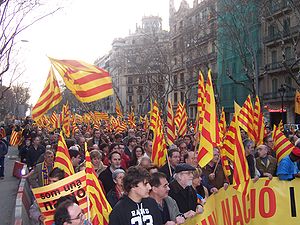 During the first part of the 20th century, the main nationalist party was the right-wing Lliga Regionalista
, headed by Francesc Cambó
. For the nationalists, the main achievement in this period was the Commonwealth of Catalonia a grouping of the four Catalan provinces, with limited administrative power. This institution was abolished during the dictatorship of Miguel Primo de Rivera
.
In 1931, the left-wing Esquerra Republicana de Catalunya
party won the elections in Catalonia, advocating a Catalan Republic
federated with Spain. Under pressure from the Spanish government, the leader of ERC, Francesc Macià i Llussà
, accepted an autonomous Catalan government instead, which recovered the historical name of Generalitat de Catalunya
.
A dramatically short period of restoration of democratic and cultural normality was interrupted at its outset by the outbreak of the Spanish Civil War
. The autonomous government was abolished in 1939, after the victory of the Francoist troops. During the last stages of the war, when the Republican side was on the verge of defeat, Catalan president of the Generalitat, Lluís Companys, rhetorically declared Catalan independence, even though it never materialized due to objections within Catalonia and, eventually, by the defeat of the Second Spanish Republic
.
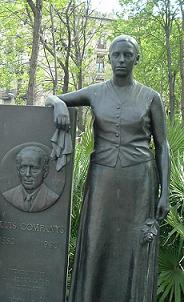 Right after the war, Companys, along with thousands of Spanish Republicans, sought cover in France exiled but because of the, by that time, mutual sympathy between Franco's government and Nazi Germany
, he was captured after the Fall of France in 1940 and handed to Spanish authorities, which sentenced him to death.
Several political or cultural Catalan movements operated underground during the dictatorship of Francisco Franco
, which lasted until 1975. A president of the Catalan government was still designated, and operated symbolically in exile.
Companys's successor in exile, Josep Tarradellas, kept away from Spain until Franco's death in 1975. When he came back in 1977 the government of Catalonia -the Generalitat
- was restored again. Following the approval of the Spanish constitution in 1978, a Statute of Autonomy
was promulgated and approved in referendum. Catalonia was organized as an Autonomous Community, and in 1980 Jordi Pujol, from the conservative nationalist party Convergència Democràtica de Catalunya, was elected president and ruled the autonomous government for 23 consecutive years.
In contrast, there is no significant political autonomy, nor recognition of the language in the historical Catalan territories
belonging to France (Roussillon, in the French département
of Pyrénées-Orientales
).
Currently, the main political parties which define themselves as being Catalan nationalists are Convergència Democràtica de Catalunya, Unió Democràtica de Catalunya and the Independence Rally
. The Esquerra Republicana de Catalunya
, although deriving from nationalism, refuses the term "nationalism" and prefers to describe itself as independentist
; so does Soldaritat Catalana
. These parties obtained 50,03% of the votes in the 2010 election. Within these parties, there is much divergence of opinion. More radical elements are only content with the establishment of a separate Catalan state. In contrast, more moderate elements do not necessarily identify with the belief that protection of Catalan identity is incompatible within Spain. Others vote for these parties simply as a protest and do not necessarily identify with the overall party platform (for example, some people may vote for ERC because they are simply tired of CiU, even though they do not actually desire a leftist Catalan republic). The other way around also occurs: some voters may vote for non-nationalist parties (especially the Initiative for Catalonia, ICV, and the Socialists' Party of Catalonia
, PSC) for reasons of policy, ideology or personal preference, although they share a nationalist viewpoint regarding Catalonia's status within Spain. Some polls, conducted in 2010, show that more than a third of PSC and more than half of ICV voters support Catalonia's independence (in the latter case, the percentage is even higher than among Convergence and Union voters); according to these polls, even 15% of the pro-Spanish Partido Popular voters in Catalonia support the region's independence.
In 2006, a referendum
was held on amending the 1979 Catalan Statute of Autonomy to further expand the authority of the Catalan government
. It was approved by 73.24% of the census, and became effective as of August 9, 2006. However, the turnout of 48.84% represented an unprecedented high abstention
in Catalonia's democratic history. This has been cited both as a symptom of having large sectors in the average populace disengaged or at odds with the politics of identity in Catalonia, and, alternatively, as a symptom of fatigue among Catalan nationalists who would like to see bolder steps towards political autonomy or independence. In this regard, both Esquerra Republicana de Catalunya
(Catalan independentist left wing) and Partido Popular
(Spanish right wing) campaigned against having the 2006 Statute of Autonomy passed: the former considered it too little, the latter too much.
Nationalism
Nationalism is a political ideology that involves a strong identification of a group of individuals with a political entity defined in national terms, i.e. a nation. In the 'modernist' image of the nation, it is nationalism that creates national identity. There are various definitions for what...
or Catalanism , is a political
Politics
Politics is a process by which groups of people make collective decisions. The term is generally applied to the art or science of running governmental or state affairs, including behavior within civil governments, but also applies to institutions, fields, and special interest groups such as the...
movement advocating for either further political autonomy or full independence of Catalonia
Catalonia
Catalonia is an autonomous community in northeastern Spain, with the official status of a "nationality" of Spain. Catalonia comprises four provinces: Barcelona, Girona, Lleida, and Tarragona. Its capital and largest city is Barcelona. Catalonia covers an area of 32,114 km² and has an...
.
Intellectually, Catalanism departs from the unsuccessful attempts to establish a federal state in Spain in the context of the First Republic
First Spanish Republic
The First Spanish Republic was the political regime that existed in Spain between the parliamentary proclamation on 11 February 1873 and 29 December 1874 when General Arsenio Martínez-Campos's pronunciamento marked the beginning of the Bourbon Restoration in Spain...
. Valentí Almirall and other intellectuals that participated in this process set up a new political ideology in the 19th century, to restore self-government, as well as to obtain recognition for the Catalan language
Catalan language
Catalan is a Romance language, the national and only official language of Andorra and a co-official language in the Spanish autonomous communities of Catalonia, the Balearic Islands and Valencian Community, where it is known as Valencian , as well as in the city of Alghero, on the Italian island...
. These demands were summarized in the so-called Bases de Manresa in 1892.
It met very little support at first. But after the Spanish-American war in which the United States invaded and annexed the last of the Spanish colonies, these early stages of Catalanism grew in support, mostly because of the weakened Spanish international position after the war and the loss of the two main destinations for Catalan exports (Cuba
Cuba
The Republic of Cuba is an island nation in the Caribbean. The nation of Cuba consists of the main island of Cuba, the Isla de la Juventud, and several archipelagos. Havana is the largest city in Cuba and the country's capital. Santiago de Cuba is the second largest city...
and Puerto Rico
Puerto Rico
Puerto Rico , officially the Commonwealth of Puerto Rico , is an unincorporated territory of the United States, located in the northeastern Caribbean, east of the Dominican Republic and west of both the United States Virgin Islands and the British Virgin Islands.Puerto Rico comprises an...
).
Several forms of contemporary Catalanism
Being a broad movement, it can be found in several presentations in the current political scenario. Most of the main Catalan political parties (Convergence and Union (CiU), Socialists' Party of CataloniaSocialists' Party of Catalonia
The Socialists' Party of Catalonia is a social-democratic political party in Catalonia, Spain resulting from the merge of two parties PSC Reagrupament led by Josep Pallach i Carolà and PSC Comgres. It is the Catalan referent of the Spanish Socialist Workers' Party , and its Aranese section is...
(PSC), Republican Left of Catalonia (ERC) and Initiative for Catalonia Greens
Initiative for Catalonia Greens
Initiative for Catalonia Greens is a political party in Catalonia, Spain. It was formed as a merger of Iniciativa per Catalunya and Els Verds. IC had been an alliance led by Partit Socialista Unificat de Catalunya and was the equivalent of Izquierda Unida in Catalonia...
(ICV)) adhere to Catalanism to some extent, even though some of them (PSC and ICV) reject being labelled as "independentist".
The framework for their national demands diverges as well. While some restrict them to Catalonia-proper, others claim to seek for the acknowledgment of the political personality of the so-called Catalan Countries
Catalan Countries
The Catalan term Països Catalans refers to the territories where the Catalan language is spoken.The first mentions of the term date back to the late 19th century, but it never surpassed the limits of a small circle of Catalan authors until its strictly cultural dimension became increasingly...
, the Catalan-speaking territories as a whole. Such claims, which can be seen as a form of Pan-nationalism
Pan-nationalism
Pan-nationalism is a form of nationalism distinguished by the large-scale of the claimed national territory, and because it often defines the nation on the basis of a ‘’cluster’’ of cultures and ethnic groups. It shares the general nationalist ideology, that the nation is a fundamental unit of...
, can be read in official documents of CiU, ERC and Popular Unity Candidates
Popular Unity Candidates
The Popular Unity Candidatures are independentist candidatures running in the territorial frame which they define as "Catalan Countries". These candidatures focus their political action on municipalities....
(CUP). Besides Catalonia, the main Catalan-speaking regions have their own nationalist parties and coalitions thereof which support, at some degree, the demands for the building of a national personality for the Catalan Countries: Valencian Nationalist Bloc
Valencian Nationalist Bloc
The Valencian Nationalist Bloc is a Valencian nationalist party in the Valencian Country, Spain. It is the largest party in the Coalició Compromís....
(BNV) in the Valencian Community
Valencian Community
The Valencian Community is an autonomous community of Spain located in central and south-eastern Iberian Peninsula. Its capital and largest city is Valencia...
, Bloc Nacional i d'Esquerres, PSM and Majorcan Union (UM) in the Balearic Islands. Other nationalist parties existed with additional affiliation such as PSC - Reagrupament whose leader Josep Pallach i Carolà
Josep Pallach i Carolà
Josep Pallach i Carolà Social democratic leader of Catalonia who most likely would have become the first democratic president of Catalonia had he survived a few more years...
died in 1977.
The two main Catalan nationalist parties have shown their commitment to the idea of the Catalan Countries in different ways and with different intensities. For CiU, this issue is not among the main items in their agenda. Nevertheless, the federation has enjoyed a long term collaboration with the Valencian party BNV and with the Majorcan parties UM and Majorca Socialist Party
Majorca Socialist Party
The Majorca Socialist Party is a political party in Majorca, Spain. The PSM defines itself as socialist, environmentalist, and Catalan nationalist, from a Majorcan point of view....
(PSM). In contrast, Esquerra Republicana de Catalunya
Esquerra Republicana de Catalunya
The Republican Left of Catalonia is a left wing Catalan independentist political party in Spain. It is also the main sponsor of the independence movement from France and Spain in the territories known among Catalan nationalists as Països Catalans...
(ERC) has taken more substantial steps in that direction by expanding the party to Roussillon
Roussillon
Roussillon is one of the historical counties of the former Principality of Catalonia, corresponding roughly to the present-day southern French département of Pyrénées-Orientales...
, Balearic Islands
Balearic Islands
The Balearic Islands are an archipelago of Spain in the western Mediterranean Sea, near the eastern coast of the Iberian Peninsula.The four largest islands are: Majorca, Minorca, Ibiza and Formentera. The archipelago forms an autonomous community and a province of Spain with Palma as the capital...
and (as Republican Left of the Valencian Country
Republican Left of the Valencian Country
Republican Left of the Valencian Country is a Valencian left nationalist and republican party.The original ERPV was founded in 1933, then disbanded in 1935...
(ERPV)) the Valencian Community
Valencian Community
The Valencian Community is an autonomous community of Spain located in central and south-eastern Iberian Peninsula. Its capital and largest city is Valencia...
.
The origins of Catalan national identity
During the first centuries of the ReconquistaReconquista
The Reconquista was a period of almost 800 years in the Middle Ages during which several Christian kingdoms succeeded in retaking the Muslim-controlled areas of the Iberian Peninsula broadly known as Al-Andalus...
, the Franks
Franks
The Franks were a confederation of Germanic tribes first attested in the third century AD as living north and east of the Lower Rhine River. From the third to fifth centuries some Franks raided Roman territory while other Franks joined the Roman troops in Gaul. Only the Salian Franks formed a...
drove the Muslims south of the Pyrenees. To prevent future incursions, Holy Roman Emperor Charlemagne
Charlemagne
Charlemagne was King of the Franks from 768 and Emperor of the Romans from 800 to his death in 814. He expanded the Frankish kingdom into an empire that incorporated much of Western and Central Europe. During his reign, he conquered Italy and was crowned by Pope Leo III on 25 December 800...
created the Marca Hispanica
Marca Hispanica
The Marca Hispanica , also known as Spanish March or March of Barcelona was a buffer zone beyond the province of Septimania, created by Charlemagne in 795 as a defensive barrier between the Umayyad Moors of Al-Andalus and the Frankish Kingdom....
in 790 CE, which consisted of a series of petty kingdom
Petty kingdom
A petty kingdom is one of a number of small kingdoms, described as minor or "petty" by contrast to an empire or unified kingdom that either preceded or succeeded it...
s serving as buffer state
Buffer state
A buffer state is a country lying between two rival or potentially hostile greater powers, which by its sheer existence is thought to prevent conflict between them. Buffer states, when authentically independent, typically pursue a neutralist foreign policy, which distinguishes them from satellite...
s between the Frankish kingdom and Al-Andalus
Al-Andalus
Al-Andalus was the Arabic name given to a nation and territorial region also commonly referred to as Moorish Iberia. The name describes parts of the Iberian Peninsula and Septimania governed by Muslims , at various times in the period between 711 and 1492, although the territorial boundaries...
.
Between 878 and 988 CE, the area became a hotbed of Frankish-Muslim conflict. However, as the Frankish monarchy and the Caliphate of Córdoba
Caliphate of Córdoba
The Caliphate of Córdoba ruled the Iberian peninsula and part of North Africa, from the city of Córdoba, from 929 to 1031. This period was characterized by remarkable success in trade and culture; many of the masterpieces of Islamic Iberia were constructed in this period, including the famous...
weakened during the 11th century, the resulting impasse allowed for a process of consolidation throughout the region's many earl
Earl
An earl is a member of the nobility. The title is Anglo-Saxon, akin to the Scandinavian form jarl, and meant "chieftain", particularly a chieftain set to rule a territory in a king's stead. In Scandinavia, it became obsolete in the Middle Ages and was replaced with duke...
doms, resulting in their combination into the County of Barcelona, which became the embryo of today's Catalonia. By 1070, Ramon Berenguer I, Count of Barcelona, had subordinated other Catalan Counts and intransigent nobles
Nobility
Nobility is a social class which possesses more acknowledged privileges or eminence than members of most other classes in a society, membership therein typically being hereditary. The privileges associated with nobility may constitute substantial advantages over or relative to non-nobles, or may be...
as vassal
Vassal
A vassal or feudatory is a person who has entered into a mutual obligation to a lord or monarch in the context of the feudal system in medieval Europe. The obligations often included military support and mutual protection, in exchange for certain privileges, usually including the grant of land held...
s. His action brought peace to a turbulent feudal system and sowed the seeds of Catalan identity
Cultural identity
Cultural identity is the identity of a group or culture, or of an individual as far as one is influenced by one's belonging to a group or culture. Cultural identity is similar to and has overlaps with, but is not synonymous with, identity politics....
.
According to several scholars, the term "Catalan" and "Catalonia" emerged near the end of the 11th century and appeared in the Usatges of 1150. Two factors fostered this identity: stable institutions and cultural prosperity. While the temporary lack of foreign invasions contributed to Catalonia's stability, it was not a main cause. Rather, it provided a site for sociopolitical development. For example, after the County of Barcelona merged with the Kingdom of Aragon
Kingdom of Aragon
The Kingdom of Aragon was a medieval and early modern kingdom in the Iberian Peninsula, corresponding to the modern-day autonomous community of Aragon, in Spain...
, to create the Crown of Aragon
Crown of Aragon
The Crown of Aragon Corona d'Aragón Corona d'Aragó Corona Aragonum controlling a large portion of the present-day eastern Spain and southeastern France, as well as some of the major islands and mainland possessions stretching across the Mediterranean as far as Greece...
in 1137 through a dynastic union
Dynastic union
A dynastic union is the combination by which two different states are governed by the same dynasty, while their boundaries, their laws and their interests remain distinct...
, the system was designed to mutually check both the king's and nobility's powers, while the small but growing numbers of free citizens and bourgeoisie would tactically take sides with the king in order to diminish typically feudal institutions.
By 1150, the king approved a series of pacts, called the Usatges, which "explicitly acknowledged legal equality between burghers…and nobility" (Woolard 17). In addition, the Catalan-Aragonese gentry established the Corts, a representative body of nobles, bishop
Bishop
A bishop is an ordained or consecrated member of the Christian clergy who is generally entrusted with a position of authority and oversight. Within the Catholic Church, Eastern Orthodox, Oriental Orthodox Churches, in the Assyrian Church of the East, in the Independent Catholic Churches, and in the...
s, and abbot
Abbot
The word abbot, meaning father, is a title given to the head of a monastery in various traditions, including Christianity. The office may also be given as an honorary title to a clergyman who is not actually the head of a monastery...
s that counterbalanced the King's authority. By the end of the 13th century, "the monarch needed the consent of the Corts to approve laws or collect revenue" (McRoberts 10). Soon after, the Corts elected a standing body called the Diputació del General or the Generalitat
Generalitat
Generalitat is the name of the autonomous systems of government of two of the present Spanish autonomous communities: Catalonia and the Valencian Community. The term is also used for the government of the semi-autonomous comarca of Val d'Aran, the Generalitat a l'Aran.Generalitat refers to all...
, which included the rising high bourgeoisie. The first Catalan constitutions
Catalan constitutions
The Catalan constitutions were promulgated by the Corts of Barcelona . The first constitution was promulgated by the court of 1283. The last ones were promulgated by the court of 1702...
were promulgated by the Corts of Barcelona in 1283, following the Roman tradition of the Codex
Codex
A codex is a book in the format used for modern books, with multiple quires or gatherings typically bound together and given a cover.Developed by the Romans from wooden writing tablets, its gradual replacement...
.
In the 13th century, King James I of Aragon
James I of Aragon
James I the Conqueror was the King of Aragon, Count of Barcelona, and Lord of Montpellier from 1213 to 1276...
conquered Valencia
Kingdom of Valencia
The Kingdom of Valencia , located in the eastern shore of the Iberian Peninsula, was one of the component realms of the Crown of Aragon. When the Crown of Aragon merged by dynastic union with the Crown of Castile to form the Kingdom of Spain, the Kingdom of Valencia became a component realm of the...
and the Balearic Islands
Balearic Islands
The Balearic Islands are an archipelago of Spain in the western Mediterranean Sea, near the eastern coast of the Iberian Peninsula.The four largest islands are: Majorca, Minorca, Ibiza and Formentera. The archipelago forms an autonomous community and a province of Spain with Palma as the capital...
. Subsequent conquests expanded into the Mediterranean, reaching Sardinia
Sardinia
Sardinia is the second-largest island in the Mediterranean Sea . It is an autonomous region of Italy, and the nearest land masses are the French island of Corsica, the Italian Peninsula, Sicily, Tunisia and the Spanish Balearic Islands.The name Sardinia is from the pre-Roman noun *sard[],...
, Corsica
Corsica
Corsica is an island in the Mediterranean Sea. It is located west of Italy, southeast of the French mainland, and north of the island of Sardinia....
, Sicily
Sicily
Sicily is a region of Italy, and is the largest island in the Mediterranean Sea. Along with the surrounding minor islands, it constitutes an autonomous region of Italy, the Regione Autonoma Siciliana Sicily has a rich and unique culture, especially with regard to the arts, music, literature,...
, Naples
Naples
Naples is a city in Southern Italy, situated on the country's west coast by the Gulf of Naples. Lying between two notable volcanic regions, Mount Vesuvius and the Phlegraean Fields, it is the capital of the region of Campania and of the province of Naples...
and Greece, so by 1350 the Crown of Aragon
Crown of Aragon
The Crown of Aragon Corona d'Aragón Corona d'Aragó Corona Aragonum controlling a large portion of the present-day eastern Spain and southeastern France, as well as some of the major islands and mainland possessions stretching across the Mediterranean as far as Greece...
"presided over the one of the most extensive and powerful mercantile empires of the Mediterranean during this period" (Woolard 16). Catalonia's economic success formed a powerful merchant
Merchant
A merchant is a businessperson who trades in commodities that were produced by others, in order to earn a profit.Merchants can be one of two types:# A wholesale merchant operates in the chain between producer and retail merchant...
class, which wielded the Corts as its political weapon. It also produced a smaller middle class, or menestralia, that was "composed of artisans, shopkeepers and workshop owners" (McRoberts 11).
Over the 13th and 14th centuries, these merchants accrued so much wealth and political sway that placed a significant check on the Aragonese crown. By the 15th century the Aragonese monarch "was not considered legitimate until he had sworn to respect the basic law of the land in the presence of the Corts" (Balcells 9). This balance of power is a classic example of pactisme, or contractualism, which seems to be a defining feature of the Catalan political culture
Political culture
Political culture is the traditional orientation of the citizens of a nation toward politics, affecting their perceptions of political legitimacy.Conceptions...
.
Along with political and economic success, Catalan culture flourished in the 13th and 14th centuries. During this period, the Catalan vernacular gradually replaced Latin as the language of culture and government. Scholars rewrote everything from ancient Visigothic law to religious sermons in Catalan (Woolard 14). Wealthy citizens bolstered Catalan's literary appeal through poetry contests and history pageants dubbed the Jocs Florals, or "Floral Games." As the kingdom expanded southeast into Valencia and the Mediterranean, Catalan followed.
The medieval heyday of Catalan culture would not last, however. After a bout of famine and plague
Bubonic plague
Plague is a deadly infectious disease that is caused by the enterobacteria Yersinia pestis, named after the French-Swiss bacteriologist Alexandre Yersin. Primarily carried by rodents and spread to humans via fleas, the disease is notorious throughout history, due to the unrivaled scale of death...
hit Catalonia in the mid-14th century, the population dropped from 500,000 to 200,000 (McRoberts 13). This exacerbated feudal tensions, sparking serf
SERF
A spin exchange relaxation-free magnetometer is a type of magnetometer developed at Princeton University in the early 2000s. SERF magnetometers measure magnetic fields by using lasers to detect the interaction between alkali metal atoms in a vapor and the magnetic field.The name for the technique...
revolts in rural areas and political impasses in Barcelona. Financial issues and the burden of multiple dependencies abroad further strained the region.
In 1410, the Aragonese king died without leaving an heir to the throne. Finding no legitimate alternative, leaders of the realms composing the Crown of Aragon
Crown of Aragon
The Crown of Aragon Corona d'Aragón Corona d'Aragó Corona Aragonum controlling a large portion of the present-day eastern Spain and southeastern France, as well as some of the major islands and mainland possessions stretching across the Mediterranean as far as Greece...
agreed by means of the Compromise of Caspe
Compromise of Caspe
The Compromise of Caspe made in 1412 was an act and resolution of parliamentary representatives on behalf of the Kingdoms of Aragon and Valencia and the County of Barcelona, to resolve the interregnum commenced by the death of King Martin I of Aragon in 1410 without a legitimate heir, in Caspe.The...
that the vacant throne should go to the Castilian Ferdinand I
Ferdinand I of Aragon
Ferdinand I called of Antequera and also the Just or the Honest) was king of Aragon, Valencia, Majorca, Sardinia and Corsica and king of Sicily, duke of Athens and Neopatria, and count of Barcelona, Roussillon and Cerdanya...
, as he was among the nearest relatives of the recently extinguished House of Barcelona
House of Barcelona
The House of Barcelona was a medieval dynasty that ruled the County of Barcelona continuously from 878 and the Crown of Aragon from 1137 . From the male part they descend from the Bellonids, the descendants of Wifred the Hairy...
through a maternal line. The new dynasty began to assert the authority of the Crown, leading to a perception among the nobility that their traditional privileges associated with their position in society where at risk. From 1458 to 1479, civil wars between King John II
John II of Aragon
John II the Faithless, also known as the Great was the King of Aragon from 1458 until 1479, and jure uxoris King of Navarre from 1425 until his death. He was the son of Ferdinand I and his wife Eleanor of Alburquerque...
and local chieftains engulfed Catalonia.
During the conflict, John II, on the face of French aggression in the Pyrenees "had his heir Ferdinand married to Isabella I of Castile
Isabella I of Castile
Isabella I was Queen of Castile and León. She and her husband Ferdinand II of Aragon brought stability to both kingdoms that became the basis for the unification of Spain. Later the two laid the foundations for the political unification of Spain under their grandson, Charles V, Holy Roman Emperor...
, the heiress to the Castilian throne, in a bid to find outside allies" (Balcells 11). Their dynastic union, which came to be known as the Catholic Monarchs
Catholic Monarchs
The Catholic Monarchs is the collective title used in history for Queen Isabella I of Castile and King Ferdinand II of Aragon. They were both from the House of Trastámara and were second cousins, being both descended from John I of Castile; they were given a papal dispensation to deal with...
, marked the de facto unification of the Kingdom of Spain. At that point, however, de jure both the Castile
Crown of Castile
The Crown of Castile was a medieval and modern state in the Iberian Peninsula that formed in 1230 as a result of the third and definitive union of the crowns and parliaments of the kingdoms of Castile and León upon the accession of the then King Ferdinand III of Castile to the vacant Leonese throne...
and the Crown of Aragon remained distinct territories, each keeping its own traditional institutions, Parliaments and laws. This was a common practice at this time in Western Europe as the concept of sovereignty laid in the monarch.
With the dawn of the Age of Discoveries, led by the Crown of Castile, the importance of the Aragonese possessions in the Mediterranean became drastically reduced and, along the rise of barbary pirates predating commerce in the Mediterranean, the theater of European power shifted from the Mediterranean basin to the Atlantic Ocean. These political and economic restrictions impacted all segments of society. Also, because of the locally bred social conflicts, Catalonia squandered in one century most of what it had gained in political rights between 1070 and 1410.
Nevertheless, early political, economic and cultural advances gave Catalonia "a mode of organization and an awareness of its own identity which might in some ways be described as national, though the idea of popular or national sovereignty did not yet exist" (Balcells 9). Other scholars like Kenneth McRoberts and Katheryn Woolard hold similar views. Both support Pierre Vilar, who contends that in 13th and 14th centuries "the Catalan principality was perhaps the European country to which it would be the least inexact or risky to use such seemingly anachronistic terms as political and economic imperialism
Imperialism
Imperialism, as defined by Dictionary of Human Geography, is "the creation and/or maintenance of an unequal economic, cultural, and territorial relationships, usually between states and often in the form of an empire, based on domination and subordination." The imperialism of the last 500 years,...
or ‘nation-state
Nation-state
The nation state is a state that self-identifies as deriving its political legitimacy from serving as a sovereign entity for a nation as a sovereign territorial unit. The state is a political and geopolitical entity; the nation is a cultural and/or ethnic entity...
’" (McRoberts 13). In other words, an array of political and cultural forces laid the foundations of Catalan "national" identity.
Llobera agrees with this opinion, saying, "By the mid-thirteenth century, the first solid manifestations of national consciousness can be observed." Indeed, 13th and 14th century Catalonia did exhibit features of a nation-state. The role of Catalan Counts, the Corts, Mediterranean rule and economic prosperity support this thesis. But as Vilar points out, these analogies are only true if we acknowledge that a 14th century nation-state is anachronistic. In other words, those living in Catalonia before latter day nationalism possessed something like a collective identity on which this was to be based, but this does not automatically equate to the modern concept of nation, neither in Catalonia nor elsewhere in similar circumstances during the Middle Age.
The Corts and the rest of the autochthonous legal and political organization was finally terminated in 1716 as a result of the Spanish War of Succession. The local population mostly took sides and provided troops and resources for Archduke Charles
Charles VI, Holy Roman Emperor
Charles VI was the penultimate Habsburg sovereign of the Habsburg Empire. He succeeded his elder brother, Joseph I, as Holy Roman Emperor, King of Bohemia , Hungary and Croatia , Archduke of Austria, etc., in 1711...
, the pretender who was arguably to maintain the legal status quo
Status quo
Statu quo, a commonly used form of the original Latin "statu quo" – literally "the state in which" – is a Latin term meaning the current or existing state of affairs. To maintain the status quo is to keep the things the way they presently are...
. His utter defeat meant the legal and political termination of the autonomous parliaments in the Crown of Aragon, as the Nueva Planta Decrees
Nueva Planta decrees
The Nueva Planta decrees were a number of decrees signed between 1707 and 1716 by Philip V—the first Bourbon king of Spain—during and shortly after the end of the War of the Spanish Succession which he won....
were passed and the King Philip V of Spain
Philip V of Spain
Philip V was King of Spain from 15 November 1700 to 15 January 1724, when he abdicated in favor of his son Louis, and from 6 September 1724, when he assumed the throne again upon his son's death, to his death.Before his reign, Philip occupied an exalted place in the royal family of France as a...
of the new House of Bourbon
House of Bourbon
The House of Bourbon is a European royal house, a branch of the Capetian dynasty . Bourbon kings first ruled Navarre and France in the 16th century. By the 18th century, members of the Bourbon dynasty also held thrones in Spain, Naples, Sicily, and Parma...
sealed the transformation of Spain from a de facto unified realm into a de jure centralized state.
The development of modern Catalanism
The RenaixençaRenaixença
The Renaixença was an early 19th century late romantic revivalist movement in Catalan language and culture, akin to the Galician Rexurdimento or the Occitan Félibrige movements. The first stimuli of the movement date of the 1830s and 1840s, but the Renaixença stretches up into the 1880s, until it...
("rebirth" or "renaissance") was a cultural, historical and literary movement that pursued in the wake of European Romanticism
Romanticism
Romanticism was an artistic, literary and intellectual movement that originated in the second half of the 18th century in Europe, and gained strength in reaction to the Industrial Revolution...
the recovery of the own language and literature. As time went by, and particularly immediately after the fiasco of the Revolution of 1868
Glorious Revolution (Spain)
The Glorious Revolution took place in Spain in 1868, resulting in the deposition of Queen Isabella II.An 1866 rebellion led by General Juan Prim and a revolt of the sergeants at San Gil barracks, in Madrid, sent a signal to Spanish liberals and republicans that there was serious unrest with the...
(led by the Catalan general Juan Prim), the movement acquired a clear political character, directed to the attainment of self-government for Catalonia within the framework of the Spanish liberal state.
Like most Romantic
Romanticism
Romanticism was an artistic, literary and intellectual movement that originated in the second half of the 18th century in Europe, and gained strength in reaction to the Industrial Revolution...
currents, the Renaixença gave historical analysis a central role. History, in fact, was an integral part of Catalonia's "rebirth." Texts on Catalonia's history—inspired by the Romantic philosophy of history—laid the foundations of a Catalanist movement. Works like Valentí Almirall's Lo Catalanisme, Victor Balaguer's Historia de Cataluña y de la Corona de Aragón and Prat de la Riba's La nacionalitat catalana used history as evidence for Catalonia's nationhood. According to Elie Kedourie, such claims were common in 19th century nationalist discourse because "the ‘past’ is used to explain the ‘present,’ to give it meaning and legitimacy. The ‘past’ reveals one's identity, and history determines one's role in the drama of human development and progress" (36). Publications of histories thus "explained" why the Catalans constituted a nation instead of a Spanish region or coastal province.
At the heart of many of works of the Renaixença lay a powerful idea: the Volk. Indeed, the concept of Volk (pl. Völker) played a vital role in mainstream Catalan Romantic nationalism. It has its origins in the writings of German Romantics like Friedrich Carl von Savigny
Friedrich Carl von Savigny
Friedrich Carl von Savigny was one of the most respected and influential 19th-century jurists and historians.-Early life and education:...
, Georg Wilhelm Friedrich Hegel
Georg Wilhelm Friedrich Hegel
Georg Wilhelm Friedrich Hegel was a German philosopher, one of the creators of German Idealism. His historicist and idealist account of reality as a whole revolutionized European philosophy and was an important precursor to Continental philosophy and Marxism.Hegel developed a comprehensive...
and, most notably, Johann Gottfried Herder
Johann Gottfried Herder
Johann Gottfried von Herder was a German philosopher, theologian, poet, and literary critic. He is associated with the periods of Enlightenment, Sturm und Drang, and Weimar Classicism.-Biography:...
.
The concept of Volk entered Catalan intellectual circles in the 1830s, stemming from the emphasis on the region's medieval history and philology. It first appeared in the writings of Joan Cortada, Marti d'Eixalà and his discipline, Francesc-Xavier Llorens i Barba, intellectuals who reinvigorated the literature on the Catalan national character. Inspired by the ideas of Herder, Savigny and the entire Scottish School of Common Sense, they asked why the Catalans were different from other Spaniards—especially the Castilians (Conversi 1997: 15) For example, Cortada wanted to determine why, despite its poor natural environment, Catalonia was so much more successful than other parts of Spain. In a series of generalizations, he concluded that the "Catalans have succeeded in developing a strong sense of resolution and constancy over the centuries. Another feature of their character was the fact that they were hardworking people" (Llobera 1983: 342). D’Eixalà and Llorens held a similar understanding of the Catalan national character. They held that that two characteristics particular to Catalans were common sense (seny
Seny
Seny is a form of ancestral Catalan wisdom or sensibleness. It involves well-pondered perception of situations, level-headedness, awareness, integrity and right action. The opposite of seny is known as rauxa "foolish recklessness"....
) and industriousness. To them, "the traditional Catalan seny was a manifestation of the Volksgeist
Volksgeist
Volksgeist is a German loanword for a unique "spirit" possessed collectively by each people or nation. The idea has its origins in the Romantic era and was proposed by Johann Gottfried Herder.Herder used this to create cultural sentiments on the people of Germany....
", one which made Catalans essentially different from Castilians (Llobera 2004: 75).
The early works on the Catalan Volk would remain on paper long before they entered politics. This is because the Catalan bourgeoisie
Bourgeoisie
In sociology and political science, bourgeoisie describes a range of groups across history. In the Western world, between the late 18th century and the present day, the bourgeoisie is a social class "characterized by their ownership of capital and their related culture." A member of the...
had not yet abandoned the hope of spearheading the Spanish state (Conversi 1997: 14). Indeed, in the 1830s, the Renaixença was still embryonic and the industrial class still thought that it could at least control the Spanish economy. Notions of Catalonia's uniqueness mattered little to a group that believed it could integrate and lead the entire country. But this all changed around 1880. After decades of discrimination from Spanish elites, Catalan industrialists buried their dream of leading Spain. As Vilar observes: "It is only because, in its acquisition of the Spanish market, the Catalan industrial bourgeoisie did not succeed either in securing the state apparatus or identifying its interests with those of the whole of Spain, in influential opinion, that Catalonia, this little "fatherland", finally became the 'national' focal point", (1980: 551)
This switch of allegiance was particularly easy because the idea of a Catalan nation had already matured into a corpus of texts about the region's "uniqueness" and Volksgeist. Inspired by these works of Romantic nationalism, the Catalan economic elite became conscious of "the growing dissimilitude between the Catalonia's social structure and that of the rest of the nation" (Vilar 1963: 101). Consequently, Romantic nationalism (and the Volk) expanded beyond its philosophical bounds into the political arena.
In the last third of the 19th century, Catalanism was formulating its own doctrinal foundations, not only among the progressive ranks but also in the conservative, and at the same time it started to establish the first political programmes (e.g. Bases de Manresa, 1892), and to generate a wide cultural and association movement of a clearly vindicatory character.
In 1898, Spain lost its last colonial possessions in Cuba
Cuba
The Republic of Cuba is an island nation in the Caribbean. The nation of Cuba consists of the main island of Cuba, the Isla de la Juventud, and several archipelagos. Havana is the largest city in Cuba and the country's capital. Santiago de Cuba is the second largest city...
and the Philippines
Philippines
The Philippines , officially known as the Republic of the Philippines , is a country in Southeast Asia in the western Pacific Ocean. To its north across the Luzon Strait lies Taiwan. West across the South China Sea sits Vietnam...
, a fact that not only involved an important crisis of confidence, but also gave an impulse to political Catalanism. The first modern political party in Catalonia and Spain was the Lliga Regionalista
Regionalist League
Regionalist League was a political party of Catalonia, Spain, that appeared thanks to the triumph of the candidacy of the "four presidents" in 1901...
. Founded in 1901, it formed a coalition in 1907 with other Catalanist forces (from Carlism to Federalists), grouped in the so-called Solidaritat Catalana, and won the elections with the regionalist programme that Enric Prat de la Riba
Enric Prat de la Riba
Enric Prat de la Riba i Sarrà was a Catalan politician. He became a member of the Centre Escolar Catalanista, where one of the earliest definitions of Catalan nationalism was formulated....
had formulated in his manifesto La nacionalitat catalana (1906).
Industrialization and Catalanism
Agriculture
Agriculture is the cultivation of animals, plants, fungi and other life forms for food, fiber, and other products used to sustain life. Agriculture was the key implement in the rise of sedentary human civilization, whereby farming of domesticated species created food surpluses that nurtured the...
. The social structure stayed hierarchical, if not feudal, while the Roman Catholic Church
Roman Catholic Church
The Catholic Church, also known as the Roman Catholic Church, is the world's largest Christian church, with over a billion members. Led by the Pope, it defines its mission as spreading the gospel of Jesus Christ, administering the sacraments and exercising charity...
and Bourbon
House of Bourbon
The House of Bourbon is a European royal house, a branch of the Capetian dynasty . Bourbon kings first ruled Navarre and France in the 16th century. By the 18th century, members of the Bourbon dynasty also held thrones in Spain, Naples, Sicily, and Parma...
monarchs wrestled for internal supremacy. Into the 19th century, the Napoleonic invasion devastated the country and its early attempts for industrialization and led to political unstability, so Spain remained politically and culturally isolated from the rest of Europe.
Unlike in the rest of Spain, the Industrial Revolution
Industrial Revolution
The Industrial Revolution was a period from the 18th to the 19th century where major changes in agriculture, manufacturing, mining, transportation, and technology had a profound effect on the social, economic and cultural conditions of the times...
made some progress in Catalonia, whose pro-industry middle class
Middle class
The middle class is any class of people in the middle of a societal hierarchy. In Weberian socio-economic terms, the middle class is the broad group of people in contemporary society who fall socio-economically between the working class and upper class....
strived to mechanize everything, from textiles and crafts to wineries. Industrialization and trade went hand in hand with the proto-nationalist Renaixença
Renaixença
The Renaixença was an early 19th century late romantic revivalist movement in Catalan language and culture, akin to the Galician Rexurdimento or the Occitan Félibrige movements. The first stimuli of the movement date of the 1830s and 1840s, but the Renaixença stretches up into the 1880s, until it...
cultural movement, which, annoyed with the shortcomings of the Royal court in Madrid, began to fashion an alternative, and that was Catalan identity.
To finance their cultural project, a locally bred proto-nationalist intelligentsia
Intelligentsia
The intelligentsia is a social class of people engaged in complex, mental and creative labor directed to the development and dissemination of culture, encompassing intellectuals and social groups close to them...
sought patronage and protection from Barcelona's industrial barons. This relationship played a decisive role in the development of Catalanism. On the one hand, intellectuals sought to renew Catalan identity as a response to Spain's overall backwardness. They wanted to distance themselves from the Spanish problems by creating a new ontology
Ontology
Ontology is the philosophical study of the nature of being, existence or reality as such, as well as the basic categories of being and their relations...
rooted in Catalan culture
Culture
Culture is a term that has many different inter-related meanings. For example, in 1952, Alfred Kroeber and Clyde Kluckhohn compiled a list of 164 definitions of "culture" in Culture: A Critical Review of Concepts and Definitions...
, language and worldview. On the other hand, those same intellectuals avoided demands for separation. They knew that their patrons would want Catalan nationalism to include Spain for two reasons:
- Any secession from Spain would devastate industrial markets and impoverish the region.
- The Catalan industrial classIndustrial societyIn sociology, industrial society refers to a society driven by the use of technology to enable mass production, supporting a large population with a high capacity for division of labour. Such a structure developed in the west in the period of time following the Industrial Revolution, and replaced...
was "unconditionally pro-Spanish at heart" (Conversi 1997: 18).
As Woolard notes, the economic interests in Madrid and the budding Catalan industrialists converged during the 18th century, resulting in cooperation between. For the nationalist literati, this meant that Catalanism could promote a national identity, but it had to function within Spain.
Furthermore, Barcelona's industrial elite
Elite
Elite refers to an exceptional or privileged group that wields considerable power within its sphere of influence...
wanted Catalonia to stay part of Spain since Catalonia's industrial markets relied on consumption from other Spanish regions which, little by little, started to join some sort of development. In fact, part of the industrialists’ desire to remain part of Spain was their desire for protectionism, hegemony in domestic markets and the push to "influence Madrid's political choices by intervening in central Spanish affairs" (Conversi 1997: 18-20), thus, it made no economic sense to promote any secession from Spain. To the contrary, Catalonia's prominent industrialists acted as the Spanish leading economic heads. As Stanley Payne observes: "The modern Catalan élite had played a major role in what there was of economic industrialization in the nineteenth century, and had tended to view Catalonia not as the antagonist but to some degree the leader of a freer, more prosperous Spain" (482). Barcelona's bourgeois industrialists even claimed that protectionism and leadership served the interests of the "‘national market’ or of ‘developing the national economy’ (national meaning Spanish here) " (Balcells 19). The inclusion of Spain was instrumental to Catalonia's success, meaning that industrialists would not tolerate any secessionist movement. Claiming for independence would have assured nothing but weak markets, an internal enemy and strengthened anarchist movements. And hence, though manufacturers funded the Renaixença— and Catalan nationalism — they demanded that Catalonia stayed part of Spain to ensure economic stability.
This federalist-like lobbying had not worked at first, nor did it succeed until the late 1880s. Finally, in 1889, the pro-industrialist Lliga Regionalista
Regionalist League
Regionalist League was a political party of Catalonia, Spain, that appeared thanks to the triumph of the candidacy of the "four presidents" in 1901...
managed to save the particular Catalan Civil Code
Civil code
A civil code is a systematic collection of laws designed to comprehensively deal with the core areas of private law. A jurisdiction that has a civil code generally also has a code of civil procedure...
after a liberal attempt to homogenize the Spanish legal structures (Conversi 1997: 20). Two years later, they coaxed Madrid into passing protectionist measures, which reinvigorated pro-Spanish attitudes among manufacturers. Then, they also took great profits from Spain's neutrality
Neutral country
A neutral power in a particular war is a sovereign state which declares itself to be neutral towards the belligerents. A non-belligerent state does not need to be neutral. The rights and duties of a neutral power are defined in Sections 5 and 13 of the Hague Convention of 1907...
in World War I, which allowed them to export to both sides, and the Spanish expansion in Morocco
Spanish Morocco
The Spanish protectorate of Morocco was the area of Morocco under colonial rule by the Spanish Empire, established by the Treaty of Fez in 1912 and ending in 1956, when both France and Spain recognized Moroccan independence.-Territorial borders:...
, which Catalan industrialists encouraged since it was to become a fast growing market for them. Also, by early 20th century, Catalan businessmen had managed to gain control of the most profitable commerce between Spain and its American colonies and ex-colonies, namely Cuba and Puerto Rico
Puerto Rico
Puerto Rico , officially the Commonwealth of Puerto Rico , is an unincorporated territory of the United States, located in the northeastern Caribbean, east of the Dominican Republic and west of both the United States Virgin Islands and the British Virgin Islands.Puerto Rico comprises an...
.
This nationalist-industrialist accord is a classic example of inclusionary Catalanism. Nationalists might have hoped for an independent Catalonia but their patrons needed access to markets and protectionism
Protectionism
Protectionism is the economic policy of restraining trade between states through methods such as tariffs on imported goods, restrictive quotas, and a variety of other government regulations designed to allow "fair competition" between imports and goods and services produced domestically.This...
. As a result, nationalists could propagate the Catalan identity provided that it coincided with the industrialists’ pro-Spanish stance. Because the Lliga Regionalista de Catalunya endorsed this compromise, it dominated Catalan politics after the turn of the century. Payne notes: "The main Catalanist party, the bourgeois Lliga, never sought separatism but rather a more discrete and distinctive place for a self-governing Catalonia within a more reformist and progressive Spain. The Lligas leaders ran their 1916 electoral campaign under the slogan ‘Per l'Espanya Gran’ (For the Great Spain)" (482). The Lliga had tempered the nationalist position to one of inclusionary nationalism. It allowed Catalanism to flourish, but demanded that it promote federalism
Federalism
Federalism is a political concept in which a group of members are bound together by covenant with a governing representative head. The term "federalism" is also used to describe a system of the government in which sovereignty is constitutionally divided between a central governing authority and...
within Spain, and not separation from it. Any deviation from this delicate balance would have enraged those pro-Catalan and Spanish-identifying industrialists. Ultimately, this prevented any moves towards separation while strengthening Catalonia's "federal" rights after the Commonwealth of Catalonia took power in 1914.
Catalanism in the 20th century
Regionalist League
Regionalist League was a political party of Catalonia, Spain, that appeared thanks to the triumph of the candidacy of the "four presidents" in 1901...
, headed by Francesc Cambó
Francesc Cambó
Francesc Cambó i Batlle was a conservative Catalan politician, founder and leader of the autonomist party Lliga Regionalista. He was minister in several Spanish governments...
. For the nationalists, the main achievement in this period was the Commonwealth of Catalonia a grouping of the four Catalan provinces, with limited administrative power. This institution was abolished during the dictatorship of Miguel Primo de Rivera
Miguel Primo de Rivera
Miguel Primo de Rivera y Orbaneja, 2nd Marquis of Estella, 22nd Count of Sobremonte, Knight of Calatrava was a Spanish dictator, aristocrat, and a military official who was appointed Prime Minister by the King and who for seven years was a dictator, ending the turno system of alternating...
.
In 1931, the left-wing Esquerra Republicana de Catalunya
Esquerra Republicana de Catalunya
The Republican Left of Catalonia is a left wing Catalan independentist political party in Spain. It is also the main sponsor of the independence movement from France and Spain in the territories known among Catalan nationalists as Països Catalans...
party won the elections in Catalonia, advocating a Catalan Republic
Catalan Republic
The Catalan Republic also known as the Catalan State, is an unrecognized state claimed by the Catalan independentism or nationalism. The Catalan Republic has been proclaimed at least four times:* In 1641, by Pau Claris....
federated with Spain. Under pressure from the Spanish government, the leader of ERC, Francesc Macià i Llussà
Francesc Macià i Llussà
Francesc Macià i Llussà was the 122nd President of Catalonia formerly a Catalan officer in the Spanish Army.-Life:He achieved the rank of lieutenant-colonel during his military career....
, accepted an autonomous Catalan government instead, which recovered the historical name of Generalitat de Catalunya
Generalitat de Catalunya
The Generalitat of Catalonia is the institution under which the autonomous community of Catalonia is politically organised. It consists of the Parliament, the President of the Generalitat of Catalonia and the Government of Catalonia....
.
A dramatically short period of restoration of democratic and cultural normality was interrupted at its outset by the outbreak of the Spanish Civil War
Spanish Civil War
The Spanish Civil WarAlso known as The Crusade among Nationalists, the Fourth Carlist War among Carlists, and The Rebellion or Uprising among Republicans. was a major conflict fought in Spain from 17 July 1936 to 1 April 1939...
. The autonomous government was abolished in 1939, after the victory of the Francoist troops. During the last stages of the war, when the Republican side was on the verge of defeat, Catalan president of the Generalitat, Lluís Companys, rhetorically declared Catalan independence, even though it never materialized due to objections within Catalonia and, eventually, by the defeat of the Second Spanish Republic
Second Spanish Republic
The Second Spanish Republic was the government of Spain between April 14 1931, and its destruction by a military rebellion, led by General Francisco Franco....
.
Nazi Germany
Nazi Germany , also known as the Third Reich , but officially called German Reich from 1933 to 1943 and Greater German Reich from 26 June 1943 onward, is the name commonly used to refer to the state of Germany from 1933 to 1945, when it was a totalitarian dictatorship ruled by...
, he was captured after the Fall of France in 1940 and handed to Spanish authorities, which sentenced him to death.
Several political or cultural Catalan movements operated underground during the dictatorship of Francisco Franco
Francisco Franco
Francisco Franco y Bahamonde was a Spanish general, dictator and head of state of Spain from October 1936 , and de facto regent of the nominally restored Kingdom of Spain from 1947 until his death in November, 1975...
, which lasted until 1975. A president of the Catalan government was still designated, and operated symbolically in exile.
Companys's successor in exile, Josep Tarradellas, kept away from Spain until Franco's death in 1975. When he came back in 1977 the government of Catalonia -the Generalitat
Generalitat de Catalunya
The Generalitat of Catalonia is the institution under which the autonomous community of Catalonia is politically organised. It consists of the Parliament, the President of the Generalitat of Catalonia and the Government of Catalonia....
- was restored again. Following the approval of the Spanish constitution in 1978, a Statute of Autonomy
Statute of Autonomy of Catalonia of 1979
The Statute of Autonomy of Catalonia is a constitutional law defining the region of Catalonia as an autonomous community within the Kingdom of Spain. It was promulgated on 18 September 1979. It is one of seventeen such statutes granted, in various forms and capabilities, to the different...
was promulgated and approved in referendum. Catalonia was organized as an Autonomous Community, and in 1980 Jordi Pujol, from the conservative nationalist party Convergència Democràtica de Catalunya, was elected president and ruled the autonomous government for 23 consecutive years.
In contrast, there is no significant political autonomy, nor recognition of the language in the historical Catalan territories
Northern Catalonia
Northern Catalonia is a term that is sometimes used, particularly in Catalan writings, to refer to the territory ceded to France by Spain through the signing of the Treaty of the Pyrenees in 1659...
belonging to France (Roussillon, in the French département
Départements of France
The departments of France are French administrative divisions. The 101 departments form one of the three levels of local government, together with the 22 metropolitan and 5 overseas regions above them and more than 36 000 communes beneath them...
of Pyrénées-Orientales
Pyrénées-Orientales
Pyrénées-Orientales is a department of southern France adjacent to the northern Spanish frontier and the Mediterranean Sea. It also surrounds the tiny Spanish enclave of Llívia, and thus has two distinct borders with Spain.- History :...
).
Currently, the main political parties which define themselves as being Catalan nationalists are Convergència Democràtica de Catalunya, Unió Democràtica de Catalunya and the Independence Rally
Reagrupament
Reagrupament or Reagrupament Independentista is a political party in Catalonia, Spain, formally constituted on 3 October 2009. It is an umbrella group for various supporters of Catalan independence and the creation of a sovereign state for Catalonia. Currently, it has no representation in the...
. The Esquerra Republicana de Catalunya
Esquerra Republicana de Catalunya
The Republican Left of Catalonia is a left wing Catalan independentist political party in Spain. It is also the main sponsor of the independence movement from France and Spain in the territories known among Catalan nationalists as Països Catalans...
, although deriving from nationalism, refuses the term "nationalism" and prefers to describe itself as independentist
Catalan independentism
Catalan independentism is a political movement, derived from Catalan nationalism, which supports the independence of Catalonia or the so-called Catalan countries from Spain and France...
; so does Soldaritat Catalana
Solidaritat Catalana per la Independència
Catalan Solidarity for Independence is a political party in Catalonia, founded in the summer of 2010 as an outcome of the grassroots social movement that initiated and organized the Catalonian independence referendums of 2009 and 2010...
. These parties obtained 50,03% of the votes in the 2010 election. Within these parties, there is much divergence of opinion. More radical elements are only content with the establishment of a separate Catalan state. In contrast, more moderate elements do not necessarily identify with the belief that protection of Catalan identity is incompatible within Spain. Others vote for these parties simply as a protest and do not necessarily identify with the overall party platform (for example, some people may vote for ERC because they are simply tired of CiU, even though they do not actually desire a leftist Catalan republic). The other way around also occurs: some voters may vote for non-nationalist parties (especially the Initiative for Catalonia, ICV, and the Socialists' Party of Catalonia
Socialists' Party of Catalonia
The Socialists' Party of Catalonia is a social-democratic political party in Catalonia, Spain resulting from the merge of two parties PSC Reagrupament led by Josep Pallach i Carolà and PSC Comgres. It is the Catalan referent of the Spanish Socialist Workers' Party , and its Aranese section is...
, PSC) for reasons of policy, ideology or personal preference, although they share a nationalist viewpoint regarding Catalonia's status within Spain. Some polls, conducted in 2010, show that more than a third of PSC and more than half of ICV voters support Catalonia's independence (in the latter case, the percentage is even higher than among Convergence and Union voters); according to these polls, even 15% of the pro-Spanish Partido Popular voters in Catalonia support the region's independence.
In 2006, a referendum
Catalan constitutional referendum, 2006
A referendum on the new Statute of Autonomy of Catalonia was held in Catalonia, Spain, on June 18, 2006. The referendum was successful and the new statute came into effect on August 9, 2006....
was held on amending the 1979 Catalan Statute of Autonomy to further expand the authority of the Catalan government
Generalitat de Catalunya
The Generalitat of Catalonia is the institution under which the autonomous community of Catalonia is politically organised. It consists of the Parliament, the President of the Generalitat of Catalonia and the Government of Catalonia....
. It was approved by 73.24% of the census, and became effective as of August 9, 2006. However, the turnout of 48.84% represented an unprecedented high abstention
Abstention
Abstention is a term in election procedure for when a participant in a vote either does not go to vote or, in parliamentary procedure, is present during the vote, but does not cast a ballot. Abstention must be contrasted with "blank vote", in which a voter casts a ballot willfully made invalid by...
in Catalonia's democratic history. This has been cited both as a symptom of having large sectors in the average populace disengaged or at odds with the politics of identity in Catalonia, and, alternatively, as a symptom of fatigue among Catalan nationalists who would like to see bolder steps towards political autonomy or independence. In this regard, both Esquerra Republicana de Catalunya
Esquerra Republicana de Catalunya
The Republican Left of Catalonia is a left wing Catalan independentist political party in Spain. It is also the main sponsor of the independence movement from France and Spain in the territories known among Catalan nationalists as Països Catalans...
(Catalan independentist left wing) and Partido Popular
People's Party (Spain)
The People's Party is a conservative political party in Spain.The People's Party was a re-foundation in 1989 of the People's Alliance , a party led and founded by Manuel Fraga Iribarne, a former Minister of Tourism during Francisco Franco's dictatorship...
(Spanish right wing) campaigned against having the 2006 Statute of Autonomy passed: the former considered it too little, the latter too much.
See also
- 2010 Catalan autonomy protest2010 Catalan autonomy protestThe 2010 Catalan autonomy protest was a demonstration in central Barcelona on 10 July 2010 against limitations of the autonomy of Catalonia within Spain, and particularly against a recent decision of the Spanish Constitutional Court to annul or reinterpret several articles of the 2006 Statute...
- Catalan independentismCatalan independentismCatalan independentism is a political movement, derived from Catalan nationalism, which supports the independence of Catalonia or the so-called Catalan countries from Spain and France...
- Anti-CatalanismAnti-CatalanismAnti-Catalanism is the collective name given to various political attitudes, nowadays particularly in Spain. Hence, it can refer to a reaction against Catalan nationalism or, particularly, Catalan independentism...
- Catalan symbolsCatalan symbolsThe oldest Catalan symbol is the Coat of arms of Catalonia, one of the oldest coats of arms in Europe.. It dates back to the 9th century, according to a legend that says that the four red bars are the result of Charles the Bald, known also as Charles II, king of West Francia, smearing four...
External links
- Party Urging More Autonomy From Spain Seems to Win in Catalonia Article on New York Times, November 2, 2006
- Courage in Catalonia Article on New York Times, June 22, 2006
- Voters in Catalonia Approve A Plan for Greater Autonomy Article on New York Times, June 19, 2006
- Spain Moves On Law to Give Broad Powers To Catalonia Article on New York Times, March 31, 2006
- Catalanism in Catalan Encyclopaedia
- The Spirit of Catalonia. 1946 book by Oxford Professor Dr. Josep TruetaJosep TruetaJosep Trueta i Raspall was a Catalan medical doctor.As a Catalan nationalist, he was forced into exile to England after the Spanish Civil War, during which he had been the chief of trauma services for the city of Barcelona. During World War II, he helped to organize medical emergency services there...
- Spain's secret conflict (Documentary)