


Alpine climate

Encyclopedia
- For the climate of the mountains named the Alps, see Climate of the AlpsClimate of the AlpsThe climate of the Alps is the climate, or average weather conditions over a long time, of the exact middle Alpine region of Europe. As air rises from sea level to the upper regions of the atmosphere the temperature decreases...
.
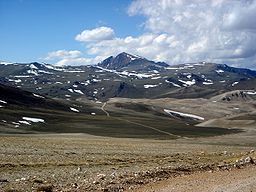
Alpine climate is the average weather (climate
Climate
Climate encompasses the statistics of temperature, humidity, atmospheric pressure, wind, rainfall, atmospheric particle count and other meteorological elemental measurements in a given region over long periods...
) for a region above the tree line. This climate is also referred to as mountain climate or highland climate.
In the Köppen climate classification
Köppen climate classification
The Köppen climate classification is one of the most widely used climate classification systems. It was first published by Crimea German climatologist Wladimir Köppen in 1884, with several later modifications by Köppen himself, notably in 1918 and 1936...
the alpine climate is part of "Group E," along with the polar climate
Polar climate
Regions with a polar climate are characterized by a lack of warm summers . Regions with polar climate cover over 20% of the Earth. The sun shines 24 hours in the summer, and barely ever shines at all in the winter...
, where no month has a mean temperature higher than 10 °C (50 °F). Certain highland climates can also fit under hemiboreal climate
Humid continental climate
A humid continental climate is a climatic region typified by large seasonal temperature differences, with warm to hot summers and cold winters....
or Semi-arid climate groups of climate classification
Climate classification
Climate classification systems are ways of classifying the world's climates. A climate classification may correlate closely with a biome category, as climate is a major influence on biological life in a region...
.
Description
The climate becomes colder at high elevationElevation
The elevation of a geographic location is its height above a fixed reference point, most commonly a reference geoid, a mathematical model of the Earth's sea level as an equipotential gravitational surface ....
s—this characteristic is described by the lapse rate of air: air tends to get colder as it rises, since it expands. The dry adiabatic lapse rate is 10 °C per km of elevation or altitude. Therefore, moving up 100 meters on a mountain is roughly equivalent to moving 80 kilometers (45 miles or 0.75° of latitude
Latitude
In geography, the latitude of a location on the Earth is the angular distance of that location south or north of the Equator. The latitude is an angle, and is usually measured in degrees . The equator has a latitude of 0°, the North pole has a latitude of 90° north , and the South pole has a...
) towards the pole. This relationship is only approximate, however, since local factors such as proximity to ocean
Ocean
An ocean is a major body of saline water, and a principal component of the hydrosphere. Approximately 71% of the Earth's surface is covered by ocean, a continuous body of water that is customarily divided into several principal oceans and smaller seas.More than half of this area is over 3,000...
s can drastically modify the climate. The main form of precipitation is often snow, often accompanied by stronger winds.
Distribution
The Cascade Mountains, the Rocky MountainsRocky Mountains
The Rocky Mountains are a major mountain range in western North America. The Rocky Mountains stretch more than from the northernmost part of British Columbia, in western Canada, to New Mexico, in the southwestern United States...
, the Alps
Alps
The Alps is one of the great mountain range systems of Europe, stretching from Austria and Slovenia in the east through Italy, Switzerland, Liechtenstein and Germany to France in the west....
, the Pyrenees
Pyrenees
The Pyrenees is a range of mountains in southwest Europe that forms a natural border between France and Spain...
and Sierra Nevada
Sierra Nevada (Spain)
The Sierra Nevada is a mountain range in the region of provinces of Granada and Almería in Spain. It contains the highest point of continental Spain, Mulhacén at 3478 m above sea level....
, the Andes
Andes
The Andes is the world's longest continental mountain range. It is a continual range of highlands along the western coast of South America. This range is about long, about to wide , and of an average height of about .Along its length, the Andes is split into several ranges, which are separated...
, the Himalayas
Himalayas
The Himalaya Range or Himalaya Mountains Sanskrit: Devanagari: हिमालय, literally "abode of snow"), usually called the Himalayas or Himalaya for short, is a mountain range in Asia, separating the Indian subcontinent from the Tibetan Plateau...
, the Tibetan Plateau
Tibetan Plateau
The Tibetan Plateau , also known as the Qinghai–Tibetan Plateau is a vast, elevated plateau in Central Asia covering most of the Tibet Autonomous Region and Qinghai, in addition to smaller portions of western Sichuan, southwestern Gansu, and northern Yunnan in Western China and Ladakh in...
, the Eastern Highlands
Eastern Highlands
The Eastern or 'East African Highlands is a mountain range in the east of Zimbabwe and one of 4 distinct physiographic divisions on the African continent.-Location and description:...
of Africa, and the central parts of Borneo
Borneo
Borneo is the third largest island in the world and is located north of Java Island, Indonesia, at the geographic centre of Maritime Southeast Asia....
and New Guinea
New Guinea
New Guinea is the world's second largest island, after Greenland, covering a land area of 786,000 km2. Located in the southwest Pacific Ocean, it lies geographically to the east of the Malay Archipelago, with which it is sometimes included as part of a greater Indo-Australian Archipelago...
are examples of highland climates. The mountain climate in the Northern Andes is particularly known for the notion of four zones of elevation:
- Tierra calienteTierra calienteTierra caliente is a pseudo-climatalogical term used in Latin America to refer to those places within that realm which have a distinctly tropical climate...
or hot land - Tierra templadaTierra templadaTierra templada is a pseudoclimatological term used in Latin America to refer to places within that realm which are either located in the tropics at a moderately high elevation, or are marginally outside the astronomical tropics, producing a somewhat cooler overall climate than that found in the...
or temperate land - Tierra friaTierra fríaTierra fría is a pseudoclimatological term used in parts of Latin America to refer to mountain locations within that cultural realm, where high elevation results in a markedly cooler climate than that encountered in the lowlands at a comparable latitude.To a climatologist, the term is inaccurate,...
or cold land - Tierra heladaTierra heladaTierra helada is a term used in Latin America to refer to the highest places found within the Andes mountains.Tierra helada is for the Montane grasslands and shrublands, Sunis, Punas and Paramos between the Treeline and the Snow line...
or frozen land
In mountainous areas with alpine climate, the dominant biome
Biome
Biomes are climatically and geographically defined as similar climatic conditions on the Earth, such as communities of plants, animals, and soil organisms, and are often referred to as ecosystems. Some parts of the earth have more or less the same kind of abiotic and biotic factors spread over a...
is alpine tundra
Alpine tundra
Alpine tundra is a natural region that does not contain trees because it is at high altitude. Alpine tundra is distinguished from arctic tundra, because alpine soils are generally better drained than arctic soils...
.
See also
- Alpine plantAlpine plantAlpine plants are plants that grow in the alpine climate, which occurs at high elevation and above the tree line. Alpine plants grow together as a plant community in alpine tundra.-Alpine plant diversity:...
- Alpine flora
- Climate of the AlpsClimate of the AlpsThe climate of the Alps is the climate, or average weather conditions over a long time, of the exact middle Alpine region of Europe. As air rises from sea level to the upper regions of the atmosphere the temperature decreases...
- Köppen climate classificationKöppen climate classificationThe Köppen climate classification is one of the most widely used climate classification systems. It was first published by Crimea German climatologist Wladimir Köppen in 1884, with several later modifications by Köppen himself, notably in 1918 and 1936...