


Generalitat de Catalunya

Encyclopedia
The Generalitat of Catalonia ' onMouseout='HidePop("44924")' href="/topics/English_language">English
; Government of Catalonia) is the institution under which the autonomous community
of Catalonia
is politically organised. It consists of the Parliament
, the President of the Generalitat of Catalonia
and the Government of Catalonia
.
The Generalitat had responsibility for an annual budget of more than €
23.9 billion in 2006, rising to more than €
32.5 billion in 2010.
of Catalonia stems from the medieval institution which ruled, in the name of the King of the Crown of Aragon
, some aspects of the administration of the Principality of Catalonia
. The first Catalan constitution
is that of the Corts of Barcelona from 1283. The last was promulgated by the Corts of 1702. The Generalitat was, in the Late Middle Ages
, the chief governing institution of Catalonia after the Monarch himself.
, one year after the signature of the Treaty of the Pyrenees
in the 17th century, which transferred the territory from Spanish to French sovereignty.
Then, by the early 18th century, as the Nueva Planta decrees
were passed in Spain, the institution was abolished in the Spanish territory as well.
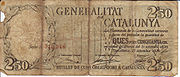 The Generalitat of Catalonia was restored in Spanish Catalonia and given its modern political and representative function as the regional government of Catalonia in 1932, during the Second Spanish Republic
.
After the right wing coalition won the Spanish elections in 1934, the leftist leaders of the Generalitat of Catalonia rebelled against the Spanish authorities, and was temporarily suspended from 1934 to 1936.
finished with the defeat of the Republican side, the institution was abolished and remained so during all the Francoist dictatorship.
After this, the powers given to the autonomous Catalan government according to the Spanish Constitution of 1978
were transferred and the Statute of Autonomy of Catalonia
(Estatut d'Autonomia) was passed after being approved both by referendum in Catalonia and by the Spanish Cortes Generales
.
José Montilla
was the president of the Generalitat until November 2010 (also leader of the Socialist Party), and was backed up by a tripartite coalition of left-wing and Catalan nationalist political parties. His party actually won fewer seats in parliament than the main opposition party, Convergence and Union, in the 2006 election
, but as he gathered more support from MPs from other parties in the parliament, he was able to repeat the same coalition government that his predecessor (Pasqual Maragall) had formed in order to send CiU to the opposition for the first time after 23 years of Jordi Pujol's government.
On June 18, 2006, a reformed version was approved
of the Statute of Autonomy of Catalonia and went into effect in August. In its inception, the reform was promoted by both the leftist parties in the government and by the main opposition party (CiU), which were united in pushing for increased devolution of powers from the Spanish government level, enhanced fiscal autonomy and finances, and explicit recognition of Catalonia's national identity; however the details of its final redaction were harshly fought and the subject became a controversial issue in the Catalan politics, with the ERC, themselves members of the Tripartite, opposing it.
The region has gradually achieved a greater degree of autonomy since 1979. After Navarre
and the Basque Country
regions, Catalonia has the greatest level of self-government in Spain. The Generalitat holds exclusive and wide jurisdiction in various matters of culture, environment, communications, transportation, commerce, public safety and local governments. http://www10.gencat.net/gencat/AppJava/en/generalitat/generalitat/competencies/exclusives.jsp In many aspects relating to education, health and justice, the region shares jurisdiction with the Spanish government. http://www10.gencat.net/gencat/AppJava/en/generalitat/generalitat/competencies/concurrents.jsp
One of the examples of Catalonia's degree of autonomy is its own police force, the Mossos d'Esquadra
, which is currently taking over most of the police functions in Catalonia which used to be served by the Guardia Civil and the Policía Nacional.
With few exceptions, most of the justice system is administered by national judicial institutions. The legal system is uniform throughout the Spanish State, with the exception of so-called civil law
. This is administered separately within Catalonia. http://civil.udg.es/normacivil/catalunya.htm As another institution stemming from the Generalitat, but independent from it in its check and balance functions, there is a Síndic de Greuges (ombudsman
) http://www.sindicgreugescat.org to address problems that may arise between private citizens or organizations and the Generalitat or local governments.
state. However, as Catalonia has progressively gained a greater degree of self-government in recent years, the Catalan Government has established nearly bilateral relationships with foreign bodies. For the most part, these relationships are with the governments of other self-styled stateless nations such as Quebec
http://www.mdeie.gouv.qc.ca/index.php?id=4201 or powerful sub-national administrations like California
http://soir.senate.ca.gov/scr71. In addition, like most Spanish autonomous communities, Catalonia has permanent delegations before international organizations, such as the European Union
http://www.copca.cat/infoglueDeliverLive/ViewPage.action?siteNodeId=247&languageId=1&contentId=-1.
Altogether, Catalonia has well over 40 representative offices worldwide http://www20.gencat.cat/portal/site/Departament-de-la-Vicepresidencia/menuitem.9a6dd4d7cef8efc12b121577b0c0e1a0/?vgnextoid=9a588f43a9e31210VgnVCM1000008d0c1e0aRCRD&vgnextchannel=9a588f43a9e31210VgnVCM1000008d0c1e0aRCRD&vgnextfmt=default http://www.copca.cat/infoglueDeliverLive/ViewPage.action?siteNodeId=97&languageId=1&contentId=1143. Most of these offices are located in major world cities like London
, New York
, Los Angeles
, Paris
, Tokyo
and others. Each office has specific duties assigned by their ministry or department agency. Generally, the functions of these are the representation of specific interests of the Government of Catalonia, trade and foreign investment, Catalan culture and language support, tourist promotion and international cooperation activities. http://www.copca.cat/infoglueDeliverLive/ViewPage.action?siteNodeId=97&languageId=1&contentId=1143 http://www20.gencat.cat/portal/site/Departament-de-la-Vicepresidencia/menuitem.1bd9513103ff0c512b121577b0c0e1a0/?vgnextoid=d586d2bd5ce31210VgnVCM1000008d0c1e0aRCRD&vgnextchannel=d586d2bd5ce31210VgnVCM1000008d0c1e0aRCRD&vgnextfmt=default
There are no specific Catalan political institutions in Northern Catalonia
, the French département of Pyrénées-Orientales
. However, since September 5, 2003, there has been a Casa de la Generalitat in Perpignan
, which aims to promote the Catalan culture and facilitate exchanges between each side of the Franco
–Spanish
border.http://www10.gencat.net/sac/AppJava/organisme_fitxa.jsp?codi=13599
English language
English is a West Germanic language that arose in the Anglo-Saxon kingdoms of England and spread into what was to become south-east Scotland under the influence of the Anglian medieval kingdom of Northumbria...
; Government of Catalonia) is the institution under which the autonomous community
Autonomous communities of Spain
An autonomous community In other languages of Spain:*Catalan/Valencian .*Galician .*Basque . The second article of the constitution recognizes the rights of "nationalities and regions" to self-government and declares the "indissoluble unity of the Spanish nation".Political power in Spain is...
of Catalonia
Catalonia
Catalonia is an autonomous community in northeastern Spain, with the official status of a "nationality" of Spain. Catalonia comprises four provinces: Barcelona, Girona, Lleida, and Tarragona. Its capital and largest city is Barcelona. Catalonia covers an area of 32,114 km² and has an...
is politically organised. It consists of the Parliament
Parliament of Catalonia
The Parliament of Catalonia is the unicameral legislature of Catalonia. It is formed by 135 members , who are elected every four years in ordinary period, or extraordinarily upon dissolution and call of elections by the President of Catalonia, by universal suffrage in proportional lists with four...
, the President of the Generalitat of Catalonia
President of the Generalitat de Catalunya
The President of the Generalitat of Catalonia is the head of government of Catalonia. The president leads the executive branch of the regional government....
and the Government of Catalonia
Government of Catalonia
The Government of Catalonia is the executive branch of the Generalitat de Catalunya. It is responsible for the political action, reglamentation and administration of the Generalitat....
.
The Generalitat had responsibility for an annual budget of more than €
Euro
The euro is the official currency of the eurozone: 17 of the 27 member states of the European Union. It is also the currency used by the Institutions of the European Union. The eurozone consists of Austria, Belgium, Cyprus, Estonia, Finland, France, Germany, Greece, Ireland, Italy, Luxembourg,...
23.9 billion in 2006, rising to more than €
Euro
The euro is the official currency of the eurozone: 17 of the 27 member states of the European Union. It is also the currency used by the Institutions of the European Union. The eurozone consists of Austria, Belgium, Cyprus, Estonia, Finland, France, Germany, Greece, Ireland, Italy, Luxembourg,...
32.5 billion in 2010.
Medieval origins
The GeneralitatGeneralitat
Generalitat is the name of the autonomous systems of government of two of the present Spanish autonomous communities: Catalonia and the Valencian Community. The term is also used for the government of the semi-autonomous comarca of Val d'Aran, the Generalitat a l'Aran.Generalitat refers to all...
of Catalonia stems from the medieval institution which ruled, in the name of the King of the Crown of Aragon
Crown of Aragon
The Crown of Aragon Corona d'Aragón Corona d'Aragó Corona Aragonum controlling a large portion of the present-day eastern Spain and southeastern France, as well as some of the major islands and mainland possessions stretching across the Mediterranean as far as Greece...
, some aspects of the administration of the Principality of Catalonia
Principality of Catalonia
The Principality of Catalonia , is a historic territory in the northeastern Iberian Peninsula, mostly in Spain and with an adjoining portion in southern France....
. The first Catalan constitution
Catalan constitutions
The Catalan constitutions were promulgated by the Corts of Barcelona . The first constitution was promulgated by the court of 1283. The last ones were promulgated by the court of 1702...
is that of the Corts of Barcelona from 1283. The last was promulgated by the Corts of 1702. The Generalitat was, in the Late Middle Ages
Late Middle Ages
The Late Middle Ages was the period of European history generally comprising the 14th to the 16th century . The Late Middle Ages followed the High Middle Ages and preceded the onset of the early modern era ....
, the chief governing institution of Catalonia after the Monarch himself.
First abolition
Catalan institutions which depended on the Generalitat were abolished in what is currently known in Catalonia as Northern CataloniaNorthern Catalonia
Northern Catalonia is a term that is sometimes used, particularly in Catalan writings, to refer to the territory ceded to France by Spain through the signing of the Treaty of the Pyrenees in 1659...
, one year after the signature of the Treaty of the Pyrenees
Treaty of the Pyrenees
The Treaty of the Pyrenees was signed to end the 1635 to 1659 war between France and Spain, a war that was initially a part of the wider Thirty Years' War. It was signed on Pheasant Island, a river island on the border between the two countries...
in the 17th century, which transferred the territory from Spanish to French sovereignty.
Then, by the early 18th century, as the Nueva Planta decrees
Nueva Planta decrees
The Nueva Planta decrees were a number of decrees signed between 1707 and 1716 by Philip V—the first Bourbon king of Spain—during and shortly after the end of the War of the Spanish Succession which he won....
were passed in Spain, the institution was abolished in the Spanish territory as well.
First restoration
Second Spanish Republic
The Second Spanish Republic was the government of Spain between April 14 1931, and its destruction by a military rebellion, led by General Francisco Franco....
.
After the right wing coalition won the Spanish elections in 1934, the leftist leaders of the Generalitat of Catalonia rebelled against the Spanish authorities, and was temporarily suspended from 1934 to 1936.
Second abolition
In 1939, as the Spanish Civil WarSpanish Civil War
The Spanish Civil WarAlso known as The Crusade among Nationalists, the Fourth Carlist War among Carlists, and The Rebellion or Uprising among Republicans. was a major conflict fought in Spain from 17 July 1936 to 1 April 1939...
finished with the defeat of the Republican side, the institution was abolished and remained so during all the Francoist dictatorship.
Second restoration
The succession of presidents of the Generalitat was maintained in exile from 1939 to 1977, when Josep Tarradellas returned to Catalonia and was recognized as the legitimate president by the Spanish government. Tarradellas, when he returned to Catalonia, made his often quoted remark "Ciutadans de Catalunya: ja sóc aquí" ("Citizens of Catalonia: I am back here, now!"), reassuming the autonomous powers of Catalonia, one of the historic nationalities of present-day Spain.After this, the powers given to the autonomous Catalan government according to the Spanish Constitution of 1978
Spanish Constitution of 1978
-Structure of the State:The Constitution recognizes the existence of nationalities and regions . Preliminary Title As a result, Spain is now composed entirely of 17 Autonomous Communities and two autonomous cities with varying degrees of autonomy, to the extent that, even though the Constitution...
were transferred and the Statute of Autonomy of Catalonia
Statute of Autonomy of Catalonia
The Statute of Autonomy of Catalonia provides Catalonia's basic institutional regulations. It defines the rights and obligations of the citizens of Catalonia , the political institutions of the Catalan nationality, their competences and relations with the rest of Spain, and the financing of the...
(Estatut d'Autonomia) was passed after being approved both by referendum in Catalonia and by the Spanish Cortes Generales
Cortes Generales
The Cortes Generales is the legislature of Spain. It is a bicameral parliament, composed of the Congress of Deputies and the Senate . The Cortes has power to enact any law and to amend the constitution...
.
Current status
Artur Mas has been the president of the Generalitat (also leader of Convergence and Union) since mid-December 2010. His party did not obtain an absolute majority in the 2010 election, but is now in government on the basis of occasional pacts with other parties, as in the case of the pact with the Socialist Party to elect Artur Mas as President.José Montilla
José Montilla
José Montilla Aguilera was the 128th President of Generalitat de Catalunya. He became the First Secretary of the Socialists' Party of Catalonia on 18 June 2000, and a member of the Federal Executive Committee and the Federal Committee of the Spanish Socialist Workers' Party on 23 July 2000...
was the president of the Generalitat until November 2010 (also leader of the Socialist Party), and was backed up by a tripartite coalition of left-wing and Catalan nationalist political parties. His party actually won fewer seats in parliament than the main opposition party, Convergence and Union, in the 2006 election
Catalan Parliament election, 2006
Elections to the Parliament of the Autonomous Community of Catalonia, Spain, were held on November 1, 2006.-Background:The November 2006 Catalan parliament election was an early one...
, but as he gathered more support from MPs from other parties in the parliament, he was able to repeat the same coalition government that his predecessor (Pasqual Maragall) had formed in order to send CiU to the opposition for the first time after 23 years of Jordi Pujol's government.
On June 18, 2006, a reformed version was approved
Catalan constitutional referendum, 2006
A referendum on the new Statute of Autonomy of Catalonia was held in Catalonia, Spain, on June 18, 2006. The referendum was successful and the new statute came into effect on August 9, 2006....
of the Statute of Autonomy of Catalonia and went into effect in August. In its inception, the reform was promoted by both the leftist parties in the government and by the main opposition party (CiU), which were united in pushing for increased devolution of powers from the Spanish government level, enhanced fiscal autonomy and finances, and explicit recognition of Catalonia's national identity; however the details of its final redaction were harshly fought and the subject became a controversial issue in the Catalan politics, with the ERC, themselves members of the Tripartite, opposing it.
Autonomous system of government
The Generalitat consists of the Executive Council, the President and the Parliament. Some people wrongly apply this name only to the Council as if it were the same as Cabinet only; however, Generalitat de Catalunya is the (autonomous) Catalan system as a whole.The region has gradually achieved a greater degree of autonomy since 1979. After Navarre
Navarre
Navarre , officially the Chartered Community of Navarre is an autonomous community in northern Spain, bordering the Basque Country, La Rioja, and Aragon in Spain and Aquitaine in France...
and the Basque Country
Basque Country (autonomous community)
The Basque Country is an autonomous community of northern Spain. It includes the Basque provinces of Álava, Biscay and Gipuzkoa, also called Historical Territories....
regions, Catalonia has the greatest level of self-government in Spain. The Generalitat holds exclusive and wide jurisdiction in various matters of culture, environment, communications, transportation, commerce, public safety and local governments. http://www10.gencat.net/gencat/AppJava/en/generalitat/generalitat/competencies/exclusives.jsp In many aspects relating to education, health and justice, the region shares jurisdiction with the Spanish government. http://www10.gencat.net/gencat/AppJava/en/generalitat/generalitat/competencies/concurrents.jsp
One of the examples of Catalonia's degree of autonomy is its own police force, the Mossos d'Esquadra
Mossos d'Esquadra
The Mossos d'Esquadra are the police force of Catalonia, one of the autonomous communities of Spain. It is the oldest civil police force in Europe, founded in the 18th century as the Esquadres de Catalunya to protect the people of Catalonia....
, which is currently taking over most of the police functions in Catalonia which used to be served by the Guardia Civil and the Policía Nacional.
With few exceptions, most of the justice system is administered by national judicial institutions. The legal system is uniform throughout the Spanish State, with the exception of so-called civil law
Civil law (legal system)
Civil law is a legal system inspired by Roman law and whose primary feature is that laws are codified into collections, as compared to common law systems that gives great precedential weight to common law on the principle that it is unfair to treat similar facts differently on different...
. This is administered separately within Catalonia. http://civil.udg.es/normacivil/catalunya.htm As another institution stemming from the Generalitat, but independent from it in its check and balance functions, there is a Síndic de Greuges (ombudsman
Ombudsman
An ombudsman is a person who acts as a trusted intermediary between an organization and some internal or external constituency while representing not only but mostly the broad scope of constituent interests...
) http://www.sindicgreugescat.org to address problems that may arise between private citizens or organizations and the Generalitat or local governments.
International presence
As an autonomous community of Spain, Catalonia has no recognition as a sovereign state from any UN member or any de factoDe facto
De facto is a Latin expression that means "concerning fact." In law, it often means "in practice but not necessarily ordained by law" or "in practice or actuality, but not officially established." It is commonly used in contrast to de jure when referring to matters of law, governance, or...
state. However, as Catalonia has progressively gained a greater degree of self-government in recent years, the Catalan Government has established nearly bilateral relationships with foreign bodies. For the most part, these relationships are with the governments of other self-styled stateless nations such as Quebec
Quebec
Quebec or is a province in east-central Canada. It is the only Canadian province with a predominantly French-speaking population and the only one whose sole official language is French at the provincial level....
http://www.mdeie.gouv.qc.ca/index.php?id=4201 or powerful sub-national administrations like California
California
California is a state located on the West Coast of the United States. It is by far the most populous U.S. state, and the third-largest by land area...
http://soir.senate.ca.gov/scr71. In addition, like most Spanish autonomous communities, Catalonia has permanent delegations before international organizations, such as the European Union
European Union
The European Union is an economic and political union of 27 independent member states which are located primarily in Europe. The EU traces its origins from the European Coal and Steel Community and the European Economic Community , formed by six countries in 1958...
http://www.copca.cat/infoglueDeliverLive/ViewPage.action?siteNodeId=247&languageId=1&contentId=-1.
Altogether, Catalonia has well over 40 representative offices worldwide http://www20.gencat.cat/portal/site/Departament-de-la-Vicepresidencia/menuitem.9a6dd4d7cef8efc12b121577b0c0e1a0/?vgnextoid=9a588f43a9e31210VgnVCM1000008d0c1e0aRCRD&vgnextchannel=9a588f43a9e31210VgnVCM1000008d0c1e0aRCRD&vgnextfmt=default http://www.copca.cat/infoglueDeliverLive/ViewPage.action?siteNodeId=97&languageId=1&contentId=1143. Most of these offices are located in major world cities like London
London
London is the capital city of :England and the :United Kingdom, the largest metropolitan area in the United Kingdom, and the largest urban zone in the European Union by most measures. Located on the River Thames, London has been a major settlement for two millennia, its history going back to its...
, New York
New York
New York is a state in the Northeastern region of the United States. It is the nation's third most populous state. New York is bordered by New Jersey and Pennsylvania to the south, and by Connecticut, Massachusetts and Vermont to the east...
, Los Angeles
Los Ángeles
Los Ángeles is the capital of the province of Biobío, in the commune of the same name, in Region VIII , in the center-south of Chile. It is located between the Laja and Biobío rivers. The population is 123,445 inhabitants...
, Paris
Paris
Paris is the capital and largest city in France, situated on the river Seine, in northern France, at the heart of the Île-de-France region...
, Tokyo
Tokyo
, ; officially , is one of the 47 prefectures of Japan. Tokyo is the capital of Japan, the center of the Greater Tokyo Area, and the largest metropolitan area of Japan. It is the seat of the Japanese government and the Imperial Palace, and the home of the Japanese Imperial Family...
and others. Each office has specific duties assigned by their ministry or department agency. Generally, the functions of these are the representation of specific interests of the Government of Catalonia, trade and foreign investment, Catalan culture and language support, tourist promotion and international cooperation activities. http://www.copca.cat/infoglueDeliverLive/ViewPage.action?siteNodeId=97&languageId=1&contentId=1143 http://www20.gencat.cat/portal/site/Departament-de-la-Vicepresidencia/menuitem.1bd9513103ff0c512b121577b0c0e1a0/?vgnextoid=d586d2bd5ce31210VgnVCM1000008d0c1e0aRCRD&vgnextchannel=d586d2bd5ce31210VgnVCM1000008d0c1e0aRCRD&vgnextfmt=default
There are no specific Catalan political institutions in Northern Catalonia
Northern Catalonia
Northern Catalonia is a term that is sometimes used, particularly in Catalan writings, to refer to the territory ceded to France by Spain through the signing of the Treaty of the Pyrenees in 1659...
, the French département of Pyrénées-Orientales
Pyrénées-Orientales
Pyrénées-Orientales is a department of southern France adjacent to the northern Spanish frontier and the Mediterranean Sea. It also surrounds the tiny Spanish enclave of Llívia, and thus has two distinct borders with Spain.- History :...
. However, since September 5, 2003, there has been a Casa de la Generalitat in Perpignan
Perpignan
-Sport:Perpignan is a rugby stronghold: their rugby union side, USA Perpignan, is a regular competitor in the Heineken Cup and seven times champion of the Top 14 , while their rugby league side plays in the engage Super League under the name Catalans Dragons.-Culture:Since 2004, every year in the...
, which aims to promote the Catalan culture and facilitate exchanges between each side of the Franco
France
The French Republic , The French Republic , The French Republic , (commonly known as France , is a unitary semi-presidential republic in Western Europe with several overseas territories and islands located on other continents and in the Indian, Pacific, and Atlantic oceans. Metropolitan France...
–Spanish
Spain
Spain , officially the Kingdom of Spain languages]] under the European Charter for Regional or Minority Languages. In each of these, Spain's official name is as follows:;;;;;;), is a country and member state of the European Union located in southwestern Europe on the Iberian Peninsula...
border.http://www10.gencat.net/sac/AppJava/organisme_fitxa.jsp?codi=13599
See also
- Autonomous communities of SpainAutonomous communities of SpainAn autonomous community In other languages of Spain:*Catalan/Valencian .*Galician .*Basque . The second article of the constitution recognizes the rights of "nationalities and regions" to self-government and declares the "indissoluble unity of the Spanish nation".Political power in Spain is...
- Composition of the Catalan Government
- List of Presidents of Catalonia
- Commonwealth of Catalonia
- Palau de la Generalitat de CatalunyaPalau de la Generalitat de CatalunyaThe Palau de la Generalitat is a historic palace in Barcelona, Catalonia, northern Spain. It houses the offices of the Presidency of the Generalitat de Catalunya. It is one of the few buildings of medieval origin in Europe that still functions as a seat of government and houses the institution that...