

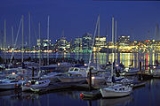
City of Halifax

Encyclopedia
Halifax is a city in Canada
Canada
Canada is a North American country consisting of ten provinces and three territories. Located in the northern part of the continent, it extends from the Atlantic Ocean in the east to the Pacific Ocean in the west, and northward into the Arctic Ocean...
, which was the capital of the province of Nova Scotia
Nova Scotia
Nova Scotia is one of Canada's three Maritime provinces and is the most populous province in Atlantic Canada. The name of the province is Latin for "New Scotland," but "Nova Scotia" is the recognized, English-language name of the province. The provincial capital is Halifax. Nova Scotia is the...
and shire town
County seat
A county seat is an administrative center, or seat of government, for a county or civil parish. The term is primarily used in the United States....
of Halifax County
Halifax County, Nova Scotia
Halifax County is a county in the Canadian province of Nova Scotia.The Municipality of the County of Halifax was the municipal government of Halifax County, apart from the separately incorporated towns and cities therein...
. It was the largest city in Atlantic Canada
Atlantic Canada
Atlantic Canada is the region of Canada comprising the four provinces located on the Atlantic coast, excluding Quebec: the three Maritime provinces – New Brunswick, Prince Edward Island, and Nova Scotia – and Newfoundland and Labrador...
until it was amalgamated into Halifax Regional Municipality in 1996. It is no longer an incorporated city and is a community of Halifax Regional Municipality (HRM).
The Town of Halifax was founded by British government
Kingdom of Great Britain
The former Kingdom of Great Britain, sometimes described as the 'United Kingdom of Great Britain', That the Two Kingdoms of Scotland and England, shall upon the 1st May next ensuing the date hereof, and forever after, be United into One Kingdom by the Name of GREAT BRITAIN. was a sovereign...
under the direction of the Board of Trade and Plantations
Board of Trade
The Board of Trade is a committee of the Privy Council of the United Kingdom, originating as a committee of inquiry in the 17th century and evolving gradually into a government department with a diverse range of functions...
under the command of Governor Edward Cornwallis
Edward Cornwallis
Lieutenant General Edward Cornwallis was a British military officer who founded Halifax, Nova Scotia with 2500 settlers and later served as the Governor of Gibraltar.-Early life:...
in 1749. The founding of Halifax marked the beginning of Father Le Loutre's War
Father Le Loutre's War
Father Le Loutre’s War , also known as the Indian War, the Micmac War and the Anglo-Micmac War, took place between King George's War and the French and Indian War in Acadia and Nova Scotia. On one side of the conflict, the British and New England colonists were led by British Officer Charles...
, in which the capital region was raided 13 times by the Mi'kmaq and Acadians.
Halifax was founded below a glacial drumlin
Drumlin
A drumlin, from the Irish word droimnín , first recorded in 1833, is an elongated whale-shaped hill formed by glacial ice acting on underlying unconsolidated till or ground moraine.-Drumlin formation:...
that would later be named Citadel Hill. The outpost was named in honour of George Montague-Dunk, 2nd Earl of Halifax, who was the President of the British Board of Trade. Halifax was ideal for a military base, with the vast Halifax Harbour
Halifax Harbour
Halifax Harbour is a large natural harbour on the Atlantic coast of Nova Scotia, Canada, located in the Halifax Regional Municipality.-Harbour description:The harbour is called Jipugtug by the Mi'kmaq first nation, anglisized as Chebucto...
, among the largest natural harbours in the world, which could be well protected with batteries
Artillery battery
In military organizations, an artillery battery is a unit of guns, mortars, rockets or missiles so grouped in order to facilitate better battlefield communication and command and control, as well as to provide dispersion for its constituent gunnery crews and their systems...
at McNab's Island, the North West Arm
North West Arm
North West Arm is a natural arm of approximately 20 miles in length and average of 1 mile wide located on the south side of Random Island at the inner region of Trinity Bay in the Canadian province of Newfoundland and Labrador....
, Point Pleasant
Point Pleasant Park
Point Pleasant Park is a large, partially forested municipal park at the southern tip of the Halifax peninsula. It once hosted several artillery batteries, and a well-preserved 18th century Martello tower can be found there...
, George's Island and York Redoubt
York Redoubt
York Redoubt is a National Historic Site of Canada situated on a bluff overlooking the entrance to Halifax Harbour at Ferguson's Cove, Nova Scotia, originally constructed in 1793. It was a key element in the defence of Halifax Harbour in the 19th and 20th centuries, and underwent many additions to...
. In its early years, Citadel Hill was used as a command and observation post, before changes in artillery that could range out into the harbour.
After a protracted struggle between residents and the Governor, the City of Halifax was incorporated in 1841. On April 1, 1996, the government of Nova Scotia dissolved the City of Halifax, and amalgamated the four municipalities within Halifax County and formed Halifax Regional Municipality, a single-tier regional government covering that whole area.
Today the area of the former City of Halifax is referred to as an unincorporated "provincial metropolitan area
Metropolitan area
The term metropolitan area refers to a region consisting of a densely populated urban core and its less-populated surrounding territories, sharing industry, infrastructure, and housing. A metropolitan area usually encompasses multiple jurisdictions and municipalities: neighborhoods, townships,...
" by the provincial government's place name website and the area is referred to as "Halifax, Nova Scotia" for civic addressing and as a placename.
The area is administered as two separate community planning areas by the regional government for development, Halifax Peninsula
Halifax Peninsula
The Halifax Peninsula is a community and planning area located in the urban core of Halifax Regional Municipality in the province of Nova Scotia. Halifax Peninsula is home to Downtown Halifax, the financial and economic heart of the region, which was also the site of the original settlement and...
and Mainland Halifax
Mainland Halifax
Mainland Halifax is a region in central Nova Scotia, Canada that refers to the central-eastern part of the Chebucto Peninsula in the Halifax Regional Municipality...
. It forms a significant part of the Halifax urban area. Residents of the former city are called "Haligonians".
Historical context
The Mi'kmaq called the area "Jipugtug", (anglicised as "Chebucto"), which means "the biggest harbour", in reference to present-day Halifax HarbourHalifax Harbour
Halifax Harbour is a large natural harbour on the Atlantic coast of Nova Scotia, Canada, located in the Halifax Regional Municipality.-Harbour description:The harbour is called Jipugtug by the Mi'kmaq first nation, anglisized as Chebucto...
. There is evidence that bands would spend the summer on the shores of the Bedford Basin
Bedford Basin
Bedford Basin is a large enclosed bay, forming the northwestern end of Halifax Harbour on Canada's Atlantic coast.-Geography:Geographically, the basin is situated entirely within the Halifax Regional Municipality and is oriented northwest-southeast, measuring approximately 8 kilometres long and 5...
, moving to points inland before the harsh Atlantic winter set in. Examples of Mikmaq habitation and burial sites have been found from Point Pleasant Park to the north and south mainland. Prior to the establishment of Halifax, the most remarkable event in the region was the fate of the Duc d'Anville Expedition
Duc d'Anville Expedition
The Duc d'Anville Expedition was sent from France to recapture peninsular Acadia . The expedition was the largest military force ever to set sail for the New World prior to the American Revolution. The effort to take the Nova Scotian capital, Annapolis Royal was also supported on land by a force...
.
Despite the Conquest of Acadia
Siege of Port Royal (1710)
The Siege of Port Royal , also known as the Conquest of Acadia, was conducted by British regular and provincial forces under the command of Francis Nicholson against a French Acadian garrison under the command of Daniel d'Auger de Subercase, at the Acadian capital, Port Royal...
in 1710, no serious attempts were made by Great Britain to colonize Nova Scotia, aside from its presence at Annapolis Royal and Canso. The peninsula was dominated by Catholic Acadians and Mi'kmaq residents. To counter the influence of Louisbourg and to dominate Nova Scotia and Acadia, Halifax was established.
Father Le Loutre's War
The establishment of Halifax marked the beginning of Father Le Loutre's WarFather Le Loutre's War
Father Le Loutre’s War , also known as the Indian War, the Micmac War and the Anglo-Micmac War, took place between King George's War and the French and Indian War in Acadia and Nova Scotia. On one side of the conflict, the British and New England colonists were led by British Officer Charles...
. The war began when Edward Cornwallis
Edward Cornwallis
Lieutenant General Edward Cornwallis was a British military officer who founded Halifax, Nova Scotia with 2500 settlers and later served as the Governor of Gibraltar.-Early life:...
arrived to establish Halifax with 13 transports and a sloop of war on June 21, 1749. By unilaterally establishing Halifax the British were violating earlier treaties with the Mi'kmaq (1726), which were signed after Dummer's War
Dummer's War
Dummer's War , also known as Lovewell's War, Father Rale's War, Greylock's War, the Three Years War, the 4th Indian War or the Wabanaki-New England War of 1722–1725, was a series of battles between British settlers of the three northernmost British colonies of North America of the time and the...
. Cornwallis brought along 1,176 settlers and their families. To guard against Mi'kmaq, Acadian, and French attacks on the new Protestant settlements, British fortifications were erected in Halifax (Citadel Hill)(1749), Dartmouth (1750), Bedford
Bedford, Nova Scotia
Bedford is a community in the Halifax Regional Municipality, Nova Scotia, Canada. It was an independent town from 1980-1996. Bedford lies on the northwestern end of Bedford Basin, an extension of the Halifax Harbour...
(Fort Sackville) (1751), Lunenburg
Lunenburg, Nova Scotia
Lunenburg , is a Canadian port town in Lunenburg County, Nova Scotia.Situated on the province's South Shore, Lunenburg is located on a peninsula at the western side of Mahone Bay. The town is approximately 90 kilometres southwest of the county boundary with the Halifax Regional Municipality.The...
(1753) and Lawrencetown
Lawrencetown, Halifax County, Nova Scotia
Lawrencetown is a Canadian rural community in Nova Scotia's Halifax Regional Municipality on Route 207. The settlement was established during Father Le Loutre's War.- History :...
(1754).
During Father Le Loutre's War
Father Le Loutre's War
Father Le Loutre’s War , also known as the Indian War, the Micmac War and the Anglo-Micmac War, took place between King George's War and the French and Indian War in Acadia and Nova Scotia. On one side of the conflict, the British and New England colonists were led by British Officer Charles...
, the Mi'kmaq and Acadians raided in the capital region (Halifax and Dartmouth) 12 times. The worst of these raids was the Dartmouth Massacre (1751)
Raid on Dartmouth (1751)
The Raid on Dartmouth occurred during Father Le Loutre’s War on May 13, 1751 when an Acadian and Mi’kmaq militia from Chignecto, under the command of Acadian Joseph Broussard, raided Dartmouth, Nova Scotia, destroying the town and killing twenty British villagers...
. Four of these raids were against Halifax. The first raid against Halifax was in July 1750: in the woods on peninsular Halifax, the Mi'kmaq scalped Cornwallis' gardener, his son, and four others. They buried the son, left the gardener's body exposed, and carried off the other four bodies.
In 1751, there were two attacks on blockhouses surrounding Halifax. Mi'kmaq attacked the North Blockhouse (located at the north end of Joseph Howe Drive) and killed the men on guard. They also attacked near the South Blockhouse (located at the south end of Joseph Howe Drive), at a saw-mill on a stream flowing out of Chocolate Lake. They killed two men. (Map of Halifax Blockhouses)
In 1753, when Lawrence became governor, the Mi'kmaq attacked again upon the sawmills near the South Blockhouse on the Northwest Arm, where they killed three British. The Mi'kmaq made three attempts to retrieve the bodies for their scalps.
Prominent Halifax business person Michael Francklin
Michael Francklin
Michael Francklin or Franklin served as Nova Scotia's Lieutenant Governor from 1766-1772.Born in Poole, England, Francklin immigrated to Halifax, Nova Scotia in 1752. He worked as a trader and merchant, initially in association with Joshua Maugher...
was captured by a Mi'kmaw raiding party in 1754 and held captive for three months.
French and Indian War
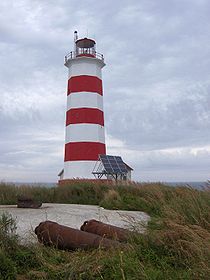
French and Indian War
The French and Indian War is the common American name for the war between Great Britain and France in North America from 1754 to 1763. In 1756, the war erupted into the world-wide conflict known as the Seven Years' War and thus came to be regarded as the North American theater of that war...
as a counter to the French fortress Louisbourg in Cape Breton. Halifax provided the base for the Siege of Louisbourg (1758)
Siege of Louisbourg (1758)
The Siege of Louisbourg was a pivotal battle of the Seven Years' War in 1758 which ended the French colonial era in Atlantic Canada and led directly to the loss of Quebec in 1759 and the remainder of French North America the following year.-Background:The British government realized that with the...
and operated as a major naval base for the remainder of the war. On Georges Island (Nova Scotia) in the Halifax harbour, Acadians from the expulsion were imprisoned.
Acadian Pierre Gautier, son of Joseph-Nicolas Gautier
Joseph-Nicolas Gautier
Joseph-Nicolas Gautier dit Bellair, Joseph-Nicolas Gautier dit Bellair, Joseph-Nicolas Gautier dit Bellair, (b. 1689 at Rochefort, France, d. 1752 at Port-La-Joie (Fort Amherst, P.E.I.) was a merchant trader and a leader of the Acadian militia who participated in war efforts against the British...
, led Mi’kmaq warriors from Louisbourg on three raids against Halifax in 1757. In each raid, Gautier took prisoners or scalps or both. The last raid happened in September and Gautier went with four Mi’kmaq and killed and scalped two British men at the foot of Citadel Hill. (Pierre went on to participate in the Battle of Restigouche
Battle of Restigouche
The Battle of Restigouche was a naval battle fought during the French and Indian War on the Restigouche River between the British Royal Navy and the small flotilla of French Navy vessels. The French vessels had been sent to relieve New France after the fall of Quebec...
.)
The Sambro Island Lighthouse
Sambro Island Lighthouse
Sambro Island Lighthouse is a landfall lighthouse located at the entrance to Halifax Harbour, Nova Scotia, on an island near the community of Sambro in the Halifax Regional Municipality...
was constructed at the harbour entrance in 1758 to develop the port city's merchant and naval shipping. A permanent navy base, the Halifax Naval Yard
Royal Naval Dockyard, Halifax
Royal Naval Dockyard, Halifax was a British Royal Navy base in Halifax, Nova Scotia from 1759 to 1905. The Halifax Yard was the main year round base of the Royal Navy's North American Station when first established in 1759 during the Seven Years' War....
was established in 1759. For much of this period in the early 18th century, Nova Scotia was considered a frontier posting for the British military, given the proximity to the border with French territory and potential for conflict; the local environment was also very inhospitable and many early settlers were ill-suited for the colony's wilderness on the shores of Halifax Harbour. The original settlers, who were often discharged soldiers and sailors, left the colony for established cities such as New York
New York City
New York is the most populous city in the United States and the center of the New York Metropolitan Area, one of the most populous metropolitan areas in the world. New York exerts a significant impact upon global commerce, finance, media, art, fashion, research, technology, education, and...
and Boston
Boston
Boston is the capital of and largest city in Massachusetts, and is one of the oldest cities in the United States. The largest city in New England, Boston is regarded as the unofficial "Capital of New England" for its economic and cultural impact on the entire New England region. The city proper had...
or the lush plantations of the Virginia's and Carolina's. However, the new city did attract New England merchants exploiting the near-by fisheries and English merchants such as Joshua Maugher who profited greatly from both British military contracts and smuggling with the French at Louisbourg. The military threat to Nova Scotia was removed following British victory over France in the Seven Years War.
With the addition of remaining territories of the colony of Acadia, the enlarged British colony of Nova Scotia was mostly depopulated, following the deportation of Acadian residents
Great Upheaval
The Expulsion of the Acadians was the forced removal by the British of the Acadian people from present day Canadian Maritime provinces: Nova Scotia, New Brunswick, and Prince Edward Island...
. In addition, Britain was unwilling to allow its residents to emigrate, this being at the dawn of their Industrial Revolution
Industrial Revolution
The Industrial Revolution was a period from the 18th to the 19th century where major changes in agriculture, manufacturing, mining, transportation, and technology had a profound effect on the social, economic and cultural conditions of the times...
, thus Nova Scotia invited settlement by "foreign Protestants". The region, including its new capital of Halifax, saw a modest immigration boom comprising Germans
Germany
Germany , officially the Federal Republic of Germany , is a federal parliamentary republic in Europe. The country consists of 16 states while the capital and largest city is Berlin. Germany covers an area of 357,021 km2 and has a largely temperate seasonal climate...
, Dutch, New England
New England
New England is a region in the northeastern corner of the United States consisting of the six states of Maine, New Hampshire, Vermont, Massachusetts, Rhode Island, and Connecticut...
ers, residents of Martinique
Martinique
Martinique is an island in the eastern Caribbean Sea, with a land area of . Like Guadeloupe, it is an overseas region of France, consisting of a single overseas department. To the northwest lies Dominica, to the south St Lucia, and to the southeast Barbados...
and many other areas. In addition to the surnames of many present-day residents of Halifax who are descended from these settlers, an enduring name in the city is the "Dutch Village Road", which led from the "Dutch Village", located in Fairview
Fairview, Nova Scotia
Fairview is a former community and current neighbourhood within the urban core of Halifax Regional Municipality in Nova Scotia, Canada.-Geography:...
. Dutch here referring to the German "Deutsch" which sounded like "dutch" to Haligonian ears.
The American Revolution
Halifax's fortunes waxed and waned with the military needs of the EmpireBritish Empire
The British Empire comprised the dominions, colonies, protectorates, mandates and other territories ruled or administered by the United Kingdom. It originated with the overseas colonies and trading posts established by England in the late 16th and early 17th centuries. At its height, it was the...
. While it had quickly become the largest Royal Navy
Royal Navy
The Royal Navy is the naval warfare service branch of the British Armed Forces. Founded in the 16th century, it is the oldest service branch and is known as the Senior Service...
base on the Atlantic coast and had hosted large numbers of British army regulars, the complete destruction of Louisbourg in 1760 removed the threat of French attack. With peace in 1763, the garrison and naval squadron was dramatically reduced. With naval vessels no longer carrying the mail, Halifax merchants banded together in 1765 to build the Nova Scotia Packet a schooner to carry mail to Boston, later commissioned as the naval schooner HMS Halifax
HMS Halifax (1768)
HMS Halifax was a schooner built for merchant service at Halifax, Nova Scotia in 1765 and purchased in 1768 by the British Royal Navy for coastal patrol in North America in the years just prior to the American Revolution...
, the first warship built in English Canada. Meanwhile Boston and New England turned their eyes west, to the French territory now available due to the defeat of Montcalm
Louis-Joseph de Montcalm
Louis-Joseph de Montcalm-Gozon, Marquis de Saint-Veran was a French soldier best known as the commander of the forces in North America during the Seven Years' War .Montcalm was born near Nîmes in France to a noble family, and entered military service...
at the Plains of Abraham
Plains of Abraham
The Plains of Abraham is a historic area within The Battlefields Park in Quebec City, Quebec, that was originally grazing land, but became famous as the site of the Battle of the Plains of Abraham, which took place on 13 September 1759. Though written into the history books, housing and minor...
. By the mid-1770s the town was feeling its first of many peacetime slumps.
The American Revolutionary War
American Revolutionary War
The American Revolutionary War , the American War of Independence, or simply the Revolutionary War, began as a war between the Kingdom of Great Britain and thirteen British colonies in North America, and ended in a global war between several European great powers.The war was the result of the...
was not at first uppermost in the minds of most residents of Halifax. The government did not have enough money to pay for oil for the Sambro
Sambro, Nova Scotia
Sambro is a rural fishing community on the Chebucto Peninsula in the Halifax Regional Municipality, in Nova Scotia, Canada.Located on the Atlantic Ocean at the head of Sambro Harbour, the community is immediately west of the entrance to Halifax Harbour...
lighthouse. The militia was unable to maintain a guard, and was disbanded. Provisions were so scarce during the winter of 1775 that Quebec
Quebec
Quebec or is a province in east-central Canada. It is the only Canadian province with a predominantly French-speaking population and the only one whose sole official language is French at the provincial level....
had to send flour to feed the town. While Halifax was remote from the troubles in the rest of the American colonies, martial law was declared in November 1775 to combat lawlessness.
On March 30, 1776, General William Howe
William Howe, 5th Viscount Howe
William Howe, 5th Viscount Howe, KB, PC was a British army officer who rose to become Commander-in-Chief of British forces during the American War of Independence...
arrived, having been driven from Boston by rebel forces. He brought with him 200 officers, 3000 men, and over 4,000 loyalist refugees, and demanded housing and provisions for all. This was merely the beginning of Halifax's role in the war. Throughout the conflict, and for a considerable time afterwards, thousands more refugees, often "in a destitute and helpless condition" had arrived in Halifax or other ports in Nova Scotia. This would peak with the evacuation of New York, and continue until well after the formal conclusion of war in 1783. At the instigation of the newly arrived Loyalists who desired greater local control, Britain subdivided Nova Scotia in 1784 with the creation of the colonies of New Brunswick
New Brunswick
New Brunswick is one of Canada's three Maritime provinces and is the only province in the federation that is constitutionally bilingual . The provincial capital is Fredericton and Saint John is the most populous city. Greater Moncton is the largest Census Metropolitan Area...
and Cape Breton Island
Cape Breton Island
Cape Breton Island is an island on the Atlantic coast of North America. It likely corresponds to the word Breton, the French demonym for Brittany....
; this had the effect of considerably diluting Halifax's presence over the region.
During the American Revolution, Halifax became the staging point of many attacks on rebel-controlled areas in the Thirteen Colonies
Thirteen Colonies
The Thirteen Colonies were English and later British colonies established on the Atlantic coast of North America between 1607 and 1733. They declared their independence in the American Revolution and formed the United States of America...
, and was the city to which British forces from Boston and New York were sent after the over-running of those cities. After the War, tens of thousands of United Empire Loyalists
United Empire Loyalists
The name United Empire Loyalists is an honorific given after the fact to those American Loyalists who resettled in British North America and other British Colonies as an act of fealty to King George III after the British defeat in the American Revolutionary War and prior to the Treaty of Paris...
from the American Colonies flooded Halifax, and many of their descendants still reside in the city today.
Napoleonic Wars

Napoleonic Wars
The Napoleonic Wars were a series of wars declared against Napoleon's French Empire by opposing coalitions that ran from 1803 to 1815. As a continuation of the wars sparked by the French Revolution of 1789, they revolutionised European armies and played out on an unprecedented scale, mainly due to...
. Military spending and the opportunities of wartime shipping and trading stimulated growth led by local merchants such as Charles Ramage Prescott
Charles Ramage Prescott
Charles Ramage Prescott was a merchant, noted horticulturalist and political figure in Nova Scotia. He represented the town of Cornwallis in the Nova Scotia House of Assembly from 1818 to 1820....
and Enos Collins
Enos Collins
Enos Collins was a merchant, shipowner, banker and privateer from Nova Scotia, Canada. Upon his death he was acclaimed as the richest man in Canada. He was born to a merchant family in Liverpool, Nova Scotia...
. By 1794, Prince Edward, Duke of Kent
Prince Edward Augustus, Duke of Kent and Strathearn
The Prince Edward, Duke of Kent and Strathearn was a member of the British Royal Family, the fourth son of King George III and the father of Queen Victoria...
, was sent to take command of Nova Scotia. Many of the city's forts were designed by him, and he left an indelible mark on the city in the form of many public buildings of Georgian architecture, and a dignified British feel to the city itself. It was during this time that Halifax truly became a city. Many landmarks and institutions were built during his tenure, from the Town Clock
Halifax Town Clock
The Town Clock, also sometimes called the Old Town Clock or Citadel Clock Tower, is one of the most recognizable landmarks in the historic urban core of Nova Scotia's Halifax Regional Municipality....
on Citadel Hill to St. George's Round Church, fortifications in the Halifax Defence Complex were built up, businesses established, and the population boomed.
War of 1812
Though the Duke left in 1800, the city's prosperity continued to grow throughout the Napoleonic WarsNapoleonic Wars
The Napoleonic Wars were a series of wars declared against Napoleon's French Empire by opposing coalitions that ran from 1803 to 1815. As a continuation of the wars sparked by the French Revolution of 1789, they revolutionised European armies and played out on an unprecedented scale, mainly due to...
and War of 1812
War of 1812
The War of 1812 was a military conflict fought between the forces of the United States of America and those of the British Empire. The Americans declared war in 1812 for several reasons, including trade restrictions because of Britain's ongoing war with France, impressment of American merchant...
. While the Royal Navy squadron based in Halifax was small at the beginning of the Napoleonic Wars, it grew to a large size by the War of 1812 and ensured that Halifax was never attacked. The Naval Yard in Halifax expanded to become a major base for the Royal Navy and while its main task was supply and refit, it also built several smaller warships including the namesake HMS Halifax
HMS Halifax (1806)
HMS Halifax was a ship-rigged sloop of the Merlin class built in 1806 for the British Royal Navy at the Naval Yard in Halifax, Nova Scotia...
in 1806. Several notable naval engagements occurred off the Halifax station. Most dramatic was the victory of the Halifax-based British frigate HMS Shannon
HMS Shannon (1806)
HMS Shannon was a 38-gun Leda-class frigate of the Royal Navy. She was launched in 1806 and served in the Napoleonic Wars and the War of 1812...
which captured the American frigate USS Chesapeake
USS Chesapeake (1799)
USS Chesapeake was a 38-gun wooden-hulled, three-masted heavy frigate of the United States Navy. She was one of the original six frigates whose construction was authorized by the Naval Act of 1794. Joshua Humphreys designed these frigates to be the young navy's capital ships...
and brought her to Halifax as prize. As well, an invasion force which attacked Washington in 1813, and burned the Capitol and White House was sent from Halifax. Early in the War, an expedition under Lord Dalhousie left Halifax to capture the Area of Castine, Maine, which they held for the entirety of the war. The revenues which were taken from this invasion were used after the war to found Dalhousie University
Dalhousie University
Dalhousie University is a public research university located in Halifax, Nova Scotia, Canada. The university comprises eleven faculties including Schulich School of Law and Dalhousie University Faculty of Medicine. It also includes the faculties of architecture, planning and engineering located at...
which is today Halifax's largest university. The city also thrived in the War of 1812 on the large numbers of captured American ships and cargoes captured by the British navy and provincial privateers.
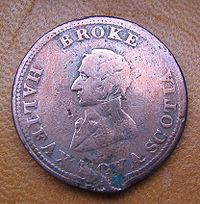
Province House (Nova Scotia)
Province House is where the Nova Scotia Legislature, known officially as the Nova Scotia House of Assembly, has met every year since 1819. The building is Canada's oldest house of government...
, built to house the House of Assembly
Nova Scotia House of Assembly
The Nova Scotia Legislature, consisting of Her Majesty The Queen represented by the Lieutenant Governor and the House of Assembly, is the legislative branch of the provincial government of Nova Scotia, Canada...
, were both built during the city's peak of prosperity at the end of the War of 1812.
Saint Mary's University was founded in 1802, originally as an elementary school. Saint Mary's was upgraded to a college following the establishment of Dalhousie University
Dalhousie University
Dalhousie University is a public research university located in Halifax, Nova Scotia, Canada. The university comprises eleven faculties including Schulich School of Law and Dalhousie University Faculty of Medicine. It also includes the faculties of architecture, planning and engineering located at...
in 1819; both were initially located in the downtown central business district before relocating to the then-outskirts of the city in the south end near the Northwest Arm
Northwest Arm
The Northwest Arm, originally named Sandwich River, is an inlet in eastern Canada off the Atlantic Ocean in Nova Scotia's Halifax Regional Municipality.-Geography:...
. Separated by only few minutes walking distance, the two schools now enjoy a friendly rivalry.
19th century prosperity
In the peace after 1815, the city at first suffered an economic malaise for a few years, aggravated by the move of the Royal Naval yard to Bermuda in 1818. However the economy recovered in the next decade led by a very successful local merchant class. Powerful local entrepreneurs included steamship pioneer Samuel CunardSamuel Cunard
Sir Samuel Cunard, 1st Baronet was a British shipping magnate, born at Halifax, Nova Scotia, who founded the Cunard Line...
and the banker Enos Collins
Enos Collins
Enos Collins was a merchant, shipowner, banker and privateer from Nova Scotia, Canada. Upon his death he was acclaimed as the richest man in Canada. He was born to a merchant family in Liverpool, Nova Scotia...
. During the 19th century Halifax became the birthplace of two of Canada's largest banks; local financial institutions included the Halifax Banking Company
Halifax Banking Company
The Halifax Banking Company was the first bank in Nova Scotia. Established in 1825, it was unable to obtain a charter from the Nova Scotia Legislative Assembly and operated as a private company. It became incorporated as a chartered bank in 1872 and enjoyed a period of rapid growth and prosperity...
, Union Bank of Halifax
Union Bank of Halifax
The Union Bank of Halifax was granted a charter by the government of Canada in 1856 and established its head office at the corner of Hollis and Prince Streets in the port city of Halifax, Nova Scotia....
, People's Bank of Halifax, Bank of Nova Scotia, and the Merchants' Bank of Halifax
Royal Bank of Canada
The Royal Bank of Canada or RBC Financial Group is the largest financial institution in Canada, as measured by deposits, revenues, and market capitalization. The bank serves seventeen million clients and has 80,100 employees worldwide. The company corporate headquarters are located in Toronto,...
, making the city one of the most important financial centres in colonial British North America
British North America
British North America is a historical term. It consisted of the colonies and territories of the British Empire in continental North America after the end of the American Revolutionary War and the recognition of American independence in 1783.At the start of the Revolutionary War in 1775 the British...
and later Canada until the beginning of the 20th century. This position was somewhat rivalled by neighbouring Saint John, New Brunswick
Saint John, New Brunswick
City of Saint John , or commonly Saint John, is the largest city in the province of New Brunswick, and the first incorporated city in Canada. The city is situated along the north shore of the Bay of Fundy at the mouth of the Saint John River. In 2006 the city proper had a population of 74,043...
during the city's economic hey-day in the mid-19th century.
Having played a key role to maintain and expand British power in North America and elsewhere during the 18th century, Halifax played less dramatic roles in the many decades of peace during the 19th Century. However as one of the most important British overseas bases, the harbour's defences were successively refortified with the latest artillery defences throughout the century to provide a secure base for British Empire forces. Nova Scotians and Maritimers were recruited through Halifax for the Crimean War
Crimean War
The Crimean War was a conflict fought between the Russian Empire and an alliance of the French Empire, the British Empire, the Ottoman Empire, and the Kingdom of Sardinia. The war was part of a long-running contest between the major European powers for influence over territories of the declining...
. The city boomed during the American Civil War
American Civil War
The American Civil War was a civil war fought in the United States of America. In response to the election of Abraham Lincoln as President of the United States, 11 southern slave states declared their secession from the United States and formed the Confederate States of America ; the other 25...
, mostly by supplying the wartime economy of the North but also by offering refuge and supplies to Confederate
Confederate States of America
The Confederate States of America was a government set up from 1861 to 1865 by 11 Southern slave states of the United States of America that had declared their secession from the U.S...
blockade runners. The port also saw Canada's first overseas military deployment as a nation to aid the British Empire during the Second Boer War
Second Boer War
The Second Boer War was fought from 11 October 1899 until 31 May 1902 between the British Empire and the Afrikaans-speaking Dutch settlers of two independent Boer republics, the South African Republic and the Orange Free State...
.
Responsible government


Joseph Howe
Joseph Howe, PC was a Nova Scotian journalist, politician, and public servant. He is one of Nova Scotia's greatest and best-loved politicians...
and would subsequently lead to this form of accountability being brought to colonial affairs for the colony of Nova Scotia.
Howe was later considered a great Nova Scotian leader, and the father of responsible government in British North America. After election to the House of Assembly as leader of the Liberal party, one of his first acts was the incorporation of the City of Halifax in 1842, followed by the direct election of civic politicians by Haligonians.
Halifax became a hotbed of political activism as the winds of responsible government swept British North America during the 1840s, following the rebellions against oligarchies
Oligarchy
Oligarchy is a form of power structure in which power effectively rests with an elite class distinguished by royalty, wealth, family ties, commercial, and/or military legitimacy...
in the colonies of Upper
Upper Canada
The Province of Upper Canada was a political division in British Canada established in 1791 by the British Empire to govern the central third of the lands in British North America and to accommodate Loyalist refugees from the United States of America after the American Revolution...
and Lower Canada
Lower Canada
The Province of Lower Canada was a British colony on the lower Saint Lawrence River and the shores of the Gulf of Saint Lawrence...
. The first instance of responsible government in the British Empire was achieved by the colony of Nova Scotia in January–February 1848 through the efforts of Howe. The leaders of the fight for responsible or self-government later took up the Anti-Confederation fight, the movement that from 1868 to 1875 tried to take Nova Scotia out of Confederation
Canadian Confederation
Canadian Confederation was the process by which the federal Dominion of Canada was formed on July 1, 1867. On that day, three British colonies were formed into four Canadian provinces...
.
During the 1850s, Howe was a heavy promoter of railway
Rail transport
Rail transport is a means of conveyance of passengers and goods by way of wheeled vehicles running on rail tracks. In contrast to road transport, where vehicles merely run on a prepared surface, rail vehicles are also directionally guided by the tracks they run on...
technology, having been a key instigator in the founding of the Nova Scotia Railway
Nova Scotia Railway
The Nova Scotia Railway is a historic Canadian railway. It was composed of two lines, one connecting Richmond with Windsor, the other connecting Richmond with Pictou via Truro....
, which ran from Richmond in the city's north end to the Minas Basin
Minas Basin
The Minas Basin is an inlet of the Bay of Fundy and a sub-basin of the Fundy Basin located in Nova Scotia, Canada. It is known for its extremely high tides.- Geography :- Boundary :...
at Windsor
Windsor, Nova Scotia
Windsor is a town located in Hants County, Mainland Nova Scotia at the junction of the Avon and St. Croix Rivers. It is the largest community in western Hants County with a 2001 population of 3,779 and was at one time the shire town of the county. The region encompassing present day Windsor was...
and to Truro
Truro, Nova Scotia
-Education:Truro has one high school, Cobequid Educational Centre. Post-secondary options include a campus of the Nova Scotia Community College, as well as the Nova Scotia Agricultural College in the neighboring town of Bible Hill.- Sports :...
and on to Pictou
Pictou, Nova Scotia
Pictou is a town in Pictou County, in the Canadian province of Nova Scotia. Located on the north shore of Pictou Harbour, the town is approximately 10 km north of the larger town of New Glasgow....
on the Northumberland Strait
Northumberland Strait
The Northumberland Strait is a strait in the southern part of the Gulf of Saint Lawrence in eastern Canada...
. In the 1870s Halifax became linked by rail to Moncton
Moncton, New Brunswick
Moncton is a Canadian city, located in Westmorland County, New Brunswick. The city is situated in southeastern New Brunswick, within the Petitcodiac River Valley, and lies at the geographic centre of the Maritime Provinces...
and Saint John
Saint John, New Brunswick
City of Saint John , or commonly Saint John, is the largest city in the province of New Brunswick, and the first incorporated city in Canada. The city is situated along the north shore of the Bay of Fundy at the mouth of the Saint John River. In 2006 the city proper had a population of 74,043...
through the Intercolonial Railway
Intercolonial Railway of Canada
The Intercolonial Railway of Canada , also referred to as the Intercolonial Railway , was a historic Canadian railway that operated from 1872 to 1918, when it became part of Canadian National Railways...
and on into Quebec
Quebec
Quebec or is a province in east-central Canada. It is the only Canadian province with a predominantly French-speaking population and the only one whose sole official language is French at the provincial level....
and New England
New England
New England is a region in the northeastern corner of the United States consisting of the six states of Maine, New Hampshire, Vermont, Massachusetts, Rhode Island, and Connecticut...
, not to mention numerous rural areas in Nova Scotia.
American Civil War
The American Civil WarAmerican Civil War
The American Civil War was a civil war fought in the United States of America. In response to the election of Abraham Lincoln as President of the United States, 11 southern slave states declared their secession from the United States and formed the Confederate States of America ; the other 25...
again saw much activity and prosperity in Halifax. Due to longstanding economic and social connections to New England as well as the Abolition
Abolitionism
Abolitionism is a movement to end slavery.In western Europe and the Americas abolitionism was a movement to end the slave trade and set slaves free. At the behest of Dominican priest Bartolomé de las Casas who was shocked at the treatment of natives in the New World, Spain enacted the first...
movement, a majority of the population supported the North and many volunteered to fight in the Union army. However, parts of the city's merchant class, especially those trading in the West Indies, supported the South. A few merchants in the city made huge profits selling supplies and sometimes arms to both sides of the conflict (see for example Alexander Keith, Jr.
Alexander Keith, Jr.
Alexander 'Sandy' Keith, Jr. was a notorious nineteenth century criminal from Halifax, Nova Scotia.-Life and career:Keith was born in 1827 in Caithness, Scotland, immigrating to Halifax when he was a small boy...
). Confederate ships often called on the port to take on supplies, and make repairs. One such ship, the CSS Tallahassee
CSS Tallahassee
The CSS Tallahassee was a twin-screw steamer and cruiser in the Confederate States Navy, purchased in 1864, and used for commerce raiding off the Atlantic coast.-History:...
, became a legend in Halifax when she made a daring midnight escape through from northern warships believed waiting at the harbour entrance. Halifax was also played a significant role in the Chesapeake Affair
Chesapeake Affair
The Chesapeake Affair was an international diplomatic incident that occurred during the American Civil War. On December 7, 1863 Confederate sympathizers from Canada’s Maritime Provinces captured the American Steamer Chesapeake off the coast of Cape Cod. The expedition was planned and led by...
.
Confederation
After the American Civil War, the five colonies which made up British North America, OntarioOntario
Ontario is a province of Canada, located in east-central Canada. It is Canada's most populous province and second largest in total area. It is home to the nation's most populous city, Toronto, and the nation's capital, Ottawa....
, Quebec
Quebec
Quebec or is a province in east-central Canada. It is the only Canadian province with a predominantly French-speaking population and the only one whose sole official language is French at the provincial level....
, Prince Edward Island
Prince Edward Island
Prince Edward Island is a Canadian province consisting of an island of the same name, as well as other islands. The maritime province is the smallest in the nation in both land area and population...
, Nova Scotia
Nova Scotia
Nova Scotia is one of Canada's three Maritime provinces and is the most populous province in Atlantic Canada. The name of the province is Latin for "New Scotland," but "Nova Scotia" is the recognized, English-language name of the province. The provincial capital is Halifax. Nova Scotia is the...
and New Brunswick
New Brunswick
New Brunswick is one of Canada's three Maritime provinces and is the only province in the federation that is constitutionally bilingual . The provincial capital is Fredericton and Saint John is the most populous city. Greater Moncton is the largest Census Metropolitan Area...
, held meetings to consider uniting into a single country. This was due to a threat of annexation and invasion from the United States. Canadian Confederation became a reality in 1867, but received much resistance from the merchant classes of Halifax, and from many prominent Halifax politicians due to the fact that both Halifax and Nova Scotia were at the time very wealthy, held trading ties with Boston and New York which would be damaged, and did not see the need for the Colony to give up its comparative independence. After confederation Halifax retained its British military garrison until British troops were replaced by the Canadian army in 1906. The British Royal Navy remained until 1910 when the newly created Royal Canadian Navy took over the Naval Dockyard.
The city's cultural roots deepened as its economy matured. The Victorian College of Art was founded in 1887 (later to become the Nova Scotia College of Art and Design
Nova Scotia College of Art and Design University
NSCAD University also known as the Nova Scotia College of Art and Design, is a post-secondary art school located in Halifax, Nova Scotia, Canada....
.) Local artist John O'Brien
John O'Brien (marine artist)
John O'Brien was a Canadian marine artist.O'Brien is believed to have been born at sea as his Irish family emigrated from County Cork. He emerged as a self-taught artist in Halifax, Nova Scotia in the 1850s. O'Brien excelled at ship portraits and dramatic storm scenes...
excelled at portraits of the city's ships, yacht races and seascapes. The province's Public Archives and the provincial museum were founded in this period (first called the Mechanic's Institute, later the Nova Scotia Museum
Nova Scotia Museum
Nova Scotia Museum is the corporate name for the most decentralized museum in Canada - 27 museums across Nova Scotia, including over 200 historic buildings, living history sites, vessels, specialized museums and close to a million artifacts and specimens...
.)
After Confederation, boosters of Halifax expected federal help to make the city's natural harbor Canada's official winter port and a gateway for trade with Europe. Halifax's advantages included its location just off the Great Circle route made it the closest to Europe of any mainland North American port. But the new Intercolonial Railway (ICR) took an indirect, southerly route for military and political reasons, and the national government made little effort to promote Halifax as Canada's winter port. Ignoring appeals to nationalism and the ICR's own attempts to promote traffic to Halifax, most Canadian exporters sent their wares by train though Boston or Portland. No one was interested in financing the large-scale port facilities Halifax lacked. It took the First World War to at last boost Halifax's harbor into prominence on the North Atlantic.
World War I
It was in World War IWorld War I
World War I , which was predominantly called the World War or the Great War from its occurrence until 1939, and the First World War or World War I thereafter, was a major war centred in Europe that began on 28 July 1914 and lasted until 11 November 1918...
that Halifax would truly come into its own as a world class port and naval facility in the steamship era. The strategic location of the port with its protective waters of Bedford Basin
Bedford Basin
Bedford Basin is a large enclosed bay, forming the northwestern end of Halifax Harbour on Canada's Atlantic coast.-Geography:Geographically, the basin is situated entirely within the Halifax Regional Municipality and is oriented northwest-southeast, measuring approximately 8 kilometres long and 5...
sheltered convoy
Convoy
A convoy is a group of vehicles, typically motor vehicles or ships, traveling together for mutual support and protection. Often, a convoy is organized with armed defensive support, though it may also be used in a non-military sense, for example when driving through remote areas.-Age of Sail:Naval...
s from German U-boat
U-boat
U-boat is the anglicized version of the German word U-Boot , itself an abbreviation of Unterseeboot , and refers to military submarines operated by Germany, particularly in World War I and World War II...
attack prior to heading into the open Atlantic Ocean
Atlantic Ocean
The Atlantic Ocean is the second-largest of the world's oceanic divisions. With a total area of about , it covers approximately 20% of the Earth's surface and about 26% of its water surface area...
. Halifax's railway connections with the Intercolonial Railway of Canada
Intercolonial Railway of Canada
The Intercolonial Railway of Canada , also referred to as the Intercolonial Railway , was a historic Canadian railway that operated from 1872 to 1918, when it became part of Canadian National Railways...
and its port facilities became vital to the British war effort during the First World War as Canada's industrial centres churned out material for the Western Front. In 1914, Halifax began playing a major role in the First World War, both as the departure point for Canadian Soldiers heading overseas, and as an assembly point for all convoys (a responsibility which would be placed on the city again during WW2). Most Canadian troops left overseas from Halifax aboard enormous peacetime ocean liners converted to troopships such as RMS Olympic
RMS Olympic
RMS Olympic was the lead ship of the Olympic-class ocean liners built for the White Star Line, which also included Titanic and Britannic...
and RMS Mauretania
RMS Mauretania
Two ocean liners of the Cunard Line have been named RMS Mauretania, after the ancient territory of Mauretania:* RMS Mauretania , launched in 1906 and remained in service until 1934...
as well as hundreds of other smaller liners. The city also served as the return point for a steady stream of wounded soldiers returning on hospital ships. A new generation of gun batteries, searchlights and an anti-submarine net defended the harbour, manned by a large garrison of soldiers. Halifax's limited 19th Century housing and transit facilities were heavily burdened. In November 1917, a subway system was presented to City Hall, but the city did not pursue the scheme.
Halifax Explosion

The war was seen as a blessing for the city's economy, but in 1917 a French munitions ship, the Mont Blanc
SS Mont-Blanc
The SS Mont-Blanc was a French freighter which exploded while carrying ammunition in Halifax Harbour on December 6, 1917 causing the Halifax Explosion which killed 2000 people. The explosion was caused by a collision with the Norwegian ship SS Imo...
, collided with a Belgian relief ship, the Imo. The collision sparked a fire on the munitions ship which was filled with 2,300 tons of wet and dry picric acid
Picric acid
Picric acid is the chemical compound formally called 2,4,6-trinitrophenol . This yellow crystalline solid is one of the most acidic phenols. Like other highly nitrated compounds such as TNT, picric acid is an explosive...
(used for making lyddite for artillery shells), 200 tons of trinitrotoluene (TNT), 10 tons of gun cotton, with drums of Benzol (High Octane fuel) stacked on her deck. On December 6, 1917, at 9:04:35 AM the munitions ship exploded in what was the largest man-made explosion before the first testing
Trinity test
Trinity was the code name of the first test of a nuclear weapon. This test was conducted by the United States Army on July 16, 1945, in the Jornada del Muerto desert about 35 miles southeast of Socorro, New Mexico, at the new White Sands Proving Ground, which incorporated the Alamogordo Bombing...
of an atomic bomb, and is still one of the largest non-nuclear man-made explosions. Items from the exploding ship landed five kilometres away. The Halifax Explosion
Halifax Explosion
The Halifax Explosion occurred on Thursday, December 6, 1917, when the city of Halifax, Nova Scotia, Canada, was devastated by the huge detonation of the SS Mont-Blanc, a French cargo ship, fully loaded with wartime explosives, which accidentally collided with the Norwegian SS Imo in "The Narrows"...
decimated the city's north end, killing roughly 2,000 inhabitants, injuring 9,000, and leaving tens of thousands homeless and without shelter.
The following day a blizzard hit the city, hindering recovery efforts. Immediate help rushed in from the rest of Nova Scotia, New Brunswick, Prince Edward Island, and Newfoundland. In the following week more relief from other parts of North America arrived and donations were sent from around the world. The most celebrated effort came from the Boston Red Cross and the Massachusetts
Massachusetts
The Commonwealth of Massachusetts is a state in the New England region of the northeastern United States of America. It is bordered by Rhode Island and Connecticut to the south, New York to the west, and Vermont and New Hampshire to the north; at its east lies the Atlantic Ocean. As of the 2010...
Public Safety Committee; as an enduring thank-you, since 1971 the province of Nova Scotia has donated the annual Christmas tree lit at the Boston Common
Boston Common
Boston Common is a central public park in Boston, Massachusetts. It is sometimes erroneously referred to as the "Boston Commons". Dating from 1634, it is the oldest city park in the United States. The Boston Common consists of of land bounded by Tremont Street, Park Street, Beacon Street,...
in Boston.
The explosion and the rebuilding which followed had important impacts on the city: reshaping the layout of North End neighbourhoods; creating a progressive housing development known as the Hydrostone; and hastening the move of railways to the South End of the City.
Between the Wars
The city's economy slumped after the war, although reconstruction from the Halifax Explosion brought new housing and infrastructure as well as the establishment of the Halifax Shipyard. However, a tremendous drop in worldwide shipping following the war as well as the failure of regional industries in the 1920s brought hard-times to the city, further aggravated by the Great DepressionGreat Depression
The Great Depression was a severe worldwide economic depression in the decade preceding World War II. The timing of the Great Depression varied across nations, but in most countries it started in about 1929 and lasted until the late 1930s or early 1940s...
in 1929. One bright spot was the completion of Ocean Terminals in the city's south end, a large modern complex to trans-ship freight and passengers from steamships to railways. The harbour's strategic location made the city the base for the famous and successful salvage tug
Salvage tug
A salvage tug is a specialized type of tugboat which is used to rescue or marine salvage ships which are in distress or in danger of sinking, or which have already sunk or run aground....
Foundation Franklin
Foundation Franklin
The SS Foundation Franklin was a sea-going salvage tug built for the Royal Navy in 1918 but most famous for many daring salvage operations and rescues while operated by Foundation Maritime between 1930-1949.- History :...
which brought lucrative salvage jobs to the city in the 1930s.
War Plan Red
War Plan Red
Joint Army and Navy Basic War Plan Red, also known as the Atlantic Strategic War Plan, was a plan for the United States to make war with the British Empire . It was developed by the United States Army following the 1927 Geneva Naval Conference; and approved in May 1930 by the Secretary of War and...
, a military strategy developed by the United States Army during the mid-1920s and officially withdrawn in 1939, involved an occupation of Halifax by US forces following a poison gas first strike, to deny the British a major naval base and cut links between Britain and Canada.
World War II
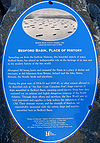
World War II
World War II, or the Second World War , was a global conflict lasting from 1939 to 1945, involving most of the world's nations—including all of the great powers—eventually forming two opposing military alliances: the Allies and the Axis...
. The only theatre of War to be commanded by a Canadian was the North Western Atlantic, commanded from Halifax by Rear-Admiral Leonard W. Murray
Leonard W. Murray
Rear Admiral Leonard Warren Murray, CB, CBE was a officer of the Royal Canadian Navy who played a significant role in the Battle of the Atlantic. He commanded the Newfoundland Escort Force from 1941–1943, and from 1943 to the end of the war was Commander-in-Chief, Canadian Northwest Atlantic...
. Halifax became a lifeline for preserving Britain during the Nazi onslaught of the Battle of Britain
Battle of Britain
The Battle of Britain is the name given to the World War II air campaign waged by the German Air Force against the United Kingdom during the summer and autumn of 1940...
and the Battle of the Atlantic, the supplies helping to offset a threatened amphibious invasion by Germany. Many convoys assembled in Bedford Basin
Bedford Basin
Bedford Basin is a large enclosed bay, forming the northwestern end of Halifax Harbour on Canada's Atlantic coast.-Geography:Geographically, the basin is situated entirely within the Halifax Regional Municipality and is oriented northwest-southeast, measuring approximately 8 kilometres long and 5...
to deliver supplies to troops in Europe
Europe
Europe is, by convention, one of the world's seven continents. Comprising the westernmost peninsula of Eurasia, Europe is generally 'divided' from Asia to its east by the watershed divides of the Ural and Caucasus Mountains, the Ural River, the Caspian and Black Seas, and the waterways connecting...
. The city's railway links fed large numbers of troopships building up Allied armies in Europe. The harbour became an essential base for Canadian, British and other Allied warships. Very much a front-line city, civilians lived with the fears of possible German raids or another accidental ammunition explosion. Well-defended, the city was never attacked although some merchant ships and two small naval vessels were sunk at the outer approaches to the harbour. However, the sounds and sometimes the flames of these distant attacks fed wartime rumours, some of which linger to the present day of imaginary tales of German
Nazi Germany
Nazi Germany , also known as the Third Reich , but officially called German Reich from 1933 to 1943 and Greater German Reich from 26 June 1943 onward, is the name commonly used to refer to the state of Germany from 1933 to 1945, when it was a totalitarian dictatorship ruled by...
U-Boats entering Halifax Harbour
Halifax Harbour
Halifax Harbour is a large natural harbour on the Atlantic coast of Nova Scotia, Canada, located in the Halifax Regional Municipality.-Harbour description:The harbour is called Jipugtug by the Mi'kmaq first nation, anglisized as Chebucto...
. The city's housing, retail and public transit infrastructure, small and neglected after 20 years of prewar economic stagnation was severely stressed. Severe housing and recreational problems simmered all through the war and culminated in the Halifax Riot
Halifax Riot
The Halifax VE-Day riots, 7–8 May 1945 in Halifax and Dartmouth, Nova Scotia began as a celebration of the World War II Victory in Europe. This rapidly declined into a rampage by several thousand servicemen, merchant seamen and civilians, who looted the City of Halifax...
on VE Day in May 1945. The war was also marked by a massive explosion of the Navy's Bedford ammunition magazine which accidentally blew up on July 18, 1945 causing the evacuation of the north end of Halifax and Dartmouth and fears of another Halifax Explosion
Halifax Explosion
The Halifax Explosion occurred on Thursday, December 6, 1917, when the city of Halifax, Nova Scotia, Canada, was devastated by the huge detonation of the SS Mont-Blanc, a French cargo ship, fully loaded with wartime explosives, which accidentally collided with the Norwegian SS Imo in "The Narrows"...
Post-war
After World War Two, Halifax did not experience the postwar economic malaise it had so often experienced after previous wars. This was partially due to the Cold WarCold War
The Cold War was the continuing state from roughly 1946 to 1991 of political conflict, military tension, proxy wars, and economic competition between the Communist World—primarily the Soviet Union and its satellite states and allies—and the powers of the Western world, primarily the United States...
which required continued spending on a modern Canadian Navy. However, the city also benefited from a more diverse economy and postwar growth in government services and education. The 1960s-1990s saw less suburban sprawl than in many comparable Canadian cities in the areas surrounding Halifax. This was partly as a result of local geographies and topography (Halifax is extremely hilly with exposed granite not conducive to construction), a weaker regional and local economy, and a smaller population base than, for example, central Canada or New England. There were also deliberate local government policies to limit not only suburban growth but also put some controls on growth in the central business district to address concerns from heritage advocates.
The late 1960s was a period of significant change and expansion of the city when surrounding areas of Halifax County were amalgamated into Halifax: Rockingham
Rockingham, Nova Scotia
Rockingham is a community located in Nova Scotia's Halifax Regional Municipality. It is part of a large suburban area along the western shore of Bedford Basin, north of Clayton Park and south of Bedford.-Geography:...
, Clayton Park
Clayton Park, Nova Scotia
Clayton Park is a Canadian suburban development in Nova Scotia's Halifax Regional Municipality inside the city of Halifax.-Original development:...
, Fairview
Fairview, Nova Scotia
Fairview is a former community and current neighbourhood within the urban core of Halifax Regional Municipality in Nova Scotia, Canada.-Geography:...
, Armdale
Armdale, Nova Scotia
Armdale is a Canadian urban community located in Halifax Regional Municipality, Nova Scotia.Situated at the head of the Northwest Arm, from which it derives its name, Armdale borders the southern part of an isthmus connecting the Halifax Peninsula with the larger Chebucto Peninsula.-History:The...
, and Spryfield
Spryfield, Nova Scotia
Spryfield is a community in Mainland Halifax, Nova Scotia, Canada. It was founded about 1770, by Captain William Spry, who purchased land there and established the settlement with the aid of stationed soldiers from the nearby Halifax garrison...
were all added in 1969.
Urban renewal plans in the 1960s and 70s resulted in the loss of much of its heritage architecture and community fabric in large downtown developments such as the Scotia Square mall and office towers. However, a citizens protest movement limited further destructive plans such as a waterfront freeway which opened the way for a popular and successful revitalized waterfront. Selective height limits were also achieved to protect the views from Citadel Hill. However, municipal heritage protection remained weak with only pockets of heritage buildings surviving in the downtown and constant pressure from developers for further demolition. Selective height restrictions were adopted to protect views from Citadel Hill which triggered battles over proposed developments that would fill vacant lots or add height to existing historical structures.
Another casualty during the 1960s and 1970s period of expansion and urban renewal was the Black community of Africville which was declared a slum
Slum
A slum, as defined by United Nations agency UN-HABITAT, is a run-down area of a city characterized by substandard housing and squalor and lacking in tenure security. According to the United Nations, the percentage of urban dwellers living in slums decreased from 47 percent to 37 percent in the...
, demolished and its residents displaced to clear land for industrial use as well as for the A. Murray MacKay Bridge
A. Murray MacKay Bridge
The A. Murray MacKay Bridge locally known as "the new bridge" is the second suspension bridge linking the Halifax Peninsula with Dartmouth, Nova Scotia, and opened on July 10, 1970....
. The repercussions continue to this day and a 2001 United Nations
United Nations
The United Nations is an international organization whose stated aims are facilitating cooperation in international law, international security, economic development, social progress, human rights, and achievement of world peace...
report has called for reparations be paid to the community's former residents.
Restrictions on development were relaxed somewhat during the 1990s, resulting in some suburban sprawl off the peninsula. Today the community of Halifax is more compact than most Canadian urban areas although expanses of suburban growth have occurred in neighbouring Dartmouth, Bedford and Sackville. One development in the late 1990s was the Bayers Lake Business Park, where warehouse style retailers were permitted to build in a suburban industrial park west of Rockingham
Rockingham, Nova Scotia
Rockingham is a community located in Nova Scotia's Halifax Regional Municipality. It is part of a large suburban area along the western shore of Bedford Basin, north of Clayton Park and south of Bedford.-Geography:...
. This has become an important yet controversial centre of commerce for the city and the province as it used public infrastructure to subsidise multi-national retail chains and draw business from local downtown business. Much of this subsidy was due to competition between Halifax, Bedford and Dartmouth to host these giant retail chains and this controversy helped lead the province to force amalgamation as a way to end wasteful municipal rivalries. In the past few years, urban housing sprawl has even reached these industrial/retail parks as new blasting techniques permitted construction on the granite wilderness around the city. What was once a business park surrounded by forest and a highway on one side has become a large suburb with numerous new apartment buildings and condominiums. Some of this growth has been spurred by offshore oil and natural gas economic activity but much has been due to a population shift from rural Nova Scotian communities to the Halifax urban area. The new amalgamated city has attempted to manage this growth with a new master development plan.
Amalgamation
During the 1990s, Halifax like many other Canadian cities, amalgamatedAmalgamation (politics)
A merger or amalgamation in a political or administrative sense is the combination of two or more political or administrative entities such as municipalities , counties, districts, etc. into a single entity. This term is used when the process occurs within a sovereign entity...
with its suburbs under a single municipal government. The provincial government had sought to reduce the number of municipal governments throughout the province as a cost-saving measure and created a task force in 1992 to pursue this rationalisation.
In 1995, an Act to Incorporate the Halifax Regional Municipality received Royal Assent
Royal Assent
The granting of royal assent refers to the method by which any constitutional monarch formally approves and promulgates an act of his or her nation's parliament, thus making it a law...
in the provincial legislature and the Halifax Regional Municipality
Halifax Regional Municipality, Nova Scotia
Halifax Regional Municipality is the capital of the province of Nova Scotia, Canada. The Regional Municipality had a 2006 census population of 372,679, while the metropolitan area had a 2010 estimated population of 403,188, and the urban area of Halifax had a population of 282,924...
, or "HRM" (as it is commonly called) was created on April 1, 1996. HRM is an amalgamation of all municipal governments in Halifax County
Halifax County, Nova Scotia
Halifax County is a county in the Canadian province of Nova Scotia.The Municipality of the County of Halifax was the municipal government of Halifax County, apart from the separately incorporated towns and cities therein...
, these being the cities of Halifax and Dartmouth
Dartmouth, Nova Scotia
Dartmouth founded in 1750, is a community and planning area of the Halifax Regional Municipality, Nova Scotia. Located on the eastern shore of Halifax Harbour, Dartmouth has been nicknamed the City of Lakes after the large number of lakes located in the city.On April 1, 1996, the provincial...
, town of Bedford
Bedford, Nova Scotia
Bedford is a community in the Halifax Regional Municipality, Nova Scotia, Canada. It was an independent town from 1980-1996. Bedford lies on the northwestern end of Bedford Basin, an extension of the Halifax Harbour...
, and Municipality of the County of Halifax). Sable Island
Sable Island
Sable Island is a small Canadian island situated 300 km southeast of mainland Nova Scotia in the Atlantic Ocean. The island is a year-round home to approximately five people...
, being part of Halifax County, is also jurisdictionally part of HRM, despite being located 180 km offshore.
Although cities in other provinces affected by amalgamation retained their original names, the new municipality is often referred by its full name or the initials "HRM" especially in the media and by residents of areas outside of the former City of Halifax. However, the communities outside of the former City of Halifax still retained their original place-names to avoid confusion with duplicate street names for civic addressing, media reference, emergency, postal and other services along with Halifax.
In 1995, the city hosted the G8
G8
The Group of Eight is a forum, created by France in 1975, for the governments of seven major economies: Canada, France, Germany, Italy, Japan, the United Kingdom, and the United States. In 1997, the group added Russia, thus becoming the G8...
summit of the world's major economic powers.
Geography
| Census | Population |
|---|---|
| Town | |
| 1761 | 2,500 |
| 1790 | 4,000 |
| 1828 | 14,439 |
| 1841 | 14,422 |
| City | |
| 1851 | 20,749 |
| 1861 | 25,026 |
| 1871 | 29,582 |
| 1881 | 36,100 |
| 1891 | 38,437 |
| 1901 | 40,832 |
| 1911 | 46,619 |
| 1921 | 58,372 |
| 1931 | 59,275 |
| 1941 | 69,326 |
| 1951 | 85,589 |
| 1961 | 92,511 |
| 1971 | 122,035 |
| 1981 | 114,594 |
| 1991 | 114,455 |
| Urban Area | |
| 2001 | 276,412 |
| 2006 | 282,924 |
| 2011 | 285,831 |
The original settlements of Halifax occupied a small stretch of land inside a palisade at the foot of Citadel Hill on the Halifax Peninsula
Halifax Peninsula
The Halifax Peninsula is a community and planning area located in the urban core of Halifax Regional Municipality in the province of Nova Scotia. Halifax Peninsula is home to Downtown Halifax, the financial and economic heart of the region, which was also the site of the original settlement and...
, a sub-peninsula of the much larger Chebucto Peninsula
Chebucto Peninsula
The Chebucto Peninsula is a Canadian peninsula located in central Nova Scotia entirely within the Halifax Regional Municipality on the Atlantic coast....
that extends into Halifax Harbour
Halifax Harbour
Halifax Harbour is a large natural harbour on the Atlantic coast of Nova Scotia, Canada, located in the Halifax Regional Municipality.-Harbour description:The harbour is called Jipugtug by the Mi'kmaq first nation, anglisized as Chebucto...
. Halifax subsequently grew to incorporate all of the north, south, and west ends of the peninsula with a central business district concentrated in the southeastern end along "The Narrows".
In 1969, the City of Halifax grew westward of the peninsula by amalgamating several communities from the surrounding Halifax County
Halifax County, Nova Scotia
Halifax County is a county in the Canadian province of Nova Scotia.The Municipality of the County of Halifax was the municipal government of Halifax County, apart from the separately incorporated towns and cities therein...
; namely Fairview
Fairview, Nova Scotia
Fairview is a former community and current neighbourhood within the urban core of Halifax Regional Municipality in Nova Scotia, Canada.-Geography:...
, Rockingham
Rockingham, Nova Scotia
Rockingham is a community located in Nova Scotia's Halifax Regional Municipality. It is part of a large suburban area along the western shore of Bedford Basin, north of Clayton Park and south of Bedford.-Geography:...
, Spryfield
Spryfield, Nova Scotia
Spryfield is a community in Mainland Halifax, Nova Scotia, Canada. It was founded about 1770, by Captain William Spry, who purchased land there and established the settlement with the aid of stationed soldiers from the nearby Halifax garrison...
, Purcell's Cove
Purcell's Cove, Nova Scotia
Purcell's Cove is a community within the Halifax Regional Municipality Nova Scotia Canada on the west side of Halifax Harbour from the Northwest Arm to Ferguson's Cove along Route 253 . The first 3 digits of the postal code in the area is B3P.-References:...
, and Armdale
Armdale, Nova Scotia
Armdale is a Canadian urban community located in Halifax Regional Municipality, Nova Scotia.Situated at the head of the Northwest Arm, from which it derives its name, Armdale borders the southern part of an isthmus connecting the Halifax Peninsula with the larger Chebucto Peninsula.-History:The...
. These communities saw a number of modern subdivision developments during the late 1960s through to the 1990s, one of the earliest being the Clayton Park
Clayton Park, Nova Scotia
Clayton Park is a Canadian suburban development in Nova Scotia's Halifax Regional Municipality inside the city of Halifax.-Original development:...
development at the southwestern edge of Rockingham.
Since amalgamation into HRM, "Halifax" has been used variously to describe all HRM, all of urban HRM, and the area of the Halifax Peninsula
Halifax Peninsula
The Halifax Peninsula is a community and planning area located in the urban core of Halifax Regional Municipality in the province of Nova Scotia. Halifax Peninsula is home to Downtown Halifax, the financial and economic heart of the region, which was also the site of the original settlement and...
and Mainland Halifax
Mainland Halifax
Mainland Halifax is a region in central Nova Scotia, Canada that refers to the central-eastern part of the Chebucto Peninsula in the Halifax Regional Municipality...
(which together form the provincially recognized Halifax Metropolitan Area) that had been covered by the dissolved city government. http://cbc.ca/informationmorningns/media/20070329forum_part_3_24216.ram http://www.destinationhalifax.com/ http://visitors.halifax.ca/index.shtml http://www.nsplacenames.ca/
The communities of mainland Halifax that were amalgamated into the City of Halifax in 1969 are reasserting their identities http://www.spryfield.ca/http://halifax.ca/commcoun/ccc/ccc.html principally through the creation of the Mainland Halifax
Mainland Halifax
Mainland Halifax is a region in central Nova Scotia, Canada that refers to the central-eastern part of the Chebucto Peninsula in the Halifax Regional Municipality...
planning area, which is governed by the Chebucto Community Council
Halifax Regional Community Council
A Community Council in Nova Scotia's Halifax Regional Municipality is a form of local government consisting of several councillors from the larger Halifax Regional Council....
.
Halifax is also located on the Appalachian land form region
Halifax is in the Atlantic Maritime ecozone, we climate soil region, mixwood forest vegetation region, Atlantic Canada Climate region.
The Streets on the Halifax peninsula are a grid and numbered sequentially making it easy to get around. Numbered from south-to-north House Numbers start at 1 and reach 1000 block at Ingles Street, 2000 block at Quinpool Road, 3000 block at Almon Street and 4000 block at Duffus Street. Moving from east-to-west 5000 block is at Lower Water Street, 6000 block at Robie Street.
One of the longest streets on the peninsula is Robie Street. When looking for 2010 Robie Street look one block north of Quinpool Road across fron the Halifax Commons, move a block to the west and you will find 2010 Windsor Street; walk a few more blocks west and Quinpool will take you to 2010 Oxford Street. If you are moving west on Almon Street you will find 5200 Almon at the Gotingen Street intersection, 6000 Almon at Robie, 7000 Almon at Connaught Ave., Chebucto Road numbers to 8000 at Joseph Howe Drive. The numbering system is consistent to the grid even when the streets are not perfectly parallel or perpendicular to one another on the map.
Neighbourhoods

- North End HalifaxNorth End, HalifaxThe North End of Halifax is a neighbourhood located in the urban core of Nova Scotia's Halifax Regional Municipality, occupying the northern part of the Halifax Peninsula.-Geography:...
, north of North Street to Seaview Park - West End, HalifaxWest End, HalifaxThe West End is a neighbourhood of Halifax Regional Municipality in the Canadian province of Nova Scotia, located on the western half of the Halifax Peninsula. The West End is predominantly middle class with many blocks of tree-lined older residential streets. However, it is also home to many...
, West of Windsor Street, between North and South Streets to Joseph Howe Drive - Quinpool districtQuinpool districtThe Quinpool District refers to a commercial district of Halifax, Nova Scotia, encompassing the eastern portion of Quinpool Road as well as the streets directly north and south of it...
, Shopping and Dining area - South End HalifaxSouth End, HalifaxThe South End is a region of Halifax Regional Municipality, located on the southern half of the Halifax Peninsula in Halifax's urban centre. Quinpool Road is increasingly considered to be an arbitrary border between the South and North Ends, though Quinpool Road is also a part of the West End, and...
, South of South Street to Point Plesant Park - Spring GardenSpring Garden, HalifaxSpring Garden, along with Barrington Street and Quinpool Road, is a major commercial and cultural district in Halifax, Nova Scotia, Canada. It comprises Spring Garden Road, South Park Street, and a number of smaller side streets...
, shopping and dining area - Central Halifax, the original city, between North Street and South Street, from Lower-Water Street to Windsor Street

(including former villages, residential neighbourhoods; and modern names of housing developments and industrial parks)
- ArmdaleArmdale, Nova ScotiaArmdale is a Canadian urban community located in Halifax Regional Municipality, Nova Scotia.Situated at the head of the Northwest Arm, from which it derives its name, Armdale borders the southern part of an isthmus connecting the Halifax Peninsula with the larger Chebucto Peninsula.-History:The...
, village neighbourhood - Bayer's Lake
- Beechwood ParkBeechwood Park, Nova ScotiaBeechwood Park is a Residential subdivision in Fairview on Mainland Halifax within the Halifax Regional Municipality Nova Scotia on the shore of the Bedford Basin in Halifax Harbour .-References:*...
- Boulderwood
- BridgeviewBridgeview, Nova ScotiaBridgeview is a Residential subdivision in Fairview on Mainland Halifax within the Halifax Regional Municipality Nova Scotia on the shore of the Bedford Basin in Halifax Harbour .-References:* *...
- Clayton ParkClayton Park, Nova ScotiaClayton Park is a Canadian suburban development in Nova Scotia's Halifax Regional Municipality inside the city of Halifax.-Original development:...
- Convoy PlaceConvoy Place, Nova ScotiaConvoy Place is a residential neighbourhood in Halifax on the Halifax Peninsula within the Halifax Regional Municipality of Nova Scotia.-References:*...
- Cowie Hill
- FairmountFairmount, Nova ScotiaFairmount, Nova Scotia is a residential neighbourhood in Halifax on the Halifax Peninsula within the Halifax Regional Municipality Nova Scotia .-References:*...
- FairviewFairview, Nova ScotiaFairview is a former community and current neighbourhood within the urban core of Halifax Regional Municipality in Nova Scotia, Canada.-Geography:...
,village neighbourhood - FernleighFernleigh, Nova ScotiaFernleigh, Nova Scotia is a Residential subdivision in Fairview on Mainland Halifax within the Halifax Regional Municipality Nova Scotia on the shore of the Bedford Basin in Halifax Harbour .-References:*...
- Green AcresGreen Acres, Nova ScotiaGreen Acres, Nova Scotia is a residential neighbourhood in Halifax on the Mainland Halifax within the Halifax Regional Municipality Nova Scotia .-References:*...
- HydrostoneThe HydrostoneThe Hydrostone is a neighbourhood in the North End of the Halifax Peninsula in the Halifax Regional Municipality, Nova Scotia, Canada. It consists of ten short parallel streets and is bordered by Duffus Street to the north, Young Street to the south, Isleville Street to the west and Novalea Drive...
post Halifax Explosion re-development neighbourhood - Jollimore, village neighbourhood
- Kent ParkKent Park, Nova ScotiaKent Park, Nova Scotia is a Residential subdivision in Fairview on Mainland Halifax within the Halifax Regional Municipality Nova Scotia on the shore of the Bedford Basin in Halifax Harbour .-References:*...
- Leiblin ParkLeiblin Park, Nova ScotiaLeiblin Park, Nova Scotia is a residential neighbourhood in Halifax on the Mainland Halifax within the Halifax Regional Municipality Nova Scotia .-References:*...
- Melville Cove
- Mulgrave ParkMulgrave Park, Nova ScotiaMulgrave Park is a residential neighbourhood in Halifax in the North End within the Halifax Regional Municipality Nova Scotia . It consists of local public housing along Barrington Street. It is also referred to as MGP by most residents.-References:*...
, housing development in Mulgrave district - RockinghamRockingham, Nova ScotiaRockingham is a community located in Nova Scotia's Halifax Regional Municipality. It is part of a large suburban area along the western shore of Bedford Basin, north of Clayton Park and south of Bedford.-Geography:...
, village neighbourhood - Sherwood HeightsSherwood Heights, Nova ScotiaSherwood Heights, Nova Scotia is a residential neighbourhood in Halifax on the Mainland Halifax within the Halifax Regional Municipality Nova Scotia .-References:*...
- SpryfieldSpryfield, Nova ScotiaSpryfield is a community in Mainland Halifax, Nova Scotia, Canada. It was founded about 1770, by Captain William Spry, who purchased land there and established the settlement with the aid of stationed soldiers from the nearby Halifax garrison...
, village neighbourhood - ThornhillThornhill, Nova ScotiaThornhill, Nova Scotia is a residential neighbourhood in Halifax on the Mainland Halifax within the Halifax Regional Municipality Nova Scotia .-References:*...
- WedgewoodWedgewood, Nova ScotiaWedgewood, Nova Scotia is a residential neighbourhood in Halifax on the Mainland Halifax within the Halifax Regional Municipality Nova Scotia .-References:*...
- Westmount SubdivisionWestmount SubdivisionThe Westmount Subdivision is a Subdivision in the Community of Halifax, Nova Scotia in the Halifax Regional Municipality.-History:In 1931 the Halifax Municipal Airport was built . Pan American Airways operated at the airport running a route between Halifax and Boston till the outbreak of World War...
Historic neighbourhood names
- Africville, now Seaview Park
- Richmond, now The North End east of Novalea Drive facing the harbour.
- Mulgrave (Halifax), north of Duffus Street, east of Gottingen Street in the North End.
- Needham (Halifax), now The Hydrostone and much of the North End west of Novalea Drive.
- Dutch Village, The West End west of Windsor Street
- Fort Massey, East of Robie Street from Duke Street to South Street
Richmond, Needham and Mulgrave were voting district names. Historically, these working-class Catholic neighbourhoods used their parish names: Saint Stephen's, Saint Joeseph's, Saint Patrick's. Today they are the integrated and prosperous North End; the neighbourhood names are no longer in common use and the parish boundaries no longer exist.