

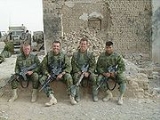
Operation APOLLO

Encyclopedia
Operation APOLLO was the codename for an operation conducted by Canadian Forces
in support of the United States
in its military operations in Afghanistan
. The operation took place from October 2001 to October 2003. In addition, the sequence of events that led to the full manifestation of Operation APOLLO started on September 12, 2001, when the United Nations Security Council
issued Resolution 1368
. The resolution had condemned the attacks of 9/11 and reaffirmed via the UN Charter's Article 51 that allied nations had the obligation to eradicate global terrorism.
September 20, 2001:
September 28, 2001:
October 4, 2001:
October 7, 2001:
October 8, 2001:
In mid-August 2003, following the re-alignment of Canadian activities in southwest Asia, the NCE was reduced to a liaison staff. This liaison team was part of a new mission known as Task Force Tampa (TFT) or Operation Foundation.
Commanders:
.
The situation on the ground in Afghanistan changed significantly during November and December 2001; consequently, Canada's troop commitment was revised to a contingent of about 750 soldiers to deploy to Kandahar as part of a U.S. Army task force built around the 187th Brigade Combat Team. In January 2002, Canada agreed to deploy the 3rd Battalion, Princess Patricia's Canadian Light Infantry (3 PPCLI) Battle Group, which included a reconnaissance squadron from Lord Strathcona's Horse (Royal Canadians) (LdSH(RC)), and combat service support elements from 1 Service Battalion. During their six months in Afghanistan, the soldiers of the 3 PPCLI Battle Group performed tasks ranging from airfield security to combat.
The 3 PPCLI Battle Group returned home after six months of service in Afghanistan. The redeployment was announced on June 21, 2002, and the troops arrived back in Canada in two contingents on July 28 and July 30. This troop movement was co-ordinated with the scheduled rotation of American troops to permit the 3 PPCLI Battle Group to travel by American airlift, reflecting Canada's lack of any strategic lift capability.
Two CP-140 Aurora
long-range surveillance and maritime patrol aircraft deployed to the region on December 27, 2001,with about 200 Air Force personnel, including flight crews and support personnel. The mission of the Long-Range Patrol Detachment (LRP Det) was to deliver reconnaissance and surveillance support to the maritime coalition forces. The CP-140 Aurora extended the surveillance range of maritime coalition forces to areas not accessible to ship-borne radar. On June 19, 2003, the LRP Det conducted its last mission in support of the coalition fleet, having completed 500 missions and logged more than 4,300 flying hours on Op APOLLO.
Two CC-130 Hercules aircraft from Op APOLLO were assigned to Op CARAVAN, from 7 June to 6 July, to assist in the airlifting of a UN peacekeeping mission into the Democratic Republic of the Congo. On August 16, 2003, the TAL Det was re-named the Tactical Airlift Unit (TAU) and its efforts were refocused on Op ATHENA in Afghanistan where it provided sustainment flights to Task Force Kabul. While part of Op APOLLO, TAL Det crews conducted more than 800 sorties and flew about 5,800 hours.
Changes of command:
Canadian Forces
The Canadian Forces , officially the Canadian Armed Forces , are the unified armed forces of Canada, as constituted by the National Defence Act, which states: "The Canadian Forces are the armed forces of Her Majesty raised by Canada and consist of one Service called the Canadian Armed Forces."...
in support of the United States
United States
The United States of America is a federal constitutional republic comprising fifty states and a federal district...
in its military operations in Afghanistan
War in Afghanistan (2001–present)
The War in Afghanistan began on October 7, 2001, as the armed forces of the United States of America, the United Kingdom, Australia, and the Afghan United Front launched Operation Enduring Freedom...
. The operation took place from October 2001 to October 2003. In addition, the sequence of events that led to the full manifestation of Operation APOLLO started on September 12, 2001, when the United Nations Security Council
United Nations Security Council
The United Nations Security Council is one of the principal organs of the United Nations and is charged with the maintenance of international peace and security. Its powers, outlined in the United Nations Charter, include the establishment of peacekeeping operations, the establishment of...
issued Resolution 1368
United Nations Security Council Resolution 1368
United Nations Security Council Resolution 1368, adopted unanimously on September 12, 2001, after expressing its determination to combat threats to international peace and security caused by acts of terrorism and recognising the right of individual and collective self-defense, the Council condemned...
. The resolution had condemned the attacks of 9/11 and reaffirmed via the UN Charter's Article 51 that allied nations had the obligation to eradicate global terrorism.
Chronology of events
September 12, 2001:- The UN Security Council issued Resolution 1368, condemning the attacks of September 11, offering deepest sympathy to the American people, and reaffirming the right of member nations (expressed in Article 51 of the UN Charter) to individual and collective self-defence. It also urged the world community to suppress terrorism and hold accountable all who aid, support or harbour the perpetrators, organizers and sponsors of terrorist acts, and stated that the UN was prepared to combat all forms of terrorism.
September 20, 2001:
- Minister of National Defence Art EggletonArt EggletonArthur "Art" C. Eggleton, PC is a former Canadian Cabinet minister and Mayor of Toronto, and is currently a Senator representing Ontario.-City council:...
authorized more than 100 CF members serving on military exchange programs in the U.S. and other allied nations to participate in operations conducted by their host units in response to the September 11 terrorist attacks
September 28, 2001:
- The UN Security Council issued Resolution 1373, setting out the methods by which member states were to root out terrorists and terrorist organizations, and deprive terrorists of the funds and materials necessary to conduct their operations.
October 4, 2001:
- NATO Secretary General George RobertsonGeorge RobertsonGeorge Robertson may refer to:*George Robertson, Baron Robertson of Port Ellen , UK Defence Secretary, NATO Secretary-General*George Croom Robertson , Scottish philosopher*George R. Robertson , American actor*George S...
announced that, in response to the terrorist attacks in the U.S., the North Atlantic Council (NATO's senior advisory body) was invoking Article 5 of the Treaty of Washington, which states that any attack on a NATO nation launched from outside that nation shall be interpreted as an attack on all the NATO nations.
October 7, 2001:
- Prime Minister Jean ChrétienJean ChrétienJoseph Jacques Jean Chrétien , known commonly as Jean Chrétien is a former Canadian politician who was the 20th Prime Minister of Canada. He served in the position for over ten years, from November 4, 1993 to December 12, 2003....
announced that Canada would contribute air, land and sea forces to the international force being formed to conduct a campaign against terrorism. - General Ray Henault, the Chief of the Defence Staff (CDS), issued warning orders to several CF units
- Op APOLLO was established in support of the U.S. initiative code-named Operation Enduring Freedom.
October 8, 2001:
- Minister Eggleton announced the first CF commitments under Op APOLLO, which involved about 2,000 CF members. Navy ships were the first CF units to participate in the campaign against terrorism, and they began deploying immediately.
Command and Control
The CF units and formations committed to Op APOLLO were organized under the Commander, Canadian Joint Task Force South West Asia (CA-JTFSWA). The headquarters of the CA-JTFSWA was the Canadian National Command Element (NCE) co-located with U.S. Central Command (CENTCOM) at MacDill Air Force Base near Tampa, Florida. The NCE linked the Canadian Chief of the Defence Staff with U.S. CENTCOM and the various CF units assigned to Op APOLLO.In mid-August 2003, following the re-alignment of Canadian activities in southwest Asia, the NCE was reduced to a liaison staff. This liaison team was part of a new mission known as Task Force Tampa (TFT) or Operation Foundation.
Commanders:
- October 2001-April 2002: Commodore Jean-Pierre Thiffault
- April-November 2002: Brigadier-General Michel Gauthier
- November 2002-May 2003: Brigadier-General Angus Watt
- May 2003-August 2003: Brigadier-General Dennis Tabbernor
Land Component
In February 2002, the 3 PPCLI Battle Group commanded by then Lieutenant-Colonel Pat Stogran deployed to Kandahar, Afghanistan, for a six-month tour of duty that included tasks ranging from airfield security to combat. This mission received airlift support from a Tactical Airlift Detachment, later named the Theatre Support Element (TSE), located in southwest AsiaDeployment of the 3 PPCLI Battle Group
In mid-November 2001, the U.S. asked its coalition partners (including Canada) to provide ground troops for a stabilization force to be deployed in areas secured by the Northern Alliance to facilitate distribution of humanitarian relief and supplies to the people of Afghanistan. Canada immediately placed 1,000 members of the Immediate Reaction Force (Land) (IRF(L)) on 48 hours' notice to deploy. At that time, it was drawn mostly from the Edmonton and Winnipeg-based battalions of Princess Patricia's Canadian Light InfantryPrincess Patricia's Canadian Light Infantry
Princess Patricia's Canadian Light Infantry is one of the three regular force infantry regiments of the Canadian Army. The regiment is composed of four battalions including a primary reserve battalion, for a total of 2,000 soldiers...
.
The situation on the ground in Afghanistan changed significantly during November and December 2001; consequently, Canada's troop commitment was revised to a contingent of about 750 soldiers to deploy to Kandahar as part of a U.S. Army task force built around the 187th Brigade Combat Team. In January 2002, Canada agreed to deploy the 3rd Battalion, Princess Patricia's Canadian Light Infantry (3 PPCLI) Battle Group, which included a reconnaissance squadron from Lord Strathcona's Horse (Royal Canadians) (LdSH(RC)), and combat service support elements from 1 Service Battalion. During their six months in Afghanistan, the soldiers of the 3 PPCLI Battle Group performed tasks ranging from airfield security to combat.
The 3 PPCLI Battle Group returned home after six months of service in Afghanistan. The redeployment was announced on June 21, 2002, and the troops arrived back in Canada in two contingents on July 28 and July 30. This troop movement was co-ordinated with the scheduled rotation of American troops to permit the 3 PPCLI Battle Group to travel by American airlift, reflecting Canada's lack of any strategic lift capability.
Operations
- Operation AnacondaOperation AnacondaOperation Anaconda took place in early March 2002 in which the United States military and CIA Paramilitary Officers, working with allied Afghan military forces, and other North Atlantic Treaty Organization and non NATO forces attempted to destroy al-Qaeda and Taliban forces in the Shahi-Kot...
: During March 2002, members of the 3 PPCLI Battle Group were in the mountains of Paktia Province east of Gardez on Op ANACONDA, a U.S.-led coalition effort to search the mountains for Al-Qaeda and Taliban fighters, capture them, and destroy their shelters. The Canadian contingent comprised 16 soldiers, including six snipers led by MCpl Graham RagsdaleGraham RagsdaleMaster Corporal Graham Ragsdale of the Canadian Forces was the commander of the Third Battalion Princess Patricia's Canadian Light Infantry sniper team attached to the 101st Airborne of the U.S. Army during Operation Anaconda in the Shah-i-kot Valley, Paktia Province, Afghanistan in March, 2002...
and an emergency extraction force of medical, security and transport personnel with vehicles specialized for winter operations. These soldiers came under fire and engaged the enemy; as a result, some Al-Qaeda and Taliban fighters were killed. The coalition force met with determined resistance, and the enemy demonstrated that they were well organized and well supplied. Throughout Op ANACONDA, the Canadian sniper teams were noted for the deadly accuracy with which they suppressed enemy mortar and heavy machine-gun positions. One Canadian sniper Cpl Rob FurlongRob FurlongRob Furlong , is a former corporal of the Canadian Forces, who held the record for the longest confirmed sniper kill in combat, at 2,430 metres...
reportedly achieved the longest-distance sniper kill ever recorded: over 2,400 m. These operations are credited with preventing or stopping attacks that could have taken the lives of many U.S. soldiers. JTF2 is known to have provided surveillance and strike teams for Task Force K-Bar in the war against Al-Qaeda in Afghanistan. For its service in Afghanistan, Task Force K-Bar, in which JTF2 members took part, was awarded the Presidential Unit Citation (US) in 2004.
- Operation HarpoonOperation HarpoonOperation Harpoon may refer to:* Operation Harpune, a major German deception plan of 1941 to conceal preparations for Operation Barbarossa* Operation Harpoon , one of two simultaneous Allied convoys in 1942...
: In the early hours of March 13, 2002, the coalition launched a separate offensive operation in roughly the same region as Op ANACONDA. This new mission, called Op HARPOON, was a joint Canadian-American assault using land and air forces to eliminate a specific pocket of Taliban and Al-Qaeda resistance. The land component was a battalion-sized mixed Canadian and American force under the tactical command of Lieutenant-Colonel Pat Stogran, the commanding officer of the 3 PPCLI Battle Group. On March 14, 2002, LCol Stogran's Canadian reconnaissance troops led one of his American platoons to a cave-and-bunker complex where the Americans proceeded to destroy several bunkers. Op HARPOON was completed on March 19, 2002.
- Tarnak Farm incidentTarnak Farm incidentThe Tarnak Farm incident refers to the killing of four Canadian soldiers and the injury of eight others from the Third Battalion of Princess Patricia's Canadian Light Infantry on the night of April 17, 2002, by an American F-16 fighter jet. The aircraft, piloted by U.S...
: After Op HARPOON, the 3 PPCLI Battle Group returned to camp at Kandahar International Airport to resume their security duties and train for other taskings. On April 17, 2002, an aerial bomb was dropped by an American F-16 during a live-fire exercise at Tarnak Farm, a designated training area about 5 km south of the Kandahar airfield. Four 3 PPCLI soldiers were killed and eight others were injured. The Minister of National Defence convened a Board of Inquiry to investigate the "Tarnak Farm incident", as it is now known, and portions of the Board's final report are now public.
- Operation TORII: On May 4, 2002, the coalition forces in Afghanistan launched Op TORII, a three-day operation in the Tora Bora region of Afghanistan conducted by Lieutenant-Colonel Pat Stogran in command of an international task force that included about 400 Canadian soldiers. Their mission was to find Taliban and Al-Qaeda cave complexes, gather information about terrorist operations in the area, and destroy the cave complexes to prevent terrorists from using them in the future. Burial sites discovered during Op TORII yielded DNADNADeoxyribonucleic acid is a nucleic acid that contains the genetic instructions used in the development and functioning of all known living organisms . The DNA segments that carry this genetic information are called genes, but other DNA sequences have structural purposes, or are involved in...
evidence with potential intelligence value.
- Zobol Province: Between June 30, 2002, and July 4, 2002, most of the 3 PPCLI Battle Group was deployed in Zobol Province, about 100 km northeast of Kandahar, to establish a coalition presence there for the first time. During this deployment, the Canadians and the Afghan National Army conducted a sweep operation in the Shin Key Valley that produced information about recent Al Qaeda and Taliban activities. They also recovered several rockets, fostered relations with the governor of the province, and distributed humanitarian aid (e.g., blankets, food, school supplies) to local people.
Repatriation
On July 13, 2002, the 3 PPCLI Battle Group ceased operations and began preparing to return to Canada. Following a brief stay in Guam, part of the planned reintegration process, the soldiers arrived in Edmonton, Alberta, on July 28-30, 2002.Logistics
During its deployment in Afghanistan, the 3 PPCLI Battle Group was supported by the Strategic Line of Communication (SLOC) Unit, made up of 50 soldiers from 1 Service Battalion in Edmonton and support personnel drawn from other bases. It comprised a headquarters, two movements sections, a supply platoon and a transportation section. The SLOC Unit returned to Canada by the end of August 2002. Because of the complexity of Op APOLLO, the logistic units originally deployed to support the Air Force detachments, the 3 PPCLI Battle Group and the Canadian Naval Task Group were consolidated on April 17, 2002, to form a National Support Unit (NSU).Air Force
Canada deployed a small number of aircraft to support Op APOLLO, both in Afghanistan and in the Persian Gulf region in general. Though small in number, Canada's deployment — like its land deployments — included technical or specialist airframes and was thus considered by the Canadian government to be a coalition "force multiplier" which offset its small numbers.Airlift and Patrol
On November 16, 2001 the Strategic Airlift Detachment deployed from 8 Wing Trenton with one CC-150 Polaris (Airbus A310) long-range transport aircraft and about 40 CF members, including three flight crews and one air-cargo handling team. Initially based in Germany, the Strategic Airlift Detachment later moved to the Persian Gulf region, likely Qatar. Its tasks included medical evacuation, sustainment and re-supply, rapid delivery of operationally required items, and movement of personnel into the theatre of operations. The Strategic Airlift Detachment ceased operations in May 2002. The CC-150 Polaris continued to support Op APOLLO by carrying out regular sustainment flights from Canada to the Persian Gulf region.Two CP-140 Aurora
CP-140 Aurora
The Lockheed CP-140 Aurora is a maritime patrol aircraft operated by the Royal Canadian Air Force. The aircraft is based on the Lockheed P-3 Orion airframe, but mounts the electronics suite of the S-3 Viking...
long-range surveillance and maritime patrol aircraft deployed to the region on December 27, 2001,with about 200 Air Force personnel, including flight crews and support personnel. The mission of the Long-Range Patrol Detachment (LRP Det) was to deliver reconnaissance and surveillance support to the maritime coalition forces. The CP-140 Aurora extended the surveillance range of maritime coalition forces to areas not accessible to ship-borne radar. On June 19, 2003, the LRP Det conducted its last mission in support of the coalition fleet, having completed 500 missions and logged more than 4,300 flying hours on Op APOLLO.
Tactical Airlift Detachment
On January 21, 2002, the 35-strong advance party of the Tactical Airlift Detachment (TAL Det) departed Canada for the Persian Gulf region to prepare the infrastructure required to operate three CC-130 Hercules transport aircraft. On January 25, 2002, the main body of the TAL Det deployed with the aircraft and about 180 Air Force personnel, most of them from 8 Wing Trenton, Ontario. The mission of the TAL Det was to support coalition forces by transporting military personnel, equipment and cargo between destinations in the theatre of operations, including Afghanistan.Two CC-130 Hercules aircraft from Op APOLLO were assigned to Op CARAVAN, from 7 June to 6 July, to assist in the airlifting of a UN peacekeeping mission into the Democratic Republic of the Congo. On August 16, 2003, the TAL Det was re-named the Tactical Airlift Unit (TAU) and its efforts were refocused on Op ATHENA in Afghanistan where it provided sustainment flights to Task Force Kabul. While part of Op APOLLO, TAL Det crews conducted more than 800 sorties and flew about 5,800 hours.
Helicopter Detachments
Most of the ships that served with the Canadian Naval Task Group in the Persian Gulf region had an embarked CH-124 Sea King helicopter. Each Canadian frigate normally carries one helicopter, with maintenance personnel and flight crews. Each Canadian replenishment ship carries two helicopters, with flight crews and sufficient maintenance personnel to support other helicopter detachments in the task group while keeping their own aircraft flying. The CH-124 Sea King helicopter detachments that serve aboard HMC ships belong to 12 Wing, an Air Force formation divided between Shearwater, Nova Scotia and Patricia Bay, British Columbia.Naval Component
Canada's initial response to the U.S. call for assistance was provided with ships already afloat or near the Persian Gulf region. From that point onwards, Canada maintained a small but hard-working naval component in the Persian Gulf Region.Chronology of ship deployments
- August 4 , 2001-February 14, 2002: HMCS HalifaxHMCS Halifax (FFH 330)HMCS Halifax is a that has served in the Canadian Forces since 1992.Halifax is the lead ship in her class which is the name for the Canadian Patrol Frigate Project. She is the second vessel to carry the designation...
- December 5, 2001-May 27, 2002: HMCS TorontoHMCS TorontoSeveral Canadian naval units have been named HMCS Toronto. was a River-class frigate that served in the Second World War in the Royal Canadian Navy. It was sold to the Royal Norwegian Navy in 1956....
- October 17, 2001-April 27, 2002: HMCS CharlottetownHMCS CharlottetownSeveral Canadian naval units have been named HMCS Charlottetown after the provincial capital of Prince Edward Island. Uniquely in Canadian naval history, two of these vessels had the same name and pennant number....
- October 17, 2001-April 27, 2002: HMCS IroquoisHMCS Iroquois (DDH 280)HMCS Iroquois is an that has served the Canadian Forces since 1972.Iroquois is the lead ship of her class which is sometimes referred to as the Tribal-class or simply as the 280-class. She is the second vessel to use the designation...
and HMCS PreserverHMCS PreserverHMCS Preserver is the name of several ships:* HMCS Preserver , Protecteur-class supply ship* HMCS Preserver , leadship of the Fairmile-support depot ships... - October 29, 2001-May 28, 2002: HMCS VancouverHMCS VancouverSeveral Canadian naval units have been named HMCS Vancouver after the city. was an Thorneycroft S class destroyer that served in the Royal Navy as from 1919 until her transfer to the Royal Canadian Navy in 1928...
- December 5, 2001-May 28, 2002: HMCS TorontoHMCS TorontoSeveral Canadian naval units have been named HMCS Toronto. was a River-class frigate that served in the Second World War in the Royal Canadian Navy. It was sold to the Royal Norwegian Navy in 1956....
- February 17-August 17, 2002: HMCS OttawaHMCS OttawaFour Canadian naval units have been named HMCS Ottawa. was C class destroyer commissioned as in the Royal Navy before serving with the Royal Canadian Navy from 1938-1942....
- March 23-October 14, 2002: HMCS AlgonquinHMCS AlgonquinSeveral Canadian naval units have been named HMCS Algonquin. was a V class destroyer active from 1944 to 1970. is an Iroquois class destroyer active from 1973 to date.Battle Honours*Norway, 1944.*Normandy, 1944.*Arctic, 1944-45....
- May 1-November 17, 2002: HMCS St. John's
- May 22-November 24, 2002: HMCS Protecteur
- September 9, 2002-April 25, 2003: HMCS MontrealHMCS MontrealSeveral Canadian naval units have been named HMCS Montreal. , a River class frigate that served in the Royal Canadian Navy during the Battle of the Atlantic. In service 1943 to 1945 and scrapped 1947. , a Halifax class frigate commissioned in 1994....
- September 15, 2002-May 2, 2003: HMCS WinnipegHMCS WinnipegSeveral Canadian naval units have been named HMCS Winnipeg. was a Algerine class minesweeper that served in the Royal Canadian Navy. HMCS Winnipeg served from its commission in March 1943 to November 1946....
- February 2-July 1, 2003: HMCS ReginaHMCS ReginaSeveral Canadian naval units have been named HMCS Regina. was a Flower-class corvette that served in the Royal Canadian Navy during World War II. is a Halifax class frigate that serves in the Canadian Forces.-Battle honours:...
- February 24-July 29, 2003: HMCS IroquoisHMCS Iroquois (DDH 280)HMCS Iroquois is an that has served the Canadian Forces since 1972.Iroquois is the lead ship of her class which is sometimes referred to as the Tribal-class or simply as the 280-class. She is the second vessel to use the designation...
- March 5-August 28, 2003: HMCS FrederictonHMCS FrederictonSeveral Canadian naval units have been named HMCS Fredericton. , a Flower class corvette that served in the Royal Canadian Navy during the Battle of the Atlantic. , a Halifax class frigate commissioned in 1995.-References:*...
- June 15-December 14, 2003: HMCS CalgaryHMCS CalgarySeveral Canadian naval units have been named HMCS Calgary. , a Flower class corvette that served in the Royal Canadian Navy during the Battle of the Atlantic. , a Halifax class frigate commissioned into the Canadian Forces in 1994....
Changes of command:
- February 7, 2003-June 15, 2003: Commodore Roger Girouard commanded Coalition Task Force 151.
Key operational focus
- Force-protection operations: Heavily armed, manoeuvrable warships such as Canada's destroyers and frigates provided defensive capabilities to the more vulnerable specialized vessels in the multinational coalition fleet. While no large naval force opposed the coalition fleet in the Persian Gulf, a repeat of the suicide-bombing of the USS ColeUSS Cole bombingThe USS Cole Bombing, or the USS Cole Incident, was a suicide attack against the United States Navy destroyer on October 12, 2000 while it was harbored and refueled in the Yemeni port of Aden. Seventeen American sailors were killed, and 39 were injured...
was feared, thus prompting a robust defensive stance.
- Fleet-support operations: The replenishment ships HMCS Preserver and Protecteur have both cruised the Persian GulfPersian GulfThe Persian Gulf, in Southwest Asia, is an extension of the Indian Ocean located between Iran and the Arabian Peninsula.The Persian Gulf was the focus of the 1980–1988 Iran-Iraq War, in which each side attacked the other's oil tankers...
and the Red SeaRed SeaThe Red Sea is a seawater inlet of the Indian Ocean, lying between Africa and Asia. The connection to the ocean is in the south through the Bab el Mandeb strait and the Gulf of Aden. In the north, there is the Sinai Peninsula, the Gulf of Aqaba, and the Gulf of Suez...
at different times to replenish ships of the coalition fleet at sea. During their time in theatre, HMCS Preserver and Protecteur conducted more than 200 replenishment at sea (RAS) operations.
- Leadership interdiction operations: To prevent Al-Qaeda and Taliban members from escaping the area of operations in merchant ships and fishing boats operating from Pakistan and Iran, Canadian sailors hailed vessels, identified them, pursued and boarded them when necessary, and searched them for material and activity indicating the presence of Al-Qaeda or Taliban members.
- Maritime interdiction operations: Since the beginning of Op APOLLO, Canadian ships have hailed more than 21,800 vessels. To date, Canadian ships have performed more than 50 percent of the 1,100 boardings conducted by the multinational coalition fleet.
Significant events
While the Canadian Navy did not engage in any fighting, several incidents of note did occur:- HMCS Vancouver came to the aid of a disabled dhowDhowDhow is the generic name of a number of traditional sailing vessels with one or more masts with lateen sails used in the Red Sea and Indian Ocean region. Some historians believe the dhow was invented by Arabs but this is disputed by some others. Dhows typically weigh 300 to 500 tons, and have a...
carrying 45 dehydrated people who had been adrift at sea for about a week with nothing to eat or drink. After receiving first aid, food, water and engineering assistance from the frigate, passengers and crew were able to resume their journey in the dhow. In March 2002, the crew of HMCS Preserver also saved lives when they rescued two severely dehydrated Arab sailors found adrift in a disabled vessel. On May 23, 2003, HMCS Fredericton rescued two crewmen from the fishing vessel Al Safa who had been severely burned. The burned men were stabilized aboard the frigate, and were then taken ashore to a hospital by helicopter.
- In July 2002, HMCS Algonquin co-operated with CF marine patrol aircraft and a French warship to apprehend four suspected Al-Qaeda members. On July 13, 2002 and July 17, 2002, boarding parties from HMCS Algonquin detained suspects and handed them over to U.S. forces.
- On October 31, 2002, HMCS Montréal intercepted and boarded a cargo vessel bound for Iraq. On searching the cargo, the boarding party discovered suspicious material, including five 24-metre patrol boats that appeared to be in violation of the United Nations Security Council Resolutions against Iraq.
External links
- http://www.forces.gc.ca/site/Newsroom/view_news_e.asp?id=490
- http://www.comfec-cefcom.forces.gc.ca/pa-ap/ops/apollo/index-eng.asp