
|
|
|
|
Battle of Vimy Ridge
|
| |
|
| |
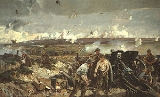
The Battle of Vimy Ridge was a military offensive of World War I by the Canadian Corps against elements of the German Sixth Army along the Western Front in the Nord-Pas-de-Calais region of France, from 9 April 1917 to 12 April 1917.
The Canadian Corps attack on Vimy Ridge, an escarpment at the western edge of the Douai plain, was part of the opening phase of the Battle of Arras, a diversionary attack for the French Nivelle Offensive. The immediate objective of the Canadian Corps was to take control of the German-held high ground at the northernmost end of the advance, to permit the southern flank of the Arras offensive to advance without suffering enfilade fire.
Supported by a creeping barrage, the Canadian Corps captured the majority of the ridge during the first day of the attack. The town of Thélus and, after overcoming considerable German resistance, the crest of the ridge fell during the second day. The final objective, the fortified Pimple knoll outside the town of Givenchy-en-Gohelle, falling to the Canadian Corps on 12 April, after which point the German forces retreated to the Oppy-Méricourt line.
The success of the Canadian Corps in capturing the ridge is attributed to a mixture of technical and tactical innovation, meticulous planning, powerful artillery support, extensive training as well as the failure of the German Sixth Army to apply the defensive doctrine of elastic defence. Noted as the first occasion where all four divisions of the Canadian Expeditionary Force participated in an action as a composite formation, the battle quickly became a nationalistic symbol of achievement and sacrifice. Since 1922, a portion of the former battleground has served as a preserved memorial park and home to the Canadian National Vimy Memorial.
BackgroundSituated approximately 8 km northeast of Arras, Vimy Ridge is a gradually rising escarpment on the western edge of the Douai plain approximately 7 km in length and culminating at an elevation of 145 m. Providing a natural unobstructed view for tens of kilometers, the ridge had fallen under German control in October 1914 during the Race to the Sea as the opponents continually attempted to outflank each other through northeastern France.
In May 1915, the French advanced on the ridge itself during the Second Battle of Artois during which the 1st Moroccan Division managed to take possession of the ridge, after an astonishing 4km advance, but was unable to maintain it due to a lack of reinforcements. After capturing the town of Souchez, the French Tenth Army briefly captured the ridge during the Third Battle of Artois in September 1915, before being rebuffed. Following the Third Battle of Artois, the Vimy sector became calmer with the both sides taking a largely live and let live approach. The French suffered approximately 150,000 casualties in their attempts to gain control of Vimy Ridge and surrounding territory.
The British XVII Corps, commanded by Lieutenant-General Sir Julian Byng, relieved the French Tenth Army from the sector in February 1916, permitting the French to expand their operations at Verdun. It was quickly discovered that German tunnelling companies had taken advantage of the relative calm on the surface to push aggressive tunnelling and deep mining activity against French positions. Royal Engineer Tunnelling Companies were immediately deployed along the front to combat the German mining nuisance. In response to increased British mining aggression, German artillery and trench mortar fire intensified in early May 1916.
On 21 May 1916, after shelling both forward trenches and divisional artillery positions from no less than 80 out-of-sight batteries on the reverse slope of the ridge, the German infantry attacked the British lines along a front in an effort to repulse them from positions along the ridge. The German advance, having captured their objective of the British mine craters, halted, and entrenched their position. Small counterattacks by units of 140th and 141st British Brigades took place on 22 May, but did not manage to change the situation. The newly-formed Canadian Corps relieved the British IV Corps stationed along the western slopes of Vimy Ridge in October 1916.
Assault preparationsFormal discussions of a spring offensive near Arras began following a conference of corps commanders held at First Army Headquarters on 21 November 1916. It was not until 5 January, 1917 however that Lieutenant-General Sir Julian Byng, having taken command of the Canadian Corps from Lieutenant-General Sir E.A.H. Alderson in May 1916, was formally presented with orders outlining Vimy Ridge as the corps' objective for the Arras offensive. Heavily drawing on briefings of staff officers sent to learn from the French Army's experience during the Battle of Verdun, a formal assault plan was devised, approved and adopted by early March 1917. For the first time, all four Canadian divisions were to be assembled to operate in combat as a corps. The four Canadian divisions were joined by the British 5th Infantry Division, and reinforced by artillery, engineer and labour units. This brought the Canadian Corps nominal strength up to about 170,000 all ranks, of which 97,184 were Canadians.
Tactical planIn January 1917, a large contingent of nominated British and Dominion officers, amongst them three Canadian Corps officers, attended a series of lectures hosted by the French Army regarding their experiences during the Battle of Verdun. One of the limited allied successes of 1916 had been the French counter-offensive devised by General Robert Nivelle. Following extensive rehearsal, eight French divisions, assaulting in two waves on a front, with exceedingly strong artillery support, recovered lost ground and inflicted heavy casualties on five German divisions.
Upon their return, the Canadian Corps staff officers produced a tactical analysis of the Verdun battles and delivered a series of corps and divisional level lectures primarily espousing the primacy of artillery but also noting the importance of harassing fire and company and platoon flexibility. Correspondingly, the Canadian Corps assault plan for Vimy Ridge, which was submitted to First Army commander General Henry Horne for approval on 5 March 1917, drew heavily on the experiences and tactical analysis of the three corps officers who had attended the Verdun subjected lectures.
The plan submitted divided the Canadian Corps advance into four coloured objective lines. The Canadian Corps attack would be made on a front of , the centre being opposite the village of Vimy, which lay on the east side of the Ridge. The Black Line, the first objective, involved the seizure of the German forward defense line. The Red Line, the final objective of the northern flank, involved the taking of the highest point on the ridge, the fortified knoll known as "the Pimple", the La Folie Farm, the Zwischen-Stellung dugout and the hamlet of Les Tilleuls. On the southern flank, two additional objectives were planned; The Blue Line, encompassing the town of Thélus and the woods outside the town of Vimy, and the Brown Line which consisted the Zwölfer-Graben dugout and the German second line. The infantry would procede close behind a creeping barrage, placed down by light field guns, which would advance in timed increments. The medium and heavy howitzers would establish a series of standing barrages further ahead of the infantry, against known defensive systems. To maintain momentum during the attack, the plan arranged for units to leap frog over one another as the advance progressed. The first units were to reach the Black Line and push forward to the Red Line. After a pause to enable reserve units to move up, the barrage would recommence to allow the reserve units to push beyond the Red Line and reach the Blue Line. Upon securing the Blue Line, the plan would be repeated for the capture of the Brown Line. Conducted properly, the German forces would have little time to exit the security of their deep dugouts and defend their positions before being overwhelmed by the infantry advance. So long as the schedule could be maintained, the plan called for the Canadian Corps to advance as much as and have the majority of the ridge under its control by 1pm on the first day of the attack.
The experience of the Battle of the Somme lead the German command to conclude that the policy of rigidly defending a statically fixed line was no longer effective and could not be relied upon as a defensive strategy. As a result, the German command began espousing a new defensive doctrine in December 1916 that emphasized fighting an elastic defensive battle in depth rather than rigidly holding successive lines of trenches. The German forces spent two years constructing fortifications after capturing Vimy Ridge but these were designed in accordance with the old doctrine of rigid defence and little reconstruction based upon the new defence in depth doctrine had been accomplished by April 1917. The geography of the battlefield made application of the defence in depth doctrine all the more problematic as the eastern side of the ridge drops steeply creating difficulties for any potential counter-attacks. Three line divisions, with seven infantry regiments between them, were responsible for the immediate defence of the ridge. Reserve divisions were however kept approximately behind the front lines instead of assemble close behind the second line as espoused by the defence in depth doctrine.
ArtilleryTwenty-four brigade artillery groups consisting of 480 eighteen-pounders, 138 4.5-inch howitzers, 96 2-inch trench mortars, 24 9.45-inch mortars, supported by 245 corps level siege guns and heavy mortars, were made available to the Canadian Corps. This firepower gave a density of one heavy gun for every and one field gun for every of Canadian Corps frontage, representing a considerable average increase, including three times the heavy guns, over the distribution of artillery at the Battle of the Somme a year earlier. To support the efforts of the infantry, a 35-page multi-phased fire support plan called Canadian Corps Artillery Instruction No. 1 for the Capture of Vimy Ridge was developed, and subsequent issued by Brigadier General Edward Morrison. To logistically manage three times the artillery normally allocated to a corps, Royal Artillery staff officer Major Alan Brooke developed coordinated communication and transport plans to work in conjunction with his complex barrage plans.
The artillery along the Canadian Corps front remained extremely active largely due to their 1.6 million shell allotment. The higher quality of the shells, in comparison to earlier points in the war, also ensured fewer duds. Aiding the effectiveness of the artillery was the introduction of the instantaneous No. 106 fuse. This fuse reliably burst with the slightest of contact, unlike past timed fuses, making it especially effective at cutting barbed wire before the advance. To ensure that men at observation points could communicate, particularly with the artillery, over of cable was laid at a depth of for telegraph and field telephones. To aid artillery operations during the battle, coordinated counter-battery initiatives before the battle were also conducted. Utilizing flash spotting, sound ranging and aerial reconnaissance from No. 16 Squadron and No. 1 & 2 Balloon Company of the Royal Flying Corps in the week before the battle, the counter-battery artillery under command of Lt-Col Andrew McNaughton fired 125,900 shells, harassing an estimated 83% of the enemy gun positions.
Training In February 1917, the British General Staff released a training pamphlet entitled SS 143 Instructions for the Training of Platoons for Offensive Action, espousing the return of fire and movement tactics in which the platoon was considered a self contained tactical unit. The Canadian Corps instilled the tactical change with vigor. Before the attack, assaulting infantry battalions utilized hilled areas behind the lines as full-scale model representations of the battlefield. Infantry were trained in platoon-level tactics, taped lines were utilized to represent enemy trench lines and officers on horseback carried flags to represent the advancing front of the artillery barrage.
Recognizing that the men in leadership positions were likely to be wounded or killed, soldiers learned the jobs of those beside and above them. At the First Army headquarters, a large-scale plasticine model of the Vimy sector was constructed and utilized to show officers and senior non-commissioned officers the topographical features of the battlefield and details of the German trench system. In addition, upwards of 40,000 topographical trench maps were printed and distributed to ensure that even platoon sergeants and section commanders possessed a wider awareness of the battlefield. The objective was to give each platoon a complete picture of the battle plan and a specific task within it, with the intent of reducing the command and control problems that plagued World War I combat.
Underground operationsThe Arras-Vimy sector was conducive to tunnel excavation owing to the soft, porous yet extremely stable nature of the chalk underground. As a result, pronounced underground warfare had been an active feature of the Vimy sector since 1915, with no less than 19 distinct mine crater groups existing along the Canadian front by 1917. Since their arrival in 1916, British Royal Engineer tunnelling companies had been actively engaged in offensive mining against German miners.
There in preparation for the assault, British tunnelling companies, with the assistance of Canadian engineers and infantry, created extensive underground networks and fortifications. Twelve subways, up to in length, were excavated at a depth of and utilized to connect reserve lines to front lines, permitting soldiers to advance to the front quickly, securely and unseen. Often incorporated into subways were concealed light rail lines, hospitals, command posts, water reservoirs, ammunition stores, mortar and machine gun posts, and communication centres. Many subways were also lit by electricity provided by generators.
Thirteen multi-thousand pound mines were also laid under German positions, particularly near the Pimple and Broadmarsh crater, with the intention of destroying fortified points before the assault. Also laid were eight Wombat mine charges designed to open up the end of subway into an elongated trench-depth crater across no man's land, protecting advancing troops from enfilade machine gun fire. Of the explosive charges laid, three mines were fired before the assault, and three mines and two Wombat charges fired in support of the assault.
Trench raidingFor more details on this topic, see Trench raiding
The practice of making small scale surprise attacks on enemy positions, in the dead of night without the intention of consolidation, became common practice for the Canadian Corps by late 1916. Trench raiding had originally been a strategy to harass the enemy and gain intelligence but soon developed into a training and leadership building mechanism. The four months before the April attack saw the Canadian Corps execute no less than 55 separate trench raids. Competition between units even developed with units competing for the honour of greatest number of prisoners captured or most destruction wrought. The policy of aggressive trench raiding was not however without its cost. On March 1, 1917, a month before the assault, an ambitious brigade-sized trench raid by the 4th Canadian Division backed by poison gas deployment failed, resulting in 637 casualties including two battalion commanders and a number of company commanders killed. This experience did not lessen the extent to which trench raiding were employed with raids continuing up until the night before the attack.
Battle in the airIn support of the spring offensive, the Royal Flying Corps launched a determined effort to gain air superiority over the battlefield. In support of the spring offensive, the Royal Flying Corps launched a determined effort to gain air superiority over the battlefield. Considered essential and necessary to continue unimpeded were activities such as artillery spotting and photography of opposing trench systems, troop movements and gun emplacements. The Royal Flying Corps deployed 25 squadrons totalling 365 aircraft along the Arras sector, outnumbering the enemy by no less than 2-to-1. Byng was given use of No. 2 Squadron, No. 8 (Naval) Squadron, No. 25 Squadron, No. 40 Squadron and No. 43 Squadron, with No. 16 Squadron permanently attached to the Canadian Corps and employed exclusively for observation and artillery support. Forced to fly at slower speeds and at lower altitudes, conducting aerial reconnaissance was often a hazardous task. The task was made all the more dangerous with the arrival of additional German flying squadrons, including Manfred von Richthofen's highly experienced and well equipped Jasta 11, which led to sharp increase in Royal Flying Corps casualties. Although significantly outnumbering the enemy, the Royal Flying Corps lost 131 aircraft during the first week of April alone. Despite the losses suffered by the Royal Flying Corps, the Imperial German Army Air Service failed to prevent the Royal Flying Corps from carrying out its prime objective, namely the continued support of the army throughout the Arras offensive with up-to-date aerial photographs and reconnaissance information.
The BattleBeligerentsGerman general Ludwig von Falkenhausen's Sixth Army had twenty line divisions (plus reserves) responsible for the Cambrai to Lille sector. Vimy Ridge itself was principally defended by the ad hoc Gruppe Vimy, formation based under I Bavarian Corps commander General Karl von Fasbender. However, a division of Gruppe Souchez, under VIII Reserve Corps General Georg Karl Wichura, was also involved in the front-line defence along the northernmost portion of the ridge.
The defending elements of the German Sixth Army were;
- the 16th Bavarian Infantry Division under the command of General Arnold Ritter von Möhl. Located opposite the town of Souchez and responsible for the defence of the northernmost section of the ridge, the 16th Bavarian Infantry Division had been created in January 1917 from existing Bavarian formations and had so far only opposed the Canadian Corps.
- the 79th Reserve Division under the command of General Ernst August Max Von Bachmeister, responsible for the defense of vast central section including the highest point of the ridge, Hill 145. The 79th Reserve Division had fought for two years on the Eastern Front, transffered at the end of 1916, and appeared in the Vimy sector at the end of February 1917.
- the 1st Bavarian Reserve Division under General Freiherr von Bechmann, which had been in the Arras area since October 1914, were holding Thélus, Bailleul and the southern slope of the ridge.
Canadian Corps commander Lieutenant-General Sir Julian Byng had four attacking divisions, one division of reserves and numerous support units under his command. He was supported to the north by the 24th British Division of I Corps which advanced north of the Souchez river and by the advancing XVII Corps to the south.
The attacking elements of the Canadian Corps consisted of;
Byng also planned for a healthy reserve for contingencies that included the relief of forward troops, help in consolidating positions and aiding the 4th Canadian Division with the capture of the "Pimple". The reserve forces of the Canadian Corps consisted of;
- the 9th Canadian Brigade of the 3rd Canadian Division.
- the 15th British Brigade of the 5th British Division.
- the 95th British Brigade of the 5th British Division.
Preliminary attackBy March 1917, the German forces were aware that a major attack was imminent. German 79th Reserve Division commander General Von Bachmeister reported that he believed the Canadian Corps was moving into an echelon formation and were preparing for a major attack but his superiors ignored his concerns. The preliminary phase of the artillery bombardment began on 20 March 1917 with a two week systematic bombardment of German batteries, trenches and strongpoints. Particular attention was paid to eliminating enemy barbed wire, a task made easier with the introduction of the instantaneous No. 106 fuse. In addition, only half of the available artillery was committed at any one point in time with the intensity of the barrage expressly varied as to confuse the enemy and preserve some level of secrecy. Phase two began 2 April 1917, lasted an entire week, and employed the entire artillery arsenal at the disposal of the Canadian Corps, the equivalent of one heavy gun for every and one field gun for every . The German soldier aptly named the week before the attack “the week of suffering”. In many cases, the German trenches were completely demolished and morale suffered from the stress of remaining at the ready for eleven straight days. Compounding German difficulties was the inability of ration parties to bring food supplies to the front lines. On 3 April German Sixth Army commander General Ludwig von Falkenhausen ordered his reserve division to prepare to relieve front-line divisions over the course of a long drawn-out defensive battle, similar to the Battle of the Somme, but kept them from the battlefield to avoid their being shelled.
Main assault
The attack was to begin at 5:30 a.m. on Easter Monday, 9 April 1917. During the late hours of 8 April and early morning of 9 April, the men of the leading and supporting wave of the attack were moved into their forward assembly positions and issued the customary rum ration and mug of sweet tea just as the weather became cold, overcast with sweeping sleet and snow. Although physically discomforting, the northwesterly storm advantaged the assaulting as the wind was at their backs and consequently in face of the defenders. Light artillery bombardments had continued through the prior night however in the moments before the attack an eerie silence fell over the battlefield. All shell fire stopped as the artillery re-calibrated and reloaded their guns in preparation for the synchronized barrage. At exactly 5:30 a.m., every artillery piece at the disposal of the Canadian Corps began firing. 30 seconds later, the mine charges laid under no man's land and the German trench line were fired, destroying a number of German strongpoints and creating secure communication trenches directly across no man's land. Light field guns laid down a barrage which advanced in predetermined increments, often every three minutes, while medium and heavy howitzers established a series of standing barrages further ahead, against known defensive systems.
The 1st, 2nd and 3rd Canadian Divisions reported reaching and capturing their first objective, the Black Line, by 6:25 a.m. The 4th Canadian Division encountered a great deal of trouble during their advance and were unable to complete its first objective till some hours later. After a planned pause during which time the 1st, 2nd and 3rd Canadian Divisions consolidated their positions, the advance resumed. Shortly after 7:00 a.m., the 1st Canadian Division had taken the left half of its second objective, the Red Line, and moved the 1st Canadian Brigade forward mount an attack on the remainder. The 2nd Canadian Division having reported reaching the Red Line and capturing the town of Les Tilleuls at approximately the same time. Units at the southern end of the 3rd Canadian Division's front reached the Red Line at the western edge of the Bois de la Folie, at around 7:30 a.m. However, by 9:00 a.m. the division had learned of its exposed left flank, as the 4th Canadian Division had not yet captured Hill 145. The 7th Canadian Brigade of the 3rd Canadian Division was hence called upon to establish a divisional defensive flank to its north. It was not until 11:00 a.m. that Von Bachmeister first ordered the German 79th Reserve Division to counter-attack, by which time only the 4th Canadian Division had not reached it's objective. The initial advance of the 4th Canadian Division collapsed almost immediately after exiting their trenches. The commanding officer of one assaulting battalion having requested that the artillery leave a portion of German trench be left un-destroyed. Undestroyed machine-gun nests pinned down, wounded or killed much of the 4th Canadian Division's right flank while the progress on the left was eventually impeded by harassing fire from the Pimple made worst by the creeping barrage escaping the advancing troops. Reserve units were called forward, with the battle untested 85th (Nova Scotia Highlanders) Battalion finally capturing the south-western portion of Hill 145 in the late afternoon. The Canadian Corps had achieved an impressive advance however the failure to capture the entirety of Hill 145 or the Pimple left much of the territory gained in a tenuous state.
Fresh units of the 1st and 2nd Canadian Divisions were moved up to the Red Line by 9:30 a.m., 10 April in preparation to leap frog existing units occupying the Red line and advance onto the Blue Line. Two sections of tanks and the 13th British Brigade called up from reserve supported the advance on the 2nd Canadian Division and by approximately 11:00am the Blue Line, including Hill 135 and the town of Thélus, had been captured. To permit the troops time to consolidate the Blue Line, the advance halted and the barrage remained stationary for 90 minutes and machine-guns were brought forward. Shortly before 1pm, the advance recommenced with both the 1st and 2nd Canadian Divisions reporting their final objective, the Brown Line, secure around 2:00pm. Fresh troops from the 10th Canadian Brigade finally forced the remaining German troops from the northern half of Hill 145 at around 3:15pm and by nightfall of 10 April the only objective not yet achieved was the capture of the Pimple.
The mission to capture the fortified high point know as the Pimple, just outside the town of Givenchy-en-Gohelle, was set for 12 April after having been delayed by the difficulties faced by the 4th Canadian Division. The night before the attack, artillery harassed enemy positions while a gas section of Royal Engineers, employing Livens projectors, fired more than 40 gas drums of mustard gas directly into the town of Givenchy-en-Gohelle to cause confusion. Supported by a significant amount of artillery and the 24th British Division of I Corps to the north, the 10th Canadian Brigade attacked at 5:00 a.m. 12 April. Fighting against hastily entrained German troops and benefited once again by westerly blowing wind and snow, the 10th Canadian Brigade captured the entirety of the Pimple by 6:00 p.m.
AftermathBy nightfall 12 April 1917 the Canadian Corps was in firm control of the ridge. The corps had suffered 10,602 casualties; 3,598 killed and 7,004 wounded. The German Sixth Army suffered an unknown number of casualties with an approximate 4,000 men becoming prisoners of war.
Four Victoria Crosses, the highest military decoration awarded for valour, were awarded to members of the Canadian Corps for their actions during the battle;
At least two Order Pour le Mérite, the Kingdom of Prussia's highest military order, were awarded to German commanders for their actions during the battle;
- Wilhelh Von Goerne commander of the 261st Prussian Reserve Infantry Regiment, of the German 79th Reserve Division.
- Georg Karl Wichura commander of the VIII Reserve Corps and Gruppe Souchez.
Following the defeat, the Chief of the German General Staff, Field Marshal Paul von Hindenburg, ordered the Oberste Heeresleitung to conduct a court of enquiry into the defensive collapse of the Arras sector. The court concluded that the Sixth Army headquarters had disregarded frontline commander reports, noting a possible imminent attack, and as a result, reserve units were kept too far back to execute a timely and effective counterattack. The court also concluded that Sixth Army commander General Ludwig von Falkenhausen had failed to properly apply an elastic defence as espoused by German defensive doctrine of the time. Instead, the defensive system had been based around a series of unmoving strong-points and static lines of resistance, which were ultimately isolated and destroy by artillery. Von Falkenhausen was ultimately transferred to Belgium where he served as Governor General until the end of the war. The Germans did not however see the Canadian Corps capture of Vimy Ridge as a loss. Contemporary German sources viewed the action as at worst a draw given no full-scale breakthrough occurred following the attack.
The loss of Vimy Ridge forced the Germans to reassess their defensive strategy in the area, instead of mounting a counterattack, pursued a scorched earth policy, and retreated to the Oppy-Méricourt line. The complete failure of the French Nivelle Offensive in the week after the Arras offensive placed pressure on Field Marshal Douglas Haig to keep the Germans occupied in the Arras sector in order to minimize French losses. The Canadian Corps would participate in a number of these actions including the Battle of Arleux and the Third Battle of the Scarpe in late April and early May 1917.
CommemorationVimy Memorial
Set on the highest point of Vimy Ridge is the Canadian National Vimy Memorial, the largest of Canada's war monuments. In 1922, use of the land, for the battlefield park which contains the memorial was granted, in perpetuity, for all time by the French nation to the people of Canada in recognition of Canada's war efforts. of the former Vimy Ridge battlefield is preserved as part of the memorial park which surrounds the monument. The grounds of the site are still honeycombed with wartime tunnels, trenches and craters, closed off for public safety.
The memorial took eleven years and $1.5 million to build and was unveiled on 26 July 1936 by King Edward VIII (prior to his abdication), in the presence of President Albert Lebrun of France and 50,000 or more Canadian and French veterans and their families.
The memorial site is tended by Veterans Affairs Canada.
Vimy Ridge Day
In 2003, the Government of Canada declared April 9 as Vimy Ridge Day, to honour and remember the battle that took place at Vimy Ridge in 1917.
90th anniversary
The 90th anniversary of the Battle of Vimy Ridge was celebrated on April 9 2007, in many locations across Canada, and in formal ceremonies in the cities of Toronto, Ottawa, and at the Canadian National Vimy Memorial in France. Over 25,000 people, including 5,000 Canadian students, attended a ceremony in France that commemorated the 90th anniversary of the battle as well as rededicated of the Canadian National Vimy Memorial which had been under multi-year restoration as part of the Canadian Battlefield Memorials Restoration Project. The ceremony was presided by Queen Elizabeth II, Queen of Canada, who formally rededicated the restored memorial, French Prime Minister Dominique de Villepin and Canadian Prime Minister Stephen Harper.
Citadelle of Quebec - Vimy Cross
After the battle a number of memorials were erecting along Vimy Ridge, including a wooden cross by the Canadian 2nd Division in memory of the soldiers killed during the battle. Before the Canadian National Vimy Memorial was constructed, the responsibility of this Cross was given to the Royal 22e Régiment and moved to the Citadelle of Quebec between 1923 and 1924. The cross underwent restoration in 1947 and again in 1978 and is still used today during commemoration ceremonies of the battle.
Parliament of Canada - West Wall
The stone masons rebuilding Parliament of Canada's Centre Block after the 1916 fire were granted permission by the architect to mark the battle with a commemorative stone and inscription on the outside west wall.
External links- Battle info, video footage and photos.
|
| |
|
|