


Garrison cap

Encyclopedia
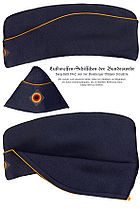
United States
The United States of America is a federal constitutional republic comprising fifty states and a federal district...
), a wedge cap (in Canada
Canada
Canada is a North American country consisting of ten provinces and three territories. Located in the northern part of the continent, it extends from the Atlantic Ocean in the east to the Pacific Ocean in the west, and northward into the Arctic Ocean...
), or officially field service cap, (in the United Kingdom
United Kingdom
The United Kingdom of Great Britain and Northern IrelandIn the United Kingdom and Dependencies, other languages have been officially recognised as legitimate autochthonous languages under the European Charter for Regional or Minority Languages...
and Commonwealth
Commonwealth of Nations
The Commonwealth of Nations, normally referred to as the Commonwealth and formerly known as the British Commonwealth, is an intergovernmental organisation of fifty-four independent member states...
countries), but it is more generally known as the side cap.
It follows the style which originated with the so-called Austrian Cap in the 1890s. There was also a previous version known as the 'Torin', which had a much more curved top line when viewed from the side. Both Austrian and Torin types were distinguished by the inclusion of a fold down section for warming the ears and back of the head in inclement weather. These two styles are still used by officers of some British units and continue to include this feature. In appearance the cap is similar to the Glengarry
Glengarry
The glengarry bonnet is a traditional boat-shaped hat without a peak made of thick-milled woollen material with a toorie on top, a rosette cockade on the left, and ribbons hanging down behind...
, but differs by a lack of the tartan, or check trim, toorie, and ribbons typical of the Scottish cap. It has been associated with various military forces from the time of World War I
World War I
World War I , which was predominantly called the World War or the Great War from its occurrence until 1939, and the First World War or World War I thereafter, was a major war centred in Europe that began on 28 July 1914 and lasted until 11 November 1918...
to the present day, and various youth organizations. A convenient feature of this cap is that when the owner is indoors and no coat-hook is available on which to hang it, then it can be easily stored (by folding it over the belt or, unofficially, by tucking it under a shoulder strap
Shoulder strap
A shoulder strap is a strap over a shoulder. They are often affixed to women's dresses to support its weight or as part of its style. The term is also applied to carrying bags and to epaulettes.-Carrier shoulder strap:...
).
Synonyms and slang terms
Other terms for this cap in semi-official and or slang usage include garrison cover (USMC), flight cap (USAF), side cap, overseas cap, envelope hat, piss-cutter cap, chip hat, and cunt cap.Army
In the Canadian army, the field service cap is defined by the Canadian Forces Dress Instructions as a "cloth folding or 'wedge cap'...Originally designed for wear during field operations and training, it may now also be worn as an undress cap with full and undress uniforms." The cap is worn as part of the Undress uniform by students of Royal Military College of CanadaRoyal Military College of Canada
The Royal Military College of Canada, RMC, or RMCC , is the military academy of the Canadian Forces, and is a degree-granting university. RMC was established in 1876. RMC is the only federal institution in Canada with degree granting powers...
, and as an optional item by all ranks of Rifle regiments with Ceremonial Dress, Mess Dress, and Service Dress uniforms.
The field service cap was originally adopted Army-wide in 1939, and replaced in 1943 by a khaki beret. The Coloured Field Service Cap was a variant permitted for private purchase and worn only when off duty. These were in the colours of the regiment or corps of the wearer.
Air Force
In the Canadian air force, the blue wedge cap (French: calot) is authorized for wear with all orders of dress. It is properly worn "on the right side of the head, centred front and back, with the front edge of the cap 2.5 cm (1 in.) above the right eyebrow." Cap badges are worn on the left side, with the centre ofthe badge 6.5 cm (2½ in.) from the front of the cap centred between the flap
and the top seam. The cap worn by general officers is embellished with gold piping
Piping
Within industry, piping is a system of pipes used to convey fluids from one location to another. The engineering discipline of piping design studies the efficient transport of fluid....
. Military police wear a scarlet flash in the front of their
wedge caps showing 1 cm (1/4 in.).
Prior to Unification in 1968, the Royal Canadian Air Force
Royal Canadian Air Force
The history of the Royal Canadian Air Force begins in 1920, when the air force was created as the Canadian Air Force . In 1924 the CAF was renamed the Royal Canadian Air Force and granted royal sanction by King George V. The RCAF existed as an independent service until 1968...
wore uniforms similar to those worn by the Royal Air Force
Royal Air Force
The Royal Air Force is the aerial warfare service branch of the British Armed Forces. Formed on 1 April 1918, it is the oldest independent air force in the world...
, including a blue wedge cap. After 1968, the uniforms of the three services were replaced by a universal rifle-green uniform; the air force, however, was permitted to retain the wedge cap, although in rifle green instead of blue. With the advent of the Distinct Environmental Uniform, the blue wedge cap returned.
The wedge cap is also the official headdress of the Air Force Association of Canada
Air Force Association of Canada
The Air Force Association of Canada is a not-for-profit community service organization of Royal Canadian Air Force veterans and aviation enthusiasts. The AFAC's main goals are to advocate for a well-equipped, professional air force for Canada; interest Canadians in Canadian aerospace issues; and...
and the Royal Canadian Air Cadets
Royal Canadian Air Cadets
Royal Canadian Air Cadets is a Canadian national youth program for persons aged 12 to 18. It is administered by the Canadian Forces and funded through the Department of National Defence with additional support from the civilian Air Cadet League of Canada...
.
France
In FranceFrance
The French Republic , The French Republic , The French Republic , (commonly known as France , is a unitary semi-presidential republic in Western Europe with several overseas territories and islands located on other continents and in the Indian, Pacific, and Atlantic oceans. Metropolitan France...
, the bonnet de police replaced the kepi
Kepi
The kepi is a cap with a flat circular top and a visor or peak . Etymologically, the word is a borrowing of the French képi, itself a respelling of the Alemannic Käppi: a diminutive form of Kappe, meaning "cap"....
because of its greater convenience, when the "Adrian" steel helmet was issued in 1915.
Nightcap (garment)
A nightcap is a warm cloth cap worn while sleeping, often with pajamas or a nightgown. They are similar to winter 'beanies' worn in cold climates. They were common in northern Europe before central heating was available, when homes were cold at night....
). The rim of the cap was folded upward. Originally the pompon hung down at the back between the soldier's shoulder blades; subsequently the cap became shorter and the tail hung near the soldier's ear. By the mid-nineteenth century the bonnet de police had become a true flat cap with no trailing crown. Instead the pompon dangled from a short cord sewn onto the rim in front of the bonnet de police, hanging above the soldier's right eye. This style of headdress with a trailing tassel was widely worn by both the Belgian Army
Belgian Army
The Land Component is organised using the concept of capacities, whereby units are gathered together according to their function and material. Within this framework, there are five capacities: the command capacity, the combat capacity, the support capacity, the services capacity and the training...
and the Spanish Army
Spanish Army
The Spanish Army is the terrestrial army of the Spanish Armed Forces responsible for land-based military operations. It is one of the oldest active armies - dating back to the 15th century.-Introduction:...
during the first half of the 20th Century. It is still used by the Spanish Foreign Legion.
When reintroduced for undress or fatigue wear in the 1890s, the French army's bonnet de police had become a plain item of dress without decoration. The colour of this working cap matched that of the tunic with which it was worn (either dark blue, light blue or black prior to World War I; horizon blue from 1915 to 1930; and thereafter khaki). Between 1944 and 1962 however this headdress was worn by most branches of the French Army
French Army
The French Army, officially the Armée de Terre , is the land-based and largest component of the French Armed Forces.As of 2010, the army employs 123,100 regulars, 18,350 part-time reservists and 7,700 Legionnaires. All soldiers are professionals, following the suspension of conscription, voted in...
in a wide variety of colours, which normally matched those of the kepi
Kepi
The kepi is a cap with a flat circular top and a visor or peak . Etymologically, the word is a borrowing of the French képi, itself a respelling of the Alemannic Käppi: a diminutive form of Kappe, meaning "cap"....
s historically worn by the particular branch or regiment. At the end of the Algerian War the bonnet de police, was replaced by the beret
Beret
A beret is a soft, round, flat-crowned hat, designated a "cap", usually of woven, hand-knitted wool, crocheted cotton, or wool felt, or acrylic fiber....
for most units.
In the modern French Army the bonnet de police is still worn by the 1st Regiment of Spahi
Spahi
Spahis were light cavalry regiments of the French army recruited primarily from the indigenous populations of Algeria, Tunisia and Morocco. The modern French Army retains one regiment of Spahis as an armoured unit, with personnel now recruited in mainland France...
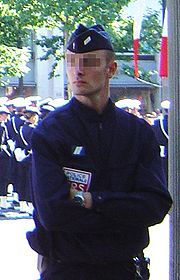
s in the historic bright red of this branch. The bonnet de police is also worn by anti-riot law enforcement units, such as the Gendarmerie Mobile
Mobile Gendarmerie
The Mobile Gendarmerie is a subdivision of the French Gendarmerie. The Mobile Gendarmerie is the inheritor of the traditions of the gendarmerie's historic infantry component. Specific anti-riot units of the Gendarmerie date back to the beginning of the 19th century...
of the French Gendarmerie (at least when in riot control gear) and the CRS
Compagnies Républicaines de Sécurité
The Compagnies Républicaines de Sécurité are the riot control forces and general reserve of the French National Police. The CRS were created on 8 December 1944 and the first units were organised by 31 January 1945. The CRS were reorganized in 1948...
of the French National Police
French National Police
The National Police , formerly the Sûreté Nationale, is one of two national police forces and the main civil law enforcement agency of France, with primary jurisdiction in cities and large towns. The other main agency is the military Gendarmerie, with primary jurisdiction in smaller towns and rural...
. Members of these units may have to change quickly from an ordinary headdress to a helmet, and an easily foldable cap is therefore practical.
Norway
In Norway, this is known as båtlue, literally boat cap. The Royal GuardsHans Majestet Kongens Garde
Hans Majestet Kongens Garde is a battalion of the Norwegian Army. The battalion has two main roles; it serves as the Norwegian King's bodyguards, guarding the royal residences and Akershus Fortress in Oslo, and is also the main infantry unit responsible for the defence of...
use a distinct variety commonly known as gardelue which is worn in garrison and while on leave.
Spain
The gorro de cuartel - referred to variously as gorrillo, gorra, chapiri or platano- was modelled on the later versions of the French bonnet de police and has the same vestigial tassel hanging from the front of the crown. The gorro de cuartel was originally known as the Isabellina from its use by the supporters of Queen Isabella II in the Carlist Wars of the mid-19th century.It was in common use by both sides during the Spanish Civil War
Spanish Civil War
The Spanish Civil WarAlso known as The Crusade among Nationalists, the Fourth Carlist War among Carlists, and The Rebellion or Uprising among Republicans. was a major conflict fought in Spain from 17 July 1936 to 1 April 1939...
and
continued in use by the Francoist forces after the war ended. It is now the distinguishing headgear of the Spanish Legion who wear it in barracks and on parade.
Sweden
In SwedenSweden
Sweden , officially the Kingdom of Sweden , is a Nordic country on the Scandinavian Peninsula in Northern Europe. Sweden borders with Norway and Finland and is connected to Denmark by a bridge-tunnel across the Öresund....
this style of headdress is known as a "båtmössa" (lit. "boat cap"). It is mainly used by the Swedish Police Service
Swedish Police Service
The Swedish Police Service is a collection of Government agencies concerned with police matters in Sweden. The Swedish Police Service consists of 28,500 employees of which 39 per cent are women. The staff consists of 20,000 police officers of which 25 per cent are women and 8,500 civilian staff of...
where it has been the standard headwear since the 1980s.
United Kingdom
In the British ArmyBritish Army
The British Army is the land warfare branch of Her Majesty's Armed Forces in the United Kingdom. It came into being with the unification of the Kingdom of England and Scotland into the Kingdom of Great Britain in 1707. The new British Army incorporated Regiments that had already existed in England...
, the first cap to be adopted of this style was the "Glengarry", which was authorised for all British infantry regiments in 1868 (although Scots regiments had been wearing it since 1848). The Glengarry was replaced for officers of most non-Scottish units by a cap called the "Torin" (similar in shape to the USSR's pilotka), which was worn from circa 1884 until 1896, when it too was replaced by a style for all ranks known as the "Austrian Cap", which had a fold down arrangement, giving the appearance when unfolded of a balaclava, thus warming the ears and back of the neck. The Austrian Cap (officially known as the field cap) was then replaced by an entirely different style of head dress in 1902 and so went into abeyance from general usage, although officers continued to wear them as a private purchase item of undress uniform. An all khaki version was also selected in 1912 as a practical head dress by the fledgling Flying Corps that went on to become the Royal Air Force (who continue to use the same type of cap to this day). Additionally, in 1937, a khaki field service cap, described in an amendment to the Dress Regulations for the Army that year as "similar in shape to the Glengarry
Glengarry
The glengarry bonnet is a traditional boat-shaped hat without a peak made of thick-milled woollen material with a toorie on top, a rosette cockade on the left, and ribbons hanging down behind...
" was introduced as the Universal Pattern Field Service Cap, and saw extensive service during World War II
World War II
World War II, or the Second World War , was a global conflict lasting from 1939 to 1945, involving most of the world's nations—including all of the great powers—eventually forming two opposing military alliances: the Allies and the Axis...
as a head dress to be worn with Battle Dress when steel helmets were not required. At around the same time coloured versions were introduced for officers of both regular and territorial regiments, although these were an optional item and in the midst of war not every officer chose to purchase one. Nevertheless, some did and they were produced in a wide range of colours for the different infantry, cavalry and yeomanry regiments. Since the universal introduction of the beret in 1947, the field service cap continued as an optional officer's accessory to be worn in barrack dress (as an alternative to the peaked, khaki Service Dress cap). They are still tailored in regimental colours and have become less common with the introduction of Combat Soldier '95 camouflaged uniform (which for the first time serves as both barrack and combat dress), although they are still worn by the Rifles, Royal Artillery and some cavalry and other infantry regiments. A more obscure type known as the "Tent Cap" is worn by officers of the Queen's Royal Hussars only and is unique in that it is not fitted with a badge, but identified instead by its regimental colouring. Its origins lie with one of their forebears, the 8th Kings Royal Irish Hussars, who adopted the cap in WW2 to reflect their long association with the Danish Royal family, whose Life Guards wear a similar design of cap with their undress uniform. This cap is in turn based on the French, 'bonnet-de-police', that was worn by Hussars in the Napoleonic wars and after. The Torin style of cap is still worn by the Duke of Lancaster's Regiment and the Royal Dragoon Guards.
Colloquially the Field Service cap is occasionally mistakenly called a forage cap but this is incorrect and it has never appeared in War Office or Ministry of Defence official publications under that name. It is, however, often referred to as the 'side hat/cap'.
In the Royal Air Force
Royal Air Force
The Royal Air Force is the aerial warfare service branch of the British Armed Forces. Formed on 1 April 1918, it is the oldest independent air force in the world...
, a blue-grey field service cap (sometimes called the 'chip bag hat') of an identical style remains widely worn with both working dress and flying suits, where it can be easily fitted into a leg pocket of the latter. They are predominantly worn by fast jet flight crew.
United States

Campaign hat
A campaign cover is a broad-brimmed felt or straw hat, with a high crown, pinched symmetrically at the four corners .It is associated with the New Zealand Army, the Royal Canadian...
, a distinct form of headgear), flight cap, piss-cutter, garrison hat, fore-and-aft cap, envelope cap, overseas cap, or cunt cap and also the flat hat.
When first issued to U.S. "doughboys" in World War I, the hat was called the "overseas cap" as it was only worn by troops in France who were given the French type forage cap as they did not have their campaign hats. The overseas cap could be stored easily when the helmet was being worn. A blue overseas cap was adopted post war by the American Legion
American Legion
The American Legion is a mutual-aid organization of veterans of the United States armed forces chartered by the United States Congress. It was founded to benefit those veterans who served during a wartime period as defined by Congress...
. The hat largely disappeared between the wars except for the Air Corps, Paratroopers and Armored Force. The hat was widely issued from 1941 on and lost its 'overseas' connotation. With the replacement of the campaign hat, the garrison cap was given branch of service color piping, as had earlier been the case with the cord of the campaign hat (light blue for infantry, red for artillery, yellow for cavalry etc.). This practice was discontinued when individuals had to purchase a new hat if they were transferred to a different branch of the service (i.e., infantry, armor, quartermaster, et al.) Officers' piping was similarly carried over from campaign hat cords and continues: warrant officers' caps are piped in silver and black, commissioned officers' caps are piped in gold and black, and general officers' caps are piped in gold.
Recently, it has largely been replaced in the U.S. Army by the beret
Military beret
Berets have been a component of the uniforms of many armed forces throughout the world since the mid-20th century. Military berets are usually pushed to the right to free the shoulder that bears the rifle on most soldiers, but the armies of some European countries have influenced the push to the...
. Until May 2004, it was also part of the initial uniform issue for soldiers who received their Army Green Service Uniform before becoming MOS-qualified, and thus being allowed to wear the standard black Army beret. The green service uniform is scheduled to be obsolete in 2012; details of the blue service uniform (modified from the extant blue dress uniform) are in flux, and no blue service cap has yet been announced.
Usage is common in the U.S. Marine Corps as the headgear when wearing service uniforms (the other option being the bulkier frame-type "barracks cover"). In addition, it is the standard headgear for Marines wearing flightsuits. The Marine officer's garrison cap, unlike those of the Army or Air Force, does not have metallic piping; the only marking that distinguishes it from the enlisted cap is the placement of officer's rank insignia on the right side of the cap. Enlisted garrison caps carry no rank insignia, however all Marine garrison caps carry the Eagle, Globe, and Anchor
Eagle, Globe, and Anchor
The Eagle, Globe, and Anchor is the official emblem and insignia of the United States Marine Corps. The current emblem traces its roots in the designs and ornaments of the early Continental Marines as well as the British Royal Marines. The present emblem, adopted in 1966, differs from the emblem of...
insignia on the left side.
A blue flight cap is the most common headgear worn with the US Air Force's service dress or "blues" uniform. The color of the piping varies: solid blue for enlisted; blue and silver braid for company-grade officer
Company-grade officer
In US military usage, a company-grade officer is a Second Lieutenant, First Lieutenant, or Captain.In the Army, company-grade officers are typically assigned to a company as a platoon leader or executive officer or as a commander . They may also be assigned as staff officers. They may preside...
s and field grade officers, and solid silver for general officers. Officers wear metal rank insignia affixed to the left front of the cap. No other accoutrements are worn.
In the US Navy, the garrison cap was first authorized during World War II
World War II
World War II, or the Second World War , was a global conflict lasting from 1939 to 1945, involving most of the world's nations—including all of the great powers—eventually forming two opposing military alliances: the Allies and the Axis...
, originally for aviators
Naval Aviator
A United States Naval Aviator is a qualified pilot in the United States Navy, Marine Corps or Coast Guard.-Naming Conventions:Most Naval Aviators are Unrestricted Line Officers; however, a small number of Limited Duty Officers and Chief Warrant Officers are also trained as Naval Aviators.Until 1981...
and later for all officers and CPO
CPO
-Officers:* Chief Performance Officer of the United States* Chief Petty Officer, a military rank* Chief privacy officer, an executive responsible for managing issues of privacy laws and policies...
's. Blue and white versions were discontinued after the war, but garrison caps in khaki and the seldom-seen forest green are still worn with service khakis, aviation greens and flight suits (the green uniform will be phased out at the end of 2010). Officers wear a miniature version of the officer crest on the left and rank insignia on the right side of the cap. Enlisted personnel since 2008 have been issued a black garrison cap for wear with the new Navy Service Uniform. It has since been authorized for officers' Service Dress Blue uniform.
The U.S. Coast Guard issues the garrison cap to all service members. The cap is serge and is authorized with Tropical Blue Long, Winter Dress Blue, and Service Dress Blue Bravo uniforms. Regulations for the placement of insignia follow those of the U.S. Navy and Marine Corps.
Participants of U.S. Military ROTC and JROTC are issued garrison caps for the duration of their studies.
The USSR
In the USSR the Garrison Cap was known as a "Pilotka" (from "pilot" — the cap was a part of air force pilots' uniform in World War IWorld War I
World War I , which was predominantly called the World War or the Great War from its occurrence until 1939, and the First World War or World War I thereafter, was a major war centred in Europe that began on 28 July 1914 and lasted until 11 November 1918...
). They were the most common type of hat in the WWII Red Army and were used in summer instead of the winter ushanka
Ushanka
An ushanka , also known as a trooper, is a Russian fur cap with ear flaps that can be tied up to the crown of the cap, or tied at the chin to protect the ears, jaw and lower chin from the cold. The thick dense fur also offers some protection against blunt impacts to the head...
s.
Yugoslavia
In Yugoslavia, the pilotka was widely used in the army after WWII and known as "Titovka", after Josip Broz TitoJosip Broz Tito
Marshal Josip Broz Tito – 4 May 1980) was a Yugoslav revolutionary and statesman. While his presidency has been criticized as authoritarian, Tito was a popular public figure both in Yugoslavia and abroad, viewed as a unifying symbol for the nations of the Yugoslav federation...
.
Civilian Use
Royal Canadian Air Cadets
Royal Canadian Air Cadets is a Canadian national youth program for persons aged 12 to 18. It is administered by the Canadian Forces and funded through the Department of National Defence with additional support from the civilian Air Cadet League of Canada...
wear wedge caps in Air Force blue as part of their uniform.
United States Civil Air Patrol
Civil Air Patrol
Civil Air Patrol is a Congressionally chartered, federally supported, non-profit corporation that serves as the official civilian auxiliary of the United States Air Force . CAP is a volunteer organization with an aviation-minded membership that includes people from all backgrounds, lifestyles, and...
personnel wear the US Air Force Flight Cap with distinctive CAP hat insignia. Cadet officers wear rank insignia instead of the CAP insignia. This hat is the standard cover with most of the Air Force style uniforms.
Many uniformed civilian organizations such as the Boy Scouts of America
Boy Scouts of America
The Boy Scouts of America is one of the largest youth organizations in the United States, with over 4.5 million youth members in its age-related divisions...
have used garrison caps.
Waiters at many old fashioned style diners also wear garrison caps.
The American Legion
American Legion
The American Legion is a mutual-aid organization of veterans of the United States armed forces chartered by the United States Congress. It was founded to benefit those veterans who served during a wartime period as defined by Congress...
and many other Veterans Service Organizations wear distinctive garrison caps.
Some commercial air-line employees, particularly flight attendants, wear garrison caps
Participants of U.S. Military ROTC and JROTC are issued garrison caps for the duration of their studies.
Massachusetts Maritime Academy also requires its students to wear garrison covers