

Austrofascism

Encyclopedia
Austrofascism is a term which is frequently used by historians to describe the authoritarian rule installed in Austria
with the May Constitution of 1934, which ceased with the forcible incorporation
of the newly-founded Federal State of Austria
into Nazi Germany
in 1938. It was based on a ruling party, the Fatherland Front (Vaterländische Front) and the Heimwehr
(Home Guard) paramilitary militia. Leaders were Engelbert Dollfuss
and, after Dollfuss' assassination, Kurt Schuschnigg
, who originally were politicians of the Christian Social Party, which was quickly integrated into the new movement.
on 18 May 1930. The declaration condemned both "Marxist class struggle" and "liberal-capitalistic economical structures" and also explicitly rejected "the Western democratic parliamentary system and the [multi]-party state".
The declaration was directed mainly at the Social Democratic opposition, largely in response to the Linz Program of 1926, and was not only taken by the Heimwehr but also by many Christian Social politicians, setting Austria on a course to an authoritarian system.
Ideologically, Austrofascism was partly based on a fusion of Italian fascism
, as expounded by Giovanni Gentile
, and Austria's Political Catholicism
.
 The election in Vienna in 1932 made it likely that the coalition of Christian Social Party, the Landbund
, and the Heimwehr would lose their majority in the national parliament
, depriving the Dolfuss government of its parliamentary basis. To prevent its loss of power, the government sought to replace Austrian democracy with an authoritarian system. These efforts were supported from abroad by Benito Mussolini
.
The opportunity for such a transition arrived on 4 March 1933 when the national parliament was paralysed by procedural disputes. Dolfuss branded this as the "self-elimination of the Parliament" and proceeded to rule on the basis of the Wartime Economy Authority Law. This law had been passed in 1917 during World War I
to enable the government to issue decrees ensuring the supply of necessities. The law had never been explicitly revoked and was now used by the Dollfuss government to inaugurate an authoritarian state.
On 7 March 1933 the Council of Ministers issued a ban on assembly and protests. Press regulations were also levied by the Wartime Economy Authority Law and touted as economic safeguards. The law allowed for the government to require approval of a newspaper which had already been printed up to two hours before its distribution under certain circumstances, for instance if "through damage to patriotic, religious or moral sensibility, a danger to public peace, order and security" would arise. This allowed for censorship
of the press, but the government was eager to avoid the appearance of open censorship, which was forbidden by the constitution. The opposition made a final attempt to reverse the changes in parliament, which was met by police power on 15 March 1933. As Großdeutsche, who advocated a merger with Germany, and Social Democrats arrived at the Parliament building, the government sent 200 detectives to the Parliament to prevent the representatives from taking their places in the assembly hall.
On 31 March the government dissolved the Republican Schutzbund. On 10 April 1933 the "Glöckel-Erlass", authored by former Social Democratic Education Minister Otto Glöckel
, was abolished; the new law made participation in Catholic lessons in schools mandatory. On 10 May, all federal, state and local elections were cancelled. The Communist Party of Austria was dissolved on 26 May, the National Socialist Workers' Party (NSDAP) on 19 June, and the Free Thinkers Guild on 20 June.
The Hotel Schiff, an asylum of the Social Democrats in Linz, was raided by the police in February 1934. The Social Democrats resisted, leading to the February Uprising, which was quelled with military and paramilitary force. Afterward, the Social Democratic Party was banned in Austria.
On 30 April 1934 the national parliament, in its last session, passed a law that authorised the government with all the powers previously held by parliament.
" (Bundesstaat Österreich), though the constitution actually reduced the individual states
' autonomy. The Federal Council
was retained, though only as a significantly limited check on the Federal government. Rather than establishing the composition of a fifty-nine member National Council through direct suffrage, this was accomplished by four "Councils" representing the professionals from Austrian Culture
, State
affairs, the States of Austria
(Länder) and Economic affairs (the latter elected by seven corporations
supposedly representing workers and employers). The National Council lost its power to initiate legislation but was still expected to approve decrees from the government. All essential power lay with the Federal Chancellor (Bundeskanzler), who appointed his government single-handedly, and the Federal President (Bundespräsident), who named the Chancellor.
As Antonio de Salazar
's 1933 constitution (and the Estado Novo regime in whole), the Maiverfassung promoted Catholic
clericalist corporatism
and bore a strong resemblance to the Quadragesimo Anno
, rejecting capitalism
while defending private ownership, though the latter rather rejected authoritarian government than it sought to promote it.
Chancellor Dolfuss was killed in July 1934, during an attempt by Austria's National Socialist Party
to topple the regime and proclaim a Nazi government under Ambassador to Rome Anton Rintelen
. The assassination of Dollfuss was accompanied by Nazi uprisings in many regions in Austria, resulting in further deaths. In Carinthia
a large contingent of northern German Nazis tried to grab power but were subdued by the loyalist Heimwehr units. The Nazi assassins holding the Federal Chancellery Vienna
surrendered after threats to dynamite
the building and were executed before the end of July. While Heimwehr leader Starhemberg briefly assumed power as Vice Chancellor, Kurt Schuschnigg was appointed Dollfuss' successor by President Miklas on 29 July, ousting Starhemberg from the government completely in 1936, before surrendering to Nazi pressure in March 1938.
One of the reasons for the failure of the putsch was Italian intervention: Mussolini assembled an army corps of four divisions on the Austrian border and threatened Hitler with a war with Italy in the event of a German invasion of Austria as originally planned, should the coup have been more successful. Support for the Nazi movement in Austria was surpassed only by that in Germany, allegedly amounting to 75 % in some areas.
In September 1933 the government established internment camps for political opposition members. Social Democrat
s, Socialists, Communists
, and Anarchists
were all considered dissidents condemned to internment. After the July Putsch
of 1934, National Socialists were also regularly interned.
On 11 November 1933 the government reinstated the death penalty for the crimes of murder, arson, and "public violence through malicious damage to others' property". In February 1934, rioting (Aufruhr) was added to the list of capital offenses. Judges were instructed that, if they did not pass down a death penalty verdict within three days, they would be removed from the case and it would be brought to a jury trial
.
Post-secondary education was also targeted by the new regime. The number of professors and assistants fell as the government produced legal grounds for deposing those who were critical of the new regime. Disciplinary actions, previously the responsibility of individual universities, were relegated to the government. Only members of the Fatherland Front were allowed to become university officials.
in 1929.
Unemployment grew drastically under the Austrofascist regime (over 25% between 1932 and 1933). In response, the government removed unemployment benefits from the national budget. Additionally, the government created the so-called "Cooperations" of workers and enterprisers charged with undermining workers' movements. International trade was restricted and eventually banned.
and other "pre-revolutionary" styles. The government encouraged a cultural mindset reminiscent of the times before the French Revolution
. This recalled images of the "Threat from the East" – the invasion of Europe by the Ottoman Turks
– which were then projected onto the Soviet Union
. In this way the government warned its people against what it called "cultural Bolshevism
," a force which it claimed posed a great threat to Austria.
) was different from that of the National Socialists. They were similar in that both served to attack the idea of a class struggle
by accusing leftism of destroying individuality, and thus help usher in a totalitarian state. Dolfuß claimed he wanted to "over-Hitler" (überhitlern) National Socialism.
Austrofascism, however, focused on the history of Austria. The Catholic Church played a large role in the Austrofascist definition of Austrian history and identity, which served to alienate Austrian and German culture. According to this philosophy, Austrians were "better Germans." (By this time, the majority of the German population was Protestant.) The monarchy was elevated to the ideal of a powerful and far-reaching state, a status which Austria lost after the Treaty of Saint-Germain
.
which employed famous Jewish artists like Herbert Graf
, Alexander Moissi, Max Reinhardt
, Richard Tauber
, Margarete Wallmann
, and Bruno Walter
. Walter also was a leading conductor for the Vienna State Opera
until 1938 and conducted several concerts given by the Vienna Philharmonic Orchestra
. Therefore the festival was harshly criticised by German officials and boycotted by German artists like Richard Strauss
, Wilhelm Furtwängler
, and Clemens Krauss
. The Festival also came under attack by Austrian antisemites and exponents of right-wing parties.
Many Jews fled Germany and found a temporary refuge in Austria. Artists like filmmaker Henry Koster
and producer Joe Pasternak
could not work in Germany any longer and continued to produce films in Austria. Vienna's Theater in der Josefstadt
provided many Jewish actors, playwrights and directors with the opportunity to continue their work, among them Reinhardt, Albert Bassermann
, Egon Friedell
, Hans Jaray, Otto Preminger
(the theater's managing director until 1935), Ernst Lothar
(managing director until 1938), and Franz Werfel
. Jewish athletes made the SC Hakoah Wien one of the most successful athletic clubs in Austria before 1938. Its athletes excelled on many occasions throughout Europe.
Yet there was a purge of public offices, and many Jews were fired from their posts on the accusations that they were Communist or Social-Democratic sympathizers. There were occasional outbursts of Antisemitism in right-wing newspapers. However, Jews continued to be an integral part of Austrian society until March 1938. But some of them lost their hopes for a fruitful future and left Austria before 1938, especially following the Juliabkommen 1936 between Austria and Germany which provided an amnesty for illegal Nazis. Among the most prominent Jews who left Austria before 1938 were Stefan Zweig
and Otto Preminger
.
. However, when Mussolini sought to end Italy's own increasing international isolation by forming an alliance with Hitler in 1938, Austria was left alone to face increasing German pressure.
To protect Austria's independence, Schuschnigg reached an agreement with Hitler under which 17,000 Austrian Nazis received amnesty and were integrated into the fold of the Fatherland Front. Arthur Seyß-Inquart, the leader of the Austrian Nazis, was appointed Minister of the Interior and Security. As Nazi pressure continued, now supported from within the government, Schuschnigg tried to rally popular support for Austria's independence by a referendum. Hitler reacted by alleging an attempt at a fraudulent vote and demanded that Schuschnigg should hand over the government to the Austrian Nazis or face invasion. Schuschnigg, unable to find support in France or Great Britain, resigned to avoid bloodshed. After an interlude, in which Nazis had gained control of Vienna, President Miklas, who had at first refused, appointed Seyß-Inquart Chancellor, who then requested military occupation by the German army. The next day, Hitler entered Austria and declared it a part of the German Reich, which was subsequently formalized on March 15.
(ÖVP; the post-World War II successors of the Christian Social Party), some of whom do not distance themselves from the authoritarian Austrian regime of the Patriotic Front. They usually stress the Austro-fascists' merits in fighting for Austria's independence and against Nazism
.
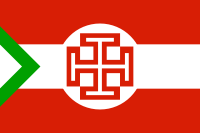
While it is undisputed that the regime was an authoritarian dictatorship in character (it locked away members of the opposition, mostly Nazis, Communists and Social-Democrats, in concentration camps called Anhaltelager or imprisonment centers), some historians argue that it lacked certain characteristics of true fascism. Although the Fatherland Front used fascist-like symbols (such as the Kruckenkreuz) and was meant to be a party of the masses, it lacked a solid basis in the population, especially among labourers who tended to support the Communists or the Nazis. The Austrian government also did not target minorities or engage in any sort of expansionism.
According to some historians, Austrofascism was a contrived and desperate attempt to "out-Hitler" ("überhitlern") the Nazis, a term used by Dollfuss himself. They argue that Dollfuss was interested in a renaissance of Catholicism
rather than in a totalitarian
state, meaning that he wanted to return to the time before the ideas of the French Revolution
of 1789 took hold. Ernst Hanisch, for example, speaks of semi-fascism. Some parallels to Spain
under Francisco Franco
cannot be overlooked, however. Austrofascism is sometimes also called imitation fascism.
Austria
Austria , officially the Republic of Austria , is a landlocked country of roughly 8.4 million people in Central Europe. It is bordered by the Czech Republic and Germany to the north, Slovakia and Hungary to the east, Slovenia and Italy to the south, and Switzerland and Liechtenstein to the...
with the May Constitution of 1934, which ceased with the forcible incorporation
Anschluss
The Anschluss , also known as the ', was the occupation and annexation of Austria into Nazi Germany in 1938....
of the newly-founded Federal State of Austria
Federal State of Austria
The Federal State of Austria refers to Austria from 1934 to 1938, according to its self-conception a non-party, in fact a single-party state led by the fascist Fatherland's Front...
into Nazi Germany
Nazi Germany
Nazi Germany , also known as the Third Reich , but officially called German Reich from 1933 to 1943 and Greater German Reich from 26 June 1943 onward, is the name commonly used to refer to the state of Germany from 1933 to 1945, when it was a totalitarian dictatorship ruled by...
in 1938. It was based on a ruling party, the Fatherland Front (Vaterländische Front) and the Heimwehr
Heimwehr
The Heimwehr or sometimes Heimatschutz were a Nationalist, initially paramilitary group operating within Austria during the 1920s and 1930s; they were similar in methods, organisation, and ideology to Germany's Freikorps...
(Home Guard) paramilitary militia. Leaders were Engelbert Dollfuss
Engelbert Dollfuss
Engelbert Dollfuss was an Austrian Christian Social and Patriotic Front statesman. Serving previously as Minister for Forest and Agriculture, he ascended to Federal Chancellor in 1932 in the midst of a crisis for the conservative government...
and, after Dollfuss' assassination, Kurt Schuschnigg
Kurt Schuschnigg
Kurt Alois Josef Johann Schuschnigg was Chancellor of the First Austrian Republic, following the assassination of his predecessor, Dr. Engelbert Dollfuss, in July 1934, until Germany’s invasion of Austria, , in March 1938...
, who originally were politicians of the Christian Social Party, which was quickly integrated into the new movement.
Origins
The Austrofascist movement's origin lies in the Korneuburg Oath, a declaration released by the Christian Social paramilitary organization HeimwehrHeimwehr
The Heimwehr or sometimes Heimatschutz were a Nationalist, initially paramilitary group operating within Austria during the 1920s and 1930s; they were similar in methods, organisation, and ideology to Germany's Freikorps...
on 18 May 1930. The declaration condemned both "Marxist class struggle" and "liberal-capitalistic economical structures" and also explicitly rejected "the Western democratic parliamentary system and the [multi]-party state".
The declaration was directed mainly at the Social Democratic opposition, largely in response to the Linz Program of 1926, and was not only taken by the Heimwehr but also by many Christian Social politicians, setting Austria on a course to an authoritarian system.
Ideologically, Austrofascism was partly based on a fusion of Italian fascism
Italian Fascism
Italian Fascism also known as Fascism with a capital "F" refers to the original fascist ideology in Italy. This ideology is associated with the National Fascist Party which under Benito Mussolini ruled the Kingdom of Italy from 1922 until 1943, the Republican Fascist Party which ruled the Italian...
, as expounded by Giovanni Gentile
Giovanni Gentile
Giovanni Gentile was an Italian neo-Hegelian Idealist philosopher, a peer of Benedetto Croce. He described himself as 'the philosopher of Fascism', and ghostwrote A Doctrine of Fascism for Benito Mussolini. He also devised his own system of philosophy, Actual Idealism.- Life and thought :Giovanni...
, and Austria's Political Catholicism
Political Catholicism
Political catholicism is a political and cultural conception which promotes the ideas and social teaching of the Catholic Church in public life...
.
Transition towards a Ständestaat
Landbund
The Landbund was an Austrian political party during the period of the First Republic .-History:The Landbund was founded in 1919 as Deutsche Bauernpartei and represented liberal and protestant farmers in Styria, Carinthia and Upper Austria...
, and the Heimwehr would lose their majority in the national parliament
National Council of Austria
The National Council is one of the two houses of the Austrian parliament. According to the constitution, the National Council and the complementary Federal Council are peers...
, depriving the Dolfuss government of its parliamentary basis. To prevent its loss of power, the government sought to replace Austrian democracy with an authoritarian system. These efforts were supported from abroad by Benito Mussolini
Benito Mussolini
Benito Amilcare Andrea Mussolini was an Italian politician who led the National Fascist Party and is credited with being one of the key figures in the creation of Fascism....
.
The opportunity for such a transition arrived on 4 March 1933 when the national parliament was paralysed by procedural disputes. Dolfuss branded this as the "self-elimination of the Parliament" and proceeded to rule on the basis of the Wartime Economy Authority Law. This law had been passed in 1917 during World War I
World War I
World War I , which was predominantly called the World War or the Great War from its occurrence until 1939, and the First World War or World War I thereafter, was a major war centred in Europe that began on 28 July 1914 and lasted until 11 November 1918...
to enable the government to issue decrees ensuring the supply of necessities. The law had never been explicitly revoked and was now used by the Dollfuss government to inaugurate an authoritarian state.
On 7 March 1933 the Council of Ministers issued a ban on assembly and protests. Press regulations were also levied by the Wartime Economy Authority Law and touted as economic safeguards. The law allowed for the government to require approval of a newspaper which had already been printed up to two hours before its distribution under certain circumstances, for instance if "through damage to patriotic, religious or moral sensibility, a danger to public peace, order and security" would arise. This allowed for censorship
Censorship
thumb|[[Book burning]] following the [[1973 Chilean coup d'état|1973 coup]] that installed the [[Military government of Chile |Pinochet regime]] in Chile...
of the press, but the government was eager to avoid the appearance of open censorship, which was forbidden by the constitution. The opposition made a final attempt to reverse the changes in parliament, which was met by police power on 15 March 1933. As Großdeutsche, who advocated a merger with Germany, and Social Democrats arrived at the Parliament building, the government sent 200 detectives to the Parliament to prevent the representatives from taking their places in the assembly hall.
On 31 March the government dissolved the Republican Schutzbund. On 10 April 1933 the "Glöckel-Erlass", authored by former Social Democratic Education Minister Otto Glöckel
Otto Glöckel
Otto Glöckel social-democratic politician and school-reformer during the First Austrian Republic...
, was abolished; the new law made participation in Catholic lessons in schools mandatory. On 10 May, all federal, state and local elections were cancelled. The Communist Party of Austria was dissolved on 26 May, the National Socialist Workers' Party (NSDAP) on 19 June, and the Free Thinkers Guild on 20 June.
The Hotel Schiff, an asylum of the Social Democrats in Linz, was raided by the police in February 1934. The Social Democrats resisted, leading to the February Uprising, which was quelled with military and paramilitary force. Afterward, the Social Democratic Party was banned in Austria.
On 30 April 1934 the national parliament, in its last session, passed a law that authorised the government with all the powers previously held by parliament.
May Constitution
On 1 May, Dollfuss' government proclaimed the May Constitution (Maiverfassung), which diminished the term Republic and instead used as the official name of the state "Federal State of AustriaFederal State of Austria
The Federal State of Austria refers to Austria from 1934 to 1938, according to its self-conception a non-party, in fact a single-party state led by the fascist Fatherland's Front...
" (Bundesstaat Österreich), though the constitution actually reduced the individual states
States of Austria
Austria is a federal republic made up of nine states, known in German as Länder . Since Land is also the German word for a country, the term Bundesländer is often used instead to avoid ambiguity. The Constitution of Austria uses both terms...
' autonomy. The Federal Council
Federal Council of Austria
The Federal Council of Austria or Bundesrat is the second chamber of the Austrian parliament, representing the nine States of Austria on federal level. As part of a bicameral legislature alongside of the National Council of Austria , it can be compared with an upper house or a senate...
was retained, though only as a significantly limited check on the Federal government. Rather than establishing the composition of a fifty-nine member National Council through direct suffrage, this was accomplished by four "Councils" representing the professionals from Austrian Culture
Culture
Culture is a term that has many different inter-related meanings. For example, in 1952, Alfred Kroeber and Clyde Kluckhohn compiled a list of 164 definitions of "culture" in Culture: A Critical Review of Concepts and Definitions...
, State
Central government
A central government also known as a national government, union government and in federal states, the federal government, is the government at the level of the nation-state. The structure of central governments varies from institution to institution...
affairs, the States of Austria
States of Austria
Austria is a federal republic made up of nine states, known in German as Länder . Since Land is also the German word for a country, the term Bundesländer is often used instead to avoid ambiguity. The Constitution of Austria uses both terms...
(Länder) and Economic affairs (the latter elected by seven corporations
Corporatism
Corporatism, also known as corporativism, is a system of economic, political, or social organization that involves association of the people of society into corporate groups, such as agricultural, business, ethnic, labor, military, patronage, or scientific affiliations, on the basis of common...
supposedly representing workers and employers). The National Council lost its power to initiate legislation but was still expected to approve decrees from the government. All essential power lay with the Federal Chancellor (Bundeskanzler), who appointed his government single-handedly, and the Federal President (Bundespräsident), who named the Chancellor.
As Antonio de Salazar
António de Oliveira Salazar
António de Oliveira Salazar, GColIH, GCTE, GCSE served as the Prime Minister of Portugal from 1932 to 1968. He also served as acting President of the Republic briefly in 1951. He founded and led the Estado Novo , the authoritarian, right-wing government that presided over and controlled Portugal...
's 1933 constitution (and the Estado Novo regime in whole), the Maiverfassung promoted Catholic
Catholic
The word catholic comes from the Greek phrase , meaning "on the whole," "according to the whole" or "in general", and is a combination of the Greek words meaning "about" and meaning "whole"...
clericalist corporatism
Corporatism
Corporatism, also known as corporativism, is a system of economic, political, or social organization that involves association of the people of society into corporate groups, such as agricultural, business, ethnic, labor, military, patronage, or scientific affiliations, on the basis of common...
and bore a strong resemblance to the Quadragesimo Anno
Quadragesimo Anno
Quadragesimo Anno is an encyclical written by Pope Pius XI, issued 15 May 1931, 40 years after Leo XIII's Rerum Novarum. Unlike Leo XIII, who addressed the condition of workers, Pius XI discusses the ethical implications of the social and economic order...
, rejecting capitalism
Capitalism
Capitalism is an economic system that became dominant in the Western world following the demise of feudalism. There is no consensus on the precise definition nor on how the term should be used as a historical category...
while defending private ownership, though the latter rather rejected authoritarian government than it sought to promote it.
Chancellor Dolfuss was killed in July 1934, during an attempt by Austria's National Socialist Party
Austrian National Socialism
Austrian National Socialism was a Pan-German movement that was formed at the beginning of the 20th century. The movement took a concrete form on November 15, 1903 when the German Worker's Party was established in Austria with its secretariat stationed in the town of Aussig...
to topple the regime and proclaim a Nazi government under Ambassador to Rome Anton Rintelen
Anton Rintelen
Anton Rintelen was an Austrian academic, jurist and politician. Initially associated with the right wing Christian Social Party, he later became involved in a Nazi coup d'etat plot....
. The assassination of Dollfuss was accompanied by Nazi uprisings in many regions in Austria, resulting in further deaths. In Carinthia
Carinthia (state)
Carinthia is the southernmost Austrian state or Land. Situated within the Eastern Alps it is chiefly noted for its mountains and lakes.The main language is German. Its regional dialects belong to the Southern Austro-Bavarian group...
a large contingent of northern German Nazis tried to grab power but were subdued by the loyalist Heimwehr units. The Nazi assassins holding the Federal Chancellery Vienna
Vienna
Vienna is the capital and largest city of the Republic of Austria and one of the nine states of Austria. Vienna is Austria's primary city, with a population of about 1.723 million , and is by far the largest city in Austria, as well as its cultural, economic, and political centre...
surrendered after threats to dynamite
Dynamite
Dynamite is an explosive material based on nitroglycerin, initially using diatomaceous earth , or another absorbent substance such as powdered shells, clay, sawdust, or wood pulp. Dynamites using organic materials such as sawdust are less stable and such use has been generally discontinued...
the building and were executed before the end of July. While Heimwehr leader Starhemberg briefly assumed power as Vice Chancellor, Kurt Schuschnigg was appointed Dollfuss' successor by President Miklas on 29 July, ousting Starhemberg from the government completely in 1936, before surrendering to Nazi pressure in March 1938.
One of the reasons for the failure of the putsch was Italian intervention: Mussolini assembled an army corps of four divisions on the Austrian border and threatened Hitler with a war with Italy in the event of a German invasion of Austria as originally planned, should the coup have been more successful. Support for the Nazi movement in Austria was surpassed only by that in Germany, allegedly amounting to 75 % in some areas.
Legal process
After the parliament was dissolved, the government also dissolved the Constitutional Court (Verfassungsgerichtshof). The four Christian Social members of the Constitutional Court had resigned, and the government banned the nomination of new judges, effectively closing the court.In September 1933 the government established internment camps for political opposition members. Social Democrat
Social democracy
Social democracy is a political ideology of the center-left on the political spectrum. Social democracy is officially a form of evolutionary reformist socialism. It supports class collaboration as the course to achieve socialism...
s, Socialists, Communists
Communism
Communism is a social, political and economic ideology that aims at the establishment of a classless, moneyless, revolutionary and stateless socialist society structured upon common ownership of the means of production...
, and Anarchists
Anarchism
Anarchism is generally defined as the political philosophy which holds the state to be undesirable, unnecessary, and harmful, or alternatively as opposing authority in the conduct of human relations...
were all considered dissidents condemned to internment. After the July Putsch
July Putsch
The July Putsch was a failed coup d'etat attempt against the Austrofascist regime by Austrian Nazis, which took place between 25 – 30 July 1934.- Background :...
of 1934, National Socialists were also regularly interned.
On 11 November 1933 the government reinstated the death penalty for the crimes of murder, arson, and "public violence through malicious damage to others' property". In February 1934, rioting (Aufruhr) was added to the list of capital offenses. Judges were instructed that, if they did not pass down a death penalty verdict within three days, they would be removed from the case and it would be brought to a jury trial
Jury trial
A jury trial is a legal proceeding in which a jury either makes a decision or makes findings of fact which are then applied by a judge...
.
Education
By 1933 a series of laws had already been passed to bring the educational system in Austria into line with Austrofascism. The Catholic Church was, under the new government, able to exert significant influence on educational policy, which had previously been secularised. In order to pass the Matura (the test required for graduation), a student had to have taken religious education classes. Educational opportunities for women were significantly limited under the new regime.Post-secondary education was also targeted by the new regime. The number of professors and assistants fell as the government produced legal grounds for deposing those who were critical of the new regime. Disciplinary actions, previously the responsibility of individual universities, were relegated to the government. Only members of the Fatherland Front were allowed to become university officials.
Economic policy
By 1930, foreign trade to and from Austria moved away from a free market system and became an extension of the autocratic government. Chief among the changes was the closing of the Austrian market to foreign trade in response to the New York stock exchange crisisBlack Thursday
Black Thursday is a term used to refer to events which occurred on a Thursday. It has been used in the following cases:* February 6, 1851, Black Thursday, a day of devastating bushfires in Victoria, Australia...
in 1929.
Unemployment grew drastically under the Austrofascist regime (over 25% between 1932 and 1933). In response, the government removed unemployment benefits from the national budget. Additionally, the government created the so-called "Cooperations" of workers and enterprisers charged with undermining workers' movements. International trade was restricted and eventually banned.
Culture
The official cultural policy of the Austrofascist government was the affirmation of the BaroqueBaroque
The Baroque is a period and the style that used exaggerated motion and clear, easily interpreted detail to produce drama, tension, exuberance, and grandeur in sculpture, painting, literature, dance, and music...
and other "pre-revolutionary" styles. The government encouraged a cultural mindset reminiscent of the times before the French Revolution
French Revolution
The French Revolution , sometimes distinguished as the 'Great French Revolution' , was a period of radical social and political upheaval in France and Europe. The absolute monarchy that had ruled France for centuries collapsed in three years...
. This recalled images of the "Threat from the East" – the invasion of Europe by the Ottoman Turks
Ottoman Empire
The Ottoman EmpireIt was usually referred to as the "Ottoman Empire", the "Turkish Empire", the "Ottoman Caliphate" or more commonly "Turkey" by its contemporaries...
– which were then projected onto the Soviet Union
Soviet Union
The Soviet Union , officially the Union of Soviet Socialist Republics , was a constitutionally socialist state that existed in Eurasia between 1922 and 1991....
. In this way the government warned its people against what it called "cultural Bolshevism
Cultural Bolshevism
Cultural Bolshevism, or in German Kulturbolschewismus, was a term widely used during the Third Reich by critics who denounced modernism in the arts, particularly when seeking to discredit more nihilistic forms of expression...
," a force which it claimed posed a great threat to Austria.
Ideology and ideals
The ideology of the "community of the people" (VolksgemeinschaftVolksgemeinschaft
Volksgemeinschaft is a German expression meaning "people's community". Originally appearing during World War I as Germans rallied behind the war, it derived its popularity as a means to break down elitism and class divides...
) was different from that of the National Socialists. They were similar in that both served to attack the idea of a class struggle
Class struggle
Class struggle is the active expression of a class conflict looked at from any kind of socialist perspective. Karl Marx and Friedrich Engels wrote "The [written] history of all hitherto existing society is the history of class struggle"....
by accusing leftism of destroying individuality, and thus help usher in a totalitarian state. Dolfuß claimed he wanted to "over-Hitler" (überhitlern) National Socialism.
Austrofascism, however, focused on the history of Austria. The Catholic Church played a large role in the Austrofascist definition of Austrian history and identity, which served to alienate Austrian and German culture. According to this philosophy, Austrians were "better Germans." (By this time, the majority of the German population was Protestant.) The monarchy was elevated to the ideal of a powerful and far-reaching state, a status which Austria lost after the Treaty of Saint-Germain
Treaty of Saint-Germain
The Treaty of Saint-Germain-en-Laye, was signed on 10 September 1919 by the victorious Allies of World War I on the one hand and by the new Republic of Austria on the other...
.
Antisemitism
There was no official policy of Antisemitism between 1933 and 1938. Public violence against Jews was rare. As the Austrofascist state saw itself under the growing pressure by Nazi Germany which penalized its citizens who travelled to Austria with a 1000 Mark fee, and even more so after the failed Nazi coup against the Austrian government in July 1934, many Jews supported the regime. Austrofascist officials supported the Salzburg FestivalSalzburg Festival
The Salzburg Festival is a prominent festival of music and drama established in 1920. It is held each summer within the Austrian town of Salzburg, the birthplace of Wolfgang Amadeus Mozart...
which employed famous Jewish artists like Herbert Graf
Herbert Graf
Herbert Grafton was an Austrian-American opera producer. Born in Vienna in 1904, he was the son of Max Graf , the Austrian author, critic, musicologist and member of Sigmund Freud's circle of friends...
, Alexander Moissi, Max Reinhardt
Max Reinhardt
----Max Reinhardt was an Austrian theater and film director and actor.-Biography:...
, Richard Tauber
Richard Tauber
Richard Tauber was an Austrian tenor acclaimed as one of the greatest singers of the 20th century. Some critics commented that "his heart felt every word he sang".-Early life:...
, Margarete Wallmann
Margarete Wallmann
Margarete Wallmann or Wallman was a ballerina, choreographer, stage designer, and opera director....
, and Bruno Walter
Bruno Walter
Bruno Walter was a German-born conductor. He is considered one of the best known conductors of the 20th century. Walter was born in Berlin, but is known to have lived in several countries between 1933 and 1939, before finally settling in the United States in 1939...
. Walter also was a leading conductor for the Vienna State Opera
Vienna State Opera
The Vienna State Opera is an opera house – and opera company – with a history dating back to the mid-19th century. It is located in the centre of Vienna, Austria. It was originally called the Vienna Court Opera . In 1920, with the replacement of the Habsburg Monarchy by the First Austrian...
until 1938 and conducted several concerts given by the Vienna Philharmonic Orchestra
Vienna Philharmonic Orchestra
The Vienna Philharmonic is an orchestra in Austria, regularly considered one of the finest in the world....
. Therefore the festival was harshly criticised by German officials and boycotted by German artists like Richard Strauss
Richard Strauss
Richard Georg Strauss was a leading German composer of the late Romantic and early modern eras. He is known for his operas, which include Der Rosenkavalier and Salome; his Lieder, especially his Four Last Songs; and his tone poems and orchestral works, such as Death and Transfiguration, Till...
, Wilhelm Furtwängler
Wilhelm Furtwängler
Wilhelm Furtwängler was a German conductor and composer. He is widely considered to have been one of the greatest symphonic and operatic conductors of the 20th century. By the 1930s he had built a reputation as one of the leading conductors in Europe, and he was the leading conductor who remained...
, and Clemens Krauss
Clemens Krauss
Clemens Heinrich Krauss was an Austrian conductor and opera impresario, particularly associated with the music of Richard Strauss.-Biography:...
. The Festival also came under attack by Austrian antisemites and exponents of right-wing parties.
Many Jews fled Germany and found a temporary refuge in Austria. Artists like filmmaker Henry Koster
Henry Koster
Henry Koster was born Hermann Kosterlitz in Berlin, Germany. He became a film director and later moved to Hollywood. Koster's father, a salesman, left home when Henry was a young man...
and producer Joe Pasternak
Joe Pasternak
thumb|right|250px|Pasterrnak receiving his star on [[Hollywood Boulevard]] from [[Johnny Grant |Johnny Grant]] with [[Gene Kelly]] on the left on July 29, 1991....
could not work in Germany any longer and continued to produce films in Austria. Vienna's Theater in der Josefstadt
Theater in der Josefstadt
The Theater in der Josefstadt is a theater in Vienna in the eighth district of Josefstadt. It was founded in 1788 and is the oldest still performing theater in Vienna...
provided many Jewish actors, playwrights and directors with the opportunity to continue their work, among them Reinhardt, Albert Bassermann
Albert Bassermann
Albert Bassermann was a German stage and screen actor.-Career:Bassermann began his acting career in 1887 in his birthplace, Mannheim. He then spent four years at the Hoftheater in Meiningen. He then moved to Berlin. From 1899, he worked for Otto Brahm. He began work at the Deutsches Theater...
, Egon Friedell
Egon Friedell
Egon Friedell born Egon Friedmann, 21 January 1878, in Vienna, died 16 March 1938, in Vienna, was a prominent Austrian philosopher, historian, journalist, actor, cabaret performer and theatre critic.- Early life :...
, Hans Jaray, Otto Preminger
Otto Preminger
Otto Ludwig Preminger was an Austro–Hungarian-American theatre and film director.After moving from the theatre to Hollywood, he directed over 35 feature films in a five-decade career. He rose to prominence for stylish film noir mysteries such as Laura and Fallen Angel...
(the theater's managing director until 1935), Ernst Lothar
Ernst Lothar
Ernst Lothar was a Moravian-Austrian writer, theatre director/manager and producer.He was born Ernst Lothar Müller, and as Müller is common German surname, he dropped it. His brother, Hans Müller-Einigen, went the other way and added a surname.-Biography:...
(managing director until 1938), and Franz Werfel
Franz Werfel
Franz Werfel was an Austrian-Bohemian novelist, playwright, and poet.- Biography :Born in Prague , Werfel was the first of three children of a wealthy manufacturer of gloves and leather goods. His mother, Albine Kussi, was the daughter of a mill owner...
. Jewish athletes made the SC Hakoah Wien one of the most successful athletic clubs in Austria before 1938. Its athletes excelled on many occasions throughout Europe.
Yet there was a purge of public offices, and many Jews were fired from their posts on the accusations that they were Communist or Social-Democratic sympathizers. There were occasional outbursts of Antisemitism in right-wing newspapers. However, Jews continued to be an integral part of Austrian society until March 1938. But some of them lost their hopes for a fruitful future and left Austria before 1938, especially following the Juliabkommen 1936 between Austria and Germany which provided an amnesty for illegal Nazis. Among the most prominent Jews who left Austria before 1938 were Stefan Zweig
Stefan Zweig
Stefan Zweig was an Austrian novelist, playwright, journalist and biographer. At the height of his literary career, in the 1920s and 1930s, he was one of the most famous writers in the world.- Biography :...
and Otto Preminger
Otto Preminger
Otto Ludwig Preminger was an Austro–Hungarian-American theatre and film director.After moving from the theatre to Hollywood, he directed over 35 feature films in a five-decade career. He rose to prominence for stylish film noir mysteries such as Laura and Fallen Angel...
.
Demise
The regime lasted as long as the favour of Fascist Italy under Mussolini protected it against the expansionist aims of Nazi GermanyNazi Germany
Nazi Germany , also known as the Third Reich , but officially called German Reich from 1933 to 1943 and Greater German Reich from 26 June 1943 onward, is the name commonly used to refer to the state of Germany from 1933 to 1945, when it was a totalitarian dictatorship ruled by...
. However, when Mussolini sought to end Italy's own increasing international isolation by forming an alliance with Hitler in 1938, Austria was left alone to face increasing German pressure.
To protect Austria's independence, Schuschnigg reached an agreement with Hitler under which 17,000 Austrian Nazis received amnesty and were integrated into the fold of the Fatherland Front. Arthur Seyß-Inquart, the leader of the Austrian Nazis, was appointed Minister of the Interior and Security. As Nazi pressure continued, now supported from within the government, Schuschnigg tried to rally popular support for Austria's independence by a referendum. Hitler reacted by alleging an attempt at a fraudulent vote and demanded that Schuschnigg should hand over the government to the Austrian Nazis or face invasion. Schuschnigg, unable to find support in France or Great Britain, resigned to avoid bloodshed. After an interlude, in which Nazis had gained control of Vienna, President Miklas, who had at first refused, appointed Seyß-Inquart Chancellor, who then requested military occupation by the German army. The next day, Hitler entered Austria and declared it a part of the German Reich, which was subsequently formalized on March 15.
Criticism of the term
Although the term "Austrofascism" was used by the proponents of the regime itself, it is still disputed today. It is predominantly used by left-wing historians, while most historians prefer the term Ständestaat. On a political level, criticism sometimes comes from representatives of the Austrian People's PartyAustrian People's Party
The Austrian People's Party is a Christian democratic and conservative political party in Austria. A successor to the Christian Social Party of the late 19th and early 20th centuries, it is similar to the Christian Democratic Union of Germany in terms of ideology...
(ÖVP; the post-World War II successors of the Christian Social Party), some of whom do not distance themselves from the authoritarian Austrian regime of the Patriotic Front. They usually stress the Austro-fascists' merits in fighting for Austria's independence and against Nazism
Nazism
Nazism, the common short form name of National Socialism was the ideology and practice of the Nazi Party and of Nazi Germany...
.
While it is undisputed that the regime was an authoritarian dictatorship in character (it locked away members of the opposition, mostly Nazis, Communists and Social-Democrats, in concentration camps called Anhaltelager or imprisonment centers), some historians argue that it lacked certain characteristics of true fascism. Although the Fatherland Front used fascist-like symbols (such as the Kruckenkreuz) and was meant to be a party of the masses, it lacked a solid basis in the population, especially among labourers who tended to support the Communists or the Nazis. The Austrian government also did not target minorities or engage in any sort of expansionism.
According to some historians, Austrofascism was a contrived and desperate attempt to "out-Hitler" ("überhitlern") the Nazis, a term used by Dollfuss himself. They argue that Dollfuss was interested in a renaissance of Catholicism
Catholicism
Catholicism is a broad term for the body of the Catholic faith, its theologies and doctrines, its liturgical, ethical, spiritual, and behavioral characteristics, as well as a religious people as a whole....
rather than in a totalitarian
Totalitarianism
Totalitarianism is a political system where the state recognizes no limits to its authority and strives to regulate every aspect of public and private life wherever feasible...
state, meaning that he wanted to return to the time before the ideas of the French Revolution
French Revolution
The French Revolution , sometimes distinguished as the 'Great French Revolution' , was a period of radical social and political upheaval in France and Europe. The absolute monarchy that had ruled France for centuries collapsed in three years...
of 1789 took hold. Ernst Hanisch, for example, speaks of semi-fascism. Some parallels to Spain
Spain
Spain , officially the Kingdom of Spain languages]] under the European Charter for Regional or Minority Languages. In each of these, Spain's official name is as follows:;;;;;;), is a country and member state of the European Union located in southwestern Europe on the Iberian Peninsula...
under Francisco Franco
Francisco Franco
Francisco Franco y Bahamonde was a Spanish general, dictator and head of state of Spain from October 1936 , and de facto regent of the nominally restored Kingdom of Spain from 1947 until his death in November, 1975...
cannot be overlooked, however. Austrofascism is sometimes also called imitation fascism.