

.gif)
Hundred (division)

Encyclopedia
A hundred is a geographic division formerly used in England
, Wales
, Denmark
, South Australia
, some parts of the United States
, Germany
(Southern Schleswig
), Sweden
, Finland
and Norway
, which historically was used to divide a larger region into smaller administrative division
s. Alternative names include wapentake, herred (Danish, Norwegian bokmål), herad (Norwegian nynorsk), hérað (Icelandic), härad (Swedish), Harde (German) and kihlakunta (Finnish
).
The name "hundred" is derived from the number one hundred. It may once have referred to an area liable to provide for a hundred men under arms, or containing roughly a hundred homesteads. It was a traditional Germanic system described as early as AD 98 by Tacitus
(the centeni). Similar systems were used in the traditional administrative regimes of China
and Japan
.
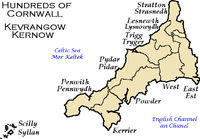 In England and Wales a hundred was the division of a shire for administrative, military and judicial purposes under the common law
and, until the introduction of districts by the Local Government Act 1894
, hundreds were the only widely used administrative unit between the parish and the county in size.
Originally, when introduced by the Saxons
between 613 and 1017, a hundred had enough land to sustain approximately one hundred households headed by a hundred-man or hundred eolder. He was responsible for administration, justice, and supplying military troops, as well as leading its forces. The office was not hereditary, but by the 10th century the office was selected from among a few outstanding families. Within each hundred there was a meeting place where the men of the hundred discussed local issues, and judicial trials were enacted. The role of the hundred court was described in the Dooms (laws) of King Edgar. The name of the hundred was normally that of its meeting-place.
In England
, specifically, it has been suggested that 'hundred' referred to the amount of land sufficient to sustain one hundred families, defined as the land covered by one hundred "hides".
Hundreds were further divided. Larger or more populous hundreds were split into divisions (or in Sussex, half hundreds). All hundreds were divided into tithings, which contained ten households. Below that, the basic unit of land was called the hide
, which was enough land to support one family and varied in size from 60 to 120 old acres, or 15 to 30 modern acres (6 to 12 ha) depending on the quality and fertility
of the land. Compare with township
.
Above the hundred was the shire
under the control of a shire-reeve
(or sheriff
). Hundred boundaries were independent of both parish and county boundaries, although often aligned, meaning that a hundred could be split between counties (usually only a fraction), or a parish could be split between hundreds.
The system of hundreds was not as stable as the system of counties being established at the time, and lists frequently differ on how many hundreds a county has. The Domesday Book contained a radically different set of hundreds than that which later became established, in many parts of the country. The number of hundreds in each county varied wildly. Leicestershire
had six (up from four at Domesday), whereas Devon
, nearly three times larger, had thirty-two.
system. Where the hundred was under the jurisdiction of the crown, the chief magistrate was a sheriff. However, many hundreds were in private hands, with the lordship of the hundred being attached to the principal manor
of the area and becoming hereditary. Where a hundred was under a lord, a steward
was appointed in place of a sheriff.
The importance of the hundred courts declined from the seventeenth century, and most of the powers were extinguished with the establishment of county court
s in 1867. The remaining duty of the inhabitants of a hundred to make good damages caused by riot
was ended in 1886, when the cost was transferred to the county police rate. Although hundreds had no administrative or legal role after this date, they have never been formally abolished.
Groupings of hundreds were used to define parliamentary constituencies from 1832 to 1885. On the redistribution of seats in 1885 a different county subdivision, the petty sessional division was used. Hundreds were also used to administer the first four national censuses from 1801 to 1841.
By the 19th century several different single-purpose subdivisions of counties, such as poor law union
s, sanitary district
s, and highway district
s sprang up, which, together with the introduction of urban district
s and rural district
s in 1894, replaced the administrative role previously played by hundreds and reduced the role of the parishes. Several ancient hundred names give their name to modern local government districts.
are notable as a legal fiction
, owing to a quirk of British Parliamentary law. A Crown Steward was appointed to maintain law and order in the area, but the position's duties ceased to be required in the 16th century, and the holder ceased to gain any benefits during the 17th century. The position has since been used as a procedural device to allow resignation from the House of Commons.
A wapentake is a term derived from the Old Norse
vápnatak, the rough equivalent of an Anglo-Saxon
hundred. The word denotes an administrative meeting place, typically a crossroads or a ford in a river. The origin of the word is not known. Folk etymology has it that voting would be denoted or conducted by the show of weapon
s, or alternately voting was done only by citizens, who were the only ones who could possess weapons, an idea perhaps suggested by references in The Germania of Tacitus
or current practice in the Swiss
canton of Appenzell Innerrhoden
. According to other authorities weapons were not flourished at a Norse þing and "weapon taking" or vopnatak was the end of an assembly, when one was allowed to take weapons up again, providing another possible origin of the wapentake.
The Danelaw
counties of Yorkshire
, Derbyshire
, Leicestershire
, Northamptonshire
, Nottinghamshire
, Rutland
and Lincolnshire
were divided into wapentakes, just as most of the remainder of England was divided into hundreds.
In Yorkshire, a Norse wapentake usually replaced several Anglo-Saxon hundreds. This process was complete by 1086 in the North and West Ridings, but continued in the East Riding until the mid 12th century.
In some counties, such as Leicestershire, the wapentakes recorded at the time of the Domesday Book
evolved into hundreds later on. In others, such as Lincolnshire
, the term remained in use. Although no longer part of local government, the structure of Wappentakes is largely preserved in Rural Deaneries (See, for example Beltisloe
or Loveden
).
The term ward was used in a similar manner in the four northern counties of Cumberland
, Durham
, Northumberland
and Westmorland
.
Lathes in Kent
and rapes in Sussex
consisted of several hundreds, and filled some roles usually associated with hundreds.
In Wales the hundred replaced traditional units such as the cantref (or cantred) or commote. Irish counties were divided into baronies.
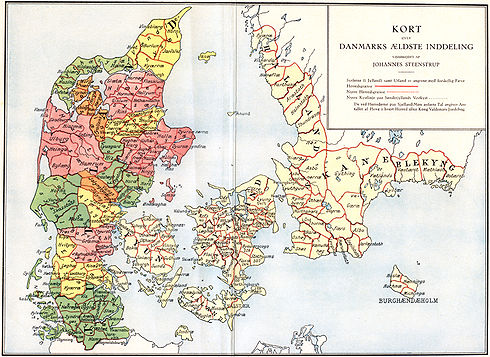 The term hundare (hundred) was used in Svealand
and present-day Finland
. Eventually that division was superseded by introducing the härad or Herred, which was the name in the rest of Scandinavia. This word was either derived from Proto-Norse *harja-raiðō (warband) or Proto-Germanic *harja-raiða (war equipment, cf. Wapentake). Similar to skipreide, a part of the coast where the inhabitants were responsible for equipping and manning a war ship.
Hundreds were not organized in Norrland
, the northern sparsely populated part of Sweden. In Sweden, a countryside härad was typically divided in a few socken units (parish), where the ecclestial and worldly administrative units often coincided. This began losing its basic significance through the communal reform of 1862 [sv]. A härad was originally a subdivision of a landskap (province), but since the government reform of 1634, län ("county") took over all administrative roles of landskap. A härad functioned also as electoral district for one peasant representative during the Riksdag of the Estates
(Swedish parliament 1436-1866). The häradsrätt[sv] (hundred court) was the court of first instance in the countryside, abolished in 1970 and superseded by tingsrätt
.
Today the hundreds serve no administrative role in Sweden, but are occasionally used in expressions, e.g. Sjuhäradsbygden.
It is not entirely clear when hundreds were organised in the western part of Finland. The name of the province of Satakunta, roughly meaning hundred (sata=100), hints at influences from the times before the Northern Crusades
, Christianization
, and incorporation into Sweden.
As kihlakunta, hundreds remained the fundamental administrative division for the state authorities until 2009. Each was subordinated to a lääni (province/county) and had its own police department, district court and prosecutors. Typically, cities would comprise an urban kihlakunta by themselves, but several rural municipalities would belong to a rural kihlakunta. Following the abolition of the provinces as an administrative unit, the territory for each authority could be demarcated separately, i.e. police districts need not equal court districts in number.
, New Jersey
and Pennsylvania
were divided into hundreds in the seventeenth century, in imitation of the English system. They survive in Delaware (see List of Delaware Counties and Hundreds), and were used as tax reporting and voting districts until the 1960s, but now serve no administrative role, their only official legal use being in real-estate title descriptions.
The hundred was also used as a division of the county in Maryland
. Carroll County, Maryland
, was composed in 1836 by taking the following hundreds from Baltimore County
: North Hundred, Pipe Creek Hundred, Delaware Upper Hundred, Delaware Lower Hundred and from Frederick County
: Pipe Creek Hundred, Westminster Hundred, Unity Hundred, Burnt House Hundred, Piney Creek Hundred, and Taneytown Hundred.
Some plantations in early colonial Virginia
used the term hundred in their names, such as Martin's Hundred
, Flowerdew Hundred
, and West and Shirley Hundred. Bermuda Hundred was the first incorporated town in the English colony of Virginia. It was founded by Sir Thomas Dale in 1613, six years after Jamestown.
While debating what became the Land Ordinance of 1785
, Thomas Jefferson
's committee wanted to divide the public lands in the west into “hundreds of ten geographical miles square, each mile containing 6086 and 4-10ths of a foot” The legislation instead introduced the six-mile square township
of the Public Land Survey System
.
listed on the system of titles, hundreds are not generally used when referring to a district and are little known by the general population. Cumberland County
(Sydney
) was also divided into hundreds in the nineteenth century, although these were later repealed. A hundred is traditionally one hundred square miles.
England
England is a country that is part of the United Kingdom. It shares land borders with Scotland to the north and Wales to the west; the Irish Sea is to the north west, the Celtic Sea to the south west, with the North Sea to the east and the English Channel to the south separating it from continental...
, Wales
Wales
Wales is a country that is part of the United Kingdom and the island of Great Britain, bordered by England to its east and the Atlantic Ocean and Irish Sea to its west. It has a population of three million, and a total area of 20,779 km²...
, Denmark
Denmark
Denmark is a Scandinavian country in Northern Europe. The countries of Denmark and Greenland, as well as the Faroe Islands, constitute the Kingdom of Denmark . It is the southernmost of the Nordic countries, southwest of Sweden and south of Norway, and bordered to the south by Germany. Denmark...
, South Australia
South Australia
South Australia is a state of Australia in the southern central part of the country. It covers some of the most arid parts of the continent; with a total land area of , it is the fourth largest of Australia's six states and two territories.South Australia shares borders with all of the mainland...
, some parts of the United States
United States
The United States of America is a federal constitutional republic comprising fifty states and a federal district...
, Germany
Germany
Germany , officially the Federal Republic of Germany , is a federal parliamentary republic in Europe. The country consists of 16 states while the capital and largest city is Berlin. Germany covers an area of 357,021 km2 and has a largely temperate seasonal climate...
(Southern Schleswig
Southern Schleswig
Southern Schleswig denotes the southern half of the former Duchy of Schleswig on the Jutland Peninsula. The geographical area today covers the thirty or forty northernmost kilometers of Germany up to the Flensburg Fjord, where it borders on Denmark...
), Sweden
Sweden
Sweden , officially the Kingdom of Sweden , is a Nordic country on the Scandinavian Peninsula in Northern Europe. Sweden borders with Norway and Finland and is connected to Denmark by a bridge-tunnel across the Öresund....
, Finland
Finland
Finland , officially the Republic of Finland, is a Nordic country situated in the Fennoscandian region of Northern Europe. It is bordered by Sweden in the west, Norway in the north and Russia in the east, while Estonia lies to its south across the Gulf of Finland.Around 5.4 million people reside...
and Norway
Norway
Norway , officially the Kingdom of Norway, is a Nordic unitary constitutional monarchy whose territory comprises the western portion of the Scandinavian Peninsula, Jan Mayen, and the Arctic archipelago of Svalbard and Bouvet Island. Norway has a total area of and a population of about 4.9 million...
, which historically was used to divide a larger region into smaller administrative division
Administrative division
An administrative division, subnational entity, or country subdivision is a portion of a country or other political division, established for the purpose of government. Administrative divisions are each granted a certain degree of autonomy, and are required to manage themselves through their own...
s. Alternative names include wapentake, herred (Danish, Norwegian bokmål), herad (Norwegian nynorsk), hérað (Icelandic), härad (Swedish), Harde (German) and kihlakunta (Finnish
Finnish language
Finnish is the language spoken by the majority of the population in Finland Primarily for use by restaurant menus and by ethnic Finns outside Finland. It is one of the two official languages of Finland and an official minority language in Sweden. In Sweden, both standard Finnish and Meänkieli, a...
).
The name "hundred" is derived from the number one hundred. It may once have referred to an area liable to provide for a hundred men under arms, or containing roughly a hundred homesteads. It was a traditional Germanic system described as early as AD 98 by Tacitus
Tacitus
Publius Cornelius Tacitus was a senator and a historian of the Roman Empire. The surviving portions of his two major works—the Annals and the Histories—examine the reigns of the Roman Emperors Tiberius, Claudius, Nero and those who reigned in the Year of the Four Emperors...
(the centeni). Similar systems were used in the traditional administrative regimes of China
China
Chinese civilization may refer to:* China for more general discussion of the country.* Chinese culture* Greater China, the transnational community of ethnic Chinese.* History of China* Sinosphere, the area historically affected by Chinese culture...
and Japan
Japan
Japan is an island nation in East Asia. Located in the Pacific Ocean, it lies to the east of the Sea of Japan, China, North Korea, South Korea and Russia, stretching from the Sea of Okhotsk in the north to the East China Sea and Taiwan in the south...
.
England and Wales
Common law
Common law is law developed by judges through decisions of courts and similar tribunals rather than through legislative statutes or executive branch action...
and, until the introduction of districts by the Local Government Act 1894
Local Government Act 1894
The Local Government Act 1894 was an Act of the Parliament of the United Kingdom that reformed local government in England and Wales outside the County of London. The Act followed the reforms carried out at county level under the Local Government Act 1888...
, hundreds were the only widely used administrative unit between the parish and the county in size.
Originally, when introduced by the Saxons
Saxons
The Saxons were a confederation of Germanic tribes originating on the North German plain. The Saxons earliest known area of settlement is Northern Albingia, an area approximately that of modern Holstein...
between 613 and 1017, a hundred had enough land to sustain approximately one hundred households headed by a hundred-man or hundred eolder. He was responsible for administration, justice, and supplying military troops, as well as leading its forces. The office was not hereditary, but by the 10th century the office was selected from among a few outstanding families. Within each hundred there was a meeting place where the men of the hundred discussed local issues, and judicial trials were enacted. The role of the hundred court was described in the Dooms (laws) of King Edgar. The name of the hundred was normally that of its meeting-place.
In England
England
England is a country that is part of the United Kingdom. It shares land borders with Scotland to the north and Wales to the west; the Irish Sea is to the north west, the Celtic Sea to the south west, with the North Sea to the east and the English Channel to the south separating it from continental...
, specifically, it has been suggested that 'hundred' referred to the amount of land sufficient to sustain one hundred families, defined as the land covered by one hundred "hides".
Hundreds were further divided. Larger or more populous hundreds were split into divisions (or in Sussex, half hundreds). All hundreds were divided into tithings, which contained ten households. Below that, the basic unit of land was called the hide
Hide (unit)
The hide was originally an amount of land sufficient to support a household, but later in Anglo-Saxon England became a unit used in assessing land for liability to "geld", or land tax. The geld would be collected at a stated rate per hide...
, which was enough land to support one family and varied in size from 60 to 120 old acres, or 15 to 30 modern acres (6 to 12 ha) depending on the quality and fertility
Fertility
Fertility is the natural capability of producing offsprings. As a measure, "fertility rate" is the number of children born per couple, person or population. Fertility differs from fecundity, which is defined as the potential for reproduction...
of the land. Compare with township
Township (England)
In England, a township is a local division or district of a large parish containing a village or small town usually having its own church...
.
Above the hundred was the shire
Shire
A shire is a traditional term for a division of land, found in the United Kingdom and in Australia. In parts of Australia, a shire is an administrative unit, but it is not synonymous with "county" there, which is a land registration unit. Individually, or as a suffix in Scotland and in the far...
under the control of a shire-reeve
Reeve (England)
Originally in Anglo-Saxon England the reeve was a senior official with local responsibilities under the Crown e.g. as the chief magistrate of a town or district...
(or sheriff
Sheriff
A sheriff is in principle a legal official with responsibility for a county. In practice, the specific combination of legal, political, and ceremonial duties of a sheriff varies greatly from country to country....
). Hundred boundaries were independent of both parish and county boundaries, although often aligned, meaning that a hundred could be split between counties (usually only a fraction), or a parish could be split between hundreds.
The system of hundreds was not as stable as the system of counties being established at the time, and lists frequently differ on how many hundreds a county has. The Domesday Book contained a radically different set of hundreds than that which later became established, in many parts of the country. The number of hundreds in each county varied wildly. Leicestershire
Leicestershire
Leicestershire is a landlocked county in the English Midlands. It takes its name from the heavily populated City of Leicester, traditionally its administrative centre, although the City of Leicester unitary authority is today administered separately from the rest of Leicestershire...
had six (up from four at Domesday), whereas Devon
Devon
Devon is a large county in southwestern England. The county is sometimes referred to as Devonshire, although the term is rarely used inside the county itself as the county has never been officially "shired", it often indicates a traditional or historical context.The county shares borders with...
, nearly three times larger, had thirty-two.
Hundred courts
Over time, the principal functions of the hundred became the administration of law and the keeping of the peace. By the twelfth century the hundred court was held twelve times a year. This was later increased to being held fortnightly, although an ordinance of 1234 reduced the frequency to once every three weeks. In some hundreds, courts were held at a fixed place; while in others, courts moved with each sitting to a different location. The main duties of the hundred court were the maintenance of the frankpledgeFrankpledge
Frankpledge, earlier known as frith-borh , was a system of joint suretyship common in England throughout the Early Middle Ages. The essential characteristic was the compulsory sharing of responsibility among persons connected through kinship, or some other kind of tie such as an oath of fealty to a...
system. Where the hundred was under the jurisdiction of the crown, the chief magistrate was a sheriff. However, many hundreds were in private hands, with the lordship of the hundred being attached to the principal manor
Lord of the Manor
The Lordship of a Manor is recognised today in England and Wales as a form of property and one of three elements of a manor that may exist separately or be combined and may be held in moieties...
of the area and becoming hereditary. Where a hundred was under a lord, a steward
Steward (office)
A steward is an official who is appointed by the legal ruling monarch to represent him or her in a country, and may have a mandate to govern it in his or her name; in the latter case, it roughly corresponds with the position of governor or deputy...
was appointed in place of a sheriff.
The importance of the hundred courts declined from the seventeenth century, and most of the powers were extinguished with the establishment of county court
County Court
A county court is a court based in or with a jurisdiction covering one or more counties, which are administrative divisions within a country, not to be confused with the medieval system of county courts held by the High Sheriff of each county.-England and Wales:County Court matters can be lodged...
s in 1867. The remaining duty of the inhabitants of a hundred to make good damages caused by riot
Riot
A riot is a form of civil disorder characterized often by what is thought of as disorganized groups lashing out in a sudden and intense rash of violence against authority, property or people. While individuals may attempt to lead or control a riot, riots are thought to be typically chaotic and...
was ended in 1886, when the cost was transferred to the county police rate. Although hundreds had no administrative or legal role after this date, they have never been formally abolished.
Administrative functions
Until the middle of the 19th century, hundreds had performed important administrative functions since the 11th century in England, and to a lesser extent from the 16th century in Wales. Of particular importance was their use for taxation, and six centuries of taxation returns for the hundreds survive to this day.Groupings of hundreds were used to define parliamentary constituencies from 1832 to 1885. On the redistribution of seats in 1885 a different county subdivision, the petty sessional division was used. Hundreds were also used to administer the first four national censuses from 1801 to 1841.
By the 19th century several different single-purpose subdivisions of counties, such as poor law union
Poor Law Union
A Poor Law Union was a unit used for local government in the United Kingdom from the 19th century. The administration of the Poor Law was the responsibility of parishes, which varied wildly in their size, populations, financial resources, rateable values and requirements...
s, sanitary district
Sanitary district
Sanitary districts were established in England and Wales in 1875 and in Ireland in 1878. The districts were of two types, based on existing structures:*Urban sanitary districts in towns with existing local government bodies...
s, and highway district
Highway district
Highway Districts were areas in England and Wales united for the maintenance and repair of highways. They were first formed in 1862 and consisted of groupings of civil parishes in rural areas...
s sprang up, which, together with the introduction of urban district
Urban district
In the England, Wales and Ireland, an urban district was a type of local government district that covered an urbanised area. Urban districts had an elected Urban District Council , which shared local government responsibilities with a county council....
s and rural district
Rural district
Rural districts were a type of local government area – now superseded – established at the end of the 19th century in England, Wales, and Ireland for the administration of predominantly rural areas at a level lower than that of the administrative counties.-England and Wales:In England...
s in 1894, replaced the administrative role previously played by hundreds and reduced the role of the parishes. Several ancient hundred names give their name to modern local government districts.
Chiltern Hundreds
The Chiltern HundredsChiltern Hundreds
Appointment to the office of Crown Steward and Bailiff of the three Chiltern Hundreds of Stoke, Desborough and Burnham is a sinecure appointment which is used as a device allowing a Member of the United Kingdom Parliament to resign his or her seat...
are notable as a legal fiction
Legal fiction
A legal fiction is a fact assumed or created by courts which is then used in order to apply a legal rule which was not necessarily designed to be used in that way...
, owing to a quirk of British Parliamentary law. A Crown Steward was appointed to maintain law and order in the area, but the position's duties ceased to be required in the 16th century, and the holder ceased to gain any benefits during the 17th century. The position has since been used as a procedural device to allow resignation from the House of Commons.
Other terms
A wapentake is a term derived from the Old Norse
Old Norse
Old Norse is a North Germanic language that was spoken by inhabitants of Scandinavia and inhabitants of their overseas settlements during the Viking Age, until about 1300....
vápnatak, the rough equivalent of an Anglo-Saxon
Anglo-Saxons
Anglo-Saxon is a term used by historians to designate the Germanic tribes who invaded and settled the south and east of Great Britain beginning in the early 5th century AD, and the period from their creation of the English nation to the Norman conquest. The Anglo-Saxon Era denotes the period of...
hundred. The word denotes an administrative meeting place, typically a crossroads or a ford in a river. The origin of the word is not known. Folk etymology has it that voting would be denoted or conducted by the show of weapon
Weapon
A weapon, arm, or armament is a tool or instrument used with the aim of causing damage or harm to living beings or artificial structures or systems...
s, or alternately voting was done only by citizens, who were the only ones who could possess weapons, an idea perhaps suggested by references in The Germania of Tacitus
Tacitus
Publius Cornelius Tacitus was a senator and a historian of the Roman Empire. The surviving portions of his two major works—the Annals and the Histories—examine the reigns of the Roman Emperors Tiberius, Claudius, Nero and those who reigned in the Year of the Four Emperors...
or current practice in the Swiss
Switzerland
Switzerland name of one of the Swiss cantons. ; ; ; or ), in its full name the Swiss Confederation , is a federal republic consisting of 26 cantons, with Bern as the seat of the federal authorities. The country is situated in Western Europe,Or Central Europe depending on the definition....
canton of Appenzell Innerrhoden
Appenzell Innerrhoden
Appenzell Innerrhoden is the smallest canton of Switzerland by population and the second smallest by area, Basel-City having less area.-Foundation:...
. According to other authorities weapons were not flourished at a Norse þing and "weapon taking" or vopnatak was the end of an assembly, when one was allowed to take weapons up again, providing another possible origin of the wapentake.
The Danelaw
Danelaw
The Danelaw, as recorded in the Anglo-Saxon Chronicle , is a historical name given to the part of England in which the laws of the "Danes" held sway and dominated those of the Anglo-Saxons. It is contrasted with "West Saxon law" and "Mercian law". The term has been extended by modern historians to...
counties of Yorkshire
Yorkshire
Yorkshire is a historic county of northern England and the largest in the United Kingdom. Because of its great size in comparison to other English counties, functions have been increasingly undertaken over time by its subdivisions, which have also been subject to periodic reform...
, Derbyshire
Derbyshire
Derbyshire is a county in the East Midlands of England. A substantial portion of the Peak District National Park lies within Derbyshire. The northern part of Derbyshire overlaps with the Pennines, a famous chain of hills and mountains. The county contains within its boundary of approx...
, Leicestershire
Leicestershire
Leicestershire is a landlocked county in the English Midlands. It takes its name from the heavily populated City of Leicester, traditionally its administrative centre, although the City of Leicester unitary authority is today administered separately from the rest of Leicestershire...
, Northamptonshire
Northamptonshire
Northamptonshire is a landlocked county in the English East Midlands, with a population of 629,676 as at the 2001 census. It has boundaries with the ceremonial counties of Warwickshire to the west, Leicestershire and Rutland to the north, Cambridgeshire to the east, Bedfordshire to the south-east,...
, Nottinghamshire
Nottinghamshire
Nottinghamshire is a county in the East Midlands of England, bordering South Yorkshire to the north-west, Lincolnshire to the east, Leicestershire to the south, and Derbyshire to the west...
, Rutland
Rutland
Rutland is a landlocked county in central England, bounded on the west and north by Leicestershire, northeast by Lincolnshire and southeast by Peterborough and Northamptonshire....
and Lincolnshire
Lincolnshire
Lincolnshire is a county in the east of England. It borders Norfolk to the south east, Cambridgeshire to the south, Rutland to the south west, Leicestershire and Nottinghamshire to the west, South Yorkshire to the north west, and the East Riding of Yorkshire to the north. It also borders...
were divided into wapentakes, just as most of the remainder of England was divided into hundreds.
In Yorkshire, a Norse wapentake usually replaced several Anglo-Saxon hundreds. This process was complete by 1086 in the North and West Ridings, but continued in the East Riding until the mid 12th century.
In some counties, such as Leicestershire, the wapentakes recorded at the time of the Domesday Book
Domesday Book
Domesday Book , now held at The National Archives, Kew, Richmond upon Thames in South West London, is the record of the great survey of much of England and parts of Wales completed in 1086...
evolved into hundreds later on. In others, such as Lincolnshire
Lincolnshire
Lincolnshire is a county in the east of England. It borders Norfolk to the south east, Cambridgeshire to the south, Rutland to the south west, Leicestershire and Nottinghamshire to the west, South Yorkshire to the north west, and the East Riding of Yorkshire to the north. It also borders...
, the term remained in use. Although no longer part of local government, the structure of Wappentakes is largely preserved in Rural Deaneries (See, for example Beltisloe
Beltisloe
Beltisloe is a Deanery of the Diocese of Lincoln England, and a former Wapentake.The Wapentake of Beltisloe, was an old administrative division of the English county of Lincolnshire. In England a wapentake was the division of a shire for administrative, military and judicial purposes under the...
or Loveden
Loveden
Loveden is a Deanery of the Diocese of Lincoln, England, and a former Wapentake.Loveden is located broadly to the North of Grantham and includes the villages from Long Bennington in the west to Culverthorpe in the east, and from Welby in the south as far north as Welbourn...
).
The term ward was used in a similar manner in the four northern counties of Cumberland
Cumberland
Cumberland is a historic county of North West England, on the border with Scotland, from the 12th century until 1974. It formed an administrative county from 1889 to 1974 and now forms part of Cumbria....
, Durham
County Durham
County Durham is a ceremonial county and unitary district in north east England. The county town is Durham. The largest settlement in the ceremonial county is the town of Darlington...
, Northumberland
Northumberland
Northumberland is the northernmost ceremonial county and a unitary district in North East England. For Eurostat purposes Northumberland is a NUTS 3 region and is one of three boroughs or unitary districts that comprise the "Northumberland and Tyne and Wear" NUTS 2 region...
and Westmorland
Westmorland
Westmorland is an area of North West England and one of the 39 historic counties of England. It formed an administrative county from 1889 to 1974, after which the entirety of the county was absorbed into the new county of Cumbria.-Early history:...
.
Lathes in Kent
Kent
Kent is a county in southeast England, and is one of the home counties. It borders East Sussex, Surrey and Greater London and has a defined boundary with Essex in the middle of the Thames Estuary. The ceremonial county boundaries of Kent include the shire county of Kent and the unitary borough of...
and rapes in Sussex
Sussex
Sussex , from the Old English Sūþsēaxe , is an historic county in South East England corresponding roughly in area to the ancient Kingdom of Sussex. It is bounded on the north by Surrey, east by Kent, south by the English Channel, and west by Hampshire, and is divided for local government into West...
consisted of several hundreds, and filled some roles usually associated with hundreds.
In Wales the hundred replaced traditional units such as the cantref (or cantred) or commote. Irish counties were divided into baronies.
Scandinavia
Svealand
Svealand , Swealand or Sweden proper is the historical core region of Sweden. It is located in south central Sweden and is one of three lands of Sweden, bounded to the north by Norrland and to the south by Götaland. Deep forests, Tiveden, Tylöskog, Kolmården, separated Svealand from Götaland...
and present-day Finland
Finland
Finland , officially the Republic of Finland, is a Nordic country situated in the Fennoscandian region of Northern Europe. It is bordered by Sweden in the west, Norway in the north and Russia in the east, while Estonia lies to its south across the Gulf of Finland.Around 5.4 million people reside...
. Eventually that division was superseded by introducing the härad or Herred, which was the name in the rest of Scandinavia. This word was either derived from Proto-Norse *harja-raiðō (warband) or Proto-Germanic *harja-raiða (war equipment, cf. Wapentake). Similar to skipreide, a part of the coast where the inhabitants were responsible for equipping and manning a war ship.
Hundreds were not organized in Norrland
Norrland
Norrland is one of the three lands of Sweden , the northern part, consisting of nine provinces. The term Norrland is not used for any administrative purpose, but it is common in everyday language, e.g...
, the northern sparsely populated part of Sweden. In Sweden, a countryside härad was typically divided in a few socken units (parish), where the ecclestial and worldly administrative units often coincided. This began losing its basic significance through the communal reform of 1862 [sv]. A härad was originally a subdivision of a landskap (province), but since the government reform of 1634, län ("county") took over all administrative roles of landskap. A härad functioned also as electoral district for one peasant representative during the Riksdag of the Estates
Riksdag of the Estates
The Riksdag of the Estates , was the name used for the Estates of the Swedish realm when they were assembled. Until its dissolution in 1866, the institution was the highest authority in Sweden next to the King...
(Swedish parliament 1436-1866). The häradsrätt[sv] (hundred court) was the court of first instance in the countryside, abolished in 1970 and superseded by tingsrätt
Tingsrätt
Tingsrätt , käräjäoikeus or tingrett is a term used for district courts in Sweden, Finland and Norway...
.
Today the hundreds serve no administrative role in Sweden, but are occasionally used in expressions, e.g. Sjuhäradsbygden.
It is not entirely clear when hundreds were organised in the western part of Finland. The name of the province of Satakunta, roughly meaning hundred (sata=100), hints at influences from the times before the Northern Crusades
Northern Crusades
The Northern Crusades or Baltic Crusades were crusades undertaken by the Christian kings of Denmark and Sweden, the German Livonian and Teutonic military orders, and their allies against the pagan peoples of Northern Europe around the southern and eastern shores of the Baltic Sea...
, Christianization
Christianization
The historical phenomenon of Christianization is the conversion of individuals to Christianity or the conversion of entire peoples at once...
, and incorporation into Sweden.
As kihlakunta, hundreds remained the fundamental administrative division for the state authorities until 2009. Each was subordinated to a lääni (province/county) and had its own police department, district court and prosecutors. Typically, cities would comprise an urban kihlakunta by themselves, but several rural municipalities would belong to a rural kihlakunta. Following the abolition of the provinces as an administrative unit, the territory for each authority could be demarcated separately, i.e. police districts need not equal court districts in number.
United States
Counties in DelawareDelaware
Delaware is a U.S. state located on the Atlantic Coast in the Mid-Atlantic region of the United States. It is bordered to the south and west by Maryland, and to the north by Pennsylvania...
, New Jersey
New Jersey
New Jersey is a state in the Northeastern and Middle Atlantic regions of the United States. , its population was 8,791,894. It is bordered on the north and east by the state of New York, on the southeast and south by the Atlantic Ocean, on the west by Pennsylvania and on the southwest by Delaware...
and Pennsylvania
Pennsylvania
The Commonwealth of Pennsylvania is a U.S. state that is located in the Northeastern and Mid-Atlantic regions of the United States. The state borders Delaware and Maryland to the south, West Virginia to the southwest, Ohio to the west, New York and Ontario, Canada, to the north, and New Jersey to...
were divided into hundreds in the seventeenth century, in imitation of the English system. They survive in Delaware (see List of Delaware Counties and Hundreds), and were used as tax reporting and voting districts until the 1960s, but now serve no administrative role, their only official legal use being in real-estate title descriptions.
The hundred was also used as a division of the county in Maryland
Maryland
Maryland is a U.S. state located in the Mid Atlantic region of the United States, bordering Virginia, West Virginia, and the District of Columbia to its south and west; Pennsylvania to its north; and Delaware to its east...
. Carroll County, Maryland
Carroll County, Maryland
Carroll County is a county located in the U.S. state of Maryland. In 2010, its population was 167,134. It was named for Charles Carroll of Carrollton , signer of the American Declaration of Independence. Its county seat is Westminster....
, was composed in 1836 by taking the following hundreds from Baltimore County
Baltimore County, Maryland
Baltimore County is a county located in the northern part of the US state of Maryland. In 2010, its population was 805,029. It is part of the Baltimore-Washington Metropolitan Area. Its county seat is Towson. The name of the county was derived from the barony of the Proprietor of the Maryland...
: North Hundred, Pipe Creek Hundred, Delaware Upper Hundred, Delaware Lower Hundred and from Frederick County
Frederick County, Maryland
Frederick County is a county located in the western part of the U.S. state of Maryland, bordering the southern border of Pennsylvania and the northeastern border of Virginia. As of the 2010 Census, the population was 233,385....
: Pipe Creek Hundred, Westminster Hundred, Unity Hundred, Burnt House Hundred, Piney Creek Hundred, and Taneytown Hundred.
Some plantations in early colonial Virginia
Virginia
The Commonwealth of Virginia , is a U.S. state on the Atlantic Coast of the Southern United States. Virginia is nicknamed the "Old Dominion" and sometimes the "Mother of Presidents" after the eight U.S. presidents born there...
used the term hundred in their names, such as Martin's Hundred
Martin's Hundred
Martin's Hundred was an early 17th century plantation located along about ten miles of the north shore of the James River in the Virginia Colony east of Jamestown in the southeastern portion of present-day James City County, Virginia...
, Flowerdew Hundred
Flowerdew Hundred Plantation
Flowerdew Hundred Plantation dates to 1618/19 with the patent by Sir George Yeardley, the Governor and Captain General of Virginia, of on the south side of the James River. Yeardley probably named the plantation after his wife's wealthy father, Anthony Flowerdew, just as he named another...
, and West and Shirley Hundred. Bermuda Hundred was the first incorporated town in the English colony of Virginia. It was founded by Sir Thomas Dale in 1613, six years after Jamestown.
While debating what became the Land Ordinance of 1785
Land Ordinance of 1785
The Land Ordinance of 1785 was adopted by the United States Congress on May 20, 1785. Under the Articles of Confederation, Congress did not have the power to raise revenue by direct taxation of the inhabitants of the United States...
, Thomas Jefferson
Thomas Jefferson
Thomas Jefferson was the principal author of the United States Declaration of Independence and the Statute of Virginia for Religious Freedom , the third President of the United States and founder of the University of Virginia...
's committee wanted to divide the public lands in the west into “hundreds of ten geographical miles square, each mile containing 6086 and 4-10ths of a foot” The legislation instead introduced the six-mile square township
Survey township
Survey township, sometimes called Congressional township, as used by the United States Public Land Survey System, refers to a square unit of land, that is nominally six miles on a side...
of the Public Land Survey System
Public Land Survey System
The Public Land Survey System is a method used in the United States to survey and identify land parcels, particularly for titles and deeds of rural, wild or undeveloped land. Its basic units of area are the township and section. It is sometimes referred to as the rectangular survey system,...
.
Australia
In South Australia land titles still record which hundred a parcel of land is located in. Similar to the notion of the South Australian countiesCadastral divisions of South Australia
The Lands administrative divisions of South Australia refers to the cadastral units of counties, and hundreds in South Australia.These form part of the Lands administrative divisions of Australia. They are located in the south-eastern part of the state and do not cover the whole state...
listed on the system of titles, hundreds are not generally used when referring to a district and are little known by the general population. Cumberland County
Cumberland County, New South Wales
Cumberland County is a county in the State of New South Wales, Australia. Most of the Sydney metropolitan area is located within the County of Cumberland....
(Sydney
Sydney
Sydney is the most populous city in Australia and the state capital of New South Wales. Sydney is located on Australia's south-east coast of the Tasman Sea. As of June 2010, the greater metropolitan area had an approximate population of 4.6 million people...
) was also divided into hundreds in the nineteenth century, although these were later repealed. A hundred is traditionally one hundred square miles.
See also
- AttundalandAttundalandAttundaland was the name given to the southeastern part of the present day province of Uppland, north of Stockholm. Its name refers to its role of providing 800 men and 32 ships for the leidang of the Swedish kings at Uppsala.Snorri Sturluson relates that Tiundaland was the richest and most...
- Cantref
- Chiltern HundredsChiltern HundredsAppointment to the office of Crown Steward and Bailiff of the three Chiltern Hundreds of Stoke, Desborough and Burnham is a sinecure appointment which is used as a device allowing a Member of the United Kingdom Parliament to resign his or her seat...
- Feudal measurement
- FjärdhundralandFjärdhundralandFjärdhundraland or the land of the four hundreds is, since 1296, a part of the province of Uppland in Sweden. Its name refers to its role of providing 400 men and 16 ships for the leidang of the Swedish king at Uppsala....
- Henry de BractonHenry de BractonHenry of Bracton, also Henry de Bracton, also Henrici Bracton, or Henry Bratton also Henry Bretton was an English jurist....
- Hundred RollsHundred RollsThe Hundred Rolls are a census of England and parts of what is now Wales taken in the late thirteenth century. Often considered an attempt to produce a second Domesday Book, they are named for the hundreds by which most returns were recorded....
- LeidangLeidangThe institution known as leiðangr , leidang , leding, , ledung , expeditio or sometimes lething , was a public levy of free farmers typical for medieval Scandinavians. It was a form of conscription to organise coastal fleets for seasonal excursions and in defence of the realm...
- List of hundreds of England and Wales
- List of hundreds of Sweden
- Moot moundMoot hallA moot hall is meeting or assembly building, traditionally to decide local issues.In Anglo-Saxon England, a low ring-shaped earthwork served as a moot hill or moot mound, where the elders of the hundred would meet to take decisions. Some of these acquired permanent buildings, known as moot halls...
, the meeting place of an Anglo-Saxon hundred - RoslagenRoslagenRoslagen is the name of the coastal areas of Uppland province in Sweden, which also constitutes the northern part of the Stockholm archipelago....
- TiundalandTiundalandTiundaland is a historic region, Folkland, and since 1296 part of the modern province of Uppland. It originally meant the land of the ten hundreds and referred to its duty of providing 1000 men and 40 ships for the Swedish king's leidang....