
All Topics  
Royal Corps of Signals


   Email Print
   Bookmark   Link


Royal Corps of Signals


The Royal Corps of Signals (often simply known as the Royal Signals - abbreviated to R SIGNALS) is one of the combat support arms of the British Army
British Army

The British Army is the Army branch of the British Armed Forces. It came into being with the unification of the Kingdoms of Kingdom of England and Kingdom of Scotland into the Kingdom of Great Britain in 1707....
. It is responsible for installing, maintaining and operating all types of telecommunications equipment and information
Information technology

Information technology , as defined by the Information Technology Association of America , is "the study, design, development, implementation, support or management of computer-based information systems, particularly software applications and computer hardware." IT deals with the use of electronic computers and computer software to data conv...
 systems, providing command support to commanders and their headquarters, and conducting electronic warfare against enemy communications.
Personnel
Training & trades
Royal Signals officers receive a general military training at the Royal Military Academy Sandhurst
Royal Military Academy Sandhurst

The Royal Military Academy Sandhurst , commonly known simply as Sandhurst, is the British Army Commissioned officer initial training centre....
, followed by specialist communications training at the Royal School of Signals
Royal School of Signals

The Royal School of Signals is a military training establishment that is part of the United Kingdom's Defence College of Communications and Information Systems....
, Blandford Camp
Blandford Camp

Blandford Camp is a military base comprising some 390 hectares of downland lying 2 miles north-east of Blandford Forum in the county of Dorset in southern England....
, Dorset
Dorset

Dorset , is a Counties of England in South West England on the English Channel coast. The county town is Dorchester, Dorset, situated in the south of the county at ....
.


Discussion
Ask a question about 'Royal Corps of Signals'
Start a new discussion about 'Royal Corps of Signals'
Answer questions from other users
Full Discussion Forum


Recent Posts


Encyclopedia


The Royal Corps of Signals (often simply known as the Royal Signals - abbreviated to R SIGNALS) is one of the combat support arms of the British Army
British Army

The British Army is the Army branch of the British Armed Forces. It came into being with the unification of the Kingdoms of Kingdom of England and Kingdom of Scotland into the Kingdom of Great Britain in 1707....
. It is responsible for installing, maintaining and operating all types of telecommunications equipment and information
Information technology

Information technology , as defined by the Information Technology Association of America , is "the study, design, development, implementation, support or management of computer-based information systems, particularly software applications and computer hardware." IT deals with the use of electronic computers and computer software to data conv...
 systems, providing command support to commanders and their headquarters, and conducting electronic warfare against enemy communications.

Personnel


Training & trades


Royal Signals officers receive a general military training at the Royal Military Academy Sandhurst
Royal Military Academy Sandhurst

The Royal Military Academy Sandhurst , commonly known simply as Sandhurst, is the British Army Commissioned officer initial training centre....
, followed by specialist communications training at the Royal School of Signals
Royal School of Signals

The Royal School of Signals is a military training establishment that is part of the United Kingdom's Defence College of Communications and Information Systems....
, Blandford Camp
Blandford Camp

Blandford Camp is a military base comprising some 390 hectares of downland lying 2 miles north-east of Blandford Forum in the county of Dorset in southern England....
, Dorset
Dorset

Dorset , is a Counties of England in South West England on the English Channel coast. The county town is Dorchester, Dorset, situated in the south of the county at ....
. Officers are not differentiated into trade groups - their training covers the whole range of their future employment.

Other ranks are trained both as field soldiers and tradesmen. Their basic military training is delivered at the Army Foundation College
Army Foundation College

The Army Foundation College in Harrogate AFC trains future soldiers from all cap badges except the Royal Military Police. School leavers aged between 16 and 17 years and one month of age are eligible to join, the AFC offers young men and women the opportunity to learn as you earn....
 Harrogate or the Army Training Regiment
Army Training Regiment

An Army Training Regiment is a unit of the British Army which conducts basic training for all new recruits, less adult Infantry recruits who are trained at the ITC at Catterick North Yorkshire, and some non-infantry TA units ....
 Pirbright before undergoing trade training at 11 Signal Regiment, (part of the Royal School of Signals
Royal School of Signals

The Royal School of Signals is a military training establishment that is part of the United Kingdom's Defence College of Communications and Information Systems....
). There are currently seven different trades available to other ranks
Other Ranks

Other Ranks in the British Army, Royal Marines and Royal Air Force are those personnel who are not commissioned officers. In the Royal Navy, these personnel are called Naval ratings....
 , each of which is open to both men and women:

  • Communication Systems Operator: an expert in military radio and trunk communications systems
  • Communication Systems Engineer: an expert in data communications and computer networks
  • Royal Signals Electrician: an expert in maintaining and repairing generators and providing electrical power
  • Driver Lineman: an expert in driving, laying line and installing cabling
  • Installation Technician: an expert in installing and repairing fibreoptics and telephone systems
  • Electronic Warfare Systems Operator: an expert in intercepting and jamming enemy communications
  • Technical Supply Specialist: an expert in managing and accounting for communications equipment


Staff sergeants and warrant officers work in one of five supervisory rosters:
  • Yeoman of Signals - experts in the planning and deployment of military tactical/strategic communications networks;
  • Yeoman of Signals (Electronic Warfare) - experts in the planning and deployment of military tactical/strategic electronic warfare assets;
  • Foreman of Signals - experts in the installation, maintenance, repair and interoperability of military tactical/strategic communications assets;
  • Foreman of Signals (Information Systems) - experts in the installation, maintenance, repair and interoperability of military tactical/strategic Information Systems;
  • Regimental Duty - experts in the daily routine and running of a unit.


History


Origins


In 1870, 'C' Telegraph Troop, Royal Engineers
Royal Engineers

The Corps of Royal Engineers, usually just called the Royal Engineers , and commonly known as the Sappers, is one of the Structure of the British Army of the British Army....
, was founded under Captain Montague Lambert. The Troop
Troop

A troop is a military unit, originally a small force of cavalry, subordinate to a squadron and headed by the troop leader. A cavalry soldier of Private is called a Trooper ....
 was the first formal professional body of signallers in the British Army and its duty was to provide communications for a field army by means of visual signalling, mounted orderlies and telegraph. By 1871, 'C' Troop had expanded in size from 2 officers and 133 other ranks to 5 officers and 245 other ranks. In 1879, 'C' Troop first saw action during the Anglo-Zulu War
Anglo-Zulu War

The Anglo-Zulu War was fought in 1879 between the British Empire and the Zulu Empire. From complex beginnings, the war is notable for several particularly bloody battles, as well as for being a landmark in the timeline of colonialism in the region....
. On 1 May 1884, 'C' Troop was amalgamated with the 22nd and 34th Companies, Royal Engineers, to form the Telegraph Battalion Royal Engineers; 'C' Troop formed the 1st Division (Field Force, based at Aldershot
Aldershot

Aldershot is a town in the England county of Hampshire, located on heathland about 60 km southwest of London. The town is administered by Rushmoor Borough Council....
) while the two Royal Engineers companies formed the 2nd Division (Postal and Telegraph, based in London
London

London is the capital of both England and the United Kingdom, and the most populous municipality in the European Union. An important settlement for two millennia, History of London goes back to its founding by the Roman Empire....
). Signalling was the responsibility of the Telegraph Battalion
Battalion

A battalion is a military unit of around 500-1500 men usually consisting of between two and seven company and typically commanded by a Lieutenant Colonel....
 until 1908, when the Royal Engineers Signal Service was formed. As such it provided communications during World War I
World War I

World War I, or the First World War , was a global military conflict which involved the Great powers, organized into two opposing military alliances: the Allies of World War I and the Central Powers....
. It was about this time that motorcycle
Motorcycle

A motorcycle is a Single track, two-wheeled motor vehicle powered by an Motorcycle engine. Motorcycles vary considerably depending on the task for which they are designed, such as Touring motorcycle travel, navigating Naked bike, Cruiser , Motorcycle sport and Motorbike racing, or off-road conditions....
 despatch rider
Despatch rider

A despatch rider is a military messenger, mounted on horse or motorcycle.Despatch riders were used by armed forces to deliver urgent orders and messages between headquarters and military units....
s and wireless
Wireless

Wireless communication is the transfer of information over a distance without the use of electrical conductors or "wires". The distances involved may be short or long ....
 sets were introduced into service.

Royal Warrant

A Royal Warrant
Royal Warrant

Royal Warrants of Appointment have been issued for centuries to those who supply goods or services to a royal court or certain royal personages....
 for the creation of a Corps of Signals was signed by the Secretary of State for War
Secretary of State for War

The position of Secretary of State for War, commonly called War Secretary, was a United Kingdom Cabinet -level position, first applied to Henry Dundas ....
, Winston Churchill
Winston Churchill

Sir Winston Leonard Spencer-Churchill, Order of the Garter, Order of Merit, Order of the Companions of Honour, Territorial Decoration, Fellow of the Royal Society, Her Majesty's Most Honourable Privy Council, Queen's Privy Council for Canada was a Politics of the United Kingdom known chiefly for his leadership of the United King...
, on 28 June 1920. Six weeks later, King George V
George V of the United Kingdom

George V was the first British monarch belonging to the House of Windsor, which he created from the British branch of the German House of Saxe-Coburg and Gotha....
 conferred the title Royal Corps of Signals. It was given precedence immediately after the Royal Engineers.

Subsequent History

Before the Second World War, Royal Signals recruits were required to be at least 5 feet 2 inches tall. They initially enlisted for eight years with the colours and a further four years with the reserve. They trained at the Signal Training Centre at Catterick Camp. All personnel were taught to ride.

Throughout World War II
World War II

World War II, or the Second World War , was a global military conflict which involved a Participants in World War II, including all of the great powers, organised into two opposing military alliances: the Allies of World War II and the Axis powers....
, members of the Corps served in every theatre of war. By the end of the war the strength of the Corps was 8,518 officers and 142,472 men. In one famous episode, Corporal Thomas Waters of 5th Parachute Brigade Signal Section was awarded the Military Medal for laying and maintaining the field telephone line under heavy enemy fire across the Caen Canal Bridge on D Day 1944.

In the immediate post-war period, the Corps played a full and active part in numerous campaigns, including Palestine
Palestine

Palestine is a name which has been widely used since Roman times to refer to the region between the Mediterranean Sea and the Jordan River. It is derived from a name used already much earlier for a narrower geographical region, mainly along the coastal region....
, Malaya
Malayan Emergency

The Malayan Emergency refers to a guerrilla warfare for independence fought between Commonwealth armed forces and the Malayan Races Liberation Army, the military arm of the Malayan Communist Party, from 1948 to 1960; some have gone as far as to characterise it as a civil war....
 and the Korean War
Korean War

The Korean War refers to a period of military conflict between North Korea and South Korea regimes, with major hostilities lasting from June 25, 1950 until the armistice signed on July 27, 1953....
. Until the end of the Cold War
Cold War

The Cold War was the continuing state of conflict, tension and competition that existed between a number of world powers, including the United States, the Soviet Union, People's Republic of China, France, United Kingdom and those countries' respective allies from the mid-1940s to the early 1990s....
, the main body of the Corps was deployed with the British Army of the Rhine
British Army of the Rhine

There have been two formations named British Army of the Rhine . Both were originally occupation forces in Germany, one after World War I, and the other after World War II....
 confronting the former Communist Bloc forces, providing the British Forces' contribution to NATO
NATO

The North Atlantic Treaty Organization , also called the Atlantic Alliance, is a military alliance established by the signing of the North Atlantic Treaty on 4 April 1949....
 with its communications infrastructure
Infrastructure

Infrastructure can be defined as the basic physical and organizational structures needed for the operation of a society or enterprise , or the services and facilities necessary for an economy to function....
. Soldiers from the Royal Signals delivered communications in the Falklands War, the first Gulf War, Bosnia, Kosovo and the second Gulf War. They are currently deployed in Cyprus[TA], Bosnia[TA], Iraq and Afghanistan.

In 1993, The Royal Corps of Signals relocated its training regiments: 11th Signal Regiment and 8th Signal Regiment, from Catterick Garrison, North Yorkshire to Blandford Camp in Dorset.

Dress and Ceremonial


Tactical Recognition Flash

The Corps wears a blue and white tactical recognition flash
Tactical recognition flash

A Tactical recognition flash is a coloured patch worn on the arm of combat clothing by members of the Royal Navy, British Army and Royal Air Force to distinguish their Regiment or Corps in the absence of a cap badge....
 on the right arm.

Cap Badge

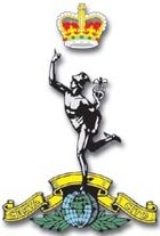
The flag and cap badge feature Mercury
Mercury (mythology)

In Roman mythology, Mercury was a messenger, and a god of trade, profit and commerce, the son of Maia Maiestas, also known as Ops, the Roman version of Cronus, and Jupiter ....
, the winged messenger of the gods, who is referred to by members of the corps as "Jimmy". The origins of this nickname are unclear. According to one explanation, the badge is referred to as "Jimmy" because the image of (the ancient Greek god) Mercury was based on the late mediaeval bronze statue of that 'divine' being by the Italian sculptor Giambologna (this is usually referred to as "Giambologna's Mercury" - shortening over time reduced the name Giambologna to "Jimmy". The most widely accepted theory of where the name Jimmy comes from is a Royal Signals boxer, called Jimmy Emblem, who was the British Army Champion in 1924 and represented the Royal Corps of Signals from 1921 to 1924.

Lanyard

On Service Dress and No 2 Dress the Corps wears a dark blue lanyard signifying its early links with the Royal Engineers.

Motto

The Corps motto
Motto

A motto is a phrase meant to formally describe the general motivation or intention of a social group or organization. A motto may be in any language, but Latin is the most used....
 is Certa Cito, which freely translates as Swift and Sure.

Appointments

The Colonel in Chief is currently HRH The Princess Royal. The Master of Signals is General Baxter. The Signal Officer-in-Chief (Army) is Brigadier Ted Flint, and the Corps Regimental Sergeant Major is Warrant Officer Class One (CRSM) David Taylor.

Equipment

The Corps deploys and operates a broad range of specialist military and off-the-shelf communications systems. The main categories are as follows:
  • Satellite ground terminals
  • Terrestrial trunk radio systems
  • Combat net radio systems
  • Computer networks
  • Specialist military applications (computer programmes)

Royal Corps of Signals Units


Brigades


There are three signal brigade
Brigade

A brigade is a military unit that is typically composed of two to five regiments or battalions, depending on the era and nationality of a given army....
s:

  • 1st Signal Brigade (Germany) (7 and 16 Signal Regiments plus Allied Rapid Reaction Corps Support Battalion) 1 Signal Brigade also consists of 22 Signal Regiment, and 12 Signal Group, which comprises 33, 34 and 35 Signal Regiments.
  • 2 (National Communications) Signal Brigade
    2 (National Communications) Signal Brigade

    2 Signal Brigade is an operational Brigade of the Royal Corps of Signals with a Regular HQ, 1 Regular Regiment, 8 TA Regiments and a number of specialist sub-units....
     (10th, 31st, 32nd, 36th, 37th, 38th, 40th and 71st Signal Regiments, plus 1st, 2nd and 81st Signal Squadrons and LIAG)
  • 11th Signal Brigade (2nd, 14th and 30th Signal Regiments)


Regular Army


  • 2nd Signal Regiment
    • Support Squadron
    • 214 Signal Squadron
    • 219 Signal Squadron
    • 246 Gurkha Signal Squadron


  • 7th (Allied Rapid Reaction Corps) Signal Regiment
    • Headquarters Squadron
    • 229 Signal Squadron
    • 231 Signal Squadron
    • 232 Signal Squadron


  • 10th Signal Regiment
    • 233 Signal Squadron
    • 241 Signal Squadron
    • 243 Signal Squadron
    • 251 Signal Squadron
    • ECM (FP) Squadron (Northern Ireland) (Formerly Romeo Troop, 15 Sig Regt which disbanded May 2006)


  • 14th Signal Regiment (Electronic Warfare)
    • Headquarters Squadron (now renamed as Operations Support Sqaudron)
    • 223 Signal Squadron (Electronic Warfare) Officially formed up Jan 2009. Manning announced Dec 2008.
    • 224 Signal Squadron (Electronic Warfare) As of Jan 2009 will be disbanded.
    • 226 Signal Squadron (Electronic Warfare)
    • 237 Signal Squadron (Electronic Warfare)
    • 245 Signal Squadron (Electronic Warfare)


  • 16th Signal Regiment
    • Headquarters Squadron
    • 230 Signal Squadron
    • 255 Signal Squadron
    • 252 Signal Squadron


  • 18 (UKSF) Signal Regiment
    18 (UKSF) Signal Regiment

    18 Signal Regiment is a Regiment of the British Army Royal Corps of Signals which provides communications and information systems support to the force elements of the United Kingdom Special Forces....


  • 21st Signal Regiment (Air Support)
    • HQ Squadron
    • 220 Signal Squadron
    • 244 Signal Squadron
    • 248 Gurkha Signal Squadron (To move to 22 Signal Regiment 2007)


  • 22nd Signal Regiment
    • Support Squadron
    • 217 Signal Squadron
    • 222 Signal Squadron (From 3 (UK) Divisional Signal Regiment)
    • 248 Gurkha Signal Squadron (From 21 Signal Regiment (Air Support))


  • 628 Signal Troop (Formerly 280 Signal Squadron)
  • 280 Signal Squadron (Formerly 28 Signal Regiment)
  • 28 (UK)Signal Regiment BAOR (NORTHAG)
    • 1 Squadron
    • 2 Squadron
    • HQ Squadron
    • Motorised Transport Squadron
    • Victor Troop (Comms) Rheindalen
    • 13 TTR (Belgium)


  • 30th Signal Regiment
    • Support Squadron
    • 250 Gurkha Signal Squadron
    • 256 Signal Squadron


  • 1st (UK) Armoured Division Headquarters and Signal Regiment
    British 1st Armoured Division

    The 1st Armoured Division is an armored division of the British Army. It saw extensive service during World War II, was disbanded afterward, was reconstituted in 1976, and remains in service today....
    • Headquarters Squadron
    • 201 Signal Squadron (Wheeled Sqn)
    • 211 Signal Squadron (Armoured Sqn)
    • 212 Signal Squadron (Armoured Sqn)


  • 3rd (UK) Division Headquarters and Signal Regiment
    • Headquarters (Somme) Squadron
    • 202 Signal Squadron
    • 206 Signal Squadron
    • 222 Signal Squadron (To move to 22 Signal Regiment 2007)


  • Royal School of Signals
    Royal School of Signals

    The Royal School of Signals is a military training establishment that is part of the United Kingdom's Defence College of Communications and Information Systems....
    • 11th Signal Regiment


  • 20th Armoured Brigade
    British 20th Armoured Brigade

    The British Army's 20th Armoured Brigade is an armoured formation currently based in Paderborn, northern Germany, as part of the 1st Armoured Division....
     Headquarters and Signal Squadron (200)


  • 4th Armoured Brigade
    British 4th Armoured Brigade

    The 4th Mechanized Brigade is a British Army brigade formed during the Second World War in 1941 , it is currently based in Catterick Garrison, England, forming part of the 1st Armoured Division ....
     Headquarters and Signal Squadron (204)


  • 7th Armoured Brigade
    British 7th Armoured Brigade

    The 7th Armoured Brigade is a formation of the British Army. The brigade is also known as the 'Desert Rats', a nickname formerly held by the 7th Armoured Division ....
     Headquarters and Signal Squadron (207)


  • Mechanized Brigade Headquarters and Signal Squadron (209)


  • 39 Infantry Brigade Headquarters and Signal Squadron (213)


  • 1 Mechanised Brigade
    British 1st Infantry Brigade (Guards)

    The 1st Infantry Brigade is a British Army formation with a long history including service during the First World War and Second World Wars ....
     Headquarters and Signal Squadron (215)
  • 16 (Air Assault) Brigade Headquarters and Signal Squadron (216)


  • 8 Infantry Brigade Headquarters and Signal Squadron (218)


  • 12 Mechanised Brigade Headquarters and Signal Squadron (228)


  • 52 Infantry Brigade Headquarters and Signal Squadron (258)


  • 101 Logistic Brigade Headquarters and Signal Squadron (261)


  • 102 Logistic Brigade Headquarters and Signal Squadron (262)


  • 264 (SAS
    Special Air Service

    The Special Air Service is a special forces regiment within the British Army which has served as a model for the special forces of other countries....
    ) Signal Squadron (renamed 18 (UKSF) Signal Regiment in early 2005)


  • 628 Signal Troop (UK DCM(A)) - 1 NATO Signal Battalion (Formally 280 UK Signal Squadron Dec 05)


  • 660 Signal Troop (Attached to 11 EOD Regt RLC for support in ECM and communications)


  • Defence Communication Services Agency (DCSA) (Many locations throughout UK and Germany)


  • Joint Service Signal Unit (Cyprus)1 (British Forces Cyprus
    British Forces Cyprus

    British Forces Cyprus is the name given to the British Armed Forces stationed in the UK sovereign base areas of Dhekelia and Akrotiri on the island of Cyprus....
    )


  • Cyprus Communications Unit (British Forces Cyprus
    British Forces Cyprus

    British Forces Cyprus is the name given to the British Armed Forces stationed in the UK sovereign base areas of Dhekelia and Akrotiri on the island of Cyprus....
    )


  • Joint Communications Unit (Falkland Islands)


  • The Royal Signals Motorcycle Display Team (RSMDT) [Known since 1960's as "The White Helmets"]


  • Band of the Royal Corps of Signals


Territorial Army


  • 31 (City of London) Signal Regiment
    31 (City of London) Signal Regiment

    31 Signal Regiment is Territorial Army regiment in the Royal Corps of Signals in the British Army. The regiment forms part of 2 Signal Brigade, providing military communications for national operations....
     (Volunteers)
    • Headquarters Squadron/83 (London) Support Squadron (Volunteers [Southfields]
    • 5 (Queen's Own Oxfordshire Hussars
      Queen's Own Oxfordshire Hussars

      The Queen's Own Oxfordshire Hussars was the designated name of a Yeomanry regiment of the British Army between 1888 and 1922. It can date its foundation back to the formation of a troop of Yeomanry at Watlington, Oxfordshire in 1798....
      ) Signal Squadron (Volunteers) [Banbury]
    • 41 (Princess Louise's Kensington) Signal Squadron (Volunteers) [Coulsdon]
    • 56 Signal Squadron (Volunteers) [Eastbourne & Brighton]


  • 32 (Scottish) Signal Regiment
    32 (Scottish) Signal Regiment

    The 32nd Signal Regiment is a United Kingdom Territorial Army regiment of the Royal Corps of Signals....
     (Volunteers)
    • Headquarters Squadron [Glasgow]
    • 51 (Highland) Signal Squadron (Volunteers) [Aberdeen]
    • 52 (Lowland) Signal Squadron (Volunteers) [East Kilbride]
    • 61 (City of Edinburgh) Signal Squadron (Volunteers) [Edinburgh]


  • 33 (Lancashire and Cheshire) Signal Regiment
    33 (Lancashire and Cheshire) Signal Regiment

    The 33rd Signal Regiment is a United Kingdom Territorial Army regiment of the Royal Corps of Signals....
     (Volunteers)
    • 42 (City of Manchester) Signal Squadron (Volunteers) [Manchester]
    • 55 (Merseyside) Headquarters Squadron (Volunteers) [Huyton]
    • 59 (City of Liverpool) Signal Squadron (Volunteers) [Liverpool]
    • 80 (Cheshire Yeomanry
      Cheshire Yeomanry

      The Cheshire Yeomanry was a yeomanry regiment that can trace its history back to 1797 when Sir John Fleming Leicester of Tabley raised a county regiment of light cavalry in response to the growing fears of invasion from Napoleonic France....
      ) (Earl of Chester's) Signal Squadron (Volunteers) [Runcorn]


  • 34 (Northern) Signal Regiment
    34 (Northern) Signal Regiment

    34 Signal Regiment is Territorial Army regiment in the Royal Corps of Signals in the British Army. The regiment forms part of 11 Signal Brigade, providing command and control communication for NATO's Rapid Reaction Corps ....
     (Volunteers)
    • Headquarters Squadron [Middlesbrough]
    • 49 (West Riding) Signal Squadron (Volunteers) [Leeds/Hull]
    • 50 (Northumbrian) Signal Squadron (Volunteers) [Darlington/Newcastle]
    • 90 (North Riding) Signal Squadron (Volunteers) [Hartlepool/Middlesbrough]


  • 35 (South Midlands) Signal Regiment
    35 (South Midlands) Signal Regiment

    The 35th Signal Regiment is a United Kingdom Territorial Army regiment of the Royal Corps of Signals.The Regiment consists of five squadrons:...
     (Volunteers)
    • Headquarters Squadron [Coventry]
    • 48 (City of Birmingham) Signal Squadron (Volunteers) [Birmingham]
    • 58 (Staffordshire) Signal Squadron (Volunteers) [Newcastle under Lyme]
    • 89 (Warwickshire) Signal Squadron (Volunteers) [Rugby]
    • 95 (Shropshire Yeomanry
      Shropshire Yeomanry

      HistoryThe Shropshire Yeomanry dates its origins to the French wars of 1793-1815, when volunteer cavalry units were raised throughout the country....
      ) Signal Squadron (Volunteers) [Shrewsbury]


  • 36 (Eastern) Signal Regiment
    36 (Eastern) Signal Regiment

    36 Signal Regiment is Territorial Army regiment in the Royal Corps of Signals in the British Army. The regiment forms part of 2 Signal Brigade, providing military communications for national operations....
     (Volunteers)] http://www.36sigregt.mod.uk
    • 45 (Essex & Cinque Ports) Signal Squadron (Volunteers) [Colchester/Ipswich/Southend]
    • 54 (Support) Squadron (Volunteers) [Cambridge]
    • 60 (Royal Buckinghamshire Hussars
      Royal Buckinghamshire Hussars

      A unit of volunteer cavalry, with roots back to the independent Yeomanry troops formed in 1794. Known by several names, lastly the Buckinghamshire Yeomanry , the Hussar title was lost in the 1918 merger with the Berkshire Yeomanry....
      ) Signal Squadron (Volunteers) [Aylesbury/Bedford]


  • 37 Signal Regiment
    37 Signal Regiment

    37 Signal Regiment is Territorial Army regiment in the Royal Corps of Signals in the British Army. The regiment forms part of 2 Signal Brigade, providing military communications for national operations....
     (Volunteers)
    • Support Squadron [Redditch]
    • 53 (Welsh) Signal Squadron
      53 (Welsh) Signal Squadron

      53 Signal Squadron is Territorial Army squadron in the Royal Corps of Signals in the British Army. The regiment forms part of 37 Signal Regiment, itself part of 2 Signal Brigade, providing military communications for national operations....
       (Volunteers) [Cardiff/Brecon]
    • 67 (Queen's Own Warwickshire and Worcestershire Yeomanry
      Queen's Own Warwickshire and Worcestershire Yeomanry

      The Queens Own Warwickshire & Worcestershire Yeomanry was a regiment of the Territorial Army, formed in 1956 by the amalgamation of The Warwickshire Yeomanry and The Queen's Own Worcestershire Hussars, and split up in 1971....
      ) Signal Squadron (Volunteers) [Stratford on Avon/Stourbridge]
    • 96 Signal Squadron (Volunteers) [Coventry/Harborne]


  • 38 Signal Regiment (Volunteers)
    • Headquarters Squadron [Sheffield]
    • 46 (City of Derby) Signal Squadron (Volunteers) [Derby]
    • 64 (City of Sheffield) Signal Squadron (Volunteers) [Sheffield/Nottingham]
    • 93 (East Lancashire) Signal Squadron (Volunteers) [Blackburn/Manchester]


  • 39 (Skinners) Signal Regiment
    39 (Skinners) Signal Regiment

    39 Signal Regiment is Territorial Army regiment in the Royal Corps of Signals in the British Army. The regiment forms part of 2 Signal Brigade, providing military communications for national operations....
     (Volunteers)
    • Headquarters Squadron (North Somerset Yeomanry) [Bristol]
    • 57 (City and County of Bristol) Signal Squadron (Volunteers) [Bristol]
    • 94 (Berkshire Yeomanry) Signal Squadron
      Berkshire Yeomanry

      94 Signal Squadron recently became a member of 39 Signal Regiment. They are based in three locations in the Home Counties. The Headquarters of the Squadron is based in Windsor, Berkshire along with 908 troop and a support troop....
       (Volunteers) [Windsor/Reading/Chertsey]


  • 40 (Ulster) Signal Regiment
    40 (Ulster) Signal Regiment

    40 Signal Regiment is Territorial Army regiment in the Royal Corps of Signals in the British Army. The regiment forms part of 2 Signal Brigade, providing military communications for national operations....
     (Volunteers)
    • Headquarters Squadron [Belfast]
    • 66 (City of Belfast) Signal Squadron (Volunteers) [Belfast]
    • 69 (North Irish Horse
      North Irish Horse

      The North Irish Horse is a yeomanry unit of the United Kingdom Territorial Army raised in the northern counties of Ireland in the aftermath of the Second Boer War....
      ) Signal Squadron (Volunteers) [Limavady]
    • 85 (Ulster and Antrim Artillery) Signal Squadron (Volunteers) [Bangor]


  • 71 (Yeomanry) Signal Regiment
    71 (Yeomanry) Signal Regiment

    71 Signal Regiment is Territorial Army regiment in the Royal Corps of Signals in the British Army. The regiment forms part of 2 Signal Brigade, providing military communications for national operations....
     (Volunteers)
    • 47 (Middlesex Yeomanry
      Middlesex Yeomanry

      47 Signal SquadronDuring the Napoleonic Wars that the Gentlemen of Uxbridge sought permission from the Government to form a Military Association to maintain law and order when the Regular Forces were sent to the coast to protect the country against invasion by the French....
      ) Signal Squadron (Volunteers) [Uxbridge/High Wycombe]
    • 68 (Inns of Court and City Yeomanry
      Inns of Court and City Yeomanry

      HistoryThe Inns of Court and City Yeomanry is a yeomanry regiment of the British Territorial Army .The regiment was formed in 1961 by the amalgamation of the Inns of Court Regiment and the City of London Yeomanry....
      ) Signal Squadron (Volunteers) [London/Whipps Cross]
    • 70 (Essex Yeomanry
      Essex Yeomanry

      The Essex Yeomanry is a yeomanry regiment of the British Army. The Essex Yeomanry was raised in 1797 and remains part of the current British Army order of battle....
      ) Signal Squadron (Volunteers) [Chelmsford/Harlow]
    • 265 (Kent and County of London Yeomanry) Support Squadron (Volunteers) [Bexleyheath]


  • 1 (Royal Buckinghamshire Yeomanry
    Royal Buckinghamshire Yeomanry

    The Royal Buckinghamshire Yeomanry was formed in 1794, when King George III , was on the throne and William Pitt the Younger was the Prime Minister , of Great Britain , across the English Channel , Britain was faced by a French nation which had recently guillotined its King and which possessed a revolutionary army numbering half a million me...
    ) Signal Squadron (Special Communications) (Volunteers) [Bletchley]
  • 2 (City of Dundee) Signal Squadron (Volunteers) [Dundee]
  • 63 (SAS) Signal Squadron (Volunteers) [Thorney Island/Southampton/Portsmouth/Bournemouth/Chichester/London]
  • 81 Signal Squadron (Volunteers) [Corsham]
  • Land Information Assurance Group (LIAG)
    Land Information Assurance Group (LIAG)

    The Land Information Assurance Group - LIAG - is a specialist Territorial Army unit, formed as a result of the Strategic Defence Review of 1998:...
     (Volunteers) [Corsham]


Cadet Forces


The Royal Corps of Signals is the sponsoring Corps for several Army Cadet Force
Army Cadet Force

The Army Cadet Force is a United Kingdom youth organisation that offers progressive training in a multitude of the subjects from military training to adventurous training and first aid, at the same time as promoting achievement, discipline, and good citizenship, to boys and girls aged 12 to 18 year olds and 9 months....
 and Combined Cadet Force
Combined Cadet Force

The Combined Cadet Force is a Ministry of Defence sponsored youth organisation in the United Kingdom. Its aim is to "provide a disciplined organisation in a school so that pupils may develop powers of leadership by means of training to promote the qualities of responsibility, self reliance, resourcefulness, endurance and perseverance"....
 units. They also, quite unusually, sponsor small groups of signals trained cadets in cadet detatchment
Army Cadet Force

The Army Cadet Force is a United Kingdom youth organisation that offers progressive training in a multitude of the subjects from military training to adventurous training and first aid, at the same time as promoting achievement, discipline, and good citizenship, to boys and girls aged 12 to 18 year olds and 9 months....
s which are affiliated to a different Regiment or Corps. One such contingent
Combined Cadet Force

The Combined Cadet Force is a Ministry of Defence sponsored youth organisation in the United Kingdom. Its aim is to "provide a disciplined organisation in a school so that pupils may develop powers of leadership by means of training to promote the qualities of responsibility, self reliance, resourcefulness, endurance and perseverance"....
 with cadets who wear the insignia of the Royal Signals, but are sponsored by a different regiment is the Brighton College CCF
Brighton College

Brighton College is an independent co-educational public school in Brighton, England. The current headmaster is Richard J. Cairns.The Good Schools Guide called the school a "Happy and forward-looking town school with a wide and healthy spread of pupils and parents", also stating: "A good bet to become an even more impressive school in t...
. The parent regiment of this contingent is the Princess of Wales' Royal Regiment.

Order of Precedence


Footnotes


See also


External links