

Privy Council of the United Kingdom

Encyclopedia
Her Majesty's Most Honourable Privy Council, usually known simply as the Privy Council, is a formal body of advisers
to the Sovereign
in the United Kingdom
. Its membership is mostly made up of senior politicians who are (or have been) members of either the House of Commons or the House of Lords
.
The Privy Council, the modern-day successor to the Privy Council of England
, was formerly a powerful institution, but its policy decisions are now exclusively in the hands of one of its committees, the Cabinet
. The Council formally advises the Sovereign on the exercise of the Royal Prerogative
, and together (as the Queen in Council) they issue executive instruments known as Orders in Council, which amongst other things are used to make Regulations. The Council by itself also has a delegated authority to issue Orders of Council
, which are mostly used to regulate certain public institutions. The Council also advises the Sovereign on the issuing of Royal Charter
s, which are used to grant special status to incorporated bodies, and city
or borough
status to local authorities.
Certain judicial functions are also performed by the Queen in Council, although in practice the actual work of hearing and deciding upon cases is carried out exclusively by the Judicial Committee of the Privy Council
. The Judicial Committee consists of senior judges appointed as Privy Counsellors: Justices
of the Supreme Court of the United Kingdom
, judges of the Court of Appeal of England and Wales
, judges of the Court of Appeal in Northern Ireland
, judges of the Inner House of the Court of Session
(the supreme civil court in Scotland
), and judges from various other Commonwealth
member states. The Council was formerly a supreme court
of appeal for the entire British Empire
(other than for the United Kingdom itself), and continues to hear appeals from the Crown Dependencies, the British Overseas Territories
, and a number of Commonwealth member countries.
s, ecclesiastics and high officials. The body originally concerned itself with advising the Sovereign on legislation, administration and justice. Later, different bodies assuming distinct functions evolved from the court. The courts of law took over the business of dispensing justice, while Parliament
became the supreme legislature of the kingdom. Nevertheless, the Council retained the power to hear legal disputes, either in the first instance or on appeal. Furthermore, laws made by the Sovereign on the advice of the Council, rather than on the advice of Parliament, were accepted as valid. Powerful Sovereigns often used the body to circumvent the courts and Parliament. For example, a committee of the Council—which later became the Court of the Star Chamber
—was during the fifteenth century permitted to inflict any punishment except death, without being bound by normal court procedure. During Henry VIII's
reign, the Sovereign, on the advice of the Council, was allowed to enact laws by mere proclamation. The legislative pre-eminence of Parliament was not restored until after Henry VIII's death. Though the royal Council retained legislative and judicial responsibilities, it became a primarily administrative body. The Council consisted of forty members in 1553, but the Sovereign relied on a smaller committee, which later evolved into the modern Cabinet
.
By the end of the English Civil War
, the monarchy, House of Lords and Privy Council were abolished. The remaining house of Parliament, the House of Commons, instituted a Council of State
to execute laws and to direct administrative policy. The forty-one members of the Council were elected by the Commons; the body was headed by Oliver Cromwell
, the de facto
military dictator of the nation. In 1653, however, Cromwell became Lord Protector
, and the Council was reduced to between thirteen and twenty-one members, all elected by the Commons. In 1657, the Commons granted Cromwell even greater powers, some of which were reminiscent of those enjoyed by monarchs. The Council became known as the Protector's Privy Council; its members were appointed by the Lord Protector, subject to Parliament's approval.
In 1659, shortly before the restoration of the monarchy
, the Protector's Council was abolished. Charles II
restored the royal Privy Council, but he, like previous Stuart monarchs, chose to rely on a small committee of advisers. Under George I
even more power passed to this committee. It now began to meet in the absence of the Sovereign, communicating their decisions to him after the fact. Thus the Privy Council, as a whole, ceased to be a body of important confidential advisers to the Sovereign; the role passed to a committee of the Privy Council, now known as the Cabinet.
, the definition of the word "privy
" in Privy Council is an obsolete one meaning "of or pertaining exclusively to a particular person or persons; one's own", insofar as the Council is personal to the Sovereign. It is closely related to the word "private".
, who is the fourth highest Great Officer of State
, a member of the Cabinet, and normally, the Leader of either the House of Lords
or the House of Commons. Another important official is the Clerk
, whose signature is appended to all orders made in the Council.
Both "Privy Counsellor" and "Privy Councillor" may be correctly used to refer to a member of the Council. The former, however, is preferred by the Privy Council Office, emphasising English usage of the term "Counsellor" as "one who gives counsel", as opposed to "one who is a member of a council." A Privy Counsellor is said to be "sworn of" the Council when he or she first joins it.
The Sovereign may appoint anyone a Privy Counsellor, but in practice appointments are made only on the advice of the Government, and generally consist only of senior members of parliament, the church and judiciary. There is no limit to the numbers sworn in as members. As of August 2008 there are 538 members. However, the members have no right to attend all meetings of the Privy Council, and only some are summoned to each meeting (in practice at the Prime Minister's discretion).
The Church of England
's three senior bishops—the Archbishop of Canterbury
, the Archbishop of York
and the Bishop of London
are made Privy Counsellors on their appointment. Senior members of the Royal Family may also be appointed—Prince Philip is a member, the most senior at present in terms of service, and is the only present member not to be appointed by the current monarch, having been appointed to the council by her father. The Private Secretary to the Sovereign
is always appointed to the Council.
Several senior judges—Justices
of the Supreme Court of the United Kingdom
, judges of the Court of Appeal of England and Wales
, judges of the Court of Appeal in Northern Ireland and judges of the Inner House of the Court of Session
(the highest court in Scotland)—are also named to the Privy Council.
The bulk of Privy Counsellors, however, are politicians. The Prime Minister, ministers in the cabinet, and the Leader of the Opposition
must be sworn of the Privy Council on appointment. Leaders of large parties in the House of Commons, First Minister
s of the devolved assemblies
, some senior ministers outside the cabinet, and on occasion senior Parliamentarians are appointed Privy Counsellors. As Privy Counsellors are bound by their oath to keep matters discussed at Council meetings secret, the appointment of the leaders of Opposition parties as Privy Counsellors allows the Government to share confidential information with them "on Privy Council terms". This usually only happens in special circumstances, such as in matters of national security. For example, Tony Blair
met Leader of the Opposition Iain Duncan Smith
and Leader of the Liberal Democrats
Charles Kennedy
on privy council terms to discuss the evidence for Iraq's weapons of mass destruction
.
Although the Privy Council is primarily a British institution, officials from some other Commonwealth realms are also appointed to the body. By 2000, the most notable instance was New Zealand, whose Prime Minister, senior politicians, Chief Justice and Court of Appeal judges were conventionally made Privy Counsellors. However, appointments of New Zealand members have since been discontinued. The Prime Minister, the Speaker and the Governor General of New Zealand are still granted the prefix Right Honourable, but without membership in the council. Until the latter part of the 20th century, the prime ministers and chief justices of Canada and Australia were also appointed to Privy Counsellors. Prime Ministers of some other Commonwealth countries which retain the Queen as their sovereign continue to be sworn as Privy Counsellors.
ous, to disclose the oath administered to Privy Counsellors as they take office. However, the oath was officially made public in a written parliamentary answer in 1998, as follows:
Privy Counsellors can choose to affirm
their allegiance in similar terms if they prefer not to take a religious oath.
. By convention, however, the Sovereign would reappoint all members of the Council after its dissolution. In practice, therefore, membership continued without a break. Reappointment was made unnecessary from 1901 when the law was changed to ensure that Crown appointments were wholly unaffected by a change of monarch.
The Sovereign may however remove an individual from the Council. On 8 June 2011 Elliot Morley
was expelled following his conviction on charges of false accounting in connection with an expenses scandal
. Before this, the last individual to be expelled from the Council against his will was Sir Edgar Speyer, 1st Baronet
, who was removed on 13 December 1921 for pro-German activities during the First World War
.
Individuals may choose to resign to avoid expulsion. The last individual to leave the Privy Council voluntarily was Jonathan Aitken
, who left on 25 June 1997 following allegations of perjury
.
He was one of only three Privy Counsellors to resign in the twentieth century (the others being John Profumo
, who resigned on 26 June 1963, and John Stonehouse
, who resigned on 17 August 1976).
.jpg) Meetings of the Privy Council are normally held once each month wherever the Sovereign may be residing at the time. The quorum
Meetings of the Privy Council are normally held once each month wherever the Sovereign may be residing at the time. The quorum
, according to the Privy Council Office, is three, though some statutes provide for other quorum (for example, section 35 of Opticians Act 1989 (c. 44) provides for a lower quorum of two).
The Sovereign attends the meeting, though his or her place may be taken by two or more Counsellors of State. Under the Regency Acts 1937 to 1953, Counsellors of State
may be chosen from amongst the Sovereign's spouse and the four individuals next in the line of succession who are over 21 years of age (18 for the Heir to the Throne). Normally the Sovereign remains standing at meetings of the Privy Council, so that no other members may sit down, thereby keeping meetings short. The Lord President reads out a list of Orders to be made, and the Sovereign merely says "Approved".
Only a few privy counsellors attend these regular meetings. The settled practice is that day-to-day meetings of the Council are attended by four privy counsellors, usually the Ministers responsible for the matters being approved. Unless prevented from attending, the Government Minister holding office as Lord President of the Council
is usually among the privy counsellors present. Under Britain's modern conventions of parliamentary government and constitutional monarchy, every order made in Council has been drafted by a Government Department and has already been approved by the responsible Ministers—the action taken by the Queen in Council is a mere formality required for the valid adoption of the measure.
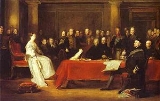
Full meetings of the Privy Council are only held when the reigning Sovereign announces his or her own engagement (which last happened on 23 November 1839, in the reign of Queen Victoria); or when there is a Demise of the Crown
, either by the death or abdication of the monarch. A full meeting of the Privy Council was also held on 6 February 1811, when George, Prince of Wales, took the oaths upon entering into the execution of the royal authority as Prince Regent, as required by Act of Parliament. The current statutes regulating the establishment of a Regency
in the case of minority or incapacity of the Sovereign also require any Regents to take their oaths before the Privy Council.
In the case of a demise of the crown, the Privy Council—together with the Lords Spiritual
, the Lords Temporal, the Lord Mayor of the City of London, the Aldermen of the City of London
and representatives of Commonwealth
nations—makes a proclamation declaring the accession of the new Sovereign and receives an oath from the new monarch relating to the security of the Church of Scotland
, as required by law. It is also customary for the new Sovereign to make an allocution
to the Privy Council on that occasion, and the Sovereign's speech is published in the London Gazette
. That special assembly of the Privy Council and others held to proclaim the accession of the new Sovereign and to receive the required statutory oath from the monarch, is known as an Accession Council
. The last such meetings were held on 6 February and 8 February 1952. As the present Queen
was abroad when the last Demise of the Crown took place, the Accession Council had to meet twice, once to proclaim the Sovereign (meeting of 6 February 1952), and then again after the new Queen had returned to Britain, to receive from her the oath required by statute (meeting of 8 February 1952).
to Measures of the National Assembly for Wales, and laws passed by the legislative authorities of British Crown dependencies
.
Distinct from Orders-in-Council are Orders of Council
. Whilst the former are made by the Sovereign on the advice of the Privy Council, the latter are made by members of the Privy Council without the participation of the Sovereign. They are issued under the specific authority of Acts of Parliament, and are normally used to regulate public institutions.
The Sovereign, furthermore, issues Royal Charter
s on the advice of the Privy Council. Charters grant special status to incorporated bodies; they are used to grant city
and borough
status to towns, and "chartered" status to certain professional or educational bodies. The Privy Council therefore deals with a wide variety of matters, including university statutes, graveyards, coinage, and dates of bank holiday
s.
The Crown-in-Council also performs certain judicial functions. Within the United Kingdom, the Crown-in-Council hears appeals from ecclesiastical courts, the Court of Admiralty of the Cinque Ports
, prize courts and the Disciplinary Committee of the Royal College of Veterinary Surgeons
, appeals against schemes of the Church Commissioners
and appeals under certain Acts of Parliament (e.g., the House of Commons Disqualification Act 1975
). The Crown-in-Council was formerly a supreme court of appeal for the entire British Empire, however a number of Commonwealth countries have now abolished such appeals. The Privy Council does continue to hear appeals from several Commonwealth countries, from British Overseas Territories, Sovereign Base Areas and crown dependencies. The aforementioned cases are theoretically decided by the monarch in Council, but are in practice heard and decided by the Judicial Committee of the Privy Council
, which consists of senior judges who are Privy Counsellors. The decision of the Committee is presented in the form of "advice" to the monarch, but in practice it is always followed by the Sovereign, who formally approves the recommendation of the Judicial Committee. The Judicial Committee had direct jurisdiction in cases relating to the Scotland Act 1998
, the Government of Wales Act 1998
and the Northern Ireland Act 1998
, but this was transferred to the new Supreme Court of the United Kingdom
in 2009.
staff from joining a trade union. Another, the Civil Service (Amendment) Order in Council 1997, permitted the Prime Minister to grant up to three political advisers
management authority over some civil servants.
In the 1960s, the Privy Council made an order to evict the 2,000 inhabitants of the 65-island Chagos Archipelago
in the Indian Ocean
, in preparation for the establishment of joint United States-United Kingdom military base on the largest outlying island Diego Garcia
, some 60 miles (96.6 km) distant. In 2000 the High Court ruled the 1971 Immigration Ordinance preventing resettlement unlawful. In 2004, the Privy Council, under Jack Straw
's tenure, overturned the ruling. In 2006 the High Court of Justice
found the Privy Council's decision to be unlawful. Sir Sydney Kentridge
, QC described the treatment of the Chagossians as "outrageous, unlawful and a breach of accepted moral standards". He said there was no known precedent "for the lawful use of prerogative powers to remove or exclude an entire population of British subjects from their homes and place of birth".
", individual Privy Counsellors are entitled to the style
"The Right Honourable
". Peers
who are also members of the Privy Council append the post-nominal letters
"PC" to indicate membership as they are already entitled to the style "The Right Honourable" (in the case of baron
s, viscount
s and earl
s) or other higher style (in the case of duke
s and marquess
es), even when they are not Privy Counsellors. For commoners, on the other hand, "The Right Honourable" is sufficient identification of status as a Privy Counsellor. The Earl of Mar and Kellie and the Earl of Scarbrough
prefer not to be addressed as 'The Rt Hon' at all on the grounds that the prefix more properly belongs to Privy Counsellors. The Ministry of Justice takes a similar position.
Privy Counsellors are entitled to positions in the order of precedence in England and Wales
. At the beginning of each new Parliament, and at the discretion of the Speaker
, members of the House of Commons who are Privy Counsellors usually take the oath of allegiance before all other members except the Speaker and the Father of the House
(the most senior member of the House). Often, whenever a Privy Counsellor rose to make a speech in the House of Commons at the same time as another member, the Speaker would first recognise the Privy Counsellor. This informal custom, however, was considered obsolete by 1998.
Furthermore, only Privy Counsellors can signify, at the monarch's command, the royal consent to the examination of a bill affecting the rights of the Crown.
Privy Counsellors are allowed to sit on the steps to the Sovereign's Throne in the House of Lords Chamber during debates. They share this privilege with hereditary Lords who were members of the House of Lords
before the reform of 1999, diocesan bishops of the Church of England
(who are not yet Lords Spiritual
), retired bishops who formerly sat in the House of Lords, the Dean of Westminster, Peers of Ireland, the eldest child of members of the House of Lords, the Clerk of the Crown in Chancery
and the Gentleman Usher of the Black Rod
.
Each Privy Counsellor has the individual right of personal access to the Sovereign. Peers are considered to enjoy the same right individually; members of the House of Commons possess the right collectively. In each case, personal access may only be used to tender advice on public affairs.
(Great Council, or the assembly of all the Peers of the Realm). All are still in existence, or at least have never been formally abolished, but the Magnum Concilium has not been summoned since 1640 and was considered obsolete then.
Several other Privy Councils have advised the Sovereign. England
and Scotland (see Privy Council of Scotland
) once had separate Privy Councils, but the Acts of Union 1707
, which united the two countries into the Kingdom of Great Britain
, replaced both with a single body. Ireland
, on the other hand, continued to have a separate Privy Council even after the Act of Union 1800
. The Privy Council of Ireland
was abolished in 1922, when the southern part of Ireland
separated from the United Kingdom; it was succeeded by the Privy Council of Northern Ireland
, which became dormant after the suspension of the Parliament of Northern Ireland
. No further appointments have been made since then, and no more than seven appointees were still living as of December 2010.
Canada
has had its own Privy Council—the Queen's Privy Council for Canada
—since 1867. While the Canadian Privy Council is specifically "for Canada", the Privy Council discussed above is not "for the United Kingdom"; in order to clarify the ambiguity where necessary, the latter is referred to as the Imperial Privy Council. Equivalent organs of state in other Commonwealth realms, such as Australia and New Zealand, are called Executive Councils
.
Privy council
A privy council is a body that advises the head of state of a nation, typically, but not always, in the context of a monarchic government. The word "privy" means "private" or "secret"; thus, a privy council was originally a committee of the monarch's closest advisors to give confidential advice on...
to the Sovereign
British monarchy
The monarchy of the United Kingdom is the constitutional monarchy of the United Kingdom and its overseas territories. The present monarch, Queen Elizabeth II, has reigned since 6 February 1952. She and her immediate family undertake various official, ceremonial and representational duties...
in the United Kingdom
United Kingdom
The United Kingdom of Great Britain and Northern IrelandIn the United Kingdom and Dependencies, other languages have been officially recognised as legitimate autochthonous languages under the European Charter for Regional or Minority Languages...
. Its membership is mostly made up of senior politicians who are (or have been) members of either the House of Commons or the House of Lords
House of Lords
The House of Lords is the upper house of the Parliament of the United Kingdom. Like the House of Commons, it meets in the Palace of Westminster....
.
The Privy Council, the modern-day successor to the Privy Council of England
Privy Council of England
The Privy Council of England, also known as His Majesty's Most Honourable Privy Council, was a body of advisers to the sovereign of the Kingdom of England...
, was formerly a powerful institution, but its policy decisions are now exclusively in the hands of one of its committees, the Cabinet
Cabinet of the United Kingdom
The Cabinet of the United Kingdom is the collective decision-making body of Her Majesty's Government in the United Kingdom, composed of the Prime Minister and some 22 Cabinet Ministers, the most senior of the government ministers....
. The Council formally advises the Sovereign on the exercise of the Royal Prerogative
Royal Prerogative
The royal prerogative is a body of customary authority, privilege, and immunity, recognized in common law and, sometimes, in civil law jurisdictions possessing a monarchy as belonging to the sovereign alone. It is the means by which some of the executive powers of government, possessed by and...
, and together (as the Queen in Council) they issue executive instruments known as Orders in Council, which amongst other things are used to make Regulations. The Council by itself also has a delegated authority to issue Orders of Council
Order of Council
An Order of Council is a form of legislation in the United Kingdom. It is made by the Lords of the Privy Council ....
, which are mostly used to regulate certain public institutions. The Council also advises the Sovereign on the issuing of Royal Charter
Royal Charter
A royal charter is a formal document issued by a monarch as letters patent, granting a right or power to an individual or a body corporate. They were, and are still, used to establish significant organizations such as cities or universities. Charters should be distinguished from warrants and...
s, which are used to grant special status to incorporated bodies, and city
City status in the United Kingdom
City status in the United Kingdom is granted by the British monarch to a select group of communities. The holding of city status gives a settlement no special rights other than that of calling itself a "city". Nonetheless, this appellation carries its own prestige and, consequently, competitions...
or borough
Borough
A borough is an administrative division in various countries. In principle, the term borough designates a self-governing township although, in practice, official use of the term varies widely....
status to local authorities.
Certain judicial functions are also performed by the Queen in Council, although in practice the actual work of hearing and deciding upon cases is carried out exclusively by the Judicial Committee of the Privy Council
Judicial Committee of the Privy Council
The Judicial Committee of the Privy Council is one of the highest courts in the United Kingdom. Established by the Judicial Committee Act 1833 to hear appeals formerly heard by the King in Council The Judicial Committee of the Privy Council (JCPC) is one of the highest courts in the United...
. The Judicial Committee consists of senior judges appointed as Privy Counsellors: Justices
Justice of the Supreme Court of the United Kingdom
Justices of the Supreme Court of the United Kingdom are the judges of the Supreme Court of the United Kingdom other than the President and Deputy President. The Supreme Court is the highest in the United Kingdom for civil matters, and for criminal matters from England and Wales and Northern Ireland...
of the Supreme Court of the United Kingdom
Supreme Court of the United Kingdom
The Supreme Court of the United Kingdom is the supreme court in all matters under English law, Northern Ireland law and Scottish civil law. It is the court of last resort and highest appellate court in the United Kingdom; however the High Court of Justiciary remains the supreme court for criminal...
, judges of the Court of Appeal of England and Wales
Court of Appeal of England and Wales
The Court of Appeal of England and Wales is the second most senior court in the English legal system, with only the Supreme Court of the United Kingdom above it...
, judges of the Court of Appeal in Northern Ireland
Courts of Northern Ireland
The courts of Northern Ireland are the civil and criminal courts responsible for the administration of justice in Northern Ireland: they are constituted and governed by Northern Ireland law....
, judges of the Inner House of the Court of Session
Court of Session
The Court of Session is the supreme civil court of Scotland, and constitutes part of the College of Justice. It sits in Parliament House in Edinburgh and is both a court of first instance and a court of appeal....
(the supreme civil court in Scotland
Scotland
Scotland is a country that is part of the United Kingdom. Occupying the northern third of the island of Great Britain, it shares a border with England to the south and is bounded by the North Sea to the east, the Atlantic Ocean to the north and west, and the North Channel and Irish Sea to the...
), and judges from various other Commonwealth
Commonwealth of Nations
The Commonwealth of Nations, normally referred to as the Commonwealth and formerly known as the British Commonwealth, is an intergovernmental organisation of fifty-four independent member states...
member states. The Council was formerly a supreme court
Supreme court
A supreme court is the highest court within the hierarchy of many legal jurisdictions. Other descriptions for such courts include court of last resort, instance court, judgment court, high court, or apex court...
of appeal for the entire British Empire
British Empire
The British Empire comprised the dominions, colonies, protectorates, mandates and other territories ruled or administered by the United Kingdom. It originated with the overseas colonies and trading posts established by England in the late 16th and early 17th centuries. At its height, it was the...
(other than for the United Kingdom itself), and continues to hear appeals from the Crown Dependencies, the British Overseas Territories
British overseas territories
The British Overseas Territories are fourteen territories of the United Kingdom which, although they do not form part of the United Kingdom itself, fall under its jurisdiction. They are remnants of the British Empire that have not acquired independence or have voted to remain British territories...
, and a number of Commonwealth member countries.
History
During the reigns of the Norman monarchs, the English Crown was advised by a royal court, which consisted of magnateMagnate
Magnate, from the Late Latin magnas, a great man, itself from Latin magnus 'great', designates a noble or other man in a high social position, by birth, wealth or other qualities...
s, ecclesiastics and high officials. The body originally concerned itself with advising the Sovereign on legislation, administration and justice. Later, different bodies assuming distinct functions evolved from the court. The courts of law took over the business of dispensing justice, while Parliament
Parliament of England
The Parliament of England was the legislature of the Kingdom of England. In 1066, William of Normandy introduced a feudal system, by which he sought the advice of a council of tenants-in-chief and ecclesiastics before making laws...
became the supreme legislature of the kingdom. Nevertheless, the Council retained the power to hear legal disputes, either in the first instance or on appeal. Furthermore, laws made by the Sovereign on the advice of the Council, rather than on the advice of Parliament, were accepted as valid. Powerful Sovereigns often used the body to circumvent the courts and Parliament. For example, a committee of the Council—which later became the Court of the Star Chamber
Star Chamber
The Star Chamber was an English court of law that sat at the royal Palace of Westminster until 1641. It was made up of Privy Counsellors, as well as common-law judges and supplemented the activities of the common-law and equity courts in both civil and criminal matters...
—was during the fifteenth century permitted to inflict any punishment except death, without being bound by normal court procedure. During Henry VIII's
Henry VIII of England
Henry VIII was King of England from 21 April 1509 until his death. He was Lord, and later King, of Ireland, as well as continuing the nominal claim by the English monarchs to the Kingdom of France...
reign, the Sovereign, on the advice of the Council, was allowed to enact laws by mere proclamation. The legislative pre-eminence of Parliament was not restored until after Henry VIII's death. Though the royal Council retained legislative and judicial responsibilities, it became a primarily administrative body. The Council consisted of forty members in 1553, but the Sovereign relied on a smaller committee, which later evolved into the modern Cabinet
Cabinet of the United Kingdom
The Cabinet of the United Kingdom is the collective decision-making body of Her Majesty's Government in the United Kingdom, composed of the Prime Minister and some 22 Cabinet Ministers, the most senior of the government ministers....
.
By the end of the English Civil War
English Civil War
The English Civil War was a series of armed conflicts and political machinations between Parliamentarians and Royalists...
, the monarchy, House of Lords and Privy Council were abolished. The remaining house of Parliament, the House of Commons, instituted a Council of State
English Council of State
The English Council of State, later also known as the Protector's Privy Council, was first appointed by the Rump Parliament on 14 February 1649 after the execution of King Charles I....
to execute laws and to direct administrative policy. The forty-one members of the Council were elected by the Commons; the body was headed by Oliver Cromwell
Oliver Cromwell
Oliver Cromwell was an English military and political leader who overthrew the English monarchy and temporarily turned England into a republican Commonwealth, and served as Lord Protector of England, Scotland, and Ireland....
, the de facto
De facto
De facto is a Latin expression that means "concerning fact." In law, it often means "in practice but not necessarily ordained by law" or "in practice or actuality, but not officially established." It is commonly used in contrast to de jure when referring to matters of law, governance, or...
military dictator of the nation. In 1653, however, Cromwell became Lord Protector
Lord Protector
Lord Protector is a title used in British constitutional law for certain heads of state at different periods of history. It is also a particular title for the British Heads of State in respect to the established church...
, and the Council was reduced to between thirteen and twenty-one members, all elected by the Commons. In 1657, the Commons granted Cromwell even greater powers, some of which were reminiscent of those enjoyed by monarchs. The Council became known as the Protector's Privy Council; its members were appointed by the Lord Protector, subject to Parliament's approval.
In 1659, shortly before the restoration of the monarchy
English Restoration
The Restoration of the English monarchy began in 1660 when the English, Scottish and Irish monarchies were all restored under Charles II after the Interregnum that followed the Wars of the Three Kingdoms...
, the Protector's Council was abolished. Charles II
Charles II of England
Charles II was monarch of the three kingdoms of England, Scotland, and Ireland.Charles II's father, King Charles I, was executed at Whitehall on 30 January 1649, at the climax of the English Civil War...
restored the royal Privy Council, but he, like previous Stuart monarchs, chose to rely on a small committee of advisers. Under George I
George I of Great Britain
George I was King of Great Britain and Ireland from 1 August 1714 until his death, and ruler of the Duchy and Electorate of Brunswick-Lüneburg in the Holy Roman Empire from 1698....
even more power passed to this committee. It now began to meet in the absence of the Sovereign, communicating their decisions to him after the fact. Thus the Privy Council, as a whole, ceased to be a body of important confidential advisers to the Sovereign; the role passed to a committee of the Privy Council, now known as the Cabinet.
Origin of the term
According to the Oxford English DictionaryOxford English Dictionary
The Oxford English Dictionary , published by the Oxford University Press, is the self-styled premier dictionary of the English language. Two fully bound print editions of the OED have been published under its current name, in 1928 and 1989. The first edition was published in twelve volumes , and...
, the definition of the word "privy
Privy
Privy may refer to:* Privy council* Privy purse* A garderobe* An outhouse, a small structure for defecation and urination* Privity...
" in Privy Council is an obsolete one meaning "of or pertaining exclusively to a particular person or persons; one's own", insofar as the Council is personal to the Sovereign. It is closely related to the word "private".
Composition
The Sovereign, when acting on the Council's advice, is known as the "King-in-Council" or "Queen-in-Council". The members of the Council are collectively known as "The Lords of Her Majesty's Most Honourable Privy Council" (sometimes "The Lords and others of ..."). The chief officer of the body is the Lord President of the CouncilLord President of the Council
The Lord President of the Council is the fourth of the Great Officers of State of the United Kingdom, ranking beneath the Lord High Treasurer and above the Lord Privy Seal. The Lord President usually attends each meeting of the Privy Council, presenting business for the monarch's approval...
, who is the fourth highest Great Officer of State
Great Officer of State
In the United Kingdom, the Great Officers of State are traditional Crown ministers, who either inherit their positions or are appointed to exercise certain largely ceremonial functions. Separate Great Officers exist for England and Scotland, and formerly for Ireland...
, a member of the Cabinet, and normally, the Leader of either the House of Lords
House of Lords
The House of Lords is the upper house of the Parliament of the United Kingdom. Like the House of Commons, it meets in the Palace of Westminster....
or the House of Commons. Another important official is the Clerk
Clerk of the Privy Council (United Kingdom)
The Clerk of the Privy Council is a civil servant in the government of the United Kingdom. He or she is the most senior civil servant in the Privy Council Office....
, whose signature is appended to all orders made in the Council.
Both "Privy Counsellor" and "Privy Councillor" may be correctly used to refer to a member of the Council. The former, however, is preferred by the Privy Council Office, emphasising English usage of the term "Counsellor" as "one who gives counsel", as opposed to "one who is a member of a council." A Privy Counsellor is said to be "sworn of" the Council when he or she first joins it.
The Sovereign may appoint anyone a Privy Counsellor, but in practice appointments are made only on the advice of the Government, and generally consist only of senior members of parliament, the church and judiciary. There is no limit to the numbers sworn in as members. As of August 2008 there are 538 members. However, the members have no right to attend all meetings of the Privy Council, and only some are summoned to each meeting (in practice at the Prime Minister's discretion).
The Church of England
Church of England
The Church of England is the officially established Christian church in England and the Mother Church of the worldwide Anglican Communion. The church considers itself within the tradition of Western Christianity and dates its formal establishment principally to the mission to England by St...
's three senior bishops—the Archbishop of Canterbury
Archbishop of Canterbury
The Archbishop of Canterbury is the senior bishop and principal leader of the Church of England, the symbolic head of the worldwide Anglican Communion, and the diocesan bishop of the Diocese of Canterbury. In his role as head of the Anglican Communion, the archbishop leads the third largest group...
, the Archbishop of York
Archbishop of York
The Archbishop of York is a high-ranking cleric in the Church of England, second only to the Archbishop of Canterbury. He is the diocesan bishop of the Diocese of York and metropolitan of the Province of York, which covers the northern portion of England as well as the Isle of Man...
and the Bishop of London
Bishop of London
The Bishop of London is the ordinary of the Church of England Diocese of London in the Province of Canterbury.The diocese covers 458 km² of 17 boroughs of Greater London north of the River Thames and a small part of the County of Surrey...
are made Privy Counsellors on their appointment. Senior members of the Royal Family may also be appointed—Prince Philip is a member, the most senior at present in terms of service, and is the only present member not to be appointed by the current monarch, having been appointed to the council by her father. The Private Secretary to the Sovereign
Private Secretary to the Sovereign
The Private Secretary to the Sovereign is the senior operational member of the Royal Household of the Sovereign of the United Kingdom, as distinct from the Great Officers of the Household. The Private Secretary is the principal channel of communication with Her Majesty's Government and the...
is always appointed to the Council.
Several senior judges—Justices
Justice of the Supreme Court of the United Kingdom
Justices of the Supreme Court of the United Kingdom are the judges of the Supreme Court of the United Kingdom other than the President and Deputy President. The Supreme Court is the highest in the United Kingdom for civil matters, and for criminal matters from England and Wales and Northern Ireland...
of the Supreme Court of the United Kingdom
Supreme Court of the United Kingdom
The Supreme Court of the United Kingdom is the supreme court in all matters under English law, Northern Ireland law and Scottish civil law. It is the court of last resort and highest appellate court in the United Kingdom; however the High Court of Justiciary remains the supreme court for criminal...
, judges of the Court of Appeal of England and Wales
Court of Appeal of England and Wales
The Court of Appeal of England and Wales is the second most senior court in the English legal system, with only the Supreme Court of the United Kingdom above it...
, judges of the Court of Appeal in Northern Ireland and judges of the Inner House of the Court of Session
Court of Session
The Court of Session is the supreme civil court of Scotland, and constitutes part of the College of Justice. It sits in Parliament House in Edinburgh and is both a court of first instance and a court of appeal....
(the highest court in Scotland)—are also named to the Privy Council.
The bulk of Privy Counsellors, however, are politicians. The Prime Minister, ministers in the cabinet, and the Leader of the Opposition
Leader of the Opposition (UK)
The Leader of Her Majesty's Most Loyal Opposition in the United Kingdom is the politician who leads the Official Opposition in the United Kingdom. There is also a Leader of the Opposition in the House of Lords...
must be sworn of the Privy Council on appointment. Leaders of large parties in the House of Commons, First Minister
First Minister
A First Minister is the leader of a government cabinet.-Canada:In Canada, "First Ministers" is a collective term that refers to all Canadian first ministers of the Crown, otherwise known as heads of government, including the Prime Minister of Canada and the provincial and territorial premiers...
s of the devolved assemblies
Devolution
Devolution is the statutory granting of powers from the central government of a sovereign state to government at a subnational level, such as a regional, local, or state level. Devolution can be mainly financial, e.g. giving areas a budget which was formerly administered by central government...
, some senior ministers outside the cabinet, and on occasion senior Parliamentarians are appointed Privy Counsellors. As Privy Counsellors are bound by their oath to keep matters discussed at Council meetings secret, the appointment of the leaders of Opposition parties as Privy Counsellors allows the Government to share confidential information with them "on Privy Council terms". This usually only happens in special circumstances, such as in matters of national security. For example, Tony Blair
Tony Blair
Anthony Charles Lynton Blair is a former British Labour Party politician who served as the Prime Minister of the United Kingdom from 2 May 1997 to 27 June 2007. He was the Member of Parliament for Sedgefield from 1983 to 2007 and Leader of the Labour Party from 1994 to 2007...
met Leader of the Opposition Iain Duncan Smith
Iain Duncan Smith
George Iain Duncan Smith is a British Conservative politician. He is currently the Secretary of State for Work and Pensions and was previously leader of the Conservative Party from September 2001 to October 2003...
and Leader of the Liberal Democrats
Liberal Democrats
The Liberal Democrats are a social liberal political party in the United Kingdom which supports constitutional and electoral reform, progressive taxation, wealth taxation, human rights laws, cultural liberalism, banking reform and civil liberties .The party was formed in 1988 by a merger of the...
Charles Kennedy
Charles Kennedy
Charles Peter Kennedy is a British Liberal Democrat politician, who led the Liberal Democrats from 9 August 1999 until 7 January 2006 and is currently a Member of Parliament for the Ross, Skye and Lochaber constituency....
on privy council terms to discuss the evidence for Iraq's weapons of mass destruction
September Dossier
Iraq's Weapons of Mass Destruction: The Assessment of the British Government, also known as the September Dossier, was a document published by the British government on 24 September 2002 on the same day of a recall of Parliament to discuss the contents of the document...
.
Although the Privy Council is primarily a British institution, officials from some other Commonwealth realms are also appointed to the body. By 2000, the most notable instance was New Zealand, whose Prime Minister, senior politicians, Chief Justice and Court of Appeal judges were conventionally made Privy Counsellors. However, appointments of New Zealand members have since been discontinued. The Prime Minister, the Speaker and the Governor General of New Zealand are still granted the prefix Right Honourable, but without membership in the council. Until the latter part of the 20th century, the prime ministers and chief justices of Canada and Australia were also appointed to Privy Counsellors. Prime Ministers of some other Commonwealth countries which retain the Queen as their sovereign continue to be sworn as Privy Counsellors.
Privy Council oath
It was formerly regarded by the Privy Council as criminal, and possibly treasonTreason
In law, treason is the crime that covers some of the more extreme acts against one's sovereign or nation. Historically, treason also covered the murder of specific social superiors, such as the murder of a husband by his wife. Treason against the king was known as high treason and treason against a...
ous, to disclose the oath administered to Privy Counsellors as they take office. However, the oath was officially made public in a written parliamentary answer in 1998, as follows:
You do swear by Almighty God to be a true and faithful Servant unto the Queen's Majesty, as one of Her Majesty's Privy Council. You will not know or understand of any manner of thing to be attempted, done, or spoken against Her Majesty's Person, Honour, Crown, or Dignity Royal, but you will lett and withstand the same to the uttermost of your Power, and either cause it to be revealed to Her Majesty Herself, or to such of Her Privy Council as shall advertise Her Majesty of the same. You will, in all things to be moved, treated, and debated in Council, faithfully and truly declare your Mind and Opinion, according to your Heart and Conscience; and will keep secret all Matters committed and revealed unto you, or that shall be treated of secretly in Council. And if any of the said Treaties or Counsels shall touch any of the Counsellors, you will not reveal it unto him, but will keep the same until such time as, by the Consent of Her Majesty, or of the Council, Publication shall be made thereof. You will to your uttermost bear Faith and Allegiance unto the Queen's Majesty; and will assist and defend all Jurisdictions, Pre-eminences, and Authorities, granted to Her Majesty, and annexed to the Crown by Acts of Parliament, or otherwise, against all Foreign Princes, Persons, Prelates, States, or Potentates. And generally in all things you will do as a faithful and true Servant ought to do to Her Majesty. So help you God.
Privy Counsellors can choose to affirm
Affirmation in law
In law, an affirmation is a solemn declaration allowed to those who conscientiously object to taking an oath. An affirmation has exactly the same legal effect as an oath, but is usually taken to avoid the religious implications of an oath...
their allegiance in similar terms if they prefer not to take a religious oath.
Term of office
Membership is generally for life. Formerly, the death of a monarch brought an immediate dissolution of the Council, as all Crown appointments automatically lapsed. By the 18th century, it was enacted that the Council would not be dissolved until up to six months after the demise of the CrownDemise of the Crown
In relation to the shared monarchy of the Commonwealth realms and other monarchies, the demise of the Crown is the legal term for the end of a reign by a king, queen, or emperor, whether by death or abdication....
. By convention, however, the Sovereign would reappoint all members of the Council after its dissolution. In practice, therefore, membership continued without a break. Reappointment was made unnecessary from 1901 when the law was changed to ensure that Crown appointments were wholly unaffected by a change of monarch.
The Sovereign may however remove an individual from the Council. On 8 June 2011 Elliot Morley
Elliot Morley
Elliot Anthony Morley is a former Labour Party politician, who was the Member of Parliament for Glanford and Scunthorpe from 1987 to 1997 and then Scunthorpe from 1997 to 2010. In 2009, he was accused by The Daily Telegraph of continuing to claim parliamentary expenses for a mortgage that had...
was expelled following his conviction on charges of false accounting in connection with an expenses scandal
United Kingdom Parliamentary expenses scandal
The United Kingdom parliamentary expenses scandal was a major political scandal triggered by the leak and subsequent publication by the Telegraph Group in 2009 of expense claims made by members of the United Kingdom Parliament over several years...
. Before this, the last individual to be expelled from the Council against his will was Sir Edgar Speyer, 1st Baronet
Edgar Speyer
Sir Edgar Speyer, 1st Baronet was an American-born financier and philanthropist. He became a British subject in 1892 and was chairman of Speyer Brothers, the British branch of his family's international finance house, and a partner in the German and American branches...
, who was removed on 13 December 1921 for pro-German activities during the First World War
World War I
World War I , which was predominantly called the World War or the Great War from its occurrence until 1939, and the First World War or World War I thereafter, was a major war centred in Europe that began on 28 July 1914 and lasted until 11 November 1918...
.
Individuals may choose to resign to avoid expulsion. The last individual to leave the Privy Council voluntarily was Jonathan Aitken
Jonathan Aitken
Jonathan William Patrick Aitken is a former Conservative Member of Parliament in the United Kingdom, and British government minister. He was convicted of perjury in 1999 and received an 18-month prison sentence, of which he served seven months...
, who left on 25 June 1997 following allegations of perjury
Perjury
Perjury, also known as forswearing, is the willful act of swearing a false oath or affirmation to tell the truth, whether spoken or in writing, concerning matters material to a judicial proceeding. That is, the witness falsely promises to tell the truth about matters which affect the outcome of the...
.
He was one of only three Privy Counsellors to resign in the twentieth century (the others being John Profumo
John Profumo
Brigadier John Dennis Profumo, 5th Baron Profumo CBE , informally known as Jack Profumo , was a British politician. His title, 5th Baron, which he did not use, was Italian. Although Profumo held an increasingly responsible series of political posts in the 1950s, he is best known today for his...
, who resigned on 26 June 1963, and John Stonehouse
John Stonehouse
John Thomson Stonehouse was a British politician and minister under Harold Wilson. Stonehouse is perhaps best remembered for his unsuccessful attempt at faking his own death in 1974...
, who resigned on 17 August 1976).
Meetings
Quorum
A quorum is the minimum number of members of a deliberative assembly necessary to conduct the business of that group...
, according to the Privy Council Office, is three, though some statutes provide for other quorum (for example, section 35 of Opticians Act 1989 (c. 44) provides for a lower quorum of two).
The Sovereign attends the meeting, though his or her place may be taken by two or more Counsellors of State. Under the Regency Acts 1937 to 1953, Counsellors of State
Counsellor of State
In the United Kingdom, Counsellors of State are senior members of the British royal family to whom the Monarch, currently Elizabeth II, delegates certain state functions and powers when she is in another Commonwealth realm, abroad or unavailable for other reasons...
may be chosen from amongst the Sovereign's spouse and the four individuals next in the line of succession who are over 21 years of age (18 for the Heir to the Throne). Normally the Sovereign remains standing at meetings of the Privy Council, so that no other members may sit down, thereby keeping meetings short. The Lord President reads out a list of Orders to be made, and the Sovereign merely says "Approved".
Only a few privy counsellors attend these regular meetings. The settled practice is that day-to-day meetings of the Council are attended by four privy counsellors, usually the Ministers responsible for the matters being approved. Unless prevented from attending, the Government Minister holding office as Lord President of the Council
Lord President of the Council
The Lord President of the Council is the fourth of the Great Officers of State of the United Kingdom, ranking beneath the Lord High Treasurer and above the Lord Privy Seal. The Lord President usually attends each meeting of the Privy Council, presenting business for the monarch's approval...
is usually among the privy counsellors present. Under Britain's modern conventions of parliamentary government and constitutional monarchy, every order made in Council has been drafted by a Government Department and has already been approved by the responsible Ministers—the action taken by the Queen in Council is a mere formality required for the valid adoption of the measure.
Full meetings of the Privy Council are only held when the reigning Sovereign announces his or her own engagement (which last happened on 23 November 1839, in the reign of Queen Victoria); or when there is a Demise of the Crown
Demise of the Crown
In relation to the shared monarchy of the Commonwealth realms and other monarchies, the demise of the Crown is the legal term for the end of a reign by a king, queen, or emperor, whether by death or abdication....
, either by the death or abdication of the monarch. A full meeting of the Privy Council was also held on 6 February 1811, when George, Prince of Wales, took the oaths upon entering into the execution of the royal authority as Prince Regent, as required by Act of Parliament. The current statutes regulating the establishment of a Regency
Regency Acts
The Regency Acts are Acts of the Parliament of the United Kingdom passed at various times, to provide a regent if the reigning monarch were to be incapacitated or a minor . Prior to 1937, Regency Acts were passed only when necessary to deal with a specific situation...
in the case of minority or incapacity of the Sovereign also require any Regents to take their oaths before the Privy Council.
In the case of a demise of the crown, the Privy Council—together with the Lords Spiritual
Lords Spiritual
The Lords Spiritual of the United Kingdom, also called Spiritual Peers, are the 26 bishops of the established Church of England who serve in the House of Lords along with the Lords Temporal. The Church of Scotland, which is Presbyterian, is not represented by spiritual peers...
, the Lords Temporal, the Lord Mayor of the City of London, the Aldermen of the City of London
City of London
The City of London is a small area within Greater London, England. It is the historic core of London around which the modern conurbation grew and has held city status since time immemorial. The City’s boundaries have remained almost unchanged since the Middle Ages, and it is now only a tiny part of...
and representatives of Commonwealth
Commonwealth of Nations
The Commonwealth of Nations, normally referred to as the Commonwealth and formerly known as the British Commonwealth, is an intergovernmental organisation of fifty-four independent member states...
nations—makes a proclamation declaring the accession of the new Sovereign and receives an oath from the new monarch relating to the security of the Church of Scotland
Church of Scotland
The Church of Scotland, known informally by its Scots language name, the Kirk, is a Presbyterian church, decisively shaped by the Scottish Reformation....
, as required by law. It is also customary for the new Sovereign to make an allocution
Allocution
Generally, to allocute in law means "to speak out formally." In the field of apologetics, allocution is generally done in defense of a belief. In politics, one may allocute before a legislative body in an effort to influence their position on an issue...
to the Privy Council on that occasion, and the Sovereign's speech is published in the London Gazette
London Gazette
The London Gazette is one of the official journals of record of the British government, and the most important among such official journals in the United Kingdom, in which certain statutory notices are required to be published...
. That special assembly of the Privy Council and others held to proclaim the accession of the new Sovereign and to receive the required statutory oath from the monarch, is known as an Accession Council
Accession Council
In the United Kingdom, the Accession Council is a ceremonial body which assembles in St. James's Palace upon the death of a monarch , to make a formal proclamation of the accession of his or her successor to the throne, and to receive a religious oath from the new monarch...
. The last such meetings were held on 6 February and 8 February 1952. As the present Queen
Elizabeth II of the United Kingdom
Elizabeth II is the constitutional monarch of 16 sovereign states known as the Commonwealth realms: the United Kingdom, Canada, Australia, New Zealand, Jamaica, Barbados, the Bahamas, Grenada, Papua New Guinea, the Solomon Islands, Tuvalu, Saint Lucia, Saint Vincent and the Grenadines, Belize,...
was abroad when the last Demise of the Crown took place, the Accession Council had to meet twice, once to proclaim the Sovereign (meeting of 6 February 1952), and then again after the new Queen had returned to Britain, to receive from her the oath required by statute (meeting of 8 February 1952).
Functions
The Sovereign exercises executive authority by making Orders in Council upon the advice of the Privy Council. Orders-in-Council, which are drafted by the government rather than by the Sovereign, are secondary legislation and are used to make government regulations and to make government appointments. Furthermore, Orders-in-Council are used to grant the Royal AssentRoyal Assent
The granting of royal assent refers to the method by which any constitutional monarch formally approves and promulgates an act of his or her nation's parliament, thus making it a law...
to Measures of the National Assembly for Wales, and laws passed by the legislative authorities of British Crown dependencies
Crown dependency
The Crown Dependencies are British possessions of the Crown, as opposed to overseas territories of the United Kingdom. They comprise the Channel Island Bailiwicks of Jersey and Guernsey in the English Channel, and the Isle of Man in the Irish Sea....
.
Distinct from Orders-in-Council are Orders of Council
Order of Council
An Order of Council is a form of legislation in the United Kingdom. It is made by the Lords of the Privy Council ....
. Whilst the former are made by the Sovereign on the advice of the Privy Council, the latter are made by members of the Privy Council without the participation of the Sovereign. They are issued under the specific authority of Acts of Parliament, and are normally used to regulate public institutions.
The Sovereign, furthermore, issues Royal Charter
Royal Charter
A royal charter is a formal document issued by a monarch as letters patent, granting a right or power to an individual or a body corporate. They were, and are still, used to establish significant organizations such as cities or universities. Charters should be distinguished from warrants and...
s on the advice of the Privy Council. Charters grant special status to incorporated bodies; they are used to grant city
City status in the United Kingdom
City status in the United Kingdom is granted by the British monarch to a select group of communities. The holding of city status gives a settlement no special rights other than that of calling itself a "city". Nonetheless, this appellation carries its own prestige and, consequently, competitions...
and borough
Borough
A borough is an administrative division in various countries. In principle, the term borough designates a self-governing township although, in practice, official use of the term varies widely....
status to towns, and "chartered" status to certain professional or educational bodies. The Privy Council therefore deals with a wide variety of matters, including university statutes, graveyards, coinage, and dates of bank holiday
Bank Holiday
A bank holiday is a public holiday in the United Kingdom or a colloquialism for public holiday in Ireland. There is no automatic right to time off on these days, although the majority of the population is granted time off work or extra pay for working on these days, depending on their contract...
s.
The Crown-in-Council also performs certain judicial functions. Within the United Kingdom, the Crown-in-Council hears appeals from ecclesiastical courts, the Court of Admiralty of the Cinque Ports
Cinque Ports
The Confederation of Cinque Ports is a historic series of coastal towns in Kent and Sussex. It was originally formed for military and trade purposes, but is now entirely ceremonial. It lies at the eastern end of the English Channel, where the crossing to the continent is narrowest...
, prize courts and the Disciplinary Committee of the Royal College of Veterinary Surgeons
Royal College of Veterinary Surgeons
The Royal College of Veterinary Surgeons is the regulatory body for veterinary surgeons in the United Kingdom. Established in 1844 by Royal Charter, its statutory duties are laid out in the 1966 Veterinary Surgeons Act.-Role:...
, appeals against schemes of the Church Commissioners
Church Commissioners
The Church Commissioners is a body managing the historic property assets of the Church of England. It was set up in 1948 combining the assets of Queen Anne's Bounty, a fund dating from 1704 for the relief of poor clergy, and of the Ecclesiastical Commissioners formed in 1836...
and appeals under certain Acts of Parliament (e.g., the House of Commons Disqualification Act 1975
House of Commons Disqualification Act 1975
The House of Commons Disqualification Act 1975 is an Act of the Parliament of the United Kingdom that prohibits certain categories of people from becoming members of the House of Commons...
). The Crown-in-Council was formerly a supreme court of appeal for the entire British Empire, however a number of Commonwealth countries have now abolished such appeals. The Privy Council does continue to hear appeals from several Commonwealth countries, from British Overseas Territories, Sovereign Base Areas and crown dependencies. The aforementioned cases are theoretically decided by the monarch in Council, but are in practice heard and decided by the Judicial Committee of the Privy Council
Judicial Committee of the Privy Council
The Judicial Committee of the Privy Council is one of the highest courts in the United Kingdom. Established by the Judicial Committee Act 1833 to hear appeals formerly heard by the King in Council The Judicial Committee of the Privy Council (JCPC) is one of the highest courts in the United...
, which consists of senior judges who are Privy Counsellors. The decision of the Committee is presented in the form of "advice" to the monarch, but in practice it is always followed by the Sovereign, who formally approves the recommendation of the Judicial Committee. The Judicial Committee had direct jurisdiction in cases relating to the Scotland Act 1998
Scotland Act 1998
The Scotland Act 1998 is an Act of the Parliament of the United Kingdom. It is the Act which established the devolved Scottish Parliament.The Act will be amended by the Scotland Bill 2011, if and when it receives royal assent.-History:...
, the Government of Wales Act 1998
Government of Wales Act 1998
This is about the Act that set up the Welsh Assembly. For the newer Government of Wales Act 2006, see that article.The Government of Wales Act 1998 This is about the Act that set up the Welsh Assembly. For the newer Government of Wales Act 2006, see that article.The Government of Wales Act 1998...
and the Northern Ireland Act 1998
Northern Ireland Act 1998
The Northern Ireland Act 1998 is an Act of the Parliament of the United Kingdom which established a devolved legislature for Northern Ireland, the Northern Ireland Assembly, after decades of direct rule from Westminster....
, but this was transferred to the new Supreme Court of the United Kingdom
Supreme Court of the United Kingdom
The Supreme Court of the United Kingdom is the supreme court in all matters under English law, Northern Ireland law and Scottish civil law. It is the court of last resort and highest appellate court in the United Kingdom; however the High Court of Justiciary remains the supreme court for criminal...
in 2009.
Notable orders
The Civil Service is formally governed by Privy Council orders, as an exercise of the royal prerogative. One such order implemented the government's ban of GCHQGovernment Communications Headquarters
The Government Communications Headquarters is a British intelligence agency responsible for providing signals intelligence and information assurance to the UK government and armed forces...
staff from joining a trade union. Another, the Civil Service (Amendment) Order in Council 1997, permitted the Prime Minister to grant up to three political advisers
Special advisers in the United Kingdom
A special adviser works in a supporting role to the British government. With media, political or policy expertise, their duty is to assist and advise government ministers.-Role:...
management authority over some civil servants.
In the 1960s, the Privy Council made an order to evict the 2,000 inhabitants of the 65-island Chagos Archipelago
Chagos Archipelago
The Chagos Archipelago , is a group of seven atolls comprising more than 60 individual tropical islands in the Indian Ocean; situated some due south of the Maldives archipelago. This chain of islands are the southernmost archipelago of the Chagos-Laccadive Ridge a long submarine mountain range...
in the Indian Ocean
Indian Ocean
The Indian Ocean is the third largest of the world's oceanic divisions, covering approximately 20% of the water on the Earth's surface. It is bounded on the north by the Indian Subcontinent and Arabian Peninsula ; on the west by eastern Africa; on the east by Indochina, the Sunda Islands, and...
, in preparation for the establishment of joint United States-United Kingdom military base on the largest outlying island Diego Garcia
Diego Garcia
Diego Garcia is a tropical, footprint-shaped coral atoll located south of the equator in the central Indian Ocean at 7 degrees, 26 minutes south latitude. It is part of the British Indian Ocean Territory [BIOT] and is positioned at 72°23' east longitude....
, some 60 miles (96.6 km) distant. In 2000 the High Court ruled the 1971 Immigration Ordinance preventing resettlement unlawful. In 2004, the Privy Council, under Jack Straw
Jack Straw
Jack Straw , British politician.Jack Straw may also refer to:* Jack Straw , English* "Jack Straw" , 1971 song by the Grateful Dead* Jack Straw by W...
's tenure, overturned the ruling. In 2006 the High Court of Justice
High Court of Justice
The High Court of Justice is, together with the Court of Appeal and the Crown Court, one of the Senior Courts of England and Wales...
found the Privy Council's decision to be unlawful. Sir Sydney Kentridge
Sydney Kentridge
Sir Sydney Kentridge KCMG, QC is a prominent South African lawyer and member of the English Bar. He played a leading part in a number of the most significant political trials in apartheid-era South Africa, including the Stephen Biko inquest in 1977.-Education:Kentridge was born in 1922 in...
, QC described the treatment of the Chagossians as "outrageous, unlawful and a breach of accepted moral standards". He said there was no known precedent "for the lawful use of prerogative powers to remove or exclude an entire population of British subjects from their homes and place of birth".
Rights and privileges of members
Although the Privy Council as a whole is "The Most HonourableThe Most Honourable
The prefix The Most Honourable is a title of quality attached to the names of marquesses in the United Kingdom. Dukes are The Most Noble or His Grace and peers under the rank of marquess are The Right Honourable. Scottish Feudal Barons and Lairds are The Much Honoured.Certain corporate entities...
", individual Privy Counsellors are entitled to the style
Style (manner of address)
A style of office, or honorific, is a legal, official, or recognized title. A style, by tradition or law, precedes a reference to a person who holds a post or political office, and is sometimes used to refer to the office itself. An honorific can also be awarded to an individual in a personal...
"The Right Honourable
The Right Honourable
The Right Honourable is an honorific prefix that is traditionally applied to certain people in the United Kingdom, Canada, Australia, New Zealand, the Anglophone Caribbean and other Commonwealth Realms, and occasionally elsewhere...
". Peers
Peerage
The Peerage is a legal system of largely hereditary titles in the United Kingdom, which constitute the ranks of British nobility and is part of the British honours system...
who are also members of the Privy Council append the post-nominal letters
Post-nominal letters
Post-nominal letters, also called post-nominal initials, post-nominal titles or designatory letters, are letters placed after the name of a person to indicate that the individual holds a position, educational degree, accreditation, office, or honour. An individual may use several different sets of...
"PC" to indicate membership as they are already entitled to the style "The Right Honourable" (in the case of baron
Baron
Baron is a title of nobility. The word baron comes from Old French baron, itself from Old High German and Latin baro meaning " man, warrior"; it merged with cognate Old English beorn meaning "nobleman"...
s, viscount
Viscount
A viscount or viscountess is a member of the European nobility whose comital title ranks usually, as in the British peerage, above a baron, below an earl or a count .-Etymology:...
s and earl
Earl
An earl is a member of the nobility. The title is Anglo-Saxon, akin to the Scandinavian form jarl, and meant "chieftain", particularly a chieftain set to rule a territory in a king's stead. In Scandinavia, it became obsolete in the Middle Ages and was replaced with duke...
s) or other higher style (in the case of duke
Duke
A duke or duchess is a member of the nobility, historically of highest rank below the monarch, and historically controlling a duchy...
s and marquess
Marquess
A marquess or marquis is a nobleman of hereditary rank in various European peerages and in those of some of their former colonies. The term is also used to translate equivalent oriental styles, as in imperial China, Japan, and Vietnam...
es), even when they are not Privy Counsellors. For commoners, on the other hand, "The Right Honourable" is sufficient identification of status as a Privy Counsellor. The Earl of Mar and Kellie and the Earl of Scarbrough
Earl of Scarbrough
Earl of Scarbrough is a title in the Peerage of England. It was created in 1690 for Richard Lumley, 2nd Viscount Lumley. He is best remembered as one of the Immortal Seven who invited William of Orange to invade England and depose his father-in-law James II...
prefer not to be addressed as 'The Rt Hon' at all on the grounds that the prefix more properly belongs to Privy Counsellors. The Ministry of Justice takes a similar position.
Privy Counsellors are entitled to positions in the order of precedence in England and Wales
Order of precedence in England and Wales
The Order of precedence in England and Wales as of 11 May 2010:Names in italics indicate higher precedence elsewhere in the table or precedence in the table for the other sex.- Royal Family :* The Sovereign , regardless of gender...
. At the beginning of each new Parliament, and at the discretion of the Speaker
Speaker of the British House of Commons
The Speaker of the House of Commons is the presiding officer of the House of Commons, the United Kingdom's lower chamber of Parliament. The current Speaker is John Bercow, who was elected on 22 June 2009, following the resignation of Michael Martin...
, members of the House of Commons who are Privy Counsellors usually take the oath of allegiance before all other members except the Speaker and the Father of the House
Father of the House
Father of the House is a term that has by tradition been unofficially bestowed on certain members of some national legislatures, most notably the House of Commons in the United Kingdom. In some legislatures the term refers to the oldest member, but in others it refers the longest-serving member.The...
(the most senior member of the House). Often, whenever a Privy Counsellor rose to make a speech in the House of Commons at the same time as another member, the Speaker would first recognise the Privy Counsellor. This informal custom, however, was considered obsolete by 1998.
Furthermore, only Privy Counsellors can signify, at the monarch's command, the royal consent to the examination of a bill affecting the rights of the Crown.
Privy Counsellors are allowed to sit on the steps to the Sovereign's Throne in the House of Lords Chamber during debates. They share this privilege with hereditary Lords who were members of the House of Lords
House of Lords
The House of Lords is the upper house of the Parliament of the United Kingdom. Like the House of Commons, it meets in the Palace of Westminster....
before the reform of 1999, diocesan bishops of the Church of England
Church of England
The Church of England is the officially established Christian church in England and the Mother Church of the worldwide Anglican Communion. The church considers itself within the tradition of Western Christianity and dates its formal establishment principally to the mission to England by St...
(who are not yet Lords Spiritual
Lords Spiritual
The Lords Spiritual of the United Kingdom, also called Spiritual Peers, are the 26 bishops of the established Church of England who serve in the House of Lords along with the Lords Temporal. The Church of Scotland, which is Presbyterian, is not represented by spiritual peers...
), retired bishops who formerly sat in the House of Lords, the Dean of Westminster, Peers of Ireland, the eldest child of members of the House of Lords, the Clerk of the Crown in Chancery
Clerk of the Crown in Chancery
In the Government of the United Kingdom, the Clerk of the Crown in Chancery is a senior civil servant who is the head of the Crown Office. The Crown Office, a section of the Ministry of Justice, has custody of the Great Seal of the Realm, and has certain administrative functions in connection with...
and the Gentleman Usher of the Black Rod
Black Rod
The Gentleman Usher of the Black Rod, generally shortened to just Black Rod, is an official in the parliaments of several Commonwealth countries. The position originates in the House of Lords of the Parliament of the United Kingdom...
.
Each Privy Counsellor has the individual right of personal access to the Sovereign. Peers are considered to enjoy the same right individually; members of the House of Commons possess the right collectively. In each case, personal access may only be used to tender advice on public affairs.
Other councils
The Privy Council is one of the four principal councils of the Sovereign. The other three are the courts of law, the Commune Concilium (Common Council, or Parliament) and the Magnum ConciliumMagnum Concilium
In the kingdom of England, the Magnum Concilium, or Great Council, was an assembly convened at certain times of the year when church leaders and wealthy landowners were invited to discuss the affairs of the country with the king. It was established in the reign of the Normans, and was called for...
(Great Council, or the assembly of all the Peers of the Realm). All are still in existence, or at least have never been formally abolished, but the Magnum Concilium has not been summoned since 1640 and was considered obsolete then.
Several other Privy Councils have advised the Sovereign. England
England
England is a country that is part of the United Kingdom. It shares land borders with Scotland to the north and Wales to the west; the Irish Sea is to the north west, the Celtic Sea to the south west, with the North Sea to the east and the English Channel to the south separating it from continental...
and Scotland (see Privy Council of Scotland
Privy Council of Scotland
The Privy Council of Scotland was a body that advised the King.In the range of its functions the council was often more important than the Estates in the running the country. Its registers include a wide range of material on the political, administrative, economic and social affairs of Scotland...
) once had separate Privy Councils, but the Acts of Union 1707
Acts of Union 1707
The Acts of Union were two Parliamentary Acts - the Union with Scotland Act passed in 1706 by the Parliament of England, and the Union with England Act passed in 1707 by the Parliament of Scotland - which put into effect the terms of the Treaty of Union that had been agreed on 22 July 1706,...
, which united the two countries into the Kingdom of Great Britain
Kingdom of Great Britain
The former Kingdom of Great Britain, sometimes described as the 'United Kingdom of Great Britain', That the Two Kingdoms of Scotland and England, shall upon the 1st May next ensuing the date hereof, and forever after, be United into One Kingdom by the Name of GREAT BRITAIN. was a sovereign...
, replaced both with a single body. Ireland
Kingdom of Ireland
The Kingdom of Ireland refers to the country of Ireland in the period between the proclamation of Henry VIII as King of Ireland by the Crown of Ireland Act 1542 and the Act of Union in 1800. It replaced the Lordship of Ireland, which had been created in 1171...
, on the other hand, continued to have a separate Privy Council even after the Act of Union 1800
Act of Union 1800
The Acts of Union 1800 describe two complementary Acts, namely:* the Union with Ireland Act 1800 , an Act of the Parliament of Great Britain, and...
. The Privy Council of Ireland
Privy Council of Ireland
The Privy Council of Ireland was an institution of the Kingdom of Ireland until 31 December 1800 and of the United Kingdom of Great Britain and Ireland 1801-1922...
was abolished in 1922, when the southern part of Ireland
Southern Ireland
Southern Ireland was a short-lived autonomous region of the United Kingdom established on 3 May 1921 and dissolved on 6 December 1922.Southern Ireland was established under the Government of Ireland Act 1920 together with its sister region, Northern Ireland...
separated from the United Kingdom; it was succeeded by the Privy Council of Northern Ireland
Privy Council of Northern Ireland
The Privy Council of Northern Ireland was a formal body of advisors to the sovereign and was a vehicle for the monarch's prerogative powers in Northern Ireland. It was modelled on the Privy Council of the United Kingdom....
, which became dormant after the suspension of the Parliament of Northern Ireland
Parliament of Northern Ireland
The Parliament of Northern Ireland was the home rule legislature of Northern Ireland, created under the Government of Ireland Act 1920, which sat from 7 June 1921 to 30 March 1972, when it was suspended...
. No further appointments have been made since then, and no more than seven appointees were still living as of December 2010.
Canada
Canada
Canada is a North American country consisting of ten provinces and three territories. Located in the northern part of the continent, it extends from the Atlantic Ocean in the east to the Pacific Ocean in the west, and northward into the Arctic Ocean...
has had its own Privy Council—the Queen's Privy Council for Canada
Queen's Privy Council for Canada
The Queen's Privy Council for Canada ), sometimes called Her Majesty's Privy Council for Canada or simply the Privy Council, is the full group of personal consultants to the monarch of Canada on state and constitutional affairs, though responsible government requires the sovereign or her viceroy,...
—since 1867. While the Canadian Privy Council is specifically "for Canada", the Privy Council discussed above is not "for the United Kingdom"; in order to clarify the ambiguity where necessary, the latter is referred to as the Imperial Privy Council. Equivalent organs of state in other Commonwealth realms, such as Australia and New Zealand, are called Executive Councils
Executive Council (Commonwealth countries)
An Executive Council in Commonwealth constitutional practice based on the Westminster system is a constitutional organ which exercises executive power and advises the governor or governor-general. Executive Councils often make decisions via Orders in Council.Executive Councillors are informally...
.
See also
- List of Royal members of the Privy Council
- Historic list of Privy CounsellorsHistorical lists of Privy CounsellorsThese are lists of Privy Counsellors of England, Great Britain and the United Kingdom from the reorganisation of the Her Majesty's Most Honourable Privy Council in 1679 to the present day...
- List of current Privy Counsellors
- List of Privy Council Orders
- Committee of the Privy Council for Trade and Foreign PlantationsBoard of TradeThe Board of Trade is a committee of the Privy Council of the United Kingdom, originating as a committee of inquiry in the 17th century and evolving gradually into a government department with a diverse range of functions...