

.gif)
Battle of Cape St. Vincent (1780)

Encyclopedia
The naval Battle of Cape St Vincent, took place off the coast of Portugal
on 16 January 1780 during the American War of Independence. A British
fleet under Admiral Sir George Rodney
defeated a Spanish
squadron under Don Juan de Lángara
. The battle is sometimes referred to as the Moonlight Battle, because it was unusual for naval battles in the Age of Sail
to take place at night. It was also the first major naval victory for the British over its European enemies in the war, and proved the value of copper sheathing
the hulls of warships.
Admiral Rodney was escorting a fleet of supply ships to relieve Gibraltar
with a fleet of about 20 ships of the line when he encountered Lángara's squadron south of Cape St. Vincent
. When Lángara saw the size of the British fleet, he attempted to make for the safety of Cadiz
, but the copper-sheathed British ships chased his fleet down. In a running battle that lasted from mid-afternoon until after midnight, the British captured four Spanish ships, including Lángara's flagship. Two other ships were also captured, but their final disposition is unclear: some Spanish sources indicate they were retaken by their Spanish crews, while Rodney's report indicates the ships were grounded and destroyed.
After the battle Rodney successfully resupplied Gibraltar
and Minorca
before continuing on to the West Indies station. Lángara was released on parole, and was promoted to lieutenant general by King Carlos III.
's principal goals upon its entry
into the American War of Independence in 1779 was the recovery of Gibraltar
, which had been lost to England
in 1704
. The Spanish planned to retake Gibraltar by blockading and starving out its garrison, which included troops from Britain and the Electorate of Hanover
. The siege formally began in June 1779, with the Spanish establishing a land blockade around the Rock of Gibraltar
. The matching naval blockade was comparatively weak, and the British discovered that small fast ships could evade the blockaders, while slower and larger supply ships generally could not. By late 1779, however, supplies in Gibraltar had become seriously depleted, and its commander, General George Eliott
, appealed to London
for relief.
A supply convoy was organized, and in late December 1779 a large fleet sailed from England under the command of Admiral Sir George Brydges Rodney
. Although Rodney's ultimate orders were to command the West Indies fleet, he had secret instructions to first resupply Gibraltar and Minorca
. On 4 January 1780 the fleet divided, with ships headed for the West Indies sailing westward. This left Rodney in command of 19 ships of the line which were to accompany the supply ships to Gibraltar.
On 8 January 1780 ships from Rodney's fleet spotted a group of sails. Giving chase with their faster copper clad
ships, the British determined these to be a Spanish supply convoy that was protected by a single ship of the line and several frigates. The entire convoy was captured
, with the lone ship of the line, the Guipuzcoana, striking her colours after a perfunctory exchange of fire. The Guipuzcoana was renamed , in honour of Prince William
, who was serving as midshipman
in the fleet, and staffed with a small prize crew. Rodney then detached and the frigate to escort most of the captured ships back to England; the Prince William was added to his fleet, as were some of the supply ships that carried items likely to be of use to the Gibraltar garrison. On 12 January , which had lost part of her topmast on 3 January, suffered additional damage and raised a distress flag. Assisted by , she limped into Lisbon
on 16 January.
The Spanish had learnt of the British relief effort. From the blockading squadron a fleet comprising 11 ships of the line under Admiral Juan de Lángara
was despatched to intercept Rodney's convoy, and the Atlantic fleet of Admiral Luis de Córdova
at Cadiz
was also alerted to try to catch him. Córdova learnt of the strength of Rodney's fleet, and returned to Cadiz rather than giving chase. On 16 January the fleets of Lángara and Rodney spotted each other around 1:00 pm south of Cape St. Vincent
, the southwestern point of Portugal
and the Iberian Peninsula
. The weather was hazy, with heavy swells and occasional squalls.
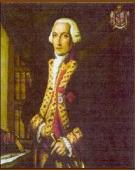 Rodney was ill, and would spend the entire action in his bunk. His flag captain
, Walter Young, urged Rodney to give orders to engage when the Spanish fleet was first spotted, but Rodney only gave orders to form a line abreast. Lángara started to establish a line of battle
, but when he realised the size of Rodney's fleet, he gave orders make all sail for Cadiz. Around 2:00 pm, when Rodney felt certain that the ships seen were not the vanguard of a larger fleet, he issued commands for a general chase. Rodney's instructions to his fleet were to chase at their best speed, and engage the Spanish ships from the rear as they came upon them. They were also instructed to sail to the lee side
to interfere with Spanish attempts to gain the safety of a harbour, a tactic that would also prevent the Spanish ships from opening their lowest gun ports. Because of their copper-sheathed hulls (which reduced marine growths and drag), the ships of the Royal Navy
were faster and soon gained on the Spanish.
The chase lasted for about two hours, and the battle finally began around 4:00 pm. The Santo Domingo, trailing in the Spanish fleet, received broadsides from , , and before blowing up around 4:40, with the loss of all but one of her crew.Syrett, pp. 240, 313 Marlborough and Ajax then passed Princessa
to engage other Spanish ships. Princessa was eventually engaged in an hour-long battle with before striking her colours at about 5:30. By 6:00 pm it was getting dark, and there was a discussion aboard , Rodney's flagship, about whether to continue the pursuit. Although Captain Young is credited in some accounts with pushing Rodney to do so, Dr. Gilbert Blane, the fleet physician, reported it as a decision of the council.
The chase continued into the dark and squally night, leading it to later become known as the "Moonlight Battle", since it was uncommon at the time for naval battles to continue after sunset. At 7:30 pm, came upon Lángara's flagship , engaging her in a battle lasting over an hour. She was broadsided in passing by and , and Lángara was wounded in the battle. Fenix finally surrendered to , which arrived late in the battle and shot away her mainmast. Fenix takeover was complicated by an outbreak of smallpox
aboard Bienfaisant. Captain John MacBride
, rather than sending over a possibly infected prize crew, apprised Lángara of the situation and put him and his crew on parole.
 At 9:15 the Montagu engaged the Diligente
, which struck after her maintopmast was shot away. Around 11:00 pm San Eugenio surrendered after having all of her masts shot away by , but the difficult seas made it impossible to board a prize crew until morning. That duel was passed by and Prince George, which engaged San Julián and compelled her to surrender around 1:00 am. The last ship to surrender was Monarca
. She nearly escaped, shooting away 's topmast, but was engaged in a running battle with the frigate HMS Apollo. Apollo managed to keep up the unequal engagement until about the time that Rodney's flagship Sandwich came upon the scene around 2:00 am. Sandwich fired a broadside, unaware that Monarca had already hauled down her flag.
The British took six ships. Four Spanish ships of the line and the fleet's two frigates escaped, although sources are unclear if two of the Spanish ships were even present with the fleet at the time of the battle. Lángara's report states that San Justo and San Genaro were not in his line of battle (although they are listed in Spanish records as part of his fleet). Rodney's report states that San Justo escaped but was damaged in battle, and that San Genaro escaped without damage. According to one account two of Lángara's ships (unspecified which two) were despatched to investigate other unidentified sails sometime before the action.
with an onshore breeze. One of the prizes, San Julián, was recorded by Rodney as too badly damaged to save, and was driven ashore. The fate of another prize, San Eugenio, is unclear. Some sources report that she too was grounded, but others report that she was retaken by her crew and managed to reach Cadiz. A Spanish history claims that the prize crews of both ships appealed to their Spanish captors for help escaping the lee shore. The Spanish captains retook control of their ships, imprisoned the British crews, and sailed to Cadiz.
The British reported their casualties in the battle as 32 killed and 102 wounded. The supply convoy sailed into Gibraltar on 19 January, driving the smaller blockading fleet to retreat to the safety of Algeciras
. Rodney arrived several days later, after first stopping in Tangier
. The wounded Spanish prisoners, who included Admiral Lángara, were offloaded there, and the British garrison was heartened by the arrival of the supplies and the presence of Prince William Henry. After also resupplying Minorca, Rodney sailed for the West Indies in February, detaching part of the fleet for service in the Channel
. This homebound fleet intercepted a French fleet destined for the East Indies
, capturing one warship and three supply ships. Gibraltar would be resupplied twice more before the siege was lifted at the end of the war
in 1783.
Admiral Lángara and other Spanish officers were eventually released on parole, the admiral receiving a promotion to lieutenant general. He continued his distinguished career, becoming Spanish marine minister in the French Revolutionary Wars
.
Admiral Rodney was lauded for his victory, the first major victory of the war by the Royal Navy over its European opponents. He distinguished himself for the remainder of the war, notably winning the 1782 Battle of the Saintes
in which he captured the French Admiral Comte de Grasse
. He was, however, criticised by Captain Young, who portrayed him as weak and indecisive in the battle with Lángara. (He was also rebuked by the admiralty for leaving a ship of the line at Gibraltar, against his express orders.) Rodney's observations on the benefits of copper sheathing in the victory were influential in British Admiralty decisions to deploy the technology more widely.
There are some discrepancies between the English and Spanish sources listing the Spanish fleet, principally in the number of guns most of the vessels are claimed to mount. The table below lists the Spanish records describing Lángara's fleet. Beatson lists all of the Spanish ships of the line at 70 guns, except Fenix, which he lists at 80 guns. One frigate, the Santa Rosalia, is listed by Beatson at 28 guns. The identify of the second Spanish frigate is different in the two listings. Beatson records her as the Santa Gertrudie, 26 guns, with captain Don Annibal Cassoni, while Duro's listing describes her as Santa Cecilia, 34, captain Don Domingo Grandallana. Both frigates, whatever their identity, escaped the battle.
Portugal
Portugal , officially the Portuguese Republic is a country situated in southwestern Europe on the Iberian Peninsula. Portugal is the westernmost country of Europe, and is bordered by the Atlantic Ocean to the West and South and by Spain to the North and East. The Atlantic archipelagos of the...
on 16 January 1780 during the American War of Independence. A British
Kingdom of Great Britain
The former Kingdom of Great Britain, sometimes described as the 'United Kingdom of Great Britain', That the Two Kingdoms of Scotland and England, shall upon the 1st May next ensuing the date hereof, and forever after, be United into One Kingdom by the Name of GREAT BRITAIN. was a sovereign...
fleet under Admiral Sir George Rodney
George Brydges Rodney, 1st Baron Rodney
George Brydges Rodney, 1st Baron Rodney, KB was a British naval officer. He is best known for his commands in the American War of Independence, particularly his victory over the French at the Battle of the Saintes in 1782...
defeated a Spanish
Spain
Spain , officially the Kingdom of Spain languages]] under the European Charter for Regional or Minority Languages. In each of these, Spain's official name is as follows:;;;;;;), is a country and member state of the European Union located in southwestern Europe on the Iberian Peninsula...
squadron under Don Juan de Lángara
Juan de Lángara
Juan Francisco de Lángara y Huarte was a Spanish naval officer and Minister of Marine.-Life and career:He was born at Coruña, Galicia, the son of a renowned Basque family...
. The battle is sometimes referred to as the Moonlight Battle, because it was unusual for naval battles in the Age of Sail
Age of Sail
The Age of Sail was the period in which international trade and naval warfare were dominated by sailing ships, lasting from the 16th to the mid 19th century...
to take place at night. It was also the first major naval victory for the British over its European enemies in the war, and proved the value of copper sheathing
Copper sheathing
Copper sheathing was the practice of protecting the under-water hull of a ship or boat through the use of copper plates affixed to the outside of the hull. It was pioneered and developed by the Royal Navy during the 18th century.-Development:...
the hulls of warships.
Admiral Rodney was escorting a fleet of supply ships to relieve Gibraltar
Great Siege of Gibraltar
The Great Siege of Gibraltar was an unsuccessful attempt by Spain and France to capture Gibraltar from the British during the American War of Independence. This was the largest action fought during the war in terms of numbers, particularly the Grand Assault of 18 September 1782...
with a fleet of about 20 ships of the line when he encountered Lángara's squadron south of Cape St. Vincent
Cape St. Vincent
Cape St. Vincent , next to the Sagres Point, on the so-called Costa Vicentina , is a headland in the municipality of Sagres, in the Algarve, southern Portugal.- Description :This cape is the southwesternmost point in Portugal...
. When Lángara saw the size of the British fleet, he attempted to make for the safety of Cadiz
Cádiz
Cadiz is a city and port in southwestern Spain. It is the capital of the homonymous province, one of eight which make up the autonomous community of Andalusia....
, but the copper-sheathed British ships chased his fleet down. In a running battle that lasted from mid-afternoon until after midnight, the British captured four Spanish ships, including Lángara's flagship. Two other ships were also captured, but their final disposition is unclear: some Spanish sources indicate they were retaken by their Spanish crews, while Rodney's report indicates the ships were grounded and destroyed.
After the battle Rodney successfully resupplied Gibraltar
Gibraltar
Gibraltar is a British overseas territory located on the southern end of the Iberian Peninsula at the entrance of the Mediterranean. A peninsula with an area of , it has a northern border with Andalusia, Spain. The Rock of Gibraltar is the major landmark of the region...
and Minorca
Minorca
Min Orca or Menorca is one of the Balearic Islands located in the Mediterranean Sea belonging to Spain. It takes its name from being smaller than the nearby island of Majorca....
before continuing on to the West Indies station. Lángara was released on parole, and was promoted to lieutenant general by King Carlos III.
Background
One of SpainSpain
Spain , officially the Kingdom of Spain languages]] under the European Charter for Regional or Minority Languages. In each of these, Spain's official name is as follows:;;;;;;), is a country and member state of the European Union located in southwestern Europe on the Iberian Peninsula...
's principal goals upon its entry
Spain in the American Revolutionary War
Spain actively supported the Thirteen Colonies throughout the American Revolutionary War, beginning in 1776 by jointly funding Roderigue Hortalez and Company, a trading company that provided critical military supplies, through financing the final Siege of Yorktown in 1781 with a collection of gold...
into the American War of Independence in 1779 was the recovery of Gibraltar
Gibraltar
Gibraltar is a British overseas territory located on the southern end of the Iberian Peninsula at the entrance of the Mediterranean. A peninsula with an area of , it has a northern border with Andalusia, Spain. The Rock of Gibraltar is the major landmark of the region...
, which had been lost to England
Kingdom of England
The Kingdom of England was, from 927 to 1707, a sovereign state to the northwest of continental Europe. At its height, the Kingdom of England spanned the southern two-thirds of the island of Great Britain and several smaller outlying islands; what today comprises the legal jurisdiction of England...
in 1704
Capture of Gibraltar
The Capture of Gibraltar by the Anglo-Dutch forces of the Grand Alliance occurred between 1–3 August 1704 during the War of the Spanish Succession. Since the beginning of the war the Allies had been looking for a harbour in the Iberian Peninsula to control the Strait of Gibraltar and facilitate...
. The Spanish planned to retake Gibraltar by blockading and starving out its garrison, which included troops from Britain and the Electorate of Hanover
Electorate of Hanover
The Electorate of Brunswick-Lüneburg was the ninth Electorate of the Holy Roman Empire of the German Nation...
. The siege formally began in June 1779, with the Spanish establishing a land blockade around the Rock of Gibraltar
Rock of Gibraltar
The Rock of Gibraltar is a monolithic limestone promontory located in Gibraltar, off the southwestern tip of Europe on the Iberian Peninsula. It is high...
. The matching naval blockade was comparatively weak, and the British discovered that small fast ships could evade the blockaders, while slower and larger supply ships generally could not. By late 1779, however, supplies in Gibraltar had become seriously depleted, and its commander, General George Eliott
George Augustus Eliott, 1st Baron Heathfield
George Augustus Eliott, 1st Baron Heathfield, KB was a British Army officer who took served in three major wars during the eighteenth century. He rose to distinction during the Seven Years War when he fought in Germany and participated in the British attacks on Belle Île and Cuba...
, appealed to London
London
London is the capital city of :England and the :United Kingdom, the largest metropolitan area in the United Kingdom, and the largest urban zone in the European Union by most measures. Located on the River Thames, London has been a major settlement for two millennia, its history going back to its...
for relief.
A supply convoy was organized, and in late December 1779 a large fleet sailed from England under the command of Admiral Sir George Brydges Rodney
George Brydges Rodney, 1st Baron Rodney
George Brydges Rodney, 1st Baron Rodney, KB was a British naval officer. He is best known for his commands in the American War of Independence, particularly his victory over the French at the Battle of the Saintes in 1782...
. Although Rodney's ultimate orders were to command the West Indies fleet, he had secret instructions to first resupply Gibraltar and Minorca
Minorca
Min Orca or Menorca is one of the Balearic Islands located in the Mediterranean Sea belonging to Spain. It takes its name from being smaller than the nearby island of Majorca....
. On 4 January 1780 the fleet divided, with ships headed for the West Indies sailing westward. This left Rodney in command of 19 ships of the line which were to accompany the supply ships to Gibraltar.
On 8 January 1780 ships from Rodney's fleet spotted a group of sails. Giving chase with their faster copper clad
Copper sheathing
Copper sheathing was the practice of protecting the under-water hull of a ship or boat through the use of copper plates affixed to the outside of the hull. It was pioneered and developed by the Royal Navy during the 18th century.-Development:...
ships, the British determined these to be a Spanish supply convoy that was protected by a single ship of the line and several frigates. The entire convoy was captured
Action of 8 January 1780
The Action of 8 January 1780 was a naval encounter off Cape Finisterre between a British Royal Naval fleet under Admiral Sir George Rodney, and a fleet of Spanish merchants sailing in convoy with seven warships of the Caracas Company, under the command of Commodore Don Juan Augustin de Yardi....
, with the lone ship of the line, the Guipuzcoana, striking her colours after a perfunctory exchange of fire. The Guipuzcoana was renamed , in honour of Prince William
William IV of the United Kingdom
William IV was King of the United Kingdom of Great Britain and Ireland and of Hanover from 26 June 1830 until his death...
, who was serving as midshipman
Midshipman
A midshipman is an officer cadet, or a commissioned officer of the lowest rank, in the Royal Navy, United States Navy, and many Commonwealth navies. Commonwealth countries which use the rank include Australia, New Zealand, South Africa, India, Pakistan, Singapore, Sri Lanka and Kenya...
in the fleet, and staffed with a small prize crew. Rodney then detached and the frigate to escort most of the captured ships back to England; the Prince William was added to his fleet, as were some of the supply ships that carried items likely to be of use to the Gibraltar garrison. On 12 January , which had lost part of her topmast on 3 January, suffered additional damage and raised a distress flag. Assisted by , she limped into Lisbon
Lisbon
Lisbon is the capital city and largest city of Portugal with a population of 545,245 within its administrative limits on a land area of . The urban area of Lisbon extends beyond the administrative city limits with a population of 3 million on an area of , making it the 9th most populous urban...
on 16 January.
The Spanish had learnt of the British relief effort. From the blockading squadron a fleet comprising 11 ships of the line under Admiral Juan de Lángara
Juan de Lángara
Juan Francisco de Lángara y Huarte was a Spanish naval officer and Minister of Marine.-Life and career:He was born at Coruña, Galicia, the son of a renowned Basque family...
was despatched to intercept Rodney's convoy, and the Atlantic fleet of Admiral Luis de Córdova
Luis de Córdova y Córdova
Luis de Córdova y Córdova was a Spanish admiral. He is best known for his command of the Spanish fleet during the American War of Independence...
at Cadiz
Cádiz
Cadiz is a city and port in southwestern Spain. It is the capital of the homonymous province, one of eight which make up the autonomous community of Andalusia....
was also alerted to try to catch him. Córdova learnt of the strength of Rodney's fleet, and returned to Cadiz rather than giving chase. On 16 January the fleets of Lángara and Rodney spotted each other around 1:00 pm south of Cape St. Vincent
Cape St. Vincent
Cape St. Vincent , next to the Sagres Point, on the so-called Costa Vicentina , is a headland in the municipality of Sagres, in the Algarve, southern Portugal.- Description :This cape is the southwesternmost point in Portugal...
, the southwestern point of Portugal
Portugal
Portugal , officially the Portuguese Republic is a country situated in southwestern Europe on the Iberian Peninsula. Portugal is the westernmost country of Europe, and is bordered by the Atlantic Ocean to the West and South and by Spain to the North and East. The Atlantic archipelagos of the...
and the Iberian Peninsula
Iberian Peninsula
The Iberian Peninsula , sometimes called Iberia, is located in the extreme southwest of Europe and includes the modern-day sovereign states of Spain, Portugal and Andorra, as well as the British Overseas Territory of Gibraltar...
. The weather was hazy, with heavy swells and occasional squalls.
Battle
Flag captain
In the Royal Navy, a flag captain was the captain of an admiral's flagship. During the 18th and 19th centuries, this ship might also have a "captain of the fleet", who would be ranked between the admiral and the "flag captain" as the ship's "First Captain", with the "flag captain" as the ship's...
, Walter Young, urged Rodney to give orders to engage when the Spanish fleet was first spotted, but Rodney only gave orders to form a line abreast. Lángara started to establish a line of battle
Line of battle
In naval warfare, the line of battle is a tactic in which the ships of the fleet form a line end to end. A primitive form had been used by the Portuguese under Vasco Da Gama in 1502 near Malabar against a Muslim fleet.,Maarten Tromp used it in the Action of 18 September 1639 while its first use in...
, but when he realised the size of Rodney's fleet, he gave orders make all sail for Cadiz. Around 2:00 pm, when Rodney felt certain that the ships seen were not the vanguard of a larger fleet, he issued commands for a general chase. Rodney's instructions to his fleet were to chase at their best speed, and engage the Spanish ships from the rear as they came upon them. They were also instructed to sail to the lee side
Lee shore
The terms lee shore and windweather or ward shore are nautical terms used to describe a stretch of shoreline. A lee shore is one that is to the lee side of a vessel - meaning the wind is blowing towards it. A weather shore has the wind blowing from inland over it out to sea...
to interfere with Spanish attempts to gain the safety of a harbour, a tactic that would also prevent the Spanish ships from opening their lowest gun ports. Because of their copper-sheathed hulls (which reduced marine growths and drag), the ships of the Royal Navy
Royal Navy
The Royal Navy is the naval warfare service branch of the British Armed Forces. Founded in the 16th century, it is the oldest service branch and is known as the Senior Service...
were faster and soon gained on the Spanish.
The chase lasted for about two hours, and the battle finally began around 4:00 pm. The Santo Domingo, trailing in the Spanish fleet, received broadsides from , , and before blowing up around 4:40, with the loss of all but one of her crew.Syrett, pp. 240, 313 Marlborough and Ajax then passed Princessa
Spanish ship Princessa (1750)
Princesa was a 70-gun ship of the line of the Spanish Navy, launched in 1750.She fought at the Battle of Cape St Vincent in 1780, where she was captured by the Royal Navy and commissioned as the third rate HMS Princessa. From 1784 she was employed as a sheer hulk, and she was broken up in 1809....
to engage other Spanish ships. Princessa was eventually engaged in an hour-long battle with before striking her colours at about 5:30. By 6:00 pm it was getting dark, and there was a discussion aboard , Rodney's flagship, about whether to continue the pursuit. Although Captain Young is credited in some accounts with pushing Rodney to do so, Dr. Gilbert Blane, the fleet physician, reported it as a decision of the council.
The chase continued into the dark and squally night, leading it to later become known as the "Moonlight Battle", since it was uncommon at the time for naval battles to continue after sunset. At 7:30 pm, came upon Lángara's flagship , engaging her in a battle lasting over an hour. She was broadsided in passing by and , and Lángara was wounded in the battle. Fenix finally surrendered to , which arrived late in the battle and shot away her mainmast. Fenix takeover was complicated by an outbreak of smallpox
Smallpox
Smallpox was an infectious disease unique to humans, caused by either of two virus variants, Variola major and Variola minor. The disease is also known by the Latin names Variola or Variola vera, which is a derivative of the Latin varius, meaning "spotted", or varus, meaning "pimple"...
aboard Bienfaisant. Captain John MacBride
John MacBride (Royal Navy officer)
John MacBride was an officer of the Royal Navy and a politician who saw service during the Seven Years' War, the American War of Independence and the French Revolutionary Wars, eventually rising to the rank of Admiral of the Blue.MacBride entered the navy after serving on merchant vessels and...
, rather than sending over a possibly infected prize crew, apprised Lángara of the situation and put him and his crew on parole.
Spanish ship Diligente (1756)
Diligente was a 68-gun ship of the line of the Spanish Navy, launched in 1756.She fought at the Battle of Cape St Vincent in 1780, where she was captured by the Royal Navy and commissioned as the third rate HMS Diligente. She was sold out of the navy in 1784....
, which struck after her maintopmast was shot away. Around 11:00 pm San Eugenio surrendered after having all of her masts shot away by , but the difficult seas made it impossible to board a prize crew until morning. That duel was passed by and Prince George, which engaged San Julián and compelled her to surrender around 1:00 am. The last ship to surrender was Monarca
Spanish ship Monarca (1756)
Monarca was a 68-gun ship of the line of the Spanish Navy, launched in 1756.She fought in the Battle of Cape St Vincent in 1780, in which she was captured by the Royal Navy and subsequently commissioned as the third rate HMS Monarca. She came under the command of Captain John Gell who was under the...
. She nearly escaped, shooting away 's topmast, but was engaged in a running battle with the frigate HMS Apollo. Apollo managed to keep up the unequal engagement until about the time that Rodney's flagship Sandwich came upon the scene around 2:00 am. Sandwich fired a broadside, unaware that Monarca had already hauled down her flag.
The British took six ships. Four Spanish ships of the line and the fleet's two frigates escaped, although sources are unclear if two of the Spanish ships were even present with the fleet at the time of the battle. Lángara's report states that San Justo and San Genaro were not in his line of battle (although they are listed in Spanish records as part of his fleet). Rodney's report states that San Justo escaped but was damaged in battle, and that San Genaro escaped without damage. According to one account two of Lángara's ships (unspecified which two) were despatched to investigate other unidentified sails sometime before the action.
Aftermath
With the arrival of daylight, it was clear that the British fleet and their prize ships were dangerously close to a lee shoreLee shore
The terms lee shore and windweather or ward shore are nautical terms used to describe a stretch of shoreline. A lee shore is one that is to the lee side of a vessel - meaning the wind is blowing towards it. A weather shore has the wind blowing from inland over it out to sea...
with an onshore breeze. One of the prizes, San Julián, was recorded by Rodney as too badly damaged to save, and was driven ashore. The fate of another prize, San Eugenio, is unclear. Some sources report that she too was grounded, but others report that she was retaken by her crew and managed to reach Cadiz. A Spanish history claims that the prize crews of both ships appealed to their Spanish captors for help escaping the lee shore. The Spanish captains retook control of their ships, imprisoned the British crews, and sailed to Cadiz.
The British reported their casualties in the battle as 32 killed and 102 wounded. The supply convoy sailed into Gibraltar on 19 January, driving the smaller blockading fleet to retreat to the safety of Algeciras
Algeciras
Algeciras is a port city in the south of Spain, and is the largest city on the Bay of Gibraltar . Port of Algeciras is one of the largest ports in Europe and in the world in three categories: container,...
. Rodney arrived several days later, after first stopping in Tangier
Tangier
Tangier, also Tangiers is a city in northern Morocco with a population of about 700,000 . It lies on the North African coast at the western entrance to the Strait of Gibraltar where the Mediterranean meets the Atlantic Ocean off Cape Spartel...
. The wounded Spanish prisoners, who included Admiral Lángara, were offloaded there, and the British garrison was heartened by the arrival of the supplies and the presence of Prince William Henry. After also resupplying Minorca, Rodney sailed for the West Indies in February, detaching part of the fleet for service in the Channel
English Channel
The English Channel , often referred to simply as the Channel, is an arm of the Atlantic Ocean that separates southern England from northern France, and joins the North Sea to the Atlantic. It is about long and varies in width from at its widest to in the Strait of Dover...
. This homebound fleet intercepted a French fleet destined for the East Indies
East Indies
East Indies is a term used by Europeans from the 16th century onwards to identify what is now known as Indian subcontinent or South Asia, Southeastern Asia, and the islands of Oceania, including the Malay Archipelago and the Philippines...
, capturing one warship and three supply ships. Gibraltar would be resupplied twice more before the siege was lifted at the end of the war
Treaty of Paris (1783)
The Treaty of Paris, signed on September 3, 1783, ended the American Revolutionary War between Great Britain on the one hand and the United States of America and its allies on the other. The other combatant nations, France, Spain and the Dutch Republic had separate agreements; for details of...
in 1783.
Admiral Lángara and other Spanish officers were eventually released on parole, the admiral receiving a promotion to lieutenant general. He continued his distinguished career, becoming Spanish marine minister in the French Revolutionary Wars
French Revolutionary Wars
The French Revolutionary Wars were a series of major conflicts, from 1792 until 1802, fought between the French Revolutionary government and several European states...
.
Admiral Rodney was lauded for his victory, the first major victory of the war by the Royal Navy over its European opponents. He distinguished himself for the remainder of the war, notably winning the 1782 Battle of the Saintes
Battle of the Saintes
The Battle of the Saintes took place over 4 days, 9 April 1782 – 12 April 1782, during the American War of Independence, and was a victory of a British fleet under Admiral Sir George Rodney over a French fleet under the Comte de Grasse forcing the French and Spanish to abandon a planned...
in which he captured the French Admiral Comte de Grasse
François Joseph Paul de Grasse
Lieutenant Général des Armées Navales François-Joseph Paul, marquis de Grasse Tilly, comte de Grasse was a French admiral. He is best known for his command of the French fleet at the Battle of the Chesapeake, which led directly to the British surrender at Yorktown...
. He was, however, criticised by Captain Young, who portrayed him as weak and indecisive in the battle with Lángara. (He was also rebuked by the admiralty for leaving a ship of the line at Gibraltar, against his express orders.) Rodney's observations on the benefits of copper sheathing in the victory were influential in British Admiralty decisions to deploy the technology more widely.
Order of battle
None of the listed sources give an accurate accounting of the ships in Rodney's fleet at the time of the action. Beatson lists the composition of the fleet at its departure from England, and notes which ships separated to go to the West Indies, as well as those detached to return the prizes captured on 8 January to England. He does not list two ships (Dublin and Shrewsbury, identified in despatches reprinted by Syrett) that were separated from the fleet on 13 January. Furthermore, HMS Prince William is sometimes misunderstood to have been part of the prize escort back to England, but she was present at Gibraltar after the action. Beatson also fails to list a number of frigates, including , which played a key role in the capture of the Monarca.| British fleet | ||||||
|---|---|---|---|---|---|---|
| Ship | Rate | Guns | Commander | Casualties | ||
| Killed | Wounded | Total | ||||
| Second rate | 90 | Admiral of the White Sir George Rodney George Brydges Rodney, 1st Baron Rodney George Brydges Rodney, 1st Baron Rodney, KB was a British naval officer. He is best known for his commands in the American War of Independence, particularly his victory over the French at the Battle of the Saintes in 1782... (fleet commander) Walter Young |
0 | 0 | 0 | |
| First rate | 100 | Rear Admiral of the Blue Robert Digby Robert Digby (Royal Navy officer) Admiral Robert Digby was an officer in the Royal Navy officer who also served briefly as an Member of Parliament .- Naval career :... John Bourmaster |
0 | 0 | 0 | |
| Second rate | 90 | Rear Admiral of the Blue Sir John Lockhart-Ross Philip Patton |
1 | 3 | 4 | |
| Third rate | 74 | Samuel Uvedale | 0 | 6 | 6 | |
| Third rate | 74 | John Brisbane | 0 | 0 | 0 | |
| Third rate | 74 | Edmund Affleck Edmund Affleck Sir Edmund Affleck, 1st Baronet was a naval officer of considerable repute. He entered the navy at an early age, and during reign of George II, served in the several capacities of lieutenant, master and commander, and post captain... |
3 | 9 | 12 | |
| Third rate | 74 | George Balfour | 0 | 0 | 0 | |
| Third rate | 74 | Joseph Peyton | 0 | 1 | 1 | |
| Third rate | 74 | James Cranston | 10 | 12 | 22 | |
| Third rate | 74 | John Elliot | 6 | 20 | 26 | |
| Third rate | 74 | S. Cornish | 3 | 4 | 7 | |
| Third rate | 74 | Thomas Penny | 0 | 0 | 0 | |
| Third rate | 74 | Adam Duncan | 3 | 26 | 29 | |
| Third rate | 74 | John Houlton | 0 | 0 | 0 | |
| Third rate | 74 | Sir Chaloner Ogle Sir Chaloner Ogle, 1st Baronet Sir Chalonor Ogle was an Admiral in the British navy.He was the son of Nathaniel Ogle of Kirkley Hall, Northumberland.... |
0 | 0 | 0 | |
| Third rate | 74 | John Leigh Douglas | 6 | 12 | 18 | |
| Third rate | 64 | John MacBride John MacBride (Royal Navy officer) John MacBride was an officer of the Royal Navy and a politician who saw service during the Seven Years' War, the American War of Independence and the French Revolutionary Wars, eventually rising to the rank of Admiral of the Blue.MacBride entered the navy after serving on merchant vessels and... |
0 | 0 | 0 | |
| Third rate | 64 | Unknown | ||||
| Frigate Frigate A frigate is any of several types of warship, the term having been used for ships of various sizes and roles over the last few centuries.In the 17th century, the term was used for any warship built for speed and maneuverability, the description often used being "frigate-built"... |
32 | Philemon Pownoll Philemon Pownoll Philemon Pownoll was an officer of the Royal Navy who saw service during the War of the Austrian Succession, the Seven Years' War and the American War of Independence, rising to the rank of post-captain.... |
||||
| Frigate Frigate A frigate is any of several types of warship, the term having been used for ships of various sizes and roles over the last few centuries.In the 17th century, the term was used for any warship built for speed and maneuverability, the description often used being "frigate-built"... |
32 | Henry Harvey Henry Harvey Admiral Sir Henry Harvey, KB was a long-serving officer of the British Royal Navy during the second half of the eighteenth century. Harvey participated in numerous naval operations and actions and especially distinguished himself at the Glorious First of June in command of... |
||||
| Frigate Frigate A frigate is any of several types of warship, the term having been used for ships of various sizes and roles over the last few centuries.In the 17th century, the term was used for any warship built for speed and maneuverability, the description often used being "frigate-built"... |
28 | Skeffington Lutwidge Skeffington Lutwidge Skeffington Lutwidge was an officer of the Royal Navy, who saw service during the American War of Independence, and the French Revolutionary and Napoleonic Wars... |
||||
| Frigate Frigate A frigate is any of several types of warship, the term having been used for ships of various sizes and roles over the last few centuries.In the 17th century, the term was used for any warship built for speed and maneuverability, the description often used being "frigate-built"... |
24 | John Bazely | ||||
| Frigate Frigate A frigate is any of several types of warship, the term having been used for ships of various sizes and roles over the last few centuries.In the 17th century, the term was used for any warship built for speed and maneuverability, the description often used being "frigate-built"... |
24 | Hugh Seymour-Conway Lord Hugh Seymour Vice-Admiral Lord Hugh Seymour was a senior British Royal Navy officer of the late 18th century who was the fifth son of Francis Seymour-Conway, 1st Marquess of Hertford and became known for being both a prominent society figure and a highly competent naval officer... |
||||
| Frigate Frigate A frigate is any of several types of warship, the term having been used for ships of various sizes and roles over the last few centuries.In the 17th century, the term was used for any warship built for speed and maneuverability, the description often used being "frigate-built"... |
24 | Edward Thompson Edward Thompson (Royal Navy officer) Edward Thompson was an English Royal Navy officer who rose to the rank of commodore, known also as as a literary figure with the nickname "Poet Thompson".-Life:... |
||||
| Unless otherwise cited, table information is from Beatson, pp. 232, 234, and Syrett, p. 274. Full captain names are from Syrett, p. 259. Blank casualty report fields mean there was no report listed for that ship. |
||||||
There are some discrepancies between the English and Spanish sources listing the Spanish fleet, principally in the number of guns most of the vessels are claimed to mount. The table below lists the Spanish records describing Lángara's fleet. Beatson lists all of the Spanish ships of the line at 70 guns, except Fenix, which he lists at 80 guns. One frigate, the Santa Rosalia, is listed by Beatson at 28 guns. The identify of the second Spanish frigate is different in the two listings. Beatson records her as the Santa Gertrudie, 26 guns, with captain Don Annibal Cassoni, while Duro's listing describes her as Santa Cecilia, 34, captain Don Domingo Grandallana. Both frigates, whatever their identity, escaped the battle.
| Spanish fleet | |||||||
|---|---|---|---|---|---|---|---|
| Ship | Rate | Guns | Commander | Notes | |||
| Third rate | 80 | Don Juan de Lángara Juan de Lángara Juan Francisco de Lángara y Huarte was a Spanish naval officer and Minister of Marine.-Life and career:He was born at Coruña, Galicia, the son of a renowned Basque family... (fleet commander) Don Francisco Melgarejo |
Captured, 700 men. | ||||
| Third rate | 74 | Don Manuel León | Captured, 600 men. | ||||
| Third rate | 74 | Don Antonio Albornoz | Captured, 600 men. | ||||
| Third rate | 74 | Don Antonio Oyarvide | Captured, 600 men. | ||||
| Santo Domingo | Third rate | 74 | Don Ignacio Mendizábal | Blown up. | |||
| Third rate | 74 | Don Vicente Doz | Escaped. | ||||
| San Lorenzo | Third rate | 74 | Don Juan Araoz | Escaped with damage. | |||
| San Julián | Third rate | 64 | Marqués de Medina | Captured (600 men), either grounded or retaken. | |||
| San Eugenio | Third rate | 74 | Don Antonio Damonte | Captured (600 men), either grounded or retaken. | |||
| San Jenaro | Third rate | 74 | Don Félix de Tejada | Not listed in Lángara's line of battle. Listed by Beatson as escaping. | |||
| San Justo | Third rate | 74 | Don Francisco Urreiztieta | Not listed in Lángara's line of battle. Listed by Beatson as escaping with damage. | |||
| Santa Cecilia | Frigate Frigate A frigate is any of several types of warship, the term having been used for ships of various sizes and roles over the last few centuries.In the 17th century, the term was used for any warship built for speed and maneuverability, the description often used being "frigate-built"... |
34 | Don Domingo Grandallana | Identified as Santa Gertrudis in Beatson. Escaped. | |||
| Santa Rosalia | Frigate Frigate A frigate is any of several types of warship, the term having been used for ships of various sizes and roles over the last few centuries.In the 17th century, the term was used for any warship built for speed and maneuverability, the description often used being "frigate-built"... |
34 | Don Antonio Ortega | Escaped. | |||
| Unless otherwise cited, table information is from Duro, pp. 259, 263, and Beatson, p. 233. | |||||||
See also
- Battle of Cape St. Vincent (disambiguation), for several other naval battles fought off Cape St Vincent, the best known in 1797
Sources
Reprints Lángara's report. Reprints numerous British documents concerning Rodney's entire expedition.Further reading
- Sapherson, C. A. and Lenton, J. R. (1986) Navy Lists from the Age of Sail; Vol. 2: 1776-1783. Leeds: Raider Games
- Spinney, David (1969) Rodney. London: Allen & Unwin ISBN 0049200224
- Trew, Peter. Rodney and The Breaking of the Line Leo Cooper Ltd (2005) ISBN 9781844151431