

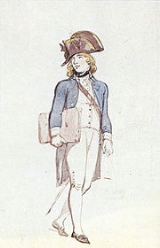
Midshipman

Encyclopedia
A midshipman is an officer cadet
, or a commissioned officer of the lowest rank, in the Royal Navy
, United States Navy
, and many Commonwealth
navies. Commonwealth countries which use the rank include Australia, New Zealand, South Africa, India, Pakistan, Singapore, Sri Lanka and Kenya. The rank was also used, prior to 1968, by the Royal Canadian Navy
, but upon the creation of the Canadian Forces
the rank of midshipman was replaced with the rank of naval cadet.
In the 17th century, a midshipman was a rating
for an experienced seaman, and the word derives from the area aboard a ship, amidships, either where the original rating worked on the ship, or where he was berthed
. Beginning in the 18th century, a commissioned officer candidate was rated as a midshipman, and the seaman rating began to slowly die out. By the Napoleonic era
(1793–1815), a midshipman was an apprentice officer who had previously served at least three years as a volunteer, officer's servant or able seaman, and was roughly equivalent to a present day petty officer
in rank and responsibilities. After serving at least three years as a midshipman or master's mate
, he was eligible to take the examination for lieutenant. Promotion to lieutenant was not automatic and many midshipmen took positions as master's mates for an increase in pay and responsibility aboard ship. Midshipmen in the United States Navy were trained and served similarly to midshipman in the Royal Navy, although unlike their counterparts in the Royal Navy, a midshipman was a warrant officer
rank until 1912.
During the 19th century, changes in the training of naval officers in both the Royal Navy and the United States Navy led to the replacement of apprenticeship aboard ships with formal schooling in a naval college
. Midshipman began to mean an officer cadet at a naval college. Trainees now spent around four years in a college and two years at sea prior to promotion to commissioned officer rank. Between the mid-19th and mid-20th centuries, time at sea declined to less than a year as the entry age was increased from 12 to 18.
Ranks equivalent to midshipman exist in many other navies. Using US midshipman or pre-fleet board UK midshipman as the basis for comparison, the equivalent rank would be a naval cadet in training to become a junior commissioned officer. Using post-fleet board UK midshipman for comparison, the rank would be the most junior commissioned officer in the rank structure, and similar to a US ensign in role and responsibility. In many Romance languages, the literal translation of the local term for "midshipman" into English is "Navy Guard", including the French
garde marine, Spanish
guardia marina, Portuguese
guarda-marinha, and Italian
guardiamarina. Today, these ranks all refer to naval cadets, but historically they were selected by the monarchy, and were trained mostly on land as soldiers.
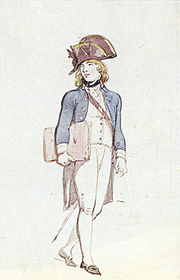 The rank of midshipman originated during the Tudor
and Stuart eras, and originally referred to a post for an experienced seaman promoted from the ordinary deck hands, who worked in between the main and mizzen mast and had more responsibility than an ordinary seaman, but was not a military officer or an officer in training. The first published use of the term midshipman was in 1662. The word derives from an area aboard a ship, amidships, but it refers either to the location where midshipmen worked on the ship, or the location where midshipmen were berthed
.
By the 18th century four types of midshipman existed: midshipman (original rating), midshipman extraordinary
, midshipman (apprentice officer), and midshipman ordinary
. Some midshipmen were older men, and while most were officer candidates who failed to pass the lieutenant examination or were passed over for promotion, some members of the original rating served, as late as 1822, alongside apprentice officers without themselves aspiring to a commission. By 1794, all midshipmen were considered officer candidates, and the original rating was phased out.
Beginning in 1661, boys who aspired to become officers were sent by their families to serve on ships with a "letter of service" from the crown, and were paid at the same rate as midshipmen. The letter instructed the admirals and captains that the bearer was to be shown "such kindness as you shall judge fit for a gentleman, both in accommodating him in your ship and in furthering his improvement". Their official rating was volunteer-per-order
, but they were often known as King's letter boys, to distinguish their higher social class from the original midshipman rating.
Beginning in 1677, Royal Navy regulations for promotion to lieutenant required service as a midshipman, and promotion to midshipman required some time at sea. By the Napoleonic Era, the regulations required at least three years of services as a midshipman or master's mate
and six years of total sea time. Sea time was earned in various ways, most boys served this period at sea in any lower rating, either as a servant of one of the ship's officers, a volunteer, or a seaman.
By the 1730s, the rating volunteer-per-order was phased out and replaced with a system where prospective midshipmen served as servants for officers. For example, a captain
was allowed four servants for every 100 men aboard his ship; many of these servants were young men destined to become officers.
In 1729, the Royal Naval Academy in Portsmouth
, renamed the Royal Naval College in 1806, was founded, for 40 students aged between 13 and 16, who would take three years to complete a course of study defined in an illustrated book, and would earn two years of sea time as part of their studies. The rating of midshipman-by-order, or midshipman ordinary, was used specifically for graduates of the Royal Naval College, to distinguish them from midshipmen who had served aboard ship, who were paid more. The school was unpopular in the Navy, because officers enjoyed the privilege of having servants and preferred the traditional method of training officers via apprenticeship.
In 1794, officer's servants were abolished and a new class of volunteers called 'Volunteer Class I' was created for boys between the ages of 11 and 13 who were considered future midshipmen and lived in the gunroom on a ship-of-the-line or with the midshipmen on a frigate
or smaller vessel. Volunteers were paid £6 per year. By 1816, the rating of midshipman ordinary was phased out, and all apprentice officers were rated as midshipmen.
In the 18th century Royal Navy, rank and position on board ship was defined by a mix of two hierarchies, an official hierarchy of ranks and a conventionally recognized social divide between gentlemen and non-gentlemen. Boys aspiring for a commission were often called young gentlemen
instead of their substantive rating to distinguish their higher social standing from the ordinary sailors. Occasionally, a midshipman would be posted aboard a ship in a lower rating such as able seaman
but would eat and sleep with his social equals in the cockpit
.
Approximately 50 percent of midshipmen were the sons of professional men, which included the sons of naval officers, and there were notable sailing families throughout the Age of Sail, such as the Saumarez
, Hood
, and Parker
families. The niceties of preferment and promotion made family connections an obvious advantage for prospective officers. Members of the peerage
and landed gentry
formed the next largest group, about 27 percent of officers. The numbers were smaller, but similarly, their connections gave them excellent prospects for promotion, and they had a considerable influence on the Royal Navy. A notable member of this group was Prince William, later William IV who served as a midshipman from 1780–1785. The rest were from commercial or working class
backgrounds, and because of the advantages possessed by the nobility and professional sailors, their chances of promotion to lieutenant were slim.
Since most midshipmen were from the gentry or had family connections with sailing ships, many used their connections to have their names placed on a ship's books. The practice, known colloquially as "false muster" was common even though it was technically illegal and frowned upon. This allowed some boys to be promoted to midshipmen, or in some cases lieutenant, without having completed the required amount of time at sea. A notable example was Thomas Cochrane
, whose uncle had him entered at the age of five; his name was carried on various ships until he was 18 and received his commission.
When uniforms were introduced in the Navy in 1748, midshipmen started wearing the same uniform as commissioned officers. They also began wearing their traditional badge of rank, a white patch of cloth with a gold button and a twist of white cord on each side of the coat collar. The uniform emphasized that midshipmen were gentlemen and officers under instruction.
Midshipmen were expected to work on the ship, but were also expected to learn navigation and seamanship. They were expected to have learned already, as able seamen and volunteers, to rig sails; other duties included keeping watch, relaying messages between decks, supervising gun batteries, commanding small boats, and taking command of sub-division of the ship's company under one of the lieutenants. On smaller ships midshipmen were instructed by a senior master's mate, often a passed midshipman
, who taught them mathematics, navigation, and sailing lore. Larger ships would carry a schoolmaster
, who was rated as a midshipman but usually was a civilian like the chaplain
. Midshipmen were expected to keep detailed navigational logs, which were shown to the captain to assess their progress.
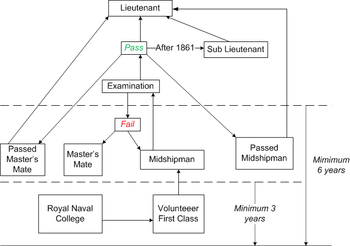 Prior to promotion to lieutenant, a commissioned officer candidate in the Royal Navy had to pass a formal examination. Officially, a prospective lieutenant was at least 19, and was expected to produce proof of his service, which would include certificates from his commanders and journals kept while a midshipman. However, most midshipmen aspired to take the lieutenant examination at age 17 or 18, and the typical age of a midshipman was between 15 and 22. The candidate was summoned before a board of three captains and questioned about seamanship
, navigation
, and discipline
. The board would ask questions such as:
Like the board, which might be an ad hoc affair, the actual exam questions were not standardized and their content depended mostly on individual captains. In seamanship, the candidate was expected to be able to splice ropes
, reef a sail
, work a ship in sailing
and shift his tides. In navigation, he was expected to be able to keep a reckoning of the ship's way by plane sailing
, to use Mercator projection
maps and observation of the sun and stars to determine the course and position of the ship, and to understand the variation of the compass
. He was also expected to be qualified to do the duty of an able seaman
and midshipman.
Failure usually meant six more months of sea service before the examination could again be attempted. Some men never passed it. Successful completion made the midshipman a 'passed midshipman'. From the 18th century until the second half of the 19th century, a midshipman in the Royal Navy who passed the lieutenant's examination did not automatically receive a commission. Midshipmen with political connections were promoted first, while others would wait their turn on a roster. During wartime, when large numbers of ships and men might be lost in battle, most passed midshipman would be promoted in a year or two, but during peacetime the wait might be so long that the midshipman would eventually be considered too old and lose his chance for a commission.
Passed midshipmen awaiting promotion often elected to become master's mates, a high-ranking petty officer who assisted the master
with his duties, served on watch as deputy to the lieutenants, and commanded small boats. A midshipman who became master's mate earned an increase in pay from £2 5s to £3 16s per month but initially reduced his chances at a commission because master's mates, along with masters, were assumed to have a working class background. Over time, however, appointment to master's mate became considered a normal part of the path to a commission; the situation caused some confusion during the last part of the 18th century, when two parallel roles – master's mates trying to become masters, and former midshipmen working toward a commission – held the same title and responsibilities aboard ship.
By the first years of the 19th century, the term 'mate', without the prefix master's, was used for passed midshipmen
, to distinguish them from master's mates who had not served as midshipmen. In 1824, the rating of master's assistant replaced master's mate, and mate continued to be used unofficially by passed midshipmen. These changes helped eliminate the confusion caused by the mingling of midshipmen in the navigator's branch. In 1838 a Royal Commission
, presided over by the Duke of Wellington
, recommended the institution of the rank of mate as an official step between midshipman and lieutenant. In 1861 mate was abolished in favor of sub-lieutenant
.
in 1794, midshipman was listed as a rank of warrant officer in the Naval Act of 1794
, and they were appointed by the President of the United States
. Midshipmen had similar duties and responsibilities as in the Royal Navy, and were typically young men between the age of 14 and 22 training to become a naval officer. "Passed midshipman" was first used in 1819, and was an official rank of the US Navy.
During the long period of peace between 1815 and 1846 midshipmen had few opportunities for promotion, and their warrants were often obtained via patronage. The poor quality of officer training in the US Navy became visible after the Somers Affair, an alleged mutiny
aboard the training ship USS Somers
in 1842, and the subsequent execution of midshipman Philip Spencer
. Spencer had gained his post aboard the Somers via the influence of his father, United States Secretary of War
John C. Spencer.
, which was replaced by HMS Britannia
in 1859. Britannia was moved to Portland
in 1862, and to the present location of the Britannia Royal Naval College
, Dartmouth
in 1863.
Beginning in 1840s, the normal entry age for executive officer cadets, those destined to command ships and fleets, was between 12 and 13, and instruction consisted of two years of classroom training, during which time trainees were rated as naval cadets. Cadets who received a first-class passing grade in studies, seamanship and conduct on their final examination could receive a credit for up to a year of sea time, and could be rated as midshipmen immediately after passing out of the college. After passing out of the college, cadets served aboard a special training vessel for one year. Cadets were then rated as midshipmen, and served aboard the fleet another two years. Midshipmen lived in the gunroom, kept watches, and ran the ship's boats. They received instruction in navigation every day. After five total years of training and having reached the age of 19, the midshipmen were eligible to take the examination for lieutenant. After passing the examination for lieutenant, midshipmen were commissioned as sub-lieutenants, and were transferred to the Royal Naval College, Greenwich, which opened in 1873 as the 'University of the Navy'.
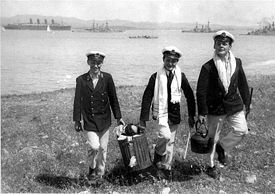 Beginning in 1903, officer training of military and engineering students was reformed by the Selborne-Fisher scheme
, and engineering and executive officer candidates began to enter the Navy in the same way, which was termed 'Common Entry'. Previously, engineer cadets had been trained separately at the Royal Naval Engineering College, Keyham which was closed in 1910. In 1903 a new preparatory school was opened at Royal Naval College, Osborne
, which was Queen Victoria's favorite residence but was not a favorite of her successor Edward VII
who had donated it to the nation in 1902. Training initially consisted of two years at Osborne and two years at Dartmouth as cadets, later four years at Dartmouth, followed by approximately 3 years of sea duty as midshipmen prior to promotion to sub-lieutenant. In 1905, a new building was completed on shore to replace Britannia, which was named Britannia Royal Naval College. In 1913, increasing demand for officers led to recruitment of 18 year-old graduates of public schools, which was called 'Special Entry', and was conducted separately from Selborne scheme cadets. Special entry cadets trained for approximately 6 months prior to service in the fleet as midshipmen. When World War I
began in 1914, all the cadets at Dartmouth were quickly mobilized as midshipmen in the reserve fleet. During the war, two midshipmen, George Drewry
and Wilfred Malleson were awarded the Victoria Cross
, the highest award of the British Commonwealth for gallantry, during the Landing at Cape Helles
. After World War I ended, opposition to the Selborne-Fisher scheme led to re-segregating executive and engineering officers into separate branches, while common entry and special entry were maintained.
After World War II
another series of reforms, influenced by the quality of officers produced by the special entry scheme and other nations' experience with training officer candidates in a university setting, were initiated to increase the quality of officers in the Navy. In 1949 the entry age was increased to 16, and by 1955 the entry age was increased to 18 and entry required a minimum of two A levels. After 1957 midshipmen no longer served in the fleet. In 1972, all cadets became midshipmen when the rank of cadet was abolished.
in 1802, but it took almost 50 years to approve a similar school for naval officers. One major reason for the delay was that Navy leaders preferred the apprenticeship system, citing famous officers such as Nelson
and the captains of the War of 1812
who did not attend a formal naval school. However, after the Somers Affair, officers realized that the system for training officers had to change to be more efficient.
George Bancroft
, appointed Secretary of the Navy in 1845, decided to work outside of congressional approval and create a new academy for officers. He formed a council led by Commodore Perry to create a new system for training officers, and turned the old Fort Severn
at Annapolis into a new institution which would be designated as the United States Naval Academy
in 1851. Midshipmen studied at the Academy for four years and trained aboard ships each summer. Midshipman began to mean "passed midshipman" at this time, and a student at the Naval Academy was a cadet midshipman. The rank of ensign was created in 1862, and passed midshipmen were promoted to ensign when vacancies occurred.
In 1865, the Department of Steam Enginery was created and cadet engineers were admitted to the Academy for the first time. In 1874, Congress changed the curriculum to include four years of classroom training and two years of sea duty aboard a regular vessel prior to examinations as warranted midshipmen. In 1882, Congress eliminated the distinction in training between engineer and naval cadets, and designated the student officers as naval cadets; the name reverted to midshipmen in 1902. By an act of Congress passed in 1903, two appointments as midshipmen were allowed for each senator
, representative, and delegate
in Congress, two for the District of Columbia, and five each year at large. In 1912, Congress authorized commissioning midshipmen as ensigns on graduation day, and ended the previously required two years of post-graduation sea service as warrant officers.
In 1930, the Naval Academy received accreditation
as an approved technological institution. In 1933, a new law enabled the Naval, Military, and Coast Guard Academies to award Bachelor of Science degrees
, and the class of 1933 was the first to receive this degree and have it written in the diploma. In 1937, the superintendent of the Naval Academy was granted the authority to award Bachelor of Science degrees to all living graduates.
s of the British Empire
formed their own navies during the 20th century, further countries began using the rank of midshipman. Today Australia, New Zealand, South Africa, Pakistan, India, Singapore
, Sri Lanka, Bangladesh
and Kenya
use the rank. Prior to 1968 Canada also used the rank of midshipman, until the National Defence Act
consolidated the Royal Canadian Navy with the Army and Air Force into a single military, called the Canadian Forces. As part of the act, the rank of midshipman was replaced with the rank of naval cadet.
 In the modern Royal Navy
a midshipman is the lowest rank of officer, and rank with second lieutenant
in the British Army
and pilot officer
in the Royal Air Force
and above all enlisted and warrant ranks. A midshipman's rank insignia, which has changed little since Napoleonic
times, is called a "turnback": a white patch of cloth with a gold button and a twist of white cord on each side of the coat collar.
Prospective officers must have at least five GCSEs, including English and maths, plus at least 180 UCAS
points from A levels or other suitable qualifications. They must pass a two-and-a-half day assessment, called the Admiralty Interview Board
, and a medical examination. Those joining the Navy as university graduates start as sub-lieutenants, with non-graduates joining as midshipmen.
General basic training (Initial Officer Training) for Royal Navy officers takes place at the Britannia Royal Naval College
. Training takes up to a year depending on specialization; all midshipmen participate in at least the first two terms, which are 14 weeks each. Until they have completed initial fleet training, both midshipmen and sub-lieutenants at Britannia Royal Naval College do not use their substantive ranks, but instead use the rank of officer cadet
.
During the first seven weeks of training, officer cadets learn militarization and sea sense, focusing on learning about the military environment, along with team and leadership skills. During the second seven weeks, officer cadets learn essential sea officer skills, including navigation and the marine environment, strategic studies, and basic sea survival. During the second term officer cadets spend 10 weeks in Initial Fleet Time, serving aboard capital warships as junior ratings
. Upon completion of Initial Fleet Time, officer cadets return to Dartmouth for four weeks to complete their final leadership assessment, the Maritime Leadership Exercise (MARL), and a week spent with different areas of the Royal Navy. If they have been successful, officers of all branches then pass out of the college.
Upon completion of Initial Officer Training, university cadet entrants, engineering, logistics and flight specialization officer cadets move to their second phase of training elsewhere within the Royal Navy. Midshipmen specializing in warfare remain at the college for the Initial Warfare Officer's Foundation course, which completes part of a Foundation degree
in Naval Studies (equating to two thirds of a Bachelor's degree
), on completion of initial professional training. Officers can complete degrees via distance learning with the Open University
, although completion is not required.
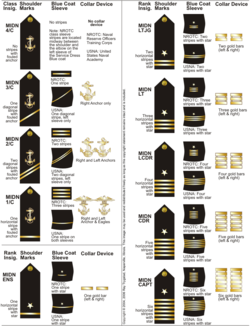 In the modern United States Navy a midshipman is classified as an officer of the line, though their exercise of authority is limited by their training status. Legally, midshipmen are a special grade of officer that ranks between Warrant Officer (W-1) and the lowest grade of Chief Warrant Officer (W-2).
Students at the United States Naval Academy
(USNA) are appointed as midshipman, United States Navy by the President
. Students in the Naval Reserve Officer Training Corps
(NROTC) are appointed as midshipman, United States Navy Reserve
or United States Marine Corps Reserve
by the secretary of the Navy. Students at the United States Merchant Marine Academy
(USMMA) are appointed as midshipman, United States Navy Reserve, Merchant Marine
Reserve. The student body at the USNA is the Brigade of Midshipmen and the student body at the USMMA is the Regiment of Midshipmen.
Generally, a nomination from a member of Congress or the vice president
is required to receive an appointment. A nomination does not guarantee an appointment and in a typical year only about 38% of nominees receive an appointment. Currently each member of Congress and the vice president can have five appointees attending the Naval Academy at any time. Other nomination sources include the secretary of the Navy, who may appoint 170 enlisted members of the regular and reserve Navy and Marine Corps to the Naval Academy each year, and the president may nominate an unlimited number of children of career military personnel for up to 100 appointments each year. Additionally, children of Medal of Honor
recipients do not need a nomination but need only qualify for admission.
Midshipmen at the US Naval Academy and in the NROTC wear uniforms that comply with standards established for commissioned officers of the Navy, with shoulder board and sleeve insignia varying by school year or officer rank as prescribed by Chapter 6 of Navy Uniform Regulations. Midshipmen wear gold fouled anchors as the primary insignia on caps and shoulder boards and plain anchors as collar insignia on service dress
and full dress
uniforms. Marine option midshipmen in the NROTC wear gold globe and anchor
insignia in place of the insignia worn by other midshipmen.
Midshipmen study a core curriculum plus 21 major fields of study, a wide variety of elective courses and advanced study and research opportunities. Upon graduation, midshipmen are commissioned as ensigns in the Navy or second lieutenants in the Marine Corps.
(RAN) holds a commission, which is usually not issued until promotion to sub-lieutenant or lieutenant. Officer candidates enter the RAN at various ranks depending on previous experience or degree qualifications; graduates from a three-year course, non-degree qualified entrants, and sailor changeovers below the rank of leading seaman enter as midshipman.
On joining the RAN, midshipmen complete six months' initial officer training (New Entry Officer's Course) at the Royal Australian Naval College. Following this all members serve six months in the fleet completing Primary Qualification (PQ) continuation training. Direct entry midshipmen continue their normal training and Australian Defence Force Academy
(ADFA) entry midshipmen post to Canberra to study at the ADFA in their second year in the Navy. Midshipmen undertake an undergraduate degree over the course of three years, whilst also completing elements of their naval training. ADFA midshipmen are also undergraduate students of the University of New South Wales
(UNSW). When they graduate from UNSW at ADFA at the completion of their three or four year undergraduate program, they do so with a fully recognized degree from UNSW – the same degree received by graduates of UNSW's campus in Sydney. During Single Service Training (SST) at ADFA midshipmen have the opportunity to return to sea during the SST period as well as visiting shore establishment
s for PQ related training.
(RNZN), midshipman is the lowest commissioned officer rank, for officers under training and retained upon completion of initial training by those without a university degree. Unlike officer cadet ranks in the Army, midshipmen are treated as officers and hold a commission. The RNZN has approximately 60 midshipman commissioned at a time.
Midshipman begin their career at Junior Officer Common Training, which lasts 6 months. After completing their initial training course, midshipmen serve aboard ships for a short time, followed by specialty training for about 14 weeks. After approximately two years in the Navy, midshipmen are promoted to ensign. Officers who entered the service with a university degree are promoted to sub-lieutenant after completion of Junior Officer Common Training. Officers without a degree have the option of earning a university degree while serving in the Navy.
(SAN) is an officer of the lowest rank. Officer candidates are citizens between the ages of 18 and 22, either in grade 12 or graduated from high school with an academic background in mathematics and science. Cadets initially spend a year training at the South African Naval College in Gordon's Bay
, about 55 km southeast of Cape Town
, and upon graduation are commissioned as midshipmen. Midshipmen study for three more years at the South African Military Academy
, and upon graduation receive a B Mil degree from Stellenbosch University
.
begin their career as cadets at the National Defence Academy or the Indian Naval Academy
, where they study for approximately three years. After graduation they receive a B Tech degree from Jawaharlal Nehru University
and are assigned to training ships for one year. After six months aboard the training ship, the cadets are promoted to midshipman. At the end of their training midshipmen are examined by a board and are cleared for promotion to acting sub-lieutenant.
undertake an initial 18 months' training at the Pakistan Naval Academy
. They study humanities, engineering, professional and technical subjects. After passing out they are appointed midshipmen, and undertake another six months of training at sea. They are assigned to Operations, Weapons Engineering, Mechanical Engineering, or Logistics. After passing the final fleet examination, they are promoted to the rank of sub-lieutenant.
The Dutch navy has since the early 17th century included a midshipman rank which literally means 'young gentleman' ; today, adelborsten train at the Royal Netherlands Naval College
for 3 years. Officer cadets in the German navy begin their training at the Naval Academy at Mürwik holding enlisted ranks with the qualifier officer candidate , abbreviated as OA. After about a year, they are promoted to Seekadetten, equivalent to the non-commissioned officer
(NCO) rank Mate , and move to the University of the German Federal Armed Forces
. About nine months later, they are promoted to Fähnrich zur See rank, equivalent to the NCO rank Boatswain . After 30 months of total training they are promoted to the final officer candidate rank, Oberfähnrich zur See, equivalent to the NCO rank Hauptbootsmann, and after about 4 years of total training graduate with a Bachelor's degree.
In many romance languages, the literal translation of the local term for "midshipman" into English is "Navy Guard", including the French
garde-marine, Spanish
guardia marina, Portuguese
guarda-marinha, and Italian
guardiamarina. These ranks all refer to young naval officer cadets, but the selection, training, and responsibilities of each diverge from the British tradition. The French rank of garde de la marine was established in 1670, when an office of the monarchy selected young gentlemen from the nobility to serve the King in the Gardes de la Marine
. The concept of the Gardes was borrowed from the various guards units within the Maison militaire du roi de France
. In 1686 these guards were organized into companies of cadets at the ports of Brest
, Rochefort
and Toulon
. Unlike midshipmen in the Royal Navy, the Gardes trained mostly on shore and focused on military drill and theory rather than practical skills in gunnery, navigation and seamanship. After the succession of the Bourbon
Phillip V of Spain to the Spanish throne, the French system of naval officer education spread to Spain. The Spanish navy created the rank of guardia marina in 1717, with the formation at Cadiz of the Royal Company of Midshipmen .
By restricting the French officer corps to members of the nobility, there were not enough Gardes to man all of the ships during wartime. To fill the gaps, volunteers were temporarily recruited from the merchant service; they were allowed to hold permanent rank in the navy starting in 1763. These professional officers wore blue uniforms to distinguish them from the Gardes de la Marine who wore red uniforms. After the revolution, the royal connotations of the term garde marine led to its replacement with aspirant (officer cadet), and later élèves de la Marine (naval officer candidate). Contemporary French naval officer training still reflects this structure: students at the École navale begin their the first year as élève-officier, are promoted in their second year to aspirant, and in their third year are commissioned as an acting sub-lieutenant . In a modern French-English dictionary, élève officier translates to midshipman, but both the historical term garde-marine and the modern term for an officer candidate, aspirant, are also equivalent to midshipman.
In most Spanish and Portuguese speaking countries, officers begin training at the rank of naval cadet, called aspirante in both languages. They are promoted to the rank guardia marina/guarda-marinha during training (in Spain and Brazil) or after graduation (in Portugal). Similarly, in Italy naval officer cadets, called allievo dell'accademia navale, are promoted to the rank of aspirante guardiamarina in their final year, and the lowest rank of commissioned officer is guardiamarina, both terms which translate to midshipman.
Officer Cadet
Officer cadet is a rank held by military and merchant navy cadets during their training to become commissioned officers and merchant navy officers, respectively. The term officer trainee is used interchangeably in some countries...
, or a commissioned officer of the lowest rank, in the Royal Navy
Royal Navy
The Royal Navy is the naval warfare service branch of the British Armed Forces. Founded in the 16th century, it is the oldest service branch and is known as the Senior Service...
, United States Navy
United States Navy
The United States Navy is the naval warfare service branch of the United States Armed Forces and one of the seven uniformed services of the United States. The U.S. Navy is the largest in the world; its battle fleet tonnage is greater than that of the next 13 largest navies combined. The U.S...
, and many Commonwealth
Commonwealth of Nations
The Commonwealth of Nations, normally referred to as the Commonwealth and formerly known as the British Commonwealth, is an intergovernmental organisation of fifty-four independent member states...
navies. Commonwealth countries which use the rank include Australia, New Zealand, South Africa, India, Pakistan, Singapore, Sri Lanka and Kenya. The rank was also used, prior to 1968, by the Royal Canadian Navy
Royal Canadian Navy
The history of the Royal Canadian Navy goes back to 1910, when the naval force was created as the Naval Service of Canada and renamed a year later by King George V. The Royal Canadian Navy is one of the three environmental commands of the Canadian Forces...
, but upon the creation of the Canadian Forces
Canadian Forces
The Canadian Forces , officially the Canadian Armed Forces , are the unified armed forces of Canada, as constituted by the National Defence Act, which states: "The Canadian Forces are the armed forces of Her Majesty raised by Canada and consist of one Service called the Canadian Armed Forces."...
the rank of midshipman was replaced with the rank of naval cadet.
In the 17th century, a midshipman was a rating
Naval rating
A Naval Rating is an enlisted member of a country's Navy, subordinate to Warrant Officers and Officers hence not conferred by commission or warrant...
for an experienced seaman, and the word derives from the area aboard a ship, amidships, either where the original rating worked on the ship, or where he was berthed
Berth (sleeping)
The word berth was originally used to describe beds and sleeping accommodation on boats and ships and has now been extended to refer to similar facilities on trains, aircraft and buses.-Beds in boats or ships:...
. Beginning in the 18th century, a commissioned officer candidate was rated as a midshipman, and the seaman rating began to slowly die out. By the Napoleonic era
Napoleonic Era
The Napoleonic Era is a period in the history of France and Europe. It is generally classified as including the fourth and final stage of the French Revolution, the first being the National Assembly, the second being the Legislative Assembly, and the third being the Directory...
(1793–1815), a midshipman was an apprentice officer who had previously served at least three years as a volunteer, officer's servant or able seaman, and was roughly equivalent to a present day petty officer
Petty Officer
A petty officer is a non-commissioned officer in many navies and is given the NATO rank denotion OR-6. They are equal in rank to sergeant, British Army and Royal Air Force. A Petty Officer is superior in rank to Leading Rate and subordinate to Chief Petty Officer, in the case of the British Armed...
in rank and responsibilities. After serving at least three years as a midshipman or master's mate
Master's mate
Master's mate is an obsolete rating which was used by the Royal Navy, United States Navy and merchant services in both countries for a senior petty officer who assisted the master...
, he was eligible to take the examination for lieutenant. Promotion to lieutenant was not automatic and many midshipmen took positions as master's mates for an increase in pay and responsibility aboard ship. Midshipmen in the United States Navy were trained and served similarly to midshipman in the Royal Navy, although unlike their counterparts in the Royal Navy, a midshipman was a warrant officer
Warrant Officer
A warrant officer is an officer in a military organization who is designated an officer by a warrant, as distinguished from a commissioned officer who is designated an officer by a commission, or from non-commissioned officer who is designated an officer by virtue of seniority.The rank was first...
rank until 1912.
During the 19th century, changes in the training of naval officers in both the Royal Navy and the United States Navy led to the replacement of apprenticeship aboard ships with formal schooling in a naval college
Military academy
A military academy or service academy is an educational institution which prepares candidates for service in the officer corps of the army, the navy, air force or coast guard, which normally provides education in a service environment, the exact definition depending on the country concerned.Three...
. Midshipman began to mean an officer cadet at a naval college. Trainees now spent around four years in a college and two years at sea prior to promotion to commissioned officer rank. Between the mid-19th and mid-20th centuries, time at sea declined to less than a year as the entry age was increased from 12 to 18.
Ranks equivalent to midshipman exist in many other navies. Using US midshipman or pre-fleet board UK midshipman as the basis for comparison, the equivalent rank would be a naval cadet in training to become a junior commissioned officer. Using post-fleet board UK midshipman for comparison, the rank would be the most junior commissioned officer in the rank structure, and similar to a US ensign in role and responsibility. In many Romance languages, the literal translation of the local term for "midshipman" into English is "Navy Guard", including the French
French language
French is a Romance language spoken as a first language in France, the Romandy region in Switzerland, Wallonia and Brussels in Belgium, Monaco, the regions of Quebec and Acadia in Canada, and by various communities elsewhere. Second-language speakers of French are distributed throughout many parts...
garde marine, Spanish
Spanish language
Spanish , also known as Castilian , is a Romance language in the Ibero-Romance group that evolved from several languages and dialects in central-northern Iberia around the 9th century and gradually spread with the expansion of the Kingdom of Castile into central and southern Iberia during the...
guardia marina, Portuguese
Portuguese language
Portuguese is a Romance language that arose in the medieval Kingdom of Galicia, nowadays Galicia and Northern Portugal. The southern part of the Kingdom of Galicia became independent as the County of Portugal in 1095...
guarda-marinha, and Italian
Italian language
Italian is a Romance language spoken mainly in Europe: Italy, Switzerland, San Marino, Vatican City, by minorities in Malta, Monaco, Croatia, Slovenia, France, Libya, Eritrea, and Somalia, and by immigrant communities in the Americas and Australia...
guardiamarina. Today, these ranks all refer to naval cadets, but historically they were selected by the monarchy, and were trained mostly on land as soldiers.
Origins
Tudor period
The Tudor period usually refers to the period between 1485 and 1603, specifically in relation to the history of England. This coincides with the rule of the Tudor dynasty in England whose first monarch was Henry VII...
and Stuart eras, and originally referred to a post for an experienced seaman promoted from the ordinary deck hands, who worked in between the main and mizzen mast and had more responsibility than an ordinary seaman, but was not a military officer or an officer in training. The first published use of the term midshipman was in 1662. The word derives from an area aboard a ship, amidships, but it refers either to the location where midshipmen worked on the ship, or the location where midshipmen were berthed
Berth (sleeping)
The word berth was originally used to describe beds and sleeping accommodation on boats and ships and has now been extended to refer to similar facilities on trains, aircraft and buses.-Beds in boats or ships:...
.
By the 18th century four types of midshipman existed: midshipman (original rating), midshipman extraordinary
Midshipman extraordinary
Midshipman extraordinary originally referred to an officer in the Royal Navy below the rank of post captain who was paid as a midshipman until he could find another ship...
, midshipman (apprentice officer), and midshipman ordinary
Midshipman ordinary
Midshipman ordinary, or midshipman-by-order, refers to a obsolete rating for prospective officers in the British Royal Navy. The rating was specifically applied to graduates of the Royal Naval Academy who had earned their sea time in a classroom instead of serving at sea.-History:In 1729, the...
. Some midshipmen were older men, and while most were officer candidates who failed to pass the lieutenant examination or were passed over for promotion, some members of the original rating served, as late as 1822, alongside apprentice officers without themselves aspiring to a commission. By 1794, all midshipmen were considered officer candidates, and the original rating was phased out.
Entry
Beginning in 1661, boys who aspired to become officers were sent by their families to serve on ships with a "letter of service" from the crown, and were paid at the same rate as midshipmen. The letter instructed the admirals and captains that the bearer was to be shown "such kindness as you shall judge fit for a gentleman, both in accommodating him in your ship and in furthering his improvement". Their official rating was volunteer-per-order
Volunteer-per-order
Volunteer-per-order was a name for a rating for young boys in the Royal Navy for young gentlemen who were training to become officers. The rating was introduced by Samuel Pepys in 1676 and the recipient received £24 a year and a letter from the crown which virtually guaranteed him promotion after...
, but they were often known as King's letter boys, to distinguish their higher social class from the original midshipman rating.
Beginning in 1677, Royal Navy regulations for promotion to lieutenant required service as a midshipman, and promotion to midshipman required some time at sea. By the Napoleonic Era, the regulations required at least three years of services as a midshipman or master's mate
Master's mate
Master's mate is an obsolete rating which was used by the Royal Navy, United States Navy and merchant services in both countries for a senior petty officer who assisted the master...
and six years of total sea time. Sea time was earned in various ways, most boys served this period at sea in any lower rating, either as a servant of one of the ship's officers, a volunteer, or a seaman.
By the 1730s, the rating volunteer-per-order was phased out and replaced with a system where prospective midshipmen served as servants for officers. For example, a captain
Captain (naval)
Captain is the name most often given in English-speaking navies to the rank corresponding to command of the largest ships. The NATO rank code is OF-5, equivalent to an army full colonel....
was allowed four servants for every 100 men aboard his ship; many of these servants were young men destined to become officers.
In 1729, the Royal Naval Academy in Portsmouth
Portsmouth
Portsmouth is the second largest city in the ceremonial county of Hampshire on the south coast of England. Portsmouth is notable for being the United Kingdom's only island city; it is located mainly on Portsea Island...
, renamed the Royal Naval College in 1806, was founded, for 40 students aged between 13 and 16, who would take three years to complete a course of study defined in an illustrated book, and would earn two years of sea time as part of their studies. The rating of midshipman-by-order, or midshipman ordinary, was used specifically for graduates of the Royal Naval College, to distinguish them from midshipmen who had served aboard ship, who were paid more. The school was unpopular in the Navy, because officers enjoyed the privilege of having servants and preferred the traditional method of training officers via apprenticeship.
In 1794, officer's servants were abolished and a new class of volunteers called 'Volunteer Class I' was created for boys between the ages of 11 and 13 who were considered future midshipmen and lived in the gunroom on a ship-of-the-line or with the midshipmen on a frigate
Frigate
A frigate is any of several types of warship, the term having been used for ships of various sizes and roles over the last few centuries.In the 17th century, the term was used for any warship built for speed and maneuverability, the description often used being "frigate-built"...
or smaller vessel. Volunteers were paid £6 per year. By 1816, the rating of midshipman ordinary was phased out, and all apprentice officers were rated as midshipmen.
Social background and uniform
In the 18th century Royal Navy, rank and position on board ship was defined by a mix of two hierarchies, an official hierarchy of ranks and a conventionally recognized social divide between gentlemen and non-gentlemen. Boys aspiring for a commission were often called young gentlemen
Young gentlemen
Young gentlemen is an archaic term that was used in the Royal Navy to refer to boys aspiring to become a commissioned officer. Until promotion to lieutenant, these boys would serve in various ratings, and the term was used to group all these boys together...
instead of their substantive rating to distinguish their higher social standing from the ordinary sailors. Occasionally, a midshipman would be posted aboard a ship in a lower rating such as able seaman
Able seaman
An able seaman is an unlicensed member of the deck department of a merchant ship. An AB may work as a watchstander, a day worker, or a combination of these roles.-Watchstander:...
but would eat and sleep with his social equals in the cockpit
Cockpit (sailing)
In the Royal Navy, the term cockpit originally referred to the area where the coxswain was stationed. This led to the word being used to refer to the area towards the stern of a small decked vessel that houses the rudder controls...
.
Approximately 50 percent of midshipmen were the sons of professional men, which included the sons of naval officers, and there were notable sailing families throughout the Age of Sail, such as the Saumarez
James Saumarez, 1st Baron de Saumarez
Admiral James Saumarez, 1st Baron de Saumarez , GCB was an admiral of the British Royal Navy, notable for his victory at the Battle of Algeciras.-Early life:...
, Hood
Samuel Hood, 1st Viscount Hood
Samuel Hood, 1st Viscount Hood was a British Admiral known particularly for his service in the American War of Independence and French Revolutionary Wars...
, and Parker
Sir Hyde Parker, 5th Baronet
Vice-Admiral Sir Hyde Parker, 5th Baronet was a British naval commander.Parker was born at Tredington, Gloucestershire. His father, a clergyman, was a son of Sir Henry Parker. His paternal grandfather had married a daughter of Alexander Hyde, Bishop of Salisbury. He began his career at sea in the...
families. The niceties of preferment and promotion made family connections an obvious advantage for prospective officers. Members of the peerage
Peerage
The Peerage is a legal system of largely hereditary titles in the United Kingdom, which constitute the ranks of British nobility and is part of the British honours system...
and landed gentry
Landed gentry
Landed gentry is a traditional British social class, consisting of land owners who could live entirely off rental income. Often they worked only in an administrative capacity looking after the management of their own lands....
formed the next largest group, about 27 percent of officers. The numbers were smaller, but similarly, their connections gave them excellent prospects for promotion, and they had a considerable influence on the Royal Navy. A notable member of this group was Prince William, later William IV who served as a midshipman from 1780–1785. The rest were from commercial or working class
Working class
Working class is a term used in the social sciences and in ordinary conversation to describe those employed in lower tier jobs , often extending to those in unemployment or otherwise possessing below-average incomes...
backgrounds, and because of the advantages possessed by the nobility and professional sailors, their chances of promotion to lieutenant were slim.
Since most midshipmen were from the gentry or had family connections with sailing ships, many used their connections to have their names placed on a ship's books. The practice, known colloquially as "false muster" was common even though it was technically illegal and frowned upon. This allowed some boys to be promoted to midshipmen, or in some cases lieutenant, without having completed the required amount of time at sea. A notable example was Thomas Cochrane
Thomas Cochrane, 10th Earl of Dundonald
Admiral Thomas Cochrane, 10th Earl of Dundonald, 1st Marquess of Maranhão, GCB, ODM , styled Lord Cochrane between 1778 and 1831, was a senior British naval flag officer and radical politician....
, whose uncle had him entered at the age of five; his name was carried on various ships until he was 18 and received his commission.
When uniforms were introduced in the Navy in 1748, midshipmen started wearing the same uniform as commissioned officers. They also began wearing their traditional badge of rank, a white patch of cloth with a gold button and a twist of white cord on each side of the coat collar. The uniform emphasized that midshipmen were gentlemen and officers under instruction.
Duties and promotion
Midshipmen were expected to work on the ship, but were also expected to learn navigation and seamanship. They were expected to have learned already, as able seamen and volunteers, to rig sails; other duties included keeping watch, relaying messages between decks, supervising gun batteries, commanding small boats, and taking command of sub-division of the ship's company under one of the lieutenants. On smaller ships midshipmen were instructed by a senior master's mate, often a passed midshipman
Passed midshipman
A Passed Midshipman, sometimes called as Midshipman, Passed, is an unused and historic term which describes a Midshipman who had passed the Lieutenant exam and was eligible for promotion to Lieutenant as soon as there was a vacancy in that grade....
, who taught them mathematics, navigation, and sailing lore. Larger ships would carry a schoolmaster
Schoolmaster
A schoolmaster, or simply master, once referred to a male school teacher. This usage survives in British public schools, but is generally obsolete elsewhere.The teacher in charge of a school is the headmaster...
, who was rated as a midshipman but usually was a civilian like the chaplain
Chaplain
Traditionally, a chaplain is a minister in a specialized setting such as a priest, pastor, rabbi, or imam or lay representative of a religion attached to a secular institution such as a hospital, prison, military unit, police department, university, or private chapel...
. Midshipmen were expected to keep detailed navigational logs, which were shown to the captain to assess their progress.
Seamanship
Seamanship is the art of operating a ship or boat.It involves a knowledge of a variety of topics and development of specialised skills including: navigation and international maritime law; weather, meteorology and forecasting; watchstanding; ship-handling and small boat handling; operation of deck...
, navigation
Navigation
Navigation is the process of monitoring and controlling the movement of a craft or vehicle from one place to another. It is also the term of art used for the specialized knowledge used by navigators to perform navigation tasks...
, and discipline
Discipline
In its original sense, discipline is referred to systematic instruction given to disciples to train them as students in a craft or trade, or to follow a particular code of conduct or "order". Often, the phrase "to discipline" carries a negative connotation. This is because enforcement of order –...
. The board would ask questions such as:
An enemy is observed; give orders for clearing your ship, and make all the necessary preparations for engaging.
Like the board, which might be an ad hoc affair, the actual exam questions were not standardized and their content depended mostly on individual captains. In seamanship, the candidate was expected to be able to splice ropes
Ropework
Ropework or Marlinespike Seamanship is the set of processes and skills used to make, repair, and use rope. This includes tying knots, splicing, making lashings, and proper use and storage of rope...
, reef a sail
Reefing
Reefing is a sailing manoeuvre intended to reduce the area of a sail on a sailboat or sailing ship, which can improve the ship's stability and reduce the risk of capsizing, broaching, or damaging sails or boat hardware in a strong wind...
, work a ship in sailing
Sailing
Sailing is the propulsion of a vehicle and the control of its movement with large foils called sails. By changing the rigging, rudder, and sometimes the keel or centre board, a sailor manages the force of the wind on the sails in order to move the boat relative to its surrounding medium and...
and shift his tides. In navigation, he was expected to be able to keep a reckoning of the ship's way by plane sailing
Plane sailing
Plane sailing is an approximate method of navigation over small ranges of latitude and longitude.Both spellings have been in use for several centuries,...
, to use Mercator projection
Mercator projection
The Mercator projection is a cylindrical map projection presented by the Belgian geographer and cartographer Gerardus Mercator, in 1569. It became the standard map projection for nautical purposes because of its ability to represent lines of constant course, known as rhumb lines or loxodromes, as...
maps and observation of the sun and stars to determine the course and position of the ship, and to understand the variation of the compass
Magnetic declination
Magnetic declination is the angle between magnetic north and true north. The declination is positive when the magnetic north is east of true north. The term magnetic variation is a synonym, and is more often used in navigation...
. He was also expected to be qualified to do the duty of an able seaman
Able seaman
An able seaman is an unlicensed member of the deck department of a merchant ship. An AB may work as a watchstander, a day worker, or a combination of these roles.-Watchstander:...
and midshipman.
Failure usually meant six more months of sea service before the examination could again be attempted. Some men never passed it. Successful completion made the midshipman a 'passed midshipman'. From the 18th century until the second half of the 19th century, a midshipman in the Royal Navy who passed the lieutenant's examination did not automatically receive a commission. Midshipmen with political connections were promoted first, while others would wait their turn on a roster. During wartime, when large numbers of ships and men might be lost in battle, most passed midshipman would be promoted in a year or two, but during peacetime the wait might be so long that the midshipman would eventually be considered too old and lose his chance for a commission.
Passed midshipmen awaiting promotion often elected to become master's mates, a high-ranking petty officer who assisted the master
Master (naval)
The master, or sailing master, was a historic term for a naval officer trained in and responsible for the navigation of a sailing vessel...
with his duties, served on watch as deputy to the lieutenants, and commanded small boats. A midshipman who became master's mate earned an increase in pay from £2 5s to £3 16s per month but initially reduced his chances at a commission because master's mates, along with masters, were assumed to have a working class background. Over time, however, appointment to master's mate became considered a normal part of the path to a commission; the situation caused some confusion during the last part of the 18th century, when two parallel roles – master's mates trying to become masters, and former midshipmen working toward a commission – held the same title and responsibilities aboard ship.
By the first years of the 19th century, the term 'mate', without the prefix master's, was used for passed midshipmen
Passed midshipman
A Passed Midshipman, sometimes called as Midshipman, Passed, is an unused and historic term which describes a Midshipman who had passed the Lieutenant exam and was eligible for promotion to Lieutenant as soon as there was a vacancy in that grade....
, to distinguish them from master's mates who had not served as midshipmen. In 1824, the rating of master's assistant replaced master's mate, and mate continued to be used unofficially by passed midshipmen. These changes helped eliminate the confusion caused by the mingling of midshipmen in the navigator's branch. In 1838 a Royal Commission
Royal Commission
In Commonwealth realms and other monarchies a Royal Commission is a major ad-hoc formal public inquiry into a defined issue. They have been held in various countries such as the United Kingdom, Australia, Canada, New Zealand, and Saudi Arabia...
, presided over by the Duke of Wellington
Arthur Wellesley, 1st Duke of Wellington
Field Marshal Arthur Wellesley, 1st Duke of Wellington, KG, GCB, GCH, PC, FRS , was an Irish-born British soldier and statesman, and one of the leading military and political figures of the 19th century...
, recommended the institution of the rank of mate as an official step between midshipman and lieutenant. In 1861 mate was abolished in favor of sub-lieutenant
Sub-Lieutenant
Sub-lieutenant is a military rank. It is normally a junior officer rank.In many navies, a sub-lieutenant is a naval commissioned or subordinate officer, ranking below a lieutenant. In the Royal Navy the rank of sub-lieutenant is equivalent to the rank of lieutenant in the British Army and of...
.
United States Navy (1794–1845)
When Congress created the United States NavyUnited States Navy
The United States Navy is the naval warfare service branch of the United States Armed Forces and one of the seven uniformed services of the United States. The U.S. Navy is the largest in the world; its battle fleet tonnage is greater than that of the next 13 largest navies combined. The U.S...
in 1794, midshipman was listed as a rank of warrant officer in the Naval Act of 1794
Naval Act of 1794
The Act to Provide a Naval Armament, also known as the Naval Act, was passed by the United States Congress on March 27, 1794 and established the country's first naval force, which eventually became the United States Navy...
, and they were appointed by the President of the United States
President of the United States
The President of the United States of America is the head of state and head of government of the United States. The president leads the executive branch of the federal government and is the commander-in-chief of the United States Armed Forces....
. Midshipmen had similar duties and responsibilities as in the Royal Navy, and were typically young men between the age of 14 and 22 training to become a naval officer. "Passed midshipman" was first used in 1819, and was an official rank of the US Navy.
During the long period of peace between 1815 and 1846 midshipmen had few opportunities for promotion, and their warrants were often obtained via patronage. The poor quality of officer training in the US Navy became visible after the Somers Affair, an alleged mutiny
Mutiny
Mutiny is a conspiracy among members of a group of similarly situated individuals to openly oppose, change or overthrow an authority to which they are subject...
aboard the training ship USS Somers
USS Somers (1842)
The second USS Somers was a brig in the United States Navy during the Mexican-American War, infamous for being the only U.S. Navy ship to undergo a mutiny which led to executions....
in 1842, and the subsequent execution of midshipman Philip Spencer
Philip Spencer
Philip Spencer , a midshipman aboard the USS Somers, was hanged for mutiny without a lawful court-martial. He was the son of John C. Spencer, Secretary of War in U.S. President John Tyler's administration, and the grandson of Ambrose Spencer, a New York politician and lawyer.-Background:Spencer was...
. Spencer had gained his post aboard the Somers via the influence of his father, United States Secretary of War
United States Secretary of War
The Secretary of War was a member of the United States President's Cabinet, beginning with George Washington's administration. A similar position, called either "Secretary at War" or "Secretary of War," was appointed to serve the Congress of the Confederation under the Articles of Confederation...
John C. Spencer.
Royal Navy from 1836
The original Royal Naval College closed in 1836, after which the only method for training midshipmen in the Royal Navy was aboard ships. In 1844 the rank of naval cadet was created, and to qualify as a midshipman a candidate had to be 14 years old, successfully pass an admiralty examination and have two years of service as a naval cadet or three years of service in the Navy. A decline in qualified officers prompted the Navy to order training in a ship at anchor for all cadets, which began in 1857 aboard HMS IllustriousHMS Illustrious (1803)
HMS Illustrious was a 74-gun third rate ship of the line of the Royal Navy, launched on 3 September 1803 at Rotherhithe.Illustrious served as a gunnery ship from 1854, and was broken up in 1868....
, which was replaced by HMS Britannia
HMS Britannia (1820)
HMS Britannia was a 120-gun first-rate ship-of-the-line of the Royal Navy, laid down in 1813 and launched on 20 October 1820.Commissioned in 1823, she saw service in the Mediterranean from 1830-1 and in 1841...
in 1859. Britannia was moved to Portland
Portland Harbour
Portland Harbour is located beside the Isle of Portland, off Dorset, on the south coast of England. It is one of the largest man-made harbours in the world. Grid reference: .-History:...
in 1862, and to the present location of the Britannia Royal Naval College
Britannia Royal Naval College
Britannia Royal Naval College is the initial officer training establishment of the Royal Navy, located on a hill overlooking Dartmouth, Devon, England. While Royal Naval officer training has taken place in the town since 1863, the buildings which are seen today were only finished in 1905, and...
, Dartmouth
Dartmouth, Devon
Dartmouth is a town and civil parish in the English county of Devon. It is a tourist destination set on the banks of the estuary of the River Dart, which is a long narrow tidal ria that runs inland as far as Totnes...
in 1863.
Beginning in 1840s, the normal entry age for executive officer cadets, those destined to command ships and fleets, was between 12 and 13, and instruction consisted of two years of classroom training, during which time trainees were rated as naval cadets. Cadets who received a first-class passing grade in studies, seamanship and conduct on their final examination could receive a credit for up to a year of sea time, and could be rated as midshipmen immediately after passing out of the college. After passing out of the college, cadets served aboard a special training vessel for one year. Cadets were then rated as midshipmen, and served aboard the fleet another two years. Midshipmen lived in the gunroom, kept watches, and ran the ship's boats. They received instruction in navigation every day. After five total years of training and having reached the age of 19, the midshipmen were eligible to take the examination for lieutenant. After passing the examination for lieutenant, midshipmen were commissioned as sub-lieutenants, and were transferred to the Royal Naval College, Greenwich, which opened in 1873 as the 'University of the Navy'.
Selborne-Fisher scheme
The Selborne-Fisher scheme, or Selborne scheme refers to an effort by John Fisher, 1st Baron Fisher, Second Sea Lord, approved by William Palmer, 2nd Earl of Selborne, First Lord of the Admiralty, in 1903 to combine the military and engineering branches of the Royal Navy...
, and engineering and executive officer candidates began to enter the Navy in the same way, which was termed 'Common Entry'. Previously, engineer cadets had been trained separately at the Royal Naval Engineering College, Keyham which was closed in 1910. In 1903 a new preparatory school was opened at Royal Naval College, Osborne
Osborne House
Osborne House is a former royal residence in East Cowes, Isle of Wight, UK. The house was built between 1845 and 1851 for Queen Victoria and Prince Albert as a summer home and rural retreat....
, which was Queen Victoria's favorite residence but was not a favorite of her successor Edward VII
Edward VII of the United Kingdom
Edward VII was King of the United Kingdom and the British Dominions and Emperor of India from 22 January 1901 until his death in 1910...
who had donated it to the nation in 1902. Training initially consisted of two years at Osborne and two years at Dartmouth as cadets, later four years at Dartmouth, followed by approximately 3 years of sea duty as midshipmen prior to promotion to sub-lieutenant. In 1905, a new building was completed on shore to replace Britannia, which was named Britannia Royal Naval College. In 1913, increasing demand for officers led to recruitment of 18 year-old graduates of public schools, which was called 'Special Entry', and was conducted separately from Selborne scheme cadets. Special entry cadets trained for approximately 6 months prior to service in the fleet as midshipmen. When World War I
World War I
World War I , which was predominantly called the World War or the Great War from its occurrence until 1939, and the First World War or World War I thereafter, was a major war centred in Europe that began on 28 July 1914 and lasted until 11 November 1918...
began in 1914, all the cadets at Dartmouth were quickly mobilized as midshipmen in the reserve fleet. During the war, two midshipmen, George Drewry
George Leslie Drewry
George Leslie Drewry VC was an English recipient of the Victoria Cross, the highest and most prestigious award for gallantry in the face of the enemy that can be awarded to British and Commonwealth forces....
and Wilfred Malleson were awarded the Victoria Cross
Victoria Cross
The Victoria Cross is the highest military decoration awarded for valour "in the face of the enemy" to members of the armed forces of various Commonwealth countries, and previous British Empire territories....
, the highest award of the British Commonwealth for gallantry, during the Landing at Cape Helles
Landing at Cape Helles
The landing at Cape Helles was part of the amphibious invasion of the Gallipoli peninsula by British and French forces on April 25, 1915 during the First World War. Helles, at the foot of the peninsula, was the main landing area. With the support of the guns of the Royal Navy, a British division...
. After World War I ended, opposition to the Selborne-Fisher scheme led to re-segregating executive and engineering officers into separate branches, while common entry and special entry were maintained.
After World War II
World War II
World War II, or the Second World War , was a global conflict lasting from 1939 to 1945, involving most of the world's nations—including all of the great powers—eventually forming two opposing military alliances: the Allies and the Axis...
another series of reforms, influenced by the quality of officers produced by the special entry scheme and other nations' experience with training officer candidates in a university setting, were initiated to increase the quality of officers in the Navy. In 1949 the entry age was increased to 16, and by 1955 the entry age was increased to 18 and entry required a minimum of two A levels. After 1957 midshipmen no longer served in the fleet. In 1972, all cadets became midshipmen when the rank of cadet was abolished.
United States Navy from 1845
Congress formally authorized the establishment of the United States Military AcademyUnited States Military Academy
The United States Military Academy at West Point is a four-year coeducational federal service academy located at West Point, New York. The academy sits on scenic high ground overlooking the Hudson River, north of New York City...
in 1802, but it took almost 50 years to approve a similar school for naval officers. One major reason for the delay was that Navy leaders preferred the apprenticeship system, citing famous officers such as Nelson
Horatio Nelson, 1st Viscount Nelson
Horatio Nelson, 1st Viscount Nelson, 1st Duke of Bronté, KB was a flag officer famous for his service in the Royal Navy, particularly during the Napoleonic Wars. He was noted for his inspirational leadership and superb grasp of strategy and unconventional tactics, which resulted in a number of...
and the captains of the War of 1812
War of 1812
The War of 1812 was a military conflict fought between the forces of the United States of America and those of the British Empire. The Americans declared war in 1812 for several reasons, including trade restrictions because of Britain's ongoing war with France, impressment of American merchant...
who did not attend a formal naval school. However, after the Somers Affair, officers realized that the system for training officers had to change to be more efficient.
George Bancroft
George Bancroft
George Bancroft was an American historian and statesman who was prominent in promoting secondary education both in his home state and at the national level. During his tenure as U.S. Secretary of the Navy, he established the United States Naval Academy at Annapolis in 1845...
, appointed Secretary of the Navy in 1845, decided to work outside of congressional approval and create a new academy for officers. He formed a council led by Commodore Perry to create a new system for training officers, and turned the old Fort Severn
Fort Severn
For the trading post in Canada see Fort Severn First Nation Fort Severn, in present-day Annapolis, Maryland, was built in 1808 on the same site as an earlier American Revolutionary War fort of 1776. Although intended to guard Annapolis harbor from British attack, it never saw action during the War...
at Annapolis into a new institution which would be designated as the United States Naval Academy
United States Naval Academy
The United States Naval Academy is a four-year coeducational federal service academy located in Annapolis, Maryland, United States...
in 1851. Midshipmen studied at the Academy for four years and trained aboard ships each summer. Midshipman began to mean "passed midshipman" at this time, and a student at the Naval Academy was a cadet midshipman. The rank of ensign was created in 1862, and passed midshipmen were promoted to ensign when vacancies occurred.
In 1865, the Department of Steam Enginery was created and cadet engineers were admitted to the Academy for the first time. In 1874, Congress changed the curriculum to include four years of classroom training and two years of sea duty aboard a regular vessel prior to examinations as warranted midshipmen. In 1882, Congress eliminated the distinction in training between engineer and naval cadets, and designated the student officers as naval cadets; the name reverted to midshipmen in 1902. By an act of Congress passed in 1903, two appointments as midshipmen were allowed for each senator
United States Senate
The United States Senate is the upper house of the bicameral legislature of the United States, and together with the United States House of Representatives comprises the United States Congress. The composition and powers of the Senate are established in Article One of the U.S. Constitution. Each...
, representative, and delegate
Delegate
A delegate is a person who speaks or acts on behalf of an organization at a meeting or conference between organizations of the same level A delegate is a person who speaks or acts on behalf of an organization (e.g., a government, a charity, an NGO, or a trade union) at a meeting or conference...
in Congress, two for the District of Columbia, and five each year at large. In 1912, Congress authorized commissioning midshipmen as ensigns on graduation day, and ended the previously required two years of post-graduation sea service as warrant officers.
In 1930, the Naval Academy received accreditation
Educational accreditation
Educational accreditation is a type of quality assurance process under which services and operations of educational institutions or programs are evaluated by an external body to determine if applicable standards are met...
as an approved technological institution. In 1933, a new law enabled the Naval, Military, and Coast Guard Academies to award Bachelor of Science degrees
Bachelor's degree
A bachelor's degree is usually an academic degree awarded for an undergraduate course or major that generally lasts for three or four years, but can range anywhere from two to six years depending on the region of the world...
, and the class of 1933 was the first to receive this degree and have it written in the diploma. In 1937, the superintendent of the Naval Academy was granted the authority to award Bachelor of Science degrees to all living graduates.
Commonwealth navies
As DominionDominion
A dominion, often Dominion, refers to one of a group of autonomous polities that were nominally under British sovereignty, constituting the British Empire and British Commonwealth, beginning in the latter part of the 19th century. They have included Canada, Australia, New Zealand, Newfoundland,...
s of the British Empire
British Empire
The British Empire comprised the dominions, colonies, protectorates, mandates and other territories ruled or administered by the United Kingdom. It originated with the overseas colonies and trading posts established by England in the late 16th and early 17th centuries. At its height, it was the...
formed their own navies during the 20th century, further countries began using the rank of midshipman. Today Australia, New Zealand, South Africa, Pakistan, India, Singapore
Republic of Singapore Navy
The Republic of Singapore Navy is the naval component of the Singapore Armed Forces , responsible for the defence of Singapore against sea-borne threats and protection of its sea lines of communications. Operating within the crowded littoral waters of the Singapore Strait, the RSN is regarded as...
, Sri Lanka, Bangladesh
Bangladesh Navy
The Bangladesh Navy is the naval arm of the Bangladesh Armed Forces. At present the navy is mostly limited to coastal patrolling, however it is implementing an ambitious procurement and expansion program to ensure the security of Bangladesh's maritime boundary...
and Kenya
Kenya Navy
Kenya Navy is the naval branch of Kenyan military forces. It is headquartered in Mombasa. Kenya Navy was established on December 12, 1964, exactly one year after Kenya gained independence. It was preceded by the colonial Royal East African Navy...
use the rank. Prior to 1968 Canada also used the rank of midshipman, until the National Defence Act
National Defence Act
The National Defence Act is the primary enabling legislation for organizing and funding Canada's military....
consolidated the Royal Canadian Navy with the Army and Air Force into a single military, called the Canadian Forces. As part of the act, the rank of midshipman was replaced with the rank of naval cadet.
Snotty
In Royal Navy slang, a midshipman is sometimes referred to as a "snotty". Two popular stories give origins for the term: the first claims that it arose due to a shortage of handkerchiefs among midshipmen, who would consequently use their sleeves to wipe their noses. Prince William, later William IV, is sometimes cited as a notorious example of this practice among midshipmen. The other story claims that the three buttons formerly sewn onto midshipmen's jacket cuffs were placed there to prevent them from wiping their noses on their sleeves.Royal Navy
Royal Navy
The Royal Navy is the naval warfare service branch of the British Armed Forces. Founded in the 16th century, it is the oldest service branch and is known as the Senior Service...
a midshipman is the lowest rank of officer, and rank with second lieutenant
Second Lieutenant
Second lieutenant is a junior commissioned officer military rank in many armed forces.- United Kingdom and Commonwealth :The rank second lieutenant was introduced throughout the British Army in 1871 to replace the rank of ensign , although it had long been used in the Royal Artillery, Royal...
in the British Army
British Army
The British Army is the land warfare branch of Her Majesty's Armed Forces in the United Kingdom. It came into being with the unification of the Kingdom of England and Scotland into the Kingdom of Great Britain in 1707. The new British Army incorporated Regiments that had already existed in England...
and pilot officer
Pilot Officer
Pilot officer is the lowest commissioned rank in the Royal Air Force and the air forces of many other Commonwealth countries. It ranks immediately below flying officer...
in the Royal Air Force
Royal Air Force
The Royal Air Force is the aerial warfare service branch of the British Armed Forces. Formed on 1 April 1918, it is the oldest independent air force in the world...
and above all enlisted and warrant ranks. A midshipman's rank insignia, which has changed little since Napoleonic
Napoleonic Wars
The Napoleonic Wars were a series of wars declared against Napoleon's French Empire by opposing coalitions that ran from 1803 to 1815. As a continuation of the wars sparked by the French Revolution of 1789, they revolutionised European armies and played out on an unprecedented scale, mainly due to...
times, is called a "turnback": a white patch of cloth with a gold button and a twist of white cord on each side of the coat collar.
Prospective officers must have at least five GCSEs, including English and maths, plus at least 180 UCAS
UCAS
The Universities and Colleges Admissions Service is the British admission service for students applying to university and college. UCAS is primarily funded by students who pay a fee when they apply and a capitation fee from universities for each student they accept..-Location:UCAS is based near...
points from A levels or other suitable qualifications. They must pass a two-and-a-half day assessment, called the Admiralty Interview Board
Admiralty Interview Board
The Admiralty Interview Board is the instrument of Officer selection for the Royal Navy, Royal Marines, Royal Naval Reserve, Royal Marines Reserve, and Royal Fleet Auxiliary...
, and a medical examination. Those joining the Navy as university graduates start as sub-lieutenants, with non-graduates joining as midshipmen.
General basic training (Initial Officer Training) for Royal Navy officers takes place at the Britannia Royal Naval College
Britannia Royal Naval College
Britannia Royal Naval College is the initial officer training establishment of the Royal Navy, located on a hill overlooking Dartmouth, Devon, England. While Royal Naval officer training has taken place in the town since 1863, the buildings which are seen today were only finished in 1905, and...
. Training takes up to a year depending on specialization; all midshipmen participate in at least the first two terms, which are 14 weeks each. Until they have completed initial fleet training, both midshipmen and sub-lieutenants at Britannia Royal Naval College do not use their substantive ranks, but instead use the rank of officer cadet
Officer Cadet
Officer cadet is a rank held by military and merchant navy cadets during their training to become commissioned officers and merchant navy officers, respectively. The term officer trainee is used interchangeably in some countries...
.
During the first seven weeks of training, officer cadets learn militarization and sea sense, focusing on learning about the military environment, along with team and leadership skills. During the second seven weeks, officer cadets learn essential sea officer skills, including navigation and the marine environment, strategic studies, and basic sea survival. During the second term officer cadets spend 10 weeks in Initial Fleet Time, serving aboard capital warships as junior ratings
Naval rating
A Naval Rating is an enlisted member of a country's Navy, subordinate to Warrant Officers and Officers hence not conferred by commission or warrant...
. Upon completion of Initial Fleet Time, officer cadets return to Dartmouth for four weeks to complete their final leadership assessment, the Maritime Leadership Exercise (MARL), and a week spent with different areas of the Royal Navy. If they have been successful, officers of all branches then pass out of the college.
Upon completion of Initial Officer Training, university cadet entrants, engineering, logistics and flight specialization officer cadets move to their second phase of training elsewhere within the Royal Navy. Midshipmen specializing in warfare remain at the college for the Initial Warfare Officer's Foundation course, which completes part of a Foundation degree
Foundation degree
The Foundation Degree is a vocational qualification introduced by the government of the United Kingdom in September 2001, which is available in England, Wales and Northern Ireland...
in Naval Studies (equating to two thirds of a Bachelor's degree
Bachelor's degree
A bachelor's degree is usually an academic degree awarded for an undergraduate course or major that generally lasts for three or four years, but can range anywhere from two to six years depending on the region of the world...
), on completion of initial professional training. Officers can complete degrees via distance learning with the Open University
Open University
The Open University is a distance learning and research university founded by Royal Charter in the United Kingdom...
, although completion is not required.
United States Navy and Marine Corps
Students at the United States Naval Academy
United States Naval Academy
The United States Naval Academy is a four-year coeducational federal service academy located in Annapolis, Maryland, United States...
(USNA) are appointed as midshipman, United States Navy by the President
President of the United States
The President of the United States of America is the head of state and head of government of the United States. The president leads the executive branch of the federal government and is the commander-in-chief of the United States Armed Forces....
. Students in the Naval Reserve Officer Training Corps
Naval Reserve Officer Training Corps
The Naval Reserve Officers Training Corps program is a college-based, commissioned officer training program of the United States Navy and the United States Marine Corps.-Origins:...
(NROTC) are appointed as midshipman, United States Navy Reserve
United States Navy Reserve
The United States Navy Reserve, until 2005 known as the United States Naval Reserve, is the Reserve Component of the United States Navy...
or United States Marine Corps Reserve
United States Marine Corps Reserve
The Marine Forces Reserve is the reserve force of the United States Marine Corps. It is the largest command in the U.S...
by the secretary of the Navy. Students at the United States Merchant Marine Academy
United States Merchant Marine Academy
The United States Merchant Marine Academy is one of the five United States Service academies...
(USMMA) are appointed as midshipman, United States Navy Reserve, Merchant Marine
United States Merchant Marine
The United States Merchant Marine refers to the fleet of U.S. civilian-owned merchant vessels, operated by either the government or the private sector, that engage in commerce or transportation of goods and services in and out of the navigable waters of the United States. The Merchant Marine is...
Reserve. The student body at the USNA is the Brigade of Midshipmen and the student body at the USMMA is the Regiment of Midshipmen.
Generally, a nomination from a member of Congress or the vice president
Vice President of the United States
The Vice President of the United States is the holder of a public office created by the United States Constitution. The Vice President, together with the President of the United States, is indirectly elected by the people, through the Electoral College, to a four-year term...
is required to receive an appointment. A nomination does not guarantee an appointment and in a typical year only about 38% of nominees receive an appointment. Currently each member of Congress and the vice president can have five appointees attending the Naval Academy at any time. Other nomination sources include the secretary of the Navy, who may appoint 170 enlisted members of the regular and reserve Navy and Marine Corps to the Naval Academy each year, and the president may nominate an unlimited number of children of career military personnel for up to 100 appointments each year. Additionally, children of Medal of Honor
Medal of Honor
The Medal of Honor is the highest military decoration awarded by the United States government. It is bestowed by the President, in the name of Congress, upon members of the United States Armed Forces who distinguish themselves through "conspicuous gallantry and intrepidity at the risk of his or her...
recipients do not need a nomination but need only qualify for admission.
Midshipmen at the US Naval Academy and in the NROTC wear uniforms that comply with standards established for commissioned officers of the Navy, with shoulder board and sleeve insignia varying by school year or officer rank as prescribed by Chapter 6 of Navy Uniform Regulations. Midshipmen wear gold fouled anchors as the primary insignia on caps and shoulder boards and plain anchors as collar insignia on service dress
Dress uniform
Dress uniform , is the most formal military uniform, typically worn at ceremonies, official receptions, and other special occasions; with order insignias and full size medals...
and full dress
Full dress
Full dress is a category dress codes that refers to most formal clothing available in Western society.-Civilian:For a civilian, during the Victorian and Edwardian period, this corresponded to a frock coat in the day, and white tie at night...
uniforms. Marine option midshipmen in the NROTC wear gold globe and anchor
Eagle, Globe, and Anchor
The Eagle, Globe, and Anchor is the official emblem and insignia of the United States Marine Corps. The current emblem traces its roots in the designs and ornaments of the early Continental Marines as well as the British Royal Marines. The present emblem, adopted in 1966, differs from the emblem of...
insignia in place of the insignia worn by other midshipmen.
Midshipmen study a core curriculum plus 21 major fields of study, a wide variety of elective courses and advanced study and research opportunities. Upon graduation, midshipmen are commissioned as ensigns in the Navy or second lieutenants in the Marine Corps.
Royal Australian Navy
A midshipman in the Royal Australian NavyRoyal Australian Navy
The Royal Australian Navy is the naval branch of the Australian Defence Force. Following the Federation of Australia in 1901, the ships and resources of the separate colonial navies were integrated into a national force: the Commonwealth Naval Forces...
(RAN) holds a commission, which is usually not issued until promotion to sub-lieutenant or lieutenant. Officer candidates enter the RAN at various ranks depending on previous experience or degree qualifications; graduates from a three-year course, non-degree qualified entrants, and sailor changeovers below the rank of leading seaman enter as midshipman.
On joining the RAN, midshipmen complete six months' initial officer training (New Entry Officer's Course) at the Royal Australian Naval College. Following this all members serve six months in the fleet completing Primary Qualification (PQ) continuation training. Direct entry midshipmen continue their normal training and Australian Defence Force Academy
Australian Defence Force Academy
The Australian Defence Force Academy is a tri-service military Academy that provides military and tertiary academic education for junior officers of the Australian Defence Force in the Royal Australian Navy , Australian Army and Royal Australian Air Force .Tertiary education is provided by the...
(ADFA) entry midshipmen post to Canberra to study at the ADFA in their second year in the Navy. Midshipmen undertake an undergraduate degree over the course of three years, whilst also completing elements of their naval training. ADFA midshipmen are also undergraduate students of the University of New South Wales
University of New South Wales
The University of New South Wales , is a research-focused university based in Kensington, a suburb in Sydney, New South Wales, Australia...
(UNSW). When they graduate from UNSW at ADFA at the completion of their three or four year undergraduate program, they do so with a fully recognized degree from UNSW – the same degree received by graduates of UNSW's campus in Sydney. During Single Service Training (SST) at ADFA midshipmen have the opportunity to return to sea during the SST period as well as visiting shore establishment
Stone frigate
Stone frigate is a nickname for a naval establishment on land. The term has its origin in Britain's Royal Navy after its use of Diamond Rock, off Martinique, as a 'sloop of war' to harass the French...
s for PQ related training.
Royal New Zealand Navy
In the Royal New Zealand NavyRoyal New Zealand Navy
The Royal New Zealand Navy is the maritime arm of the New Zealand Defence Force...
(RNZN), midshipman is the lowest commissioned officer rank, for officers under training and retained upon completion of initial training by those without a university degree. Unlike officer cadet ranks in the Army, midshipmen are treated as officers and hold a commission. The RNZN has approximately 60 midshipman commissioned at a time.
Midshipman begin their career at Junior Officer Common Training, which lasts 6 months. After completing their initial training course, midshipmen serve aboard ships for a short time, followed by specialty training for about 14 weeks. After approximately two years in the Navy, midshipmen are promoted to ensign. Officers who entered the service with a university degree are promoted to sub-lieutenant after completion of Junior Officer Common Training. Officers without a degree have the option of earning a university degree while serving in the Navy.
South African Navy
A midshipman in the South African NavySouth African Navy
The South African Navy is the navy of the Republic of South Africa.-Formation:The South African Navy can trace its official origins back to the SA Naval Service, which was established on 1 April 1922....
(SAN) is an officer of the lowest rank. Officer candidates are citizens between the ages of 18 and 22, either in grade 12 or graduated from high school with an academic background in mathematics and science. Cadets initially spend a year training at the South African Naval College in Gordon's Bay
Gordon's Bay
Gordon's Bay is a harbour town in the Western Cape province of South Africa, close to Strand. It is situated on the northeastern corner of False Bay about 50 km from Cape Town to the south of the N2 national road and is named after Robert Jacob Gordon , the Dutch explorer of Scottish descent...
, about 55 km southeast of Cape Town
Cape Town
Cape Town is the second-most populous city in South Africa, and the provincial capital and primate city of the Western Cape. As the seat of the National Parliament, it is also the legislative capital of the country. It forms part of the City of Cape Town metropolitan municipality...
, and upon graduation are commissioned as midshipmen. Midshipmen study for three more years at the South African Military Academy
South African Military Academy
The South African Military Academy is based on similar principles as that of the Military Academy system of the United States , and was established on 1 April 1950 under the auspices of the University of Pretoria, as a branch of the South African Military College in Voortrekkerhoogte...
, and upon graduation receive a B Mil degree from Stellenbosch University
Stellenbosch University
Stellenbosch University is a public research university situated in the town of Stellenbosch, South Africa. Other nearby universities are the University of Cape Town and University of the Western Cape....
.
Indian Navy
Midshipmen in the Indian NavyIndian Navy
The Indian Navy is the naval branch of the armed forces of India. The President of India serves as the Commander-in-Chief of the Navy. The Chief of Naval Staff , usually a four-star officer in the rank of Admiral, commands the Navy...
begin their career as cadets at the National Defence Academy or the Indian Naval Academy
Indian Naval Academy
The Indian Naval Academy is the initial officer training establishment of the Indian Navy, located in Ezhimala, Kerala. Situated between Mount Dilli and the Kavvayi backwaters, NAVAC has a 7 km beach front on the Arabian Sea. It conducts basic training for all officers inducted into the...
, where they study for approximately three years. After graduation they receive a B Tech degree from Jawaharlal Nehru University
Jawaharlal Nehru University
Jawaharlal Nehru University, also known as JNU, is located in New Delhi, the capital of India. It is mainly a research oriented postgraduate University with approximately 5,500 students and a faculty strength of around 550.-History:...
and are assigned to training ships for one year. After six months aboard the training ship, the cadets are promoted to midshipman. At the end of their training midshipmen are examined by a board and are cleared for promotion to acting sub-lieutenant.
Pakistan Navy
Cadets in the Pakistan NavyPakistan Navy
The Pakistan Navy is the naval warfare/service branch of the Pakistan Armed Forces. Pakistan's Navy is responsible for Pakistan's coastline along the Arabian Sea and the defense of important civilian harbors and military bases...
undertake an initial 18 months' training at the Pakistan Naval Academy
Pakistan Naval Academy
The Pakistan Naval Academy The Pakistan Naval Academy The Pakistan Naval Academy (formerly known as Pakistan Naval Station Rahbar (PNS Rahbar) is a four-year coeducational federal military academy located in Manora Island, Sindh Province, Pakistan...
. They study humanities, engineering, professional and technical subjects. After passing out they are appointed midshipmen, and undertake another six months of training at sea. They are assigned to Operations, Weapons Engineering, Mechanical Engineering, or Logistics. After passing the final fleet examination, they are promoted to the rank of sub-lieutenant.
Other countries
Today, ranks equivalent to midshipman exist in many countries. Using US midshipman or pre-fleet board UK midshipman as the basis for comparison, the equivalent rank would be a naval cadet in training to become a junior commissioned officer. Using post-fleet board UK midshipman for comparison, the rank would be the most junior commissioned officer in the rank structure, and similar to a US ensign in role and responsibility.The Dutch navy has since the early 17th century included a midshipman rank which literally means 'young gentleman' ; today, adelborsten train at the Royal Netherlands Naval College
Royal Netherlands Naval College
The Royal Netherlands Naval College in Den Helder is the service academy of the Royal Netherlands Navy. The KIM offers a program of four or five years and also a short course of sixteen to twenty-two months...
for 3 years. Officer cadets in the German navy begin their training at the Naval Academy at Mürwik holding enlisted ranks with the qualifier officer candidate , abbreviated as OA. After about a year, they are promoted to Seekadetten, equivalent to the non-commissioned officer
Non-commissioned officer
A non-commissioned officer , called a sub-officer in some countries, is a military officer who has not been given a commission...
(NCO) rank Mate , and move to the University of the German Federal Armed Forces
University of the German Federal Armed Forces
The German Armed Forces run two universities—one in Munich, and another in Hamburg —which focus on the scientific work and the academic study of the German armed forces' officers...
. About nine months later, they are promoted to Fähnrich zur See rank, equivalent to the NCO rank Boatswain . After 30 months of total training they are promoted to the final officer candidate rank, Oberfähnrich zur See, equivalent to the NCO rank Hauptbootsmann, and after about 4 years of total training graduate with a Bachelor's degree.
In many romance languages, the literal translation of the local term for "midshipman" into English is "Navy Guard", including the French
French language
French is a Romance language spoken as a first language in France, the Romandy region in Switzerland, Wallonia and Brussels in Belgium, Monaco, the regions of Quebec and Acadia in Canada, and by various communities elsewhere. Second-language speakers of French are distributed throughout many parts...
garde-marine, Spanish
Spanish language
Spanish , also known as Castilian , is a Romance language in the Ibero-Romance group that evolved from several languages and dialects in central-northern Iberia around the 9th century and gradually spread with the expansion of the Kingdom of Castile into central and southern Iberia during the...
guardia marina, Portuguese
Portuguese language
Portuguese is a Romance language that arose in the medieval Kingdom of Galicia, nowadays Galicia and Northern Portugal. The southern part of the Kingdom of Galicia became independent as the County of Portugal in 1095...
guarda-marinha, and Italian
Italian language
Italian is a Romance language spoken mainly in Europe: Italy, Switzerland, San Marino, Vatican City, by minorities in Malta, Monaco, Croatia, Slovenia, France, Libya, Eritrea, and Somalia, and by immigrant communities in the Americas and Australia...
guardiamarina. These ranks all refer to young naval officer cadets, but the selection, training, and responsibilities of each diverge from the British tradition. The French rank of garde de la marine was established in 1670, when an office of the monarchy selected young gentlemen from the nobility to serve the King in the Gardes de la Marine
Gardes de la Marine
In France, under the Ancien Régime, the Gardes de la Marine , or Gardes-Marine were young gentlemen picked and maintained by the king in his harbours to learn the navy service, and to train to be officers. They were organized in companies, divided up between the harbors of Brest, Toulon, and...
. The concept of the Gardes was borrowed from the various guards units within the Maison militaire du roi de France
Maison militaire du roi de France
The maison militaire du roi de France was the military part of the royal household or Maison du Roi in France under the Ancien Régime. The term only appeared in 1671, though such a gathering of units pre-dates this...
. In 1686 these guards were organized into companies of cadets at the ports of Brest
Brest, France
Brest is a city in the Finistère department in Brittany in northwestern France. Located in a sheltered position not far from the western tip of the Breton peninsula, and the western extremity of metropolitan France, Brest is an important harbour and the second French military port after Toulon...
, Rochefort
Rochefort, Charente-Maritime
Rochefort is a commune in southwestern France, a port on the Charente estuary. It is a sub-prefecture of the Charente-Maritime department.-History:...
and Toulon
Toulon
Toulon is a town in southern France and a large military harbor on the Mediterranean coast, with a major French naval base. Located in the Provence-Alpes-Côte-d'Azur region, Toulon is the capital of the Var department in the former province of Provence....
. Unlike midshipmen in the Royal Navy, the Gardes trained mostly on shore and focused on military drill and theory rather than practical skills in gunnery, navigation and seamanship. After the succession of the Bourbon
House of Bourbon
The House of Bourbon is a European royal house, a branch of the Capetian dynasty . Bourbon kings first ruled Navarre and France in the 16th century. By the 18th century, members of the Bourbon dynasty also held thrones in Spain, Naples, Sicily, and Parma...
Phillip V of Spain to the Spanish throne, the French system of naval officer education spread to Spain. The Spanish navy created the rank of guardia marina in 1717, with the formation at Cadiz of the Royal Company of Midshipmen .
By restricting the French officer corps to members of the nobility, there were not enough Gardes to man all of the ships during wartime. To fill the gaps, volunteers were temporarily recruited from the merchant service; they were allowed to hold permanent rank in the navy starting in 1763. These professional officers wore blue uniforms to distinguish them from the Gardes de la Marine who wore red uniforms. After the revolution, the royal connotations of the term garde marine led to its replacement with aspirant (officer cadet), and later élèves de la Marine (naval officer candidate). Contemporary French naval officer training still reflects this structure: students at the École navale begin their the first year as élève-officier, are promoted in their second year to aspirant, and in their third year are commissioned as an acting sub-lieutenant . In a modern French-English dictionary, élève officier translates to midshipman, but both the historical term garde-marine and the modern term for an officer candidate, aspirant, are also equivalent to midshipman.
In most Spanish and Portuguese speaking countries, officers begin training at the rank of naval cadet, called aspirante in both languages. They are promoted to the rank guardia marina/guarda-marinha during training (in Spain and Brazil) or after graduation (in Portugal). Similarly, in Italy naval officer cadets, called allievo dell'accademia navale, are promoted to the rank of aspirante guardiamarina in their final year, and the lowest rank of commissioned officer is guardiamarina, both terms which translate to midshipman.
Comparative ranks and insignia
| Country, Equivalent Rank | Insignia | Country, Equivalent Rank | Insignia |
|---|---|---|---|
| Brazil Brazilian Navy The Brazilian Navy is a branch of the Brazilian Armed Forces responsible for conducting naval operations. It is the largest navy in Latin America... Guarda-marinha |
 |
Canada Canadian Forces The Canadian Forces , officially the Canadian Armed Forces , are the unified armed forces of Canada, as constituted by the National Defence Act, which states: "The Canadian Forces are the armed forces of Her Majesty raised by Canada and consist of one Service called the Canadian Armed Forces."... Naval Cadet Aspirant de marine |
|
| France French Navy The French Navy, officially the Marine nationale and often called La Royale is the maritime arm of the French military. It includes a full range of fighting vessels, from patrol boats to a nuclear powered aircraft carrier and 10 nuclear-powered submarines, four of which are capable of launching... Aspirant |
 |
Germany German Navy The German Navy is the navy of Germany and is part of the unified Bundeswehr .The German Navy traces its roots back to the Imperial Fleet of the revolutionary era of 1848 – 52 and more directly to the Prussian Navy, which later evolved into the Northern German Federal Navy... Seekadett Fähnrich zur See Oberfähnrich zur See |
|
| Italy Italian Navy Italian Navy may refer to:* Pre-unitarian navies of the Italian states* Regia Marina, the Royal Navy of the Kingdom of Italy * Italian Navy , the navy of the Italian Republic... Aspirante guardiamarina |
 |
Malaysia Royal Malaysian Navy The Royal Malaysian Navy is the naval arm of Malaysian Armed Forces. All commissioned ships of the RMN have the prefix KD , which means Royal Ship.-Straits Settlement Naval Volunteer Reserve:... Pegawai Kadet Kanan |
|
| Portugal Portuguese Navy The Portuguese Navy is the naval branch of the Portuguese Armed Forces which, in cooperation and integrated with the other branches of the Portuguese military, is charged with the military defence of Portugal.... Aspirante |
Netherlands Royal Netherlands Navy The Koninklijke Marine is the navy of the Netherlands. In the mid-17th century the Dutch Navy was the most powerful navy in the world and it played an active role in the wars of the Dutch Republic and later those of the Batavian Republic and the Kingdom of the Netherlands... Adelborst |
||
| Spain Spanish Navy The Spanish Navy is the maritime branch of the Spanish Armed Forces, one of the oldest active naval forces in the world. The Armada is responsible for notable achievements in world history such as the discovery of Americas, the first world circumnavigation, and the discovery of a maritime path... Guardiamarina Aspirante |
 |
Norway Royal Norwegian Navy The Royal Norwegian Navy is the branch of the Norwegian Defence Force responsible for naval operations. , the RNoN consists of approximately 3,700 personnel and 70 vessels, including 5 heavy frigates, 6 submarines, 14 patrol boats, 4 minesweepers, 4 minehunters, 1 mine detection vessel, 4 support... Kvartermester |