

Megleno-Romanian language

Encyclopedia

Romance languages
The Romance languages are a branch of the Indo-European language family, more precisely of the Italic languages subfamily, comprising all the languages that descend from Vulgar Latin, the language of ancient Rome...
, similar to Aromanian
Aromanian language
Aromanian , also known as Macedo-Romanian, Arumanian or Vlach is an Eastern Romance language spoken in Southeastern Europe...
and Romanian
Romanian language
Romanian Romanian Romanian (or Daco-Romanian; obsolete spellings Rumanian, Roumanian; self-designation: română, limba română ("the Romanian language") or românește (lit. "in Romanian") is a Romance language spoken by around 24 to 28 million people, primarily in Romania and Moldova...
, or a dialect
Dialect
The term dialect is used in two distinct ways, even by linguists. One usage refers to a variety of a language that is a characteristic of a particular group of the language's speakers. The term is applied most often to regional speech patterns, but a dialect may also be defined by other factors,...
of the Romanian language
Romanian language
Romanian Romanian Romanian (or Daco-Romanian; obsolete spellings Rumanian, Roumanian; self-designation: română, limba română ("the Romanian language") or românește (lit. "in Romanian") is a Romance language spoken by around 24 to 28 million people, primarily in Romania and Moldova...
. It is spoken by the Megleno-Romanians
Megleno-Romanians
The Megleno-Romanians or Meglen Vlachs or Moglenite Vlachs, are a small Eastern Romance people, currently inhabiting seven villages in the Moglena region spanning the Pella and Kilkis prefectures of Central Macedonia, Greece, and one village, Huma, across the border in the Republic of...
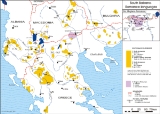
in a few villages in the Moglena (Μογλενά) region of Macedonia
Macedonia (Greece)
Macedonia is a geographical and historical region of Greece in Southern Europe. Macedonia is the largest and second most populous Greek region...
(Greece
Macedonia (Greece)
Macedonia is a geographical and historical region of Greece in Southern Europe. Macedonia is the largest and second most populous Greek region...
and the Republic of Macedonia
Republic of Macedonia
Macedonia , officially the Republic of Macedonia , is a country located in the central Balkan peninsula in Southeast Europe. It is one of the successor states of the former Yugoslavia, from which it declared independence in 1991...
), in Romania
Romania
Romania is a country located at the crossroads of Central and Southeastern Europe, on the Lower Danube, within and outside the Carpathian arch, bordering on the Black Sea...
and by a very small Muslim
Muslim
A Muslim, also spelled Moslem, is an adherent of Islam, a monotheistic, Abrahamic religion based on the Quran, which Muslims consider the verbatim word of God as revealed to prophet Muhammad. "Muslim" is the Arabic term for "submitter" .Muslims believe that God is one and incomparable...
group in Turkey
Turkey
Turkey , known officially as the Republic of Turkey , is a Eurasian country located in Western Asia and in East Thrace in Southeastern Europe...
(Karadjaovalides). It is considered an endangered language
Endangered language
An endangered language is a language that is at risk of falling out of use. If it loses all its native speakers, it becomes a dead language. If eventually no one speaks the language at all it becomes an "extinct language"....
.
Classification
Megleno-Romanian is a member of the Italic branchItalic languages
The Italic subfamily is a member of the Indo-European language family. It includes the Romance languages derived from Latin , and a number of extinct languages of the Italian Peninsula, including Umbrian, Oscan, Faliscan, and Latin.In the past various definitions of "Italic" have prevailed...
of the Indo-European language family. More specifically, it is an Eastern Romance language, a language formed after the retreat of the Roman Empire
Roman Empire
The Roman Empire was the post-Republican period of the ancient Roman civilization, characterised by an autocratic form of government and large territorial holdings in Europe and around the Mediterranean....
from South-Eastern Europe. Some linguists consider it to be an intermediary between Romanian
Romanian language
Romanian Romanian Romanian (or Daco-Romanian; obsolete spellings Rumanian, Roumanian; self-designation: română, limba română ("the Romanian language") or românește (lit. "in Romanian") is a Romance language spoken by around 24 to 28 million people, primarily in Romania and Moldova...
and Aromanian
Aromanian language
Aromanian , also known as Macedo-Romanian, Arumanian or Vlach is an Eastern Romance language spoken in Southeastern Europe...
, often being considered either a dialect of Romanian, a dialect of Aromanian, or an independent language. It is much closer to standard Romanian than the Aromanian language, suggesting that it split from Proto-Romanian later than Aromanian. Megleno-Romanian is influenced a lot by South Slavic
South Slavic languages
The South Slavic languages comprise one of three branches of the Slavic languages. There are approximately 30 million speakers, mainly in the Balkans. These are separated geographically from speakers of the other two Slavic branches by a belt of German, Hungarian and Romanian speakers...
.
Name
The term "Megleno-Romanian" has been used by linguists who noticed the similarity to the Romanian languageRomanian language
Romanian Romanian Romanian (or Daco-Romanian; obsolete spellings Rumanian, Roumanian; self-designation: română, limba română ("the Romanian language") or românește (lit. "in Romanian") is a Romance language spoken by around 24 to 28 million people, primarily in Romania and Moldova...
. The Megleno-Romanians identify themselves as Vlahi (see Etymology of Vlach for more on this term).
Origins
The origins of Megleno-Romanian could possibly be somewhere along the AxiosVardar
The Vardar or Axios is the longest and major river in the Republic of Macedonia and also a major river of Greece. It is long, and drains an area of around . The maximum depth of river is ....
valley in Republic of Macedonia
Republic of Macedonia
Macedonia , officially the Republic of Macedonia , is a country located in the central Balkan peninsula in Southeast Europe. It is one of the successor states of the former Yugoslavia, from which it declared independence in 1991...
and the north side of Paiko
Paiko
Paiko may refer to:*Mount Paiko , a mountain in the Macedonian region of Greece*Paiko , a rock-pop band from Paraguay...
mountain (Macedonian: Пајак планина), northern Greece
Greece
Greece , officially the Hellenic Republic , and historically Hellas or the Republic of Greece in English, is a country in southeastern Europe....
, close to the border with Republic of Macedonia
Republic of Macedonia
Macedonia , officially the Republic of Macedonia , is a country located in the central Balkan peninsula in Southeast Europe. It is one of the successor states of the former Yugoslavia, from which it declared independence in 1991...
, maybe latinized ancient Paeonians or even latinized ancient Macedonians. The Meglen Vlach language may have separated from the form of Latin spoken in the Eastern part of the Roman Empire at a different time in history than the other Vlach groups. Megleno-Romanian is most influenced by the south Slavic languages
South Slavic languages
The South Slavic languages comprise one of three branches of the Slavic languages. There are approximately 30 million speakers, mainly in the Balkans. These are separated geographically from speakers of the other two Slavic branches by a belt of German, Hungarian and Romanian speakers...
of the region. According to researcher Maria Papageorgiou from Skra (Municipality of Axioupolis
Axioupoli
Axioupoli , known until 1927 as Boymitsa , is a small town and a former municipality in the former Paionia Province of Kilkis regional unit, Greece. Since the 2011 local government reform it is part of the municipality Paionia, of which it is a municipal unit...
, Kilkis prefecture
Kilkis Prefecture
Kilkis is one of the regional units of Greece. It is part of the region of Central Macedonia. Its capital is the city of Kilkis.-Geography:The mountains near Kilkis are Paiko to the west, parts of the western part of Kerkini to the northeast and Krousia to the east...
, Macedonia region, Greece
Greece
Greece , officially the Hellenic Republic , and historically Hellas or the Republic of Greece in English, is a country in southeastern Europe....
), in the Meglenitic dialect several ancient Greek plays of tragic poets that are lost nowadays have been saved as oral tales/sagas.
Geographic distribution
Megleno-Romanian is spoken in the KilkisKilkis
Kilkis is an industrial city in Central Macedonia, Greece. As of 2001 there were 17,430 people living in the city proper, 24,812 people living in the municipal unit, and 56,336 in the municipality of Kilkis. It is also the capital city of the regional unit of Kilkis.-Name:Kilkis is located in a...
and Serres
Serres
Serres is a city in Greece, seat of the Serres prefecture.Serres may also refer to:Places:* Serres, Germany, a part of Wiernsheim in Baden-WürttembergIn France:* Serres, Aude in the Aude département...
prefectures of Macedonia (Greece)
Macedonia (Greece)
Macedonia is a geographical and historical region of Greece in Southern Europe. Macedonia is the largest and second most populous Greek region...
, as well as in several villages close to the Greek border in the Republic of Macedonia
Republic of Macedonia
Macedonia , officially the Republic of Macedonia , is a country located in the central Balkan peninsula in Southeast Europe. It is one of the successor states of the former Yugoslavia, from which it declared independence in 1991...
. In one village, Huma, the language was spoken by most inhabitants. Some of people with Meglono-Romanian origin, knowing the Megleno-Romanian language are living in city of Gevgelija
Gevgelija
Gevgelija is a town with a population of 15,685 located in the very southeast of the Republic of Macedonia along the banks of the Vardar River, situated at the country's main border with Greece , the point which links the motorway from Skopje and three other former Yugoslav capitals with...
and in Skopje
Skopje
Skopje is the capital and largest city of the Republic of Macedonia with about a third of the total population. It is the country's political, cultural, economic, and academic centre...
the capital of Republic of Macedonia
Republic of Macedonia
Macedonia , officially the Republic of Macedonia , is a country located in the central Balkan peninsula in Southeast Europe. It is one of the successor states of the former Yugoslavia, from which it declared independence in 1991...
. After World War I
World War I
World War I , which was predominantly called the World War or the Great War from its occurrence until 1939, and the First World War or World War I thereafter, was a major war centred in Europe that began on 28 July 1914 and lasted until 11 November 1918...
, some Megleno-Romanians moved to Romania
Romania
Romania is a country located at the crossroads of Central and Southeastern Europe, on the Lower Danube, within and outside the Carpathian arch, bordering on the Black Sea...
, many of them settling in the Cerna
Cerna
Cerna may refer to:Croatia:* Cerna, Vukovar-Syrmia County, a village in Vukovar-Syrmia County, CroatiaRomania:* Cerna River , a river in Romania, tributary of the Danube* Cerna River , a river in Romania, tributary of the Mureş River...
village in the Tulcea County
Tulcea County
Tulcea is a county of Romania, in the historical region Dobruja, with the capital city at Tulcea.-Demographics:In 2002, Tulcea County had a population of 256,492...
, in which about 1,200 continue to speak Megleno-Romanian. In 1940, about 30 families moved from Cerna to the Banat
Banat
The Banat is a geographical and historical region in Central Europe currently divided between three countries: the eastern part lies in western Romania , the western part in northeastern Serbia , and a small...
region of Romania
Romania
Romania is a country located at the crossroads of Central and Southeastern Europe, on the Lower Danube, within and outside the Carpathian arch, bordering on the Black Sea...
in the villages of Variaş, Biled and Jimbolia. Some speakers who identified as Muslims were moved to Turkey from Greece as part of religious-based population exchanges.
Phonetics
Megleno-Romanian has some unique phonetic characteristics, not found in the other Eastern Romance languagesEastern Romance languages
The Eastern Romance languages in their narrow conception, sometimes known as the Vlach languages, are a group of Romance languages that developed in Southeastern Europe from the local eastern variant of Vulgar Latin. Some classifications include the Italo-Dalmatian languages; when Italian is...
:
- long vowels: ā, ē, ī, ō, ū
- ă, â → o, a: câmp → comp (field), mânc → mānc (I eat)
- unaccentuated initial a disappears: adaug → daug (I add), afară → fară (outside), aduc → duc (I bring)
Vocabulary
Much of the vocabulary is of LatinLatin
Latin is an Italic language originally spoken in Latium and Ancient Rome. It, along with most European languages, is a descendant of the ancient Proto-Indo-European language. Although it is considered a dead language, a number of scholars and members of the Christian clergy speak it fluently, and...
origin and much of its phonetics and semantics is shared with Aromanian and Romanian: (n.b.: MR=Megleno-Romanian, DR=Daco-Romanian, i.e. Romanian)
- basilica > MR bisearică, DR biserică (church, originally "basilicaBasilicaThe Latin word basilica , was originally used to describe a Roman public building, usually located in the forum of a Roman town. Public basilicas began to appear in Hellenistic cities in the 2nd century BC.The term was also applied to buildings used for religious purposes...
") - lumen > MR lumi, DR lume (world, originally "lightLightLight or visible light is electromagnetic radiation that is visible to the human eye, and is responsible for the sense of sight. Visible light has wavelength in a range from about 380 nanometres to about 740 nm, with a frequency range of about 405 THz to 790 THz...
") - monumentum > MR murmint, DR mormânt (grave, originally "monumentMonumentA monument is a type of structure either explicitly created to commemorate a person or important event or which has become important to a social group as a part of their remembrance of historic times or cultural heritage, or simply as an example of historic architecture...
") - strigis > MR strig, DR strig (I yell, originally "owlOwlOwls are a group of birds that belong to the order Strigiformes, constituting 200 bird of prey species. Most are solitary and nocturnal, with some exceptions . Owls hunt mostly small mammals, insects, and other birds, although a few species specialize in hunting fish...
") - draco > MR drac, DR drac (devil, originally "dragonDragonA dragon is a legendary creature, typically with serpentine or reptilian traits, that feature in the myths of many cultures. There are two distinct cultural traditions of dragons: the European dragon, derived from European folk traditions and ultimately related to Greek and Middle Eastern...
")
Megleno-Romanian also contains some words that have cognates with Albanian
Albanian language
Albanian is an Indo-European language spoken by approximately 7.6 million people, primarily in Albania and Kosovo but also in other areas of the Balkans in which there is an Albanian population, including western Macedonia, southern Montenegro, southern Serbia and northwestern Greece...
. These words are present in Daco-Romanian
Daco-Romanian
Daco-Romanian is the term used to identify the Romanian language in contexts where distinction needs to be made between the various Eastern Romance languages...
too:
- MR brad; DR brad; cf. Alb. bredh (fir tree)
- MR monz; DR mânz; cf. Alb. mës (colt)
- MR bucuros; DR bucuros; (happy) cf. Alb bukurë (beautiful)
There are also some words which are of Slavic origin and which can be found in all the Eastern Romance languages:
- MR trup; DR trup (body); cf. Sl. trupŭ
- MR stăpon; Dr stăpân (master); cf. Old Slavic. stopanŭ, today's Bulgarian stopanin and Macedonian stopan
There are a number of Byzantine and Modern Greek
Modern Greek
Modern Greek refers to the varieties of the Greek language spoken in the modern era. The beginning of the "modern" period of the language is often symbolically assigned to the fall of the Byzantine Empire in 1453, even though that date marks no clear linguistic boundary and many characteristic...
words, several dozens which are also found in Daco-Romanian
Daco-Romanian
Daco-Romanian is the term used to identify the Romanian language in contexts where distinction needs to be made between the various Eastern Romance languages...
(Romanian language
Romanian language
Romanian Romanian Romanian (or Daco-Romanian; obsolete spellings Rumanian, Roumanian; self-designation: română, limba română ("the Romanian language") or românește (lit. "in Romanian") is a Romance language spoken by around 24 to 28 million people, primarily in Romania and Moldova...
) and Aromanian and about 80 words that were borrowed via Macedonian
Macedonian language
Macedonian is a South Slavic language spoken as a first language by approximately 2–3 million people principally in the region of Macedonia but also in the Macedonian diaspora...
and Bulgarian
Bulgarian language
Bulgarian is an Indo-European language, a member of the Slavic linguistic group.Bulgarian, along with the closely related Macedonian language, demonstrates several linguistic characteristics that set it apart from all other Slavic languages such as the elimination of case declension, the...
languages and other languages of the Balkans
Balkans
The Balkans is a geopolitical and cultural region of southeastern Europe...
. Prior to the creation of the modern state of Greece, Megleno-Romanian borrowed very few words directly from Greek.
- Gr. prósfatos > MR proaspit; DR proaspăt; (fresh)
- Gr. keramídi > MR chirămidă; DR cărămidă (brick)
- Gr. lemoni > MR limonă, via Bulg. limon (lemon); cf. DR lămâie
The most important influence on Megleno-Romanian was the East South Slavic languages, this influence being more profound than the influence exerted by Greek on Aromanian. Linguist Theodor Capidan argued that the words borrowed show some phonetical features of the Bulgarian language dialect spoken in the Rhodope Mountains
Rhodope Mountains
The Rhodopes are a mountain range in Southeastern Europe, with over 83% of its area in southern Bulgaria and the remainder in Greece. Its highest peak, Golyam Perelik , is the seventh highest Bulgarian mountain...
. There are many instances where basic words of Latin origin that can still be found in Daco-Romanian and Aromanian were replaced by Slavic words. In some cases, standard Romanian also independently borrowed the same word.
- Slavic. drob > MR drob; DR drob (liver)
- Slavic nevesta > MR niveastă; DR nevastă (wife)
- Slavic gora > MR goră (forest)
See also
- Thraco-RomanThraco-RomanThe terms Thraco-Roman and Daco-Roman refer to the culture and language of the Thracian and Dacian peoples who were incorporated into the Roman Empire and ultimately fell under the Roman and Latin sphere of influence.-Meaning and usage:...
- Eastern Romance substratumEastern Romance substratumThe Eastern Romance languages developed from the Proto-Romanian language, which in turn developed from the Vulgar Latin spoken in a region of the Balkans which has not yet been exactly determined, but is generally agreed to have been a region north of the Jireček Line.That there was...
- Romanian languageRomanian languageRomanian Romanian Romanian (or Daco-Romanian; obsolete spellings Rumanian, Roumanian; self-designation: română, limba română ("the Romanian language") or românește (lit. "in Romanian") is a Romance language spoken by around 24 to 28 million people, primarily in Romania and Moldova...
- Origin of the Romanians
- Romance languagesRomance languagesThe Romance languages are a branch of the Indo-European language family, more precisely of the Italic languages subfamily, comprising all the languages that descend from Vulgar Latin, the language of ancient Rome...
- Legacy of the Roman EmpireLegacy of the Roman EmpireThe legacy of the Roman Empire refers to the set of cultural values, religious beliefs, as well as technological and other achievements of Ancient Rome which were passed on after the demise of the empire itself and continued to shape other civilizations, a process which continues to this day.-...
- The Balkan linguistic unionBalkan linguistic unionThe Balkan sprachbund or linguistic area is the ensemble of areal features—similarity in grammar, syntax, vocabulary and phonology—among the languages of the Balkans. Several features are found across these languages though not all need apply to every single language...
External links
- Despre muzica folclorică a dialectului meglenoromân, by Dr. Mirela Kozlovsky
- Megleno-Romanii, by Dr. Emil Tarcovnicu
- EthnologueEthnologueEthnologue: Languages of the World is a web and print publication of SIL International , a Christian linguistic service organization, which studies lesser-known languages, to provide the speakers with Bibles in their native language and support their efforts in language development.The Ethnologue...
, Megleno Romanian entry - Megleno-Romanian Swadesh list of basic vocabulary words (from Wiktionary's Swadesh list appendix)
- Asterios Koukoudis, Studies on the Vlachs