


Megleno-Romanians

Encyclopedia
The Megleno-Romanians or Meglen Vlachs or Moglenite Vlachs, (Megleno-Romanian
: Vlashi; , Vlachomoglenítes; , Megleniţi, or Vlaşi) are a small Eastern Romance people, currently inhabiting seven villages in the Moglena region spanning the Pella
and Kilkis
prefectures of Central Macedonia
, Greece
, and one village, Huma, across the border in the Republic of Macedonia
. This people live in an area of approximately 300 km2 in size. Unlike the Aromanian
Vlachs, the other Romance speaking population in the same historic region, the Meglen Vlachs are traditionally sedentary agriculturalists, and not traditionally transhumants.
They speak a Romance language most often called by linguists Megleno-Romanian
or Meglenitic in English, and βλαχομογλενίτικα (vlachomoglenítika) or simply μογλενίτικα (moglenítika) in Greek
. The people themselves call their language vlaheshte, but the Megleno-Romanian diaspora in Romania
also uses the term megleno-româna.
Unlike the other Eastern Romanace populations, in time Megleno-Romanians have disused a name for themselves originating from Latin Romanus, and instead have adopted the term Vlasi or Vlashi, derived from Vlachs
, a general term by which in the Middle Ages non-Romance people called the Romance peoples. (The word Vlachs appears in the Byzantine documents at about the 10th century.) The term Megleno-Romanians was given to them in the 19th century by the scientists that studied their language and customs, based on the region in which they live.
Their number is estimated between 5,213 (P. Atanasov, most recent estimate), and 20,000 (P.Papahagi, ca, 1900). There is a larger Megleno-Romanian diaspora in Romania (ca. 1,500 people), and a smaller one in Turkey
(ca. 500 people). Greece
does not recognize national minorities, thus this approximately 4,000-strong community does not have any official recognition from Greece. Another 1,000 Megleno-Romanians live in the Republic of Macedonia
. It is believed, however, that there are up to 20,000 people of Megleno-Romanian descent worldwide (including those assimilated into the basic populations of these countries).
: Karacaova) is located in the north of Greece at the border with the Republic of Macedonia. It is roughly bounded by the Vardar
river to the east, by the Cosuf and Nigea Mountains to the west, by the plains of Ianita and Vodena to the south, and by the Mariansca Mountains to the north. The number of Megleno-Romanians was estimated by different authors as follows:
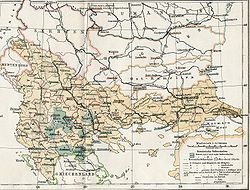
Historians Ovid Densusianu
and Konstantin Jirecek considered that Megleno-Romanians descend from a mixture of Romanians
with Pecenegs, settled in Moglen by the Byzantine Emperor Alexios I Komnenos
in 1091. They argued this based in part on the Asian-like facial appearance (more prominent cheek bones) of Meglen Vlachs. By contrast, Gustav Weigand
and George Murnu
believed that Megleno-Romanians are descendants of the Romanian-Bulgarian Empire
that retreated to Moglen. This view was opposed by Jiricek.
Pericle Papahagi argued another version, that Megleno-Romanians are descendants of a group of Romanians who were incorrectly called Vlachs.
Megleno-Romanians used to have a traditional custom, called bondic, where the head of a household would take an oak log and place it in the hearth just before Christmas
, burning it bit by bit till Epiphany. The resulting charcoal would be put under fruit trees to make them fertile. A similar custom (called bavnic), but with specific variations, also existed among Aromanians
, some Romanians and Latvians
. In Serbian
, the custom is known as badnjak, in Bulgarian
as budnik
, and in Macedonian
as Badnik or Badni Vecher (Badni Evening). Some believe that this and other cultural archetypes discovered by scientists are a proof that Megleno-Romanians come from a traditional mountainous region.
Theodor Capidan, studying the resemblance of the Megleno-Romanian language
with Romanian
and other languages, concluded that Megleno-Romanians must have spent some time in the Rhodope Mountains
before moving on to Moglen (due to similar elements with the language of the Bulgarians
in the Rhodopes). Both Papahagi and Capidan observed that Armonanian
and Megleno-Romanian
lack a Slavic
influence, but have a Greek one instead. The study of Megleno-Romanian and other Eastern Romance varieties led Capidan to believe that during the establishment of the Romanian language in the Early Middle Ages, there was an ethnic Romanian continuity on both banks of the Danube (north and south).
From the medieval and modern periods, it is known that Moglen Vlachs had an administration of their own. Each village was led by a captain. Their economic and social center was the town of Nânta. After the incursions of the Pomaks
of Moglen against the Ottomans, the latter started a persecution campaign against villages in the area, including those of the Moglen Vlachs. Most of the villages were put under the administration of an Ottoman bei, who exploited them to the extreme in exchange for their security. The village of Osani, however, resisted much longer before being subdued by the Ottomans, because its captain was more skilled militarily.
In 1900, the then province of Gevgelija
, which contained most of the Megleno-Romanian settlements, had a population of 49,315, of which 20,643 Slavs, 14,900 Turks
, 9,400 Christian Aromanians and Megleno-Romanians, 3,500 Muslim Megleno-Romanians, 655 Gypsies, and 187 Circassians. The villages of Meglen Vlachs had in 1900 the following populations:
1Aromanian
village surround by the Megleno-Romanian ones.
, which in 1900 had a population of 3,660, of which 3,500 Megleno-Romanians, in the Upper Karadjova Plain converted to Islam
in the 17th or 18th century. It is the only case among Eastern Romance populations with an entire community converting to Islam. The entire population of this village was forcefully expelled to Turkey
in 1923, as part of the population exchange between Greece and Turkey
, where they mostly settled in Kırklareli
and Şarköy
, and became known as Karadjovalides after the Turkish name of Moglen.
Since 1913, after the Second Balkan War
, there was a general policy of the Balkan states to achieve more ethnically uniformity through exchange of population. On September 29, 1913, a first such treaty was signed between Turkey and Bulgaria about exchange of population of up to 15 km deep from their border. The Treaty of Neuilly-sur-Seine (November 27, 1919) led to an exchange 50,000 Greeks for 70,000 Bulgarians between the two countries. After the Greek-Turkish War
, by the Treaty of Lausanne
, 500,000 of Turks and other Muslims were exchanged for a comparable number of Asia Minor
Greeks. Muslim Megleno-Romanians, despite all their protests were forcefully deported to Turkey because of their religion. A significant number of arriving Greeks were settled in Greek Macedonia and Greek Thrace
, including in traditional Aromanian and Megleno-Romanian areas. Economic and social consequences soon followed, and local conflict between Aromanians and Greeks appeared. Acts of intimidation by the Greek authorities led to the formation in 1921-1923 of a national movement among Aromanians and Megleno-Romanians favorable to the idea of emigration to Romania, especially from Moglena, Veria
and Vodena.
In 1926, about 450 families of Megleno-Romanians of Greece moved to Romania
, and settled in Southern Dobruja
(Cadrilater), a region which became Romanian in 1913. They originated from the villages of Osani, Liumnita, Cupa, Lundzini, Birislav, Livezi, and were settled in villages around the city of Durostor such as Cocina (Turkish "Koçina", now Profesor-Ishirkovo), Cazimir (Turkish "Kazemir", now Kazimir), Capaclia (Turkish "Kapaklı", now Slatina), Bazarghian (Turkish "Bezirgan", now Miletich), Aidodu (Turkish "Aydoğdu", now Zvezdel), Tatar Admagea (Turkish "Tatar Atmaca, now Sokol), Uzungi Ozman (Turkish "Uzunca Orman", now Bogdantsi), Strebarna Viskioi (Now Sreburna), Cadichioi (Turkish "Kadıköy", now Maluk Preslavets), Haschioi (Turkish "Hasköy, now Dobrotitsa).
After Bulgaria re-acquired Southern Dobruja from Romania in 1940, the Megleno-Romanians moved to other regions of Romania, many of them to the village of Cerna
in Tulcea County
, in northern Dobruja
. 270 families of Megleno-Romanians and 158 families of Aromanians settled in this village in 1940. Between 1940 and 1948, the Aromanian families moved to other localities of Dobruja.
In 1947-1948, the new Communist authorities
deported 40 Megleno-Romanian families from Cerna to the Ialomiţa
and Brăila Counties
, and to Banat
, and only a few of them returned to Cerna, where about 1,200 continue to speak Megleno-Romanian to this day.
Another wave of Megleno-Romanians emigrated to Romania and to other countries during World War II
and the Greek Civil War
, due to the heavy fighting carried out in the Moglená region.
, ca. 4,000 Moglen Vlachs still speak their language today, while several thousand others are already assimilated:
 Archangelos
(Megleno-Romanian
: Ossiani)
Karpi (Megleno-Romanian
: Tarnareca)
Koupa (Megleno-Romanian
: Cupa)
Langadia (Megleno-Romanian
: Lugunţa, Lundzini)
Notia
(Megleno-Romanian
: Nânti, Nânta)
Perikleia (Megleno-Romanian
: Birislav)
Skra (Megleno-Romanian
: Liumniţa)
Kastaneri (Megleno-Romanian
: Baroviţa)
, live in one village and in the town of Gevgelija. Ca. 200, mostly old people, still speak the Megleno-Romanian language
:
 Huma (Megleno-Romanian
: Uma)
Konsko (Megleno-Romanian
: Coinsco)
Sermenin (Megleno-Romanian
: Sirminia)
, the only case among Eastern Romance populations with an entire community converting to Islam
, was forcefully expelled to Turkey
, as part of the population exchange between Greece and Turkey
.
These 3700 people mostly settled in the Edirne
area (mainly in Kırklareli
and Şarköy
) of Turkish Thrace
, and became known as Karadjovalides after the Turkish name of Moglen:
 Kirklareli
, near Edirne
.
The number of families settled in Turkish cities and villages were: Kirklareli (110), Edirne (100), Şarköy (80), Babaeski (70), Lüleburgaz (80), Uzunköprü (100), Corlu (100), Malkara (50), Balli (10), Gözsüzköy (50), Kalamiş (50), Hoşköy (20), Mürefte (5), according to the scholar Kahl.
Actually they number only 500, concentrated in Kirklareli and culturally assimilated to the Turks (most of them speak mainly the Turkish language
).
 Cerna
Cerna
, a commune on Tulcea County
,
Situated in a hilly landscape 55 km from the city of Tulcea
and 25 km from Măcin
, the village of Cerna had at the 2002 Romanian Census a population of 2,427, and together with three smaller villages the population of the entire commune was 4,227. Estimates of the number of Megleno-Romanians in this village vary from 1,200 to 2,000. In this locality, Megleno-Romanians settled according to the villages they originate from in Moglen: lumnicianii, those from Lumniţa in the South-East, lunzaneţii, those from Lugunţa in the North, usineţii, those from Ossiani in the Center, North and North-East, cupineţii, those from Cupa in (w)est, wihle Romanians and Bulgarians that lived in the village before them are concentrated in the (w)estern part of the village.
Megleno-Romanians in this village preserved very well their Megleno-Romanian language
. Ca. 1,200 people speak the language today.
However, their small overall number led to the fact that after 1950 mixed marriages with Romanians
were more often, unlike the Aromanians
who by the nature of their traditional occupations have developed a special psychology, gaining weight in the Romanian society and preserving their people (very few mixed marriages with Romanians occurring). However, due to the hardships this small community has passed through, Megleno-Romanians in Romania remain very united, with a very sharp national sentiment. During their weddings, they use the Romanian tricolor as a furgliţa (wedding flag), and very rarely the traditional white-red colors. This illustrates the fact that despite their distinct (albeit also East Romanic) language, identity-wise, Megleno-Romanians in Romania identify themselves as Romanians. According to one observer, they consider themselves "more Romanian than the Romanians".
Very small numbers of Megleno-Romanian live also in the communes of Variaş
and Biled
, and in the city of Jimbolia
in Timiş County
, in the historic region of Banat
in Romania.
Megleno-Romanian language
Megleno-Romanian is a Romance language, similar to Aromanian and Romanian, or a dialect of the Romanian language...
: Vlashi; , Vlachomoglenítes; , Megleniţi, or Vlaşi) are a small Eastern Romance people, currently inhabiting seven villages in the Moglena region spanning the Pella
Pella Prefecture
Pella is one of the regional units of Greece, in the geographic region of Macedonia. It is part of the Region of Central Macedonia. It is named after the ancient city of Pella, the capital of ancient Macedonia. The capital of Pella is Edessa....
and Kilkis
Kilkis Prefecture
Kilkis is one of the regional units of Greece. It is part of the region of Central Macedonia. Its capital is the city of Kilkis.-Geography:The mountains near Kilkis are Paiko to the west, parts of the western part of Kerkini to the northeast and Krousia to the east...
prefectures of Central Macedonia
Central Macedonia
Central Macedonia is one of the thirteen regions of Greece, consisting of the central part of the region of Macedonia. With a population of over 1.8 million, it is the second most populous in Greece after Attica.- Administration :...
, Greece
Greece
Greece , officially the Hellenic Republic , and historically Hellas or the Republic of Greece in English, is a country in southeastern Europe....
, and one village, Huma, across the border in the Republic of Macedonia
Republic of Macedonia
Macedonia , officially the Republic of Macedonia , is a country located in the central Balkan peninsula in Southeast Europe. It is one of the successor states of the former Yugoslavia, from which it declared independence in 1991...
. This people live in an area of approximately 300 km2 in size. Unlike the Aromanian
Aromanians
Aromanians are a Latin people native throughout the southern Balkans, especially in northern Greece, Albania, the Republic of Macedonia, Bulgaria, and as an emigrant community in Serbia and Romania . An older term is Macedo-Romanians...
Vlachs, the other Romance speaking population in the same historic region, the Meglen Vlachs are traditionally sedentary agriculturalists, and not traditionally transhumants.
They speak a Romance language most often called by linguists Megleno-Romanian
Megleno-Romanian language
Megleno-Romanian is a Romance language, similar to Aromanian and Romanian, or a dialect of the Romanian language...
or Meglenitic in English, and βλαχομογλενίτικα (vlachomoglenítika) or simply μογλενίτικα (moglenítika) in Greek
Greek language
Greek is an independent branch of the Indo-European family of languages. Native to the southern Balkans, it has the longest documented history of any Indo-European language, spanning 34 centuries of written records. Its writing system has been the Greek alphabet for the majority of its history;...
. The people themselves call their language vlaheshte, but the Megleno-Romanian diaspora in Romania
Romania
Romania is a country located at the crossroads of Central and Southeastern Europe, on the Lower Danube, within and outside the Carpathian arch, bordering on the Black Sea...
also uses the term megleno-româna.
Unlike the other Eastern Romanace populations, in time Megleno-Romanians have disused a name for themselves originating from Latin Romanus, and instead have adopted the term Vlasi or Vlashi, derived from Vlachs
Vlachs
Vlach is a blanket term covering several modern Latin peoples descending from the Latinised population in Central, Eastern and Southeastern Europe. English variations on the name include: Walla, Wlachs, Wallachs, Vlahs, Olahs or Ulahs...
, a general term by which in the Middle Ages non-Romance people called the Romance peoples. (The word Vlachs appears in the Byzantine documents at about the 10th century.) The term Megleno-Romanians was given to them in the 19th century by the scientists that studied their language and customs, based on the region in which they live.
Their number is estimated between 5,213 (P. Atanasov, most recent estimate), and 20,000 (P.Papahagi, ca, 1900). There is a larger Megleno-Romanian diaspora in Romania (ca. 1,500 people), and a smaller one in Turkey
Turkey
Turkey , known officially as the Republic of Turkey , is a Eurasian country located in Western Asia and in East Thrace in Southeastern Europe...
(ca. 500 people). Greece
Greece
Greece , officially the Hellenic Republic , and historically Hellas or the Republic of Greece in English, is a country in southeastern Europe....
does not recognize national minorities, thus this approximately 4,000-strong community does not have any official recognition from Greece. Another 1,000 Megleno-Romanians live in the Republic of Macedonia
Republic of Macedonia
Macedonia , officially the Republic of Macedonia , is a country located in the central Balkan peninsula in Southeast Europe. It is one of the successor states of the former Yugoslavia, from which it declared independence in 1991...
. It is believed, however, that there are up to 20,000 people of Megleno-Romanian descent worldwide (including those assimilated into the basic populations of these countries).
Origins
The Moglen region (TurkishTurkish language
Turkish is a language spoken as a native language by over 83 million people worldwide, making it the most commonly spoken of the Turkic languages. Its speakers are located predominantly in Turkey and Northern Cyprus with smaller groups in Iraq, Greece, Bulgaria, the Republic of Macedonia, Kosovo,...
: Karacaova) is located in the north of Greece at the border with the Republic of Macedonia. It is roughly bounded by the Vardar
Vardar
The Vardar or Axios is the longest and major river in the Republic of Macedonia and also a major river of Greece. It is long, and drains an area of around . The maximum depth of river is ....
river to the east, by the Cosuf and Nigea Mountains to the west, by the plains of Ianita and Vodena to the south, and by the Mariansca Mountains to the north. The number of Megleno-Romanians was estimated by different authors as follows:
- 14,000 in 1892
- 21,700 in 1895
- 11,960 in 1900
- 20,000 in 1902
- 14,720 in 1925
Historians Ovid Densusianu
Ovid Densusianu
Ovid Densusianu was a Romanian poet, philologist, linguist and folklorist. He is known for introducing new trends of European modernism into Romanian literature.He was a professor at the University of Bucharest, and a member of the Romanian Academy....
and Konstantin Jirecek considered that Megleno-Romanians descend from a mixture of Romanians
Romanians
The Romanians are an ethnic group native to Romania, who speak Romanian; they are the majority inhabitants of Romania....
with Pecenegs, settled in Moglen by the Byzantine Emperor Alexios I Komnenos
Alexios I Komnenos
Alexios I Komnenos, Latinized as Alexius I Comnenus , was Byzantine emperor from 1081 to 1118, and although he was not the founder of the Komnenian dynasty, it was during his reign that the Komnenos family came to full power. The title 'Nobilissimus' was given to senior army commanders,...
in 1091. They argued this based in part on the Asian-like facial appearance (more prominent cheek bones) of Meglen Vlachs. By contrast, Gustav Weigand
Gustav Weigand
Gustav Weigand , was a German linguist and specialist in Balkan languages, especially Rumanian and Aromanian. He is known for his seminal contributions to the dialectology of the Romance languages of the Balkans and to the study of the relationships between the languages of the Balkan...
and George Murnu
George Murnu
George Murnu was a Romanian university professor, archaeologist, historian, translator, and poet of Aromanian origin....
believed that Megleno-Romanians are descendants of the Romanian-Bulgarian Empire
Second Bulgarian Empire
The Second Bulgarian Empire was a medieval Bulgarian state which existed between 1185 and 1396 . A successor of the First Bulgarian Empire, it reached the peak of its power under Kaloyan and Ivan Asen II before gradually being conquered by the Ottomans in the late 14th-early 15th century...
that retreated to Moglen. This view was opposed by Jiricek.
Pericle Papahagi argued another version, that Megleno-Romanians are descendants of a group of Romanians who were incorrectly called Vlachs.
Megleno-Romanians used to have a traditional custom, called bondic, where the head of a household would take an oak log and place it in the hearth just before Christmas
Christmas
Christmas or Christmas Day is an annual holiday generally celebrated on December 25 by billions of people around the world. It is a Christian feast that commemorates the birth of Jesus Christ, liturgically closing the Advent season and initiating the season of Christmastide, which lasts twelve days...
, burning it bit by bit till Epiphany. The resulting charcoal would be put under fruit trees to make them fertile. A similar custom (called bavnic), but with specific variations, also existed among Aromanians
Aromanians
Aromanians are a Latin people native throughout the southern Balkans, especially in northern Greece, Albania, the Republic of Macedonia, Bulgaria, and as an emigrant community in Serbia and Romania . An older term is Macedo-Romanians...
, some Romanians and Latvians
Latvians
Latvians or Letts are the indigenous Baltic people of Latvia.-History:Latvians occasionally refer to themselves by the ancient name of Latvji, which may have originated from the word Latve which is a name of the river that presumably flowed through what is now eastern Latvia...
. In Serbian
Serbian language
Serbian is a form of Serbo-Croatian, a South Slavic language, spoken by Serbs in Serbia, Bosnia and Herzegovina, Montenegro, Croatia and neighbouring countries....
, the custom is known as badnjak, in Bulgarian
Bulgarian language
Bulgarian is an Indo-European language, a member of the Slavic linguistic group.Bulgarian, along with the closely related Macedonian language, demonstrates several linguistic characteristics that set it apart from all other Slavic languages such as the elimination of case declension, the...
as budnik
Bulgarian budnik
Budnik , refers to a log brought into the house and placed on the fire on the evening of Christmas Eve, a central tradition in Slavic Christmas celebrations in Bulgaria, Bosnia and Herzegovina, Croatia, Serbia, and Montenegro, much like a yule log in other European traditions Budnik (Bulgarian...
, and in Macedonian
Macedonian language
Macedonian is a South Slavic language spoken as a first language by approximately 2–3 million people principally in the region of Macedonia but also in the Macedonian diaspora...
as Badnik or Badni Vecher (Badni Evening). Some believe that this and other cultural archetypes discovered by scientists are a proof that Megleno-Romanians come from a traditional mountainous region.
Theodor Capidan, studying the resemblance of the Megleno-Romanian language
Megleno-Romanian language
Megleno-Romanian is a Romance language, similar to Aromanian and Romanian, or a dialect of the Romanian language...
with Romanian
Romanian language
Romanian Romanian Romanian (or Daco-Romanian; obsolete spellings Rumanian, Roumanian; self-designation: română, limba română ("the Romanian language") or românește (lit. "in Romanian") is a Romance language spoken by around 24 to 28 million people, primarily in Romania and Moldova...
and other languages, concluded that Megleno-Romanians must have spent some time in the Rhodope Mountains
Rhodope Mountains
The Rhodopes are a mountain range in Southeastern Europe, with over 83% of its area in southern Bulgaria and the remainder in Greece. Its highest peak, Golyam Perelik , is the seventh highest Bulgarian mountain...
before moving on to Moglen (due to similar elements with the language of the Bulgarians
Bulgarians
The Bulgarians are a South Slavic nation and ethnic group native to Bulgaria and neighbouring regions. Emigration has resulted in immigrant communities in a number of other countries.-History and ethnogenesis:...
in the Rhodopes). Both Papahagi and Capidan observed that Armonanian
Aromanian language
Aromanian , also known as Macedo-Romanian, Arumanian or Vlach is an Eastern Romance language spoken in Southeastern Europe...
and Megleno-Romanian
Megleno-Romanian language
Megleno-Romanian is a Romance language, similar to Aromanian and Romanian, or a dialect of the Romanian language...
lack a Slavic
Slavic languages
The Slavic languages , a group of closely related languages of the Slavic peoples and a subgroup of Indo-European languages, have speakers in most of Eastern Europe, in much of the Balkans, in parts of Central Europe, and in the northern part of Asia.-Branches:Scholars traditionally divide Slavic...
influence, but have a Greek one instead. The study of Megleno-Romanian and other Eastern Romance varieties led Capidan to believe that during the establishment of the Romanian language in the Early Middle Ages, there was an ethnic Romanian continuity on both banks of the Danube (north and south).
From the medieval and modern periods, it is known that Moglen Vlachs had an administration of their own. Each village was led by a captain. Their economic and social center was the town of Nânta. After the incursions of the Pomaks
Pomaks
Pomaks is a term used for a Slavic Muslim population native to some parts of Bulgaria, Turkey, Greece, the Republic of Macedonia, Albania and Kosovo. The Pomaks speak Bulgarian as their native language, also referred to in Greece and Turkey as Pomak language, and some are fluent in Turkish,...
of Moglen against the Ottomans, the latter started a persecution campaign against villages in the area, including those of the Moglen Vlachs. Most of the villages were put under the administration of an Ottoman bei, who exploited them to the extreme in exchange for their security. The village of Osani, however, resisted much longer before being subdued by the Ottomans, because its captain was more skilled militarily.
In 1900, the then province of Gevgelija
Gevgelija
Gevgelija is a town with a population of 15,685 located in the very southeast of the Republic of Macedonia along the banks of the Vardar River, situated at the country's main border with Greece , the point which links the motorway from Skopje and three other former Yugoslav capitals with...
, which contained most of the Megleno-Romanian settlements, had a population of 49,315, of which 20,643 Slavs, 14,900 Turks
Turkish people
Turkish people, also known as the "Turks" , are an ethnic group primarily living in Turkey and in the former lands of the Ottoman Empire where Turkish minorities had been established in Bulgaria, Cyprus, Bosnia and Herzegovina, Georgia, Greece, Kosovo, Macedonia, and Romania...
, 9,400 Christian Aromanians and Megleno-Romanians, 3,500 Muslim Megleno-Romanians, 655 Gypsies, and 187 Circassians. The villages of Meglen Vlachs had in 1900 the following populations:
| Village | Population |
| Notia Notia Nótia is a village in the Exaplatanos municipality of the Pella Prefecture, Central Macedonia, Greece. Lying at an altitude of 595 metres in the Upper Karadjova Plain, it was for centuries the largest Meglen Vlach village, and the only one with a regular market.Much of Notia's Meglen Vlach... (Nânti, Nânta) |
3,660 |
| Perikleia (Birislav) | 380 |
| Lagkadia (Lugunţa) | 700 |
| Archangelos Archangelos, Pella Archangelos is a town and part of the Exaplatanos municipality in the Pella Prefecture of Macedonia, Greece, near Aridaia. Originally, the inhabitants of the town speak Megleno-Romanian and this is still the main language in the town. The town is known for its monastery of Saint Michael, in which... (Ossiani, Osani) |
1,500 |
| Skra (Liumniţa) | 2,600 |
| Koupa (Cupa) | 600 |
| Kastaneri (Baroviţa) | 237 |
| Karpi (Tarnareca) | 400 |
| Huma (Uma) | 490 |
| Konsko (Coinsco) | 560 |
| Sermenin (Sirminia) | 480 |
| Livadia Livadia, Kilkis Livadia is a village and a former community in the former Paionia Province, Kilkis regional unit, Greece. Since the 2011 local government reform it is part of the municipality Paionia, of which it is a municipal unit. 11 km northwest of Griva, 15 km northwest of Goumenissa. Its... (Giumala de Jos)1 |
2,100 |
1Aromanian
Aromanians
Aromanians are a Latin people native throughout the southern Balkans, especially in northern Greece, Albania, the Republic of Macedonia, Bulgaria, and as an emigrant community in Serbia and Romania . An older term is Macedo-Romanians...
village surround by the Megleno-Romanian ones.
20th century
Most Meglen Vlachs are Orthodox Christians, but the population of the village of Nânti (Nótia)Notia
Nótia is a village in the Exaplatanos municipality of the Pella Prefecture, Central Macedonia, Greece. Lying at an altitude of 595 metres in the Upper Karadjova Plain, it was for centuries the largest Meglen Vlach village, and the only one with a regular market.Much of Notia's Meglen Vlach...
, which in 1900 had a population of 3,660, of which 3,500 Megleno-Romanians, in the Upper Karadjova Plain converted to Islam
Islam
Islam . The most common are and . : Arabic pronunciation varies regionally. The first vowel ranges from ~~. The second vowel ranges from ~~~...
in the 17th or 18th century. It is the only case among Eastern Romance populations with an entire community converting to Islam. The entire population of this village was forcefully expelled to Turkey
Turkey
Turkey , known officially as the Republic of Turkey , is a Eurasian country located in Western Asia and in East Thrace in Southeastern Europe...
in 1923, as part of the population exchange between Greece and Turkey
Population exchange between Greece and Turkey
The 1923 population exchange between Greece and Turkey was based upon religious identity, and involved the Greek Orthodox citizens of Turkey and the Muslim citizens of Greece...
, where they mostly settled in Kırklareli
Kirklareli
Kırklareli is the capital of Kırklareli Province in Eastern Thrace, on the European part of Turkey. The province has a coastline on the Black Sea. There is a Jewish community.-Name:It is not clearly known when the city was founded, nor under what name...
and Şarköy
Sarköy
Şarköy is a seaside town and district of Tekirdağ Province situated on the north coast of the Marmara Sea in Thrace in Turkey. Şarköy is 86 km west of the town of Tekirdağ, and can be reached either by the inland road or by the winding coast road, which goes on to Gallipoli...
, and became known as Karadjovalides after the Turkish name of Moglen.
Since 1913, after the Second Balkan War
Second Balkan War
The Second Balkan War was a conflict which broke out when Bulgaria, dissatisfied with its share of the spoils of the First Balkan War, attacked its former allies, Serbia and Greece, on 29 June 1913. Bulgaria had a prewar agreement about the division of region of Macedonia...
, there was a general policy of the Balkan states to achieve more ethnically uniformity through exchange of population. On September 29, 1913, a first such treaty was signed between Turkey and Bulgaria about exchange of population of up to 15 km deep from their border. The Treaty of Neuilly-sur-Seine (November 27, 1919) led to an exchange 50,000 Greeks for 70,000 Bulgarians between the two countries. After the Greek-Turkish War
Turkish War of Independence
The Turkish War of Independence was a war of independence waged by Turkish nationalists against the Allies, after the country was partitioned by the Allies following the Ottoman Empire's defeat in World War I...
, by the Treaty of Lausanne
Treaty of Lausanne
The Treaty of Lausanne was a peace treaty signed in Lausanne, Switzerland on 24 July 1923, that settled the Anatolian and East Thracian parts of the partitioning of the Ottoman Empire. The treaty of Lausanne was ratified by the Greek government on 11 February 1924, by the Turkish government on 31...
, 500,000 of Turks and other Muslims were exchanged for a comparable number of Asia Minor
Asia Minor
Asia Minor is a geographical location at the westernmost protrusion of Asia, also called Anatolia, and corresponds to the western two thirds of the Asian part of Turkey...
Greeks. Muslim Megleno-Romanians, despite all their protests were forcefully deported to Turkey because of their religion. A significant number of arriving Greeks were settled in Greek Macedonia and Greek Thrace
Thrace
Thrace is a historical and geographic area in southeast Europe. As a geographical concept, Thrace designates a region bounded by the Balkan Mountains on the north, Rhodope Mountains and the Aegean Sea on the south, and by the Black Sea and the Sea of Marmara on the east...
, including in traditional Aromanian and Megleno-Romanian areas. Economic and social consequences soon followed, and local conflict between Aromanians and Greeks appeared. Acts of intimidation by the Greek authorities led to the formation in 1921-1923 of a national movement among Aromanians and Megleno-Romanians favorable to the idea of emigration to Romania, especially from Moglena, Veria
Veria
Veria is a city built at the foot of Vermion Mountains in Greece. It is a commercial center of Macedonia, the capital of the prefecture of Imathia, the province of Imathia and the seat of a bishop of the Greek Orthodox Church...
and Vodena.
In 1926, about 450 families of Megleno-Romanians of Greece moved to Romania
Romania
Romania is a country located at the crossroads of Central and Southeastern Europe, on the Lower Danube, within and outside the Carpathian arch, bordering on the Black Sea...
, and settled in Southern Dobruja
Southern Dobruja
Southern Dobruja is an area of north-eastern Bulgaria comprising the administrative districts named for its two principal cities of Dobrich and Silistra...
(Cadrilater), a region which became Romanian in 1913. They originated from the villages of Osani, Liumnita, Cupa, Lundzini, Birislav, Livezi, and were settled in villages around the city of Durostor such as Cocina (Turkish "Koçina", now Profesor-Ishirkovo), Cazimir (Turkish "Kazemir", now Kazimir), Capaclia (Turkish "Kapaklı", now Slatina), Bazarghian (Turkish "Bezirgan", now Miletich), Aidodu (Turkish "Aydoğdu", now Zvezdel), Tatar Admagea (Turkish "Tatar Atmaca, now Sokol), Uzungi Ozman (Turkish "Uzunca Orman", now Bogdantsi), Strebarna Viskioi (Now Sreburna), Cadichioi (Turkish "Kadıköy", now Maluk Preslavets), Haschioi (Turkish "Hasköy, now Dobrotitsa).
After Bulgaria re-acquired Southern Dobruja from Romania in 1940, the Megleno-Romanians moved to other regions of Romania, many of them to the village of Cerna
Cerna, Tulcea
Cerna is a commune in Tulcea County, Romania. It is composed of four villages: Cerna, General Praporgescu, Mircea Vodă and Traian.Situated in a hilly landscape 55 km from the city of Tulcea and 25 km from Măcin, the village of Cerna had at the 2002 Romanian Census a population of 2,427, and...
in Tulcea County
Tulcea County
Tulcea is a county of Romania, in the historical region Dobruja, with the capital city at Tulcea.-Demographics:In 2002, Tulcea County had a population of 256,492...
, in northern Dobruja
Dobruja
Dobruja is a historical region shared by Bulgaria and Romania, located between the lower Danube river and the Black Sea, including the Danube Delta, Romanian coast and the northernmost part of the Bulgarian coast...
. 270 families of Megleno-Romanians and 158 families of Aromanians settled in this village in 1940. Between 1940 and 1948, the Aromanian families moved to other localities of Dobruja.
In 1947-1948, the new Communist authorities
Communist Romania
Communist Romania was the period in Romanian history when that country was a Soviet-aligned communist state in the Eastern Bloc, with the dominant role of Romanian Communist Party enshrined in its successive constitutions...
deported 40 Megleno-Romanian families from Cerna to the Ialomiţa
Ialomita County
Ialomița is a county of Romania, in Muntenia, with the capital city at Slobozia.-Demographics:In 2002, it had a population of 296,572 and the population density was 67/km²....
and Brăila Counties
Braila County
Brăila is a county of Romania, in Muntenia, with the capital city at Brăila.- Demographics :In 2002, Brăila had a population of 373,174 and the population density was 78/km².*Romanians – 98%*Romas, Russians, Lipovans, Aromanians and others....
, and to Banat
Banat
The Banat is a geographical and historical region in Central Europe currently divided between three countries: the eastern part lies in western Romania , the western part in northeastern Serbia , and a small...
, and only a few of them returned to Cerna, where about 1,200 continue to speak Megleno-Romanian to this day.
Another wave of Megleno-Romanians emigrated to Romania and to other countries during World War II
World War II
World War II, or the Second World War , was a global conflict lasting from 1939 to 1945, involving most of the world's nations—including all of the great powers—eventually forming two opposing military alliances: the Allies and the Axis...
and the Greek Civil War
Greek Civil War
The Greek Civil War was fought from 1946 to 1949 between the Greek governmental army, backed by the United Kingdom and United States, and the Democratic Army of Greece , the military branch of the Greek Communist Party , backed by Bulgaria, Yugoslavia and Albania...
, due to the heavy fighting carried out in the Moglená region.
Current Megleno-Romanian settlements
The following is a list of the Megleno-Romanian settlements.Greece
In seven villages (including one already assimilated by Greeks) and the small town of NotiaNotia
Nótia is a village in the Exaplatanos municipality of the Pella Prefecture, Central Macedonia, Greece. Lying at an altitude of 595 metres in the Upper Karadjova Plain, it was for centuries the largest Meglen Vlach village, and the only one with a regular market.Much of Notia's Meglen Vlach...
, ca. 4,000 Moglen Vlachs still speak their language today, while several thousand others are already assimilated:
ArchangelosArchangelos, Pella
Archangelos is a town and part of the Exaplatanos municipality in the Pella Prefecture of Macedonia, Greece, near Aridaia. Originally, the inhabitants of the town speak Megleno-Romanian and this is still the main language in the town. The town is known for its monastery of Saint Michael, in which...
(Megleno-Romanian
Megleno-Romanian language
Megleno-Romanian is a Romance language, similar to Aromanian and Romanian, or a dialect of the Romanian language...
: Ossiani)
Karpi (Megleno-RomanianMegleno-Romanian language
Megleno-Romanian is a Romance language, similar to Aromanian and Romanian, or a dialect of the Romanian language...
: Tarnareca)
Koupa (Megleno-RomanianMegleno-Romanian language
Megleno-Romanian is a Romance language, similar to Aromanian and Romanian, or a dialect of the Romanian language...
: Cupa)
Langadia (Megleno-RomanianMegleno-Romanian language
Megleno-Romanian is a Romance language, similar to Aromanian and Romanian, or a dialect of the Romanian language...
: Lugunţa, Lundzini)
NotiaNotia
Nótia is a village in the Exaplatanos municipality of the Pella Prefecture, Central Macedonia, Greece. Lying at an altitude of 595 metres in the Upper Karadjova Plain, it was for centuries the largest Meglen Vlach village, and the only one with a regular market.Much of Notia's Meglen Vlach...
(Megleno-Romanian
Megleno-Romanian language
Megleno-Romanian is a Romance language, similar to Aromanian and Romanian, or a dialect of the Romanian language...
: Nânti, Nânta)
Perikleia (Megleno-RomanianMegleno-Romanian language
Megleno-Romanian is a Romance language, similar to Aromanian and Romanian, or a dialect of the Romanian language...
: Birislav)
Skra (Megleno-RomanianMegleno-Romanian language
Megleno-Romanian is a Romance language, similar to Aromanian and Romanian, or a dialect of the Romanian language...
: Liumniţa)
- Former Megleno-Romanian village
Kastaneri (Megleno-RomanianMegleno-Romanian language
Megleno-Romanian is a Romance language, similar to Aromanian and Romanian, or a dialect of the Romanian language...
: Baroviţa)
Republic of Macedonia
Less than 1,000 people of Megleno-Romanian descent, most of which are already slavisizedSlavicisation
Slavicisation is a term used to describe a cultural change in which something non-Slavic becomes Slavic. The process can either be voluntary, or applied with varying degrees of force.* Bulgarisation* Croatisation* Czechification* Polonization...
, live in one village and in the town of Gevgelija. Ca. 200, mostly old people, still speak the Megleno-Romanian language
Megleno-Romanian language
Megleno-Romanian is a Romance language, similar to Aromanian and Romanian, or a dialect of the Romanian language...
:
Huma (Megleno-RomanianMegleno-Romanian language
Megleno-Romanian is a Romance language, similar to Aromanian and Romanian, or a dialect of the Romanian language...
: Uma)
- Former Megleno-Romanian villages
Konsko (Megleno-RomanianMegleno-Romanian language
Megleno-Romanian is a Romance language, similar to Aromanian and Romanian, or a dialect of the Romanian language...
: Coinsco)
Sermenin (Megleno-RomanianMegleno-Romanian language
Megleno-Romanian is a Romance language, similar to Aromanian and Romanian, or a dialect of the Romanian language...
: Sirminia)
Turkey
In 1923 the entire population of the village of Nânti (Nótia)Notia
Nótia is a village in the Exaplatanos municipality of the Pella Prefecture, Central Macedonia, Greece. Lying at an altitude of 595 metres in the Upper Karadjova Plain, it was for centuries the largest Meglen Vlach village, and the only one with a regular market.Much of Notia's Meglen Vlach...
, the only case among Eastern Romance populations with an entire community converting to Islam
Islam
Islam . The most common are and . : Arabic pronunciation varies regionally. The first vowel ranges from ~~. The second vowel ranges from ~~~...
, was forcefully expelled to Turkey
Turkey
Turkey , known officially as the Republic of Turkey , is a Eurasian country located in Western Asia and in East Thrace in Southeastern Europe...
, as part of the population exchange between Greece and Turkey
Population exchange between Greece and Turkey
The 1923 population exchange between Greece and Turkey was based upon religious identity, and involved the Greek Orthodox citizens of Turkey and the Muslim citizens of Greece...
.
These 3700 people mostly settled in the Edirne
Edirne
Edirne is a city in Eastern Thrace, the northwestern part of Turkey, close to the borders with Greece and Bulgaria. Edirne served as the capital city of the Ottoman Empire from 1365 to 1453, before Constantinople became the empire's new capital. At present, Edirne is the capital of the Edirne...
area (mainly in Kırklareli
Kirklareli
Kırklareli is the capital of Kırklareli Province in Eastern Thrace, on the European part of Turkey. The province has a coastline on the Black Sea. There is a Jewish community.-Name:It is not clearly known when the city was founded, nor under what name...
and Şarköy
Sarköy
Şarköy is a seaside town and district of Tekirdağ Province situated on the north coast of the Marmara Sea in Thrace in Turkey. Şarköy is 86 km west of the town of Tekirdağ, and can be reached either by the inland road or by the winding coast road, which goes on to Gallipoli...
) of Turkish Thrace
Thrace
Thrace is a historical and geographic area in southeast Europe. As a geographical concept, Thrace designates a region bounded by the Balkan Mountains on the north, Rhodope Mountains and the Aegean Sea on the south, and by the Black Sea and the Sea of Marmara on the east...
, and became known as Karadjovalides after the Turkish name of Moglen:
KirklareliKirklareli
Kırklareli is the capital of Kırklareli Province in Eastern Thrace, on the European part of Turkey. The province has a coastline on the Black Sea. There is a Jewish community.-Name:It is not clearly known when the city was founded, nor under what name...
, near Edirne
Edirne
Edirne is a city in Eastern Thrace, the northwestern part of Turkey, close to the borders with Greece and Bulgaria. Edirne served as the capital city of the Ottoman Empire from 1365 to 1453, before Constantinople became the empire's new capital. At present, Edirne is the capital of the Edirne...
.
The number of families settled in Turkish cities and villages were: Kirklareli (110), Edirne (100), Şarköy (80), Babaeski (70), Lüleburgaz (80), Uzunköprü (100), Corlu (100), Malkara (50), Balli (10), Gözsüzköy (50), Kalamiş (50), Hoşköy (20), Mürefte (5), according to the scholar Kahl.
Actually they number only 500, concentrated in Kirklareli and culturally assimilated to the Turks (most of them speak mainly the Turkish language
Turkish language
Turkish is a language spoken as a native language by over 83 million people worldwide, making it the most commonly spoken of the Turkic languages. Its speakers are located predominantly in Turkey and Northern Cyprus with smaller groups in Iraq, Greece, Bulgaria, the Republic of Macedonia, Kosovo,...
).
Romania
They adopted the Megleno-Romanian exonym promoted by the Romanian authorities. As of 1996, in all Romania there were about 820 families that claimed Megleno-Romanian origin. CernaCerna, Tulcea
Cerna is a commune in Tulcea County, Romania. It is composed of four villages: Cerna, General Praporgescu, Mircea Vodă and Traian.Situated in a hilly landscape 55 km from the city of Tulcea and 25 km from Măcin, the village of Cerna had at the 2002 Romanian Census a population of 2,427, and...
, a commune on Tulcea County
Tulcea County
Tulcea is a county of Romania, in the historical region Dobruja, with the capital city at Tulcea.-Demographics:In 2002, Tulcea County had a population of 256,492...
,
Situated in a hilly landscape 55 km from the city of Tulcea
Tulcea
Tulcea is a city in Dobrogea, Romania. It is the administrative center of Tulcea county, and has a population of 92,379 as of 2007. One village, Tudor Vladimirescu, is administered by the city.- History :...
and 25 km from Măcin
Macin
-Location:Măcin is located in the north-western part of the Dobrudja region, in Tulcea County. The city is located at the intersection of the DN22 and DN22D national roads. The DN22 road links it to the Romanian capital, Bucharest and to the cities of Isaccea and Tulcea...
, the village of Cerna had at the 2002 Romanian Census a population of 2,427, and together with three smaller villages the population of the entire commune was 4,227. Estimates of the number of Megleno-Romanians in this village vary from 1,200 to 2,000. In this locality, Megleno-Romanians settled according to the villages they originate from in Moglen: lumnicianii, those from Lumniţa in the South-East, lunzaneţii, those from Lugunţa in the North, usineţii, those from Ossiani in the Center, North and North-East, cupineţii, those from Cupa in (w)est, wihle Romanians and Bulgarians that lived in the village before them are concentrated in the (w)estern part of the village.
Megleno-Romanians in this village preserved very well their Megleno-Romanian language
Megleno-Romanian language
Megleno-Romanian is a Romance language, similar to Aromanian and Romanian, or a dialect of the Romanian language...
. Ca. 1,200 people speak the language today.
However, their small overall number led to the fact that after 1950 mixed marriages with Romanians
Romanians
The Romanians are an ethnic group native to Romania, who speak Romanian; they are the majority inhabitants of Romania....
were more often, unlike the Aromanians
Aromanians
Aromanians are a Latin people native throughout the southern Balkans, especially in northern Greece, Albania, the Republic of Macedonia, Bulgaria, and as an emigrant community in Serbia and Romania . An older term is Macedo-Romanians...
who by the nature of their traditional occupations have developed a special psychology, gaining weight in the Romanian society and preserving their people (very few mixed marriages with Romanians occurring). However, due to the hardships this small community has passed through, Megleno-Romanians in Romania remain very united, with a very sharp national sentiment. During their weddings, they use the Romanian tricolor as a furgliţa (wedding flag), and very rarely the traditional white-red colors. This illustrates the fact that despite their distinct (albeit also East Romanic) language, identity-wise, Megleno-Romanians in Romania identify themselves as Romanians. According to one observer, they consider themselves "more Romanian than the Romanians".
Very small numbers of Megleno-Romanian live also in the communes of Variaş
Varias
Variaş is a commune in Timiş County, Romania. It is composed of three villages: Gelu , Sânpetru Mic and Variaş....
and Biled
Biled
Biled is a commune in Timiş County, Romania. It is composed of a single village, Biled. It also included two other villages until 2004, when they were split off to form Şandra Commune....
, and in the city of Jimbolia
Jimbolia
Jimbolia is a town in Timiş county, Romania. In 2004, it had a population of 11,605.-History:The earliest record of a community in this location is a place identified as Chumbul in a papal tax record in 1333. This place came under Turkish administration in 1552. As a result of the Treaty of...
in Timiş County
Timis County
Timiș , , Banat Bulgarian: ) is a county of western Romania, in the historical region Banat, with the county seat at Timișoara. It is the largest county in Romania in terms of land area....
, in the historic region of Banat
Banat
The Banat is a geographical and historical region in Central Europe currently divided between three countries: the eastern part lies in western Romania , the western part in northeastern Serbia , and a small...
in Romania.
See also
- Thraco-RomanThraco-RomanThe terms Thraco-Roman and Daco-Roman refer to the culture and language of the Thracian and Dacian peoples who were incorporated into the Roman Empire and ultimately fell under the Roman and Latin sphere of influence.-Meaning and usage:...
- Eastern Romance substratumEastern Romance substratumThe Eastern Romance languages developed from the Proto-Romanian language, which in turn developed from the Vulgar Latin spoken in a region of the Balkans which has not yet been exactly determined, but is generally agreed to have been a region north of the Jireček Line.That there was...
- Romanian languageRomanian languageRomanian Romanian Romanian (or Daco-Romanian; obsolete spellings Rumanian, Roumanian; self-designation: română, limba română ("the Romanian language") or românește (lit. "in Romanian") is a Romance language spoken by around 24 to 28 million people, primarily in Romania and Moldova...
- Origin of the Romanians
- Legacy of the Roman EmpireLegacy of the Roman EmpireThe legacy of the Roman Empire refers to the set of cultural values, religious beliefs, as well as technological and other achievements of Ancient Rome which were passed on after the demise of the empire itself and continued to shape other civilizations, a process which continues to this day.-...
External links
- Theodor Capidan, "Meglenoromânii" vol. 1, vol 2 Bucuresti 1925.
- Thede Kahl, "The Islamisation of the Meglen Vlachs (Megleno-Romanians): The Village of Nânti (Nótia) and the Nântinets in Present-Day Turkey". Nationalities Papers 34:1, March 2006.
- Map with the Megleno-Romanian settlements in Greece and the Republic of Macedonia
- Megleno-Romanii, by Prof. Emil Tarcovnicu
- Meglena, ingropata
- The Vlachs of Greece and their Misunderstood History, by Helen Abadzi
- Studies on the Vlachs by Asterios Koukoudis
- Report on the Vlachs (a term used collectively to refer to Eastern RomanceEastern Romance languagesThe Eastern Romance languages in their narrow conception, sometimes known as the Vlach languages, are a group of Romance languages that developed in Southeastern Europe from the local eastern variant of Vulgar Latin. Some classifications include the Italo-Dalmatian languages; when Italian is...
peoples)
