

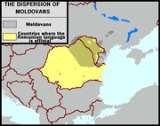
Moldovans

Encyclopedia
Moldovans or Moldavians (in Moldovan
/Romanian
moldoveni moldoˈvenʲ; also written молдовень in the Moldovan Cyrillic script
currently used only in Transnistria
) are the largest population group of Moldova
. The term Moldavians is also used to refer to all inhabitants of the territory of historical Principality of Moldova
, currently divided among Romania
(47.5%), Moldova (30.5%) and Ukraine
(22%). This article refers primarily to the Romance
-speakers of the Republic of Moldova, the historical Bessarabia
and diaspora originating in these regions. There is an ongoing controversy
whether Moldovans are a fully fledged ethnic group or a subgroup of the Romanian ethnic group
. However, most Romance-speakers from the historical region of Bessarabia prefer the self-identification Moldovan, rather than Romanian.
on a scale between 1 (entirely the same) to 5 (completely different). The poll showed that 26% of the entire sample, which included all ethnic groups, claimed the two identities were the same or very similar, whereas 47% claimed they were different or entirely different. The results varied significantly among different categories of subjects. For instance, while 33% of the young respondents (ages 18–29) chose the same or very similar and 44% different or very different, among the senior respondents (aged over 60) the corresponding figures were 18.5% and 53%. The proportion of those who chose the same or very similar identity was higher than the average among the native speakers of Romanian/Moldovan (30%), among the urban dwellers (30%), among those with higher education (36%), and among the residents of the capital city (42%).
According to a study conducted in the Republic of Moldova in May 1998, when the self-declared Moldovans were asked to relate the Romanian and Moldovan identities, 55% considered them somewhat different, 26% very different and less than 5% identical.
A survey carried out in the Republic of Moldova by William Crowther in 1992 showed that 87% of the Romanian/Moldovan speakers chose to identify themselves as "Moldovans", rather than "Romanians".
Alexei Mateevici
(1888–1917), author of the current Moldovan anthem Limba noastra
said at a congress of Bessarabian teachers in 1917: "Yes, we are Moldovans, sons of the old Moldavia, but we belong to the large body of the Romanian nation, that lives in Romania, Bukovina
and Transylvania
. Our brothers from Bukovina, Transylvania and Macedonia don't call themselves after the places they live in, but call themselves Romanians. That is what we should do as well!"
Emanoil Catelli
(1883–1943) a politician of the Moldavian Democratic Republic
, and later of Romania
, said in 1917: „The Moldovans who remained silent for 106 years, should speak louder today [...] because they are Romanians, and only the Russians demoted them to the role of "Moldovans".
Maria Cebotari
(1910–1949) one of the most famous sopranos born in Bessarabia
said „Never and in no circumstance has it crossed my mind to say that I am anything else than a Romanian from Bessarabia, or, simply, a Romanian.“
Grigore Vieru
(1935–2009), prominent Moldovan poet, a staunch supporter of Pan-Romanianism
" Moldovans hurt me too/ Inhumanly/ But I'm happy that Romanianness/Still lives in them " (Bessarabia with Sorrow)
Eugen Doga
(b. 1937), a famous Moldovan composer, explained in an interview his visit to Alba-Iulia (Romania)
"This is the capital of the unification, a real Mecca [...]. I think people come here not forced, but freely, for a return to their brothers"
Gheorghe Duca
(b. 1952), president of the Moldovan Academy of Sciences said
"Just like the whole Romanian nation, that Grigore Vieru praised, I cannot believe the Poet left home forever"
Constantin Tanase (b. 1949), director of the Moldovan newspaper "Timpul de dimineata", one of the most influential opinion leaders from Moldova
"The academia, the political and cultural elite has to show that Romanianness in the Republic of Moldova is not an extremist whim, but a reality and a condition of the existence of this state"
The resolution of the "Association of Historians from the Republic of Moldova" (AIRM) from October 28, 2009 in favor of teaching the history of Romanians in Moldovan schools reads
"The people of the Moldovan SSR were subjected to the Communist ideology, with the aim of replacing the Romanian identity of the native population, with one newly created"
The welcome message of the Union of Writers from Moldova is a quote from Mircea Eliade
: "We invite you to become initiated in the literary life of Bessarabia, border Romanian land subjected to a long, too long terror of history"
The national poet of Moldova and Romania, Mihai Eminescu
was born and lived outside of the territory of the current Republic of Moldova and considered himself Romanian. He is often quoted as saying "We are Romanians and period./Suntem romani si punctum."
reported that out of the 3,383,332 people living in Moldova (without Transnistria), 75.81% declared themselves Moldovans and only 2.17% Romanians. A group of international observers considered the census was generally conducted in a professional manner, although they reported several cases when enumerators encouraged respondents to declare themselves Moldovans rather than Romanians.
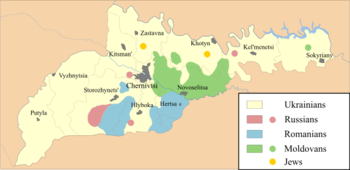
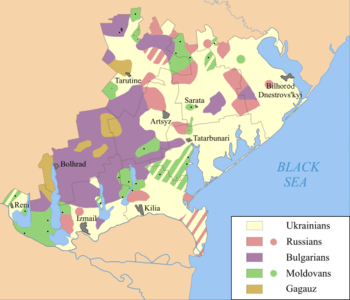
The 2001 census in Ukraine
counted 258,600 Moldovans and 150,989 Romanians. The self-identified Moldovans live mostly in the historical regions of Bessarabia
(the Budjak
region of the Odessa oblast
and the Novoselytskyi Raion
of Chernivtsi oblast
), whereas the self-identified Romanians live mostly in the Northern Bukovina and Hertsa regions of the Chernivtsi oblast
.
In Russia
, 172,330 Moldovans have been counted in the 2002 Russian census
. They are concentrated mostly in Moscow
, but also in some rural areas in Kuban
, southern Siberia
, and the Russian Far East
, where they were deported generations ago. Around 20,000 Moldovans live in Kazakhstan
, mostly in the former capital Almaty
, but also in some rural areas in the northern parts of the country (another destination of Soviet deportations).
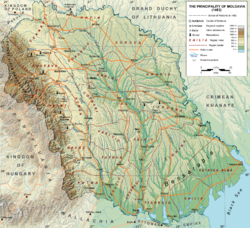
(approximately 42%) together with all its formal capitals (Târgul Moldovei
, Suceava
and Iaşi
) and the famous painted churches
are located in Romania. The river Moldova
(possibly, the origin of the name of the Principality, see Etymology of Moldova
) now flows entirely through Romania. After the Russian annexation of Bessarabia
in 1812, and Austrian annexation of Bukovina
in 1775, the rest of Moldova united with Walachia and formed the modern Romania.
According to the Romanian census of 2002, there are 4.7 million Romanian speakers in the 8 counties that were once part of the Principality of Moldavia
. The number of people, if any, who possibly declared themselves as Moldovans in this census is impossible to know, since Moldovan is officially considered a regional identity in Romania. The Romanian-speaking inhabitants of these counties generally refer to themselves as "Moldavians", but declare Romanian ethnicity.
In February 2007, a small group of Romanian citizens who created the "Moldovan/Moldavian Community in Romania" (Comunitatea moldovenilor din România) attempted unsuccessfully to gain recognition of the minority status for Moldovans from Romania. The organization was initially registered legally, but the decision was soon reverted. Around the same time, during a visit to Moldova
, three delegates met with President Vladimir Voronin
, who promised them his support. Being denied legal recognition the Community eventually dissolved.
In 1998, Constantin Simirad, the former mayor of Iaşi
founded the Party of the Moldavians (Partidul Moldovenilor) which later joined the Social Democratic Party
. However, the party's declared objective was to represent the interests of the Moldavia region in Romania rather than any ethnic identification.
In Romania, the Moldovans from Bessarabia
are often called Bessarabians (basarabeni) in order to distinguish them from the inhabitants of Eastern Romania.
 According to Miron Costin
, a prominent chronicler from the 17th century Moldavia
, the inhabitants of the Principality of Moldavia
spoke Romanian and called themselves "Moldovans", but also "Romanians" which, he notes, comes from "romanus
". Also, the Slavic neighbours called Moldovans "Vlachs
" or "Volokhs", a term equally used to refer to all native Romance speakers from Eastern Europe
and the Balkan peninsula.
As the ethnonym "Romanian" was gaining more and more popularity throughout the West Moldavia and Bukovina during the 19th century, its dissemination in Bessarabia, a more backward and rural province of the Russian Empire at the time, was welcomed mostly by the Romanian-oriented intellectuals, while the majority of the rural population continued to use the old self-identification "Moldovans".
Until the 1920s, historians generally considered Moldovans as a subgroup of the Romanian ethnos
. After 1924, within the newly created Moldavian Autonomous Soviet Socialist Republic, Soviet authorities supported the creation of a different standardized language (see Moldovan language
) to prove that Moldovans form a separate ethnic group.
If in the past, the term "Moldovan" has been used to refer to the population of the historical Principality of Moldavia. However, for the inhabitants of Bessarabia living under the Russian rule, the term gained an ethnic connotation by the beginning 20th century: in May 1917, at a congress of Bessarabian teachers, a dispute arose over the identification of the native population; a group protested against being called "Romanians", affirming they were "Moldovan", while another group, led by the poet Alexei Mateevici
, supported the view that the Moldovans are also Romanians.
In 1918, Bessarabia joined
the Kingdom of Romania
, following a vote of Sfatul Ţării
. The circumstance of the vote was itself complex, since the Romanian troops were present in Bessarabia at the request of the Sfatul Ţării as it was facing exterior threats and anarchy.
By the time of the union, the largely illiterate Romanian-speaking peasants of Bessarabia did not consider themselves part of a larger Romanian nation, and there was no mass nationalist movement as in other regions, such as Transylvania. The unified Romanian state promoted a common identity for all its Romanian-speaking inhabitants. Owing partly to its relative underdevelopment compared to other regions of Greater Romania
, as well as to the low competence and corruption of the new Romanian administration in this province, the integration process of Bessarabia in the unified Romanian state was less successful than in other regions and was soon to be disrupted by the Soviet occupation.
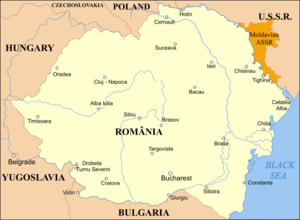 In 1940, during World War II
, Romania agreed to an ultimatum and ceded the region to the Soviet Union, which organized it into the Moldavian SSR
. The Soviets began a campaign to strengthen the Moldovan identity different from that of the rest of Romanian
speakers, taking advantage of the incomplete integration of the Bessarabia into the interwar Romania (see also Moldovenism
). The official Soviet policy also stated that Romanian
and Moldovan
were two different languages and, to emphasize this distinction, Moldovan had to be written in a new Cyrillic alphabet (the Moldovan alphabet
) based on the Russian Cyrillic, rather than the older Romanian Cyrillic that ceased to be used in the 19th century in the Old Kingdom and 1917 in Bessarabia.
). This contradiction is reflected in their stance toward the national history that should be taught in Moldovans schools. Forces such as the Liberal Party (PL), Liberal Democratic Party (PLDM) and Our Moldova Alliance (AMN) support the teaching of the history of Romanians. Others, such as the Democratic Party (PD) and the Party of Communists (PCRM) support the history of Republic of Moldova
The diverging opinions are also reflected in the official state documents issued in successive legislatures. The Declaration of Independence of 1991 calls the official language "Romanian
", and the first anthem adopted by the independent Moldova was "Deşteaptă-te, române" ("Awaken, Romanian!"), the same as the anthem of Romania
.
Mirroring different political configurations of the later Moldovan Parliament, the Constitution of Moldova (1994)
calls the official language "Moldovan
", while the "Concept of the National Policy of the Republic of Moldova" (2003) adopted by the Communist-dominated Parliament distinguishes explicitely Moldovans and Romanians as ethnic groups, and so does the census of 2004.
in Moldova is Eastern Orthodox Christianity
. The majority of Moldovan Orthodox Christians belong to the Moldovan Orthodox Church
, a branch of the Russian Orthodox Church
, while a minority belongs to the Metropolis of Bessarabia
, a branch of the Romanian Orthodox Church
. Both bodies are in full communion
, the dispute between them being purely territorial and revolves around the legitimate succession of the interwar Metropolitan See
of Bessarabia. As of 2007, the Moldovan Orthodox Church has 1255 parishes, while the Metropolis of Bessarabia has 219.
Moldovan language
Moldovan is one of the names of the Romanian language as spoken in the Republic of Moldova, where it is official. The spoken language of Moldova is closer to the dialects of Romanian spoken in northeastern Romania, and the two countries share the same literary standard...
/Romanian
Romanian language
Romanian Romanian Romanian (or Daco-Romanian; obsolete spellings Rumanian, Roumanian; self-designation: română, limba română ("the Romanian language") or românește (lit. "in Romanian") is a Romance language spoken by around 24 to 28 million people, primarily in Romania and Moldova...
moldoveni moldoˈvenʲ; also written молдовень in the Moldovan Cyrillic script
Moldovan alphabet
The Moldovan Cyrillic alphabet is a Cyrillic alphabet designed for the Moldovan language in the Soviet Union and used from 1938 to 1989 . Its introduction was decided by the Central Executive Committee of the Moldavian Autonomous Soviet Socialist Republic on May 19, 1938...
currently used only in Transnistria
Transnistria
Transnistria is a breakaway territory located mostly on a strip of land between the Dniester River and the eastern Moldovan border to Ukraine...
) are the largest population group of Moldova
Moldova
Moldova , officially the Republic of Moldova is a landlocked state in Eastern Europe, located between Romania to the West and Ukraine to the North, East and South. It declared itself an independent state with the same boundaries as the preceding Moldavian Soviet Socialist Republic in 1991, as part...
. The term Moldavians is also used to refer to all inhabitants of the territory of historical Principality of Moldova
Moldavia
Moldavia is a geographic and historical region and former principality in Eastern Europe, corresponding to the territory between the Eastern Carpathians and the Dniester river...
, currently divided among Romania
Romania
Romania is a country located at the crossroads of Central and Southeastern Europe, on the Lower Danube, within and outside the Carpathian arch, bordering on the Black Sea...
(47.5%), Moldova (30.5%) and Ukraine
Ukraine
Ukraine is a country in Eastern Europe. It has an area of 603,628 km², making it the second largest contiguous country on the European continent, after Russia...
(22%). This article refers primarily to the Romance
Romance languages
The Romance languages are a branch of the Indo-European language family, more precisely of the Italic languages subfamily, comprising all the languages that descend from Vulgar Latin, the language of ancient Rome...
-speakers of the Republic of Moldova, the historical Bessarabia
Bessarabia
Bessarabia is a historical term for the geographic region in Eastern Europe bounded by the Dniester River on the east and the Prut River on the west....
and diaspora originating in these regions. There is an ongoing controversy
Controversy over linguistic and ethnic identity in Moldova
A controversy exists over the national identity and name of the native language of the main ethnic group in the Republic of Moldova. The issue more frequently disputed is whether Moldovans constitute a subgroup of Romanians or a separate ethnic group...
whether Moldovans are a fully fledged ethnic group or a subgroup of the Romanian ethnic group
Romanians
The Romanians are an ethnic group native to Romania, who speak Romanian; they are the majority inhabitants of Romania....
. However, most Romance-speakers from the historical region of Bessarabia prefer the self-identification Moldovan, rather than Romanian.
Moldovan self-awareness
A poll conducted in the Republic of Moldova by IMAS-Inc Chisinau in October 2009 presented a detailed picture. The respondents were asked to rate the relationship between the identity of Moldovans and that of RomaniansRomanians
The Romanians are an ethnic group native to Romania, who speak Romanian; they are the majority inhabitants of Romania....
on a scale between 1 (entirely the same) to 5 (completely different). The poll showed that 26% of the entire sample, which included all ethnic groups, claimed the two identities were the same or very similar, whereas 47% claimed they were different or entirely different. The results varied significantly among different categories of subjects. For instance, while 33% of the young respondents (ages 18–29) chose the same or very similar and 44% different or very different, among the senior respondents (aged over 60) the corresponding figures were 18.5% and 53%. The proportion of those who chose the same or very similar identity was higher than the average among the native speakers of Romanian/Moldovan (30%), among the urban dwellers (30%), among those with higher education (36%), and among the residents of the capital city (42%).
According to a study conducted in the Republic of Moldova in May 1998, when the self-declared Moldovans were asked to relate the Romanian and Moldovan identities, 55% considered them somewhat different, 26% very different and less than 5% identical.
A survey carried out in the Republic of Moldova by William Crowther in 1992 showed that 87% of the Romanian/Moldovan speakers chose to identify themselves as "Moldovans", rather than "Romanians".
Moldovan Intellectuals and the Romanian Identity
As opposed to large segments of the population, a significant number of major Moldovan intellectuals considered themselves part of the Romanian nation.Alexei Mateevici
Alexei Mateevici
Alexe Mateevici was a Moldavian poet.- Biography :He was born in the town Căinari, in Eastern Bessarabia, which was part of the Russian Empire, now in the Republic of Moldova...
(1888–1917), author of the current Moldovan anthem Limba noastra
Limba noastra
For the Moldovan public holiday on 31st August, see National Language Day"Limba noastră" has been since 1994 the national anthem of the Republic of Moldova. For a short period before that, the official anthem of the country was Deşteaptă-te, române!, which is also the national anthem of Romania....
said at a congress of Bessarabian teachers in 1917: "Yes, we are Moldovans, sons of the old Moldavia, but we belong to the large body of the Romanian nation, that lives in Romania, Bukovina
Bukovina
Bukovina is a historical region on the northern slopes of the northeastern Carpathian Mountains and the adjoining plains.-Name:The name Bukovina came into official use in 1775 with the region's annexation from the Principality of Moldavia to the possessions of the Habsburg Monarchy, which became...
and Transylvania
Transylvania
Transylvania is a historical region in the central part of Romania. Bounded on the east and south by the Carpathian mountain range, historical Transylvania extended in the west to the Apuseni Mountains; however, the term sometimes encompasses not only Transylvania proper, but also the historical...
. Our brothers from Bukovina, Transylvania and Macedonia don't call themselves after the places they live in, but call themselves Romanians. That is what we should do as well!"
Emanoil Catelli
Emanoil Catelli
Emanoil Catelli was a Moldovan politician.-Biography:The parents of Emanoil Catelli were Grigore and Anastasia Catelli. In 1917, Emanoil Catelli was the founder of the Moldovan Progressive Party. Emanoil Catelli served as minister of agriculture in the Petru Cazacu Cabinet...
(1883–1943) a politician of the Moldavian Democratic Republic
Moldavian Democratic Republic
The Moldavian Democratic Republic , a.k.a. Moldavian Republic, was the state proclaimed on by Sfatul Ţării of Bessarabia, elected in October-November 1917 in the wake of the February Revolution and disintegration of the political power in the Russian Empire.Sfatul Ţării was its legislative body,...
, and later of Romania
Romania
Romania is a country located at the crossroads of Central and Southeastern Europe, on the Lower Danube, within and outside the Carpathian arch, bordering on the Black Sea...
, said in 1917: „The Moldovans who remained silent for 106 years, should speak louder today [...] because they are Romanians, and only the Russians demoted them to the role of "Moldovans".
Maria Cebotari
Maria Cebotari
Maria Cebotari was a celebrated Moldavian soprano and actress born in Bessarabia, Russian Empire , who made her career in Germany & Austria.-Biography:...
(1910–1949) one of the most famous sopranos born in Bessarabia
Bessarabia
Bessarabia is a historical term for the geographic region in Eastern Europe bounded by the Dniester River on the east and the Prut River on the west....
said „Never and in no circumstance has it crossed my mind to say that I am anything else than a Romanian from Bessarabia, or, simply, a Romanian.“
Grigore Vieru
Grigore Vieru
Grigore Vieru was a Moldavian poet and writer. He is mostly known for his poems and books for children. His poetry is characterized by vivid natural scenery, patriotism, as well as a venerated image of the sacred mother...
(1935–2009), prominent Moldovan poet, a staunch supporter of Pan-Romanianism
" Moldovans hurt me too/ Inhumanly/ But I'm happy that Romanianness/Still lives in them " (Bessarabia with Sorrow)
Eugen Doga
Eugen Doga
Eugen Doga is a Moldovan/Romanian composer. After the fall of the Soviet Union he lives in Moscow, Russia.-Biography:Doga was born on March 1, 1937 in the village of Mocra in the Rîbniţa district of the Moldavian Autonomous Soviet Socialist Republic...
(b. 1937), a famous Moldovan composer, explained in an interview his visit to Alba-Iulia (Romania)
"This is the capital of the unification, a real Mecca [...]. I think people come here not forced, but freely, for a return to their brothers"
Gheorghe Duca
Gheorghe Duca
Gheorghe Duca Moldovan academic and politician.- Biography :Gheorghe Duca has been the head of the Academy of Sciences of Moldova since February 5, 2004.- External links :* * -References:...
(b. 1952), president of the Moldovan Academy of Sciences said
"Just like the whole Romanian nation, that Grigore Vieru praised, I cannot believe the Poet left home forever"
Constantin Tanase (b. 1949), director of the Moldovan newspaper "Timpul de dimineata", one of the most influential opinion leaders from Moldova
"The academia, the political and cultural elite has to show that Romanianness in the Republic of Moldova is not an extremist whim, but a reality and a condition of the existence of this state"
The resolution of the "Association of Historians from the Republic of Moldova" (AIRM) from October 28, 2009 in favor of teaching the history of Romanians in Moldovan schools reads
"The people of the Moldovan SSR were subjected to the Communist ideology, with the aim of replacing the Romanian identity of the native population, with one newly created"
The welcome message of the Union of Writers from Moldova is a quote from Mircea Eliade
Mircea Eliade
Mircea Eliade was a Romanian historian of religion, fiction writer, philosopher, and professor at the University of Chicago. He was a leading interpreter of religious experience, who established paradigms in religious studies that persist to this day...
: "We invite you to become initiated in the literary life of Bessarabia, border Romanian land subjected to a long, too long terror of history"
The national poet of Moldova and Romania, Mihai Eminescu
Mihai Eminescu
Mihai Eminescu was a Romantic poet, novelist and journalist, often regarded as the most famous and influential Romanian poet. Eminescu was an active member of the Junimea literary society and he worked as an editor for the newspaper Timpul , the official newspaper of the Conservative Party...
was born and lived outside of the territory of the current Republic of Moldova and considered himself Romanian. He is often quoted as saying "We are Romanians and period./Suntem romani si punctum."
Censuses
The 2004 census results2004 Moldovan Census
The 2004 Republic of Moldova Census was carried between October 5 and October 12, 2004. The breakaway Transnistria failed to come into an agreement with the central government in Chişinău, and carried out its own census during between November 11 and November 18, 2004...
reported that out of the 3,383,332 people living in Moldova (without Transnistria), 75.81% declared themselves Moldovans and only 2.17% Romanians. A group of international observers considered the census was generally conducted in a professional manner, although they reported several cases when enumerators encouraged respondents to declare themselves Moldovans rather than Romanians.
The 2001 census in Ukraine
Ukrainian Census (2001)
The first Ukrainian Census was carried out by State Statistics Committee of Ukraine on 5 December 2001, twelve years after the last Soviet Union census in 1989....
counted 258,600 Moldovans and 150,989 Romanians. The self-identified Moldovans live mostly in the historical regions of Bessarabia
Bessarabia
Bessarabia is a historical term for the geographic region in Eastern Europe bounded by the Dniester River on the east and the Prut River on the west....
(the Budjak
Budjak
Budjak or Budzhak is a historical region in the Odessa Oblast of Ukraine. Lying along the Black Sea between the Danube and Dniester rivers this multiethnic region was the southern part of Bessarabia...
region of the Odessa oblast
Odessa Oblast
Odesa Oblast, also written as Odessa Oblast , is the southernmost and largest oblast of south-western Ukraine. The administrative center of the oblast is the city of Odessa.-History:...
and the Novoselytskyi Raion
Novoselytskyi Raion
Novoselytsia Raion is a raion in Chernivtsi Oblast, in the west of Ukraine. The center of the raion is the town of Novoselytsia....
of Chernivtsi oblast
Chernivtsi Oblast
Chernivtsi Oblast is an oblast in western Ukraine, bordering on Romania and Moldova. It has a large variety of landforms: the Carpathian Mountains and picturesque hills at the foot of the mountains gradually change to a broad partly forested plain situated between the Dniester and Prut rivers....
), whereas the self-identified Romanians live mostly in the Northern Bukovina and Hertsa regions of the Chernivtsi oblast
Chernivtsi Oblast
Chernivtsi Oblast is an oblast in western Ukraine, bordering on Romania and Moldova. It has a large variety of landforms: the Carpathian Mountains and picturesque hills at the foot of the mountains gradually change to a broad partly forested plain situated between the Dniester and Prut rivers....
.
In Russia
Russia
Russia or , officially known as both Russia and the Russian Federation , is a country in northern Eurasia. It is a federal semi-presidential republic, comprising 83 federal subjects...
, 172,330 Moldovans have been counted in the 2002 Russian census
Russian Census (2002)
Russian Census of 2002 was the first census of the Russian Federation carried out on October 9 through October 16, 2002. It was carried out by the Russian Federal Service of State Statistics .-Resident population:...
. They are concentrated mostly in Moscow
Moscow
Moscow is the capital, the most populous city, and the most populous federal subject of Russia. The city is a major political, economic, cultural, scientific, religious, financial, educational, and transportation centre of Russia and the continent...
, but also in some rural areas in Kuban
Kuban
Kuban is a geographic region of Southern Russia surrounding the Kuban River, on the Black Sea between the Don Steppe, Volga Delta and the Caucasus...
, southern Siberia
Siberia
Siberia is an extensive region constituting almost all of Northern Asia. Comprising the central and eastern portion of the Russian Federation, it was part of the Soviet Union from its beginning, as its predecessor states, the Tsardom of Russia and the Russian Empire, conquered it during the 16th...
, and the Russian Far East
Russian Far East
Russian Far East is a term that refers to the Russian part of the Far East, i.e., extreme east parts of Russia, between Lake Baikal in Eastern Siberia and the Pacific Ocean...
, where they were deported generations ago. Around 20,000 Moldovans live in Kazakhstan
Kazakhstan
Kazakhstan , officially the Republic of Kazakhstan, is a transcontinental country in Central Asia and Eastern Europe. Ranked as the ninth largest country in the world, it is also the world's largest landlocked country; its territory of is greater than Western Europe...
, mostly in the former capital Almaty
Almaty
Almaty , also known by its former names Verny and Alma-Ata , is the former capital of Kazakhstan and the nation's largest city, with a population of 1,348,500...
, but also in some rural areas in the northern parts of the country (another destination of Soviet deportations).
Regional identity in Romania
The largest share of the territory of the historical Principality of MoldaviaMoldavia
Moldavia is a geographic and historical region and former principality in Eastern Europe, corresponding to the territory between the Eastern Carpathians and the Dniester river...
(approximately 42%) together with all its formal capitals (Târgul Moldovei
Baia
Baia is a commune in the Suceava County, Romania with a population of 6,793 . It is composed of two villages, Baia and Bogata. Located on the Moldova River, it was one of the earliest urban settlements in Moldavia, originally inhabited by Germans...
, Suceava
Suceava
Suceava is the Suceava County seat in Bukovina, Moldavia region, in north-eastern Romania. The city was the capital of the Principality of Moldavia from 1388 to 1565.-History:...
and Iaşi
Iasi
Iași is the second most populous city and a municipality in Romania. Located in the historical Moldavia region, Iași has traditionally been one of the leading centres of Romanian social, cultural, academic and artistic life...
) and the famous painted churches
Painted churches of northern Moldavia
The Churches of Moldavia are eight Romanian Orthodox churches in Suceava County, Romania in northern Moldavia, built approximately between 1487 and 1583.Since 1993, they have been listed by UNESCO as a World Heritage Site...
are located in Romania. The river Moldova
Moldova River
The Moldova River is a river in Romania, in the historical region of Moldavia. The river rises from the Obcina Feredeu Mountains of Bukovina in Suceava County and joins the Siret River near the city of Roman in Neamţ County....
(possibly, the origin of the name of the Principality, see Etymology of Moldova
Etymology of Moldova
The name of Moldova originates from the medieval Principality of Moldavia, which at its greatest extent included Moldova, and territories in eastern Romania and south-western Ukraine.-Origins of the name:...
) now flows entirely through Romania. After the Russian annexation of Bessarabia
Bessarabia
Bessarabia is a historical term for the geographic region in Eastern Europe bounded by the Dniester River on the east and the Prut River on the west....
in 1812, and Austrian annexation of Bukovina
Bukovina
Bukovina is a historical region on the northern slopes of the northeastern Carpathian Mountains and the adjoining plains.-Name:The name Bukovina came into official use in 1775 with the region's annexation from the Principality of Moldavia to the possessions of the Habsburg Monarchy, which became...
in 1775, the rest of Moldova united with Walachia and formed the modern Romania.
According to the Romanian census of 2002, there are 4.7 million Romanian speakers in the 8 counties that were once part of the Principality of Moldavia
Moldavia
Moldavia is a geographic and historical region and former principality in Eastern Europe, corresponding to the territory between the Eastern Carpathians and the Dniester river...
. The number of people, if any, who possibly declared themselves as Moldovans in this census is impossible to know, since Moldovan is officially considered a regional identity in Romania. The Romanian-speaking inhabitants of these counties generally refer to themselves as "Moldavians", but declare Romanian ethnicity.
In February 2007, a small group of Romanian citizens who created the "Moldovan/Moldavian Community in Romania" (Comunitatea moldovenilor din România) attempted unsuccessfully to gain recognition of the minority status for Moldovans from Romania. The organization was initially registered legally, but the decision was soon reverted. Around the same time, during a visit to Moldova
Moldova
Moldova , officially the Republic of Moldova is a landlocked state in Eastern Europe, located between Romania to the West and Ukraine to the North, East and South. It declared itself an independent state with the same boundaries as the preceding Moldavian Soviet Socialist Republic in 1991, as part...
, three delegates met with President Vladimir Voronin
Vladimir Voronin
Vladimir Nicolaevici Voronin is a Moldovan politician. He was the third President of Moldova from 2001 until 2009 and has been the First Secretary of the Party of Communists of the Republic of Moldova since 1994...
, who promised them his support. Being denied legal recognition the Community eventually dissolved.
In 1998, Constantin Simirad, the former mayor of Iaşi
Iasi
Iași is the second most populous city and a municipality in Romania. Located in the historical Moldavia region, Iași has traditionally been one of the leading centres of Romanian social, cultural, academic and artistic life...
founded the Party of the Moldavians (Partidul Moldovenilor) which later joined the Social Democratic Party
Social Democratic Party (Romania)
The Social Democratic Party is the major social-democratic political party in Romania. It was formed in 1992, after the post-communist National Salvation Front broke apart. It adopted its present name after a merger with a minor social-democratic party in 2001. Since its formation, it has always...
. However, the party's declared objective was to represent the interests of the Moldavia region in Romania rather than any ethnic identification.
In Romania, the Moldovans from Bessarabia
Bessarabia
Bessarabia is a historical term for the geographic region in Eastern Europe bounded by the Dniester River on the east and the Prut River on the west....
are often called Bessarabians (basarabeni) in order to distinguish them from the inhabitants of Eastern Romania.
Identity in the historical Principality of Moldova
Miron Costin
Miron Costin was a Moldavian political figure and chronicler. His main work, Letopiseţul Ţărâi Moldovei [de la Aron Vodă încoace] was meant to extend Grigore Ureche's narrative, covering events from 1594 to 1660...
, a prominent chronicler from the 17th century Moldavia
Moldavia
Moldavia is a geographic and historical region and former principality in Eastern Europe, corresponding to the territory between the Eastern Carpathians and the Dniester river...
, the inhabitants of the Principality of Moldavia
Moldavia
Moldavia is a geographic and historical region and former principality in Eastern Europe, corresponding to the territory between the Eastern Carpathians and the Dniester river...
spoke Romanian and called themselves "Moldovans", but also "Romanians" which, he notes, comes from "romanus
Rome
Rome is the capital of Italy and the country's largest and most populated city and comune, with over 2.7 million residents in . The city is located in the central-western portion of the Italian Peninsula, on the Tiber River within the Lazio region of Italy.Rome's history spans two and a half...
". Also, the Slavic neighbours called Moldovans "Vlachs
Vlachs
Vlach is a blanket term covering several modern Latin peoples descending from the Latinised population in Central, Eastern and Southeastern Europe. English variations on the name include: Walla, Wlachs, Wallachs, Vlahs, Olahs or Ulahs...
" or "Volokhs", a term equally used to refer to all native Romance speakers from Eastern Europe
Eastern Europe
Eastern Europe is the eastern part of Europe. The term has widely disparate geopolitical, geographical, cultural and socioeconomic readings, which makes it highly context-dependent and even volatile, and there are "almost as many definitions of Eastern Europe as there are scholars of the region"...
and the Balkan peninsula.
As the ethnonym "Romanian" was gaining more and more popularity throughout the West Moldavia and Bukovina during the 19th century, its dissemination in Bessarabia, a more backward and rural province of the Russian Empire at the time, was welcomed mostly by the Romanian-oriented intellectuals, while the majority of the rural population continued to use the old self-identification "Moldovans".
Until the 1920s, historians generally considered Moldovans as a subgroup of the Romanian ethnos
Romanians
The Romanians are an ethnic group native to Romania, who speak Romanian; they are the majority inhabitants of Romania....
. After 1924, within the newly created Moldavian Autonomous Soviet Socialist Republic, Soviet authorities supported the creation of a different standardized language (see Moldovan language
Moldovan language
Moldovan is one of the names of the Romanian language as spoken in the Republic of Moldova, where it is official. The spoken language of Moldova is closer to the dialects of Romanian spoken in northeastern Romania, and the two countries share the same literary standard...
) to prove that Moldovans form a separate ethnic group.
If in the past, the term "Moldovan" has been used to refer to the population of the historical Principality of Moldavia. However, for the inhabitants of Bessarabia living under the Russian rule, the term gained an ethnic connotation by the beginning 20th century: in May 1917, at a congress of Bessarabian teachers, a dispute arose over the identification of the native population; a group protested against being called "Romanians", affirming they were "Moldovan", while another group, led by the poet Alexei Mateevici
Alexei Mateevici
Alexe Mateevici was a Moldavian poet.- Biography :He was born in the town Căinari, in Eastern Bessarabia, which was part of the Russian Empire, now in the Republic of Moldova...
, supported the view that the Moldovans are also Romanians.
In 1918, Bessarabia joined
Union of Bessarabia with Romania
On , the Sfatul Ţării, or National Council, of Bessarabia proclaimed union with the Kingdom of Romania.-Governorate of Bessarabia:The 1812 Treaty of Bucharest between the Ottoman Empire and the Russian Empires provided for Russian annexation of the eastern half of the territory of the Principality...
the Kingdom of Romania
Kingdom of Romania
The Kingdom of Romania was the Romanian state based on a form of parliamentary monarchy between 13 March 1881 and 30 December 1947, specified by the first three Constitutions of Romania...
, following a vote of Sfatul Ţării
Sfatul Tarii
Sfatul Țării was, in 1917-1918, the National Assembly of the Governorate of Bessarabia of the disintegrating Russian Empire, which proclaimed the independent Moldavian Democratic Republic in December 1917, and then union with Romania in April 1918.-Russian participation in World War I:In August...
. The circumstance of the vote was itself complex, since the Romanian troops were present in Bessarabia at the request of the Sfatul Ţării as it was facing exterior threats and anarchy.
By the time of the union, the largely illiterate Romanian-speaking peasants of Bessarabia did not consider themselves part of a larger Romanian nation, and there was no mass nationalist movement as in other regions, such as Transylvania. The unified Romanian state promoted a common identity for all its Romanian-speaking inhabitants. Owing partly to its relative underdevelopment compared to other regions of Greater Romania
Greater Romania
The Greater Romania generally refers to the territory of Romania in the years between the First World War and the Second World War, the largest geographical extent of Romania up to that time and its largest peacetime extent ever ; more precisely, it refers to the territory of the Kingdom of...
, as well as to the low competence and corruption of the new Romanian administration in this province, the integration process of Bessarabia in the unified Romanian state was less successful than in other regions and was soon to be disrupted by the Soviet occupation.
World War II
World War II, or the Second World War , was a global conflict lasting from 1939 to 1945, involving most of the world's nations—including all of the great powers—eventually forming two opposing military alliances: the Allies and the Axis...
, Romania agreed to an ultimatum and ceded the region to the Soviet Union, which organized it into the Moldavian SSR
Moldavian SSR
The Moldavian Soviet Socialist Republic , commonly abbreviated to Moldavian SSR or MSSR, was one of the 15 republics of the Soviet Union...
. The Soviets began a campaign to strengthen the Moldovan identity different from that of the rest of Romanian
Romanian language
Romanian Romanian Romanian (or Daco-Romanian; obsolete spellings Rumanian, Roumanian; self-designation: română, limba română ("the Romanian language") or românește (lit. "in Romanian") is a Romance language spoken by around 24 to 28 million people, primarily in Romania and Moldova...
speakers, taking advantage of the incomplete integration of the Bessarabia into the interwar Romania (see also Moldovenism
Moldovenism
Moldovenism is a political term used to refer to the support and promotion of the Moldovan identity and Moldovan culture.Some of its supporters ascribe this identity to the medieval Principality of Moldavia...
). The official Soviet policy also stated that Romanian
Romanian language
Romanian Romanian Romanian (or Daco-Romanian; obsolete spellings Rumanian, Roumanian; self-designation: română, limba română ("the Romanian language") or românește (lit. "in Romanian") is a Romance language spoken by around 24 to 28 million people, primarily in Romania and Moldova...
and Moldovan
Moldovan language
Moldovan is one of the names of the Romanian language as spoken in the Republic of Moldova, where it is official. The spoken language of Moldova is closer to the dialects of Romanian spoken in northeastern Romania, and the two countries share the same literary standard...
were two different languages and, to emphasize this distinction, Moldovan had to be written in a new Cyrillic alphabet (the Moldovan alphabet
Moldovan alphabet
The Moldovan Cyrillic alphabet is a Cyrillic alphabet designed for the Moldovan language in the Soviet Union and used from 1938 to 1989 . Its introduction was decided by the Central Executive Committee of the Moldavian Autonomous Soviet Socialist Republic on May 19, 1938...
) based on the Russian Cyrillic, rather than the older Romanian Cyrillic that ceased to be used in the 19th century in the Old Kingdom and 1917 in Bessarabia.
Identity and Politics in Moldova
The major Moldovan political forces have diverging opinions regarding the identity of Moldovans. (see also Controversy over linguistic and ethnic identity in MoldovaControversy over linguistic and ethnic identity in Moldova
A controversy exists over the national identity and name of the native language of the main ethnic group in the Republic of Moldova. The issue more frequently disputed is whether Moldovans constitute a subgroup of Romanians or a separate ethnic group...
). This contradiction is reflected in their stance toward the national history that should be taught in Moldovans schools. Forces such as the Liberal Party (PL), Liberal Democratic Party (PLDM) and Our Moldova Alliance (AMN) support the teaching of the history of Romanians. Others, such as the Democratic Party (PD) and the Party of Communists (PCRM) support the history of Republic of Moldova
The diverging opinions are also reflected in the official state documents issued in successive legislatures. The Declaration of Independence of 1991 calls the official language "Romanian
Romanian language
Romanian Romanian Romanian (or Daco-Romanian; obsolete spellings Rumanian, Roumanian; self-designation: română, limba română ("the Romanian language") or românește (lit. "in Romanian") is a Romance language spoken by around 24 to 28 million people, primarily in Romania and Moldova...
", and the first anthem adopted by the independent Moldova was "Deşteaptă-te, române" ("Awaken, Romanian!"), the same as the anthem of Romania
Romania
Romania is a country located at the crossroads of Central and Southeastern Europe, on the Lower Danube, within and outside the Carpathian arch, bordering on the Black Sea...
.
Mirroring different political configurations of the later Moldovan Parliament, the Constitution of Moldova (1994)
Constitution of Moldova (1994)
The Republic of Moldova Constitution of 1994 is the country's supreme law of the country since August 27, 1994.- History :It was adopted on July 29, 1994 by the Moldovan Parliament and published in Monitorul Oficial al R. Moldova, N1, July 18, 1994....
calls the official language "Moldovan
Moldovan language
Moldovan is one of the names of the Romanian language as spoken in the Republic of Moldova, where it is official. The spoken language of Moldova is closer to the dialects of Romanian spoken in northeastern Romania, and the two countries share the same literary standard...
", while the "Concept of the National Policy of the Republic of Moldova" (2003) adopted by the Communist-dominated Parliament distinguishes explicitely Moldovans and Romanians as ethnic groups, and so does the census of 2004.
Religion in Moldova
The major denominationChristian denomination
A Christian denomination is an identifiable religious body under a common name, structure, and doctrine within Christianity. In the Orthodox tradition, Churches are divided often along ethnic and linguistic lines, into separate churches and traditions. Technically, divisions between one group and...
in Moldova is Eastern Orthodox Christianity
Eastern Orthodox Church
The Orthodox Church, officially called the Orthodox Catholic Church and commonly referred to as the Eastern Orthodox Church, is the second largest Christian denomination in the world, with an estimated 300 million adherents mainly in the countries of Belarus, Bulgaria, Cyprus, Georgia, Greece,...
. The majority of Moldovan Orthodox Christians belong to the Moldovan Orthodox Church
Moldovan Orthodox Church
The Moldovan Orthodox Church is an autonomous church under the Russian Orthodox Church, whose canonic territory covers the Republic of Moldova....
, a branch of the Russian Orthodox Church
Russian Orthodox Church
The Russian Orthodox Church or, alternatively, the Moscow Patriarchate The ROC is often said to be the largest of the Eastern Orthodox churches in the world; including all the autocephalous churches under its umbrella, its adherents number over 150 million worldwide—about half of the 300 million...
, while a minority belongs to the Metropolis of Bessarabia
Metropolis of Bessarabia
The Metropolis of Bessarabia is an autonomous Eastern Orthodox Metropolitan bishopric of the Romanian Orthodox Church. The Metropolis of Bessarabia was created in 1923 and organized in 1925, when the Archbishopric of Chișinău was raised to the rank of metropolis...
, a branch of the Romanian Orthodox Church
Romanian Orthodox Church
The Romanian Orthodox Church is an autocephalous Eastern Orthodox church. It is in full communion with other Eastern Orthodox churches, and is ranked seventh in order of precedence. The Primate of the church has the title of Patriarch...
. Both bodies are in full communion
Full communion
In Christian ecclesiology, full communion is a relationship between church organizations or groups that mutually recognize their sharing the essential doctrines....
, the dispute between them being purely territorial and revolves around the legitimate succession of the interwar Metropolitan See
Episcopal See
An episcopal see is, in the original sense, the official seat of a bishop. This seat, which is also referred to as the bishop's cathedra, is placed in the bishop's principal church, which is therefore called the bishop's cathedral...
of Bessarabia. As of 2007, the Moldovan Orthodox Church has 1255 parishes, while the Metropolis of Bessarabia has 219.
See also
- Movement for the unification of Romania and Moldova
- Controversy over linguistic and ethnic identity in MoldovaControversy over linguistic and ethnic identity in MoldovaA controversy exists over the national identity and name of the native language of the main ethnic group in the Republic of Moldova. The issue more frequently disputed is whether Moldovans constitute a subgroup of Romanians or a separate ethnic group...
- EthnogenesisEthnogenesisEthnogenesis is the process by which a group of human beings comes to be understood or to understand themselves as ethnically distinct from the wider social landscape from which their grouping emerges...
- Moldovan diasporaMoldovan diasporaMoldovan diaspora is a diaspora of Moldovans of Romanian descent, i.e., citizens of the Republic of Moldova of Romanian ethnic origin living abroad. Very few of them have settled in other parts of the world, but there is a significant number of them in some countries, mostly in the former Soviet...
Further reading
- Matthew H. Ciscel (2007) The Language of the Moldovans: Romania, Russia, and Identity in an Ex-Soviet Republic", ISBN 0739114433 - About the identity of the contemporary Moldovans in the context of debates about the their language.
- King, C. (2000) The Moldovans: Romania, Russia and the Politics of Culture, Hoover Institution Press, ISBN 0-8179-9792-X.