


Oleg of Novgorod

Encyclopedia
Oleg of Novgorod was a Varangian prince (or konung) who ruled all or part of the Rus' people
during the early 10th century.
He is credited with moving the capital of Rus'
from Novgorod the Great to Kiev
and, in doing so, he laid the foundation of the powerful state of Kievan Rus'
. He also launched at least one attack on Constantinople
, capital of the Byzantine Empire
. According to East Slavic chronicles, Oleg was supreme ruler of the Rus' from 882 to 912. This traditional dating has been challenged by some historians, who point out that it is inconsistent with such other sources as the Schechter Letter
, which mentions the activities of certain khagan
HLGW of Rus' as late the 940s, during the reign of Byzantine Emperor Romanus I. The nature of Oleg's relationship with the Rurikid ruling family of the Rus', and specifically with his successor Igor of Kiev, is a matter of much controversy among historians.
, Oleg was a relative (likely brother-in-law) of the first ruler, Rurik
, and was entrusted by Rurik to take care of both his kingdom and his young son Ingvar, or Igor. Oleg gradually took control of the Dnieper cities, captured Kiev (previously held by the Varangian warlords, Askold and Dir
) and finally moved his capital from Novgorod there. The new capital was a convenient place to launch a raid
against Tsargrad
(Constantinople
) in 911. According to the chronicle, the Byzantines attempted to poison Oleg, but the Rus' leader demonstrated his oracular powers by refusing to drink the cup of poisoned wine. Having fixed his shield to the gate of the imperial capital, Oleg won a favourable trade treaty, which eventually was of great benefit to both nations. Although Byzantine sources did not record these hostilities, the text of the treaty survives in the Primary Chronicle
.
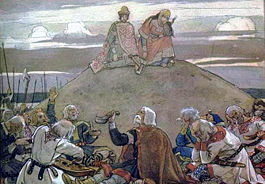 The Primary Chronicle's brief account of Oleg's life contrasts with other early sources, specifically the Novgorod First Chronicle
, which states that Oleg was not related to Rurik, and was rather a Scandinavia
n client-prince
who served as Igor's army commander. The Novgorod First Chronicle does not give the date of the commencement of Oleg's reign, but dates his death to 922 rather than 912. Scholars have contrasted this dating scheme with the "epic" reigns of roughly thirty-three years for both Oleg and Igor in the Primary Chronicle. The Primary Chronicle and other Kievan sources place Oleg's grave in Kiev, while Novgorodian sources identify a funerary barrow
in Ladoga
as Oleg's final resting place.
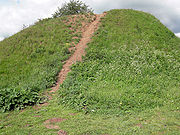 In the Primary Chronicle, Oleg is known as the Prophet (вещий), an epithet alluding to the sacred meaning of his Norse name ("priest"), but also ironically referring to the circumstances of his death. According to this legend, romanticised by Alexander Pushkin in his celebrated ballad
"The Song of the Wise Oleg," it was prophesied by the pagan priests that Oleg would take death from his stallion. Proud of his own foretelling abilities, he sent the horse away. Many years later he asked where his horse was, and was told it had died. He asked to see the remains and was taken to the place where the bones lay. When he touched the horse's skull with his boot a snake slithered from the skull and bit him. Oleg died, thus fulfilling the prophecy. In Scandinavian traditions, this legend lived on in the saga of Orvar-Odd
.
, a document written by a Jewish Khazar, a contemporary of Romanus I Lecapenus, describes the activities of a Rus' warlord named HLGW (Hebrew
: ), usually transcribed as "Helgu". For years many scholars disregarded or discounted the Schechter Letter
account, which referred to Helgu (often interpreted as Oleg) as late as the 940s.
Recently, however, scholars such as David Christian
and Constantine Zuckerman
have suggested that the Schechter Letter's account is corroborated by various other Russian chronicles, and suggests a struggle within the early Rus' polity between factions loyal to Oleg and to the Rurikid Igor, a struggle that Oleg ultimately lost. Zuckerman posited that the early chronology of the Rus' had to be re-determined in light of these sources. Among Zuckerman's beliefs and those of others who have analyzed these sources are that the Khazars did not lose Kiev
until the early 10th century (rather than 882, the traditional date), that Igor was not Rurik's son but rather a more distant descendant, and that Oleg did not immediately follow Rurik
, but rather that there is a lost generation between the legendary Varangian lord and his documented successors.
Of particular interest is the fact that the Schechter Letter account of Oleg's death (namely, that he fled to and raided FRS, tentatively identified with Persia, and was slain there) bears remarkable parallels to the account of Arab historians such as Ibn Miskawayh
, who described a similar Rus' attack on the Muslim
state of Arran
in the year 944/5.
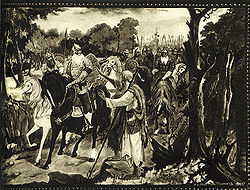 In contrast to Zuckerman's version, the Primary Chronicle and the later Kiev Chronicle place Oleg's grave in Kiev, where it could be seen at the time when these documents were compiled. Furthermore, scholars pointed out that, if Oleg succeeded Rurik in 879 (as the East Slavic chronicles assert), he could hardly have been active almost 70 years later, if his was not a case of longevity otherwise unheard of in medieval annals. To solve these difficulties, it has been proposed that "helgu", standing for "holy" in Norse language, was a hereditary title of the pagan monarchs-priests of Rus' and that this title was held by Igor, among others.
It has also been suggested that Helgu-Oleg who waged war in the 940s, was distinct from both of Rurik's successors. He could have been one of the "fair and great princes" recorded in the Russo-Byzantine treaties of 911 and 944 or one of the "archons of Rus" mentioned in De administrando imperio
. Regrettably, the Primary Chronicle does not specify the relations between minor Rurikid princes active during the period, although the names Rurik, Oleg, and Igor were recorded among the late-10th-century and 11th-century Rurikids.
Georgy Vernadsky even identified Oleg of the Schechter Letter with Igor's otherwise anonymous eldest son, whose widow Predslava is mentioned in the Russo-Byzantine treaty of 944. Alternatively, V. Ya. Petrukhin speculated that Helgu-Oleg of the 940s was one of the vernacular princes of Chernigov, whose ruling dynasty maintained especially close contacts with Khazaria, as the findings at the Black Grave
, a large royal kurgan
excavated near Chernigov, seem to testify. Neither of these theories has been endorsed in the academic mainstream, however.
Rus' (people)
The Rus' were a group of Varangians . According to the Primary Chronicle of Rus, compiled in about 1113 AD, the Rus had relocated from the Baltic region , first to Northeastern Europe, creating an early polity which finally came under the leadership of Rurik...
during the early 10th century.
He is credited with moving the capital of Rus'
Kievan Rus'
Kievan Rus was a medieval polity in Eastern Europe, from the late 9th to the mid 13th century, when it disintegrated under the pressure of the Mongol invasion of 1237–1240....
from Novgorod the Great to Kiev
Kiev
Kiev or Kyiv is the capital and the largest city of Ukraine, located in the north central part of the country on the Dnieper River. The population as of the 2001 census was 2,611,300. However, higher numbers have been cited in the press....
and, in doing so, he laid the foundation of the powerful state of Kievan Rus'
Kievan Rus'
Kievan Rus was a medieval polity in Eastern Europe, from the late 9th to the mid 13th century, when it disintegrated under the pressure of the Mongol invasion of 1237–1240....
. He also launched at least one attack on Constantinople
Constantinople
Constantinople was the capital of the Roman, Eastern Roman, Byzantine, Latin, and Ottoman Empires. Throughout most of the Middle Ages, Constantinople was Europe's largest and wealthiest city.-Names:...
, capital of the Byzantine Empire
Byzantine Empire
The Byzantine Empire was the Eastern Roman Empire during the periods of Late Antiquity and the Middle Ages, centred on the capital of Constantinople. Known simply as the Roman Empire or Romania to its inhabitants and neighbours, the Empire was the direct continuation of the Ancient Roman State...
. According to East Slavic chronicles, Oleg was supreme ruler of the Rus' from 882 to 912. This traditional dating has been challenged by some historians, who point out that it is inconsistent with such other sources as the Schechter Letter
Schechter Letter
The "Schechter Letter" was discovered in the Cairo Geniza by Solomon Schechter.-The Letter:The Schechter Letter is a communique from an unnamed Khazar author to an unidentified Jewish dignitary...
, which mentions the activities of certain khagan
Khagan
Khagan or qagan , alternatively spelled kagan, khaghan, qaghan, or chagan, is a title of imperial rank in the Mongolian and Turkic languages equal to the status of emperor and someone who rules a khaganate...
HLGW of Rus' as late the 940s, during the reign of Byzantine Emperor Romanus I. The nature of Oleg's relationship with the Rurikid ruling family of the Rus', and specifically with his successor Igor of Kiev, is a matter of much controversy among historians.
Oleg of the Russian chronicles
According to the Primary ChroniclePrimary Chronicle
The Primary Chronicle , Ruthenian Primary Chronicle or Russian Primary Chronicle, is a history of Kievan Rus' from about 850 to 1110, originally compiled in Kiev about 1113.- Three editions :...
, Oleg was a relative (likely brother-in-law) of the first ruler, Rurik
Rurik
Rurik, or Riurik , was a semilegendary 9th-century Varangian who founded the Rurik dynasty which ruled Kievan Rus and later some of its successor states, most notably the Tsardom of Russia, until 1598....
, and was entrusted by Rurik to take care of both his kingdom and his young son Ingvar, or Igor. Oleg gradually took control of the Dnieper cities, captured Kiev (previously held by the Varangian warlords, Askold and Dir
Askold and Dir
Askold and Dir are semi-legendary rulers of Kiev who, according to the Primary Chronicle, were two of Rurik's voivodes in 870s...
) and finally moved his capital from Novgorod there. The new capital was a convenient place to launch a raid
Rus'-Byzantine War (907)
The Rus'–Byzantine War of 907 is associated in the Primary Chronicle with the name of Oleg of Novgorod. The chronicle implies that it was the most successful military operation of the Kievan Rus' against the Byzantine Empire. Paradoxically, Greek sources do not mention it at all.- Primary Chronicle...
against Tsargrad
Tsargrad
Tsargrad is a historic Slavic name for the...
(Constantinople
Constantinople
Constantinople was the capital of the Roman, Eastern Roman, Byzantine, Latin, and Ottoman Empires. Throughout most of the Middle Ages, Constantinople was Europe's largest and wealthiest city.-Names:...
) in 911. According to the chronicle, the Byzantines attempted to poison Oleg, but the Rus' leader demonstrated his oracular powers by refusing to drink the cup of poisoned wine. Having fixed his shield to the gate of the imperial capital, Oleg won a favourable trade treaty, which eventually was of great benefit to both nations. Although Byzantine sources did not record these hostilities, the text of the treaty survives in the Primary Chronicle
Primary Chronicle
The Primary Chronicle , Ruthenian Primary Chronicle or Russian Primary Chronicle, is a history of Kievan Rus' from about 850 to 1110, originally compiled in Kiev about 1113.- Three editions :...
.
Novgorod First Chronicle
The Novgorod First Chronicle or The Chronicle of Novgorod, 1016-1471 is the most ancient extant chronicle of the Novgorod Republic. It reflects a tradition different from the Kievan Primary Chronicle...
, which states that Oleg was not related to Rurik, and was rather a Scandinavia
Scandinavia
Scandinavia is a cultural, historical and ethno-linguistic region in northern Europe that includes the three kingdoms of Denmark, Norway and Sweden, characterized by their common ethno-cultural heritage and language. Modern Norway and Sweden proper are situated on the Scandinavian Peninsula,...
n client-prince
Prince
Prince is a general term for a ruler, monarch or member of a monarch's or former monarch's family, and is a hereditary title in the nobility of some European states. The feminine equivalent is a princess...
who served as Igor's army commander. The Novgorod First Chronicle does not give the date of the commencement of Oleg's reign, but dates his death to 922 rather than 912. Scholars have contrasted this dating scheme with the "epic" reigns of roughly thirty-three years for both Oleg and Igor in the Primary Chronicle. The Primary Chronicle and other Kievan sources place Oleg's grave in Kiev, while Novgorodian sources identify a funerary barrow
Tumulus
A tumulus is a mound of earth and stones raised over a grave or graves. Tumuli are also known as barrows, burial mounds, Hügelgrab or kurgans, and can be found throughout much of the world. A tumulus composed largely or entirely of stones is usually referred to as a cairn...
in Ladoga
Staraya Ladoga
Staraya Ladoga , or the Aldeigjuborg of Norse sagas, is a village in the Volkhovsky District of Leningrad Oblast, Russia, located on the Volkhov River near Lake Ladoga, 8 km north of the town of Volkhov. The village used to be a prosperous trading outpost in the 8th and 9th centuries...
as Oleg's final resting place.
Legend of the death of Oleg the Prophet
Ballad
A ballad is a form of verse, often a narrative set to music. Ballads were particularly characteristic of British and Irish popular poetry and song from the later medieval period until the 19th century and used extensively across Europe and later the Americas, Australia and North Africa. Many...
"The Song of the Wise Oleg," it was prophesied by the pagan priests that Oleg would take death from his stallion. Proud of his own foretelling abilities, he sent the horse away. Many years later he asked where his horse was, and was told it had died. He asked to see the remains and was taken to the place where the bones lay. When he touched the horse's skull with his boot a snake slithered from the skull and bit him. Oleg died, thus fulfilling the prophecy. In Scandinavian traditions, this legend lived on in the saga of Orvar-Odd
Orvar-Odd
Örvar-Oddr is a legendary hero about whom an anonymous Icelander wrote a fornaldarsaga in the latter part of the 13th century. Örvar-Odds saga, the Saga of Örvar-Odd, became very popular and contains old legends and songs...
.
Helgu of the Schechter Letter
According to the Primary Chronicle, Oleg died in 912 and his successor, Igor of Kiev, ruled from then until his assassination in 945. The Schechter LetterSchechter Letter
The "Schechter Letter" was discovered in the Cairo Geniza by Solomon Schechter.-The Letter:The Schechter Letter is a communique from an unnamed Khazar author to an unidentified Jewish dignitary...
, a document written by a Jewish Khazar, a contemporary of Romanus I Lecapenus, describes the activities of a Rus' warlord named HLGW (Hebrew
Hebrew language
Hebrew is a Semitic language of the Afroasiatic language family. Culturally, is it considered by Jews and other religious groups as the language of the Jewish people, though other Jewish languages had originated among diaspora Jews, and the Hebrew language is also used by non-Jewish groups, such...
: ), usually transcribed as "Helgu". For years many scholars disregarded or discounted the Schechter Letter
Schechter Letter
The "Schechter Letter" was discovered in the Cairo Geniza by Solomon Schechter.-The Letter:The Schechter Letter is a communique from an unnamed Khazar author to an unidentified Jewish dignitary...
account, which referred to Helgu (often interpreted as Oleg) as late as the 940s.
Recently, however, scholars such as David Christian
David Christian (historian)
Dr. David Gilbert Christian is an Anglo-American historian.Christian was born in Brooklyn, New York, to British and American parents. He grew up in Africa and in England, where he earned his B.A. and Ph.D. at Oxford University....
and Constantine Zuckerman
Constantine Zuckerman
Constantine Zuckerman is a French-Jewish historian and Professor of Byzantine studies at the Ecole Pratique des Hautes Etudes in Paris.-Biography:...
have suggested that the Schechter Letter's account is corroborated by various other Russian chronicles, and suggests a struggle within the early Rus' polity between factions loyal to Oleg and to the Rurikid Igor, a struggle that Oleg ultimately lost. Zuckerman posited that the early chronology of the Rus' had to be re-determined in light of these sources. Among Zuckerman's beliefs and those of others who have analyzed these sources are that the Khazars did not lose Kiev
Kiev
Kiev or Kyiv is the capital and the largest city of Ukraine, located in the north central part of the country on the Dnieper River. The population as of the 2001 census was 2,611,300. However, higher numbers have been cited in the press....
until the early 10th century (rather than 882, the traditional date), that Igor was not Rurik's son but rather a more distant descendant, and that Oleg did not immediately follow Rurik
Rurik
Rurik, or Riurik , was a semilegendary 9th-century Varangian who founded the Rurik dynasty which ruled Kievan Rus and later some of its successor states, most notably the Tsardom of Russia, until 1598....
, but rather that there is a lost generation between the legendary Varangian lord and his documented successors.
Of particular interest is the fact that the Schechter Letter account of Oleg's death (namely, that he fled to and raided FRS, tentatively identified with Persia, and was slain there) bears remarkable parallels to the account of Arab historians such as Ibn Miskawayh
Ibn Miskawayh
Abu 'Ali Ahmad ibn Muhammad ibn Ya'qub Ibn Miskawayh, also known as Ibn Miskawayh or Ebn Meskavayh was a Persian chancery official of the Buwayhid era, and philosopher and historian from Rey, Iran...
, who described a similar Rus' attack on the Muslim
Muslim
A Muslim, also spelled Moslem, is an adherent of Islam, a monotheistic, Abrahamic religion based on the Quran, which Muslims consider the verbatim word of God as revealed to prophet Muhammad. "Muslim" is the Arabic term for "submitter" .Muslims believe that God is one and incomparable...
state of Arran
Caucasian Albania
Albania is a name for the historical region of the eastern Caucasus, that existed on the territory of present-day republic of...
in the year 944/5.
Attempts to reconcile the accounts
It has also been suggested that Helgu-Oleg who waged war in the 940s, was distinct from both of Rurik's successors. He could have been one of the "fair and great princes" recorded in the Russo-Byzantine treaties of 911 and 944 or one of the "archons of Rus" mentioned in De administrando imperio
De Administrando Imperio
De Administrando Imperio is the Latin title of a Greek work written by the 10th-century Eastern Roman Emperor Constantine VII. The Greek title of the work is...
. Regrettably, the Primary Chronicle does not specify the relations between minor Rurikid princes active during the period, although the names Rurik, Oleg, and Igor were recorded among the late-10th-century and 11th-century Rurikids.
Georgy Vernadsky even identified Oleg of the Schechter Letter with Igor's otherwise anonymous eldest son, whose widow Predslava is mentioned in the Russo-Byzantine treaty of 944. Alternatively, V. Ya. Petrukhin speculated that Helgu-Oleg of the 940s was one of the vernacular princes of Chernigov, whose ruling dynasty maintained especially close contacts with Khazaria, as the findings at the Black Grave
Black Grave
The Black Grave is the largest burial mound in Chernihiv, Ukraine. It is part of the National Sanctuary Chernihiv Ancient and is the Monument of Archeology of national importance.-Description:...
, a large royal kurgan
Kurgan
Kurgan is the Turkic term for a tumulus; mound of earth and stones raised over a grave or graves, originating with its use in Soviet archaeology, now widely used for tumuli in the context of Eastern European and Central Asian archaeology....
excavated near Chernigov, seem to testify. Neither of these theories has been endorsed in the academic mainstream, however.
Sources
- Artamonov, MikhailMikhail ArtamonovMikhail Illarionovich Artamonov Artamonov's scientific career was centered on the Leningrad University, where he was a professor since 1935 and the head of the chair of archeology since 1949. He researched Bronze Age and Iron Age settlements by the Don River, in the North Caucasus and in the Ukraine...
. Istoriya Khazar. Leningrad, 1962. - Brutskus, Julius D. Pismo Hazarskogo Evreja Ol X Veka. Berlin 1924.
- Christian, David. A History of Russia, Central Asia and Mongolia, Vol. 1. Blackwell, 1998.
- Dunlop, D.M.. History of the Jewish Khazars. Princeton: Princeton Univ. Press, 1954.
- Gregoire, H. 'Le "Glozel' khazare." Revue des Études Byzantines 12, 1937.
- Golb, Norman and Omeljan PritsakOmeljan PritsakOmeljan Pritsak was the first Mykhailo Hrushevsky Professor of Ukrainian History at Harvard University and the founder and first director of the Harvard Ukrainian Research Institute.-Career:Pritsak began his academic career at the University of Lvov in interwar Poland where he...
. Khazarian Hebrew Documents of the Tenth Century. Ithaca: Cornell Univ. Press, 1982. [Note:as each author was responsible for separate sections of the work, they are referenced separately above.] - Kloss, B.M. "Letopis' Novgorodskaja pervaja". Slovar' Kniznikov i Knizhnosti Drevnej Rusi, vol. 1. Leningrad 1987.
- Kokovtsov P.S. Еврейско-хазарская переписка в X веке. Leningrad 1932.
- al-Miskawaihi. The Eclipse of the 'Abbasid Caliphate. D. S. Margoliouth, trans. Oxford 1921.
- Mosin, V. "Les Khazars et les Byzantins d'apres l'Anonyme de Cambridge." Revue des Études Byzantines 6 (1931): 309-325.
- Nasonov, A.N., ed. Novgorodskaja Pervaja Letopis Starshego i Mladshego Izvodov. Moscow, 1950.
- Novoseltsev, Anatoli P.Anatoly NovoseltsevAnatoly Petrovich Novoseltsev was a Russian orientalist who brought to light and translated into Russian a slew of obscure Persian and Arab documents relating to the early history of Kievan Rus'....
Hazarskoe Gosudarstvo i Ego Rol' v Istorii Vostochnoj Evropy i Kavkaza. Moscow 1990. - Parkomenko V.A. У истоков русской государственности. Leningrad, 1924.
- Petrukhin V.Ya. "Князь Олег, Хелгу Кембриджского документа и русский княжеский род". Древнейшие государства Восточной Европы. 1998. Памяти А.П. Новосельцева. Moscow, Russian Academy of Sciences, 2000: 222-230.
- Pushkin, Alexander. The Song of the Wise Oleg. Leningrad, Aurora Art Publishers, 1991.
- Shahmatov, A.A.Aleksey ShakhmatovAleksey Aleksandrovich Shakhmatov was an outstanding Russian philologist credited with laying foundations for the science of textology.-Biography:...
Ocherk Drevnejshego Perioda Istorii Russkogo Jazyka. Petrograd, 1915 (reprinted Paris 1967). - Zuckerman, Constantine. "On the Date of the Khazar’s Conversion to Judaism and the Chronology of the Kings of the Rus' OlegOlegOleg , Oleh , or Aleh is a Slavic given name. It derives from the Old Norse Helgi , meaning "holy", "sacred", or "blessed"...
and IgorIgorIgor is a given name derived from the Norse name Ingvar, that was brought to ancient Rus' by the Norse Varangians, in the form Ingvar or Yngvar...
." Revue des Études Byzantines 53 (1995): 237-270. - Vernadsky, GeorgyGeorge VernadskyGeorge Vernadsky , Russian: Гео́ргий Влади́мирович Верна́дский) was a Russian-American historian and an author of numerous books on Russian history.- European years :...
. Kievan Rus. Moscow, 1996.