

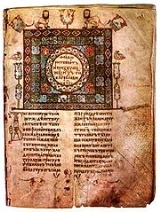
Old East Slavic language

Encyclopedia
Old East Slavic
or Old Ruthenian
was a language used in 10th-15th centuries by East Slavs
in the Kievan Rus'
and states which evolved after the collapse of the Kievan Rus. Dialect
s of it were spoken, though not exclusively, in the area today occupied by Ukraine
, Belarus
, parts of European Russia
, and several eastern voivodships of Poland
.
As the language is part of the (pre-)national history of all East Slavs, in recent years it has been increasingly referred to as:
and faithfully retained many of its features. A striking innovation in the evolution of this language was the development of so-called pleophony (or polnoglasie 'full vocalisation'), which came to differentiate the newly evolving East Slavic from other Slavic dialects. For instance, Common Slavic *gordъ 'settlement, town' was reflected as OESl. gorodъ, Common Slavic *melko 'milk' > OESl. moloko, and Common Slavic *korva 'cow' > OESl korova. Other Slavic dialects are differed by resolving the closed-syllable clusters *eRC and *aRC as liquid metathesis (South Slavic
and Czecho-
Slovak
), or by no change at all (see the article on Slavic liquid metathesis and pleophony
for a detailed account).
Since extant written records of the language are sparse, it is difficult to assess the level of its unity. In consideration of the number of tribes and clans that constituted Kievan Rus, it is probable that there were many dialects of Old East Slavonic. Therefore, today we may speak definitively only of the languages of surviving manuscripts, which, according to some interpretations, show regional divergence from the beginning of the historical records.
With time, it evolved into several more diversified forms, which were the predecessors of the modern Belarusian
, Russian
, Rusyn
and Ukrainian
languages. Each of these languages preserves much of the Old East Slavic grammar and vocabulary.
When after the end of the 'Tatar yoke' the territory of former Kievan Rus was divided between the Grand Duchy of Lithuania
and the Grand Duchy of Moscow
, two separate literary languages emerged in these states, Ruthenian
in the west and medieval Russian
in the east.
 The political unification of the region into the state called Kievan Rus'
, from which modern Belarus
, Russia
and Ukraine
trace their origins, occurred approximately a century before the adoption of Christianity
in 988 and the establishment of the South Slavic Old Church Slavonic
as the liturgical and literary language. The Old Church Slavonic language, also known as Old Bulgarian Language, as it was developed in the First Bulgarian Empire's Preslav Academy, was introduced through the Bulgarian Empire. Documentation of the language of this period is scanty, making it difficult at best fully to determine the relationship between the literary language and its spoken dialects.
There are references in Arab and Byzantine sources to pre-Christian Slavs in European Russia using some form of writing. Despite some suggestive archaeological finds and a corroboration by the tenth-century monk Chernorizets Hrabar
that ancient Slavs wrote in "strokes and incisions", the exact nature of this system is unknown.
Although the Glagolitic alphabet was briefly introduced, as witnessed by church inscriptions in Novgorod, it was soon entirely superseded by the Cyrillic. The samples of birch-bark writing excavated in Novgorod have provided crucial information about the pure tenth-century vernacular in North-West Russia
, almost entirely free of Church Slavonic influence. It is also known that borrowings and calques from Byzantine Greek
began to enter the vernacular at this time, and that simultaneously the literary language in its turn began to be modified towards Eastern Slavic.
The following excerpts illustrate two of the most famous literary monuments.
NOTE. The spelling has been partly modernized. The translations attempt to be as literal as possible; they are not literary.
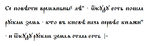
c. 1110, from the Laurentian Codex
, 1377
Early language; fall of the yer
s in progress or arguably complete (several words end with a consonant; "to rule" < , modern Uk княжити, R княжить). South-western features include "bygone"; modern R прошлых, modern Ukr "минулих"). Correct use of perfect and aorist
: єсть пошла "is/has come" (modern R пошла), нача "began" (modern R начал as a development of the old perfect.) Note the style of punctuation.
Illustrates the sung epic
s, with typical use of metaphor and simile.
It has been suggested that the phrase растекаться мыслью по древу (to run in thought upon/over wood), which has become proverbial in modern Russian with the meaning "to speak ornately, at length, excessively," is a misreading of an original "мысію" (akin to мышь "mouse") from "run like a squirrel/mouse on a tree"; however, the reading мыслью is present in both the manuscript copy of 1790 and the first edition of 1800, and in all subsequent scholarly editions.
and homily
, the disputed epic Song of Igor
(Слово о полку игореве /slovo o polku iɡorʲevʲe/) and the earliest surviving manuscript of the Primary Chronicle
(Повесть временных лет /povʲestʲ vrʲemʲennix lʲet/) – the Laurentian codex (Лаврентьевский список /lavrʲentʲjevskij spʲisok/) of 1377.
The Book of Veles
, said to have been found during the Russian civil war and to have disappeared in WWII, would, if genuine, provide about the only surviving pre-Christian East Slavic literary monument. Since the account of its find and eventual fate (several photographs are claimed to survive) has not been confirmed, and its language deviates from the accepted reconstruction, most professional linguists have so far dismissed the book's authenticity.
The earliest dated specimen of Old East Slavic (or, rather, of Church Slavonic with pronounced East Slavic interference) must be considered the written Slovo o zakone i blagodati, by Hilarion
, metropolitan
of Kiev
. In this work there is a panegyric on Prince Vladimir of Kiev, the hero of so much of East Slavic popular poetry. This subtle and graceful oration admirably conforms to the precepts of the Byzantine eloquence. It is rivalled by another panegyric on Vladimir, written a decade later by Yakov the Monk.
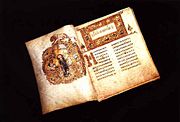 Other eleventh-century writers are Theodosius, a monk of the Kiev Pechersk Lavra
, who wrote on the Latin faith and some Pouchenia or Instructions, and Luka Zhidiata, bishop of Novgorod, who has left us a curious Discourse to the Brethren. From the writings of Theodosius we see that many pagan habits were still in vogue among the people. He finds fault with them for allowing these to continue, and also for their drunkenness; nor do the monks escape his censures. Zhidiata writes in a more vernacular style than many of his contemporaries; he eschews the declamatory tone of the Byzantine authors. And here may be mentioned the many lives of the saints and the Fathers to be found in early East Slavic literature, starting with the two Lives of Sts Boris and Gleb
, written in the late eleventh century and attributed to Jacob the Monk and to Nestor the Chronicler
.
With the so-called Primary Chronicle
, also attributed to Nestor, begins the long series of the Russian annalists. There is a regular catena of these chronicles, extending with only two breaks to the seventeenth century. Besides the work attributed to Nestor the Chronicler
, we have chronicles of Novgorod, Kiev
, Volhynia
and many others. Every town of any importance could boast of its annalists, Pskov
and Suzdal
among others. In some respects these compilations, the productions of monks in their cloisters, remind us of Herodotus
, dry details alternating with here and there a picturesque incident; and many of these annals abound with the quaintest stories.
In the twelfth century we have the sermons of bishop Cyril of Turov, which are attempts to imitate in Old East Slavic the florid Byzantine style. In his sermon on Holy Week
, Christianity
is represented under the form of spring, Paganism
and Judaism
under that of winter, and evil thoughts are spoken of as boisterous winds.
 There are also admirable works of early travellers, as the igumen Daniel
, who visited the Holy Land
at the end of the eleventh and beginning of the twelfth century. A later traveller was Afanasiy Nikitin, a merchant of Tver
, who visited India
in 1470. He has left a record of his adventures
, which has been translated into English and published for the Hakluyt Society
.
A curious monument of old Slavonic times is the Pouchenie (Instruction), written by Vladimir Monomakh for the benefit of his sons. This composition is generally found inserted in the Chronicle of Nestor; it gives a fine picture of the daily life of a Slavonic prince. The Paterik of the Kievan Caves Monastery is a typical medieval collection of stories from the life of monks, featuring devils, angels, ghosts, and miraculous resurrections.
We now come to the famous Lay of Igor's Campaign
, which narrates the expedition of Igor Svyatoslavich
, prince of Novhorod-Siverskyi
against the Cumans
. It is neither epic
nor a poem but is written in rhythmic prose. An interesting aspect of the text is its mix of Christianity
and ancient Slavic religion. Igor's wife Yaroslavna famously invokes natural forces from the walls of Putyvl
. Christian motifs present along with depersonalised pagan gods in the form of artistic images. Another aspect, which sets the book apart from contemporary Western epics, are its numerous and vivid descriptions of nature
, and the role which nature plays in human lives. Of the whole bulk of the Old East Slavic literature, the Lay is the only work familiar to every educated Russian or Ukrainian. Its brooding flow of images, murky metaphor
s, and ever changing rhythm haven't been successfully rendered into English yet. Indeed, the meanings of many words found in it have not been satisfactorily explained by scholars.
The Zadonshchina
is a sort of prose poem much in the style of the Tale of Igor's Campaign, and the resemblance of the latter to this piece furnishes an additional proof of its genuineness. This account of the battle of Kulikovo
, which was gained by Dmitri Donskoi
over the Mongols
in 1380, has come down in three important versions.
The early laws of Rus’ present many features of interest, such as the Russkaya Pravda
of Yaroslav the Wise, which is preserved in the chronicle of Novgorod; the date is between 1018 and 1072. The law
s show Rus at that time to have been in civilization quite on a level with the rest of Europe.
of Old East Slavic were undertaken by Alexander Vostokov
and Izmail Sreznevsky
in the nineteenth century. Sreznevsky's Materials for the Dictionary of the Old Russian Language on the Basis of Written Records (1893–1903), though incomplete, remained a standard reference until the appearance of a 24-volume academic dictionary in 1975–99.

East Slavic languages
The East Slavic languages constitute one of three regional subgroups of Slavic languages, currently spoken in Eastern Europe. It is the group with the largest numbers of speakers, far out-numbering the Western and Southern Slavic groups. Current East Slavic languages are Belarusian, Russian,...
or Old Ruthenian
Ruthenian language
Ruthenian, or Old Ruthenian , is a term used for the varieties of Eastern Slavonic spoken in the Grand Duchy of Lithuania and later in the East Slavic territories of the Polish–Lithuanian Commonwealth....
was a language used in 10th-15th centuries by East Slavs
East Slavs
The East Slavs are Slavic peoples speaking East Slavic languages. Formerly the main population of the medieval state of Kievan Rus, by the seventeenth century they evolved into the Russian, Ukrainian, and Belarusian peoples.-Sources:...
in the Kievan Rus'
Kievan Rus'
Kievan Rus was a medieval polity in Eastern Europe, from the late 9th to the mid 13th century, when it disintegrated under the pressure of the Mongol invasion of 1237–1240....
and states which evolved after the collapse of the Kievan Rus. Dialect
Dialect
The term dialect is used in two distinct ways, even by linguists. One usage refers to a variety of a language that is a characteristic of a particular group of the language's speakers. The term is applied most often to regional speech patterns, but a dialect may also be defined by other factors,...
s of it were spoken, though not exclusively, in the area today occupied by Ukraine
Ukraine
Ukraine is a country in Eastern Europe. It has an area of 603,628 km², making it the second largest contiguous country on the European continent, after Russia...
, Belarus
Belarus
Belarus , officially the Republic of Belarus, is a landlocked country in Eastern Europe, bordered clockwise by Russia to the northeast, Ukraine to the south, Poland to the west, and Lithuania and Latvia to the northwest. Its capital is Minsk; other major cities include Brest, Grodno , Gomel ,...
, parts of European Russia
Russia
Russia or , officially known as both Russia and the Russian Federation , is a country in northern Eurasia. It is a federal semi-presidential republic, comprising 83 federal subjects...
, and several eastern voivodships of Poland
Poland
Poland , officially the Republic of Poland , is a country in Central Europe bordered by Germany to the west; the Czech Republic and Slovakia to the south; Ukraine, Belarus and Lithuania to the east; and the Baltic Sea and Kaliningrad Oblast, a Russian exclave, to the north...
.
As the language is part of the (pre-)national history of all East Slavs, in recent years it has been increasingly referred to as:
- “Old Ukrainian LanguageUkrainian languageUkrainian is a language of the East Slavic subgroup of the Slavic languages. It is the official state language of Ukraine. Written Ukrainian uses a variant of the Cyrillic alphabet....
” or “Old Kyivan Language” rather than “Old Ruthenian LanguageRuthenian languageRuthenian, or Old Ruthenian , is a term used for the varieties of Eastern Slavonic spoken in the Grand Duchy of Lithuania and later in the East Slavic territories of the Polish–Lithuanian Commonwealth....
” . - “Old Belarusian LanguageBelarusian languageThe Belarusian language , sometimes referred to as White Russian or White Ruthenian, is the language of the Belarusian people...
” instead of traditional supranational “Old Ruthenian LanguageRuthenian languageRuthenian, or Old Ruthenian , is a term used for the varieties of Eastern Slavonic spoken in the Grand Duchy of Lithuania and later in the East Slavic territories of the Polish–Lithuanian Commonwealth....
” - “Old Russian LanguageRussian languageRussian is a Slavic language used primarily in Russia, Belarus, Uzbekistan, Kazakhstan, Tajikistan and Kyrgyzstan. It is an unofficial but widely spoken language in Ukraine, Moldova, Latvia, Turkmenistan and Estonia and, to a lesser extent, the other countries that were once constituent republics...
”
General considerations
The language was a descendant of the Proto-Slavic languageProto-Slavic language
Proto-Slavic is the proto-language from which Slavic languages later emerged. It was spoken before the seventh century AD. As with most other proto-languages, no attested writings have been found; the language has been reconstructed by applying the comparative method to all the attested Slavic...
and faithfully retained many of its features. A striking innovation in the evolution of this language was the development of so-called pleophony (or polnoglasie 'full vocalisation'), which came to differentiate the newly evolving East Slavic from other Slavic dialects. For instance, Common Slavic *gordъ 'settlement, town' was reflected as OESl. gorodъ, Common Slavic *melko 'milk' > OESl. moloko, and Common Slavic *korva 'cow' > OESl korova. Other Slavic dialects are differed by resolving the closed-syllable clusters *eRC and *aRC as liquid metathesis (South Slavic
South Slavic languages
The South Slavic languages comprise one of three branches of the Slavic languages. There are approximately 30 million speakers, mainly in the Balkans. These are separated geographically from speakers of the other two Slavic branches by a belt of German, Hungarian and Romanian speakers...
and Czecho-
Czech language
Czech is a West Slavic language with about 12 million native speakers; it is the majority language in the Czech Republic and spoken by Czechs worldwide. The language was known as Bohemian in English until the late 19th century...
Slovak
Slovak language
Slovak , is an Indo-European language that belongs to the West Slavic languages .Slovak is the official language of Slovakia, where it is spoken by 5 million people...
), or by no change at all (see the article on Slavic liquid metathesis and pleophony
Slavic liquid metathesis and pleophony
Slavic liquid metathesis refers to the historical phenomenon of metathesis of liquid consonants occurring in Common Slavic period in South Slavic and Czecho-Slovak area. Onomastics evidence indicates that it seems to have occurred sometimes in the latter half of the eighth century...
for a detailed account).
Since extant written records of the language are sparse, it is difficult to assess the level of its unity. In consideration of the number of tribes and clans that constituted Kievan Rus, it is probable that there were many dialects of Old East Slavonic. Therefore, today we may speak definitively only of the languages of surviving manuscripts, which, according to some interpretations, show regional divergence from the beginning of the historical records.
With time, it evolved into several more diversified forms, which were the predecessors of the modern Belarusian
Belarusian language
The Belarusian language , sometimes referred to as White Russian or White Ruthenian, is the language of the Belarusian people...
, Russian
Russian language
Russian is a Slavic language used primarily in Russia, Belarus, Uzbekistan, Kazakhstan, Tajikistan and Kyrgyzstan. It is an unofficial but widely spoken language in Ukraine, Moldova, Latvia, Turkmenistan and Estonia and, to a lesser extent, the other countries that were once constituent republics...
, Rusyn
Rusyn language
Rusyn , also known in English as Ruthenian, is an East Slavic language variety spoken by the Rusyns of Central Europe. Some linguists treat it as a distinct language and it has its own ISO 639-3 code; others treat it as a dialect of Ukrainian...
and Ukrainian
Ukrainian language
Ukrainian is a language of the East Slavic subgroup of the Slavic languages. It is the official state language of Ukraine. Written Ukrainian uses a variant of the Cyrillic alphabet....
languages. Each of these languages preserves much of the Old East Slavic grammar and vocabulary.
When after the end of the 'Tatar yoke' the territory of former Kievan Rus was divided between the Grand Duchy of Lithuania
Grand Duchy of Lithuania
The Grand Duchy of Lithuania was a European state from the 12th /13th century until 1569 and then as a constituent part of Polish-Lithuanian Commonwealth until 1791 when Constitution of May 3, 1791 abolished it in favor of unitary state. It was founded by the Lithuanians, one of the polytheistic...
and the Grand Duchy of Moscow
Grand Duchy of Moscow
The Grand Duchy of Moscow or Grand Principality of Moscow, also known in English simply as Muscovy , was a late medieval Rus' principality centered on Moscow, and the predecessor state of the early modern Tsardom of Russia....
, two separate literary languages emerged in these states, Ruthenian
Ruthenian language
Ruthenian, or Old Ruthenian , is a term used for the varieties of Eastern Slavonic spoken in the Grand Duchy of Lithuania and later in the East Slavic territories of the Polish–Lithuanian Commonwealth....
in the west and medieval Russian
History of the Russian language
The history proper of the Russian language dates from just before the year 1000 AD.Note: in the following sections, all examples of vocabulary appear in their modern spelling.-Kievan period and feudal breakup:...
in the east.
Literary language of Kievan Rus
Kievan Rus'
Kievan Rus was a medieval polity in Eastern Europe, from the late 9th to the mid 13th century, when it disintegrated under the pressure of the Mongol invasion of 1237–1240....
, from which modern Belarus
Belarus
Belarus , officially the Republic of Belarus, is a landlocked country in Eastern Europe, bordered clockwise by Russia to the northeast, Ukraine to the south, Poland to the west, and Lithuania and Latvia to the northwest. Its capital is Minsk; other major cities include Brest, Grodno , Gomel ,...
, Russia
Russia
Russia or , officially known as both Russia and the Russian Federation , is a country in northern Eurasia. It is a federal semi-presidential republic, comprising 83 federal subjects...
and Ukraine
Ukraine
Ukraine is a country in Eastern Europe. It has an area of 603,628 km², making it the second largest contiguous country on the European continent, after Russia...
trace their origins, occurred approximately a century before the adoption of Christianity
Christianity
Christianity is a monotheistic religion based on the life and teachings of Jesus as presented in canonical gospels and other New Testament writings...
in 988 and the establishment of the South Slavic Old Church Slavonic
Old Church Slavonic
Old Church Slavonic or Old Church Slavic was the first literary Slavic language, first developed by the 9th century Byzantine Greek missionaries Saints Cyril and Methodius who were credited with standardizing the language and using it for translating the Bible and other Ancient Greek...
as the liturgical and literary language. The Old Church Slavonic language, also known as Old Bulgarian Language, as it was developed in the First Bulgarian Empire's Preslav Academy, was introduced through the Bulgarian Empire. Documentation of the language of this period is scanty, making it difficult at best fully to determine the relationship between the literary language and its spoken dialects.
There are references in Arab and Byzantine sources to pre-Christian Slavs in European Russia using some form of writing. Despite some suggestive archaeological finds and a corroboration by the tenth-century monk Chernorizets Hrabar
Chernorizets Hrabar
Chernorizets Hrabar was a Bulgarian monk, scholar and writer who worked at the Preslav Literary School at the end of the 9th and the beginning of the 10th century, developing Medieval Bulgarian literature and spreading Old Church Slavonic.- Name :...
that ancient Slavs wrote in "strokes and incisions", the exact nature of this system is unknown.
Although the Glagolitic alphabet was briefly introduced, as witnessed by church inscriptions in Novgorod, it was soon entirely superseded by the Cyrillic. The samples of birch-bark writing excavated in Novgorod have provided crucial information about the pure tenth-century vernacular in North-West Russia
Old Novgorod dialect
Old Novgorod dialect is a term introduced by Andrey Zaliznyak to describe the astonishingly diverse linguistic features of the Old East Slavic birch bark writings from the 11th to 15th centuries excavated in Novgorod and its surroundings...
, almost entirely free of Church Slavonic influence. It is also known that borrowings and calques from Byzantine Greek
Medieval Greek
Medieval Greek, also known as Byzantine Greek, is the stage of the Greek language between the beginning of the Middle Ages around 600 and the Ottoman conquest of the city of Constantinople in 1453. The latter date marked the end of the Middle Ages in Southeast Europe...
began to enter the vernacular at this time, and that simultaneously the literary language in its turn began to be modified towards Eastern Slavic.
The following excerpts illustrate two of the most famous literary monuments.
NOTE. The spelling has been partly modernized. The translations attempt to be as literal as possible; they are not literary.
Primary Chronicle
c. 1110, from the Laurentian Codex
Laurentian Codex
Laurentian Codex or Laurentian Chronicle is a collection of chronicles that includes the oldest extant version of the Primary Chronicle and its continuations, mostly relating the events in Northern Russia ....
, 1377
- .
- Повесть временных лет, откуда пошла русская земля, кто в Киеве начал первым княжить, и откуда возникла русская земля (modern RussianRussian languageRussian is a Slavic language used primarily in Russia, Belarus, Uzbekistan, Kazakhstan, Tajikistan and Kyrgyzstan. It is an unofficial but widely spoken language in Ukraine, Moldova, Latvia, Turkmenistan and Estonia and, to a lesser extent, the other countries that were once constituent republics...
) - Повість минулих літ, звідки пішла Руська земля, і хто в ній почав спершу княжити, і як Руська Земля постала (UkrainianUkrainian languageUkrainian is a language of the East Slavic subgroup of the Slavic languages. It is the official state language of Ukraine. Written Ukrainian uses a variant of the Cyrillic alphabet....
) - These [are] the tales of the bygone years, whence is come the Russian land, who first began to rule at Kiev, and whence Russian land has come about.
Early language; fall of the yer
Yer
The letter yer of the Cyrillic alphabet, also spelled jer or er, is known as the hard sign in the modern Russian and Rusyn alphabets and as er golyam in the Bulgarian alphabet...
s in progress or arguably complete (several words end with a consonant; "to rule" < , modern Uk княжити, R княжить). South-western features include "bygone"; modern R прошлых, modern Ukr "минулих"). Correct use of perfect and aorist
Aorist
Aorist is a philological term originally from Indo-European studies, referring to verb forms of various languages that are not necessarily related or similar in meaning...
: єсть пошла "is/has come" (modern R пошла), нача "began" (modern R начал as a development of the old perfect.) Note the style of punctuation.
Tale of Igor's Campaign
. c. 1200, from the Pskov manuscript, fifteenth cent.- .
- Would it not be meet, o brothers, for us to begin with the old words the martial telling of the host of Igor, Igor Sviatoslavich? And to begin in the way of the true tales of this time, and not in the way of Boyan's inventions. For the wise Boyan, if he wished to devote to someone [his] song, would fly in thought in the trees, like a grey wolf over land, like a bluish eagle beneath the clouds.
Illustrates the sung epic
Epic poetry
An epic is a lengthy narrative poem, ordinarily concerning a serious subject containing details of heroic deeds and events significant to a culture or nation. Oral poetry may qualify as an epic, and Albert Lord and Milman Parry have argued that classical epics were fundamentally an oral poetic form...
s, with typical use of metaphor and simile.
It has been suggested that the phrase растекаться мыслью по древу (to run in thought upon/over wood), which has become proverbial in modern Russian with the meaning "to speak ornately, at length, excessively," is a misreading of an original "мысію" (akin to мышь "mouse") from "run like a squirrel/mouse on a tree"; however, the reading мыслью is present in both the manuscript copy of 1790 and the first edition of 1800, and in all subsequent scholarly editions.
Old East Slavic Literature
The Old East Slavic language developed a certain literature of its own, though much of it (in hand with those of the Slavic languages that were, after all, written down) was influenced as regards style and vocabulary by religious texts written in Church Slavonic. Surviving literary monuments include the legal code Justice of the Rus (Руська правда /rusʲka pravda/), a corpus of hagiographyHagiography
Hagiography is the study of saints.From the Greek and , it refers literally to writings on the subject of such holy people, and specifically to the biographies of saints and ecclesiastical leaders. The term hagiology, the study of hagiography, is also current in English, though less common...
and homily
Homily
A homily is a commentary that follows a reading of scripture. In Catholic, Anglican, Lutheran, and Eastern Orthodox Churches, a homily is usually given during Mass at the end of the Liturgy of the Word...
, the disputed epic Song of Igor
The Tale of Igor's Campaign
The Tale of Igor's Campaign is an anonymous epic poem written in the Old East Slavic language.The title is occasionally translated as The Song of Igor's Campaign, The Lay of Igor's Campaign, and The Lay of...
(Слово о полку игореве /slovo o polku iɡorʲevʲe/) and the earliest surviving manuscript of the Primary Chronicle
Primary Chronicle
The Primary Chronicle , Ruthenian Primary Chronicle or Russian Primary Chronicle, is a history of Kievan Rus' from about 850 to 1110, originally compiled in Kiev about 1113.- Three editions :...
(Повесть временных лет /povʲestʲ vrʲemʲennix lʲet/) – the Laurentian codex (Лаврентьевский список /lavrʲentʲjevskij spʲisok/) of 1377.
The Book of Veles
Book of Veles
The Book of Veles is a literary forgery claimed to be a text of ancient Slavic religion and history written on wooden planks.It contains religious passages and accounts of history interspersed with religious...
, said to have been found during the Russian civil war and to have disappeared in WWII, would, if genuine, provide about the only surviving pre-Christian East Slavic literary monument. Since the account of its find and eventual fate (several photographs are claimed to survive) has not been confirmed, and its language deviates from the accepted reconstruction, most professional linguists have so far dismissed the book's authenticity.
The earliest dated specimen of Old East Slavic (or, rather, of Church Slavonic with pronounced East Slavic interference) must be considered the written Slovo o zakone i blagodati, by Hilarion
Hilarion of Kiev
Hilarion or Ilarion was the first non-Greek Metropolitan of Kiev. While there is not much verifiable information regarding Ilarion's biography, there are several aspects of his life which have come to be generally accepted....
, metropolitan
Metropolitan bishop
In Christian churches with episcopal polity, the rank of metropolitan bishop, or simply metropolitan, pertains to the diocesan bishop or archbishop of a metropolis; that is, the chief city of a historical Roman province, ecclesiastical province, or regional capital.Before the establishment of...
of Kiev
Kiev
Kiev or Kyiv is the capital and the largest city of Ukraine, located in the north central part of the country on the Dnieper River. The population as of the 2001 census was 2,611,300. However, higher numbers have been cited in the press....
. In this work there is a panegyric on Prince Vladimir of Kiev, the hero of so much of East Slavic popular poetry. This subtle and graceful oration admirably conforms to the precepts of the Byzantine eloquence. It is rivalled by another panegyric on Vladimir, written a decade later by Yakov the Monk.
Kiev Pechersk Lavra
Kiev Pechersk Lavra or Kyiv Pechersk Lavra , also known as the Kiev Monastery of the Caves, is a historic Orthodox Christian monastery which gave its name to one of the city districts where it is located in Kiev, the capital of Ukraine....
, who wrote on the Latin faith and some Pouchenia or Instructions, and Luka Zhidiata, bishop of Novgorod, who has left us a curious Discourse to the Brethren. From the writings of Theodosius we see that many pagan habits were still in vogue among the people. He finds fault with them for allowing these to continue, and also for their drunkenness; nor do the monks escape his censures. Zhidiata writes in a more vernacular style than many of his contemporaries; he eschews the declamatory tone of the Byzantine authors. And here may be mentioned the many lives of the saints and the Fathers to be found in early East Slavic literature, starting with the two Lives of Sts Boris and Gleb
Boris and Gleb
Boris and Gleb , Christian names Roman and David, respectively, were the first saints canonized in Kievan Rus' after the Christianization of the country....
, written in the late eleventh century and attributed to Jacob the Monk and to Nestor the Chronicler
Nestor the Chronicler
Saint Nestor the Chronicler was the reputed author of the Primary Chronicle, , Life of the Venerable Theodosius of the Kiev Caves, Life of the Holy Passion Bearers, Boris and Gleb, and of the so-called Reading.Nestor was a monk of the Monastery of the Caves in Kiev from 1073...
.
With the so-called Primary Chronicle
Primary Chronicle
The Primary Chronicle , Ruthenian Primary Chronicle or Russian Primary Chronicle, is a history of Kievan Rus' from about 850 to 1110, originally compiled in Kiev about 1113.- Three editions :...
, also attributed to Nestor, begins the long series of the Russian annalists. There is a regular catena of these chronicles, extending with only two breaks to the seventeenth century. Besides the work attributed to Nestor the Chronicler
Nestor the Chronicler
Saint Nestor the Chronicler was the reputed author of the Primary Chronicle, , Life of the Venerable Theodosius of the Kiev Caves, Life of the Holy Passion Bearers, Boris and Gleb, and of the so-called Reading.Nestor was a monk of the Monastery of the Caves in Kiev from 1073...
, we have chronicles of Novgorod, Kiev
Kiev
Kiev or Kyiv is the capital and the largest city of Ukraine, located in the north central part of the country on the Dnieper River. The population as of the 2001 census was 2,611,300. However, higher numbers have been cited in the press....
, Volhynia
Volhynia
Volhynia, Volynia, or Volyn is a historic region in western Ukraine located between the rivers Prypiat and Southern Bug River, to the north of Galicia and Podolia; the region is named for the former city of Volyn or Velyn, said to have been located on the Southern Bug River, whose name may come...
and many others. Every town of any importance could boast of its annalists, Pskov
Pskov
Pskov is an ancient city and the administrative center of Pskov Oblast, Russia, located in the northwest of Russia about east from the Estonian border, on the Velikaya River. Population: -Early history:...
and Suzdal
Suzdal
Suzdal is a town in Vladimir Oblast, Russia, situated northeast of Moscow, from the city of Vladimir, on the Kamenka River. Population: -History:...
among others. In some respects these compilations, the productions of monks in their cloisters, remind us of Herodotus
Herodotus
Herodotus was an ancient Greek historian who was born in Halicarnassus, Caria and lived in the 5th century BC . He has been called the "Father of History", and was the first historian known to collect his materials systematically, test their accuracy to a certain extent and arrange them in a...
, dry details alternating with here and there a picturesque incident; and many of these annals abound with the quaintest stories.
In the twelfth century we have the sermons of bishop Cyril of Turov, which are attempts to imitate in Old East Slavic the florid Byzantine style. In his sermon on Holy Week
Holy Week
Holy Week in Christianity is the last week of Lent and the week before Easter...
, Christianity
Christianity
Christianity is a monotheistic religion based on the life and teachings of Jesus as presented in canonical gospels and other New Testament writings...
is represented under the form of spring, Paganism
Paganism
Paganism is a blanket term, typically used to refer to non-Abrahamic, indigenous polytheistic religious traditions....
and Judaism
Judaism
Judaism ) is the "religion, philosophy, and way of life" of the Jewish people...
under that of winter, and evil thoughts are spoken of as boisterous winds.
Daniel
Daniel is the protagonist in the Book of Daniel of the Hebrew Bible. In the narrative, when Daniel was a young man, he was taken into Babylonian captivity where he was educated in Chaldean thought. However, he never converted to Neo-Babylonian ways...
, who visited the Holy Land
Holy Land
The Holy Land is a term which in Judaism refers to the Kingdom of Israel as defined in the Tanakh. For Jews, the Land's identifiction of being Holy is defined in Judaism by its differentiation from other lands by virtue of the practice of Judaism often possible only in the Land of Israel...
at the end of the eleventh and beginning of the twelfth century. A later traveller was Afanasiy Nikitin, a merchant of Tver
Tver
Tver is a city and the administrative center of Tver Oblast, Russia. Population: 403,726 ; 408,903 ;...
, who visited India
India
India , officially the Republic of India , is a country in South Asia. It is the seventh-largest country by geographical area, the second-most populous country with over 1.2 billion people, and the most populous democracy in the world...
in 1470. He has left a record of his adventures
A Journey Beyond the Three Seas
A Journey Beyond the Three Seas is a Russian literary monument in the form of travel notes, made by a merchant from Tver Afanasiy Nikitin during his journey to India in 1466-1472....
, which has been translated into English and published for the Hakluyt Society
Hakluyt Society
Founded in 1846, the Hakluyt Society is a registered charity based in London, England, which seeks to advance knowledge and education by the publication of scholarly editions of primary records of voyages, travels and other geographical material...
.
A curious monument of old Slavonic times is the Pouchenie (Instruction), written by Vladimir Monomakh for the benefit of his sons. This composition is generally found inserted in the Chronicle of Nestor; it gives a fine picture of the daily life of a Slavonic prince. The Paterik of the Kievan Caves Monastery is a typical medieval collection of stories from the life of monks, featuring devils, angels, ghosts, and miraculous resurrections.
We now come to the famous Lay of Igor's Campaign
The Tale of Igor's Campaign
The Tale of Igor's Campaign is an anonymous epic poem written in the Old East Slavic language.The title is occasionally translated as The Song of Igor's Campaign, The Lay of Igor's Campaign, and The Lay of...
, which narrates the expedition of Igor Svyatoslavich
Igor Svyatoslavich
Igor Svyatoslavich the Brave was a Rus’ prince...
, prince of Novhorod-Siverskyi
Novhorod-Siverskyi
Novhorod-Siversky is a historic city in the Chernihiv Oblast of Ukraine. It is the administrative center of the Novhorod-Siversky Raion, and is situated on the bank of the Desna River, 330 km from the capital, Kiev, and 45 km south of the Russian border. Current estimated population:...
against the Cumans
Cumans
The Cumans were Turkic nomadic people comprising the western branch of the Cuman-Kipchak confederation. After Mongol invasion , they decided to seek asylum in Hungary, and subsequently to Bulgaria...
. It is neither epic
Epic poetry
An epic is a lengthy narrative poem, ordinarily concerning a serious subject containing details of heroic deeds and events significant to a culture or nation. Oral poetry may qualify as an epic, and Albert Lord and Milman Parry have argued that classical epics were fundamentally an oral poetic form...
nor a poem but is written in rhythmic prose. An interesting aspect of the text is its mix of Christianity
Christianity
Christianity is a monotheistic religion based on the life and teachings of Jesus as presented in canonical gospels and other New Testament writings...
and ancient Slavic religion. Igor's wife Yaroslavna famously invokes natural forces from the walls of Putyvl
Putyvl
Putyvl or Putivl is a town in north-east Ukraine, in Sumy Oblast. Currently about 20,000 people live in Putyvl.-History:One of the original Siverian towns, Putyvl was first mentioned as early as 1146 as an important fortress contested between Chernigov and Novgorod-Seversky principalities of...
. Christian motifs present along with depersonalised pagan gods in the form of artistic images. Another aspect, which sets the book apart from contemporary Western epics, are its numerous and vivid descriptions of nature
Nature
Nature, in the broadest sense, is equivalent to the natural world, physical world, or material world. "Nature" refers to the phenomena of the physical world, and also to life in general...
, and the role which nature plays in human lives. Of the whole bulk of the Old East Slavic literature, the Lay is the only work familiar to every educated Russian or Ukrainian. Its brooding flow of images, murky metaphor
Metaphor
A metaphor is a literary figure of speech that uses an image, story or tangible thing to represent a less tangible thing or some intangible quality or idea; e.g., "Her eyes were glistening jewels." Metaphor may also be used for any rhetorical figures of speech that achieve their effects via...
s, and ever changing rhythm haven't been successfully rendered into English yet. Indeed, the meanings of many words found in it have not been satisfactorily explained by scholars.
The Zadonshchina
Zadonshchina
Zadonshchina is a Russian literary monument of the late 14th century, which tells of the Battle of Kulikovo in 1380.- Redactions and the Prototext :Zadonshina exists in 2 redactions:...
is a sort of prose poem much in the style of the Tale of Igor's Campaign, and the resemblance of the latter to this piece furnishes an additional proof of its genuineness. This account of the battle of Kulikovo
Battle of Kulikovo
The Battle of Kulikovo was a battle between Tatar Mamai and Muscovy Dmitriy and portrayed by Russian historiography as a stand-off between Russians and the Golden Horde. However, the political situation at the time was much more complicated and concerned the politics of the Northeastern Rus'...
, which was gained by Dmitri Donskoi
Dmitri Donskoi
Saint Dmitry Ivanovich Donskoy , or Dmitry of the Don, sometimes referred to as Dmitry I , son of Ivan II the Meek of Moscow , reigned as the Prince of Moscow from 1359 and Grand Prince of Vladimir from 1363 to his death. He was the first prince of Moscow to openly challenge Mongol authority in...
over the Mongols
Mongols
Mongols ) are a Central-East Asian ethnic group that lives mainly in the countries of Mongolia, China, and Russia. In China, ethnic Mongols can be found mainly in the central north region of China such as Inner Mongolia...
in 1380, has come down in three important versions.
The early laws of Rus’ present many features of interest, such as the Russkaya Pravda
Russkaya Pravda
Russkaya Pravda was the legal code of Kievan Rus' and the subsequent Rus' principalities during the times of feudal division.In spite of great influence of Byzantine legislation on the contemporary world, and in...
of Yaroslav the Wise, which is preserved in the chronicle of Novgorod; the date is between 1018 and 1072. The law
Law
Law is a system of rules and guidelines which are enforced through social institutions to govern behavior, wherever possible. It shapes politics, economics and society in numerous ways and serves as a social mediator of relations between people. Contract law regulates everything from buying a bus...
s show Rus at that time to have been in civilization quite on a level with the rest of Europe.
Study
The earliest attempts to compile a comprehensive lexiconLexicon
In linguistics, the lexicon of a language is its vocabulary, including its words and expressions. A lexicon is also a synonym of the word thesaurus. More formally, it is a language's inventory of lexemes. Coined in English 1603, the word "lexicon" derives from the Greek "λεξικόν" , neut...
of Old East Slavic were undertaken by Alexander Vostokov
Alexander Vostokov
Alexander Khristoforovich Vostokov was one of the first Russian philologists.He was born in Arensburg, Governorate of Livonia, and studied at the Imperial Academy of Arts. As a natural son of Baron von Osten-Sacken, he received the name Osteneck, which he later chose to render into Russian as...
and Izmail Sreznevsky
Izmail Sreznevsky
Izmail Ivanovich Sreznevsky was a towering figure in 19th-century Slavic studies.His father, Ivan Sreznevsky, was a prolific translator of Latin poetry who taught at the Demidov Lyceum in Yaroslavl before moving to Kharkov University. It was in Kharkov that Sreznevsky graduated in philology and...
in the nineteenth century. Sreznevsky's Materials for the Dictionary of the Old Russian Language on the Basis of Written Records (1893–1903), though incomplete, remained a standard reference until the appearance of a 24-volume academic dictionary in 1975–99.
Notable texts
- BylinaBylinaBylina or Bylyna is a traditional Russian oral epic narrative poem. Byliny singers loosely utilize historical fact greatly embellished with fantasy or hyperbole to create their songs...
s - The Tale of Igor's CampaignThe Tale of Igor's CampaignThe Tale of Igor's Campaign is an anonymous epic poem written in the Old East Slavic language.The title is occasionally translated as The Song of Igor's Campaign, The Lay of Igor's Campaign, and The Lay of...
– the most outstanding literary work in this language - Russkaya PravdaRusskaya PravdaRusskaya Pravda was the legal code of Kievan Rus' and the subsequent Rus' principalities during the times of feudal division.In spite of great influence of Byzantine legislation on the contemporary world, and in...
– an eleventh-century legal code issued by Yaroslav the Wise - Praying of Daniel the ImmuredPraying of Daniel the Immured"Praying of Daniel the Immured" , is a Russian literary monument of the 13th century....
- A Journey Beyond the Three SeasA Journey Beyond the Three SeasA Journey Beyond the Three Seas is a Russian literary monument in the form of travel notes, made by a merchant from Tver Afanasiy Nikitin during his journey to India in 1466-1472....
See also
- Belarusian languageBelarusian languageThe Belarusian language , sometimes referred to as White Russian or White Ruthenian, is the language of the Belarusian people...
- History of the East Slavic languages
- Rusyn languageRusyn languageRusyn , also known in English as Ruthenian, is an East Slavic language variety spoken by the Rusyns of Central Europe. Some linguists treat it as a distinct language and it has its own ISO 639-3 code; others treat it as a dialect of Ukrainian...
- Russian languageRussian languageRussian is a Slavic language used primarily in Russia, Belarus, Uzbekistan, Kazakhstan, Tajikistan and Kyrgyzstan. It is an unofficial but widely spoken language in Ukraine, Moldova, Latvia, Turkmenistan and Estonia and, to a lesser extent, the other countries that were once constituent republics...
- Slavic languagesSlavic languagesThe Slavic languages , a group of closely related languages of the Slavic peoples and a subgroup of Indo-European languages, have speakers in most of Eastern Europe, in much of the Balkans, in parts of Central Europe, and in the northern part of Asia.-Branches:Scholars traditionally divide Slavic...
- Ukrainian languageUkrainian languageUkrainian is a language of the East Slavic subgroup of the Slavic languages. It is the official state language of Ukraine. Written Ukrainian uses a variant of the Cyrillic alphabet....