


Sviatoslav I of Kiev

Encyclopedia
Sviatoslav I Igorevich; (c. 942 – March 972), also spelled Svyatoslav, was a prince of Rus. The son of Igor of Kiev
and Olga
, Sviatoslav is famous for his incessant campaigns in the east and south, which precipitated the collapse of two great powers of Eastern Europe—Khazaria
and the First Bulgarian Empire
; he also conquered numerous East Slavic
tribes, defeated the Alans
and the Volga Bulgars
, and at times was allied with the Pechenegs and Magyars.
His decade-long reign over Rus' was marked by rapid expansion into the Volga River
valley, the Pontic steppe
and the Balkans
. By the end of his short life, Sviatoslav carved out for himself the largest state in Europe
, eventually moving his capital from Kiev
to Pereyaslavets
on the Danube
in 969. In contrast with his mother's conversion to Christianity, Sviatoslav remained a staunch pagan
all of his life. Due to his abrupt death in ambush, Sviatoslav's conquests, for the most part, were not consolidated into a functioning empire, while his failure to establish a stable succession led to fratricidal
feud among his sons, resulting in two of his three sons being killed.
 Sviatoslav was the first ruler of Rus'
who is recorded in the Primary Chronicle
with a name of Slavic
origin (as opposed to his predecessors, whose names are ultimately derived from Old Norse
). This name is however not recorded in other medieval Slavic countries. Even in Rus', it was attested only among the members of the house of Rurik
, as were the names of Sviatoslav's immediate successors: Vladimir
, Yaroslav
, Mstislav
). Some scholars speculate that the name of Sviatoslav, composed of the Slavic roots for "holy" and "glory", was an artificial derivation combining those of his predecessors Oleg
and Rurik
(they mean "holy" and "glorious" in Old Norse
, respectively).
, was killed by the Drevlians
around 945 and his mother, Olga
, ruled as regent
in Kiev
until Sviatoslav's maturity (ca. 963). His tutor was a Varangian
named Asmud. "Quick as a leopard," The tradition of having Varangian
tutors for the sons of ruling princes survived well into the 11th century. Sviatoslav appears to have had little patience for administration. His life was spent with his druzhina
(roughly, "troops") in permanent warfare against neighboring states. According to the Primary Chronicle
: upon his expeditions he carried with him neither wagons nor kettles, and boiled no meat, but cut off small strips of horseflesh, game or beef, and ate it after roasting it on the coals. Nor did he have a tent, but he spread out a horse-blanket under him, and set his saddle under his head, and all his retinue did likewise.
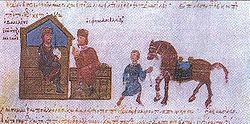 Sviatoslav's appearance has been described very clearly by Leo the Deacon
, who himself attended the meeting of Sviatoslav with John I Tzimiskes
. Following Deacon's memories, Sviatoslav was a blue-eyed male of average height but of stalwart build, much more sturdy than Tzimiskes. He shaved his blond head and his beard but wore a bushy mustache and a sidelock as a sign of his nobility. He preferred to dress in white, and it was noted that his garments were much cleaner than those of his men, although he have had a lot in common with his warriors. He wore a single large gold earring bearing a carbuncle and two pearl
s.
, converted to Eastern Orthodox Christianity at the court of Byzantine
Emperor Constantine Porphyrogenitus in 957. However, Sviatoslav remained a pagan
for all of his life. In the treaty of 971 between Sviatoslav and the Byzantine emperor Cimiskhius, the Rus' are swearing by Perun
and Veles
. According to the Primary Chronicle, he believed that his warriors (druzhina
) would lose respect for him and mock him if he became a Christian. The allegiance of his warriors was of paramount importance in his conquest of an empire that stretched from the Volga to the Danube.
 Very little is known of Sviatoslav's family life. It is possible that Sviatoslav was not the only (and the eldest) son of his parents. The Russo-Byzantine treaty of 945
mentions a certain Predslava, Volodislav's wife, as the noblest of the Rus' women after Olga. George Vernadsky
was among many historians to speculate that Volodislav was Igor's eldest son and heir who died at some point during Olga's regency. Another chronicle told that Oleg (? - 944?) was the eldest son of Igor. At the time of Igor's death, Sviatoslav was still a child and he was raised by his mother or at her instructions. Her influence, however, did not extend to his religious observance.
Sviatoslav, had several children, but the origin of his wives is not specified in the chronicle. By his wives, he had Yaropolk
and Oleg
. By Malusha
, a woman of indeterminate origins, Sviatoslav had Vladimir
, who would ultimately break with his father's paganism and convert Rus' to Christianity. John Skylitzes
reported that Vladimir had a brother named Sfengus
; whether this Sfengus was a son of Sviatoslav, a son of Malusha by a prior or subsequent husband, or an unrelated Rus' nobleman is unclear.
When Sviatoslav went on campaign he left his various relations as regents in the main cities of his realm: his mother Olga and later Yaropolk in Kiev, Vladimir in Novgorod, and Oleg over the Drevlians.
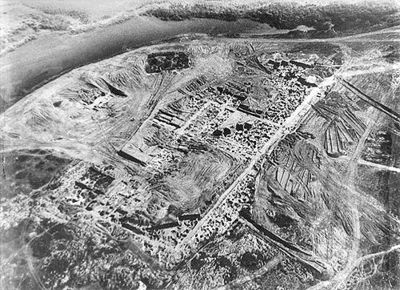 Shortly after his accession to the throne, Sviatoslav began campaigning to expand the Rus' control over the Volga valley and the Pontic steppe
region. His greatest success was the conquest of Khazaria
, which for centuries had been one of the strongest states of Eastern Europe
. The sources are not clear about the roots of the conflict between Khazaria and Rus', so several possibilities have been suggested. The Rus' had an interest in removing the Khazar hold on the Volga trade route
because the Khazars collected duties from the goods transported by the Volga. Historians have suggested that the Byzantine Empire may have incited the Rus' against the Khazars, who fell out with the Byzantines after the persecutions of the Jews in the reign of Romanus I Lecapenus
.
Sviatoslav began by rallying the Khazars' East Slavic
vassal tribes to his cause. Those who would not join him, such as the Vyatichs
, were attacked and forced to pay tribute to the Kievan Rus' rather than the Khazars. According to a legend recorded in the Primary Chronicle, Sviatoslav sent a message to the Vyatich rulers, consisting of a single phrase: "I want to come at you!" (Old East Slavic: "хощю на вы ити") This phrase is used in modern Russian (usually misquoted as "Иду на вы") to denote an unequivocal declaration of one's intentions. Proceeding by the Oka
and Volga rivers, he invaded Volga Bulgaria
and exacted tribute from the local population, thus bringing under Kievan control the upper Volga River. He employed Oghuz
and Pecheneg mercenaries in this campaign, perhaps to counter the Khazars' and Bulgars' superior cavalry
.
Sviatoslav destroyed the Khazar city of Sarkel
around 965, and possibly sacked (but did not occupy) the Khazar city of Kerch
on the Crimea
. At Sarkel he established a Rus' settlement called Belaya Vyezha ("the white tower" or "the white fortress", the East Slavic translation for "Sarkel"). He subsequently destroyed the Khazar capital of Atil
. A visitor to Atil wrote soon after Sviatoslav's campaign: "The Rus' attacked, and no grape or raisin remained, not a leaf on a branch." The exact chronology of his Khazar campaign is uncertain and disputed; for example, Mikhail Artamonov
and David Christian
proposed that the sack of Sarkel came after the destruction of Atil.
Although Ibn Haukal
reports Sviatoslav's sack of Samandar
in modern-day Dagestan
, the Rus' leader did not bother to occupy the Khazar heartlands north of the Caucasus Mountains
permanently. On his way back to Kiev, Sviatoslav chose to strike against the Ossetians
and force them into subservience. Therefore, Khazar successor statelets continued their precarious existence in the region. The destruction of Khazar imperial power paved the way for Kievan Rus' to dominate north-south trade routes through the steppe and across the Black Sea
, routes that formerly had been a major source of revenue for the Khazars. Moreover, Sviatoslav's campaigns led to increased Slavic settlement in the region of the Saltovo-Mayaki
culture, greatly changing the demographics and culture of the transitional area between the forest and the steppe.
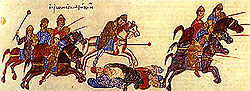
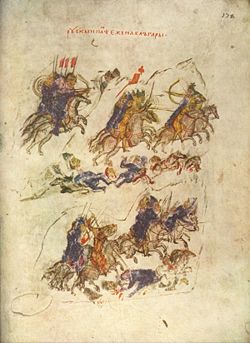 The annihilation of Khazaria was undertaken against the background of the Rus'-Byzantine alliance, concluded in the wake of Igor's Byzantine campaign
in 944. Close military ties between the Rus' and Byzantium are illustrated by the fact, reported by John Skylitzes, that a Rus' detachment accompanied Byzantine Emperor Nikephoros Phokas
in his victorious naval expedition to Crete
.
In 967 or 968 Nikephoros sent to Sviatoslav his agent, Kalokyros
, with the task of talking Sviatoslav into assisting him in a war against Bulgaria
. Sviatoslav was paid 15,000 pounds of gold and set sail with an army of 60,000 men, including thousands of Pecheneg mercenaries.
Sviatoslav defeated
the Bulgarian ruler Boris II
and proceeded to occupy the whole of northern Bulgaria. Meanwhile, the Byzantines bribed the Pechenegs to attack and besiege Kiev
, where Olga stayed with Sviatoslav's son Vladimir. The siege was relieved by the druzhina of Pretich
, and immediately following the Pecheneg retreat, Olga sent a reproachful letter to Sviatoslav. He promptly returned and defeated the Pechenegs, who continued to threaten Kiev.
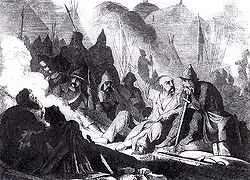 Sviatoslav refused to turn his Balkan conquests over to the Byzantines, and the parties fell out as a result. To the chagrin of his boyar
s and mother (who died within three days after learning about his decision), Sviatoslav decided to move his capital to Pereyaslavets
in the mouth of the Danube due to the great potential of that location as a commercial hub. In the Primary Chronicle
record for 969, Sviatoslav explains that it is to Pereyaslavets, the centre of his lands, "all the riches flow: gold, silks, wine, and various fruits from Greece
, silver and horses from Hungary
and Bohemia
, and from Rus' furs, wax, honey, and slaves".
In summer 969, Sviatoslav left Rus' again, dividing his dominion into three parts, each under a nominal rule of one of his sons. At the head of an army that included Pecheneg and Magyar auxiliary troops, he invaded Bulgaria again, devastating Thrace
, capturing the city of Philippopolis
, and massacring its inhabitants. Nikephoros responded by repairing the defenses of Constantinople
and raising new squadrons of armored cavalry. In the midst of his preparations, Nikephoros was overthrown and killed by John Tzimiskes
, who thus became the new Byzantine emperor.
John Tzimiskes first attempted to persuade Sviatoslav into leaving Bulgaria, but was unsuccessful. Challenging the Byzantine authority, Sviatoslav crossed the Danube and laid siege to Adrianople
, causing panic on the streets of Constantinople in summer 970. Later that year, the Byzantines launched a counteroffensive. Being occupied with suppressing a revolt of Bardas Phokas in Asia Minor
, John Tzimiskes sent his commander-in-chief, Bardas Skleros
, who defeated the coalition of Rus', Pechenegs, Magyars, and Bulgarians in the Battle of Arcadiopolis. Meanwhile, John, having quelled the revolt of Bardas Phokas, came to the Balkans with a large army and promoting himself as the liberator of Bulgaria from Sviatoslav, penetrated the impracticable mountain passes and shortly thereafter captured Marcianopolis
, where the Rus' were holding a number of Bulgar princes hostage.
Sviatoslav retreated to Dorostolon
, which the Byzantine armies besieged for sixty-five days. Cut off and surrounded, Sviatoslav came to terms with John and agreed to abandon the Balkans, renounce his claims to the southern Crimea and return west of the Dnieper River
. In return, the Byzantine emperor supplied the Rus' with food and safe passage home. Sviatoslav and his men set sail and landed on Berezan Island
at the mouth of the Dnieper, where they made camp for the winter. Several months later, their camp was devastated by famine, so that even a horse's head could not be bought for less than a half-grivna
, reports the Kievan chronicler of the Primary Chronicle. While Sviatoslav's campaign brought no tangible results for the Rus', it weakened the Bulgarian statehood and left it vulnerable to the attacks of Basil the Bulgar-Slayer
four decades later.
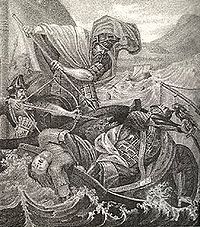 Fearing that the peace with Sviatoslav would not endure, the Byzantine emperor induced the Pecheneg khan
Kurya to kill Sviatoslav before he reached Kiev. This was in line with the policy outlined by Constantine VII
Porphyrogenitus in De Administrando Imperio
of fomenting strife between the Rus' and the Pechenegs. According to the Slavic chronicle, Sveneld
attempted to warn Sviatoslav to avoid the Dnieper rapids
, but the prince slighted his wise advice and was ambushed and slain by the Pechenegs when he tried to cross the cataracts near Khortitsa
early in 972. The Primary Chronicle reports that his skull was made into a chalice
by the Pecheneg khan, Kurya.
Following Sviatoslav's death, tensions between his sons grew. A war broke out between Sviatoslav's legitimate sons, Oleg and Yaropolk
, in 976, at the conclusion of which Oleg was killed. In 977 Vladimir
fled Novgorod to escape Oleg's fate and went to Scandinavia
, where he raised an army of Varangians
and returned in 980. Yaropolk was killed and Vladimir became the sole ruler of Kievan Rus'.
 Sviatoslav has long been a hero of Russian
, Ukrainian
, and Belarusian
patriots due to his great military successes. His figure first attracted attention of Russian artists and poets during the Russo-Turkish War, 1768–1774, which provided obvious parallels with Sviatoslav's push towards Constantinople. Russia's southward expansion and Catherine II
's imperialistic ventures in the Balkans seemed to have been legitimized by Sviatoslav's campaigns eight centuries earlier.
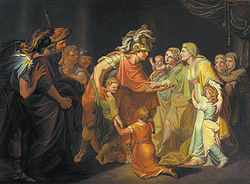
Among the works created during the war was Yakov Knyazhnin
's tragedy Olga (1772). The Russian playwright chose to introduce Sviatoslav as his protagonist, although his active participation in the events following Igor's death is out of sync with the traditional chronology. Knyazhnin's rival Nikolai Nikolev
(1758–1815) also wrote a play on the subject of Sviatoslav's life. Ivan Akimov
's painting Sviatoslav's Return from the Danube to Kiev (1773) explores the conflict between military honour and family attachment. It is a vivid example of Poussinesque
rendering of early medieval subject matter.
In the 19th century, interest in Sviatoslav's career waned. Klavdiy Lebedev
depicted an episode of Sviatoslav's meeting with Emperor John
in his well-known painting, while Eugene Lanceray
sculpted an equestrian statue
of Sviatoslav in the early 20th century. Sviatoslav appears in the Slavophile
poems of Velimir Khlebnikov
as an epitome of militant Slavdom:
He is the villain of Samuel Gordon
's novel The Lost Kingdom, or the Passing of the Khazars, a fictionalized account of the destruction of Khazaria by the Rus'. The Slavic warrior figures in a more positive context in the story "Chernye Strely Vyaticha" by Vadim Viktorovich Kargalov; the story is included in his book Istoricheskie povesti.
In 2005, reports circulated that a village in the Belgorod
region had erected a monument to Sviatoslav's victory over the Khazars by the Russian sculptor Vyacheslav Klykov
. The reports described the 13-meter tall statue as depicting a Rus' cavalryman trampling a supine Khazar bearing a Star of David
. This created an outcry within the Jewish community
of Russia. The controversy was further exacerbated by Klykov's connections with Pamyat
and other anti-Semitic organizations, as well as by his involvement in the "letter of 500", a controversial appeal to the Prosecutor General to review all Jewish organizations in Russia for extremism. The Press Center of the Belgorod Regional Administration responded by stating that a planned monument to Sviatoslav had not yet been constructed, but would show "respect towards representatives of all nationalities and religions." When the statue was unveiled, the shield bore a twelve-pointed star.
Svyatoslav is the main character of books "Knyaz" ("Князь") and "The Hero" ("Герой") writed by Russian writer Alexander Mazin.
Igor, Grand Prince of Kiev
Igor was a Varangian ruler of Kievan Rus' from 912 to 945.-Biography:...
and Olga
Olga of Kiev
Saint Olga , or Olga the Beauty, hypothetically Old Norse: Helga In some Scandinavian sources she was called other name. born c. 890 died 11 July 969, Kiev) was a ruler of Kievan Rus' as regent Saint Olga , or Olga the Beauty, hypothetically Old Norse: Helga In some Scandinavian sources she was...
, Sviatoslav is famous for his incessant campaigns in the east and south, which precipitated the collapse of two great powers of Eastern Europe—Khazaria
Khazars
The Khazars were semi-nomadic Turkic people who established one of the largest polities of medieval Eurasia, with the capital of Atil and territory comprising much of modern-day European Russia, western Kazakhstan, eastern Ukraine, Azerbaijan, large portions of the northern Caucasus , parts of...
and the First Bulgarian Empire
First Bulgarian Empire
The First Bulgarian Empire was a medieval Bulgarian state founded in the north-eastern Balkans in c. 680 by the Bulgars, uniting with seven South Slavic tribes...
; he also conquered numerous East Slavic
East Slavs
The East Slavs are Slavic peoples speaking East Slavic languages. Formerly the main population of the medieval state of Kievan Rus, by the seventeenth century they evolved into the Russian, Ukrainian, and Belarusian peoples.-Sources:...
tribes, defeated the Alans
Alans
The Alans, or the Alani, occasionally termed Alauni or Halani, were a group of Sarmatian tribes, nomadic pastoralists of the 1st millennium AD who spoke an Eastern Iranian language which derived from Scytho-Sarmatian and which in turn evolved into modern Ossetian.-Name:The various forms of Alan —...
and the Volga Bulgars
Volga Bulgaria
Volga Bulgaria, or Volga–Kama Bolghar, is a historic Bulgar state that existed between the seventh and thirteenth centuries around the confluence of the Volga and Kama rivers in what is now Russia.-Origin:...
, and at times was allied with the Pechenegs and Magyars.
His decade-long reign over Rus' was marked by rapid expansion into the Volga River
Volga River
The Volga is the largest river in Europe in terms of length, discharge, and watershed. It flows through central Russia, and is widely viewed as the national river of Russia. Out of the twenty largest cities of Russia, eleven, including the capital Moscow, are situated in the Volga's drainage...
valley, the Pontic steppe
Pontic-Caspian steppe
The Pontic-Caspian steppe is the vast steppeland stretching from the north of the Black Sea as far as the east of the Caspian Sea, from western Ukraine across the Southern Federal District and the Volga Federal District of Russia to western Kazakhstan,...
and the Balkans
Balkans
The Balkans is a geopolitical and cultural region of southeastern Europe...
. By the end of his short life, Sviatoslav carved out for himself the largest state in Europe
Europe
Europe is, by convention, one of the world's seven continents. Comprising the westernmost peninsula of Eurasia, Europe is generally 'divided' from Asia to its east by the watershed divides of the Ural and Caucasus Mountains, the Ural River, the Caspian and Black Seas, and the waterways connecting...
, eventually moving his capital from Kiev
Kiev
Kiev or Kyiv is the capital and the largest city of Ukraine, located in the north central part of the country on the Dnieper River. The population as of the 2001 census was 2,611,300. However, higher numbers have been cited in the press....
to Pereyaslavets
Pereyaslavets
Pereyaslavets or Preslavets was a trade city located at the mouth of the Danube...
on the Danube
Danube
The Danube is a river in the Central Europe and the Europe's second longest river after the Volga. It is classified as an international waterway....
in 969. In contrast with his mother's conversion to Christianity, Sviatoslav remained a staunch pagan
Paganism
Paganism is a blanket term, typically used to refer to non-Abrahamic, indigenous polytheistic religious traditions....
all of his life. Due to his abrupt death in ambush, Sviatoslav's conquests, for the most part, were not consolidated into a functioning empire, while his failure to establish a stable succession led to fratricidal
Fratricide
Fratricide is the act of a person killing his or her brother....
feud among his sons, resulting in two of his three sons being killed.
Name
Kievan Rus'
Kievan Rus was a medieval polity in Eastern Europe, from the late 9th to the mid 13th century, when it disintegrated under the pressure of the Mongol invasion of 1237–1240....
who is recorded in the Primary Chronicle
Primary Chronicle
The Primary Chronicle , Ruthenian Primary Chronicle or Russian Primary Chronicle, is a history of Kievan Rus' from about 850 to 1110, originally compiled in Kiev about 1113.- Three editions :...
with a name of Slavic
Slavic languages
The Slavic languages , a group of closely related languages of the Slavic peoples and a subgroup of Indo-European languages, have speakers in most of Eastern Europe, in much of the Balkans, in parts of Central Europe, and in the northern part of Asia.-Branches:Scholars traditionally divide Slavic...
origin (as opposed to his predecessors, whose names are ultimately derived from Old Norse
Old Norse
Old Norse is a North Germanic language that was spoken by inhabitants of Scandinavia and inhabitants of their overseas settlements during the Viking Age, until about 1300....
). This name is however not recorded in other medieval Slavic countries. Even in Rus', it was attested only among the members of the house of Rurik
Rurik Dynasty
The Rurik dynasty or Rurikids was a dynasty founded by the Varangian prince Rurik, who established himself in Novgorod around the year 862 AD...
, as were the names of Sviatoslav's immediate successors: Vladimir
Vladimir I of Kiev
Vladimir Sviatoslavich the Great Old East Slavic: Володимѣръ Свѧтославичь Old Norse as Valdamarr Sveinaldsson, , Vladimir, , Volodymyr, was a grand prince of Kiev, ruler of Kievan Rus' in .Vladimir's father was the prince Sviatoslav of the Rurik dynasty...
, Yaroslav
Yaroslav I the Wise
Yaroslav I, Grand Prince of Rus, known as Yaroslav the Wise Yaroslav I, Grand Prince of Rus, known as Yaroslav the Wise Yaroslav I, Grand Prince of Rus, known as Yaroslav the Wise (Old Norse: Jarizleifr; ; Old East Slavic and Russian: Ярослав Мудрый; Ukrainian: Ярослав Мудрий; c...
, Mstislav
Mstislav I of Kiev
Mstislav I Vladimirovich the Great was the Grand Prince of Kiev , the eldest son of Vladimir II Monomakh by Gytha of Wessex...
). Some scholars speculate that the name of Sviatoslav, composed of the Slavic roots for "holy" and "glory", was an artificial derivation combining those of his predecessors Oleg
Oleg of Novgorod
Oleg of Novgorod was a Varangian prince who ruled all or part of the Rus' people during the early 10th century....
and Rurik
Rurik
Rurik, or Riurik , was a semilegendary 9th-century Varangian who founded the Rurik dynasty which ruled Kievan Rus and later some of its successor states, most notably the Tsardom of Russia, until 1598....
(they mean "holy" and "glorious" in Old Norse
Old Norse
Old Norse is a North Germanic language that was spoken by inhabitants of Scandinavia and inhabitants of their overseas settlements during the Viking Age, until about 1300....
, respectively).
Early life and Personality
Virtually nothing is known about his childhood and youth, which he spent reigning in Novgorod. Sviatoslav's father, IgorIgor, Grand Prince of Kiev
Igor was a Varangian ruler of Kievan Rus' from 912 to 945.-Biography:...
, was killed by the Drevlians
Drevlyans
The Drevlians were a tribe of Early East Slavs between the 6th and the 10th century, which inhabited the territories of Polesia, Right-bank Ukraine west of Polans, down the stream of the rivers Teteriv, Uzh, Ubort, and Stviga...
around 945 and his mother, Olga
Olga of Kiev
Saint Olga , or Olga the Beauty, hypothetically Old Norse: Helga In some Scandinavian sources she was called other name. born c. 890 died 11 July 969, Kiev) was a ruler of Kievan Rus' as regent Saint Olga , or Olga the Beauty, hypothetically Old Norse: Helga In some Scandinavian sources she was...
, ruled as regent
Regent
A regent, from the Latin regens "one who reigns", is a person selected to act as head of state because the ruler is a minor, not present, or debilitated. Currently there are only two ruling Regencies in the world, sovereign Liechtenstein and the Malaysian constitutive state of Terengganu...
in Kiev
Kiev
Kiev or Kyiv is the capital and the largest city of Ukraine, located in the north central part of the country on the Dnieper River. The population as of the 2001 census was 2,611,300. However, higher numbers have been cited in the press....
until Sviatoslav's maturity (ca. 963). His tutor was a Varangian
Varangians
The Varangians or Varyags , sometimes referred to as Variagians, were people from the Baltic region, most often associated with Vikings, who from the 9th to 11th centuries ventured eastwards and southwards along the rivers of Eastern Europe, through what is now Russia, Belarus and Ukraine.According...
named Asmud. "Quick as a leopard," The tradition of having Varangian
Varangians
The Varangians or Varyags , sometimes referred to as Variagians, were people from the Baltic region, most often associated with Vikings, who from the 9th to 11th centuries ventured eastwards and southwards along the rivers of Eastern Europe, through what is now Russia, Belarus and Ukraine.According...
tutors for the sons of ruling princes survived well into the 11th century. Sviatoslav appears to have had little patience for administration. His life was spent with his druzhina
Druzhina
Druzhina, Drużyna or Družyna in the medieval history of Slavic Europe was a retinue in service of a chieftain, also called knyaz. The name is derived from the Slavic word drug with the meaning of "companion, friend". -Early Rus:...
(roughly, "troops") in permanent warfare against neighboring states. According to the Primary Chronicle
Primary Chronicle
The Primary Chronicle , Ruthenian Primary Chronicle or Russian Primary Chronicle, is a history of Kievan Rus' from about 850 to 1110, originally compiled in Kiev about 1113.- Three editions :...
: upon his expeditions he carried with him neither wagons nor kettles, and boiled no meat, but cut off small strips of horseflesh, game or beef, and ate it after roasting it on the coals. Nor did he have a tent, but he spread out a horse-blanket under him, and set his saddle under his head, and all his retinue did likewise.
Appearance
Leo the Deacon
Leo the Deacon was a Byzantine Roman historian and chronicler.He was born around 950 at Kaloe in Asia Minor, and was educated in Constantinople, where he became a deacon in the imperial palace. While in Constantinople he wrote a history covering the reigns of Romanus II, Nicepheros II, John...
, who himself attended the meeting of Sviatoslav with John I Tzimiskes
John I Tzimiskes
John I Tzimiskes or Tzimisces, was Byzantine Emperor from December 11, 969 to January 10, 976. A brilliant and intuitive general, John's short reign saw the expansion of the empire's borders and the strengthening of Byzantium itself.- Background :...
. Following Deacon's memories, Sviatoslav was a blue-eyed male of average height but of stalwart build, much more sturdy than Tzimiskes. He shaved his blond head and his beard but wore a bushy mustache and a sidelock as a sign of his nobility. He preferred to dress in white, and it was noted that his garments were much cleaner than those of his men, although he have had a lot in common with his warriors. He wore a single large gold earring bearing a carbuncle and two pearl
Pearl
A pearl is a hard object produced within the soft tissue of a living shelled mollusk. Just like the shell of a mollusk, a pearl is made up of calcium carbonate in minute crystalline form, which has been deposited in concentric layers. The ideal pearl is perfectly round and smooth, but many other...
s.
Religious Beliefs
His mother, OlgaOlga of Kiev
Saint Olga , or Olga the Beauty, hypothetically Old Norse: Helga In some Scandinavian sources she was called other name. born c. 890 died 11 July 969, Kiev) was a ruler of Kievan Rus' as regent Saint Olga , or Olga the Beauty, hypothetically Old Norse: Helga In some Scandinavian sources she was...
, converted to Eastern Orthodox Christianity at the court of Byzantine
Byzantine Empire
The Byzantine Empire was the Eastern Roman Empire during the periods of Late Antiquity and the Middle Ages, centred on the capital of Constantinople. Known simply as the Roman Empire or Romania to its inhabitants and neighbours, the Empire was the direct continuation of the Ancient Roman State...
Emperor Constantine Porphyrogenitus in 957. However, Sviatoslav remained a pagan
Paganism
Paganism is a blanket term, typically used to refer to non-Abrahamic, indigenous polytheistic religious traditions....
for all of his life. In the treaty of 971 between Sviatoslav and the Byzantine emperor Cimiskhius, the Rus' are swearing by Perun
Perun
In Slavic mythology, Perun is the highest god of the pantheon and the god of thunder and lightning. His other attributes were the fire, mountains, the oak, iris, eagle, firmament , horses and carts, weapons and war...
and Veles
Veles
Veles may refer to:*Veles , Slavic deity*Veles , in the Republic of Macedonia*Veles municipality, in the Republic of Macedonia*Veles, singular of velites, a class of infantry in the early Roman Republic...
. According to the Primary Chronicle, he believed that his warriors (druzhina
Druzhina
Druzhina, Drużyna or Družyna in the medieval history of Slavic Europe was a retinue in service of a chieftain, also called knyaz. The name is derived from the Slavic word drug with the meaning of "companion, friend". -Early Rus:...
) would lose respect for him and mock him if he became a Christian. The allegiance of his warriors was of paramount importance in his conquest of an empire that stretched from the Volga to the Danube.
Family
Rus'-Byzantine Treaty (945)
The Rus'–Byzantine Treaty between the Byzantine emperor Constantine VII and Igor I of Kiev was concluded either in 944 or 945 as a result of a naval expedition undertaken by Kievan Rus against Constantinople in the early 940s...
mentions a certain Predslava, Volodislav's wife, as the noblest of the Rus' women after Olga. George Vernadsky
George Vernadsky
George Vernadsky , Russian: Гео́ргий Влади́мирович Верна́дский) was a Russian-American historian and an author of numerous books on Russian history.- European years :...
was among many historians to speculate that Volodislav was Igor's eldest son and heir who died at some point during Olga's regency. Another chronicle told that Oleg (? - 944?) was the eldest son of Igor. At the time of Igor's death, Sviatoslav was still a child and he was raised by his mother or at her instructions. Her influence, however, did not extend to his religious observance.
Sviatoslav, had several children, but the origin of his wives is not specified in the chronicle. By his wives, he had Yaropolk
Yaropolk I of Kiev
Yaropolk I Svyatoslavich was a young and rather enigmatic ruler of Kiev between 972 and 980. His royal title is traditionally translated as "Prince"....
and Oleg
Oleg of Drelinia
Oleg was a Rurikid ruler of the Drevlyans from 969 to his death in 977. He was the second son of Sviatoslav I of Kiev.Date of birth is not known, but is probably before 957. Sviatoslav split up his domains, and gave the Drevlyan lands to Oleg. Oleg and his brother Yaropolk went to war after their...
. By Malusha
Malusha
Malusha/Malfrida historically is known as a housekeeper for Olga of Kiev and a concubine of Sviatoslav I of Kiev. According to Slavonic chronicles, she was the mother of Vladimir the Great and sister of Dobrynya...
, a woman of indeterminate origins, Sviatoslav had Vladimir
Vladimir I of Kiev
Vladimir Sviatoslavich the Great Old East Slavic: Володимѣръ Свѧтославичь Old Norse as Valdamarr Sveinaldsson, , Vladimir, , Volodymyr, was a grand prince of Kiev, ruler of Kievan Rus' in .Vladimir's father was the prince Sviatoslav of the Rurik dynasty...
, who would ultimately break with his father's paganism and convert Rus' to Christianity. John Skylitzes
John Skylitzes
John Skylitzes, latinized as Ioannes Scylitzes was a Greek historian of the late 11th century. He was born in the beginning of 1040's and died after 1101.- Life :Very little is known about his life...
reported that Vladimir had a brother named Sfengus
Sfengus
According to John Skylitzes, Sfengus or Sphengos was a brother of Knyaz Vladimir I of Kiev. Sfengus was a leader in the joint Byzantine-Kievan campaign to depose Georgius Tzul, the last recorded khagan of the Khazars....
; whether this Sfengus was a son of Sviatoslav, a son of Malusha by a prior or subsequent husband, or an unrelated Rus' nobleman is unclear.
When Sviatoslav went on campaign he left his various relations as regents in the main cities of his realm: his mother Olga and later Yaropolk in Kiev, Vladimir in Novgorod, and Oleg over the Drevlians.
Sons
- OlegOleg of DreliniaOleg was a Rurikid ruler of the Drevlyans from 969 to his death in 977. He was the second son of Sviatoslav I of Kiev.Date of birth is not known, but is probably before 957. Sviatoslav split up his domains, and gave the Drevlyan lands to Oleg. Oleg and his brother Yaropolk went to war after their...
- YaropolkYaropolk I of KievYaropolk I Svyatoslavich was a young and rather enigmatic ruler of Kiev between 972 and 980. His royal title is traditionally translated as "Prince"....
- VladimirVladimir I of KievVladimir Sviatoslavich the Great Old East Slavic: Володимѣръ Свѧтославичь Old Norse as Valdamarr Sveinaldsson, , Vladimir, , Volodymyr, was a grand prince of Kiev, ruler of Kievan Rus' in .Vladimir's father was the prince Sviatoslav of the Rurik dynasty...
, a son of MalushaMalushaMalusha/Malfrida historically is known as a housekeeper for Olga of Kiev and a concubine of Sviatoslav I of Kiev. According to Slavonic chronicles, she was the mother of Vladimir the Great and sister of Dobrynya...
(supposedly slavanized version of Malfried)
Eastern campaigns
Pontic-Caspian steppe
The Pontic-Caspian steppe is the vast steppeland stretching from the north of the Black Sea as far as the east of the Caspian Sea, from western Ukraine across the Southern Federal District and the Volga Federal District of Russia to western Kazakhstan,...
region. His greatest success was the conquest of Khazaria
Khazars
The Khazars were semi-nomadic Turkic people who established one of the largest polities of medieval Eurasia, with the capital of Atil and territory comprising much of modern-day European Russia, western Kazakhstan, eastern Ukraine, Azerbaijan, large portions of the northern Caucasus , parts of...
, which for centuries had been one of the strongest states of Eastern Europe
Eastern Europe
Eastern Europe is the eastern part of Europe. The term has widely disparate geopolitical, geographical, cultural and socioeconomic readings, which makes it highly context-dependent and even volatile, and there are "almost as many definitions of Eastern Europe as there are scholars of the region"...
. The sources are not clear about the roots of the conflict between Khazaria and Rus', so several possibilities have been suggested. The Rus' had an interest in removing the Khazar hold on the Volga trade route
Volga trade route
In the Middle Ages, the Volga trade route connected Northern Europe and Northwestern Russia with the Caspian Sea, via the Volga River. The Rus used this route to trade with Muslim countries on the southern shores of the Caspian Sea, sometimes penetrating as far as Baghdad...
because the Khazars collected duties from the goods transported by the Volga. Historians have suggested that the Byzantine Empire may have incited the Rus' against the Khazars, who fell out with the Byzantines after the persecutions of the Jews in the reign of Romanus I Lecapenus
Romanos I
Romanos I Lekapenos was Byzantine Emperor from 920 until his deposition on December 16, 944.-Origin:...
.
Sviatoslav began by rallying the Khazars' East Slavic
East Slavs
The East Slavs are Slavic peoples speaking East Slavic languages. Formerly the main population of the medieval state of Kievan Rus, by the seventeenth century they evolved into the Russian, Ukrainian, and Belarusian peoples.-Sources:...
vassal tribes to his cause. Those who would not join him, such as the Vyatichs
Vyatichs
The Vyatichi or Viatichi were a tribe of East Slavs who inhabited a part of the Oka basin.The Primary Chronicle names a certain tribal leader Vyatko as the forefather of the tribe, but the modern etymology places the word as a cognate to Veneti and Vandals. The Vyatichi were mainly engaged in...
, were attacked and forced to pay tribute to the Kievan Rus' rather than the Khazars. According to a legend recorded in the Primary Chronicle, Sviatoslav sent a message to the Vyatich rulers, consisting of a single phrase: "I want to come at you!" (Old East Slavic: "хощю на вы ити") This phrase is used in modern Russian (usually misquoted as "Иду на вы") to denote an unequivocal declaration of one's intentions. Proceeding by the Oka
Oka River
Oka is a river in central Russia, the largest right tributary of the Volga. It flows through the regions of Oryol, Tula, Kaluga, Moscow, Ryazan, Vladimir, and Nizhny Novgorod and is navigable over a large part of its total length, as far upstream as to the town of Kaluga. Its length exceeds...
and Volga rivers, he invaded Volga Bulgaria
Volga Bulgaria
Volga Bulgaria, or Volga–Kama Bolghar, is a historic Bulgar state that existed between the seventh and thirteenth centuries around the confluence of the Volga and Kama rivers in what is now Russia.-Origin:...
and exacted tribute from the local population, thus bringing under Kievan control the upper Volga River. He employed Oghuz
Oghuz Turks
The Turkomen also known as Oghuz Turks were a historical Turkic tribal confederation in Central Asia during the early medieval Turkic expansion....
and Pecheneg mercenaries in this campaign, perhaps to counter the Khazars' and Bulgars' superior cavalry
Cavalry
Cavalry or horsemen were soldiers or warriors who fought mounted on horseback. Cavalry were historically the third oldest and the most mobile of the combat arms...
.
Sviatoslav destroyed the Khazar city of Sarkel
Sarkel
Sarkel was a large limestone-and-brick fortress built by the Khazars with Byzantine assistance in the 830s. It was named white-house because of the white limestone bricks they have used to build Sarkel...
around 965, and possibly sacked (but did not occupy) the Khazar city of Kerch
Kerch
Kerch is a city on the Kerch Peninsula of eastern Crimea, an important industrial, transport and tourist centre of Ukraine. Kerch, founded 2600 years ago, is considered as one of the most ancient cities in Ukraine.-Ancient times:...
on the Crimea
Crimea
Crimea , or the Autonomous Republic of Crimea , is a sub-national unit, an autonomous republic, of Ukraine. It is located on the northern coast of the Black Sea, occupying a peninsula of the same name...
. At Sarkel he established a Rus' settlement called Belaya Vyezha ("the white tower" or "the white fortress", the East Slavic translation for "Sarkel"). He subsequently destroyed the Khazar capital of Atil
Atil
Atil , literally meaning "Big River", was the capital of Khazaria from the middle of the 8th century until the end of the 10th century. The word is also a Turkic name for the Volga River.-History:...
. A visitor to Atil wrote soon after Sviatoslav's campaign: "The Rus' attacked, and no grape or raisin remained, not a leaf on a branch." The exact chronology of his Khazar campaign is uncertain and disputed; for example, Mikhail Artamonov
Mikhail Artamonov
Mikhail Illarionovich Artamonov Artamonov's scientific career was centered on the Leningrad University, where he was a professor since 1935 and the head of the chair of archeology since 1949. He researched Bronze Age and Iron Age settlements by the Don River, in the North Caucasus and in the Ukraine...
and David Christian
David Christian (historian)
Dr. David Gilbert Christian is an Anglo-American historian.Christian was born in Brooklyn, New York, to British and American parents. He grew up in Africa and in England, where he earned his B.A. and Ph.D. at Oxford University....
proposed that the sack of Sarkel came after the destruction of Atil.
Although Ibn Haukal
Ibn Hawqal
Muḥammad Abū’l-Qāsim Ibn Ḥawqal was a 10th century Muslim writer, geographer, and chronicler. His famous work, written in 977, is called Ṣūrat al-’Arḍ ....
reports Sviatoslav's sack of Samandar
Samandar (city)
Samandar was a city in Khazaria on the western shore of the Caspian Sea, south of the city of Atil, in the North Caucasus. The exact location of the city is unknown, but most likely, it was situated on the Terek river near the present-day city of Kizlyar, which, like Samandar, is noted for its...
in modern-day Dagestan
Dagestan
The Republic of Dagestan is a federal subject of Russia, located in the North Caucasus region. Its capital and the largest city is Makhachkala, located at the center of Dagestan on the Caspian Sea...
, the Rus' leader did not bother to occupy the Khazar heartlands north of the Caucasus Mountains
Caucasus Mountains
The Caucasus Mountains is a mountain system in Eurasia between the Black Sea and the Caspian Sea in the Caucasus region .The Caucasus Mountains includes:* the Greater Caucasus Mountain Range and* the Lesser Caucasus Mountains....
permanently. On his way back to Kiev, Sviatoslav chose to strike against the Ossetians
Ossetians
The Ossetians are an Iranic ethnic group of the Caucasus Mountains, eponymous of the region known as Ossetia.They speak Ossetic, an Iranian language of the Eastern branch, with most also fluent in Russian as a second language....
and force them into subservience. Therefore, Khazar successor statelets continued their precarious existence in the region. The destruction of Khazar imperial power paved the way for Kievan Rus' to dominate north-south trade routes through the steppe and across the Black Sea
Black Sea
The Black Sea is bounded by Europe, Anatolia and the Caucasus and is ultimately connected to the Atlantic Ocean via the Mediterranean and the Aegean seas and various straits. The Bosphorus strait connects it to the Sea of Marmara, and the strait of the Dardanelles connects that sea to the Aegean...
, routes that formerly had been a major source of revenue for the Khazars. Moreover, Sviatoslav's campaigns led to increased Slavic settlement in the region of the Saltovo-Mayaki
Saltovo-Mayaki
Saltovo-Mayaki is the name given by archaeologists to the early medieval culture of the Pontic steppe region roughly between the Don and the Dnieper Rivers. Their culture was a melting pot of Onogur, Khazar, Pecheneg, Magyar, Alan, and Slavic influences...
culture, greatly changing the demographics and culture of the transitional area between the forest and the steppe.
Campaigns in the Balkans
Rus'-Byzantine War (941)
The Rus'–Byzantine War of 941 took place during the reign of Igor of Kiev. The Khazar Correspondence reveals that the campaign was instigated by the Khazars, who wished revenge on the Byzantines after the persecutions of the Jews undertaken by Emperor Romanus I Lecapenus.The Rus' and their allies,...
in 944. Close military ties between the Rus' and Byzantium are illustrated by the fact, reported by John Skylitzes, that a Rus' detachment accompanied Byzantine Emperor Nikephoros Phokas
Nikephoros II
Nikephoros II Phokas was a Byzantine Emperor whose brilliant military exploits contributed to the resurgence of Byzantine Empire in the tenth century.-Early exploits:...
in his victorious naval expedition to Crete
Crete
Crete is the largest and most populous of the Greek islands, the fifth largest island in the Mediterranean Sea, and one of the thirteen administrative regions of Greece. It forms a significant part of the economy and cultural heritage of Greece while retaining its own local cultural traits...
.
In 967 or 968 Nikephoros sent to Sviatoslav his agent, Kalokyros
Kalokyros
Kalokyros was a pretender to the Byzantine throne during the Russo-Byzantine Wars in the reigns of Nikephoros II and John I Tzimiskes....
, with the task of talking Sviatoslav into assisting him in a war against Bulgaria
First Bulgarian Empire
The First Bulgarian Empire was a medieval Bulgarian state founded in the north-eastern Balkans in c. 680 by the Bulgars, uniting with seven South Slavic tribes...
. Sviatoslav was paid 15,000 pounds of gold and set sail with an army of 60,000 men, including thousands of Pecheneg mercenaries.
Sviatoslav defeated
Battle of Silistra
The Battle of Silistra occurred in the spring of 968 near the Bulgarian town of Silistra, but most probably on the modern territory of Romania. It was fought between the armies of Bulgaria and Kievan Rus' and resulted in a Rus' victory. Upon the news of the defeat the Bulgarian emperor Peter I...
the Bulgarian ruler Boris II
Boris II of Bulgaria
Boris II was emperor of Bulgaria from 969 to 977 .-Reign:Boris II was the eldest surviving son of Emperor Peter I of Bulgaria and Maria Lakapena, a granddaughter of Emperor Romanos I Lakapenos of Byzantium...
and proceeded to occupy the whole of northern Bulgaria. Meanwhile, the Byzantines bribed the Pechenegs to attack and besiege Kiev
Siege of Kiev (968)
The siege of Kiev by the Pechenegs in 968 is documented in the Primary Chronicle, whose account freely mixes historical details with folklore....
, where Olga stayed with Sviatoslav's son Vladimir. The siege was relieved by the druzhina of Pretich
Siege of Kiev (968)
The siege of Kiev by the Pechenegs in 968 is documented in the Primary Chronicle, whose account freely mixes historical details with folklore....
, and immediately following the Pecheneg retreat, Olga sent a reproachful letter to Sviatoslav. He promptly returned and defeated the Pechenegs, who continued to threaten Kiev.
Boyar
A boyar, or bolyar , was a member of the highest rank of the feudal Moscovian, Kievan Rus'ian, Bulgarian, Wallachian, and Moldavian aristocracies, second only to the ruling princes , from the 10th century through the 17th century....
s and mother (who died within three days after learning about his decision), Sviatoslav decided to move his capital to Pereyaslavets
Pereyaslavets
Pereyaslavets or Preslavets was a trade city located at the mouth of the Danube...
in the mouth of the Danube due to the great potential of that location as a commercial hub. In the Primary Chronicle
Primary Chronicle
The Primary Chronicle , Ruthenian Primary Chronicle or Russian Primary Chronicle, is a history of Kievan Rus' from about 850 to 1110, originally compiled in Kiev about 1113.- Three editions :...
record for 969, Sviatoslav explains that it is to Pereyaslavets, the centre of his lands, "all the riches flow: gold, silks, wine, and various fruits from Greece
Greece
Greece , officially the Hellenic Republic , and historically Hellas or the Republic of Greece in English, is a country in southeastern Europe....
, silver and horses from Hungary
Hungary
Hungary , officially the Republic of Hungary , is a landlocked country in Central Europe. It is situated in the Carpathian Basin and is bordered by Slovakia to the north, Ukraine and Romania to the east, Serbia and Croatia to the south, Slovenia to the southwest and Austria to the west. The...
and Bohemia
Bohemia
Bohemia is a historical region in central Europe, occupying the western two-thirds of the traditional Czech Lands. It is located in the contemporary Czech Republic with its capital in Prague...
, and from Rus' furs, wax, honey, and slaves".
In summer 969, Sviatoslav left Rus' again, dividing his dominion into three parts, each under a nominal rule of one of his sons. At the head of an army that included Pecheneg and Magyar auxiliary troops, he invaded Bulgaria again, devastating Thrace
Thrace
Thrace is a historical and geographic area in southeast Europe. As a geographical concept, Thrace designates a region bounded by the Balkan Mountains on the north, Rhodope Mountains and the Aegean Sea on the south, and by the Black Sea and the Sea of Marmara on the east...
, capturing the city of Philippopolis
Plovdiv
Plovdiv is the second-largest city in Bulgaria after Sofia with a population of 338,153 inhabitants according to Census 2011. Plovdiv's history spans some 6,000 years, with traces of a Neolithic settlement dating to roughly 4000 BC; it is one of the oldest cities in Europe...
, and massacring its inhabitants. Nikephoros responded by repairing the defenses of Constantinople
Constantinople
Constantinople was the capital of the Roman, Eastern Roman, Byzantine, Latin, and Ottoman Empires. Throughout most of the Middle Ages, Constantinople was Europe's largest and wealthiest city.-Names:...
and raising new squadrons of armored cavalry. In the midst of his preparations, Nikephoros was overthrown and killed by John Tzimiskes
John I Tzimiskes
John I Tzimiskes or Tzimisces, was Byzantine Emperor from December 11, 969 to January 10, 976. A brilliant and intuitive general, John's short reign saw the expansion of the empire's borders and the strengthening of Byzantium itself.- Background :...
, who thus became the new Byzantine emperor.
John Tzimiskes first attempted to persuade Sviatoslav into leaving Bulgaria, but was unsuccessful. Challenging the Byzantine authority, Sviatoslav crossed the Danube and laid siege to Adrianople
Edirne
Edirne is a city in Eastern Thrace, the northwestern part of Turkey, close to the borders with Greece and Bulgaria. Edirne served as the capital city of the Ottoman Empire from 1365 to 1453, before Constantinople became the empire's new capital. At present, Edirne is the capital of the Edirne...
, causing panic on the streets of Constantinople in summer 970. Later that year, the Byzantines launched a counteroffensive. Being occupied with suppressing a revolt of Bardas Phokas in Asia Minor
Asia Minor
Asia Minor is a geographical location at the westernmost protrusion of Asia, also called Anatolia, and corresponds to the western two thirds of the Asian part of Turkey...
, John Tzimiskes sent his commander-in-chief, Bardas Skleros
Bardas Skleros
Bardas Skleros or Sclerus was a Byzantine general who led a wide-scale Asian rebellion against Emperor Basil II in 976–979.-Background:...
, who defeated the coalition of Rus', Pechenegs, Magyars, and Bulgarians in the Battle of Arcadiopolis. Meanwhile, John, having quelled the revolt of Bardas Phokas, came to the Balkans with a large army and promoting himself as the liberator of Bulgaria from Sviatoslav, penetrated the impracticable mountain passes and shortly thereafter captured Marcianopolis
Marcianopolis
Marcianopolis or Marcianople was an ancient Roman city in Thracia. It was located at the site of modern day Devnya, Bulgaria.-History:...
, where the Rus' were holding a number of Bulgar princes hostage.
Sviatoslav retreated to Dorostolon
Silistra
Silistra is a port city of northeastern Bulgaria, lying on the southern bank of the lower Danube at the country's border with Romania. Silistra is the administrative centre of Silistra Province and one of the important cities of the historical region of Southern Dobrudzha...
, which the Byzantine armies besieged for sixty-five days. Cut off and surrounded, Sviatoslav came to terms with John and agreed to abandon the Balkans, renounce his claims to the southern Crimea and return west of the Dnieper River
Dnieper River
The Dnieper River is one of the major rivers of Europe that flows from Russia, through Belarus and Ukraine, to the Black Sea.The total length is and has a drainage basin of .The river is noted for its dams and hydroelectric stations...
. In return, the Byzantine emperor supplied the Rus' with food and safe passage home. Sviatoslav and his men set sail and landed on Berezan Island
Berezan Island
Berezan is an island in the Black Sea at the entrance of the Dnieper-Bug estuary, Mykolaiv Oblast, Ukraine. The island measures approximately 900 metres in length by 320 metres in width...
at the mouth of the Dnieper, where they made camp for the winter. Several months later, their camp was devastated by famine, so that even a horse's head could not be bought for less than a half-grivna
Ukrainian hryvnia
The hryvnia, sometimes hryvnya or grivna ; sign: ₴, code: , has been the national currency of Ukraine since September 2, 1996. The hryvnia is subdivided into 100 kopiyok. In medieval times, it was a currency of Kievan Rus'....
, reports the Kievan chronicler of the Primary Chronicle. While Sviatoslav's campaign brought no tangible results for the Rus', it weakened the Bulgarian statehood and left it vulnerable to the attacks of Basil the Bulgar-Slayer
Basil II
Basil II , known in his time as Basil the Porphyrogenitus and Basil the Young to distinguish him from his ancestor Basil I the Macedonian, was a Byzantine emperor from the Macedonian dynasty who reigned from 10 January 976 to 15 December 1025.The first part of his long reign was dominated...
four decades later.
Death and aftermath
Khan (title)
Khan is an originally Altaic and subsequently Central Asian title for a sovereign or military ruler, widely used by medieval nomadic Turko-Mongol tribes living to the north of China. 'Khan' is also seen as a title in the Xianbei confederation for their chief between 283 and 289...
Kurya to kill Sviatoslav before he reached Kiev. This was in line with the policy outlined by Constantine VII
Constantine VII
Constantine VII Porphyrogennetos or Porphyrogenitus, "the Purple-born" was the fourth Emperor of the Macedonian dynasty of the Byzantine Empire, reigning from 913 to 959...
Porphyrogenitus in De Administrando Imperio
De Administrando Imperio
De Administrando Imperio is the Latin title of a Greek work written by the 10th-century Eastern Roman Emperor Constantine VII. The Greek title of the work is...
of fomenting strife between the Rus' and the Pechenegs. According to the Slavic chronicle, Sveneld
Sveneld
Sveneld was a 10th-century Varangian warlord in the service of Svyatoslav I of Kiev and his family...
attempted to warn Sviatoslav to avoid the Dnieper rapids
Khortytsia
Khortytsia is a national cultural reserve located on one of the largest islands of the Dnieper river, in Ukraine.The island has played an important role in the history of Ukraine, specially in the history of the Zaporozhian Cossacks. This historic site is located within the city limits of...
, but the prince slighted his wise advice and was ambushed and slain by the Pechenegs when he tried to cross the cataracts near Khortitsa
Khortytsia
Khortytsia is a national cultural reserve located on one of the largest islands of the Dnieper river, in Ukraine.The island has played an important role in the history of Ukraine, specially in the history of the Zaporozhian Cossacks. This historic site is located within the city limits of...
early in 972. The Primary Chronicle reports that his skull was made into a chalice
Skull cup
A skull cup is a drinking vessel or eating bowl made from an inverted human calvaria that has been cut away from the rest of the skull. The use of a human skull as a drinking cup in ritual use or as a trophy is reported in numerous sources throughout history and among various peoples, and among...
by the Pecheneg khan, Kurya.
Following Sviatoslav's death, tensions between his sons grew. A war broke out between Sviatoslav's legitimate sons, Oleg and Yaropolk
Yaropolk I of Kiev
Yaropolk I Svyatoslavich was a young and rather enigmatic ruler of Kiev between 972 and 980. His royal title is traditionally translated as "Prince"....
, in 976, at the conclusion of which Oleg was killed. In 977 Vladimir
Vladimir I of Kiev
Vladimir Sviatoslavich the Great Old East Slavic: Володимѣръ Свѧтославичь Old Norse as Valdamarr Sveinaldsson, , Vladimir, , Volodymyr, was a grand prince of Kiev, ruler of Kievan Rus' in .Vladimir's father was the prince Sviatoslav of the Rurik dynasty...
fled Novgorod to escape Oleg's fate and went to Scandinavia
Scandinavia
Scandinavia is a cultural, historical and ethno-linguistic region in northern Europe that includes the three kingdoms of Denmark, Norway and Sweden, characterized by their common ethno-cultural heritage and language. Modern Norway and Sweden proper are situated on the Scandinavian Peninsula,...
, where he raised an army of Varangians
Varangians
The Varangians or Varyags , sometimes referred to as Variagians, were people from the Baltic region, most often associated with Vikings, who from the 9th to 11th centuries ventured eastwards and southwards along the rivers of Eastern Europe, through what is now Russia, Belarus and Ukraine.According...
and returned in 980. Yaropolk was killed and Vladimir became the sole ruler of Kievan Rus'.
In art and literature
Russians
The Russian people are an East Slavic ethnic group native to Russia, speaking the Russian language and primarily living in Russia and neighboring countries....
, Ukrainian
Ukrainians
Ukrainians are an East Slavic ethnic group native to Ukraine, which is the sixth-largest nation in Europe. The Constitution of Ukraine applies the term 'Ukrainians' to all its citizens...
, and Belarusian
Belarusians
Belarusians ; are an East Slavic ethnic group who populate the majority of the Republic of Belarus. Introduced to the world as a new state in the early 1990s, the Republic of Belarus brought with it the notion of a re-emerging Belarusian ethnicity, drawn upon the lines of the Old Belarusian...
patriots due to his great military successes. His figure first attracted attention of Russian artists and poets during the Russo-Turkish War, 1768–1774, which provided obvious parallels with Sviatoslav's push towards Constantinople. Russia's southward expansion and Catherine II
Catherine II of Russia
Catherine II, also known as Catherine the Great , Empress of Russia, was born in Stettin, Pomerania, Prussia on as Sophie Friederike Auguste von Anhalt-Zerbst-Dornburg...
's imperialistic ventures in the Balkans seemed to have been legitimized by Sviatoslav's campaigns eight centuries earlier.
Among the works created during the war was Yakov Knyazhnin
Yakov Knyazhnin
Yakov Borisovich Knyazhnin was Russia's foremost tragic author during the reign of Catherine the Great. Knyazhnin's contemporaries hailed him as the true successor to his father-in-law Alexander Sumarokov, but posterity, in the words of Vladimir Nabokov, tended to view his tragedies and comedies...
's tragedy Olga (1772). The Russian playwright chose to introduce Sviatoslav as his protagonist, although his active participation in the events following Igor's death is out of sync with the traditional chronology. Knyazhnin's rival Nikolai Nikolev
Nikolai Nikolev
Nikolay Petrovich Nikolev , , was a Russian poet and playwright.He was brought up and educated in the family of Princess Ekaterina Dashkova, his distant relation. As President of the Russian Academy, Dashkova secured his admission into the academy and helped popularize his tragedies and folk songs...
(1758–1815) also wrote a play on the subject of Sviatoslav's life. Ivan Akimov
Ivan Akimov
Ivan Akimovich Akimov was a Russian Neoclassical painter who studied under Anton Losenko and then worked in the Saint Petersburg Academy of Arts, capping off his career as its director in 1796-1800...
's painting Sviatoslav's Return from the Danube to Kiev (1773) explores the conflict between military honour and family attachment. It is a vivid example of Poussinesque
Nicolas Poussin
Nicolas Poussin was a French painter in the classical style. His work predominantly features clarity, logic, and order, and favors line over color. His work serves as an alternative to the dominant Baroque style of the 17th century...
rendering of early medieval subject matter.
In the 19th century, interest in Sviatoslav's career waned. Klavdiy Lebedev
Klavdiy Lebedev
Klavdy Vasiliyevich Lebedev was a Russian painter, a member of The Wanderers group.- Work :...
depicted an episode of Sviatoslav's meeting with Emperor John
John I Tzimiskes
John I Tzimiskes or Tzimisces, was Byzantine Emperor from December 11, 969 to January 10, 976. A brilliant and intuitive general, John's short reign saw the expansion of the empire's borders and the strengthening of Byzantium itself.- Background :...
in his well-known painting, while Eugene Lanceray
Eugene Lanceray
Yevgeny Yevgenyevich Lansere , also spelled Eugene Lanceray , was a Russian graphic artist, painter, sculptor, mosaicist, and illustrator, associated stylistically with Mir iskusstva ....
sculpted an equestrian statue
Equestrian sculpture
An equestrian statue is a statue of a rider mounted on a horse, from the Latin "eques", meaning "knight", deriving from "equus", meaning "horse". A statue of a riderless horse is strictly an "equine statue"...
of Sviatoslav in the early 20th century. Sviatoslav appears in the Slavophile
Slavophile
Slavophilia was an intellectual movement originating from 19th century that wanted the Russian Empire to be developed upon values and institutions derived from its early history. Slavophiles were especially opposed to the influences of Western Europe in Russia. There were also similar movements in...
poems of Velimir Khlebnikov
Velimir Khlebnikov
Velimir Khlebnikov , pseudonym of Viktor Vladimirovich Khlebnikov , was a central part of the Russian Futurist movement, but his work and influence stretch far beyond it.Khlebnikov belonged to Hylaea,...
as an epitome of militant Slavdom:
| Знаменитый сок Дуная, | | Pouring the famed juice of the Danube |
| Наливая в глубь главы, | | Into the depth of my head, |
| Стану пить я, вспоминая | | I shall drink and remember |
| Светлых клич: "Иду на вы!". | | The cry of the bright ones: "I come at you!" |
He is the villain of Samuel Gordon
Samuel Gordon
Samuel Gordon may refer to:*Samuel Y. Gordon, lieutenant governor of Minnesota*Samuel Gordon , US representative from New York...
's novel The Lost Kingdom, or the Passing of the Khazars, a fictionalized account of the destruction of Khazaria by the Rus'. The Slavic warrior figures in a more positive context in the story "Chernye Strely Vyaticha" by Vadim Viktorovich Kargalov; the story is included in his book Istoricheskie povesti.
In 2005, reports circulated that a village in the Belgorod
Belgorod
-Twin towns/sister cities:Belgorod is twinned with: Wakefield, England, United Kingdom Herne, North Rhine-Westphalia, Germany Palembang, South Sumatra, Indonesia Opole, Poland Vyshhorod, Ukraine Kharkiv, Ukraine-External links:...
region had erected a monument to Sviatoslav's victory over the Khazars by the Russian sculptor Vyacheslav Klykov
Vyacheslav Klykov
Vyacheslav Mikhailovich Klykov was a Russian sculptor who specialized in public monuments to key figures of national history and culture....
. The reports described the 13-meter tall statue as depicting a Rus' cavalryman trampling a supine Khazar bearing a Star of David
Star of David
The Star of David, known in Hebrew as the Shield of David or Magen David is a generally recognized symbol of Jewish identity and Judaism.Its shape is that of a hexagram, the compound of two equilateral triangles...
. This created an outcry within the Jewish community
History of the Jews in Russia and the Soviet Union
The vast territories of the Russian Empire at one time hosted the largest populations of Jews in the diaspora. Within these territories the Jewish community flourished and developed many of modern Judaism's most distinctive theological and cultural traditions, while also facing periods of...
of Russia. The controversy was further exacerbated by Klykov's connections with Pamyat
Pamyat
Pamyat is a Russian nationalist organization identifying itself as the "People's National-patriotic Orthodox Christian movement." The group's stated focus is preserving Russian culture.- History :...
and other anti-Semitic organizations, as well as by his involvement in the "letter of 500", a controversial appeal to the Prosecutor General to review all Jewish organizations in Russia for extremism. The Press Center of the Belgorod Regional Administration responded by stating that a planned monument to Sviatoslav had not yet been constructed, but would show "respect towards representatives of all nationalities and religions." When the statue was unveiled, the shield bore a twelve-pointed star.
Svyatoslav is the main character of books "Knyaz" ("Князь") and "The Hero" ("Герой") writed by Russian writer Alexander Mazin.