


Battle of Nicopolis

Encyclopedia
The Battle of Nicopolis took place on 25 September 1396 and resulted in the rout of an allied army of Hungarian
, Wallachian, French
, Burgundian
, German
and assorted troops (assisted by the Venetian
navy) at the hands of an Ottoman
force, raising of the siege of the Danubian
fortress of Nicopolis
and leading to the end of the Second Bulgarian Empire
. It is often referred to as the Crusade of Nicopolis and was the last large-scale crusade of the Middle Ages
.
in 1390, and there was ongoing warfare in northern Europe
along the Baltic
coast. After their victory at the Battle of Kosovo
in 1389, the Ottomans had conquered most of the Balkans
, and had reduced the Byzantine Empire
to the area immediately surrounding Constantinople
, which they later proceeded to besiege (in 1390, 1395, 1397, 1400, 1422 and finally conquering the Byzantine capital
in 1453).
In 1393 the Bulgaria
n tsar Ivan Shishman
had lost Nicopolis — his temporary capital — to the Ottomans, while his brother, Ivan Stratsimir, still held Vidin
but had been reduced to an Ottoman vassal. In the eyes of the Bulgarian boyar
s, despots and other independent Balkan rulers, this was a great chance to reverse the course of the Ottoman conquest and free the Balkans from Islamic rule. In addition, the frontline between Islam and Christianity had been moving slowly towards the Kingdom of Hungary. The Kingdom of Hungary
was now the frontier between the two religions in Eastern Europe, and the Hungarians were in danger of being attacked themselves. The Republic of Venice
feared that an Ottoman control of the Balkan peninsula, which included Venetian territories like parts of Morea
and Dalmatia
, would reduce their influence over the Adriatic Sea
, Ionian Sea
and Aegean Sea
. The Republic of Genoa
, on the other hand, feared that if the Ottomans would gain control over River Danube and the Turkish Straits
, they would eventually obtain a monopoly over the trade routes between Europe and the Black Sea
, where the Genoese had many important colonies like Caffa, Sinop
and Amasra
. The Genoese also owned the citadel of Galata
, located at the north of the Golden Horn
in Constantinople
, to which Bayezid had laid siege in 1395.
In 1394, Pope Boniface IX
proclaimed a new crusade against the Turks, although the Western Schism
had split the papacy in two, with rival popes at Avignon
and Rome
, and the days when a pope had the authority to call a crusade were long past.
The two decisive factors in the formation of the last crusade were the ongoing Hundred Years' War
between Richard II
's England
and Charles VI
's France
and the support of Philip II
, Duke of Burgundy
. In 1389, the war had ground to one of its periodic truces. Further, in March 1395, Richard II proposed a marriage between himself and Charles VI's daughter Isabella in the interests of peace and the two kings met in October 1396 on the borders of Calais
to agree to the union and agree to lengthen the Truce of Leulinghem
. The support of Burgundy, among the most powerful of the French nobles was also vital. In 1391, Burgundy, trying to decide between sending a crusade to either Prussia
or Hungary
, sent his envoy Guy de La Trémoille to Venice
and Hungary to evaluate the situation. Burgundy originally envisioned a crusade led by himself and the Dukes of Orléans and Lancaster
, though none would join the eventual crusade. It was very unlikely that defense against the Turks was considered a particularly important goal of the crusade. Burgundy's interest in sponsoring the crusade was in increasing his and his house's prestige and power and, historian Barbara Tuchman
notes, "since he was the prince of self-magnification, the result was that opulent display became the dominant theme; plans, logistics, intelligence about the enemy came second, if at all." In 1394, Burgundy extracted 120,000 livres from Flanders
, sufficient to begin preparations for a crusade, and in January 1395 sent word to Sigismund
, the King of Hungary that an official request to the King of France would be accepted. (Sigismund became Holy Roman Emperor in 1433).
In August, Sigismund's delegation of four knights and a bishop arrived in the court of Paris
to paint a description of how "40,000" Turks were despoiling and imperiling Christian lands and beg, on Sigismund of Hungary's behalf, for help. Charles VI, having secured a peace with England through the marriage of his daughter, was able to reply that "as chief of the Christian kings" it was his responsibility to protect Christianity and punish Sultan Bayezid
. French nobility responded enthusiastically to the declaration; Philip of Artois, Count of Eu
, the Constable of France
, and Jean Le Maingre
, the Marshal of France
, declared participation in the crusade the duty of every "man of valor".
at Iron Gate
, while the crusaders took eight days.
The closest record to a first-person account was made by Johann Schiltberger
, a German follower of a Bavarian noble, who witnessed the battle at the age of 16 and was captured and enslaved for 30 years by the Turks before returning home, at which time he wrote a narrative of the battle estimating the crusader strength at the final battle at 16,000, though he also estimated Turkish forces as a wildly inflated 200,000. German historians of the 19th century attempting to estimate the combatants on each side came to the figures of about 7,500-9000 Christians and about 12,000-20,000 Turks, while noting that, from the point of logistics, it would have been impossible for the countryside around Nicopolis to have supplied food and fodder for scores of thousands of men and horses. (Medieval armies acquired supplies by taking them from the surrounding area as they marched, as opposed to using the supply lines of modern armies.)
of Rhodes
, who were the standard bearers of Christianity in the Levant
since the decline of Constantinople
and Cyprus
. Venice
supplied a naval fleet for supporting action, while Hungarian envoys encouraged German princes of the Rhineland
, Bavaria
, Saxony
and other parts of the empire to join. French heralds had proclaimed the crusade in Poland
, Bohemia
, Navarre
and Spain
, from which individuals came to join.
The Italian city-states were too much engaged in their customary violent rivalries to participate, and the widely reported and acclaimed English participation never actually occurred. The report of 1000 English knights comes from contemporary Antonio Fiorentino, and was taken as fact by historian Aziz S. Atiya and others following him. A thousand knights would have actually amounted to "four to six thousand men and at least twice as many horses", counting foot-soldiers and other retainers. However, there are no records of financial arrangements being made in England to send a force abroad, nor of any royal preparation needed to organize and dispatch such a force. Reports of Henry of Bolingbroke or other "son of the Duke of Lancaster" leading an English contingent must be false since the presence of Henry and every other such son, as well as almost every other significant noble in the land, is recorded at the king's wedding five months after the crusade's departure. Atiya also thought that the invocation of St. George as a war cry at Nicopolis signified the presence of English soldiers, for whom George was a patron saint; but Froissart, who mentions this, claims that the cry was made by the French knight Philippe d'Eu. Furthermore, there was no collection of ransom money in England to pay for captives, as there was in every other country that had sent men to the battle. Sporadic mention in contemporary accounts of the presence of "English" may be attributed to Knights Hospitaller of the English tongue
subgrouping, who joined their comrades for the crusade after leaving Rhodes
(where the Hospitallers were based at the time) and sailing up the Danube. Possible reasons for the English absence include the increasing tension between the king and the Duke of Gloucester, which may have convinced the two that they had best keep their supporters close, and the antipathy caused by the long war between the English and French, resulting in the English refusing to consider putting themselves under a French-led crusade, regardless of the recently concluded peace.
Nevertheless, obviously inflated figures continue to be repeated. These include 6-8,000 Hungarians, ~ 10,000 French, English and Burgundian troops, ~ 10,000 Wallachians lead by Mircea cel Batran (Mircea The elder) the king of Wallachia, ~ 6,000 Germans and nearly 15,000 Dutch, Bohemian, Spanish, Italian, Polish, Bulgarian, Scottish and Swiss troops on the land, with the naval support of Venice, Genoa and the Knights of St. John. These result in a figure of about 47,000 - 49,000 in total; possibly up to 120,000 or 130,000 according to numerous sources, including the 15th century Ottoman historian Şükrullah who gives the figure of the Crusader army as 130,000 in his Behçetu't-Tevârih.
, who was Sultan Bayezid's vassal
since the Battle of Kosovo
in 1389, as well as his brother-in-law
after the Sultan married Stefan's sister, Princess Olivera Despina, the daughter of Prince Lazar of Serbia
(Stefan's father) who had perished at Kosovo.
, had originally planned to lead the crusade along with John of Gaunt and Louis of Orleans
, all three withdrew, claiming that the peace negotiations with England required their presence, though perhaps also because none dared leave the vicinity of the throne if their chief rivals stayed. However, Burgundy retained control of the enterprise he was funding by naming 24-year-old John de Nevers, the Duke's eldest son, for nominal command. Burgundy, perhaps recognizing that his son, as well as Constable d'Eu and Marshal Boucicaut, who were both under 35, lacked the necessary experience, summoned Enguerrand VII, Lord of Coucy, the most experienced warrior and statesman of the realm, and prevailed on him to be "chief counselor" to Nevers during the crusade. The ambiguity of the crusaders' command structure would prove to be crucial in the final outcome. While Nevers was given a long list of "counselors", as well as another list of prominent French lords on the crusade with whom Nevers could consult "when it seemed good to him", the concept of unity of command
was not yet understood by medieval warriors. Rules of discipline for the crusade were decreed at a War Council on March 28, 1396, which included the final provision, "Item, that [in battle] the Count and his company claim the avante garde," revealing that the chivalric code continued to require knights to prove their valor by leading the charge.
on April 30, 1396, heading across Bavaria
by way of Strasbourg
to the upper Danube
, from where they used river transport to join with Sigismund in Buda
. From there the crusader goals, though lacking details of planning, were to expel the Turks from the Balkans
and then go to the aid of Constantinople, cross the Hellespont, and march through Turkey
and Syria
to liberate Palestine
and the Holy Sepulchre
, before returning in triumph to Europe by sea. Arrangements were made for a fleet of Venetian vessels to blockade the Turks in the Sea of Marmara
and for the Venetians to sail up the Danube to meet the crusaders in Wallachia
in July.
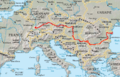 Coucy was not with the crusader body as it traveled, having been detached on a diplomatic mission to Gian Galeazzo Visconti
, the Duke of Milan
. Furious at French political maneuvering that had removed Genoa
from his influence, Gian Galeazzo had been attempting to stop the transfer of Genovese sovereignty to France and Coucy was dispatched to warn him that France would consider further interference a hostile act. The quarrel was more than political. Valentina Visconti
, the wife of the Duke of Orleans and Gian Galeazzo's beloved daughter, had been exiled from Paris due the machinations of Queen Isabeau
the same month as the departure of the crusade. The Duke of Milan threatened to send knights to defend his daughter's honor but, in the wake of the disaster at Nicopolis, it was widely believed that he had relayed intelligence to Bayezid I of crusader troop movements. There is no firm evidence of this and it is likely that Gian Galeazzo became a scapegoat after the fact due the existing animosity with France, though there remains the possibility that the Duke of Milan, who had murdered his own uncle to ensure his own power, did in fact betray the crusaders. Coucy, his diplomatic mission complete and accompanied by Henry of Bar
and their followers, left Milan for Venice, from where he requisitioned a ship on May 17 to take him across the Adriatic Sea
, landing in the Croatia
n port of Senj
on May 30 before making his way overland to the rendezvous in Buda.
Coucy arrived well before Nevers, who had stopped in the upper Danube for receptions and festivities thrown by German princes. Nevers did not arrive in Vienna
until June 24, a full month behind the crusader vanguard led by d'Eu and Boucicaut. A fleet of 70 Venetian vessels loaded with provisions was sent down the Danube, while Nevers enjoyed yet more parties thrown by his brother in law Leopold IV, Duke of Austria
. Nevers then asked his brother in law for a staggering loan of 100,000 ducat
s, which took time to arrange, and eventually arrived in Buda in July.
, Master of the Knights Hospitaller, and representatives of the Venetian fleet. Forty-four Venetian ships had carried the Hospitallers from Rhodes through the Aegean into the Sea of Mamara, and some continued into the Black Sea
and up the Danube without engaging in battle. The fact that the Turks, who had an inferior naval presence, did not challenge the Venetians for control of the sea is seen as evidence that Bayezid and the majority of his forces were already on the European side.
The War Council in Buda was immediately the forum of a fierce dispute. The previous year, Bayezid had declared that he would attack Hungary by May, yet he had not appeared by end of July. Hungarian scouts sent out as far as the Hellespont could find no sign of him, causing the French to proclaim that he was a coward. Sigismund of Hungary assured the crusaders that Bayezid would come, and advised that it would be wiser to let the Turks make the long march to them, rather than make the same long march to find them. This strategy was rejected by the French and their allies. Coucy, acting as spokesman, stated, "Though the Sultan's boasts be lies, that should not keep us from doing deeds of arms and pursuing our enemies, for that is the purpose for which we came." Sigismund had little choice but to acquiesce, though chroniclers also write that Coucy's speech excited jealousy in D'Eu, who felt that he should have had the honor of spokesman due to his position as Constable of France.
The crusaders began to march down the left bank of the Danube, though part of the Hungarian army veered north to gather the forces of Transylvania
and the Mircea the Elder-led forces of Wallachia
. The remainder of the Hungarians brought up the rear of the crusader column. As the crusaders moved into Muslim-held territory, pillaging and mistreatment of the population reportedly grew. While crusaders had been reported to engage in periodic pillage and rapine while passing through Germany, the indiscipline of the French reportedly reached new heights when they entered "schismatic" lands. Chroniclers also waxed eloquent on the immorality and blasphemy of the crusaders, writing detailed accounts of drunkard knights lying with prostitutes for days, despite writing from at best second-hand accounts. Tuchman cautions that such chroniclers were part of a contemporary tendency to blame the defeat of the crusade on the immorality of the crusaders, and that it is impossible to verify such claims.
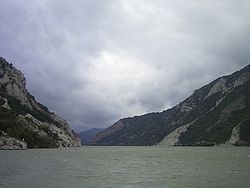 At Orşova
, where the Danube narrows at the Iron Gates
gorge, the column crossed to the right bank using pontoons and boats over eight days. Their first target was Vidin
, previously an important town of western Bulgaria
and then under Turkish control. The prince of Vidin, having no desire to fight for his Turkish conquerors against an overwhelming force of crusaders, promptly surrendered. The only bloodshed was the execution of Turkish officers in the defending garrison, though the incident served to further convince the French that Turks were incapable of challenging the crusaders in the field.
The next target was Oryahovo
(Rachowa), a strong fortress located 75 miles from Vidin. Frustrated by the lack of opportunity to show their bravery in deeds of arms, the French carried out a forced march at night to reach the castle before their allies, arriving in the morning just as the Turkish forces had come out to destroy the bridge across the moat. In fierce combat the French secured the bridge but were unable to push forward until Sigismund arrived. The forces combined and managed to reach the walls before night forced the combatants to retire. The next morning the inhabitants of Oryahovo agreed to surrender to Sigismund on the assurance that their lives and property would be spared. The French promptly broke Sigismund's agreement, pillaging and massacring the town after the gates were open, and later claiming that they had taken the town by conquest because their men-at-arms had topped the walls the night before. A thousand residents, both Turkish and Bulgarian, were taken hostage and the town set ablaze. The Hungarians took the French action as a grave insult to their king, while the French accused the Hungarians of trying to rob them of the glory of victory through combat.
Leaving a garrison to hold Oryahovo, the crusaders continued towards Nicopolis
, assaulting one or two forts or settlements along the way, but bypassing one citadel from which messengers escaped to inform Bayezid of the Christian army. On September 12, the crusaders came within view of the fortress of Nicopolis on its limestone cliff.
The crusaders had brought no siege machines
with them, but Boucicaut optimistically stated that ladders were easily made and worth more than catapults when used by courageous men. However, the lack of siege weapons, the steep slope up to the walls and the formidable fortifications made taking the castle by force impossible. The crusaders set up positions around the town to block the exits, and with the naval blockade of the river, settled in for a siege
to starve out the defenders. Nevertheless they were convinced that the siege of the fortress would be a mere prelude to a major thrust into relieving Constantinople and did not believe that Bayezid I would arrive so speedily to give them a real battle.
Two weeks passed as the bored crusaders entertained themselves with feasts, games and insulting the martial prowess of their enemy. Whether through drunkenness or carelessness, the crusaders posted no sentries, though foragers venturing away from the camps brought word of the Turks' approach. Bayezid was at this time already through Adrianople
and on a forced march through the Shipka Pass to Tirnovo. His ally Stefan Lazarević
of Serbia
joined him on the way. Sigismund had sent 500 horsemen to carry out reconnaissance in force around Tirnovo, 70 miles to the north, and they brought word back that the Turks were indeed coming. Word also reached the besieged inhabitants of Nicopolis, who blew horns and cheered. Boucicaut claimed the noise of their celebration was a ruse as he believed that the Sultan would never attack; he further threatened to cut off the ears of anyone who discussed rumors of the Turks' approach as being damaging to the morale of the crusaders.
One of the few to concern himself with scouting the situation was Coucy, who took a group of 500 knights and 500 mounted archers south. Learning of a large group of Turks approaching through a nearby pass, he separated 200 horsemen to carry out a feint retreat
, drawing the pursuing Turks into an ambush where the rest of his men, waiting concealed, attacked their rear. Giving no quarter, Coucy's men killed as many as they could and returned to the camp where his action shook the camp from its lethargy and drew the admiration of the other crusaders. Tuchman argues that it also increased the overconfidence of the French and again drew the jealousy of D'Eu, who accused Coucy of risking the army out of recklessness and attempting to steal glory and authority from Nevers.
Sigismund called a war council on the 24th, in which he and Mircea cel Batran suggested a battle plan in which the Wallachian foot soldiers with experience in battles with Turks, would be sent in the first attack to meet the Turk vanguard, which was usually a poorly armed militia normally used for pillage but was used in battles to tire opponents before they met better quality Turkish forces. Sigismund claimed that this vanguard was not worthy of the attention of knights. Once the shock of first clash had past, Sigismund proposed that the French form the front line to rush in, while the Hungarians and the other allies followed to support the attack and keep the sipahi
s (Turkish cavalry) from sweeping around the crusaders' flanks. D'Eu denounced the proposal as a demeaning to the knights, who would be forced to follow peasant footmen into battle. He reportedly stated, "To take up the rear is to dishonor us, and expose us to the contempt of all" and declared that he would claim front place as Constable and anyone in front of him would do him mortal insult. In this he was supported by Boucicaut; Nevers, reassured by the confidence of the younger French lords, was easily convinced.
With the French set on a charge, Sigismund left to make a battle plan for his own forces. Apparently within hours, he sent word to the camp that Bayezid was only six hours away. The crusaders, said to be drunk over dinner, reacted in confusion - some refusing to believe the report, some rising in panic, and some hastily preparing for battle. At this point, supposedly because of a lack of spare guards, the prisoners taken at Rachowa were massacred. Even European chroniclers would later dub this an act of "barbarism".
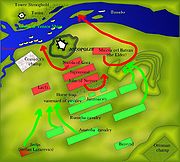 At daybreak on September 25, the combatants began to organize themselves under the banners of their leaders. At this point, Sigismund sent his Grand Marshal to Nevers to report that his scouts had sighted the Turkish vanguard and asked for the offensive to be postponed for two hours, when his scouts would have returned with intelligence as to the numbers and disposition of the enemy. Nevers summoned a hasty council of advisors, in which Coucy and Jean de Vienne
, admiral of France
and the eldest French knight on the crusade, advised obeying the wishes of the Hungarian king, which seemed wise to them. At this, D'Eu declared that Sigismund simply wished to hoard the battle honors for himself and declared his willingness to lead the charge. Coucy, who declared D'Eu's words to be a "presumption," asked for the council of Vienne, who noted, "When truth and reason cannot be heard, then must rule presumption." Vienne commented that if D'Eu wished to advance, the army must follow, but that it would be wiser to advance in concert with the Hungarians and other allies. D'Eu rejected any wait and the council fell into a fierce dispute, with the younger hawks charging that the elder knights were not prudent, but fearful. The argument seems to have been settled when D'Eu decided to advance.
D'Eu took control of the vanguard of the French knights, while Nevers and Coucy commanded the main body. The French knights, accompanied by their mounted archers, rode out with their backs to Nicopolis to meet the Turks, who were descending the hills to the south. The Knights Hospitaler, Germans and other allies stayed with the Hungarian forces under Sigismund. The subsequent events are obscured by conflicting accounts. Tuchman notes, "Out of the welter of different versions, a coherent account of the movements and fortunes of the battlefield is not to be had; there is only a tossing kaleidoscope."
_1.jpg) The French charge crushed the untrained conscripts in the Turkish front line and advanced into the lines of trained infantry, though the knights came under heavy fire from archers and were hampered by rows of sharpened stakes designed to skewer the stomachs of their horses. Chroniclers write of horses impaled on stakes, riders dismounting, stakes being pulled up to allow horses through, and the eventual rout of the Turkish infantry, who fled behind the relative safety of the sipahis. Coucy and Vienne recommended that the French pause to reform their ranks, give themselves some rest and allow the Hungarians time to advance to a position where they could support the French. They were overruled by the younger knights who, having no idea of the size of the Turkish force, believed that they had just defeated Bayezid's entire army and insisted on pursuit.
The French charge crushed the untrained conscripts in the Turkish front line and advanced into the lines of trained infantry, though the knights came under heavy fire from archers and were hampered by rows of sharpened stakes designed to skewer the stomachs of their horses. Chroniclers write of horses impaled on stakes, riders dismounting, stakes being pulled up to allow horses through, and the eventual rout of the Turkish infantry, who fled behind the relative safety of the sipahis. Coucy and Vienne recommended that the French pause to reform their ranks, give themselves some rest and allow the Hungarians time to advance to a position where they could support the French. They were overruled by the younger knights who, having no idea of the size of the Turkish force, believed that they had just defeated Bayezid's entire army and insisted on pursuit.
The French knights thus continued up the hill, though accounts state that more than half were on foot by this point, either because they had been unhorsed by the lines of sharpened stakes or had dismounted to pull up stakes. Struggling in their heavy armor, they reached the plateau on the top of the slope, where they had expected to find fleeing Turkish forces, but instead found themselves facing a fresh corps of sipahis, whom Bayezid had kept in reserve
. As the sipahis surged forward in the counterattack sounding trumpets, banging kettle drums and yelling "God is great
!", the desperation of their situation was readily apparent to the French and some knights broke and fled back down the slope. The rest fought on "no frothing boar nor enraged wolf more fiercely," in the words of one contemporary chronicler. Admiral de Vienne, to whom was granted the honor as the eldest knight of carrying the French standard into battle, was wounded many times as he attempted to rally the morale of his countrymen, before being struck down dead. Other notable knights who were slain include Jean de Carrouges
, Philippe de Bar and Odard de Chasseron. The Turks threatened to overwhelm Nevers and his bodyguard threw themselves to the ground in silent submission to plead for the life of their liege lord. Notwithstanding the declaration of jihad
, the Turks were as interested in the riches that could be gained by ransom
ing noble captives as anyone else, and took Nevers prisoner. Seeing Nevers taken, the rest of the French yielded.
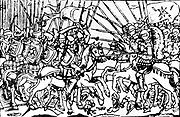 The timeline of events is hazy, but it appears that as the French were advancing up the slope, sipahis were sweeping down along the flanks in an envelopment. Accounts tell of the Hungarians and other nationalities in confused combat on the plain and of a stampede of riderless horses, which Tuchman speculates pulled free from their tethers, at the sight of which the Transylvania
ns and the Wallachia
ns concluded that the day was lost and abandoned the field. Sigismund, the Master of Rhodes, and the Germans fought to prevent the envelopment with "unspeakable massacre" on both sides. At this point, a reinforcement of 1,500 Serbian knights under the command of Stefan Lazarević
proved critical. Sigismund's force was overwhelmed. Convinced to flee, Sigismund and the Master managed to escape by fisherman's boat to the Venetian ships in the Danube. Hermann, a soldier in Sigismund's army led the force that allowed the escape and was later rewarded by being named a count. Bayezid and his ally Stefan Lazarevic recognized the Nikola II Gorjanski, Lazarevic's brother-in-law, fighting on Sigismund's side. A deal was made, and Sigismund's army surrendered, completing their defeat in detail
.
 Sigismund would later state to the Hospitaller Master, "We lost the day by the pride and vanity of these French. If they believed my advice, we had enough men to fight our enemies." Chronicler Jean Froissart
would declare. "Since the Battle of Roncesvalles
when [all] twelve peers of France were slain, Christendom received not so great a damage."
, and had him identify the chief nobles for ransom. Coucy, Bar, D'Eu, Gui de La Tremoïlle and several others were grouped with Nevers to be spared. Those judged to be under age 20 were also spared and put into forced servitude.
The rest, thought to number several thousand, were bound together in groups of three or four and had their hands tied to be marched naked before the Sultan. Ordered to proceed, a group of executioners proceeded to kill each group in turn, either by decapitation
or by severing their limbs from the body. Nevers and the rest of the noble captives were forced to stand beside Bayezid and watch the executions. Jean Le Maingre, called "Boucicaut"
, was recognized in the line, and Nevers fell to his knees before the Sultan and indicated with intertwined fingers that they were like brothers. Thus convinced that Boucicaut was worth a noble ransom, he was spared and grouped with the other high nobles. The killing continued from early morning until late afternoon, at which point Bayezid, either himself sickened by the bloodshed or convinced by his ministers that he was unnecessarily enraging Christendom against him, called off the executioners. Leaving aside the more hyperbolic account, the number of dead is said to have ranged from 300 to 3000, though the number of dead on the battlefield was much more.
Of those who fled the battlefield, few survived. So many attempted to swim to the boats in the Danube that several sank from the load; afterward, those on the boats pushed away those trying to board. Many who attempted to swim all the way across the river drowned. Sigismund, fearful of Wallachian treachery, sailed to the Black Sea and Constantinople before making his way home by sea. Those Crusaders who made it across the Danube and tried to return home by land found that the land they were traveling over had already been stripped of forage by the retreating force of Wallachians. Reduced to wandering through the woods in rags and robbed of whatever possessions they had, many of the starved survivors died along the way. Perhaps the most famous of the few who reached home after this journey was Count Rupert of Bavaria, who arrived at his doorstep in beggar's rags and died several days later from his trials.
The captives were forced to march the 350-mile length to Gallipoli
, stripped of clothing down to the their shirts and most without shoes, with hands tied and beaten by their captors. At Gallipoli, the noble captives were kept in the upper rooms of a tower while the 300 prisoners that were the Sultan's share of the common captives were kept below. The ship carrying Sigismund passed within half a mile of the tower as it went through the Hellespont, for which the Turks lined the captives along the shore and mockingly called out for Sigismund to come and rescue his comrades. Sigismund, while in Constantinople, had made overtures to ransom the captives, but Bayezid was aware that Hungary's wealth had been depleted in the crusade and that richer ransoms could be had from France. After two months in Gallipoli, the prisoners were transferred to Brusa, the joint Ottoman capital located in Asia, where they awaited word of their ransom.
In the first week of December, rumors of unimaginable defeat arrived in Paris. As no certain news was to be had, rumor-mongers were imprisoned in the Grand Châtelet
and, if convicted of lying, sentenced to death by drowning. The King, Burgundy, Orleans and Duc de Bar all sped envoys to Venice and Hungary to bring word back. On December 16, merchant ships brought word to Venice of defeat at Nicopolis and the escape of Sigismund.
Jacques de Helly, the knight who had identified the nobles after the battle, had been charged by Bayezid, under his vow to return, to inform the King of France and Duke of Burgundy of his victory and demands for ransom. On Christmas, de Helly rode into Paris and, kneeling before the king, recounted the expedition, the battle, defeat and Bayezid's massacre of the prisoners. He also carried letters from Nevers and the other noble captives. Those for whom he did not carry letters were assumed to be dead, and weeping members of the court gathered around de Helly to seek more information about loved ones. According to the Monk of St. Denis, "affliction reigned in all hearts" and Deschamps wrote of "funerals from morning to eve." January 9 was declared a day of mourning throughout France and that day "it was piteous to hear the bells toiling in all the churches in Paris."
A delegation with rich gifts for Bayezid left Paris on 20 January 1397 to negotiate the ransoms. De Helly, bound by his oath to return, had already departed with letters for the captives. Gian Galeazzo's help became vital, as he had extensive contacts in the Ottoman court. Envoys were sent informing him of belated approval by the King allowing the fleur-de-lis
to be added to the Visconti escutcheon, Galeazzo's first wife having been from the French royal house, and to make every effort to gain his assistance. Meanwhile, those envoys sent in early December had reached Venice and, having learned of the fate of the captives, were attempting to make their way to Brusa. Venice, which was the French conduit to the Muslim east due to her trade network, became the center for exchange of news, cash and ransomed captives.
On 13 February 1397, de Coucy, ill and perhaps suffering from battle wounds, died. Boucicaut and Guy de Tremoille released on their own accord to seek funds in the Levant reached Rhodes where de Tremoille fell ill and died around Easter. French negotiators in the Sultan's court finally reached agreement on a ransom of 200,000 gold florins in June. Comte d'Eu died on 15 June. With a down payment of 75,000, the prisoners were released on 24 June on their promise to stay in Venice until the rest of the ransom was paid. However, the nobles found it unthinkable to travel in less than their accustomed splendor and borrowed nearly as much as the ransom amount in re-provisioning themselves. Arriving in Venice in October after stopping in various islands to recover and borrow money, the financial transactions required to both provide the ransom and pay for the travel arrangements and living expenses of the nobles were tremendously complicated. A three-sided transaction between Burgundy, Sigismund and Venice took 27 years to settle. A plague outbreak in Venice required the nobles to move temporarily to Treviso
, but still claimed Henri de Bar.
The last of the Crusader leaders - Nevers, Boucicaut, Guillaume de Tremoille and Jacques de la Marche -, along with seven or eight other knights, re-entered France in February 1398. They were greeted by minstrels, parties and parades as they journeyed across the kingdom, though Tuchman notes, "the receptions probably represented not so much popular enthusiasm as organized joy, in which the 14th century excelled."
remarked upon "the lamentable consquences of statecraft recklessly embarking on an enterprise of vital import in the spirit of a chivalrous adventure
", though participants and contemporary chroniclers did not analyse the catastrophe in these terms.
No new expedition was launched from Western Europe to stop the Turkish advance in the Balkans after this defeat, until the 1440s. England and France soon renewed their war. Wallachia continued its stance against the Ottomans, having stopped another expedition in the next year, 1397, and in 1400 yet another expedition of the Ottomans. The defeat of Sultan Beyazid I by Timur
(Tamerlane) at Ankara in the summer of 1402 opened a period of anarchy in the Ottoman Empire and Mircea cel Batran took advantage of it to organize together with the Kingdom of Hungary a campaign against the Turks. The Hungarians and Poles
were defeated at the Battle of Varna
in 1444, and Constantinople finally fell
in 1453 to the Turks, followed by the Despotate of Morea
in 1460 and the Empire of Trebizond
in 1461, which brought an end to the last vestiges of the Byzantine Empire as well as the final remaining pockets of Greek resistance against the Ottoman Turks in both the Balkans and Anatolia.
The Battle of Nicopolis is also widely regarded as the end of the Second Bulgarian Empire
, since hopes for its salvation had come to an end with the defeat of the Crusaders.
By their victory at Nicopolis, the Turks discouraged the formation of future European coalitions against them. They maintained their pressure on Constantinople, tightened their control over the Balkans, and became a greater threat to central Europe.
Kingdom of Hungary
The Kingdom of Hungary comprised present-day Hungary, Slovakia and Croatia , Transylvania , Carpatho Ruthenia , Vojvodina , Burgenland , and other smaller territories surrounding present-day Hungary's borders...
, Wallachian, French
France in the Middle Ages
France in the Middle Ages covers an area roughly corresponding to modern day France, from the death of Louis the Pious in 840 to the middle of the 15th century...
, Burgundian
Burgundian
Burgundian can refer to any of the following:*Burgundians, an East Germanic tribe, who first appear in history in South East Europe. Later Burgundians colonised the area of Gaul that is now known as Burgundy ....
, German
Holy Roman Empire
The Holy Roman Empire was a realm that existed from 962 to 1806 in Central Europe.It was ruled by the Holy Roman Emperor. Its character changed during the Middle Ages and the Early Modern period, when the power of the emperor gradually weakened in favour of the princes...
and assorted troops (assisted by the Venetian
Republic of Venice
The Republic of Venice or Venetian Republic was a state originating from the city of Venice in Northeastern Italy. It existed for over a millennium, from the late 7th century until 1797. It was formally known as the Most Serene Republic of Venice and is often referred to as La Serenissima, in...
navy) at the hands of an Ottoman
Ottoman Empire
The Ottoman EmpireIt was usually referred to as the "Ottoman Empire", the "Turkish Empire", the "Ottoman Caliphate" or more commonly "Turkey" by its contemporaries...
force, raising of the siege of the Danubian
Danube
The Danube is a river in the Central Europe and the Europe's second longest river after the Volga. It is classified as an international waterway....
fortress of Nicopolis
Nikopol, Bulgaria
Nikopol is a town in northern Bulgaria, the administrative center of Nikopol municipality, part of Pleven Province, on the right bank of the Danube river, 4 km downstream from the mouth of the Osam river. It spreads at the foot of steep chalk cliffs along the Danube and up a narrow valley...
and leading to the end of the Second Bulgarian Empire
Second Bulgarian Empire
The Second Bulgarian Empire was a medieval Bulgarian state which existed between 1185 and 1396 . A successor of the First Bulgarian Empire, it reached the peak of its power under Kaloyan and Ivan Asen II before gradually being conquered by the Ottomans in the late 14th-early 15th century...
. It is often referred to as the Crusade of Nicopolis and was the last large-scale crusade of the Middle Ages
Middle Ages
The Middle Ages is a periodization of European history from the 5th century to the 15th century. The Middle Ages follows the fall of the Western Roman Empire in 476 and precedes the Early Modern Era. It is the middle period of a three-period division of Western history: Classic, Medieval and Modern...
.
Background
There were many minor crusades in the 14th century, undertaken by individual kings or knights. Most recently there had been a failed crusade against TunisiaTunisia
Tunisia , officially the Tunisian RepublicThe long name of Tunisia in other languages used in the country is: , is the northernmost country in Africa. It is a Maghreb country and is bordered by Algeria to the west, Libya to the southeast, and the Mediterranean Sea to the north and east. Its area...
in 1390, and there was ongoing warfare in northern Europe
Northern Crusades
The Northern Crusades or Baltic Crusades were crusades undertaken by the Christian kings of Denmark and Sweden, the German Livonian and Teutonic military orders, and their allies against the pagan peoples of Northern Europe around the southern and eastern shores of the Baltic Sea...
along the Baltic
Baltic Sea
The Baltic Sea is a brackish mediterranean sea located in Northern Europe, from 53°N to 66°N latitude and from 20°E to 26°E longitude. It is bounded by the Scandinavian Peninsula, the mainland of Europe, and the Danish islands. It drains into the Kattegat by way of the Øresund, the Great Belt and...
coast. After their victory at the Battle of Kosovo
Battle of Kosovo
The Battle of Kosovo took place on St. Vitus' Day, June 15, 1389, between the army led by Serbian Prince Lazar Hrebeljanović, and the invading army of the Ottoman Empire under the leadership of Sultan Murad I...
in 1389, the Ottomans had conquered most of the Balkans
Balkans
The Balkans is a geopolitical and cultural region of southeastern Europe...
, and had reduced the Byzantine Empire
Byzantine Empire
The Byzantine Empire was the Eastern Roman Empire during the periods of Late Antiquity and the Middle Ages, centred on the capital of Constantinople. Known simply as the Roman Empire or Romania to its inhabitants and neighbours, the Empire was the direct continuation of the Ancient Roman State...
to the area immediately surrounding Constantinople
Constantinople
Constantinople was the capital of the Roman, Eastern Roman, Byzantine, Latin, and Ottoman Empires. Throughout most of the Middle Ages, Constantinople was Europe's largest and wealthiest city.-Names:...
, which they later proceeded to besiege (in 1390, 1395, 1397, 1400, 1422 and finally conquering the Byzantine capital
Fall of Constantinople
The Fall of Constantinople was the capture of the capital of the Byzantine Empire, which occurred after a siege by the Ottoman Empire, under the command of Ottoman Sultan Mehmed II, against the defending army commanded by Byzantine Emperor Constantine XI...
in 1453).
In 1393 the Bulgaria
Bulgaria
Bulgaria , officially the Republic of Bulgaria , is a parliamentary democracy within a unitary constitutional republic in Southeast Europe. The country borders Romania to the north, Serbia and Macedonia to the west, Greece and Turkey to the south, as well as the Black Sea to the east...
n tsar Ivan Shishman
Ivan Shishman of Bulgaria
Ivan Shishman ruled as emperor of Bulgaria in Tarnovo from 1371 to 3 July 1395. The authority of Ivan Shishman was limited to the central parts of the Bulgarian Empire. His indecisive and inconsistent policy did little to prevent the fall of his country under Ottoman rule. In 1393 the Ottoman...
had lost Nicopolis — his temporary capital — to the Ottomans, while his brother, Ivan Stratsimir, still held Vidin
Vidin
Vidin is a port town on the southern bank of the Danube in northwestern Bulgaria. It is close to the borders with Serbia and Romania, and is also the administrative centre of Vidin Province, as well as of the Metropolitan of Vidin...
but had been reduced to an Ottoman vassal. In the eyes of the Bulgarian boyar
Boyar
A boyar, or bolyar , was a member of the highest rank of the feudal Moscovian, Kievan Rus'ian, Bulgarian, Wallachian, and Moldavian aristocracies, second only to the ruling princes , from the 10th century through the 17th century....
s, despots and other independent Balkan rulers, this was a great chance to reverse the course of the Ottoman conquest and free the Balkans from Islamic rule. In addition, the frontline between Islam and Christianity had been moving slowly towards the Kingdom of Hungary. The Kingdom of Hungary
Kingdom of Hungary
The Kingdom of Hungary comprised present-day Hungary, Slovakia and Croatia , Transylvania , Carpatho Ruthenia , Vojvodina , Burgenland , and other smaller territories surrounding present-day Hungary's borders...
was now the frontier between the two religions in Eastern Europe, and the Hungarians were in danger of being attacked themselves. The Republic of Venice
Republic of Venice
The Republic of Venice or Venetian Republic was a state originating from the city of Venice in Northeastern Italy. It existed for over a millennium, from the late 7th century until 1797. It was formally known as the Most Serene Republic of Venice and is often referred to as La Serenissima, in...
feared that an Ottoman control of the Balkan peninsula, which included Venetian territories like parts of Morea
Morea
The Morea was the name of the Peloponnese peninsula in southern Greece during the Middle Ages and the early modern period. It also referred to a Byzantine province in the region, known as the Despotate of Morea.-Origins of the name:...
and Dalmatia
Dalmatia
Dalmatia is a historical region on the eastern coast of the Adriatic Sea. It stretches from the island of Rab in the northwest to the Bay of Kotor in the southeast. The hinterland, the Dalmatian Zagora, ranges from fifty kilometers in width in the north to just a few kilometers in the south....
, would reduce their influence over the Adriatic Sea
Adriatic Sea
The Adriatic Sea is a body of water separating the Italian Peninsula from the Balkan peninsula, and the system of the Apennine Mountains from that of the Dinaric Alps and adjacent ranges...
, Ionian Sea
Ionian Sea
The Ionian Sea , is an arm of the Mediterranean Sea, south of the Adriatic Sea. It is bounded by southern Italy including Calabria, Sicily and the Salento peninsula to the west, southern Albania to the north, and a large number of Greek islands, including Corfu, Zante, Kephalonia, Ithaka, and...
and Aegean Sea
Aegean Sea
The Aegean Sea[p] is an elongated embayment of the Mediterranean Sea located between the southern Balkan and Anatolian peninsulas, i.e., between the mainlands of Greece and Turkey. In the north, it is connected to the Marmara Sea and Black Sea by the Dardanelles and Bosporus...
. The Republic of Genoa
Republic of Genoa
The Most Serene Republic of Genoa |Ligurian]]: Repúbrica de Zêna) was an independent state from 1005 to 1797 in Liguria on the northwestern Italian coast, as well as Corsica from 1347 to 1768, and numerous other territories throughout the Mediterranean....
, on the other hand, feared that if the Ottomans would gain control over River Danube and the Turkish Straits
Turkish Straits
The term Turkish Straits refers to the two narrow straits in northwestern Turkey, the Bosphorus and the Dardanelles, that connect the Sea of Marmara with the Black Sea on one side and the Aegean arm of the Mediterranean Sea on the other. They are conventionally considered the boundary between the...
, they would eventually obtain a monopoly over the trade routes between Europe and the Black Sea
Black Sea
The Black Sea is bounded by Europe, Anatolia and the Caucasus and is ultimately connected to the Atlantic Ocean via the Mediterranean and the Aegean seas and various straits. The Bosphorus strait connects it to the Sea of Marmara, and the strait of the Dardanelles connects that sea to the Aegean...
, where the Genoese had many important colonies like Caffa, Sinop
Sinop, Turkey
Sinop is a city with a population of 36,734 on İnce Burun , by its Cape Sinop which is situated on the most northern edge of the Turkish side of Black Sea coast, in the ancient region of Paphlagonia, in modern-day northern Turkey, historically known as Sinope...
and Amasra
Amasra
Amasra is a small Black Sea port town in the Bartın Province, Turkey. The town is today much appreciated for its beaches and natural setting, which has made tourism the most important activity for its inhabitants...
. The Genoese also owned the citadel of Galata
Galata
Galata or Galatae is a neighbourhood in the Beyoğlu district on the European side of Istanbul, the largest city of Turkey. Galata is located at the northern shore of the Golden Horn, the inlet which separates it from the historic peninsula of old Constantinople. The Golden Horn is crossed by...
, located at the north of the Golden Horn
Golden Horn
The Golden Horn is a historic inlet of the Bosphorus dividing the city of Istanbul and forming the natural harbor that has sheltered Greek, Roman, Byzantine, Ottoman and other ships for thousands of...
in Constantinople
Constantinople
Constantinople was the capital of the Roman, Eastern Roman, Byzantine, Latin, and Ottoman Empires. Throughout most of the Middle Ages, Constantinople was Europe's largest and wealthiest city.-Names:...
, to which Bayezid had laid siege in 1395.
In 1394, Pope Boniface IX
Pope Boniface IX
Pope Boniface IX , born Piero Tomacelli, was the second Roman Pope of the Western Schism from November 2, 1389, until October 1, 1404...
proclaimed a new crusade against the Turks, although the Western Schism
Western Schism
The Western Schism or Papal Schism was a split within the Catholic Church from 1378 to 1417. Two men simultaneously claimed to be the true pope. Driven by politics rather than any theological disagreement, the schism was ended by the Council of Constance . The simultaneous claims to the papal chair...
had split the papacy in two, with rival popes at Avignon
Avignon
Avignon is a French commune in southeastern France in the départment of the Vaucluse bordered by the left bank of the Rhône river. Of the 94,787 inhabitants of the city on 1 January 2010, 12 000 live in the ancient town centre surrounded by its medieval ramparts.Often referred to as the...
and Rome
Rome
Rome is the capital of Italy and the country's largest and most populated city and comune, with over 2.7 million residents in . The city is located in the central-western portion of the Italian Peninsula, on the Tiber River within the Lazio region of Italy.Rome's history spans two and a half...
, and the days when a pope had the authority to call a crusade were long past.
The two decisive factors in the formation of the last crusade were the ongoing Hundred Years' War
Hundred Years' War
The Hundred Years' War was a series of separate wars waged from 1337 to 1453 by the House of Valois and the House of Plantagenet, also known as the House of Anjou, for the French throne, which had become vacant upon the extinction of the senior Capetian line of French kings...
between Richard II
Richard II of England
Richard II was King of England, a member of the House of Plantagenet and the last of its main-line kings. He ruled from 1377 until he was deposed in 1399. Richard was a son of Edward, the Black Prince, and was born during the reign of his grandfather, Edward III...
's England
England
England is a country that is part of the United Kingdom. It shares land borders with Scotland to the north and Wales to the west; the Irish Sea is to the north west, the Celtic Sea to the south west, with the North Sea to the east and the English Channel to the south separating it from continental...
and Charles VI
Charles VI of France
Charles VI , called the Beloved and the Mad , was the King of France from 1380 to 1422, as a member of the House of Valois. His bouts with madness, which seem to have begun in 1392, led to quarrels among the French royal family, which were exploited by the neighbouring powers of England and Burgundy...
's France
France
The French Republic , The French Republic , The French Republic , (commonly known as France , is a unitary semi-presidential republic in Western Europe with several overseas territories and islands located on other continents and in the Indian, Pacific, and Atlantic oceans. Metropolitan France...
and the support of Philip II
Philip the Bold
Philip the Bold , also Philip II, Duke of Burgundy , was the fourth and youngest son of King John II of France and his wife, Bonne of Luxembourg. By his marriage to Margaret III, Countess of Flanders, he also became Count Philip II of Flanders, Count Philip IV of Artois and Count-Palatine Philip IV...
, Duke of Burgundy
Duke of Burgundy
Duke of Burgundy was a title borne by the rulers of the Duchy of Burgundy, a small portion of traditional lands of Burgundians west of river Saône which in 843 was allotted to Charles the Bald's kingdom of West Franks...
. In 1389, the war had ground to one of its periodic truces. Further, in March 1395, Richard II proposed a marriage between himself and Charles VI's daughter Isabella in the interests of peace and the two kings met in October 1396 on the borders of Calais
Calais
Calais is a town in Northern France in the department of Pas-de-Calais, of which it is a sub-prefecture. Although Calais is by far the largest city in Pas-de-Calais, the department's capital is its third-largest city of Arras....
to agree to the union and agree to lengthen the Truce of Leulinghem
Truce of Leulinghem
The Truce of Leulinghem was a truce agreed to by Richard II's kingdom of England and its allies, and Charles VI's kingdom of France and its allies, on 18 July 1389, ending the third phase of the Hundred Years' War. England was on the edge of financial collapse and suffering from internal political...
. The support of Burgundy, among the most powerful of the French nobles was also vital. In 1391, Burgundy, trying to decide between sending a crusade to either Prussia
Prussia
Prussia was a German kingdom and historic state originating out of the Duchy of Prussia and the Margraviate of Brandenburg. For centuries, the House of Hohenzollern ruled Prussia, successfully expanding its size by way of an unusually well-organized and effective army. Prussia shaped the history...
or Hungary
Hungary
Hungary , officially the Republic of Hungary , is a landlocked country in Central Europe. It is situated in the Carpathian Basin and is bordered by Slovakia to the north, Ukraine and Romania to the east, Serbia and Croatia to the south, Slovenia to the southwest and Austria to the west. The...
, sent his envoy Guy de La Trémoille to Venice
Venice
Venice is a city in northern Italy which is renowned for the beauty of its setting, its architecture and its artworks. It is the capital of the Veneto region...
and Hungary to evaluate the situation. Burgundy originally envisioned a crusade led by himself and the Dukes of Orléans and Lancaster
John of Gaunt, 1st Duke of Lancaster
John of Gaunt, 1st Duke of Lancaster , KG was a member of the House of Plantagenet, the third surviving son of King Edward III of England and Philippa of Hainault...
, though none would join the eventual crusade. It was very unlikely that defense against the Turks was considered a particularly important goal of the crusade. Burgundy's interest in sponsoring the crusade was in increasing his and his house's prestige and power and, historian Barbara Tuchman
Barbara Tuchman
Barbara Wertheim Tuchman was an American historian and author. She became known for her best-selling book The Guns of August, a history of the prelude to and first month of World War I, which won the Pulitzer Prize for General Non-Fiction in 1963....
notes, "since he was the prince of self-magnification, the result was that opulent display became the dominant theme; plans, logistics, intelligence about the enemy came second, if at all." In 1394, Burgundy extracted 120,000 livres from Flanders
Flanders
Flanders is the community of the Flemings but also one of the institutions in Belgium, and a geographical region located in parts of present-day Belgium, France and the Netherlands. "Flanders" can also refer to the northern part of Belgium that contains Brussels, Bruges, Ghent and Antwerp...
, sufficient to begin preparations for a crusade, and in January 1395 sent word to Sigismund
Sigismund
Sigismund is a German proper name, meaning "protection through victory", from Old High German sigu "victory" + munt "hand, protection". Tacitus Latinises it Segimundus...
, the King of Hungary that an official request to the King of France would be accepted. (Sigismund became Holy Roman Emperor in 1433).
In August, Sigismund's delegation of four knights and a bishop arrived in the court of Paris
Paris
Paris is the capital and largest city in France, situated on the river Seine, in northern France, at the heart of the Île-de-France region...
to paint a description of how "40,000" Turks were despoiling and imperiling Christian lands and beg, on Sigismund of Hungary's behalf, for help. Charles VI, having secured a peace with England through the marriage of his daughter, was able to reply that "as chief of the Christian kings" it was his responsibility to protect Christianity and punish Sultan Bayezid
Bayezid I
Bayezid I was the Sultan of the Ottoman Empire, from 1389 to 1402. He was the son of Murad I and Valide Sultan Gülçiçek Hatun.-Biography:Bayezid was born in Edirne and spent his youth in Bursa, where he received a high-level education...
. French nobility responded enthusiastically to the declaration; Philip of Artois, Count of Eu
Philip of Artois, Count of Eu
Philip of Artois , son of John of Artois, Count of Eu and Isabeau of Melun, was Count of Eu from 1387 until his death, succeeding his brother Robert....
, the Constable of France
Constable of France
The Constable of France , as the First Officer of the Crown, was one of the original five Great Officers of the Crown of France and Commander in Chief of the army. He, theoretically, as Lieutenant-general of the King, outranked all the nobles and was second-in-command only to the King...
, and Jean Le Maingre
Jean Le Maingre
Jean II Le Maingre , called Boucicaut was marshal of France and a knight renowned for his military skill.He was the son of marshal Jean I Le Maingre, also called Boucicaut...
, the Marshal of France
Marshal of France
The Marshal of France is a military distinction in contemporary France, not a military rank. It is granted to generals for exceptional achievements...
, declared participation in the crusade the duty of every "man of valor".
Strength of forces
The number of combatants is heavily contested in historical accounts. Historian Tuchman notes, "Chroniclers habitually matched numbers to the awesomeness of the event," and the Battle of Nicopolis was considered so significant that the number of combatants given by medieval chroniclers ranges as high as 400,000, with each side insisting that the enemy outnumbered them two-to-one, which for the crusaders offered some solace for their defeat and for the Turks increased the glory of their victory. The oft-given figure of 100,000 crusaders is dismissed by Tuchman, who notes that 100,000 men would have taken a month to cross the DanubeDanube
The Danube is a river in the Central Europe and the Europe's second longest river after the Volga. It is classified as an international waterway....
at Iron Gate
Iron Gate (Danube)
The Iron Gates The gorge lies between Romania in the north and Serbia in the south. At this point, the river separates the southern Carpathian Mountains from the northwestern foothills of the Balkan Mountains. The Romanian, Hungarian, Slovakian, Turkish, German and Bulgarian names literally mean...
, while the crusaders took eight days.
The closest record to a first-person account was made by Johann Schiltberger
Johann Schiltberger
Johann Schiltberger was a German traveller and writer. He was born of a noble family, probably at Hollern near Lohhof halfway between Munich and Freising.- Travels:...
, a German follower of a Bavarian noble, who witnessed the battle at the age of 16 and was captured and enslaved for 30 years by the Turks before returning home, at which time he wrote a narrative of the battle estimating the crusader strength at the final battle at 16,000, though he also estimated Turkish forces as a wildly inflated 200,000. German historians of the 19th century attempting to estimate the combatants on each side came to the figures of about 7,500-9000 Christians and about 12,000-20,000 Turks, while noting that, from the point of logistics, it would have been impossible for the countryside around Nicopolis to have supplied food and fodder for scores of thousands of men and horses. (Medieval armies acquired supplies by taking them from the surrounding area as they marched, as opposed to using the supply lines of modern armies.)
| Source | Year | Affiliation | # of crusaders | # of Turks | Total # | Cite |
|---|---|---|---|---|---|---|
| Johann Schiltberger Johann Schiltberger Johann Schiltberger was a German traveller and writer. He was born of a noble family, probably at Hollern near Lohhof halfway between Munich and Freising.- Travels:... |
1427 | European | 16,000 | 200,000 | 216,000 | |
| German historians of the 19th c | 19th century | European | 7,500-9,000 | 12,000-20,000 | 19,500-29,000 | |
| Şükrullah in his Behçetu't-Tevârih | 15th century | Ottoman | 130,000 | 60,000 | 190,000 | |
| David Nicholle | 1999 | European | 16,000 | 15,000 | 31,000 |
Composition of crusader forces
From France, it was said about 2,000 knights and squires joined, and were accompanied by 6,000 archers and foot soldiers drawn from the best volunteer and mercenary companies. Next in importance were the Knights HospitallerKnights Hospitaller
The Sovereign Military Hospitaller Order of Saint John of Jerusalem of Rhodes and of Malta , also known as the Sovereign Military Order of Malta , Order of Malta or Knights of Malta, is a Roman Catholic lay religious order, traditionally of military, chivalrous, noble nature. It is the world's...
of Rhodes
Rhodes
Rhodes is an island in Greece, located in the eastern Aegean Sea. It is the largest of the Dodecanese islands in terms of both land area and population, with a population of 117,007, and also the island group's historical capital. Administratively the island forms a separate municipality within...
, who were the standard bearers of Christianity in the Levant
Levant
The Levant or ) is the geographic region and culture zone of the "eastern Mediterranean littoral between Anatolia and Egypt" . The Levant includes most of modern Lebanon, Syria, Jordan, Israel, the Palestinian territories, and sometimes parts of Turkey and Iraq, and corresponds roughly to the...
since the decline of Constantinople
Constantinople
Constantinople was the capital of the Roman, Eastern Roman, Byzantine, Latin, and Ottoman Empires. Throughout most of the Middle Ages, Constantinople was Europe's largest and wealthiest city.-Names:...
and Cyprus
Cyprus
Cyprus , officially the Republic of Cyprus , is a Eurasian island country, member of the European Union, in the Eastern Mediterranean, east of Greece, south of Turkey, west of Syria and north of Egypt. It is the third largest island in the Mediterranean Sea.The earliest known human activity on the...
. Venice
Venice
Venice is a city in northern Italy which is renowned for the beauty of its setting, its architecture and its artworks. It is the capital of the Veneto region...
supplied a naval fleet for supporting action, while Hungarian envoys encouraged German princes of the Rhineland
Rhineland
Historically, the Rhinelands refers to a loosely-defined region embracing the land on either bank of the River Rhine in central Europe....
, Bavaria
Bavaria
Bavaria, formally the Free State of Bavaria is a state of Germany, located in the southeast of Germany. With an area of , it is the largest state by area, forming almost 20% of the total land area of Germany...
, Saxony
Saxony
The Free State of Saxony is a landlocked state of Germany, contingent with Brandenburg, Saxony Anhalt, Thuringia, Bavaria, the Czech Republic and Poland. It is the tenth-largest German state in area, with of Germany's sixteen states....
and other parts of the empire to join. French heralds had proclaimed the crusade in Poland
Poland
Poland , officially the Republic of Poland , is a country in Central Europe bordered by Germany to the west; the Czech Republic and Slovakia to the south; Ukraine, Belarus and Lithuania to the east; and the Baltic Sea and Kaliningrad Oblast, a Russian exclave, to the north...
, Bohemia
Bohemia
Bohemia is a historical region in central Europe, occupying the western two-thirds of the traditional Czech Lands. It is located in the contemporary Czech Republic with its capital in Prague...
, Navarre
Navarre
Navarre , officially the Chartered Community of Navarre is an autonomous community in northern Spain, bordering the Basque Country, La Rioja, and Aragon in Spain and Aquitaine in France...
and Spain
Spain
Spain , officially the Kingdom of Spain languages]] under the European Charter for Regional or Minority Languages. In each of these, Spain's official name is as follows:;;;;;;), is a country and member state of the European Union located in southwestern Europe on the Iberian Peninsula...
, from which individuals came to join.
The Italian city-states were too much engaged in their customary violent rivalries to participate, and the widely reported and acclaimed English participation never actually occurred. The report of 1000 English knights comes from contemporary Antonio Fiorentino, and was taken as fact by historian Aziz S. Atiya and others following him. A thousand knights would have actually amounted to "four to six thousand men and at least twice as many horses", counting foot-soldiers and other retainers. However, there are no records of financial arrangements being made in England to send a force abroad, nor of any royal preparation needed to organize and dispatch such a force. Reports of Henry of Bolingbroke or other "son of the Duke of Lancaster" leading an English contingent must be false since the presence of Henry and every other such son, as well as almost every other significant noble in the land, is recorded at the king's wedding five months after the crusade's departure. Atiya also thought that the invocation of St. George as a war cry at Nicopolis signified the presence of English soldiers, for whom George was a patron saint; but Froissart, who mentions this, claims that the cry was made by the French knight Philippe d'Eu. Furthermore, there was no collection of ransom money in England to pay for captives, as there was in every other country that had sent men to the battle. Sporadic mention in contemporary accounts of the presence of "English" may be attributed to Knights Hospitaller of the English tongue
Tongue (Knights Hospitaller)
Tongues or langues were the geographic-cultural subgroupings of the members of the Knights of Rhodes/Maltese Knights from the 14th to the 18th century...
subgrouping, who joined their comrades for the crusade after leaving Rhodes
Rhodes
Rhodes is an island in Greece, located in the eastern Aegean Sea. It is the largest of the Dodecanese islands in terms of both land area and population, with a population of 117,007, and also the island group's historical capital. Administratively the island forms a separate municipality within...
(where the Hospitallers were based at the time) and sailing up the Danube. Possible reasons for the English absence include the increasing tension between the king and the Duke of Gloucester, which may have convinced the two that they had best keep their supporters close, and the antipathy caused by the long war between the English and French, resulting in the English refusing to consider putting themselves under a French-led crusade, regardless of the recently concluded peace.
Nevertheless, obviously inflated figures continue to be repeated. These include 6-8,000 Hungarians, ~ 10,000 French, English and Burgundian troops, ~ 10,000 Wallachians lead by Mircea cel Batran (Mircea The elder) the king of Wallachia, ~ 6,000 Germans and nearly 15,000 Dutch, Bohemian, Spanish, Italian, Polish, Bulgarian, Scottish and Swiss troops on the land, with the naval support of Venice, Genoa and the Knights of St. John. These result in a figure of about 47,000 - 49,000 in total; possibly up to 120,000 or 130,000 according to numerous sources, including the 15th century Ottoman historian Şükrullah who gives the figure of the Crusader army as 130,000 in his Behçetu't-Tevârih.
Composition of Islamic forces
Also estimated at about 20-25,000; but inflated figures continue to be repeated of up to 60,000 according to numerous sources including the 15th century Ottoman historian Şükrullah, who gives the figure of the Ottoman army as 60,000 in his Behçetu't-Tevârih; alternately described as roughly half of the Crusader army. The Ottoman force also included 1,500 Serbian heavy cavalry knights under the command of Prince Stefan LazarevićStefan Lazarevic
Stefan Lazarević known also as Stevan the Tall was a Serbian Despot, ruler of the Serbian Despotate between 1389 and 1427. He was the son and heir to Prince Lazar, who died at the Battle of Kosovo against the Turks in 1389, and Princess Milica from the subordinate branch of the Nemanjić dynasty...
, who was Sultan Bayezid's vassal
Vassal
A vassal or feudatory is a person who has entered into a mutual obligation to a lord or monarch in the context of the feudal system in medieval Europe. The obligations often included military support and mutual protection, in exchange for certain privileges, usually including the grant of land held...
since the Battle of Kosovo
Battle of Kosovo
The Battle of Kosovo took place on St. Vitus' Day, June 15, 1389, between the army led by Serbian Prince Lazar Hrebeljanović, and the invading army of the Ottoman Empire under the leadership of Sultan Murad I...
in 1389, as well as his brother-in-law
Brother-in-law
A brother-in-law is the brother of one's spouse, the husband of one's sibling, or the husband of one's spouse's sibling.-See also:*Affinity *Sister-in-law*Brothers in Law , a 1955 British comedy novel...
after the Sultan married Stefan's sister, Princess Olivera Despina, the daughter of Prince Lazar of Serbia
Lazar of Serbia
Lazar Hrebeljanović , was a medieval nobleman that emerged as the most powerful Serbian ruler after the death of the previous, childless, Emperor Uroš the Weak, which resulted in years of instability in the Serbian realm. As Stefan Lazar, he was Prince of Serbia from 1371 to 1389, ruling what is...
(Stefan's father) who had perished at Kosovo.
Journey
While Philip, Duke of BurgundyDuke of Burgundy
Duke of Burgundy was a title borne by the rulers of the Duchy of Burgundy, a small portion of traditional lands of Burgundians west of river Saône which in 843 was allotted to Charles the Bald's kingdom of West Franks...
, had originally planned to lead the crusade along with John of Gaunt and Louis of Orleans
Louis of Valois, Duke of Orléans
Louis I was Duke of Orléans from 1392 to his death. He was also Count of Valois, Duke of Touraine , Count of Blois , Angoulême , Périgord, Dreux, and Soissons....
, all three withdrew, claiming that the peace negotiations with England required their presence, though perhaps also because none dared leave the vicinity of the throne if their chief rivals stayed. However, Burgundy retained control of the enterprise he was funding by naming 24-year-old John de Nevers, the Duke's eldest son, for nominal command. Burgundy, perhaps recognizing that his son, as well as Constable d'Eu and Marshal Boucicaut, who were both under 35, lacked the necessary experience, summoned Enguerrand VII, Lord of Coucy, the most experienced warrior and statesman of the realm, and prevailed on him to be "chief counselor" to Nevers during the crusade. The ambiguity of the crusaders' command structure would prove to be crucial in the final outcome. While Nevers was given a long list of "counselors", as well as another list of prominent French lords on the crusade with whom Nevers could consult "when it seemed good to him", the concept of unity of command
Command (military formation)
A command in military terminology is an organisational unit that the individual in Military command has responsibility for. A Commander will normally be specifically appointed into the role in order to provide a legal framework for the authority bestowed...
was not yet understood by medieval warriors. Rules of discipline for the crusade were decreed at a War Council on March 28, 1396, which included the final provision, "Item, that [in battle] the Count and his company claim the avante garde," revealing that the chivalric code continued to require knights to prove their valor by leading the charge.
To Buda
The crusade set forth from DijonDijon
Dijon is a city in eastern France, the capital of the Côte-d'Or département and of the Burgundy region.Dijon is the historical capital of the region of Burgundy. Population : 151,576 within the city limits; 250,516 for the greater Dijon area....
on April 30, 1396, heading across Bavaria
Bavaria
Bavaria, formally the Free State of Bavaria is a state of Germany, located in the southeast of Germany. With an area of , it is the largest state by area, forming almost 20% of the total land area of Germany...
by way of Strasbourg
Strasbourg
Strasbourg is the capital and principal city of the Alsace region in eastern France and is the official seat of the European Parliament. Located close to the border with Germany, it is the capital of the Bas-Rhin département. The city and the region of Alsace are historically German-speaking,...
to the upper Danube
Danube
The Danube is a river in the Central Europe and the Europe's second longest river after the Volga. It is classified as an international waterway....
, from where they used river transport to join with Sigismund in Buda
Buda
For detailed information see: History of Buda CastleBuda is the western part of the Hungarian capital Budapest on the west bank of the Danube. The name Buda takes its name from the name of Bleda the Hun ruler, whose name is also Buda in Hungarian.Buda comprises about one-third of Budapest's...
. From there the crusader goals, though lacking details of planning, were to expel the Turks from the Balkans
Balkans
The Balkans is a geopolitical and cultural region of southeastern Europe...
and then go to the aid of Constantinople, cross the Hellespont, and march through Turkey
Turkey
Turkey , known officially as the Republic of Turkey , is a Eurasian country located in Western Asia and in East Thrace in Southeastern Europe...
and Syria
Syria
Syria , officially the Syrian Arab Republic , is a country in Western Asia, bordering Lebanon and the Mediterranean Sea to the West, Turkey to the north, Iraq to the east, Jordan to the south, and Israel to the southwest....
to liberate Palestine
Palestine
Palestine is a conventional name, among others, used to describe the geographic region between the Mediterranean Sea and the Jordan River, and various adjoining lands....
and the Holy Sepulchre
Church of the Holy Sepulchre
The Church of the Holy Sepulchre, also called the Church of the Resurrection by Eastern Christians, is a church within the walled Old City of Jerusalem. It is a few steps away from the Muristan....
, before returning in triumph to Europe by sea. Arrangements were made for a fleet of Venetian vessels to blockade the Turks in the Sea of Marmara
Sea of Marmara
The Sea of Marmara , also known as the Sea of Marmora or the Marmara Sea, and in the context of classical antiquity as the Propontis , is the inland sea that connects the Black Sea to the Aegean Sea, thus separating Turkey's Asian and European parts. The Bosphorus strait connects it to the Black...
and for the Venetians to sail up the Danube to meet the crusaders in Wallachia
Wallachia
Wallachia or Walachia is a historical and geographical region of Romania. It is situated north of the Danube and south of the Southern Carpathians...
in July.
Gian Galeazzo Visconti
Gian Galeazzo Visconti , son of Galeazzo II Visconti and Bianca of Savoy, was the first Duke of Milan and ruled the late-medieval city just before the dawn of the Renaissance...
, the Duke of Milan
Milan
Milan is the second-largest city in Italy and the capital city of the region of Lombardy and of the province of Milan. The city proper has a population of about 1.3 million, while its urban area, roughly coinciding with its administrative province and the bordering Province of Monza and Brianza ,...
. Furious at French political maneuvering that had removed Genoa
Genoa
Genoa |Ligurian]] Zena ; Latin and, archaically, English Genua) is a city and an important seaport in northern Italy, the capital of the Province of Genoa and of the region of Liguria....
from his influence, Gian Galeazzo had been attempting to stop the transfer of Genovese sovereignty to France and Coucy was dispatched to warn him that France would consider further interference a hostile act. The quarrel was more than political. Valentina Visconti
Valentina Visconti
Not to be confused with Valentina Visconti, Queen of CyprusValentina Visconti was the wife of Louis de Valois, Duke of Orléans, a younger brother of Charles VI of France....
, the wife of the Duke of Orleans and Gian Galeazzo's beloved daughter, had been exiled from Paris due the machinations of Queen Isabeau
Isabeau of Bavaria
Isabeau of Bavaria was Queen consort of France as spouse of King Charles VI of France, a member of the Valois Dynasty...
the same month as the departure of the crusade. The Duke of Milan threatened to send knights to defend his daughter's honor but, in the wake of the disaster at Nicopolis, it was widely believed that he had relayed intelligence to Bayezid I of crusader troop movements. There is no firm evidence of this and it is likely that Gian Galeazzo became a scapegoat after the fact due the existing animosity with France, though there remains the possibility that the Duke of Milan, who had murdered his own uncle to ensure his own power, did in fact betray the crusaders. Coucy, his diplomatic mission complete and accompanied by Henry of Bar
Henry of Bar
Henry of Bar was lord of Marle and the Marquis de Pont-à-Mousson. He was the eldest son of Robert I of Bar and Marie of Valois....
and their followers, left Milan for Venice, from where he requisitioned a ship on May 17 to take him across the Adriatic Sea
Adriatic Sea
The Adriatic Sea is a body of water separating the Italian Peninsula from the Balkan peninsula, and the system of the Apennine Mountains from that of the Dinaric Alps and adjacent ranges...
, landing in the Croatia
Croatia
Croatia , officially the Republic of Croatia , is a unitary democratic parliamentary republic in Europe at the crossroads of the Mitteleuropa, the Balkans, and the Mediterranean. Its capital and largest city is Zagreb. The country is divided into 20 counties and the city of Zagreb. Croatia covers ...
n port of Senj
Senj
Senj , German Zengg, Hungarian Zeng and Italian Segna) is the oldest town on the upper Adriatic, and it was founded in the time before the Romans some 3000 years ago on the hill Kuk. It was the center of the Illyrian tribe Iapydes. The current settlement is situated at the foot of the slopes Mala...
on May 30 before making his way overland to the rendezvous in Buda.
Coucy arrived well before Nevers, who had stopped in the upper Danube for receptions and festivities thrown by German princes. Nevers did not arrive in Vienna
Vienna
Vienna is the capital and largest city of the Republic of Austria and one of the nine states of Austria. Vienna is Austria's primary city, with a population of about 1.723 million , and is by far the largest city in Austria, as well as its cultural, economic, and political centre...
until June 24, a full month behind the crusader vanguard led by d'Eu and Boucicaut. A fleet of 70 Venetian vessels loaded with provisions was sent down the Danube, while Nevers enjoyed yet more parties thrown by his brother in law Leopold IV, Duke of Austria
Leopold IV, Duke of Austria
Leopold IV of Austria, Duke of Further Austria was an Austrian Habsburg Duke of the Leopoldinian Line.He was the second son of Leopold III. His eldest brother Duke William of Inner Austria took him as his effective co-ruler, putting him in particular charge of Further Austria, which also meant...
. Nevers then asked his brother in law for a staggering loan of 100,000 ducat
Ducat
The ducat is a gold coin that was used as a trade coin throughout Europe before World War I. Its weight is 3.4909 grams of .986 gold, which is 0.1107 troy ounce, actual gold weight...
s, which took time to arrange, and eventually arrived in Buda in July.
Buda to Nicopolis
Once the leaders had arrived, strategy had to be coordinated with Philibert de NaillacPhilibert de Naillac
Philibert de Naillac was Grand Master of the Knights Hospitaller from 1396 until his death in Rhodes in 1421....
, Master of the Knights Hospitaller, and representatives of the Venetian fleet. Forty-four Venetian ships had carried the Hospitallers from Rhodes through the Aegean into the Sea of Mamara, and some continued into the Black Sea
Black Sea
The Black Sea is bounded by Europe, Anatolia and the Caucasus and is ultimately connected to the Atlantic Ocean via the Mediterranean and the Aegean seas and various straits. The Bosphorus strait connects it to the Sea of Marmara, and the strait of the Dardanelles connects that sea to the Aegean...
and up the Danube without engaging in battle. The fact that the Turks, who had an inferior naval presence, did not challenge the Venetians for control of the sea is seen as evidence that Bayezid and the majority of his forces were already on the European side.
The War Council in Buda was immediately the forum of a fierce dispute. The previous year, Bayezid had declared that he would attack Hungary by May, yet he had not appeared by end of July. Hungarian scouts sent out as far as the Hellespont could find no sign of him, causing the French to proclaim that he was a coward. Sigismund of Hungary assured the crusaders that Bayezid would come, and advised that it would be wiser to let the Turks make the long march to them, rather than make the same long march to find them. This strategy was rejected by the French and their allies. Coucy, acting as spokesman, stated, "Though the Sultan's boasts be lies, that should not keep us from doing deeds of arms and pursuing our enemies, for that is the purpose for which we came." Sigismund had little choice but to acquiesce, though chroniclers also write that Coucy's speech excited jealousy in D'Eu, who felt that he should have had the honor of spokesman due to his position as Constable of France.
The crusaders began to march down the left bank of the Danube, though part of the Hungarian army veered north to gather the forces of Transylvania
Transylvania
Transylvania is a historical region in the central part of Romania. Bounded on the east and south by the Carpathian mountain range, historical Transylvania extended in the west to the Apuseni Mountains; however, the term sometimes encompasses not only Transylvania proper, but also the historical...
and the Mircea the Elder-led forces of Wallachia
Wallachia
Wallachia or Walachia is a historical and geographical region of Romania. It is situated north of the Danube and south of the Southern Carpathians...
. The remainder of the Hungarians brought up the rear of the crusader column. As the crusaders moved into Muslim-held territory, pillaging and mistreatment of the population reportedly grew. While crusaders had been reported to engage in periodic pillage and rapine while passing through Germany, the indiscipline of the French reportedly reached new heights when they entered "schismatic" lands. Chroniclers also waxed eloquent on the immorality and blasphemy of the crusaders, writing detailed accounts of drunkard knights lying with prostitutes for days, despite writing from at best second-hand accounts. Tuchman cautions that such chroniclers were part of a contemporary tendency to blame the defeat of the crusade on the immorality of the crusaders, and that it is impossible to verify such claims.
Orsova
Orșova is a port city on the Danube river in southwestern Romania's Mehedinți County. It is one of four localities in the county located in the Banat historical region. It is situated just above the Iron Gates, on the spot where the Cerna River meets the Danube.- History :The first documented...
, where the Danube narrows at the Iron Gates
Iron Gate (Danube)
The Iron Gates The gorge lies between Romania in the north and Serbia in the south. At this point, the river separates the southern Carpathian Mountains from the northwestern foothills of the Balkan Mountains. The Romanian, Hungarian, Slovakian, Turkish, German and Bulgarian names literally mean...
gorge, the column crossed to the right bank using pontoons and boats over eight days. Their first target was Vidin
Vidin
Vidin is a port town on the southern bank of the Danube in northwestern Bulgaria. It is close to the borders with Serbia and Romania, and is also the administrative centre of Vidin Province, as well as of the Metropolitan of Vidin...
, previously an important town of western Bulgaria
Bulgaria
Bulgaria , officially the Republic of Bulgaria , is a parliamentary democracy within a unitary constitutional republic in Southeast Europe. The country borders Romania to the north, Serbia and Macedonia to the west, Greece and Turkey to the south, as well as the Black Sea to the east...
and then under Turkish control. The prince of Vidin, having no desire to fight for his Turkish conquerors against an overwhelming force of crusaders, promptly surrendered. The only bloodshed was the execution of Turkish officers in the defending garrison, though the incident served to further convince the French that Turks were incapable of challenging the crusaders in the field.
The next target was Oryahovo
Oryahovo
Oryahovo is a port city in northwestern Bulgaria, part of Vratsa Province. It is located in a hilly country on the right bank of the Danube, just east of the mouth of the river Ogosta, a few more kilometres downstream from where the Jiu flows into the Danube on Romanian territory. The town is...
(Rachowa), a strong fortress located 75 miles from Vidin. Frustrated by the lack of opportunity to show their bravery in deeds of arms, the French carried out a forced march at night to reach the castle before their allies, arriving in the morning just as the Turkish forces had come out to destroy the bridge across the moat. In fierce combat the French secured the bridge but were unable to push forward until Sigismund arrived. The forces combined and managed to reach the walls before night forced the combatants to retire. The next morning the inhabitants of Oryahovo agreed to surrender to Sigismund on the assurance that their lives and property would be spared. The French promptly broke Sigismund's agreement, pillaging and massacring the town after the gates were open, and later claiming that they had taken the town by conquest because their men-at-arms had topped the walls the night before. A thousand residents, both Turkish and Bulgarian, were taken hostage and the town set ablaze. The Hungarians took the French action as a grave insult to their king, while the French accused the Hungarians of trying to rob them of the glory of victory through combat.
Leaving a garrison to hold Oryahovo, the crusaders continued towards Nicopolis
Nikopol, Bulgaria
Nikopol is a town in northern Bulgaria, the administrative center of Nikopol municipality, part of Pleven Province, on the right bank of the Danube river, 4 km downstream from the mouth of the Osam river. It spreads at the foot of steep chalk cliffs along the Danube and up a narrow valley...
, assaulting one or two forts or settlements along the way, but bypassing one citadel from which messengers escaped to inform Bayezid of the Christian army. On September 12, the crusaders came within view of the fortress of Nicopolis on its limestone cliff.
Siege of Nicopolis
Nicopolis, located in a natural defensive position, was a key stronghold controlling the lower Danube and lines of communication to the interior. A small road ran between the cliff and river, while the fortress was actually two walled towns, the larger one on the heights on the cliff and the smaller below. Further inland from the fortified walls, the cliff sloped steeply down to the plain. Well-defended and well-supplied, the Turkish governor of Nicopolis, Doğan Bey, was certain that Bayezid would have to come to the aid of the town and was prepared to endure a long siege.The crusaders had brought no siege machines
Siege engine
A siege engine is a device that is designed to break or circumvent city walls and other fortifications in siege warfare. Some have been operated close to the fortifications, while others have been used to attack from a distance. From antiquity, siege engines were constructed largely of wood and...
with them, but Boucicaut optimistically stated that ladders were easily made and worth more than catapults when used by courageous men. However, the lack of siege weapons, the steep slope up to the walls and the formidable fortifications made taking the castle by force impossible. The crusaders set up positions around the town to block the exits, and with the naval blockade of the river, settled in for a siege
Siege
A siege is a military blockade of a city or fortress with the intent of conquering by attrition or assault. The term derives from sedere, Latin for "to sit". Generally speaking, siege warfare is a form of constant, low intensity conflict characterized by one party holding a strong, static...
to starve out the defenders. Nevertheless they were convinced that the siege of the fortress would be a mere prelude to a major thrust into relieving Constantinople and did not believe that Bayezid I would arrive so speedily to give them a real battle.
Two weeks passed as the bored crusaders entertained themselves with feasts, games and insulting the martial prowess of their enemy. Whether through drunkenness or carelessness, the crusaders posted no sentries, though foragers venturing away from the camps brought word of the Turks' approach. Bayezid was at this time already through Adrianople
Edirne
Edirne is a city in Eastern Thrace, the northwestern part of Turkey, close to the borders with Greece and Bulgaria. Edirne served as the capital city of the Ottoman Empire from 1365 to 1453, before Constantinople became the empire's new capital. At present, Edirne is the capital of the Edirne...
and on a forced march through the Shipka Pass to Tirnovo. His ally Stefan Lazarević
Stefan Lazarevic
Stefan Lazarević known also as Stevan the Tall was a Serbian Despot, ruler of the Serbian Despotate between 1389 and 1427. He was the son and heir to Prince Lazar, who died at the Battle of Kosovo against the Turks in 1389, and Princess Milica from the subordinate branch of the Nemanjić dynasty...
of Serbia
Serbia
Serbia , officially the Republic of Serbia , is a landlocked country located at the crossroads of Central and Southeast Europe, covering the southern part of the Carpathian basin and the central part of the Balkans...
joined him on the way. Sigismund had sent 500 horsemen to carry out reconnaissance in force around Tirnovo, 70 miles to the north, and they brought word back that the Turks were indeed coming. Word also reached the besieged inhabitants of Nicopolis, who blew horns and cheered. Boucicaut claimed the noise of their celebration was a ruse as he believed that the Sultan would never attack; he further threatened to cut off the ears of anyone who discussed rumors of the Turks' approach as being damaging to the morale of the crusaders.
One of the few to concern himself with scouting the situation was Coucy, who took a group of 500 knights and 500 mounted archers south. Learning of a large group of Turks approaching through a nearby pass, he separated 200 horsemen to carry out a feint retreat
Feint
Feint is a French term that entered English from the discipline of fencing. Feints are maneuvers designed to distract or mislead, done by giving the impression that a certain maneuver will take place, while in fact another, or even none, will...
, drawing the pursuing Turks into an ambush where the rest of his men, waiting concealed, attacked their rear. Giving no quarter, Coucy's men killed as many as they could and returned to the camp where his action shook the camp from its lethargy and drew the admiration of the other crusaders. Tuchman argues that it also increased the overconfidence of the French and again drew the jealousy of D'Eu, who accused Coucy of risking the army out of recklessness and attempting to steal glory and authority from Nevers.
Sigismund called a war council on the 24th, in which he and Mircea cel Batran suggested a battle plan in which the Wallachian foot soldiers with experience in battles with Turks, would be sent in the first attack to meet the Turk vanguard, which was usually a poorly armed militia normally used for pillage but was used in battles to tire opponents before they met better quality Turkish forces. Sigismund claimed that this vanguard was not worthy of the attention of knights. Once the shock of first clash had past, Sigismund proposed that the French form the front line to rush in, while the Hungarians and the other allies followed to support the attack and keep the sipahi
Sipahi
Sipahi was the name of several Ottoman cavalry corps...
s (Turkish cavalry) from sweeping around the crusaders' flanks. D'Eu denounced the proposal as a demeaning to the knights, who would be forced to follow peasant footmen into battle. He reportedly stated, "To take up the rear is to dishonor us, and expose us to the contempt of all" and declared that he would claim front place as Constable and anyone in front of him would do him mortal insult. In this he was supported by Boucicaut; Nevers, reassured by the confidence of the younger French lords, was easily convinced.
With the French set on a charge, Sigismund left to make a battle plan for his own forces. Apparently within hours, he sent word to the camp that Bayezid was only six hours away. The crusaders, said to be drunk over dinner, reacted in confusion - some refusing to believe the report, some rising in panic, and some hastily preparing for battle. At this point, supposedly because of a lack of spare guards, the prisoners taken at Rachowa were massacred. Even European chroniclers would later dub this an act of "barbarism".
The battle
Jean de Vienne
Jean de Vienne was a French knight, general and Admiral of France during the Hundred Years' War.-Early life:Jean de Vienne was born at Dole, in what is now Franche-Comté. As a nobleman, he started his military career at the age of 19, and was made a knight at 21.-Career:By the age of 24, de Vienne...
, admiral of France
Admiral of France
The title Admiral of France is one of the Great Officers of the Crown of France, the naval equivalent of Marshal of France.The title was created in 1270 by Louis IX of France, during the Eighth Crusade. At the time it was equivalent to the office of Constable of France. The Admiral was responsible...
and the eldest French knight on the crusade, advised obeying the wishes of the Hungarian king, which seemed wise to them. At this, D'Eu declared that Sigismund simply wished to hoard the battle honors for himself and declared his willingness to lead the charge. Coucy, who declared D'Eu's words to be a "presumption," asked for the council of Vienne, who noted, "When truth and reason cannot be heard, then must rule presumption." Vienne commented that if D'Eu wished to advance, the army must follow, but that it would be wiser to advance in concert with the Hungarians and other allies. D'Eu rejected any wait and the council fell into a fierce dispute, with the younger hawks charging that the elder knights were not prudent, but fearful. The argument seems to have been settled when D'Eu decided to advance.
D'Eu took control of the vanguard of the French knights, while Nevers and Coucy commanded the main body. The French knights, accompanied by their mounted archers, rode out with their backs to Nicopolis to meet the Turks, who were descending the hills to the south. The Knights Hospitaler, Germans and other allies stayed with the Hungarian forces under Sigismund. The subsequent events are obscured by conflicting accounts. Tuchman notes, "Out of the welter of different versions, a coherent account of the movements and fortunes of the battlefield is not to be had; there is only a tossing kaleidoscope."
The French knights thus continued up the hill, though accounts state that more than half were on foot by this point, either because they had been unhorsed by the lines of sharpened stakes or had dismounted to pull up stakes. Struggling in their heavy armor, they reached the plateau on the top of the slope, where they had expected to find fleeing Turkish forces, but instead found themselves facing a fresh corps of sipahis, whom Bayezid had kept in reserve
Military reserve
A military reserve, tactical reserve, or strategic reserve is a group of military personnel or units which are initially not committed to a battle by their commander so that they are available to address unforeseen situations or exploit suddenly developing...
. As the sipahis surged forward in the counterattack sounding trumpets, banging kettle drums and yelling "God is great
Takbir
The Takbīr or Tekbir is the Arabic term for the phrase ' . It is usually translated "God is [the] Greatest," or "God is Great". It is a common Islamic Arabic expression...
!", the desperation of their situation was readily apparent to the French and some knights broke and fled back down the slope. The rest fought on "no frothing boar nor enraged wolf more fiercely," in the words of one contemporary chronicler. Admiral de Vienne, to whom was granted the honor as the eldest knight of carrying the French standard into battle, was wounded many times as he attempted to rally the morale of his countrymen, before being struck down dead. Other notable knights who were slain include Jean de Carrouges
Jean de Carrouges
Sir Jean de Carrouges IV was a fourteenth century French knight who governed estates in Normandy as a vassal of Count Pierre d'Alençon and served under Admiral Jean de Vienne in several campaigns against the English and the forces of the Ottoman Empire...
, Philippe de Bar and Odard de Chasseron. The Turks threatened to overwhelm Nevers and his bodyguard threw themselves to the ground in silent submission to plead for the life of their liege lord. Notwithstanding the declaration of jihad
Jihad
Jihad , an Islamic term, is a religious duty of Muslims. In Arabic, the word jihād translates as a noun meaning "struggle". Jihad appears 41 times in the Quran and frequently in the idiomatic expression "striving in the way of God ". A person engaged in jihad is called a mujahid; the plural is...
, the Turks were as interested in the riches that could be gained by ransom
Ransom
Ransom is the practice of holding a prisoner or item to extort money or property to secure their release, or it can refer to the sum of money involved.In an early German law, a similar concept was called bad influence...
ing noble captives as anyone else, and took Nevers prisoner. Seeing Nevers taken, the rest of the French yielded.
Transylvania
Transylvania is a historical region in the central part of Romania. Bounded on the east and south by the Carpathian mountain range, historical Transylvania extended in the west to the Apuseni Mountains; however, the term sometimes encompasses not only Transylvania proper, but also the historical...
ns and the Wallachia
Wallachia
Wallachia or Walachia is a historical and geographical region of Romania. It is situated north of the Danube and south of the Southern Carpathians...
ns concluded that the day was lost and abandoned the field. Sigismund, the Master of Rhodes, and the Germans fought to prevent the envelopment with "unspeakable massacre" on both sides. At this point, a reinforcement of 1,500 Serbian knights under the command of Stefan Lazarević
Stefan Lazarevic
Stefan Lazarević known also as Stevan the Tall was a Serbian Despot, ruler of the Serbian Despotate between 1389 and 1427. He was the son and heir to Prince Lazar, who died at the Battle of Kosovo against the Turks in 1389, and Princess Milica from the subordinate branch of the Nemanjić dynasty...
proved critical. Sigismund's force was overwhelmed. Convinced to flee, Sigismund and the Master managed to escape by fisherman's boat to the Venetian ships in the Danube. Hermann, a soldier in Sigismund's army led the force that allowed the escape and was later rewarded by being named a count. Bayezid and his ally Stefan Lazarevic recognized the Nikola II Gorjanski, Lazarevic's brother-in-law, fighting on Sigismund's side. A deal was made, and Sigismund's army surrendered, completing their defeat in detail
Defeat in detail
Defeat in detail is a military phrase referring to the tactic of bringing a large portion of one's own force to bear on small enemy units in sequence, rather than engaging the bulk of the enemy force all at once...
.
Aftermath
Jean Froissart
Jean Froissart , often referred to in English as John Froissart, was one of the most important chroniclers of medieval France. For centuries, Froissart's Chronicles have been recognized as the chief expression of the chivalric revival of the 14th century Kingdom of England and France...
would declare. "Since the Battle of Roncesvalles
Battle of Roncevaux Pass
The Battle of Roncevaux Pass was a battle in 778 in which Roland, prefect of the Breton March and commander of the rear guard of Charlemagne's army, was defeated by the Basques...
when [all] twelve peers of France were slain, Christendom received not so great a damage."
Captives and ransom
Bayezid toured the battlefield later that day, hoping to find the corpse of the King of Hungary, and "torn by grief" at his losses, which outnumbered that of the Crusaders. His rage was only heightened by the discovery of the massacred prisoners from Rahovo. He ordered all of the prisoners assembled before him the following morning (September 26). The Turks recognized Jacques de Helly, a French knight who had served under Murad IMurad I
Murad I was the Sultan of the Ottoman Empire, from 1361 to 1389...
, and had him identify the chief nobles for ransom. Coucy, Bar, D'Eu, Gui de La Tremoïlle and several others were grouped with Nevers to be spared. Those judged to be under age 20 were also spared and put into forced servitude.
The rest, thought to number several thousand, were bound together in groups of three or four and had their hands tied to be marched naked before the Sultan. Ordered to proceed, a group of executioners proceeded to kill each group in turn, either by decapitation
Decapitation
Decapitation is the separation of the head from the body. Beheading typically refers to the act of intentional decapitation, e.g., as a means of murder or execution; it may be accomplished, for example, with an axe, sword, knife, wire, or by other more sophisticated means such as a guillotine...
or by severing their limbs from the body. Nevers and the rest of the noble captives were forced to stand beside Bayezid and watch the executions. Jean Le Maingre, called "Boucicaut"
Jean Le Maingre
Jean II Le Maingre , called Boucicaut was marshal of France and a knight renowned for his military skill.He was the son of marshal Jean I Le Maingre, also called Boucicaut...
, was recognized in the line, and Nevers fell to his knees before the Sultan and indicated with intertwined fingers that they were like brothers. Thus convinced that Boucicaut was worth a noble ransom, he was spared and grouped with the other high nobles. The killing continued from early morning until late afternoon, at which point Bayezid, either himself sickened by the bloodshed or convinced by his ministers that he was unnecessarily enraging Christendom against him, called off the executioners. Leaving aside the more hyperbolic account, the number of dead is said to have ranged from 300 to 3000, though the number of dead on the battlefield was much more.
Of those who fled the battlefield, few survived. So many attempted to swim to the boats in the Danube that several sank from the load; afterward, those on the boats pushed away those trying to board. Many who attempted to swim all the way across the river drowned. Sigismund, fearful of Wallachian treachery, sailed to the Black Sea and Constantinople before making his way home by sea. Those Crusaders who made it across the Danube and tried to return home by land found that the land they were traveling over had already been stripped of forage by the retreating force of Wallachians. Reduced to wandering through the woods in rags and robbed of whatever possessions they had, many of the starved survivors died along the way. Perhaps the most famous of the few who reached home after this journey was Count Rupert of Bavaria, who arrived at his doorstep in beggar's rags and died several days later from his trials.
The captives were forced to march the 350-mile length to Gallipoli
Gallipoli
The Gallipoli peninsula is located in Turkish Thrace , the European part of Turkey, with the Aegean Sea to the west and the Dardanelles straits to the east. Gallipoli derives its name from the Greek "Καλλίπολις" , meaning "Beautiful City"...
, stripped of clothing down to the their shirts and most without shoes, with hands tied and beaten by their captors. At Gallipoli, the noble captives were kept in the upper rooms of a tower while the 300 prisoners that were the Sultan's share of the common captives were kept below. The ship carrying Sigismund passed within half a mile of the tower as it went through the Hellespont, for which the Turks lined the captives along the shore and mockingly called out for Sigismund to come and rescue his comrades. Sigismund, while in Constantinople, had made overtures to ransom the captives, but Bayezid was aware that Hungary's wealth had been depleted in the crusade and that richer ransoms could be had from France. After two months in Gallipoli, the prisoners were transferred to Brusa, the joint Ottoman capital located in Asia, where they awaited word of their ransom.
In the first week of December, rumors of unimaginable defeat arrived in Paris. As no certain news was to be had, rumor-mongers were imprisoned in the Grand Châtelet
Grand Châtelet
The Grand Châtelet was a stronghold in Ancien Régime Paris, on the right bank of the Seine, on the site of what is now the Place du Châtelet; it contained a court and police headquarters and a number of prisons....
and, if convicted of lying, sentenced to death by drowning. The King, Burgundy, Orleans and Duc de Bar all sped envoys to Venice and Hungary to bring word back. On December 16, merchant ships brought word to Venice of defeat at Nicopolis and the escape of Sigismund.
Jacques de Helly, the knight who had identified the nobles after the battle, had been charged by Bayezid, under his vow to return, to inform the King of France and Duke of Burgundy of his victory and demands for ransom. On Christmas, de Helly rode into Paris and, kneeling before the king, recounted the expedition, the battle, defeat and Bayezid's massacre of the prisoners. He also carried letters from Nevers and the other noble captives. Those for whom he did not carry letters were assumed to be dead, and weeping members of the court gathered around de Helly to seek more information about loved ones. According to the Monk of St. Denis, "affliction reigned in all hearts" and Deschamps wrote of "funerals from morning to eve." January 9 was declared a day of mourning throughout France and that day "it was piteous to hear the bells toiling in all the churches in Paris."
A delegation with rich gifts for Bayezid left Paris on 20 January 1397 to negotiate the ransoms. De Helly, bound by his oath to return, had already departed with letters for the captives. Gian Galeazzo's help became vital, as he had extensive contacts in the Ottoman court. Envoys were sent informing him of belated approval by the King allowing the fleur-de-lis
Fleur-de-lis
The fleur-de-lis or fleur-de-lys is a stylized lily or iris that is used as a decorative design or symbol. It may be "at one and the same time, political, dynastic, artistic, emblematic, and symbolic", especially in heraldry...
to be added to the Visconti escutcheon, Galeazzo's first wife having been from the French royal house, and to make every effort to gain his assistance. Meanwhile, those envoys sent in early December had reached Venice and, having learned of the fate of the captives, were attempting to make their way to Brusa. Venice, which was the French conduit to the Muslim east due to her trade network, became the center for exchange of news, cash and ransomed captives.
On 13 February 1397, de Coucy, ill and perhaps suffering from battle wounds, died. Boucicaut and Guy de Tremoille released on their own accord to seek funds in the Levant reached Rhodes where de Tremoille fell ill and died around Easter. French negotiators in the Sultan's court finally reached agreement on a ransom of 200,000 gold florins in June. Comte d'Eu died on 15 June. With a down payment of 75,000, the prisoners were released on 24 June on their promise to stay in Venice until the rest of the ransom was paid. However, the nobles found it unthinkable to travel in less than their accustomed splendor and borrowed nearly as much as the ransom amount in re-provisioning themselves. Arriving in Venice in October after stopping in various islands to recover and borrow money, the financial transactions required to both provide the ransom and pay for the travel arrangements and living expenses of the nobles were tremendously complicated. A three-sided transaction between Burgundy, Sigismund and Venice took 27 years to settle. A plague outbreak in Venice required the nobles to move temporarily to Treviso
Treviso
Treviso is a city and comune in Veneto, northern Italy. It is the capital of the province of Treviso and the municipality has 82,854 inhabitants : some 3,000 live within the Venetian walls or in the historical and monumental center, some 80,000 live in the urban center proper, while the city...
, but still claimed Henri de Bar.
The last of the Crusader leaders - Nevers, Boucicaut, Guillaume de Tremoille and Jacques de la Marche -, along with seven or eight other knights, re-entered France in February 1398. They were greeted by minstrels, parties and parades as they journeyed across the kingdom, though Tuchman notes, "the receptions probably represented not so much popular enthusiasm as organized joy, in which the 14th century excelled."
Broader ramifications
With a historian's hindsight Johan HuizingaJohan Huizinga
Johan Huizinga , was a Dutch historian and one of the founders of modern cultural history.-Life:Born in Groningen as the son of Dirk Huizinga, a professor of physiology, and Jacoba Tonkens, who died two years after his birth, he started out as a student of Indo-Germanic languages, earning his...
remarked upon "the lamentable consquences of statecraft recklessly embarking on an enterprise of vital import in the spirit of a chivalrous adventure
Chivalry
Chivalry is a term related to the medieval institution of knighthood which has an aristocratic military origin of individual training and service to others. Chivalry was also the term used to refer to a group of mounted men-at-arms as well as to martial valour...
", though participants and contemporary chroniclers did not analyse the catastrophe in these terms.
No new expedition was launched from Western Europe to stop the Turkish advance in the Balkans after this defeat, until the 1440s. England and France soon renewed their war. Wallachia continued its stance against the Ottomans, having stopped another expedition in the next year, 1397, and in 1400 yet another expedition of the Ottomans. The defeat of Sultan Beyazid I by Timur
Timur
Timur , historically known as Tamerlane in English , was a 14th-century conqueror of West, South and Central Asia, and the founder of the Timurid dynasty in Central Asia, and great-great-grandfather of Babur, the founder of the Mughal Dynasty, which survived as the Mughal Empire in India until...
(Tamerlane) at Ankara in the summer of 1402 opened a period of anarchy in the Ottoman Empire and Mircea cel Batran took advantage of it to organize together with the Kingdom of Hungary a campaign against the Turks. The Hungarians and Poles
Poland
Poland , officially the Republic of Poland , is a country in Central Europe bordered by Germany to the west; the Czech Republic and Slovakia to the south; Ukraine, Belarus and Lithuania to the east; and the Baltic Sea and Kaliningrad Oblast, a Russian exclave, to the north...
were defeated at the Battle of Varna
Battle of Varna
The Battle of Varna took place on November 10, 1444 near Varna in eastern Bulgaria. In this battle the Ottoman Empire under Sultan Murad II defeated the Polish and Hungarian armies under Władysław III of Poland and János Hunyadi...
in 1444, and Constantinople finally fell
Fall of Constantinople
The Fall of Constantinople was the capture of the capital of the Byzantine Empire, which occurred after a siege by the Ottoman Empire, under the command of Ottoman Sultan Mehmed II, against the defending army commanded by Byzantine Emperor Constantine XI...
in 1453 to the Turks, followed by the Despotate of Morea
Despotate of Morea
The Despotate of the Morea or Despotate of Mystras was a province of the Byzantine Empire which existed between the mid-14th and mid-15th centuries. Its territory varied in size during its 100 years of existence but eventually grew to take in almost all the southern Greek peninsula, the...
in 1460 and the Empire of Trebizond
Empire of Trebizond
The Empire of Trebizond, founded in April 1204, was one of three Byzantine successor states of the Byzantine Empire. However, the creation of the Empire of Trebizond was not directly related to the capture of Constantinople by the Fourth Crusade, rather it had broken away from the Byzantine Empire...
in 1461, which brought an end to the last vestiges of the Byzantine Empire as well as the final remaining pockets of Greek resistance against the Ottoman Turks in both the Balkans and Anatolia.
The Battle of Nicopolis is also widely regarded as the end of the Second Bulgarian Empire
Second Bulgarian Empire
The Second Bulgarian Empire was a medieval Bulgarian state which existed between 1185 and 1396 . A successor of the First Bulgarian Empire, it reached the peak of its power under Kaloyan and Ivan Asen II before gradually being conquered by the Ottomans in the late 14th-early 15th century...
, since hopes for its salvation had come to an end with the defeat of the Crusaders.
By their victory at Nicopolis, the Turks discouraged the formation of future European coalitions against them. They maintained their pressure on Constantinople, tightened their control over the Balkans, and became a greater threat to central Europe.