

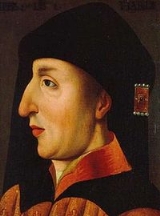
Philip II, Duke of Burgundy

Encyclopedia
Philip the Bold also Philip II, Duke of Burgundy (January 15, 1342, Pontoise
– April 27, 1404, Halle
), was the fourth and youngest son of King John II of France
and his wife, Bonne of Luxembourg. By his marriage to Margaret III, Countess of Flanders
, he also became Count Philip II of Flanders, Count Philip IV of Artois and Count-Palatine Philip IV of Burgundy. He was the founder of the Burgundian branch
of the House of Valois.
the Bold when, at the age of 14, he fought beside and was captured with his father at the Battle of Poitiers
in 1356. He was created Duke of Touraine
in 1360, but in 1363, as a reward for his behaviour at Poitiers, he returned this to the crown, receiving instead from his father the Duchy of Burgundy
in apanage, which his father had been Duke of since the death of Philip of Rouvres
in 1361. Philip would rule the Duchy until his death.
On 19 June 1369, Philip married the 19 year old Margaret of Dampierre
, the daughter of Louis II, Count of Flanders, who would become the heiress of Flanders
, Brabant
, Artois
, and the Free County of Burgundy
after the death of her brother in 1376. Margaret was the widow of his stepbrother, Philip of Rouvres
, Duke of Burgundy, Count Palatine of Burgundy, and Count of Artois, Boulogne and Auvergne. The two had been betrothed and married as children, she at seven years old, he at 11 years old; he died when he was about 15 and she about 11. Their marriage was without issue. As her father's eventual heiress, Margaret would bring rich possessions to her husband and to their children.
From 1379 to 1382, he helped his father-in-law put down revolts in Flanders, particularly in Ghent
, organising an army against Philip van Artevelde
. The revolts were finally ended only in 1385, following the death of Louis II, with the Peace of Tournai
. As jure uxoris Count of Flanders, he would keep in mind the economic interests of the Flemish cities, which made their money from weaving and spinning. In this he was aided by the expansion of the Three Members - a parliament consisting of representatives from the towns of Bruges
, Ghent
and Ypres
- to the Four Members
through the addition of the rural area Franc of Bruges
In 1390, Philip also became the Count of Charolais, a title used by Philip the Good and Charles the Bold as the heirs of Burgundy.
, who left the 12 year old Charles VI
as King. Charles was a minor, so a regency was undertaken by his uncles, Louis, Duke of Anjou
, John, Duke of Berry
, Philip himself, and Louis II, Duke of Bourbon
, Charles VI's maternal uncle. Among his acts while regent was the putting down of the 1382 tax revolt known as the Harelle
. The regency lasted until 1388, Philip taking the dominant rôle: Louis of Anjou was fighting for his claim to the Kingdom of Naples after 1382, dying in 1384, John of Berry was interested mainly in the Languedoc
, and not particularly interested in politics; whilst Louis of Bourbon was a largely unimportant figure, due to his personality (he showed signs of mental instability) and his status (since he was not the son of a King). However, Burgundy, along with Berry and Bourbon, lost their power in 1388, when Charles VI, taking up personal rule, chose to favour the advice of the Marmousets
, his personal advisors, over that of his uncles.
In 1392, events conspired to allow Burgundy to seize power once more in France. Charles VI's friend and advisor, Olivier de Clisson
, had recently been the target of an assassination attempt by agents of John V, Duke of Brittany
; the would-be assassin, Pierre de Craon
, had taken refuge in Brittany. Charles, outraged at these events, determined to punish Craon, and on 1 July 1392 led an expedition against Brittany. Whilst progressing towards Brittany, the King, already overwrought by the slow progress, was shocked by a madman who spent half-an-hour following the procession, warning the King that he had been betrayed; when a page dropped a lance, the King reacted by killing several of his knights, and had to be wrestled to the ground. Burgundy, who was present, immediately assumed command, and appointed himself regent, dismissing Charles' advisors. He was the principal ruler of France until 1402.
His seizure of power, however, had disastrous consequences for the unity of the House of Valois, and of France itself. The King's brother, Louis, Duke of Orléans, resented his uncle rather than himself being regent; the result was a feud between Philip and Louis, which was continued after their deaths by their families. In particular, both quarrelled over the royal funds, each desiring to appropriate this for their own ends: Louis to fund his extravagant lifestyle, Philip to further his ambitions in Burgundy and the Low Countries. Nonetheless, this struggle only served to enhance the reputation of Philip, and gave him real popularity in Paris, since, in comparison with the profligate and irresponsible Orléans, he appeared a sober and honest reformer. Thus, although Charles VI, in a rare moment of sanity, confirmed his brother as regent in 1402, Orléans' misrule allowed Burgundy to regain control of France as regent in 1404, shortly before his death.
Philip died in Halle
, County of Hainaut
(modern Belgium
), on 27 April 1404. His territories were bequeathed to his eldest son, John the Fearless, who inherited also Philip's political position in France and leadership of the Burgundians against Orléans.
 In 1378, Philip the Bold acquired the domain of Champmol just outside Dijon, to build the Chartreuse de Champmol (1383–1388), a Carthusian
monastery ("Charterhouse"), which he intended to house the tombs of his dynasty. His tomb and his recumbent effigy are one of the chief works of Burgundian sculpture. They were made by Jean de Marville (1381–1389), Claus Sluter
(1389–1406) and Claus de Werve (1406–1410). Jean Malouel
, official painter to the duke, was responsible for the polychrome and gilt decoration. After his death, the body of Philip the Bold was eviscerated and embalmed, then placed in a lead coffin. It was then deposited in the choir of Chartreuse de Champmol on 16 June 1404. His internal organs were sent to the church of Saint Martin
at Halle. In 1792, his body was transferred to Dijon Cathedral and in the following year his tomb was damaged by revolutionaries and looters. It was restored in the first half of the 19th century, and is today in the former palace of the dukes, now part of the Musée des Beaux-Arts of Dijon.
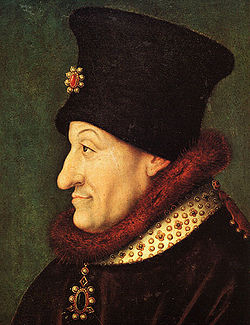 Philip the Bold married Margaret III, Countess of Flanders
(1350–1405) on 19 June 1369, a marriage which would eventually not only reunite the Duchy of Burgundy with the Free County of Burgundy and the County of Artois, but also unite it to the rich county of Flanders. Philip and Margaret had the following children:
In arranging the marriages of his children, Philip followed an intelligent diplomatic and strategic design, which would be followed by his successors in Burgundy as far as Emperor Maximilian I
. For example, the marriages in 1385 of his son, John the Fearless, and his daughter, Marguerite, to Margaret of Bavaria
and William of Bavaria
, son and daughter of Albert
, Count of the neighbouring Hainault and Holland, prepared the later union of Hainault and Holland with Burgundy and Flanders, as carried out by Philip's grandson, Philip the Good; the marriages also inserted the new Valois Burgundy dynasty into the Wittelsbach
network of alliances: the other daughters of Count Albert had married William I, Duke of Guelders
and Wenceslaus
, King of Bohemia; their cousin, Isabeau of Bavaria
, had married Charles VI of France
, and become Queen of France.
In addition to his alliance with the low county Bavarians, Philip also made links with the Dukes of Austria and of Savoy
, by marrying his daughter Catherine to Leopold IV of Austria, and his daughter Mary to Amadeus VIII Savoy.
See also: Dukes of Burgundy family tree
, largely preserved. This residence was offered to his wife, Margaret III, Countess of Flanders
in 1381. The princess transformed the old fortress into a luxurious home with the help of the finest artists of the Burgundian School Claus Sluter
and Jean de Beaumetz
.
Pontoise
Pontoise is a commune in the northwestern suburbs of Paris, France. It is located from the centre of Paris, in the "new town" of Cergy-Pontoise.-Administration:...
– April 27, 1404, Halle
Halle, Belgium
Halle , is a Belgian city and municipality in the district Halle-Vilvoorde of the province Flemish Brabant. The city is located on the Brussels-Charleroi Canal and on the Flemish side of the language border that separates Flanders and Wallonia...
), was the fourth and youngest son of King John II of France
John II of France
John II , called John the Good , was the King of France from 1350 until his death. He was the second sovereign of the House of Valois and is perhaps best remembered as the king who was vanquished at the Battle of Poitiers and taken as a captive to England.The son of Philip VI and Joan the Lame,...
and his wife, Bonne of Luxembourg. By his marriage to Margaret III, Countess of Flanders
Margaret III, Countess of Flanders
Margaret of Dampierre was Countess of Flanders , Countess of Artois and Countess Palatine of Burgundy and twice Duchess consort of Burgundy...
, he also became Count Philip II of Flanders, Count Philip IV of Artois and Count-Palatine Philip IV of Burgundy. He was the founder of the Burgundian branch
House of Valois-Burgundy
The term "Valois Dukes of Burgundy" is employed to refer to the dynasty which began after John II of France granted the Duchy of Burgundy to his youngest son, Philip the Bold...
of the House of Valois.
Early life
Born in 1342, Philip gained his cognomenCognomen
The cognomen nōmen "name") was the third name of a citizen of Ancient Rome, under Roman naming conventions. The cognomen started as a nickname, but lost that purpose when it became hereditary. Hereditary cognomina were used to augment the second name in order to identify a particular branch within...
the Bold when, at the age of 14, he fought beside and was captured with his father at the Battle of Poitiers
Battle of Poitiers (1356)
The Battle of Poitiers was fought between the Kingdoms of England and France on 19 September 1356 near Poitiers, resulting in the second of the three great English victories of the Hundred Years' War: Crécy, Poitiers, and Agincourt....
in 1356. He was created Duke of Touraine
Duke of Touraine
Duke of Touraine was a title in the Peerage of France, relating to Touraine.It was first created in 1360 for Philip, youngest son of King John II of France. He returned the duchy to the Crown in 1363 on being made Duke of Burgundy and died in 1404....
in 1360, but in 1363, as a reward for his behaviour at Poitiers, he returned this to the crown, receiving instead from his father the Duchy of Burgundy
Duchy of Burgundy
The Duchy of Burgundy , was heir to an ancient and prestigious reputation and a large division of the lands of the Second Kingdom of Burgundy and in its own right was one of the geographically larger ducal territories in the emergence of Early Modern Europe from Medieval Europe.Even in that...
in apanage, which his father had been Duke of since the death of Philip of Rouvres
Philip I, Duke of Burgundy
Philip I of Burgundy, also Philip II of Palatine Burgundy, Philip III of Artois, Philip III of Boulogne and Auvergne, nicknamed Philip of Rouvres was Duke of Burgundy from 1350 until his death. Philip was the only son of Philip of Burgundy, heir to the Duchy of Burgundy, and Joanna I, Countess of...
in 1361. Philip would rule the Duchy until his death.
On 19 June 1369, Philip married the 19 year old Margaret of Dampierre
Margaret III, Countess of Flanders
Margaret of Dampierre was Countess of Flanders , Countess of Artois and Countess Palatine of Burgundy and twice Duchess consort of Burgundy...
, the daughter of Louis II, Count of Flanders, who would become the heiress of Flanders
County of Flanders
The County of Flanders was one of the territories constituting the Low Countries. The county existed from 862 to 1795. It was one of the original secular fiefs of France and for centuries was one of the most affluent regions in Europe....
, Brabant
Duchy of Brabant
The Duchy of Brabant was a historical region in the Low Countries. Its territory consisted essentially of the three modern-day Belgian provinces of Flemish Brabant, Walloon Brabant and Antwerp, the Brussels-Capital Region and most of the present-day Dutch province of North Brabant.The Flag of...
, Artois
County of Artois
The County of Artois was an historic province of the Kingdom of France, held by the Dukes of Burgundy from 1384 until 1477/82, and a state of the Holy Roman Empire from 1493 until 1659....
, and the Free County of Burgundy
County of Burgundy
The Free County of Burgundy , was a medieval county , within the traditional province and modern French region Franche-Comté, whose very French name is still reminiscent of the unusual title of its count: Freigraf...
after the death of her brother in 1376. Margaret was the widow of his stepbrother, Philip of Rouvres
Philip I, Duke of Burgundy
Philip I of Burgundy, also Philip II of Palatine Burgundy, Philip III of Artois, Philip III of Boulogne and Auvergne, nicknamed Philip of Rouvres was Duke of Burgundy from 1350 until his death. Philip was the only son of Philip of Burgundy, heir to the Duchy of Burgundy, and Joanna I, Countess of...
, Duke of Burgundy, Count Palatine of Burgundy, and Count of Artois, Boulogne and Auvergne. The two had been betrothed and married as children, she at seven years old, he at 11 years old; he died when he was about 15 and she about 11. Their marriage was without issue. As her father's eventual heiress, Margaret would bring rich possessions to her husband and to their children.
From 1379 to 1382, he helped his father-in-law put down revolts in Flanders, particularly in Ghent
Ghent
Ghent is a city and a municipality located in the Flemish region of Belgium. It is the capital and biggest city of the East Flanders province. The city started as a settlement at the confluence of the Rivers Scheldt and Lys and in the Middle Ages became one of the largest and richest cities of...
, organising an army against Philip van Artevelde
Philip van Artevelde
Philip van Artevelde was a Flemish patriot, the son of Jacob van Artevelde. Because of his father's prominence he was godson of English queen Philippa of Hainault, who held him in her arms during his baptism....
. The revolts were finally ended only in 1385, following the death of Louis II, with the Peace of Tournai
Peace of Tournai
The peace of Tournai was an agreement between the Burgundian Duke Philip II and the rebellious city of Ghent signed on December 18, 1385....
. As jure uxoris Count of Flanders, he would keep in mind the economic interests of the Flemish cities, which made their money from weaving and spinning. In this he was aided by the expansion of the Three Members - a parliament consisting of representatives from the towns of Bruges
Bruges
Bruges is the capital and largest city of the province of West Flanders in the Flemish Region of Belgium. It is located in the northwest of the country....
, Ghent
Ghent
Ghent is a city and a municipality located in the Flemish region of Belgium. It is the capital and biggest city of the East Flanders province. The city started as a settlement at the confluence of the Rivers Scheldt and Lys and in the Middle Ages became one of the largest and richest cities of...
and Ypres
Ypres
Ypres is a Belgian municipality located in the Flemish province of West Flanders. The municipality comprises the city of Ypres and the villages of Boezinge, Brielen, Dikkebus, Elverdinge, Hollebeke, Sint-Jan, Vlamertinge, Voormezele, Zillebeke, and Zuidschote...
- to the Four Members
Four Members
The Four members consisted of Bruges, Franc of Bruges, Ghent and Ypres gathered together in a medieval parliament. Together they exercised considerable power in Flanders....
through the addition of the rural area Franc of Bruges
In 1390, Philip also became the Count of Charolais, a title used by Philip the Good and Charles the Bold as the heirs of Burgundy.
Involvement in France
Philip was very active in the court of France, particularly after the death of his brother, Charles VCharles V of France
Charles V , called the Wise, was King of France from 1364 to his death in 1380 and a member of the House of Valois...
, who left the 12 year old Charles VI
Charles VI of France
Charles VI , called the Beloved and the Mad , was the King of France from 1380 to 1422, as a member of the House of Valois. His bouts with madness, which seem to have begun in 1392, led to quarrels among the French royal family, which were exploited by the neighbouring powers of England and Burgundy...
as King. Charles was a minor, so a regency was undertaken by his uncles, Louis, Duke of Anjou
Louis I of Naples
Louis I of Anjou , or Louis I of Naples, was the second son of King John II of France and Bonne of Luxembourg...
, John, Duke of Berry
John, Duke of Berry
John of Valois or John the Magnificent was Duke of Berry and Auvergne and Count of Poitiers and Montpensier. He was the third son of King John II of France and Bonne of Luxemburg; his brothers were King Charles V of France, Duke Louis I of Anjou and Duke Philip the Bold of Burgundy...
, Philip himself, and Louis II, Duke of Bourbon
Louis II, Duke of Bourbon
Louis de Bourbon, called the Good , son of Peter de Bourbon and Isabella de Valois, was the third Duke of Bourbon....
, Charles VI's maternal uncle. Among his acts while regent was the putting down of the 1382 tax revolt known as the Harelle
Harelle
The Harelle was a revolt that occurred in the French city of Rouen in 1382 followed by the Maillotins Revolt a few days later in Paris, and numerous other revolts across France in the subsequent week. France was in the midst of the Hundred Years War, and had seen decades of warfare, widespread...
. The regency lasted until 1388, Philip taking the dominant rôle: Louis of Anjou was fighting for his claim to the Kingdom of Naples after 1382, dying in 1384, John of Berry was interested mainly in the Languedoc
Languedoc
Languedoc is a former province of France, now continued in the modern-day régions of Languedoc-Roussillon and Midi-Pyrénées in the south of France, and whose capital city was Toulouse, now in Midi-Pyrénées. It had an area of approximately 42,700 km² .-Geographical Extent:The traditional...
, and not particularly interested in politics; whilst Louis of Bourbon was a largely unimportant figure, due to his personality (he showed signs of mental instability) and his status (since he was not the son of a King). However, Burgundy, along with Berry and Bourbon, lost their power in 1388, when Charles VI, taking up personal rule, chose to favour the advice of the Marmousets
Marmousets
The marmousets were counselors to Charles VI of France. Although they were neither princes nor civil servants, they were simply very close to the king. Thanks to this position, they were able to access the highest functions of the state...
, his personal advisors, over that of his uncles.
In 1392, events conspired to allow Burgundy to seize power once more in France. Charles VI's friend and advisor, Olivier de Clisson
Olivier de Clisson
Olivier de Clisson , nicknamed "The Butcher", was a Breton soldier, the son of the Olivier de Clisson who was put to death in 1343 on the suspicion of having wished to give up Nantes to the English.- Biography :...
, had recently been the target of an assassination attempt by agents of John V, Duke of Brittany
John V, Duke of Brittany
John V the Conqueror KG was Duke of Brittany and Count of Montfort, from 1345 until his death.-Numbering:...
; the would-be assassin, Pierre de Craon
Pierre de Craon
Pierre de Craon , known as "le Grand", was a medieval French aristocrat notorious for his riotous temperament, culminating in his attempted murder of Olivier de Clisson, Constable of France...
, had taken refuge in Brittany. Charles, outraged at these events, determined to punish Craon, and on 1 July 1392 led an expedition against Brittany. Whilst progressing towards Brittany, the King, already overwrought by the slow progress, was shocked by a madman who spent half-an-hour following the procession, warning the King that he had been betrayed; when a page dropped a lance, the King reacted by killing several of his knights, and had to be wrestled to the ground. Burgundy, who was present, immediately assumed command, and appointed himself regent, dismissing Charles' advisors. He was the principal ruler of France until 1402.
His seizure of power, however, had disastrous consequences for the unity of the House of Valois, and of France itself. The King's brother, Louis, Duke of Orléans, resented his uncle rather than himself being regent; the result was a feud between Philip and Louis, which was continued after their deaths by their families. In particular, both quarrelled over the royal funds, each desiring to appropriate this for their own ends: Louis to fund his extravagant lifestyle, Philip to further his ambitions in Burgundy and the Low Countries. Nonetheless, this struggle only served to enhance the reputation of Philip, and gave him real popularity in Paris, since, in comparison with the profligate and irresponsible Orléans, he appeared a sober and honest reformer. Thus, although Charles VI, in a rare moment of sanity, confirmed his brother as regent in 1402, Orléans' misrule allowed Burgundy to regain control of France as regent in 1404, shortly before his death.
Philip died in Halle
Halle, Belgium
Halle , is a Belgian city and municipality in the district Halle-Vilvoorde of the province Flemish Brabant. The city is located on the Brussels-Charleroi Canal and on the Flemish side of the language border that separates Flanders and Wallonia...
, County of Hainaut
County of Hainaut
The County of Hainaut was a historical region in the Low Countries with its capital at Mons . In English sources it is often given the archaic spelling Hainault....
(modern Belgium
Belgium
Belgium , officially the Kingdom of Belgium, is a federal state in Western Europe. It is a founding member of the European Union and hosts the EU's headquarters, and those of several other major international organisations such as NATO.Belgium is also a member of, or affiliated to, many...
), on 27 April 1404. His territories were bequeathed to his eldest son, John the Fearless, who inherited also Philip's political position in France and leadership of the Burgundians against Orléans.
Tomb of Philip the Bold
Carthusian
The Carthusian Order, also called the Order of St. Bruno, is a Roman Catholic religious order of enclosed monastics. The order was founded by Saint Bruno of Cologne in 1084 and includes both monks and nuns...
monastery ("Charterhouse"), which he intended to house the tombs of his dynasty. His tomb and his recumbent effigy are one of the chief works of Burgundian sculpture. They were made by Jean de Marville (1381–1389), Claus Sluter
Claus Sluter
Claus Sluter was a sculptor of Dutch origin. He was the most important northern European sculptor of his age and is considered a pioneer of the "northern realism" of the Early Netherlandish painting that came into full flower with the work of Jan van Eyck and others in the next generation.Sluter...
(1389–1406) and Claus de Werve (1406–1410). Jean Malouel
Jean Malouel
Jean Malouel, or Jan Maelwael in his native Dutch, was a Netherlandish artist, sometimes classified as French, who was the court painter of Philip the Bold, Duke of Burgundy and his successor John the Fearless, working in the International Gothic style.-Documented life:He was presumably born in...
, official painter to the duke, was responsible for the polychrome and gilt decoration. After his death, the body of Philip the Bold was eviscerated and embalmed, then placed in a lead coffin. It was then deposited in the choir of Chartreuse de Champmol on 16 June 1404. His internal organs were sent to the church of Saint Martin
Martin of Tours
Martin of Tours was a Bishop of Tours whose shrine became a famous stopping-point for pilgrims on the road to Santiago de Compostela. Around his name much legendary material accrued, and he has become one of the most familiar and recognizable Christian saints...
at Halle. In 1792, his body was transferred to Dijon Cathedral and in the following year his tomb was damaged by revolutionaries and looters. It was restored in the first half of the 19th century, and is today in the former palace of the dukes, now part of the Musée des Beaux-Arts of Dijon.
Marriage and issue
Margaret III, Countess of Flanders
Margaret of Dampierre was Countess of Flanders , Countess of Artois and Countess Palatine of Burgundy and twice Duchess consort of Burgundy...
(1350–1405) on 19 June 1369, a marriage which would eventually not only reunite the Duchy of Burgundy with the Free County of Burgundy and the County of Artois, but also unite it to the rich county of Flanders. Philip and Margaret had the following children:
- John the Fearless (1371–1419, murdered at MontereauMontereau-Fault-YonneMontereau-Fault-Yonne, or simply Montereau, is a commune in the Seine-et-Marne department in the Île-de-France region in north-central France.-Name:...
), his eldest son and successor as Duke of Burgundy - Charles (1372–1373)
- Marguerite of Burgundy (October 1374 – March 8, 1441, Le QuesnoyLe QuesnoyLe Quesnoy is a commune in the Nord department in northern France.Le Quesnoy's inhabitants are known as Quercitains.- Economy :The town of Le Quesnoy has somehow missed much of the Industrial Revolution. Unlike the neighboring towns of Valenciennes or Maubeuge, iron/steel works did not take hold...
), Countess of Mortain married William VI, Count of Holland and Duke of Bavaria-Straubing - Louis (1377–1378)
- Catherine of Burgundy (April 1378, MontbardMontbardMontbard is a commune and subprefecture of the Côte-d'Or department in the Bourgogne region in eastern France.Montbard is a small industrial town on the river Brenne. The Forges de Buffon, ironworks established by Buffon, are located in the nearby village of Buffon...
– January 24, 1425, Gray, Haute-SaôneGray, Haute-SaôneGray is a commune in the Haute-Saône department in the region of Franche-Comté in eastern France. It has a population of 6,175 inhabitants .-Geography:Gray is situated on the banks of the Saône River...
), married Leopold IV, Duke of Austria - Bonne (1379–1399, ArrasArrasArras is the capital of the Pas-de-Calais department in northern France. The historic centre of the Artois region, its local speech is characterized as a Picard dialect...
) betrothed to John I, Duke of BourbonJohn I, Duke of BourbonJean de Bourbon was Duke of Bourbon, from 1410 to his death and Duke of Auvergne since 1416. He was the eldest son of Louis II and Anna d'Auvergne... - Antoine, Duke of BrabantDuke of BrabantThe Duchy of Brabant was formally erected in 1183/1184. The title "Duke of Brabant" was created by the German Emperor Frederick Barbarossa in favor of Henry I, son of Godfrey III of Leuven . The Duchy of Brabant was a feudal elevation of the since 1085/1086 existing title of Landgrave of Brabant...
(August, 1384 – October 25, 1415, at AgincourtBattle of AgincourtThe Battle of Agincourt was a major English victory against a numerically superior French army in the Hundred Years' War. The battle occurred on Friday, 25 October 1415 , near modern-day Azincourt, in northern France...
) - Mary of Burgundy (September 1386, DijonDijonDijon is a city in eastern France, the capital of the Côte-d'Or département and of the Burgundy region.Dijon is the historical capital of the region of Burgundy. Population : 151,576 within the city limits; 250,516 for the greater Dijon area....
– October 2, 1422, Thonon-les-BainsThonon-les-BainsThonon-les-Bains is a town in the Haute-Savoie department in the Rhône-Alpes region in south-eastern France. It is a sub-prefecture of the department.-History:...
), married Amadeus VIII, Duke of Savoy - Philip II, Count of NeversPhilip II, Count of NeversPhillip II, Count of Nevers was the youngest son of Philip the Bold and Margaret III of Flanders....
and RethelCounts and dukes of RethelThis is a list of counts and dukes of Rethel. The first counts of Rethel ruled independently, before the county passed first to the Counts of Nevers, then to the Counts of Flanders, and finally to the Dukes of Burgundy. In 1405 the County became part of the Peerage of France, and in 1581 it was...
(1389–1415, at AgincourtBattle of AgincourtThe Battle of Agincourt was a major English victory against a numerically superior French army in the Hundred Years' War. The battle occurred on Friday, 25 October 1415 , near modern-day Azincourt, in northern France...
)
In arranging the marriages of his children, Philip followed an intelligent diplomatic and strategic design, which would be followed by his successors in Burgundy as far as Emperor Maximilian I
Maximilian I, Holy Roman Emperor
Maximilian I , the son of Frederick III, Holy Roman Emperor and Eleanor of Portugal, was King of the Romans from 1486 and Holy Roman Emperor from 1493 until his death, though he was never in fact crowned by the Pope, the journey to Rome always being too risky...
. For example, the marriages in 1385 of his son, John the Fearless, and his daughter, Marguerite, to Margaret of Bavaria
Margaret of Bavaria
Margaret of Bavaria, , was the fifth child of Albert, Duke of Bavaria-Straubing, Count of Hainault, Holland, and Zeeland and Lord of Friesia, and Margaret of Brieg. She was the regent of the Burgundian Low countries during the absence of her spouse in 1404–1419 and the regent in French Burgundy...
and William of Bavaria
William II, Duke of Bavaria-Straubing
Duke William II of Bavaria-Straubing KG was also count William VI of Holland, count William IV of Hainaut and count William V of Zeeland. He ruled from 1404 until 1417, when he died of a dog bite. William was a son of Albert I and Margaret of Brieg.-Biography:William, allied with the Hooks, was...
, son and daughter of Albert
Albert I, Duke of Bavaria
Duke Albert I or Albrecht KG was a feudal ruler of the counties of Holland, Hainaut, and Zeeland in the Low Countries...
, Count of the neighbouring Hainault and Holland, prepared the later union of Hainault and Holland with Burgundy and Flanders, as carried out by Philip's grandson, Philip the Good; the marriages also inserted the new Valois Burgundy dynasty into the Wittelsbach
Wittelsbach
The Wittelsbach family is a European royal family and a German dynasty from Bavaria.Members of the family served as Dukes, Electors and Kings of Bavaria , Counts Palatine of the Rhine , Margraves of Brandenburg , Counts of Holland, Hainaut and Zeeland , Elector-Archbishops of Cologne , Dukes of...
network of alliances: the other daughters of Count Albert had married William I, Duke of Guelders
Dukes of Guelders
-House of Wassenberg:The first count of Guelders was Gerard IV, Lord of Wassenberg.During Reginald II's reign, the county of Guelders became a duchy.* before 1096–about 1129 : Gerard I* about 1129–about 1131 : Gerard II the tall, son of...
and Wenceslaus
Wenceslaus, King of the Romans
Wenceslaus ) was, by election, German King from 1376 and, by inheritance, King of Bohemia from 1378. He was the third Bohemian and second German monarch of the Luxembourg dynasty...
, King of Bohemia; their cousin, Isabeau of Bavaria
Isabeau of Bavaria
Isabeau of Bavaria was Queen consort of France as spouse of King Charles VI of France, a member of the Valois Dynasty...
, had married Charles VI of France
Charles VI of France
Charles VI , called the Beloved and the Mad , was the King of France from 1380 to 1422, as a member of the House of Valois. His bouts with madness, which seem to have begun in 1392, led to quarrels among the French royal family, which were exploited by the neighbouring powers of England and Burgundy...
, and become Queen of France.
In addition to his alliance with the low county Bavarians, Philip also made links with the Dukes of Austria and of Savoy
House of Savoy
The House of Savoy was formed in the early 11th century in the historical Savoy region. Through gradual expansion, it grew from ruling a small county in that region to eventually rule the Kingdom of Italy from 1861 until the end of World War II, king of Croatia and King of Armenia...
, by marrying his daughter Catherine to Leopold IV of Austria, and his daughter Mary to Amadeus VIII Savoy.
See also: Dukes of Burgundy family tree
Dukes of Burgundy family tree
This is a family tree of the Dukes of Burgundy, from the 9th century to 1482.Image:BurgundyDukes.pngrect 174 129 324 169 Richard of Autunrect 407 138 521 166 rect 90 189 184 214 Rainier II of Hainautrect 219 189 271 213...
His residences
In Burgundy, the residences that once belonged to Philippe the Bold and that still exist are rare. Apart from several elements of the ducal palace in Dijon (Tour de Bar), we find the château de GermollesChâteau de Germolles
The château is situated in Burgundy, not far from Beaune and Chalon-sur-Saône. It is the best preserved residence of the Dukes of Burgundy. Built during the second part of the 14th century, this château is important for the history of the region...
, largely preserved. This residence was offered to his wife, Margaret III, Countess of Flanders
Margaret III, Countess of Flanders
Margaret of Dampierre was Countess of Flanders , Countess of Artois and Countess Palatine of Burgundy and twice Duchess consort of Burgundy...
in 1381. The princess transformed the old fortress into a luxurious home with the help of the finest artists of the Burgundian School Claus Sluter
Claus Sluter
Claus Sluter was a sculptor of Dutch origin. He was the most important northern European sculptor of his age and is considered a pioneer of the "northern realism" of the Early Netherlandish painting that came into full flower with the work of Jan van Eyck and others in the next generation.Sluter...
and Jean de Beaumetz
Jean de Beaumetz
Jean de Beaumetz is recorded to have been "painter and valet" to Philip the Hardy, for whom he painted numerous works, and decorated, among other chapels, that of the Castle of Argilli, in Burgundy. Some of his mural paintings are still preserved at château de Germolles. Jean de Beaumetz was...
.
Titles
- 1360–1363: Duke of TouraineDuke of TouraineDuke of Touraine was a title in the Peerage of France, relating to Touraine.It was first created in 1360 for Philip, youngest son of King John II of France. He returned the duchy to the Crown in 1363 on being made Duke of Burgundy and died in 1404....
as Philip II - 1363–1404: Duke of BurgundyDuke of BurgundyDuke of Burgundy was a title borne by the rulers of the Duchy of Burgundy, a small portion of traditional lands of Burgundians west of river Saône which in 843 was allotted to Charles the Bald's kingdom of West Franks...
as Philip II - 1390–1404: Count of Charolais as Philip I

- 1384–1404: Count Palatine of Burgundy as Philip IV by jure uxoris
 Jure uxorisJure uxoris is a Latin term that means "by right of his wife" or "in right of a wife". It is commonly used to refer to a title held by a man whose wife holds it in her own right. In other words, he acquired the title simply by being her husband....
 - 1384–1404: Count of ArtoisCounts of ArtoisThe counts of Artois were the rulers over the County of Artois from the 9th century until the abolition of the countship by the French revolutionaries in 1790.-List of Counts of Artois:*Odalric...
as Philip IV by jure uxorisJure uxorisJure uxoris is a Latin term that means "by right of his wife" or "in right of a wife". It is commonly used to refer to a title held by a man whose wife holds it in her own right. In other words, he acquired the title simply by being her husband.... - 1384–1404: Count of Flanders as Philip II by jure uxorisJure uxorisJure uxoris is a Latin term that means "by right of his wife" or "in right of a wife". It is commonly used to refer to a title held by a man whose wife holds it in her own right. In other words, he acquired the title simply by being her husband....
- 1384: Count of Nevers as Philip I by jure uxorisJure uxorisJure uxoris is a Latin term that means "by right of his wife" or "in right of a wife". It is commonly used to refer to a title held by a man whose wife holds it in her own right. In other words, he acquired the title simply by being her husband....
- 1384–1402: Count of RethelCounts and dukes of RethelThis is a list of counts and dukes of Rethel. The first counts of Rethel ruled independently, before the county passed first to the Counts of Nevers, then to the Counts of Flanders, and finally to the Dukes of Burgundy. In 1405 the County became part of the Peerage of France, and in 1581 it was...
as Philip I by jure uxorisJure uxorisJure uxoris is a Latin term that means "by right of his wife" or "in right of a wife". It is commonly used to refer to a title held by a man whose wife holds it in her own right. In other words, he acquired the title simply by being her husband....