

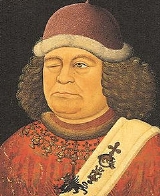
Order of the Dragon

Encyclopedia
The Order of the Dragon (Latin
Societas Draconistrarum) was a monarchical chivalric order for selected nobility,
founded in 1408 by Sigismund
, King of Hungary (r. 1387-1437) and later Holy Roman Emperor
(r. 1433-1437).
It was fashioned after the military order
s of the crusades
, requiring its initiates to defend the Cross
and fight the enemies of Christianity
, in particular the Ottoman Turks
.
The Order flourished during the first half of the 15th century, primarily in Germany and Italy. After Sigismund's death in 1437 its importance declined in Western Europe, but after the Fall of Constantinople
of 1453, it continued to play a role in Hungary
, Wallachia
and Serbia
, which bore the brunt of the Ottoman incursions
.
n royal son Sigismund of Luxembourg
was elected King of Hungary
and Croatia
, a title which he owed chiefly to his marriage to Queen Mary of Hungary
in 1385, without her consent. During the next decade, he constantly sought support or employed ruthless methods to strengthen his unsteady hold on the throne. His rule was weakened in 1395 when Mary, who was pregnant, died in an accident. In 1389, the Ottoman Sultan Murad I
had defeated Lazar, Prince of Serbia
at the Battle of Kosovo Polje, in which both leaders died. Two years later, the Turks
had taken the fortress of Nicopolis
. In 1396, Pope Boniface IX
proclaimed a crusade against the Ottomans, and a campaign was organised to recapture the fortress and put a halt to the Ottoman expansion. Sigismund was nominally in charge; however, in the 1396 Battle of Nicopolis
the French
leader, John of Nevers, commanded the French half of the forces and ignored Sigismund's entreaties by charging the Turks. About 15,000 crusaders died with only a few leaders, including Sigismund, escaping. He returned to Hungary in 1401 and, facing a number of revolts, gradually resumed control and re-asserted himself as the King of Hungary. This he achieved by allying himself with the political party of Nicholas II Garay
and Hermann II of Celje
, in return for their military support, which enabled him to fight off domestic rivals. He campaigned against the Croats
and Bosnians
, which culminated in 1408 with the Battle of Dobor — fought for the possession of Bosnia
— and a massacre of noble families. His pact with Hermann II was secured in 1408, when Sigismund married Herman II's daughter Barbara of Celje
(also called Cilli).
, founded the league known today as the Order of the Dragon. Its statutes, written in Latin
, call it a society (societas) whose members carry the signum draconis (see below), but assign no name to it. Contemporary records, however, refer to it by a variety of similar if unofficial names, such as Gesellschaft mit dem Trakchen, Divisa seu Societate Draconica, Societate Draconica seu Draconistrarum and Fraternitas Draconum. It was to some extent modelled after the earlier Hungarian monarchical order, the Order of St. George
(Societas militae Sancti Georgii), founded by King Carol Robert of Anjou
in 1318. It likewise adopted St. George as its patron saint
, whose legendary defeat of a dragon
was used as a symbol for the military and religious ethos of the order.
The statute of the Order, which was expanded by Bishop Eberhard
of Nagyvárad, chancellor of Sigismund's court, survives only in a copy made in 1707.
An edition was published in 1841. The prologue to these statutes of 1408 reports that the society was created:
Though described in general terms, the primary representatives of "the perfidious Enemy" remained the Ottoman Turks, who continued to be problem for Sigismund's successors. The Order's outward focus on foreign threats was also aimed at achieving a level of domestic cohesion. The statutes go on to describe the order's symbols of the ouroboros
and the red cross, which were worn by its members and gave the order its corporate identity (see below). They also list the mutual obligations of the king and his nobles. The members were to swear loyalty to the king, queen and their future sons and to protect the royal interests. Boulton argues that "the Society of the Dragon was clearly intended to serve [...] as the institutional embodiment of the royal faction its founder had created." In return for their services, the nobles could expect to enjoy royal protection, honors and offices.
The creation of the order is an instance within a larger fashion of founding chivalric orders during the 14th and early 15th centuries, not infrequently dedicated to organizing "crusades", epecially after the disaster of the battle of Nicopolis
(1396). Sigismund's order was particularly inspired from the Order of Saint George of 1326. Another influential model may have been the Sicilian Order of the Ship, founded in 1381. A comparable order founded after the Order of the Dragon was the Order of Calatrava
, founded in 1409, also dedicated to battling Turks.
, Nicholas II Garay
and Hermann II of Celje
, including such local magnates as Stibor of Stiboricz
and Pipo of Ozora
. The initial group of inductees for Sigismund's Order numbered 21 men, which extended to about 24 in 1418.
After some time, Sigismund chose to expand the ranks of the Order. A second group of inductees was initiated between 1431-1437. As membership grew, the Order of the Dragon came to have two degrees. There was a superior class, which between 1408 and 1418 wore both the dragon and the cross as the Order's emblem and a more elaborate version afterwards. The second degree had a large amount of members, and its symbol was only the dragon.
Following Sigismund's death in 1437, the Order lost prominence. However, the prestigious emblem of the Order was retained on the coat of arms
of several Hungarian noble families, including Báthory
, Bocskai, Bethlen, Szathmáry and Rákóczi
.
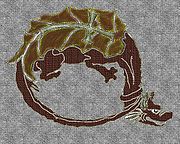
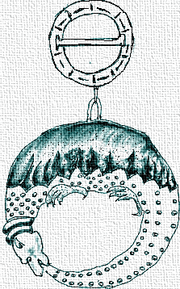 The edict of 1408 describes two insignia to be worn by members of the Order:
The dragon described here, with its tail coiled around its neck, bears comparison to the ouroboros
. On the back of the dragon, from the base of the neck to the tail, is the Red Cross of Saint George
, with the entire image on an argent
field. The Order's dragon emblem has not survived in any original form, but it has been referenced on coins, art, and in writing.
A University of Bucharest
annotation to the original edict reads "O Quam Misericors est Deus, Pius et Justus" (O how merciful is God, faithful and just), which may have been officially part of the emblem. The various classes of the order had a slight variation of the dragon symbol. Common changes included the addition of inscriptions like O Quam Misericors est Deus ("Oh, how merciful God is") and "Justus et Paciens" ("Just and patient"). One of the highest classes may have worn a necklace with a seal, while a period painting of Otto von Wolkenstein depicts another type of class variation.
Few historical artifacts of the Order now remain. A copy, dating to 1707, of the statutes of 1408 is the oldest known literary artifact of the society. Today, known materials are archived within the University of Budapest
.
Latin
Latin is an Italic language originally spoken in Latium and Ancient Rome. It, along with most European languages, is a descendant of the ancient Proto-Indo-European language. Although it is considered a dead language, a number of scholars and members of the Christian clergy speak it fluently, and...
Societas Draconistrarum) was a monarchical chivalric order for selected nobility,
founded in 1408 by Sigismund
Sigismund, Holy Roman Emperor
Sigismund of Luxemburg KG was King of Hungary, of Croatia from 1387 to 1437, of Bohemia from 1419, and Holy Roman Emperor for four years from 1433 until 1437, the last Emperor of the House of Luxemburg. He was also King of Italy from 1431, and of Germany from 1411...
, King of Hungary (r. 1387-1437) and later Holy Roman Emperor
Holy Roman Emperor
The Holy Roman Emperor is a term used by historians to denote a medieval ruler who, as German King, had also received the title of "Emperor of the Romans" from the Pope...
(r. 1433-1437).
It was fashioned after the military order
Military order
A military order is a Christian society of knights that was founded for crusading, i.e. propagating or defending the faith , either in the Holy Land or against Islam or pagans in Europe...
s of the crusades
Crusades
The Crusades were a series of religious wars, blessed by the Pope and the Catholic Church with the main goal of restoring Christian access to the holy places in and near Jerusalem...
, requiring its initiates to defend the Cross
Christian cross
The Christian cross, seen as a representation of the instrument of the crucifixion of Jesus Christ, is the best-known religious symbol of Christianity...
and fight the enemies of Christianity
Christianity
Christianity is a monotheistic religion based on the life and teachings of Jesus as presented in canonical gospels and other New Testament writings...
, in particular the Ottoman Turks
Ottoman Turks
The Ottoman Turks were the Turkish-speaking population of the Ottoman Empire who formed the base of the state's military and ruling classes. Reliable information about the early history of Ottoman Turks is scarce, but they take their Turkish name, Osmanlı , from the house of Osman I The Ottoman...
.
The Order flourished during the first half of the 15th century, primarily in Germany and Italy. After Sigismund's death in 1437 its importance declined in Western Europe, but after the Fall of Constantinople
Fall of Constantinople
The Fall of Constantinople was the capture of the capital of the Byzantine Empire, which occurred after a siege by the Ottoman Empire, under the command of Ottoman Sultan Mehmed II, against the defending army commanded by Byzantine Emperor Constantine XI...
of 1453, it continued to play a role in Hungary
Kingdom of Hungary
The Kingdom of Hungary comprised present-day Hungary, Slovakia and Croatia , Transylvania , Carpatho Ruthenia , Vojvodina , Burgenland , and other smaller territories surrounding present-day Hungary's borders...
, Wallachia
Wallachia
Wallachia or Walachia is a historical and geographical region of Romania. It is situated north of the Danube and south of the Southern Carpathians...
and Serbia
Serbian Despotate
The Serbian Despotate was a Serbian state, the last to be conquered by the Ottoman Empire. Although the Battle of Kosovo in 1389 is generally considered the end of the medieval Serbian state, the Despotate, a successor of the Serbian Empire and Moravian Serbia survived for 70 more years,...
, which bore the brunt of the Ottoman incursions
Ottoman wars in Europe
The wars of the Ottoman Empire in Europe are also sometimes referred to as the Ottoman Wars or as Turkish Wars, particularly in older, European texts.- Rise :...
.
Historical background
Sigismund faced fierce struggles for power leading up to the foundation of the order in 1408. In 1387, the BohemiaBohemia
Bohemia is a historical region in central Europe, occupying the western two-thirds of the traditional Czech Lands. It is located in the contemporary Czech Republic with its capital in Prague...
n royal son Sigismund of Luxembourg
Luxembourg
Luxembourg , officially the Grand Duchy of Luxembourg , is a landlocked country in western Europe, bordered by Belgium, France, and Germany. It has two principal regions: the Oesling in the North as part of the Ardennes massif, and the Gutland in the south...
was elected King of Hungary
Hungary
Hungary , officially the Republic of Hungary , is a landlocked country in Central Europe. It is situated in the Carpathian Basin and is bordered by Slovakia to the north, Ukraine and Romania to the east, Serbia and Croatia to the south, Slovenia to the southwest and Austria to the west. The...
and Croatia
Croatia
Croatia , officially the Republic of Croatia , is a unitary democratic parliamentary republic in Europe at the crossroads of the Mitteleuropa, the Balkans, and the Mediterranean. Its capital and largest city is Zagreb. The country is divided into 20 counties and the city of Zagreb. Croatia covers ...
, a title which he owed chiefly to his marriage to Queen Mary of Hungary
Mary of Hungary
Mary of Anjou was queen regnant of Hungary from 1382 until her death in 1395.-Childhood:...
in 1385, without her consent. During the next decade, he constantly sought support or employed ruthless methods to strengthen his unsteady hold on the throne. His rule was weakened in 1395 when Mary, who was pregnant, died in an accident. In 1389, the Ottoman Sultan Murad I
Murad I
Murad I was the Sultan of the Ottoman Empire, from 1361 to 1389...
had defeated Lazar, Prince of Serbia
Lazar of Serbia
Lazar Hrebeljanović , was a medieval nobleman that emerged as the most powerful Serbian ruler after the death of the previous, childless, Emperor Uroš the Weak, which resulted in years of instability in the Serbian realm. As Stefan Lazar, he was Prince of Serbia from 1371 to 1389, ruling what is...
at the Battle of Kosovo Polje, in which both leaders died. Two years later, the Turks
Ottoman Turks
The Ottoman Turks were the Turkish-speaking population of the Ottoman Empire who formed the base of the state's military and ruling classes. Reliable information about the early history of Ottoman Turks is scarce, but they take their Turkish name, Osmanlı , from the house of Osman I The Ottoman...
had taken the fortress of Nicopolis
Nicopolis
Nicopolis — or Actia Nicopolis — was an ancient city of Epirus, founded 31 BC by Octavian in memory of his victory over Antony and Cleopatra at Actium the previous year. It was later the capital of Epirus Vetus...
. In 1396, Pope Boniface IX
Pope Boniface IX
Pope Boniface IX , born Piero Tomacelli, was the second Roman Pope of the Western Schism from November 2, 1389, until October 1, 1404...
proclaimed a crusade against the Ottomans, and a campaign was organised to recapture the fortress and put a halt to the Ottoman expansion. Sigismund was nominally in charge; however, in the 1396 Battle of Nicopolis
Battle of Nicopolis
The Battle of Nicopolis took place on 25 September 1396 and resulted in the rout of an allied army of Hungarian, Wallachian, French, Burgundian, German and assorted troops at the hands of an Ottoman force, raising of the siege of the Danubian fortress of Nicopolis and leading to the end of the...
the French
France
The French Republic , The French Republic , The French Republic , (commonly known as France , is a unitary semi-presidential republic in Western Europe with several overseas territories and islands located on other continents and in the Indian, Pacific, and Atlantic oceans. Metropolitan France...
leader, John of Nevers, commanded the French half of the forces and ignored Sigismund's entreaties by charging the Turks. About 15,000 crusaders died with only a few leaders, including Sigismund, escaping. He returned to Hungary in 1401 and, facing a number of revolts, gradually resumed control and re-asserted himself as the King of Hungary. This he achieved by allying himself with the political party of Nicholas II Garay
Nicholas II Garay
Nicholas II Garay was the ban of Mačva, Usora, Soli , Slavonia, Croatia, and Dalmatia. He also ruled Braničevo, Syrmia, Bačka, Banat and Baranya regions through vassals. In 1416 Sigismund extended their armorial bearings showing the Order of the Dragon and the Order of the Scarf...
and Hermann II of Celje
Hermann II of Celje
Hermann II was a Count of Celje and Ban of Croatia, Slavonia and Dalmatia. Hermann was the son of Hermann I, Count of Cilli and his wife Katherine of Bosnia.Hermann II married Countess Anna of Schaunberg in c...
, in return for their military support, which enabled him to fight off domestic rivals. He campaigned against the Croats
Croats
Croats are a South Slavic ethnic group mostly living in Croatia, Bosnia and Herzegovina and nearby countries. There are around 4 million Croats living inside Croatia and up to 4.5 million throughout the rest of the world. Responding to political, social and economic pressure, many Croats have...
and Bosnians
Bosnians
Bosnians are people who reside in, or come from, Bosnia and Herzegovina. By the modern state definition a Bosnian can be anyone who holds citizenship of the state. This includes, but is not limited to, members of the constituent ethnic groups of Bosnia and Herzegovina: Bosniaks, Bosnian Serbs and...
, which culminated in 1408 with the Battle of Dobor — fought for the possession of Bosnia
Bosnia (region)
Bosnia is a eponomous region of Bosnia and Herzegovina. It lies mainly in the Dinaric Alps, ranging to the southern borders of the Pannonian plain, with the rivers Sava and Drina marking its northern and eastern borders. The other eponomous region, the southern, other half of the country is...
— and a massacre of noble families. His pact with Hermann II was secured in 1408, when Sigismund married Herman II's daughter Barbara of Celje
Barbara of Celje
Barbara of Cilli was the spouse of Holy Roman Emperor Sigismund and as such Holy Roman Empress. She was by marriage also Queen of Hungary and Bohemia and also Holy Roman Empress. She received the sobriquet "Messalina of Germany" for her political intrigues, and was instrumental in creating the...
(also called Cilli).
Foundation and purpose
On December 12, 1408, following the Battle of Dobor in which he slaughtered most of Bosnia's nobility, many of whom had fought the Turks; Sigismund and his queen, Barbara of CeljeBarbara of Celje
Barbara of Cilli was the spouse of Holy Roman Emperor Sigismund and as such Holy Roman Empress. She was by marriage also Queen of Hungary and Bohemia and also Holy Roman Empress. She received the sobriquet "Messalina of Germany" for her political intrigues, and was instrumental in creating the...
, founded the league known today as the Order of the Dragon. Its statutes, written in Latin
Latin
Latin is an Italic language originally spoken in Latium and Ancient Rome. It, along with most European languages, is a descendant of the ancient Proto-Indo-European language. Although it is considered a dead language, a number of scholars and members of the Christian clergy speak it fluently, and...
, call it a society (societas) whose members carry the signum draconis (see below), but assign no name to it. Contemporary records, however, refer to it by a variety of similar if unofficial names, such as Gesellschaft mit dem Trakchen, Divisa seu Societate Draconica, Societate Draconica seu Draconistrarum and Fraternitas Draconum. It was to some extent modelled after the earlier Hungarian monarchical order, the Order of St. George
Order of Saint George (Kingdom of Hungary)
The Order of Saint George was the first secular chivalric order in the world established by King Charles I of Hungary in 1326.The Order was awarded to only 50 knights, and the admission of a new member required the unanimous vote of the former members. New members had to swear fidelity to the...
(Societas militae Sancti Georgii), founded by King Carol Robert of Anjou
Charles I of Hungary
Charles I , also known as Charles Robert , was the first King of Hungary and Croatia of the House of Anjou. He was also descended from the old Hungarian Árpád dynasty. His claim to the throne of Hungary was contested by several pretenders...
in 1318. It likewise adopted St. George as its patron saint
Saint
A saint is a holy person. In various religions, saints are people who are believed to have exceptional holiness.In Christian usage, "saint" refers to any believer who is "in Christ", and in whom Christ dwells, whether in heaven or in earth...
, whose legendary defeat of a dragon
Saint George and the Dragon
The episode of Saint George and the Dragon appended to the hagiography of Saint George was Eastern in origin, brought back with the Crusaders and retold with the courtly appurtenances belonging to the genre of Romance...
was used as a symbol for the military and religious ethos of the order.
The statute of the Order, which was expanded by Bishop Eberhard
Eberhard
Eberhard or Everard or Everardo is an old Germanic name meaning the strength or courage of a wild boar.-First name:*Eberhard of Friuli , Duke and key figure in the Carolingian Empire*Eberhard of Béthune , Flemish grammarian....
of Nagyvárad, chancellor of Sigismund's court, survives only in a copy made in 1707.
An edition was published in 1841. The prologue to these statutes of 1408 reports that the society was created:
- "in company with the prelates, barons, and magnates of our kingdom, whom we invite to participate with us in this party, by reason of the sign and effigy of our pure inclination and intention to crush the pernicious deeds of the same perfidious Enemy, and of the followers of the ancient Dragon, and (as one would expect) of the pagan knights, schismatics, and other nations of the Orthodox faith, and those envious of the Cross of Christ, and of our kingdoms, and of his holy and saving religion of faith, under the banner of the triumphant Cross of Christ ..."
Though described in general terms, the primary representatives of "the perfidious Enemy" remained the Ottoman Turks, who continued to be problem for Sigismund's successors. The Order's outward focus on foreign threats was also aimed at achieving a level of domestic cohesion. The statutes go on to describe the order's symbols of the ouroboros
Ouroboros
The Ouroboros is an ancient symbol depicting a serpent or dragon eating its own tail. The name originates from within Greek language; οὐρά meaning "tail" and βόρος meaning "eating", thus "he who eats the tail"....
and the red cross, which were worn by its members and gave the order its corporate identity (see below). They also list the mutual obligations of the king and his nobles. The members were to swear loyalty to the king, queen and their future sons and to protect the royal interests. Boulton argues that "the Society of the Dragon was clearly intended to serve [...] as the institutional embodiment of the royal faction its founder had created." In return for their services, the nobles could expect to enjoy royal protection, honors and offices.
The creation of the order is an instance within a larger fashion of founding chivalric orders during the 14th and early 15th centuries, not infrequently dedicated to organizing "crusades", epecially after the disaster of the battle of Nicopolis
Battle of Nicopolis
The Battle of Nicopolis took place on 25 September 1396 and resulted in the rout of an allied army of Hungarian, Wallachian, French, Burgundian, German and assorted troops at the hands of an Ottoman force, raising of the siege of the Danubian fortress of Nicopolis and leading to the end of the...
(1396). Sigismund's order was particularly inspired from the Order of Saint George of 1326. Another influential model may have been the Sicilian Order of the Ship, founded in 1381. A comparable order founded after the Order of the Dragon was the Order of Calatrava
Order of Calatrava
The Order of Calatrava was the first military order founded in Castile, but the second to receive papal approval. The papal bull confirming the Order of Calatrava as a Militia was given by Pope Alexander III on September 26, 1164.-Origins and Foundation:...
, founded in 1409, also dedicated to battling Turks.
Membership
Members of the order, known as "Draconists", are referred to in the statutes as barons (barones, occasionally socii). They were mostly Sigismund's political allies and supporters, who were at first largely confined to the political factions of Stefan LazarevićStefan Lazarevic
Stefan Lazarević known also as Stevan the Tall was a Serbian Despot, ruler of the Serbian Despotate between 1389 and 1427. He was the son and heir to Prince Lazar, who died at the Battle of Kosovo against the Turks in 1389, and Princess Milica from the subordinate branch of the Nemanjić dynasty...
, Nicholas II Garay
Nicholas II Garay
Nicholas II Garay was the ban of Mačva, Usora, Soli , Slavonia, Croatia, and Dalmatia. He also ruled Braničevo, Syrmia, Bačka, Banat and Baranya regions through vassals. In 1416 Sigismund extended their armorial bearings showing the Order of the Dragon and the Order of the Scarf...
and Hermann II of Celje
Hermann II of Celje
Hermann II was a Count of Celje and Ban of Croatia, Slavonia and Dalmatia. Hermann was the son of Hermann I, Count of Cilli and his wife Katherine of Bosnia.Hermann II married Countess Anna of Schaunberg in c...
, including such local magnates as Stibor of Stiboricz
Stibor of Stiboricz
Stibor of Stiboricz of Ostoja coat of arms was an aristocrat of Polish origin in the Kingdom of Hungary. He was a close friend of King Sigismund of Hungary who appointed him to several offices during his reign. For instance, between 1395 and 1401, then from 1409 to 1414 he was the voivode of...
and Pipo of Ozora
Pipo of Ozora
Pipo of Ozora was an Italian condottiero, general, strategist...
. The initial group of inductees for Sigismund's Order numbered 21 men, which extended to about 24 in 1418.
After some time, Sigismund chose to expand the ranks of the Order. A second group of inductees was initiated between 1431-1437. As membership grew, the Order of the Dragon came to have two degrees. There was a superior class, which between 1408 and 1418 wore both the dragon and the cross as the Order's emblem and a more elaborate version afterwards. The second degree had a large amount of members, and its symbol was only the dragon.
Following Sigismund's death in 1437, the Order lost prominence. However, the prestigious emblem of the Order was retained on the coat of arms
Coat of arms
A coat of arms is a unique heraldic design on a shield or escutcheon or on a surcoat or tabard used to cover and protect armour and to identify the wearer. Thus the term is often stated as "coat-armour", because it was anciently displayed on the front of a coat of cloth...
of several Hungarian noble families, including Báthory
Báthory
The Báthory were a Hungarian noble family of the Gutkeled clan. The family rose to significant influence in Central Europe during the late Middle Ages, holding high military, administrative and ecclesiastical positions in the Kingdom of Hungary...
, Bocskai, Bethlen, Szathmáry and Rákóczi
Rákóczi
The Rákóczi were a Hungarian noble family in the Kingdom of Hungary between the 13th century and 18th century. Their name is also spelled Rakoczi and Rakoczy in some foreign sources....
.
Founding members
The original members of the Order of the Dragon in the founding charters of 1408 were:- Stephanus despothStefan LazarevicStefan Lazarević known also as Stevan the Tall was a Serbian Despot, ruler of the Serbian Despotate between 1389 and 1427. He was the son and heir to Prince Lazar, who died at the Battle of Kosovo against the Turks in 1389, and Princess Milica from the subordinate branch of the Nemanjić dynasty...
, dominus Rasciae, item - Hermannus comes Cily et Zagoriae,
- comes Fredericus, filius eiusdem,
- Nicolaus de garaNicholas II GarayNicholas II Garay was the ban of Mačva, Usora, Soli , Slavonia, Croatia, and Dalmatia. He also ruled Braničevo, Syrmia, Bačka, Banat and Baranya regions through vassals. In 1416 Sigismund extended their armorial bearings showing the Order of the Dragon and the Order of the Scarf...
, regni Hungariae palatinus, - Stiborius de StiboriczStibor of StiboriczStibor of Stiboricz of Ostoja coat of arms was an aristocrat of Polish origin in the Kingdom of Hungary. He was a close friend of King Sigismund of Hungary who appointed him to several offices during his reign. For instance, between 1395 and 1401, then from 1409 to 1414 he was the voivode of...
alias vaiuoda Transyluanus, - Joannes filius Henrici de Thamassy et
- Jacobus Laczk de Zantho, vaiuodae Transyluani,
- Joannes de Maroth Machouiensis,
- Pipo de OzoraPipo of OzoraPipo of Ozora was an Italian condottiero, general, strategist...
Zewreniensis, bani; - Nicolaus de Zeech magister tauernicorum regalium,
- comes Karolus de Corbauia, supremus thesaurarius regius,
- Symon filius condam Konye bani de Zecheen, janitorum,
- comes Joannes de Corbauia, dapiferorum,
- Joannes filius Georgii de Alsaan pincernarum,
- Petrus Cheh de Lewa aganzonum regalium magistri,
- Nicolaus de Chak, alias vaiuoda Transyluanus,
- Paulus Byssenus, alter Paulus de Peth, pridem Dalmatiae, Croatiae et totius Sclauoniae regnorum bani,
- Michael, filius Salamonis de Nadasd comes siculorum regalium,
- Petrus de Peren, alias siculorum nunc vero maramorossensis comes,
- Emericus de eadem Pern secretarius cancellarius regius
- et Joannes filius condam domini Nicolai de Gara palatini.
Other inductees
- Stibor of Beckov or Stibor II, son of Stibor I
- Hrvoje Vukcic Hrvatinic, Ban of Croatia and Grand Duke of Bosnia
- Vlad II DraculVlad II DraculVlad II , known as Vlad Dracul , was a voivode of Wallachia. He reigned from 1436 to 1442, and again from 1443 to 1447...
(d. 1447), then Prince of Wallachia - Oswald von WolkensteinOswald von WolkensteinOswald von Wolkenstein was a poet, composer and diplomat. In the latter capacity, he traveled through much of Europe, even as far as Georgia , and was inducted into the Order of the Dragon...
(d. 1445) - Vladislas II of Bohemia and Hungary (1456–1516)
- Foreign allies, who did not swear an oath of loyalty:
- King Ladislaus II of Poland
- Grand Duke Vytautas of LithuaniaVytautas the GreatVytautas ; styled "the Great" from the 15th century onwards; c. 1350 October 27, 1430) was one of the most famous rulers of medieval Lithuania. Vytautas was the ruler of the Grand Duchy of Lithuania which chiefly encompassed the Lithuanians and Ruthenians...
, Sigismund's former brother-in-law - Henry V of EnglandHenry V of EnglandHenry V was King of England from 1413 until his death at the age of 35 in 1422. He was the second monarch belonging to the House of Lancaster....
- members of Italian families, such as the CarraraCarraraCarrara is a city and comune in the province of Massa-Carrara , notable for the white or blue-grey marble quarried there. It is on the Carrione River, some west-northwest of Florence....
, della Scala and leaders of Venezia, Padova and Verona
Symbol of the Order and other artifacts
- " ... we and the faithful barons and magnates of our kingdom shall bear and have, and do choose and agree to wear and bear, in the manner of society, the sign or effigy of the Dragon incurved into the form of a circle, its tail winding around its neck, divided through the middle of its back along its length from the top of its head right to the tip of its tail, with blood [forming] a red cross flowing out into the interior of the cleft by a white crack, untouched by blood, just as and in the same way that those who fight under the banner of the glorious martyr St George are accustomed to bear a red cross on a white field ..."
The dragon described here, with its tail coiled around its neck, bears comparison to the ouroboros
Ouroboros
The Ouroboros is an ancient symbol depicting a serpent or dragon eating its own tail. The name originates from within Greek language; οὐρά meaning "tail" and βόρος meaning "eating", thus "he who eats the tail"....
. On the back of the dragon, from the base of the neck to the tail, is the Red Cross of Saint George
St George's Cross
St George's Cross is a red cross on a white background used as a symbolic reference to Saint George. The red cross on white was associated with St George from medieval times....
, with the entire image on an argent
Argent
In heraldry, argent is the tincture of silver, and belongs to the class of light tinctures, called "metals". It is very frequently depicted as white and usually considered interchangeable with it...
field. The Order's dragon emblem has not survived in any original form, but it has been referenced on coins, art, and in writing.
A University of Bucharest
University of Bucharest
The University of Bucharest , in Romania, is a university founded in 1864 by decree of Prince Alexander John Cuza to convert the former Saint Sava Academy into the current University of Bucharest.-Presentation:...
annotation to the original edict reads "O Quam Misericors est Deus, Pius et Justus" (O how merciful is God, faithful and just), which may have been officially part of the emblem. The various classes of the order had a slight variation of the dragon symbol. Common changes included the addition of inscriptions like O Quam Misericors est Deus ("Oh, how merciful God is") and "Justus et Paciens" ("Just and patient"). One of the highest classes may have worn a necklace with a seal, while a period painting of Otto von Wolkenstein depicts another type of class variation.
Few historical artifacts of the Order now remain. A copy, dating to 1707, of the statutes of 1408 is the oldest known literary artifact of the society. Today, known materials are archived within the University of Budapest
University of Budapest
The Eötvös Loránd University or ELTE, founded in 1635, is the largest university in Hungary, located in Budapest.-History:The university was founded in 1635 in Nagyszombat by the archbishop and theologian Péter Pázmány. Leadership was given over to the Jesuits...
.
Secondary sources
- Boulton, D'A.J.D. The Knights of the Crown: The Monarchical Orders of Knighthood in Later Medieval Europe, 1325-1520. Boydell Press, 2000. 348 ff.
- Fine, John V.A. The Late Medieval Balkans: A Critical Survey from the Twelfth Century to the Ottoman Conquest, University of Michigan Press, Ann Arbor, 1987.
- Florescu, Radu and Raymond McNally, Dracula: Prince of Many Faces. His Life and His Times. Boston: Little Brown, 1989. ISBN 0316286567
- Rezachevici, Constantin. "From the Order of the Dragon to Dracula." Journal of Dracula Studies 1 (1999): pp 3–7. Transcriptions available online: http://blooferland.com/drc/images/01Rezach.rtf (RTF-document), http://barcelona.esoterismo.tripod.com/id17.html (Barcelona-Esoterismo-Esoterisme-Magia).
Primary sources
- Statutes of the society, promulgated on 13 December 1408, ed. György Fejér, Codex diplomaticus Hungariae X.4. No. CCCXVII. Buda, 1841. 682-94; earlier edition by J.F Miller, "Monumenta diplomatica nunc primum ex autographis edita". In Acta Literaria Musei Nationalis Hungarici 1. Buda, 1818. 167-90.
- Sigismund's charters, ed. J.F. Böhmer, Regesta Imperii XI: Die Urkunden Kaiser Sigismunds 1410/11-1437. 2 vols. Innsbruck, 1896–1900.
- Documenta Romaniae Historica. Bucharest, 1977.
- Calatori straini despre tarile romane. Bucharest, 1970.
- Cronici turcesti privind tarile romana. Bucharest 1966.
Secondary sources
- Bogyay, Thomas von. "Drachenorden." In: Lexikon des Mittelalters 3. Munich, 1986. p. 1346.
- Devries, Dickie, Dougherty, Jestice, Jorgensen, and Pavkovic. Battles of the Crusades 1097 - 1444. Barnes & Noble, 2007. pp 188–195
- Hupchick, D.P. and Cox, H.E. The Palgrave Concise Historical Atlas of Eastern Europe. Palgrave Press, 2001, Map 22.
- Kuzdrzal-Kicki, Wladyslaw. Der Drachenorden: Genese, Gründung und Entartung. Dokumentation und Schlußfolgerungen. Vol. 1. Munich, 1978.
- Lendvai, P. The Hungarians Princeton University Press, 2003. pp 70–72.
- McNally, Raymond T. "In Search of the Lesbian Vampire: Barbara von Cilli, Le Fanu’s “Carmilla” and the Dragon Order." Journal of Dracula Studies 3 (2001). http://blooferland.com/drc/images/03McNally.doc
- Sugar, P.F. and Hanak, P. and Frank, T. A History of Hungary. Indiana University Press, 1994. pp 54–62.
- Timon, Akos. Ungarische Verfassung- und Rechtsgeschichte. Berlin, 1904.
- Baslack, Andreas. Abbildung und Beschreibung aller Ritterorden in Europa. Reprintauflage der Ausgabe von 1792. Holzminden, 1980 and 1999. ISBN 3-8262-1807-8. From the original: G. Eichler, Abbildungen und Beschreibung aller hoher Geistlichen, Weltlichen und Frauenzimmer Ritter-Orden in Europa. Augsburg: Bürgien, 1792.
- Wheatcroft, A. The Enemy at the Gate Basic Books, 2008. pp 4–6.
External links
- Regesta Imperii
- Embroidered emblem, Bayerisches Nationalmuseum, Sigismund.hu.
- Drawing of the badge, Sigismundus.hu.