


Antipope John XXIII

Encyclopedia
Baldassarre Cossa was Pope John XXIII (1410–1415) during the Western Schism
. The Catholic Church regards him as an antipope
.
or Ischia
in the Kingdom of Naples
into a noble but impoverished family. Initially he followed a military career, taking part in the Angevin-Neapolitan war
. His two brothers were sentenced to death for piracy
by Ladislaus of Naples.
He studied law at the University of Bologna
and obtained a doctorate. In 1392 he entered the service of Pope Boniface IX
, first working in Bologna and then in Rome. (The Western Schism
had begun in 1378 and there were two competing popes at the time, one in Avignon supported by France and Spain, and one in Rome supported by most of Italy, Germany and England.) Still a member of the laity
, he became Cardinal deacon in 1402 and Papal legate
in Forlì
in 1403.
He was one of the seven cardinal
s who, in May 1408, deserted Pope Gregory XII
, and, with those following Antipope Benedict XIII
from Avignon, convened the Council of Pisa
, of which Cossa became the leader. The aim of the council was to end the schism; to this end they deposed Gregory XII and Benedict XIII and elected the new pope Alexander V
in 1409. Gregory and Benedict ignored this decision however, so that there were now three simultaneous claimants to the Papacy.
Alexander V died soon after, and on 25 May 1410 Cossa was consecrated pope, taking the name John XXIII. He had been ordained priest
only one day earlier. John XXIII was acknowledged as pope by France
, England
, Bohemia
, Prussia
, Portugal
, parts of the Holy Roman Empire
, and numerous Northern Italian city states, including Florence and Venice
; however, the Avignon Pope Benedict XIII was regarded as pope by the Kingdoms of Aragon
, Castile
, and Scotland
and Gregory XII was still favored by Ladislaus of Naples, Carlo I Malatesta
, the princes of Bavaria, Louis III
, Elector Palatine, and parts of Germany and Poland
.
The Medicis had supported Cossa in his campaign to become cardinal and pope. Once in office, John XXIII made the Medici Bank
the bank of the papacy, contributing considerably to the family's wealth and prestige.
John had his officials sell indulgence
s, a controversial practice that was protested in various parts of Europe, for instance by the followers of Jan Hus
in Prague
.
The main enemy of John was Ladislaus of Naples, who protected Gregory XII in Rome. Following his election as pope, John spent a year in Bologna and then joined forces with Louis II of Anjou to march against Ladislaus. An initial victory proved short-lived and Ladislaus retook Rome in 1413, forcing John to flee to Florence.
 In Florence he met Sigismund
, who had just been crowned King of Germany and who had ambitions to become emperor
. Sigismund wanted to end the schism and urged John to call a general council. John did so with hesitation, afraid that he might be deposed at the council. The Council of Constance
was convened on 30 October 1413. During the third session, rival Pope Gregory XII
authorized the council as well. The council resolved that all three popes should abdicate and a new pope be elected. Gregory agreed and John initially did as well, but then he fled the council, hoping that without him it would lose its authority. Instead, the council deposed him and tried him for heresy, simony, schism and immorality, finding him guilty on all counts. The last remaining claimant in Avignon, Benedict XIII
, refused to resign and was excommunicated. Martin V
was elected as new pope in 1417.
Cossa, as he was again, was imprisoned in Germany. He was freed in 1418 after a heavy ransom had been paid by the Medicis. In Rome he submitted to Martin V who made him cardinal bishop of Tusculum
. He went to Florence and died only a few months later.
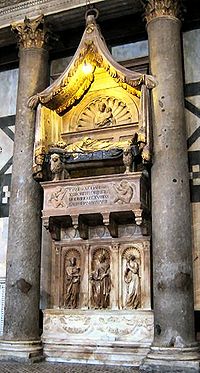
The Medicis oversaw the construction of his magnificent tomb
by Donatello
and Michelozzo
in the Battistero di San Giovanni in Florence. Pope Martin V protested in vain against the inscription on the sarcophagus: "John the former pope".
The 1910 Catholic Encyclopedia
remarks that "Undeniably secular and ambitious, his moral life was not above reproach, and his unscrupulous methods in no wise accorded with the requirements of his high office ... the heinous crimes of which his opponents in the council accused him were certainly gravely exaggerated." One of his secretaries concluded that John was "a great man in temporal things, but a complete failure and worthless in spiritual things."
of the twentieth century. When Angelo Cardinal Roncalli
was elected and became Pope John, there was some confusion as to whether he would be John XXIII or John XXIV; he then declared that he was John XXIII to put this question to rest. There was no John XX
; for example, Gibbon refers to the antipope John as John XXII.
Western Schism
The Western Schism or Papal Schism was a split within the Catholic Church from 1378 to 1417. Two men simultaneously claimed to be the true pope. Driven by politics rather than any theological disagreement, the schism was ended by the Council of Constance . The simultaneous claims to the papal chair...
. The Catholic Church regards him as an antipope
Antipope
An antipope is a person who opposes a legitimately elected or sitting Pope and makes a significantly accepted competing claim to be the Pope, the Bishop of Rome and leader of the Roman Catholic Church. At times between the 3rd and mid-15th century, antipopes were typically those supported by a...
.
Biography
Baldassarre Cossa was born on the island of ProcidaProcida
Procida is one of the Flegrean Islands off the coast of Naples in southern Italy. The island is between Cape Miseno and the island of Ischia. With its tiny satellite island of Vivara, it is a comune of the province of Naples, in the region of Campania. The population is about ten...
or Ischia
Ischia
Ischia is a volcanic island in the Tyrrhenian Sea. It lies at the northern end of the Gulf of Naples, about 30 km from the city of Naples. It is the largest of the Phlegrean Islands. Roughly trapezoidal in shape, it measures around 10 km east to west and 7 km north to south and has...
in the Kingdom of Naples
Kingdom of Naples
The Kingdom of Naples, comprising the southern part of the Italian peninsula, was the remainder of the old Kingdom of Sicily after secession of the island of Sicily as a result of the Sicilian Vespers rebellion of 1282. Known to contemporaries as the Kingdom of Sicily, it is dubbed Kingdom of...
into a noble but impoverished family. Initially he followed a military career, taking part in the Angevin-Neapolitan war
Kingdom of Naples
The Kingdom of Naples, comprising the southern part of the Italian peninsula, was the remainder of the old Kingdom of Sicily after secession of the island of Sicily as a result of the Sicilian Vespers rebellion of 1282. Known to contemporaries as the Kingdom of Sicily, it is dubbed Kingdom of...
. His two brothers were sentenced to death for piracy
Piracy
Piracy is an act of robbery or criminal violence at sea. The term can include acts committed on land, in the air, or in other major bodies of water or on a shore. It does not normally include crimes committed against persons traveling on the same vessel as the perpetrator...
by Ladislaus of Naples.
He studied law at the University of Bologna
University of Bologna
The Alma Mater Studiorum - University of Bologna is the oldest continually operating university in the world, the word 'universitas' being first used by this institution at its foundation. The true date of its founding is uncertain, but believed by most accounts to have been 1088...
and obtained a doctorate. In 1392 he entered the service of Pope Boniface IX
Pope Boniface IX
Pope Boniface IX , born Piero Tomacelli, was the second Roman Pope of the Western Schism from November 2, 1389, until October 1, 1404...
, first working in Bologna and then in Rome. (The Western Schism
Western Schism
The Western Schism or Papal Schism was a split within the Catholic Church from 1378 to 1417. Two men simultaneously claimed to be the true pope. Driven by politics rather than any theological disagreement, the schism was ended by the Council of Constance . The simultaneous claims to the papal chair...
had begun in 1378 and there were two competing popes at the time, one in Avignon supported by France and Spain, and one in Rome supported by most of Italy, Germany and England.) Still a member of the laity
Laity
In religious organizations, the laity comprises all people who are not in the clergy. A person who is a member of a religious order who is not ordained legitimate clergy is considered as a member of the laity, even though they are members of a religious order .In the past in Christian cultures, the...
, he became Cardinal deacon in 1402 and Papal legate
Papal legate
A papal legate – from the Latin, authentic Roman title Legatus – is a personal representative of the pope to foreign nations, or to some part of the Catholic Church. He is empowered on matters of Catholic Faith and for the settlement of ecclesiastical matters....
in Forlì
Forlì
Forlì is a comune and city in Emilia-Romagna, Italy, and is the capital of the province of Forlì-Cesena. The city is situated along the Via Emilia, to the right of the Montone river, and is an important agricultural centre...
in 1403.
He was one of the seven cardinal
Cardinal (Catholicism)
A cardinal is a senior ecclesiastical official, usually an ordained bishop, and ecclesiastical prince of the Catholic Church. They are collectively known as the College of Cardinals, which as a body elects a new pope. The duties of the cardinals include attending the meetings of the College and...
s who, in May 1408, deserted Pope Gregory XII
Pope Gregory XII
Pope Gregory XII , born Angelo Correr or Corraro, Pope from 1406 to 1415, succeeded Pope Innocent VII on 30 November 1406....
, and, with those following Antipope Benedict XIII
Antipope Benedict XIII
Benedict XIII, born Pedro Martínez de Luna y Pérez de Gotor , known as in Spanish, was an Aragonese nobleman, who is officially considered by the Catholic Church to be an antipope....
from Avignon, convened the Council of Pisa
Council of Pisa
The Council of Pisa was an unrecognized ecumenical council of the Catholic Church held in 1409 that attempted to end the Western Schism by deposing Benedict XIII and Gregory XII...
, of which Cossa became the leader. The aim of the council was to end the schism; to this end they deposed Gregory XII and Benedict XIII and elected the new pope Alexander V
Antipope Alexander V
Alexander V was antipope during the Western Schism . He reigned from June 26, 1409, to his death in 1410 and is officially regarded by the Roman Catholic Church as an antipope....
in 1409. Gregory and Benedict ignored this decision however, so that there were now three simultaneous claimants to the Papacy.
Alexander V died soon after, and on 25 May 1410 Cossa was consecrated pope, taking the name John XXIII. He had been ordained priest
Priesthood (Catholic Church)
The ministerial orders of the Catholic Church include the orders of bishops, deacons and presbyters, which in Latin is sacerdos. The ordained priesthood and common priesthood are different in function and essence....
only one day earlier. John XXIII was acknowledged as pope by France
France
The French Republic , The French Republic , The French Republic , (commonly known as France , is a unitary semi-presidential republic in Western Europe with several overseas territories and islands located on other continents and in the Indian, Pacific, and Atlantic oceans. Metropolitan France...
, England
England
England is a country that is part of the United Kingdom. It shares land borders with Scotland to the north and Wales to the west; the Irish Sea is to the north west, the Celtic Sea to the south west, with the North Sea to the east and the English Channel to the south separating it from continental...
, Bohemia
Bohemia
Bohemia is a historical region in central Europe, occupying the western two-thirds of the traditional Czech Lands. It is located in the contemporary Czech Republic with its capital in Prague...
, Prussia
Prussia
Prussia was a German kingdom and historic state originating out of the Duchy of Prussia and the Margraviate of Brandenburg. For centuries, the House of Hohenzollern ruled Prussia, successfully expanding its size by way of an unusually well-organized and effective army. Prussia shaped the history...
, Portugal
Portugal
Portugal , officially the Portuguese Republic is a country situated in southwestern Europe on the Iberian Peninsula. Portugal is the westernmost country of Europe, and is bordered by the Atlantic Ocean to the West and South and by Spain to the North and East. The Atlantic archipelagos of the...
, parts of the Holy Roman Empire
Holy Roman Empire
The Holy Roman Empire was a realm that existed from 962 to 1806 in Central Europe.It was ruled by the Holy Roman Emperor. Its character changed during the Middle Ages and the Early Modern period, when the power of the emperor gradually weakened in favour of the princes...
, and numerous Northern Italian city states, including Florence and Venice
Venice
Venice is a city in northern Italy which is renowned for the beauty of its setting, its architecture and its artworks. It is the capital of the Veneto region...
; however, the Avignon Pope Benedict XIII was regarded as pope by the Kingdoms of Aragon
Kingdom of Aragon
The Kingdom of Aragon was a medieval and early modern kingdom in the Iberian Peninsula, corresponding to the modern-day autonomous community of Aragon, in Spain...
, Castile
Kingdom of Castile
Kingdom of Castile was one of the medieval kingdoms of the Iberian Peninsula. It emerged as a political autonomous entity in the 9th century. It was called County of Castile and was held in vassalage from the Kingdom of León. Its name comes from the host of castles constructed in the region...
, and Scotland
Kingdom of Scotland
The Kingdom of Scotland was a Sovereign state in North-West Europe that existed from 843 until 1707. It occupied the northern third of the island of Great Britain and shared a land border to the south with the Kingdom of England...
and Gregory XII was still favored by Ladislaus of Naples, Carlo I Malatesta
Carlo I Malatesta
Carlo I Malatesta was an Italian condottiero during the Wars in Lombardy and lord of Rimini, Fano, Cesena and Pesaro...
, the princes of Bavaria, Louis III
Louis III, Elector Palatine
Louis III, Count Palatine of the Rhine , was an Elector Palatine of the Rhine from the house of Wittelsbach in 1410–1436....
, Elector Palatine, and parts of Germany and Poland
Kingdom of Poland (1385–1569)
The Kingdom of Poland of the Jagiellons was the Polish state created by the accession of Jogaila , Grand Duke of Lithuania, to the Polish throne in 1386. The Union of Krewo or Krėva Act, united Poland and Lithuania under the rule of a single monarch...
.
The Medicis had supported Cossa in his campaign to become cardinal and pope. Once in office, John XXIII made the Medici Bank
Medici bank
The Medici Bank was a financial institution created by the Medici family in Italy during the 15th century. It was the largest and most respected bank in Europe during its prime. There are some estimates that the Medici family was, for a period of time, the wealthiest family in Europe...
the bank of the papacy, contributing considerably to the family's wealth and prestige.
John had his officials sell indulgence
Indulgence
In Catholic theology, an indulgence is the full or partial remission of temporal punishment due for sins which have already been forgiven. The indulgence is granted by the Catholic Church after the sinner has confessed and received absolution...
s, a controversial practice that was protested in various parts of Europe, for instance by the followers of Jan Hus
Jan Hus
Jan Hus , often referred to in English as John Hus or John Huss, was a Czech priest, philosopher, reformer, and master at Charles University in Prague...
in Prague
Prague
Prague is the capital and largest city of the Czech Republic. Situated in the north-west of the country on the Vltava river, the city is home to about 1.3 million people, while its metropolitan area is estimated to have a population of over 2.3 million...
.
The main enemy of John was Ladislaus of Naples, who protected Gregory XII in Rome. Following his election as pope, John spent a year in Bologna and then joined forces with Louis II of Anjou to march against Ladislaus. An initial victory proved short-lived and Ladislaus retook Rome in 1413, forcing John to flee to Florence.
Sigismund, Holy Roman Emperor
Sigismund of Luxemburg KG was King of Hungary, of Croatia from 1387 to 1437, of Bohemia from 1419, and Holy Roman Emperor for four years from 1433 until 1437, the last Emperor of the House of Luxemburg. He was also King of Italy from 1431, and of Germany from 1411...
, who had just been crowned King of Germany and who had ambitions to become emperor
Holy Roman Emperor
The Holy Roman Emperor is a term used by historians to denote a medieval ruler who, as German King, had also received the title of "Emperor of the Romans" from the Pope...
. Sigismund wanted to end the schism and urged John to call a general council. John did so with hesitation, afraid that he might be deposed at the council. The Council of Constance
Council of Constance
The Council of Constance is the 15th ecumenical council recognized by the Roman Catholic Church, held from 1414 to 1418. The council ended the Three-Popes Controversy, by deposing or accepting the resignation of the remaining Papal claimants and electing Pope Martin V.The Council also condemned and...
was convened on 30 October 1413. During the third session, rival Pope Gregory XII
Pope Gregory XII
Pope Gregory XII , born Angelo Correr or Corraro, Pope from 1406 to 1415, succeeded Pope Innocent VII on 30 November 1406....
authorized the council as well. The council resolved that all three popes should abdicate and a new pope be elected. Gregory agreed and John initially did as well, but then he fled the council, hoping that without him it would lose its authority. Instead, the council deposed him and tried him for heresy, simony, schism and immorality, finding him guilty on all counts. The last remaining claimant in Avignon, Benedict XIII
Antipope Benedict XIII
Benedict XIII, born Pedro Martínez de Luna y Pérez de Gotor , known as in Spanish, was an Aragonese nobleman, who is officially considered by the Catholic Church to be an antipope....
, refused to resign and was excommunicated. Martin V
Pope Martin V
Pope Martin V , born Odo Colonna, was Pope from 1417 to 1431. His election effectively ended the Western Schism .-Biography:...
was elected as new pope in 1417.
Cossa, as he was again, was imprisoned in Germany. He was freed in 1418 after a heavy ransom had been paid by the Medicis. In Rome he submitted to Martin V who made him cardinal bishop of Tusculum
Tusculum
Tusculum is a ruined Roman city in the Alban Hills, in the Latium region of Italy.-Location:Tusculum is one of the largest Roman cities in Alban Hills. The ruins of Tusculum are located on Tuscolo hill—more specifically on the northern edge of the outer crater ring of the Alban volcano...
. He went to Florence and died only a few months later.
The Medicis oversaw the construction of his magnificent tomb
Tomb of Antipope John XXIII
The Tomb of Antipope John XXIII is the marble and bronze tomb monument of Antipope John XXIII , created by Donatello and Michelozzo for the Florence Baptistry adjacent to the Duomo...
by Donatello
Donatello
Donato di Niccolò di Betto Bardi , also known as Donatello, was an early Renaissance Italian artist and sculptor from Florence...
and Michelozzo
Michelozzo
thumb|250px|[[Palazzo Medici]] in Florence.Michelozzo di Bartolomeo Michelozzi was an Italian architect and sculptor.-Biography:...
in the Battistero di San Giovanni in Florence. Pope Martin V protested in vain against the inscription on the sarcophagus: "John the former pope".
The 1910 Catholic Encyclopedia
Catholic Encyclopedia
The Catholic Encyclopedia, also referred to as the Old Catholic Encyclopedia and the Original Catholic Encyclopedia, is an English-language encyclopedia published in the United States. The first volume appeared in March 1907 and the last three volumes appeared in 1912, followed by a master index...
remarks that "Undeniably secular and ambitious, his moral life was not above reproach, and his unscrupulous methods in no wise accorded with the requirements of his high office ... the heinous crimes of which his opponents in the council accused him were certainly gravely exaggerated." One of his secretaries concluded that John was "a great man in temporal things, but a complete failure and worthless in spiritual things."
Numbering issues
He should not be confused with Pope John XXIIIPope John XXIII
-Papal election:Following the death of Pope Pius XII in 1958, Roncalli was elected Pope, to his great surprise. He had even arrived in the Vatican with a return train ticket to Venice. Many had considered Giovanni Battista Montini, Archbishop of Milan, a possible candidate, but, although archbishop...
of the twentieth century. When Angelo Cardinal Roncalli
Pope John XXIII
-Papal election:Following the death of Pope Pius XII in 1958, Roncalli was elected Pope, to his great surprise. He had even arrived in the Vatican with a return train ticket to Venice. Many had considered Giovanni Battista Montini, Archbishop of Milan, a possible candidate, but, although archbishop...
was elected and became Pope John, there was some confusion as to whether he would be John XXIII or John XXIV; he then declared that he was John XXIII to put this question to rest. There was no John XX
Pope John XX
There has never been a Pope John XX, because the 20th pope of this name, formerly Petrus Hispanus, when elected Pope in 1276, decided to skip the number XX and to be counted as John XXI instead...
; for example, Gibbon refers to the antipope John as John XXII.