

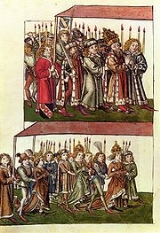
Council of Constance

Encyclopedia
The Council of Constance is the 15th ecumenical council
recognized by the Roman Catholic Church
, held from 1414 to 1418. The council ended the Three-Popes Controversy
, by deposing or accepting the resignation of the remaining Papal claimants and electing Pope Martin V
.
The Council also condemned and executed Jan Hus
and ruled on issues of national sovereignty, the rights of pagans, and just war in response to a conflict between the Kingdom of Poland
and the Order of the Teutonic Knights
. The Council is important for its relationship to ecclesial Conciliarism
and Papal supremacy
.
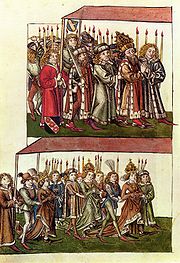 The council's main purpose was to end the Papal schism which had resulted from the confusion following the Avignon Papacy
. Pope Gregory XI
's return to Rome in 1377, followed by his death and the controverisal election of his successor, Pope Urban VI
, resulted in the defection of a number of cardinals and the election of a rival pope based at Avignon in 1378. After thirty years of schism, the Council of Pisa
had sought to resolve the situation by deposing the two claimant popes and elected a new pope, Alexander V. The council claimed that in such a situation, a council of bishops had greater authority than just one bishop, even if he were the bishop of Rome. Though Alexander and his successor, John XXIII
, gained widespread support, especially at the cost of the Avignon pope, the schism remained, now involving not two but three claimants: Gregory XII
at Rome, Benedict XIII
at Avignon and John XXIII.
Therefore, many voices, including Sigismund, King of Germany and Hungary
(and later Holy Roman Emperor) pressed for another council to resolve the issue. That council was called by John XXIII
and was held from 16 November 1414 to 22 April 1418 in Constance
, Germany. According to Joseph McCabe
, the council was attended by roughly 29 cardinal
s, 100 "learned doctors of law and divinity," 134 abbot
s, and 183 bishop
s and archbishop
s. An innovation at the Council was that instead of voting as individuals, the bishops voted in national blocs, explicitly confirming the national pressures that had fueled the schism since 1378.
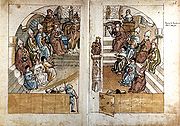 The famous decree Haec Sancta Synodus, which gave primacy to the authority of the Council and thus became a source for ecclesial conciliarism, was promulgated in the fifth session, 6 April 1415:
Marks the high water mark of the Conciliar movement of reform. This decree, however, is not considered valid by the Magisterium of the Catholic Church, since it was never approved by Pope Gregory XII or his successors, and was passed by the Council in a session before his confirmation. The Church declared the first sessions of the Council of Constance an invalid and illicit assembly of Bishops, gathered under the authority of John XXIII.
The acts of the Council were not made public until 1442, at the behest of the Council of Basel; they were printed in 1500. The creation of a book on how to die was ordered by the council, and thus written in 1415 called Ars moriendi
.
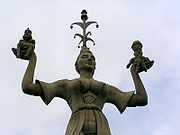 With the support of King Sigismund
, enthroned before the high altar of the cathedral of Constance, the Council of Constance recommended that all three popes abdicate, and that another be chosen. In part because of the constant presence of the King, other rulers demanded that they have a say in who would be pope.
Gregory XII then sent representatives to Constance, whom he granted full powers to summon, open and preside over an Ecumenical Council; he also empowered them to present his resignation to the Papacy. This would pave the way for the end of the Western Schism.
The legates were received by King Sigismund and by the assembled Bishops, and the King yielded the presidency of the proceedings to the papal legates, Cardinal Dominici of Ragusa and Prince Charles of Malatesta. On 4 July 1415 the Bull of Gregory XII which appointed Malatesta and Cardinal Dominici of Ragusa as his proxies at the council was formally read before the assembled Bishops. The cardinal then read a decree of Gregory XII which convoked the council and authorized its succeeding acts. Thereupon, the Bishops voted to accept the summons. Prince Malatesta immediately informed the Council that he was empowered by a commission from Pope Gregory XII to resign the Papal Throne on the Pontiff's behalf. He asked the Council whether they would prefer to receive the abdication at that point or at a later date. The Bishops voted to receive the Papal abdication immediately. Thereupon the commission by Gregory XII authorizing his proxy to resign the Papacy on his behalf was read and Malatesta, acting in the name of Gregory XII, pronounced the resignation of the papacy by Gregory XII and handed a written copy of the resignation to the assembly.
Former Pope Gregory XII was then created titular Cardinal Bishop of Porto and Santa Ruffina by the Council, with rank immediately below the Pope (which made him the highest ranking person in the Church, since, due to his abdication, the See of Peter was vacant). Gregory XII's cardinals were accepted as true cardinals by the Council, but the members of the council delayed electing a new pope for fear that a new pope would restrict further discussion of pressing issues in the Church.
By the time the anti-popes were all deposed and the new Pope, Martin V
, was elected, two years had passed since Gregory XII's abdication, and Gregory was already dead. The council took great care to protect the legitimacy of the succession, ratified all his acts and a new pontiff was chosen. The new pope, Martin V
, elected November 1417, soon asserted the absolute authority of the papal office.
, and their followers. Jan Hus
, summoned to Constance under a letter of indemnity, was condemned by council and burned at the stake
notwithstanding on 6 July 1415.
fought the Kingdom of Poland
and Grand Duchy of Lithuania
. However, the peace was not stable and further conflicts arose regarding demarcation of the Samogitia
n borders. The tensions erupted into the brief Hunger War in summer 1414. It was concluded that the disputes would be mediated by the Council of Constance. The propaganda war soon grew from a border quarrel to a fundamental dispute of the Teutonic mission – did the Knights have the right to wage the crusade? was it a Just War
?
The Polish position was defended by Paulus Vladimiri, rector of the Jagiellonian University
, who challenged legality of the Teutonic crusade. He argued that a forced conversion was incompatible with free will, which was an essential component of a genuine conversion. Therefore the Knights could only wage a defensive war if pagans violated natural rights
of the Christians. Vladimiri further stipulated that infidels had right which had to be respected and neither the Pope or the Holy Roman Emperor
had the authority to violate them. Poles and Lithuanians also brought a group of Samogitian representatives to testify of atrocities committed by the Knights. However, Vladimiri's ideas were rejected by Catholic theologians.
John of Falkenberg
proved to be the fiercest opponent of the Poles. In his Liber de doctrina, Falkenberg argued that "the Emperor has the right to slay even peaceful infidels simply because they are pagans (...). The Poles deserve death for defending infidels, and should be exterminated even more than the infidels; they should be deprived of their sovereignty and reduced to slavery." In Satira, he attacked Polish King Jogaila
, calling him a "mad dog" unworthy to be king. Falkenberg was condemned and imprisoned for such libel, but was not officially accused of heresy. Other opponents included Grand Master's proctor Peter Wormditt, Dominic of San Gimignano, John Urbach, Ardecino de Porta of Novara, and Bishop of Ciudad Rodrigo Andrew Escobar. They argued that the Knights were perfectly justified in their crusade as it was a sacred duty of Christians to spread the true faith. Cardinal Pierre d'Ailly
published an independent opinion that attempted to somewhat balance both Polish and Teutonic positions.
The Council did not make any political decisions. It established Diocese of Samogitia, with seat in Medininkai
and subordinated to Lithuanian dioceses, and appointed Matthias of Trakai
as the first bishop. Pope Martin V appointed Polish King Jogaila
and Lithuanian Grand Duke Vytautas as vicar general
s in Pskov
and Veliky Novgorod
in recognition of their Catholicism. After another round of futile negotiations, Gollub War
broke out in 1422. It ended with the Treaty of Melno
that resolved the territorial disputes for good.
Ecumenical council
An ecumenical council is a conference of ecclesiastical dignitaries and theological experts convened to discuss and settle matters of Church doctrine and practice....
recognized by the Roman Catholic Church
Roman Catholic Church
The Catholic Church, also known as the Roman Catholic Church, is the world's largest Christian church, with over a billion members. Led by the Pope, it defines its mission as spreading the gospel of Jesus Christ, administering the sacraments and exercising charity...
, held from 1414 to 1418. The council ended the Three-Popes Controversy
Western Schism
The Western Schism or Papal Schism was a split within the Catholic Church from 1378 to 1417. Two men simultaneously claimed to be the true pope. Driven by politics rather than any theological disagreement, the schism was ended by the Council of Constance . The simultaneous claims to the papal chair...
, by deposing or accepting the resignation of the remaining Papal claimants and electing Pope Martin V
Pope Martin V
Pope Martin V , born Odo Colonna, was Pope from 1417 to 1431. His election effectively ended the Western Schism .-Biography:...
.
The Council also condemned and executed Jan Hus
Jan Hus
Jan Hus , often referred to in English as John Hus or John Huss, was a Czech priest, philosopher, reformer, and master at Charles University in Prague...
and ruled on issues of national sovereignty, the rights of pagans, and just war in response to a conflict between the Kingdom of Poland
Kingdom of Poland (1385–1569)
The Kingdom of Poland of the Jagiellons was the Polish state created by the accession of Jogaila , Grand Duke of Lithuania, to the Polish throne in 1386. The Union of Krewo or Krėva Act, united Poland and Lithuania under the rule of a single monarch...
and the Order of the Teutonic Knights
Teutonic Knights
The Order of Brothers of the German House of Saint Mary in Jerusalem , commonly the Teutonic Order , is a German medieval military order, in modern times a purely religious Catholic order...
. The Council is important for its relationship to ecclesial Conciliarism
Conciliarism
Conciliarism, or the conciliar movement, was a reform movement in the 14th, 15th and 16th century Roman Catholic Church which held that final authority in spiritual matters resided with the Roman Church as a corporation of Christians, embodied by a general church council, not with the pope...
and Papal supremacy
Papal supremacy
Papal supremacy refers to the doctrine of the Roman Catholic Church that the pope, by reason of his office as Vicar of Christ and as pastor of the entire Christian Church, has full, supreme, and universal power over the whole Church, a power which he can always exercise unhindered: that, in brief,...
.
Origin and background
Avignon Papacy
The Avignon Papacy was the period from 1309 to 1376 during which seven Popes resided in Avignon, in modern-day France. This arose from the conflict between the Papacy and the French crown....
. Pope Gregory XI
Pope Gregory XI
Gregory XI was pope from 1370 until his death.-Biography:He was born Pierre Roger de Beaufort, in Maumont, in the modern commune of Rosiers-d'Égletons, Limousin around 1336. He succeeded Pope Urban V in 1370, and was pope until 1378...
's return to Rome in 1377, followed by his death and the controverisal election of his successor, Pope Urban VI
Pope Urban VI
Pope Urban VI , born Bartolomeo Prignano, was Pope from 1378 to 1389.-Biography:Born in Itri, he was a devout monk and learned casuist, trained at Avignon. On March 21, 1364, he was consecrated Archbishop of Acerenza in the Kingdom of Naples...
, resulted in the defection of a number of cardinals and the election of a rival pope based at Avignon in 1378. After thirty years of schism, the Council of Pisa
Council of Pisa
The Council of Pisa was an unrecognized ecumenical council of the Catholic Church held in 1409 that attempted to end the Western Schism by deposing Benedict XIII and Gregory XII...
had sought to resolve the situation by deposing the two claimant popes and elected a new pope, Alexander V. The council claimed that in such a situation, a council of bishops had greater authority than just one bishop, even if he were the bishop of Rome. Though Alexander and his successor, John XXIII
Antipope John XXIII
Baldassarre Cossa was Pope John XXIII during the Western Schism. The Catholic Church regards him as an antipope.-Biography:...
, gained widespread support, especially at the cost of the Avignon pope, the schism remained, now involving not two but three claimants: Gregory XII
Pope Gregory XII
Pope Gregory XII , born Angelo Correr or Corraro, Pope from 1406 to 1415, succeeded Pope Innocent VII on 30 November 1406....
at Rome, Benedict XIII
Antipope Benedict XIII
Benedict XIII, born Pedro Martínez de Luna y Pérez de Gotor , known as in Spanish, was an Aragonese nobleman, who is officially considered by the Catholic Church to be an antipope....
at Avignon and John XXIII.
Therefore, many voices, including Sigismund, King of Germany and Hungary
Sigismund, Holy Roman Emperor
Sigismund of Luxemburg KG was King of Hungary, of Croatia from 1387 to 1437, of Bohemia from 1419, and Holy Roman Emperor for four years from 1433 until 1437, the last Emperor of the House of Luxemburg. He was also King of Italy from 1431, and of Germany from 1411...
(and later Holy Roman Emperor) pressed for another council to resolve the issue. That council was called by John XXIII
Antipope John XXIII
Baldassarre Cossa was Pope John XXIII during the Western Schism. The Catholic Church regards him as an antipope.-Biography:...
and was held from 16 November 1414 to 22 April 1418 in Constance
Konstanz
Konstanz is a university city with approximately 80,000 inhabitants located at the western end of Lake Constance in the south-west corner of Germany, bordering Switzerland. The city houses the University of Konstanz.-Location:...
, Germany. According to Joseph McCabe
Joseph McCabe
Joseph Martin McCabe was an English writer and speaker on freethought, after having been a Roman Catholic priest earlier in his life.-Early life:...
, the council was attended by roughly 29 cardinal
Cardinal (Catholicism)
A cardinal is a senior ecclesiastical official, usually an ordained bishop, and ecclesiastical prince of the Catholic Church. They are collectively known as the College of Cardinals, which as a body elects a new pope. The duties of the cardinals include attending the meetings of the College and...
s, 100 "learned doctors of law and divinity," 134 abbot
Abbot
The word abbot, meaning father, is a title given to the head of a monastery in various traditions, including Christianity. The office may also be given as an honorary title to a clergyman who is not actually the head of a monastery...
s, and 183 bishop
Bishop (Catholic Church)
In the Catholic Church, a bishop is an ordained minister who holds the fullness of the sacrament of Holy Orders and is responsible for teaching the Catholic faith and ruling the Church....
s and archbishop
Archbishop
An archbishop is a bishop of higher rank, but not of higher sacramental order above that of the three orders of deacon, priest , and bishop...
s. An innovation at the Council was that instead of voting as individuals, the bishops voted in national blocs, explicitly confirming the national pressures that had fueled the schism since 1378.
Decrees and doctrinal status
Marks the high water mark of the Conciliar movement of reform. This decree, however, is not considered valid by the Magisterium of the Catholic Church, since it was never approved by Pope Gregory XII or his successors, and was passed by the Council in a session before his confirmation. The Church declared the first sessions of the Council of Constance an invalid and illicit assembly of Bishops, gathered under the authority of John XXIII.
The acts of the Council were not made public until 1442, at the behest of the Council of Basel; they were printed in 1500. The creation of a book on how to die was ordered by the council, and thus written in 1415 called Ars moriendi
Ars moriendi
The Ars moriendi are two related Latin texts dating from about 1415 and 1450 which offer advice on the protocols and procedures of a good death, explaining how to "die well" according to Christian precepts of the late Middle Ages...
.
Ending the Western Schism
Sigismund, Holy Roman Emperor
Sigismund of Luxemburg KG was King of Hungary, of Croatia from 1387 to 1437, of Bohemia from 1419, and Holy Roman Emperor for four years from 1433 until 1437, the last Emperor of the House of Luxemburg. He was also King of Italy from 1431, and of Germany from 1411...
, enthroned before the high altar of the cathedral of Constance, the Council of Constance recommended that all three popes abdicate, and that another be chosen. In part because of the constant presence of the King, other rulers demanded that they have a say in who would be pope.
Gregory XII then sent representatives to Constance, whom he granted full powers to summon, open and preside over an Ecumenical Council; he also empowered them to present his resignation to the Papacy. This would pave the way for the end of the Western Schism.
The legates were received by King Sigismund and by the assembled Bishops, and the King yielded the presidency of the proceedings to the papal legates, Cardinal Dominici of Ragusa and Prince Charles of Malatesta. On 4 July 1415 the Bull of Gregory XII which appointed Malatesta and Cardinal Dominici of Ragusa as his proxies at the council was formally read before the assembled Bishops. The cardinal then read a decree of Gregory XII which convoked the council and authorized its succeeding acts. Thereupon, the Bishops voted to accept the summons. Prince Malatesta immediately informed the Council that he was empowered by a commission from Pope Gregory XII to resign the Papal Throne on the Pontiff's behalf. He asked the Council whether they would prefer to receive the abdication at that point or at a later date. The Bishops voted to receive the Papal abdication immediately. Thereupon the commission by Gregory XII authorizing his proxy to resign the Papacy on his behalf was read and Malatesta, acting in the name of Gregory XII, pronounced the resignation of the papacy by Gregory XII and handed a written copy of the resignation to the assembly.
Former Pope Gregory XII was then created titular Cardinal Bishop of Porto and Santa Ruffina by the Council, with rank immediately below the Pope (which made him the highest ranking person in the Church, since, due to his abdication, the See of Peter was vacant). Gregory XII's cardinals were accepted as true cardinals by the Council, but the members of the council delayed electing a new pope for fear that a new pope would restrict further discussion of pressing issues in the Church.
By the time the anti-popes were all deposed and the new Pope, Martin V
Pope Martin V
Pope Martin V , born Odo Colonna, was Pope from 1417 to 1431. His election effectively ended the Western Schism .-Biography:...
, was elected, two years had passed since Gregory XII's abdication, and Gregory was already dead. The council took great care to protect the legitimacy of the succession, ratified all his acts and a new pontiff was chosen. The new pope, Martin V
Pope Martin V
Pope Martin V , born Odo Colonna, was Pope from 1417 to 1431. His election effectively ended the Western Schism .-Biography:...
, elected November 1417, soon asserted the absolute authority of the papal office.
Condemnation of Jan Hus
A second goal of the council was to continue the reforms begun at the Council of Pisa. These reforms were largely directed against John Wycliff, mentioned in the opening session, and condemned in the eighth, 4 May 1415 and Jan HusJan Hus
Jan Hus , often referred to in English as John Hus or John Huss, was a Czech priest, philosopher, reformer, and master at Charles University in Prague...
, and their followers. Jan Hus
Jan Hus
Jan Hus , often referred to in English as John Hus or John Huss, was a Czech priest, philosopher, reformer, and master at Charles University in Prague...
, summoned to Constance under a letter of indemnity, was condemned by council and burned at the stake
Burned at the Stake
Burned at the Stake is a 1981 film directed by Bert I. Gordon. It stars Susan Swift and Albert Salmi.-Cast:*Susan Swift as Loreen Graham / Ann Putnam*Albert Salmi as Captaiin Billingham*Guy Stockwell as Dr. Grossinger*Tisha Sterling as Karen Graham...
notwithstanding on 6 July 1415.
Polish–Lithuanian–Teutonic conflict
In 1411, the First Peace of Thorn ended the Polish–Lithuanian–Teutonic War, in which the Teutonic KnightsTeutonic Knights
The Order of Brothers of the German House of Saint Mary in Jerusalem , commonly the Teutonic Order , is a German medieval military order, in modern times a purely religious Catholic order...
fought the Kingdom of Poland
Poland during the Jagiellon dynasty
History of Poland during the Jagiellon dynasty is the period in the history of Poland that spans the late Middle Ages and early Modern Era. Beginning with the Lithuanian Grand Duke Jogaila , the Jagiellon dynasty formed the Polish–Lithuanian union...
and Grand Duchy of Lithuania
Grand Duchy of Lithuania
The Grand Duchy of Lithuania was a European state from the 12th /13th century until 1569 and then as a constituent part of Polish-Lithuanian Commonwealth until 1791 when Constitution of May 3, 1791 abolished it in favor of unitary state. It was founded by the Lithuanians, one of the polytheistic...
. However, the peace was not stable and further conflicts arose regarding demarcation of the Samogitia
Samogitia
Samogitia is one of the five ethnographic regions of Lithuania. It is located in northwestern Lithuania. Its largest city is Šiauliai/Šiaulē. The region has a long and distinct cultural history, reflected in the existence of the Samogitian dialect...
n borders. The tensions erupted into the brief Hunger War in summer 1414. It was concluded that the disputes would be mediated by the Council of Constance. The propaganda war soon grew from a border quarrel to a fundamental dispute of the Teutonic mission – did the Knights have the right to wage the crusade? was it a Just War
Just War
Just war theory is a doctrine of military ethics of Roman philosophical and Catholic origin, studied by moral theologians, ethicists and international policy makers, which holds that a conflict ought to meet philosophical, religious or political criteria.-Origins:The concept of justification for...
?
The Polish position was defended by Paulus Vladimiri, rector of the Jagiellonian University
Jagiellonian University
The Jagiellonian University was established in 1364 by Casimir III the Great in Kazimierz . It is the oldest university in Poland, the second oldest university in Central Europe and one of the oldest universities in the world....
, who challenged legality of the Teutonic crusade. He argued that a forced conversion was incompatible with free will, which was an essential component of a genuine conversion. Therefore the Knights could only wage a defensive war if pagans violated natural rights
Natural rights
Natural and legal rights are two types of rights theoretically distinct according to philosophers and political scientists. Natural rights are rights not contingent upon the laws, customs, or beliefs of any particular culture or government, and therefore universal and inalienable...
of the Christians. Vladimiri further stipulated that infidels had right which had to be respected and neither the Pope or the Holy Roman Emperor
Holy Roman Emperor
The Holy Roman Emperor is a term used by historians to denote a medieval ruler who, as German King, had also received the title of "Emperor of the Romans" from the Pope...
had the authority to violate them. Poles and Lithuanians also brought a group of Samogitian representatives to testify of atrocities committed by the Knights. However, Vladimiri's ideas were rejected by Catholic theologians.
John of Falkenberg
John of Falkenberg
John of Falkenberg or Johannes Falkenberg was a German Dominican theologian and writer....
proved to be the fiercest opponent of the Poles. In his Liber de doctrina, Falkenberg argued that "the Emperor has the right to slay even peaceful infidels simply because they are pagans (...). The Poles deserve death for defending infidels, and should be exterminated even more than the infidels; they should be deprived of their sovereignty and reduced to slavery." In Satira, he attacked Polish King Jogaila
Jogaila
Jogaila, later 'He is known under a number of names: ; ; . See also: Jogaila : names and titles. was Grand Duke of Lithuania , king consort of Kingdom of Poland , and sole King of Poland . He ruled in Lithuania from 1377, at first with his uncle Kęstutis...
, calling him a "mad dog" unworthy to be king. Falkenberg was condemned and imprisoned for such libel, but was not officially accused of heresy. Other opponents included Grand Master's proctor Peter Wormditt, Dominic of San Gimignano, John Urbach, Ardecino de Porta of Novara, and Bishop of Ciudad Rodrigo Andrew Escobar. They argued that the Knights were perfectly justified in their crusade as it was a sacred duty of Christians to spread the true faith. Cardinal Pierre d'Ailly
Pierre d'Ailly
Pierre d'Ailly was a French theologian, astrologer, and cardinal of the Roman Catholic Church....
published an independent opinion that attempted to somewhat balance both Polish and Teutonic positions.
The Council did not make any political decisions. It established Diocese of Samogitia, with seat in Medininkai
Varniai
Varniai , is a city in the Telšiai County, western Lithuania. In the Middle Ages the city was known as Medininkai. It was established in the 14th century, on the bank of the Varnelė River, near an important Samogitian castle. It was the center of Samogitian Catholic church: after the baptism of...
and subordinated to Lithuanian dioceses, and appointed Matthias of Trakai
Matthias of Trakai
Matthias of Trakai or of Vilnius was a Lithuanian Roman Catholic clergyman, the first Bishop of Samogitia from its establishment in 1417 until 1422 and the fifth Bishop of Vilnius from 4 May 1422 until 9 May 1453 and an ex-officio member of the Council of Lords.-Biography:Matthias graduated the...
as the first bishop. Pope Martin V appointed Polish King Jogaila
Jogaila
Jogaila, later 'He is known under a number of names: ; ; . See also: Jogaila : names and titles. was Grand Duke of Lithuania , king consort of Kingdom of Poland , and sole King of Poland . He ruled in Lithuania from 1377, at first with his uncle Kęstutis...
and Lithuanian Grand Duke Vytautas as vicar general
Vicar general
A vicar general is the principal deputy of the bishop of a diocese for the exercise of administrative authority. As vicar of the bishop, the vicar general exercises the bishop's ordinary executive power over the entire diocese and, thus, is the highest official in a diocese or other particular...
s in Pskov
Pskov
Pskov is an ancient city and the administrative center of Pskov Oblast, Russia, located in the northwest of Russia about east from the Estonian border, on the Velikaya River. Population: -Early history:...
and Veliky Novgorod
Veliky Novgorod
Veliky Novgorod is one of Russia's most historic cities and the administrative center of Novgorod Oblast. It is situated on the M10 federal highway connecting Moscow and St. Petersburg. The city lies along the Volkhov River just below its outflow from Lake Ilmen...
in recognition of their Catholicism. After another round of futile negotiations, Gollub War
Gollub War
The Gollub War was a two-month war of the Teutonic Knights against the Kingdom of Poland and the Grand Duchy of Lithuania in 1422. It ended by signing the Treaty of Melno, which resolved territorial disputes, dragging since 1398, between the Knights and Lithuania over Samogitia.-Background:The...
broke out in 1422. It ended with the Treaty of Melno
Treaty of Melno
The Treaty of Melno or Treaty of Lake Melno was a peace treaty ending the Gollub War. It was signed on September 27, 1422, between the Teutonic Knights and an alliance of the Kingdom of Poland and the Grand Duchy of Lithuania at Lake Melno , east of Graudenz...
that resolved the territorial disputes for good.