

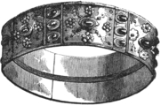
Iron Crown of Lombardy

Encyclopedia
Relic
In religion, a relic is a part of the body of a saint or a venerated person, or else another type of ancient religious object, carefully preserved for purposes of veneration or as a tangible memorial...
and one of the most ancient royal insignia of Europe
Europe
Europe is, by convention, one of the world's seven continents. Comprising the westernmost peninsula of Eurasia, Europe is generally 'divided' from Asia to its east by the watershed divides of the Ural and Caucasus Mountains, the Ural River, the Caspian and Black Seas, and the waterways connecting...
. The crown became one of the symbols of the Kingdom of Lombards and later of the medieval Kingdom of Italy
Kingdom of Italy (medieval)
The Kingdom of Italy was a political entity under control of Carolingian dynasty of Francia first, after the defeat of the Lombards in 774. It was finally incorporated as a part of the Holy Roman Empire in 962....
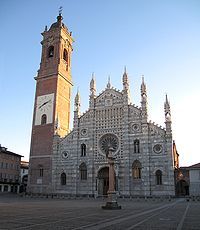
. It is kept in the Cathedral of Monza
Monza Cathedral
The Duomo of Monza often known in English as Monza Cathedral is the main religious building of Monza, near Milan, in northern Italy...
, in the suburbs of Milan
Milan
Milan is the second-largest city in Italy and the capital city of the region of Lombardy and of the province of Milan. The city proper has a population of about 1.3 million, while its urban area, roughly coinciding with its administrative province and the bordering Province of Monza and Brianza ,...
.
Description
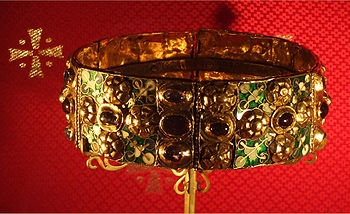
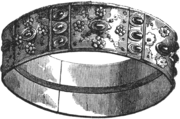
The Iron Crown is so called from a narrow band of iron about one centimeter (two-fifths of an inch) within it, said to be beaten out of one of the nails used at the crucifixionNail (relic)
Relics that are claimed to be the Holy Nails with which Christ was crucified are objects of veneration among some Christians, i.e., among Catholics and the Eastern Orthodox. In Christian symbolism and art they figure among the Instruments of the Passion or Arma Christi, the objects associated with...
. The outer circlet of the crown is of six segments of beaten gold partly enameled, joined together by hinges and set with twenty-two gemstones that stand out in relief, in the form of crosses and flowers. Its small size and hinged construction have suggested to some that it was originally a large armlet or perhaps a votive crown
Votive crown
A votive crown is a votive offering in the form of a crown, normally in precious metals and often adorned with jewels. Especially in the Early Middle Ages, they are of a special form, designed to be suspended by chains at an altar, shrine or image...
; for others, the small size of the present crown was caused by a readjustment after the loss of two segments, as described in historical documents.
Origins
Helena of Constantinople
Saint Helena also known as Saint Helen, Helena Augusta or Helena of Constantinople was the consort of Emperor Constantius, and the mother of Emperor Constantine I...
, who had discovered the True Cross
True Cross
The True Cross is the name for physical remnants which, by a Christian tradition, are believed to be from the cross upon which Jesus was crucified.According to post-Nicene historians, Socrates Scholasticus and others, the Empress Helena The True Cross is the name for physical remnants which, by a...
. Sources speak of several nails dispensed by Helena and Constantine: Helena cast one into the sea to calm a storm, while another was incorporated into Constantine's helmet, another fitted to the head of a statue of the Emperor, and a fourth melted down and molded into a bit for Constantine's horse. Some scholars posit that there were, in fact, many Holy Nails being circulated at the time. Almost thirty European countries lay claim to a holy nail. Constantinople seems to have made liberal use of them: "Empress Helena, who seems to have spent much of her reign locating holy relics, once cast a nail from the Holy Cross into the sea to calm a storm. Another was fitted to the head of a statue of the Emperor Constantine, while a third was incorporated into his helmet."
When the nail was incorporated into a crown and how it fell into the hands of the Lombard
Lombards
The Lombards , also referred to as Longobards, were a Germanic tribe of Scandinavian origin, who from 568 to 774 ruled a Kingdom in Italy...
kings, the Migration Period
Migration Period
The Migration Period, also called the Barbarian Invasions , was a period of intensified human migration in Europe that occurred from c. 400 to 800 CE. This period marked the transition from Late Antiquity to the Early Middle Ages...
Germanic conquerors of northern Italy
Northern Italy
Northern Italy is a wide cultural, historical and geographical definition, without any administrative usage, used to indicate the northern part of the Italian state, also referred as Settentrione or Alta Italia...
, is unclear, though legends involve Theodelinda
Theodelinda
Theodelinda, queen of the Lombards, was the daughter of duke Garibald I of Bavaria.She was married first in 588 to Authari, king of the Lombards, son of king Cleph. Authari died in 590. Theodelinda was allowed to pick Agilulf as her next husband and Authari's successor in 591...
, the queen of Lombards who resided at Monza in the late 6th century.
Since almost thirty European countries lay claim to fragments of the holy nails, historian Philip Blom holds that "Constantine also understood the value of these objects in diplomacy"; Several were sent off to various dignitaries, one of whom was Princess Theodelinda. "She used her nail as part of her crown, the famous Iron Crown of Lombardy Roman legend connects the crown with Pope Gregory the Great for her part in converting the Lombards to Christianity. She later donated the crown to the Italian church at Monza in 628, where it was preserved.
In some accounts it was used in Charlemagne
Charlemagne
Charlemagne was King of the Franks from 768 and Emperor of the Romans from 800 to his death in 814. He expanded the Frankish kingdom into an empire that incorporated much of Western and Central Europe. During his reign, he conquered Italy and was crowned by Pope Leo III on 25 December 800...
's coronation as King of the Lombards; others, however, hold that the crown was only forged in the 9th century, years after Charlemagne, and consider all the supposed former history as legends. There is no contemporary account of the initiation ritual actually used to make Charlemagne the King of the Lombards; thus it is possible that no crown was used in this ceremony. Contemporary or nearly contemporary accounts of the initiations of the earlier kings of the Lombards stress the importance of the king's taking in hand of a holy lance and there is no reason not to assume that the taking in hand of such a lance would not have been the central act in Charlemagne's inauguration as the King of the Lombards as well.
In 1996, ANTARES (Australian National Tandem for Applied Research) tested the samples of the beeswax and clay mixture used to hold the gemstones of the Iron Crown in their settings and concluded that the Iron Crown was made between 700 and 780.
Lord Twining cites a hypothesis by Reinhold N. Elze that Gisela
Gisela, daughter of Louis the Pious
Gisela was the youngest daughter of Louis the Pious and his second wife, Judith of Bavaria. She married the powerful and influential Evrard, Duke of Friuli, later canonized as Saint Evrard, with whom she had several children including King Berengar I of Italy, Margrave of Friuli, and Ingeltrude...
, the daughter of the Emperor Louis the Pious
Louis the Pious
Louis the Pious , also called the Fair, and the Debonaire, was the King of Aquitaine from 781. He was also King of the Franks and co-Emperor with his father, Charlemagne, from 813...
and married to Count Eberhard of Fruili, may have originally possessed the crown and left it to her son Berengar I on her death in 874. Berengar was the only major benefactor of the church at Monza at this time and also gave the Cathedral of St. John in Monza a cross made in the same style as the Iron Crown, which is still preserved in the church's treasury. Twining also notes that the Imperial Museum at St. Petersburg includes in its collection two medieval crowns found at Kazan
Kazan
Kazan is the capital and largest city of the Republic of Tatarstan, Russia. With a population of 1,143,546 , it is the eighth most populous city in Russia. Kazan lies at the confluence of the Volga and Kazanka Rivers in European Russia. In April 2009, the Russian Patent Office granted Kazan the...
in 1730 made in the same style and of the same size as the Iron Crown. Twining notes that while these crowns and the Iron Crown are too small to be worn around an adult human head, they could be worn on the top of the head if affixed to a veil and this would account for the small holes on the rim of the Iron Crown. Twining also mentions a relief plaque in the cathedral which appears to represent the coronation of Otto IV at Monza in 1209 as it was described by Morigias in 1345 and stresses the point that although four votive crowns are shown hanging above the altar, the crown which the archbishop is placing on the king's head bears no resemblance to the Iron Crown. The Encyclopædia Britannica states that the first reliable record of the use of the Iron Crown in the coronation of a King of Italy is that of the coronation of Henry VII in 1312.
Finally, Twining cites a study by Ludovico Antonio Muratori
Ludovico Antonio Muratori
Ludovico Antonio Muratori was an Italian historian, notable as a leading scholar of his age, and for his discovery of the Muratorian fragment, the earliest known list of New Testament books....
which documents the various degrees of the ecclesiastical authorities alternately authorizing and suppressing the veneration of the Iron Crown until in 1688 the matter was subjected to be studied by the Congregation of Rites in Rome, which in 1715 diplomatically concluded its official examination by permitting Iron Crown to be exposed for public veneration and carried in processions, but leaving the essential point of the identity of the iron ring of the Iron Crown with one of the nails of Christ's crucifixion undecided. However, subsequently Archbishop Visconti of Milan gave his own decision that "the iron ring in the Monza crown should be considered as one of the Nails of the Holy Cross and as an original relic." Twining notes that the clergy of Monza assert that despite the centuries that the Iron Crown has been exposed to public veneration, there is not a speck of rust on the essential inner iron ring. Lipinsky in his examination of the Iron Crown in 1985 noted that this iron ring also shows no magnetic attraction.
Thirty-four coronations with the Iron Crown were counted by the historian Bartolomeo Zucchi from the 9th to the 17th century, but the coronations surely documented in history are:
- CharlemagneCharlemagneCharlemagne was King of the Franks from 768 and Emperor of the Romans from 800 to his death in 814. He expanded the Frankish kingdom into an empire that incorporated much of Western and Central Europe. During his reign, he conquered Italy and was crowned by Pope Leo III on 25 December 800...
(800) - Conrad IIConrad II, Holy Roman EmperorConrad II was Holy Roman Emperor from 1027 until his death.The son of a mid-level nobleman in Franconia, Count Henry of Speyer and Adelaide of Alsace, he inherited the titles of count of Speyer and of Worms as an infant when Henry died at age twenty...
(1024) - Conrad IIIConrad III of GermanyConrad III was the first King of Germany of the Hohenstaufen dynasty. He was the son of Frederick I, Duke of Swabia, and Agnes, a daughter of the Salian Emperor Henry IV.-Life and reign:...
(1128) - Frederick BarbarossaFrederick I, Holy Roman EmperorFrederick I Barbarossa was a German Holy Roman Emperor. He was elected King of Germany at Frankfurt on 4 March 1152 and crowned in Aachen on 9 March, crowned King of Italy in Pavia in 1155, and finally crowned Roman Emperor by Pope Adrian IV, on 18 June 1155, and two years later in 1157 the term...
(1155) - Henry VIHenry VI, Holy Roman EmperorHenry VI was King of Germany from 1190 to 1197, Holy Roman Emperor from 1191 to 1197 and King of Sicily from 1194 to 1197.-Early years:Born in Nijmegen,...
(1186, during his marriage with Constance, Queen of Sicily) - Charles IVCharles IV, Holy Roman EmperorCharles IV , born Wenceslaus , was the second king of Bohemia from the House of Luxembourg, and the first king of Bohemia to also become Holy Roman Emperor....
(1355, at the presence of Francesco Petrarca) - Charles VCharles V, Holy Roman EmperorCharles V was ruler of the Holy Roman Empire from 1519 and, as Charles I, of the Spanish Empire from 1516 until his voluntary retirement and abdication in favor of his younger brother Ferdinand I and his son Philip II in 1556.As...
(1530) - Napoleon INapoleon INapoleon Bonaparte was a French military and political leader during the latter stages of the French Revolution.As Napoleon I, he was Emperor of the French from 1804 to 1815...
(1805) - Ferdinand I of AustriaFerdinand I of AustriaFerdinand I was Emperor of Austria, President of the German Confederation, King of Hungary and Bohemia , as well as associated dominions from the death of his father, Francis II, Holy Roman Emperor, until his abdication after the Revolutions of 1848.He married Maria Anna of Savoy, the sixth child...
(1838)
Since the 10th century, the Roman-German Kings
Holy Roman Emperor
The Holy Roman Emperor is a term used by historians to denote a medieval ruler who, as German King, had also received the title of "Emperor of the Romans" from the Pope...
would travel to Rome to be crowned Holy Roman Emperors. On their way, they traditionally stopped in Lombardy to be crowned with the Iron Crown as Kings of Italy
Kingdom of Italy (medieval)
The Kingdom of Italy was a political entity under control of Carolingian dynasty of Francia first, after the defeat of the Lombards in 774. It was finally incorporated as a part of the Holy Roman Empire in 962....
. The traditional site of the coronation was Pavia
Pavia
Pavia , the ancient Ticinum, is a town and comune of south-western Lombardy, northern Italy, 35 km south of Milan on the lower Ticino river near its confluence with the Po. It is the capital of the province of Pavia. It has a population of c. 71,000...
, the old Lombard capital, but starting with Conrad II
Conrad II, Holy Roman Emperor
Conrad II was Holy Roman Emperor from 1027 until his death.The son of a mid-level nobleman in Franconia, Count Henry of Speyer and Adelaide of Alsace, he inherited the titles of count of Speyer and of Worms as an infant when Henry died at age twenty...
in 1026 later on coronations were also performed at Milan
Milan
Milan is the second-largest city in Italy and the capital city of the region of Lombardy and of the province of Milan. The city proper has a population of about 1.3 million, while its urban area, roughly coinciding with its administrative province and the bordering Province of Monza and Brianza ,...
. In 1530, Charles V
Charles V, Holy Roman Emperor
Charles V was ruler of the Holy Roman Empire from 1519 and, as Charles I, of the Spanish Empire from 1516 until his voluntary retirement and abdication in favor of his younger brother Ferdinand I and his son Philip II in 1556.As...
received the Iron Crown simultaneously with his Imperial coronation at Bologna
Bologna
Bologna is the capital city of Emilia-Romagna, in the Po Valley of Northern Italy. The city lies between the Po River and the Apennine Mountains, more specifically, between the Reno River and the Savena River. Bologna is a lively and cosmopolitan Italian college city, with spectacular history,...
.
Napoleon I of France
Napoleon Bonaparte was a French military and political leader during the latter stages of the French Revolution.As Napoleon I, he was Emperor of the French from 1804 to 1815...
had himself crowned King of Italy
King of Italy
King of Italy is a title adopted by many rulers of the Italian peninsula after the fall of the Roman Empire...
at Milan
Milan
Milan is the second-largest city in Italy and the capital city of the region of Lombardy and of the province of Milan. The city proper has a population of about 1.3 million, while its urban area, roughly coinciding with its administrative province and the bordering Province of Monza and Brianza ,...
, with suitable splendour and magnificence. Seated upon a superb throne, he was invested with the usual insignia of royalty by the Cardinal Archbishop of Milan, and ascending the altar, he took the iron crown, and placing it on his head, exclaimed, being part of the ceremony used at the enthronement of the Lombard kings, Dieu me la donne, gare à qui la touche – "God gives it to me, beware whoever touches it".
On the occasion, Napoleon founded the Order of the Iron Crown
Order of the Iron Crown
The Imperial Order of the Iron Crown was established June 5, 1805 by Napoleon Bonaparte . It took its name from the ancient Iron Crown of Lombardy, a medieval jewel with an iron ring, forged from what was supposed to be a nail from the True Cross as a band on the inside. This crown also gave its...
, on June 15, 1805. After Napoleon's fall and the annexation of Lombardy to Austria, the order was re-instituted by the Austrian Emperor Francis I on January 1, 1816.
The last to be crowned with the Iron Crown was Emperor Ferdinand I
Ferdinand I of Austria
Ferdinand I was Emperor of Austria, President of the German Confederation, King of Hungary and Bohemia , as well as associated dominions from the death of his father, Francis II, Holy Roman Emperor, until his abdication after the Revolutions of 1848.He married Maria Anna of Savoy, the sixth child...
in his role as King of Lombardy and Venetia. This occurred in Milan on September 6, 1838.
After the war between Austria and Italy, when the Austrians had to withdraw from Lombardy in 1859, the Iron Crown was moved to Vienna
Vienna
Vienna is the capital and largest city of the Republic of Austria and one of the nine states of Austria. Vienna is Austria's primary city, with a population of about 1.723 million , and is by far the largest city in Austria, as well as its cultural, economic, and political centre...
, where it remained until 1866 when it was given back to Italy after the Third Italian War of Independence
Third Italian War of Independence
The Third Italian War of Independence was a conflict which paralleled the Austro-Prussian War, and was fought between the Kingdom of Italy and the Austrian Empire.-Background:...
.
Coronation Rite for the Kings of Italy
From the 9th to the 18th century, the Kings of ItalyKingdom of Italy (medieval)
The Kingdom of Italy was a political entity under control of Carolingian dynasty of Francia first, after the defeat of the Lombards in 774. It was finally incorporated as a part of the Holy Roman Empire in 962....
were also the Holy Roman Emperors, so many of them received the Iron Crown of Lombardy at Pavia
Pavia
Pavia , the ancient Ticinum, is a town and comune of south-western Lombardy, northern Italy, 35 km south of Milan on the lower Ticino river near its confluence with the Po. It is the capital of the province of Pavia. It has a population of c. 71,000...
, the formal capital of the Kingdom.
The earliest form of this coronation ritual closely follows that of for the imperial coronation in the Gemunden codex and makes no mention of an anointing.
The Coronation of Henry VII and Margaret
Margaret of Brabant
Margaret of Brabant , was the daughter of John I, Duke of Brabant and Margaret of Flanders. She was the wife of Count Henry of Luxemburg and after his coronation in 1308, she became Queen of Germany.-Family:...
at Milan in 1311---As the king enters the choir the prayer, "Almighty, everlasting God of heaven and earth,..." is said and then the Oath is put to the king in interrogatory form. This is followed by the bishops' petition that he respect the rights and privileges of the Church and the king's reply. The Recognition follows, the people answering, Kyrie eleison. The Litany of the Saints
Litany of the Saints
The Litany of the Saints is a sacred prayer of the Roman Catholic Church, the Western Rites of the Orthodox Church, and some Anglican Churches. It is a prayer of invocation to the Triune God, and prayers for the intercession of the Blessed Virgin Mary, the Angels and all the martyrs and saints...
is sung, concluded by three prayers, "We invoke you...," "God who the people...," and "On this day..." The consecratory prayer then said, "Almighty, everlasting God, Creator and Governor of the world,..." While the antiphon
Antiphon
An antiphon in Christian music and ritual, is a "responsory" by a choir or congregation, usually in Gregorian chant, to a psalm or other text in a religious service or musical work....
"Favorer of the Just..." or "Zadok the Priest...," is sung while the king is anointed on shoulders, after which is said the prayer, "God the Son of God..."
The king is given a ring with the, "Receive the ring of royal dignity...", followed by the prayer, "God with whom is all power...". The sword is given with the words, "Receive this sword...", followed by the prayer, "God whose providence..." The king is crowned with the words, "Receive this royal crown...", followed by the prayer, "God of Continuity..." The Scepter is given with the words, "Receive the scepter of royal power...", followed by the prayer, "Lord, fount of all goodness..." and finally the verge is given the king with the words, "Receive the rod of virtue and dignity..." followed by six blessing. The king is then enthroned, after which the Orb
Globus cruciger
The globus cruciger is an orb topped with a cross , a Christian symbol of authority used throughout the Middle Ages and even today on coins, iconography and royal regalia...
is given the king with the words, beginning, "Receive this gold apple which signifies monarchy over all the kingdom,..." The king replies, "Let it be done," to the charge, "Be upright, O king,..." and the Te Deum
Te Deum
The Te Deum is an early Christian hymn of praise. The title is taken from its opening Latin words, Te Deum laudamus, rendered literally as "Thee, O God, we praise"....
is sung.
The queen's coronation begins with the prayer, "Almighty, everlasting God, fount and origin..." and is then followed by the consecratory prayer, "God who alone..." and the queen is then anointed on her shoulders with the form, "In the name...you are anointed with this oil,...", followed by the prayer, "The grace of the Holy Spirit..."
The queen then receive a ring with the word, "Receive the ring the sign of faith in the holy Trinity...", followed by the prayer, "Lord, the fount of all goodness,..." the queen is crowned with the words, "Receive the crown of glory...", followed by the prayers, "By our unworthy ministry..." and "Almighty, everlasting God, infuse the spirit..."
The Mass said at this coronation was that of the Ambrosian
Ambrosian Rite
Ambrosian Rite, also called the Milanese Rite, is a Catholic liturgical Western Rite. The rite is named after Saint Ambrose, a bishop of Milan in the fourth century...
Missa pro imperatore ('the Mass for the Emperor').
Cultural references
A surprising image of the Iron Crown figures in Chaper 37 "Sunset" of Herman MelvilleHerman Melville
Herman Melville was an American novelist, short story writer, essayist, and poet. He is best known for his novel Moby-Dick and the posthumous novella Billy Budd....
's Moby-Dick
Moby-Dick
Moby-Dick; or, The Whale, was written by American author Herman Melville and first published in 1851. It is considered by some to be a Great American Novel and a treasure of world literature. The story tells the adventures of wandering sailor Ishmael, and his voyage on the whaleship Pequod,...
. The brief chapter is devoted to Captain Ahab's soliloquy. Among his delusions of persecution and of grandeur, he imagines himself crowned with the Iron Crown of Lombardy.
The Italian film La corona di ferro (1941), directed by Alessandro Blasetti
Alessandro Blasetti
Alessandro Blasetti was an Italian film director who influenced Italian neorealism with the film Quattro passi fra le nuvole...
, tells a fantastic story about the arrival of the crown in Italy.