

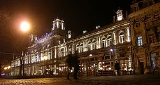
Rousse

Encyclopedia
Ruse is the fifth-largest city in Bulgaria
. Ruse is situated in the northeastern part of the country, on the right bank of the Danube
, opposite the Romania
n city of Giurgiu
, 300 km (186 mi) from the capital Sofia
and 200 km (124 mi) from the Bulgarian Black Sea Coast
. It is the most significant Bulgarian river port, serving an important part of the international trade of the country.
Ruse is known for its 19th- and 20th-century Neo-Baroque and Neo-Rococo
architecture, which attracts many tourists. It is often called the Little Vienna
. The Ruse-Giurgiu Friendship Bridge
, the only one in the shared Bulgarian-Romanian section of the Danube, crosses the river here.
. The urban area is an approximately 11-km ellipse running along the river. The city extends from the land-connected Matey island and the mouth of Rusenski Lom
on the west to Srabcheto hill on the east. During the 20th century, the west end of the city was significantly modified by moving the mouth of Rusenski Lom
to the west, as well as by moving the bank itself with its fairway considerably to the north. Sarabair hill is to the south of the city and is 159 m (521.65 ft) high. The Rousse TV Tower
is built there on the remains of Leventtabia, a former Turkish fortification.
settlement from the 3rd
to 2nd millennium BCE, when pottery, fishing, agriculture, and hunting developed. Excavations reveal several layers, suggesting that the place was attacked by neighbouring tribes and suffered a number of natural disasters. Ancient sanctuaries were found nearby, where idols of a pregnant woman, a fertility goddess, were prevalent.
The later Thracian
settlement developed into a Roman
military and naval centre during the reign of Vespasian
(69-70 CE) as part of the fortification system along the northern boundary of Moesia
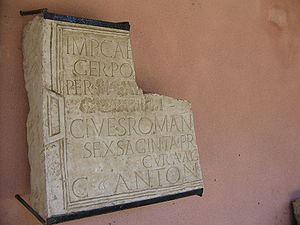
. Its name, Sexaginta Prista, suggests a meaning of "a city of 60 ships" (from — "60" and — a special type of guard ship), based on the supposed 60 nearby berths
.
The fortress was located on the main road between Singidunum
(modern Belgrade
) and the Danube Delta
and was destroyed in the sixth century by Avar
and Slavic
raids. Hungarian
historian Felix Philipp Kanitz
was the first to identify Sexaginta Prista with Ruse, but the Škorpil brothers demonstrated the link later through studying inscriptions, coins, graves, and objects of daily life. An inscription from the reign of Diocletian
proves that the city was rebuilt as a praesidium (a large fortification) after it was destroyed by the Goths
in 250 CE.
, a fortified settlement called Rusi (also Golyamo Yorgovo; ), first mentioned in 1380, emerged near the ruins of the Roman town. It later strengthened its position as an important trade centre with the lands on the opposite side of the Danube, until it was conquered by the Ottomans in 1388. Scholars suggest that the city on the river bank derived its present name from the Cherven fortress
through the root rous, which is present in many Slavic languages
and is a cognate of French
rouge and Latin
rusos.
During Ottoman rule, the invaders destroyed the town, reacting to a 1595 unsuccessful liberation attempt by a joint Vlach-Bulgarian army, led by Michael the Brave. After its rebuilding in the following years, Ruse was dubbed Rusçuk (Turkish
for "little Ruse") and had again expanded into a large fortress by the 18th century. It later grew into one of the most important Ottoman towns on the Danube and an administrative centre of Tuna Vilayet, which extended from Varna
and Tulcea
to Sofia
and Niš
.
The "Dunav" newspaper appeared – it was the first printed in Bulgaria and ... in Bulgarian. Some Bulgarian schools were founded. The streets are renamed and numbered for the first time in Bulgarian lands. A post-office, hospital, home for the aged were founded. Three empires met here for trading: Austro-Hungary, Russia, British Empire
, France and Italy opened consulates in Ruschuk. Imperceptibly, the modern city arose from the shades of the settlement. In 1865 the Obraztsov Chiflik was founded on the place where the English Consul's farm was and it was the first modern farm on the territory of the whole Ottoman Empire
of that time.
Ruse developed into a centre of the Bulgarian National Revival
and hosted the headquarters of the Bulgarian Revolutionary Central Committee
.
from the Ottoman Empire on 20 February 1878, Ruse was one of the key cultural and economic centres of the country. Intensive building during the period changed the city's architectural appearance to a typical Central Europe
an one. Ruse is famous for the many first innovations in Bulgaria, including:
Here manufactured the first bulgarian factories for soda-water, lemonade and also for neckties. The first aviator Simeon Petrov was born at Ruse.
In the newly-liberated Bulgaria of the late 19th century, Ruse was a cosmopolitan city with a multiethnic population. According to the first census conducted in 1883, Ruse was populated by 26,156 people, making it the largest city in Bulgaria. Its ethnic composition was: 11,342 Bulgarians
, 10,252 Turks
, 1,943 Sephardi Jews
, 841 Armenians
, 476 Germans
, 291 Greeks
, 231 Vlachs
(Romanians
), 170 Russians
, 113 Serbs
and Croats
, 79 Roma people, 76 Hungarians, 74 Tatars
, 58 Italians, 58 French people
, 32 English people
, 19 Persians
, 16 Poles
, 16 Czechs, and 69 people of other nationalities.
"All facades on main streets of Russe shall have rich decorations with plastic stone", postulate the Regulations for Constructions of Private Buildings of 1893, issued by the Municipality of Russe.
After knyaz Alexander Battenberg's
1886 abdication, and as a reaction to the regentship's course led by prime minister Stefan Stambolov
, a group of Russophile (pro-Russian) military officers revolted in Ruse. The riot was violently crushed, and 13 of the leaders were quickly sentenced to death and executed near the city, which caused a lot of public discontent. Decades later, in 1934, local citizens raised funds and built a monument at the place where the Russophile officers were executed. The monument was blown up in 1940, but rebuilt in 1966 at approximately the same spot.
, after Southern Dobruja
was lost to Romania, the economic significance of the city decreased. So did the population, and Ruse was no longer the second-largest city in Bulgarian lands (after former East Rumelian capital Plovdiv
), being quickly surpassed by Sofia
and Varna
. Many big companies left, and all foreign consulates were closed, except for the Russian one, which has remained functional since.
The return of Southern Dobruja to Bulgaria in September 1940 fostered good conditions for restoration of the city's leading role. It became a provincial centre, and economic activity revived. The construction of the Ruse-Giurgiu bridge
in 1954 and the fast industrialization gave a new push to development. Ruse emerged again as an important economic, transport, cultural, and educational hub. Engineering, chemical, and light industries expanded; a large harbor was built; and the city became a university centre. At the 1985 census, a population of more than 186,000 was reported.
, which polluted the air between 1980 and 1987, impacting the city's development. Population decreased, and 15,000 people moved out between 1985 and 1992. Fortunately, in 1987, the Romanian factory ceased the pollution, under pressure from environmental organizations on both Bulgarian and Romanian communist leadership. Organizations, such as Ekoglasnost, provoked nationwide demonstrations and strongly influenced the change to democracy.
During the 1990s, the economic crisis in Bulgaria affected Ruse. Most big companies suffered a decline and unemployment increased, which led to renewed emigration waves. Since 2000, the city has been continually regaining its former leading status.
centre. One of the first industrial parks in Bulgaria was built here. The French manufacturer of aluminium components for the automotive industry - Montupet and the Spanish company Keros - ceramic tiles producer, are operating at the industrial park. A Logistics park is currently being built there.
Ruse has a duty-free zone and 2 industrial zones- East and West.
Ruse East Power Plant
has an energy producing capacity of 400 MW and the Ruse West Power Plant - 41 MW.
The city's economy is dominated by light industries
— tailoring, textile
s and food processing
. Big manufactures are Fazan (the first factory for socks in Bulgaria), Fenix 94 (socks), Ariston S (women's fashion),DANINI (lady`s fashion), TOP MAN (men`s fashion), KARINA (lady`s fashion) and Sirma prista (dairy products). The petroleum industry
and the chemical industry
are represented by companies, producing paints and motor oils - Orgachim, Prista Oil
, Lubrica, Megachim, EKON 91, Ninachim, Polysan Ltd - bitumen, bitumen products and moisture-proof rolled materials on bitumen base and
vessel and boiler fuels, Marisan Ltd. - dry building materials, insulation and decorative materials of ESP and integrated systems for facade insulation.
The machinery industry and ships construction are well developed - Ruse shipyard. Also, one of the world`s leading companies in yacht design Vripack has an architecture and engineering studio in Ruse. Big metal-working companies are Zhiti — a leading producer of low-carbon steel wires, nails, fasteners, chain-link nettings, barbed wires; Precis Inter Holding JSC - produces electro-welded steel and aluminium tubes and profile; SPARKY AD - designing, engineering and building of welded parts, road construction machines, transportation and agricultural machines; EXPRESS SERVICE LTD - the only one locomotive producer in Bulgaria; WITTE AUTOMOTIVE - producer of mechanical and mechatronic latches / locks for doors and hoods, hinges or door check arms, door handle modules and safety products for car seats.KEROS BULGARIA - is major producer of ceramic floor wall tiles and porcelain tiles, located in the Eastern Industrial Park, Production started in 2010.
Steiner Elektronik Technologie is specialized in the production of single-sided, double-sided and multi-layer PCBs; Naiden Kirov JSC- a manufacturer of low-voltage electrotechnical accessories for households. Dunarit manufactures military and engineering products. Woodworking and furniture production is represented by Apex furniture, Stefany Style, Gold Apolo, IRIM. The main production of Zita is devices and appliances for control of temperature and passing of different fluids designed for automatics, pneumatics, hydraulics and everyday life technology.
There are 68 hotels and 1 813 beds at Ruse. The income from accommodations for the third quarter of 2010 г. is 1 286 008 lv. http://www.nsi.bg/otrasal.php?otr=8&a1=954&a2=955&a3=956#cont.
There are many hypermarkets such as Metro Cash & Carry
, Tehnopolis, Tehnomarket, Kaufland
(2 stores), Mr. Bricolage
, Praktiker
, Giraffe(3), and some supermarket chains such as Billa(5), Lidl
(1), Carrefour
(1), Paconi (8), Penny market (3), CBA (15), Picadilly (1).
There are 6 trade centers - Royal city center, Mega mall, Mall Rousse, trade center Danube, Yalta and Evas. In a process of construction are a sports hall and Business park Rousse. The wastewater treatment plant is almost finished.
The first private museum in Bulgaria will soon be opened in the Old High School of Music
, Varna
and Bucharest
. Ruse has two railway stations for passenger services (Central and Razpredelitelna) and other 2 for freight transport services. There are intercity buses that link Ruse with cities and towns all over the country and some European countries. They are based in two bus stations: South and East.
Ruse has an extensive public transport system including around 30 bus
and trolleybus
lines. Most of them are operated on terms of concession by the Bulgarian subsidiary of the Israeli transport holding Egged Ruse. There are also several suburban bus lines, operated by several private Bulgarian transport companies.
Approximately 15 km southeast of Ruse is the village of Shtraklevo
, near which is the former military Ruse Airport
with an international statute but currently closed. Plans exist to redevelop and reopen the airport for internal, charter, and cargo flights. The runway is long enough for Boeing 747
s (Jumbo Jets).
The Danube bridge is the only road and rail bridge between Bulgaria
and Romania
and it is located east of Ruse.

. The city is famous for its preserved buildings from the end of XIX and the beginning of ХХ century. There are more than 260 monuments. Most of the sights of the city are located at the center of Ruse (museums, architectural landmarks, the theater, the opera, hotels, restaurants, cafes and souvenir shops). Among all the sights the following ones are outstanding:
Other landmarks are:
and Razgrad
.
There is also a subsidiary of the College of Agriculture - Plovdiv in the city.
In 1978, the "All Saints" Church was destroyed and the Pantheon of National Revival Heroes
was built thereupon.
The Jewish community in Ruse built and consecrated a synagogue
in 1797. It was destroyed in the 1810 fire, but two other synagogues were later built in 1826 and 1852.
, the Rousse State Opera
(founded in 1949) and the "Sava Ognianov" theater
.
with:
(800 m) on Livingston Island in the South Shetland Islands
, Antarctica is named after the city.
Bulgaria
Bulgaria , officially the Republic of Bulgaria , is a parliamentary democracy within a unitary constitutional republic in Southeast Europe. The country borders Romania to the north, Serbia and Macedonia to the west, Greece and Turkey to the south, as well as the Black Sea to the east...
. Ruse is situated in the northeastern part of the country, on the right bank of the Danube
Danube
The Danube is a river in the Central Europe and the Europe's second longest river after the Volga. It is classified as an international waterway....
, opposite the Romania
Romania
Romania is a country located at the crossroads of Central and Southeastern Europe, on the Lower Danube, within and outside the Carpathian arch, bordering on the Black Sea...
n city of Giurgiu
Giurgiu
Giurgiu is the capital city of Giurgiu County, Romania, in the Greater Wallachia. It is situated amid mud-flats and marshes on the left bank of the Danube facing the Bulgarian city of Rousse on the opposite bank. Three small islands face the city, and a larger one shelters its port, Smarda...
, 300 km (186 mi) from the capital Sofia
Sofia
Sofia is the capital and largest city of Bulgaria and the 12th largest city in the European Union with a population of 1.27 million people. It is located in western Bulgaria, at the foot of Mount Vitosha and approximately at the centre of the Balkan Peninsula.Prehistoric settlements were excavated...
and 200 km (124 mi) from the Bulgarian Black Sea Coast
Bulgarian Black Sea Coast
The Bulgarian Black Sea Coast covers the entire eastern bound of Bulgaria stretching from the Romanian Black Sea resorts in the north to European Turkey in the south, along 378 km of coastline. White and golden sandy beaches occupy approximately 130 km of the 378 km long coast...
. It is the most significant Bulgarian river port, serving an important part of the international trade of the country.
Ruse is known for its 19th- and 20th-century Neo-Baroque and Neo-Rococo
Historicism
Historicism is a mode of thinking that assigns a central and basic significance to a specific context, such as historical period, geographical place and local culture. As such it is in contrast to individualist theories of knowledges such as empiricism and rationalism, which neglect the role of...
architecture, which attracts many tourists. It is often called the Little Vienna
Little Vienna
Little Vienna may refer to the numerous towns that closely resemble the architecture of the Austrian capital of Vienna:* Bielsko-Biała, a city in Poland* Chernivtsi, a city in Ukraine* Lviv, a city in Ukraine* Rousse, a city in Bulgaria...
. The Ruse-Giurgiu Friendship Bridge
Giurgiu-Rousse Friendship Bridge
The Danube Bridge is a steel truss bridge over the Danube River connecting the Bulgarian bank to the south with the Romanian bank to the north and the cities of Ruse and Giurgiu respectively.-History:Opened on 20 June 1954 and designed by...
, the only one in the shared Bulgarian-Romanian section of the Danube, crosses the river here.
Geography
Ruse is located on the right bank of the Danube, which is the high bank, having two underwater terraces and three river terraces at 15 to 22 m (49.2 to 72.2 ), 30 to 66 m (98.4 to 216.5 ), and 54 to 65 m (177.2 to 213.3 ). The average altitude is 45.5 m (149.28 ft) AMSLAbove mean sea level
The term above mean sea level refers to the elevation or altitude of any object, relative to the average sea level datum. AMSL is used extensively in radio by engineers to determine the coverage area a station will be able to reach...
. The urban area is an approximately 11-km ellipse running along the river. The city extends from the land-connected Matey island and the mouth of Rusenski Lom
Rusenski Lom
The Rusenski Lom is a river in northeastern Bulgaria, the last major right tributary of the Danube. It is formed by the rivers Beli Lom and Cherni Lom, the former taking its source south of Razgrad and the latter southeast of Popovo....
on the west to Srabcheto hill on the east. During the 20th century, the west end of the city was significantly modified by moving the mouth of Rusenski Lom
Rusenski Lom
The Rusenski Lom is a river in northeastern Bulgaria, the last major right tributary of the Danube. It is formed by the rivers Beli Lom and Cherni Lom, the former taking its source south of Razgrad and the latter southeast of Popovo....
to the west, as well as by moving the bank itself with its fairway considerably to the north. Sarabair hill is to the south of the city and is 159 m (521.65 ft) high. The Rousse TV Tower
Rousse TV Tower
The Rousse TV Tower is a 204-metre high TV tower built of reinforced concrete at Rousse, Bulgaria. Originally, the structure was constructed as a 206-metre-high TV tower with a cafe/restaurant on top and was the tallest one on the Balkan peninsula until 2001. In the 1990s an additional antenna was...
is built there on the remains of Leventtabia, a former Turkish fortification.
Climate
History
Antiquity and Early Middle Ages
The city emerged as a NeolithicNeolithic
The Neolithic Age, Era, or Period, or New Stone Age, was a period in the development of human technology, beginning about 9500 BC in some parts of the Middle East, and later in other parts of the world. It is traditionally considered as the last part of the Stone Age...
settlement from the 3rd
3rd millennium BC
The 3rd millennium BC spans the Early to Middle Bronze Age.It represents a period of time in which imperialism, or the desire to conquer, grew to prominence, in the city states of the Middle East, but also throughout Eurasia, with Indo-European expansion to Anatolia, Europe and Central Asia. The...
to 2nd millennium BCE, when pottery, fishing, agriculture, and hunting developed. Excavations reveal several layers, suggesting that the place was attacked by neighbouring tribes and suffered a number of natural disasters. Ancient sanctuaries were found nearby, where idols of a pregnant woman, a fertility goddess, were prevalent.
The later Thracian
Thracians
The ancient Thracians were a group of Indo-European tribes inhabiting areas including Thrace in Southeastern Europe. They spoke the Thracian language – a scarcely attested branch of the Indo-European language family...
settlement developed into a Roman
Ancient Rome
Ancient Rome was a thriving civilization that grew on the Italian Peninsula as early as the 8th century BC. Located along the Mediterranean Sea and centered on the city of Rome, it expanded to one of the largest empires in the ancient world....
military and naval centre during the reign of Vespasian
Vespasian
Vespasian , was Roman Emperor from 69 AD to 79 AD. Vespasian was the founder of the Flavian dynasty, which ruled the Empire for a quarter century. Vespasian was descended from a family of equestrians, who rose into the senatorial rank under the Emperors of the Julio-Claudian dynasty...
(69-70 CE) as part of the fortification system along the northern boundary of Moesia
Moesia
Moesia was an ancient region and later Roman province situated in the Balkans, along the south bank of the Danube River. It included territories of modern-day Southern Serbia , Northern Republic of Macedonia, Northern Bulgaria, Romanian Dobrudja, Southern Moldova, and Budjak .-History:In ancient...
. Its name, Sexaginta Prista, suggests a meaning of "a city of 60 ships" (from — "60" and — a special type of guard ship), based on the supposed 60 nearby berths
Berth (moorings)
A berth is a location in a port or harbour used specifically for mooring vessels while not at sea.-Locations in a port:Berth is the term used in ports and harbors to define a specific location where a vessel may be berthed, usually for the purposes of loading and unloading.Most berths will be...
.
The fortress was located on the main road between Singidunum
Singidunum
Singidunum is the name for the ancient city in Serbia which became Belgrade, the capital of Serbia. It was recorded that a Celtic tribe Scordisci settled the area in the 3rd century BC following the Gallic invasion of the Balkans. The Roman Empire conquered the area in 75 BC and later garrisoned...
(modern Belgrade
Belgrade
Belgrade is the capital and largest city of Serbia. It is located at the confluence of the Sava and Danube rivers, where the Pannonian Plain meets the Balkans. According to official results of Census 2011, the city has a population of 1,639,121. It is one of the 15 largest cities in Europe...
) and the Danube Delta
Danube Delta
The Danube Delta is the second largest river delta in Europe, after the Volga Delta, and is the best preserved on the continent. The greater part of the Danube Delta lies in Romania , while its northern part, on the left bank of the Chilia arm, is situated in Ukraine . The approximate surface is...
and was destroyed in the sixth century by Avar
Eurasian Avars
The Eurasian Avars or Ancient Avars were a highly organized nomadic confederacy of mixed origins. They were ruled by a khagan, who was surrounded by a tight-knit entourage of nomad warriors, an organization characteristic of Turko-Mongol groups...
and Slavic
Slavic peoples
The Slavic people are an Indo-European panethnicity living in Eastern Europe, Southeast Europe, North Asia and Central Asia. The term Slavic represents a broad ethno-linguistic group of people, who speak languages belonging to the Slavic language family and share, to varying degrees, certain...
raids. Hungarian
Hungary
Hungary , officially the Republic of Hungary , is a landlocked country in Central Europe. It is situated in the Carpathian Basin and is bordered by Slovakia to the north, Ukraine and Romania to the east, Serbia and Croatia to the south, Slovenia to the southwest and Austria to the west. The...
historian Felix Philipp Kanitz
Felix Philipp Kanitz
Felix Philipp Kanitz was an Austro-Hungarian naturalist, geographer, ethnographer, archaeologist and author of travel notes....
was the first to identify Sexaginta Prista with Ruse, but the Škorpil brothers demonstrated the link later through studying inscriptions, coins, graves, and objects of daily life. An inscription from the reign of Diocletian
Diocletian
Diocletian |latinized]] upon his accession to Diocletian . c. 22 December 244 – 3 December 311), was a Roman Emperor from 284 to 305....
proves that the city was rebuilt as a praesidium (a large fortification) after it was destroyed by the Goths
Goths
The Goths were an East Germanic tribe of Scandinavian origin whose two branches, the Visigoths and the Ostrogoths, played an important role in the fall of the Roman Empire and the emergence of Medieval Europe....
in 250 CE.
Second Bulgarian Empire and Ottoman rule
In the 13th and 14th centuries, during the time of the Second Bulgarian EmpireSecond Bulgarian Empire
The Second Bulgarian Empire was a medieval Bulgarian state which existed between 1185 and 1396 . A successor of the First Bulgarian Empire, it reached the peak of its power under Kaloyan and Ivan Asen II before gradually being conquered by the Ottomans in the late 14th-early 15th century...
, a fortified settlement called Rusi (also Golyamo Yorgovo; ), first mentioned in 1380, emerged near the ruins of the Roman town. It later strengthened its position as an important trade centre with the lands on the opposite side of the Danube, until it was conquered by the Ottomans in 1388. Scholars suggest that the city on the river bank derived its present name from the Cherven fortress
Cherven (fortress)
The stronghold of Cherven was one of the Second Bulgarian Empire's primary military, administrative, economic and cultural centres between the 12th and the 14th century...
through the root rous, which is present in many Slavic languages
Slavic languages
The Slavic languages , a group of closely related languages of the Slavic peoples and a subgroup of Indo-European languages, have speakers in most of Eastern Europe, in much of the Balkans, in parts of Central Europe, and in the northern part of Asia.-Branches:Scholars traditionally divide Slavic...
and is a cognate of French
French language
French is a Romance language spoken as a first language in France, the Romandy region in Switzerland, Wallonia and Brussels in Belgium, Monaco, the regions of Quebec and Acadia in Canada, and by various communities elsewhere. Second-language speakers of French are distributed throughout many parts...
rouge and Latin
Latin
Latin is an Italic language originally spoken in Latium and Ancient Rome. It, along with most European languages, is a descendant of the ancient Proto-Indo-European language. Although it is considered a dead language, a number of scholars and members of the Christian clergy speak it fluently, and...
rusos.
During Ottoman rule, the invaders destroyed the town, reacting to a 1595 unsuccessful liberation attempt by a joint Vlach-Bulgarian army, led by Michael the Brave. After its rebuilding in the following years, Ruse was dubbed Rusçuk (Turkish
Turkish language
Turkish is a language spoken as a native language by over 83 million people worldwide, making it the most commonly spoken of the Turkic languages. Its speakers are located predominantly in Turkey and Northern Cyprus with smaller groups in Iraq, Greece, Bulgaria, the Republic of Macedonia, Kosovo,...
for "little Ruse") and had again expanded into a large fortress by the 18th century. It later grew into one of the most important Ottoman towns on the Danube and an administrative centre of Tuna Vilayet, which extended from Varna
Varna
Varna is the largest city and seaside resort on the Bulgarian Black Sea Coast and third-largest in Bulgaria after Sofia and Plovdiv, with a population of 334,870 inhabitants according to Census 2011...
and Tulcea
Tulcea
Tulcea is a city in Dobrogea, Romania. It is the administrative center of Tulcea county, and has a population of 92,379 as of 2007. One village, Tudor Vladimirescu, is administered by the city.- History :...
to Sofia
Sofia
Sofia is the capital and largest city of Bulgaria and the 12th largest city in the European Union with a population of 1.27 million people. It is located in western Bulgaria, at the foot of Mount Vitosha and approximately at the centre of the Balkan Peninsula.Prehistoric settlements were excavated...
and Niš
Niš
Niš is the largest city of southern Serbia and third-largest city in Serbia . According to the data from 2011, the city of Niš has a population of 177,972 inhabitants, while the city municipality has a population of 257,867. The city covers an area of about 597 km2, including the urban area,...
.
The "Dunav" newspaper appeared – it was the first printed in Bulgaria and ... in Bulgarian. Some Bulgarian schools were founded. The streets are renamed and numbered for the first time in Bulgarian lands. A post-office, hospital, home for the aged were founded. Three empires met here for trading: Austro-Hungary, Russia, British Empire
British Empire
The British Empire comprised the dominions, colonies, protectorates, mandates and other territories ruled or administered by the United Kingdom. It originated with the overseas colonies and trading posts established by England in the late 16th and early 17th centuries. At its height, it was the...
, France and Italy opened consulates in Ruschuk. Imperceptibly, the modern city arose from the shades of the settlement. In 1865 the Obraztsov Chiflik was founded on the place where the English Consul's farm was and it was the first modern farm on the territory of the whole Ottoman Empire
Ottoman Empire
The Ottoman EmpireIt was usually referred to as the "Ottoman Empire", the "Turkish Empire", the "Ottoman Caliphate" or more commonly "Turkey" by its contemporaries...
of that time.
Ruse developed into a centre of the Bulgarian National Revival
Bulgarian National Revival
The Bulgarian National Revival , sometimes called the Bulgarian Renaissance, was a period of socio-economic development and national integration among Bulgarian people under Ottoman rule...
and hosted the headquarters of the Bulgarian Revolutionary Central Committee
Bulgarian Revolutionary Central Committee
The Bulgarian Revolutionary Central Committee or BRCK was a Bulgarian revolutionary organisation founded in 1869 among the Bulgarian emigrant circles in Romania. The decisive influence for the establishment of the committee was exerted by the Svoboda newspaper which Lyuben Karavelov began to...
.
Liberated Bulgaria
After it was liberatedLiberation of Bulgaria
In Bulgarian historiography, the term Liberation of Bulgaria is used to denote the events of the Russo-Turkish War of 1877-78 that led to the re-establishment of Bulgarian state with the Treaty of San Stefano of March 3, 1878, after the complete conquest of the Second Bulgarian Empire, which...
from the Ottoman Empire on 20 February 1878, Ruse was one of the key cultural and economic centres of the country. Intensive building during the period changed the city's architectural appearance to a typical Central Europe
Central Europe
Central Europe or alternatively Middle Europe is a region of the European continent lying between the variously defined areas of Eastern and Western Europe...
an one. Ruse is famous for the many first innovations in Bulgaria, including:
- 1864 - the first printing office in Bulgaria;
- 1867 - the first railway line linking Ruse and VarnaVarnaVarna is the largest city and seaside resort on the Bulgarian Black Sea Coast and third-largest in Bulgaria after Sofia and Plovdiv, with a population of 334,870 inhabitants according to Census 2011...
, was launched into operation; - 1879 - the first agronomical school "Obraztsov chiflik", today - Agricultural scientific research institute, currently profiled in agriculture and seed science;
- 1881 - the first steel ship in Bulgaria was built;
- 1881 - the first privately-owned Bulgarian bank GirdapGirdapGirdap or Ghirdap was the first privately-owned Bulgarian bank. Established in Ruse in 1881, until its closure in 1925 it was one of the two large Bulgarian banks which relied on capital that was both private and local, along with the Bulgarian Commercial Bank...
; - 1881 - the Machine School for the NavyNikola Vaptsarov Naval AcademyThe Nikola Vaptsarov Naval Academy is the naval academy of Bulgaria and the most authoritative centre of maritime personnel education in the country. Based in the Black Sea port of Varna...
, the first technical school in Bulgaria. Later it was moved to VarnaVarnaVarna is the largest city and seaside resort on the Bulgarian Black Sea Coast and third-largest in Bulgaria after Sofia and Plovdiv, with a population of 334,870 inhabitants according to Census 2011...
; - 1883 - the first Weather stationWeather stationA weather station is a facility, either on land or sea, with instruments and equipment for observing atmospheric conditions to provide information for weather forecasts and to study the weather and climate. The measurements taken include temperature, barometric pressure, humidity, wind speed, wind...
; - 1884 - the first bulgarian pharmacy association;
- 1885 - the first Bulgarian technical association was instituted;
- 1890 - the first Chamber of Commerce and Industry;
- 1891 - the first private insurance company "Bulgaria";
- 1896 - the first manually operated elevator;
- 1987 - the first movie projection. The second was a month later in the capital SofiaSofiaSofia is the capital and largest city of Bulgaria and the 12th largest city in the European Union with a population of 1.27 million people. It is located in western Bulgaria, at the foot of Mount Vitosha and approximately at the centre of the Balkan Peninsula.Prehistoric settlements were excavated...
; - 1927 - the first socks producing factory in Bulgaria - "Fazan";
- 1933 - the first oil refinery;
Here manufactured the first bulgarian factories for soda-water, lemonade and also for neckties. The first aviator Simeon Petrov was born at Ruse.
In the newly-liberated Bulgaria of the late 19th century, Ruse was a cosmopolitan city with a multiethnic population. According to the first census conducted in 1883, Ruse was populated by 26,156 people, making it the largest city in Bulgaria. Its ethnic composition was: 11,342 Bulgarians
Bulgarians
The Bulgarians are a South Slavic nation and ethnic group native to Bulgaria and neighbouring regions. Emigration has resulted in immigrant communities in a number of other countries.-History and ethnogenesis:...
, 10,252 Turks
Turkish people
Turkish people, also known as the "Turks" , are an ethnic group primarily living in Turkey and in the former lands of the Ottoman Empire where Turkish minorities had been established in Bulgaria, Cyprus, Bosnia and Herzegovina, Georgia, Greece, Kosovo, Macedonia, and Romania...
, 1,943 Sephardi Jews
Sephardi Jews
Sephardi Jews is a general term referring to the descendants of the Jews who lived in the Iberian Peninsula before their expulsion in the Spanish Inquisition. It can also refer to those who use a Sephardic style of liturgy or would otherwise define themselves in terms of the Jewish customs and...
, 841 Armenians
Armenians
Armenian people or Armenians are a nation and ethnic group native to the Armenian Highland.The largest concentration is in Armenia having a nearly-homogeneous population with 97.9% or 3,145,354 being ethnic Armenian....
, 476 Germans
Germans
The Germans are a Germanic ethnic group native to Central Europe. The English term Germans has referred to the German-speaking population of the Holy Roman Empire since the Late Middle Ages....
, 291 Greeks
Greeks
The Greeks, also known as the Hellenes , are a nation and ethnic group native to Greece, Cyprus and neighboring regions. They also form a significant diaspora, with Greek communities established around the world....
, 231 Vlachs
Vlachs
Vlach is a blanket term covering several modern Latin peoples descending from the Latinised population in Central, Eastern and Southeastern Europe. English variations on the name include: Walla, Wlachs, Wallachs, Vlahs, Olahs or Ulahs...
(Romanians
Romanians
The Romanians are an ethnic group native to Romania, who speak Romanian; they are the majority inhabitants of Romania....
), 170 Russians
Russians
The Russian people are an East Slavic ethnic group native to Russia, speaking the Russian language and primarily living in Russia and neighboring countries....
, 113 Serbs
Serbs
The Serbs are a South Slavic ethnic group of the Balkans and southern Central Europe. Serbs are located mainly in Serbia, Montenegro and Bosnia and Herzegovina, and form a sizable minority in Croatia, the Republic of Macedonia and Slovenia. Likewise, Serbs are an officially recognized minority in...
and Croats
Croats
Croats are a South Slavic ethnic group mostly living in Croatia, Bosnia and Herzegovina and nearby countries. There are around 4 million Croats living inside Croatia and up to 4.5 million throughout the rest of the world. Responding to political, social and economic pressure, many Croats have...
, 79 Roma people, 76 Hungarians, 74 Tatars
Tatars
Tatars are a Turkic speaking ethnic group , numbering roughly 7 million.The majority of Tatars live in the Russian Federation, with a population of around 5.5 million, about 2 million of which in the republic of Tatarstan.Significant minority populations are found in Uzbekistan, Kazakhstan,...
, 58 Italians, 58 French people
French people
The French are a nation that share a common French culture and speak the French language as a mother tongue. Historically, the French population are descended from peoples of Celtic, Latin and Germanic origin, and are today a mixture of several ethnic groups...
, 32 English people
English people
The English are a nation and ethnic group native to England, who speak English. The English identity is of early mediaeval origin, when they were known in Old English as the Anglecynn. England is now a country of the United Kingdom, and the majority of English people in England are British Citizens...
, 19 Persians
Persian people
The Persian people are part of the Iranian peoples who speak the modern Persian language and closely akin Iranian dialects and languages. The origin of the ethnic Iranian/Persian peoples are traced to the Ancient Iranian peoples, who were part of the ancient Indo-Iranians and themselves part of...
, 16 Poles
Poles
thumb|right|180px|The state flag of [[Poland]] as used by Polish government and diplomatic authoritiesThe Polish people, or Poles , are a nation indigenous to Poland. They are united by the Polish language, which belongs to the historical Lechitic subgroup of West Slavic languages of Central Europe...
, 16 Czechs, and 69 people of other nationalities.
"All facades on main streets of Russe shall have rich decorations with plastic stone", postulate the Regulations for Constructions of Private Buildings of 1893, issued by the Municipality of Russe.
After knyaz Alexander Battenberg's
Alexander, Prince of Bulgaria
Alexander Joseph, Prince of Bulgaria GCB , known as Alexander of Battenberg, was the first prince of modern Bulgaria, reigning from 29 April 1879 to 7 September 1886.-Early life:...
1886 abdication, and as a reaction to the regentship's course led by prime minister Stefan Stambolov
Stefan Stambolov
Stefan Nikolov Stambolov was a Bulgarian politician, who served as Prime Minister and regent. He is considered one of the most important and popular "Founders of Modern Bulgaria", and is sometimes referred to as "the Bulgarian Bismarck".- Early years :Stambolov was born in Veliko Tarnovo...
, a group of Russophile (pro-Russian) military officers revolted in Ruse. The riot was violently crushed, and 13 of the leaders were quickly sentenced to death and executed near the city, which caused a lot of public discontent. Decades later, in 1934, local citizens raised funds and built a monument at the place where the Russophile officers were executed. The monument was blown up in 1940, but rebuilt in 1966 at approximately the same spot.
World War II and Socialism
Between World War I and IIWorld War II
World War II, or the Second World War , was a global conflict lasting from 1939 to 1945, involving most of the world's nations—including all of the great powers—eventually forming two opposing military alliances: the Allies and the Axis...
, after Southern Dobruja
Southern Dobruja
Southern Dobruja is an area of north-eastern Bulgaria comprising the administrative districts named for its two principal cities of Dobrich and Silistra...
was lost to Romania, the economic significance of the city decreased. So did the population, and Ruse was no longer the second-largest city in Bulgarian lands (after former East Rumelian capital Plovdiv
Plovdiv
Plovdiv is the second-largest city in Bulgaria after Sofia with a population of 338,153 inhabitants according to Census 2011. Plovdiv's history spans some 6,000 years, with traces of a Neolithic settlement dating to roughly 4000 BC; it is one of the oldest cities in Europe...
), being quickly surpassed by Sofia
Sofia
Sofia is the capital and largest city of Bulgaria and the 12th largest city in the European Union with a population of 1.27 million people. It is located in western Bulgaria, at the foot of Mount Vitosha and approximately at the centre of the Balkan Peninsula.Prehistoric settlements were excavated...
and Varna
Varna
Varna is the largest city and seaside resort on the Bulgarian Black Sea Coast and third-largest in Bulgaria after Sofia and Plovdiv, with a population of 334,870 inhabitants according to Census 2011...
. Many big companies left, and all foreign consulates were closed, except for the Russian one, which has remained functional since.
The return of Southern Dobruja to Bulgaria in September 1940 fostered good conditions for restoration of the city's leading role. It became a provincial centre, and economic activity revived. The construction of the Ruse-Giurgiu bridge
Giurgiu-Rousse Friendship Bridge
The Danube Bridge is a steel truss bridge over the Danube River connecting the Bulgarian bank to the south with the Romanian bank to the north and the cities of Ruse and Giurgiu respectively.-History:Opened on 20 June 1954 and designed by...
in 1954 and the fast industrialization gave a new push to development. Ruse emerged again as an important economic, transport, cultural, and educational hub. Engineering, chemical, and light industries expanded; a large harbor was built; and the city became a university centre. At the 1985 census, a population of more than 186,000 was reported.
Fall of Socialism and democratic Bulgaria
In the early 1980s, Ruse entered a dark period of its history. The Verachim factory was built in GiurgiuGiurgiu
Giurgiu is the capital city of Giurgiu County, Romania, in the Greater Wallachia. It is situated amid mud-flats and marshes on the left bank of the Danube facing the Bulgarian city of Rousse on the opposite bank. Three small islands face the city, and a larger one shelters its port, Smarda...
, which polluted the air between 1980 and 1987, impacting the city's development. Population decreased, and 15,000 people moved out between 1985 and 1992. Fortunately, in 1987, the Romanian factory ceased the pollution, under pressure from environmental organizations on both Bulgarian and Romanian communist leadership. Organizations, such as Ekoglasnost, provoked nationwide demonstrations and strongly influenced the change to democracy.
During the 1990s, the economic crisis in Bulgaria affected Ruse. Most big companies suffered a decline and unemployment increased, which led to renewed emigration waves. Since 2000, the city has been continually regaining its former leading status.
Population
Ruse is the fifth biggest city in Bulgaria by population. It was the most populated city in 1880.| Ruse | ||||||||||||||
|---|---|---|---|---|---|---|---|---|---|---|---|---|---|---|
| Year | 1880 | 1887 | 1910 | 1934 | 1946 | 1956 | 1965 | 1975 | 1985 | 1992 | 2001 | 2006 | 2008 | 2011 |
| Population* | 26 163 | 27 194 | 36 255 | 41 447 | 57 509 | 83 453 | 128 888 | 159 578 | 183 746 | 170 038 | 161 453 | 157 540 | 156 761 | 149 642 |
| Permanent address | 190 798 | 177 104 | 175 374 | 173 205 | ||||||||||
| Current address | 179 666 | 170 208 | 168 116 | 165 208 |
- "Population" - Permanent and current address at the same place
Economy
Ruse is a big industrialIndustry
Industry refers to the production of an economic good or service within an economy.-Industrial sectors:There are four key industrial economic sectors: the primary sector, largely raw material extraction industries such as mining and farming; the secondary sector, involving refining, construction,...
centre. One of the first industrial parks in Bulgaria was built here. The French manufacturer of aluminium components for the automotive industry - Montupet and the Spanish company Keros - ceramic tiles producer, are operating at the industrial park. A Logistics park is currently being built there.
Ruse has a duty-free zone and 2 industrial zones- East and West.
Ruse East Power Plant
Ruse Iztok Power Plant
Ruse Iztok Thermal Power Plant is a power plant situated near the city of Ruse, Bulgaria. It has an installed capacity of 400 MW. It is owned by Holding Slovenske elektrarne....
has an energy producing capacity of 400 MW and the Ruse West Power Plant - 41 MW.
The city's economy is dominated by light industries
Light industry
Light industry is usually less capital intensive than heavy industry, and is more consumer-oriented than business-oriented...
— tailoring, textile
Textile
A textile or cloth is a flexible woven material consisting of a network of natural or artificial fibres often referred to as thread or yarn. Yarn is produced by spinning raw fibres of wool, flax, cotton, or other material to produce long strands...
s and food processing
Food processing
Food processing is the set of methods and techniques used to transform raw ingredients into food or to transform food into other forms for consumption by humans or animals either in the home or by the food processing industry...
. Big manufactures are Fazan (the first factory for socks in Bulgaria), Fenix 94 (socks), Ariston S (women's fashion),DANINI (lady`s fashion), TOP MAN (men`s fashion), KARINA (lady`s fashion) and Sirma prista (dairy products). The petroleum industry
Petroleum
Petroleum or crude oil is a naturally occurring, flammable liquid consisting of a complex mixture of hydrocarbons of various molecular weights and other liquid organic compounds, that are found in geologic formations beneath the Earth's surface. Petroleum is recovered mostly through oil drilling...
and the chemical industry
Chemical industry
The chemical industry comprises the companies that produce industrial chemicals. Central to the modern world economy, it converts raw materials into more than 70,000 different products.-Products:...
are represented by companies, producing paints and motor oils - Orgachim, Prista Oil
Prista Oil
Prista Oil is a Bulgarian company headquartered in the city of Rousse and mainly engaged in the production of 150 kinds of motor oils and industrial lubricants, as well as their distribution, transport and storage, cleaning petroleum pollution and the production and recycling of car batteries.The...
, Lubrica, Megachim, EKON 91, Ninachim, Polysan Ltd - bitumen, bitumen products and moisture-proof rolled materials on bitumen base and
vessel and boiler fuels, Marisan Ltd. - dry building materials, insulation and decorative materials of ESP and integrated systems for facade insulation.
The machinery industry and ships construction are well developed - Ruse shipyard. Also, one of the world`s leading companies in yacht design Vripack has an architecture and engineering studio in Ruse. Big metal-working companies are Zhiti — a leading producer of low-carbon steel wires, nails, fasteners, chain-link nettings, barbed wires; Precis Inter Holding JSC - produces electro-welded steel and aluminium tubes and profile; SPARKY AD - designing, engineering and building of welded parts, road construction machines, transportation and agricultural machines; EXPRESS SERVICE LTD - the only one locomotive producer in Bulgaria; WITTE AUTOMOTIVE - producer of mechanical and mechatronic latches / locks for doors and hoods, hinges or door check arms, door handle modules and safety products for car seats.KEROS BULGARIA - is major producer of ceramic floor wall tiles and porcelain tiles, located in the Eastern Industrial Park, Production started in 2010.
Steiner Elektronik Technologie is specialized in the production of single-sided, double-sided and multi-layer PCBs; Naiden Kirov JSC- a manufacturer of low-voltage electrotechnical accessories for households. Dunarit manufactures military and engineering products. Woodworking and furniture production is represented by Apex furniture, Stefany Style, Gold Apolo, IRIM. The main production of Zita is devices and appliances for control of temperature and passing of different fluids designed for automatics, pneumatics, hydraulics and everyday life technology.
There are 68 hotels and 1 813 beds at Ruse. The income from accommodations for the third quarter of 2010 г. is 1 286 008 lv. http://www.nsi.bg/otrasal.php?otr=8&a1=954&a2=955&a3=956#cont.
There are many hypermarkets such as Metro Cash & Carry
Metro AG
Metro AG is a diversified retail and wholesale/cash and carry group based in Düsseldorf, Germany. It has the largest market share in its home market, and is one of the most globalised retail and wholesale corporations. It is the fourth-largest retailer in the world measured by revenues . In English...
, Tehnopolis, Tehnomarket, Kaufland
Kaufland
Kaufland is a German hypermarket chain part of the same group as Lidl and Handelshof. It opened its first store in 1984 in Neckarsulm and quickly expanded to become a leader in what was formerly East Germany...
(2 stores), Mr. Bricolage
Mr. Bricolage
Mr. Bricolage is a French retail chain offering home improvement and do-it-yourself goods. The chain operates over 500 stores in these countries: France Serbia Bulgaria Romania Spain Andorra Belgium Argentina Uruguay Morocco Madagascar Mauritius...
, Praktiker
Praktiker
Praktiker is a German hypermarket chain offering home improvement and do-it-yourself goods. It is based in Kirkel, Saarland, and opened its first store in 1978. Initially owned by ASKO, the chain became a division of Metro AG after the merger of ASKO with Metro Cash & Carry in 1995...
, Giraffe(3), and some supermarket chains such as Billa(5), Lidl
Lidl
Lidl is a discount supermarket chain based in Germany that operates over 7,200 stores across Europe. The company's full name is Lidl Stiftung & Co. KG...
(1), Carrefour
Carrefour
Carrefour S.A. is an international hypermarket chain headquartered in Levallois-Perret, France. It is one of the largest hypermarket chains in the world...
(1), Paconi (8), Penny market (3), CBA (15), Picadilly (1).
There are 6 trade centers - Royal city center, Mega mall, Mall Rousse, trade center Danube, Yalta and Evas. In a process of construction are a sports hall and Business park Rousse. The wastewater treatment plant is almost finished.
The first private museum in Bulgaria will soon be opened in the Old High School of Music
Infrastracture
Ruse is a major road and railway hub in Northern Bulgaria. Railway transportation in the city dates back to 1867 when it became a station of first railway line in Bulgaria Ruse - Varna. There are railways to Southern Bulgaria, SofiaSofia
Sofia is the capital and largest city of Bulgaria and the 12th largest city in the European Union with a population of 1.27 million people. It is located in western Bulgaria, at the foot of Mount Vitosha and approximately at the centre of the Balkan Peninsula.Prehistoric settlements were excavated...
, Varna
Varna
Varna is the largest city and seaside resort on the Bulgarian Black Sea Coast and third-largest in Bulgaria after Sofia and Plovdiv, with a population of 334,870 inhabitants according to Census 2011...
and Bucharest
Bucharest
Bucharest is the capital municipality, cultural, industrial, and financial centre of Romania. It is the largest city in Romania, located in the southeast of the country, at , and lies on the banks of the Dâmbovița River....
. Ruse has two railway stations for passenger services (Central and Razpredelitelna) and other 2 for freight transport services. There are intercity buses that link Ruse with cities and towns all over the country and some European countries. They are based in two bus stations: South and East.
Ruse has an extensive public transport system including around 30 bus
Bus
A bus is a road vehicle designed to carry passengers. Buses can have a capacity as high as 300 passengers. The most common type of bus is the single-decker bus, with larger loads carried by double-decker buses and articulated buses, and smaller loads carried by midibuses and minibuses; coaches are...
and trolleybus
Trolleybus
A trolleybus is an electric bus that draws its electricity from overhead wires using spring-loaded trolley poles. Two wires and poles are required to complete the electrical circuit...
lines. Most of them are operated on terms of concession by the Bulgarian subsidiary of the Israeli transport holding Egged Ruse. There are also several suburban bus lines, operated by several private Bulgarian transport companies.
Approximately 15 km southeast of Ruse is the village of Shtraklevo
Shtraklevo
Shtraklevo is a village in northern Bulgaria. It is located in the municipality of Ivanovo in the Rousse Province. Shtraklevo village is located south of Rousse. Rousse Airport is located approximately 1 kilometer from the village....
, near which is the former military Ruse Airport
Ruse Airport
Ruse Airport , also known as Shtraklevo after the village located to the north, is a former military airport located about 20 km south of the city of Ruse, Bulgaria.- History :...
with an international statute but currently closed. Plans exist to redevelop and reopen the airport for internal, charter, and cargo flights. The runway is long enough for Boeing 747
Boeing 747
The Boeing 747 is a wide-body commercial airliner and cargo transport, often referred to by its original nickname, Jumbo Jet, or Queen of the Skies. It is among the world's most recognizable aircraft, and was the first wide-body ever produced...
s (Jumbo Jets).
The Danube bridge is the only road and rail bridge between Bulgaria
Bulgaria
Bulgaria , officially the Republic of Bulgaria , is a parliamentary democracy within a unitary constitutional republic in Southeast Europe. The country borders Romania to the north, Serbia and Macedonia to the west, Greece and Turkey to the south, as well as the Black Sea to the east...
and Romania
Romania
Romania is a country located at the crossroads of Central and Southeastern Europe, on the Lower Danube, within and outside the Carpathian arch, bordering on the Black Sea...
and it is located east of Ruse.
Architectural landmarks
Ruse is one of the 100 Tourist Sites of Bulgaria100 Tourist Sites of Bulgaria
"100 Tourist Sites of Bulgaria" is a Bulgarian national movement established in 1966 to promote tourism among Bulgaria's most significant cultural, historic, and natural landmarks....
. The city is famous for its preserved buildings from the end of XIX and the beginning of ХХ century. There are more than 260 monuments. Most of the sights of the city are located at the center of Ruse (museums, architectural landmarks, the theater, the opera, hotels, restaurants, cafes and souvenir shops). Among all the sights the following ones are outstanding:
| Site | Description | Photo |
|---|---|---|
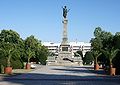
| Monument of Liberty Monument of Liberty, Rousse The Monument of Liberty in Rousse, Bulgaria, was built at the beginning of the 20th century by the Italian sculptor Arnoldo Zocchi. As time went by, it gained significance as one of the city's symbols, and now forms a part of her coat of arms.- Design :The structure is a pyramidal one... |
The Monument of Liberty was built at the beginning of the 20th century by the Italian sculptor Arnoldo Zocchi Arnoldo Zocchi Arnoldo Zocchi was a noted Italian sculptor of the late 19th and early 20th century. He was born in Florence and died in Rome... . As time went by, it gained significance as one of the city's symbols, and now forms a part of its coat of arms. |
 |
| Dohodno Zdanie ("Sava Ognianov" theater) Dohodno Zdanie Dohodno Zdanie is an imposing Neoclassical edifice on Freedom Square in the city centre of Rousse, Bulgaria, built in 1898–1902 to accommodate the local theatre performances. The name originates from the construction's purpose: to provide the school board of trustees with funds by means of the... |
Dohodno Zdanie is an imposing Neoclassical edifice in the city centre of Ruse, built in 1898–1902 to accommodate the local theatre performances. Along with the Monument of Liberty it is a symbol of the city. | 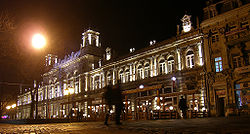 |
| "Aleksandrovska" street | The main street of the city is "Aleksandrovska". It is an architectural ensemble of buildings in Neo-Baroque, Neo-Rococo Historicism Historicism is a mode of thinking that assigns a central and basic significance to a specific context, such as historical period, geographical place and local culture. As such it is in contrast to individualist theories of knowledges such as empiricism and rationalism, which neglect the role of... and other architectural styles |
|
| The first private bank "Girdap" (The town's clock) Girdap Girdap or Ghirdap was the first privately-owned Bulgarian bank. Established in Ruse in 1881, until its closure in 1925 it was one of the two large Bulgarian banks which relied on capital that was both private and local, along with the Bulgarian Commercial Bank... |
Girdap was the first privately-owned Bulgarian bank. Established in Ruse in 1881, Girdap was among the six largest banks in Bulgaria, and during the wars its financial group was the most influential in the country. Today the main building houses the administration of Ruse's Chamber of Control and it a favorite meeting point. | |
| The old city centre of Ruse | The old city centre is the square around the Rousse Historical Museum. The regional library "Lyuben Karavelov" is located on the square. The building is decorated with baroque ornaments- leaves, pearles and rosettes. The former bank of Ivan and Stefan Simeonov is situated at the beginning of "Aleksandrovska" street. The building is in the typical for Ruse, baroque style. | 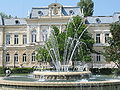 |
| The house of Elias Canetti Elias Canetti Elias Canetti was a Bulgarian-born modernist novelist, playwright, memoirist, and non-fiction writer. He wrote in German and won the Nobel Prize in Literature in 1981, "for writings marked by a broad outlook, a wealth of ideas and artistic power".-Life:... , Nobel Prize laureate in Literature - 1981 |
The house is located on "Slavianska" street. | |
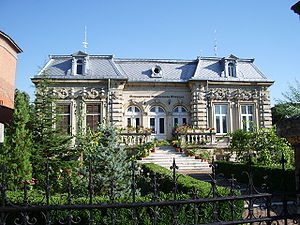
| The house of Andrea Turio | The house of Andrea Turio is the most beautiful house in Ruse. It was completed in 1900. The input materials for the construction were carefully chosen from all over the world. The halls of the house are decorated in Pompeii Pompeii The city of Pompeii is a partially buried Roman town-city near modern Naples in the Italian region of Campania, in the territory of the comune of Pompei. Along with Herculaneum, Pompeii was destroyed and completely buried during a long catastrophic eruption of the volcano Mount Vesuvius spanning... art style. |
|
| Insurance company "Bulgaria" | Insurance company "Bulgaria" was the first one in Bulgaria. It was created in 1891. The building is located on the main street "Aleksandrovska" and it was constructed in the neoclassicism Neoclassicism Neoclassicism is the name given to Western movements in the decorative and visual arts, literature, theatre, music, and architecture that draw inspiration from the "classical" art and culture of Ancient Greece or Ancient Rome... architectural style. |
|
| Old High School of Music | The "Old High School of Music" is an abandoned historic building, built in 1900-1901. The architectural style Architectural style Architectural styles classify architecture in terms of the use of form, techniques, materials, time period, region and other stylistic influences. It overlaps with, and emerges from the study of the evolution and history of architecture... is eclectic Eclecticism Eclecticism is a conceptual approach that does not hold rigidly to a single paradigm or set of assumptions, but instead draws upon multiple theories, styles, or ideas to gain complementary insights into a subject, or applies different theories in particular cases.It can sometimes seem inelegant or... , combining neoclassical Neoclassicism Neoclassicism is the name given to Western movements in the decorative and visual arts, literature, theatre, music, and architecture that draw inspiration from the "classical" art and culture of Ancient Greece or Ancient Rome... and gothic revival elements and Northern Europe Northern Europe Northern Europe is the northern part or region of Europe. Northern Europe typically refers to the seven countries in the northern part of the European subcontinent which includes Denmark, Estonia, Latvia, Lithuania, Norway, Finland and Sweden... an influences. The building is currently being reconstructed to become the first private museum in Bulgaria Bulgaria Bulgaria , officially the Republic of Bulgaria , is a parliamentary democracy within a unitary constitutional republic in Southeast Europe. The country borders Romania to the north, Serbia and Macedonia to the west, Greece and Turkey to the south, as well as the Black Sea to the east... . |
 |
| The flower vase | The flower vase is located at the city's park. Its height is 3.40 metres and its width is 7 metres. |
Other landmarks are:
- Museums
- "Slavianska" street (the house of Elias CanettiElias CanettiElias Canetti was a Bulgarian-born modernist novelist, playwright, memoirist, and non-fiction writer. He wrote in German and won the Nobel Prize in Literature in 1981, "for writings marked by a broad outlook, a wealth of ideas and artistic power".-Life:...
is located on it) - The house of Ivan Simeonov(The Catholic Eparchy in Ruse) and of Stefan Simeonov.
- Basarbovo MonasteryBasarbovo MonasteryBasarbovo Monastery - the Monastery of Saint Dimitar Basarbowski - is a bulgarian-orthodox cave monastery near the city of Ruse in north-eastern Bulgaria...
- Rousse TV TowerRousse TV TowerThe Rousse TV Tower is a 204-metre high TV tower built of reinforced concrete at Rousse, Bulgaria. Originally, the structure was constructed as a 206-metre-high TV tower with a cafe/restaurant on top and was the tallest one on the Balkan peninsula until 2001. In the 1990s an additional antenna was...
, the tallest TV tower in Bulgaria and one of the tallest buildings on the Balkan Peninsula .
Natural landmarks
| Site | Description | Photo |
|---|---|---|
| Rusenski lom (park) | Nature Park of Rusenski Lom is one of the ten nature parks of Bulgaria. It is situated along the canyon type valley of Rusenski Lom River - the last right feeder of the Danube. The park has been announced as a protected area in 1970 and embraces a territory of 3408 hectares. The park is recognized as an interesting and precious site of high aesthetic value preserving beautiful riverside terraces, meanders, high vertical rocks, areas of rich variety of species, caves, rock formations, historical monuments of national and international significance. | |
| Lipnik park | It is situated near the village of Nikolovo, 10 km away from Rusе. The park's size is around 2000 hectares and the main flora consists of linden trees. | |
| Orlova Chuka (Eagle rock) | This cave is an archaeological reserve, located 8 km near Dve Mogili Dve Mogili Dve Mogili is a town in northeastern Bulgaria, part of Ruse Province. It is the administrative centre of Dve Mogili Municipality, which lies in the western part of the area. Dve Mogili is located 32 kilometres away from the provincial capital of Ruse... . The remains of prehistoric people and a cave bear were found there. The cave is the habitat of more than 10 types of bats, thousands of them living there in the winter. This is the longest cave in North Bulgaria (13 km) and the second cave by length in Bulgaria (has about 15 kilometers of tunnels at 7 levels). |
|
Education
There is one university in Ruse - "Angel Kanchev" University of Ruse with a capacity of 12 000 students. The university's structure includes a subsidiaries in SilistraSilistra
Silistra is a port city of northeastern Bulgaria, lying on the southern bank of the lower Danube at the country's border with Romania. Silistra is the administrative centre of Silistra Province and one of the important cities of the historical region of Southern Dobrudzha...
and Razgrad
Razgrad
Razgrad is a city in northeastern Bulgaria, administrative and industrial centre of the homonymous Razgrad Province. As of February 2011, it has a population of 33,238 inhabitants.-History:...
.
There is also a subsidiary of the College of Agriculture - Plovdiv in the city.
Religious buildings
- Church of the Holy Trinity
- Church of the Holy Theotokos
- Church of St George
- Church of Holy Archangel Michael
- Church of the Holy Ascension
- Church of St Petka
- RussianRussian Orthodox ChurchThe Russian Orthodox Church or, alternatively, the Moscow Patriarchate The ROC is often said to be the largest of the Eastern Orthodox churches in the world; including all the autocephalous churches under its umbrella, its adherents number over 150 million worldwide—about half of the 300 million...
Church of St Nicholas the Miracle Worker - Roman Catholic St Paul of the Cross CathedralSt Paul of the Cross CathedralThe St Paul of the Cross Cathedral is a Roman Catholic cathedral in the city of Rousse in northeastern Bulgaria. It is the cathedral church of the Nikopol diocese and it is dedicated to Saint Paul of the Cross, founder of the Passionists....
, built 1890 - ArmenianArmenian Apostolic ChurchThe Armenian Apostolic Church is the world's oldest National Church, is part of Oriental Orthodoxy, and is one of the most ancient Christian communities. Armenia was the first country to adopt Christianity as its official religion in 301 AD, in establishing this church...
Surp Astvadzadzin Church - Evangelical Baptist church
- Evangelical Methodist Church
- Seid Pasha Mosque
- Rock-hewn Churches of IvanovoRock-hewn Churches of IvanovoThe Rock-hewn Churches of Ivanovo are a group of monolithic churches, chapels and monasteries hewn out of solid rock and completely different from other monastery complexes in Bulgaria, located near the village of Ivanovo, 20 km south of Rousse, on the high rocky banks of the Rusenski Lom, 32 m...
, a World Heritage SiteWorld Heritage SiteA UNESCO World Heritage Site is a place that is listed by the UNESCO as of special cultural or physical significance...
, is situated 20 km to the south.
In 1978, the "All Saints" Church was destroyed and the Pantheon of National Revival Heroes
Pantheon of National Revival Heroes
The Pantheon of National Revival Heroes is a Bulgarian national monument and an ossuary, located in the city of Rousse. 39 famous Bulgarians are buried in it, including Lyuben Karavelov, Zahari Stoyanov, Stefan Karadzha, Panayot Hitov, Tonka Obretenova, Nikola Obretenov, Panayot Volov, Angel...
was built thereupon.
The Jewish community in Ruse built and consecrated a synagogue
Synagogue
A synagogue is a Jewish house of prayer. This use of the Greek term synagogue originates in the Septuagint where it sometimes translates the Hebrew word for assembly, kahal...
in 1797. It was destroyed in the 1810 fire, but two other synagogues were later built in 1826 and 1852.
Theatres and opera houses
Noted for its rich culture, Ruse hosts a philharmonic orchestraRousse Philharmonic Orchestra
- History of the Orchestra :The Rousse Philharmonic Orchestra was established in 1948. Some of the best Bulgarian conductors — Konstantin Iliev, Dobrin Petkov, Sasha Popov, Russlan Raychev, Ilia Temkov, Alexander Vladigerov, Tzanko Delibozov and Georgi Dimitrov among others, have worked with this...
, the Rousse State Opera
Rousse State Opera
- History :Founded in 1949, the Rousse Opera Theatre is the inheritor of the Rousse Opera Society , which makes it one of the oldest state cultural institutions in Bulgaria. The staff of schooled singers, the monolithic choir, the ballet, and the instrumental culture of the orchestra have a...
(founded in 1949) and the "Sava Ognianov" theater
Dohodno Zdanie
Dohodno Zdanie is an imposing Neoclassical edifice on Freedom Square in the city centre of Rousse, Bulgaria, built in 1898–1902 to accommodate the local theatre performances. The name originates from the construction's purpose: to provide the school board of trustees with funds by means of the...
.
Museums
| Site | Description | Photo |
|---|---|---|
| Rousse Historical Museum | The Rousse Regional Historical Museum was established in 1904. It holds approximately 140,000 items, including the Borovo treasure; the finds of excavations of the antique Danube castles Yatrus and Sexaginta Prista, and of the medieval Bulgarian city - Cherven Cherven (fortress) The stronghold of Cherven was one of the Second Bulgarian Empire's primary military, administrative, economic and cultural centres between the 12th and the 14th century... ; a collection of urban clothing, china, glass, and silver from the end of the 19th — beginning of the 20th century. |
 |
| Roman fortress "Sexaginta Prista" | Sexaginta Prista is located at the city of Ruse. The name means "the port town of the sixty ships". | |
| Rock-hewn Churches of Ivanovo Rock-hewn Churches of Ivanovo The Rock-hewn Churches of Ivanovo are a group of monolithic churches, chapels and monasteries hewn out of solid rock and completely different from other monastery complexes in Bulgaria, located near the village of Ivanovo, 20 km south of Rousse, on the high rocky banks of the Rusenski Lom, 32 m... |
The Rock-hewn Churches of Ivanovo are a group of monolithic churches, chapels and monasteries hewn out of solid rock, located near the village of Ivanovo, 20 km south of Ruse, on the high rocky banks of the park Rusenski Lom. The complex is noted for its beautiful and well-preserved medieval frescoes. The Rock-hewn Churches of Ivanovo are included in the UNESCO World Heritage List since 1979. | 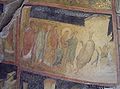 |
| National Transport Museum National Transport Museum, Bulgaria The National Transport Museum in Rousse, Bulgaria, is situated on the bank of the Danube, in the country's first railway station, built in 1866.- The museum :Exhibits are laid out both inside and outside the old station... |
The National Transport Museum is situated on the bank of the Danube, in the country's first railway station, built in 1866. | 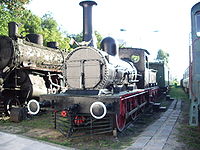 |
| "Urban lifestyle of Rousse" museum Kaliopa House The Kaliopa House , a popular name for the Bulgarian "Urban lifestyle of Rousse" museum , was built in 1864. According to a legend, the house was bestowed upon the beautiful Kaliopa , the wife of the Prussian consul Kalish, by the governor of the Danubian Vilayet, Midhat Pasha, who was in love with... |
The exposition represents the role of Ruse as a gateway towards Europe, and the influx of European urban culture into Bulgaria at the end of the 19th and the beginning of the 20th century. Sample interior layouts are shown, of a drawing-room, a living-room, a music hall and a bedroom, with furniture from Vienna Vienna Vienna is the capital and largest city of the Republic of Austria and one of the nine states of Austria. Vienna is Austria's primary city, with a population of about 1.723 million , and is by far the largest city in Austria, as well as its cultural, economic, and political centre... , as well as collections of urban clothing, of jewelry and other accessories, of silverware (cutlery) and china, which mark the changes present in the daily life of Ruse citizens. The first grand piano, imported into Bulgaria from Vienna, can be seen here. |
|
| Pantheon of National Revival Heroes Pantheon of National Revival Heroes The Pantheon of National Revival Heroes is a Bulgarian national monument and an ossuary, located in the city of Rousse. 39 famous Bulgarians are buried in it, including Lyuben Karavelov, Zahari Stoyanov, Stefan Karadzha, Panayot Hitov, Tonka Obretenova, Nikola Obretenov, Panayot Volov, Angel... |
The Pantheon of National Revival Heroes is a national monument and an ossuary Ossuary An ossuary is a chest, building, well, or site made to serve as the final resting place of human skeletal remains. They are frequently used where burial space is scarce. A body is first buried in a temporary grave, then after some years the skeletal remains are removed and placed in an ossuary... , located in the city of Ruse. 39 famous Bulgarians are buried in it, including Lyuben Karavelov Lyuben Karavelov Lyuben Stoychev Karavelov was a Bulgarian writer and an important figure of the Bulgarian National Revival.... , Zahari Stoyanov Zahari Stoyanov Zahari Stoyanov , born Dzhendo Stoyanov Dzhedev , was a Bulgarian revolutionary, writer, and historian. A participant in the April Uprising of 1876, he became its first historiographer with his book Memoirs of the Bulgarian Uprisings... , Stefan Karadzha Stefan Karadzha Stefan Karadzha , was a Bulgarian national hero, a revolutionary from the national liberation movement and a prominent leader of rebellion against the Ottoman Empire.... , Panayot Hitov Panayot Hitov Panayot Ivanov Hitov was a Bulgarian hajduk, national revolutionary and band leader .Born in 1830 in Sliven, he became a hajduk in Georgi Trankin's band in 1858. Two years later, after the death of Trankin, Hitov succeeded him as voivode of the band, which became one of the most active in... , Tonka Obretenova Tonka Obretenova Tonka Obretenova , known as baba Tonka , was a female Bulgarian revolutionary, born in 1812, probably in Rousse.Her parents, Toncho Postavchiyata and Minka Toncheva , were from the village of Cherven. She married Tiho Obretenov — a famous tailor and tradesman in Rousse... , Nikola Obretenov Nikola Obretenov Nikola Tihov Obretenov was a Bulgarian revolutionary, one of the combatants for the liberation of Bulgaria, and a participant in the Stara Zagora Uprising and the April Uprising... , Panayot Volov Panayot Volov Panayot Volov was the pseudonym of Petar Vankov , the organizer and leader of the Gyurgevo Revolutionary Committee of the Bulgarian April Uprising against the Ottoman Empire in 1876.... , Angel Kanchev Angel Kanchev Angel Kanchev Angelov was a Bulgarian revolutionary from Tryavna.Kanchev was born in 1852 in the family of a master-builder. At first he studied in his hometown Tryavna and then in Ruse under the guidance of people like Pencho Slaveykov and Dragan Tsankov... , etc. |
|
| The stronghold of Cherven Cherven (fortress) The stronghold of Cherven was one of the Second Bulgarian Empire's primary military, administrative, economic and cultural centres between the 12th and the 14th century... |
The stronghold of Cherven was one of the Second Bulgarian Empire's primary military, administrative, economic and cultural centres between the 12th and the 14th century. The ruins of the fortress are located near the village of the same name 30–35 km south of Rousse, northeastern Bulgaria. | |
| "Zahari Stoyanov" Museum | Zahari Stoyanov Zahari Stoyanov Zahari Stoyanov , born Dzhendo Stoyanov Dzhedev , was a Bulgarian revolutionary, writer, and historian. A participant in the April Uprising of 1876, he became its first historiographer with his book Memoirs of the Bulgarian Uprisings... was a Bulgarian revolutionary, writer, and historian. The museum shows expositions from the Bulgarian Revival period and about the life and struggles of Zahari Stoyanov Zahari Stoyanov Zahari Stoyanov , born Dzhendo Stoyanov Dzhedev , was a Bulgarian revolutionary, writer, and historian. A participant in the April Uprising of 1876, he became its first historiographer with his book Memoirs of the Bulgarian Uprisings... . |
Libraries
- The Regional Library "Lyuben Karavelov"
- The Austrian Library, located in the 2nd floor of the theater and home of the International Elias Canetti Society.
Regular events
- The March Music DaysMarch Music DaysThe March Music Days is a festival, held annually for two weeks in the second half of March in Rousse, Bulgaria, which attracts many elite musicians....
is an international music festivalMusic festivalA music festival is a festival oriented towards music that is sometimes presented with a theme such as musical genre, nationality or locality of musicians, or holiday. They are commonly held outdoors, and are often inclusive of other attractions such as food and merchandise vending machines,...
for classical musicClassical musicClassical music is the art music produced in, or rooted in, the traditions of Western liturgical and secular music, encompassing a broad period from roughly the 11th century to present times...
. - St George's DaySt George's DaySt George's Day is celebrated by the several nations, kingdoms, countries, and cities of which Saint George is the patron saint. St George's Day is celebrated on 23 April, the traditionally accepted date of Saint George's death in AD 303...
(6 May) is Ruse's holiday. A local fairFairA fair or fayre is a gathering of people to display or trade produce or other goods, to parade or display animals and often to enjoy associated carnival or funfair entertainment. It is normally of the essence of a fair that it is temporary; some last only an afternoon while others may ten weeks. ...
is organized for a week around this date. - Ruse Carnival is a masqueradeMasquerade ceremonyA masquerade ceremony is a cultural or religious event involving the wearing of masks.Examples include the West African and African Diaspora masquerades, such as Egungun Masquerades, Northern Edo Masquerades, Caribbean Carnival and Jonkonnu.-External links:* - slideshow by Life magazine*...
held around 24 June, Enyovden. - The Sexaginta Prista Summer Stage is an urban festival. Events are hosted at the Roman castle every Friday from May through October.
- At the end of October are BG MediaMarket and the Bulgarian Europe Media Festival.
- The Skate-Festival "Collision Course" is taking place in May since 2007.
- Since 2008 the Literary Spring Parlour is organized by the International Elias Canetti Society in April or May.
Notable citizens
- Elias CanettiElias CanettiElias Canetti was a Bulgarian-born modernist novelist, playwright, memoirist, and non-fiction writer. He wrote in German and won the Nobel Prize in Literature in 1981, "for writings marked by a broad outlook, a wealth of ideas and artistic power".-Life:...
, winner of the 1981 Nobel Prize for Literature - Albert AftalionAlbert AftalionAlbert Abram Aftalion was a French Jewish economist.He taught at the Paris University . He co-founded the academic journal Revue économique in 1950 and presided over its board of directors....
(1874–1956), French economist and economic situation theoretician - Michael ArlenMichael ArlenMichael Arlen , original name Dikran Kouyoumdjian, was an Armenian essayist, short story writer, novelist, playwright, and scriptwriter, who had his greatest successes in the 1920s while living and writing in England...
(1895–1956), original name Dikran Kouyoumdjian, short story writer, novelist, playwright, and scriptwriter - Jules Pascin (1885–1930), painter
- Tanyu KiryakovTanyu KiryakovTanyu Kiryakov is a Bulgarian pistol shooter, the only shooter to have won Olympic gold medals in both the 50 metre pistol event and the 10 metre air pistol event, in which he was also the first Olympic champion.- External links :*...
, pistol shooter, Olympic champion - Konstantin EvtimovKonstantin EvtimovKonstantin Evtimov is а Bulgarian cellist. He is currently a soloist with the Simphonic Orchestra of the Bulgarian National Radio.- Biography :...
, solo violoncello of the Simphonic Orchestra of National Bulgarian Radio (1975) - Vlad KolarovVlad KolarovVlad Kolarov is an Bulgarian-born Canadian cartoonist and humorous illustrator. His cartoons have been published by numerous newspapers, magazines and web sites, and are available through the Internet.-References:**-External links:*...
, cartoonist - Radi NedelchevRadi NedelchevRadi Nedelchev is a Bulgarian artist best known as a painter of naïve art. His paintings depict mostly landscapes, village life and festivals....
, painter - Tonka ObretenovaTonka ObretenovaTonka Obretenova , known as baba Tonka , was a female Bulgarian revolutionary, born in 1812, probably in Rousse.Her parents, Toncho Postavchiyata and Minka Toncheva , were from the village of Cherven. She married Tiho Obretenov — a famous tailor and tradesman in Rousse...
, 19th-century revolutionary - Neshka RobevaNeshka RobevaNeshka Robeva is a Bulgarian former Rhythmic Gymnast and coach.Born in Rousse, Robeva graduated from the Bulgarian State Choreography School in "Bulgarian Dances" in 1966 and since then had been a member of the Bulgarian national rhythmic gymnastics squad until 1973. She took part in four World...
, rhythmic gymnasticsRhythmic gymnasticsRhythmic gymnastics is a sport in which individuals or teams of competitors manipulate one or two pieces of apparatus: rope, clubs, hoop, ball, ribbon and Free . An individual athlete only manipulates 1 apparatus at a time...
player and coach - Veselin TopalovVeselin TopalovVeselin Aleksandrov Topalov is a Bulgarian chess grandmaster. He currently has the sixth highest rating in the world, and was the challenger facing world champion Viswanathan Anand in the World Chess Championship 2010, losing the match 6½–5½....
, chess player, FIDE world champion 2005-06 - Stefan TsanevStefan TsanevStefan Nedelchev Tsanev is a contemporary Bulgarian writer, known for his essays, plays, poems, and historical novels.His books include Ubiytsite sa mezhdu nas , and his plays, Istinskiyat Ivaylo , which was banned....
, writer - Venelina VenevaVenelina VenevaVenelina Veneva-Mateeva is a Bulgarian high jumper. Talented at a young age, she jumped 1.93 metres indoor in 1990 to record a world best performance by a 15-year-old. She did not improve this result outdoor until 1995...
, high jumper - Deyan Angeloff Nedelchev,pop singer and composer -16.01.1964.
- Boyko Angeloff Nedelchev,pop singer and composer -24.04.1965.
- Atanas Kosev-composer
- Boris Chakarov-composer
- Iskren Pezov--singer,composer
- Rositsa Bordzhieva-singer,musical pedagog
- Peter Petrov-Parcheto-jazz musician
- Mimi Blakanska-opereta singer
- Kutzi Vaptsarov - show man
- Marietta Petkova - pianist
Twin towns — Sister cities
Ruse is twinnedTown twinning
Twin towns and sister cities are two of many terms used to describe the cooperative agreements between towns, cities, and even counties in geographically and politically distinct areas to promote cultural and commercial ties.- Terminology :...
with:
| Volgograd Volgograd Volgograd , formerly called Tsaritsyn and Stalingrad is an important industrial city and the administrative center of Volgograd Oblast, Russia. It is long, north to south, situated on the western bank of the Volga River... , Russia Bratislava Bratislava Bratislava is the capital of Slovakia and, with a population of about 431,000, also the country's largest city. Bratislava is in southwestern Slovakia on both banks of the Danube River. Bordering Austria and Hungary, it is the only national capital that borders two independent countries.Bratislava... , Slovakia Slovakia The Slovak Republic is a landlocked state in Central Europe. It has a population of over five million and an area of about . Slovakia is bordered by the Czech Republic and Austria to the west, Poland to the north, Ukraine to the east and Hungary to the south... Saint-Ouen Saint-Ouen, Seine-Saint-Denis Saint-Ouen is a commune in the Seine-Saint-Denis department. It is located in the northern suburbs of Paris, France 6.6 km from the centre of Paris.... , France |
Giurgiu Giurgiu Giurgiu is the capital city of Giurgiu County, Romania, in the Greater Wallachia. It is situated amid mud-flats and marshes on the left bank of the Danube facing the Bulgarian city of Rousse on the opposite bank. Three small islands face the city, and a larger one shelters its port, Smarda... , Romania Trogir Trogir Trogir is a historic town and harbour on the Adriatic coast in Split-Dalmatia County, Croatia, with a population of 12,995 and a total municipality population of 13,322 . The historic city of Trogir is situated on a small island between the Croatian mainland and the island of Čiovo... , Croatia Peristeri Peristeri Peristeri is a suburban municipality in Athens, Greece, located about 5 km NW of the downtown area. The municipality is bordered by the Cephissus/Cephissos River, Athinon Avenue , Chaidari in the west and Petroupoli in the northwest, with a size of around... , Greece |
Huainan Huainan Huainan is a prefecture-level city with 2,334,000 inhabitants in central Anhui Province, People’s Republic of China. It borders the provincial capital of Hefei to the south, Lu’an to the southwest, Fuyang to the west, Bozhou to the northwest, Bengbu to the northeast and Chuzhou to the east.Its... , People's Republic of China People's Republic of China China , officially the People's Republic of China , is the most populous country in the world, with over 1.3 billion citizens. Located in East Asia, the country covers approximately 9.6 million square kilometres... Lisbon Lisbon Lisbon is the capital city and largest city of Portugal with a population of 545,245 within its administrative limits on a land area of . The urban area of Lisbon extends beyond the administrative city limits with a population of 3 million on an area of , making it the 9th most populous urban... , Portugal Bijeljina Bijeljina Bijeljina is a city and municipality in northeastern Bosnia and Herzegovina. The city is the second largest in the Republika Srpska entity after Banja Luka and fifth largest city in Bosnia and Herzegovina, and is situated on the flat rich plains of Semberija... , Bosnia and Herzegovina |
Honours
Ruse PeakRuse Peak
Ruse Peak is a peak rising to over 800 m in the west part of Delchev Ridge in Tangra Mountains on Livingston Island in the South Shetland Islands, Antarctica...
(800 m) on Livingston Island in the South Shetland Islands
South Shetland Islands
The South Shetland Islands are a group of Antarctic islands, lying about north of the Antarctic Peninsula, with a total area of . By the Antarctic Treaty of 1959, the Islands' sovereignty is neither recognized nor disputed by the signatories and they are free for use by any signatory for...
, Antarctica is named after the city.
External links
- Ruse municipality
- History of Ruse
- Pictures from Ruse:
- Maps of Ruse