The
Danube Delta is the second largest
river deltaA delta is a landform that is formed at the mouth of a river where that river flows into an ocean, sea, estuary, lake, reservoir, flat arid area, or another river. Deltas are formed from the deposition of the sediment carried by the river as the flow leaves the mouth of the river...
in
EuropeEurope is, by convention, one of the world's seven continents. Comprising the westernmost peninsula of Eurasia, Europe is generally 'divided' from Asia to its east by the watershed divides of the Ural and Caucasus Mountains, the Ural River, the Caspian and Black Seas, and the waterways connecting...
, after the
Volga DeltaThe Volga Delta is the largest river delta in Europe, and occurs where Europe's largest river system, the Volga River, drains into the Caspian Sea in Russia's Astrakhan Oblast, north-east of the republic of Kalmykia. The delta is located in the Caspian Depression—the far eastern part of the delta...
, and is the best preserved on the continent. The greater part of the
DanubeThe Danube is a river in the Central Europe and the Europe's second longest river after the Volga. It is classified as an international waterway....
Delta lies in
RomaniaRomania is a country located at the crossroads of Central and Southeastern Europe, on the Lower Danube, within and outside the Carpathian arch, bordering on the Black Sea...
(
TulceaTulcea is a city in Dobrogea, Romania. It is the administrative center of Tulcea county, and has a population of 92,379 as of 2007. One village, Tudor Vladimirescu, is administered by the city.- History :...
county), while its northern part, on the left bank of the Chilia arm, is situated in
UkraineUkraine is a country in Eastern Europe. It has an area of 603,628 km², making it the second largest contiguous country on the European continent, after Russia...
(
Odessa OblastOdesa Oblast, also written as Odessa Oblast , is the southernmost and largest oblast of south-western Ukraine. The administrative center of the oblast is the city of Odessa.-History:...
). The approximate surface is 4152 km², of which 3446 km² are in Romania. If one includes the lagoons of
Razim-Sinoe (1015 km² of which 865 km² water surface), which are located south of the delta proper, but are related to it geologically and ecologically (their combined territory is part of the World Heritage Site), the total area of the Danube Delta reaches 5165 km².
Geography and Geology
The modern Danube Delta began forming after 4,000 B.C. in a gulf of the
Black SeaThe Black Sea is bounded by Europe, Anatolia and the Caucasus and is ultimately connected to the Atlantic Ocean via the Mediterranean and the Aegean seas and various straits. The Bosphorus strait connects it to the Sea of Marmara, and the strait of the Dardanelles connects that sea to the Aegean...
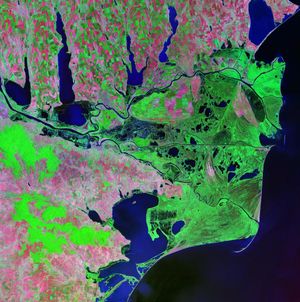
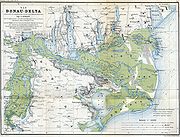
, when the sea rose to its present level. A sandy barrier blocked the Danube gulf where the river initially built its delta. Upon filling the gulf with sediments, the delta advanced outside the barrier-blocked estuary after 3,500 B.C. building several successive lobes: the St. George I (3,500-1,600 B.C.), the Sulina (1,600-0 B.C.), the St. George II (0 B.C.-Present) and the Chilia or Kilia (1600 A.D.-Present).
The Danube Delta is a low
alluvial plainAn alluvial plain is a relatively flat landform created by the deposition of sediment over a long period of time by one or more rivers coming from highland regions, from which alluvial soil forms...
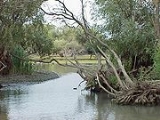
, mostly covered by wetlands and water. It consists of an intricate pattern of marshes, channels, streamlets and lakes. The average altitude is 0.52 m, with 20% of the territory below sea level, and more than half not exceeding one meter in altitude. Dunes on the most extensive strandplains of the delta (Letea and Caraorman strandplains) stand higher (12.4 m and 7 m respectively). The largest lakes are Dranov (21.7 km²), Roşu (14.5 km²), Gorgova (13.8 km²).
Distributaries of the Danube
The
DanubeThe Danube is a river in the Central Europe and the Europe's second longest river after the Volga. It is classified as an international waterway....
branches into three main
distributariesA distributary, or a distributary channel, is a stream that branches off and flows away from a main stream channel. They are a common feature of river deltas. The phenomenon is known as river bifurcation. The opposite of a distributary is a tributary...
into the
deltaA delta is a landform that is formed at the mouth of a river where that river flows into an ocean, sea, estuary, lake, reservoir, flat arid area, or another river. Deltas are formed from the deposition of the sediment carried by the river as the flow leaves the mouth of the river...
,
ChiliaThe Chilia or Kilia branch is a distributary of the river Danube, that contributes in forming the Danube Delta. It is named after the two towns having this name, located on its two shores: Kilia, on the northern, Ukrainian bank and Chilia Veche on the southern, Romanian bank.The other two main...
,
SulinaThe Sulina branch is a distributary of the river Danube, that contributes in forming the Danube Delta.The other two main branches of the Danube are the Chilia branch and the Saint George....
, and
Sfântul GheorgheThe Sfântu Gheorghe branch is a distributary of the river Danube, that contributes in forming the Danube Delta.The other two main branches of the Danube are the Chilia branch and the Sulina branch....
(Saint George). The last two branches form the
Tulcea channel, which continues as a single body for several kilometers after the separation from the Chilia. At the mouths of each channel
gradual formation of new land' is a term describing the increase in the area of land due to sediment deposited by a river. This changes the size of a piece of land and thus its value over time.-See also:*Alluvial fan*Alluvial plain...
takes place, as the delta continues to expand.
Main DistributariesA distributary, or a distributary channel, is a stream that branches off and flows away from a main stream channel. They are a common feature of river deltas. The phenomenon is known as river bifurcation. The opposite of a distributary is a tributary...
of the DanubeThe Danube is a river in the Central Europe and the Europe's second longest river after the Volga. It is classified as an international waterway....
| Danube Arm |
Length (km) |
Flow (m³/s)
(1921–1990) |
| Chilia The Chilia or Kilia branch is a distributary of the river Danube, that contributes in forming the Danube Delta. It is named after the two towns having this name, located on its two shores: Kilia, on the northern, Ukrainian bank and Chilia Veche on the southern, Romanian bank.The other two main...
|
120 |
3800 |
| Sulina The Sulina branch is a distributary of the river Danube, that contributes in forming the Danube Delta.The other two main branches of the Danube are the Chilia branch and the Saint George....
|
64 |
1250 |
| Sfântul Gheorghe The Sfântu Gheorghe branch is a distributary of the river Danube, that contributes in forming the Danube Delta.The other two main branches of the Danube are the Chilia branch and the Sulina branch....
(Saint George) |
70 |
1500 |
ChiliaThe Chilia or Kilia branch is a distributary of the river Danube, that contributes in forming the Danube Delta. It is named after the two towns having this name, located on its two shores: Kilia, on the northern, Ukrainian bank and Chilia Veche on the southern, Romanian bank.The other two main...
, in the north, the longest, youngest, and most vigorous, with two secondary internal deltas and one microdelta in full process of formation at its mouth (to Ukraine).
SulinaThe Sulina branch is a distributary of the river Danube, that contributes in forming the Danube Delta.The other two main branches of the Danube are the Chilia branch and the Saint George....
, the central and thus the shortest arm, which consequently led to its extensive use for traffic and severe transformation. At its mouth is located the main port and the single settlement with urban charactersitics of the Romanian part of the delta. Because of the
alluviumAlluvium is loose, unconsolidated soil or sediments, eroded, deposited, and reshaped by water in some form in a non-marine setting. Alluvium is typically made up of a variety of materials, including fine particles of silt and clay and larger particles of sand and gravel...
deposited at its mouth, a channel gradually advancing into the sea (presently it has 10 km), was built in order to protect the navigation.
Sfântul GheorgheThe Sfântu Gheorghe branch is a distributary of the river Danube, that contributes in forming the Danube Delta.The other two main branches of the Danube are the Chilia branch and the Sulina branch....
(
Saint George in
EnglishEnglish is a West Germanic language that arose in the Anglo-Saxon kingdoms of England and spread into what was to become south-east Scotland under the influence of the Anglian medieval kingdom of Northumbria...
), in the south, is the oldest and more sparsely populated. Its
alluviumAlluvium is loose, unconsolidated soil or sediments, eroded, deposited, and reshaped by water in some form in a non-marine setting. Alluvium is typically made up of a variety of materials, including fine particles of silt and clay and larger particles of sand and gravel...
has led to the creation, beginning with 1897, of the Sacalin islands, which as of today measure 19 km in length.
Climate
The climate of the Danube Delta is continental with strong influences from the vicinity of the Black SeaThe Black Sea is bounded by Europe, Anatolia and the Caucasus and is ultimately connected to the Atlantic Ocean via the Mediterranean and the Aegean seas and various straits. The Bosphorus strait connects it to the Sea of Marmara, and the strait of the Dardanelles connects that sea to the Aegean...
and its prevalent amphibian environment. It is the driest and sunniest region (70 days with blue sky, 2500 hours of sunshine/year) of Romania. The mean annual temperature is 11°C (-1°C in January and 22°C in July), with mean precipitation between 400and 300 mm/year, decreasing from west to east. The evaporation is around 1000 mm/year, favorized and amplified by the strong and frequent winds, resulting in long periods of drought in the summer. The northwest winds cause frequent storms in spring and autumn. In the interior of the delta the continental character of the climate is very pronounced.
Main ecosystems
The Danube Delta falls within east European steppe ecosystem, with Mediterranean influences. As a young region in full process of consolidation, the Danube Delta represents a very favourable place for the development of highly diverse flora and fauna, unique in EuropeEurope is, by convention, one of the world's seven continents. Comprising the westernmost peninsula of Eurasia, Europe is generally 'divided' from Asia to its east by the watershed divides of the Ural and Caucasus Mountains, the Ural River, the Caspian and Black Seas, and the waterways connecting...
, with numerous rare species. It hosts 23 natural ecosystems, but due to the extent of wetlands the aquatic environment is prevalent; the terrestrial environment is also present on the higher grounds of the continental levees, where xerophileXerophiles are extremophilic organisms that can grow and reproduce in conditions with a low availability of water, also known as water activity. Water activity is a measure of the amount of water within a substrate that an organism can use to support sexual growth. Xerophiles are often said to...
ecosystems have developed. Between the aquatic and terrestrial environments, is interposed a swampy, easily flooded strip of original flora and fauna, with means of adaptation for water or land, depending on the season or the hydrological regime. At the contact between freshwater and sea water, some special physical, chemical and biological processes take place, which determined biologists to consider this area as a very different ecosystem called beforedelta. Musura Gulf, north of Sulina, and Saint George Gulf are considered the most representative for this type of ecosystem.
Situated on major migratory routes, and providing adequate conditions for nesting and hatching, the Danube Delta is a magnet for birds from six major eco-regions of the world, including the Mongolian, Arctic and Siberian. There are over 320 species of birds found in the delta during summer, of which 166 are hatching species and 159 are migratory. Over one million individuals (swans, wild ducks, bald coots, etc.) winter here.
Ecosystems of running water
It comprises the Danube arms, as well as a series of more important streamlets and channels. It is an environment rich in planktonPlankton are any drifting organisms that inhabit the pelagic zone of oceans, seas, or bodies of fresh water. That is, plankton are defined by their ecological niche rather than phylogenetic or taxonomic classification...
, wormThe term worm refers to an obsolete taxon used by Carolus Linnaeus and Jean-Baptiste Lamarck for all non-arthropod invertebrate animals, and stems from the Old English word wyrm. Currently it is used to describe many different distantly-related animals that typically have a long cylindrical...
s, molluscaThe Mollusca , common name molluscs or mollusksSpelled mollusks in the USA, see reasons given in Rosenberg's ; for the spelling mollusc see the reasons given by , is a large phylum of invertebrate animals. There are around 85,000 recognized extant species of molluscs. Mollusca is the largest...
, ephemerides, grubs, spongiae, with numerous species of fish, such as the carpCarp are various species of oily freshwater fish of the family Cyprinidae, a very large group of fish native to Europe and Asia. The cypriniformes are traditionally grouped with the Characiformes, Siluriformes and Gymnotiformes to create the superorder Ostariophysi, since these groups have certain...
, pike perch, sheat fish, and freshwater sturgeons (sterletThe sterlet is a common Eurasian species of sturgeon, one of the smaller species of sturgeon. It is a common domestic species in the UK and Europe and an angling species all over the world...
, Vyza and Danube mackerel).
Ecosystem of stagnant water
Includes the lakes, to which various ponds, streamlets and channels are added. They are characterized by a rich floating and submerse flora (MyriophyllumMyriophyllum is a genus of about 69 species of freshwater aquatic plants, with a cosmopolitan distribution. The center of diversity for Myriophyllum is Australia with 43 recognized species...
, CeratophyllumCeratophyllum is a cosmopolitan genus of flowering plants, commonly found in ponds, marshes, and quiet streams in tropical and in temperate regions...
, VallisneriaVallisneria is a genus of freshwater aquatic plant, commonly called eelgrass, tape grass or vallis. The genus has 6-10 species that are widely distributed, but do not grow in colder regions....
etc. under the water; Nymphaea albaNymphaea alba, also known as the European White Waterlily, White Lotus, or Nenuphar, is an aquatic flowering plant of the family Nymphaeaceae....
, Nuphar luteum, Trapa natans, Alisma plantago etc., floating plants with roots near the lakes borders; Salvinia natansSalvinia natans, commonly known as floating fern, floating watermoss, floating moss, is an annual floating aquatic fern, which can appear superficially similar to moss...
, Stratiotes aloides-Origins:found in Europe and NW AsiaIn Britain it was once common in East Anglia and still is in many places, particularly wet ditches and healthy ponds.-Description:A rosette of serrated leaves.White flowers are produced in the Summer....
, SpirogyraSpirogyra is a genus of filamentous green algae of the order Zygnematales, named for the helical or spiral arrangement of the chloroplasts that is diagnostic of the genus. It is commonly found in freshwater areas, and there are more than 400 species of Spirogyra in the world. Spirogyra measures...
etc., floating plants without roots, having negative effects for the aquatic bioproductivity). Of the fish, the most important are Tinca tinca, Abramis brama, Scardinius erytrophalmus, Carassius auratus gibelio, Silurus glanis, Perca fluviatilis, Esox lucius etc.
Ecosystems of marshy and flooding areas
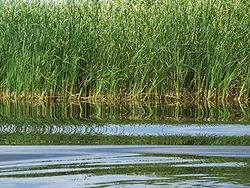
The reed plats and floating reed islands (called plaur in RomaniaRomania is a country located at the crossroads of Central and Southeastern Europe, on the Lower Danube, within and outside the Carpathian arch, bordering on the Black Sea...
) are the most common and well known components of the Danube Delta. Vegetation of this ecosystem consists of common reed (Phragmites communis), and near river banks mace reed (Typha latifoliaTypha latifolia is a perennial herbaceous plant in the genus Typha. It is found as a native plant species in North and South America, Europe, Eurasia, and Africa...
, Typha angustifoliaTypha angustifolia L., , is a perennial herbaceous plant of genus Typha. This cattail is an "obligate wetland" species that is commonly found in the northern hemisphere in brackish locations...
), sedge (Carex dioica, Carex strictaCarex stricta is a species of sedge known by the common name Tussock Sedge.-External links:*...
), Dutch rush (Scirpus radicans, Scirpus lacustris), brook mint (Mentha aquatica) etc. They constitute ideal spawning and nestling grounds. The plaur is a mixture of reed roots, grass and soil, usually floating or anchored on the bottom. As a rule, the reed surrounds the lakes and ponds, slowly invading the water surface. This type of ecosystem is noted for the variety and large populations of birds, some of them very rare. The most important are the tufted duck (Aythya fuligula, red crested pochard (Netta rufina), mallard (Anas platyrhynchos), Greylag goose (Anser anser), Pygmy cormorant (Phalacrocorax pygmaeus), purple heron (Ardea purpurea), Great white egret (Egretta alba), little egret (Egretta garzetta), Spoon bill (Platalea leucorodia), White pelican (Pelecanus onocrotalus), Dalmatian pelican (Pelecanus crispus), Mute swan (Cygnus olor), Glossy ibis (Plegadis falcinellus). A recent and welcomed spreading has the pheasant (Phasianus colchicus). Among the mammals, there is the otter (Lutra lutra), mink (Mustela lutreola), little ermine (Mustela erminea aestiva), wild boar (Sus scrofa), wild cat (Felis silvestris), and in the winter, the hare (Lepus europaeus), and on the brink of disappearing from the delta, the wolf and the fox. The enot dog (Nyctereutes procyonoides), bizam (Onda zibethica), and to some extent nutria (Myocastor coypus) are recent species successfully adapted.
River banks and levees ecosystems
The firm land of the delta used to be covered with large groves of willow trees, cut almost entirely and replaced with Canadian poplars. On the riverbanks kept in natural state, small groves of willow trees (Salix alba, Salix fragilis, Salix purpurea, Salix petandra, Salix triandraSalix triandra is a species of willow native to Europe and western and central Asia, from southeastern England east to Lake Baikal, and south to Spain and the Caucasus and Alborz mountains...
etc.) can still be found, mixed with white poplar (Populus alba). Occasionally, the willow trees form corridors along the Danubes arms and bigger channels. On the levees of Letea and Caraorman, mixed forests of oaks (Quercus robur, Quercus pedunculiflora) with various trees (Fraxinus pallisae, Ulmus foliacea, Populus tremulaPopulus tremula, commonly called aspen, common aspen, Eurasian aspen, European aspen, trembling poplar, or quaking aspen, is a species of poplar native to cool temperate regions of Europe and Asia, from the British Isles east to Kamchatka, north to inside the Arctic Circle in Scandinavia and...
), shrubs (Prunus spinosaPrunus spinosa is a species of Prunus native to Europe, western Asia, and locally in northwest Africa. It is also locally naturalised in New Zealand and eastern North America....
, Crataegus monogyna, Rosa canina, Berberis vulgarisBerberis vulgaris /// is a shrub in the family Berberidaceae, native to central and southern Europe, northwest Africa and western Asia; it is also naturalised in northern Europe, including the British Isles and Scandinavia, and North America.It is a deciduous shrub growing up to 4 m high...
etc.), and vines (Vitis sylvestris, Hedera helixHedera helix is a species of ivy native to most of Europe and western Asia. It is labeled as an invasive species in a number of areas where it has been introduced.-Description:...
, Humulus lupulusHumulus lupulus is a species of Humulus in the Cannabaceae family.Common hop is a dioecious, perennial herbaceous climbing plant which sends up new shoots in early spring and dies back to the cold-hardy rhizome in autumn...
, Periploca graecaPeriploca graeca, the Silk Vine is an ornamental plant in the Apocynaceae family.-External links:* photo* - ibiblio.org...
, which reaches up to 25m) grow on sand dunes. On the Letea levee, these exotic looking forests grow especially in the depressions between the sand dunes, in small groves called hasmace. Fauna of this region includes Meadow Viper (Vipera ursinii), OspreyThe Osprey , sometimes known as the sea hawk or fish eagle, is a diurnal, fish-eating bird of prey. It is a large raptor, reaching more than in length and across the wings...
(Pandion haliaetus), Eagle Owl (Bubo bubo), etc.
Inhabitants
The Danube Delta is perhaps the least inhabited region of temperate EuropeEurope is, by convention, one of the world's seven continents. Comprising the westernmost peninsula of Eurasia, Europe is generally 'divided' from Asia to its east by the watershed divides of the Ural and Caucasus Mountains, the Ural River, the Caspian and Black Seas, and the waterways connecting...
. In the Romanian side live about 20,000 people, of which 4,600 in the port of SulinaSulina is a town and free port in Tulcea County, Romania, at the mouth of the Sulina branch of the Danube. It is the easternmost point of Romania and of the continental European Union.-History:...
, which gives an average density of approx. 2 inhabitants per km². The rest is scattered in 27 villages, of which only three, all situated marginally, have more than 500 people (2002). The city of TulceaTulcea is a city in Dobrogea, Romania. It is the administrative center of Tulcea county, and has a population of 92,379 as of 2007. One village, Tudor Vladimirescu, is administered by the city.- History :...
, at the western edge of the delta, has a population of 92,000 (2002). It represents the node of the region and the gate to the delta.
The acute isolation and the harsh conditions of living, based mainly on subsistence, made the Danube Delta a place of emigration, or at least of transit. Very few of the people born here stay through adulthood; at the same time, the origins of the inhabitants fall within a wide range, as people from the most various places of RomaniaRomania is a country located at the crossroads of Central and Southeastern Europe, on the Lower Danube, within and outside the Carpathian arch, bordering on the Black Sea...
can be found in the delta. The total population has somewhat remained constant throughout the 20th century; there were 12,000 inhabitants in the 1890s, and 14,000 before the Second World War. RomaniansThe Romanians are an ethnic group native to Romania, who speak Romanian; they are the majority inhabitants of Romania....
count for approximately 80%, and UkrainiansUkrainians are an East Slavic ethnic group native to Ukraine, which is the sixth-largest nation in Europe. The Constitution of Ukraine applies the term 'Ukrainians' to all its citizens...
for 10%. Other people living in the delta include Greeks, Turks and Bulgarians (1992). Distinctive for the region, but very vague as an ethnic entity are the LipovansLipovans or Lippovans are the Old Believers, mostly of Russian ethnic origin, who settled in the Moldavian Principality, in Dobruja and Eastern Muntenia...
, descendants of the Orthodox Old Rite followers who fled RussiaRussia or , officially known as both Russia and the Russian Federation , is a country in northern Eurasia. It is a federal semi-presidential republic, comprising 83 federal subjects...
in the 18th century from religious persecution. About a third of the employed population is engaged in fishingFishing is the activity of trying to catch wild fish. Fish are normally caught in the wild. Techniques for catching fish include hand gathering, spearing, netting, angling and trapping....
and pisciculture, while another third is engaged in farming (1996). However, the quasi-totality practice fishing, more or less legally, as a means of subsistence or extra money.
In the Ukrainian side, located at the northern edge of the delta, the town of IzmailIzmail is a historic town near the Danube river in the Odessa Oblast of south-western Ukraine. Serving as the administrative center of the Izmail Raion , the city itself is also designated as a separate raion within the oblast....
has a population of 85,000, Kiliya, 21,800 and Vilkovo, the main center of Lipovan community, 9,300.
History
Recorded history first noted the Delta under Dacian control before being conquered by the Romans. After invasion by the Goths the region changed hands many times. During the 15th century, the Danube Delta became part of the Ottoman EmpireThe Ottoman EmpireIt was usually referred to as the "Ottoman Empire", the "Turkish Empire", the "Ottoman Caliphate" or more commonly "Turkey" by its contemporaries...
. In 1812, following the Russo-Turkish War the borders of Ottoman and Russian EmpireThe Russian Empire was a state that existed from 1721 until the Russian Revolution of 1917. It was the successor to the Tsardom of Russia and the predecessor of the Soviet Union...
s were set by Kilia and Old Stambul Channels of Danube, and in 1829 by St George Channel. The Treaty of ParisThe Treaty of Paris of 1856 settled the Crimean War between Russia and an alliance of the Ottoman Empire, the British Empire, Second French Empire, and the Kingdom of Sardinia. The treaty, signed on March 30, 1856 at the Congress of Paris, made the Black Sea neutral territory, closing it to all...
of 1856, which ended the Crimean WarThe Crimean War was a conflict fought between the Russian Empire and an alliance of the French Empire, the British Empire, the Ottoman Empire, and the Kingdom of Sardinia. The war was part of a long-running contest between the major European powers for influence over territories of the declining...
, assigned the Danube Delta to the Ottoman EmpireThe Ottoman EmpireIt was usually referred to as the "Ottoman Empire", the "Turkish Empire", the "Ottoman Caliphate" or more commonly "Turkey" by its contemporaries...
and established an international commissionSee Internationalization of the Danube River for events before 1856.The Commissions of the Danube River were authorized by the Treaty of Paris after the close of the Crimean War...
which made a series of works to help navigation. In 1878, following the defeat of Ottoman Empire by Russia and Romania, the border between those two was set by the Kilia and Old Stambul Channels.
In 1991, the Romanian part of the Danube Delta became part of the UNESCOThe United Nations Educational, Scientific and Cultural Organization is a specialized agency of the United Nations...
list of World Heritage SiteA UNESCO World Heritage Site is a place that is listed by the UNESCO as of special cultural or physical significance...
s. Around 2,733 km² of the delta are strictly protected areas.
In 1998, under UNESCO Programme on Man and the Biosphere, the 6264.03 km² of Danube Delta were established as Biosphere ReserveThe Man and the Biosphere Programme of UNESCO was established in 1971 to promote interdisciplinary approaches to management, research and education in ecosystem conservation and sustainable use of natural resources.-Development:...
shared by Romania and Ukraine.
Historically, in Romania, part of Danube Delta was marked as a reserve back in 1938.
In Ukraine, the Danube branch of Black Sea State Reserve was established in 1973. In 1981 it was reorganized into Natural Reserve "Danube Fluxes", and in 1998 it was extended into Danube Biosphere Reserve.
Environment and issues
Large-scale works began in the Danube Delta as early as the second half of the 19th century. First corrections of the Sulina arm began in 1862, and they continued throughout the 20th century. As a result, the length of the Sulina arm was reduced from 92 to 64 km, and its flow more than doubled, thus making it suitable for large-vessel navigation. Correcting the six large meanders on its course thereby reduced the length of the Sfântu Gheorghe from 108 km to 108, and its flow also increased somewhat. Both these increases were made to the detriment of the Chilia arm, which as of present remains the most unspoiled arm of the main three. These corrections, as well as the digging of various secondary channels throughout the body of the delta, have had a serious impact on the ecosystem. Natural environments have been altered, the breeding pattern of fish has been disrupted, and the flows in the main arms have increased, with serious consequences regarding the discharge of the alluvia and the erosion of the banks.
Reed was intensively harvested during the Communist era. The regime had plans of transforming the delta into a large agro-industrial zone. Although the first modern agricultural exploitation dates from 1939 (Ostrovul Tãtaru), only after 1960 were large areas drained and converted, to the detriment of wetlands. As of 1991 agricultural land in the delta surpassed 100,000 hectares, and more than a third of its surface has been affected by crop cultivation, forest plantation, or pisciculture arrangements. As a result of these changes, as well as the increasing pollution and eutrophicationEutrophication or more precisely hypertrophication, is the movement of a body of water′s trophic status in the direction of increasing plant biomass, by the addition of artificial or natural substances, such as nitrates and phosphates, through fertilizers or sewage, to an aquatic system...
of the Danube waters, and decades of exploitation and poor regulations of fishing, the fish population has been visibly reduced.
In 2004, Ukraine inaugurated work on the Bistroe Channel that would provide an additional navigable link from the Black Sea to the populous Ukrainian section of the Danube Delta. However, because of the negative impact which this new channel may have upon the fragile ecosystem of the Delta, the European UnionThe European Union is an economic and political union of 27 independent member states which are located primarily in Europe. The EU traces its origins from the European Coal and Steel Community and the European Economic Community , formed by six countries in 1958...
advised Ukraine to shut down the works. Romanian officials threatened to sue Ukraine at the International Court of JusticeThe International Court of Justice is the primary judicial organ of the United Nations. It is based in the Peace Palace in The Hague, Netherlands...
. Under the presidency of Kuchma Ukraine had responded that Romania is just afraid of the competition that the new channel will bring, and continued working on the channel. Under the presidency of Yuschenko, who visited Romania in 2005, both sides agree that professionals should decide the fate of the channel. In the long-run, Ukraine plans to build a navigation channel, if not through Bistroe Channel then through another channel.
See also
- History of Dobruja
- Tourism in Romania
Tourism in Romania focuses on the country's natural landscapes and its rich history. The number of tourists is growing every year and tourism is becoming an increasingly important source for Romania's GDP with 7-9 million people now visiting yearly. Romania's economy is characterized by a huge...
- Volga Delta
The Volga Delta is the largest river delta in Europe, and occurs where Europe's largest river system, the Volga River, drains into the Caspian Sea in Russia's Astrakhan Oblast, north-east of the republic of Kalmykia. The delta is located in the Caspian Depression—the far eastern part of the delta...
, the largest inland delta in Europe
A series of articles on control of the Danube, in chronological order
- Internationalization of the Danube River
The Danube River has been a trade waterway for centuries, but with the rise of international borders and the jealousies of national states, commerce and shipping has often been hampered for narrow reasons. In addition, natural features of the river, most notably the sanding of the delta, has often...
, for events from earliest times to the Treaty of Paris in 1856
- Commissions of the Danube River
See Internationalization of the Danube River for events before 1856.The Commissions of the Danube River were authorized by the Treaty of Paris after the close of the Crimean War...
, for the international body governing the waterway from 1856 to 1940
- Nazi rule over the Danube River
Nazi rule over the Danube River was brought about by force of arms, through annexation of Austria, invasion of Yugoslavia and of the Soviet Union and treaties with the Kingdom of Romania and Hungary, but a legal cover was provided through moves that resulted in a new international order on the...
, for events during World War II
- Danube River Conference of 1948
The Danube River Conference of 1948 was held in Belgrade, Yugoslavia, to develop a new international regime for the development and control of the Danube in the wake of World War II...
- International Commission for the Protection of the Danube River
The International Commission for the Protection of the Danube River is an international organisation with its permanent secretariat in Vienna. It was established by the Danube River Protection Convention, signed by the Danube countries in Sofia, Bulgaria, in 1994.The commission became active in 1998...
, for the organization established in 1998 and charged with environmental and ecological activities
External links
The source of this article is
wikipedia, the free encyclopedia. The text of this article is licensed under the
GFDL.
x