


Lidl

Encyclopedia
Supermarket
A supermarket, a form of grocery store, is a self-service store offering a wide variety of food and household merchandise, organized into departments...
chain based in Germany that operates over 7,200 stores across Europe. The company's full name is Lidl Stiftung & Co. KG. It belongs to the holding company
Holding company
A holding company is a company or firm that owns other companies' outstanding stock. It usually refers to a company which does not produce goods or services itself; rather, its purpose is to own shares of other companies. Holding companies allow the reduction of risk for the owners and can allow...
Schwarz Gruppe, which also owns the store chains Handelshof and hypermarket Kaufland
Kaufland
Kaufland is a German hypermarket chain part of the same group as Lidl and Handelshof. It opened its first store in 1984 in Neckarsulm and quickly expanded to become a leader in what was formerly East Germany...
.
Founded in the 1930s by a member of the Schwarz family [and called at the time Schwarz Lebensmittel-Sortimentsgroßhandlung (Schwarz Assorted wholesale Foods)], Lidl has – since the opening in 1973 of the first of its stores in their present incarnation – now established itself in over 20 countries
Country
A country is a region legally identified as a distinct entity in political geography. A country may be an independent sovereign state or one that is occupied by another state, as a non-sovereign or formerly sovereign political division, or a geographic region associated with a previously...
in Europe. The name Lidl was the surname of a former business partner of Schwarz's, Ludwig Lidl, a retired schoolteacher, and Schwarz bought the rights to the name from him for 1,000 marks, as he could not use the name Schwarz Markt as it means 'black market' and would have negative associations. Lidl is part of the Schwarz Group, the 4th largest retailer in the world with sales of $82.4 billion (2011).
In 1930, Josef Schwarz became a partner in Südfrüchte Großhandel Lidl & Co., a fruit wholesaler, and he developed the company into a general food wholesaler. In 1977, under his son Dieter Schwarz
Dieter Schwarz
Dieter Schwarz is a German entrepreneur and owner of the Schwarz-Gruppe. He is the chairman and CEO of supermarket chain Lidl, which he inherited from his father, Josef Schwarz, in 1977. He is currently estimated to be worth 10 billion euro.-References:...
, the Schwarz-Gruppe began to focus on discount markets, larger supermarkets, and cash and carry wholesale markets. The first Lidl discount store was opened in 1973, copying the Aldi concept. Schwarz rigorously removed merchandise that did not sell from the shelves, and cut costs by keeping the size of the retail outlets as small as possible. By the year 1977, the Lidl chain comprised 33 discount stores.
Since establishing in the UK in 1994, Lidl has grown consistently and today has more than 580 stores throughout the UK. While it is still a small player in the UK market with a grocery market share of less than 5%, its importance along with that of continental no-frills competitor Aldi is growing.
Amongst other brands, Lidl owns the Silvercrest brand, which manufactures electronic products such as satellite and Freeview receivers.
Lidl is the chief competitor of the similar German discount chain Aldi
ALDI
ALDI Einkauf GmbH & Co. oHG, doing business as ', short for "Albrecht Discount", is a discount supermarket chain based in Germany...
.
Other services
In late October 2009 Lidl UK launched a DVD rental service 'Lidl Movies',, undercutting Tesco DVD rental, which had previously been the UK's cheapest online DVD rental service.The service is powered by OutNow DVD rental.
Lidl UK has also launched an online photo service, which prints photos and creates albums and photo gifts at discounted prices. http://www.lidl-photos.co.uk
How do Discount Supermarkets work?
Limited RangeThe shopping experience at Lidl is based on simplicity for the customer. They keep company costs down so that the savings Lidl make on running costs, they can give back to the customer in discounted prices.
One reason for Lidl's lower running costs is their limited range of products. Lidl stores stock about 1,800 lines, compared with approximately 30,000 stocked by the other big supermarkets. By keeping their range small, they can have smaller-sized stores (most are around 1600m2), thereby economising on lighting, heating and maintenance bills. Some see this as a clever concept, considering that research shows most shoppers tend to buy only 500 or 600 different products.
Lidl keeps overhead costs down by employing minimal numbers of store staff and training them on all aspects of the shop floor. For this reason, you will most likely see only one member of staff on the till and one stacking the fruit and veg at any one time.
Like many supermarkets based in Germany, Lidl charges customers for plastic bags, the reason being two-fold: to keep overhead costs to a minimum, and to be environmentally friendly by encouraging customers to use their plastic bags more than once. http://news.bbc.co.uk/1/hi/business/7739606.stm
Store Layout
Another reason why discount supermarkets can keep their costs low is basic store layout. Lidl stores keep most of their lines on [pallet]s, moving them directly from the warehouse to the shop floor, in order to reduce the time it takes for staff to unpack and shelve the items.
Lidl also keeps prices down by stocking their own label product ranges, which have very similar packaging to the leading brands but are cheaper. The own-label products are quality tested by external institutes and are generally packaged at source to keep costs down. Italian Parmesan, for example, is manufactured and packaged in Italy, and then shipped out to Lidl stores across Europe, which is why a number of European languages can often be seen on their packaging.
In addition to their year-round listed products, Lidl also has weekly offers on a number of non-food items, stocking anything from lawn mowers to barbecue sets or ski suits.
The majority of Lidl stores follow the same basic layout flow, with tins and carbonated drinks in the first aisle and alcohol in the last. The chiller always runs along the back wall of the store, with chilled convenience foods such as sandwiches, pasta salads and quiches in the first chiller bay. Fruit and vegetables are normally in the first aisle of the store, as are bread and cakes. http://news.bbc.co.uk/1/hi/business/7739606.stm
Premium Food
The term 'Premium Discounter' is being heard more and more frequently and refers to the trend amongst some discounters to sell more luxury foods. http://www.blumenverschicken.info/danke-mama-12-bunte-rosen-inkl-gratis-pralinen-beim-lidl-highlight-des-tages/
In order to attract a wider range of shoppers and to keep their customers interested, Lidl frequently stocks gourmet foods such as pheasant, quails and other delicacies. Recent press coverage on Lidl lobsters and champagne has increased interest in them as a Premium Discounter. http://news.bbc.co.uk/1/hi/business/7739606.stm
Fairtrade
Lidl has introduced a range of FAIRGLOBE products to its existing lines, including brown cane sugar, chocolate, coffee, bananas, and orange juice. Read more about Fairtrade products and how they are increasing public awareness of sustainable produce grown in developing countries. http://en.wikipedia.org/wiki/Fairtrade http://www.lidl.co.uk/cps/rde/xchg/lidl_uk/hs.xsl/10727.htm
Approach to retailing
Like fellow German supermarket AldiALDI
ALDI Einkauf GmbH & Co. oHG, doing business as ', short for "Albrecht Discount", is a discount supermarket chain based in Germany...
, Lidl has a no-frills approach of keeping its products in the original delivery cartons, allowing the customers to take the product directly from the carton. When the carton is empty, it is simply replaced with a full one. The aisles are not decorated, the cartons are stacked on pallets, and staffing is minimal, so that a profit can still be made even though the prices are low. Together with Aldi, Lidl has carved out its own niche with this approach; while some shoppers may not like shopping in a bland or industrial-looking (and possibly congested) store, such a lack of frills has become part of the accepted norm with Lidl. In contrast to Aldi, there are generally more branded products on offer (but due to the small size of Lidl stores there are usually only a few different brands of product available), and while Lidl imports many low-priced gourmet foods from Europe, it also sources many local products from the country where the store is located. Like Aldi, Lidl has special weekly offers, and its stock of non-food items often changes with time, this being due to Lidl stores' small size. Lidl operates in many European countries (much of Eastern Europe
Eastern Europe
Eastern Europe is the eastern part of Europe. The term has widely disparate geopolitical, geographical, cultural and socioeconomic readings, which makes it highly context-dependent and even volatile, and there are "almost as many definitions of Eastern Europe as there are scholars of the region"...
, Italy
Italy
Italy , officially the Italian Republic languages]] under the European Charter for Regional or Minority Languages. In each of these, Italy's official name is as follows:;;;;;;;;), is a unitary parliamentary republic in South-Central Europe. To the north it borders France, Switzerland, Austria and...
and Greece
Greece
Greece , officially the Hellenic Republic , and historically Hellas or the Republic of Greece in English, is a country in southeastern Europe....
as well as in Northern Ireland
Northern Ireland
Northern Ireland is one of the four countries of the United Kingdom. Situated in the north-east of the island of Ireland, it shares a border with the Republic of Ireland to the south and west...
and Scandinavia
Scandinavia
Scandinavia is a cultural, historical and ethno-linguistic region in northern Europe that includes the three kingdoms of Denmark, Norway and Sweden, characterized by their common ethno-cultural heritage and language. Modern Norway and Sweden proper are situated on the Scandinavian Peninsula,...
) where rival Aldi does not operate. In contrast to Aldi, Lidl advertises extensively in its homeland of Germany.
Criticism of Lidl's treatment of its staff
Trade unions in Germany and other countries have repeatedly criticised Lidl for mistreatment of workers, breach of European directives on working time and other abuses. These have been published in the Black Book on the Schwarz Retail Company published in Germany and now available in English. While The Times notes that Lidl managers work excessive hours, being obliged to sign out of the working time directive when starting with the company, both The Guardian and The Times in the UK amongst other allegations have reported that Lidl spies on its workforce with cameras, makes extensive notes on employee behaviour, particularly focusing on attempting to sack female workers who might become pregnant and also forces staff at warehouses to do "piece-rate" workPiece work
Piece work is any type of employment in which a worker is paid a fixed "piece rate" for each unit produced or action performed regardless of time...
. Lidl management has denied the charges. In Italy
Italy
Italy , officially the Italian Republic languages]] under the European Charter for Regional or Minority Languages. In each of these, Italy's official name is as follows:;;;;;;;;), is a unitary parliamentary republic in South-Central Europe. To the north it borders France, Switzerland, Austria and...
, in 2003, a judge in Savona
Savona
Savona is a seaport and comune in the northern Italian region of Liguria, capital of the Province of Savona, in the Riviera di Ponente on the Mediterranean Sea....
sentenced Lidl for anti-union policies, a crime in that country. Lidl has been criticised in the United Kingdom
United Kingdom
The United Kingdom of Great Britain and Northern IrelandIn the United Kingdom and Dependencies, other languages have been officially recognised as legitimate autochthonous languages under the European Charter for Regional or Minority Languages...
and Ireland
Republic of Ireland
Ireland , described as the Republic of Ireland , is a sovereign state in Europe occupying approximately five-sixths of the island of the same name. Its capital is Dublin. Ireland, which had a population of 4.58 million in 2011, is a constitutional republic governed as a parliamentary democracy,...
for not allowing workers to join unions.
In March 2008 the German news magazine Stern
Stern (magazine)
Stern is a weekly news magazine published in Germany. It was founded in 1948 by Henri Nannen, and is currently published by Gruner + Jahr, a subsidiary of Bertelsmann. In the first quarter of 2006, its print run was 1.019 million copies and it reached 7.84 million readers according to...
released a cover story reporting systematic surveillance of Lidl workers, including the most intimate details of their private affairs.
Countries with Lidl branches
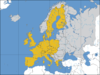
As of 2011, Lidl operates in every country of the EU except the Baltic statesBaltic states
The term Baltic states refers to the Baltic territories which gained independence from the Russian Empire in the wake of World War I: primarily the contiguous trio of Estonia, Latvia, Lithuania ; Finland also fell within the scope of the term after initially gaining independence in the 1920s.The...
, and also in Croatia and Switzerland.
Current
| Country | Number of Stores |
|---|---|
 Austria Austria |
197 |
 Belgium Belgium |
~300 |
 Kingdom of Bulgaria Kingdom of Bulgaria |
52 |
 Independent State of Croatia Independent State of Croatia |
73 |
 Czech Republic Czech Republic |
220 |
 Cyprus Cyprus |
11 |
 Denmark Denmark |
83 |
 Finland Finland |
137 |
 Early Modern France Early Modern France |
1,500 |
 Germany Germany |
3,300 |
 Greece Greece |
207 |
 Hungary Hungary |
141 |
 Republic of Ireland Republic of Ireland |
106 |
 Italy Italy |
550 |
 Luxembourg Luxembourg |
6 |
 Malta Malta |
12 (5 opened 7 more to open in the coming years including 2 stores in Gozo) |
 Netherlands Netherlands |
340 |
 Norway Norway |
Sold to Reitangruppen—now REMA 1000 REMA 1000 REMA 1000 is a multinational no-frills supermarket chain owned entirely by the Reitan Group . REMA is a short for REitan MAt , referring to Odd Reitan... stores. |
 Poland Poland |
525 |
 Portugal Portugal |
210 |
 Kingdom of Romania Kingdom of Romania |
124 |
 Slovakia Slovakia |
110 |
 Slovenia Slovenia |
36 |
 Spain Spain |
500 |
 Sweden Sweden |
151 |
 Switzerland Switzerland |
65 |
 United Kingdom United Kingdom |
580 |
Planned
| Country | Opening | Notes |
|---|---|---|
 Lithuania Lithuania |
||
 Serbia Serbia |
Competitors
| Store | Stores | Country |
|---|---|---|
| Aldi ALDI ALDI Einkauf GmbH & Co. oHG, doing business as ', short for "Albrecht Discount", is a discount supermarket chain based in Germany... (Hofer) |
8,210 | Europe Europe Europe is, by convention, one of the world's seven continents. Comprising the westernmost peninsula of Eurasia, Europe is generally 'divided' from Asia to its east by the watershed divides of the Ural and Caucasus Mountains, the Ural River, the Caspian and Black Seas, and the waterways connecting... , USA, Australia Australia Australia , officially the Commonwealth of Australia, is a country in the Southern Hemisphere comprising the mainland of the Australian continent, the island of Tasmania, and numerous smaller islands in the Indian and Pacific Oceans. It is the world's sixth-largest country by total area... |
| Tesco Tesco Tesco plc is a global grocery and general merchandise retailer headquartered in Cheshunt, United Kingdom. It is the third-largest retailer in the world measured by revenues and the second-largest measured by profits... |
||
| Netto Netto (store) Netto is a Danish discount supermarket operating in several European countries. Netto is owned by Dansk Supermarked Group, which in turn is partly owned by A.P. Møller-Mærsk Group.Netto also operates an express version of the store, known as Døgn Netto... |
1,200 | Europe Europe Europe is, by convention, one of the world's seven continents. Comprising the westernmost peninsula of Eurasia, Europe is generally 'divided' from Asia to its east by the watershed divides of the Ural and Caucasus Mountains, the Ural River, the Caspian and Black Seas, and the waterways connecting... |
| Biedronka Biedronka Biedronka is the biggest chain of no frills supermarkets in Poland , owned by the Portuguese company Jerónimo Martins. Literally, the name translates as ladybird which is the logo of the company.... |
1,500 | Poland Poland Poland , officially the Republic of Poland , is a country in Central Europe bordered by Germany to the west; the Czech Republic and Slovakia to the south; Ukraine, Belarus and Lithuania to the east; and the Baltic Sea and Kaliningrad Oblast, a Russian exclave, to the north... |
| Netto Marken-Discount Netto Marken-Discount Netto Marken-Discount is a German supermarket chain. It is owned by the largest German supermarket cooperative Edeka Group and operates mostly in the south and west of Germany... |
4,000 | Germany Germany Germany , officially the Federal Republic of Germany , is a federal parliamentary republic in Europe. The country consists of 16 states while the capital and largest city is Berlin. Germany covers an area of 357,021 km2 and has a largely temperate seasonal climate... |
| Penny Market Penny Market Penny Market is a discount supermarket chain based in Germany, which operates 3,000 stores in Europe. It is owned by Rewe Group.-Competitors:* Aldi * Lidl * Netto * Plus... |
5,000 | Austria Austria Austria , officially the Republic of Austria , is a landlocked country of roughly 8.4 million people in Central Europe. It is bordered by the Czech Republic and Germany to the north, Slovakia and Hungary to the east, Slovenia and Italy to the south, and Switzerland and Liechtenstein to the... , Bulgaria Bulgaria Bulgaria , officially the Republic of Bulgaria , is a parliamentary democracy within a unitary constitutional republic in Southeast Europe. The country borders Romania to the north, Serbia and Macedonia to the west, Greece and Turkey to the south, as well as the Black Sea to the east... , Czech Republic Czech Republic The Czech Republic is a landlocked country in Central Europe. The country is bordered by Poland to the northeast, Slovakia to the east, Austria to the south, and Germany to the west and northwest.... , Germany Germany Germany , officially the Federal Republic of Germany , is a federal parliamentary republic in Europe. The country consists of 16 states while the capital and largest city is Berlin. Germany covers an area of 357,021 km2 and has a largely temperate seasonal climate... , Hungary Hungary Hungary , officially the Republic of Hungary , is a landlocked country in Central Europe. It is situated in the Carpathian Basin and is bordered by Slovakia to the north, Ukraine and Romania to the east, Serbia and Croatia to the south, Slovenia to the southwest and Austria to the west. The... , Romania Romania Romania is a country located at the crossroads of Central and Southeastern Europe, on the Lower Danube, within and outside the Carpathian arch, bordering on the Black Sea... , Italy Italy Italy , officially the Italian Republic languages]] under the European Charter for Regional or Minority Languages. In each of these, Italy's official name is as follows:;;;;;;;;), is a unitary parliamentary republic in South-Central Europe. To the north it borders France, Switzerland, Austria and... |
| Iceland Iceland (supermarket) Iceland is a supermarket chain in the United Kingdom and Ireland. Iceland's primary product lines include frozen foods, such as frozen prepared meals and frozen vegetables - hence the name of the company... |
682 | United Kingdom United Kingdom The United Kingdom of Great Britain and Northern IrelandIn the United Kingdom and Dependencies, other languages have been officially recognised as legitimate autochthonous languages under the European Charter for Regional or Minority Languages... , Ireland Republic of Ireland Ireland , described as the Republic of Ireland , is a sovereign state in Europe occupying approximately five-sixths of the island of the same name. Its capital is Dublin. Ireland, which had a population of 4.58 million in 2011, is a constitutional republic governed as a parliamentary democracy,... |
| Norma Norma (supermarket) Norma is a food discount store with more than 1,300 stores in Germany, France, Czech Republic and Austria. The stores are appearing as Norma and Norma-Rodi, as Norma has acquired the company Rodi.- Company :... |
>1,300 | Germany Germany Germany , officially the Federal Republic of Germany , is a federal parliamentary republic in Europe. The country consists of 16 states while the capital and largest city is Berlin. Germany covers an area of 357,021 km2 and has a largely temperate seasonal climate... , Austria Austria Austria , officially the Republic of Austria , is a landlocked country of roughly 8.4 million people in Central Europe. It is bordered by the Czech Republic and Germany to the north, Slovakia and Hungary to the east, Slovenia and Italy to the south, and Switzerland and Liechtenstein to the... , France France The French Republic , The French Republic , The French Republic , (commonly known as France , is a unitary semi-presidential republic in Western Europe with several overseas territories and islands located on other continents and in the Indian, Pacific, and Atlantic oceans. Metropolitan France... , Czech Republic Czech Republic The Czech Republic is a landlocked country in Central Europe. The country is bordered by Poland to the northeast, Slovakia to the east, Austria to the south, and Germany to the west and northwest.... |
| Dia Dia (supermarket chain) Día is the trading name of Distribuidora Internacional de Alimentación, S.A., a Spanish international hard-discount supermarket chain which since 2000 is part of the Carrefour Group but since 13 May 2011 has begun a legal process of separation as a listed company on the Madrid stockmarket... , in Portugal Minipreço, in France Ed's |
2,566 | Spain Spain Spain , officially the Kingdom of Spain languages]] under the European Charter for Regional or Minority Languages. In each of these, Spain's official name is as follows:;;;;;;), is a country and member state of the European Union located in southwestern Europe on the Iberian Peninsula... , Portugal Portugal Portugal , officially the Portuguese Republic is a country situated in southwestern Europe on the Iberian Peninsula. Portugal is the westernmost country of Europe, and is bordered by the Atlantic Ocean to the West and South and by Spain to the North and East. The Atlantic archipelagos of the... , Turkey Turkey Turkey , known officially as the Republic of Turkey , is a Eurasian country located in Western Asia and in East Thrace in Southeastern Europe... , Argentina Argentina Argentina , officially the Argentine Republic , is the second largest country in South America by land area, after Brazil. It is constituted as a federation of 23 provinces and an autonomous city, Buenos Aires... , Brazil Brazil Brazil , officially the Federative Republic of Brazil , is the largest country in South America. It is the world's fifth largest country, both by geographical area and by population with over 192 million people... , France France The French Republic , The French Republic , The French Republic , (commonly known as France , is a unitary semi-presidential republic in Western Europe with several overseas territories and islands located on other continents and in the Indian, Pacific, and Atlantic oceans. Metropolitan France... |
| Eurospin | Italy Italy Italy , officially the Italian Republic languages]] under the European Charter for Regional or Minority Languages. In each of these, Italy's official name is as follows:;;;;;;;;), is a unitary parliamentary republic in South-Central Europe. To the north it borders France, Switzerland, Austria and... , Slovenia Slovenia Slovenia , officially the Republic of Slovenia , is a country in Central and Southeastern Europe touching the Alps and bordering the Mediterranean. Slovenia borders Italy to the west, Croatia to the south and east, Hungary to the northeast, and Austria to the north, and also has a small portion of... |
|
| Denner | Switzerland Switzerland Switzerland name of one of the Swiss cantons. ; ; ; or ), in its full name the Swiss Confederation , is a federal republic consisting of 26 cantons, with Bern as the seat of the federal authorities. The country is situated in Western Europe,Or Central Europe depending on the definition.... |
|
| Maxima Maxima supermarket "Maxima" is a retail chain operating in Lithuania, Latvia, Estonia, and Bulgaria and it is the largest Lithuanian capital company and the largest employer in the Baltic States. "Maxima Group" has 444 stores in Lithuania, Latvia, Estonia and Bulgaria. Depending on the size of the "Maxima" stores,... |
430 | Lithuania Lithuania Lithuania , officially the Republic of Lithuania is a country in Northern Europe, the biggest of the three Baltic states. It is situated along the southeastern shore of the Baltic Sea, whereby to the west lie Sweden and Denmark... , Latvia Latvia Latvia , officially the Republic of Latvia , is a country in the Baltic region of Northern Europe. It is bordered to the north by Estonia , to the south by Lithuania , to the east by the Russian Federation , to the southeast by Belarus and shares maritime borders to the west with Sweden... , Estonia Estonia Estonia , officially the Republic of Estonia , is a state in the Baltic region of Northern Europe. It is bordered to the north by the Gulf of Finland, to the west by the Baltic Sea, to the south by Latvia , and to the east by Lake Peipsi and the Russian Federation . Across the Baltic Sea lies... , Bulgaria Bulgaria Bulgaria , officially the Republic of Bulgaria , is a parliamentary democracy within a unitary constitutional republic in Southeast Europe. The country borders Romania to the north, Serbia and Macedonia to the west, Greece and Turkey to the south, as well as the Black Sea to the east... |
| UGO (New discount stores operated by Haldanes) | United Kingdom United Kingdom The United Kingdom of Great Britain and Northern IrelandIn the United Kingdom and Dependencies, other languages have been officially recognised as legitimate autochthonous languages under the European Charter for Regional or Minority Languages... |
External links
- Official homepage (includes links to national sites)
- Yahoo! — Lidl & Schwarz Stiftung & Co. KG Company Profile
- Current stores number