


Red-figure pottery

Encyclopedia
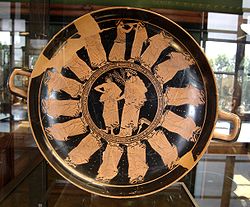
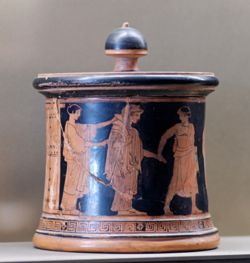
Pottery of Ancient Greece
As the result of its relative durability, pottery is a large part of the archaeological record of Ancient Greece, and because there is so much of it it has exerted a disproportionately large influence on our understanding of Greek society...
. It developed in Athens
Athens
Athens , is the capital and largest city of Greece. Athens dominates the Attica region and is one of the world's oldest cities, as its recorded history spans around 3,400 years. Classical Athens was a powerful city-state...
around 530 BC and remained in use until the late 3rd century BC. It replaced the previously dominant style of Black-figure vase painting within a few decades. Its modern name is based on the figural depictions in red colour on a black background, in contrast to the preceding black-figure style with black figures on a red background. The most important areas of production, apart from Attica
Attica
Attica is a historical region of Greece, containing Athens, the current capital of Greece. The historical region is centered on the Attic peninsula, which projects into the Aegean Sea...
, were in Southern Italy
Magna Graecia
Magna Græcia is the name of the coastal areas of Southern Italy on the Tarentine Gulf that were extensively colonized by Greek settlers; particularly the Achaean colonies of Tarentum, Crotone, and Sybaris, but also, more loosely, the cities of Cumae and Neapolis to the north...
. The style was also adopted in other parts of Greece
Greece
Greece , officially the Hellenic Republic , and historically Hellas or the Republic of Greece in English, is a country in southeastern Europe....
. Etruria
Etruria
Etruria—usually referred to in Greek and Latin source texts as Tyrrhenia—was a region of Central Italy, an area that covered part of what now are Tuscany, Latium, Emilia-Romagna, and Umbria. A particularly noteworthy work dealing with Etruscan locations is D. H...
became an important centre of production outside the Greek World
Ancient Greece
Ancient Greece is a civilization belonging to a period of Greek history that lasted from the Archaic period of the 8th to 6th centuries BC to the end of antiquity. Immediately following this period was the beginning of the Early Middle Ages and the Byzantine era. Included in Ancient Greece is the...
.
Attic red-figure vases were exported throughout Greece and beyond. For a long time, they dominated the market for fine ceramics. Only few centres of pottery production could compete with Athens in terms of innovativeness, quality and production capacity. Of the red figure vases produced in Athens alone, more than 40,000 specimens and fragments survive today. From the second most important production centre, Southern Italy, more than 20,000 vases and fragments are preserved. Starting with the studies by John D. Beazley
John Beazley
Sir John Davidson Beazley was an English classical scholar.Born in Glasgow, Scotland, Beazley attended Balliol College, Oxford, where he was a close friend of the poet James Elroy Flecker. After graduating in 1907, Beazley was a student and tutor in Classics at Christ Church, and in 1925 he...
and Arthur Dale Trendall
Arthur Dale Trendall
Arthur Dale Trendall AC CMG was a New Zealand-born Australian art historian and classical archaeologist whose work on identifying the work of individual artists on Greek ceramic vessels at Apulia and other sites earned him international prizes and a papal knighthood...
, the study of this style of art has made enormous progress. Some vases can be ascribed to individual artists or schools. The images provide evidence for the exploration of Greek cultural history, everyday life, iconography
Iconography
Iconography is the branch of art history which studies the identification, description, and the interpretation of the content of images. The word iconography literally means "image writing", and comes from the Greek "image" and "to write". A secondary meaning is the painting of icons in the...
, and mythology
Greek mythology
Greek mythology is the body of myths and legends belonging to the ancient Greeks, concerning their gods and heroes, the nature of the world, and the origins and significance of their own cult and ritual practices. They were a part of religion in ancient Greece...
.
Technique
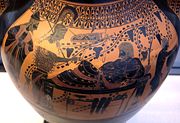
Three-phase firing
Three-phase firing or iron reduction technique is a firing technique used in ancient Greek pottery production, specifically for painted vases. Already vessels from the Bronze Age feature the colouring typical of the technique, with yellow, orange or red clay and brown or red decoration...
. The paintings were applied to the shaped but unfired vessels after they had dried to a leathery, near-brittle texture. In Attica
Attica
Attica is a historical region of Greece, containing Athens, the current capital of Greece. The historical region is centered on the Attic peninsula, which projects into the Aegean Sea...
, the normal unburnt clay was of orange colour at this stage. The outlines of the intended figures were drawn either with a blunt scraper, leaving a slight groove, or with charcoal, which would disappear entirely during firing. Then, the contours were redrawn with a brush, using a glossy clay slip
Slip (ceramics)
A slip is a suspension in water of clay and/or other materials used in the production of ceramic ware. Deflocculant, such as sodium silicate, can be added to the slip to disperse the raw material particles...
. Occasionally, the painter decided to somewhat change the figural scene. In such cases, the grooves from the original sketch sometimes remain visible. Important contours were often drawn with a thicker slip, leading to a slightly protruding outline (relief line); less important lines and internal details were drawn with diluted glossy clay. Detail in other colours, like white or red, were applied at this point. The relief line was probably drawn with a bristle brush or a hair, dipped in thick paint. The suggestion of a hollow needle seems somewhat unlikely. The application of relief outlines was necessary, as the rather liquid glossy clay would otherwise have turned out too dull. After the technique's initial phase of development, both alternatives were used, so as to differentiate gradations and details more clearly. The space between figures was filled with a glossy grey clay slip. Then, the vases underwent triple-phase firing, during which the glossy clay reached its characteristic black or black-brown colour through reduction
Redox
Redox reactions describe all chemical reactions in which atoms have their oxidation state changed....
, the reddish color by a final re-oxidation. Since this final oxidizing phase was fired using lower temperatures, the glazed parts of the vase did not re-oxidize from black to red: their finer surface was melted (sintered) in the reducing phase, and now protected from oxygen.
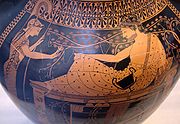
Silhouette
A silhouette is the image of a person, an object or scene consisting of the outline and a basically featureless interior, with the silhouetted object usually being black. Although the art form has been popular since the mid-18th century, the term “silhouette” was seldom used until the early decades...
s. They were also more clearly contrasted against the black backgrounds. It was now possible to depict humans not only in profile, but also in frontal, rear, or three-quarter perspectives. The red-figure technique also permitted the indication of a third dimension on the figures. However, it also had disadvantages. For example, the distinction of sex by using black slip for male skin and white paint for female skin was now impossible. The ongoing trend to depict heroes and deities naked and of youthful age also made it harder to distinguish the sexes through garments or hairstyles. In the initial phases, there were also miscalculations regarding the thickness of human figures. In black-figure vase painting, the pre-drawn outlines were a part of the figure. In red-figure vases, the outline would, after firing, form part of the black background. This led to vases with very thin figures early on. A further problem was that the black background did not permit the depiction of space with any depth, so that the use of spatial perspective almost never was attempted. Nonetheless, the advantages outnumbered the disadvantages. The depiction of muscles and other anatomical detail clearly illustrates the development of the style.
Attica
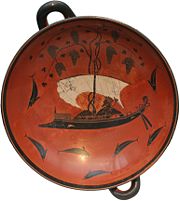
Corinth
Corinth is a city and former municipality in Corinthia, Peloponnese, Greece. Since the 2011 local government reform it is part of the municipality Corinth, of which it is the seat and a municipal unit...
in the 7th century BC and quickly became the dominant style of pottery decoration throughout the Greek world and beyond. Although Corinth dominated the overall market, regional markets and centres of production did develop. Initially, Athens copied the Corinthian style, but it gradually came to rival and overcome the dominance of Corinth. Attic artists developed the style to an unprecedented quality, reaching the apex of their creative possibilities in the second third of the 6th century BC. Exekias
Exekias
Exekias was an ancient Greek vase-painter and potter, who worked between approximately 550 BC - 525 BC at Athens. Most of his vases, however, were exported to other regions of the Mediterranean, such as Etruria, while some of his other works remained in Athens. Exekias worked mainly with a...
, active around 530 BC, can be seen as the most important representative of the black-figure style.
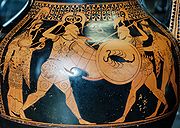
Magna Graecia
Magna Græcia is the name of the coastal areas of Southern Italy on the Tarentine Gulf that were extensively colonized by Greek settlers; particularly the Achaean colonies of Tarentum, Crotone, and Sybaris, but also, more loosely, the cities of Cumae and Neapolis to the north...
and even Etruria
Etruria
Etruria—usually referred to in Greek and Latin source texts as Tyrrhenia—was a region of Central Italy, an area that covered part of what now are Tuscany, Latium, Emilia-Romagna, and Umbria. A particularly noteworthy work dealing with Etruscan locations is D. H...
. The preference for Attic vases led to the development of local South Italian
South Italian
South Italian is a designation for ancient Greek pottery fabricated in Magna Graecia largely during the 4th century BC. The fact that Greek Southern Italy produced its own red figure pottery as early as the end of the 5th century BC. was first established by Adolf Furtwaengler in 1893...
and Etrurian workshops or "schools", strongly influenced by Attic style, but producing exclusively for local markets.
Beginnings
The first red-figure vases were produced around 530 BC. The invention of the technique normally is accredited to the Andokides PainterAndokides Painter
The Andokides painter was an ancient Athenian vase painter who was active from 530 to approximately 515 BCE. His work is unsigned; he is named after Andokides, the potter for whom he worked. He is believed to be the inventor of the red figure style of vase painting.-Beginnings of his art:The...
. He, and other early representatives of the style, eg. Psiax
Psiax
Psiax was an Attic vase painter of the transitional period between the black-figure and red-figure styles. His works date to circa 525 to 505 BC and comprise about 60 surviving vases, two of which bear his signature. Initially he was allocated the name Menon Painter by John Beazley...
, initially painted vases in both styles, with black-figure scenes on one side, and red-figure on the other. Such vases, eg. the Belly Amphora by the Andokides Painter (Munich 2301)
Belly Amphora by the Andokides Painter (Munich 2301)
The Belly Amphora by the Andokides Painter in the Staatliche Antikensammlungen at Munich is one of the most famous works of the artist in question. As a bilingual vase, it is an important archaeological source regarding the transition from attic black-figure pottery to the red-figure style...
, are called bilingual vases. Although they display major advances against the black figure style, the figures still appear somewhat stilted and seldom overlap. Compositions and techniques of the older style remained in use. Thus, incised lines are quite common, as is the additional application of red paint ("added red") to cover large areas.
Pioneering phase
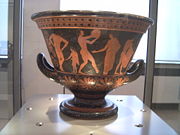
Pioneer Group
The Pioneer Group were a number of red-figure vase painters working in Kerameikos or the potters' quarter of Athens around the beginning of the 5th century BCE. Characterized by John Boardman as perhaps the first conscious art movement in the western tradition, the group comprised the painters...
" made the step towards a full exploitation of the possibilities of the red-figure technique. They were active between circa 520 and 500 BC. Important representatives include Euphronios
Euphronios
Euphronios was an ancient Greek vase painter and potter, active in Athens in the late 6th and early 5th centuries BC. As part of the so-called "Pioneer Group,"...
, Euthymides
Euthymides
Euthymides was an ancient Athenian potter and painter of vases, primarily active between 515 and 500 BC. He was a member of the Greek art movement later to be known as "The Pioneers" for their exploration of the new decorative style known as red-figure pottery...
and Phintias
Phintias (painter)
Phintias was an ancient Greek vase painter; along with Euphronios and Euthymides, he was one of the most important representatives of the Pioneer Group of Athenian red-figure vase painters. Ten works from the period between 525 and 510 BC bearing his signature survive: seven vase paintings and...
. This group, recognised and defined by twentieth-century scholarship, experimented with the different possibilities offered by the new style. Thus, figures appeared in new perspectives, such as frontal or rear views, there were experiments with perspective foreshortening, and more dynamic compositions. As a technical innovation, Euphronios introduced the "relief line". At the same time, new vase shapes
Typology of Greek Vase Shapes
Pottery in Greece has a long history and the form of Greek Vase Shapes has had a continuous evolution from the Minoan period down to the Hellenistic era...
were invented, a development favoured by the fact that many of the pioneer group painters also were active as potters.
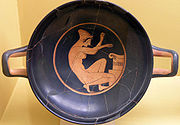
Psykter
A psykter is a type of Greek pot that is characterized by a bulbous body set on a high, narrow foot. It was used as a wine cooler. The psykter would be filled with wine, and then be placed in a krater full of cold water or ice....
and the pelike
Pelike
A pelike is a one-piece ceramic container similar to an amphora.It has two open handles that are vertical on their lateral aspects and even at the side with the edge of the belly, a narrow neck, a flanged mouth, and a sagging, almost spherical belly....
. Large krater
Krater
A krater was a large vase used to mix wine and water in Ancient Greece.-Form and function:...
and amphorae became popular at this time. Although there is no indication that the painters understood themselves as a group in the way that modern scholarship does, there were some connections and mutual influences, perhaps, in an atmosphere of friendly competition and encouragement. Thus, a vase by Euthymides is inscribed "as Euphronios never [would have been able]". More generally, the pioneer group tended to use inscriptions. The labelling of mythological figures or the addition of Kalos inscription
Kalos inscription
The Kalos inscription was a form of epigraph found on Attic vases and graffiti in antiquity, common between 550 and 450 BC, and usually found on symposion vessels. The word καλός means "beautiful"; here it had an erotic connotation, and the inscription took the form of a youth's name, in the...
s are the rule rather than the exception.
Apart from the vase painters, some bowl painters also used the new style. These include Oltos
Oltos
Oltos was a Late Archaic Greek vase painter, active in Athens. From the time between 525 BC and 500 BC, about 150 works by him are known. Two pieces, a cup in Berlin and a cup in Tarquinia , are signed by him as painter.Oltos is thought to have begun his career in the workshop of the potter...
and Epiktetos
Epiktetos
Epiktetos was an Attic vase painter in the early red-figure style. Besides Oltos, he is the most important painter of the Pioneer Group. He was active between 520 and 490 BC...
. Many of their works were bilingual, often using red-figure only on the interior of the bowl.
Late Archaic
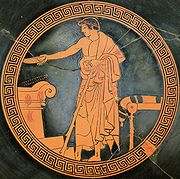
Archaic period in Greece
The Archaic period in Greece was a period of ancient Greek history that followed the Greek Dark Ages. This period saw the rise of the polis and the founding of colonies, as well as the first inklings of classical philosophy, theatre in the form of tragedies performed during Dionysia, and written...
period (circa 500 to 470 BC) brought the style to a new flourish. During this time, black-figure vases failed to reach the same quality and were pushed out of the market eventually. Some of the most famous Attic vase painters belong to this generation. They include the Berlin Painter
Berlin Painter
The Berlin Painter is the conventional name given to an Attic Greek vase-painter who is widely regarded as a rival to the Kleophrades Painter, among the most talented vase painters of the early 5th century BCE .The Berlin Painter along with the Kleophrades Painter was educated by a member of the...
, the Kleophrades Painter
Kleophrades Painter
The Kleophrades Painter is the name given to the anonymous red-figure Athenian vase painter, who was active from approximately 510 – 470 BCE and whose work, considered amongst the finest of the red figure style, is identified by its stylistic traits....
, and among the bowl painters Onesimos
Onesimos (vase painter)
Onesimos was an ancient Athenian vase painter who flourished between 505 and 480 BC. He specialized in decorating cups, mostly of Type B, which comprise virtually all known examples of his work....
, Douris
Douris (vase painter)
Douris was an ancient Athenian red-figure vase-painter and potter active ca. 500 to 460 BCE.-Work:He began his career painting for the potters Kleophrades and Euphronios, before beginning a long collaboration with the potter Python. He signed 39 vases as a painter, also one as a potter and...
, Makron
Makron (vase painter)
Makron was an ancient Greek vase painter active in Athens ca. 490-480 BC. Though only one signed example of his work is known to have survived, some 350 vases have been attributed to him by Sir John Beazley, making him one of the best surviving painters of the red-figure period.Makron is strongly...
and the Brygos Painter
Brygos Painter
The Brygos Painter was an ancient Greek Attic red-figure vase painter of the Late Archaic period. Together with Onesimos , Douris and Makron, he is among the most important bowl painters of his time. He was active in the first third of the fifth century BCE, especially in the 480s and 470s...
. The improvement of quality went along with a doubling of output during this period. Athens became the dominant producer of fine pottery in the Mediterranean world, overshadowing nearly all other production centres.
One of the key features of this most successful Attic vase painting style is the mastery of perspective foreshortening, allowing a much more naturalistic depiction of figures and actions. Another characteristic is the drastic reduction of figures per vessel, of anatomic details, and of ornamental decorations. In contrast, the repertoire of depicted scenes was increased. For example, the myths surrounding Theseus
Theseus
For other uses, see Theseus Theseus was the mythical founder-king of Athens, son of Aethra, and fathered by Aegeus and Poseidon, both of whom Aethra had slept with in one night. Theseus was a founder-hero, like Perseus, Cadmus, or Heracles, all of whom battled and overcame foes that were...
became very popular at this time. New or modified vase shapes were frequently employed, including the Nolan amphora (see Typology of Greek Vase Shapes
Typology of Greek Vase Shapes
Pottery in Greece has a long history and the form of Greek Vase Shapes has had a continuous evolution from the Minoan period down to the Hellenistic era...
), lekythoi
Lekythos
A lekythos is a type of Greek pottery used for storing oil , especially olive oil. It has a narrow body and one handle attached to the neck of the vessel. The lekythos was used for anointing dead bodies of unmarried men and many lekythoi are found in tombs. The images on lekythoi were often...
, as well as bowls of the askos
Askos (pottery vessel)
Askos is the name given in modern terminology to a type of ancient Greek pottery vessel used to pour small quantities of liquids such as oil. It is recognisable from its flat shape and a spout at one or both ends that could also be used as a handle...
and dinos
Dinos
In the typology of ancient Greek pottery, the dinos is a mixing bowl. Dinos means "drinking cup," but in modern typology is used for the same shape as a lebes, that is, a bowl with a spherical body meant to sit on a stand...
types. The specialisation into separate vase and bowl painters increased.
Early and High Classical
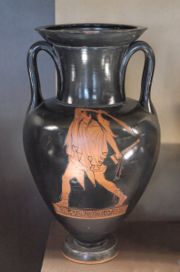
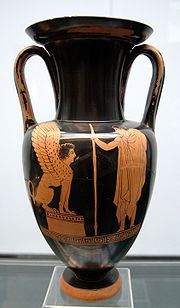
Classical Greece
Classical Greece was a 200 year period in Greek culture lasting from the 5th through 4th centuries BC. This classical period had a powerful influence on the Roman Empire and greatly influenced the foundation of Western civilizations. Much of modern Western politics, artistic thought, such as...
figures is that they are often somewhat stockier and less dynamic than their predecessors. As a result, the depictions gained seriousness, even pathos
Pathos
Pathos represents an appeal to the audience's emotions. Pathos is a communication technique used most often in rhetoric , and in literature, film and other narrative art....
. The folds of garments were depicted less linear, thus appearing more plastic. The manner of presenting scenes also changed substantially. Firstly, the paintings ceased to focus on the moment of a particular event, but rather, with dramatic tension, showed the situation immediately before the action, thus implying and contextualsing the event proper. Also, some of the other new achievements of Athenian democracy
Athenian democracy
Athenian democracy developed in the Greek city-state of Athens, comprising the central city-state of Athens and the surrounding territory of Attica, around 508 BC. Athens is one of the first known democracies. Other Greek cities set up democracies, and even though most followed an Athenian model,...
began to show an influence on vase painting. Thus, influences of tragedy and of wall painting can be detected. Since Greek wall painting is almost entirely lost today, its reflection on vases constitutes one of the few, albeit modest, sources of information on that genre of art. Other influences on High Classical vase painting include the newly erected Parthenon
Parthenon
The Parthenon is a temple on the Athenian Acropolis, Greece, dedicated to the Greek goddess Athena, whom the people of Athens considered their virgin patron. Its construction began in 447 BC when the Athenian Empire was at the height of its power. It was completed in 438 BC, although...
and its sculptural decoration. This is especially visible in the depiction of garments, The material now falls more naturally, more folds are depicted, leading to an increased "depth" of the depiction. The overall compositions were simplified even more. Artists placed special emphasis on symmetry
Symmetry
Symmetry generally conveys two primary meanings. The first is an imprecise sense of harmonious or aesthetically pleasing proportionality and balance; such that it reflects beauty or perfection...
, harmony
Harmony
In music, harmony is the use of simultaneous pitches , or chords. The study of harmony involves chords and their construction and chord progressions and the principles of connection that govern them. Harmony is often said to refer to the "vertical" aspect of music, as distinguished from melodic...
, and balance
Balance
- Equipment :* Balance beam, a piece of gymnastics apparatus.* Balance board, a piece of training equipment.* Balancing machine, a machine that balances mechanical rotating parts to lessen vibration.* Balance wheel, a watch component....
. The human figures had returned to their earlier slenderness; often they radiate a self-absorbed, divine serenity.
Important painters of this period, roughly 480 to 425 BC, include the Providence Painter
Providence Painter
The Providence Painter is the conventional name given to a painter of the Attic red-figure style. He was active around 470 BC.The Providence Painter is considered to have been a pupil of the Berlin Painter. His reputation is that of a careful artist at the transition from Archaic to Classical art....
, Hermonax
Hermonax
Hermonax was a Greek vase painter working in the red-figure style. He painted between ca. 470 and 440 BC in Athens. Ten vases signed with the phrase "Hermonax has painted it" survive, mainly stamnoi and lekythoi...
, and the Achilles Painter
Achilles Painter
The Achilles Painter, was a vase-painter active ca. 470-420 BC. His name vase is an amphora in the Vatican museums depicting Achilles. Sir John Beazley attributed over 200 vases to his hand, the largest share being red-figure and white-ground lekythoi. In his middle phase , he decorates more open...
, all following the tradition of the Berlin Painter. The Phiale Painter
Phiale Painter
The Phiale Painter was a painter of the Attic red-figure style. He was active around 460 to 430 BC. The Phiale Painter is assumed to have been a pupil of the Achilles Painter. In contrast to his master, he liked to depict narrative scenes...
, probably a pupil of the Achilles Painter, is also important. New workshop traditions also developed. Notable examples include the so-called "mannerists
Mannerists (Greek vase painting)
In archaeological scholarship, the term Mannerists describes a large group of Attic red-figure vase painters, stylistically linked by their affected painting style....
", most famously among them, the Pan Painter
Pan Painter
The Pan Painter was an ancient Greek vase-painter of the Attic red-figure style, active ca. 480 to 450 BC. A pupil of Myson, he stands the beginning of the Mannerists, though his drawing technique is considered the finest. Sir John Beazley attributed over 150 vases to his hand...
. Another tradition was begun by the Niobid Painter
Niobid Painter
The Niobid Painter was an ancient Athenian potter in the red figure style, named after a krater which on one side shows the god Apollo and his sister Artemis killing the children of Niobe who were collectively called the Niobids. There is some confusion as to what is being depicted on the opposite...
and continued by Polygnotos
Polygnotos (vase painter)
Polygnotos , a Greek vase-painter in Athens, is considered one of the most important vase painters of the red figure style of the high-classical period...
, the Kleophon Painter
Kleophon Painter
The Kleophon Painter is the name given to an anonymous Athenian vase painter in the red figure style who flourished in the mid-to-late 5th century BCE...
, and the Dinos Painter
Dinos Painter
The Dinos Painter was an Attic red-figure vase painter who was active during the second half of the 5th century BC. The Dinos Painter stood in the tradition of the Kleophon Painter, but was less serious. One or few figures are depicted as the centre of an event; the frieze-like depiction of the...
. The role of bowls decreased, although they were still produced in large numbers, eg. by the workshop of the Penthesilea Painter
Penthesilea Painter
The Penthesilea Painter was a Greek vase painter of the Attic red-figure style. His true name is unknown. His conventional name is derived from his name vase, "bowl 2688" in Munich, the inside of which depicts the slaying of Penthesilea by Achilles...
.
Late Classical
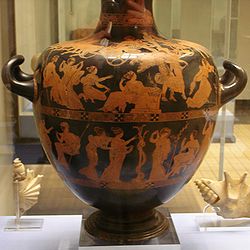

Meidias Painter
The Meidias Painter was an Athenian red-figure vase painter in Ancient Greece, active in the last quarter of the fifth century BCE . He is named after the potter whose signature is found on a large hydria of the Meidias Painter’s decoration , excavated from an Etruscan tomb...
. Characteristic features include transparent garments and multiple folds of cloth. There is also an increase in the depiction of jewellery and other objects. The use of additional colours, mostly white and gold, depicting accessories in a low relief, is very striking. Over time, there is a marked "softening": The male body, heretofore defined by the depiction of muscles, gradually lost that key feature.

Aphrodite
Aphrodite is the Greek goddess of love, beauty, pleasure, and procreation.Her Roman equivalent is the goddess .Historically, her cult in Greece was imported from, or influenced by, the cult of Astarte in Phoenicia....
. It is not clear what caused this change of depicted topic among some of the artists. Suggestions include a context with the horrors of the Peloponnesian War
Peloponnesian War
The Peloponnesian War, 431 to 404 BC, was an ancient Greek war fought by Athens and its empire against the Peloponnesian League led by Sparta. Historians have traditionally divided the war into three phases...
, but also the loss of Athens' dominant role in the Mediterranean pottery trade (itself partially a result of the war). The increasing role of new markets, e.g. Iberia
Iberian Peninsula
The Iberian Peninsula , sometimes called Iberia, is located in the extreme southwest of Europe and includes the modern-day sovereign states of Spain, Portugal and Andorra, as well as the British Overseas Territory of Gibraltar...
, implied new needs and wishes on part of the customers. These theories are contradicted by the fact that some artists maintained the earlier style. Some, e.g. the Eretria Painter
Eretria Painter
The Eretria Painter was an ancient Greek Attic red-figure vase painter. He worked in the final quarter of the 5th century BC. The Eretria Painter is assumed to have been a contemporary of the Shuvalov Painter; he is considered one of the most interesting painters of his time. Many of hist best...
, attempted to combine both traditions. The best works of the Late Classical period are often found on smaller vessels, such as belly lekythoi
Lekythos
A lekythos is a type of Greek pottery used for storing oil , especially olive oil. It has a narrow body and one handle attached to the neck of the vessel. The lekythos was used for anointing dead bodies of unmarried men and many lekythoi are found in tombs. The images on lekythoi were often...
, pyxides
Pyxis (pottery)
A pyxis is a shape of vessel from the classical world, usually a round box with a separate lid. Originally mostly used by women to hold cosmetics, trinkets or jewellery, surviving pyxides are mostly Greek pottery, but especially in later periods may be in wood, metal, ivory, or other materials...
and oinochai. Lekanis, Bell krater(seeTypology of Greek Vase Shapes
Typology of Greek Vase Shapes
Pottery in Greece has a long history and the form of Greek Vase Shapes has had a continuous evolution from the Minoan period down to the Hellenistic era...
) and hydria
Hydria
A hydria is a type of Greek pottery used for carrying water. The hydria has three handles. Two horizontal handles on either side of the body of the pot were used for lifting and carrying the pot. The third handle, a vertical one, located in the center of the other two handles, was used when...
were also popular.
The production of mainstream red-figure pottery ceased around 360 BC. The Rich and Simple styles both existed until that time. Late representatives include the Meleager Painter
Meleager Painter
The Meleager Painter was an ancient Greek vase painter of the Attic red-figure tradition. He was active in the first third of the 4th century BC. The Meleager Painter followed a tradition started by a group of slightly earlier artists, such as the Mikion Painter. He is probably the most important...
(Rich Style) and the Jena Painter
Jena Painter
The Jena Painter was an ancient Greek vase painter, active in Athens around 400 BC. He mainly painted kylikes in the red-figure technique. His stylistic and chronological place was first determined by the British Classical archaeologist, John D. Beazley...
(Simple Style).
Kerch Style
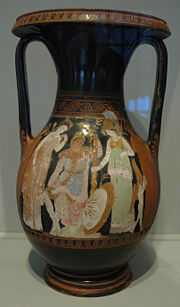
Kerch Style
.The Kerch style is an archaeological term describing vases from the final phase of Attic red-figure pottery production. Their exact chronology remains problematic, but they are generally assumed to have been produced roughly between 375 and 330/20 BC...
. This style, current between 370 and 330 BC, combined the preceding Rich and Modest Styles, with a preponderance of the Rich. Crowded compositions with large statuesque figures are typical. The added colours now include blue, green and others. Volume and shading are indicated by the use of diluted runny glossy clay. Occasionally, whole figures are added as appliques, i.e. as thin figural reliefs attached to the body of the vase. The variety of vessel shapes in use was reduced sharply. Common painted shapes include pelike, chalice krater, belly lekythos, skyphos, hydria and oinochoe. Scenes from female life are very common. Mythological themes are still dominated by Dionysos; Ariadne
Ariadne
Ariadne , in Greek mythology, was the daughter of King Minos of Crete, and his queen Pasiphaë, daughter of Helios, the Sun-titan. She aided Theseus in overcoming the Minotaur and was the bride of the god Dionysus.-Minos and Theseus:...
and Heracles
Heracles
Heracles ,born Alcaeus or Alcides , was a divine hero in Greek mythology, the son of Zeus and Alcmene, foster son of Amphitryon and great-grandson of Perseus...
are the most commonly depicted heroes. The best-known painter of this style is the Marsyas Painter
Marsyas Painter
The Marsyas Painter was an ancient Greek vase painter of the red-figure style. He was active in Attica between 370 and 340/330 BC. The Marsyas Painter is sometimes considered the best of the Attic red-figure painters of the late 4th-century Kerch Style. His conventional name is derived from the...
.
The last Athenian vases with figural depictions were created around 320 BC at the latest. The style continued somewhat longer, but with non-figural decorations. The last recognised examples are by painters known as the YZ Group
YZ Group
The YZ Group is an assumed group of ancient Greek Attic vase painters of the red-figure style.Individual artists can only be identified with difficulty. The group was given its conventional name by John D. Beazley during his studies of Attic red-figure was painting. He named the group "YZ" because...
.
Artists and Works

Jena Painter
The Jena Painter was an ancient Greek vase painter, active in Athens around 400 BC. He mainly painted kylikes in the red-figure technique. His stylistic and chronological place was first determined by the British Classical archaeologist, John D. Beazley...
was discovered. The artefacts from it are now on display in the University collection of the Friedrich Schiller University of Jena
Friedrich Schiller University of Jena
Friedrich Schiller University of Jena , is a public research university located in Jena, Thuringia, Germany....
. According to modern research, the workshops were owned by the potters. The names of about 40 Attic vase painters are known, from vase inscriptions, usually accompanied by the words (égrapsen, has painted). In contrast, the signature of the potter, (epoíesen, has made) has survived on more than twice as many, namely circa 100, pots (both numbers refer to the totality of Attic figural vase painting). Although signatures had been known since circa 580 BC (first known signature by the potter Sophilos
Sophilos
Sophilos was an Attic potter and vase painter in the black-figure style.Sophilos is the oldest Attic vase painter to be so far known by his true name. Fragments of two wine basins '’dinoi’’ in Athens are signed by him, indicating that he both potted and painted them...
), their use increased to an apex around the Pioneering Phase. A changing, apparently increasingly negative, attitude to artisans led to a reduction of signatures, starting during the Classical period at the latest. Overall, signatures are quite rare. The fact that they are mostly found on especially good pieces indicates that they expressed the pride of potter and/or painter.

Slavery in Ancient Greece
Slavery was common practice and an integral component of ancient Greece throughout its rich history, as it was in other societies of the time including ancient Israel and early Christian societies. It is estimated that in Athens, the majority of citizens owned at least one slave...
. On the other hand, some of the known names indicate that there were at least some former slaves and some perioikoi
Perioikoi
The perioeci, or perioikoi, were the members of an autonomous group of free but non-citizen inhabitants of Sparta. Concentrated in the beach and highland areas of Laconia, the name περίοικοι derives from περί / peri, "around," and / oikos, "dwelling, house." They were the only people allowed to...
among the painters. Additionally, some of the names are not unique: for example, several painters signed as Polygnotos. This may represent attempts to profit from the name of that great painter. The same may be the case where painters bear otherwise fanous names, like Aristophanes (vase painter)
Aristophanes (vase painter)
Aristophanes was an ancient Greek vase painter of the Attic red-figure style. Three pieces signed by him are known. Two of them are bowls made by the potter Erginos, now in Berlin and Boston , the third is the fragment of a krater in Agrigento...
. The careers of some vase painters are quite well known. Apart from painters with relatively short periods of activity (one or two decades), some can be traced for much longer. Examples include Douris
Douris (vase painter)
Douris was an ancient Athenian red-figure vase-painter and potter active ca. 500 to 460 BCE.-Work:He began his career painting for the potters Kleophrades and Euphronios, before beginning a long collaboration with the potter Python. He signed 39 vases as a painter, also one as a potter and...
, Makron
Makron (vase painter)
Makron was an ancient Greek vase painter active in Athens ca. 490-480 BC. Though only one signed example of his work is known to have survived, some 350 vases have been attributed to him by Sir John Beazley, making him one of the best surviving painters of the red-figure period.Makron is strongly...
, Hermonax
Hermonax
Hermonax was a Greek vase painter working in the red-figure style. He painted between ca. 470 and 440 BC in Athens. Ten vases signed with the phrase "Hermonax has painted it" survive, mainly stamnoi and lekythoi...
and the Achilles Painter
Achilles Painter
The Achilles Painter, was a vase-painter active ca. 470-420 BC. His name vase is an amphora in the Vatican museums depicting Achilles. Sir John Beazley attributed over 200 vases to his hand, the largest share being red-figure and white-ground lekythoi. In his middle phase , he decorates more open...
. The fact that several painters later became potters, and the relatively frequent cases were it is unclear whether some potters were also painters or vice versa, suggest a career structure, perhaps starting with an apprenticeship involving mainly painting, and leading up to being a potter. This division of labours appears to have developed along with the introduction of red-figure painting, since many potter-painters are known from the black-figure period (including Exekias
Exekias
Exekias was an ancient Greek vase-painter and potter, who worked between approximately 550 BC - 525 BC at Athens. Most of his vases, however, were exported to other regions of the Mediterranean, such as Etruria, while some of his other works remained in Athens. Exekias worked mainly with a...
, Nearchos and perhaps the Amasis Painter
Amasis Painter
The Amasis Painter was an ancient Greek vase painter of the black figure style. He owes his name to the fact that eight of the potter Amasis's manufactured marked work are painted by the same painter, who is therefore called the Amasis painter...
). The increased demand for exports would have led to new structures of production, encouraging specialisation and division of labour, leading to a sometimes ambiguous distinction between painter and potter. As mentioned above, the painting of vessels was probably mainly the responsibility of younger assistants or apprentices. Some further conclusions regarding the organisational aspects of pottery production can be suggested. It appears that generally, several painters worked for one pottery workshop, as indicated by the fact that frequently, several roughly contemporary pots by the same potter are painted by various painters. For examples, pots made by Euphronios
Euphronios
Euphronios was an ancient Greek vase painter and potter, active in Athens in the late 6th and early 5th centuries BC. As part of the so-called "Pioneer Group,"...
have been found to be painted by Onesimos
Onesimos (vase painter)
Onesimos was an ancient Athenian vase painter who flourished between 505 and 480 BC. He specialized in decorating cups, mostly of Type B, which comprise virtually all known examples of his work....
, Douris
Douris (vase painter)
Douris was an ancient Athenian red-figure vase-painter and potter active ca. 500 to 460 BCE.-Work:He began his career painting for the potters Kleophrades and Euphronios, before beginning a long collaboration with the potter Python. He signed 39 vases as a painter, also one as a potter and...
, the Antiphon Painter
Antiphon Painter
The Antiphon painter was an Athenian vase painter of the early 5th century BC. He owes his name to a double Kalos inscription of Antiphon on the dinos stand in the Antique collection of Berlin . He was active between 500 and 475 BC in Athens as a painter of the red figure style in the largest...
, the Triptolemos Painter
Triptolemos Painter
The Triptolemos Painter was an ancient Greek vase painter, belonging to the Attic red-figure style. He was active in Athens between 490 and 470 BC. His real name is not known. He started working in the workshop of Euphronios, where he was probably taught by Douris. Later, he also worked for the...
and the Pistoxenos Painter
Pistoxenos Painter
The Pistoxenos Painter was an important ancient Greek vase painter of the Classical period. He was active in Athens between circa 480 and 460 BC. His conventional name is derived from his name vase. The vase, a skyphos, now at Schwerin, has a signature indicating that it was made by the potter...
. Conversely, an individual painter could also change from one workshop to another. For example, the bowl painter Oltos
Oltos
Oltos was a Late Archaic Greek vase painter, active in Athens. From the time between 525 BC and 500 BC, about 150 works by him are known. Two pieces, a cup in Berlin and a cup in Tarquinia , are signed by him as painter.Oltos is thought to have begun his career in the workshop of the potter...
worked for at least six different potters.
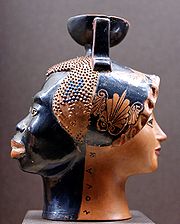
Art
Art is the product or process of deliberately arranging items in a way that influences and affects one or more of the senses, emotions, and intellect....
, this view is not consistent with that held in antiquity. Vase painters, like potters, were considered as craftsmen, their produce as trade goods. The craftsmen must have had a reasonably high level of education, as a variety of inscriptions occur. On the one hand, the aforementioned Kalos inscription
Kalos inscription
The Kalos inscription was a form of epigraph found on Attic vases and graffiti in antiquity, common between 550 and 450 BC, and usually found on symposion vessels. The word καλός means "beautiful"; here it had an erotic connotation, and the inscription took the form of a youth's name, in the...
s are common, on the other hand, inscriptions often label the depicted figures. That not every vase painter could write is shown by some examples of meaningless rows of random letters. The vases indicate a steady improvement of literacy from the 6th century BC onwards. Whether potters, and perhaps vase painters, belonged to the Attic elite
Elite
Elite refers to an exceptional or privileged group that wields considerable power within its sphere of influence...
has not been satisfactorily clarified so far. Do the frequent depictions of the symposium
Symposium
In ancient Greece, the symposium was a drinking party. Literary works that describe or take place at a symposium include two Socratic dialogues, Plato's Symposium and Xenophon's Symposium, as well as a number of Greek poems such as the elegies of Theognis of Megara...
, a definite upper-class activity, reflect the painters' personal experience, their aspirations to attend such events, or simply the demands of the market? A large proportion of the painted vases produced, such as psykter
Psykter
A psykter is a type of Greek pot that is characterized by a bulbous body set on a high, narrow foot. It was used as a wine cooler. The psykter would be filled with wine, and then be placed in a krater full of cold water or ice....
, krater
Krater
A krater was a large vase used to mix wine and water in Ancient Greece.-Form and function:...
, kalpis, stamnos
Stamnos
A stamnos is a type of Greek pottery used to store liquids. It is much squatter than an amphora and has two stubby handles relatively high on its sides. It is a relatively unusual container form. Generally, it was used for mixing and storing....
, as well as kylikes
Kylix (drinking cup)
A kylix is a type of wine-drinking glass with a broad relatively shallow body raised on a stem from a foot and usually with two horizontal handles disposed symmetrically...
and kantharoi
Kantharos
A kantharos or cantharus is a type of Greek pottery used for drinking. It is characterized by its high swung handles which extend above the lip of the pot.The god Dionysus had a kantharos which was never empty....
, were made and bought to be used at symposia.
Elaborately painted vases were good, but not the best, table wares available to a Greek. Metal vessels, especially from precious metals, were held in higher regard. Nonetheless, painted vases were not cheap products; the larger specimens, especially, were expensive. Around 500 BC, a large painted vase cost about one drachma, equivalent to the daily wage of a stonemason. It has been suggested that the painted vases represent an attempt to imitate metal vessels. It is normally assumed that the lower social classes tended to use simple undecorated coarse wares, massive quantities of which are found in excavations. Tablewares made of perishable materials, like wood, may have been even more widespread. Nonetheless, multiple finds of red-figure vases, usually not of the highest quality, found in settlements, prove that such vessels were used in daily life. A large proportion of production was taken up by cult and grave vessels. In any case, it can be assumed that the production of high-quality pottery was a profitable business. For example, an expensive votive gift by the painter Euphronios was found on the Athenian Acropolis. There can be little doubt that the export of such pottery made an important contribution to the affluence of Athens. It is hardly surprising that many workshops appear to have aimed their production at export markets, for example by producing vessel shapes that were more popular in the target region than in Athens. The 4th century BC demise of Attic vase painting tellingly coincides with the very period when the Etruscans, probably the main western export market, came under increasing pressure from South Italian Greeks
Magna Graecia
Magna Græcia is the name of the coastal areas of Southern Italy on the Tarentine Gulf that were extensively colonized by Greek settlers; particularly the Achaean colonies of Tarentum, Crotone, and Sybaris, but also, more loosely, the cities of Cumae and Neapolis to the north...
and the Romans
Ancient Rome
Ancient Rome was a thriving civilization that grew on the Italian Peninsula as early as the 8th century BC. Located along the Mediterranean Sea and centered on the city of Rome, it expanded to one of the largest empires in the ancient world....
. A further reason for the end of the production of figurally decorated vases is a change in tastes at the start of the Hellenistic period
Hellenistic civilization
Hellenistic civilization represents the zenith of Greek influence in the ancient world from 323 BCE to about 146 BCE...
. The main reason, however, should be seen in the increasingly unsuccessful progress of the Peloponnesian War, culminating in the devastating defeat of Athens in 404 BC. After this, Sparta
Sparta
Sparta or Lacedaemon, was a prominent city-state in ancient Greece, situated on the banks of the River Eurotas in Laconia, in south-eastern Peloponnese. It emerged as a political entity around the 10th century BC, when the invading Dorians subjugated the local, non-Dorian population. From c...
controlled the western trade, albeit without having the economic strength to fully exploit it. The Attic potters had to find new markets; they did so in the Black Sea
Black Sea
The Black Sea is bounded by Europe, Anatolia and the Caucasus and is ultimately connected to the Atlantic Ocean via the Mediterranean and the Aegean seas and various straits. The Bosphorus strait connects it to the Sea of Marmara, and the strait of the Dardanelles connects that sea to the Aegean...
area. But Athens and its industries never fully recovered from the defeat. Some potters and painters had already relocated to Italy during the war, seeking better economic conditions. A key indicator for the export-oriented nature of Attic vase production is the nearly total absence of theatre scenes. Buyers from other cultural backgrounds, such as Etruscans or later customers in the Iberian Peninsula
Iberian Peninsula
The Iberian Peninsula , sometimes called Iberia, is located in the extreme southwest of Europe and includes the modern-day sovereign states of Spain, Portugal and Andorra, as well as the British Overseas Territory of Gibraltar...
, would have found such depiction incomprehensible or uninteresting. In Southern Italian vase painting, which was mostly not aimed at export, such scenes are quite common.
Southern Italy
At least from a modern point of view, the Southern Italian red-figure vase paintings represent the only region of production that reaches Attic standards of artistic quality. After the Attic vases, the South ItalianSouth Italian
South Italian is a designation for ancient Greek pottery fabricated in Magna Graecia largely during the 4th century BC. The fact that Greek Southern Italy produced its own red figure pottery as early as the end of the 5th century BC. was first established by Adolf Furtwaengler in 1893...
ones (including those from Sicily
Sicily
Sicily is a region of Italy, and is the largest island in the Mediterranean Sea. Along with the surrounding minor islands, it constitutes an autonomous region of Italy, the Regione Autonoma Siciliana Sicily has a rich and unique culture, especially with regard to the arts, music, literature,...
), are the most thoroughly researched. In contrastic to their Attic counterparts, they were mostly produced for local markets. Only few pieces have been found outside Southern Italy and Sicily. The first workshops were founded in the mid-5th century BC by Attic potters. Soon, local craftsmen were trained and the thematic and formal dependence on Attic vases overcome. Towards the end of the century, the distinctive "ornate style" and "plain style" developed in Apulia
Apulia
Apulia is a region in Southern Italy bordering the Adriatic Sea in the east, the Ionian Sea to the southeast, and the Strait of Òtranto and Gulf of Taranto in the south. Its most southern portion, known as Salento peninsula, forms a high heel on the "boot" of Italy. The region comprises , and...
. Especially the ornate style was adopted by other mainland schools, but without reaching the same quality.
By now, 21,000 South Italian vases and fragments are known. Of those, 11,000 are ascribed to Apulian workshops, 4,000 to Campanian, 2,000 to Paestan, 1,500 to Lucanian and 1,000 to Sicilian ones.
Apulia
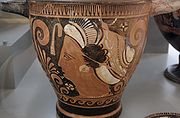
Apulia
Apulia is a region in Southern Italy bordering the Adriatic Sea in the east, the Ionian Sea to the southeast, and the Strait of Òtranto and Gulf of Taranto in the south. Its most southern portion, known as Salento peninsula, forms a high heel on the "boot" of Italy. The region comprises , and...
n vase painting tradition is considered as the leading South Italian style. The main centre of production was at Taras
Taranto
Taranto is a coastal city in Apulia, Southern Italy. It is the capital of the Province of Taranto and is an important commercial port as well as the main Italian naval base....
. Apulian red-figure vases were produced from circa 430 to 300 BC. The plain and ornate styles are distinguished. The main difference between them is that the plain style favoured bell craters, column kraters and smaller vessels, and that a single "plain" vessel rarely depicted more than four figures. The main subjects were mythological scenes, female heads, warriors in scenes of combat of farewell, and dionysiac thiasos
Dionysian Mysteries
The Dionysian Mysteries were a ritual of ancient Greece and Rome which used intoxicants and other trance-inducing techniques to remove inhibitions and social constraints, liberating the individual to return to a natural state. It also provided some liberation for those marginalized by Greek...
imagery. The reverse often showed youths wearing cloaks. The key feature of these simply decorated wares is the general absence of additional colours. Important plain style representatives are the Sisyphus Painter
Sisyphus Painter
The Sisyphus Painter was an Apulian red-figure vase painter. His works are dated to the last two decades of the fifth century and the very early fourth century BC....
and the Tarporley Painter
Tarporley Painter
The Tarporley Painter was an Apulian red-figure vase painter. His works date to the first quarter of the 4th century BC. The Tarporley Painter is his period's most important representative of the so-called "Plain Style"...
. After the mid-4th century BC, the style grows more and more similar to the ornate style. An important artist of that period is the Varrese Painter
Varrese Painter
The Varrese Painter was an Apulian red-figure vase painter. His works are dated to the middle of the 4th century BC.His conventional name is derived from the Varrese hypogeum at Canosa di Puglia, which contained several vases painted by him. In total, over 200 known vases are attributed to him...
.
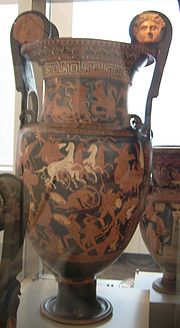
Loutrophoros
A loutrophoros is a distinctive type of Greek pottery vessel characterized by an elongated neck with two handles. The loutrophoros was used to hold water during marriage and funeral rituals, and was placed in the tombs of the unmarried...
and hydriai. The larger surface area was used to depict up to 20 figures, often in several registers on the body of the vase. Additional colours, especially shades of red, yellow-gold and white are used copiously. Since the 2nd half of the 4th century, the necks and sides of the vases are decorated with rich vegetal or ornamental decorations. At the same time, perspective views, especially of buildings such as "Palace of Hades
Hades
Hades , Hadēs, originally , Haidēs or , Aidēs , meaning "the unseen") was the ancient Greek god of the underworld. The genitive , Haidou, was an elision to denote locality: "[the house/dominion] of Hades". Eventually, the nominative came to designate the abode of the dead.In Greek mythology, Hades...
" (naiskoi
Naiskos
The naiskos is a small temple in Classical order with columns or pillars and pediment. Often applied as an artificial motif, it is not rare in ancient art...
), develop. Since 360 BC, such structures are often depicted in scenes connected with burial rites (naiskos vases). Important representatives of this style are the Ilioupersis Painter
Ilioupersis Painter
The Ilioupersis Painter was an Apulian vase painter. His works are dated to the second quarter of the 4th century BC.The Ilioupersis Painter begins to the beginning of the middle phase of Apulian vase painting, and the start of the so called Ornate Style...
, the Darius Painter
Darius Painter
The Darius Painter was an Apulian vase painter and the most eminent representative at the end of the "Ornate Style" in South Italian red-figure vase painting...
and the Baltimore Painter
Baltimore Painter
The Baltimore Painter was an ancient Apulian vase painter whose works date to the final quarter of the 4th century BC. The Baltimore Painter is considered the most important Late Apulian vase painter, and the last Apulian painter of importance. His conventional name is derived from a vase kept at...
. Mythological scenes were especially popular: The assembly of the Gods, the amazonomachy
Amazonomachy
An Amazonomachy was a portrayal of legendary battle between Greeks and Amazons...
, the Trojan War
Trojan War
In Greek mythology, the Trojan War was waged against the city of Troy by the Achaeans after Paris of Troy took Helen from her husband Menelaus, the king of Sparta. The war is among the most important events in Greek mythology and was narrated in many works of Greek literature, including the Iliad...
, Heracles
Heracles
Heracles ,born Alcaeus or Alcides , was a divine hero in Greek mythology, the son of Zeus and Alcmene, foster son of Amphitryon and great-grandson of Perseus...
and Bellerophon
Bellerophon
Bellerophon or Bellerophontes is a hero of Greek mythology. He was "the greatest hero and slayer of monsters, alongside of Cadmus and Perseus, before the days of Heracles", and his greatest feat was killing the Chimera, a monster that Homer depicted with a lion's head, a goat's body, and a...
. Additionally, such vases frequently depict scenes from myths that are only rarely illustrated on vases. Some specimens represent the single source for the iconography of a particular myth. Another subject that is unknown from Attic vase painting are the theatre scenes. Especially farce scenes, e.g. from the so-called phlyax
Phlyax play
A Phlyax play , also known as a hilarotragedy, was a burlesque dramatic form that developed in the Greek colonies of Magna Graecia in the 4th century BCE. Its name derives from the Phlyakes or “Gossip Players” in Doric Greek...
vases are quite common. Scenes of athletic activity or everyday life only occur in the early phase, they disappear entirely after 370 BC.
Apulian vase painting had a formative influence on the traditions of the other South Italian production centres. It is assumed that individual Apulian artists settled in other Italian cities and contributed their skills there. Apart from red-figure, Apulia also produced black-varnished vases with painted decor (Gnathia vases) and polychrome vases (Canosa vases).
Campania
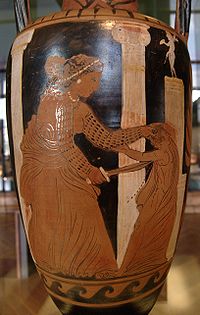
Campania
Campania is a region in southern Italy. The region has a population of around 5.8 million people, making it the second-most-populous region of Italy; its total area of 13,590 km² makes it the most densely populated region in the country...
also produced red-figure vases in the 5th and 4th centuries BC. The light brown clay of Campania was covered with a slip that developed a pink or red tint after firing. The Campanian painters preferred smaller vessel types, but also hydriai and bell kraters. The most popular shape is the bow-handled amphora. Many typical Apulian vessel shapes, like volute kraters, column kraters, loutrophoroi, rhyta
Rhyton
A rhyton is a container from which fluids were intended to be drunk, or else poured in some ceremony such as libation. Rhytons were very common in ancient Persia, where they were called takuk...
and nestoris amphorae are absent, pelike
Pelike
A pelike is a one-piece ceramic container similar to an amphora.It has two open handles that are vertical on their lateral aspects and even at the side with the edge of the belly, a narrow neck, a flanged mouth, and a sagging, almost spherical belly....
s are rare. The repertoire of motifs is limited. Subjects include youths, women, thiasos scenes, birds and animals, and often native warriors. The backs often show cloaked youths. Mythological scenes and depictions related to burial rites play a subsidiary role. Naiskos scsnes, ornamental elements and polychromy are adopted after 340 BC under Lucanian influence.
Before the immigration of Sicilian potters in the second quarter of the 4th century BC, when several workshops were established in Campania, only the Owl-Pillar Workshop of the second half of the 5th century is known. Campanian vase painting is subdivided in three main groups:
The first group is represented by the Kassandra Painter
Kassandra Painter
The Kassandra Painter was an Attic vase painter in the black-figure style.A contemporary of the Heidelberg Painter, he decorated Siana cups with tall feet and rims. The vessels painted by him are of medium size. He is considered one of the first producers of Little-master cups...
from Capua
Capua
Capua is a city and comune in the province of Caserta, Campania, southern Italy, situated 25 km north of Naples, on the northeastern edge of the Campanian plain. Ancient Capua was situated where Santa Maria Capua Vetere is now...
, still under Sicilian influence. He was followed by the workshop of the Parrish Painter and that of the Laghetto Painter and the Caivano Painter. Their work is characterised by a preference for satyr
Satyr
In Greek mythology, satyrs are a troop of male companions of Pan and Dionysus — "satyresses" were a late invention of poets — that roamed the woods and mountains. In myths they are often associated with pipe-playing....
figures with thyrsos, depictions of heads (normally below the handles of hydriai), decorative borders of garments, and the frequent use of additional white, red and yellow. The Laghetto and Caivano Painters appear to have moved to Paestum
Paestum
Paestum is the classical Roman name of a major Graeco-Roman city in the Campania region of Italy. It is located in the north of Cilento, near the coast about 85 km SE of Naples in the province of Salerno, and belongs to the commune of Capaccio, officially also named...
later.
The AV Group also had its workshop in Capua. Of particular importance is the Whiteface-Frignano Painter, one of the first in this group. His typical characteristic is the use of additional white paint to depict the faces of women. This group favoured domestic scenes, women and warriors. Multiple figures are rare, usually there is only one figure each on the front and back of the vase, sometimes only the head. Garments are usually drawn casually.
After 350 BC, the CA Painter and his successors worked in Cumae
Cumae
Cumae is an ancient Greek settlement lying to the northwest of Naples in the Italian region of Campania. Cumae was the first Greek colony on the mainland of Italy , and the seat of the Cumaean Sibyl...
. The CA painter is considered as the outstanding artist of his group, or even of Campanian vase painting as a whole. From 330 onwards, a strong Apulian influence is visible. The most common motifs are naiskos and grave scenes, dionysiac scenes and symposia. Depictions of bejewelled female heads are also common. The CA painter was polychrome but tended to use much white for architecture and female figures. His successors were not fully able to maintain his quality, leading to a rapid demise, terminating with the end of Campanian vase painting around 300 BC.

Lucania
The LucaniaLucania
Lucania was an ancient district of southern Italy, extending from the Tyrrhenian Sea to the Gulf of Taranto. To the north it adjoined Campania, Samnium and Apulia, and to the south it was separated by a narrow isthmus from the district of Bruttium...
n vase painting tradition began around 430 BC, with the works of the Pisticci Painter
Pisticci Painter
The “Pisticci Painter” was a vase painter who lived in the second half of the V century B.C., thus called because much of his artistic works were discovered in Pisticci, a small town few miles away from Metaponto, Basilicata, Italy....
. He was probably active in Pisticci
Pisticci
Pisticci is a town comune in the province of Matera, in the Southern Italian region of Basilicata....
, where some of his works were discovered. He was strongly influenced by Attic tradition. His successors, the Amykos Painter and the Cyclops Painter had a workshop in Metapontum
Metapontum
Metapontum, Metapontium or Metapontion , was an important city of Magna Graecia, situated on the gulf of Tarentum, between the river Bradanus and the Casuentus . It was distant about 20 km from Heraclea and 40 from Tarentum...
. They were the first to paint the new nestoris (see Typology of Greek Vase Shapes
Typology of Greek Vase Shapes
Pottery in Greece has a long history and the form of Greek Vase Shapes has had a continuous evolution from the Minoan period down to the Hellenistic era...
) vase type. Mythical or theatrical scenes are common. For example, the Cheophoroi painter, named after the Cheophoroi by Aeschylos showed scenes from the tragedy in question on several of his vases. The influence of Apulian vase painting becomes tangible roughly at the same time. Especially polychromy and vegetal decor became standard. Important representatives of this style include the Dolon Painter and the Brooklyn-Budapest Painter. Towards the mid-4th century BC, a massive drop in quality and thematic variety becomes notable. The last notable Lucanian vase painter was the Primato Painter, strongly influenced by the Apulian Lycourgos Painter. After him, a short rapid demise is followed by the cessation of Lucanian vase painting at the start of the last quarter of the 4th century BC.
Paestum
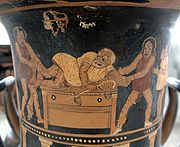
Paestum
Paestum is the classical Roman name of a major Graeco-Roman city in the Campania region of Italy. It is located in the north of Cilento, near the coast about 85 km SE of Naples in the province of Salerno, and belongs to the commune of Capaccio, officially also named...
vase painting style developed as the last of the South Italian styles. It was founded by Sicilian immigrants around 360 BC. the first workshop was controlled by Asteas
Asteas
Asteas was one of the more active ancient Greek vase painters in Southern Italy, practicing the red figure style. He managed a large workshop, in which above all hydriai and kraters were painted. He painted mostly mythological and theatrical scenes...
and Python. They are the only South Italian vase painters known from inscriptions. They mainly painted bell kraters, neck amphorae, hydriai, lebes gamikos
Lebes Gamikos
The lebes gamikos, or "nuptial lebes," is a form of ancient Greek Pottery used in marriage ceremonies . It was probably used in the ritual sprinkling of the bride with water before the wedding. In form, it has a large bowl-like body and a stand that can be long or short...
, lekanes, lekythoi and jugs, more rarely pelikes, chalice kraters and volute kraters. Characteristics include decorations such as lateral palmettes, a pattern of tendrils with calyx and umbel known as "asteas flower", crenelation-like patterns on garments and curly hair hanging over the back of figures. Figures that bend forwards, resting on plants or rocks, are equally common. Special colours are used often, especially white, gold, black, purple and shades of red.
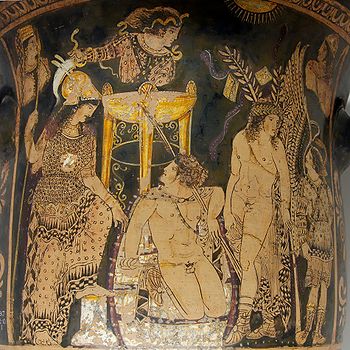
Maenad
In Greek mythology, maenads were the female followers of Dionysus , the most significant members of the Thiasus, the god's retinue. Their name literally translates as "raving ones"...
s, Silenos, Orestes
Orestes
Orestes was the son of Agamemnon in Greek mythology; Orestes may also refer to:Drama*Orestes , by Euripides*Orestes, the character in Sophocles' tragedy Electra*Orestes, the character in Aeschylus' trilogy of tragedies, Oresteia...
, Electra
Electra
In Greek mythology, Electra was an Argive princess and daughter of King Agamemnon and Queen Clytemnestra. She and her brother Orestes plotted revenge against their mother Clytemnestra and stepfather Aegisthus for the murder of their father Agamemnon...
, the gods Aphrodite
Aphrodite
Aphrodite is the Greek goddess of love, beauty, pleasure, and procreation.Her Roman equivalent is the goddess .Historically, her cult in Greece was imported from, or influenced by, the cult of Astarte in Phoenicia....
and Eros
Eros
Eros , in Greek mythology, was the Greek god of love. His Roman counterpart was Cupid . Some myths make him a primordial god, while in other myths, he is the son of Aphrodite....
, Apollo
Apollo
Apollo is one of the most important and complex of the Olympian deities in Greek and Roman mythology...
, Athena
Athena
In Greek mythology, Athena, Athenê, or Athene , also referred to as Pallas Athena/Athene , is the goddess of wisdom, courage, inspiration, civilization, warfare, strength, strategy, the arts, crafts, justice, and skill. Minerva, Athena's Roman incarnation, embodies similar attributes. Athena is...
and Hermes
Hermes
Hermes is the great messenger of the gods in Greek mythology and a guide to the Underworld. Hermes was born on Mount Kyllini in Arcadia. An Olympian god, he is also the patron of boundaries and of the travelers who cross them, of shepherds and cowherds, of the cunning of thieves, of orators and...
. Paestan painting rarely depicts domestic scenes, but favours animals. Asteas and Python had a major influence on the vase painting of Paestum. This is clearly visible in the work of the Aphrodite Painter, who probably immigrated from Apulia. Around 330 BC, a second workshop developed, originally following the work of the first. The quality of its painting and variety of its motifs deteriorated quickly. At the same time, an influence by the Campanian Caivano Painter becomes notable, garments falling in a linear fashion and contourless female figures followed. Around 300 BC, Paestan vase painting came to a halt.
Sicily
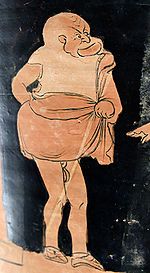
Sicily
Sicily is a region of Italy, and is the largest island in the Mediterranean Sea. Along with the surrounding minor islands, it constitutes an autonomous region of Italy, the Regione Autonoma Siciliana Sicily has a rich and unique culture, especially with regard to the arts, music, literature,...
vase painting began before the end of the 5th century BC, in the poleis
Polis
Polis , plural poleis , literally means city in Greek. It could also mean citizenship and body of citizens. In modern historiography "polis" is normally used to indicate the ancient Greek city-states, like Classical Athens and its contemporaries, so polis is often translated as "city-state."The...
of Himera
Himera
thumb|250px|Remains of the Temple of Victory.thumb|250px|Ideal reconstruction of the Temple of Victory.Himera , was an important ancient Greek city of Sicily, situated on the north coast of the island, at the mouth of the river of the same name , between Panormus and Cephaloedium...
and Syracusae. In terms of style, themes, ornamentation and vase shapes, the workshops were strongly influenced by the Attic tradition, especially by the Late Classical Meidias Painter
Meidias Painter
The Meidias Painter was an Athenian red-figure vase painter in Ancient Greece, active in the last quarter of the fifth century BCE . He is named after the potter whose signature is found on a large hydria of the Meidias Painter’s decoration , excavated from an Etruscan tomb...
. In the second quarter of the 4th century, Sicilian vase painters emigrated to Campania and Paestum, where they introduced red-figure vase painting. Only Syracusae retained a limited production.
The typical Sicilian style only developed around 340 BC. Three groups of workshops can be distinguished. The first, known as the Lentini-Manfria Group, was active in Syracusae and Gela
Gela
Gela is a town and comune in the province of Caltanissetta in the south of Sicily, Italy. The city is at about 84 kilometers distance from the city of Caltanissetta, on the Mediterranean Sea. The city has a larger population than the provincial capital, and ranks second in land area.Gela is an...
, a second, the Centuripe Style around Mt. Aetna
Aetna
Aetna, Inc. is an American health insurance company, providing a range of traditional and consumer directed health care insurance products and related services, including medical, pharmaceutical, dental, behavioral health, group life, long-term care, and disability plans, and medical management...
, and a third on Lipari
Lipari
Lipari is the largest of the Aeolian Islands in the Tyrrhenian Sea off the north coast of Sicily, and the name of the island's main town. It has a permanent population of 11,231; during the May–September tourist season, its population may reach up to 20,000....
. The most typical feature of Sicilian vase painting is the use of additional colours, especially white. In the early phase, large vessels like chalice kraters and hydriai were painted, but smaller vessels like flasks, lekanes, lekythoi and skyphoid pyxides are more typical. The most common motifs are scenes from female life, erotes
Eros
Eros , in Greek mythology, was the Greek god of love. His Roman counterpart was Cupid . Some myths make him a primordial god, while in other myths, he is the son of Aphrodite....
, female heads and phlyax scenes. Mythological scenes are rare. Like in all other areas, vase painting disappears from Sicily around 300 BC.
Etruria and other regions
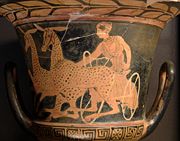
Boeotia
Boeotia, also spelled Beotia and Bœotia , is one of the regional units of Greece. It is part of the region of Central Greece. It was also a region of ancient Greece. Its capital is Livadeia, the second largest city being Thebes.-Geography:...
(Painter of the Great Athens Kantharos), Chalkidike, Elis
Elis
Elis, or Eleia is an ancient district that corresponds with the modern Elis peripheral unit...
, Eretria
Eretria
Erétria was a polis in Ancient Greece, located on the western coast of the island of Euboea, south of Chalcis, facing the coast of Attica across the narrow Euboean Gulf. Eretria was an important Greek polis in the 6th/5th century BC. However, it lost its importance already in antiquity...
, Corinth
Corinth
Corinth is a city and former municipality in Corinthia, Peloponnese, Greece. Since the 2011 local government reform it is part of the municipality Corinth, of which it is the seat and a municipal unit...
and Laconia
Laconia
Laconia , also known as Lacedaemonia, is one of the regional units of Greece. It is part of the region of Peloponnese. It is situated in the southeastern part of the Peloponnese peninsula. Its administrative capital is Sparti...
.
Only Etruria
Etruria
Etruria—usually referred to in Greek and Latin source texts as Tyrrhenia—was a region of Central Italy, an area that covered part of what now are Tuscany, Latium, Emilia-Romagna, and Umbria. A particularly noteworthy work dealing with Etruscan locations is D. H...
, one of the main export markets for Attic vases, developed its own schools and workshops, eventually exporting its own products. The adoption of red-figure painting, imitating Athenian vases, occurred only after 490 BC, half a century after the style had been developed. Because of the technique used, the earliest examples are known as pseudo-red-figure vase paintings. The true red-figure technique was introduced much later, near the end of the 5th century BC. Several painters, workshops and production centres are known for both styles. Their products were not only used locally, but also exported to Malta
Malta
Malta , officially known as the Republic of Malta , is a Southern European country consisting of an archipelago situated in the centre of the Mediterranean, south of Sicily, east of Tunisia and north of Libya, with Gibraltar to the west and Alexandria to the east.Malta covers just over in...
, Carthage
Carthage
Carthage , implying it was a 'new Tyre') is a major urban centre that has existed for nearly 3,000 years on the Gulf of Tunis, developing from a Phoenician colony of the 1st millennium BC...
, Rome
Ancient Rome
Ancient Rome was a thriving civilization that grew on the Italian Peninsula as early as the 8th century BC. Located along the Mediterranean Sea and centered on the city of Rome, it expanded to one of the largest empires in the ancient world....
and Liguria
Liguria
Liguria is a coastal region of north-western Italy, the third smallest of the Italian regions. Its capital is Genoa. It is a popular region with tourists for its beautiful beaches, picturesque little towns, and good food.-Geography:...
.
Pseudo-red-figure vase painting
The early Etrurian examples merely imitated the red-figure technique. Similar to a rare and early Attic technique (see Six's techniqueSix's technique
Six's technique was a technique used by Attic black-figure vase painters first described by the Dutch scholar Jan Six in 1888 It involves laying on figures in white or red on a black surface and incising the details so that the black shows through. It was in regular use for the decoration of the...
), the whole vessel was covered with black glossy clay and figures were applied afterwards using mineral colours that would oxidise red or white. Thus, in contrast to contemporary Attic vase painting, the red colour was not achieved by leaving areas unpainted but by adding paint to the black prime layer. Like in black-figure vases, internal detail was not painted on, but incised into the figures. Important representatives of this style include the Praxias Painter and other masters from his workshop in Vulci. In spite of their evident good knowledge of Greek myth and iconography, there is no evidence to indicate that these painters had immigrated from Attica. An exception to this may be the Praxia Painter, as Greek inscription on four of his vases may indicate that he originated from Greece.
In Etruria, the pseudo-red-figure style was not just a phenomenon of the earliest phases, as it had been in Attica. Especially during the 4th century, some workshops specialised in this technique, although true red-figure painting was widespread among Etrurian workshops at the same time. Notable workshops include the Sokra Group and the Phantom Group. The Sokra Group, somewhat older, preferred bowls with interior decoration of Greek mythical themes, but also some Etruscan motifs. The phantom Group mainly painted cloaked figures combined with vegetal or palmette ornamentation. The workshops of both groups are suspected to have been in Caere
Caere
Caere is the Latin name given by the Romans to one of the larger cities of Southern Etruria, the modern Cerveteri, approximately 50-60 kilometres north-northwest of Rome. To the Etruscans it was known as Cisra and to the Greeks as Agylla...
, Falerii
Falerii
Falerii was one of the twelve chief cities of Etruria, situated about 1.5 km west of the ancient Via Flaminia, around 50 kilometers north of Rome.- History :According to legend, it was of Argive origin...
and Tarquinia
Tarquinia
Tarquinia, formerly Corneto and in Antiquity Tarquinii, is an ancient city in the province of Viterbo, Lazio, Italy.- History :Tarquinii is said to have been already a flourishing city when Demaratus of Corinth brought in Greek workmen...
. The Phantom Group produced until the early 3rd century BC. Like elsewhere, the changing tastes of the customers eventually led to the end of this style.
Red-figure vase painting
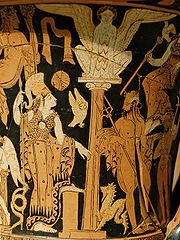
South Italian
South Italian is a designation for ancient Greek pottery fabricated in Magna Graecia largely during the 4th century BC. The fact that Greek Southern Italy produced its own red figure pottery as early as the end of the 5th century BC. was first established by Adolf Furtwaengler in 1893...
influence is evident, too. These workshops dominated the Etruscan market into the 4th century BC. Large and medium-sized vessels like kraters and jugs were decorated mostly with mythological scenes. In the course of the 4th century, the Falerian production began to eclipse that of Vulci. New centres of production developed in Chiusi
Chiusi
Chiusi is a town and comune in province of Siena, Tuscany, Italy.-History:It was one of the more powerful among the Etruscan 12‑city confederation...
and Orvieto
Orvieto
Orvieto is a city and comune in Province of Terni, southwestern Umbria, Italy situated on the flat summit of a large butte of volcanic tuff...
. Especially the Tondo Group of Chiusi, producing mainly drinking vessels with interior depictions of dionysiac scenes, became important. During the second half of the century, Volterra
Volterra
Volterra, known to the ancient Etruscans as Velathri, to the Romans as Volaterrae, is a town and comune in the Tuscany region of Italy.-History:...
became a main centre. Here, especially rod-handled kraters were produced and, especially in the early phases, painted elaborately.
During the 2nd half of the 4th century BC, mythological themes disappeared from the repertoire of Etruscan painters. They were replaced by female heads and scenes of up to two figures. Instead of figural depictions, ornaments and floral motifs covered the vessel bodies. Large figural compositions, like that on a krater by the Den Haag Funnel Group Painter were only produced exceptionally. The originally large-scale production at Falerii lost its dominant role to the production centre at Caere, which had probably been founded by Falerian painters and cannot be said to represent a distinct tradition. The standard repertoire of the Caere workshops included simply painted oinochoai, lekythoi and drinking bowls of the Torcop Group, and plates of the Genucuilia Group. The switch to the production of black glaze vases near the end of the 4th century, probably as a reaction to changing tastes of the time, spelt the end of Etrurian red-figure vase painting.
Research and Reception
About 65,000 red-figure vases and vase fragments are known to have survived. The study of ancient pottery and of Greek vase painting began already in the Middle AgesMiddle Ages
The Middle Ages is a periodization of European history from the 5th century to the 15th century. The Middle Ages follows the fall of the Western Roman Empire in 476 and precedes the Early Modern Era. It is the middle period of a three-period division of Western history: Classic, Medieval and Modern...
. Restoro d'Arezzo
Restoro d'Arezzo
Ristoro or Restoro d'Arezzo was an Italian monk of the thirteenth century, author of the Composizione del Mondo of c. 1282.This is the first astronomical work to be written in Italian...
dedicated a chapter (Capitolo de le vasa antiche) of his description of the world to ancient vases. He considered especially the clay vessels as perfect in terms of shape, colour, and artistic style. Nevertheless, initially the attention focused on vases in general, and perhaps especially on stone vases. The first collections of ancient vases, including some painted vessels, developed during the Renaissance
Renaissance
The Renaissance was a cultural movement that spanned roughly the 14th to the 17th century, beginning in Italy in the Late Middle Ages and later spreading to the rest of Europe. The term is also used more loosely to refer to the historical era, but since the changes of the Renaissance were not...
. We even know of some imports from Greece to Italy at that time. Still, until the end of the Baroque
Baroque
The Baroque is a period and the style that used exaggerated motion and clear, easily interpreted detail to produce drama, tension, exuberance, and grandeur in sculpture, painting, literature, dance, and music...
period, vase painting was overshadowed by other genres, especially by sculpture. A rare pre-Classicist exception is a book of watercolours depicting figural vases, which was produced for Nicolas-Claude Fabri de Peiresc
Nicolas-Claude Fabri de Peiresc
Nicolas-Claude Fabri de Peiresc was a French astronomer, antiquary and savant who maintained a wide correspondence with scientists and was a successful organizer of scientific inquiry...
. Like some of his contemporary collectors, Peiresc owned a number of clay vases.
Since the period of Classicism
Classicism
Classicism, in the arts, refers generally to a high regard for classical antiquity, as setting standards for taste which the classicists seek to emulate. The art of classicism typically seeks to be formal and restrained: of the Discobolus Sir Kenneth Clark observed, "if we object to his restraint...
, ceramic vessels were collected more frequently. For example, Sir William Hamilton and Giuseppe Valletta had vase collections. Vases found in Italy were relatively affordable, so that even private individuals could assemble important collections. Vases were a popular souvenir for young northwestern Europeans to bring home from the Grand Tour
Grand Tour
The Grand Tour was the traditional trip of Europe undertaken by mainly upper-class European young men of means. The custom flourished from about 1660 until the advent of large-scale rail transit in the 1840s, and was associated with a standard itinerary. It served as an educational rite of passage...
. In the diaries of his voyageto Italy, Goethe refers to the temptation of buying ancient vases. Those who could not afford originals had the option of acquiring copies or prints. There were even manufactories specialised in imitating ancient pottery. The best known is Wedgwood
Wedgwood
Wedgwood, strictly speaking Josiah Wedgwood and Sons, is a pottery firm owned by KPS Capital Partners, a private equity company based in New York City, USA. Wedgwood was founded on May 1, 1759 by Josiah Wedgwood and in 1987 merged with Waterford Crystal to create Waterford Wedgwood, an...
ware, although it employed techniques entirely unrelated to those used in antiquity, using ancient motifs merely as a thematic inspiration.
Since the 1760s, archaeological research also began to focus on vase paintings. The vases were appreciated as source material for all aspects of ancient life, especially for iconographical
Iconography
Iconography is the branch of art history which studies the identification, description, and the interpretation of the content of images. The word iconography literally means "image writing", and comes from the Greek "image" and "to write". A secondary meaning is the painting of icons in the...
and mythological
Greek mythology
Greek mythology is the body of myths and legends belonging to the ancient Greeks, concerning their gods and heroes, the nature of the world, and the origins and significance of their own cult and ritual practices. They were a part of religion in ancient Greece...
studies. Vase painting was now treated as a substitute for the almost entirely lost oeuvre of Greek monumental painting. Around this time, the widespread view that all painted vases were Etruscan works became untenable. Nonetheless, the artistic fashion of that time to imitate ancient vases came to be called all’etrusque. England and France tried to outdo each other in terms of both research and imitation of vases. The German aesthetic writers Johann Heinrich Müntz and Johann Joachim Winckelmann
Johann Joachim Winckelmann
Johann Joachim Winckelmann was a German art historian and archaeologist. He was a pioneering Hellenist who first articulated the difference between Greek, Greco-Roman and Roman art...
studied vase paintings. Winckelmann especially praised the Umrißlinienstil ("outline style", i.e. red-figure painting). Vase ornaments were compiled and disseminated in England through Pattern books.
Vase paintings even had an influence on the development of modern painting. The linear style influenced artists such as Edward Burne-Jones
Edward Burne-Jones
Sir Edward Coley Burne-Jones, 1st Baronet was a British artist and designer closely associated with the later phase of the Pre-Raphaelite movement, who worked closely with William Morris on a wide range of decorative arts as a founding partner in Morris, Marshall, Faulkner, and Company...
, Gustave Moreau
Gustave Moreau
Gustave Moreau was a French Symbolist painter whose main emphasis was the illustration of biblical and mythological figures. As a painter of literary ideas, Moreau appealed to the imaginations of some Symbolist writers and artists.- Biography :Moreau was born in Paris. His father, Louis Jean Marie...
or Gustav Klimt
Gustav Klimt
Gustav Klimt was an Austrian Symbolist painter and one of the most prominent members of the Vienna Secession movement. His major works include paintings, murals, sketches, and other art objects...
. Around 1840, Ferdinand Georg Waldmüller
Ferdinand Georg Waldmüller
Ferdinand Georg Waldmüller was an Austrian painter and writer.He briefly attended the Academy of Fine Arts Vienna, but later had to finance his life by painting portraits. In 1811 he worked as a teacher of arts for the children of Count Gyulay in Croatia...
painted a Still Life with Silver Vessels and Red-Figure Bell Krater. Henri Matisse
Henri Matisse
Henri Matisse was a French artist, known for his use of colour and his fluid and original draughtsmanship. He was a draughtsman, printmaker, and sculptor, but is known primarily as a painter...
produced a similar painting (Intérieur au vase étrusque). Their aesthetic influence extends into the present. For example, the well-known curved shape of the Coca Cola bottle is inspired by Greek vases.
The scientific study of Attic vase paintings was advanced especially by John D. Beazley
John Beazley
Sir John Davidson Beazley was an English classical scholar.Born in Glasgow, Scotland, Beazley attended Balliol College, Oxford, where he was a close friend of the poet James Elroy Flecker. After graduating in 1907, Beazley was a student and tutor in Classics at Christ Church, and in 1925 he...
. Beazley began to study the vases from about 1910 onwards, inspired by the methodology that the art historian Giovanni Morelli
Giovanni Morelli
Giovanni Morelli was an Italian art critic and political figure. As an art historian, he developed the "Morellian" technique of scholarship, identifying the characteristic "hands" of painters through scrutiny of diagnostic minor details that revealed artists' scarcely conscious shorthand and...
had developed for the study of paintings. He assumed that each painter produced individual works that can always be unmistakably ascribed. To do so, particular details, such as faces, fingers, arms, legs, knees, garment folds and so on, were compared. Beazley examined 65,000 vases and fragments (of which 20,000 were black-figure). In the course of six decades of study, he was able to ascribe 17,000 of them to individual artists. Where their names remained unknown, he developed a system of conventional names. Beazley also united and combined individual painters into groups, workshops, schools and styles. No other archaeologist has ever had as formative an influence on a whole subdiscipline as had Beazley on the study of Greek vase painting. A large proportion of his analysis is still considered valid today. Beazley first published his conclusions on red-figure vase painting in 1925 and 1942. His initial studies only considered material from before the 4th century BC. For a new edition of his work published in 1963, he also incorporated that later period, making use of the work of other scholars, such as Karl Schefold
Karl Schefold
Karl Schefold was a classical archaeologist based in Basel, Switzerland. Born and educated in Germany, he was forced in 1935 to emigrate to Switzerland, which he adopted as his home country...
, who had especially studied the Kerch Style
Kerch Style
.The Kerch style is an archaeological term describing vases from the final phase of Attic red-figure pottery production. Their exact chronology remains problematic, but they are generally assumed to have been produced roughly between 375 and 330/20 BC...
vases. Famous scholars who continued the study of Attic red-figure after Beazley include John Boardman
John Boardman
Jack Melton Boardman, commonly known as John Boardman, is an American former professor of physics at Brooklyn College.- Academic career :...
, Erika Simon
Erika Simon
Erika Simon is a German scholar of classical archaeology and professor emeritus of the University of Würzburg.-Selected writings:* 1968 Ara Pacis Augustae* 1983 Festivals of Attica: an Archaeological Commentary...
and Dietrich von Bothmer
Dietrich von Bothmer
Dietrich Felix von Bothmer was a German-born American art historian, who spent six decades as a curator at the Metropolitan Museum of Art, where he developed into the world's leading specialist in the field of ancient Greek vases.-Early life and education:...
.
For the study of South Italian
South Italian
South Italian is a designation for ancient Greek pottery fabricated in Magna Graecia largely during the 4th century BC. The fact that Greek Southern Italy produced its own red figure pottery as early as the end of the 5th century BC. was first established by Adolf Furtwaengler in 1893...
case painting, Arthur Dale Trendall
Arthur Dale Trendall
Arthur Dale Trendall AC CMG was a New Zealand-born Australian art historian and classical archaeologist whose work on identifying the work of individual artists on Greek ceramic vessels at Apulia and other sites earned him international prizes and a papal knighthood...
's work has a similar significance to that of Beazley for Attica. Most post-Beazley scholars can be said to follow Beazley's tradition and use his methodology. The study of Greek vases is ongoing, not least because of the constant addition of new material from archaeological excavations, illicit excavations and unknown private collections.
See also
- Pottery of Ancient GreecePottery of Ancient GreeceAs the result of its relative durability, pottery is a large part of the archaeological record of Ancient Greece, and because there is so much of it it has exerted a disproportionately large influence on our understanding of Greek society...
- Black-figure potteryBlack-figure potteryBlack-figure pottery painting, also known as the black-figure style or black-figure ceramic is one of the most modern styles for adorning antique Greek vases. It was especially common between the 7th and 5th centuries BC, although there are specimens dating as late as the 2nd century BC...
- Art in ancient GreeceArt in Ancient GreeceThe arts of ancient Greece have exercised an enormous influence on the culture of many countries all over the world, particularly in the areas of sculpture and architecture. In the West, the art of the Roman Empire was largely derived from Greek models...
- List of Greek Vase Painters
- Classical Greek art
- See also Liste der Formen, Typen und Varianten der antiken griechischen Fein- und Gebrauchskeramik in the German Wikipedia for a useful set of tables classifying vase shapes and variations, with distinguishing shape outlines and typical examples, also Typology of Greek vase shapesTypology of Greek Vase ShapesPottery in Greece has a long history and the form of Greek Vase Shapes has had a continuous evolution from the Minoan period down to the Hellenistic era...
.
Literature
- John D. BeazleyJohn BeazleySir John Davidson Beazley was an English classical scholar.Born in Glasgow, Scotland, Beazley attended Balliol College, Oxford, where he was a close friend of the poet James Elroy Flecker. After graduating in 1907, Beazley was a student and tutor in Classics at Christ Church, and in 1925 he...
: Attic red-figure vase-painters. 2nd ed. Oxford 1963. - John Boardman: Rotfigurige Vasen aus Athen. Die archaische Zeit. Ein Handbuch, von Zabern, Mainz 1981 (= 4. ed. 1994) (Kulturgeschichte der Antiken Welt, Vol 4), ISBN 3-8053-0234-7
- John Boardman: Rotfigurige Vasen aus Athen. Die klassische Zeit. Ein Handbuch. Mainz, Zabern 1991 (Kulturgeschichte der Antiken Welt, Vol 48), ISBN 3-8053-1262-8.
- Friederike Fless: Rotfigurige Keramik als Handelsware. Erwerb und Gebrauch attischer Vasen im mediterranen und pontischen Raum während des 4. Jhs. v. Chr., Leidorf, Rahden 2002 (Internationale Archäologie, Bd. 71) ISBN 3-89646-343-8
- Luca Giuliani: Tragik, Trauer und Trost. Bildervasen für eine apulische Totenfeier. Berlin, Staatliche Museen zu Berlin – Preußischer Kulturbesitz 1995. ISBN 3-88609-325-9
- Rolf Hurschmann: Apulische Vasen, in: DNPPauly-WissowaThe Realencyclopädie der Classischen Altertumswissenschaft, commonly called the Pauly–Wissowa or simply RE, is a German encyclopedia of classical scholarship. With its supplements it comprises over eighty volumes....
1 (1996), col. 922 f.; Kampanische Vasenmalerei, in: DNP 6 (1998), col. 227 f.; Lukanische Vasen, in: DNP 7 (1999), col. 491; Paestanische Vasen, in: DNP 9 (2000), col. 142/43; Sizilische Vasen, in: DNP 11 (2001), col. 606; Unteritalische Vasenmalerei, in: DNP 12/1 (2002), col. 1009-1011 - Thomas Mannack: Griechische Vasenmalerei. Wissenschaftliche Buchgesellschaft, Darmstadt 2002. (also Theiss, Stuttgart 2002 ISBN 3-8062-1743-2)
- Sabine Naumer: Vasen/Vasenmalerei, in DNP 15/3, col. 946-958
- John H. Oakley: Rotfigurige Vasenmalerei, in: DNP 10 (2001), col. 1141-43
- Christoph Reusser: Vasen für Etrurien: Verbreitung und Funktionen attischer Keramik im Etrurien des 6. und 5. Jahrhunderts vor Christus. Zürich 2002. ISBN 3-905083-17-5
- Ingeborg Scheibler: Griechische Töpferkunst. Herstellung, Handel und Gebrauch der antiken Tongefäße. 2nd ed., München 1995. ISBN 978-3-406-39307-5
- Ingeborg Scheibler: Vasenmaler, in: DNP 12/I (2002), col. 1147f.
- Erika SimonErika SimonErika Simon is a German scholar of classical archaeology and professor emeritus of the University of Würzburg.-Selected writings:* 1968 Ara Pacis Augustae* 1983 Festivals of Attica: an Archaeological Commentary...
, Max Hirmer: Die griechischen Vasen. 2nd updated ed. Hirmer, München 1981, ISBN 3-7774-3310-1. - Arthur Dale TrendallArthur Dale TrendallArthur Dale Trendall AC CMG was a New Zealand-born Australian art historian and classical archaeologist whose work on identifying the work of individual artists on Greek ceramic vessels at Apulia and other sites earned him international prizes and a papal knighthood...
: Rotfigurige Vasen aus Unteritalien und Sizilien. Ein Handbuch. von Zabern, Mainz 1991 (Kulturgeschichte der Antiken Welt, Vol. 47), ISBN 3-8053-1111-7