

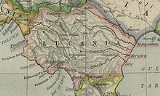
Lucania

Encyclopedia

Italy
Italy , officially the Italian Republic languages]] under the European Charter for Regional or Minority Languages. In each of these, Italy's official name is as follows:;;;;;;;;), is a unitary parliamentary republic in South-Central Europe. To the north it borders France, Switzerland, Austria and...
, extending from the Tyrrhenian Sea
Tyrrhenian Sea
The Tyrrhenian Sea is part of the Mediterranean Sea off the western coast of Italy.-Geography:The sea is bounded by Corsica and Sardinia , Tuscany, Lazio, Campania, Basilicata and Calabria and Sicily ....
to the Gulf of Taranto
Gulf of Taranto
The Gulf of Taranto is a gulf of the Ionian Sea, in southern Italy.The Gulf of Taranto is almost square, 140 km long and wide, and is delimited by the capes Santa Maria di Leuca and Colonna...
. To the north it adjoined Campania
Campania
Campania is a region in southern Italy. The region has a population of around 5.8 million people, making it the second-most-populous region of Italy; its total area of 13,590 km² makes it the most densely populated region in the country...
, Samnium
Samnium
Samnium is a Latin exonym for a region of south or south and central Italy in Roman times. The name survives in Italian today, but today's territory comprising it is only a small portion of what it once was. The populations of Samnium were called Samnites by the Romans...
and Apulia
Apulia
Apulia is a region in Southern Italy bordering the Adriatic Sea in the east, the Ionian Sea to the southeast, and the Strait of Òtranto and Gulf of Taranto in the south. Its most southern portion, known as Salento peninsula, forms a high heel on the "boot" of Italy. The region comprises , and...
, and to the south it was separated by a narrow isthmus
Isthmus
An isthmus is a narrow strip of land connecting two larger land areas usually with waterforms on either side.Canals are often built through isthmuses where they may be particularly advantageous to create a shortcut for marine transportation...
from the district of Bruttium. It thus comprised almost all the modern region of the Basilicata
Basilicata
Basilicata , also known as Lucania, is a region in the south of Italy, bordering on Campania to the west, Apulia to the north and east, and Calabria to the south, having one short southwestern coastline on the Tyrrhenian Sea between Campania in the northwest and Calabria in the southwest, and a...
, with the greater part of the province of Salerno
Salerno
Salerno is a city and comune in Campania and is the capital of the province of the same name. It is located on the Gulf of Salerno on the Tyrrhenian Sea....
(the so-called Cilento
Cilento
Cilento is an Italian geographical region of Campania in the central and southern part of the Province of Salerno and an important tourist area of southern Italy.-Geography:...
) and a portion of that of Cosenza
Cosenza
Cosenza is a city in southern Italy, located at the confluence of two historic rivers: the Busento and the Crathis. The municipal population is of around 70,000; the urban area, however, counts over 260,000 inhabitants...
. The precise limits were the river Silarus
Silarus
Silarus was the Latin name of two Italian rivers:*Silarus , today the Sele in Campania*Silarus , today the Sillaro, in Emilia-Romagna...
on the north-west, which separated it from Campania
Campania
Campania is a region in southern Italy. The region has a population of around 5.8 million people, making it the second-most-populous region of Italy; its total area of 13,590 km² makes it the most densely populated region in the country...
, and the Bradanus, which flows into the Gulf of Tarentum, on the north-east; while the two little rivers Laus
Lao River
The Lao is a river of southern Italy. It is a considerable stream, rising in the Lucanian Apennines in the province of Potenza, Basilicata region and falling into the Gulf of Policastro near Santa Maria del Cedro, province of Cosenza, Calabria region...
and Crathis
Crathis
The Crathis or Crater is a river in Calabria, southern Italy. It rises in the central the Sila Mountains, a few kilometers south of Cosenza, flows below the walls of that city, where it is joined by the smaller stream of the Busento, and has a course nearly due north through the center of the...
, flowing from the ridge of the Apennines
Apennine mountains
The Apennines or Apennine Mountains or Greek oros but just as often used alone as a noun. The ancient Greeks and Romans typically but not always used "mountain" in the singular to mean one or a range; thus, "the Apennine mountain" refers to the entire chain and is translated "the Apennine...
to the sea on the west and east, marked the limits of the district on the side of the Bruttii
Bruttii
The Bruttii , were an ancient Italic people who inhabited the southern extremity of Italy, from the frontiers of Lucania to the Sicilian Straits and the promontory of Leucopetra, roughly corresponding to modern Calabria.-History:...
.
Geography
Almost the whole is occupied by the ApenninesApennine mountains
The Apennines or Apennine Mountains or Greek oros but just as often used alone as a noun. The ancient Greeks and Romans typically but not always used "mountain" in the singular to mean one or a range; thus, "the Apennine mountain" refers to the entire chain and is translated "the Apennine...
, here an irregular group of lofty masses. The main ridge approaches the western sea
Sea
A sea generally refers to a large body of salt water, but the term is used in other contexts as well. Most commonly, it means a large expanse of saline water connected with an ocean, and is commonly used as a synonym for ocean...
, and is continued from the lofty knot of mountain
Mountain
Image:Himalaya_annotated.jpg|thumb|right|The Himalayan mountain range with Mount Everestrect 58 14 160 49 Chomo Lonzorect 200 28 335 52 Makalurect 378 24 566 45 Mount Everestrect 188 581 920 656 Tibetan Plateaurect 250 406 340 427 Rong River...
s on the frontiers of Samnium
Samnium
Samnium is a Latin exonym for a region of south or south and central Italy in Roman times. The name survives in Italian today, but today's territory comprising it is only a small portion of what it once was. The populations of Samnium were called Samnites by the Romans...
, nearly due south to within a few miles of the Gulf of Policastro, and thenceforward is separated from the sea by only a narrow interval until it enters the district of the Bruttii
Bruttii
The Bruttii , were an ancient Italic people who inhabited the southern extremity of Italy, from the frontiers of Lucania to the Sicilian Straits and the promontory of Leucopetra, roughly corresponding to modern Calabria.-History:...
. Just within the frontier of Lucania rises Monte Pollino, 7325 ft (2,232.7 m), the highest peak in the southern Apennines
Apennine mountains
The Apennines or Apennine Mountains or Greek oros but just as often used alone as a noun. The ancient Greeks and Romans typically but not always used "mountain" in the singular to mean one or a range; thus, "the Apennine mountain" refers to the entire chain and is translated "the Apennine...
. The mountains descend by a much more gradual slope to the coastal plain
Coastal plain
A coastal plain is an area of flat, low-lying land adjacent to a seacoast and separated from the interior by other features. One of the world's longest coastal plains is located in eastern South America. The southwestern coastal plain of North America is notable for its species diversity...
of the Gulf of Tarentum. Thus the rivers which flow to the Tyrrhenian Sea
Tyrrhenian Sea
The Tyrrhenian Sea is part of the Mediterranean Sea off the western coast of Italy.-Geography:The sea is bounded by Corsica and Sardinia , Tuscany, Lazio, Campania, Basilicata and Calabria and Sicily ....
are of little importance compared with those that descend towards the Gulf of Tarentum. Of these the most important are the Bradanus (Bradano
Bradano
The Bradano is an Italian river that flows southeast through Basilicata before emptying into the Gulf of Taranto. Its source is Lake Pesole in the province of Potenza. After crossing into the province of Matera, it is joined by a tributary. The Basentello and then the Bilioso join the Bradano...
), the Casuentus (Basento
Basento
The Basento is a river in southern Italy. It rises in the southern Apennine Mountains, west of Potenza. It flows into the Gulf of Taranto, which is part of the Ionian Sea, in Metaponto. The main city on the Basento is Potenza, the capital of Basilicata....
), the Aciris (Agri
Agri River
The Agri is a 136 km long river in southern Italy. It flows through the region of Basilicata and into the Ionian Sea, near Policoro. In ancient times it was known as Aciris ....
), and the Siris
Siris (Magna Graecia)
Siris was an ancient city of Magna Graecia , situated at the mouth of the river of the same name flowing into the Tarentine gulf, and now called the Sinni.-History:...
(Sinni). The Crathis
Crathis
The Crathis or Crater is a river in Calabria, southern Italy. It rises in the central the Sila Mountains, a few kilometers south of Cosenza, flows below the walls of that city, where it is joined by the smaller stream of the Busento, and has a course nearly due north through the center of the...
, which forms at its mouth the southern limit of the province, belongs almost wholly to the territory of the Bruttii
Bruttii
The Bruttii , were an ancient Italic people who inhabited the southern extremity of Italy, from the frontiers of Lucania to the Sicilian Straits and the promontory of Leucopetra, roughly corresponding to modern Calabria.-History:...
, but it receives a tributary, the Sybaris
Sybaris
Sybaris was an ancient city in Magna Graecia on the western shore of the Gulf of Taranto. The wealth of the city during the 6th century BC was so great that the Sybarites became synonymous with pleasure and luxury...
(Coscile), from the mountains of Lucania. The only considerable stream on the western side is the Silarus (Sele
Sele River
The Sele is a river in southwestern Italy. Originating from the Monti Picentini in Caposele , it flows through the region of Campania, in the provinces of Salerno and Avellino...
), which constitutes the northern boundary, and has two important tributaries in the Calor (Calore Lucano
Calore lucano
The Calore Lucano is a river in Campania,southern Italy, whose course is entirely included in the province of Salerno, within Cilento, for a total of about 63 kilometers...
or Calore Salernitano) and the Tanager (Tanagro
Tanagro
The Tanagro or Negro is a river in southwestern Italy. It rises in the Vallo di Diano and is a tributary of the Sele River. In ancient times it was known as Tanager....
or Negro) which joins it from the south.
Origin of the name
There are several hypotheses on the origin of the name Lucania, inhabited by LucaniLucani (ancient people)
The Lucani were an ancient people of Italy, living in Lucania, who spoke an Oscan language, a member of the Italic languages.-Society:...
, an Osco-Samnite population from central Italy
Central Italy
Central Italy is one of the five official statistical regions of Italy used by the National Institute of Statistics , a first level NUTS region and a European Parliament constituency...
. Lucania might be derived from Greek Leukos meaning "white", cognate of Latin Lux ("Light"). According to another hypothesis, Lucania might be derived from Latin word Lucus meaning "Sacred Wood
Sacred grove
A sacred grove is a grove of trees of special religious importance to a particular culture. Sacred groves were most prominent in the Ancient Near East and prehistoric Europe, but feature in various cultures throughout the world...
" (lucus = lux; or from verb lucere), or from Greek Lykos meaning "Wolf".
History
The district of Lucania was so called from the people bearing the name LucaniLucani (ancient people)
The Lucani were an ancient people of Italy, living in Lucania, who spoke an Oscan language, a member of the Italic languages.-Society:...
(Lucanians) by whom it was conquered about the middle of the 5th century BC. They were a Sabellic people. Before that period it was included under the general name of Oenotria, which was applied by the Greeks to the southernmost portion of Italy. The mountainous interior was occupied by the tribes known as Oenotrians
Oenotrians
The Oenotrians were an ancient Italic people of unknown origin who inhabited a territory from Paestum to southern Calabria in southern Italy...
and Choni
Choni
Choni may refer to:*Chone Monastery*Jonê Town*Jonê County*Honi HaM'agel*Xionites*An ancient people of the interior of Lucania is southern Italy...
, while the coasts on both sides were occupied by powerful Greek colonies which doubtless exercised a protectorate over the interior (see Magna Graecia
Magna Graecia
Magna Græcia is the name of the coastal areas of Southern Italy on the Tarentine Gulf that were extensively colonized by Greek settlers; particularly the Achaean colonies of Tarentum, Crotone, and Sybaris, but also, more loosely, the cities of Cumae and Neapolis to the north...
). The Lucanians were a southern branch of the Samnite
Samnium
Samnium is a Latin exonym for a region of south or south and central Italy in Roman times. The name survives in Italian today, but today's territory comprising it is only a small portion of what it once was. The populations of Samnium were called Samnites by the Romans...
or Sabellic race, who spoke the Oscan language. They had a democratic constitution save in time of war, when a dictator
Dictator
A dictator is a ruler who assumes sole and absolute power but without hereditary ascension such as an absolute monarch. When other states call the head of state of a particular state a dictator, that state is called a dictatorship...
was chosen from among the regular magistrates. A few Oscan inscriptions survive, mostly in Greek characters, from the 4th or 3rd century BC, and some coin
Coin
A coin is a piece of hard material that is standardized in weight, is produced in large quantities in order to facilitate trade, and primarily can be used as a legal tender token for commerce in the designated country, region, or territory....
s with Oscan legends of the 3rd century. The Lucanians gradually conquered the whole country (with the exception of the Greek towns on the coast) from the borders of Samnium
Samnium
Samnium is a Latin exonym for a region of south or south and central Italy in Roman times. The name survives in Italian today, but today's territory comprising it is only a small portion of what it once was. The populations of Samnium were called Samnites by the Romans...
and Campania
Campania
Campania is a region in southern Italy. The region has a population of around 5.8 million people, making it the second-most-populous region of Italy; its total area of 13,590 km² makes it the most densely populated region in the country...
to the southern extremity of Italy
Italy
Italy , officially the Italian Republic languages]] under the European Charter for Regional or Minority Languages. In each of these, Italy's official name is as follows:;;;;;;;;), is a unitary parliamentary republic in South-Central Europe. To the north it borders France, Switzerland, Austria and...
. Subsequently the inhabitants of the peninsula, now known as Calabria
Calabria
Calabria , in antiquity known as Bruttium, is a region in southern Italy, south of Naples, located at the "toe" of the Italian Peninsula. The capital city of Calabria is Catanzaro....
, broke into insurrection, and under the name of Bruttians established their independence, after which the Lucanians became confined within the limits already described. After this we find them engaged in hostilities with the Tarentines
Taranto
Taranto is a coastal city in Apulia, Southern Italy. It is the capital of the Province of Taranto and is an important commercial port as well as the main Italian naval base....
, and with Alexander
Alexander I of Epirus
Alexander I of Epirus , also known as Alexander Molossus , was a king of Epirus of the Aeacid dynasty. As the son of Neoptolemus I and brother of Olympias, he was an uncle of Alexander the Great...
, king of Epirus
Epirus
The name Epirus, from the Greek "Ήπειρος" meaning continent may refer to:-Geographical:* Epirus - a historical and geographical region of the southwestern Balkans, straddling modern Greece and Albania...
, who was called in by that people to their assistance, 334 BC. In 298 BC (Livy x. II seq.) they made alliance with Rome
Rome
Rome is the capital of Italy and the country's largest and most populated city and comune, with over 2.7 million residents in . The city is located in the central-western portion of the Italian Peninsula, on the Tiber River within the Lazio region of Italy.Rome's history spans two and a half...
, and Roman influence was extended by the colonies of Venusia (291 BC), Paestum
Paestum
Paestum is the classical Roman name of a major Graeco-Roman city in the Campania region of Italy. It is located in the north of Cilento, near the coast about 85 km SE of Naples in the province of Salerno, and belongs to the commune of Capaccio, officially also named...
(273), and above all Tarentum
Taranto
Taranto is a coastal city in Apulia, Southern Italy. It is the capital of the Province of Taranto and is an important commercial port as well as the main Italian naval base....
(272). Subsequently they were sometimes in alliance, but more frequently engaged in hostilities, during the Samnite wars
Samnite Wars
The First, Second, and Third Samnite Wars, between the early Roman Republic and the tribes of Samnium, extended over half a century, involving almost all the states of Italy, and ended in Roman domination of the Samnites...
. On the landing of Pyrrhus
Pyrrhus of Epirus
Pyrrhus or Pyrrhos was a Greek general and statesman of the Hellenistic era. He was king of the Greek tribe of Molossians, of the royal Aeacid house , and later he became king of Epirus and Macedon . He was one of the strongest opponents of early Rome...
in Italy (281 BC) they were among the first to declare in his favor, and found themselves exposed to the resentment of Rome when the departure of Pyrrhus left his allies at the mercy of the Romans. After several campaigns they were reduced to subjection (272 BC). Notwithstanding this they espoused the cause of Hannibal during the Second Punic War
Second Punic War
The Second Punic War, also referred to as The Hannibalic War and The War Against Hannibal, lasted from 218 to 201 BC and involved combatants in the western and eastern Mediterranean. This was the second major war between Carthage and the Roman Republic, with the participation of the Berbers on...
(216 BC), and their territory during several campaigns was ravaged by both armies. The country never recovered from these disasters, and under the Roman government fell into decay, to which the Social War
Social War
The Allied War was a war waged from 91 to 88 BC between the Roman Republic and several of the other cities in Italy, which prior to the war had been Roman allies for centuries.-Origins:The Early Italian campaigns saw the Roman conquest of Italy...
, in which the Lucanians took part with the Samnites against Rome
Rome
Rome is the capital of Italy and the country's largest and most populated city and comune, with over 2.7 million residents in . The city is located in the central-western portion of the Italian Peninsula, on the Tiber River within the Lazio region of Italy.Rome's history spans two and a half...
(90-88 BC) gave the finishing stroke. In the time of Strabo
Strabo
Strabo, also written Strabon was a Greek historian, geographer and philosopher.-Life:Strabo was born to an affluent family from Amaseia in Pontus , a city which he said was situated the approximate equivalent of 75 km from the Black Sea...
the Greek cities on the coast had fallen into insignificance, and owing to the decrease of population and cultivation the malaria began to obtain the upper hand. The few towns of the interior were of no importance. A large part of the province was given up to pasture, and the mountains were covered with forests, which abounded in wild boars, bears and wolves. There were some fifteen independent communities, but none of great importance.
For administrative purposes under the Roman empire
Roman Empire
The Roman Empire was the post-Republican period of the ancient Roman civilization, characterised by an autocratic form of government and large territorial holdings in Europe and around the Mediterranean....
, Lucania was always united with the district of the Bruttii, a practice continued by Theodoric
Theodoric the Great
Theodoric the Great was king of the Ostrogoths , ruler of Italy , regent of the Visigoths , and a viceroy of the Eastern Roman Empire...
. The two together constituted the third region of Augustus
Augustus
Augustus ;23 September 63 BC – 19 August AD 14) is considered the first emperor of the Roman Empire, which he ruled alone from 27 BC until his death in 14 AD.The dates of his rule are contemporary dates; Augustus lived under two calendars, the Roman Republican until 45 BC, and the Julian...
.
Cities and towns
The towns on the east coast were MetapontumMetapontum
Metapontum, Metapontium or Metapontion , was an important city of Magna Graecia, situated on the gulf of Tarentum, between the river Bradanus and the Casuentus . It was distant about 20 km from Heraclea and 40 from Tarentum...
, a few miles south of the Bradanus; Heraclea
Heraclea (Lucania)
Heraclea was an ancient city of Magna Graecia, situated in Lucania on the Gulf of Tarentum , but a short distance from the sea, and between the rivers Aciris and Siris , the site of which is located in the modern comune of Policoro, Province of Matera, Basilicata,...
, at the mouth of the Aciris; and Sins, on the river of the same name. Close to its southern frontier stood Sybaris
Sybaris
Sybaris was an ancient city in Magna Graecia on the western shore of the Gulf of Taranto. The wealth of the city during the 6th century BC was so great that the Sybarites became synonymous with pleasure and luxury...
, which was destroyed in 510 ac., but subsequently replaced by Thurii
Thurii
Thurii , called also by some Latin writers Thurium , for a time also Copia and Copiae, was a city of Magna Graecia, situated on the Tarentine gulf, within a short distance of the site of Sybaris, whose place it may be considered as having taken...
. On the west coast stood Posidonia
Posidonia
Posidonia is a genus of flowering plants. It contains two to nine species of marine plants , found in the seas of the Mediterranean and around the south coast of Australia....
, known under the Roman government as Paestum
Paestum
Paestum is the classical Roman name of a major Graeco-Roman city in the Campania region of Italy. It is located in the north of Cilento, near the coast about 85 km SE of Naples in the province of Salerno, and belongs to the commune of Capaccio, officially also named...
; below that came Elea
Elea
Elea may refer to:* Elea, ancient name of an Italian Greek colony, now known as Velia**Eleatics, school of pre-Socratic philosophers at Elea* Elea, Kyrenia, a settlement of Cyprus in Kyrenia District...
or Velia, Pyxus
Policastro Bussentino
Policastro Bussentino is an Italian hamlet , the greatest one in the municipality of Santa Marina in the province of Salerno, Campania region.-History:...
, called by the Romans Buxentum, and Laüs
Laüs
Laüs or Laus or Laos , was an ancient city on the west coast of Lucania, at the mouth of the river of the same name, which formed the boundary between Lucania and Bruttium; the site of Laüs is in the frazione of Marcellina in the comune of Santa Maria del Cedro, Province of Cosenza, Calabria...
, near the frontier of the province towards Bruttium. Of the towns of the interior the most considerable was Potentia, still called Potenza
Potenza
-Transportation:Potenza is a rail junction on the main line from Salerno to Taranto, managed by FS Trenitalia; it has also a connection to Altamura, served by the Ferrovie Appulo Lucane regional company...
. To the north, near the frontier of Apulia, was Bantia
Banzi
Banzi is a town and comune in the province of Potenza, in the Southern Italian region of Basilicata.Called Bantia in antiquity, it was the site of the find of the bronze tablet known as the Tabula Bantina, which contains an important fragment of the ancient Oscan language....
(Aceruntia
Acerenza
Acerenza is a town and comune in the province of Potenza, in the Southern Italian region of Basilicata.-History:With its strategic position 800 m above sea-level, Acerenza has been sacked by a series of invaders....
belonged more properly to Apulia); while due south from Potentia was Grumentum
Grumentum
Grumentum was an ancient town in the centre of Lucania, in what is now the comune of Grumento Nova, c. 50 km south of Potenza by the direct road through Anxia, and 80 km by the Via Herculia, at the point of divergence of a road eastward to Heraclea.-History:The first settlements, of the...
, and still farther in that direction were Nerulum and Muranum. In the upland valley of the Tanagrus were Atina
Atena Lucana
Atena Lucana is a town and comune in the province of Salerno in the Campania region of south-western Italy.-History:Atena Lucana is one of the most ancient settlements in the Vallo di Diano, as testified by the presence of prehistoric Megalithic walls. Later it was a Greek trading center, a...
, Forum Popilii and Consilinum (near Sala Consilina
Sala Consilina
Sala Consilina is a town and comune in the province of Salerno in the Campania region of south-western Italy. With 12,738 inhabitants it is the most populated town of Vallo di Diano.-History:...
); Eburi (Eboli
Eboli
Eboli is a town and comune of Campania, southern Italy, in the province of Salerno, on the south edge of the hills overlooking the valley of the Sele....
) and Volceii (Buccino
Buccino
Buccino is a town and comune in Campania in Italy, in the province of Salerno, located about 700 m above sea level.-History and main sights:In Roman times, the town was known as Volcei...
), though to the north of the Silarus
Sele River
The Sele is a river in southwestern Italy. Originating from the Monti Picentini in Caposele , it flows through the region of Campania, in the provinces of Salerno and Avellino...
, were also included in Lucania. The Via Popilia
Via Popilia
The Via Popilia is the name of two different ancient Roman roads begun in the consulship of Publius Popilius Laenas.The first road was an extension of the Via Flaminia from Ariminum around the north of the Adriatic through the region that later became Venice...
traversed the district from N. to S., entering it at the NW. extremity; the Via Herculia, coming southwards from the Via Appia and passing through Potentia and Grumentum, joined the Via Popilia
Via Popilia
The Via Popilia is the name of two different ancient Roman roads begun in the consulship of Publius Popilius Laenas.The first road was an extension of the Via Flaminia from Ariminum around the north of the Adriatic through the region that later became Venice...
near the S.W edge of the district: while another nameless road followed the east coast and other roads of less importance ran W. from Potentia to the Via Popilia
Via Popilia
The Via Popilia is the name of two different ancient Roman roads begun in the consulship of Publius Popilius Laenas.The first road was an extension of the Via Flaminia from Ariminum around the north of the Adriatic through the region that later became Venice...
, N.E. to the Via Appia and E. from Grumentum to the coast at Heraclea. (T. As.)