


Electra

Encyclopedia
In Greek mythology
, Electra was an Argive
princess and daughter of King Agamemnon
and Queen Clytemnestra
. She and her brother Orestes
plotted revenge against their mother Clytemnestra and stepfather Aegisthus for the murder of their father Agamemnon. Electra is the main character in the Greek tragedies
Electra
by Sophocles
and Electra
by Euripides
and has inspired various other works. The psychological concept of the Electra complex
is also named after her.
and Chrysothemis
, and her brother Orestes
. In the Iliad
, Homer
is understood to be referring to Electra in mentioning "Laodice" as a daughter of Agamemnon.
The daughter of Agamemnon should not be confused with her namesake the sea-nymph Electra
, the mother of the lesser goddess Iris
by the Sea-Titan Thaumas
.
when her father, King Agamemnon, returned from the Trojan War
to be murdered by Aegisthus
, Clytemnestra's lover, and/or by Clytemnestra herself. Clytemnestra had held a grudge against her husband Agamemnon for murdering their eldest daughter Iphigenia as sacrifice to Artemis
or Athena
(disputed). Aegisthus and Clytemnestra also killed Cassandra
, Agamemnon's war prize, a prophet priestess of Troy. Eight years later Electra was brought from Athens
with her brother, Orestes
. (Odyssey
, iii. 306; X. 542).
According to Pindar
(Pythia, xi. 25), Orestes was saved by his old nurse or by Electra, and was taken to Phanote on Mount Parnassus
, where King Strophius
took charge of him. In his twentieth year, Orestes was ordered by the Delphi
c oracle
to return home and avenge his father's death.
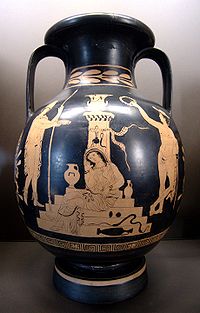
, Orestes saw Electra's face before the tomb of Agamemnon, where both had gone to perform rites to the dead; a recognition took place, and they arranged how Orestes should accomplish his revenge. Pylades
and Orestes killed Clytemnestra and Aegisthus (in some accounts with Electra helping).
Before her death, Clytemnestra curses Orestes and the Furies come to torment him. The furies tell him to end his life. He was pursued by the Erinyes
, or Furies, whose duty it is to punish any violation of the ties of family piety. Electra, however, was not hounded by the Erinyes. Orestes took refuge in the temple at Delphi
. When he went to the temple it is said a priestess found him first, covered in blood and with the furies flying all around him (Orestes). Afterward, they washed him with pig blood to purify him. Once purified he traveled to Athens to seek Athena.
At last Athena
(also known as Areia) received him on the Acropolis
of Athens and arranged a formal trial of the case before twelve Attic judges. The Erinyes demanded their victim; he pleaded the orders of Apollo; the votes of the judges were equally divided, and Athena gave her casting vote for acquittal.
In Iphigeneia in Tauris
, Euripides tells the tale somewhat differently. He claims that Orestes was led by the Furies to Tauris on the Black Sea, where his sister Iphigeneia
was being held. The two met when Orestes and Pylades were brought to Iphigeneia to be prepared for sacrifice to Artemis
. Iphigeneia, Orestes, and Pylades escaped from Tauris. The Furies, appeased by the reunion of the family, abated their persecution.
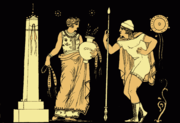
Greek mythology
Greek mythology is the body of myths and legends belonging to the ancient Greeks, concerning their gods and heroes, the nature of the world, and the origins and significance of their own cult and ritual practices. They were a part of religion in ancient Greece...
, Electra was an Argive
Argos
Argos is a city and a former municipality in Argolis, Peloponnese, Greece. Since the 2011 local government reform it is part of the municipality Argos-Mykines, of which it is a municipal unit. It is 11 kilometres from Nafplion, which was its historic harbour...
princess and daughter of King Agamemnon
Agamemnon
In Greek mythology, Agamemnon was the son of King Atreus and Queen Aerope of Mycenae, the brother of Menelaus, the husband of Clytemnestra, and the father of Electra and Orestes. Mythical legends make him the king of Mycenae or Argos, thought to be different names for the same area...
and Queen Clytemnestra
Clytemnestra
Clytemnestra or Clytaemnestra , in ancient Greek legend, was the wife of Agamemnon, king of the Ancient Greek kingdom of Mycenae or Argos. In the Oresteia by Aeschylus, she was a femme fatale who murdered her husband, Agamemnon – said by Euripides to be her second husband – and the Trojan princess...
. She and her brother Orestes
Orestes
Orestes was the son of Agamemnon in Greek mythology; Orestes may also refer to:Drama*Orestes , by Euripides*Orestes, the character in Sophocles' tragedy Electra*Orestes, the character in Aeschylus' trilogy of tragedies, Oresteia...
plotted revenge against their mother Clytemnestra and stepfather Aegisthus for the murder of their father Agamemnon. Electra is the main character in the Greek tragedies
Tragedy
Tragedy is a form of art based on human suffering that offers its audience pleasure. While most cultures have developed forms that provoke this paradoxical response, tragedy refers to a specific tradition of drama that has played a unique and important role historically in the self-definition of...
Electra
Electra (Sophocles)
Electra or Elektra is a Greek tragedy by Sophocles. Its date is not known, but various stylistic similarities with the Philoctetes and the Oedipus at Colonus lead scholars to suppose that it was written towards the end of Sophocles' career.Set in the city of Argos a few years after the Trojan...
by Sophocles
Sophocles
Sophocles is one of three ancient Greek tragedians whose plays have survived. His first plays were written later than those of Aeschylus, and earlier than or contemporary with those of Euripides...
and Electra
Electra (Euripides)
Euripides' Electra was a play probably written in the mid 410s BC, likely after 413 BC. It is unclear whether it was first produced before or after Sophocles' version of the Electra story.-Background:...
by Euripides
Euripides
Euripides was one of the three great tragedians of classical Athens, the other two being Aeschylus and Sophocles. Some ancient scholars attributed ninety-five plays to him but according to the Suda it was ninety-two at most...
and has inspired various other works. The psychological concept of the Electra complex
Electra complex
In Neo-Freudian psychology, the Electra complex, as proposed by Carl Gustav Jung, is a girl’s psychosexual competition with mother for possession of father. In the course of her psychosexual development, the complex is the girl’s phallic stage formation of a discrete sexual identity; a boy’s...
is also named after her.
Family
Electra's parents were King Agamemnon and Queen Clytemnestra. Her sisters were IphigeneiaIphigeneia
Iphigenia is a daughter of Agamemnon and Clytemnestra in Greek mythology. In Attic accounts, her name means "strong-born", "born to strength", or "she who causes the birth of strong offspring."-Post-Homeric Greek myth:...
and Chrysothemis
Chrysothemis
Chrysothemis or Khrysothemis , is a name ascribed to several characters in Greek mythology.Most prominently among these, Chrysothemis was a daughter of Agamemnon and Clytemnestra...
, and her brother Orestes
Orestes (mythology)
In Greek mythology, Orestes was the son of Clytemnestra and Agamemnon. He is the subject of several Ancient Greek plays and of various myths connected with his madness and purification, which retain obscure threads of much older ones....
. In the Iliad
Iliad
The Iliad is an epic poem in dactylic hexameters, traditionally attributed to Homer. Set during the Trojan War, the ten-year siege of the city of Troy by a coalition of Greek states, it tells of the battles and events during the weeks of a quarrel between King Agamemnon and the warrior Achilles...
, Homer
Homer
In the Western classical tradition Homer , is the author of the Iliad and the Odyssey, and is revered as the greatest ancient Greek epic poet. These epics lie at the beginning of the Western canon of literature, and have had an enormous influence on the history of literature.When he lived is...
is understood to be referring to Electra in mentioning "Laodice" as a daughter of Agamemnon.
The daughter of Agamemnon should not be confused with her namesake the sea-nymph Electra
Electra (Pleiad)
The Pleiad Electra of Greek mythology was one of the seven daughters of Atlas and Pleione. Electra was the wife of Corythus. She was raped by Zeus and gave birth to Dardanus, who became the founder of Troy, ancestor of Priam and his house. According to one legend, she was the lost Pleiad,...
, the mother of the lesser goddess Iris
Iris (mythology)
In Greek mythology, Iris is the personification of the rainbow and messenger of the gods. As the sun unites Earth and heaven, Iris links the gods to humanity...
by the Sea-Titan Thaumas
Thaumas
In Greek mythology, Thaumas was a sea god, son of Pontus and Gaia. He married an Oceanid, Electra . The children of Thaumas and Electra were the Harpies and Iris, the goddess of rainbows and a messenger of the gods; according to some, also Arke.Thaumas was also the name of a centaur...
.
The Murder of Agamemnon
Electra was absent from MycenaeMycenae
Mycenae is an archaeological site in Greece, located about 90 km south-west of Athens, in the north-eastern Peloponnese. Argos is 11 km to the south; Corinth, 48 km to the north...
when her father, King Agamemnon, returned from the Trojan War
Trojan War
In Greek mythology, the Trojan War was waged against the city of Troy by the Achaeans after Paris of Troy took Helen from her husband Menelaus, the king of Sparta. The war is among the most important events in Greek mythology and was narrated in many works of Greek literature, including the Iliad...
to be murdered by Aegisthus
Aegisthus
In Greek mythology, Aegisthus was the son of Thyestes and of Thyestes' daughter, Pelopia....
, Clytemnestra's lover, and/or by Clytemnestra herself. Clytemnestra had held a grudge against her husband Agamemnon for murdering their eldest daughter Iphigenia as sacrifice to Artemis
Artemis
Artemis was one of the most widely venerated of the Ancient Greek deities. Her Roman equivalent is Diana. Some scholars believe that the name and indeed the goddess herself was originally pre-Greek. Homer refers to her as Artemis Agrotera, Potnia Theron: "Artemis of the wildland, Mistress of Animals"...
or Athena
Athena
In Greek mythology, Athena, Athenê, or Athene , also referred to as Pallas Athena/Athene , is the goddess of wisdom, courage, inspiration, civilization, warfare, strength, strategy, the arts, crafts, justice, and skill. Minerva, Athena's Roman incarnation, embodies similar attributes. Athena is...
(disputed). Aegisthus and Clytemnestra also killed Cassandra
Cassandra
In Greek mythology, Cassandra was the daughter of King Priam and Queen Hecuba of Troy. Her beauty caused Apollo to grant her the gift of prophecy...
, Agamemnon's war prize, a prophet priestess of Troy. Eight years later Electra was brought from Athens
Athens
Athens , is the capital and largest city of Greece. Athens dominates the Attica region and is one of the world's oldest cities, as its recorded history spans around 3,400 years. Classical Athens was a powerful city-state...
with her brother, Orestes
Orestes
Orestes was the son of Agamemnon in Greek mythology; Orestes may also refer to:Drama*Orestes , by Euripides*Orestes, the character in Sophocles' tragedy Electra*Orestes, the character in Aeschylus' trilogy of tragedies, Oresteia...
. (Odyssey
Odyssey
The Odyssey is one of two major ancient Greek epic poems attributed to Homer. It is, in part, a sequel to the Iliad, the other work ascribed to Homer. The poem is fundamental to the modern Western canon, and is the second—the Iliad being the first—extant work of Western literature...
, iii. 306; X. 542).
According to Pindar
Pindar
Pindar , was an Ancient Greek lyric poet. Of the canonical nine lyric poets of ancient Greece, his work is the best preserved. Quintilian described him as "by far the greatest of the nine lyric poets, in virtue of his inspired magnificence, the beauty of his thoughts and figures, the rich...
(Pythia, xi. 25), Orestes was saved by his old nurse or by Electra, and was taken to Phanote on Mount Parnassus
Mount Parnassus
Mount Parnassus, also Parnassos , is a mountain of limestone in central Greece that towers above Delphi, north of the Gulf of Corinth, and offers scenic views of the surrounding olive groves and countryside. According to Greek mythology, this mountain was sacred to Apollo and the Corycian nymphs,...
, where King Strophius
Strophius
In Greek mythology, Strophius, son of Crisus, was a King of Phocis, husband of the sister of Agamemnon and by her father of Pylades and Astydameia. When Orestes was hiding from his murderous mother, Clytemnestra, Strophius hid him...
took charge of him. In his twentieth year, Orestes was ordered by the Delphi
Delphi
Delphi is both an archaeological site and a modern town in Greece on the south-western spur of Mount Parnassus in the valley of Phocis.In Greek mythology, Delphi was the site of the Delphic oracle, the most important oracle in the classical Greek world, and a major site for the worship of the god...
c oracle
Oracle
In Classical Antiquity, an oracle was a person or agency considered to be a source of wise counsel or prophetic predictions or precognition of the future, inspired by the gods. As such it is a form of divination....
to return home and avenge his father's death.
The Murder of Clytemnestra
According to AeschylusAeschylus
Aeschylus was the first of the three ancient Greek tragedians whose work has survived, the others being Sophocles and Euripides, and is often described as the father of tragedy. His name derives from the Greek word aiskhos , meaning "shame"...
, Orestes saw Electra's face before the tomb of Agamemnon, where both had gone to perform rites to the dead; a recognition took place, and they arranged how Orestes should accomplish his revenge. Pylades
Pylades
In Greek mythology, Pylades is the son of King Strophius of Phocis and of Anaxibia, daughter of Atreus and sister of Agamemnon and Menelaus. He is mostly known for his strong friendship with his cousin Orestes, son of Agamemnon.-Orestes and Pylades:...
and Orestes killed Clytemnestra and Aegisthus (in some accounts with Electra helping).
Before her death, Clytemnestra curses Orestes and the Furies come to torment him. The furies tell him to end his life. He was pursued by the Erinyes
Erinyes
In Greek mythology the Erinyes from Greek ἐρίνειν " pursue, persecute"--sometimes referred to as "infernal goddesses" -- were female chthonic deities of vengeance. A formulaic oath in the Iliad invokes them as "those who beneath the earth punish whosoever has sworn a false oath"...
, or Furies, whose duty it is to punish any violation of the ties of family piety. Electra, however, was not hounded by the Erinyes. Orestes took refuge in the temple at Delphi
Delphi
Delphi is both an archaeological site and a modern town in Greece on the south-western spur of Mount Parnassus in the valley of Phocis.In Greek mythology, Delphi was the site of the Delphic oracle, the most important oracle in the classical Greek world, and a major site for the worship of the god...
. When he went to the temple it is said a priestess found him first, covered in blood and with the furies flying all around him (Orestes). Afterward, they washed him with pig blood to purify him. Once purified he traveled to Athens to seek Athena.
At last Athena
Athena
In Greek mythology, Athena, Athenê, or Athene , also referred to as Pallas Athena/Athene , is the goddess of wisdom, courage, inspiration, civilization, warfare, strength, strategy, the arts, crafts, justice, and skill. Minerva, Athena's Roman incarnation, embodies similar attributes. Athena is...
(also known as Areia) received him on the Acropolis
Acropolis, Athens
Acropolis is a neighborhood of Athens, near the ancient monument of Acropolis, along the Dionysios Areopagitis, courier road. This neighborhood has a significant number of tourists all year round. It is the site of the Museum of Acropolis, opened in 2009....
of Athens and arranged a formal trial of the case before twelve Attic judges. The Erinyes demanded their victim; he pleaded the orders of Apollo; the votes of the judges were equally divided, and Athena gave her casting vote for acquittal.
In Iphigeneia in Tauris
Iphigeneia in Tauris
Iphigenia in Tauris is a drama by the playwright Euripides, written between 414 BC and 412 BC. It has much in common with another of Euripides's plays, Helen, and is often described as a romance, a melodrama or an escape play.-Background:...
, Euripides tells the tale somewhat differently. He claims that Orestes was led by the Furies to Tauris on the Black Sea, where his sister Iphigeneia
Iphigeneia
Iphigenia is a daughter of Agamemnon and Clytemnestra in Greek mythology. In Attic accounts, her name means "strong-born", "born to strength", or "she who causes the birth of strong offspring."-Post-Homeric Greek myth:...
was being held. The two met when Orestes and Pylades were brought to Iphigeneia to be prepared for sacrifice to Artemis
Artemis
Artemis was one of the most widely venerated of the Ancient Greek deities. Her Roman equivalent is Diana. Some scholars believe that the name and indeed the goddess herself was originally pre-Greek. Homer refers to her as Artemis Agrotera, Potnia Theron: "Artemis of the wildland, Mistress of Animals"...
. Iphigeneia, Orestes, and Pylades escaped from Tauris. The Furies, appeased by the reunion of the family, abated their persecution.
Plays
- The Oresteia, a trilogy of plays by AeschylusAeschylusAeschylus was the first of the three ancient Greek tragedians whose work has survived, the others being Sophocles and Euripides, and is often described as the father of tragedy. His name derives from the Greek word aiskhos , meaning "shame"...
- ElectraElectra (Sophocles)Electra or Elektra is a Greek tragedy by Sophocles. Its date is not known, but various stylistic similarities with the Philoctetes and the Oedipus at Colonus lead scholars to suppose that it was written towards the end of Sophocles' career.Set in the city of Argos a few years after the Trojan...
, play by SophoclesSophoclesSophocles is one of three ancient Greek tragedians whose plays have survived. His first plays were written later than those of Aeschylus, and earlier than or contemporary with those of Euripides... - ElectraElectra (Euripides)Euripides' Electra was a play probably written in the mid 410s BC, likely after 413 BC. It is unclear whether it was first produced before or after Sophocles' version of the Electra story.-Background:...
, play by EuripidesEuripidesEuripides was one of the three great tragedians of classical Athens, the other two being Aeschylus and Sophocles. Some ancient scholars attributed ninety-five plays to him but according to the Suda it was ninety-two at most... - Electra, a lost play by Quintus Tullius CiceroQuintus Tullius CiceroQuintus Tullius Cicero was the younger brother of the celebrated orator, philosopher and statesman Marcus Tullius Cicero. He was born into a family of the equestrian order, as the son of a wealthy landowner in Arpinum, some 100 kilometres south-east of Rome.- Biography :Cicero's well-to-do father...
of which nothing is known but the name and that it was "a tragedy in the Greek style" - ElectraElectra (Giraudoux)Electra is a two act play written in 1937 by French dramatist Jean Giraudoux. It was the first Giraudoux play to employ the staging of Louis Jouvet. Based on the classic myth of antiquity, Jean Giraudoux wrote perhaps his best play...
, play by Jean GiraudouxJean GiraudouxHippolyte Jean Giraudoux was a French novelist, essayist, diplomat and playwright. He is considered among the most important French dramatists of the period between World War I and World War II. His work is noted for its stylistic elegance and poetic fantasy... - Electra, drama by Danilo KišDanilo KišDanilo Kiš was a Yugoslavian novelist, short story writer and poet who wrote in Serbo-Croatian. Kiš was influenced by Bruno Schulz, Vladimir Nabokov, Jorge Luis Borges and Ivo Andrić, among other authors...
- The FliesThe FliesThe Flies is a play by Jean-Paul Sartre, written in 1943. It is an adaptation of the Electra myth, previously used by the Greek playwrights Sophocles, Aeschylus and Euripides....
, a play by Jean-Paul SartreJean-Paul SartreJean-Paul Charles Aymard Sartre was a French existentialist philosopher, playwright, novelist, screenwriter, political activist, biographer, and literary critic. He was one of the leading figures in 20th century French philosophy, particularly Marxism, and was one of the key figures in literary...
, modernizing the Electra myth around the theme of existentialismExistentialismExistentialism is a term applied to a school of 19th- and 20th-century philosophers who, despite profound doctrinal differences, shared the belief that philosophical thinking begins with the human subject—not merely the thinking subject, but the acting, feeling, living human individual...
. - Elektra, a play by Hugo von HofmannsthalHugo von HofmannsthalHugo Laurenz August Hofmann von Hofmannsthal ; , was an Austrian novelist, librettist, poet, dramatist, narrator, and essayist.-Early life:...
, based on the Sophocles play. - Mourning Becomes ElectraMourning Becomes ElectraMourning Becomes Electra is a play cycle written by American playwright Eugene O'Neill. The play premiered on Broadway at the Guild Theatre on 26 October 1931 where it ran for 150 performances before closing in March 1932...
, play by Eugene O'NeillEugene O'NeillEugene Gladstone O'Neill was an American playwright and Nobel laureate in Literature. His poetically titled plays were among the first to introduce into American drama techniques of realism earlier associated with Russian playwright Anton Chekhov, Norwegian playwright Henrik Ibsen, and Swedish...
, based on Aeschylus - ElectricidadElectricidadElectricidad is the second studio album by Mexican duo Jesse & Joy. The album was released 15 September 2009 and reached number twenty-one on the Mexican Albums Chart.-Background:...
, play by Luis AlfaroLuis AlfaroLuis Alfaro is a renowned Chicano performance artist, writer, theater director, and social activist. His plays and fiction are set in Los Angeles's Chicano barrios, including the Pico Union district, and often feature gay and lesbian and working-class themes. Many of Alfaro's plays also deal with...
, modern adaptation of Electra based in the Chicano barrio - Infamante Electra (2005) a play by Benjamín Galemiri
- Molora (2004) a play by Yael Farber
- Electra (1901) a play by Benito Pérez GaldósBenito Pérez GaldósBenito Pérez Galdós was a Spanish realist novelist. Considered second only to Cervantes in stature, he was the leading Spanish realist novelist....
- Electra, or The dropping of the masks (1954) a play by Marguerite YourcenarMarguerite YourcenarMarguerite Yourcenar was a Belgian-born French novelist and essayist. Winner of the Prix Femina and the Erasmus Prize, she was the first woman elected to the Académie française, in 1980, and the seventeenth person to occupy Seat 3.-Biography:Yourcenar was born Marguerite Antoinette Jeanne Marie...
- Elektra (2011) a Danish play by rap-group SuspektSuspektSuspekt is a Danish hip hop group. They are known for their dark, intense style, which has sometimes been described as horrorcore. The group consists of rappers Bai-D and Orgi-E , as well as producer Rune Rask. Former member Troo.L.S...
Opera
- ElektraElektra (opera)Elektra is a one-act opera by Richard Strauss, to a German-language libretto by Hugo von Hofmannsthal, which he adapted from his 1903 drama Elektra. The opera was the first of many collaborations between Strauss and Hofmannsthal...
, by Richard StraussRichard StraussRichard Georg Strauss was a leading German composer of the late Romantic and early modern eras. He is known for his operas, which include Der Rosenkavalier and Salome; his Lieder, especially his Four Last Songs; and his tone poems and orchestral works, such as Death and Transfiguration, Till...
, with libretto by Hugo von HofmannsthalHugo von HofmannsthalHugo Laurenz August Hofmann von Hofmannsthal ; , was an Austrian novelist, librettist, poet, dramatist, narrator, and essayist.-Early life:...
, based on his own play - Elektra, by Mikis TheodorakisMikis TheodorakisMikis Theodorakis is one of the most renowned Greek songwriters and composers. Internationally, he is probably best known for his songs and for his scores for the films Zorba the Greek , Z , and Serpico .Politically, he identified with the left until the late 1980s; in 1989, he ran as an...
- Mourning Becomes ElectraMourning Becomes ElectraMourning Becomes Electra is a play cycle written by American playwright Eugene O'Neill. The play premiered on Broadway at the Guild Theatre on 26 October 1931 where it ran for 150 performances before closing in March 1932...
, by Marvin David Levy, based on Eugene O'NeillEugene O'NeillEugene Gladstone O'Neill was an American playwright and Nobel laureate in Literature. His poetically titled plays were among the first to introduce into American drama techniques of realism earlier associated with Russian playwright Anton Chekhov, Norwegian playwright Henrik Ibsen, and Swedish...
's play - IdomeneoIdomeneoIdomeneo, re di Creta ossia Ilia e Idamante is an Italian language opera by Wolfgang Amadeus Mozart. The libretto was adapted by Giambattista Varesco from a French text by Antoine Danchet, which had been set to music by André Campra as Idoménée in 1712...
, by Wolfgang Amadeus MozartWolfgang Amadeus MozartWolfgang Amadeus Mozart , baptismal name Johannes Chrysostomus Wolfgangus Theophilus Mozart , was a prolific and influential composer of the Classical era. He composed over 600 works, many acknowledged as pinnacles of symphonic, concertante, chamber, piano, operatic, and choral music...
, where she plays the role of rejected lover/villain. - Electra, opera by Johann Christian Friedrich Haeffner, Libretto by Adolf Fredrik Ristell after Nicolas Francois Guillard. First performed on 22 July 1787 at DrottningholmDrottningholmDrottningholm, literally "Queen's Islet", is a locality situated in Ekerö Municipality, Stockholm County, Sweden, with 410 inhabitants in 2005....
.
Films
- Electra, a film by Michael Cacoyannis, starring Irene PapasIrene PapasIrene Papas is a Greek actress and occasional singer, who has starred in over seventy films in a career spanning more than fifty years.-Life:...
, based on Euripides. - Ellie, a film which transfers the story to a Southern U.S. locale.
- Szerelmem, Elektra (Elektra, My Love), film by Miklós JancsóMiklós JancsóMiklós Jancsó is a Hungarian film director and screenwriter.Jancsó achieved international prominence from the mid-1960s onwards, with works including The Round Up , The Red and the White and Red Psalm .Jancsó's films are characterized by visual stylization,...
, starring Mari TörőcsikMari TöröcsikMari Törőcsik is a Hungarian film actress. She has appeared in over 120 films since 1956. She won the award for Best Actress at the 1976 Cannes Film Festival for the film Mrs...
. - Filha da Mãe, and Mal Nascida, both by Portuguese film director João CanijoJoão CanijoJoão Canijo is a Portuguese film director. His film Get a Life was screened in the Un Certain Regard section at the 2001 Cannes Film Festival.-Filmography:* Três Menos Eu * Lovely Child/ Filha da Mãe João Canijo (born 1957) is a Portuguese film director. His film Get a Life was screened in the Un...
. - elektraZenSuite, medium-length film by Alessandro Brucini, based on texts by Aeschylus, Sophocles, William Shakespeare, Hugo von Hofmannsthal, Sylvia Plath, and the Zen Buddhist monk Takuan Soho.
- ElectraElektra (2010 film)Elektra is a 2010 Malayalam psychological drama film co-written and directed by Shyamaprasad, starring Nayantara, Manisha Koirala, Prakash Raj, Biju Menon and Skanda Ashok. It was produced by N. B...
, film by ShyamaprasadShyamaprasadShyamaprasad is an Indian film director. Directing highly acclaimed and complex films such as Agnisakshi, Akale, Ore Kadal and Elektra, he has won several state, national and international film awards.-Biography:...
, starring Nayanthara, Manisha KoiralaManisha KoiralaManisha B. Koirala is a Nepali-Indian actress who works in Indian films, as well as a UNFPA Goodwill Ambassador and social activist. Koirala has primarily worked in Hindi cinema, though she has appeared in several Tamil, Telugu and Malayalam films as well...
and Prakash RajPrakash RajPrakash Raj , better known by his stage name Prakash Raj, is a National Award winning actor, director and producer who has worked in Kannada, Tamil, Telugu, Hindi and Malayalam films. Though he was born in a Tulu family he achieved fame through Kannada, Tamil and Telugu films. He got introduced to...
, based on Euripides.
Music
- La tragédie d'Oreste et Électre, an album based on Sartre's The FliesThe FliesThe Flies is a play by Jean-Paul Sartre, written in 1943. It is an adaptation of the Electra myth, previously used by the Greek playwrights Sophocles, Aeschylus and Euripides....
by the British band CranesCranes (band)Cranes are a British music group formed in 1986, whose style has been described as "gothic minimalism".-History:Formed in 1986 in Portsmouth, England by siblings Alison and Jim Shaw, and named after the many mechanical cranes around the city's docks, Cranes are best known for the childlike,...
. - ElektraElektra (album)Elektra is the fourth studio album from Danish hip hop group Suspekt, released 12 september 2011. It is produced by Rune Rask and Jonas Vestergaard. The symphony orchestra Czech Film Orchestra is featured on Brænder Byen Ned , Helt Alene , Nyt Pas , and Parasitter...
, an album by the Danish rap-group SuspektSuspektSuspekt is a Danish hip hop group. They are known for their dark, intense style, which has sometimes been described as horrorcore. The group consists of rappers Bai-D and Orgi-E , as well as producer Rune Rask. Former member Troo.L.S... - Marina and the Diamonds uses the name Electra Heart as a story to portray part of the American dream with elements of Greek tragedy which will come out through the visuals of her sophomore album with the same name.
Literature
- In Dante AlighieriDante AlighieriDurante degli Alighieri, mononymously referred to as Dante , was an Italian poet, prose writer, literary theorist, moral philosopher, and political thinker. He is best known for the monumental epic poem La commedia, later named La divina commedia ...
's Divine Comedy poem InfernoInferno (Dante)Inferno is the first part of Dante Alighieri's 14th-century epic poem Divine Comedy. It is followed by Purgatorio and Paradiso. It is an allegory telling of the journey of Dante through what is largely the medieval concept of Hell, guided by the Roman poet Virgil. In the poem, Hell is depicted as...
, Electra is seen in Limbo.
Comics
- In the Marvel ComicsMarvel ComicsMarvel Worldwide, Inc., commonly referred to as Marvel Comics and formerly Marvel Publishing, Inc. and Marvel Comics Group, is an American company that publishes comic books and related media...
universe, the character Elektra NatchiosElektra (comics)Elektra Natchios, usually referred to only by her first name Elektra, is a fictional character in publications from Marvel Comics.Elektra is a kunoichi – female ninja assassin – of Greek descent. She wields a pair of bladed sai as her trademark weapon. She is a love interest of the superhero...
was distantly based on Electra; in the comics, Elektra becomes an assassin after witnessing her father's murder. When Elektra's backstory was revealed, her older brother's name was Orestez Natchios and they had a family dog named Agamemnon. Although two conflicting histories of Elektra were published, in the original story Orestez murdered their mother after her infidelities shamed their father.
Games
- Electra is a character in the game Dante's InfernoDante's Inferno (video game)Dante's Inferno is a 2010 action-adventure video game developed by Visceral Games and published by Electronic Arts for the Xbox 360 and PlayStation 3 consoles. The game was also released on the PlayStation Portable and was developed by Artificial Mind and Movement...
, in which the player can choose either to punish or absolve her when she is encountered in Limbo.
- Electra is a universe in the game OGameOGameOGame is a text-based, resource-management and space-war themed massively multiplayer online browser game with over two million accounts. OGame was created in 2000 and is produced and maintained by Bioware.. OGame is available in multiple languages, and different nationalities have their own...