

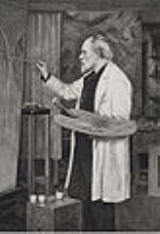
Edward Burne-Jones

Encyclopedia
Sir Edward Coley Burne-Jones, 1st Baronet (28 August 1833 – 17 June 1898) was a British
artist and designer
closely associated with the later phase of the Pre-Raphaelite movement
, who worked closely with William Morris
on a wide range of decorative arts as a founding partner in Morris, Marshall, Faulkner, and Company
. Burne-Jones was closely involved in the rejuvenation of the tradition of stained glass
art in England; his stained glass works include the windows of St. Philip's Cathedral, Birmingham, St Martin's Church
in Brampton
, Cumbria
, the church designed by Philip Webb
, All Saints, Jesus Lane
, Cambridge
and in Christ Church, Oxford
.
Burne-Jones's early paintings show the heavy inspiration of Dante Gabriel Rossetti
, but by the 1860s Burne-Jones was discovering his own artistic "voice". In 1877, he was persuaded to show eight oil paintings at the Grosvenor Gallery
(a new rival to the Royal Academy
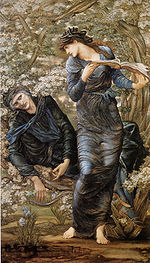
). These included The Beguiling of Merlin
. The timing was right, and he was taken up as a herald and star of the new Aesthetic Movement.
In addition to painting and stained glass, Burne-Jones worked in a variety of crafts; including designing ceramic
tile
s, jewellery
, tapestries, mosaics and book illustration, most famously designing woodcuts for the Kelmscott Press's Chaucer in 1896.
, the son of a Welshman, Edward Richard Jones, a frame-maker at Bennetts Hill
, where a blue plaque
commemorates the painter's childhood. His mother Elizabeth Coley Jones died within six days of his birth, and he was raised by his grieving father and the family housekeeper, Ann Sampson, an obsessively affectionate but humorless and unintellectual local girl. He attended Birmingham's King Edward VI grammar school
from 1844 and the Birmingham School of Art
from 1848 to 1852, before studying theology
at Exeter College
, Oxford. At Oxford he became a friend of William Morris
as a consequence of a mutual interest in poetry. The two Exeter undergraduates, together with a small group of Jones' friends from Birmingham known as the Birmingham Set
, speedily formed a very close and intimate society, which they called "The Brotherhood". The members of the Brotherhood read John Ruskin
and Tennyson, visited churches, and worshipped the Middle Ages
. At this time Burne-Jones discovered Thomas Malory
's Le Morte d'Arthur
which was to be so influential in his life. At that time neither Burne-Jones nor Morris knew Rossetti personally, but both were much influenced by his works, and met him by recruiting him as a contributor to their Oxford and Cambridge Magazine which Morris founded in 1856 to promote their ideas.
Burne-Jones had intended to become a church minister, but under Rossetti's influence both he and Morris decided to become artists, and Burne-Jones left college before taking a degree to pursue a career in art. In February 1857, Rossetti wrote to William Bell Scott
Burne-Jones' early work was heavily influenced by his mentor Rossetti, but he later developed his own style influenced by his travels in Italy with Ruskin and others.
. She was training to be a painter
, and was the sister of Burne-Jones's old school friend. The couple married in 1860, after which she made her own work in woodcut
s and became a close friend of George Eliot
. (Another MacDonald sister married the artist Sir Edward Poynter
, a further sister married the ironmaster Alfred Baldwin and was the mother of the Prime Minister Stanley Baldwin
, and yet another sister was the mother of Rudyard Kipling
. Kipling and Baldwin were thus Burne-Jones's nephews).
Georgiana bore a son, Philip
, in 1861. A second son, born in the winter of 1864 while Georgiana was gravely ill with scarlet fever, died soon after birth. The family soon moved to 41 Kensington Square, and their daughter Margaret was born there in 1866.
In 1867 Burne-Jones and his family settled at the Grange, an 18th-century house set in a large garden in North End Road, Fulham
, London. For much of the 1870s Burne-Jones did not exhibit, following a spate of bitterly hostile attacks in the press, and a passionate affair (described as the "emotional climax of his life") with his Greek model Maria Zambaco
which ended with her trying to commit suicide
by throwing herself in Regent's Canal
. During these difficult years Georgiana developed a close friendship with Morris, whose wife Jane had fallen in love with Rossetti. Morris and Georgie may have been in love, but if he asked her to leave her husband, she refused. In the end, the Burne-Joneses remained together, as did the Morrises, but Morris and Georgiana were close for the rest of their lives.
In 1880 the Burne-Joneses bought Prospect House in Rottingdean
, near Brighton
in Sussex, as their holiday home, and soon after the next door Aubrey Cottage to create North End House, reflecting the fact that their Fulham home was in North End Road. (Years later, in 1923, Sir Roderick Jones, head of Reuters
, and his wife, playwright and novelist Enid Bagnold
, were to add the adjacent Gothic House to the property and which became the inspiration and setting for her play The Chalk Garden
).
His troubled son Philip became a successful portrait painter and died in 1926. His adored daughter Margaret (died 1953) married John William Mackail
(1850–1945), the friend and biographer of Morris, and Professor of Poetry at Oxford from 1911–1916. Their children were the novelists Angela Thirkell
and Denis Mackail
.
, exquisitely finished, of which 1856's Waxen Image is one of the earliest and best examples. Although subject, medium and manner derive from Rossetti's inspiration, it is not the hand of a pupil merely, but of a potential master. This was recognized by Rossetti himself, who before long avowed that he had nothing more to teach him. Burne-Jones's first sketch in oils dates from this same year, 1856; and during 1857 he made for Bradfield College
the first of what was to be an immense series of cartoons for stained glass. In 1858 he decorated a cabinet with the Prioress's Tale from Geoffrey Chaucer
's Canterbury Tales, his first direct illustration of the work of a poet whom he especially loved and who inspired him with endless subjects. Thus early, therefore, we see the artist busy in all the various fields in which he was to labour.
In the autumn of 1857 Burne-Jones joined Morris, Valentine Prinsep, J. R. Spencer Stanhope
and others in Rossetti's ill-fated scheme to decorate the walls of the Oxford Union
. None of the painters had mastered the technique of fresco
, and their pictures had begun to peel from the walls before they were completed. In 1859 Burne-Jones made his first journey to Italy. He saw Florence
, Pisa
, Siena
, Venice
and other places, and appears to have found the gentle and romantic Sienese more attractive than any other school. Rossetti's influence still persisted, and is visible, more strongly perhaps than ever before, in the two watercolours
of 1860, Sidonia von Bork and Clara von Bork. Both paintings illustrate the 1849 gothic novel Sidonia the Sorceress by Lady Wilde
, a translation of Sidonia Von Bork: Die Klosterhexe (1847) by Johann Wilhelm Meinhold.

In 1861, William Morris founded the decorative arts firm of Morris, Marshall, Faulkner & Co. with Rossetti, Burne-Jones, Ford Madox Brown
and Philip Webb as partners, together with Charles Faulkner
and Peter Paul Marshall
, the former of whom was a member of the Oxford Brotherhood, and the latter a friend of Brown and Rossetti. The prospectus set forth that the firm would undertake carving, stained glass
, metal-work, paper-hangings, chintz
es (printed fabrics), and carpet
s. The decoration of churches was from the first an important part of the business. The work shown by the firm at the 1862 International Exhibition
attracted much notice, and within a few years it was flourishing. Two significant secular commissions helped establish the firm's reputation in the late 1860s: a royal project at St. James's Palace
and the "green dining room" at the South Kensington Museum (now the Victoria and Albert
) of 1867 which featured stained glass windows and panel figures by Burne-Jones.
In 1871 Morris & Co. were responsible for the windows at All Saints
, designed by Burne-Jones for Alfred Baldwin, his wife's brother-in-law. The firm was reorganized as Morris & Co. in 1875, and Burne-Jones continued to contribute designs for stained glass, and later tapestries until the end of his career.
Stained glass windows in the Christ Church
cathedral and other buildings in Oxford
are by William Morris & Co. with designs by Burne-Jones Stanmore Hall was the last major decorating commission executed by Morris & Co. before Morris's death in 1896. It was also the most extensive commission undertaken by the firm, and included a series of tapestries based on the story of the Holy Grail
for the dining room, with figures by Burne-Jones.
 In 1864 Burne-Jones was elected an associate of the Society of Painters in Water-Colours
(also known as the Old Water-Colour Society), and exhibited, among other works, The Merciful Knight, the first picture which fully revealed his ripened personality as an artist. The next six years saw a series of fine watercolours at the same gallery.
In 1866 Mrs Cassavetti commissioned Burne-Jones to paint her daughter, Maria Zambaco, in Cupid finding Psyche, an introduction which led to their tragic affair. In 1870, Burne-Jones resigned his membership following a controversy over his painting Phyllis and Demophoön. The features of Maria Zambaco were clearly recognizable in the barely draped Phyllis (as they are in several of Burne-Jones's finest works), and the undraped nakedness of Demophoön coupled with the suggestion of female sexual assertiveness offended Victorian
sensibilities. Burne-Jones was asked to make a slight alteration, but instead "withdrew not only the picture from the walls, but himself from the Society."
During the next seven years, 1870–1877, only two works of the painter's were exhibited. These were two water-colours, shown at the Dudley Gallery in 1873, one of them being the beautiful Love among the Ruins, destroyed twenty years later by a cleaner who supposed it to be an oil painting, but afterwards reproduced in oils by the painter. This silent period was, however, one of unremitting production. Hitherto Burne-Jones had worked almost entirely in water-colours. He now began a number of large pictures in oils, working at them in turn, and having always several on hand. The first Briar Rose series, Laus Veneris, the Golden Stairs, the Pygmalion series, and The Mirror of Venus are among the works planned and completed, or carried far towards completion, during these years. These years also mark the beginnings of Burne-Jones's partnership with the fine-art photographer Frederick Hollyer
, whose reproductions of paintings and—especially—drawings would expose a wider audience to Burne-Jones's works in the coming decades.
 At last, in May 1877, the day of recognition came, with the opening of the first exhibition of the Grosvenor Gallery
, when the Days of Creation, The Beguiling of Merlin
, and the Mirror of Venus were all shown. Burne-Jones followed up the signal success of these pictures with Laus Veneris, the Chant d'Amour, Pan and Psyche, and other works, exhibited in 1878. Most of these pictures are painted in brilliant colours. A change is noticeable next year, 1879, in the Annunciation and in the four pictures making up the second series of Pygmalion and the Image; the former of these, one of the simplest and most perfect of the artist's works, is subdued and sober; in the latter a scheme of soft and delicate tints was attempted, not with entire success. A similar temperance of colours marks The Golden Stairs, first exhibited in 1880. The almost sombre Wheel of Fortune was shown in 1883, followed in 1884 by King Cophetua and the Beggar Maid, in which Burne-Jones once more indulged his love of gorgeous colour, refined by the period of self-restraint. He next turned to two important sets of pictures, The Briar Rose and The Story of Perseus, though these were not completed for some years to come.
Burne-Jones was elected an Associate of the Royal Academy
in 1885, and the following year he exhibited (for the only time) at the Academy, showing The Depths of the Sea, a painting of a mermaid carrying down with her a youth whom she has unconsciously drowned in the impetuosity of her love. This picture adds to the habitual haunting charm a tragic irony of conception and a felicity of execution which give it a place apart among Burne-Jones's works. He formally resigned his Associateship in 1893. One of the Perseus series was exhibited in 1887, two more in 1888, with The Brazen Tower, inspired by the same legend. In 1890 the second series of The Legend of Briar Rose
were exhibited by themselves, and won the widest admiration. The huge tempera picture, The Star of Bethlehem
, painted for the corporation of Birmingham, was exhibited in 1891. A long illness for some time checked the painter's activity, which, when resumed, was much occupied with decorative schemes. An exhibition of his work was held at the New Gallery
in the winter of 1892-1893. To this period belong several of his comparatively few portraits. In 1894 Burne-Jones was made a baronet. Ill-health again interrupted the progress of his works, chief among which was the vast Arthur in Avalon
. In the winter following his death a second exhibition of his works was held at the New Gallery, and an exhibition of his drawings (including some of the charmingly humorous sketches made for children) at the Burlington Fine Arts Club
.
commissioned Burne-Jones to design sets and costumes for the Lyceum Theatre production of King Arthur by J. Comyns Carr
, who was Burne-Jones's patron and the director of the New Gallery as well as a playwright. The play starred Irving as King Arthur and Ellen Terry
as Guinevere
, and toured America following its London run.
Burne-Jones accepted the commission with some enthuisiasm, but was disapppointed with much of the final result. He wrote confidentially to his friend Helen Mary Gaskell (known as May), "The armour is good—they have taken pains with it ... Perceval looked the one romantic thing in it ... I hate the stage, don't tell—but I do—don't tell but I do don't tell..."
from the 1860s through the 1880s, which considered that art should be valued as an object of beauty engendering a sensual response, rather than for the story or moral implicit in the subject matter. In many ways this was antithetical to the ideals of Ruskin and the early Pre-Raphaelites.
Burne-Jones's aim in art is best given in some of his own words, written to a friend:
No artist was ever more true to his aim. Ideals resolutely pursued are apt to provoke the resentment of the world, and Burne-Jones encountered, endured and conquered an extraordinary amount of angry criticism. Insofar as this was directed against the lack of realism in his pictures, it was beside the point. The earth, the sky, the rocks, the trees, the men and women of Burne-Jones are not those of this world; but they are themselves a world, consistent with itself, and having therefore its own reality. Charged with the beauty and with the strangeness of dreams, it has nothing of a dream's incoherence. Yet it is a dreamer always whose nature penetrates these works, a nature out of sympathy with struggle and strenuous action. Burne-Jones's men and women are dreamers too. It was this which, more than anything else, estranged him from the age into which he was born. But he had an inbred "revolt from fact" which would have estranged him from the actualities of any age. That criticism seems to be more justified which has found in him a lack of such victorious energy and mastery over his materials as would have enabled him to carry out his conceptions in their original intensity. Yet Burne-Jones was singularly strenuous in production. His industry was inexhaustible, and needed to be, if it was to keep pace with the constant pressure of his ideas. Whatever faults his paintings may have, they have always the fundamental virtue of design; they are always pictures. His designs were informed with a mind of romantic temper, apt in the discovery of beautiful subjects, and impassioned with a delight in pure and variegated colour.
, and was made an Honorary Fellow in 1882. In 1885 he became the President of the Birmingham Society of Artists. At about that time he began hyphenating his name, merely—as he wrote later—to avoid "annihilation" in the mass of Joneses. In November 1893, he was approached to see if he would accept a Baronetcy on the recommendation of the outgoing Prime Minister William Ewart Gladstone
, the following February he legally changed his name to Burne-Jones He was formally created a baronet
of Rottingdean, in the county of Sussex, and of the Grange, in the parish of Fulham, in the county of London in the baronetage of the United Kingdom on 3 May 1894, but remained unhappy about accepting the honour, which disgusted his socialist friend Morris and was scorned by his equally socialist wife Georgiana. Only his son Philip, who mixed with the set of the Prince of Wales
and would inherit the title, truly wanted it.
Morris died in 1896, and the devastated Burne-Jones's health declined substantially. In 1898 he had an attack of influenza, and had apparently recovered, when he was again taken suddenly ill, and died on 17 June 1898. Six days later, at the intervention of the Prince of Wales, a memorial service was held at Westminster Abbey
. It was the first time an artist had been so honoured. Burne-Jones was buried in the churchyard at St Margaret's Church, Rottingdean
, a place he knew through summer family holidays.
painters, from 1889. His work inspired poetry
by Swinburne
— Swinburne's 1886 Poems & Ballads is dedicated to Burne-Jones.
Three of Burne-Jones's studio assistants, John Melhuish Strudwick
, T.M. Rooke and Charles Fairfax Murray, went on to successful painting careers. Murray later became an important collector and respected art dealer
. Between 1903 and 1907 he sold a great many works by Burne-Jones and the Pre-Raphaelites to the Birmingham Museum and Art Gallery
, at far below their market worth. Birmingham Museum and Art Gallery now has the largest collection of works by Burne-Jones in the world, including the massive watercolour Star of Bethlehem, commissioned for the Gallery in 1897. The paintings are believed by some to have influenced the young J. R. R. Tolkien
, then growing up in Birmingham.
Burne-Jones was also a very strong influence on the Birmingham Group of artists, from the 1890s onwards.
, a nephew of Burne-Jones, officially opened the centenary exhibition featuring Burne-Jones's drawings and paintings at the Tate Gallery
in London. In his opening speech at the exhibition, Mr Baldwin expressed what the art of Burne-Jones stood for:
But in fact, long before 1933, Burne-Jones was hopelessly out-of-fashion in the art world, much of which soon preferred the major trends in Modern art
, and the exhibit marking the 100th anniversary of his birth was a sad affair, poorly attended. It was not until the mid-1970s that his work began to be re-assessed and once again acclaimed. A major exhibit in 1989 at the Barbican Art Gallery, London (in book form as: John Christian, The Last Romantics, 1989) traced Burne-Jones's influence on the next generation of artists, and another at Tate Britain
in 1997 explored the links between British Aestheticism and Symbolism.
A second lavish centenary exhibit—this time marking the 100th anniversary of Burne-Jones's death—was held at the Metropolitan Museum of Art
in New York in 1998, before traveling to the Birmingham Museum and Art Gallery and the Musée d'Orsay
, Paris.
Fiona MacCarthy
in a review of Burne-Jones's legacy notes that he was "a painter who, while quintessentially Victorian, leads us forward to the psychological and sexual introspection of the early twentieth century."
Pygmalion (first series)
Pygmalion and the Image (second series)
The Grosvenor Gallery years
The Legend of Briar Rose (second series)
Later works
United Kingdom
The United Kingdom of Great Britain and Northern IrelandIn the United Kingdom and Dependencies, other languages have been officially recognised as legitimate autochthonous languages under the European Charter for Regional or Minority Languages...
artist and designer
Designer
A designer is a person who designs. More formally, a designer is an agent that "specifies the structural properties of a design object". In practice, anyone who creates tangible or intangible objects, such as consumer products, processes, laws, games and graphics, is referred to as a...
closely associated with the later phase of the Pre-Raphaelite movement
Pre-Raphaelite Brotherhood
The Pre-Raphaelite Brotherhood was a group of English painters, poets, and critics, founded in 1848 by William Holman Hunt, John Everett Millais and Dante Gabriel Rossetti...
, who worked closely with William Morris
William Morris
William Morris 24 March 18343 October 1896 was an English textile designer, artist, writer, and socialist associated with the Pre-Raphaelite Brotherhood and the English Arts and Crafts Movement...
on a wide range of decorative arts as a founding partner in Morris, Marshall, Faulkner, and Company
Morris & Co.
Morris, Marshall, Faulkner & Co. and its successor Morris & Co. were furnishings and decorative arts manufacturers and retailers founded by the Pre-Raphaelite artist and designer William Morris...
. Burne-Jones was closely involved in the rejuvenation of the tradition of stained glass
Stained glass
The term stained glass can refer to coloured glass as a material or to works produced from it. Throughout its thousand-year history, the term has been applied almost exclusively to the windows of churches and other significant buildings...
art in England; his stained glass works include the windows of St. Philip's Cathedral, Birmingham, St Martin's Church
St Martin's Church, Brampton
St Martin's Church, Brampton, is in Front Street, Brampton, Cumbria, England. It is an active Anglican parish church in the deanery of Brampton, the archdeaconry of Carlisle and the diocese of Carlisle. It has been designated by English Heritage as a Grade I listed building and is the only...
in Brampton
Brampton, Carlisle, Cumbria
Brampton is a small market town and civil parish within the City of Carlisle district of Cumbria, England about 9 miles east of Carlisle and 2 miles south of Hadrian's Wall. It is situated off the A69 road which bypasses it...
, Cumbria
Cumbria
Cumbria , is a non-metropolitan county in North West England. The county and Cumbria County Council, its local authority, came into existence in 1974 after the passage of the Local Government Act 1972. Cumbria's largest settlement and county town is Carlisle. It consists of six districts, and in...
, the church designed by Philip Webb
Philip Webb
Another Philip Webb — Philip Edward Webb was the architect son of leading architect Sir Aston Webb. Along with his brother, Maurice, he assisted his father towards the end of his career....
, All Saints, Jesus Lane
All Saints, Jesus Lane
All Saints is a church on Jesus Lane in central Cambridge, England, which was built by the architect G F Bodley. The church was constructed between 1863 and 1870 and, as a notable example of the Gothic Revival style and the Arts and Crafts Movement, is a Grade II* listed building...
, Cambridge
Cambridge
The city of Cambridge is a university town and the administrative centre of the county of Cambridgeshire, England. It lies in East Anglia about north of London. Cambridge is at the heart of the high-technology centre known as Silicon Fen – a play on Silicon Valley and the fens surrounding the...
and in Christ Church, Oxford
Christ Church, Oxford
Christ Church or house of Christ, and thus sometimes known as The House), is one of the largest constituent colleges of the University of Oxford in England...
.
Burne-Jones's early paintings show the heavy inspiration of Dante Gabriel Rossetti
Dante Gabriel Rossetti
Dante Gabriel Rossetti was an English poet, illustrator, painter and translator. He founded the Pre-Raphaelite Brotherhood in 1848 with William Holman Hunt and John Everett Millais, and was later to be the main inspiration for a second generation of artists and writers influenced by the movement,...
, but by the 1860s Burne-Jones was discovering his own artistic "voice". In 1877, he was persuaded to show eight oil paintings at the Grosvenor Gallery
Grosvenor Gallery
The Grosvenor Gallery was an art gallery in London founded in 1877 by Sir Coutts Lindsay and his wife Blanche. Its first directors were J. Comyns Carr and Charles Hallé...
(a new rival to the Royal Academy
Royal Academy
The Royal Academy of Arts is an art institution based in Burlington House on Piccadilly, London. The Royal Academy of Arts has a unique position in being an independent, privately funded institution led by eminent artists and architects whose purpose is to promote the creation, enjoyment and...
). These included The Beguiling of Merlin
The Beguiling of Merlin
The Beguiling of Merlin is a painting by the Pre-Raphaelite painter Edward Burne-Jones which was created between 1872 and 1877.The painting depicts a scene from Arthurian legend, the infatuation of Merlin with the Lady of the Lake, Nimue...
. The timing was right, and he was taken up as a herald and star of the new Aesthetic Movement.
In addition to painting and stained glass, Burne-Jones worked in a variety of crafts; including designing ceramic
Ceramic
A ceramic is an inorganic, nonmetallic solid prepared by the action of heat and subsequent cooling. Ceramic materials may have a crystalline or partly crystalline structure, or may be amorphous...
tile
Tile
A tile is a manufactured piece of hard-wearing material such as ceramic, stone, metal, or even glass. Tiles are generally used for covering roofs, floors, walls, showers, or other objects such as tabletops...
s, jewellery
Jewellery
Jewellery or jewelry is a form of personal adornment, such as brooches, rings, necklaces, earrings, and bracelets.With some exceptions, such as medical alert bracelets or military dog tags, jewellery normally differs from other items of personal adornment in that it has no other purpose than to...
, tapestries, mosaics and book illustration, most famously designing woodcuts for the Kelmscott Press's Chaucer in 1896.
Early life
Edward Coley Burne Jones (the hyphen came later) was born in BirminghamBirmingham
Birmingham is a city and metropolitan borough in the West Midlands of England. It is the most populous British city outside the capital London, with a population of 1,036,900 , and lies at the heart of the West Midlands conurbation, the second most populous urban area in the United Kingdom with a...
, the son of a Welshman, Edward Richard Jones, a frame-maker at Bennetts Hill
Bennetts Hill
Bennetts Hill is a street in the Core area of Birmingham City Centre, United Kingdom. It runs from New Street, uphill to Colmore Row, crossing Waterloo Street in the process.-History:...
, where a blue plaque
Blue plaque
A blue plaque is a permanent sign installed in a public place to commemorate a link between that location and a famous person or event, serving as a historical marker....
commemorates the painter's childhood. His mother Elizabeth Coley Jones died within six days of his birth, and he was raised by his grieving father and the family housekeeper, Ann Sampson, an obsessively affectionate but humorless and unintellectual local girl. He attended Birmingham's King Edward VI grammar school
King Edward's School, Birmingham
King Edward's School is an independent secondary school in Birmingham, England, founded by King Edward VI in 1552. It is part of the Foundation of the Schools of King Edward VI in Birmingham, and is widely regarded as one of the most academically successful schools in the country, according to...
from 1844 and the Birmingham School of Art
Birmingham School of Art
The Birmingham School of Art was a municipal art school based in the centre of Birmingham, England. Although the organisation was absorbed by Birmingham Polytechnic in 1971 and is now part of Birmingham City University's Birmingham Institute of Art and Design, its Grade I listed building on...
from 1848 to 1852, before studying theology
Theology
Theology is the systematic and rational study of religion and its influences and of the nature of religious truths, or the learned profession acquired by completing specialized training in religious studies, usually at a university or school of divinity or seminary.-Definition:Augustine of Hippo...
at Exeter College
Exeter College, Oxford
Exeter College is one of the constituent colleges of the University of Oxford in England and the fourth oldest college of the University. The main entrance is on the east side of Turl Street...
, Oxford. At Oxford he became a friend of William Morris
William Morris
William Morris 24 March 18343 October 1896 was an English textile designer, artist, writer, and socialist associated with the Pre-Raphaelite Brotherhood and the English Arts and Crafts Movement...
as a consequence of a mutual interest in poetry. The two Exeter undergraduates, together with a small group of Jones' friends from Birmingham known as the Birmingham Set
Birmingham Set
The Birmingham Set, sometimes called the Pembroke Set or later The Brotherhood, was a group of students at the University of Oxford in England in the 1850s, most of whom were from Birmingham or had studied at King Edward's School, Birmingham...
, speedily formed a very close and intimate society, which they called "The Brotherhood". The members of the Brotherhood read John Ruskin
John Ruskin
John Ruskin was the leading English art critic of the Victorian era, also an art patron, draughtsman, watercolourist, a prominent social thinker and philanthropist. He wrote on subjects ranging from geology to architecture, myth to ornithology, literature to education, and botany to political...
and Tennyson, visited churches, and worshipped the Middle Ages
Middle Ages
The Middle Ages is a periodization of European history from the 5th century to the 15th century. The Middle Ages follows the fall of the Western Roman Empire in 476 and precedes the Early Modern Era. It is the middle period of a three-period division of Western history: Classic, Medieval and Modern...
. At this time Burne-Jones discovered Thomas Malory
Thomas Malory
Sir Thomas Malory was an English writer, the author or compiler of Le Morte d'Arthur. The antiquary John Leland as well as John Bale believed him to be Welsh, but most modern scholars, beginning with G. L...
's Le Morte d'Arthur
Le Morte d'Arthur
Le Morte d'Arthur is a compilation by Sir Thomas Malory of Romance tales about the legendary King Arthur, Guinevere, Lancelot, and the Knights of the Round Table...
which was to be so influential in his life. At that time neither Burne-Jones nor Morris knew Rossetti personally, but both were much influenced by his works, and met him by recruiting him as a contributor to their Oxford and Cambridge Magazine which Morris founded in 1856 to promote their ideas.
Burne-Jones had intended to become a church minister, but under Rossetti's influence both he and Morris decided to become artists, and Burne-Jones left college before taking a degree to pursue a career in art. In February 1857, Rossetti wrote to William Bell Scott
William Bell Scott
William Bell Scott was a Scottish poet and artist.-Life:The son of Robert Scott , the engraver, and brother of David Scott, the painter, he was born in Edinburgh. While a young man he studied art and assisted his father, and he published verses in the Scottish magazines...
Burne-Jones' early work was heavily influenced by his mentor Rossetti, but he later developed his own style influenced by his travels in Italy with Ruskin and others.
Marriage and family
In 1856 Burne-Jones became engaged to Georgiana "Georgie" MacDonald (1840–1920), one of the MacDonald sistersMacDonald sisters
The MacDonald sisters were four British sisters, notable for their marriages to well-known people of the Victorian era. Alice, Georgiana, Agnes and Louisa were four of the seven daughters and 11 children of Reverend George Browne MacDonald , a Methodist minister, and Hannah Jones .- Biographies...
. She was training to be a painter
Painting
Painting is the practice of applying paint, pigment, color or other medium to a surface . The application of the medium is commonly applied to the base with a brush but other objects can be used. In art, the term painting describes both the act and the result of the action. However, painting is...
, and was the sister of Burne-Jones's old school friend. The couple married in 1860, after which she made her own work in woodcut
Woodcut
Woodcut—occasionally known as xylography—is a relief printing artistic technique in printmaking in which an image is carved into the surface of a block of wood, with the printing parts remaining level with the surface while the non-printing parts are removed, typically with gouges...
s and became a close friend of George Eliot
George Eliot
Mary Anne Evans , better known by her pen name George Eliot, was an English novelist, journalist and translator, and one of the leading writers of the Victorian era...
. (Another MacDonald sister married the artist Sir Edward Poynter
Edward Poynter
Sir Edward John Poynter, 1st Baronet, PRA was an English painter, designer, and draughtsman who served as President of the Royal Academy.-Life:...
, a further sister married the ironmaster Alfred Baldwin and was the mother of the Prime Minister Stanley Baldwin
Stanley Baldwin
Stanley Baldwin, 1st Earl Baldwin of Bewdley, KG, PC was a British Conservative politician, who dominated the government in his country between the two world wars...
, and yet another sister was the mother of Rudyard Kipling
Rudyard Kipling
Joseph Rudyard Kipling was an English poet, short-story writer, and novelist chiefly remembered for his celebration of British imperialism, tales and poems of British soldiers in India, and his tales for children. Kipling received the 1907 Nobel Prize for Literature...
. Kipling and Baldwin were thus Burne-Jones's nephews).
Georgiana bore a son, Philip
Philip Burne-Jones
Sir Philip Burne-Jones, 2nd Baronet was the first child of the British Pre-Raphaelite artist Sir Edward Burne-Jones. He became a well-known painter in his own right, producing more than 60 paintings, including portraits, landscapes, and poetic fantasies.-Life and career:He was born in London,...
, in 1861. A second son, born in the winter of 1864 while Georgiana was gravely ill with scarlet fever, died soon after birth. The family soon moved to 41 Kensington Square, and their daughter Margaret was born there in 1866.
In 1867 Burne-Jones and his family settled at the Grange, an 18th-century house set in a large garden in North End Road, Fulham
Fulham
Fulham is an area of southwest London in the London Borough of Hammersmith and Fulham, SW6 located south west of Charing Cross. It lies on the left bank of the Thames, between Putney and Chelsea. The area is identified in the London Plan as one of 35 major centres in Greater London...
, London. For much of the 1870s Burne-Jones did not exhibit, following a spate of bitterly hostile attacks in the press, and a passionate affair (described as the "emotional climax of his life") with his Greek model Maria Zambaco
Maria Zambaco
Maria Zambaco was born Marie Terpsithea Cassavetti , was an artist and model favoured by the Pre-Raphaelites....
which ended with her trying to commit suicide
Suicide
Suicide is the act of intentionally causing one's own death. Suicide is often committed out of despair or attributed to some underlying mental disorder, such as depression, bipolar disorder, schizophrenia, alcoholism, or drug abuse...
by throwing herself in Regent's Canal
Regent's Canal
Regent's Canal is a canal across an area just north of central London, England. It provides a link from the Paddington arm of the Grand Union Canal, just north-west of Paddington Basin in the west, to the Limehouse Basin and the River Thames in east London....
. During these difficult years Georgiana developed a close friendship with Morris, whose wife Jane had fallen in love with Rossetti. Morris and Georgie may have been in love, but if he asked her to leave her husband, she refused. In the end, the Burne-Joneses remained together, as did the Morrises, but Morris and Georgiana were close for the rest of their lives.
In 1880 the Burne-Joneses bought Prospect House in Rottingdean
Rottingdean
Rottingdean is a coastal village next to the town of Brighton and technically within the city of Brighton and Hove, in East Sussex, on the south coast of England...
, near Brighton
Brighton
Brighton is the major part of the city of Brighton and Hove in East Sussex, England on the south coast of Great Britain...
in Sussex, as their holiday home, and soon after the next door Aubrey Cottage to create North End House, reflecting the fact that their Fulham home was in North End Road. (Years later, in 1923, Sir Roderick Jones, head of Reuters
Reuters
Reuters is a news agency headquartered in New York City. Until 2008 the Reuters news agency formed part of a British independent company, Reuters Group plc, which was also a provider of financial market data...
, and his wife, playwright and novelist Enid Bagnold
Enid Bagnold
Enid Algerine Bagnold, Lady Jones, CBE , known by her maiden name as Enid Bagnold, was a British author and playwright, best known for the 1935 story National Velvet which was filmed in 1944 with Elizabeth Taylor....
, were to add the adjacent Gothic House to the property and which became the inspiration and setting for her play The Chalk Garden
The Chalk Garden
The Chalk Garden is a play by Enid Bagnold that premiered on Broadway in 1955. The play tells the story of Mrs. St Maugham and her granddaughter Laurel, a disturbed child under Miss Madrigal's care. The setting of the play was inspired by Bagnold's own garden at North End House in Rottingdean, near...
).
His troubled son Philip became a successful portrait painter and died in 1926. His adored daughter Margaret (died 1953) married John William Mackail
John William Mackail
John William Mackail O.M. was a Scottish man of letters and socialist, now best remembered as a Virgil scholar. He was also a poet, literary historian and biographer....
(1850–1945), the friend and biographer of Morris, and Professor of Poetry at Oxford from 1911–1916. Their children were the novelists Angela Thirkell
Angela Thirkell
Angela Margaret Thirkell , was an English and Australian novelist. She also published one novel, Trooper to Southern Cross, under the pseudonym Leslie Parker.-Early life:...
and Denis Mackail
Denis Mackail
Denis George Mackail was an English novelist and short-story writer, publishing between the two world-wars.Although his work is now largely forgotten, 'Greenery Street', a novel of early married life in upper-middle class London, was republished by Persephone Books in 2002.-Biography:He was born...
.
Early years: Rossetti and Morris
Burne-Jones once admitted that after leaving Oxford he "found himself at five-and-twenty what he ought to have been at fifteen." He had had no regular training as a draughtsman, and lacked the confidence of science. But his extraordinary faculty of invention as a designer was already ripening; his mind, rich in knowledge of classical story and medieval romance, teemed with pictorial subjects; and he set himself to complete his equipment by resolute labour, witnessed by innumerable drawings. The works of this first period are all more or less tinged by the influence of Rossetti; but they are already differentiated from the elder master's style by their more facile though less intensely felt elaboration of imaginative detail. Many are pen-and-ink drawings on vellumVellum
Vellum is mammal skin prepared for writing or printing on, to produce single pages, scrolls, codices or books. It is generally smooth and durable, although there are great variations depending on preparation, the quality of the skin and the type of animal used...
, exquisitely finished, of which 1856's Waxen Image is one of the earliest and best examples. Although subject, medium and manner derive from Rossetti's inspiration, it is not the hand of a pupil merely, but of a potential master. This was recognized by Rossetti himself, who before long avowed that he had nothing more to teach him. Burne-Jones's first sketch in oils dates from this same year, 1856; and during 1857 he made for Bradfield College
Bradfield College
Bradfield College is a coeducational independent school located in the small village of Bradfield in the English county of Berkshire.The college was founded in 1850 by Thomas Stevens, Rector and Lord of the Manor of Bradfield...
the first of what was to be an immense series of cartoons for stained glass. In 1858 he decorated a cabinet with the Prioress's Tale from Geoffrey Chaucer
Geoffrey Chaucer
Geoffrey Chaucer , known as the Father of English literature, is widely considered the greatest English poet of the Middle Ages and was the first poet to have been buried in Poet's Corner of Westminster Abbey...
's Canterbury Tales, his first direct illustration of the work of a poet whom he especially loved and who inspired him with endless subjects. Thus early, therefore, we see the artist busy in all the various fields in which he was to labour.
In the autumn of 1857 Burne-Jones joined Morris, Valentine Prinsep, J. R. Spencer Stanhope
John Roddam Spencer Stanhope
John Roddam Spencer-Stanhope is an English artist associated with Edward Burne-Jones and George Frederic Watts and often regarded as a second-wave pre-Raphaelite. His work is also studied within the context of Aestheticism and British Symbolism. As a painter, Stanhope worked in oil, watercolor,...
and others in Rossetti's ill-fated scheme to decorate the walls of the Oxford Union
Oxford Union
The Oxford Union Society, commonly referred to simply as the Oxford Union, is a debating society in the city of Oxford, Britain, whose membership is drawn primarily but not exclusively from the University of Oxford...
. None of the painters had mastered the technique of fresco
Fresco
Fresco is any of several related mural painting types, executed on plaster on walls or ceilings. The word fresco comes from the Greek word affresca which derives from the Latin word for "fresh". Frescoes first developed in the ancient world and continued to be popular through the Renaissance...
, and their pictures had begun to peel from the walls before they were completed. In 1859 Burne-Jones made his first journey to Italy. He saw Florence
Florence
Florence is the capital city of the Italian region of Tuscany and of the province of Florence. It is the most populous city in Tuscany, with approximately 370,000 inhabitants, expanding to over 1.5 million in the metropolitan area....
, Pisa
Pisa
Pisa is a city in Tuscany, Central Italy, on the right bank of the mouth of the River Arno on the Tyrrhenian Sea. It is the capital city of the Province of Pisa...
, Siena
Siena
Siena is a city in Tuscany, Italy. It is the capital of the province of Siena.The historic centre of Siena has been declared by UNESCO a World Heritage Site. It is one of the nation's most visited tourist attractions, with over 163,000 international arrivals in 2008...
, Venice
Venice
Venice is a city in northern Italy which is renowned for the beauty of its setting, its architecture and its artworks. It is the capital of the Veneto region...
and other places, and appears to have found the gentle and romantic Sienese more attractive than any other school. Rossetti's influence still persisted, and is visible, more strongly perhaps than ever before, in the two watercolours
Watercolor painting
Watercolor or watercolour , also aquarelle from French, is a painting method. A watercolor is the medium or the resulting artwork in which the paints are made of pigments suspended in a water-soluble vehicle...
of 1860, Sidonia von Bork and Clara von Bork. Both paintings illustrate the 1849 gothic novel Sidonia the Sorceress by Lady Wilde
Jane Wilde
Jane Francesca Agnes, Lady Wilde was an Irish poet under the pen name "Speranza" and supporter of the nationalist movement; had a special interest on Irish Fairy Tales, which she helped to gather...
, a translation of Sidonia Von Bork: Die Klosterhexe (1847) by Johann Wilhelm Meinhold.
Decorative arts: Morris & Co.
In 1861, William Morris founded the decorative arts firm of Morris, Marshall, Faulkner & Co. with Rossetti, Burne-Jones, Ford Madox Brown
Ford Madox Brown
Ford Madox Brown was an English painter of moral and historical subjects, notable for his distinctively graphic and often Hogarthian version of the Pre-Raphaelite style. Arguably, his most notable painting was Work...
and Philip Webb as partners, together with Charles Faulkner
Charles Joseph Faulkner
Charles Joseph Faulkner was a mathematician and fellow of University College, Oxford and a founding partner of Morris, Marshall, Faulkner and Co....
and Peter Paul Marshall
Peter Paul Marshall
Peter Paul Marshall was a Scottish civil engineer and amateur painter, and a founding partner of the decorative arts firm Morris, Marshall, Faulkner & Co....
, the former of whom was a member of the Oxford Brotherhood, and the latter a friend of Brown and Rossetti. The prospectus set forth that the firm would undertake carving, stained glass
Stained glass
The term stained glass can refer to coloured glass as a material or to works produced from it. Throughout its thousand-year history, the term has been applied almost exclusively to the windows of churches and other significant buildings...
, metal-work, paper-hangings, chintz
Chintz
Chintz is glazed calico cloth printed with flowers and other patterns in different colours. Unglazed calico is called "cretonne". The word Calico is derived from the name of the Indian city Calicut to which it had a manufacturing association.-History:Chintz was originally a woodblock printed,...
es (printed fabrics), and carpet
Carpet
A carpet is a textile floor covering consisting of an upper layer of "pile" attached to a backing. The pile is generally either made from wool or a manmade fibre such as polypropylene,nylon or polyester and usually consists of twisted tufts which are often heat-treated to maintain their...
s. The decoration of churches was from the first an important part of the business. The work shown by the firm at the 1862 International Exhibition
1862 International Exhibition
The International of 1862, or Great London Exposition, was a world's fair. It was held from 1 May to 1 November 1862, beside the gardens of the Royal Horticultural Society, South Kensington, London, England, on a site that now houses museums including the Natural History Museum and the Science...
attracted much notice, and within a few years it was flourishing. Two significant secular commissions helped establish the firm's reputation in the late 1860s: a royal project at St. James's Palace
St. James's Palace
St. James's Palace is one of London's oldest palaces. It is situated in Pall Mall, just north of St. James's Park. Although no sovereign has resided there for almost two centuries, it has remained the official residence of the Sovereign and the most senior royal palace in the UK...
and the "green dining room" at the South Kensington Museum (now the Victoria and Albert
Victoria and Albert Museum
The Victoria and Albert Museum , set in the Brompton district of The Royal Borough of Kensington and Chelsea, London, England, is the world's largest museum of decorative arts and design, housing a permanent collection of over 4.5 million objects...
) of 1867 which featured stained glass windows and panel figures by Burne-Jones.
In 1871 Morris & Co. were responsible for the windows at All Saints
All Saints Church, Wilden
All Saints Church in Wilden, Worcestershire about one mile to the north east of Stourport. It was designed by W J Hopkins with funds provided by Alfred Baldwin very close to his own home, Wilden House and one of his large iron works...
, designed by Burne-Jones for Alfred Baldwin, his wife's brother-in-law. The firm was reorganized as Morris & Co. in 1875, and Burne-Jones continued to contribute designs for stained glass, and later tapestries until the end of his career.
Stained glass windows in the Christ Church
Christ Church, Oxford
Christ Church or house of Christ, and thus sometimes known as The House), is one of the largest constituent colleges of the University of Oxford in England...
cathedral and other buildings in Oxford
Oxford
The city of Oxford is the county town of Oxfordshire, England. The city, made prominent by its medieval university, has a population of just under 165,000, with 153,900 living within the district boundary. It lies about 50 miles north-west of London. The rivers Cherwell and Thames run through...
are by William Morris & Co. with designs by Burne-Jones Stanmore Hall was the last major decorating commission executed by Morris & Co. before Morris's death in 1896. It was also the most extensive commission undertaken by the firm, and included a series of tapestries based on the story of the Holy Grail
Holy Grail
The Holy Grail is a sacred object figuring in literature and certain Christian traditions, most often identified with the dish, plate, or cup used by Jesus at the Last Supper and said to possess miraculous powers...
for the dining room, with figures by Burne-Jones.
Painting
Royal Watercolour Society
The Royal Watercolour Society is an English institution of painters working in watercolours...
(also known as the Old Water-Colour Society), and exhibited, among other works, The Merciful Knight, the first picture which fully revealed his ripened personality as an artist. The next six years saw a series of fine watercolours at the same gallery.
In 1866 Mrs Cassavetti commissioned Burne-Jones to paint her daughter, Maria Zambaco, in Cupid finding Psyche, an introduction which led to their tragic affair. In 1870, Burne-Jones resigned his membership following a controversy over his painting Phyllis and Demophoön. The features of Maria Zambaco were clearly recognizable in the barely draped Phyllis (as they are in several of Burne-Jones's finest works), and the undraped nakedness of Demophoön coupled with the suggestion of female sexual assertiveness offended Victorian
Victorian era
The Victorian era of British history was the period of Queen Victoria's reign from 20 June 1837 until her death on 22 January 1901. It was a long period of peace, prosperity, refined sensibilities and national self-confidence...
sensibilities. Burne-Jones was asked to make a slight alteration, but instead "withdrew not only the picture from the walls, but himself from the Society."
During the next seven years, 1870–1877, only two works of the painter's were exhibited. These were two water-colours, shown at the Dudley Gallery in 1873, one of them being the beautiful Love among the Ruins, destroyed twenty years later by a cleaner who supposed it to be an oil painting, but afterwards reproduced in oils by the painter. This silent period was, however, one of unremitting production. Hitherto Burne-Jones had worked almost entirely in water-colours. He now began a number of large pictures in oils, working at them in turn, and having always several on hand. The first Briar Rose series, Laus Veneris, the Golden Stairs, the Pygmalion series, and The Mirror of Venus are among the works planned and completed, or carried far towards completion, during these years. These years also mark the beginnings of Burne-Jones's partnership with the fine-art photographer Frederick Hollyer
Frederick Hollyer
Frederick Hollyer was an English photographer and engraver known for his photographic reproductions of paintings and drawings, particularly those of the Pre-Raphaelite Brotherhood, and for portraits of literary and artistic figures of late Victorian and Edwardian London.-Family:Hollyer was the...
, whose reproductions of paintings and—especially—drawings would expose a wider audience to Burne-Jones's works in the coming decades.
Grosvenor Gallery
The Grosvenor Gallery was an art gallery in London founded in 1877 by Sir Coutts Lindsay and his wife Blanche. Its first directors were J. Comyns Carr and Charles Hallé...
, when the Days of Creation, The Beguiling of Merlin
The Beguiling of Merlin
The Beguiling of Merlin is a painting by the Pre-Raphaelite painter Edward Burne-Jones which was created between 1872 and 1877.The painting depicts a scene from Arthurian legend, the infatuation of Merlin with the Lady of the Lake, Nimue...
, and the Mirror of Venus were all shown. Burne-Jones followed up the signal success of these pictures with Laus Veneris, the Chant d'Amour, Pan and Psyche, and other works, exhibited in 1878. Most of these pictures are painted in brilliant colours. A change is noticeable next year, 1879, in the Annunciation and in the four pictures making up the second series of Pygmalion and the Image; the former of these, one of the simplest and most perfect of the artist's works, is subdued and sober; in the latter a scheme of soft and delicate tints was attempted, not with entire success. A similar temperance of colours marks The Golden Stairs, first exhibited in 1880. The almost sombre Wheel of Fortune was shown in 1883, followed in 1884 by King Cophetua and the Beggar Maid, in which Burne-Jones once more indulged his love of gorgeous colour, refined by the period of self-restraint. He next turned to two important sets of pictures, The Briar Rose and The Story of Perseus, though these were not completed for some years to come.
Burne-Jones was elected an Associate of the Royal Academy
Royal Academy
The Royal Academy of Arts is an art institution based in Burlington House on Piccadilly, London. The Royal Academy of Arts has a unique position in being an independent, privately funded institution led by eminent artists and architects whose purpose is to promote the creation, enjoyment and...
in 1885, and the following year he exhibited (for the only time) at the Academy, showing The Depths of the Sea, a painting of a mermaid carrying down with her a youth whom she has unconsciously drowned in the impetuosity of her love. This picture adds to the habitual haunting charm a tragic irony of conception and a felicity of execution which give it a place apart among Burne-Jones's works. He formally resigned his Associateship in 1893. One of the Perseus series was exhibited in 1887, two more in 1888, with The Brazen Tower, inspired by the same legend. In 1890 the second series of The Legend of Briar Rose
The Legend of Briar Rose
The Legend of Briar Rose is the title of a series of paintings by the Pre-Raphaelite artist Edward Burne-Jones which were completed between 1885 and 1890...
were exhibited by themselves, and won the widest admiration. The huge tempera picture, The Star of Bethlehem
Star of Bethlehem (painting)
The Star of Bethlehem is a painting in watercolour by Sir Edward Burne-Jones depicting the Adoration of the Magi with an angel holding the star of Bethlehem. It was commissioned by the Corporation of the City of Birmingham for its new Museum and Art Gallery in 1887, two years after Burne-Jones was...
, painted for the corporation of Birmingham, was exhibited in 1891. A long illness for some time checked the painter's activity, which, when resumed, was much occupied with decorative schemes. An exhibition of his work was held at the New Gallery
New Gallery (London)
The New Gallery was an art gallery founded at 121 Regent Street W., London, in 1888 by J. Comyns Carr and Charles Edward Hallé. Carr and Hallé had been co-directors of Sir Coutts Lindsay's Grosvenor Gallery, but resigned from that troubled gallery in 1887....
in the winter of 1892-1893. To this period belong several of his comparatively few portraits. In 1894 Burne-Jones was made a baronet. Ill-health again interrupted the progress of his works, chief among which was the vast Arthur in Avalon
The Last Sleep of Arthur in Avalon
The Last Sleep of Arthur in Avalon is a painting by Edward Burne-Jones, started in 1881. The massive painting measures 279 cm × 650 cm, and is widely considered to be Burne-Jones's magnum opus....
. In the winter following his death a second exhibition of his works was held at the New Gallery, and an exhibition of his drawings (including some of the charmingly humorous sketches made for children) at the Burlington Fine Arts Club
Burlington Fine Arts Club
The Burlington Fine Arts Club was a London gentlemen's club, now dissolved, which was established in 1866 and was disbanded in 1952. It was based at 17 Savile Row....
.
Design for the theatre
In 1894, theatrical manager and actor Henry IrvingHenry Irving
Sir Henry Irving , born John Henry Brodribb, was an English stage actor in the Victorian era, known as an actor-manager because he took complete responsibility for season after season at the Lyceum Theatre, establishing himself and his company as...
commissioned Burne-Jones to design sets and costumes for the Lyceum Theatre production of King Arthur by J. Comyns Carr
J. Comyns Carr
Joseph William Comyns Carr was an English drama and art critic, gallery director, author, poet, playwright and theatre manager....
, who was Burne-Jones's patron and the director of the New Gallery as well as a playwright. The play starred Irving as King Arthur and Ellen Terry
Ellen Terry
Dame Ellen Terry, GBE was an English stage actress who became the leading Shakespearean actress in Britain. Among the members of her famous family is her great nephew, John Gielgud....
as Guinevere
Guinevere
Guinevere was the legendary queen consort of King Arthur. In tales and folklore, she was said to have had a love affair with Arthur's chief knight Sir Lancelot...
, and toured America following its London run.
Burne-Jones accepted the commission with some enthuisiasm, but was disapppointed with much of the final result. He wrote confidentially to his friend Helen Mary Gaskell (known as May), "The armour is good—they have taken pains with it ... Perceval looked the one romantic thing in it ... I hate the stage, don't tell—but I do—don't tell but I do don't tell..."
Aesthetics
Burne-Jones's paintings were one strand in the evolving tapestry of AestheticismAestheticism
Aestheticism was a 19th century European art movement that emphasized aesthetic values more than socio-political themes for literature, fine art, the decorative arts, and interior design...
from the 1860s through the 1880s, which considered that art should be valued as an object of beauty engendering a sensual response, rather than for the story or moral implicit in the subject matter. In many ways this was antithetical to the ideals of Ruskin and the early Pre-Raphaelites.
Burne-Jones's aim in art is best given in some of his own words, written to a friend:
No artist was ever more true to his aim. Ideals resolutely pursued are apt to provoke the resentment of the world, and Burne-Jones encountered, endured and conquered an extraordinary amount of angry criticism. Insofar as this was directed against the lack of realism in his pictures, it was beside the point. The earth, the sky, the rocks, the trees, the men and women of Burne-Jones are not those of this world; but they are themselves a world, consistent with itself, and having therefore its own reality. Charged with the beauty and with the strangeness of dreams, it has nothing of a dream's incoherence. Yet it is a dreamer always whose nature penetrates these works, a nature out of sympathy with struggle and strenuous action. Burne-Jones's men and women are dreamers too. It was this which, more than anything else, estranged him from the age into which he was born. But he had an inbred "revolt from fact" which would have estranged him from the actualities of any age. That criticism seems to be more justified which has found in him a lack of such victorious energy and mastery over his materials as would have enabled him to carry out his conceptions in their original intensity. Yet Burne-Jones was singularly strenuous in production. His industry was inexhaustible, and needed to be, if it was to keep pace with the constant pressure of his ideas. Whatever faults his paintings may have, they have always the fundamental virtue of design; they are always pictures. His designs were informed with a mind of romantic temper, apt in the discovery of beautiful subjects, and impassioned with a delight in pure and variegated colour.
Honours
In 1881 Burne-Jones received an honorary degree from OxfordUniversity of Oxford
The University of Oxford is a university located in Oxford, United Kingdom. It is the second-oldest surviving university in the world and the oldest in the English-speaking world. Although its exact date of foundation is unclear, there is evidence of teaching as far back as 1096...
, and was made an Honorary Fellow in 1882. In 1885 he became the President of the Birmingham Society of Artists. At about that time he began hyphenating his name, merely—as he wrote later—to avoid "annihilation" in the mass of Joneses. In November 1893, he was approached to see if he would accept a Baronetcy on the recommendation of the outgoing Prime Minister William Ewart Gladstone
William Ewart Gladstone
William Ewart Gladstone FRS FSS was a British Liberal statesman. In a career lasting over sixty years, he served as Prime Minister four separate times , more than any other person. Gladstone was also Britain's oldest Prime Minister, 84 years old when he resigned for the last time...
, the following February he legally changed his name to Burne-Jones He was formally created a baronet
Baronet
A baronet or the rare female equivalent, a baronetess , is the holder of a hereditary baronetcy awarded by the British Crown...
of Rottingdean, in the county of Sussex, and of the Grange, in the parish of Fulham, in the county of London in the baronetage of the United Kingdom on 3 May 1894, but remained unhappy about accepting the honour, which disgusted his socialist friend Morris and was scorned by his equally socialist wife Georgiana. Only his son Philip, who mixed with the set of the Prince of Wales
Edward VII of the United Kingdom
Edward VII was King of the United Kingdom and the British Dominions and Emperor of India from 22 January 1901 until his death in 1910...
and would inherit the title, truly wanted it.
Morris died in 1896, and the devastated Burne-Jones's health declined substantially. In 1898 he had an attack of influenza, and had apparently recovered, when he was again taken suddenly ill, and died on 17 June 1898. Six days later, at the intervention of the Prince of Wales, a memorial service was held at Westminster Abbey
Westminster Abbey
The Collegiate Church of St Peter at Westminster, popularly known as Westminster Abbey, is a large, mainly Gothic church, in the City of Westminster, London, United Kingdom, located just to the west of the Palace of Westminster. It is the traditional place of coronation and burial site for English,...
. It was the first time an artist had been so honoured. Burne-Jones was buried in the churchyard at St Margaret's Church, Rottingdean
St Margaret's Church, Rottingdean
St Margaret's Church is an Anglican church in Rottingdean, in the English city of Brighton and Hove. It is the parish church of the previously separate village of Rottingdean, which became part of the former Borough of Brighton in 1928...
, a place he knew through summer family holidays.
Influence
Burne-Jones exerted a considerable influence on British painting. Burne-Jones was also highly influential among French symbolistSymbolism (arts)
Symbolism was a late nineteenth-century art movement of French, Russian and Belgian origin in poetry and other arts. In literature, the style had its beginnings with the publication Les Fleurs du mal by Charles Baudelaire...
painters, from 1889. His work inspired poetry
Poetry
Poetry is a form of literary art in which language is used for its aesthetic and evocative qualities in addition to, or in lieu of, its apparent meaning...
by Swinburne
Swinburne
Swinburne may refer to:* A place:**Swinburne University of Technology in Melbourne, Australia**Swinburne University of Technology Sarawak Campus in Kuching, Malaysia**Swinburne Senior Secondary College in Melbourne, Australia...
— Swinburne's 1886 Poems & Ballads is dedicated to Burne-Jones.
Three of Burne-Jones's studio assistants, John Melhuish Strudwick
John Melhuish Strudwick
John Melhuish Strudwick , was a Victorian Pre-Raphaelite painter, the son of William Strudwick and Sarah Melhuish .John Strudwick attended St Saviour's Grammar School in Southwark...
, T.M. Rooke and Charles Fairfax Murray, went on to successful painting careers. Murray later became an important collector and respected art dealer
Art dealer
An art dealer is a person or company that buys and sells works of art. Art dealers' professional associations serve to set high standards for accreditation or membership and to support art exhibitions and shows.-Role:...
. Between 1903 and 1907 he sold a great many works by Burne-Jones and the Pre-Raphaelites to the Birmingham Museum and Art Gallery
Birmingham Museum & Art Gallery
Birmingham Museum and Art Gallery is a museum and art gallery in Birmingham, England.Entrance to the Museum and Art Gallery is free, but some major exhibitions in the Gas Hall incur an entrance fee...
, at far below their market worth. Birmingham Museum and Art Gallery now has the largest collection of works by Burne-Jones in the world, including the massive watercolour Star of Bethlehem, commissioned for the Gallery in 1897. The paintings are believed by some to have influenced the young J. R. R. Tolkien
J. R. R. Tolkien
John Ronald Reuel Tolkien, CBE was an English writer, poet, philologist, and university professor, best known as the author of the classic high fantasy works The Hobbit, The Lord of the Rings, and The Silmarillion.Tolkien was Rawlinson and Bosworth Professor of Anglo-Saxon at Pembroke College,...
, then growing up in Birmingham.
Burne-Jones was also a very strong influence on the Birmingham Group of artists, from the 1890s onwards.
Neglect and rediscovery
On 16 June 1933, Prime Minister Stanley BaldwinStanley Baldwin
Stanley Baldwin, 1st Earl Baldwin of Bewdley, KG, PC was a British Conservative politician, who dominated the government in his country between the two world wars...
, a nephew of Burne-Jones, officially opened the centenary exhibition featuring Burne-Jones's drawings and paintings at the Tate Gallery
Tate Britain
Tate Britain is an art gallery situated on Millbank in London, and part of the Tate gallery network in Britain, with Tate Modern, Tate Liverpool and Tate St Ives. It is the oldest gallery in the network, opening in 1897. It houses a substantial collection of the works of J. M. W. Turner.-History:It...
in London. In his opening speech at the exhibition, Mr Baldwin expressed what the art of Burne-Jones stood for:
But in fact, long before 1933, Burne-Jones was hopelessly out-of-fashion in the art world, much of which soon preferred the major trends in Modern art
Modern art
Modern art includes artistic works produced during the period extending roughly from the 1860s to the 1970s, and denotes the style and philosophy of the art produced during that era. The term is usually associated with art in which the traditions of the past have been thrown aside in a spirit of...
, and the exhibit marking the 100th anniversary of his birth was a sad affair, poorly attended. It was not until the mid-1970s that his work began to be re-assessed and once again acclaimed. A major exhibit in 1989 at the Barbican Art Gallery, London (in book form as: John Christian, The Last Romantics, 1989) traced Burne-Jones's influence on the next generation of artists, and another at Tate Britain
Tate Britain
Tate Britain is an art gallery situated on Millbank in London, and part of the Tate gallery network in Britain, with Tate Modern, Tate Liverpool and Tate St Ives. It is the oldest gallery in the network, opening in 1897. It houses a substantial collection of the works of J. M. W. Turner.-History:It...
in 1997 explored the links between British Aestheticism and Symbolism.
A second lavish centenary exhibit—this time marking the 100th anniversary of Burne-Jones's death—was held at the Metropolitan Museum of Art
Metropolitan Museum of Art
The Metropolitan Museum of Art is a renowned art museum in New York City. Its permanent collection contains more than two million works, divided into nineteen curatorial departments. The main building, located on the eastern edge of Central Park along Manhattan's Museum Mile, is one of the...
in New York in 1998, before traveling to the Birmingham Museum and Art Gallery and the Musée d'Orsay
Musée d'Orsay
The Musée d'Orsay is a museum in Paris, France, on the left bank of the Seine. It is housed in the former Gare d'Orsay, an impressive Beaux-Arts railway station built between 1898 and 1900. The museum holds mainly French art dating from 1848 to 1915, including paintings, sculptures, furniture,...
, Paris.
Fiona MacCarthy
Fiona MacCarthy
Fiona MacCarthy OBE is a British biographer and cultural historian best known for her studies of 19th and 20th century arts, crafts and design....
in a review of Burne-Jones's legacy notes that he was "a painter who, while quintessentially Victorian, leads us forward to the psychological and sexual introspection of the early twentieth century."
Paintings
Early worksPygmalion (first series)
Pygmalion and the Image (second series)
The Grosvenor Gallery years
The Legend of Briar Rose (second series)
Later works
Further reading
- Arscott, Caroline. William Morris and Edward Burne-Jones: Interlacings, (New Haven and London: Yale University Press (Published for the Paul Mellon Centre for Studies in British Art), 2008). ISBN 978-0-300-14093-4.
- Mackail, J. W.John William MackailJohn William Mackail O.M. was a Scottish man of letters and socialist, now best remembered as a Virgil scholar. He was also a poet, literary historian and biographer....
, The Life of William Morris in two volumes, London, New York and Bombay: Longmans, Green and Co., 1899.- Google Books edition of Volume I and Volume II (1911 reprint) retrieved 16 August 2008.
- Marsh, Jan, Jane and May Morris: A Biographical Story 1839–1938, London, Pandora Press, 1986 ISBN 0-86358-026-2.
- Marsh, Jan, Jane and May Morris: A Biographical Story 1839–1938 (updated edition, privately published by author), London, 2000.
External links
- The Age of Rossetti, Burne-Jones and Watts: Symbolism in Britain 1860-1910 Online version of exhibit at the Tate Britain 16 October 1997 - 4 January 1998, with 100 works by Burne-Jones, at Art Magick
- Birmingham Museums and Art Gallery's Pre-Raphaelite Online Resource Large online collection of the works of Edward Burne Jones
- Lady Lever Art Gallery
- Last Sleep of Arthur in Avalon (1881) in the Museo de Arte de Ponce
- Pre-Raphaelite online resource project website at the Birmingham Museums & Art Gallery, with about a thousand paintings on canvas and works on paper by Edward Burne-Jones
- Burne-Jones Stained Glass Windows in Cumbria
- The Pre-Raphaelite Church - Brampton
- Some Burne-Jones stained glass designs
- Speldhurst Church
- Phryne's list of pictures in public galleries in the UK
- Mary Lago Collection at the University of MissouriUniversity of MissouriThe University of Missouri System is a state university system providing centralized administration for four universities, a health care system, an extension program, five research and technology parks, and a publishing press. More than 64,000 students are currently enrolled at its four campuses...
Libraries. Personal papers of a Burne-Jones scholar.