


Symposium

Encyclopedia
Ancient Greece
Ancient Greece is a civilization belonging to a period of Greek history that lasted from the Archaic period of the 8th to 6th centuries BC to the end of antiquity. Immediately following this period was the beginning of the Early Middle Ages and the Byzantine era. Included in Ancient Greece is the...
, the symposium (Greek συμπόσιον symposion, from συμπίνειν sympinein, "to drink together") was a drinking party. Literary works that describe or take place at a symposium include two Socratic dialogue
Socratic dialogue
Socratic dialogue is a genre of prose literary works developed in Greece at the turn of the fourth century BC, preserved today in the dialogues of Plato and the Socratic works of Xenophon - either dramatic or narrative - in which characters discuss moral and philosophical problems, illustrating a...
s, Plato
Plato
Plato , was a Classical Greek philosopher, mathematician, student of Socrates, writer of philosophical dialogues, and founder of the Academy in Athens, the first institution of higher learning in the Western world. Along with his mentor, Socrates, and his student, Aristotle, Plato helped to lay the...
's Symposium
Symposium (Plato)
The Symposium is a philosophical text by Plato dated c. 385–380 BCE. It concerns itself at one level with the genesis, purpose and nature of love....
and Xenophon
Xenophon
Xenophon , son of Gryllus, of the deme Erchia of Athens, also known as Xenophon of Athens, was a Greek historian, soldier, mercenary, philosopher and a contemporary and admirer of Socrates...
's Symposium
Symposium (Xenophon)
Xenophon's Symposium records the discussion of Socratesand company at a dinner given by Callias for Autolycus, son of Lycon. Xenophon's Symposium (Συμπόσιον) records the discussion of Socratesand company at a dinner given by Callias for Autolycus, son of Lycon. Xenophon's Symposium (Συμπόσιον)...
, as well as a number of Greek poems
Ancient Greek literature
Ancient Greek literature refers to literature written in the Ancient Greek language until the 4th century.- Classical and Pre-Classical Antiquity :...
such as the elegies
Elegiac couplet
The elegiac couplet is a poetic form used by Greek lyric poets for a variety of themes usually of smaller scale than the epic. Roman poets, particularly Ovid, adopted the same form in Latin many years later...
of Theognis of Megara
Theognis of Megara
Theognis of Megara was an ancient Greek poet active sometime in the sixth century BC. The work attributed to him consists of gnomic poetry quite typical of the time, featuring ethical maxims and practical advice about life...
. Symposia are depicted in Greek and Etruscan art
Etruscan art
Etruscan art was the form of figurative art produced by the Etruscan civilization in central Italy between the 9th and 2nd centuries BC. Particularly strong in this tradition were figurative sculpture in terracotta and cast bronze, wall-painting and metalworking .-History:The origins of...
that shows similar scenes. The equivalent in Roman society
Ancient Rome
Ancient Rome was a thriving civilization that grew on the Italian Peninsula as early as the 8th century BC. Located along the Mediterranean Sea and centered on the city of Rome, it expanded to one of the largest empires in the ancient world....
is the Latin
Latin
Latin is an Italic language originally spoken in Latium and Ancient Rome. It, along with most European languages, is a descendant of the ancient Proto-Indo-European language. Although it is considered a dead language, a number of scholars and members of the Christian clergy speak it fluently, and...
convivium.
Setting and social occasion
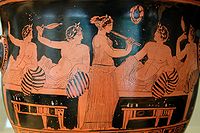
The Greek symposium was a key Hellenic social institution. It was a forum for men of good family to debate, plot, boast, or simply to revel with others. They were also frequently held to celebrate the introduction of young men into aristocratic society. Symposia were also held by aristocrats to celebrate other special occasions, such as victories in athletic and poetic contests.Symposia were usually held in the andrōn (ἀνδρών), the men's quarters of the household. The participants, or "symposiasts," would recline on pillowed couches
Triclinium
A triclinium is a formal dining room in a Roman building. The word is adopted from the Greek τρικλίνιον, triklinion, from τρι-, tri-, "three", and κλίνη, klinē, a sort of "couch" or rather chaise longue...
arrayed against the three walls of the room away from the door. Due to space limitations the couches would number between seven and nine, limiting the total number of participants to somewhere between fourteen and twenty seven (Oswyn Murray gives a figure of between seven and fifteen couches and reckons fourteen to thirty participants a "standard size for a drinking group"). If any young men took part they did not recline but sat up.
Food and wine were served. Entertainment was provided, and depending on the occasion could include games, songs, flute-girls or boys, slaves performing various acts, and hired entertainment.
Symposia often were held for specific occasions. The most famous symposium of all, described in Plato's dialogue
Symposium (Plato)
The Symposium is a philosophical text by Plato dated c. 385–380 BCE. It concerns itself at one level with the genesis, purpose and nature of love....
of that name (and rather differently in Xenophon's
Symposium (Xenophon)
Xenophon's Symposium records the discussion of Socratesand company at a dinner given by Callias for Autolycus, son of Lycon. Xenophon's Symposium (Συμπόσιον) records the discussion of Socratesand company at a dinner given by Callias for Autolycus, son of Lycon. Xenophon's Symposium (Συμπόσιον)...
) was hosted by the poet Agathon
Agathon
Agathon was an Athenian tragic poet whose works, up to the present moment, have been lost. He is best known for his appearance in Plato's Symposium, which describes the banquet given to celebrate his obtaining a prize for his first tragedy at the Lenaia in . He is also a prominent character in...
on the occasion of his first victory at the theater contest of the 416 BC
416 BC
Year 416 BC was a year of the pre-Julian Roman calendar. At the time, it was known as the Year of the Tribunate of Atratinus, Ambustus, Mugillanus and Rutilus...
Dionysia
Dionysia
The Dionysia[p] was a large festival in ancient Athens in honor of the god Dionysus, the central events of which were the theatrical performances of dramatic tragedies and, from 487 BC, comedies. It was the second-most important festival after the Panathenaia...
. According to Plato's account, the celebration was upstaged by the unexpected entrance of the toast of the town, the young Alcibiades
Alcibiades
Alcibiades, son of Clinias, from the deme of Scambonidae , was a prominent Athenian statesman, orator, and general. He was the last famous member of his mother's aristocratic family, the Alcmaeonidae, which fell from prominence after the Peloponnesian War...
, dropping in drunken and nearly naked, having just left another symposium.
The men apart of the symposium would discuss a multitude of topics—from philosophy to the differences between gender and love.
Drinking
A symposium would be overseen by a "symposiarch" who would decide how strong the wine for the evening would be, depending on whether serious discussions or merely sensual indulgence were in the offing. The Greeks and Romans customarily served their wine mixed with water, as the drinking of pure wine was considered a habit of uncivilized peoples. The wine was drawn from a kraterKrater
A krater was a large vase used to mix wine and water in Ancient Greece.-Form and function:...
, a large jar designed to be carried by two men, and served from pitchers (oenochoe
Oenochoe
An oenochoe, also spelled oinochoe, is a wine jug and a key form of Greek pottery. There are many different forms of Oenochoe. The earliest is the olpe and has an S-shaped profile from head to foot.Oenochoe may be decorated or undecorated...
). Certain formalities were observed, most important among which were libation
Libation
A libation is a ritual pouring of a liquid as an offering to a god or spirit or in memory of those who have died. It was common in many religions of antiquity and continues to be offered in various cultures today....
s, the pouring of a small amount of wine in honour of various deities or the mourned dead.
In a fragment from his circa 375 BC play Semele or Dionysus Eubulus
Eubulus (poet)
Eubulus was an Athenian "Middle Comic" poet, victorious six times at the Lenaia, first probably in the late 370s or 360s BC According to the Suda , which dates him to the 101st Olympiad Eubulus was an Athenian "Middle Comic" poet, victorious six times at the Lenaia, first probably in the late 370s...
has the god of wine Dionysos describe proper and improper drinking:
For sensible men I prepare only three kraters: one for health (which they drink first), the second for love and pleasure, and the third for sleep. After the third one is drained, wise men go home. The fourth krater is not mine any more - it belongs to bad behaviour; the fifth is for shouting; the sixth is for rudeness and insults; the seventh is for fights; the eighth is for breaking the furniture; the ninth is for depression; the tenth is for madness and unconsciousness.
In keeping with the Greek virtue of moderation, the symposiarch should have prevented festivities from getting out of hand, but Greek literature and art often indicate that the third-krater limit was not observed.
Entertainments
Hetaera
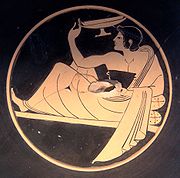
In ancient Greece, hetaerae were courtesans, that is to say, highly educated, sophisticated companions...
) and entertainers were hired to perform, consort, and converse with the guests. Among the instruments women might play was the aulos
Aulos
An aulos or tibia was an ancient Greek wind instrument, depicted often in art and also attested by archaeology.An aulete was the musician who performed on an aulos...
, a Greek woodwind instrument sometimes compared to an oboe
Oboe
The oboe is a double reed musical instrument of the woodwind family. In English, prior to 1770, the instrument was called "hautbois" , "hoboy", or "French hoboy". The spelling "oboe" was adopted into English ca...
. When string instruments were played, the barbiton
Barbiton
The barbiton, or barbitos , is an ancient stringed instrument known from Greek and Roman classics related to the lyre...
was the traditional instrument. Slaves and boys also provided service and entertainment.
The guests also participated actively in competitive entertainments. A game sometimes played at symposia was kottabos
Kottabos
Kottabos was a game of skill popular for a long time at ancient Greek and Etruscan symposia , especially in the 5th and 4th centuries BC. The game is played by flinging wine lees at targets...
, in which players swirled the dregs of their wine in a kylix
Kylix (drinking cup)
A kylix is a type of wine-drinking glass with a broad relatively shallow body raised on a stem from a foot and usually with two horizontal handles disposed symmetrically...
, a platter-like stemmed drinking vessel, and flung them at a target. Another feature of the symposia were skolia
Skolion
Not to be confused with scholionSkolion , also scolion , were songs sung by invited guests at banquets in ancient Greece. Often extolling the virtues of the gods or heroic men, skolia were improvised to suit the occasion and accompanied by a lyre, which was handed about from singer to singer as the...
, drinking songs of a patriotic or bawdy nature, performed competitively with one symposiast reciting the first part of a song and another expected to improvise the end of it. Symposiasts might also compete in rhetorical contests, for which reason the word "symposium" has come to refer in English to any event where multiple speeches are made.
Etruscan and Roman drinking parties
Etruscan art
Etruscan art
Etruscan art was the form of figurative art produced by the Etruscan civilization in central Italy between the 9th and 2nd centuries BC. Particularly strong in this tradition were figurative sculpture in terracotta and cast bronze, wall-painting and metalworking .-History:The origins of...
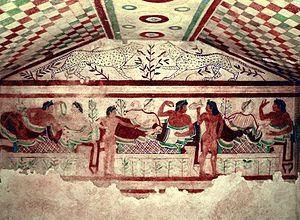
shows scenes of banqueting that recall aspects of the Greek symposia; however, one major difference is that women of status participated more fully in this as in other realms of Etruscan society
Etruscan civilization
Etruscan civilization is the modern English name given to a civilization of ancient Italy in the area corresponding roughly to Tuscany. The ancient Romans called its creators the Tusci or Etrusci...
.
As with many other Greek customs, the aesthetic framework of the symposium was adopted by the Romans under the name of comissatio. These revels also involved the drinking of assigned quantities of wine, and the oversight of a master of the ceremonies appointed for the occasion from among the guests. Another Roman version of the symposium was the convivium.