
All Topics  
Johann Joachim Winckelmann

 
Johann Joachim Winckelmann

   Email Print
   Bookmark   Link


Johann Joachim Winckelmann


Johann Joachim Winckelmann (December 9, 1717 - June 8, 1768) a German
Germany

Germany , officially the Federal Republic of Germany , is a country in Central Europe. It is bordered to the north by the North Sea, Denmark, and the Baltic Sea; to the east by Poland and the Czech Republic; to the south by Austria and Switzerland; and to the west by France, Luxembourg, Belgium, and the Netherlands....
 art historian and archaeologist, was a pioneering Hellenist
Hellenism (neoclassicism)

Hellenism, as a neoclassical movement distinct from other Roman or Greco-Roman forms of neoclassicism emerging after the European Renaissance, is most often associated with Germany and England in the eighteenth and nineteenth centuries....
 who first articulated the difference between Greek, Greco-Roman and Roman art. "The prophet and founding hero of modern archaeology," Winckelmann was one of the founders of scientific archaeology and first applied the categories of style on a large, systematic basis to the history of art
History of art

The history of art usually refers to the history of the visual arts of painting, sculpture and architecture as well as architecture. It is the history of one of the fine arts, others of which are the performing arts and literary arts....
.


Discussion
Ask a question about 'Johann Joachim Winckelmann'
Start a new discussion about 'Johann Joachim Winckelmann'
Answer questions from other users
Full Discussion Forum


Encyclopedia


Johann Joachim Winckelmann (December 9, 1717 - June 8, 1768) a German
Germany

Germany , officially the Federal Republic of Germany , is a country in Central Europe. It is bordered to the north by the North Sea, Denmark, and the Baltic Sea; to the east by Poland and the Czech Republic; to the south by Austria and Switzerland; and to the west by France, Luxembourg, Belgium, and the Netherlands....
 art historian and archaeologist, was a pioneering Hellenist
Hellenism (neoclassicism)

Hellenism, as a neoclassical movement distinct from other Roman or Greco-Roman forms of neoclassicism emerging after the European Renaissance, is most often associated with Germany and England in the eighteenth and nineteenth centuries....
 who first articulated the difference between Greek, Greco-Roman and Roman art. "The prophet and founding hero of modern archaeology," Winckelmann was one of the founders of scientific archaeology and first applied the categories of style on a large, systematic basis to the history of art
History of art

The history of art usually refers to the history of the visual arts of painting, sculpture and architecture as well as architecture. It is the history of one of the fine arts, others of which are the performing arts and literary arts....
. Many consider him the father of the discipline of art history. His would be the decisive influence on the rise of the neoclassical
Neoclassicism

Neoclassicism is the name given to quite distinct Cultural movement in the Decorative art and visual arts, literature, theatre, music, and architecture that draw upon Western classical art and culture ....
 movement during the late eighteenth century. His writings influenced not only a new science of archaeology and art history but Western painting, sculpture, literature and even philosophy. Winckelmann's History of Ancient Art (1764) was one of the first books written in German to become a classic of European literature. His subsequent influence on Lessing
Gotthold Ephraim Lessing

Gotthold Ephraim Lessing was a Germany writer, philosopher, dramatist, publicist, and art critic, and one of the most outstanding representatives of the Enlightenment era....
, Herder
Johann Gottfried Herder

Johann Gottfried von Herder was a Germany philosophy, Theology, poet, and literary critic. He is associated with the periods of Age of Enlightenment, Sturm und Drang, and Weimar Classicism....
, Goethe, Hölderlin, Heine
Heinrich Heine

Christian Johann Heinrich Heine was a journalist, essayist, and one of the most significant German literature German Romanticism poets. He is remembered chiefly for selections of his lyric poetry, many of which were set to music in the form of lieder by German composers....
, Nietzsche, George
Stefan George

Stefan Anton George was a Germany poet, editing, and translator....
, and Spengler
Oswald Spengler

Oswald Arnold Gottfried Spengler was a German historian and philosopher whose interests also included mathematics, science, and art. He is best known for his book The Decline of the West in which he puts forth a cyclical pattern theory of the rise and decline of civilizations....
 has been provocatively called "the Tyranny of Greece over Germany."

Biography


Early life

Winckelmann was born in poverty in Stendal
Stendal

Stendal is a town in Saxony-Anhalt, Germany. It is the capital of Stendal and unofficial capital of the Altmark. Its population in 2001 was 38,900....
, Margraviate of Brandenburg
Margraviate of Brandenburg

The Margraviate of Brandenburg was a major principality of the Holy Roman Empire from 1157 to 1806. Also known as the March of Brandenburg , it played a pivotal role in the history of Germany and Central Europe....
. His father, Martin Winckelmann, was a cobbler, while his mother, Anna Maria Meyer, was the daughter of a weaver. Winckelmann's early years were full of hardship, but his thirst for learning pushed him forward. Later in Rome, when he was a famous scholar, he wrote: "One gets spoiled here; but God owed me this; in my youth I suffered too much."

Winckelmann attended the Coellnische Gymnasium in Berlin
Berlin

Berlin is the Capital of Germany city and one of sixteen States of Germany of Germany. With a population of 3.4 million within its city limits, Berlin is the country's largest city....
 and the school at Salzwedel
Salzwedel

Salzwedel...
, and in 1738, at age 21, went as a student of theology to the University of Halle. However, Winckelmann was no theologian; he had become interested in Greek classics in his youth, but soon realized that the teachers in Halle could not satisfy his intellectual interests in this field. He nonetheless devoted himself privately to Greek
Greeks

The Greeks , also known as Hellenes, are a nation and ethnic group native to Greece, Cyprus and neighbouring regions, who can also be found in Greek diaspora communities around the world....
 art and literature and followed the lectures of Alexander Gottlieb Baumgarten
Alexander Gottlieb Baumgarten

Alexander Gottlieb Baumgarten was a Germany philosopher....
, who coined the term "aesthetics".

With the intention of becoming a physician, in 1740 Winckelmann attended medical classes at Jena. He also worked teaching languages. From 1743 to 1748, he was the deputy headmaster of the gymnasium of Seehausen in the Altmark. Winckelmann felt that work with children was not his true calling. Moreover, his means were insufficient: his salary was so low that he had to rely on his students' parents for free meals. He was thus obliged to accept a tutorship near Magdeburg
Magdeburg

Magdeburg , the Capital of the States of Germany of Saxony-Anhalt, Germany, lies on the Elbe River and was one of the most important medieval cities of Europe....
. While tutor for the powerful Lamprecht family, he fell into unrequited love with the handsome Lemprecht son. This was one of a series of such loves throughout his life. His enthusiasm for the male form excited Winckelmann's budding admiration of ancient Greek and Roman sculpture.

Bünau's librarian

In 1748, Winckelmann wrote to Count Heinrich von Bünau
Heinrich von Bünau

Heinrich, Graf von B?nau or Count of B?nau was a German statesman and historian....
: "... little value is set on Greek literature, to which I have devoted myself so far as I could penetrate, when good books are so scarce and expensive." In the same year, Winckelmann was appointed secretary of Bünau's library at Nöthnitz, near Dresden
Dresden

Dresden is the capital city of the Germany Federal Free state of Saxony. It is situated in a valley on the River Elbe. The Dresden conurbation is part of the Saxon triangle metropolitan area....
. The library contained some 40,000 volumes. Winckelmann had read Homer
Homer

Homer is traditionally held to be the author of the ancient Greek language epic poems the Iliad and the Odyssey, as well as of the Homeric Hymns....
, Herodotus
Herodotus

Herodotus of Halicarnassus was a Greeks historian who lived in the 5th century BC and is regarded as the "Father of History" in Western culture....
, Sophocles
Sophocles

Sophocles was the second of the three classical Greece tragedy whose work has survived. His first plays were written later than those of Aeschylus and earlier than those of Euripides....
, Xenophon
Xenophon

Xenophon , son of Gryllus, of the deme Erchia of Athens, also known as Xenophon of Athens and Xenophon of Thebes, was a soldier, mercenary and a contemporary and admirer of Socrates....
, and Plato
Plato

Plato , was a Classical Greece Greeks philosopher, mathematician, writer of philosophical dialogues, and founder of the Platonic Academy in Ancient Athens, the first institution of higher learning in the western world....
, but he found at Nöthnitz the works of such famous Enlightenment
Enlightenment

Enlightenment may refer to:...
 writers as Voltaire
Voltaire

Fran?ois-Marie Arouet , better known by the pen name Voltaire, was a French Age of Enlightenment writer, essayist, and philosophy known for his wit, philosophical sport, and defense of civil liberty, including freedom of religion and free trade....
 and Montesquieu
Charles de Secondat, baron de Montesquieu

Charles-Louis de Secondat, baron de La Br?de et de Montesquieu , was a France social commentator and Political philosophy who lived during the Age of Enlightenment....
. To leave behind the spartan atmosphere of Prussia was a great relief for him. Winckelmann's major duty was to assist von Bünau in writing a book on the Holy Roman Empire
Holy Roman Empire

The Holy Roman Empire was a union of territories in Central Europe during the Middle Ages and the Early modern Europe under a Holy Roman Emperor....
 and help collect material for it. During this period he made several visits to the collection of antiquities at Dresden, but his description of its best paintings was left unfinished. The treasures there nevertheless awakened in Winckelmann an intense interest in art, which was deepened by association with various artists, particularly the painter Adam Friedrich Oeser
Adam Friedrich Oeser

Adam Friedrich Oeser was a Germany Etching er, painting and sculptor. He worked and studied in Bratislava and Vienna at the Vienna Academy ....
 (1717-1799), Goethe's future friend and influence, who encouraged him in his aesthetic studies. (Winckelmann subsequently exercised a powerful influence over Johann Wolfgang von Goethe
Johann Wolfgang von Goethe

was a Germans writer and according to George Eliot, "Germany's greatest man of letters? and the last true polymath to walk the earth." Goethe's works span the fields of poetry, drama, literature, theology, philosophy, humanism and science....
).

In 1755, Winckelmann published his Gedanken über die Nachahmung der griechischen Werke in Malerei und Bildhauerkunst ("Thoughts on the Imitation of Greek Works in Painting and Sculpture"), followed by a feigned attack on the work and a defense of its principles, ostensibly by an impartial critic. The Gedanken contains the first statement of the doctrines he afterwards developed, the ideal of "noble simplicity and quiet grandeur" (edle Einfalt und stille Größe) and the definitive assertion "The one way for us to become great, perhaps inimitable, is by imitating the ancients." The work was warmly admired not only for the ideas it contained, but for its literary style. It made Winckelmann famous, and was reprinted several times and soon translated into French. In England, Winkelmann's views stirred discussion in the 1760s and 1770s, although it was limited to artistic circles: Henry Fuseli
Henry Fuseli

Henry Fuseli was a United Kingdom Painting, drawing, and writer on art, of German-Swiss origin. |}...
's translation of his Reflections on the Painting and Sculpture of the Greeks was published in 1765, but the translation did not find enough readers to warrant a second edition.

Rome

In 1751, the papal nuncio and Winkelmann's future employer, Alberico Archinto, visited Nöthnitz, and in 1754 Winckelmann joined the Roman Catholic Church. Goethe concluded that Winckelmann was a pagan, but his conversion ultimately opened the doors of the papal library to him. On the strength of the Gedanken über die Nachahmung der Griechischen Werke, Augustus III, king of Poland and elector of Saxony, granted him a pension of 200 thaler
Thaler

The Thaler was a silver coin used throughout Europe for almost four hundred years. Its name lives on in various currencies as the dollar or Slovenian tolar....
s, so that he could continue his studies in Rome.

Winckelmann arrived in Rome in November 1755. His first task there was to describe the statues in the Cortile del Belvedere
Cortile del Belvedere

Donato Bramante's Cortile del Belvedere, the Courtyard of the Belvedere, designed from 1506 onwards, was a major project of the High Renaissance at Rome, reverberating in its details in courtyards, formalized piazzas and garden plans throughout Western Europe for centuries....
—the Apollo Belvedere
Apollo Belvedere

The Apollo Belvedere or Apollo of the Belvedere, also called the Pythian Apollo, is a celebrated marble sculpture from Classical Antiquity....
, the Laocoön
Laocoön

LACOOON , the son of Acoetes was a Troy priest of Poseidon, , whose rules he had defied, either by marrying and having sons, or by having committed an impiety by making love with his wife in the presence of a cult image in a sanctuary; his minor role in the Epic Cycle narrating the Trojan War was of warning the Trojans in vain against acc...
, the so-called Antinous
Antinous

For the constellation, see Antinous ; for the asteroid, see 1863 Antinous; for the mythological figure, see Antinous son of EupeithesAntino?s or Antino?s , was a member of the Roman Emperor Hadrian's entourage, to whom he was beloved....
, and the Belvedere Torso
Belvedere Torso

The Belvedere Torso is a fragment of a nude male statue, signed by the Athenian sculptor Apollonius. The statue is documented in Rome from the early fifteenth century and around 1500 was in the possession of the sculptor Andrea Bregno....
—which represented to him the "utmost perfection of ancient sculpture."

Originally, Winckelmann planned to stay in Italy only two years with the help of the grant from Dresden, but the outbreak of the Seven Years' War
Seven Years' War

The Seven Years' War lasted between 1756?1763 and involved all of the major European powers of the period. The war pitted Kingdom of Prussia and Kingdom of Great Britain and a coalition of smaller German states against an alliance consisting of Archduchy of Austria, Early Modern France, Russian Empire, Kingdom of Sweden, and Electorate of Sa...
 (1756-1763) changed his plans. He was named librarian to Domenico Cardinal Passionei Cardinal Passionei, who was impressed by Winckelmann's beautiful Greek writing. Winckelmann also became librarian to Cardinal Archinto, and received much kindness from Cardinal Passionei. After their deaths, Winckelmann was hired as librarian in the house of Alessandro Cardinal Albani, who was forming his magnificent collection of antiquities in the villa at Porta Salaria
Porta Salaria

Porta Salaria was a gate in the Aurelian Walls of Rome, demolished in 1921....
.

With the aid of his new friend and lover, the painter Anton Raphael Mengs
Anton Raphael Mengs

Anton Raphael Mengs was an German painter, active in Rome, Madrid, and Saxony, who became one of the precursors to Neoclassicism painting....
 (1728-79), with whom he first lived in Rome, Winckelmann devoted himself to the study of Roman antiquities and gradually acquired an unrivalled knowledge of ancient art. Winckelmann's method of careful observation allowed him to identify Roman copies of Greek art, something that was unusual at that time—Roman culture was considered the ultimate achievement of Antiquity. His friend Mengs became the channel through which Winkelmann's ideas were realized in art and spread around Europe. ("The only way for us to become great, yes, inimitable, if it is possible, is the imitation of the Greeks," Winckelmann declared in the Gedanken. With imitation he did not mean slavish copying: "... what is imitated, if handled with reason, may assume another nature, as it were, and become one's own.") Neoclassical artists attempted to revive the spirit as well as the forms of ancient Greece and Rome. Mengs's contribution in this was considerable—he was widely regarded as the greatest living painter of his day. The French painter Jacques-Louis David
Jacques-Louis David

Jacques-Louis David was a highly influential France painter in the Neoclassicism style, considered to be the preeminent painter of the era. In the 1780s his cerebral brand of history painting marked a change in taste away from Rococo frivolity toward a classical austerity and severity, chiming with the moral climate of the final years of th...
 met Mengs in Rome (1775-80) and was introduced through him to the artistic theories of Winckelmann. Earlier, while in Rome, Winckelmann met the English architect Robert Adam
Robert Adam

Robert Adam was a Scotland neoclassicism architect, interior designer and furniture designer. He was the son of William Adam , Scotland's foremost architect of the time, and trained under him....
, whom he influenced to become a leading proponent of neoclassicism in architecture. Winckelmann's ideals were later popularized in England through the reproductions of Josiah Wedgwood
Josiah Wedgwood

Josiah Wedgwood was an England potter, credited with the industrial process of the manufacture of pottery. He was a member of the Darwin-Wedgwood family, most famously including his grandson, Charles Darwin....
's "Etruria" factory (1782).

In 1760, Winckelmann's Description des pierres gravées du feu Baron de Stosch
Philipp von Stosch

Baron Philipp von Stosch was a Kingdom of Prussia antiquarian who lived in Rome and Florence.Stosch was born in K?strin in the Neumark region of Margraviate of Brandenburg....
 appeared, followed in 1762 by his Anmerkungen über die Baukunst der Alten ("Observations on the Architecture of the Ancients"), which included an account of the temples at Paestum
Paestum

Paestum is the classical Roman name of a major Graeco-Roman city in the Campania region of Italy. It is located in the north of Cilento, near the coast about 85 km SE of Naples in the province of Salerno, and belongs to the commune of Capaccio....
. In 1758 and 1762, he visited Naples
Naples

Naples is a city in southern Italy, the capital of the region of Campania and of the province of Naples. The city is known for its rich history, art, culture and gastronomy, playing an important role throughout much of its existence; it is over 2,800 years old....
 to observe the archaeological excavations being conducted at Pompeii
Pompeii

Pompeii is a ruined and partially buried Ancient Rome town-city near modern Naples in the Italy region of Campania, in the territory of the comune of Pompei....
 and Herculaneum
Herculaneum

Herculaneum is an ancient Roman Empire town, located in the territory of the current commune of Ercolano. Its ruins can be found at the co-ordinates , in the Italy region of Campania....
. "Despite his association with Albani, Winckelmann steered clear of the shady world of art dealing which had compromised the scholarly respectability of such brilliant, if much less systematic antiquarian
Antiquarian

An antiquarian or antiquary is an aficionado of antiquities or things of the past. Also, and most often in modern usage, an antiquarian is a person who deals with or collects rare and ancient "Antiquarian book trade in the United States"....
s as Francesco Ficoroni
Francesco Ficoroni

The abbate Francesco Ficoroni was an Italian connoisseur and antiquarian in Rome closely involved with the antiquities trade. He was the author of numerous publications on ancient Roman sculpture and antiquities, guides to the monuments of Rome and the city's ancient topography, and on Italian theatre and theatrical masks, among other s...
 and the Baron Stosch
Philipp von Stosch

Baron Philipp von Stosch was a Kingdom of Prussia antiquarian who lived in Rome and Florence.Stosch was born in K?strin in the Neumark region of Margraviate of Brandenburg....
." Winckelmann's poverty may have played a part: the trade in antiquities was an expensive and speculative game. In 1763, with Albani's advocacy, he was appointed Clement XIII
Pope Clement XIII

Pope Clement XIII , born Carlo della Torre di Rezzonico, was Pope from 16 July 1758 to 2 February 1769.He was born to a recently ennobled family of Venice, received a Society of Jesus education in Bologna and became a Cardinal in 1737....
's Prefect of Antiquities.

From 1763, while retaining his position with Albani, Winckelmann worked as a prefect of antiquities (Prefetto delle Antichità) and scriptor (Scriptor linguae teutonicae) of the Vatican. Winckelmann visited Naples again, in 1765 and 1767, and wrote for the use of the electoral prince and princess of Saxony his Briefe an Bianconi, which were published, eleven years after his death, in the Antologia romana.

Winckelmann contributed various essays to the Bibliothek der schönen Wissenschaften; and, in 1766, published his Versuch einer Allegorie. Of much greater importance was the work entitled Monumenti antichi inediti ("Unpublished monuments of antiquity", 1767-1768), prefaced by a Trattato preliminare, which presented a general sketch of the history of art. The plates in this work are representations of objects which had either been falsely explained or not explained at all. Winckelmann's explanations were of tremendous use to the future science of archaeology, by showing through observational method that the ultimate sources of inspiration of many works of art supposed to be connected with Roman history were to be found in Homer
Homer

Homer is traditionally held to be the author of the ancient Greek language epic poems the Iliad and the Odyssey, as well as of the Homeric Hymns....
.

Masterwork

Winckelmann's masterpiece, the Geschichte der Kunst des Alterthums ("The History of Ancient Art Among the Greeks"), published in 1764, was soon recognized as a permanent contribution to European literature. In this work, "Winckelmann's most significant and lasting achievement was to produce a thorough, comprehensive and lucid chronological account of all antique art— including that of the Egyptians and Etruscans." This was the first work to define in the art of a civilization an organic growth, maturity, and decline. Here, it included the revelatory tale told by a civilization's art and artifacts -- these, if we look closely, tell us their own story of cultural factors, such as climate, freedom, and craft. Winckelmann sets forth both the history of Greek art and of Greece. He presents a glowing picture of the political, social, and intellectual conditions which he believed tended to foster creative activity in ancient Greece.

The fundamental idea of Winckelmann's artistic theories are that the end of art is beauty, and that this end can be attained only when individual and characteristic features are strictly subordinated to an artist's general scheme. The true artist, selecting from nature the phenomena suited to his purpose and combining them through the exercise of his imagination, creates an ideal type in which normal proportions are maintained, and particular parts, such as muscles and veins, are not permitted to break the harmony of the general outlines.

Death

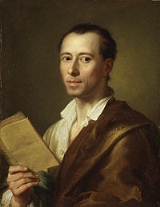
Johann Joachim Winckelmann (anton Von Maron 1768)
In 1768 Winckelmann journeyed north over the Alps, but the Tyrol depressed him and he decided to return to Italy. However, his friend, the sculptor and restorer Bartolomeo Cavaceppi
Bartolomeo Cavaceppi

Bartolomeo Cavaceppi was an Italian sculptor who worked in Rome, where he trained in the studio of the acclimatized Frenchman, Pierre-?tienne Monnot, and then in the workshop of Carlo Antonio Napolioni, a restorer of sculptures for Alessandro Cardinal Albani, who was to become a major patron of Cavaceppi....
 managed to persuade him to travel to Munich and Vienna, where he was received with honor by Maria Theresa
Maria Theresa of Austria

Maria Theresa was the List of rulers of Austria, List of rulers of Hungary, List of rulers of Croatia, Queen of Bohemia, Grand Duchy of Tuscany and a Holy Roman Emperor by marriage to Francis I, Holy Roman Emperor....
. On his way back, he was murdered at Trieste
Trieste

Trieste is a city and port in northeastern Italy very near to the Slovenian border, to the North, East, and South. Trieste is located at the head of the Gulf of Trieste on the Adriatic Sea....
 on June 8, 1768 in a hotel bed by a fellow traveller, a man named Francesco Arcangeli, for medals that Maria Theresa had given him. Arcangeli had thought that he was only "un uomo di poco conto" ("a man of little account").

Winckelmann was buried in the churchyard of the Cathedral of San Giusto, Trieste. Domenico Rosetti and Cesare Pagnini documented the last week of Winckelmann's life; Heinrich Alexander Stoll translated the Italian document, the so-called "Mordakte Winckelmann", into German.

Critical response and influence

Winckelmann's writings are key to understanding the modern European discovery of ancient (sometimes idealized) Greece;neoclassicism
Neoclassicism

Neoclassicism is the name given to quite distinct Cultural movement in the Decorative art and visual arts, literature, theatre, music, and architecture that draw upon Western classical art and culture ....
; and the doctrine of art as imitation (Nachahmung). The mimetic character of art that imitates but does not simply copy, as Winckelmann restated it, is central to any interpretation of Enlightenment
Age of Enlightenment

The Age of Enlightenment or The Enlightenment is a term used to describe a time in Western philosophy and cultural life centered upon the eighteenth century, in which rationalism was advocated as the primary source and legitimacy for authority....
 classical idealism. Winckelmann stands at an early stage of the transformation of taste in the late eighteenth century.

Winckelmann's study Sendschreiben von den Herculanischen Entdeckungen ("Letter about the Discoveries at Herculaneum") was published in 1762, and two years later Nachrichten von den neuesten Herculanischen Entdeckungen ("Report on the Latest Discoveries at Herculaneum"). From these scholars obtained their first real information about the excavations at Pompeii.

His major work, Geschichte der Kunst des Alterthums (1764, "The History of Ancient Art"), deeply influenced contemporary views of the superiority of Greek art. It was translated into French in 1766 and later into English and Italian. Among others, Gotthold Ephraim Lessing based many of the ideas in his 'Laocoon' (1766) on Winckelmann's views on harmony and expression in the visual arts.

In the historical portions of his writings, Winckelmann used not only the works of art he himself had studied but the scattered notices on the subject to be found in ancient writers; and his wide knowledge and active imagination enabled him to offer many fruitful suggestions as to periods about which he had little direct information. To the still existing works of art, he applied a minute empirical scrutiny. Many of his conclusions, based on inadequate evidence of Roman copies, would be modified or reversed by subsequent researchers. Nonetheless, the fervid descriptive enthusiasm of passages in his work, its strong and yet graceful style, and its vivid descriptions of works of art gave it a most immediate appeal. It marked an epoch by indicating the spirit in which the study of Greek art and of ancient civilization should be approached, and the methods by which investigators might hope to attain solid results. To Winckelmann's contemporaries it came as a revelation, and it exercised a profound influence on the best minds of the age. It was read with intense interest by Lessing
Gotthold Ephraim Lessing

Gotthold Ephraim Lessing was a Germany writer, philosopher, dramatist, publicist, and art critic, and one of the most outstanding representatives of the Enlightenment era....
, who found in the earliest of Winckelmann's works the starting-point for his Laocoon, and by Herder
Johann Gottfried Herder

Johann Gottfried von Herder was a Germany philosophy, Theology, poet, and literary critic. He is associated with the periods of Age of Enlightenment, Sturm und Drang, and Weimar Classicism....
, Goethe and Kant
KANT

KANT is a computer algebra system for mathematicians interested in algebraic number theory, performing sophisticated computations in algebraic number fields, in Global field function fields, and in local fields....
.

Works

The most accessible edition of selected works, in condensed forms, is David Irwin, Winckelmann: Selected Writings on Art (London: Phaidon) 1972; the critical edition is Walther Rehm and Hellmut Sichtermann, eds., Kleine Schriften
Kleine Schriften

is a German language phrase often used as a title for a collection of Article and essays written by a single scholarly method over the course of a career....
, Vorreden, Entwürfen
(Berlin) 1968.
  1. Gedanken über die Nachahmung der griechischen Werke in der Malerei und Bildhauerkunst ("Thoughts on the Imitation of Greek Works in Painting and Sculpture"), followed by a feigned attack on the work, and a defence of its principles, nominally by an impartial critic. (First edition of only 50 copies 1755, 2nd ed. 1756)
  2. Description des pierres gravées du feu Baron de Stosch (1760)
  3. Anmerkungen über die Baukunst der Alten ("Remarks on the Architecture of the Ancients"), including an account of the temples at Paestum
    Paestum

    Paestum is the classical Roman name of a major Graeco-Roman city in the Campania region of Italy. It is located in the north of Cilento, near the coast about 85 km SE of Naples in the province of Salerno, and belongs to the commune of Capaccio....
     (1762)
  4. Sendschreiben von den Herculanischen Entdeckungen ("Letter About the Discoveries at Herculaneum) (1762)
  5. ("Essay on the Beautiful in Art") (1763), an epistolary essay addressed to Friedrich Rudolph von Berg
  6. Nachrichten von den neuesten Herculanischen Entdeckungen (Report About the Latest Herculanean Discoveries) (1764)
  7. Geschichte der Kunst des Alterthums ("History of Ancient Art") (1764)
  8. Versuch einer Allegorie ("Attempt at an Allegory") (1766), which, although containing the results of much thought and reading, is not conceived in a thoroughly critical spirit.
  9. Monumenti antichi inediti (1767-1768), prefaced by a Trattato preliminare, presenting a general sketch of the history of art. The plates in this work are representations of objects which had either been falsely explained or not explained at all.
  10. Briefe an Bianconi, which were published eleven years after his death, in the Antologia Romana.


Further reading

  • Efthalia Rentetzi, "Johann Joachim Winckelmann und der altgriechische Geist," in Philia (Universität Würzburg), vol. I, (2006), pp. 26-30, ISSN 0936-1944


External links

  • at the Humboldt University in Berlin
    Berlin

    Berlin is the Capital of Germany city and one of sixteen States of Germany of Germany. With a population of 3.4 million within its city limits, Berlin is the country's largest city....