


Paestum

Encyclopedia
Paestum is the classical Roman name of a major Graeco-Roman city in the Campania
region of Italy
. It is located in the north of Cilento
, near the coast about 85 km SE of Naples
in the province of Salerno
, and belongs to the commune of Capaccio
, officially also named Capaccio-Paestum.
coast on the road linking Agropoli
to Battipaglia
. Its population is mainly located in the quarters surrounding the ancient Graeco-Roman ruins, as Santa Venere (to the south, near the hamlet of Licinella), Andreoli (north) and Torre di Paestum (west, by the sea). The town also has a railway station on the Naples-Salerno-Reggio Calabria line.
city of Sybaris
, and originally known as Poseidonia
. Outside of archaeological evidence very little is known about Paestum during its first centuries. Archaeological evidence indicates that the city was expanding with the building of roads, temples and other features of a growing city. Coinage, architecture and molded votive figurines all attest to close relations maintained with Metaponto
in the sixth and fifth centuries. It is not until the end of the fifth century BC that the city is mentioned, when according to Strabo
the city was conquered by the Lucani
. From the archaeological evidence it appears that the two cultures, Greek and Oscan, were able to thrive alongside one another. What is known is it later became the Roman city of Paestum in 273 BC after the Graeco-Italian Poseidonians sided with the loser, Pyrrhus
, in war against Rome
during the first quarter of the third century BC.
During the invasion of Italy by Hannibal the city remained faithful to Rome and afterwards was granted special favours such as the minting of its coinage. The city continued to prosper during the Roman imperial period
, but started to go into decline between the 4th and 7th centuries. It was abandoned during the Middle Ages
and its ruins only came to notice again in the 18th century, following the rediscovery of the Roman cities of Pompeii
and Herculaneum
. The decline and desertion were probably due to changes in local land drainage patterns, leading to swampy malaria
l conditions (this is difficult to picture, with the present aridity; the site is now left to lizard
s and a few tourists).
On September 9, 1943, Paestum was the location of the landing beaches of the U.S. 36th Infantry Division
during the Allied invasion of Italy. German
forces resisted the landings from the outset, causing heavy fighting within and around the town. Combat persisted around the town for nine days before the Germans withdrew to the north.
style, dating from the first half of the 6th century BC. These were dedicated to Hera
and Athena
, although they have traditionally been identified as a basilica
and temples of Neptune
and Ceres, owing to 18th-century mis-attribution.
The city of Paestum covers an area of approximately 120 hectares. It is only the 25 hectares that contain the three main temples that have been excavated. The other 95 hectares remain on private land and have not been excavated. The city is surrounded by defensive walls that still stand. The walls are approximately 4750 m long, 5 – 7 m thick and 15 m high. Positioned along the wall are 24 square and round towers. There may have been up to 28 but some of them were destroyed during the construction of highway in 18th century that effectively cuts the site in two.
The modern town of Paestum, directly to the north of the archaeological site, is a popular seaside resort. In the region of Paestum there are long, sandy beaches.
.jpg) The temple of Hera
The temple of Hera
, built around 550 BC by Greek colonists, is the oldest surviving temple in Paestum. Eighteenth-century archaeologists named it "The Basilica" because they mistakenly believed it to be a Roman building. A basilica in Roman times was a civil building, not a religious one. Inscriptions revealed that the goddess worshiped here was Hera
. Later, an altar
was unearthed in front of the temple, in the open-air site usual for a Greek altar; the faithful could attend rites and sacrifice
s without entering the cella
.
Just south of the city walls, at a site still called Santa Venera, a series of small terracotta offertory
molded statuettes of a standing female nude wearing the polos
headdress of Anatolian and Syrian goddesses, which were dated to the first half of the sixth century BC, were found in the sanctuary; other similar ones have been excavated at other Paestum sanctuaries during excavations in the 1980s, but the figure is highly unusual in the Western Mediterranean. The open-air temenos
was established at the start of Greek occupation: a temple on the site was not built until the early fifth century. A nude goddess is a figure alien to Greek culture before Praxiteles
' famous Cnidian Aphrodite in the fourth century: iconographic analogies must be sought in Phoenician Astarte
and the Cypriote Aphrodite. "In places where the Greeks and Phoenicians came in contact with one another, there is often an overlapping in the persona of the two deities," Rebecca Miller Ammerman has explained (Ammerman 1991), in identifying the cult at the site as that of Phoenician Astarte or Cypriot Aphrodite. In Roman times, inscriptions make clear, the cult was reserved to Venus
.
The nearby temple, the second Temple of Hera, was built in about 460-450 BC. It has been variously thought of as a temple dedicated to Poseidon
. The Temple of Hera II has nothing in common with the first temple, reason being for its symmetrical style for its columns. Also every column does not have a normal 20 flutes on each column but it has 24 flutes. The Temple of Hera II also has a wider column and a smaller spacing for the placing of the columns. The temple was also found to be used to worship more than just Hera but also Zeus and another unknown god. There are visible on the east side the remains of two altars, one large and one smaller. The smaller one is a Roman addition, built when they cut through the larger one to build a road to the forum
. It is also possible that the temple was originally dedicated to both Hera and Zeus
; some offertory statues found around the larger altar are thought to demonstrate this identification.
In the central part of the complex is the Roman Forum
, thought to have been built on the site of the preceding Greek agora
. On the north side of the forum is a small Roman temple, dated to around 200 BC. It was dedicated to the Capitoline Triad
, Jupiter
, Juno
and Minerva
.
To the north-west of the forum is the amphitheater. This is of normal Roman pattern, though much smaller than later examples. Only the southern half is visible; in 1930 AD, a road was built across the site, burying the northern half. It is said by local inhabitants that the civil engineer responsible was tried, convicted and received a prison sentence for what was described as wanton destruction of an historic site.
On the highest point of the town, some way from the other temples, is the temple of Athena. It was built in about 500 BC, and was for some time incorrectly thought to have been dedicated to Ceres. The architecture is transitional, being partly in the Ionic mode and partly early Doric. Three medieval Christian tombs in the floor show that the temple was at one time used as a Christian
church.
All three temples have undergone some renovation and repair in recent years. Close access is allowed, but entry by visitors into the buildings is no longer permitted.
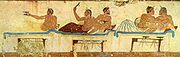 Paestum is also renowned for its painted tombs, mainly belonging to the period of the Lucania
n rule, while only one of them dates to the Greek period. It was found, on 3 June 1968, in a small necropolis
some 1,5 km south of the ancient walls. The burial monument was named Tomb of the Diver
(Italian: Tomba del tuffatore) after the enigmatic scene, depicted on the covering slab, of a lonely young man diving into a stream of water. It was dated to the first half of the fifth century BC (about 470 BC), the Golden Age
of the Greek town. The tomb is painted with the true fresco
technique and its importance lies in being "the only example of Greek painting with figured scenes dating from the Orientalizing, Archaic
, or Classical
periods to survive in its entirety. Among the thousands of Greek tombs known from this time (roughly 700–400 BC), this is the only one to have been decorated with frescoes of human subjects."
The remaining four walls of the tombs are occupied by symposium
related scenes, an iconography far more familiar from the Greek pottery, than the diving scene.
All the five frescoes are visible in the local National Museum, together with the cycle of Lucanian painted tombs.
Campania
Campania is a region in southern Italy. The region has a population of around 5.8 million people, making it the second-most-populous region of Italy; its total area of 13,590 km² makes it the most densely populated region in the country...
region of Italy
Italy
Italy , officially the Italian Republic languages]] under the European Charter for Regional or Minority Languages. In each of these, Italy's official name is as follows:;;;;;;;;), is a unitary parliamentary republic in South-Central Europe. To the north it borders France, Switzerland, Austria and...
. It is located in the north of Cilento
Cilento
Cilento is an Italian geographical region of Campania in the central and southern part of the Province of Salerno and an important tourist area of southern Italy.-Geography:...
, near the coast about 85 km SE of Naples
Naples
Naples is a city in Southern Italy, situated on the country's west coast by the Gulf of Naples. Lying between two notable volcanic regions, Mount Vesuvius and the Phlegraean Fields, it is the capital of the region of Campania and of the province of Naples...
in the province of Salerno
Salerno
Salerno is a city and comune in Campania and is the capital of the province of the same name. It is located on the Gulf of Salerno on the Tyrrhenian Sea....
, and belongs to the commune of Capaccio
Capaccio
Capaccio is a town and comune in the province of Salerno in the Campania region of south-western Italy. The ruins of the ancient city of Paestum lie within borders of the comune.-Airport:...
, officially also named Capaccio-Paestum.
Geography
Paestum is situated close to the TyrrhenianTyrrhenian Sea
The Tyrrhenian Sea is part of the Mediterranean Sea off the western coast of Italy.-Geography:The sea is bounded by Corsica and Sardinia , Tuscany, Lazio, Campania, Basilicata and Calabria and Sicily ....
coast on the road linking Agropoli
Agropoli
Agropoli is a town and comune located in the Cilento area of the province of Salerno, Campania, Italy. It is situated at the start of the Cilento coast, on the Tyrrhenian Sea. Its population is 21.251.-Pre-medieval period:...
to Battipaglia
Battipaglia
Battipaglia is a town and comune in the province of Salerno in the Campania region of south-western Italy, with some 51,000 inhabitants.- History :The birth of the comune of Battipaglia was officialised by a Royal Decree on 28 March 1929...
. Its population is mainly located in the quarters surrounding the ancient Graeco-Roman ruins, as Santa Venere (to the south, near the hamlet of Licinella), Andreoli (north) and Torre di Paestum (west, by the sea). The town also has a railway station on the Naples-Salerno-Reggio Calabria line.
History
Founded around the end of the 7th century BC by colonists from the GreekGreece
Greece , officially the Hellenic Republic , and historically Hellas or the Republic of Greece in English, is a country in southeastern Europe....
city of Sybaris
Sybaris
Sybaris was an ancient city in Magna Graecia on the western shore of the Gulf of Taranto. The wealth of the city during the 6th century BC was so great that the Sybarites became synonymous with pleasure and luxury...
, and originally known as Poseidonia
Poseidonia
Poseidonia is a village and a former municipality on the island of Syros, in the Cyclades, Greece. Since the 2011 local government reform it is part of the municipality Syros-Ermoupoli, of which it is a municipal unit. The population was 3,006 inhabitants at the 2001 census, and the land area is...
. Outside of archaeological evidence very little is known about Paestum during its first centuries. Archaeological evidence indicates that the city was expanding with the building of roads, temples and other features of a growing city. Coinage, architecture and molded votive figurines all attest to close relations maintained with Metaponto
Metaponto
Metaponto is a small town of about 1,000 people in the province of Matera, Basilicata, Italy. Administratively it is a frazione of Bernalda.-History:The town is best known for the ruins of the ancient Greek city of Metapontum...
in the sixth and fifth centuries. It is not until the end of the fifth century BC that the city is mentioned, when according to Strabo
Strabo
Strabo, also written Strabon was a Greek historian, geographer and philosopher.-Life:Strabo was born to an affluent family from Amaseia in Pontus , a city which he said was situated the approximate equivalent of 75 km from the Black Sea...
the city was conquered by the Lucani
Lucani (ancient people)
The Lucani were an ancient people of Italy, living in Lucania, who spoke an Oscan language, a member of the Italic languages.-Society:...
. From the archaeological evidence it appears that the two cultures, Greek and Oscan, were able to thrive alongside one another. What is known is it later became the Roman city of Paestum in 273 BC after the Graeco-Italian Poseidonians sided with the loser, Pyrrhus
Pyrrhus of Epirus
Pyrrhus or Pyrrhos was a Greek general and statesman of the Hellenistic era. He was king of the Greek tribe of Molossians, of the royal Aeacid house , and later he became king of Epirus and Macedon . He was one of the strongest opponents of early Rome...
, in war against Rome
Rome
Rome is the capital of Italy and the country's largest and most populated city and comune, with over 2.7 million residents in . The city is located in the central-western portion of the Italian Peninsula, on the Tiber River within the Lazio region of Italy.Rome's history spans two and a half...
during the first quarter of the third century BC.
During the invasion of Italy by Hannibal the city remained faithful to Rome and afterwards was granted special favours such as the minting of its coinage. The city continued to prosper during the Roman imperial period
Roman Empire
The Roman Empire was the post-Republican period of the ancient Roman civilization, characterised by an autocratic form of government and large territorial holdings in Europe and around the Mediterranean....
, but started to go into decline between the 4th and 7th centuries. It was abandoned during the Middle Ages
Middle Ages
The Middle Ages is a periodization of European history from the 5th century to the 15th century. The Middle Ages follows the fall of the Western Roman Empire in 476 and precedes the Early Modern Era. It is the middle period of a three-period division of Western history: Classic, Medieval and Modern...
and its ruins only came to notice again in the 18th century, following the rediscovery of the Roman cities of Pompeii
Pompeii
The city of Pompeii is a partially buried Roman town-city near modern Naples in the Italian region of Campania, in the territory of the comune of Pompei. Along with Herculaneum, Pompeii was destroyed and completely buried during a long catastrophic eruption of the volcano Mount Vesuvius spanning...
and Herculaneum
Herculaneum
Herculaneum was an ancient Roman town destroyed by volcanic pyroclastic flows in AD 79, located in the territory of the current commune of Ercolano, in the Italian region of Campania in the shadow of Mt...
. The decline and desertion were probably due to changes in local land drainage patterns, leading to swampy malaria
Malaria
Malaria is a mosquito-borne infectious disease of humans and other animals caused by eukaryotic protists of the genus Plasmodium. The disease results from the multiplication of Plasmodium parasites within red blood cells, causing symptoms that typically include fever and headache, in severe cases...
l conditions (this is difficult to picture, with the present aridity; the site is now left to lizard
Lizard
Lizards are a widespread group of squamate reptiles, with nearly 3800 species, ranging across all continents except Antarctica as well as most oceanic island chains...
s and a few tourists).
On September 9, 1943, Paestum was the location of the landing beaches of the U.S. 36th Infantry Division
U.S. 36th Infantry Division
-Pre 2 October 1941 Square Organization:*HHC, 36th Infantry Division, TXARNG**36th Military Police Platoon**36th Signal Company**111th Ordnance Company**111th Engineer Regiment , TXARNG**111th Medical Regiment**111th Quartermaster Regiment...
during the Allied invasion of Italy. German
Germany
Germany , officially the Federal Republic of Germany , is a federal parliamentary republic in Europe. The country consists of 16 states while the capital and largest city is Berlin. Germany covers an area of 357,021 km2 and has a largely temperate seasonal climate...
forces resisted the landings from the outset, causing heavy fighting within and around the town. Combat persisted around the town for nine days before the Germans withdrew to the north.
Overview
The main features of the site today are the standing remains of three major temples in DoricDoric order
The Doric order was one of the three orders or organizational systems of ancient Greek or classical architecture; the other two canonical orders were the Ionic and the Corinthian.-History:...
style, dating from the first half of the 6th century BC. These were dedicated to Hera
Hera
Hera was the wife and one of three sisters of Zeus in the Olympian pantheon of Greek mythology and religion. Her chief function was as the goddess of women and marriage. Her counterpart in the religion of ancient Rome was Juno. The cow and the peacock were sacred to her...
and Athena
Athena
In Greek mythology, Athena, Athenê, or Athene , also referred to as Pallas Athena/Athene , is the goddess of wisdom, courage, inspiration, civilization, warfare, strength, strategy, the arts, crafts, justice, and skill. Minerva, Athena's Roman incarnation, embodies similar attributes. Athena is...
, although they have traditionally been identified as a basilica
Basilica
The Latin word basilica , was originally used to describe a Roman public building, usually located in the forum of a Roman town. Public basilicas began to appear in Hellenistic cities in the 2nd century BC.The term was also applied to buildings used for religious purposes...
and temples of Neptune
Poseidon
Poseidon was the god of the sea, and, as "Earth-Shaker," of the earthquakes in Greek mythology. The name of the sea-god Nethuns in Etruscan was adopted in Latin for Neptune in Roman mythology: both were sea gods analogous to Poseidon...
and Ceres, owing to 18th-century mis-attribution.
The city of Paestum covers an area of approximately 120 hectares. It is only the 25 hectares that contain the three main temples that have been excavated. The other 95 hectares remain on private land and have not been excavated. The city is surrounded by defensive walls that still stand. The walls are approximately 4750 m long, 5 – 7 m thick and 15 m high. Positioned along the wall are 24 square and round towers. There may have been up to 28 but some of them were destroyed during the construction of highway in 18th century that effectively cuts the site in two.
The modern town of Paestum, directly to the north of the archaeological site, is a popular seaside resort. In the region of Paestum there are long, sandy beaches.
Historic buildings
Temple of Neptune, Paestum
The so-called Temple of Neptune, Paestum is a Greek temple in Paestum, Campania, Italy, actually dedicated to the goddess Hera. It is part of the UNESCO World Heritage site....
, built around 550 BC by Greek colonists, is the oldest surviving temple in Paestum. Eighteenth-century archaeologists named it "The Basilica" because they mistakenly believed it to be a Roman building. A basilica in Roman times was a civil building, not a religious one. Inscriptions revealed that the goddess worshiped here was Hera
Hera
Hera was the wife and one of three sisters of Zeus in the Olympian pantheon of Greek mythology and religion. Her chief function was as the goddess of women and marriage. Her counterpart in the religion of ancient Rome was Juno. The cow and the peacock were sacred to her...
. Later, an altar
Altar
An altar is any structure upon which offerings such as sacrifices are made for religious purposes. Altars are usually found at shrines, and they can be located in temples, churches and other places of worship...
was unearthed in front of the temple, in the open-air site usual for a Greek altar; the faithful could attend rites and sacrifice
Sacrifice
Sacrifice is the offering of food, objects or the lives of animals or people to God or the gods as an act of propitiation or worship.While sacrifice often implies ritual killing, the term offering can be used for bloodless sacrifices of cereal food or artifacts...
s without entering the cella
Cella
A cella or naos , is the inner chamber of a temple in classical architecture, or a shop facing the street in domestic Roman architecture...
.
Just south of the city walls, at a site still called Santa Venera, a series of small terracotta offertory
Offertory
The Offertory is the portion of a Eucharistic service when bread and wine are brought to the altar. The offertory exists in many liturgical Christian denominations, though the Eucharistic theology varies among celebrations conducted by these denominations....
molded statuettes of a standing female nude wearing the polos
Polos
Polos generally refers to a high cylindrical crown typically worn by mythological goddesses.Polos may also refer to:* The plural of polo* In music, the polos is one of the interlocking parts of Kotekan...
headdress of Anatolian and Syrian goddesses, which were dated to the first half of the sixth century BC, were found in the sanctuary; other similar ones have been excavated at other Paestum sanctuaries during excavations in the 1980s, but the figure is highly unusual in the Western Mediterranean. The open-air temenos
Temenos
Temenos is a piece of land cut off and assigned as an official domain, especially to kings and chiefs, or a piece of land marked off from common uses and dedicated to a god, a sanctuary, holy grove or holy precinct: The Pythian race-course is called a temenos, the sacred valley of the Nile is the ...
was established at the start of Greek occupation: a temple on the site was not built until the early fifth century. A nude goddess is a figure alien to Greek culture before Praxiteles
Praxiteles
Praxiteles of Athens, the son of Cephisodotus the Elder, was the most renowned of the Attic sculptors of the 4th century BC. He was the first to sculpt the nude female form in a life-size statue...
' famous Cnidian Aphrodite in the fourth century: iconographic analogies must be sought in Phoenician Astarte
Astarte
Astarte is the Greek name of a goddess known throughout the Eastern Mediterranean from the Bronze Age to Classical times...
and the Cypriote Aphrodite. "In places where the Greeks and Phoenicians came in contact with one another, there is often an overlapping in the persona of the two deities," Rebecca Miller Ammerman has explained (Ammerman 1991), in identifying the cult at the site as that of Phoenician Astarte or Cypriot Aphrodite. In Roman times, inscriptions make clear, the cult was reserved to Venus
Venus (mythology)
Venus is a Roman goddess principally associated with love, beauty, sex,sexual seduction and fertility, who played a key role in many Roman religious festivals and myths...
.
The nearby temple, the second Temple of Hera, was built in about 460-450 BC. It has been variously thought of as a temple dedicated to Poseidon
Poseidon
Poseidon was the god of the sea, and, as "Earth-Shaker," of the earthquakes in Greek mythology. The name of the sea-god Nethuns in Etruscan was adopted in Latin for Neptune in Roman mythology: both were sea gods analogous to Poseidon...
. The Temple of Hera II has nothing in common with the first temple, reason being for its symmetrical style for its columns. Also every column does not have a normal 20 flutes on each column but it has 24 flutes. The Temple of Hera II also has a wider column and a smaller spacing for the placing of the columns. The temple was also found to be used to worship more than just Hera but also Zeus and another unknown god. There are visible on the east side the remains of two altars, one large and one smaller. The smaller one is a Roman addition, built when they cut through the larger one to build a road to the forum
Forum (Roman)
A forum was a public square in a Roman municipium, or any civitas, reserved primarily for the vending of goods; i.e., a marketplace, along with the buildings used for shops and the stoas used for open stalls...
. It is also possible that the temple was originally dedicated to both Hera and Zeus
Zeus
In the ancient Greek religion, Zeus was the "Father of Gods and men" who ruled the Olympians of Mount Olympus as a father ruled the family. He was the god of sky and thunder in Greek mythology. His Roman counterpart is Jupiter and his Etruscan counterpart is Tinia.Zeus was the child of Cronus...
; some offertory statues found around the larger altar are thought to demonstrate this identification.
In the central part of the complex is the Roman Forum
Forum (Roman)
A forum was a public square in a Roman municipium, or any civitas, reserved primarily for the vending of goods; i.e., a marketplace, along with the buildings used for shops and the stoas used for open stalls...
, thought to have been built on the site of the preceding Greek agora
Agora
The Agora was an open "place of assembly" in ancient Greek city-states. Early in Greek history , free-born male land-owners who were citizens would gather in the Agora for military duty or to hear statements of the ruling king or council. Later, the Agora also served as a marketplace where...
. On the north side of the forum is a small Roman temple, dated to around 200 BC. It was dedicated to the Capitoline Triad
Capitoline Triad
In ancient Roman religion, the Capitoline Triad was a group of three supreme deities who were worshipped in an elaborate temple on Rome's Capitoline Hill, the Capitolium. Two distinct Capitoline Triads were worshipped at various times in Rome's history, both originating in ancient traditions...
, Jupiter
Jupiter (mythology)
In ancient Roman religion and myth, Jupiter or Jove is the king of the gods, and the god of the sky and thunder. He is the equivalent of Zeus in the Greek pantheon....
, Juno
Juno (mythology)
Juno is an ancient Roman goddess, the protector and special counselor of the state. She is a daughter of Saturn and sister of the chief god Jupiter and the mother of Mars and Vulcan. Juno also looked after the women of Rome. Her Greek equivalent is Hera...
and Minerva
Minerva
Minerva was the Roman goddess whom Romans from the 2nd century BC onwards equated with the Greek goddess Athena. She was the virgin goddess of poetry, medicine, wisdom, commerce, weaving, crafts, magic...
.
To the north-west of the forum is the amphitheater. This is of normal Roman pattern, though much smaller than later examples. Only the southern half is visible; in 1930 AD, a road was built across the site, burying the northern half. It is said by local inhabitants that the civil engineer responsible was tried, convicted and received a prison sentence for what was described as wanton destruction of an historic site.
On the highest point of the town, some way from the other temples, is the temple of Athena. It was built in about 500 BC, and was for some time incorrectly thought to have been dedicated to Ceres. The architecture is transitional, being partly in the Ionic mode and partly early Doric. Three medieval Christian tombs in the floor show that the temple was at one time used as a Christian
Christian
A Christian is a person who adheres to Christianity, an Abrahamic, monotheistic religion based on the life and teachings of Jesus of Nazareth as recorded in the Canonical gospels and the letters of the New Testament...
church.
All three temples have undergone some renovation and repair in recent years. Close access is allowed, but entry by visitors into the buildings is no longer permitted.
Painted tombs
Lucania
Lucania was an ancient district of southern Italy, extending from the Tyrrhenian Sea to the Gulf of Taranto. To the north it adjoined Campania, Samnium and Apulia, and to the south it was separated by a narrow isthmus from the district of Bruttium...
n rule, while only one of them dates to the Greek period. It was found, on 3 June 1968, in a small necropolis
Necropolis
A necropolis is a large cemetery or burial ground, usually including structural tombs. The word comes from the Greek νεκρόπολις - nekropolis, literally meaning "city of the dead"...
some 1,5 km south of the ancient walls. The burial monument was named Tomb of the Diver
Tomb of the Diver
The Tomb of the Diver is an important archaeological monument, found by the Italian archaeologist Mario Napoli on 3 June 1968 during his excavation of a small necropolis about 1.5 km south of the Greek city of Paestum in Magna Graecia, now southern Italy...
(Italian: Tomba del tuffatore) after the enigmatic scene, depicted on the covering slab, of a lonely young man diving into a stream of water. It was dated to the first half of the fifth century BC (about 470 BC), the Golden Age
Golden Age (metaphor)
A golden age is a period in a field of endeavour when great tasks were accomplished. The term originated from early Greek and Roman poets who used to refer to a time when mankind lived in a better time and was pure .-Golden Age in society:...
of the Greek town. The tomb is painted with the true fresco
Fresco
Fresco is any of several related mural painting types, executed on plaster on walls or ceilings. The word fresco comes from the Greek word affresca which derives from the Latin word for "fresh". Frescoes first developed in the ancient world and continued to be popular through the Renaissance...
technique and its importance lies in being "the only example of Greek painting with figured scenes dating from the Orientalizing, Archaic
Archaic period in Greece
The Archaic period in Greece was a period of ancient Greek history that followed the Greek Dark Ages. This period saw the rise of the polis and the founding of colonies, as well as the first inklings of classical philosophy, theatre in the form of tragedies performed during Dionysia, and written...
, or Classical
Classical Greece
Classical Greece was a 200 year period in Greek culture lasting from the 5th through 4th centuries BC. This classical period had a powerful influence on the Roman Empire and greatly influenced the foundation of Western civilizations. Much of modern Western politics, artistic thought, such as...
periods to survive in its entirety. Among the thousands of Greek tombs known from this time (roughly 700–400 BC), this is the only one to have been decorated with frescoes of human subjects."
The remaining four walls of the tombs are occupied by symposium
Symposium
In ancient Greece, the symposium was a drinking party. Literary works that describe or take place at a symposium include two Socratic dialogues, Plato's Symposium and Xenophon's Symposium, as well as a number of Greek poems such as the elegies of Theognis of Megara...
related scenes, an iconography far more familiar from the Greek pottery, than the diving scene.
All the five frescoes are visible in the local National Museum, together with the cycle of Lucanian painted tombs.
In fiction
- Gate to the Sea, a historical novel by BryherBryherBryher was the pen name of the novelist, poet, memoirist, and magazine editor Annie Winifred Ellerman. She was born in September 1894 in Margate. Her father was the shipowner and financier John Ellerman, who at the time of his death in 1933, was the richest Englishman who had ever lived...
published in 1958, portrays the flight of Harmonia, a Greek high priestess, from Poseidonia (Paestum), where the Greek inhabitants have been enslaved and culturally dominated by the LucaniLucaniLučani is a town and municipality located in the Dragačevo region within the Moravica District of Serbia . The population of the town is 3,425, while population of the municipality was 20,855....
since the death of Alexander the Great in 323 BC
Airport
The nearest Airport is Salerno-Pontecagnano (QSR), is 30 Km from Paestum.See also
- Architecture of Ancient GreeceArchitecture of Ancient GreeceThe architecture of Ancient Greece is the architecture produced by the Greek-speaking people whose culture flourished on the Greek mainland and Peloponnesus, the Aegean Islands, and in colonies in Asia Minor and Italy for a period from about 900 BC until the 1st century AD, with the earliest...
- Greek templeGreek templeGreek temples were structures built to house deity statues within Greek sanctuaries in Greek paganism. The temples themselves did usually not directly serve a cult purpose, since the sacrifices and rituals dedicated to the respective deity took place outside them...
- List of ancient Greek temples
- List of Greco-Roman roofs
- List of archaeological sites sorted by country
Sources
- A.C. Carpiceci and L. Pennino, Paestum and Velia, Matonti, Salerno, 1995
- R. Ross Holloway. The Tomb of the Diver, in American Journal of ArchaeologyAmerican Journal of ArchaeologyThe American Journal of Archaeology , the peer-reviewed journal of the Archaeological Institute of America, has been published since 1897...
, Vol. 110, n. 3, July 2006 (pp. 365–388) - J.G. Pedley, Paestum: Greeks and Roman in Southern Italy, Thames and Hudson, London, 1990