

Ashmolean Museum

Encyclopedia
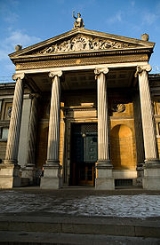
The Ashmolean Museum on Beaumont Street
, Oxford
, England, is the world's first university museum. Its first building was built in 1678–1683 to house the cabinet of curiosities
Elias Ashmole
gave Oxford University in 1677.
, which he had collected himself as well as works he had acquired from the gardeners, travellers and collectors John Tradescant the elder
and his son of the same name
. The collection included antique coins, books, engravings, geological specimens, and zoological specimens—one of which was the stuffed body of the last Dodo
ever seen in Europe, but by 1755 it was so moth-eaten it was destroyed, except for its head and one claw. The museum opened on 24 May 1683, with naturalist
Robert Plot
as the first keeper. The first building, which became known as the Old Ashmolean
, is sometimes attributed to Sir Christopher Wren
or Thomas Wood
.
After the various specimens had been moved into new museums, the "Old Ashmolean" building on Broad Street was used as office space for the Oxford English Dictionary
staff. Since 1924, the building has been established as the Museum of the History of Science, with exhibitions including the scientific instruments given to Oxford University by Lewis Evans
(1853–1930), amongst them the world's largest collection of astrolabe
s.
The present building dates from 1845. It was designed by Charles Cockerell
in a classical
style and stands on Beaumont Street. One wing of the building is occupied by the Taylor Institution
, the modern languages faculty of the university. The main museum contains huge collections of archaeology
specimens and fine art. It has one of the best collections of Pre-Raphaelite paintings, majolica
pottery and English silver. The archaeology department includes the bequest of Arthur Evans
and so has an excellent collection of Greek
and Minoan
pottery. The department also has an extensive collection of antiquities from Ancient Egypt
and the Sudan, and the museum hosts the Griffith Institute
for the advancement of Egyptology.
, incorporating the older library collections of the Ashmolean, opened in 2001 and has allowed an expansion of the book collection, which concentrates on classical civilization, archaeology and art history.
Between 2006 and 2009, the museum was extensively rebuilt and expanded to the designs of architect Rick Mather
and the exhibition design company Metaphor
, supported by the Heritage Lottery Fund
. The rebuilding resulted in five floors instead of three, with a doubling of the display space as well as new conservation studios and an education centre. The renovated museum re-opened on 7 November 2009.
Beginning in 1973, the position of Keeper was superseded by that of Director:
Beaumont Street
Beaumont Street is a street in the centre of Oxford, England.The street was laid out from 1828 to 1837 with elegant terraced houses in the Regency style. Before that, it was the location of Beaumont Palace, now noted by a plaque near the junction with Walton Street...
, Oxford
Oxford
The city of Oxford is the county town of Oxfordshire, England. The city, made prominent by its medieval university, has a population of just under 165,000, with 153,900 living within the district boundary. It lies about 50 miles north-west of London. The rivers Cherwell and Thames run through...
, England, is the world's first university museum. Its first building was built in 1678–1683 to house the cabinet of curiosities
Cabinet of curiosities
A cabinet of curiosities was an encyclopedic collection in Renaissance Europe of types of objects whose categorical boundaries were yet to be defined. They were also known by various names such as Cabinet of Wonder, and in German Kunstkammer or Wunderkammer...
Elias Ashmole
Elias Ashmole
Elias Ashmole was a celebrated English antiquary, politician, officer of arms, astrologer and student of alchemy. Ashmole supported the royalist side during the English Civil War, and at the restoration of Charles II he was rewarded with several lucrative offices.Ashmole was an antiquary with a...
gave Oxford University in 1677.
History
The collection include that of Elias AshmoleElias Ashmole
Elias Ashmole was a celebrated English antiquary, politician, officer of arms, astrologer and student of alchemy. Ashmole supported the royalist side during the English Civil War, and at the restoration of Charles II he was rewarded with several lucrative offices.Ashmole was an antiquary with a...
, which he had collected himself as well as works he had acquired from the gardeners, travellers and collectors John Tradescant the elder
John Tradescant the elder
John Tradescant the elder , father of John Tradescant the younger, was an English naturalist, gardener, collector and traveller, probably born in Suffolk, England...
and his son of the same name
John Tradescant the younger
John Tradescant the Younger , son of John Tradescant the elder, was a botanist and gardener, born in Meopham, Kent and educated at The King's School, Canterbury...
. The collection included antique coins, books, engravings, geological specimens, and zoological specimens—one of which was the stuffed body of the last Dodo
Dodo
The dodo was a flightless bird endemic to the Indian Ocean island of Mauritius. Related to pigeons and doves, it stood about a meter tall, weighing about , living on fruit, and nesting on the ground....
ever seen in Europe, but by 1755 it was so moth-eaten it was destroyed, except for its head and one claw. The museum opened on 24 May 1683, with naturalist
Natural history
Natural history is the scientific research of plants or animals, leaning more towards observational rather than experimental methods of study, and encompasses more research published in magazines than in academic journals. Grouped among the natural sciences, natural history is the systematic study...
Robert Plot
Robert Plot
Robert Plot was an English naturalist, first Professor of Chemistry at the University of Oxford, and the first keeper of the Ashmolean Museum....
as the first keeper. The first building, which became known as the Old Ashmolean
Museum of the History of Science, Oxford
The Museum of the History of Science, located in Broad Street, Oxford, is home to an unrivalled collection of scientific instruments from medieval times to the 17th century. Its collection of 18th and 19th-century instruments is also substantial...
, is sometimes attributed to Sir Christopher Wren
Christopher Wren
Sir Christopher Wren FRS is one of the most highly acclaimed English architects in history.He used to be accorded responsibility for rebuilding 51 churches in the City of London after the Great Fire in 1666, including his masterpiece, St. Paul's Cathedral, on Ludgate Hill, completed in 1710...
or Thomas Wood
Thomas Wood
Thomas Wood may refer to:* E. Thomas Wood , American journalist and author* Thomas Harold Wood , Canadian politician* Thomas J. Wood , Union General during the American Civil War* Thomas Jefferson Wood , U.S...
.
After the various specimens had been moved into new museums, the "Old Ashmolean" building on Broad Street was used as office space for the Oxford English Dictionary
Oxford English Dictionary
The Oxford English Dictionary , published by the Oxford University Press, is the self-styled premier dictionary of the English language. Two fully bound print editions of the OED have been published under its current name, in 1928 and 1989. The first edition was published in twelve volumes , and...
staff. Since 1924, the building has been established as the Museum of the History of Science, with exhibitions including the scientific instruments given to Oxford University by Lewis Evans
Lewis Evans (collector)
Lewis Evans was an English businessman and scientific instrument collector.Lewis Evans was the son of Sir John Evans, an archaeologist, and younger brother of the more famous archaeologist Sir Arthur Evans who excavated Knossos in Crete. He studied chemistry at University College London and...
(1853–1930), amongst them the world's largest collection of astrolabe
Astrolabe
An astrolabe is an elaborate inclinometer, historically used by astronomers, navigators, and astrologers. Its many uses include locating and predicting the positions of the Sun, Moon, planets, and stars, determining local time given local latitude and longitude, surveying, triangulation, and to...
s.
The present building dates from 1845. It was designed by Charles Cockerell
Charles Robert Cockerell
Charles Robert Cockerell was an English architect, archaeologist, and writer.-Life:Charles Robert Cockerell was educated at Westminster School from 1802. From the age of sixteen, he trained in the architectural practice of his father, Samuel Pepys Cockerell...
in a classical
Classicism
Classicism, in the arts, refers generally to a high regard for classical antiquity, as setting standards for taste which the classicists seek to emulate. The art of classicism typically seeks to be formal and restrained: of the Discobolus Sir Kenneth Clark observed, "if we object to his restraint...
style and stands on Beaumont Street. One wing of the building is occupied by the Taylor Institution
Taylor Institution
The Taylor Institution comprises the buildings in Oxford which harbour the libraries dedicated to the study of the European Languages at Oxford University. It also includes lecture rooms used by the Faculty of Medieval and Modern Languages, University of Oxford...
, the modern languages faculty of the university. The main museum contains huge collections of archaeology
Archaeology
Archaeology, or archeology , is the study of human society, primarily through the recovery and analysis of the material culture and environmental data that they have left behind, which includes artifacts, architecture, biofacts and cultural landscapes...
specimens and fine art. It has one of the best collections of Pre-Raphaelite paintings, majolica
Maiolica
Maiolica is Italian tin-glazed pottery dating from the Renaissance. It is decorated in bright colours on a white background, frequently depicting historical and legendary scenes.-Name:...
pottery and English silver. The archaeology department includes the bequest of Arthur Evans
Arthur Evans
Sir Arthur John Evans FRS was a British archaeologist most famous for unearthing the palace of Knossos on the Greek island of Crete and for developing the concept of Minoan civilization from the structures and artifacts found there and elsewhere throughout eastern Mediterranean...
and so has an excellent collection of Greek
Ancient Greece
Ancient Greece is a civilization belonging to a period of Greek history that lasted from the Archaic period of the 8th to 6th centuries BC to the end of antiquity. Immediately following this period was the beginning of the Early Middle Ages and the Byzantine era. Included in Ancient Greece is the...
and Minoan
Minoan civilization
The Minoan civilization was a Bronze Age civilization that arose on the island of Crete and flourished from approximately the 27th century BC to the 15th century BC. It was rediscovered at the beginning of the 20th century through the work of the British archaeologist Arthur Evans...
pottery. The department also has an extensive collection of antiquities from Ancient Egypt
Ancient Egypt
Ancient Egypt was an ancient civilization of Northeastern Africa, concentrated along the lower reaches of the Nile River in what is now the modern country of Egypt. Egyptian civilization coalesced around 3150 BC with the political unification of Upper and Lower Egypt under the first pharaoh...
and the Sudan, and the museum hosts the Griffith Institute
Griffith Institute
The Griffith Institute is an institution based in the Ashmolean Museum of the University of Oxford for the advancement of Egyptology as a discipline. The Griffith Institute is named after the eminent Egyptologist Francis Llewellyn Griffith, who bequeathed funds within his will for the foundation of...
for the advancement of Egyptology.
Theft
On 31 December 1999 (New Year's Eve), thieves used scaffolding on an adjoining building to climb onto the roof of the Ashmolean to break through a skylight, stealing a painting by Cézanne. As the thieves ignored other works in the same room and it has not been offered for sale, it is speculated that this was a case of an artwork stolen to order.Renovation
The interior of the Ashmolean has been extensively modernised in recent years and now includes a restaurant and large gift shop. The Sackler LibrarySackler Library
The Sackler Library holds a large portion of the classical, art historical, and archaeological works belonging to the University of Oxford, England.- History :...
, incorporating the older library collections of the Ashmolean, opened in 2001 and has allowed an expansion of the book collection, which concentrates on classical civilization, archaeology and art history.
Between 2006 and 2009, the museum was extensively rebuilt and expanded to the designs of architect Rick Mather
Rick Mather
Rick Mather is an American-born architect working in England. Born in Portland, Oregon and awarded a B.arch. at the University of Oregon in 1961, he came to London in 1963 where he founded his own practice, Rick Mather Architects, a decade later....
and the exhibition design company Metaphor
Metaphor (designers)
Metaphor is a London-based, global design firm that was founded in 2000 by Stephen Greenberg and Rachel Morris. Metaphor specialises in the re-presentation of museums, palaces, forts, landscapes and country houses through masterplanning and design...
, supported by the Heritage Lottery Fund
Heritage Lottery Fund
The Heritage Lottery Fund is a fund established in the United Kingdom under the National Lottery etc. Act 1993. The Fund opened for applications in 1994. It uses money raised through the National Lottery to transform and sustain the UK’s heritage...
. The rebuilding resulted in five floors instead of three, with a doubling of the display space as well as new conservation studios and an education centre. The renovated museum re-opened on 7 November 2009.
Collections
Highlights of the Ashmolean's collection include:- A substantial number of Oxyrhynchus PapyriOxyrhynchus PapyriThe Oxyrhynchus Papyri are a very numerous group of manuscripts discovered by archaeologists including Bernard Pyne Grenfell and Arthur Surridge Hunt at an ancient rubbish dump near Oxyrhynchus in Egypt . The manuscripts date from the 1st to the 6th century AD. They include thousands of Greek and...
, including OldOld TestamentThe Old Testament, of which Christians hold different views, is a Christian term for the religious writings of ancient Israel held sacred and inspired by Christians which overlaps with the 24-book canon of the Masoretic Text of Judaism...
and New TestamentNew TestamentThe New Testament is the second major division of the Christian biblical canon, the first such division being the much longer Old Testament....
biblical manuscripts - The Alfred JewelAlfred JewelThe Alfred Jewel is an Anglo-Saxon ornament dating from the late 9th century, discovered in 1693.It was made in the reign of King Alfred the Great and is inscribed "AELFRED MEC HEHT GEWYRCAN", meaning "Alfred ordered me made"...
- Drawings by MichelangeloMichelangeloMichelangelo di Lodovico Buonarroti Simoni , commonly known as Michelangelo, was an Italian Renaissance painter, sculptor, architect, poet, and engineer who exerted an unparalleled influence on the development of Western art...
, Raphael and Leonardo da VinciLeonardo da VinciLeonardo di ser Piero da Vinci was an Italian Renaissance polymath: painter, sculptor, architect, musician, scientist, mathematician, engineer, inventor, anatomist, geologist, cartographer, botanist and writer whose genius, perhaps more than that of any other figure, epitomized the Renaissance... - Watercolours and paintings by TurnerJ. M. W. TurnerJoseph Mallord William Turner RA was an English Romantic landscape painter, watercolourist and printmaker. Turner was considered a controversial figure in his day, but is now regarded as the artist who elevated landscape painting to an eminence rivalling history painting...
- Paintings by Paolo UccelloPaolo UccelloPaolo Uccello , born Paolo di Dono, was an Italian painter and a mathematician who was notable for his pioneering work on visual perspective in art. Giorgio Vasari in his book Lives of the Artists wrote that Uccello was obsessed by his interest in perspective and would stay up all night in his...
, Piero di CosimoPiero di CosimoPiero di Cosimo , also known as Piero di Lorenzo, was an Italian Renaissance painter.-Biography:The son of a goldsmith, Piero was born in Florence and apprenticed under the artist Cosimo Rosseli, from whom he derived his popular name and whom he assisted in the painting of the Sistine Chapel in...
, John ConstableJohn ConstableJohn Constable was an English Romantic painter. Born in Suffolk, he is known principally for his landscape paintings of Dedham Vale, the area surrounding his home—now known as "Constable Country"—which he invested with an intensity of affection...
, Claude Lorraine, and Pablo PicassoPablo PicassoPablo Diego José Francisco de Paula Juan Nepomuceno María de los Remedios Cipriano de la Santísima Trinidad Ruiz y Picasso known as Pablo Ruiz Picasso was a Spanish expatriate painter, sculptor, printmaker, ceramicist, and stage designer, one of the greatest and most influential artists of the... - Arab ceremonial dress owned by Lawrence of Arabia
- A death mask of Oliver CromwellOliver CromwellOliver Cromwell was an English military and political leader who overthrew the English monarchy and temporarily turned England into a republican Commonwealth, and served as Lord Protector of England, Scotland, and Ireland....
- The collection of Posie ringPosie ringPosie rings are finger rings with short inscriptions on their outer surfaces. More rarely the inscription is on the inner surface....
s that supposedly inspired the One RingOne RingThe One Ring is a fictional artifact that appears as the central plot element in J. R. R. Tolkien's Middle-earth fantasy novels. It is described in an earlier story, The Hobbit , as a magic ring of invisibility. The sequel The Lord of the Rings describes its powers as being more encompassing than...
in J. R. R. TolkienJ. R. R. TolkienJohn Ronald Reuel Tolkien, CBE was an English writer, poet, philologist, and university professor, best known as the author of the classic high fantasy works The Hobbit, The Lord of the Rings, and The Silmarillion.Tolkien was Rawlinson and Bosworth Professor of Anglo-Saxon at Pembroke College,...
's The Lord of the RingsThe Lord of the RingsThe Lord of the Rings is a high fantasy epic written by English philologist and University of Oxford professor J. R. R. Tolkien. The story began as a sequel to Tolkien's earlier, less complex children's fantasy novel The Hobbit , but eventually developed into a much larger work. It was written in... - The Parian MarbleParian ChronicleThe Parian Marble or Parian Chronicle is a Greek chronological table, covering the years from 1581 BC to 264 BC, inscribed on a stele...
, the earliest extant example of a Greek chronological table - The Metrological ReliefMetrological ReliefThe Metrological Relief is an Ancient Greek relief of a man with arms outstretched, cut with hammer and chisel on a triangular, marble slab between 460 to 430 BC. It was found in Turkey or the Greek Islands in 1625–26 AD by a chaplain called William Petty collecting sculptures for Thomas Howard,...
, showing Ancient GreekAncient GreeceAncient Greece is a civilization belonging to a period of Greek history that lasted from the Archaic period of the 8th to 6th centuries BC to the end of antiquity. Immediately following this period was the beginning of the Early Middle Ages and the Byzantine era. Included in Ancient Greece is the...
measurements - The ceremonial cloak of Chief PowhatanChief PowhatanChief Powhatan , whose proper name was Wahunsenacawh , was the paramount chief of Tsenacommacah, an alliance of Algonquian-speaking Virginia Indians in the Tidewater region of Virginia at the time English settlers landed at Jamestown in 1607...
- The lanternLanternA lantern is a portable lighting device or mounted light fixture used to illuminate broad areas. Lanterns may also be used for signaling, as 'torches', or as general light sources outdoors . Low light level varieties are used for decoration. The term "lantern" is also used more generically to...
that Gunpowder PlotGunpowder PlotThe Gunpowder Plot of 1605, in earlier centuries often called the Gunpowder Treason Plot or the Jesuit Treason, was a failed assassination attempt against King James I of England and VI of Scotland by a group of provincial English Catholics led by Robert Catesby.The plan was to blow up the House of...
conspiracist Guy FawkesGuy FawkesGuy Fawkes , also known as Guido Fawkes, the name he adopted while fighting for the Spanish in the Low Countries, belonged to a group of provincial English Catholics who planned the failed Gunpowder Plot of 1605.Fawkes was born and educated in York...
carried in 1605 - The Messiah StradivariusMessiah StradivariusThe Messiah-Salabue Stradivarius of 1716 is a violin made by Italian luthier Antonio Stradivari of Cremona. It is considered to be the only Stradivarius in existence in as new state....
, a violin made by Antonio StradivariAntonio StradivariAntonio Stradivari was an Italian luthier and a crafter of string instruments such as violins, cellos, guitars, violas, and harps. Stradivari is generally considered the most significant artisan in this field. The Latinized form of his surname, Stradivarius, as well as the colloquial, "Strad", is... - The MinoanMinoan civilizationThe Minoan civilization was a Bronze Age civilization that arose on the island of Crete and flourished from approximately the 27th century BC to the 15th century BC. It was rediscovered at the beginning of the 20th century through the work of the British archaeologist Arthur Evans...
collection of Arthur EvansArthur EvansSir Arthur John Evans FRS was a British archaeologist most famous for unearthing the palace of Knossos on the Greek island of Crete and for developing the concept of Minoan civilization from the structures and artifacts found there and elsewhere throughout eastern Mediterranean...
, the biggest outside CreteCreteCrete is the largest and most populous of the Greek islands, the fifth largest island in the Mediterranean Sea, and one of the thirteen administrative regions of Greece. It forms a significant part of the economy and cultural heritage of Greece while retaining its own local cultural traits... - The Narmer MaceheadNarmer MaceheadThe Narmer macehead is an ancient Egyptian decorative stone mace head. It was found during a dig at Kom al Akhmar, the site of Hierakonpolis It is dated to the reign of king Narmer whose serekh is engraved on it...
and Scorpion MaceheadScorpion MaceheadThe Scorpion macehead refers to a decorated ancient Egyptian macehead found by British archeologists James E. Quibell and Frederick W. Green in what they called the main deposit in the temple of Horus at Hierakonpolis during the dig season of 1897/1898... - The Kish tabletKish tabletThe Kish tablet is a limestone tablet found at Tell al-Uhaymir, Babil Governorate, Iraq - the site of the ancient Sumerian city of Kish. It is dated to ca. 3500 BC...
- The Abingdon Sword, an Anglo-Saxon sword found at Abingdon south of Oxford
Keepers and Directors
| Keeper | From | To |
|---|---|---|
| Robert Plot Robert Plot Robert Plot was an English naturalist, first Professor of Chemistry at the University of Oxford, and the first keeper of the Ashmolean Museum.... |
1683 | 1691 |
| Edward Lhuyd Edward Lhuyd Edward Lhuyd was a Welsh naturalist, botanist, linguist, geographer and antiquary. He is also known by the Latinized form of his name, Eduardus Luidius.... |
1691 | 1709 |
| David Parry David Parry (scholar) David Parry was a Welsh scholar and assistant to the naturalist Edward Lhuyd. He was Keeper of the Ashmolean Museum in Oxford from 1709 until his death in 1714.-Life:... |
1709 | 1714 |
| John Whiteside | 1714 | 1729 |
| George Huddesford | 1732 | 1755 |
| William Huddesford William Huddesford William Huddesford was Keeper of the Ashmolean Museum from 1755 to 1772. Huddesford is credited with reinventing the Museum's reputation.-Life:... |
1755 | 1772 |
| John Shute Duncan | 1823 | 1829 |
| Philip Duncan | 1829 | |
| John Henry Parker John Henry Parker John Henry Parker CB , English writer on architecture and publisher, was the son of John Parker, a London merchant.... |
1869 | |
| Sir Arthur Evans | 1884 | 1908 |
| David George Hogarth David George Hogarth David George Hogarth was a British archaeologist and scholar associated with T. E. Lawrence and Arthur Evans.-Archaeological career:... |
1909 | 1927 |
| Edward Thurlow Leeds | 1928 | 1945 |
| Sir Karl Parker | 1945 | 1962 |
| Robert W. Hamilton | 1962 | 1973 |
Beginning in 1973, the position of Keeper was superseded by that of Director:
- D. T. (later Sir David) Piper (1973–1985)
- Professor Sir Christopher White (1985–1997)
- Dr P.R.S. MooreyRoger MooreyPeter Roger Stuart Moorey, FBA, FSA was a British archaeologist and historian of Mesopotamia and the Ancient Near East, and former Keeper of Antiquities at the Ashmolean Museum of the University of Oxford...
(Acting Director) (1997–1998) - Dr Christopher Brown (1998 – )
In popular culture
- The Alfred Jewel was the inspiration for the Inspector Morse episode "The WolvercoteWolvercoteWolvercote is a village that is part of the City of Oxford, England, though still retaining its own identity. It is about northwest of the centre of Oxford, on the northern edge of Wolvercote Common, which is itself north of Port Meadow.-History:The village is listed in the Domesday Book as...
Tongue", in which the museum's interior was used as a set. The Ashmolean also figures prominently in several episodes of the successor series Lewis, particularly the episode "Point of Vanishing" where the painting The Hunt in the ForestThe Hunt in the ForestThe Hunt in the Forest is a painting by the Italian artist Paolo Uccello, made around 1470...
is a key plot element and the characters visit the painting at the museum and are instructed on its features by an art expert before solving the case.
- The musical Where's Charley?Where's Charley?Where's Charley? is a musical with music and lyrics by Frank Loesser and book by George Abbott. The story was based on the play Charley's Aunt by Brandon Thomas. The musical debuted on Broadway in 1948 and was revived on Broadway and in the West End...
, written by Frank LoesserFrank LoesserFrank Henry Loesser was an American songwriter who wrote the lyrics and scores to the Broadway hits Guys and Dolls and How To Succeed In Business Without Really Trying, among others. He won separate Tony Awards for the music and lyrics in both shows, as well as sharing the Pulitzer Prize for...
based on the play Charley's AuntCharley's AuntCharley's Aunt is a farce in three acts written by Brandon Thomas. It broke all historic records for plays of any kind, with an original London run of 1,466 performances....
, includes a song called "The New Ashmolean Marching Society and Students' Conservatory Band".