
All Topics  
Evelyn Waugh

 
Evelyn Waugh

   Email Print
   Bookmark   Link


Evelyn Waugh


Arthur Evelyn St. John Waugh (28 October 1903 – 10 April 1966) was a British
United Kingdom

The United Kingdom of Great Britain and Northern Ireland, commonly known as the United Kingdom , the UK or Britain,is a sovereign state located off the northwestern coast of continental Europe....
 writer
Writer

A writer is anyone who creates a written work, although the word usually designates those who write creatively or professionally, as well as those who have written in many different forms....
, best known for such darkly humorous and satirical
Satire

Satire is often strictly defined as a literary genre; although, in practice, it is also found in the graphic arts and performing arts. In satire, human or individual vices, follies, abuses, or shortcomings are held up to censure by means of ridicule, derision, burlesque, irony, or other methods, ideally with the intent to bring about improv...
 novels as Decline and Fall
Decline and Fall

Decline and Fall is a novel by the English author Evelyn Waugh, first published in 1928. It was Waugh's first novel, based in part on his schooldays at Lancing College and his experience as a teacher in Wales....
, Vile Bodies
Vile Bodies

Vile Bodies is a 1930 novel by Evelyn Waugh satire decadent young London society between World War I and World War II. The title comes from the Epistle to the Philippians 3:21....
, Scoop
Scoop (novel)

Scoop is a 1938 novel by England writer Evelyn Waugh, a satire of sensationalist journalism and foreign correspondence....
, A Handful of Dust
A Handful of Dust

A Handful of Dust is a novel by Evelyn Waugh published in 1934. It is included in Modern Library List of Best 20th-Century Novels, and Time Magazine's 100 Best English-language Novels from 1923 to 2005.....
, and The Loved One
The Loved One

The Loved One: An Anglo-American Tragedy is a short satirical novel by Evelyn Waugh about the funeral business in Los Angeles, the British expatriate community in Hollywood, and the film industry....
, as well as for serious works, such as Brideshead Revisited
Brideshead Revisited

Brideshead Revisited, The Sacred & Profane Memories of Captain Charles Ryder is a novel by the English writer Evelyn Waugh, first published in 1945....
 and the Sword of Honour
Sword of Honour

The Sword of Honour trilogy by Evelyn Waugh is his look at the Second World War. It consists of three novels, Men at Arms , Officers and Gentlemen and Unconditional Surrender , which loosely parallel his war time experiences....
 trilogy that clearly manifest his Catholic background. Many of Waugh's novels depict British aristocracy
Aristocracy

Aristocracy is a form of government, in which a few of the most prominent citizens rule. This may be a hereditary elite, or it may be by a system of cooption where a council of prominent citizens add leading soldiers, merchants, land owners, priests, and lawyers to their number....
 and high society, which he savagely satirizes but to which he was also strongly attracted.


Discussion
Ask a question about 'Evelyn Waugh'
Start a new discussion about 'Evelyn Waugh'
Answer questions from other users
Full Discussion Forum


Quotations


I'm one of the blind alleys off the main road of procreation.

Decline and Fall (1928) Grimes

Only when one has lost all curiosity about the future has one reached the age to write an autobiography.

A Little Learning (1964) First lines

Punctuality is the virtue of the bored.

Diaries of Evelyn Waugh (1976)

So the two of them went to London by the early morning train. 'Let's surprise her,' said Nigel, but Cedric telephoned first, wryly remembering the story of the pedantic adulterer - 'My dear, it is I who am surprised; you are astounded.'.

Put Out More Flags (1942)

It may happen in the next hundred years that the English novelists of the present day will come to be valued as we now value the artists and craftsmen of the late eighteenth century.

The Ordeal of Gilbert Pinfold (1957) First lines


Encyclopedia


Arthur Evelyn St. John Waugh (28 October 1903 – 10 April 1966) was a British
United Kingdom

The United Kingdom of Great Britain and Northern Ireland, commonly known as the United Kingdom , the UK or Britain,is a sovereign state located off the northwestern coast of continental Europe....
 writer
Writer

A writer is anyone who creates a written work, although the word usually designates those who write creatively or professionally, as well as those who have written in many different forms....
, best known for such darkly humorous and satirical
Satire

Satire is often strictly defined as a literary genre; although, in practice, it is also found in the graphic arts and performing arts. In satire, human or individual vices, follies, abuses, or shortcomings are held up to censure by means of ridicule, derision, burlesque, irony, or other methods, ideally with the intent to bring about improv...
 novels as Decline and Fall
Decline and Fall

Decline and Fall is a novel by the English author Evelyn Waugh, first published in 1928. It was Waugh's first novel, based in part on his schooldays at Lancing College and his experience as a teacher in Wales....
, Vile Bodies
Vile Bodies

Vile Bodies is a 1930 novel by Evelyn Waugh satire decadent young London society between World War I and World War II. The title comes from the Epistle to the Philippians 3:21....
, Scoop
Scoop (novel)

Scoop is a 1938 novel by England writer Evelyn Waugh, a satire of sensationalist journalism and foreign correspondence....
, A Handful of Dust
A Handful of Dust

A Handful of Dust is a novel by Evelyn Waugh published in 1934. It is included in Modern Library List of Best 20th-Century Novels, and Time Magazine's 100 Best English-language Novels from 1923 to 2005.....
, and The Loved One
The Loved One

The Loved One: An Anglo-American Tragedy is a short satirical novel by Evelyn Waugh about the funeral business in Los Angeles, the British expatriate community in Hollywood, and the film industry....
, as well as for serious works, such as Brideshead Revisited
Brideshead Revisited

Brideshead Revisited, The Sacred & Profane Memories of Captain Charles Ryder is a novel by the English writer Evelyn Waugh, first published in 1945....
 and the Sword of Honour
Sword of Honour

The Sword of Honour trilogy by Evelyn Waugh is his look at the Second World War. It consists of three novels, Men at Arms , Officers and Gentlemen and Unconditional Surrender , which loosely parallel his war time experiences....
 trilogy that clearly manifest his Catholic background. Many of Waugh's novels depict British aristocracy
Aristocracy

Aristocracy is a form of government, in which a few of the most prominent citizens rule. This may be a hereditary elite, or it may be by a system of cooption where a council of prominent citizens add leading soldiers, merchants, land owners, priests, and lawyers to their number....
 and high society, which he savagely satirizes but to which he was also strongly attracted. In addition, he wrote short stories, three biographies, and the first volume of an unfinished autobiography
Autobiography

An autobiography is a biography written by its subject . The term was first used by the poet Robert Southey in 1809 in the English language Periodical publication Quarterly Review, but the form goes back to antiquity....
. His travel writings
Travel literature

Travel literature is travel writing of literature value. Travel literature typically records the experiences of an author tourism a place for the pleasure of travel....
 and his extensive diaries and correspondence have also been published.

Waugh's works were very successful with the reading public and he was widely admired as a humorist and as a prose stylist, but as his social conservatism and religiosity became more overt, his works grew more controversial with critics. In his notes for an unpublished review of Brideshead Revisited, George Orwell
George Orwell

Eric Arthur Blair , better known by his pen name George Orwell, was an England author. His work is marked by a profound consciousness of social injustice, an intense dislike of totalitarianism, and a passion for clarity in language....
 declared that Waugh was "about as good a novelist as one can be while holding untenable opinions." Martin Amis
Martin Amis

Martin Louis Amis is an England novelist, essayist, professor, and short story writer, and the son of the novelist and poet Kingsley Amis. His works include such novels as Money , London Fields and The Information ....
 found that the snob
Snob

A snob is someone who adopts the worldview of snobbery ? that some people are inherently inferior to him or her for any one of a variety of reasons, including real or supposed intellect, wealth, education, ancestry, etc....
bery of Brideshead was "a failure of imagination, an artistic failure." On the other hand, American literary critic Edmund Wilson
Edmund Wilson

Edmund Wilson was an United States writer and literary criticism. Most experts considered Wilson the preeminent American literary critic of his day....
 pronounced Waugh "the only first-rate comic genius that has appeared in English since Bernard Shaw
George Bernard Shaw

George Bernard Shaw, was an Irish people playwright.Although Shaw's first profitable writing was music and literary criticism, his talent was for drama, and he wrote more than 60 plays....
." Time
Time (magazine)

Time is a weekly United States newsmagazine, similar to Newsweek and U.S. News & World Report. A European edition is published from London....
 magazine, in a 1966 obituary, summarized his oeuvre by claiming that Waugh had "developed a wickedly hilarious yet fundamentally religious assault on a century that, in his opinion, had ripped up the nourishing taproot of tradition and let wither all the dear things of the world."

Biography


Early life

Born in London
London

London is the capital of both England and the United Kingdom, and the most populous municipality in the European Union. An important settlement for two millennia, History of London goes back to its founding by the Roman Empire....
, England
England

native_name =|conventional_long_name = England|common_name = England|image_flag = Flag of England.svg|image_coat = England COA.svg|symbol_type = Royal Coat of Arms...
, Evelyn Waugh was the second son of noted editor and publisher Arthur Waugh
Arthur Waugh

Arthur Waugh was an England author, literary critic, and publisher....
. He was brought up in upper middle class circumstances in the wealthy suburb of Hampstead
Hampstead

Hampstead is an area of London, England, located north-west of Charing Cross. It is part of the London Borough of Camden. It is situated within Inner London....
, where he attended Heath Mount School
Heath Mount School

Heath Mount School is a co-educational Preparatory school near Watton-at-Stone, Hertfordshire. It was originally based in Hampstead Heath, until the 1930's when it moved to rural Hertfordshire....
. His only sibling was his older brother Alec
Alec Waugh

Alexander Raban Waugh , was a British novelist, the elder brother of the better-known Evelyn Waugh. He was married to Virginia Sorenson, author of the Newbery Medal-winning Miracles on Maple Hill....
, who also became a writer. Both his father and his brother had been educated at Sherborne
Sherborne School

Sherborne School is a British independent school for boys, located in the town of Sherborne in north-west Dorset, England. It is one of the original member schools of the Headmasters' and Headmistresses' Conference....
, an English public school
Public school

The term public school has two distinct meanings depending on the location of usage:* in the United States, Australia and Canada: A school funded from tax revenue and most commonly administered to some degree by government or local government agencies....
, but Alec had been asked to leave during his final and he had then published a controversial novel, The Loom of Youth, which touched on the matter of homosexual relationships among students and which was otherwise deemed injurious to Sherborne's reputation. The school therefore refused to take Evelyn, and his father sent him to Lancing College
Lancing College

Lancing College is a co-educational England Independent school , founded in 1848 by Nathaniel Woodard, whose aim was to provide education based on sound principle and sound knowledge, firmly grounded in the Christian faith. Lancing was to be the first of a family of over 30 schools founded by Woodard ....
, an institution of lesser social prestige with a strong High Church
High church

"High Church" relates to ecclesiology and liturgy in Anglican theology and practice. Although used by several Protestant Christian denominations, the term has traditionally been associated with the Anglican tradition in particular....
 Anglican
Church of England

The Church of England is the State religion Christianity Ecclesia in England, the Mother Church of the worldwide Anglican Communion and the oldest among the communion's thirty-eight independent national and regional churches....
 character. This circumstance would rankle with the status-conscious Evelyn for the rest of his life but may have contributed to his interest in religion, even though at Lancing he lost his childhood faith and became an agnostic
Agnosticism

Agnosticism is the philosophy view that the logical value of certain claims ? particularly metaphysics claims regarding theology, afterlife or the existence of deity, ghosts, or even ultimate reality ? is unknown or, depending on the form of agnosticism, inherently impossible to prove or disprove....
.

After Lancing, he attended Hertford College, Oxford
Hertford College, Oxford

Hertford College is one of the Colleges of the University of Oxford of the University of Oxford in England. It is located in Catte Street, directly opposite the main entrance of the original Bodleian Library....
 as a history scholar. There, Waugh neglected academic work and was known as much for his artwork as for his writing. He also threw himself into a vigorous social scene populated by aesthetes such as Harold Acton
Harold Acton

Sir Harold Mario Mitchell Acton Order of the British Empire was a United Kingdom writer, scholar and dilettante who is probably most famous for being believed, incorrectly, to have inspired the character of "Anthony Blanche" in Evelyn Waugh's novel Brideshead Revisited ....
, Brian Howard and David Talbot Rice
David Talbot Rice

David Talbot Rice Order of the British Empire was a British art historian.Born and brought up in Gloucestershire , he was educated at eton college prior to reading archaeology and anthropology at Christ Church, Oxford....
, and members of the British aristocracy
Peerage

The Peerage is a system of titles of nobility in the United Kingdom, part of the British honours system. The term is used both collectively to refer to the entire body of titles, and individually to refer to a specific title....
 and the upper classes. His social life at Oxford would provide the background for some of his most characteristic later writing. Asked if he had competed in any sport for his college, Waugh famously replied "I drank for Hertford." It has been claimed but not proven that he had homosexual relationships during his college years. (In his diary Waugh refers in retrospect to "my first homosexual love".)

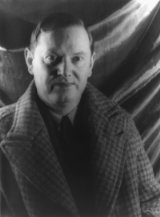
Evelyn Waughportrait
Waugh's final exam results qualified him only for a third-class degree. He was prevented from remaining in residence for the extra term that would have been required of him and he left Oxford in 1924 without taking his degree. In 1925 he taught at a private school in Wales
Wales

native_name = Cymru|conventional_long_name = Wales|common_name = Wales|image_flag = Flag of Wales 2.svg|national_motto = ...
. In his autobiography, Waugh claims that he attempted suicide at the time by swimming out to sea, only to turn back after being stung by jellyfish
Jellyfish

Jellyfish are free-swimming members of the phylum Cnidaria. They have several different morphologies that represent several different cnidarian classes including the Scyphozoa , Staurozoa , Cubozoa , and Hydrozoa ....
. He was later dismissed from another teaching post for attempting to seduce the matron, telling his father he had been dismissed for "inebriation".

He was briefly apprenticed to a cabinet-maker and afterwards maintained an interest in marquetry
Marquetry

Marquetry is the craft of covering a structural carcass with pieces of wood veneer forming decorative patterns, designs or pictures. The technique may be applied to case furniture or even seat furniture, to decorative small objects with smooth, veneerable surfaces or to free-standing pictorial panels appreciated in their own right....
, to which his novels have been compared in their intricate inlaid subplots. Waugh also provided the artwork for many of his books having been greatly inspired by a chance meeting with Pablo Picasso
Pablo Picasso

Pablo Diego Jos? Francisco de Paula Juan Nepomuceno Mar?a de los Remedios Cipriano de la Sant?sima Trinidad Ruiz y Picasso was a Spanish people Painting, drawing, and Sculpture....
 and Salvador Dali
Salvador Dalí

Salvador Domingo Felipe Jacinto Dal? i Dom?nech, 1st Marquis of P?bol was a Spain Catalonia surrealist painter born in Figueres.Dal? was a skilled Technical drawing, best known for the striking and bizarre images in his surrealism work....
 at the Slade School of Fine Art
Slade School of Fine Art

Slade School of Fine Art is the art school of University College London, UK.The school traces its roots back to 1868 when Felix Slade bequeathed funds to establish three Chairs in Fine Art, to be based at University of Oxford, University of Cambridge and University College, London, where six studentships were endowed....
 in Bloomsbury. According to Picasso, Waugh attempted to remove Dali's trademark moustache, suspecting it a surrealist joke. Dali was furious and never spoke to Waugh again; Waugh took his revenge by caricaturing the artist in a later novel (Brideshead Revisited
Brideshead Revisited

Brideshead Revisited, The Sacred & Profane Memories of Captain Charles Ryder is a novel by the English writer Evelyn Waugh, first published in 1945....
, where he portrayed him as Catelli, 'a gauche Spanish artisan.....with a less than attractive limp'.)

Waugh also worked as a journalist before he published his first novel in 1928, Decline and Fall
Decline and Fall

Decline and Fall is a novel by the English author Evelyn Waugh, first published in 1928. It was Waugh's first novel, based in part on his schooldays at Lancing College and his experience as a teacher in Wales....
. The title is from Gibbon
Edward Gibbon

Edward Gibbon was an English historian and Member of Parliament. His most important work, The History of the Decline and Fall of the Roman Empire, was published in six volumes between 1776 and 1788....
, but whereas the Georgian historian charted the bankruptcy and dissolution of the Roman Empire
Roman Empire

The Roman Empire was the Roman Republic phase of the Ancient Rome, characterised by an autocracy form of government and large territorial holdings in Europe and around the Mediterranean....
, Waugh's was a witty account of quite a different sort of dissolution, following the career of the harmless Paul Pennyfeather, a student of divinity
Divinity (academic discipline)

Divinity is the study of Christianity and other theology and religious ministry at a school, divinity school, university, or seminary. The term is sometimes a synonym for theology as an academic, speculative pursuit, and sometimes is used for the study of applied theology and ministry to make a distinction between that and academic theology....
, as he is accidentally expelled from Oxford for indecency ("I expect you'll be becoming a schoolmaster, sir," says the College porter to Paul, "That's what most of the gentlemen does, sir, that gets sent down for indecent behaviour") and enters into the worlds of schoolmastering, high society, and the white slave trade
Prostitution

The word prostitution is used to indicate:1. The exposing or otherwise offering oneself or someone else with the purpose of tempting potential customers to exchange money or goods for the promise of cooperativeness in sexual intercourse from the exposed person;...
. Other novels about England's "bright young things
Vile Bodies

Vile Bodies is a 1930 novel by Evelyn Waugh satire decadent young London society between World War I and World War II. The title comes from the Epistle to the Philippians 3:21....
" followed, and all were well received by both critics and the general public.

Waugh entered into a brief, unhappy marriage in 1928 to the Hon. Evelyn Florence Margaret Winifred Gardner, youngest daughter of Lord Burghclere
Herbert Gardner, 1st Baron Burghclere

Herbert Colstoun Gardner, 1st Baron Burghclere Her Majesty's Most Honourable Privy Council , was a United Kingdom Liberal Party politician.Gardner was the son of Alan Gardner, 3rd Baron Gardner, and his second wife, the professional actress Juliah Sarah ....
 and Lady Winifred Herbert. Their friends called them "He-Evelyn" and "She-Evelyn." Gardner's infidelity would provide the background for Waugh's novel A Handful of Dust
A Handful of Dust

A Handful of Dust is a novel by Evelyn Waugh published in 1934. It is included in Modern Library List of Best 20th-Century Novels, and Time Magazine's 100 Best English-language Novels from 1923 to 2005.....
, but her husband had made little effort to make her happy, choosing to spend much time on his own. The marriage ended in divorce in 1930.

Waugh converted to Catholicism and, after his marriage was annulled by the Church, he married Laura Herbert, a Catholic, daughter of Aubrey Herbert
Aubrey Herbert

Aubrey Nigel Henry Molyneux Herbert was a British diplomat, traveller and intelligence officer, associated with Albanian independence and twice offered the King of Albania....
, and a cousin of his first wife (they were both granddaughters of Henry Herbert, 4th Earl of Carnarvon
Henry Herbert, 4th Earl of Carnarvon

Henry Howard Molyneux Herbert, 4th Earl of Carnarvon , was an England politician and a leading member of the Conservative Party . He was the brother of Auberon Herbert, father of Aubrey Herbert, and grandfather of both of the wives of novelist Evelyn Waugh....
). This marriage was successful, lasting the rest of his life, producing seven children, one of whom, Mary, died in infancy. His son Auberon
Auberon Waugh

Auberon Alexander Waugh was a British author and journalist....
, named after Laura's brother
Auberon Herbert

Auberon Edward William Molyneux Herbert was a writer, theorist, philosopher, and member of the Parliament of the United Kingdom, son of the Henry John George Herbert, 3rd Earl of Carnarvon, brother of Henry Herbert, 4th Earl of Carnarvon, the 4th Earl, and father of the Auberon Thomas Herbert, 9th Baron Lucas of Crudwell....
, followed in his footsteps as a notable writer and journalist.

The 1930s

Waugh's fame continued to grow between the wars, based on his satires of contemporary upper class
Upper class

The upper class is a concept in sociology that refers to the group of people at the top of a social hierarchy. Members of an upper class often have great power over the allocation of resources and governmental policy in their area....
 English society, written in prose that was seductively simple and elegant. His style was often inventive (a chapter, for example, would be written entirely in the form of a dialogue of telephone calls). His conversion to Roman Catholicism in 1930 was a watershed in his life and his writing. It elevated Catholic themes in his work, and aspects of his deep and sincere faith, both implicit and explicit, can be found in all of his later work.

Waugh's conversion to Catholicism was widely discussed in London society and newspapers in September 1930. In response to the gossip, Waugh made his own contribution in article entitled, "Converted to Rome: Why It Has Happened to Me." It wasn't about ritual, said Waugh, nor about submission to the views of others. The essential issue, he believed, was making a choice between Christianity or chaos. Waugh saw in Europe's increasing materialism a major decline in what he felt created Western Civilization in the first place. "It is no longer possible ... ," he wrote, "to accept the benefits of civilization and at the same time deny the supernatural basis upon which it is based." He added that Catholicism was the "most complete and vital form" of Christianity. His faith and his conviction persisted throughout all the chapters of his life.

At the same time (and perhaps because it integrated both his beliefs and his natural "dark humour"), Black Mischief and A Handful of Dust contain episodes of the most savage farce. In some of his fiction Waugh derives comedy from the cruelty of mischance; ingenuous characters are subject to bizarre calamities in a universe that seems to lack a shaping and protecting God, or any other source of order and comfort. The period between the wars also saw extensive travels around the Mediterranean and Red Sea
Red Sea

The Red Sea is a salt water inlet of the Indian Ocean between Africa and Asia. The connection to the ocean is in the south through the Bab el Mandeb sound and the Gulf of Aden....
, Spitsbergen
Spitsbergen

Spitsbergen is a Norway island, the largest island of the Svalbard archipelago in the Arctic Ocean. The island of Spitsbergen covers approximately 39,044 km? ....
, Africa
Africa

Africa is the world's second-largest and second most-populous continent, after Asia. At about 30.2 million km? including adjacent islands, it covers 6% of the Earth's total surface area and 20.4% of the total land area....
 (most famously Ethiopia
Second Italo-Abyssinian War

The Second Italo?Abyssinian War was a brief colonial war that started in October 1935 and ended in May 1936. The war was fought between the armed forces of the Kingdom of Italy and the armed forces of the Ethiopian Empire ....
) and South America
South America

South America is the southern continent of the Americas, situated entirely in the Western Hemisphere and mostly in the Southern Hemisphere, with a relatively small portion in the Northern Hemisphere....
. Sections of the numerous travel books which resulted are often cited as among the best writing in this genre. A compendium of Waugh's favourite travel writing has been issued under the title When The Going Was Good.

Second World War

With the advent of the Second World War, Waugh used "friends in high places", such as Randolph Churchill
Randolph Churchill

Major Randolph Frederick Edward Spencer Churchill, Order of the British Empire was the son of List of British Prime Ministers Winston Churchill and his wife Clementine Churchill....
 — son of Winston
Winston Churchill

Sir Winston Leonard Spencer-Churchill, Order of the Garter, Order of Merit, Order of the Companions of Honour, Territorial Decoration, Fellow of the Royal Society, Her Majesty's Most Honourable Privy Council, Queen's Privy Council for Canada was a Politics of the United Kingdom known chiefly for his leadership of the United King...
 — to find him a service commission. Though 36 years old with poor eyesight, he was commissioned in the Royal Marines
Royal Marines

The Royal Marines are the marine and amphibious warfare infantry of the United Kingdom and, along with the Royal Navy and Royal Fleet Auxiliary, form the Naval Service....
 in 1940. Few can have been less suited to command troops. He lacked the common touch. Though personally brave, he did not suffer fools gladly. There was some concern that the men under his command might shoot him instead of the enemy. Promoted to captain, Waugh found life in the Marines dull.

Waugh participated in the failed attempt to take Dakar
Dakar

Dakar is the capital city of Senegal, located on the Cap-Vert, on the country's Atlantic Ocean coast. It is Senegal's largest city. Its position, on the western edge of Africa , is an advantageous departure point for trans-Atlantic and European trade; this fact aided its growth into a major regional seaport....
 from the Vichy French in late 1940. Following a joint exercise with No.3 Commando
British Commandos

The British Commandos were first formed by the British Army in June 1940 during World War II as a well-armed but non-regimental raider force employing unconventional and irregular military tactics to assault, disrupt and reconnoitre the enemy in mainland Europe and Scandinavia....
 (Army), he applied to join them and was accepted. Waugh took part in an ill-fated commando raid
Siege of Tobruk

The Siege of Tobruk was a lengthy confrontation between Axis Powers and Allies of World War II forces in North Africa during the Western Desert Campaign of World War II....
 on the coast of Libya
Libya

Libya , officially the Great Socialist People's Libyan Arab Jamahiriya , is a country located in North Africa. Bordering the Mediterranean Sea to the north, Libya lies between Egypt to the east, Sudan to the southeast, Chad and Niger to the south, and Algeria and Tunisia to the west....
. As special assistant to the famed commando leader Robert Laycock
Robert Laycock

Major-General Sir Robert Edward Laycock Order of St Michael and St George, Order of the Bath, Distinguished Service Order, Venerable Order of St John was a British soldier, most famous for his service with the commandos during World War II....
, Waugh showed conspicuous bravery during the fighting in Crete
Battle of Crete

The Battle of Crete was a battle during World War II on the Greek island of Crete. The battle began on the morning of 20 May 1941, when Nazi Germany launched an Airborne forces of Crete under the code-name Unternehmen Merkur ....
 in 1941, supervising the evacuation of troops while under attack by Stuka dive bombers.

Later, Waugh was placed on extended leave and later reassigned to the Royal Horse Guards
Royal Horse Guards

The Royal Horse Guards was a Cavalry regiments of the British Army of the British Army, part of the Household Cavalry.Founded August 1650 in Newcastle Upon Tyne by Sir Arthur Hesselrigge on the orders of Oliver Cromwell as the Regiment of Cuirassiers, the regiment became the Earl of Oxford's Regiment during the reign of Charles...
. During this period he wrote Brideshead Revisited
Brideshead Revisited

Brideshead Revisited, The Sacred & Profane Memories of Captain Charles Ryder is a novel by the English writer Evelyn Waugh, first published in 1945....
. He was recalled for a military/diplomatic mission to Yugoslavia
Yugoslavia

File:LocationYugoslavia2.pngYugoslavia is a term that describes three political entities that existed successively on the Balkan Peninsula in Europe, during most of the 20th century....
 in 1944 at the request of his old friend Randolph Churchill. He and Churchill narrowly escaped capture or death when the Germans undertook Operation Rösselsprung, and paratroops and glider-borne storm troops attacked the partisans'
Partisans (Yugoslavia)

The Yugoslav Partisans, or simply the Partisans, were a communist-led World War II resistance movement engaged in the fight against Axis forces and their Collaboration during World War II in Socialist Federal Republic of Yugoslavia during the Yugoslav People's Liberation War from 1941 to 1945....
 headquarters where they were staying. During his time in Yugoslavia Waugh produced a formidable report detailing Tito's persecution of Catholics and the clergy. It was "buried" by Foreign Secretary Anthony Eden
Anthony Eden

Robert Anthony Eden, 1st Earl of Avon, Order of the Garter, Military Cross, Privy Council of the United Kingdom was a British people Conservative Party politician, who was Secretary of State for Foreign and Commonwealth Affairs for three periods between 1935 and 1955, including during World War II....
 as being largely irrelevant.

Some of Waugh's best-loved and best-known novels come from this period. Brideshead Revisited (1945) is an evocation of a vanished pre-war England. It's an extraordinary work which in many ways has come to define Waugh and his view of his world. It not only painted a rich picture of life in England and at Oxford University at a time (before World War II) which Waugh himself loved and embellished in the novel, but it allowed him to share his feelings about his Catholic faith, principally through the actions of his characters. Amazingly, he was granted leave from the war to write it. The book was applauded by his friends, not just for an evocation of a time now — and then — long gone, but also for its examination of the manifold pressures within a traditional Catholic family. It was a huge success in Britain and in the United States. Decades later a television adaptation (1981) achieved popularity and acclaim in both countries, and around the world; a film adaptation has been released in 2008. Waugh revised the novel in the late 1950s because he found parts of it "distasteful on a full stomach" by which he meant that he wrote the novel during the gray privations of the latter war years.

Much of Waugh's war experience is reflected in the Sword of Honour trilogy
Trilogy

A trilogy is a set of three works of art, usually literature, film, or video games, that are connected and can be seen either as a single work or three individual works....
. It consists of three novels, Men at Arms (1952), Officers and Gentlemen (1955) and Unconditional Surrender (1961), which loosely parallel his wartime experiences. His trilogy, along with his other work after the 1930s, became some of the best books written about the Second World War. Many of his portraits are unforgettable, and often show striking resemblances to noted real personalities. Waugh biographer Christopher Sykes
Christopher Sykes

Christopher Sykes may refer to:* Christopher Sykes , Member of Parliament and friend of Edward VII as Prince of Wales* Christopher Sykes , English author, best known for his biography of Evelyn Waugh...
, felt that the fire-eating officer in the Sword of Honour trilogy, Brigadier Ben Ritchie-Hook, "...bears a very strong resemblance to..." Lieutenant-General Sir Adrian Carton de Wiart
Adrian Carton de Wiart

Lieutenant-General Sir Adrian Carton de Wiart Victoria Cross, Order of the British Empire, Order of the Bath, Order of St Michael and St George, Distinguished Service Order , was a British officer of Belgian and Irish people descent....
 VC
Victoria Cross

The Victoria Cross is the highest military decoration which is, or has been, awarded for valour "in the face of the enemy" to members of the armed forces of various Commonwealth of Nations countries, and previous British Empire territories....
, a friend of the author's father-in-law. Waugh was familiar with Carton de Wiart through the club to which he belonged. The fictional commando leader, Tommy Blackhouse, is based on Major-General Sir Robert Laycock
Robert Laycock

Major-General Sir Robert Edward Laycock Order of St Michael and St George, Order of the Bath, Distinguished Service Order, Venerable Order of St John was a British soldier, most famous for his service with the commandos during World War II....
, a real-life commando leader and friend of Waugh's, whom he greatly admired.

Later years

The period after the war saw Waugh living with his family in the West Country
West Country

The West Country is an informal term for the area of south western England roughly corresponding to the modern South West England government region....
, first at Piers Court, and from 1956 onwards, at Combe Florey
Combe Florey

Combe Florey is a village and civil parish in Somerset, England, situated north west of Taunton in the Taunton Deane district, on the West Somerset Railway....
, Somerset
Somerset

Somerset is a Counties of England in South West England. The county town is Taunton, which is in the south of the county. The Ceremonial counties of England of Somerset borders the counties of Bristol and Gloucestershire to the north, Wiltshire to the east, Dorset to the south-east, and Devon to the south-west....
, where he enjoyed the life of a country gentleman and continued to write. (Combe Florey was bought from his widow by their son Auberon
Auberon Waugh

Auberon Alexander Waugh was a British author and journalist....
.) Waugh was highly critical of Vatican II's 1960s changes to his beloved Tridentine liturgy
Tridentine Mass

The Tridentine Mass is a common name for the form of the Roman Rite Mass contained in the typical editions of the Roman Missal that were published from 1570 to 1962....
, which he in part loved for what he saw as its timelessness. (Cf. Bitter Trial by Waugh and ed. by S. Reid)

For a base in London, he was a member of White's
White's

White's is a London gentlemen's club, established at 4 Chesterfield Street in 1693 by Italian immigrant Francesco Bianco . Originally it was established to sell hot chocolate, a rare and expensive commodity at the time ....
 and the St James's Club
St James's Club

The St James's Club was a London gentlemen's club which operated between 1857 and 1978....
 in Piccadilly
Piccadilly

Piccadilly is a major London street, running from Hyde Park Corner in the west to Piccadilly Circus in the east. It is completely within the city of Westminster....
.

The Ordeal of Gilbert Pinfold (1957) is a thinly-veiled fictionalisation of Waugh's own real-life experience of alcoholic hallucinosis
Alcoholic hallucinosis

Alcoholic hallucinosis is a rare complication of alcohol withdrawal in alcoholism. This develops about 12 to 24 hours after drinking stops and involves auditory hallucinations, most commonly accusatory or threatening voices....
. This short but disturbing malady was almost certainly caused by alcoholism but Waugh preferred to blame the interaction between alcohol and sleeping medications. Unlike delirium tremens
Delirium tremens

,i.e. 'savness', or 'the heebie-jeebies',Delirium tremens is an acute episode of delirium that is usually caused by withdrawal or abstinence from benzodiazepines or barbiturates ....
 this induced auditory hallucinations rather than visual ones, which in turn led to acute paranoia. The illness was remedied once medication had been stopped and alcohol intake ceased or became moderate. During this period he wrote Helena (1953), a fictional account of the Empress Helena and the finding of the True Cross, which he regarded as his best work.

Waugh's health declined in later life. He put on weight, and the sleeping draughts he continued to take, combined with alcohol, cigars and little exercise, weakened his health. His productivity also declined, and his output was uneven. His last published work, Basil Seal Rides Again, revisiting the characters of his earliest satirical works, did not meet critical or popular approval, but is still read today. At the same time, he continued as a journalist and was well received.

He appeared in two television interviews with the BBC in the early 1960s, the only time his appearance was recorded publicly, during which the interviewers sought to corner him as an anachronistic figure. He overcame them, particularly in the second interview with novelist Elizabeth Jane Howard
Elizabeth Jane Howard

Elizabeth Jane Howard, Order of the British Empire is an English novelist. She was an actress and a model before becoming a novelist.In 1951, she won the John Llewellyn Rhys Prize for her first novel, The Beautiful Visit....
 on the Monitor programme in 1964. (The other interview was on John Freeman
John Freeman (politician)

Major John Freeman, Order of the British Empire is a retired United Kingdom politician, diplomat and broadcaster. He was the Labour Party Member of Parliament for Watford from 1945 to 1955....
's Face to Face
Face to Face (TV series)

Face To Face was a 35 episode BBC television series broadcast between 1959 and 1962. The insightful and often probing style of the interviewer, former politician John Freeman , distinguished it from other programmes of its genre at the time....
 series broadcast on 18 June 1960.) An earlier radio interview on the BBC Home Service
BBC Home Service

The BBC Home Service was a United Kingdom national radio station which broadcast from 1939 until 1967....
 in 1953 was somewhat less convivial.

Waugh's diaries, published in the 1970s, were widely acclaimed. His correspondence with lifelong friends, such as Nancy Mitford
Nancy Mitford

Nancy Freeman-Mitford, Order of the British Empire , styled The Hon. Nancy Mitford before her marriage and The Hon. Mrs Rodd thereafter, was an England novelist and biographer, one of the "Bright Young Things" on the London social scene in the inter-war years....
, is still published today. He is a fruitful source for biographers; three major works have been produced since Christopher Sykes
Christopher Sykes

Christopher Sykes may refer to:* Christopher Sykes , Member of Parliament and friend of Edward VII as Prince of Wales* Christopher Sykes , English author, best known for his biography of Evelyn Waugh...
's friendly and familiar account of Waugh's life was published in the 1970s.

Evelyn Waugh died, aged 62, on 10 April 1966, after attending a Latin Mass on Easter Sunday. He suffered a heart attack at his home, Combe Florey. His estate at probate was valued at Ł20,068. This did not include the value of his lucrative copyrights, which Waugh put in a trust (humorously named the 'Save the Children Fund') for his children. He is buried at Combe Florey, Somerset.

Critical reception

The American conservative commentator William F. Buckley, Jr.
William F. Buckley, Jr.

William Frank Buckley Jr. was an United States Conservatism in the United States author and political commentator. He founded the political magazine National Review in 1955, hosted 1429 episodes of the television show Firing Line from 1966 until 1999, and was a nationally Print syndication newspaper columnist....
 found in Waugh "the greatest English novelist of the century," (though Waugh was dismissive of Buckley) while Buckley's liberal counterpart Gore Vidal
Gore Vidal

Gore Vidal is an United States novelist, screenwriter, playwright, essayist, short story writer and politician. Early in his career he wrote the ground-breaking The City and the Pillar , which outraged mainstream critics as one of the first major American novels to feature unambiguous homosexuality....
 called him "our time's first satirist." Even the "overt racism" of his African writings has been forgiven by Ethiopian luminaries because his humour, satire, cruelty and wit were spread even-handedly, attacking the foibles of his own country at least as vigorously as those of foreigners.

Despite praise from many critics and commentators concerning Waugh's abilities as a satirist, there is a visible strain of Waugh criticism which maintains that Waugh's work is not satire at all. This idea is based on definitions of satire such as the following from J.A. Cuddon: "[the satirist] takes it upon himself to correct, censure, and ridicule the follies and vices of society and thus to bring contempt and derision upon aberrations from a desirable and civilized norm." Waugh's 'satirical' writings have been said to hold no norm in sight with which to ridicule the follies of society. For an example, see Evelyn Waugh and the Problem of Evil by William Myers. Myers reads Decline and Fall as having conflicting values rather than a stable standard.

If the beliefs of critics such as Myers are true (and there are many who think they are mistaken), then Waugh's work might best be described as anarchic humour rather than satire. From this perspective, Waugh seems to skewer everything, not just those aspects of society that stray from his ideal.

List of works


Novels

  • Decline and Fall
    Decline and Fall

    Decline and Fall is a novel by the English author Evelyn Waugh, first published in 1928. It was Waugh's first novel, based in part on his schooldays at Lancing College and his experience as a teacher in Wales....
     (1928): satire of the upper classes and social climbers
  • Vile Bodies
    Vile Bodies

    Vile Bodies is a 1930 novel by Evelyn Waugh satire decadent young London society between World War I and World War II. The title comes from the Epistle to the Philippians 3:21....
     (1930): satire; adapted to the screen by Stephen Fry
    Stephen Fry

    Stephen John Fry is an England actor, comedian, author and television presenter. With Hugh Laurie, as the comedy double act Fry and Laurie, he co-wrote and co-starred in A Bit of Fry and Laurie, and the duo also played the title roles in Jeeves and Wooster....
     as Bright Young Things
    Bright Young Things

    Bright Young Things is a 2003 in film Great Britain drama film written and directed by Stephen Fry. The screenplay, based on the 1930 in literature novel Vile Bodies by Evelyn Waugh, provides satire social commentary about young and carefree London aristocrats and bohemians, as well as society in general, in the late 1920s through the...
     (2003).
  • Black Mischief
    Black Mischief

    Black Mischief was Evelyn Waugh's third novel, published in 1932. The novel chronicles the efforts of the English-educated Emperor Seth, assisted by a fellow Oxford University graduate, Basil Seal, to modernize his Empire, the fictional African island of Azania, located off the coast of present-day Somalia....
     (1932): satire on Haile Selassie's efforts to modernise Abyssinia
    Ethiopia

    Ethiopia , officially the Federal Democratic Republic of Ethiopia, is a landlocked country situated in the Horn of Africa. Ethiopia is bordered by Eritrea to the north, Sudan to the west, Kenya to the south, Somalia to the east and Djibouti to the northeast....
     (Waugh was deeply critical of modernity and notions of rational progress)
  • A Handful of Dust
    A Handful of Dust

    A Handful of Dust is a novel by Evelyn Waugh published in 1934. It is included in Modern Library List of Best 20th-Century Novels, and Time Magazine's 100 Best English-language Novels from 1923 to 2005.....
     (1934): subtle critique of civilization set in English country house and Dutch Guyana.
  • Scoop
    Scoop (novel)

    Scoop is a 1938 novel by England writer Evelyn Waugh, a satire of sensationalist journalism and foreign correspondence....
     (1938): describes the rush of war reporters to a thinly disguised Abyssinia (now Ethiopia
    Ethiopia

    Ethiopia , officially the Federal Democratic Republic of Ethiopia, is a landlocked country situated in the Horn of Africa. Ethiopia is bordered by Eritrea to the north, Sudan to the west, Kenya to the south, Somalia to the east and Djibouti to the northeast....
    ). A Chicago theatre company's 1996 playbill cited it as the inspiration for Tom Stoppard
    Tom Stoppard

    Sir Tom Stoppard Order of Merit , Order of the British Empire, FRSL is a British screenwriter and playwright. He has written plays such as The Coast of Utopia, Arcadia , Rosencrantz & Guildenstern Are Dead, and Rock 'n' Roll ....
    's play Night and Day
    Night and Day (play)

    Night and Day is a 1978 play by Tom Stoppard. The sets and costumes were designed by Carl Toms and it ran for two years at the Phoenix Theatre in central London, UK....
    .
  • Put Out More Flags
    Put Out More Flags

    Put Out More Flags, the sixth novel by Evelyn Waugh, was first published by Chapman and Hall in 1942. The novel is set during the first year of the Second World War, and follows the wartime activities of characters introduced in Waugh's earlier satirical novels Decline and Fall, Vile Bodies and Black Mischief....
     (1942): satire of the phony war
    Phony War

    The Phoney War, also called the Twilight War by Winston Churchill, der Sitzkrieg in German language , the Bore War and la dr?le de guerre was a phase in early World War II ? in the months following the Invasion of Poland in September 1939 and preceding the Battle of France in May 1940 ? that was marked by a la...
     and wartime sillinesses
  • Brideshead Revisited
    Brideshead Revisited

    Brideshead Revisited, The Sacred & Profane Memories of Captain Charles Ryder is a novel by the English writer Evelyn Waugh, first published in 1945....
     (subtitled The Sacred and Profane Memories of Captain Charles Ryder) (1945): details the spiritual lives behind the facades of an aristocratic family and their agnostic friend, the protagonist. Filmed as a lauded ITV drama
    Brideshead Revisited (TV serial)

    Brideshead Revisited is a 1981 British television serial based on Brideshead Revisited by Evelyn Waugh. The book was adapted to the screen by producer Derek Granger and Martin Thompson after the initial script by John Mortimer was rejected....
     (1981) and as a 2008 movie
    Brideshead Revisited (film)

    Brideshead Revisited is a 2008 in film Cinema of the United Kingdom drama film directed by Julian Jarrold. The screenplay by Jeremy Brock and Andrew Davies is based on the 1945 Brideshead Revisited by Evelyn Waugh, which previously was filmed in 1981 as an Brideshead Revisited that was broadcast by ITV in the UK and Public Broadcasting...
    .
  • The Loved One
    The Loved One

    The Loved One: An Anglo-American Tragedy is a short satirical novel by Evelyn Waugh about the funeral business in Los Angeles, the British expatriate community in Hollywood, and the film industry....
     (1947) (subtitled An Anglo-American Tragedy): describes the excesses of a California
    California

    California is a U.S. state on the West Coast of the United States of the United States, along the Pacific Ocean. It is bordered by Oregon to the north, Nevada to the east, Arizona to the southeast, and to the south the Mexico state of Baja California....
    n funeral business.
  • Helena
    Helena (1950 novel)

    Helena, published in 1950 in literature, is the sole historical novel of Evelyn Waugh.It follows the quest of Helena of Constantinople to find the relics of the cross on which Christ was crucified....
     (1950): historical fiction
    Historical fiction

    Historical fiction is a sub-genre of fiction that often portrays fictional accounts or dramatization of historical figures or events. Writers of stories in this genre, while penning fiction, nominally attempt to capture the spirit, manners, and social conditions of the persons or time presented in the story, with due attention paid to period...
     about the Empress Helena and the founding of pilgrimage sites in the Holy Land
    Holy Land

    The Holy Land , generally refers to the geographical region of the Levant called Land of Canaan or Land of Israel in the Bible, and constitutes the Promised land....
    ; also a Catholic apologetic about the True Cross
    True Cross

    The True Cross is the name for physical remnants which, by a Christianity tradition, are believed to be from the actual cross upon which Jesus was crucified....
    .
  • Love Among the Ruins. A Romance of the Near Future
    Love Among the Ruins. A Romance of the Near Future

    Love Among the Ruins. A Romance of the Near Future is a novel by Evelyn Waugh which was first published in 1953 .Love among the ruins is a a satire set in a dystopian quasi-egalitarian Britain....
     (1953): a satire set in a dystopian quasi-egalitarian Britain, following the life of an arsonist released from prison.
  • Sword of Honour
    Sword of Honour

    The Sword of Honour trilogy by Evelyn Waugh is his look at the Second World War. It consists of three novels, Men at Arms , Officers and Gentlemen and Unconditional Surrender , which loosely parallel his war time experiences....
     Trilogy
    • Men at Arms (1952)
    • Officers and Gentlemen (1955)
    • Unconditional Surrender (1961)
  • The Ordeal of Gilbert Pinfold
    The Ordeal of Gilbert Pinfold

    The Ordeal of Gilbert Pinfold is a novel first published in 1957 by English writer Evelyn Waugh. Strong parallels may be drawn between events in the novel overtaking the eponymous protagonist, Gilbert Pinfold, and episodes in the author's own life....
     (1957)


Short Story Collections

  • Mr Loveday's Little Outing: And Other Sad Stories (1936)
  • Work Suspended: And Other Stories (1943)
  • The Ordeal of Gilbert Pinfold (1957)
  • Selected Works (1977)
  • Charles Ryder's Schooldays: And Other Stories (1982)
  • The Complete Short Stories (1997)
  • The Complete Stories of Evelyn Waugh (1998)


Travel writing

  • Labels (1930): An account of Waugh's cruise around the Mediterranean.
  • Remote People (1931): Waugh's journey to Addis Ababa at the time of the coronation of Haile Selassie.
  • Ninety-Two Days (1934): Waugh's journey through British Guiana.
  • Waugh In Abyssinia (1936): Waugh's second travel book in Africa.
  • Robbery Under Law (1939): Waugh's travels around Mexico in 1938.
  • When The Going Was Good (1946): A selection of Waugh's earlier travel works.
  • A Tourist In Africa (1960).


Biography

  • Saint Edmund Campion
    Edmund Campion

    Saint Edmund Campion, S.J. was an England Jesuit priest and martyr....
    : Priest and Martyr
  • The Life of the Right Reverend Ronald Knox
    Ronald Knox

    Monsignor. Ronald Arbuthnott Knox was an England theology, priest and crime writer....
  • Dante Gabriel Rossetti
    Dante Gabriel Rossetti

    Dante Gabriel Rossetti was an English poet, illustrator, Painting and translator....


Autobiography and memoirs

  • Waugh in Abyssinia (1936), a journalistic account of the war and what led up to it
  • A Little Learning
    A Little Learning (book)

    A Little Learning: The First Volume of an Autobiography is Evelyn Waugh's unfinished auto-biography and memoir. It was published just two years before his death on Easter Sunday, 1966....
     (1964)
  • The diaries of Evelyn Waugh (1976) - edited by Michael Davie.


Biographies of Waugh

  • Evelyn Waugh: Portrait of a Country Neighbour by Frances Donaldson
    Frances Donaldson, Baroness Donaldson of Kingsbridge

    Frances Annesley , Lady Donaldson of Kingsbridge was a British writer and biographer.Her father, Freddie Lonsdale, was a playwright. She married John George Stuart Donaldson, Baron Donaldson of Kingsbridge in 1935....
    , 1967.
  • Evelyn Waugh by Christopher Sykes
    Christopher Sykes

    Christopher Sykes may refer to:* Christopher Sykes , Member of Parliament and friend of Edward VII as Prince of Wales* Christopher Sykes , English author, best known for his biography of Evelyn Waugh...
    , 1975.
  • Evelyn Waugh: The Early Years 1903 – 1939 by Martin Stannard, 1987.
  • Evelyn Waugh: The Later Years 1939 – 1966 by Martin Stannard, 1994.
  • Evelyn Waugh: a Biography by Selina Hastings, 1994.
  • The Life of Evelyn Waugh: A Critical Biography by Douglas Lane Patey
    Douglas Lane Patey

    Douglas Lane Patey is Sophia Smith Professor of English literature at Smith College in Northampton, MA. He received M.A. degrees from the University of Virginia in 1977 and 1978 and his Ph.D from the same university in 1979, with a thesis on "Probability and Literary Form."...
    , 1998.
  • Fathers and Sons: The Autobiography of a Family by Alexander Waugh
    Alexander Waugh

    Alexander Waugh is an England writer, critic, composer, cartoonist, record producer and television presenter. He was educated at the University of Manchester and University of Surrey where he gained degrees in Music....
    , 2007.
  • The Same Man: George Orwell and Evelyn Waugh by David Lebedoff, 2008.


External links