

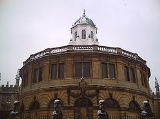
Sheldonian Theatre

Encyclopedia
The Sheldonian Theatre, located in Oxford
, England, was built from 1664 to 1668 after a design by Christopher Wren
for the University of Oxford
. The building is named after Gilbert Sheldon
, chancellor of the university at the time and the project's main financial backer. It is used for music concerts, lectures and university ceremonies, but not for drama.
With the triumph of the Restoration
and with it the Church of England
, Dean Fell sought to revive a project proposed in the 1630s by the late William Laud
Archbishop of Canterbury
: a separate building whose sole use would be graduation and degree ceremonies.
In the past these increasingly rowdy occasions had taken place in the university's church of St.-Mary-the-Virgin-on-High
. "The notion that 'sacrifice is made equally to God and Apollo
', in the same place where homage was due to God and God alone, was as repugnant to Fell and his colleagues as it had been to Laud."; with this in mind they approached the current Archbishop of Canterbury Gilbert Sheldon
, both for his blessing, his assistance, and a donation.
Sheldon was forthcoming with all three. He initially gave an impressive £1,000 (£ today) and pledged to gather the needed money from like-minded sponsors. He had little luck, however, and ultimately financed nearly the entire £14,470 (£ today) himself, in an age where a mid-level craftsman's wage was typically between £2 and £4 per year.
Nothing is known for sure of Wren's first designs for the Sheldonian, but the finished building was a sharp, unmistakable break from the Gothic past. Wren designed the Sheldonian based on Serlio's engraving of the D-shaped Theatre of Marcellus
in Rome in the first century BC.
Like any Mediterranean theatre of that time, the Theatre of Marcellus had no roof: the audience relied on a temporary awning for inclement weather. But 17th century Oxford was not ancient Rome, and the Theatre needed a permanent roof. Yet the span of the D-shaped roof was over 70 feet (21.3 m). No timbers existed that were long enough to cross that distance, and Wren dismissed the obvious solution of a Gothic roof. Instead, he decided to use the "geometrical flat floor" grid developed twenty years before by Oxford professor John Wallis.
It involved:
In 1720 surveyors inspecting the roof, following a rumour that it was no longer safe, were both surprised and impressed at what they discovered. Though sagging slightly from the massive weight of books, the inspectors pronounced that "...the whole Fabrick of the said Theatre is, in our Opinion, like to remain and continue in such Repair and Condition, for one hundred or two hundred Years yet to come.".
In November 2008 a four year project to restore the ceiling fresco was completed. The 32 oil on canvas panels originally painted by King Charles II
’s court painter, Robert Streater
, were removed and conserved. As part of the conservation process, the panels had their linings replaced, holes in the canvas mended and over-painting removed. The allegorical story depicted in the paintings shows Truth descending upon the Arts and Sciences and expelling ignorance from the University.
in the centre of the roof, which is accessible via a staircase leading to the dome over the main ceiling. The cupola has large windows on all sides, providing views across central Oxford, and is open to visitors.
The Theatre is used for music recitals, lectures (such as the annual Romanes Lecture
), conferences, and for various ceremonies held by the University (such as graduation
and matriculation
). Handel
performed here, including the first performance of his third oratorio
Athalia
in 1733.
The building seats between 800 and 1000 people and is on the grounds of part of the Bodleian Library
adjacent to Broad Street
. To the left at the front is the Clarendon Building
and to the right is the Old Ashmolean Building. Behind the Sheldonian is the Divinity School
.
The Theatre features prominently in Max Beerbohm
's 1911 novel Zuleika Dobson
.
Oxford
The city of Oxford is the county town of Oxfordshire, England. The city, made prominent by its medieval university, has a population of just under 165,000, with 153,900 living within the district boundary. It lies about 50 miles north-west of London. The rivers Cherwell and Thames run through...
, England, was built from 1664 to 1668 after a design by Christopher Wren
Christopher Wren
Sir Christopher Wren FRS is one of the most highly acclaimed English architects in history.He used to be accorded responsibility for rebuilding 51 churches in the City of London after the Great Fire in 1666, including his masterpiece, St. Paul's Cathedral, on Ludgate Hill, completed in 1710...
for the University of Oxford
University of Oxford
The University of Oxford is a university located in Oxford, United Kingdom. It is the second-oldest surviving university in the world and the oldest in the English-speaking world. Although its exact date of foundation is unclear, there is evidence of teaching as far back as 1096...
. The building is named after Gilbert Sheldon
Gilbert Sheldon
Gilbert Sheldon was an English Archbishop of Canterbury.-Early life:He was born in Stanton, Staffordshire in the parish of Ellastone, on 19 July 1598, the youngest son of Roger Sheldon; his father worked for Gilbert Talbot, 7th Earl of Shrewsbury. He was educated at Trinity College, Oxford; he...
, chancellor of the university at the time and the project's main financial backer. It is used for music concerts, lectures and university ceremonies, but not for drama.
History
What came to be known as the Sheldonian Theatre was Wren's second work, and was commissioned by Gilbert Sheldon, Archbishop of Canterbury.With the triumph of the Restoration
English Restoration
The Restoration of the English monarchy began in 1660 when the English, Scottish and Irish monarchies were all restored under Charles II after the Interregnum that followed the Wars of the Three Kingdoms...
and with it the Church of England
Church of England
The Church of England is the officially established Christian church in England and the Mother Church of the worldwide Anglican Communion. The church considers itself within the tradition of Western Christianity and dates its formal establishment principally to the mission to England by St...
, Dean Fell sought to revive a project proposed in the 1630s by the late William Laud
William Laud
William Laud was Archbishop of Canterbury from 1633 to 1645. One of the High Church Caroline divines, he opposed radical forms of Puritanism...
Archbishop of Canterbury
Archbishop of Canterbury
The Archbishop of Canterbury is the senior bishop and principal leader of the Church of England, the symbolic head of the worldwide Anglican Communion, and the diocesan bishop of the Diocese of Canterbury. In his role as head of the Anglican Communion, the archbishop leads the third largest group...
: a separate building whose sole use would be graduation and degree ceremonies.
In the past these increasingly rowdy occasions had taken place in the university's church of St.-Mary-the-Virgin-on-High
University Church of St Mary the Virgin
The University Church of St Mary the Virgin is the largest of Oxford's parish churches and the centre from which the University of Oxford grew...
. "The notion that 'sacrifice is made equally to God and Apollo
Apollo
Apollo is one of the most important and complex of the Olympian deities in Greek and Roman mythology...
', in the same place where homage was due to God and God alone, was as repugnant to Fell and his colleagues as it had been to Laud."; with this in mind they approached the current Archbishop of Canterbury Gilbert Sheldon
Gilbert Sheldon
Gilbert Sheldon was an English Archbishop of Canterbury.-Early life:He was born in Stanton, Staffordshire in the parish of Ellastone, on 19 July 1598, the youngest son of Roger Sheldon; his father worked for Gilbert Talbot, 7th Earl of Shrewsbury. He was educated at Trinity College, Oxford; he...
, both for his blessing, his assistance, and a donation.
Sheldon was forthcoming with all three. He initially gave an impressive £1,000 (£ today) and pledged to gather the needed money from like-minded sponsors. He had little luck, however, and ultimately financed nearly the entire £14,470 (£ today) himself, in an age where a mid-level craftsman's wage was typically between £2 and £4 per year.
Nothing is known for sure of Wren's first designs for the Sheldonian, but the finished building was a sharp, unmistakable break from the Gothic past. Wren designed the Sheldonian based on Serlio's engraving of the D-shaped Theatre of Marcellus
Theatre of Marcellus
The Theatre of Marcellus is an ancient open-air theatre in Rome, Italy, built in the closing years of the Roman Republic. At the theatre, locals and visitors alike were able to watch performances of drama and song. Today its ancient edifice in the rione of Sant'Angelo, Rome, once again provides...
in Rome in the first century BC.
Like any Mediterranean theatre of that time, the Theatre of Marcellus had no roof: the audience relied on a temporary awning for inclement weather. But 17th century Oxford was not ancient Rome, and the Theatre needed a permanent roof. Yet the span of the D-shaped roof was over 70 feet (21.3 m). No timbers existed that were long enough to cross that distance, and Wren dismissed the obvious solution of a Gothic roof. Instead, he decided to use the "geometrical flat floor" grid developed twenty years before by Oxford professor John Wallis.
It involved:
"...creating a series of trusses which were built up from shorter section and held in place by their own weight, with help from judiciously placed iron bolts and plates..so effective [was the roof] that for nearly a century the University Press stored its books...and for many years it was the largest unsupported floor in existence...'
In 1720 surveyors inspecting the roof, following a rumour that it was no longer safe, were both surprised and impressed at what they discovered. Though sagging slightly from the massive weight of books, the inspectors pronounced that "...the whole Fabrick of the said Theatre is, in our Opinion, like to remain and continue in such Repair and Condition, for one hundred or two hundred Years yet to come.".
In November 2008 a four year project to restore the ceiling fresco was completed. The 32 oil on canvas panels originally painted by King Charles II
Charles II of England
Charles II was monarch of the three kingdoms of England, Scotland, and Ireland.Charles II's father, King Charles I, was executed at Whitehall on 30 January 1649, at the climax of the English Civil War...
’s court painter, Robert Streater
Robert Streater
Robert Streater , was an English landscape, history, still-life and portrait artist, architectural painter, and etcher...
, were removed and conserved. As part of the conservation process, the panels had their linings replaced, holes in the canvas mended and over-painting removed. The allegorical story depicted in the paintings shows Truth descending upon the Arts and Sciences and expelling ignorance from the University.
The building
The building has a prominent eight-sided cupolaCupola
In architecture, a cupola is a small, most-often dome-like, structure on top of a building. Often used to provide a lookout or to admit light and air, it usually crowns a larger roof or dome....
in the centre of the roof, which is accessible via a staircase leading to the dome over the main ceiling. The cupola has large windows on all sides, providing views across central Oxford, and is open to visitors.
The Theatre is used for music recitals, lectures (such as the annual Romanes Lecture
Romanes Lecture
The Romanes Lecture is a prestigious free public lecture given annually at the Sheldonian Theatre, Oxford, England.The lecture series was founded by, and named after, the biologist George Romanes, and has been running since 1892. Over the years, many notable figures from the Arts and Sciences have...
), conferences, and for various ceremonies held by the University (such as graduation
Graduation
Graduation is the action of receiving or conferring an academic degree or the ceremony that is sometimes associated, where students become Graduates. Before the graduation, candidates are referred to as Graduands. The date of graduation is often called degree day. The graduation itself is also...
and matriculation
Matriculation
Matriculation, in the broadest sense, means to be registered or added to a list, from the Latin matricula – little list. In Scottish heraldry, for instance, a matriculation is a registration of armorial bearings...
). Handel
HANDEL
HANDEL was the code-name for the UK's National Attack Warning System in the Cold War. It consisted of a small console consisting of two microphones, lights and gauges. The reason behind this was to provide a back-up if anything failed....
performed here, including the first performance of his third oratorio
Oratorio
An oratorio is a large musical composition including an orchestra, a choir, and soloists. Like an opera, an oratorio includes the use of a choir, soloists, an ensemble, various distinguishable characters, and arias...
Athalia
Athalia (oratorio)
Athalia is an English-language oratorio by George Frideric Handel, his third in this genre. The structural and rhetorical achievements in Athalia project a dramatic concept that may be unique in Handel's output. Commissioned in 1733 for the Publick Act in Oxford, a commencement ceremony of the...
in 1733.
The building seats between 800 and 1000 people and is on the grounds of part of the Bodleian Library
Bodleian Library
The Bodleian Library , the main research library of the University of Oxford, is one of the oldest libraries in Europe, and in Britain is second in size only to the British Library...
adjacent to Broad Street
Broad Street, Oxford
Broad Street is a wide street in central Oxford, England, located just north of the old city wall.The street is known for its bookshops, including the original Blackwell's bookshop at number 50, located here due to the University...
. To the left at the front is the Clarendon Building
Clarendon Building
The Clarendon Building is a landmark Grade I listed building in Oxford, England, owned by the University of Oxford. It was built between 1711 and 1715 to house the Oxford University Press. It stands in the centre of the city in Broad Street, near the Bodleian Library and the Sheldonian Theatre...
and to the right is the Old Ashmolean Building. Behind the Sheldonian is the Divinity School
Divinity School, Oxford
The Divinity School is a medieval building and room in the Perpendicular style in Oxford, England, part of the University of Oxford. Built 1427–83, it is the oldest surviving purpose-built building for university use, specifically for lectures and discussions on theology...
.
The Theatre features prominently in Max Beerbohm
Max Beerbohm
Sir Henry Maximilian "Max" Beerbohm was an English essayist, parodist and caricaturist best known today for his 1911 novel Zuleika Dobson.-Early life:...
's 1911 novel Zuleika Dobson
Zuleika Dobson
Zuleika Dobson, full title Zuleika Dobson, or, an Oxford love story, is a 1911 novel by Max Beerbohm, a satire of undergraduate life at Oxford. It was his only novel, but was nonetheless very successful...
.