


Old Mobile Site

Encyclopedia
The Old Mobile Site was the location of the French settlement La Mobile and the associated Fort Louis de La Louisiane, in the French colony of New France
in North America, from 1702 until 1712. The site is located in Le Moyne
, Alabama
, on the Mobile River
in the Mobile-Tensaw River Delta
. The settlement served as the capital of French Louisiana
in from 1702 until 1711, when the capital was relocated to the site of present-day Mobile, Alabama
. The settlement was founded and originally governed by Pierre Le Moyne d'Iberville
. Upon the death of d'Iberville (or Iberville), the settlement was governed by his younger brother, Jean-Baptiste Le Moyne de Bienville
. The site can be considered a French colonial counterpart to the English settlement at Jamestown
, Virginia
.
The settlement site and fort
were listed on the National Register of Historic Places
on May 6, 1976. The Old Mobile Site was determined eligible for designation as a National Historic Landmark
on January 3, 2001.
 Following the defeat of the Spanish Armada
in 1588, Spain
's power began to wane, allowing France
to play an increasingly dominant role in Continental Europe
while England
increasingly controlled the New World
. Under Louis XIV
and his brilliant ministers
, France created an army
which intimidated Continental Europe and a navy
which was strong enough to support the exploration
and settlement of Canada
. In 1608, the French flag flew over Quebec
.
Zealous Jesuit
missionaries
spread out to convert the Indians
. Two such missionaries, Father Jacques Marquette
and Louis Jolliet
explored the Mississippi River
. René Robert Cavelier, Sieur de La Salle floated down the river in 1682 and claimed the entire Mississippi basin for France in the name of Louis XIV. France soon realized that in order to counter English and Spanish influence in the region and to protect Louisiana and the Mississippi River they needed a fort on the Gulf of Mexico
.
After the ascent of William
and Mary
to the throne of England in 1688, hostilities between England and France grew, increasing the urgency for a French settlement on the Gulf Coast
. By controlling the Gulf Coast, the Alabama river valleys, the Mississippi River, the Ohio Valley
, and Canada, France could surround England and confine them to the Eastern Seaboard
. The stakes, vast reaches of land and the lucrative Indian fur trade
, were enormous.
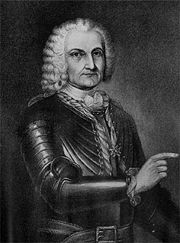 Pierre Le Moyne d'Iberville was born in Montreal
to a French emigrant. During the first of the French and Indian Wars
, King William's War
, he attacked the English in the Canadian area with such ferocity and success that he became a hero in the French court. With his seamanship
and leadership
, he was a natural choice to lead the proposed French settlement.
The younger brother of Iberville was Jean-Baptiste Le Moyne de Bienville, an energetic man with a clear perception of his responsibilities. Consistent with the autocratic
nature of the French government, Bienville ruled with authority when governor of Louisiana. Despite this style of governance, he inspired loyalty from his followers. He supported the Jesuits but was also willing to use them to his advantage. An understanding of Indian culture and Indian languages
allowed him to establish friendships and alliances with Indian tribes. While normally kind and gentle, Bienville could also be cruel, causing men to both respect and fear him.
Two additional Le Moyne brothers, Joseph Le Moyne de Sérigny and Antoine Le Moyne de Châteaugué, contributed to Old Mobile by successfully repelling attacks by Indian tribes and English and Spanish forces.
, with orders to establish a fort at the mouth of the Mississippi River. Accompanying Iberville on the voyage were Bienville, soldiers, and 200 colonists (including four women and children). The Le Moyne brothers arrived in Pensacola Bay
on January 27, 1699 and were surprised to find that Spaniards from Vera Cruz
had arrived three months earlier.
The French sailed on to Mobile Point (located at the western extreme of the peninsula
that extends across much of Mobile Bay
's mouth) and cast anchor on January 31 at the "mouth of La Mobilla". The group scouted a large island
that, due to finding a group of 60 corpses on the island, Iberville named "Massacre Island" (later renamed "Dauphin Island
"). From the top of an oak
tree, Iberville could observe brackish water
flowing from a river into the bay
. He did not, however, detect the harbor
on the northeast side of the island. After determining that the bay was too shallow, the party sailed onward.
The sailing party next visited the area of present-day Biloxi, Mississippi
(or Old Biloxi). On March 2, 1699, Iberville discovered the mouth of the Mississippi
and sailed up the river looking for a suitable landing site. Based on the low and marshy banks, it was concluded that no suitable location for a settlement was available in the area. After retracing his route to Biloxi, Iberville landed and constructed Fort Maurepas
, a crude fort of squared logs. This fort would serve as Iberville's base for additional exploration of the coastal areas. After encounters with English ships on the Lower Mississippi, Iberville ordered Bienville to construct an additional fort. The French occupied Fort de la Boulaye in 1700. The accounts of André Pénicaut, a carpenter
traveling with Iberville, reveal that "illnesses were becoming frequent" in the summer heat necessitating a move to higher ground.
Pénicaut was with a scouting party that discovered a "spot on high ground" near an Indian village approximately 20 miles (32 km) up the Mobile River. The location provided higher ground than Fort Maurepas and provided the additional benefit of allowing closer contact to the Indians and easier observation of the English traders from the Carolinas
. The French located the harbor on Massacre Island and named it Port Dauphin. They began moving the settlement from Fort Maurepas in 1702. Since shallow areas caused by silt
from the rivers and a treacherous, shifting bar
near Mobile Point made navigation by ocean-going vessels extremely dangerous, supplies were offloaded at Port Dauphin and then transported by smaller boats up the Mobile River.
Iberville's positive assessment of the selected location is apparent from the observations in his journals translated by Richebourg Gaillard McWilliams. Iberville first visited the bluff on March 3, 1702, approximately six weeks after construction of the new settlement had begun:
Writing about land north of the settlement, Iberville observed:
He also found the area to be well-suited to agricultural development:
 Charles Levasseur, a skilled draftsman
with knowledge of the Mobile area, designed and built the new fort at Twenty-Seven Mile Bluff. The square fort, equipped with cannon
s on each corner, enclosed residential buildings for soldiers and officers, a house utilized as a chapel
, and a warehouse
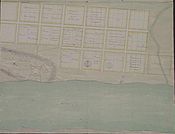
. Behind Fort Louis de la Louisiana, a village (commonly called "La Mobile") was laid out in a grid pattern
.
In 1704, Nicolas de la Salle
conducted a census
which revealed additional details regarding the settlement and its occupants.
The structures identified in the census comprised a guardhouse
, a forge
, a gunsmith
shop, a brick kiln
, and eighty one-story wooden houses. The occupants included 180 men, 27 families with ten children, eleven Native American slave
boys and girls, and numerous farm animals.
from Canada avoided agricultural labor while the settlers were often unfamiliar with farming
. In order to compensate for this lack of capabilities, slavery was utilized at La Mobile. Initially, native slaves were utilized for the clearing of land and tilling
of fields. By 1710, the population of La Mobile included 90 Indian slaves and servants. Ultimately, the Indians proved physically and temperamentally unsuitable for the work resulting in the importation of African slaves.
Due to wars (particularly the War of the Spanish Succession
) and English control of the seas, communications between Mobile and Paris
were tenuous. For a 3-year period of time, Mobile received no supply ships from France. Although Mobile had experienced difficulties in establishing successful farming, local agriculture was necessary to sustain the colony. In order to prevent starvation, hunting
and fishing
were often necessary. Occasionally, the French resorted to purchasing food from the Spanish in Pensacola
(to which they had loaned supplies) or in Havana
.
Although the Mobilian Indians
were friendly, other Indian tribes, such as the Alabama tribe
, frequently attacked the fort as well as hunting or scouting parties. Primarily through the efforts of Henri de Tonti
, the French became adept with Indian diplomacy. Bienville used entertainment and gifts to purchase Indian loyalty and to establish an alliance against the English. In 1700, the French signed an alliance with the Choctaw tribe
. In 1702, the French were able to temporarily reconcile the Choctaws and Chickasaw
s just before the resumption of hostilities between the English and French. Additionally, the French interacted with the Apalachee
, Tomeh, Chato, and Tawasa tribes. The interaction was detrimental to the regional Indian population which dropped from 5,000 in 1702 to 2,000 in 1711 due primarily to smallpox
and other diseases introduced by the colonists.
Iberville left the region for the last time in June 1702.
He subsequently recommended to the French government that one hundred "young and well-bred" women be sent to Mobile to marry the Canadians and increase the population by bearing children. In 1704, the women (selected from orphanage
s and convent
s) along with more soldiers and supplies departed La Rochelle
aboard the Pélican
. After a harrowing trip across the Atlantic Ocean, passengers were infected with yellow fever
in Havana. As the feverish and sick began to die, the Pélican arrived at Massacre Island. The "twenty-three virtuous maidens," later to become known to history as "casquette girls", and their chaperones, "two gray nuns", finally arrived at Fort Louis. Their arrival was not "the glorious occasion that either the inhabitants of Mobile or the young women from Paris had envisioned". The young women were not prepared for the primitive wilderness. The hierarchy of French society remained present, as social prejudices in the settlement, and prevented development of the cooperative spirit necessary for success under the conditions of the colony. Missing the luxuries of France (such as French bread) and resenting the realities of the colony (such as cornbread
), the women engaged in a "Petticoat Revolution" that "taxed Bienville's patience and ingenuity." However, the French government continued to send women to boost the population. The women were often referred to as "casquette girls" in reference to the small trunks called "cassettes" in French, in which some of the women brought their possessions.
The yellow fever epidemic claimed the lives of both Charles Levasseur and Henri de Tonti
. The deaths represented a great loss to Bienville and the settlement. Upon the death of Iberville to yellow fever in Havana in July 1706, Bienville became governor of Louisiana at the age of 27. Although he had only spent a total of 25 days in the settlement, the death of Iberville was a blow to the colony since he had represented the concerns of Louisiana in Europe and was able to win concessions for the struggling town from the French court.
After Iberville's death, Jérôme Phélypeaux de Maurepas de Pontchartrain
, minister for North American colonial affairs under Louis XIV, received complaints from Henri Roulleaux de La Vente, curé
of Old Mobile, and Nicolas de La Salle, keeper of the royal warehouse, regarding questionable trading practices of the Le Moyne brothers to the detriment of the colony. Based on the accusations, Pontchartrain appointed Nicolas Daneau, sieur de Muy as the new governor of Louisiana and Jean-Baptiste-Martin D'artaguiette d'Iron as a special commissioner
to investigate the charges. The new governor died at sea before reaching Mobile. Although Dartaguiette d'Iron did reach Mobile, he was unable to substantiate the charges against the Le Moyne brothers and Bienville remained in charge of Louisiana.
By 1708, Bienville realized the growing threat of the English to the French colony. They had successfully isolated the Spanish settlement at Pensacola by destroying the Indian tribes allied with the Spanish. It appeared that the English would soon advance in a similar manner against the French. In the first week of May 1709, the threat reached its peak when the Alabama tribe, allied with the English, attacked a village of the Mobilian tribe thirteen miles (21 km) north of Old Mobile. The Mobilians were able to drive the attacking Alabama tribe away, however.
The occupants of the settlement began to complain about its location. Particularly, they felt that the settlement was too far from the bay and that the land was too poorly drained, requiring several weeks after each rain for the standing water to drain.
In the spring of 1711, a flood
rushed into Fort Louis forcing soldiers and citizens to seek safety in the trees. The houses of the settlement were submerged to the top of their roofs for nearly a month. The flood was the ultimate factor in the decision to relocate the settlement. When the French abandoned Twenty-Seven Mile Bluff, the fort and houses were burned. It is likely that the structures were destroyed to prevent enemies from easily establishing a fortification at the site.
Bienville selected the location where the river meets the bay and surveyed a town. It was once theorized that soldiers and colonists dismantled houses and the fort and moved the timber and supplies down the river. However, archaeological evidence now indicates that all excavated structures were burned in place. By the middle of 1712, the relocation was complete. Gradually, La Mobile reverted to wilderness.
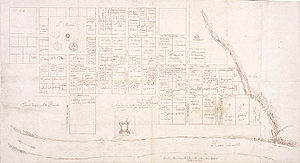 At its peak the town of Old Mobile (La Mobile) had a population
of approximately 350 inhabitants occupying between 80 and 100 structures. City plans from 1702 and 1704-1705 reveal widely dispersed houses set on large lots
arranged in a grid pattern. Iberville and Levasseur divided the land into large square blocks
approximately 320 feet by 320 feet (97.5 m by 97.5 m). These blocks were further subdivided into lots of various sizes and shapes. The plots were generally assigned to the inhabitants based on their occupation or role in the colonial town. For example, carpenters occupied a district on the northwest side, Canadians and voyageurs
lived toward the western outskirts, and administrative personnel and officers were grouped in close proximity to the fort or within the fort. A large market square
with a well
was located at the southwest corner of the site.
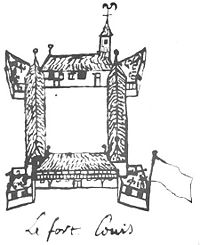 Fort Louis de la Louisiane served as the political, military, and religious center of the settlement. The fort housed the residences of Bienville and his officers and soldiers as well as a chapel and several other structures.
A detailed description of Fort Louis can be found in the narrative of André Pénicaut:
The fort bastion
s were constructed using pièce-sur-pièce techniques. In pièce-sur-pièce construction, timbers with tenons (projections) cut on each end are laid atop one another horizontally. The tenons are inserted into vertical grooves in periodically spaced vertical posts (coulisse). The fort was surrounded by a palisade fence
. Due to the damp conditions of the site, wooden structures rot
ted quickly necessitating replacement of the bastion timbers and palisade posts at approximately five-year intervals. By 1705, Bienville noted that the rotting wood of the fort made firing of the cannons unsafe. To prepare for the coming conflict with the English, the fort was repaired in 1707. Within a year, however, the bastions of the fort were severely rotted and could barely support the weight of the cannons. As the English threat intensified, the size of the fort was increased by a third so that it could accommodate all of the residents of Old Mobile and the surrounding allied Indian tribes.
and the Archives nationales
in France provided strong evidence that the site was located at Twenty-Seven Mile Bluff. However, local parties argued that the location was near the mouth of Dog River
.
Based on maps from the Archives nationales and local probate records
, Peter Hamilton, author of Colonial Mobile (1910), concluded correctly that the site was located at Twenty-Seven Mile Bluff. He claimed locating the well and finding bullet
s, crockery, large-headed spikes
, and a brass
ornament at the site. During a visit to the site in 1902, Carey Butt, a colleague of Peter Hamilton, suspected he had located the powder magazine
of Fort Louis. Based on the maps and the claims of Butt, the Iberville Historical Society erected a monument at the site in 1902 during the celebration of the 200th anniversary of the founding of Mobile.
under the direction of Donald Harris conducted the first archaeological survey
of the site. The survey lasted for a two-week period in a location immediately north from the monument. Harris unearthed a foundation which he incorrectly attributed to Fort Louis. In addition, Harris located Indian pottery
and small iron
cannonballs
.
In the middle of the 1970s, the Old Mobile Research Team was founded. James C. "Buddy" Parnell formed the group with friends and fellow employees of Courtaulds Fibers
, a company which owned a portion of the suspected Old Mobile site. Members of the team determined that Donald Harris had been exploring the incorrect location. Based on clues from aerial photographs
and French maps, the team located a house of the former settlement in February 1989. Other artifacts including fragments of dinnerware, clay pipe stems, and brick
s were discovered during this effort.
In May 1989, the Old Mobile Project was formed as a community effort involving Mobile County, the city of Mobile, and the University of South Alabama
. Funding for the project came from the private sector, university startup funds, the Alabama Historical Commission, the Bedsole Foundation, the Mitchell Foundation, the Alabama Legislature
, the National Endowment for the Humanities
, and the National Science Foundation
. The landowners of the Old Mobile Site (Courtaulds Fibers, DuPont
, Alabama Power Company
) permitted excavation on the site. In June 1989, excavation of the site began under the direction of Gregory A. Waselkov. Although previous efforts had helped to establish the precise location of the site, the surveys related to the Old Mobile Project yielded the most archaeological records of the Old Mobile site.
was utilized to determine the extent of the site and to locate structures of the settlement. From 1989 to 1993, approximately 20,000 shovel tests were performed at intervals of thirteen feet (4 m). Since extensive excavation began in 1989, the locations of more than 50 buildings and the approximate boundaries of Old Mobile have been identified. Eight of these sites have been partially or completing excavated. The sites of Fort Louis or the settlement's cemetery
have not been identified. Archaeological surveys have shown that an eastern portion of Old Mobile, possibly including portions of Fort Louis, was lost to river erosion
.
Buildings were constructed using both poteaux-en-terre and poteaux-sur-sole techniques. In poteaux-en-terre construction, wooden posts are placed vertically into the ground. The gaps remaining between the posts were filled with a mixture of mud
or clay
and Spanish moss
or hay
. The mixture can be supplemented with small rocks
. The walls are bound by a top plate and protected with plaster
or siding
. In poteaux-sur-sole construction, the floor of the building is elevated through the use of a bottom sill. The sill was formed by laying the wooden members directly on the ground. The elevation of the floor provided an airspace that minimized damage from moisture and insects. Since the conditions of the site were damaging against wooden structures, the poteaux-sur-sole structures would have been advantageous since their sill members could be more easily replaced than the wooden posts of a poteaux-en-terre structure. Exterior trenches suggest that palisade
fences were used around some of the buildings.
During the summer of 1989, the archaeologists of the Old Mobile Project excavated a house site located near the western edge of the site. The house, believed to have been occupied by French Canadians, was a long narrow building consisting of a parlor flanked by two bedrooms with a fenced garden or animal pen at one end. The only remaining features of the house were the footing trenches
used for wall sills, clay floors, and brick rubble remaining from a fireplace
.
During the 1990 field survey, the location of a blacksmith shop
was identified by the discovery of large quantities of iron scrap
, slag
, coal
, and charcoal
.
These excavations have also recovered thousands of artifacts. Originally utilized as a "property identifier," a lead seal dated 1701 with the name of the "Company of Indies of France" and a fleur-de-lis
provided evidence that the location of the settlement had been properly identified.
Among other items discovered at the site included construction materials (fired wall clay known as bousillage
, roof tiles), dishware (French faience
, Mexican majolica
, Chinese porcelain
, kettle
fragments, wine glass
es), weaponry (French gun flints
, lead shot
, gun
and sword
parts), clothing remnants (brass and silver button
s, shoe and clothing buckle
s), currency (French and Spanish coin
s, glass trade beads
),
and ceremonial items (peace pipe fragments made from catlinite
).
New France
New France was the area colonized by France in North America during a period beginning with the exploration of the Saint Lawrence River by Jacques Cartier in 1534 and ending with the cession of New France to Spain and Great Britain in 1763...
in North America, from 1702 until 1712. The site is located in Le Moyne
Le Moyne, Alabama
Le Moyne is an unincorporated community in Mobile County, Alabama. It was named in honor of the Le Moyne brothers, Pierre Le Moyne d'Iberville and Jean-Baptiste Le Moyne, Sieur de Bienville, founders of colonial Mobile. Twenty-Seven Mile Bluff, on the Mobile River, is located in...
, Alabama
Alabama
Alabama is a state located in the southeastern region of the United States. It is bordered by Tennessee to the north, Georgia to the east, Florida and the Gulf of Mexico to the south, and Mississippi to the west. Alabama ranks 30th in total land area and ranks second in the size of its inland...
, on the Mobile River
Mobile River
The Mobile River is located in southern Alabama in the United States. Formed out of the confluence of the Tombigbee and Alabama rivers, the approximately river drains an area of of Alabama, with a watershed extending into Mississippi, Georgia, and Tennessee. Its drainage basin is the...
in the Mobile-Tensaw River Delta
Mobile-Tensaw River Delta
The Mobile-Tensaw River Delta is the largest river delta and wetland in Alabama. It encompasses approximately in a 40 by area and is the second largest delta in the United States....
. The settlement served as the capital of French Louisiana
Louisiana (New France)
Louisiana or French Louisiana was an administrative district of New France. Under French control from 1682–1763 and 1800–03, the area was named in honor of Louis XIV, by French explorer René-Robert Cavelier, Sieur de la Salle...
in from 1702 until 1711, when the capital was relocated to the site of present-day Mobile, Alabama
Mobile, Alabama
Mobile is the third most populous city in the Southern US state of Alabama and is the county seat of Mobile County. It is located on the Mobile River and the central Gulf Coast of the United States. The population within the city limits was 195,111 during the 2010 census. It is the largest...
. The settlement was founded and originally governed by Pierre Le Moyne d'Iberville
Pierre Le Moyne d'Iberville
Pierre Le Moyne d'Iberville pronounced as described in note] Pierre Le Moyne d'Iberville pronounced as described in note] Pierre Le Moyne d'Iberville pronounced as described in note] (16 July 1661 – 9 July 1702 (probable)was a soldier, ship captain, explorer, colonial administrator, knight of...
. Upon the death of d'Iberville (or Iberville), the settlement was governed by his younger brother, Jean-Baptiste Le Moyne de Bienville
Jean-Baptiste Le Moyne, Sieur de Bienville
Jean-Baptiste Le Moyne de Bienvillepronounce] was a colonizer, born in Montreal, Quebec and an early, repeated governor of French Louisiana, appointed 4 separate times during 1701-1743. He was a younger brother of explorer Pierre Le Moyne d'Iberville...
. The site can be considered a French colonial counterpart to the English settlement at Jamestown
Jamestown Settlement
Jamestown Settlement is a name used by the Commonwealth of Virginia's portion of the historical sites and museums at Jamestown. Jamestown was the first successful English settlement on the mainland of North America...
, Virginia
Colony and Dominion of Virginia
The Colony of Virginia was the English colony in North America that existed briefly during the 16th century, and then continuously from 1607 until the American Revolution...
.
The settlement site and fort
Fortification
Fortifications are military constructions and buildings designed for defence in warfare and military bases. Humans have constructed defensive works for many thousands of years, in a variety of increasingly complex designs...
were listed on the National Register of Historic Places
National Register of Historic Places
The National Register of Historic Places is the United States government's official list of districts, sites, buildings, structures, and objects deemed worthy of preservation...
on May 6, 1976. The Old Mobile Site was determined eligible for designation as a National Historic Landmark
National Historic Landmark
A National Historic Landmark is a building, site, structure, object, or district, that is officially recognized by the United States government for its historical significance...
on January 3, 2001.
Factors leading to founding of Mobile
Spanish Armada
This article refers to the Battle of Gravelines, for the modern navy of Spain, see Spanish NavyThe Spanish Armada was the Spanish fleet that sailed against England under the command of the Duke of Medina Sidonia in 1588, with the intention of overthrowing Elizabeth I of England to stop English...
in 1588, Spain
Spain
Spain , officially the Kingdom of Spain languages]] under the European Charter for Regional or Minority Languages. In each of these, Spain's official name is as follows:;;;;;;), is a country and member state of the European Union located in southwestern Europe on the Iberian Peninsula...
's power began to wane, allowing France
France
The French Republic , The French Republic , The French Republic , (commonly known as France , is a unitary semi-presidential republic in Western Europe with several overseas territories and islands located on other continents and in the Indian, Pacific, and Atlantic oceans. Metropolitan France...
to play an increasingly dominant role in Continental Europe
Continental Europe
Continental Europe, also referred to as mainland Europe or simply the Continent, is the continent of Europe, explicitly excluding European islands....
while England
England
England is a country that is part of the United Kingdom. It shares land borders with Scotland to the north and Wales to the west; the Irish Sea is to the north west, the Celtic Sea to the south west, with the North Sea to the east and the English Channel to the south separating it from continental...
increasingly controlled the New World
New World
The New World is one of the names used for the Western Hemisphere, specifically America and sometimes Oceania . The term originated in the late 15th century, when America had been recently discovered by European explorers, expanding the geographical horizon of the people of the European middle...
. Under Louis XIV
Louis XIV of France
Louis XIV , known as Louis the Great or the Sun King , was a Bourbon monarch who ruled as King of France and Navarre. His reign, from 1643 to his death in 1715, began at the age of four and lasted seventy-two years, three months, and eighteen days...
and his brilliant ministers
Minister (government)
A minister is a politician who holds significant public office in a national or regional government. Senior ministers are members of the cabinet....
, France created an army
French Army
The French Army, officially the Armée de Terre , is the land-based and largest component of the French Armed Forces.As of 2010, the army employs 123,100 regulars, 18,350 part-time reservists and 7,700 Legionnaires. All soldiers are professionals, following the suspension of conscription, voted in...
which intimidated Continental Europe and a navy
French Navy
The French Navy, officially the Marine nationale and often called La Royale is the maritime arm of the French military. It includes a full range of fighting vessels, from patrol boats to a nuclear powered aircraft carrier and 10 nuclear-powered submarines, four of which are capable of launching...
which was strong enough to support the exploration
Exploration
Exploration is the act of searching or traveling around a terrain for the purpose of discovery of resources or information. Exploration occurs in all non-sessile animal species, including humans...
and settlement of Canada
Canada
Canada is a North American country consisting of ten provinces and three territories. Located in the northern part of the continent, it extends from the Atlantic Ocean in the east to the Pacific Ocean in the west, and northward into the Arctic Ocean...
. In 1608, the French flag flew over Quebec
Quebec
Quebec or is a province in east-central Canada. It is the only Canadian province with a predominantly French-speaking population and the only one whose sole official language is French at the provincial level....
.
Zealous Jesuit
Society of Jesus
The Society of Jesus is a Catholic male religious order that follows the teachings of the Catholic Church. The members are called Jesuits, and are also known colloquially as "God's Army" and as "The Company," these being references to founder Ignatius of Loyola's military background and a...
missionaries
Missionary
A missionary is a member of a religious group sent into an area to do evangelism or ministries of service, such as education, literacy, social justice, health care and economic development. The word "mission" originates from 1598 when the Jesuits sent members abroad, derived from the Latin...
spread out to convert the Indians
Indigenous peoples of the Americas
The indigenous peoples of the Americas are the pre-Columbian inhabitants of North and South America, their descendants and other ethnic groups who are identified with those peoples. Indigenous peoples are known in Canada as Aboriginal peoples, and in the United States as Native Americans...
. Two such missionaries, Father Jacques Marquette
Jacques Marquette
Father Jacques Marquette S.J. , sometimes known as Père Marquette, was a French Jesuit missionary who founded Michigan's first European settlement, Sault Ste. Marie, and later founded St. Ignace, Michigan...
and Louis Jolliet
Louis Jolliet
Louis Jolliet , also known as Louis Joliet, was a French Canadian explorer known for his discoveries in North America...
explored the Mississippi River
Mississippi River
The Mississippi River is the largest river system in North America. Flowing entirely in the United States, this river rises in western Minnesota and meanders slowly southwards for to the Mississippi River Delta at the Gulf of Mexico. With its many tributaries, the Mississippi's watershed drains...
. René Robert Cavelier, Sieur de La Salle floated down the river in 1682 and claimed the entire Mississippi basin for France in the name of Louis XIV. France soon realized that in order to counter English and Spanish influence in the region and to protect Louisiana and the Mississippi River they needed a fort on the Gulf of Mexico
Gulf of Mexico
The Gulf of Mexico is a partially landlocked ocean basin largely surrounded by the North American continent and the island of Cuba. It is bounded on the northeast, north and northwest by the Gulf Coast of the United States, on the southwest and south by Mexico, and on the southeast by Cuba. In...
.
After the ascent of William
William III of England
William III & II was a sovereign Prince of Orange of the House of Orange-Nassau by birth. From 1672 he governed as Stadtholder William III of Orange over Holland, Zeeland, Utrecht, Guelders, and Overijssel of the Dutch Republic. From 1689 he reigned as William III over England and Ireland...
and Mary
Mary II of England
Mary II was joint Sovereign of England, Scotland, and Ireland with her husband and first cousin, William III and II, from 1689 until her death. William and Mary, both Protestants, became king and queen regnant, respectively, following the Glorious Revolution, which resulted in the deposition of...
to the throne of England in 1688, hostilities between England and France grew, increasing the urgency for a French settlement on the Gulf Coast
Gulf Coast of the United States
The Gulf Coast of the United States, sometimes referred to as the Gulf South, South Coast, or 3rd Coast, comprises the coasts of American states that are on the Gulf of Mexico, which includes Texas, Louisiana, Mississippi, Alabama, and Florida and are known as the Gulf States...
. By controlling the Gulf Coast, the Alabama river valleys, the Mississippi River, the Ohio Valley
Ohio River
The Ohio River is the largest tributary, by volume, of the Mississippi River. At the confluence, the Ohio is even bigger than the Mississippi and, thus, is hydrologically the main stream of the whole river system, including the Allegheny River further upstream...
, and Canada, France could surround England and confine them to the Eastern Seaboard
East Coast of the United States
The East Coast of the United States, also known as the Eastern Seaboard, refers to the easternmost coastal states in the United States, which touch the Atlantic Ocean and stretch up to Canada. The term includes the U.S...
. The stakes, vast reaches of land and the lucrative Indian fur trade
Fur trade
The fur trade is a worldwide industry dealing in the acquisition and sale of animal fur. Since the establishment of world market for in the early modern period furs of boreal, polar and cold temperate mammalian animals have been the most valued...
, were enormous.
The Le Moyne brothers: Iberville and Bienville
Montreal
Montreal is a city in Canada. It is the largest city in the province of Quebec, the second-largest city in Canada and the seventh largest in North America...
to a French emigrant. During the first of the French and Indian Wars
French and Indian Wars
The French and Indian Wars is a name used in the United States for a series of conflicts lasting 74 years in North America that represented colonial events related to the European dynastic wars...
, King William's War
King William's War
The first of the French and Indian Wars, King William's War was the name used in the English colonies in America to refer to the North American theater of the Nine Years' War...
, he attacked the English in the Canadian area with such ferocity and success that he became a hero in the French court. With his seamanship
Seamanship
Seamanship is the art of operating a ship or boat.It involves a knowledge of a variety of topics and development of specialised skills including: navigation and international maritime law; weather, meteorology and forecasting; watchstanding; ship-handling and small boat handling; operation of deck...
and leadership
Leadership
Leadership has been described as the “process of social influence in which one person can enlist the aid and support of others in the accomplishment of a common task". Other in-depth definitions of leadership have also emerged.-Theories:...
, he was a natural choice to lead the proposed French settlement.
The younger brother of Iberville was Jean-Baptiste Le Moyne de Bienville, an energetic man with a clear perception of his responsibilities. Consistent with the autocratic
Autocracy
An autocracy is a form of government in which one person is the supreme power within the state. It is derived from the Greek : and , and may be translated as "one who rules by himself". It is distinct from oligarchy and democracy...
nature of the French government, Bienville ruled with authority when governor of Louisiana. Despite this style of governance, he inspired loyalty from his followers. He supported the Jesuits but was also willing to use them to his advantage. An understanding of Indian culture and Indian languages
Indigenous languages of the Americas
Indigenous languages of the Americas are spoken by indigenous peoples from Alaska and Greenland to the southern tip of South America, encompassing the land masses which constitute the Americas. These indigenous languages consist of dozens of distinct language families as well as many language...
allowed him to establish friendships and alliances with Indian tribes. While normally kind and gentle, Bienville could also be cruel, causing men to both respect and fear him.
Two additional Le Moyne brothers, Joseph Le Moyne de Sérigny and Antoine Le Moyne de Châteaugué, contributed to Old Mobile by successfully repelling attacks by Indian tribes and English and Spanish forces.
Exploration and site selection
Shortly after King William's War had ended, Iberville sailed from Brest, FranceBrest, France
Brest is a city in the Finistère department in Brittany in northwestern France. Located in a sheltered position not far from the western tip of the Breton peninsula, and the western extremity of metropolitan France, Brest is an important harbour and the second French military port after Toulon...
, with orders to establish a fort at the mouth of the Mississippi River. Accompanying Iberville on the voyage were Bienville, soldiers, and 200 colonists (including four women and children). The Le Moyne brothers arrived in Pensacola Bay
Pensacola Bay
Pensacola Bay is a bay located in the northwestern part of Florida, United States, known as the Florida Panhandle.The bay, an inlet of the Gulf of Mexico, is located in Escambia County and Santa Rosa County, adjacent to the city of Pensacola, Florida, and is about 13 miles long and 2.5 miles ...
on January 27, 1699 and were surprised to find that Spaniards from Vera Cruz
Veracruz, Veracruz
Veracruz, officially known as Heroica Veracruz, is a major port city and municipality on the Gulf of Mexico in the Mexican state of Veracruz. The city is located in the central part of the state. It is located along Federal Highway 140 from the state capital Xalapa, and is the state's most...
had arrived three months earlier.
The French sailed on to Mobile Point (located at the western extreme of the peninsula
Peninsula
A peninsula is a piece of land that is bordered by water on three sides but connected to mainland. In many Germanic and Celtic languages and also in Baltic, Slavic and Hungarian, peninsulas are called "half-islands"....
that extends across much of Mobile Bay
Mobile Bay
Mobile Bay is an inlet of the Gulf of Mexico, lying within the state of Alabama in the United States. Its mouth is formed by the Fort Morgan Peninsula on the eastern side and Dauphin Island, a barrier island on the western side. The Mobile River and Tensaw River empty into the northern end of the...
's mouth) and cast anchor on January 31 at the "mouth of La Mobilla". The group scouted a large island
Island
An island or isle is any piece of sub-continental land that is surrounded by water. Very small islands such as emergent land features on atolls can be called islets, cays or keys. An island in a river or lake may be called an eyot , or holm...
that, due to finding a group of 60 corpses on the island, Iberville named "Massacre Island" (later renamed "Dauphin Island
Dauphin Island, Alabama
Dauphin Island is a town in Mobile County, Alabama , on a barrier island also named Dauphin Island , at the Gulf of Mexico. The population was 1,371 at the 2000 census. The town is included in the Mobile metropolitan statistical area...
"). From the top of an oak
Oak
An oak is a tree or shrub in the genus Quercus , of which about 600 species exist. "Oak" may also appear in the names of species in related genera, notably Lithocarpus...
tree, Iberville could observe brackish water
Brackish water
Brackish water is water that has more salinity than fresh water, but not as much as seawater. It may result from mixing of seawater with fresh water, as in estuaries, or it may occur in brackish fossil aquifers. The word comes from the Middle Dutch root "brak," meaning "salty"...
flowing from a river into the bay
Bay
A bay is an area of water mostly surrounded by land. Bays generally have calmer waters than the surrounding sea, due to the surrounding land blocking some waves and often reducing winds. Bays also exist as an inlet in a lake or pond. A large bay may be called a gulf, a sea, a sound, or a bight...
. He did not, however, detect the harbor
Harbor
A harbor or harbour , or haven, is a place where ships, boats, and barges can seek shelter from stormy weather, or else are stored for future use. Harbors can be natural or artificial...
on the northeast side of the island. After determining that the bay was too shallow, the party sailed onward.
The sailing party next visited the area of present-day Biloxi, Mississippi
Biloxi, Mississippi
Biloxi is a city in Harrison County, Mississippi, in the United States. The 2010 census recorded the population as 44,054. Along with Gulfport, Biloxi is a county seat of Harrison County....
(or Old Biloxi). On March 2, 1699, Iberville discovered the mouth of the Mississippi
Mississippi River
The Mississippi River is the largest river system in North America. Flowing entirely in the United States, this river rises in western Minnesota and meanders slowly southwards for to the Mississippi River Delta at the Gulf of Mexico. With its many tributaries, the Mississippi's watershed drains...
and sailed up the river looking for a suitable landing site. Based on the low and marshy banks, it was concluded that no suitable location for a settlement was available in the area. After retracing his route to Biloxi, Iberville landed and constructed Fort Maurepas
Fort Maurepas
Not to be confused with the Fort Maurepas built in 1699 by Bienville and Iberville in present-day Ocean Springs, Mississippi.Fort Maurepas was one of the first forts built by Pierre Gaultier de Varennes, sieur de La Vérendrye and his men. In 1733, they traveled from Fort St. Charles, which was...
, a crude fort of squared logs. This fort would serve as Iberville's base for additional exploration of the coastal areas. After encounters with English ships on the Lower Mississippi, Iberville ordered Bienville to construct an additional fort. The French occupied Fort de la Boulaye in 1700. The accounts of André Pénicaut, a carpenter
Carpenter
A carpenter is a skilled craftsperson who works with timber to construct, install and maintain buildings, furniture, and other objects. The work, known as carpentry, may involve manual labor and work outdoors....
traveling with Iberville, reveal that "illnesses were becoming frequent" in the summer heat necessitating a move to higher ground.
Pénicaut was with a scouting party that discovered a "spot on high ground" near an Indian village approximately 20 miles (32 km) up the Mobile River. The location provided higher ground than Fort Maurepas and provided the additional benefit of allowing closer contact to the Indians and easier observation of the English traders from the Carolinas
The Carolinas
The Carolinas is a term used in the United States to refer collectively to the states of North and South Carolina. Together, the two states + have a population of 13,942,126. "Carolina" would be the fifth most populous state behind California, Texas, New York, and Florida...
. The French located the harbor on Massacre Island and named it Port Dauphin. They began moving the settlement from Fort Maurepas in 1702. Since shallow areas caused by silt
Silt
Silt is granular material of a size somewhere between sand and clay whose mineral origin is quartz and feldspar. Silt may occur as a soil or as suspended sediment in a surface water body...
from the rivers and a treacherous, shifting bar
Bar (landform)
A shoal, sandbar , or gravelbar is a somewhat linear landform within or extending into a body of water, typically composed of sand, silt or small pebbles. A spit or sandspit is a type of shoal...
near Mobile Point made navigation by ocean-going vessels extremely dangerous, supplies were offloaded at Port Dauphin and then transported by smaller boats up the Mobile River.
Iberville's positive assessment of the selected location is apparent from the observations in his journals translated by Richebourg Gaillard McWilliams. Iberville first visited the bluff on March 3, 1702, approximately six weeks after construction of the new settlement had begun:
The settlement is on a ridgeRidgeA ridge is a geological feature consisting of a chain of mountains or hills that form a continuous elevated crest for some distance. Ridges are usually termed hills or mountains as well, depending on size. There are several main types of ridges:...
more than 20 feet above the water, wooded with mixed trees: whiteWhite oakQuercus alba, the white oak, is one of the pre-eminent hardwoods of eastern North America. It is a long-lived oak of the Fagaceae family, native to eastern North America and found from southern Quebec west to eastern Minnesota and south to northern Florida and eastern Texas. Specimens have been...
and red oak, laurel, sassafrasSassafrasSassafras is a genus of three extant and one extinct species of deciduous trees in the family Lauraceae, native to eastern North America and eastern Asia.-Overview:...
, basswoodTiliaTilia is a genus of about 30 species of trees native throughout most of the temperate Northern Hemisphere. The greatest species diversity is found in Asia, and the genus also occurs in Europe and eastern North America, but not western North America...
, hickoryHickoryTrees in the genus Carya are commonly known as hickory, derived from the Powhatan language of Virginia. The genus includes 17–19 species of deciduous trees with pinnately compound leaves and big nuts...
, particularly a great many pinePinePines are trees in the genus Pinus ,in the family Pinaceae. They make up the monotypic subfamily Pinoideae. There are about 115 species of pine, although different authorities accept between 105 and 125 species.-Etymology:...
s suitable for mastsMast (sailing)The mast of a sailing vessel is a tall, vertical, or near vertical, spar, or arrangement of spars, which supports the sails. Large ships have several masts, with the size and configuration depending on the style of ship...
. This ridge and all the land about it are exceedingly good.
Writing about land north of the settlement, Iberville observed:
I have found the land good all along, the banks being flooded in some places. The greater part of the banks is covered with cypress treesCypressCypress is the name applied to many plants in the cypress family Cupressaceae, which is a conifer of northern temperate regions. Most cypress species are trees, while a few are shrubs...
, which are very fine, tall thick, straight. All the islands, too, are covered with cypresses, oakOakAn oak is a tree or shrub in the genus Quercus , of which about 600 species exist. "Oak" may also appear in the names of species in related genera, notably Lithocarpus...
s, and other trees.
He also found the area to be well-suited to agricultural development:
Above the settlement, I have found almost everywhere, on both banks, abandoned Indian settlements, where one has only to settle farmers, who will have no more to do than cut canes or reedsPhragmitesPhragmites, the Common reed, is a large perennial grass found in wetlands throughout temperate and tropical regions of the world. Phragmites australis is sometimes regarded as the sole species of the genus Phragmites, though some botanists divide Phragmites australis into three or four species...
or brambleBrambleBrambles are thorny plants of the genus Rubus, in the rose family . Bramble fruit is the fruit of any such plant, including the blackberry and raspberry. The word comes from Germanic *bram-bezi, whence also German Brombeere , Dutch Braam and French framboise...
before they sow.
Founding of Mobile and Fort Louis de la Louisiane
Technical drawing
Technical drawing, also known as drafting or draughting, is the act and discipline of composing plans that visually communicate how something functions or has to be constructed.Drafting is the language of industry....
with knowledge of the Mobile area, designed and built the new fort at Twenty-Seven Mile Bluff. The square fort, equipped with cannon
Cannon
A cannon is any piece of artillery that uses gunpowder or other usually explosive-based propellents to launch a projectile. Cannon vary in caliber, range, mobility, rate of fire, angle of fire, and firepower; different forms of cannon combine and balance these attributes in varying degrees,...
s on each corner, enclosed residential buildings for soldiers and officers, a house utilized as a chapel
Chapel
A chapel is a building used by Christians as a place of fellowship and worship. It may be part of a larger structure or complex, such as a church, college, hospital, palace, prison or funeral home, located on board a military or commercial ship, or it may be an entirely free-standing building,...
, and a warehouse
Warehouse
A warehouse is a commercial building for storage of goods. Warehouses are used by manufacturers, importers, exporters, wholesalers, transport businesses, customs, etc. They are usually large plain buildings in industrial areas of cities and towns. They usually have loading docks to load and unload...
. Behind Fort Louis de la Louisiana, a village (commonly called "La Mobile") was laid out in a grid pattern
Grid plan
The grid plan, grid street plan or gridiron plan is a type of city plan in which streets run at right angles to each other, forming a grid...
.
In 1704, Nicolas de la Salle
Nicolas de la Salle
Nicolas de la Salle was the first commissary appointed by the French king in the colony of Louisiana. He was the adversary of Bienville and eventually responsible for his removal from the office of governor....
conducted a census
Census
A census is the procedure of systematically acquiring and recording information about the members of a given population. It is a regularly occurring and official count of a particular population. The term is used mostly in connection with national population and housing censuses; other common...
which revealed additional details regarding the settlement and its occupants.
The structures identified in the census comprised a guardhouse
Guardhouse
A guardhouse is a building used to house personnel and security equipment...
, a forge
Forge
A forge is a hearth used for forging. The term "forge" can also refer to the workplace of a smith or a blacksmith, although the term smithy is then more commonly used.The basic smithy contains a forge, also known as a hearth, for heating metals...
, a gunsmith
Gunsmith
A gunsmith is a person who repairs, modifies, designs, or builds firearms. This occupation is different from an armorer. The armorer primarily maintains weapons and limited repairs involving parts replacement and possibly work involving accurization...
shop, a brick kiln
Kiln
A kiln is a thermally insulated chamber, or oven, in which a controlled temperature regime is produced. Uses include the hardening, burning or drying of materials...
, and eighty one-story wooden houses. The occupants included 180 men, 27 families with ten children, eleven Native American slave
Slavery
Slavery is a system under which people are treated as property to be bought and sold, and are forced to work. Slaves can be held against their will from the time of their capture, purchase or birth, and deprived of the right to leave, to refuse to work, or to demand compensation...
boys and girls, and numerous farm animals.
The struggle to survive and expand
Coureurs de boisCoureur des bois
A coureur des bois or coureur de bois was an independent entrepreneurial French-Canadian woodsman who traveled in New France and the interior of North America. They travelled in the woods to trade various things for fur....
from Canada avoided agricultural labor while the settlers were often unfamiliar with farming
Agriculture
Agriculture is the cultivation of animals, plants, fungi and other life forms for food, fiber, and other products used to sustain life. Agriculture was the key implement in the rise of sedentary human civilization, whereby farming of domesticated species created food surpluses that nurtured the...
. In order to compensate for this lack of capabilities, slavery was utilized at La Mobile. Initially, native slaves were utilized for the clearing of land and tilling
Tillage
Tillage is the agricultural preparation of the soil by mechanical agitation of various types, such as digging, stirring, and overturning. Examples of human-powered tilling methods using hand tools include shovelling, picking, mattock work, hoeing, and raking...
of fields. By 1710, the population of La Mobile included 90 Indian slaves and servants. Ultimately, the Indians proved physically and temperamentally unsuitable for the work resulting in the importation of African slaves.
Due to wars (particularly the War of the Spanish Succession
War of the Spanish Succession
The War of the Spanish Succession was fought among several European powers, including a divided Spain, over the possible unification of the Kingdoms of Spain and France under one Bourbon monarch. As France and Spain were among the most powerful states of Europe, such a unification would have...
) and English control of the seas, communications between Mobile and Paris
Paris
Paris is the capital and largest city in France, situated on the river Seine, in northern France, at the heart of the Île-de-France region...
were tenuous. For a 3-year period of time, Mobile received no supply ships from France. Although Mobile had experienced difficulties in establishing successful farming, local agriculture was necessary to sustain the colony. In order to prevent starvation, hunting
Hunting
Hunting is the practice of pursuing any living thing, usually wildlife, for food, recreation, or trade. In present-day use, the term refers to lawful hunting, as distinguished from poaching, which is the killing, trapping or capture of the hunted species contrary to applicable law...
and fishing
Fishing
Fishing is the activity of trying to catch wild fish. Fish are normally caught in the wild. Techniques for catching fish include hand gathering, spearing, netting, angling and trapping....
were often necessary. Occasionally, the French resorted to purchasing food from the Spanish in Pensacola
Pensacola, Florida
Pensacola is the westernmost city in the Florida Panhandle and the county seat of Escambia County, Florida, United States of America. As of the 2000 census, the city had a total population of 56,255 and as of 2009, the estimated population was 53,752...
(to which they had loaned supplies) or in Havana
Havana
Havana is the capital city, province, major port, and leading commercial centre of Cuba. The city proper has a population of 2.1 million inhabitants, and it spans a total of — making it the largest city in the Caribbean region, and the most populous...
.
Although the Mobilian Indians
Mobilian
Mobilian may refer to:*Mobilian jargon - An informal Native Americans trade language used among the tribes of the Southeastern United States, primarily along the coast of the Gulf of Mexico*The Native American village of Mabila...
were friendly, other Indian tribes, such as the Alabama tribe
Alabama (people)
The Alabama or Alibamu are a Southeastern culture people of Native Americans, originally from Mississippi...
, frequently attacked the fort as well as hunting or scouting parties. Primarily through the efforts of Henri de Tonti
Henri de Tonti
Henri de Tonti was an Italian-born soldier, explorer, and fur trader in the service of France.-Early life:Henri de Tonti, a Sicilian, was mostly likely born near Gaeta, Italy in either 1649 or 1650. He was the son of Lorenzo de Tonti, a financier and former governor of Gaeta...
, the French became adept with Indian diplomacy. Bienville used entertainment and gifts to purchase Indian loyalty and to establish an alliance against the English. In 1700, the French signed an alliance with the Choctaw tribe
Choctaw
The Choctaw are a Native American people originally from the Southeastern United States...
. In 1702, the French were able to temporarily reconcile the Choctaws and Chickasaw
Chickasaw
The Chickasaw are Native American people originally from the region that would become the Southeastern United States...
s just before the resumption of hostilities between the English and French. Additionally, the French interacted with the Apalachee
Apalachee
The Apalachee are a Native American people who historically lived in the Florida Panhandle, and now live primarily in the U.S. state of Louisiana. Their historical territory was known to the Spanish colonists as the Apalachee Province...
, Tomeh, Chato, and Tawasa tribes. The interaction was detrimental to the regional Indian population which dropped from 5,000 in 1702 to 2,000 in 1711 due primarily to smallpox
Smallpox
Smallpox was an infectious disease unique to humans, caused by either of two virus variants, Variola major and Variola minor. The disease is also known by the Latin names Variola or Variola vera, which is a derivative of the Latin varius, meaning "spotted", or varus, meaning "pimple"...
and other diseases introduced by the colonists.
Iberville left the region for the last time in June 1702.
He subsequently recommended to the French government that one hundred "young and well-bred" women be sent to Mobile to marry the Canadians and increase the population by bearing children. In 1704, the women (selected from orphanage
Orphanage
An orphanage is a residential institution devoted to the care of orphans – children whose parents are deceased or otherwise unable or unwilling to care for them...
s and convent
Convent
A convent is either a community of priests, religious brothers, religious sisters, or nuns, or the building used by the community, particularly in the Roman Catholic Church and in the Anglican Communion...
s) along with more soldiers and supplies departed La Rochelle
La Rochelle
La Rochelle is a city in western France and a seaport on the Bay of Biscay, a part of the Atlantic Ocean. It is the capital of the Charente-Maritime department.The city is connected to the Île de Ré by a bridge completed on 19 May 1988...
aboard the Pélican
French ship Pélican (1702)
Pélican was the ship that brought additional pioneers and yellow fever to the original Mobile site in 1704....
. After a harrowing trip across the Atlantic Ocean, passengers were infected with yellow fever
Yellow fever
Yellow fever is an acute viral hemorrhagic disease. The virus is a 40 to 50 nm enveloped RNA virus with positive sense of the Flaviviridae family....
in Havana. As the feverish and sick began to die, the Pélican arrived at Massacre Island. The "twenty-three virtuous maidens," later to become known to history as "casquette girls", and their chaperones, "two gray nuns", finally arrived at Fort Louis. Their arrival was not "the glorious occasion that either the inhabitants of Mobile or the young women from Paris had envisioned". The young women were not prepared for the primitive wilderness. The hierarchy of French society remained present, as social prejudices in the settlement, and prevented development of the cooperative spirit necessary for success under the conditions of the colony. Missing the luxuries of France (such as French bread) and resenting the realities of the colony (such as cornbread
Cornbread
Cornbread is a generic name for any number of quick breads containing cornmeal and leavened by baking powder.-History:Native Americans were using ground corn for food thousands of years before European explorers arrived in the New World...
), the women engaged in a "Petticoat Revolution" that "taxed Bienville's patience and ingenuity." However, the French government continued to send women to boost the population. The women were often referred to as "casquette girls" in reference to the small trunks called "cassettes" in French, in which some of the women brought their possessions.
The yellow fever epidemic claimed the lives of both Charles Levasseur and Henri de Tonti
Henri de Tonti
Henri de Tonti was an Italian-born soldier, explorer, and fur trader in the service of France.-Early life:Henri de Tonti, a Sicilian, was mostly likely born near Gaeta, Italy in either 1649 or 1650. He was the son of Lorenzo de Tonti, a financier and former governor of Gaeta...
. The deaths represented a great loss to Bienville and the settlement. Upon the death of Iberville to yellow fever in Havana in July 1706, Bienville became governor of Louisiana at the age of 27. Although he had only spent a total of 25 days in the settlement, the death of Iberville was a blow to the colony since he had represented the concerns of Louisiana in Europe and was able to win concessions for the struggling town from the French court.
After Iberville's death, Jérôme Phélypeaux de Maurepas de Pontchartrain
Jérôme Phélypeaux
Jérôme Phélypeaux , comte de Pontchartrain, was a French politician, son of Louis Phélypeaux.He served as a councillor to the parlement of Paris from 1692, and served with his father as Secretary of State of the Maison du Roi and Navy Minster from 1699 onwards...
, minister for North American colonial affairs under Louis XIV, received complaints from Henri Roulleaux de La Vente, curé
Curate
A curate is a person who is invested with the care or cure of souls of a parish. In this sense "curate" correctly means a parish priest but in English-speaking countries a curate is an assistant to the parish priest...
of Old Mobile, and Nicolas de La Salle, keeper of the royal warehouse, regarding questionable trading practices of the Le Moyne brothers to the detriment of the colony. Based on the accusations, Pontchartrain appointed Nicolas Daneau, sieur de Muy as the new governor of Louisiana and Jean-Baptiste-Martin D'artaguiette d'Iron as a special commissioner
Commissioner
Commissioner is in principle the title given to a member of a commission or to an individual who has been given a commission ....
to investigate the charges. The new governor died at sea before reaching Mobile. Although Dartaguiette d'Iron did reach Mobile, he was unable to substantiate the charges against the Le Moyne brothers and Bienville remained in charge of Louisiana.
By 1708, Bienville realized the growing threat of the English to the French colony. They had successfully isolated the Spanish settlement at Pensacola by destroying the Indian tribes allied with the Spanish. It appeared that the English would soon advance in a similar manner against the French. In the first week of May 1709, the threat reached its peak when the Alabama tribe, allied with the English, attacked a village of the Mobilian tribe thirteen miles (21 km) north of Old Mobile. The Mobilians were able to drive the attacking Alabama tribe away, however.
The occupants of the settlement began to complain about its location. Particularly, they felt that the settlement was too far from the bay and that the land was too poorly drained, requiring several weeks after each rain for the standing water to drain.
Abandonment of Old Mobile site
In 1710, an English privateer from Jamaica captured Port Dauphin, confiscated the supplies, food, and deer skins, looted the citizens, burned the houses and sailed away. Fort Louis received the news by canoe several days later. The possibility of moving the fort closer to the bay and abandoning the vulnerable Port Dauphin were discussed.In the spring of 1711, a flood
Flood
A flood is an overflow of an expanse of water that submerges land. The EU Floods directive defines a flood as a temporary covering by water of land not normally covered by water...
rushed into Fort Louis forcing soldiers and citizens to seek safety in the trees. The houses of the settlement were submerged to the top of their roofs for nearly a month. The flood was the ultimate factor in the decision to relocate the settlement. When the French abandoned Twenty-Seven Mile Bluff, the fort and houses were burned. It is likely that the structures were destroyed to prevent enemies from easily establishing a fortification at the site.
Bienville selected the location where the river meets the bay and surveyed a town. It was once theorized that soldiers and colonists dismantled houses and the fort and moved the timber and supplies down the river. However, archaeological evidence now indicates that all excavated structures were burned in place. By the middle of 1712, the relocation was complete. Gradually, La Mobile reverted to wilderness.
La Mobile
Population
A population is all the organisms that both belong to the same group or species and live in the same geographical area. The area that is used to define a sexual population is such that inter-breeding is possible between any pair within the area and more probable than cross-breeding with individuals...
of approximately 350 inhabitants occupying between 80 and 100 structures. City plans from 1702 and 1704-1705 reveal widely dispersed houses set on large lots
Lot (real estate)
In real estate, a lot or plot is a tract or parcel of land owned or meant to be owned by some owner. A lot is essentially considered a parcel of real property in some countries or immovable property in other countries...
arranged in a grid pattern. Iberville and Levasseur divided the land into large square blocks
City block
A city block, urban block or simply block is a central element of urban planning and urban design. A city block is the smallest area that is surrounded by streets. City blocks are the space for buildings within the street pattern of a city, they form the basic unit of a city's urban fabric...
approximately 320 feet by 320 feet (97.5 m by 97.5 m). These blocks were further subdivided into lots of various sizes and shapes. The plots were generally assigned to the inhabitants based on their occupation or role in the colonial town. For example, carpenters occupied a district on the northwest side, Canadians and voyageurs
Voyageurs
The Voyageurs were the persons who engaged in the transportation of furs by canoe during the fur trade era. Voyageur is a French word which literally translates to "traveler"...
lived toward the western outskirts, and administrative personnel and officers were grouped in close proximity to the fort or within the fort. A large market square
Market square
The market square is a feature of many European and colonial towns. It is an open area where market stalls are traditionally set out for trading, commonly on one particular day of the week known as market day....
with a well
Water well
A water well is an excavation or structure created in the ground by digging, driving, boring or drilling to access groundwater in underground aquifers. The well water is drawn by an electric submersible pump, a trash pump, a vertical turbine pump, a handpump or a mechanical pump...
was located at the southwest corner of the site.
Fort Louis de la Louisiane
A detailed description of Fort Louis can be found in the narrative of André Pénicaut:
This fort was sixty toiseToiseA toise is a unit of measure for length, area and volume originating in pre-revolutionary France. In North America, it was used in colonial French establishments in early New France, French Louisiana , and Quebec...
s [117-m or 384-ft] square. At each of the four corners there was a batteryArtillery batteryIn military organizations, an artillery battery is a unit of guns, mortars, rockets or missiles so grouped in order to facilitate better battlefield communication and command and control, as well as to provide dispersion for its constituent gunnery crews and their systems...
of six pieces of cannon which, protruding outside in a half circleSemicircleIn mathematics , a semicircle is a two-dimensional geometric shape that forms half of a circle. Being half of a circle's 360°, the arc of a semicircle always measures 180° or a half turn...
, covered the sector in front and to right and left. Inside, within the curtainsCurtain wall (fortification)A curtain wall is a defensive wall between two bastions of a castle or fortress.In earlier designs of castle the curtain walls were often built to a considerable height and were fronted by a ditch or moat to make assault difficult....
, were four fronts of buildings fifteen feet back from the curtains behind them. These buildings were to be used as chapel, as quarters for the commandantCommandantCommandant is a senior title often given to the officer in charge of a large training establishment or academy. This usage is common in anglophone nations...
and the officers, as warehouses, as guardhouse. So, in the midst of these buildings there was a place d'armes forty-five toises [88-m or 288-ft] square.
The fort bastion
Bastion
A bastion, or a bulwark, is a structure projecting outward from the main enclosure of a fortification, situated in both corners of a straight wall , facilitating active defence against assaulting troops...
s were constructed using pièce-sur-pièce techniques. In pièce-sur-pièce construction, timbers with tenons (projections) cut on each end are laid atop one another horizontally. The tenons are inserted into vertical grooves in periodically spaced vertical posts (coulisse). The fort was surrounded by a palisade fence
Palisade
A palisade is a steel or wooden fence or wall of variable height, usually used as a defensive structure.- Typical construction :Typical construction consisted of small or mid sized tree trunks aligned vertically, with no spacing in between. The trunks were sharpened or pointed at the top, and were...
. Due to the damp conditions of the site, wooden structures rot
Dry rot
Dry rot refers to a type of wood decay caused by certain types of fungi, also known as True Dry Rot, that digests parts of the wood which give the wood strength and stiffness...
ted quickly necessitating replacement of the bastion timbers and palisade posts at approximately five-year intervals. By 1705, Bienville noted that the rotting wood of the fort made firing of the cannons unsafe. To prepare for the coming conflict with the English, the fort was repaired in 1707. Within a year, however, the bastions of the fort were severely rotted and could barely support the weight of the cannons. As the English threat intensified, the size of the fort was increased by a third so that it could accommodate all of the residents of Old Mobile and the surrounding allied Indian tribes.
Location of the Old Mobile Site
Until the later part of the twentieth century, the precise location of the Old Mobile Site was not known. Maps and plans from the Bibliothèque nationaleBibliothèque nationale de France
The is the National Library of France, located in Paris. It is intended to be the repository of all that is published in France. The current president of the library is Bruno Racine.-History:...
and the Archives nationales
Archives nationales (France)
The Archives nationales preserve the national archives of the French state, apart from the archives of the Ministry of Defence and the Ministry of Foreign Affairs, as these two ministries have their own archive services, the Service historique de la défense and the Archives diplomatiques...
in France provided strong evidence that the site was located at Twenty-Seven Mile Bluff. However, local parties argued that the location was near the mouth of Dog River
Dog River (Alabama)
The Dog River is a river in Mobile County, Alabama. The Dog River watershed drains more than . The river is about long and is influenced by tides. It originates at within the city of Mobile. It discharges into Mobile Bay, a tidal estuary on the northern Gulf of Mexico, at near Hollinger's Island...
.
Based on maps from the Archives nationales and local probate records
Probate
Probate is the legal process of administering the estate of a deceased person by resolving all claims and distributing the deceased person's property under the valid will. A probate court decides the validity of a testator's will...
, Peter Hamilton, author of Colonial Mobile (1910), concluded correctly that the site was located at Twenty-Seven Mile Bluff. He claimed locating the well and finding bullet
Bullet
A bullet is a projectile propelled by a firearm, sling, or air gun. Bullets do not normally contain explosives, but damage the intended target by impact and penetration...
s, crockery, large-headed spikes
Nail (engineering)
In woodworking and construction, a nail is a pin-shaped, sharp object of hard metal or alloy used as a fastener. Formerly wrought iron, today's nails are typically made of steel, often dipped or coated to prevent corrosion in harsh conditions or improve adhesion...
, and a brass
Brass
Brass is an alloy of copper and zinc; the proportions of zinc and copper can be varied to create a range of brasses with varying properties.In comparison, bronze is principally an alloy of copper and tin...
ornament at the site. During a visit to the site in 1902, Carey Butt, a colleague of Peter Hamilton, suspected he had located the powder magazine
Gunpowder
Gunpowder, also known since in the late 19th century as black powder, was the first chemical explosive and the only one known until the mid 1800s. It is a mixture of sulfur, charcoal, and potassium nitrate - with the sulfur and charcoal acting as fuels, while the saltpeter works as an oxidizer...
of Fort Louis. Based on the maps and the claims of Butt, the Iberville Historical Society erected a monument at the site in 1902 during the celebration of the 200th anniversary of the founding of Mobile.
Archaeological projects and surveys
In 1970, the University of AlabamaUniversity of Alabama
The University of Alabama is a public coeducational university located in Tuscaloosa, Alabama, United States....
under the direction of Donald Harris conducted the first archaeological survey
Archaeological field survey
Archaeological field survey is the method by which archaeologists search for archaeological sites and collect information about the location, distribution and organization of past human cultures across a large area...
of the site. The survey lasted for a two-week period in a location immediately north from the monument. Harris unearthed a foundation which he incorrectly attributed to Fort Louis. In addition, Harris located Indian pottery
Pottery
Pottery is the material from which the potteryware is made, of which major types include earthenware, stoneware and porcelain. The place where such wares are made is also called a pottery . Pottery also refers to the art or craft of the potter or the manufacture of pottery...
and small iron
Iron
Iron is a chemical element with the symbol Fe and atomic number 26. It is a metal in the first transition series. It is the most common element forming the planet Earth as a whole, forming much of Earth's outer and inner core. It is the fourth most common element in the Earth's crust...
cannonballs
Round shot
Round shot is a solid projectile without explosive charge, fired from a cannon. As the name implies, round shot is spherical; its diameter is slightly less than the bore of the gun it is fired from.Round shot was made in early times from dressed stone, but by the 17th century, from iron...
.
In the middle of the 1970s, the Old Mobile Research Team was founded. James C. "Buddy" Parnell formed the group with friends and fellow employees of Courtaulds Fibers
Courtaulds
Courtaulds was a United Kingdom-based manufacturer of fabric, clothing, artificial fibres, and chemicals.-Foundation:The Company was founded by George Courtauld and his cousin Peter Taylor in 1794 as a silk, crepe and textile business at Pebmarsh in north Essex trading as George Courtauld & Co...
, a company which owned a portion of the suspected Old Mobile site. Members of the team determined that Donald Harris had been exploring the incorrect location. Based on clues from aerial photographs
Aerial photography
Aerial photography is the taking of photographs of the ground from an elevated position. The term usually refers to images in which the camera is not supported by a ground-based structure. Cameras may be hand held or mounted, and photographs may be taken by a photographer, triggered remotely or...
and French maps, the team located a house of the former settlement in February 1989. Other artifacts including fragments of dinnerware, clay pipe stems, and brick
Brick
A brick is a block of ceramic material used in masonry construction, usually laid using various kinds of mortar. It has been regarded as one of the longest lasting and strongest building materials used throughout history.-History:...
s were discovered during this effort.
In May 1989, the Old Mobile Project was formed as a community effort involving Mobile County, the city of Mobile, and the University of South Alabama
University of South Alabama
The University of South Alabama is a public, doctoral-level university in Mobile, Alabama, USA. It was created by the Alabama Legislature in 1963, and replaced existing extension programs operated in Mobile by the University of Alabama. No other areas of the state were willing to support such a...
. Funding for the project came from the private sector, university startup funds, the Alabama Historical Commission, the Bedsole Foundation, the Mitchell Foundation, the Alabama Legislature
Alabama Legislature
The Alabama Legislature is the legislative branch of the state government of Alabama. It is a bicameral body composed of the Alabama House of Representatives, with 105 members, and the Alabama Senate, with 35 members...
, the National Endowment for the Humanities
National Endowment for the Humanities
The National Endowment for the Humanities is an independent federal agency of the United States established by the National Foundation on the Arts and the Humanities Act of 1965 dedicated to supporting research, education, preservation, and public programs in the humanities. The NEH is located at...
, and the National Science Foundation
National Science Foundation
The National Science Foundation is a United States government agency that supports fundamental research and education in all the non-medical fields of science and engineering. Its medical counterpart is the National Institutes of Health...
. The landowners of the Old Mobile Site (Courtaulds Fibers, DuPont
DuPont
E. I. du Pont de Nemours and Company , commonly referred to as DuPont, is an American chemical company that was founded in July 1802 as a gunpowder mill by Eleuthère Irénée du Pont. DuPont was the world's third largest chemical company based on market capitalization and ninth based on revenue in 2009...
, Alabama Power Company
Alabama Power Company
Alabama Power Company, headquartered in Birmingham, Alabama, is a company in the southern United States that provides electricity service to 1.3 million homes, businesses, and industries in the southern two-thirds of Alabama. It is one of four U.S...
) permitted excavation on the site. In June 1989, excavation of the site began under the direction of Gregory A. Waselkov. Although previous efforts had helped to establish the precise location of the site, the surveys related to the Old Mobile Project yielded the most archaeological records of the Old Mobile site.
Archaeological record of Old Mobile Site
Extensive shovel testingShovel test pit
A shovel test pit is a standard method for Phase I of an Archaeological survey. It is usually a part of the CRM methodology and a popular form of rapid archaeological survey in the United States of America and Canada.It designates a series of A shovel test pit (STP) is a standard method for Phase...
was utilized to determine the extent of the site and to locate structures of the settlement. From 1989 to 1993, approximately 20,000 shovel tests were performed at intervals of thirteen feet (4 m). Since extensive excavation began in 1989, the locations of more than 50 buildings and the approximate boundaries of Old Mobile have been identified. Eight of these sites have been partially or completing excavated. The sites of Fort Louis or the settlement's cemetery
Cemetery
A cemetery is a place in which dead bodies and cremated remains are buried. The term "cemetery" implies that the land is specifically designated as a burying ground. Cemeteries in the Western world are where the final ceremonies of death are observed...
have not been identified. Archaeological surveys have shown that an eastern portion of Old Mobile, possibly including portions of Fort Louis, was lost to river erosion
Erosion
Erosion is when materials are removed from the surface and changed into something else. It only works by hydraulic actions and transport of solids in the natural environment, and leads to the deposition of these materials elsewhere...
.
Buildings were constructed using both poteaux-en-terre and poteaux-sur-sole techniques. In poteaux-en-terre construction, wooden posts are placed vertically into the ground. The gaps remaining between the posts were filled with a mixture of mud
Mud
Mud is a mixture of water and some combination of soil, silt, and clay. Ancient mud deposits harden over geological time to form sedimentary rock such as shale or mudstone . When geological deposits of mud are formed in estuaries the resultant layers are termed bay muds...
or clay
Clay
Clay is a general term including many combinations of one or more clay minerals with traces of metal oxides and organic matter. Geologic clay deposits are mostly composed of phyllosilicate minerals containing variable amounts of water trapped in the mineral structure.- Formation :Clay minerals...
and Spanish moss
Spanish Moss
Spanish moss is a flowering plant that grows upon larger trees, commonly the Southern Live Oak or Bald Cypress in the southeastern United States....
or hay
Hay
Hay is grass, legumes or other herbaceous plants that have been cut, dried, and stored for use as animal fodder, particularly for grazing livestock such as cattle, horses, goats, and sheep. Hay is also fed to pets such as rabbits and guinea pigs...
. The mixture can be supplemented with small rocks
Rock (geology)
In geology, rock or stone is a naturally occurring solid aggregate of minerals and/or mineraloids.The Earth's outer solid layer, the lithosphere, is made of rock. In general rocks are of three types, namely, igneous, sedimentary, and metamorphic...
. The walls are bound by a top plate and protected with plaster
Plaster
Plaster is a building material used for coating walls and ceilings. Plaster starts as a dry powder similar to mortar or cement and like those materials it is mixed with water to form a paste which liberates heat and then hardens. Unlike mortar and cement, plaster remains quite soft after setting,...
or siding
Siding
Siding is the outer covering or cladding of a house meant to shed water and protect from the effects of weather. On a building that uses siding, it may act as a key element in the aesthetic beauty of the structure and directly influence its property value....
. In poteaux-sur-sole construction, the floor of the building is elevated through the use of a bottom sill. The sill was formed by laying the wooden members directly on the ground. The elevation of the floor provided an airspace that minimized damage from moisture and insects. Since the conditions of the site were damaging against wooden structures, the poteaux-sur-sole structures would have been advantageous since their sill members could be more easily replaced than the wooden posts of a poteaux-en-terre structure. Exterior trenches suggest that palisade
Palisade
A palisade is a steel or wooden fence or wall of variable height, usually used as a defensive structure.- Typical construction :Typical construction consisted of small or mid sized tree trunks aligned vertically, with no spacing in between. The trunks were sharpened or pointed at the top, and were...
fences were used around some of the buildings.
During the summer of 1989, the archaeologists of the Old Mobile Project excavated a house site located near the western edge of the site. The house, believed to have been occupied by French Canadians, was a long narrow building consisting of a parlor flanked by two bedrooms with a fenced garden or animal pen at one end. The only remaining features of the house were the footing trenches
Foundation (architecture)
A foundation is the lowest and supporting layer of a structure. Foundations are generally divided into two categories: shallow foundations and deep foundations.-Shallow foundations:...
used for wall sills, clay floors, and brick rubble remaining from a fireplace
Fireplace
A fireplace is an architectural structure to contain a fire for heating and, especially historically, for cooking. A fire is contained in a firebox or firepit; a chimney or other flue allows gas and particulate exhaust to escape...
.
During the 1990 field survey, the location of a blacksmith shop
Blacksmith
A blacksmith is a person who creates objects from wrought iron or steel by forging the metal; that is, by using tools to hammer, bend, and cut...
was identified by the discovery of large quantities of iron scrap
Scrap
Scrap is a term used to describe recyclable and other materials left over from every manner of product consumption, such as parts of vehicles, building supplies, and surplus materials. Unlike waste, scrap has significant monetary value...
, slag
Slag
Slag is a partially vitreous by-product of smelting ore to separate the metal fraction from the unwanted fraction. It can usually be considered to be a mixture of metal oxides and silicon dioxide. However, slags can contain metal sulfides and metal atoms in the elemental form...
, coal
Coal
Coal is a combustible black or brownish-black sedimentary rock usually occurring in rock strata in layers or veins called coal beds or coal seams. The harder forms, such as anthracite coal, can be regarded as metamorphic rock because of later exposure to elevated temperature and pressure...
, and charcoal
Charcoal
Charcoal is the dark grey residue consisting of carbon, and any remaining ash, obtained by removing water and other volatile constituents from animal and vegetation substances. Charcoal is usually produced by slow pyrolysis, the heating of wood or other substances in the absence of oxygen...
.
These excavations have also recovered thousands of artifacts. Originally utilized as a "property identifier," a lead seal dated 1701 with the name of the "Company of Indies of France" and a fleur-de-lis
Fleur-de-lis
The fleur-de-lis or fleur-de-lys is a stylized lily or iris that is used as a decorative design or symbol. It may be "at one and the same time, political, dynastic, artistic, emblematic, and symbolic", especially in heraldry...
provided evidence that the location of the settlement had been properly identified.
Among other items discovered at the site included construction materials (fired wall clay known as bousillage
Bousillage
Bousillage is the name of one of the components of the style of construction that uses vertical logs enclosed or filled by a mud mixture. This style was commonly used by 18th century French colonial settlers in the Americas.Bousillage, in south Louisiana, was a mixture of clay earth and retted...
, roof tiles), dishware (French faience
Faience
Faience or faïence is the conventional name in English for fine tin-glazed pottery on a delicate pale buff earthenware body, originally associated with Faenza in northern Italy. The invention of a white pottery glaze suitable for painted decoration, by the addition of an oxide of tin to the slip...
, Mexican majolica
Maiolica
Maiolica is Italian tin-glazed pottery dating from the Renaissance. It is decorated in bright colours on a white background, frequently depicting historical and legendary scenes.-Name:...
, Chinese porcelain
Porcelain
Porcelain is a ceramic material made by heating raw materials, generally including clay in the form of kaolin, in a kiln to temperatures between and...
, kettle
Kettle
A kettle, sometimes called a tea kettle or teakettle, is a small kitchen appliance used for boiling water. Kettles can be heated either by placing on a stove, or by their own electric heating element.- Stovetop kettles :...
fragments, wine glass
Wine glass
A wine glass is a type of glass stemware that is used to drink and taste wine. It is generally composed of three parts: the bowl, stem, and foot...
es), weaponry (French gun flints
Flint
Flint is a hard, sedimentary cryptocrystalline form of the mineral quartz, categorized as a variety of chert. It occurs chiefly as nodules and masses in sedimentary rocks, such as chalks and limestones. Inside the nodule, flint is usually dark grey, black, green, white, or brown in colour, and...
, lead shot
Lead shot
Lead shot is a collective term for small balls of lead. These were the original projectiles for muskets and early rifles, but today lead shot is fired primarily from shotguns. It is also used for a variety of other purposes...
, gun
Gun
A gun is a muzzle or breech-loaded projectile-firing weapon. There are various definitions depending on the nation and branch of service. A "gun" may be distinguished from other firearms in being a crew-served weapon such as a howitzer or mortar, as opposed to a small arm like a rifle or pistol,...
and sword
Sword
A sword is a bladed weapon used primarily for cutting or thrusting. The precise definition of the term varies with the historical epoch or the geographical region under consideration...
parts), clothing remnants (brass and silver button
Button
In modern clothing and fashion design, a button is a small fastener, most commonly made of plastic, but also frequently of seashell, which secures two pieces of fabric together. In archaeology, a button can be a significant artifact. In the applied arts and in craft, a button can be an example of...
s, shoe and clothing buckle
Buckle
The buckle or clasp is a device used for fastening two loose ends, with one end attached to it and the other held by a catch in a secure but adjustable manner. Usually overlooked and taken for granted, the invention of the buckle has been indispensable in securing two ends before the invention of...
s), currency (French and Spanish coin
Coin
A coin is a piece of hard material that is standardized in weight, is produced in large quantities in order to facilitate trade, and primarily can be used as a legal tender token for commerce in the designated country, region, or territory....
s, glass trade beads
Slave beads
Trade beads were otherwise decorative glass beads used between the 16th and 20th century as a currency to exchange for goods, services and slaves . Made to ease the passage of European explorers and then traders mainly across the African continents, the beads were made throughout Europe although...
),
and ceremonial items (peace pipe fragments made from catlinite
Catlinite
Catlinite is a type of argillite , usually brownish-red in color, which occurs in a matrix of Sioux quartzite. Because it is fine-grained and easily worked, it is prized by Native Americans for use in making sacred pipes such as calumets and chanunpas...
).
See also
- History of Mobile, AlabamaHistory of Mobile, AlabamaMobile was founded as the capital of colonial French Louisiana in 1702 and remained a part of New France for over 60 years. During 1720, when France warred with Spain, Mobile was on the battlefront, so the capital moved west to Biloxi. In 1763, Britain took control of the colony following their...
- Dauphin Island
- List of French forts in North America