

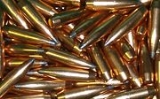
Bullet

Encyclopedia
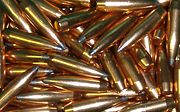
Projectile
A projectile is any object projected into space by the exertion of a force. Although a thrown baseball is technically a projectile too, the term more commonly refers to a weapon....
propelled by a firearm
Firearm
A firearm is a weapon that launches one, or many, projectile at high velocity through confined burning of a propellant. This subsonic burning process is technically known as deflagration, as opposed to supersonic combustion known as a detonation. In older firearms, the propellant was typically...
, sling
Sling (weapon)
A sling is a projectile weapon typically used to throw a blunt projectile such as a stone or lead "sling-bullet". It is also known as the shepherd's sling....
, or air gun
Air gun
An air gun is a rifle , pistol , or shotgun that fires projectiles by means of compressed air or other gas, in contrast to a firearm, which burns a propellant. Most air guns use metallic projectiles as ammunition. Air guns that only use plastic projectiles are classified as airsoft...
. Bullets do not normally contain explosives, but damage the intended target by impact and penetration
Penetration (weapons)
Strictly speaking penetration occurs when a projectile enters a target without passing through it and perforation occurs when the projectile completely passes through the target, but the word penetration is commonly used to refer to either....
. The word "bullet" is sometimes erroneously used to refer to ammunition
Ammunition
Ammunition is a generic term derived from the French language la munition which embraced all material used for war , but which in time came to refer specifically to gunpowder and artillery. The collective term for all types of ammunition is munitions...
generally, or to a cartridge
Cartridge (firearms)
A cartridge, also called a round, packages the bullet, gunpowder and primer into a single metallic case precisely made to fit the firing chamber of a firearm. The primer is a small charge of impact-sensitive chemical that may be located at the center of the case head or at its rim . Electrically...
, which is a combination of the bullet, case/shell
Shell (projectile)
A shell is a payload-carrying projectile, which, as opposed to shot, contains an explosive or other filling, though modern usage sometimes includes large solid projectiles properly termed shot . Solid shot may contain a pyrotechnic compound if a tracer or spotting charge is used...
, powder
Smokeless powder
Smokeless powder is the name given to a number of propellants used in firearms and artillery which produce negligible smoke when fired, unlike the older gunpowder which they replaced...
, and primer
Percussion cap
The percussion cap, introduced around 1830, was the crucial invention that enabled muzzleloading firearms to fire reliably in any weather.Before this development, firearms used flintlock ignition systems which produced flint-on-steel sparks to ignite a pan of priming powder and thereby fire the...
.
History


Sling (weapon)
A sling is a projectile weapon typically used to throw a blunt projectile such as a stone or lead "sling-bullet". It is also known as the shepherd's sling....
as a weapon and for hunting.
Eventually as firearms were developed, these same items were placed in front of an explosive charge of gun powder at the end of a closed tube. As firearm
Firearm
A firearm is a weapon that launches one, or many, projectile at high velocity through confined burning of a propellant. This subsonic burning process is technically known as deflagration, as opposed to supersonic combustion known as a detonation. In older firearms, the propellant was typically...
s became more technologically advanced, from 1500 to 1800, bullets changed very little. They remained simple round (spherical) lead
Lead
Lead is a main-group element in the carbon group with the symbol Pb and atomic number 82. Lead is a soft, malleable poor metal. It is also counted as one of the heavy metals. Metallic lead has a bluish-white color after being freshly cut, but it soon tarnishes to a dull grayish color when exposed...
balls, called rounds, differing only in their diameter.
The development of the hand culverin
Culverin
A culverin was a relatively simple ancestor of the musket, and later a medieval cannon, adapted for use by the French in the 15th century, and later adapted for naval use by the English in the late 16th century. The culverin was used to bombard targets from a distance. The weapon had a...
and matchlock
Matchlock
The matchlock was the first mechanism, or "lock" invented to facilitate the firing of a hand-held firearm. This design removed the need to lower by hand a lit match into the weapon's flash pan and made it possible to have both hands free to keep a firm grip on the weapon at the moment of firing,...
arquebus
Arquebus
The arquebus , or "hook tube", is an early muzzle-loaded firearm used in the 15th to 17th centuries. The word was originally modeled on the German hakenbüchse; this produced haquebute...
brought about the use of cast lead balls as projectiles. "Bullet" is derived from the French word boulette which roughly means little ball. The original musket
Musket
A musket is a muzzle-loaded, smooth bore long gun, fired from the shoulder. Muskets were designed for use by infantry. A soldier armed with a musket had the designation musketman or musketeer....
bullet was a spherical lead ball smaller than the bore, wrapped in a loosely-fitted paper patch which served to hold the bullet in the barrel firmly upon the powder. (Bullets that were not firmly upon the powder upon firing risked causing the barrel to explode, with the condition known as a short start.) The loading of muskets was, therefore, easy with the old smooth-bore Brown Bess
Brown Bess
Brown Bess is a nickname of uncertain origin for the British Army's Land Pattern Musket and its derivatives. This musket was used in the era of the expansion of the British Empire and acquired symbolic importance at least as significant as its physical importance. It was in use for over a hundred...
and similar military muskets. The original muzzle-loading rifle
Rifle
A rifle is a firearm designed to be fired from the shoulder, with a barrel that has a helical groove or pattern of grooves cut into the barrel walls. The raised areas of the rifling are called "lands," which make contact with the projectile , imparting spin around an axis corresponding to the...
, on the other hand, with a more closely fitting ball to take the rifling
Rifling
Rifling is the process of making helical grooves in the barrel of a gun or firearm, which imparts a spin to a projectile around its long axis...
grooves, was more difficult to load, particularly when the bore of the barrel was fouled from previous firings. For this reason, early rifles were not generally used for military purposes.
The first half of the nineteenth century saw a distinct change in the shape and function of the bullet. In 1826, Delvigne, a French infantry
Infantry
Infantrymen are soldiers who are specifically trained for the role of fighting on foot to engage the enemy face to face and have historically borne the brunt of the casualties of combat in wars. As the oldest branch of combat arms, they are the backbone of armies...
officer, invented a breech with abrupt shoulders on which a spherical bullet was rammed down until it caught the rifling grooves. Delvigne's method, however, deformed the bullet and was inaccurate.
Square bullets were used in one version of the Puckle gun
Puckle gun
The Puckle gun was invented in 1718 by James Puckle an English inventor, lawyer and writer.-Design and patent:...
.
Pointed bullets
Among the first pointed or "conical" bullets were those designed by Captain John Norton of the British ArmyBritish Army
The British Army is the land warfare branch of Her Majesty's Armed Forces in the United Kingdom. It came into being with the unification of the Kingdom of England and Scotland into the Kingdom of Great Britain in 1707. The new British Army incorporated Regiments that had already existed in England...
in 1823. Norton's bullet had a hollow base which upon firing expanded under pressure to engage with a barrel's rifling. The British Board of Ordnance rejected it because spherical bullets had been in use for the previous 300 years.
Renowned English gunsmith William Greener
William Greener
William Greener was an English inventor and gunmaker. He developed a self-expanding bullet in 1835, an electric lamp in 1846 some 33 years before Thomas Edison's patent in 1879...
invented the Greener bullet in 1836. It was very similar to Norton's bullet except that the hollow base of the bullet was fitted with a wooden plug which more reliably forced the base of the bullet to expand and catch the rifling. Tests proved that Greener's bullet was extremely effective but it too was rejected for military use because, being two parts, it was judged as being too complicated to produce.
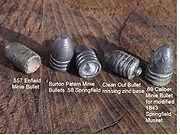
Minié ball
The Minié ball is a type of muzzle-loading spin-stabilising rifle bullet named after its co-developer, Claude-Étienne Minié, inventor of the Minié rifle...
was first introduced in 1847 by Claude-Étienne Minié, a captain in the French Army. It was nearly identical to the Greener bullet. As designed by Minié, the bullet was conical in shape with a hollow cavity in the rear, which was fitted with a little iron cap instead of a wooden plug. When fired, the iron cap would force itself into the hollow cavity at the rear of the bullet, thereby expanding the sides of the bullet to grip and engage the rifling. In 1855, the British adopted the Minié ball for their Enfield rifles
Pattern 1853 Enfield
The Enfield Pattern 1853 Rifle-Musket was a .577 calibre Minié-type muzzle-loading rifle-musket, used by the British Empire from 1853 to 1867, after which many Enfield 1853 Rifle-Muskets were converted to the cartridge-loaded Snider-Enfield rifle.-History &...
.
The Minié ball first saw widespread use in the American Civil War
American Civil War
The American Civil War was a civil war fought in the United States of America. In response to the election of Abraham Lincoln as President of the United States, 11 southern slave states declared their secession from the United States and formed the Confederate States of America ; the other 25...
. Roughly 90% of the battlefield casualties in this war were caused by Minié balls fired from rifles.
Between 1854 and 1857, Sir Joseph Whitworth
Joseph Whitworth
Sir Joseph Whitworth, 1st Baronet was an English engineer, entrepreneur, inventor and philanthropist. In 1841, he devised the British Standard Whitworth system, which created an accepted standard for screw threads...
conducted a long series of rifle experiments, and proved, among other points, the advantages of a smaller bore and, in particular, of an elongated bullet. The Whitworth bullet was made to fit the grooves of the rifle mechanically. The Whitworth rifle was never adopted by the government, although it was used extensively for match purposes and target practice between 1857 and 1866, when it was gradually superseded by Metford's.
About 1862 and later, W. E. Metford carried out an exhaustive series of experiments on bullets and rifling, and invented the important system of light rifling with increasing spiral, and a hardened bullet. The combined result was that in December 1888 the Lee-Metford
Lee-Metford
The Lee-Metford rifle was a bolt action British army service rifle, combining James Paris Lee's rear-locking bolt system and ten-round magazine with a seven groove rifled barrel designed by William Ellis Metford...
small-bore (0.303
.303 British
.303 British, or 7.7x56mmR, is a .311 inch calibre rifle and machine gun cartridge first developed in Britain as a blackpowder round put into service in December 1888 for the Lee-Metford rifle, later adapted to use smokeless powders...
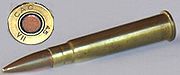
", 7.70 mm) rifle, Mark I, (photo of cartridge on right) was finally adopted for the British army. The Lee-Metford was the predecessor of the Lee-Enfield
Lee-Enfield
The Lee-Enfield bolt-action, magazine-fed, repeating rifle was the main firearm used by the military forces of the British Empire and Commonwealth during the first half of the 20th century...
.
The modern bullet
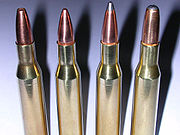
Eduard Rubin
Lieutenant Colonel Eduard Rubin was a Swiss firearm designer who is most notable for inventing the full metal jacket bullet in 1882. His most famous cartridge was the 7.5x55mm Swiss. He served as director of the Swiss Federal Ammunition Factory and Research Center in Thun.-References:...
, director of the Swiss Army Laboratory at Thun, invented the copper jacketed bullet — an elongated bullet with a lead core in a copper jacket. It was also small bore (7.5mm and 8mm) and it is the precursor of the 8mm "Lebel bullet" which was adopted for the smokeless powder ammunition of the Mle 1886 Lebel rifle.
The surface of lead bullets fired at high velocity may melt due to hot gases behind and friction with the bore. Because copper has a higher melting point, and greater specific heat capacity and hardness, copper jacketed bullets allow greater muzzle velocities.
European advances in aerodynamics led to the pointed spitzer bullet
Spitzer (bullet)
A spitzer, also commonly referred to as a spire point bullet, is an aerodynamic bullet design used in most intermediate and high-powered rifle cartridges...
. By the beginning of the twentieth century, most world armies had begun to transition to spitzer bullets. These bullets flew for greater distances more accurately and carried more energy with them. Spitzer bullets combined with machine gun
Machine gun
A machine gun is a fully automatic mounted or portable firearm, usually designed to fire rounds in quick succession from an ammunition belt or large-capacity magazine, typically at a rate of several hundred rounds per minute....
s greatly increased the lethality of the battlefield.
The latest advancement in bullet shape was the boat tail, a streamlined base for spitzer bullets. The vacuum created as air moves at high speed passes over the end of a bullet slows the projectile. The streamlined boat tail design reduces this form drag by allowing the air to flow along the surface of the tapering end. The resulting aerodynamic advantage is currently seen as the optimum shape for rifle technology. The first combination spitzer and boat-tail bullet, named Balle "D" from its inventor (a lieutenant-colonel Desaleux) , was introduced as standard military ammunition in 1901, for the French Lebel Model 1886 rifle
Lebel Model 1886 rifle
The Lebel Model 1886 rifle is also known as the "Fusil Mle 1886 M93", after a bolt modification was added in 1893. It is an 8mm bolt action infantry rifle which entered service in the French Army in April 1887...
.
Design
Bullet designs have to solve two primary problems. They must first form a seal with the gun's bore. If a strong seal is not achieved, gasGas
Gas is one of the three classical states of matter . Near absolute zero, a substance exists as a solid. As heat is added to this substance it melts into a liquid at its melting point , boils into a gas at its boiling point, and if heated high enough would enter a plasma state in which the electrons...
from the propellant charge leaks past the bullet, reducing efficiency. The bullet must also engage the rifling without damaging the gun's bore. Bullets must have a surface which will form this seal without causing excessive friction. These interactions between bullet and bore are termed internal ballistics
Internal ballistics
Internal ballistics, a subfield of ballistics, is the study of a projectile's behavior from the time its propellant's igniter is initiated until it exits the gun barrel...
. Bullets must be produced to a high standard, as surface imperfections can affect firing accuracy.
The physics affecting the bullet once it leaves the barrel, is termed external ballistics. The primary factors affecting the aerodynamics of a bullet in flight are the bullet's shape and the rotation imparted by the rifling of the gun barrel. Rotational forces stabilize the bullet gyroscopically as well as aerodynamically. Any asymmetry in the bullet is largely canceled as it spins. With smooth-bore firearms, a spherical shape was optimum because no matter how it was oriented, it presented a uniform front. These unstable bullets tumbled erratically and provided only moderate accuracy, however the aerodynamic shape changed little for centuries. Generally, bullet shapes are a compromise between aerodynamics, interior ballistic necessities, and terminal ballistics requirements. Another method of stabilization is for the center of mass of the bullet to be as far forward as is practical, which is how the Minié ball and the shuttlecock are designed. This allows the bullet to fly front-forward by means of aerodynamics.
See Terminal ballistics
Terminal ballistics
Terminal ballistics, a sub-field of ballistics, is the study of the behavior of a projectile when it hits its target. It is often referred to as stopping power when dealing with human or other living targets. Terminal ballistics is relevant both for small caliber projectiles as well as for large...
and/or Stopping power
Stopping power
Stopping power is a colloquial term used to describe the ability of a firearm or other weapon to cause a penetrating ballistic injury to a target, human or animal, sufficient to incapacitate the target where it stands....
for an overview of how bullet design affects what happens when a bullet impacts with an object. The outcome of the impact is determined by the composition and density of the target material, the angle of incidence, and the velocity and physical characteristics of the bullet itself. Bullets are generally designed to penetrate, deform, and/or break apart. For a given material and bullet, the strike velocity is the primary factor determining which outcome is achieved.
Bullet shapes are many and varied, and an array of them can be found in any reloading manual that sells bullet moulds. Mould manufacturers such as RCBS, Paul Jones Moulds, and David Mos offer many different calibers and designs. With a mould, bullets can be made at home for reloading one's own ammunition, where local laws allow. Hand-casting, however, is only time- and cost-effective for solid lead bullets. Cast and jacketed bullets are also commercially available from numerous manufacturers for hand loading and are much more convenient than casting bullets from bulk lead.
Propulsion
Propulsion of the ball can happen via several methods:- by using only gunpowder (ie as in flintlockFlintlockFlintlock is the general term for any firearm based on the flintlock mechanism. The term may also apply to the mechanism itself. Introduced at the beginning of the 17th century, the flintlock rapidly replaced earlier firearm-ignition technologies, such as the doglock, matchlock and wheellock...
weapons) - by using a percussion capPercussion capThe percussion cap, introduced around 1830, was the crucial invention that enabled muzzleloading firearms to fire reliably in any weather.Before this development, firearms used flintlock ignition systems which produced flint-on-steel sparks to ignite a pan of priming powder and thereby fire the...
and gunpower (ie as in percussion weapons) - by using a cartridgeCartridgeCartridge may refer to:* 8-track tape cartridge, a 1960s-1980s music storage format* Broadcast cartridge used in radio stations* Cartridge , a round of ammunition* Cartridge...
(which contains primerPrimerPrimer may refer to:*Primer , a 1995 music album by the musical group Rockapella*Primer *Primer , a 2004 feature film written and directed by Shane Carruth...
, gunpowder and ball in a single package)
Materials

Lead
Lead is a main-group element in the carbon group with the symbol Pb and atomic number 82. Lead is a soft, malleable poor metal. It is also counted as one of the heavy metals. Metallic lead has a bluish-white color after being freshly cut, but it soon tarnishes to a dull grayish color when exposed...
. This worked well for low speed bullets, fired at velocities of less than 450 m/s (1475 ft/s). For slightly higher speed bullets fired in modern firearms, a harder alloy
Alloy
An alloy is a mixture or metallic solid solution composed of two or more elements. Complete solid solution alloys give single solid phase microstructure, while partial solutions give two or more phases that may or may not be homogeneous in distribution, depending on thermal history...
of lead and tin or typesetter's lead (used to mold Linotype
Linotype (alloy)
Linotype or eutectic alloy is a broad name applied to five categories of lead alloys used in manufacture of type, each with three to five sub-classifications....
) works very well. For even higher speed bullet use, jacketed coated lead bullets are used. The common element in all of these, lead, is widely used because it is very dense, thereby providing a high amount of mass—and thus, kinetic energy
Kinetic energy
The kinetic energy of an object is the energy which it possesses due to its motion.It is defined as the work needed to accelerate a body of a given mass from rest to its stated velocity. Having gained this energy during its acceleration, the body maintains this kinetic energy unless its speed changes...
—for a given volume. Lead is also cheap, easy to obtain, easy to work, and melts at a low temperature, which results in comparatively easy fabrication of bullets.
- Lead: Simple castCast bulletA cast bullet is made by allowing molten metal to solidify in a mould. Most cast bullets are made of lead alloyed with tin and antimony; but zinc alloys have been used when lead is scarce, and may be used again in response to concerns about lead toxicity...
, extruded, swaged, or otherwise fabricated lead slugs are the simplest form of bullets. At speeds of greater than 300 m/s (1000 ft/s) (common in most handguns), lead is deposited in rifled bores at an ever-increasing rate. Alloying the lead with a small percentage of tinTinTin is a chemical element with the symbol Sn and atomic number 50. It is a main group metal in group 14 of the periodic table. Tin shows chemical similarity to both neighboring group 14 elements, germanium and lead and has two possible oxidation states, +2 and the slightly more stable +4...
and/or antimonyAntimonyAntimony is a toxic chemical element with the symbol Sb and an atomic number of 51. A lustrous grey metalloid, it is found in nature mainly as the sulfide mineral stibnite...
serves to reduce this effect, but grows less effective as velocities are increased. A cup made of harder metal, such as copper, placed at the base of the bullet and called a gas checkGas checkA gas check is a device used in some types of firearms ammunition. Gas checks are used when non-jacketed bullets are used in high pressure cartridges, to prevent the buildup of lead in the barrel and aid in accuracy.-Construction:...
, is often used to decrease lead deposits by protecting the rear of the bullet against melting when fired at higher pressures, but this too does not solve the problem at higher velocities. - Jacketed lead: Bullets intended for even higher-velocity applications generally have a lead core that is jacketed or plated with gilding metalGilding metalGilding metal is a copper alloy, comprising 95% copper and 5% zinc. Technically, it is a brass.Gilding metal is used for various purposes, including the jackets of bullets, driving bands on some artillery shells, as well as enameled badges and other jewellery....
, cupronickelCupronickelCupronickel or copper-nickel or "cupernickel" is an alloy of copper that contains nickel and strengthening elements, such as iron and manganese. Cupronickel is highly resistant to corrosion in seawater, because its electrode potential is adjusted to be neutral with regard to seawater...
, copperCopperCopper is a chemical element with the symbol Cu and atomic number 29. It is a ductile metal with very high thermal and electrical conductivity. Pure copper is soft and malleable; an exposed surface has a reddish-orange tarnish...
alloys, or steelSteelSteel is an alloy that consists mostly of iron and has a carbon content between 0.2% and 2.1% by weight, depending on the grade. Carbon is the most common alloying material for iron, but various other alloying elements are used, such as manganese, chromium, vanadium, and tungsten...
; a thin layer of harder metal protects the softer lead core when the bullet is passing through the barrel and during flight, which allows delivering the bullet intact to the target. There, the heavy lead core delivers its kinetic energy to the target. Full metal jacket bulletFull metal jacket bulletA full metal jacket is a bullet consisting of a soft core encased in a shell of harder metal, such as gilding metal, cupronickel or less commonly a steel alloy. This shell can extend around all of the bullet, or often just the front and sides with the rear left as exposed lead...
s or Ball bullet have the front and sides of the bullet completely encased in the harder metal jacket. Some bullet jackets do not extend to the front of the bullet to aid in expansion and increase lethality. These are called soft points or hollow point bulletHollow point bulletA hollow point is an expanding bullet that has a pit or hollowed out shape in its tip, generally intended to cause the bullet to thin upon entering a target in order to decrease penetration and disrupt more tissue as it travels through the target. It is also used for controlled penetration, where...
s. Steel bullets are often plated with copper or other metals for additional corrosion resistance during long periods of storage. Synthetic jacket materials such as nylonNylonNylon is a generic designation for a family of synthetic polymers known generically as polyamides, first produced on February 28, 1935, by Wallace Carothers at DuPont's research facility at the DuPont Experimental Station...
and Teflon have been used with limited success. - BlanksBlank (cartridge)A blank is a type of cartridge for a firearm that contains gunpowder but no bullet or shot. When fired, the blank makes a flash and an explosive sound . Blanks are often used for simulation , training, and for signaling...
: Wax, paper, plastic, and other materials are used to simulate live gunfire and are intended only to hold the powder in a blank cartridge and to produce noise. The "bullet" may be captured in a purpose-designed device or it may be allowed to expend what little energy it has in the air. Some blank cartridges are crimped or closed at the end and do not contain any bullet. - Practice: Made from lightweight materials like rubber, WaxWax bulletsWax bullets are made of paraffin wax, and are pressed into a primed cartridge case. Gun powder is not used; the primer provides all the power.- Inexpensive practice :...
, wood, plastic, or lightweight metal, practice bullets are intended for short-range target work, only. Because of their weight and low velocity, they have limited range. - Less lethal, or Less than Lethal: Rubber bulletRubber bulletRubber bullets are rubber or rubber-coated projectiles that can be fired from either standard firearms or dedicated riot guns. They are intended to be a non-lethal alternative to metal projectiles...
s, plastic bulletPlastic bulletA plastic bullet or plastic baton round is a non-lethal projectile fired from a specialised gun. Although designed as a non-lethal weapon they have still caused several deaths. They are generally used for riot control...
s, and beanbagsFlexible baton roundA bean bag round, also known by its trademarked name flexible baton round, is a baton round fired as a shotgun shell used for less lethal apprehension of suspects.-Description:...
are designed to be non-lethal, for example for use in riotRiotA riot is a form of civil disorder characterized often by what is thought of as disorganized groups lashing out in a sudden and intense rash of violence against authority, property or people. While individuals may attempt to lead or control a riot, riots are thought to be typically chaotic and...
control. They are generally low velocity and are fired from shotguns, grenade launchers, paint ball guns, or specially-designed firearms and air gun devices. - IncendiaryIncendiary ammunition-World War I:One of the first uses of incendiary ammunition occurred in World War I. At the time, phosphorus—the primary ingredient in the incendiary charge—ignited upon firing, leaving a trail of blue smoke. They were also known as 'smoke tracer' for this reason. The effective range of...
: These bullets are made with an explosive or flammable mixture in the tip that is designed to ignite on contact with a target. The intent is to ignite fuel or munitions in the target area, thereby adding to the destructive power of the bullet itself.
- Exploding: Similar to the incendiary bullet, this type of projectile is designed to explode upon hitting a hard surface, preferably the bone of the intended target. Not to be mistaken for cannon shells or grenades with fuse devices, these bullets have only a cavity filled with a small amount of low explosive depending on the velocity and deformation upon impact to detonate.
- TracerTracer ammunitionTracer ammunition are bullets that are built with a small pyrotechnic charge in their base. Ignited by the burning powder, the phosphorus tail burns very brightly, making the projectile visible to the naked eye...
: These have a hollow back, filled with a flare material. Usually this is a mixture of magnesiumMagnesiumMagnesium is a chemical element with the symbol Mg, atomic number 12, and common oxidation number +2. It is an alkaline earth metal and the eighth most abundant element in the Earth's crust and ninth in the known universe as a whole...
metal, a perchloratePerchloratePerchlorates are the salts derived from perchloric acid . They occur both naturally and through manufacturing. They have been used as a medicine for more than 50 years to treat thyroid gland disorders. They are used extensively within the pyrotechnics industry, and ammonium perchlorate is also a...
, and strontiumStrontiumStrontium is a chemical element with the symbol Sr and the atomic number 38. An alkaline earth metal, strontium is a soft silver-white or yellowish metallic element that is highly reactive chemically. The metal turns yellow when exposed to air. It occurs naturally in the minerals celestine and...
salts to yield a bright red color, although other materials providing other colors have also sometimes been used. Tracer material burns out after a certain amount of time. Such ammunition is useful to the shooter as a means of verifying how close the point of aim is to the actual point of impact, and for learning how to point shoot moving targets with rifles. This type of round is also used by all branches of the United States military in combat environments as a signaling device to friendly forces. Normally it is loaded at a four to one ratio with ball ammunition and is intended to show where you are firing so friendly forces can engage the target as well. The flight characteristics of tracer rounds differ from normal bullets, decreasing in altitude sooner than other bullets, because of increased aerodynamic drag. - Armor piercing: Jacketed designs where the core material is a very hard, high-density metal such as tungstenTungstenTungsten , also known as wolfram , is a chemical element with the chemical symbol W and atomic number 74.A hard, rare metal under standard conditions when uncombined, tungsten is found naturally on Earth only in chemical compounds. It was identified as a new element in 1781, and first isolated as...
, tungsten carbideTungsten carbideTungsten carbide is an inorganic chemical compound containing equal parts of tungsten and carbon atoms. Colloquially, tungsten carbide is often simply called carbide. In its most basic form, it is a fine gray powder, but it can be pressed and formed into shapes for use in industrial machinery,...
, depleted uraniumDepleted uraniumDepleted uranium is uranium with a lower content of the fissile isotope U-235 than natural uranium . Uses of DU take advantage of its very high density of 19.1 g/cm3...
, or steelSteelSteel is an alloy that consists mostly of iron and has a carbon content between 0.2% and 2.1% by weight, depending on the grade. Carbon is the most common alloying material for iron, but various other alloying elements are used, such as manganese, chromium, vanadium, and tungsten...
. A pointed tip is often used, but a flat tip on the penetrator portion is generally more effective. - Non toxic shot: Steel, bismuthBismuthBismuth is a chemical element with symbol Bi and atomic number 83. Bismuth, a trivalent poor metal, chemically resembles arsenic and antimony. Elemental bismuth may occur naturally uncombined, although its sulfide and oxide form important commercial ores. The free element is 86% as dense as lead...
, tungstenTungstenTungsten , also known as wolfram , is a chemical element with the chemical symbol W and atomic number 74.A hard, rare metal under standard conditions when uncombined, tungsten is found naturally on Earth only in chemical compounds. It was identified as a new element in 1781, and first isolated as...
, and other exotic bullet alloys prevent release of toxic lead into the environment. Regulations in several countries mandate the use of non-toxic projectiles especially when hunting waterfowl. It has been found that birds swallow small lead shot for their gizzards to grind food (as they would swallow pebbles of similar size), and the effects of lead poisoning by constant grinding of lead pellets against food means lead poisoning effects are magnified. Such concerns apply primarily to shotguns, firing pellets (shot) and not bullets, but reduction of hazardous substances (RoHS) legislation has also been applied to bullets on occasion to reduce the impact of lead on the environment at shooting rangeShooting rangeA shooting range or firing range is a specialized facility designed for firearms practice. Each facility is typically overseen by one or more supervisory personnel, called variously a range master or "RSO – Range Safety Officer" in the United States or a range conducting officer or "RCO" in the UK...
s. United States Environmental Protection Agency announced that the agency does not have the legal authority to regulate this type of product (lead bullets) under the Toxic Substances Control Act (TSCA), nor is the agency seeking such authority. NRA-ILA :: EPA Denies Ammo Ban Petition - Blended-metal: Bullets made using cores from powdered metals other than lead with binder or sometimes sinteredSinteringSintering is a method used to create objects from powders. It is based on atomic diffusion. Diffusion occurs in any material above absolute zero, but it occurs much faster at higher temperatures. In most sintering processes, the powdered material is held in a mold and then heated to a temperature...
. - FrangibleFrangibleA material is said to be frangible if through deformation it tends to break up into fragments, rather than deforming plastically and retaining its cohesion as a single object...
: Designed to disintegrate into tiny particles upon impact to minimize their penetration for reasons of range safety, to limit environmental impact, or to limit the shoot-through danger behind the intended target. An example is the Glaser Safety SlugGlaser Safety SlugGlaser Safety Slug is a frangible bullet made by Glaser Safety Slug, Inc., a small American ammunition company based in Sturgis, South Dakota . The company was founded in 1975 by Armin Glaser the same year as the Glaser Safety Slug was developed by Jack Canon.-History:The original round was a...
. - Solid or Monolithic Solid: mono-metal bullets intended for deep penetration in big game animals and slender shaped very-low-drag projectiles for long range shooting are produced out of metals like oxygen free copper and alloys like copperCopperCopper is a chemical element with the symbol Cu and atomic number 29. It is a ductile metal with very high thermal and electrical conductivity. Pure copper is soft and malleable; an exposed surface has a reddish-orange tarnish...
nickelNickelNickel is a chemical element with the chemical symbol Ni and atomic number 28. It is a silvery-white lustrous metal with a slight golden tinge. Nickel belongs to the transition metals and is hard and ductile...
, tellurium copper and brassBrassBrass is an alloy of copper and zinc; the proportions of zinc and copper can be varied to create a range of brasses with varying properties.In comparison, bronze is principally an alloy of copper and tin...
like highly machinable UNS C36000 Free-Cutting Brass. Often these projectiles are turned on precision CNC lathes.
Treaties and prohibitions
The St. Petersburg Declaration of 1868 prohibited the use of explosive projectiles weighing less than 400 grams.The Hague Convention
Hague Conventions (1899 and 1907)
The Hague Conventions were two international treaties negotiated at international peace conferences at The Hague in the Netherlands: The First Hague Conference in 1899 and the Second Hague Conference in 1907...
prohibits certain kinds of ammunition for use by uniformed military personnel against the uniformed military personnel of opposing forces. These include projectiles which explode within an individual, poisoned and expanding
Hollow point bullet
A hollow point is an expanding bullet that has a pit or hollowed out shape in its tip, generally intended to cause the bullet to thin upon entering a target in order to decrease penetration and disrupt more tissue as it travels through the target. It is also used for controlled penetration, where...
bullets.
Protocol III of the 1983 Convention on Certain Conventional Weapons
Convention on Certain Conventional Weapons
The United Nations Convention on Certain Conventional Weapons , concluded at Geneva on October 10, 1980 and entered into force in December 1983, seeks to prohibit or restrict the use of certain conventional weapons which are considered excessively injurious or whose effects are indiscriminate.The...
, an annexe to the Geneva Conventions
Geneva Conventions
The Geneva Conventions comprise four treaties, and three additional protocols, that establish the standards of international law for the humanitarian treatment of the victims of war...
, prohibits the use of incendiary munitions against civilians.
Nothing in these treaties prohibits tracers
Tracer ammunition
Tracer ammunition are bullets that are built with a small pyrotechnic charge in their base. Ignited by the burning powder, the phosphorus tail burns very brightly, making the projectile visible to the naked eye...
or the use of prohibited bullets on military equipment.
These treaties apply even to .22 LR bullets used in pistols, rifles and machine guns. Hence, the High Standard HDM pistol, a .22 LR suppressed pistol, had special bullets developed for it during World War II that were full metal jacketed, in place of the soft-point and hollow-point bullets that are otherwise ubiquitous for .22 LR rounds.
Some jurisdictions are acting on environmental concerns and banning hunting with lead shotgun pellets. This creates issues for shooters because stainless steel pellets are considered to behave sub-optimally in flight compared to lead. The element bismuth
Bismuth
Bismuth is a chemical element with symbol Bi and atomic number 83. Bismuth, a trivalent poor metal, chemically resembles arsenic and antimony. Elemental bismuth may occur naturally uncombined, although its sulfide and oxide form important commercial ores. The free element is 86% as dense as lead...
is a safe alternative whose atomic mass is closer to lead than steel, and ammunition made from it is becoming ever more widely available.
Bullet abbreviations
- 2F – 2-part Controlled Fragmenting
- ACC – RemingtonRemington ArmsRemington Arms Company, Inc. was founded in 1816 by Eliphalet Remington in Ilion, New York, as E. Remington and Sons. It is the oldest company in the United States which still makes its original product, and is the oldest continuously operating manufacturer in North America. It is the only U.S....
Accelerator (see sabotSabotA sabot is a device used in a firearm or cannon to fire a projectile, such as a bullet, that is smaller than the bore diameter, or which must be held in a precise position. The term is also applied to a battery stub case, a device used similarly to make a small electrical battery usable in a...
) - ACP – Automatic Colt Pistol
- AE – Action Express
- AGS – African Grand Slam (Speer)
- AP – Armor PiercingArmor-piercing shot and shellAn armor-piercing shell is a type of ammunition designed to penetrate armor. From the 1860s to 1950s, a major application of armor-piercing projectiles was to defeat the thick armor carried on many warships. From the 1920s onwards, armor-piercing weapons were required for anti-tank missions...
(has a steel or other hard metal core) - APT – Armor-piercing tracer
- API – Armor-piercing incendiary
- APFSDS – Armor-piercing Fin Stabilized Discarding Sabot round
- B – Ball
- B2F – Brass 2-part Fragmenting
- BBWC – Bevel Base WadcutterWadcutterA wadcutter is a special-purpose bullet specially designed for shooting paper targets, usually at close range and at subsonic velocities typically under 800 ft/s . They are often used in handgun and airgun competitions...
- BEB – Brass Enclosed Base
- BJHP – Brass Jacketed Hollow PointHollow point bulletA hollow point is an expanding bullet that has a pit or hollowed out shape in its tip, generally intended to cause the bullet to thin upon entering a target in order to decrease penetration and disrupt more tissue as it travels through the target. It is also used for controlled penetration, where...
- Blitz – SierraSierra BulletsFounded in 1947 in California, Sierra Bullets is an American manufacturer of bullets intended for firearms. Based in Sedalia, Missouri since 1990, Sierra manufactures a very wide range of bullets for both rifles and pistols. Sierra bullets are used for precision target shooting, hunting and defense...
BlitzKing - BMG – Browning Machine Gun.50 BMGThe .50 Browning Machine Gun or 12.7×99mm NATO is a cartridge developed for the Browning .50 caliber machine gun in the late 1910s. Entering service officially in 1921, the round is based on a greatly scaled-up .30-06 cartridge...
- BrPT – Bronze Point
- Bt – Boat-tail
- BtHP – Boat-tail Hollow PointHollow point bulletA hollow point is an expanding bullet that has a pit or hollowed out shape in its tip, generally intended to cause the bullet to thin upon entering a target in order to decrease penetration and disrupt more tissue as it travels through the target. It is also used for controlled penetration, where...
- C2F – Civilian 2-part Fragmenting
- CB – Cast Bullet
- CL, C-L – RemingtonRemington ArmsRemington Arms Company, Inc. was founded in 1816 by Eliphalet Remington in Ilion, New York, as E. Remington and Sons. It is the oldest company in the United States which still makes its original product, and is the oldest continuously operating manufacturer in North America. It is the only U.S....
Core-Lokt - CN – Cupronicknel
- CNCS – Cupronickel-Clad Steel
- CTFB – Closed Tip Flat Base
- DBBWC – Double bevel based wadcutter
- DEWC – Double Ended WadcutterWadcutterA wadcutter is a special-purpose bullet specially designed for shooting paper targets, usually at close range and at subsonic velocities typically under 800 ft/s . They are often used in handgun and airgun competitions...
- DGS – Dangerous Game Solid (Hornady)
- DGX – Dangerous Game Expanding (Hornady)
- DU – Depleted UraniumDepleted uraniumDepleted uranium is uranium with a lower content of the fissile isotope U-235 than natural uranium . Uses of DU take advantage of its very high density of 19.1 g/cm3...
- EVO, FTX – HornadyHornadyHornady Manufacturing Company is an American manufacturer of ammunition and handloading components, based in Grand Island, Nebraska.The company was founded by Joyce Hornady in 1949 and is currently run by his son Steve Hornady who took over after his father's death in a plane crash in 1981.Hornady...
LEVERevolution Flex Tip eXpanding - EVO – RWSRUAGRUAG is a Swiss technology company, with its headquarters in Bern. It has production sites in Switzerland , Germany , Sweden , Hungary and Austria .-Structure:The RUAG has following subsidiaries:*RUAG Aerospace RUAG is a Swiss technology company, with its headquarters in Bern. It has production...
Evolution bullet - FMC – Full Metal Case
- FMJ – Full Metal JacketFull metal jacket bulletA full metal jacket is a bullet consisting of a soft core encased in a shell of harder metal, such as gilding metal, cupronickel or less commonly a steel alloy. This shell can extend around all of the bullet, or often just the front and sides with the rear left as exposed lead...
- FMJBT – Full Metal Jacket Boat-Tail
- FN – Dangerous Game Solid Bullets Flat Nose
- FP – Flat Point
- FP – Full Patch
- FST – WinchesterWinchester Repeating Arms CompanyThe Winchester Repeating Arms Company was a prominent American maker of repeating firearms, located in New Haven, Connecticut. The Winchester brand is today used under license by two subsidiaries of the Herstal Group, Fabrique Nationale of Belgium and the Browning Arms Company of Morgan, Utah.-...
Fail Safe TalonBlack TalonBlack Talon is a type of ammunition that was introduced by Winchester Ammunition in 1991 primarily for law enforcement and self-defense. This hollow-point ammunition became known for its bullet's unique construction and sharp petal shape after expansion following impact with tissue or other wet media... - GC – Gas Check
- GD – Speer Gold Dot
- GDHP – Speer Gold Dot Hollow PointHollow point bulletA hollow point is an expanding bullet that has a pit or hollowed out shape in its tip, generally intended to cause the bullet to thin upon entering a target in order to decrease penetration and disrupt more tissue as it travels through the target. It is also used for controlled penetration, where...
- GM – Gilding Metal
- GMCS – Gilding Metal-Clad Steel
- GS – RemingtonRemington ArmsRemington Arms Company, Inc. was founded in 1816 by Eliphalet Remington in Ilion, New York, as E. Remington and Sons. It is the oldest company in the United States which still makes its original product, and is the oldest continuously operating manufacturer in North America. It is the only U.S....
Golden Saber - GSC – GS Custom Turned Copper Bullets
- HBWC – Hollow Base Wadcutter
- HC – Hard Cast
- HE-IT – High Explosive Incendiary Tracer
- HP – Hollow PointHollow point bulletA hollow point is an expanding bullet that has a pit or hollowed out shape in its tip, generally intended to cause the bullet to thin upon entering a target in order to decrease penetration and disrupt more tissue as it travels through the target. It is also used for controlled penetration, where...
- HPBT – Hollow Point Boat Tail
- HPJ – High Performance Jacketed
- HS – FederalFederal CartridgeFederal Cartridge is a wholly owned subsidiary of Alliant Techsystems, located in Edina, Minnesota. With a work force of nearly 1,000 in Anoka, Minnesota, Federal manufactures a complete line of shotshell, centerfire, and rimfire ammunition and components....
Hydra-ShokHydrashokHydra-Shok is a type of bullet used in commercial self-defense ammunition made by Federal Cartridge. It was originally patented by bullet designer Tom Burczynski. Hydra-Shok bullets feature a unique, patented center-post design and notched jacket. Together they are meant to provide more reliable... - HST – FederalFederal CartridgeFederal Cartridge is a wholly owned subsidiary of Alliant Techsystems, located in Edina, Minnesota. With a work force of nearly 1,000 in Anoka, Minnesota, Federal manufactures a complete line of shotshell, centerfire, and rimfire ammunition and components....
Hi-Shok Two
- HV – Low friction Drive Band Bullets High Velocity
- ID-Classic – RWSRUAGRUAG is a Swiss technology company, with its headquarters in Bern. It has production sites in Switzerland , Germany , Sweden , Hungary and Austria .-Structure:The RUAG has following subsidiaries:*RUAG Aerospace RUAG is a Swiss technology company, with its headquarters in Bern. It has production...
fragmentation bullet, ex-TIG after BrennekeBrennekeBrenneke GmbH is a German manufacturer of ammunition and bullets, based in Langenhagen, Lower Saxony.The company was founded by Wilhelm Brenneke in 1895 and is currently owned and run by his great-grandson, Dr. Peter Mank....
-license was not renewed. - I-T – Incendiary-Tracer
- IB – Interbond (Hornady)
- J – Jacketed
- JAP – Jacketed Aluminium Point
- JFP – Jacketed Flat Point
- JHC – Jacketed Hollow Cavity
- JHP – Jacketed Hollow PointHollow point bulletA hollow point is an expanding bullet that has a pit or hollowed out shape in its tip, generally intended to cause the bullet to thin upon entering a target in order to decrease penetration and disrupt more tissue as it travels through the target. It is also used for controlled penetration, where...
- JHP/sabot – Jacketed Hollow PointHollow point bulletA hollow point is an expanding bullet that has a pit or hollowed out shape in its tip, generally intended to cause the bullet to thin upon entering a target in order to decrease penetration and disrupt more tissue as it travels through the target. It is also used for controlled penetration, where...
/sabotSabotA sabot is a device used in a firearm or cannon to fire a projectile, such as a bullet, that is smaller than the bore diameter, or which must be held in a precise position. The term is also applied to a battery stub case, a device used similarly to make a small electrical battery usable in a... - JSP – Jacketed Soft Point
- L – Lead
- L-C – Lead Combat
- L-T – Lead Target
- LFN – Long Flat Nose
- LFP – Lead Flat Point
- LHP – Lead Hollow PointHollow point bulletA hollow point is an expanding bullet that has a pit or hollowed out shape in its tip, generally intended to cause the bullet to thin upon entering a target in order to decrease penetration and disrupt more tissue as it travels through the target. It is also used for controlled penetration, where...
- LRN – Lead Round Nose
- LSWC – Lead SemiwadcutterSemiwadcutterA semiwadcutter or SWC is a type of all-purpose bullet commonly used in revolvers. The SWC combines features of the wadcutter target bullet and traditional round nosed revolver bullets, and is used in both revolver and pistol cartridges for hunting, target shooting, and plinking...
- LSWC-GC – Lead SemiwadcutterSemiwadcutterA semiwadcutter or SWC is a type of all-purpose bullet commonly used in revolvers. The SWC combines features of the wadcutter target bullet and traditional round nosed revolver bullets, and is used in both revolver and pistol cartridges for hunting, target shooting, and plinking...
Gas Checked - LWC – Lead WadcutterWadcutterA wadcutter is a special-purpose bullet specially designed for shooting paper targets, usually at close range and at subsonic velocities typically under 800 ft/s . They are often used in handgun and airgun competitions...
- LTC – Lead Truncated Cone
- MC – Metal Cased
- MHP – Match Hollow PointHollow point bulletA hollow point is an expanding bullet that has a pit or hollowed out shape in its tip, generally intended to cause the bullet to thin upon entering a target in order to decrease penetration and disrupt more tissue as it travels through the target. It is also used for controlled penetration, where...
- MK – SierraSierra BulletsFounded in 1947 in California, Sierra Bullets is an American manufacturer of bullets intended for firearms. Based in Sedalia, Missouri since 1990, Sierra manufactures a very wide range of bullets for both rifles and pistols. Sierra bullets are used for precision target shooting, hunting and defense...
MatchKing - MRWC – Mid-Range WadcutterWadcutterA wadcutter is a special-purpose bullet specially designed for shooting paper targets, usually at close range and at subsonic velocities typically under 800 ft/s . They are often used in handgun and airgun competitions...
- MP – Metal Point (only the tip of the bullet is covered)
- NP – Nosler Partition
- OTM – Open Tip Match
- OWC – OgivalOgiveAn ogive is the roundly tapered end of a two-dimensional or three-dimensional object.-Applied physical science and engineering:In ballistics or aerodynamics, an ogive is a pointed, curved surface mainly used to form the approximately streamlined nose of a bullet or other projectile.The traditional...
WadcutterWadcutterA wadcutter is a special-purpose bullet specially designed for shooting paper targets, usually at close range and at subsonic velocities typically under 800 ft/s . They are often used in handgun and airgun competitions... - P – Pracitce, proof
- PB – Lead Bullet
- PB – ParabellumParabellumThe word Parabellum is a noun coined by German arms maker Deutsche Waffen und Munitionsfabriken and is derived from the Latin saying si vis pacem, para bellum, meaning If you wish for peace, prepare for war...
- PL – RemingtonRemington ArmsRemington Arms Company, Inc. was founded in 1816 by Eliphalet Remington in Ilion, New York, as E. Remington and Sons. It is the oldest company in the United States which still makes its original product, and is the oldest continuously operating manufacturer in North America. It is the only U.S....
Power-Lokt - PnPT – Pneumatic Point
- PPL – Paper patched lead
- PSP – Plated Soft Point
- PSP, PTDSP – Pointed Soft Point
- RN – Round Nose
- RNFP – Round Nose Flat Point
- RNL – Round Nosed Lead
- SJ – Semi-Jacketed
- SJHP – Semi-Jacketed Hollow PointHollow point bulletA hollow point is an expanding bullet that has a pit or hollowed out shape in its tip, generally intended to cause the bullet to thin upon entering a target in order to decrease penetration and disrupt more tissue as it travels through the target. It is also used for controlled penetration, where...
- SJSP – Semi-Jacketed Soft Point
- SP – Soft Point
- SP – Spire Point
- Sp, SPTZ – SpitzerSpitzer (bullet)A spitzer, also commonly referred to as a spire point bullet, is an aerodynamic bullet design used in most intermediate and high-powered rifle cartridges...
- SPC – Special Purpose Cartridge
- SpHP – SpitzerSpitzer (bullet)A spitzer, also commonly referred to as a spire point bullet, is an aerodynamic bullet design used in most intermediate and high-powered rifle cartridges...
Hollow PointHollow point bulletA hollow point is an expanding bullet that has a pit or hollowed out shape in its tip, generally intended to cause the bullet to thin upon entering a target in order to decrease penetration and disrupt more tissue as it travels through the target. It is also used for controlled penetration, where... - SST – HornadyHornadyHornady Manufacturing Company is an American manufacturer of ammunition and handloading components, based in Grand Island, Nebraska.The company was founded by Joyce Hornady in 1949 and is currently run by his son Steve Hornady who took over after his father's death in a plane crash in 1981.Hornady...
Super Shock Tip - SSp – Semi-SpitzerSpitzer (bullet)A spitzer, also commonly referred to as a spire point bullet, is an aerodynamic bullet design used in most intermediate and high-powered rifle cartridges...
- ST – Silver Tip
- STHP – Silver Tip Hollow PointHollow point bulletA hollow point is an expanding bullet that has a pit or hollowed out shape in its tip, generally intended to cause the bullet to thin upon entering a target in order to decrease penetration and disrupt more tissue as it travels through the target. It is also used for controlled penetration, where...
- SWC – SemiwadcutterSemiwadcutterA semiwadcutter or SWC is a type of all-purpose bullet commonly used in revolvers. The SWC combines features of the wadcutter target bullet and traditional round nosed revolver bullets, and is used in both revolver and pistol cartridges for hunting, target shooting, and plinking...
- SX – Super Explosive
- SXT – WinchesterWinchester Repeating Arms CompanyThe Winchester Repeating Arms Company was a prominent American maker of repeating firearms, located in New Haven, Connecticut. The Winchester brand is today used under license by two subsidiaries of the Herstal Group, Fabrique Nationale of Belgium and the Browning Arms Company of Morgan, Utah.-...
Ranger Supreme Expansion Technology - T – Tracer
- TAG – BrennekeBrennekeBrenneke GmbH is a German manufacturer of ammunition and bullets, based in Langenhagen, Lower Saxony.The company was founded by Wilhelm Brenneke in 1895 and is currently owned and run by his great-grandson, Dr. Peter Mank....
lead-free bullet - TBBC – Carter/Speer Trophy Bonded Bear Claw soft point
- TBSS – Carter/Speer Trophy Bonded Sledgehammer Solid
- TC – Truncated Cone
- THV – Terminal High Velocity
- TIG – BrennekeBrennekeBrenneke GmbH is a German manufacturer of ammunition and bullets, based in Langenhagen, Lower Saxony.The company was founded by Wilhelm Brenneke in 1895 and is currently owned and run by his great-grandson, Dr. Peter Mank....
fragmentation bullet - TMJ – Total Metal Jacket
- TNT – Speer TNT
- TUG – BrennekeBrennekeBrenneke GmbH is a German manufacturer of ammunition and bullets, based in Langenhagen, Lower Saxony.The company was founded by Wilhelm Brenneke in 1895 and is currently owned and run by his great-grandson, Dr. Peter Mank....
deformation bullet - TOG – BrennekeBrennekeBrenneke GmbH is a German manufacturer of ammunition and bullets, based in Langenhagen, Lower Saxony.The company was founded by Wilhelm Brenneke in 1895 and is currently owned and run by his great-grandson, Dr. Peter Mank....
deformation bullet - UmbPT – Umbrella Point
- UNI-Classic – RWSRUAGRUAG is a Swiss technology company, with its headquarters in Bern. It has production sites in Switzerland , Germany , Sweden , Hungary and Austria .-Structure:The RUAG has following subsidiaries:*RUAG Aerospace RUAG is a Swiss technology company, with its headquarters in Bern. It has production...
deformation bullet, ex-TUG after BrennekeBrennekeBrenneke GmbH is a German manufacturer of ammunition and bullets, based in Langenhagen, Lower Saxony.The company was founded by Wilhelm Brenneke in 1895 and is currently owned and run by his great-grandson, Dr. Peter Mank....
-license was not renewed. - VMAX – HornadyHornadyHornady Manufacturing Company is an American manufacturer of ammunition and handloading components, based in Grand Island, Nebraska.The company was founded by Joyce Hornady in 1949 and is currently run by his son Steve Hornady who took over after his father's death in a plane crash in 1981.Hornady...
V-Max - VLD – Very Low DragVery-low-drag bulletVery-low-drag bullets are primarily a small arms ballistics development of the 1980s–1990s, driven by shooters' desire for bullets that will give a higher degree of accuracy and kinetic efficiency, especially at extended ranges. To achieve this the projectile must minimize air resistance in flight...
- WC – WadcutterWadcutterA wadcutter is a special-purpose bullet specially designed for shooting paper targets, usually at close range and at subsonic velocities typically under 800 ft/s . They are often used in handgun and airgun competitions...
- WFN – Wide Flat Nose
- WFNGC – Wide Flat Nose Gas Check
- WLN – Wide Long Nose
- X – Barnes X-Bullet
- XTP – HornadyHornadyHornady Manufacturing Company is an American manufacturer of ammunition and handloading components, based in Grand Island, Nebraska.The company was founded by Joyce Hornady in 1949 and is currently run by his son Steve Hornady who took over after his father's death in a plane crash in 1981.Hornady...
Extreme Terminal Performance
Figurative uses
The word for the bullet, usually because of its speed, is sometimes used figuratively, e.g.:- The Japanese Bullet TrainShinkansenThe , also known as THE BULLET TRAIN, is a network of high-speed railway lines in Japan operated by four Japan Railways Group companies. Starting with the Tōkaidō Shinkansen in 1964, the network has expanded to currently consist of of lines with maximum speeds of , of Mini-shinkansen with a...
s. - The 350cc Royal EnfieldRoyal EnfieldRoyal Enfield was the name under which the Enfield Cycle Company made motorcycles, bicycles, lawnmowers and stationary engines. This legacy of weapons manufacture is reflected in the logo, a cannon, and their motto "Made like a gun, goes like a bullet". Use of the brand name Royal Enfield was...
motorcycleMotorcycleA motorcycle is a single-track, two-wheeled motor vehicle. Motorcycles vary considerably depending on the task for which they are designed, such as long distance travel, navigating congested urban traffic, cruising, sport and racing, or off-road conditions.Motorcycles are one of the most...
marketed in India is called Bullet - The expression "bullet-headed" for a dolichocephalic shape of an animal's head.
- The term silver bulletSilver bulletIn folklore, the silver bullet is supposed to be the only kind of bullet for firearms that is effective against a werewolf, witch, or other monsters...
, an extremely effective solution to a problem, comes from the modern addition to werewolfWerewolfA werewolf, also known as a lycanthrope , is a mythological or folkloric human with the ability to shapeshift into a wolf or an anthropomorphic wolf-like creature, either purposely or after being placed under a curse...
folklore that the monster is highly vulnerable to firearms using silver ammunition. - The phrase "biting the bulletBite the bulletTo "bite the bullet" is to endure a painful or otherwise unpleasant situation that is seen as unavoidable. The phrase was first recorded by Rudyard Kipling in his 1891 novel The Light that Failed...
", meaning (usually mental) preparation for an unpleasant task or experience, refers to a patient biting on a lead bullet put between his back teeth to brace himself for a painful medical procedure (such as the removal of a bullet or amputation of a limb) before the advent of anesthesiaAnesthesiaAnesthesia, or anaesthesia , traditionally meant the condition of having sensation blocked or temporarily taken away...
. This was frequently done on or behind a battlefield, where bullets would be readily available. Also comes from the process of loading rifles from paper cartridges, where a rifleman would bite the bullet to rip the paper to load their rifle. - In horse racingHorse racingHorse racing is an equestrian sport that has a long history. Archaeological records indicate that horse racing occurred in ancient Babylon, Syria, and Egypt. Both chariot and mounted horse racing were events in the ancient Greek Olympics by 648 BC...
, each track marks its fastest training session each day with a bullet in that horse's past performances. - In motion pictures (including televisionTelevisionTelevision is a telecommunication medium for transmitting and receiving moving images that can be monochrome or colored, with accompanying sound...
, narrative film and motion pictures and gameplay within videogames), bullet timeBullet timeBullet time is a special and visual effect that refers to a digitally enhanced simulation of variable-speed photography used in films, broadcast advertisements, and video games...
is a digitally enhancedVisual effectsVisual effects are the various processes by which imagery is created and/or manipulated outside the context of a live action shoot. Visual effects involve the integration of live-action footage and generated imagery to create environments which look realistic, but would be dangerous, costly, or...
shot in which, first, the film's speed is reduced to extreme slow motionSlow motionSlow motion is an effect in film-making whereby time appears to be slowed down. It was invented by the Austrian priest August Musger....
or, sometimes, to a static frame, and then, second, the camera rotates around the scene at normal speed, providing the viewer with a glimpse of the action from many different angles. Bullet time allows the viewer to capture action s/he would not be able to see in detail at normal speeds. It also allows the viewer to see this action from many angles that would be otherwise hidden from view. Under normal filming conditions, the person shooting the scene would have to choose one angle from which to shoot the action. Camera rotations in bullet time may vary from a relatively small angle, such as 90°, to a full 360°. The bullet time technique is often used in videogames as a convention that allows the player special abilities, such as the ability to slow down time and gain the advantage from this. The term, "bullet time," was first used in reference to the film, The Matrix, that used this technique to create a slow motion shot of a series of fired bullets in which the camera circled around the bullets and their intended target. - The expression "catching a bullet in his teeth" comes from reports of sleight-of-hand magician Benjamin Perry Covington, who was said to have caught three bullets in his teeth fired from three different guns fired by volunteers in a New York magic act in the early 1920s.
- The expression "shooting blanks" is used idiomatically to refer to male sterilityInfertilityInfertility primarily refers to the biological inability of a person to contribute to conception. Infertility may also refer to the state of a woman who is unable to carry a pregnancy to full term...
. A blank roundBlank (cartridge)A blank is a type of cartridge for a firearm that contains gunpowder but no bullet or shot. When fired, the blank makes a flash and an explosive sound . Blanks are often used for simulation , training, and for signaling...
contains no projectile (and thus very little lethality), much like the semenSemenSemen is an organic fluid, also known as seminal fluid, that may contain spermatozoa. It is secreted by the gonads and other sexual organs of male or hermaphroditic animals and can fertilize female ova...
of an infertile man contains no viable sperm. - In no limit holdem poker, "bullets" are the name give to the starting hand of AA, other names are "American Airlines" and "Pocket Rockets"
See also
External links
- "Bullets by the Billion", 1946 - Story about the manufacture of small caliber ammunition during World War II
- Arizona Gun List - ammunition types
- Bullet acronyms and abbreviations with illustrations
- Bullets for Beginners
- Dangerous Game Bullets.
- European Ammunition Box Translations
- Remington Core-Lokt, Bronze Point & Power-Lokt Centerfire Ammunition